Oideas 49
Kathleen Murphy
WOMEN AND EDUCATION IN IRELAND: FACTORS
LINKED TO THE CESSATION OF FORMAL
EDUCATION IN ADOLESCENCE AND RE-ENTRY
INTO EDUCATION IN MIDLIFE
Kathleen Murphy studied for her PhD in psychology at Trinity College Dublin. She is a lecturer in psychology in the faculty of health sciences at Trinity College where she carries out research into health-related behaviours and stress.
INTRODUCTION
A higher education puts a woman in control of herself and that lasts a lifetime. According to DeMott (1990), the resource most widely used as a tool for upward mobility is education. However, for many women, the opportunity to pursue a second or third level education does not present itself at age appropriate times. There are many issues related to the educational choices women make in late adolescence and throughout their lifespan. This paper endeavours to investigate and make proposals based on findings which could contribute to the understanding of the psychosocial backdrop to the choices women make regarding education both in late adolescence and in midlife. This paper will report demographic information, women’s reasons for discontinuing formal education and women’s reasons for returning to education. It will also explore women’s perceptions of personal goals in their early twenties. Correlations of independent variables will also be reported to identify links between socioeconomic factors and the pursuit of educational goals.
more advantaged classes leads parents within these classes to set a higher value on education than parents in other classes. Parents in more advantaged classes are better equipped to encourage and promote educational success on the part of their children. The concept of social class for psychology implies that social class may importantly shape, constrain, and mediate the development and expression of knowledge, beliefs and attitudes (Stewart and Ostrove, 1993). Social and economic factors are indistinguishably intertwined as a significant indicator of success at second and third-level education.
There are a number of factors which encourage women to return to education in midlife. Women in midlife often pursue education as changes in socioeconomic factors and in social roles permit greater amounts of time that can be used for personal development. A significant number of women are choosing to re-enter the educational setting to pursue new or continuing goals. Long and Porter (1984) coined the term “time gap” which reflects a woman’s realization that she has many years left before retirement age, with perhaps no husband due to separation, divorce or death; no children at home; and no means of supporting herself socially or economically. Cornwall (1991) suggests that educational institutions serve as a supportive holding environment for women in transition. Overwhelmingly, the most cited reason for re-entry into the educational system by mature women is cognitive interest and a desire to learn (Novak and Thacker, 1991). The second most important motivating factor for returning to higher education in adulthood is personal growth and satisfaction (Ibid). According to Scala (1996), women were more likely to state that they came back to college because they always wanted to go to college but never had the opportunity. Many women in midlife have, for the first time since their early twenties, the freedom from the constraints of social role involvements to make choices regarding their personal futures (Mitchell & Helson, 1990). Women’s construction of possible selves are more likely to be sociocentric or connected than men’s construction of possible selves (Curry et al., 1994). Feelings of connectedness and relatedness are part of girls’ self concept (Chowdorow, 1978). Although some of women’s experiences of self may be achieved in isolation from other people, by far the greater portion of women’s sense of self arises out of relationships with others (Snygg & Combs, 1949). It is often therefore not until social role constraints have lessened that women again begin to consider how to develop themselves.
THE STUDY
Sample
This study, conducted in 1999, was designed to explore the links between socioeconomic factors and education in a broad sample of women in midlife. As a result, the research focused on five sub-groups: [1] women pursuing university education in midlife (N=20), [2] women with leaving certificate education and no university education (N=20), [3] women with no leaving certificate education (N=20), [4] women pursuing leaving certificate education in midlife (N=20), [5] women who earned their university degrees directly after leaving school (N=20). The participants pursuing education in midlife were selected from Trinity College and Dublin based Vocational Education Programs. The women not involved in education in midlife were drawn from friends of the groups pursuing education.
All 100 women were between the ages of 35 and 55; their partners on average were two years older. All had been married at some point; 78% were still married, 20% were separated and 2% were in second relationships. All of the participants had at least one child; 78% had three children or less. There was a wide variety of types of employment held by the participants, and by their partners, although they tended to cluster in the higher social classes if the level of education was higher. Most of the participants gave birth to their first child between the ages 21 and 25. This is true of all the groups except the Trinity Alumnae Group in which (55%) of the participants gave birth to their first child when they were 30 years of age or older and 85% were 26 or older.
Measures
self-actualization, ego identity, self perception and general health: The Short Index of Self-Actualization(Jones & Crandall, 1986), the Ego Identity Scale (Tan et al.,1977) the Adult Self-Perception Profile (Messer & Harter, 1986) and the General Health Questionnaire (Goldberg, 1978).
Results
Socioeconomically there were marked differences between the 5 groups which constituted the sample. Perhaps the most interesting finding is the number of women who responded that they had no income; between 50% and 85% of women from all the groups except the Trinity Alumnae Group reported that they have no income. Those who were employed had incomes at the very lowest level, and this was true even for the majority of the Trinity Alumnae group, of whom, 59% reported incomes of less than £15,000 per year. However, 36% of the Trinity Alumnae group had an income over £22,000 p.a.; neither the No Leaving Certificate Group or the Leaving Certificate Now Group had any respondents in the last two categories. The women in the Leaving Certificate at 18 Group also had a higher level of income indicating that the higher the education level the more likely one is to have a higher income level. However, it is clear that no matter what the education level, women have a lower work place attachment than men and this is reflected in their salaries.
The total number of women with partners was 80 and all partners were employed. Focusing on the partners of the women 6% of husbands/partners had an income between £5,000 and £10,000 p.a., 9% had an income level between £10,000 and £15,000, 22% had an income level of £15,000 to £20,000 and 14% between £20,000 and £25,000, 38% were in the more than £30,000 bracket. The partners with the lowest income levels were married to the women in the No Leaving Certificate group. The partners with the highest incomes were with the women in the Trinity Alumnae Group.
In response to the question ‘what is your occupation’: 46% responded housewife, 24% responded full time student, 2% self employed, 18% full time professional employment, 7% part time employment, 2% professional part time employment and 1% responded unemployed. It is interesting to note that only one woman considered herself unemployed while 70% of the women were not earning a paycheck. The financial arrangements of the women were as follows: 78% of the women had their own bank accounts; 64% had joint bank accounts; all 100 women had either their own bank account or joint bank accounts with their husbands/partners.
CORRELATIONS BETWEEN SELECT INDEPENDENT VARIABLES
Table 1
Correlations between Select Independent Variables
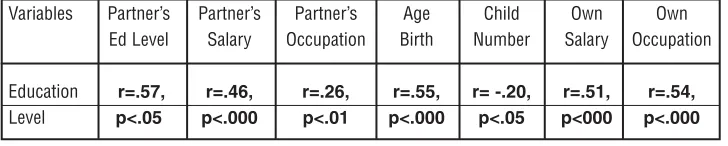
There was a strong correlation between a number of the independent variables and education level; education level was highly correlated with partner’s educational level, partner’s salary, partner’s occupation, age when first child was born, number of children, own income, own occupation, own salary.
Major Personal Goals in Early Twenties
[image:5.482.54.418.92.165.2]The participants were asked, “What were your major personal goals in your early twenties?” Table 2 shows that, for the majority of participants, except the Trinity Alumnae Group, to get married was the number one response under this category.
Table 2
Number One Response to “What were your major personal goals in your early twenties?”
The participants second responses to this question, illustrated in Table 3 indicate that to have children was the second most important goal for all of the women except the Trinity Alumnae group. They differ from the other groups on both of these responses with their responses being spread more heavily over the wealth, career and happiness categories.
Variables Partner’s Partner’s Partner’s Age Child Own Own Ed Level Salary Occupation Birth Number Salary Occupation
Education r=.57, r=.46, r=.26, r=.55, r= -.20, r=.51, r=.54, Level p<.05 p<.000 p<.01 p<.000 p<.05 p<000 p<.000
Response % Group 1 Group 2 Group 3 Group 4 Group 5
Trinity Leaving No Leaving Leaving Trinity Students Cert at 18 Cert Cert Now Alumnae
Get Married 55 40 55 55 25
Children 5 10 15 5
Wealth 5 15 10
Career 30 35 20 5 35
Table 3
Number Two Response to “What were your major personal goals in your early twenties?”
Why the pursuit of formal education ended
The participants were asked what circumstances led them to cease pursuing formal education when they did (Table 4).
Table 4
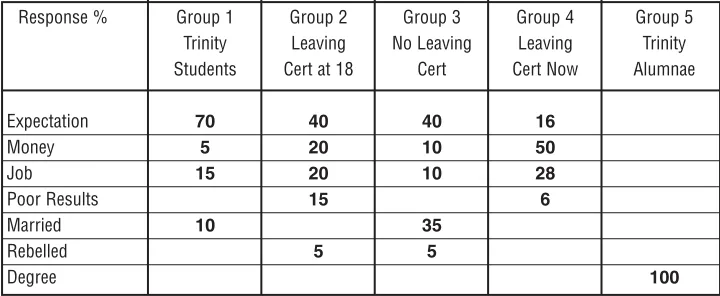
Number One Response to “Reasons for Finishing Formal Education”
The most common response for all the groups except the Trinity Alumnae Group was that parents did not encourage or expect their daughters to continue with formal education. This was particularly so in the Trinity Students Group. One woman from this group responded with a certain amount of anger:
My father wanted us to get out there and earn money and find a man. He felt his job was done the day we finished the Leaving Certificate. Passing was not even that important, we just had to
Response % Group 1 Group 2 Group 3 Group 4 Group 5 Trinity Leaving No Leaving Leaving Trinity Students Cert at 18 Cert Cert Now Alumnae
Get Married 20 35 35 20 20
Children 50 45 50 55 10
Wealth 10 5 5 25
Career 15 10 5 15 25
Happiness 5 5 10 5 20
Response % Group 1 Group 2 Group 3 Group 4 Group 5 Trinity Leaving No Leaving Leaving Trinity Students Cert at 18 Cert Cert Now Alumnae
Expectation 70 40 40 16
Money 5 20 10 50
Job 15 20 10 28
Poor Results 15 6
Married 10 35
Rebelled 5 5
finish out the time. He thought what is the point of educating the girls they are just going to get married and have babies anyway. My brother is a dentist. That always made me very upset. I was smarter than he was in school and I got nothing. It didn’t bother me so much when I was younger. It’s as I got older I saw the injustice.
50% of the women in the Leaving Certificate Now group responded that money was the overriding factor in their decision to stop pursuing formal education; a further 28% indicated that they stopped pursuing education because they had a job. Money and job were the second highest responses in the Leaving Certificate at 18 group also. A woman from the Leaving Certificate at 18 Group responded:
I got a job with the bank and loved it. I had my own money, clothes and had my friends. It was a very happy time in my life.
The highest percent of those who said that they had left school to get married was in the No Leaving Certificate Group; 35% responded they left school to get married. One woman from the No Leaving Certificate Group said:
Where I come from you just got married. You had a baby the same year and you got on with it. It was what growing up was all about. We were just kids really but we thought when we got married and had a baby we were grown up.
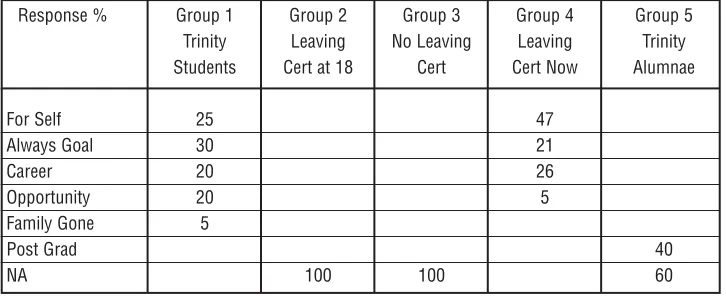
[image:7.482.54.417.469.617.2]Table 5 indicates the responses of the women when asked “What made you return to formal education” the women’s responses were distributed in the following categories.
Table 5
Number One Response to “What Made You Return to Education? ’’
Response % Group 1 Group 2 Group 3 Group 4 Group 5 Trinity Leaving No Leaving Leaving Trinity Students Cert at 18 Cert Cert Now Alumnae
For Self 25 47
Always Goal 30 21
Career 20 26
Opportunity 20 5
Family Gone 5
Post Grad 40
25% of the Trinity group responded that they were pursuing a degree for ‘something for themselves’ and 30% indicated that it was always a goal. 47% of the Leaving Certificate Now group responded that they were pursuing education for something for themselves and 21% responded that it was always a goal.
CONCLUSION AND DISCUSSION
The results indicated that level of education is linked to socioeconomic status. The women in the two groups with lower levels of education were from lower socioeconomic backgrounds. Similarly, the women with higher levels of education were from higher socioeconomic backgrounds. The results clearly indicate that socioeconomic background is a strong predictor of women’s education level. The results support a number of theories relating to education and socioeconomic background. According to Goldthorpe (1996, p. 488), “the prevailing culture of more advantaged classes, it is held, leads to parents within these classes setting a higher value on education than parents in other classes and being better equipped to encourage and promote educational success on the part of their children”. Members of the middle and upper classes are more likely to be educated than members of the lower classes (Ibid). The concept of social class for psychology implies that “social class may importantly shape, constrain, and mediate the development and expression of knowledge, beliefs, attitudes, motives, traits and symptoms” (Stewart and Ostrove, 1993, p. 476). According to DeMott (1990), the resource most widely trusted as a tool for upward mobility is education. The women who tend to return to education in midlife are usually middle-class with a comfortable lifestyle (Ibid). The women who tend to leave school before completing secondary school requirements are from more disadvantaged backgrounds than those who stay. The results of this study clearly support these theories.
to get married was in the No Leaving Certificate Group. This is reflective of the conservative traditional social norms of those from lower socioeconomic backgrounds in the late sixties and early seventies.
The women in the Leaving Certificate at 18 Group, the No Leaving Certificate Group and the Leaving Certificate Now Group noted more often than the other women that they felt restricted by the educational system and rebelled as a result of the perceived lack of autonomy. Those students involved in this study who rebelled failed to achieve their Leaving Certificate qualification by age eighteen or failed to pursue their intellectual potential at third level. The literature suggests that the teacher’s expectations of the rebellious child influences student achievement (Rosenthal & Jacobson, 1968). Teacher expectation predicts achievement more strongly for low achievers than for high achievers (Madon et al., 1997). The participants with the lowest levels of education reported that teacher perceptions of them were negative and that that affected their sense of competence in the academic arena. Perceived competence, individuals’ beliefs that they are doing well or are making progress toward their goals, is an important factor in goal attainment (Bandura, 1982; 1991; Harter, 1989; Ford, 1992). Clearly, the women involved in education in midlife have reassessed expectations of them and have redefined the expectations that they have for themselves.
REFERENCES
Baily, C. (1982), Beginning in the middle. London: Quartet Books.
Bandura, A. (1982). Self-efficacy mechanisms in human agency.American Psychologist, 37, 122-147.
Bandura, A. (1991). Personal goals and subjective well being: A longitudinal study. Journal of Personality and Social Psychology, 65, 398-407.
Chodorow, N. (1978).The reproduction of mothering: Psychoanalysis and the sociology of gender. Berkely: University of California Press.
Cornwall, K.K., (1991). Forgotten students: Women’s experience in a proprietary school.Educational Gerontology, 17, 175-186.
Cox, C. (1991). Why older adults leave the university: A comparison of continuing and non-continuing students.Educational Gerontology, 17, 1-10.
Curry, C., Trew, K., Turner, I., & Hunter, J. (1994). The effect of life domains on girl’s possible selves. Adolescence, 29, 133-150.
De Mott, B. (1990).The imperial middle. New York: William Morrow.
Ford, M. (1992).Motivating humans: Goals, emotions, and personal agency beliefs. Newbury Park, CA: Sage.
Goldthorpe, J.H. (1996). Class analysis and the reorientation of class theory: the case of persisting differentials in educational attainment.Journal of Sociology, 47, 481-505.
Harter, S. (1989). The relationship between perceived competence, affect, and motivational orientation within the classroom: Processes and patterns of change. In A. Boggiano & T. Pittman (Eds.), Achievement and motivation: A social-developmental perspective. Cambridge: Cambridge University Press.
Long, J., & Porter, K.L. (1984). Multiple roles of midlife women: A case for new directions in theory, research, and policy. In G.K. Baruch & J. Brooks-Gunn (Eds.), Women in midlife (pp. 109-159). New York: Plenum.
Madon, S., Jussim, L., & Eccles, J. (1997). In search of the powerful self-fulfilling prophecy.Journal of Personality and Social Psychology, 10, 791-809.
Mitchell, V. & Helson, R. (1990). Women’s prime of life: Is it the 50s.Psychology of Women Quarterly, 14, 451-470.
Novak, M., & Thacker, C. (1991). Satisfaction and strain among middle-aged women who return to school: Replication and extension of findings in a Canadian context.Educational Gerontology, 17, 323-342.
Rosenthal, R., & Jaconson, L. (1968). Pygmalion in the classroom: Teacher expectations and student intellectual development. New York: Holt, Rinehart & Winston.
Scala, M.A. (1996). Going back to school: Participation motives and experiences of older adults in an undergraduate classroom.Educational Gerontology, 22, 747-773.
Stewart, A.J., & Ostrove, M. (1993). Social class, social change, and gender.Psychology of Women Quarterly, 17, 475-497.
Snygg, D. & Combs, A.W. (1949).Individual behavior. New York: Harper.