STUDENTS OF SMAN 2 PADANG CERMIN
(A Thesis)
By
Vivian Agustina
MASTER IN ENGLISH LANGUAGE TEACHING STUDY PROGRAM LANGUAGE AND ARTS EDUCATION DEPARTMENT
TEACHER TRAINING AND EDUCATION FACULTY LAMPUNG UNIVERSITY
THE USE OF TASK COMPLEXITY IN SPOKEN PERFORMANCE BY THE 10THGRADE STUDENTS OF
SMAN 2 PADANG CERMIN Vivian Agustina [email protected] Magister of English Education
Lampung University
Speaking is a crucial part of second and foreign language learning and teaching. Task-Based Language Teaching (TBLT) has become popular in the field of foreign language teaching and learning. In TBLT, task complexity should be the sole basis for making prospective sequencing decisions since it can be anticipated in advance of implementation of syllabus. The current research aimed to investigate the effect of four types of task complexity manipulated along with the number of elements and prior knowledge on
students’ spoken performance in terms of complexity, accuracy, and fluency
(CAF) and to eleborate the students’ perceptions of the four types of task complexity. This research used quantitative method. The istruments were four types of monolog tasks and questionnairres. The data took the forms of a
students’ utterences and students’ perception. The subjects were 33 of the tenth grade students of SMAN 2 Padang Cermin. The result showed that the tasks which are made simple or complex in resource-directing (number of elements) generated more fluent utterences on the students’ spoken
performance since they were simple in resource-depleting (prior knowledge). This finding partly supports the cognition hypothesis. With respect to the
students’ perceptions, the current research found out that prior knowledge became the major reason for the students to do the task easily, successfully, and confidently. It also arisesthe students’ interest, motivation, and learning opportunity. The finding suggests that task complexity which is manipulated along with the number of elements and prior knowledge facilitates students to improve the speaking performance.
STUDENTS OF SMAN 2 PADANG CERMIN
By:
VIVIAN AGUSTINA
A Thesis
Submitted in a partial fulfillment of the requirements for S-2 Degree
MASTER IN ENGLISH LANGUAGE TEACHING STUDY PROGRAM LANGUAGE AND ARTS EDUCATION DEPARTMENT
TEACHER TRAINING AND EDUCATION FACULTY LAMPUNG UNIVERSITY
The researcher’s complete name is Vivian Agustina. She was born in Sidomulyo, August 6th, 1984. She is the second daughter of a lovely couple Suprapto and Sri Bunga. She has two sisters; Weni Metaria, A.Md. and Anggun Paramita. She also has one brother named Yulian Nursasongko.
She began formal education institution for the first time in Elementary school at SDN 2 Wates Pesawaran at 1991 and graduated in 1996. Then she pursued her study at SMPN 2 Padang Cermin Pesawaran in 1996 and graduated in 1999. Then in 1999 she continued at SMA Persada Bandar Lampung and graduated in 2002. At the same year, in 2002 she was registered as an S-1 college student of Teknokrat College at English Literature and graduated in 2006. In 2014, she was registered as Post-Graduate student at MPBI of Lampung University and graduated in 2017.
By offering my praise and gratitude to Allah SWT for some blessings to me, I would proudly dedicate this thesis to:
My beloved parents, Suprapto and Sri Bunga. My beloved husband, Sartono, S.E.
My beloved daughters, Shafira Almaputri (Alma) and Sakiza Ashil Nuruputri (Sisil).
My beloved brother and sisters, Weni Metaria, A.Md, Yulian Nursasongko, and Anggun Paramita.
All my teachers and lectures of English Department.
My lovely comrades English Literature of Teknokrat college’02, and the second batch of MPBI Unila.
“Learn from yesterday,
live from today, and
hope for tomorrow”.
Alhamdulilah, praise is always to the Almighty ALLAH SWT for the gracious mercy and tremendous blessing that always guides the researcher along her life. She believes that by the blessing and the grace of Allah SWT, she is able to accomplish this thesis as one of the prerequisites to finish the S2 degree at Language and Art Department at Teacher Training and Education Faculty, University of Lampung. The
researcher’s invocation is also addressed to Prophet Muhammad SAW
the best figure of the universe.
The researcher would like to address her great respect and sincere gratitude to Mahpul, M.A., Ph.D., her first advisor, for his criticism, assistance, motivation, and encouragement to the researcher to think more scientifically and critically. Her gratitude is also addressed to Dr. Ari Nurweni, M.A., her second advisor for her suggestions, motivation, assistance, unlimited patience, to the researcher during the completion of this thesis. Her thankfulness is also dedicated to Prof. Dr. Cucu Sutarsyah, M.A., as the first examiner and Dr. Flora, M.Pd., as the second examiner for patiently giving much support, input, and correction to improve this thesis better.
The appreciation is also given to Tamzir Zamka, S.Pd., the headmaster of SMAN 2 Padang Cermin for giving the researcher permit to conduct the research.The researcher’s appreciation is also given tothe students for their participation as the subject of this research.
Her great indebtedness is dedicated to her beloved husband Sartono, S.E. for his unlimited patience and support. Her beloved daughters; Shafira Almaputri (Alma) and Sakiza Ashil Nuruputri (Sisil) who have been the source of inspiration, support, prayer, motivation, and encouragement for the researcher to finish her study.
The greatest honor and thankfulness would be dedicated to her beloved father, Suprapto, and her mother, Sri Bunga. It is truly undoubted that loves, cares, support, timeless prayers during days and nights, are everything for her. Apreciation is also extended to her beloved brother and sisters; Weni Metaria, A.Md., Widi Nuridin, Yulian Nursasongko, Weni Aprilia, A.Md.Keb., and Anggun Paramita for supporting during this thesis writing.
The unforgettable thanks are also given to the researcher’s second batch
batch of MPBI) for her support and sharing. Many thanks are also
addressed to the researcher’s partner in teaching, Arina Sulistyaningsih, S.Pd and Sigit Joko Purnomo, S.Pd for the motivation and sharing in teaching students.
The researcher hopes this research would give a beneficial contribution to educational development, and to the readers.
Bandar Lampung, 30 Oktober 2017
The Researcher,
Page ABSTRACT... APPROVAL…... ADMISSION... LEMBAR PERNYATAAN... CURRICULUM VITAE... DEDICATION... MOTTO... ACKNOWLEDGEMENTS... CONTENTS... TABLES... I. INTRODUCTION
1.1 Backgrounds of the Research ... 1
1.2 Problem of the Research... 9
1.3 Objective of the Research... 9
1.4 Uses of the Research... 9
1.5 Scope of the Research... 11
1.6 Definition of Terms ... 12
II. LITERATURE REVIEW 2.1 Concepts of Task-Based Language Teaching ... 14
2.2 Concepts of Tasks in Language Teaching ... 16
2.3 Concept of Task Complexity/Cognetive Factors ... 18
2.4 Manipulating Task Complexity ... 21
2.5 Complexity, Accuracy, and Fluency ... 28
2.6 Previous Studies on Task Complexity... 32
2.7 Spoken Performance... 43
2.8 Concept of Perception on Task Complexity ... 44
2.9 Theoritical Assumption... 46
2.9 Hypotheses ... 47
III. RESEARCH METHODS 3.1 Design of the Research ... 49
3.2 Setting of the Research ... 50
3.3 Population and Sample ... 50
3.4 Procedures of the Research... 51
3.4.1 Preparing the Tasks…... 51
3.4.2 Subjects of the Research... 54
3.5 Data Collecting Technique ... 55
3.5.1 Determining the Instruments... 55
3.5.2 Recording the Students Monolog... 56
3.5.3 Distributing the Questionnaire... 56
3.5.4 Trancribing and Coding the Students Monolog... 57
3.5.5 Coding and Classifying the Students’ Perception... 57
3.6 Validity and Reliability of the Instruments ... 58
3.6.1 Content Validity... 58
3.6.2 Construct Validity... 58
3.6.3 Reliability... 59
3.7 Data Analysis... 59
3.7.1Analysis of Students’ Spoken Performance in Term of CAF. 60
3.7.1.1 Complexity... 60
3.7.1.2 Accuracy... 63
3.7.1.3 Fluency... 64
3.7.2Analysis of Students’ Post Task Questionaree... 65
3.8 Hypothesis Testing ... 67
IV. RESULT AND DISCUSSION 4.1 The Difference of Complexity, Accuracy, and Fluency (CAF) in the Four Types of Tasks Complexity... 69
4.2 Comparing Task with Prior Knowledge and No Prior Knowledge 75 4.3 Comparing Few Elements and Many Elements... 77
4.4Elaborating the Students’ Perception of Four Types of Task Complexity Manipulated Along with Number of Elements and Prior Knowledge in Spoken Performance ... 78
V. CONCLUSIONS AND SUGGESTIONS 5.1 Conclusions... . 88
5.2 Suggestions... 89
REFERENCES... 91
Page 3.1Robinson’s Finding... 42 3.2 Calculation of Lexical Words... 62 4.1 Means of CAF for the Four levels of Task ... 70 4.2 Reapeated Measures ANOVA: Main Effects of Different levels
of Tasks for CAF Measures... 73
4.3 Mean Differences of Prior Knowledge and No Prior Knowledge Tasks for Lexical Complexity, Syntactics Complexity,
Accuracy and Fluency Measures ... 75
4.4 Mean Differences of Few Elements and Many Elements for Lexical Complexity, Syntactics Complexity, Accuracy
and Fluency Measures... 77 4.5Students’ Agreement and Disagreement about the Complexity
This chapter is concerned with backgrounds of the research, problems of the
research, objectives of the research, uses of the research, and scope of the
research. It also provides the definition of terms.
1.1 Backgrounds of the Research
Speaking is a crucial part of second language learning and teaching (Kayi, 2006:
1). In spite of the importance of skill in English teaching program as a foreign
language in some public schools, it still stresses reading (reading comprehension
on the text) and writing (which focus on vocabulary and grammar) than the
expense of speaking. English language teaching and learning particulary pay more
attention on traditional grammar translation method in all grades. The focus of
English teaching and learning is explaining grammatical rules, memorizing
vocabulary and dialog, reading and translating the text. In this case, students are
not motivated to master the speaking skill. Because of the description, it has
become natural to know students’ inability when they express their performance
orally. Deng (2005) in Azizi et al., (2012: 22) suggests that the cognetive
complexity of a particular influences the nature of learner oral production.
One alternate approach, which needs to be implemented for enhancing the
students’ speaking skill by English teachers, is based approaches. A
task-based approach to focus on form is quite feasible for the EFL situation (Fotos,
1998:306). The shift from ‘traditional’ teaching practice to task-based learning is
based on the belief that task-based approaches promote more effective language
learning (Long, 1985; Swan, 2005; Shehadeh & Coombe, 2010 in Mahpul, 2014:
10). Task-based approaches to second language teaching focus on the ability of a
learner to perform target-like tasks without any explicit teaching of grammatical
rules (Rahimpour, 2008 in Mehrang & Rahimpour: 3678). It is expected that the
implementation of this approach in speaking class would change the condition
happened in the class where some students dominate the opportunity of talking
over the other ones.
The development of theoretically motivated, empirically substantiable, and
pedagogically feasible sequencing criteria has long been acknowledged as a major
goal of research aimed at operationalizing task-based approaches to syllabus
design (Robinson, 2001b: 27). Syllabus design is based essentially on a decision
about the units of classroom activity, and the sequence in which they are to be
performed, and these two decisions have consequences for the role of the learner
in assimilating the language encountered in classrooms (Robinson, 2001a: 288).
Theoretically, empirical research into task-based language learning has been
prompted by proposals for task based language teaching, (Robinson, 2011: 1). In
Task-Based Language Teaching (TBLT), Robinson (2001b: 30) proposed the
complexity (cognitive factors), task conditions (interactive factors), and task
difficulty (learner factors). Robinson (2001a: 287), distinguishes task complexity
(the task dependent and proactively manipulable cognetive demands of tasks)
from task difficulty (dependent on learner factors such as aptitude, confidence,
motivation, etc) and task conditions (the interactive demands of tasks), arguing
that these influences on task performance and learning are different in kind, and
have not been sufficiently distinguished in previous approaches to conceptualizing
the options in, and consuquences of, sequencing tasks from the syllabus designer’s
perspective. In addition, he (Robinson, 2001a: 287) argues that task complexity
should be the sole basis for making prospective sequencing decisions since most
learner factors implicated in decisions about task difficulty can only diagnosed in
situ and in process, so cannot be anticipated in advance of implementation of
syllabus and therefore can be of no use to prospective materials and syllabus
designer.
As stated by Robinson (2001a: 294; 2001b: 30) in Triadic Componential
Framework, the task complexity (cognitive factors) are divided into two
dimensions; those are resource-directing and resource-depleting/dispersing
dimension. The resource-directing includes three variables, that is, +/- here and
now, +/- few elements, +/- reasoning demands. Whereas, the resource-depleting
consists of +/- planning, +/- single task, and +/- prior knowledge variables. Based
on the TCF (Robinson, 2001b: 30) describes task complexity as consisting of a
number of dimensions which can be manipulated during task design. The
dimensions are represented by +/- component which may be present or absent
more, versus relatively less of a component such as planning time, or prior
knowledge, etc). Therefore, the current study focused on the use of task
complexity (cognitive factors).
In addition, Robinson (2001b: 31) assumes that increasing task complexity along
resource-directing dimensions (e.g. by requiring reasoning, in addition to simple
information transmission) makes greater resource demands which can be met by
using specific features of the language code. In contrast, complex tasks along
resource-depleting dimensions make greater demands on attention and working
memory, but do not direct resources to features of language code that can be used
in completing the task.
As previously described above the resource-directing dimension of task includes
three components: the number of elements, reasoning demand, and here and
now/there and then. Among these three components, the manipulation of a
number of elements is regarded to be more inclusive than the other two
components (reasoning demand), and (here and now/there and then). This is
because tasks which are manipulated according to the number of are expected to
involve the other two components of the resource-directing dimension, namely,
giving reasons and using present or past references (Mahpul, 2014: 32).
Therefore, the number of elements (+/- few elements) became one of variables
manipulated.
The number of elements (+/- few elements) was manipulated with prior
knowledge (+/- prior knowledge). Robinson (2001a: 312) states that +/- prior
out-side (see for example, Anderson, 1981; Britten & Tresser, 1982; Joseph &
Dwyer, 1984) the field of SLA. There is evidence that prior knowledge of formal
and content schemata both facilitate L2 reading (e.g., Carrel, 1987), and that prior
knowledge of the role of the listener makes speaking tasks easier (G. Brown,
1995; G. Brown et al., 1984; Yule & MacDonald, 1990 ), as does prior knowledge
of., and familiarity with, the content domain of the speaking task (Salinker &
Douglas, 1985).
As indicated, in TBLT research complexity, accuracy, and fluency are regarded as
the manifestations of learners’ language performance (Mahpul, 2014: 39). With
regard to task effects on language production, the outcome measures are often
classified in terms of accuracy, fluency, and complexity of learner language
(Robinson, 2001a: 306). Research on fluency, accuracy, and complexity in second
(L2) and foreign language learners’ production has a long tradition in the SLA
field since it is assumed that their measures can reveal the level of learner’s
proficiency in target language. Their indicators are usually used for observing
differences in learners’ written and oral discourse over time, which permits to
evaluate language development in terms of each of the above mentioned language
aspects. Within this wide field we are especially interested in the assessment of
progress in complexity of FL oral performances (Evnitskaya, 2008: 2). Therefore,
the current research used CAF as the measure.
Many studies have concerned with the implementation of Task-Based Language
Teaching especially in task complexity in terms of complexity accuracy, and
proposed by Robinson. For example: Gilabert, (2007a) did the simultaneous
manipulation of task complexity along planning time and +/- here-and-now:
effects on L2 oral production.. Besides, some other researchers (for examples:
Gilabert, 2007b; Kuiken & Vedder, 2007; Crespo, 2011; Salimi, Dadaspour, &
Asadollahfam, 2011; Shahreza, Dabaghi, & Kassaian, 2011; Soleimani &
Rezazadeh, 2014; and Cho, 2015 have manipulated task on resouce-directing. In
contrast, Mehrang & Rahimpour (2010) just focused on manipulating task
complexity in resource depleting dimension.
Robinson (2005: 14) emphasized his second study (2001b) on task complexity and
interactive production along the ± reference to many elements and ±prior
knowledge dimensions. The study purposed to examine the effects of tasks made
complex on two dimensions simultaneously, operationalized task complexity
using a direction giving map task. In the simpler condition, a small map of an area
known to the Japanese L1 participants (their own college campus) was used. In
the complex condition, an authentic street map of a much larger area likely to be
unknown to the participants (the downtown area of Nihombashi in central Tokyo)
was used. The study also also examined the effects of increasingtaskcomplexity
onlearner perceptions of task difficulty, using a procedure whereby learners
complete Likert scale responses (on a scale from 1 to 9) to questions immediately
following task performance. These questions assess learners’ overall perceptions
of task difficulty, (e.g., this task was easy/this task was hard) the extent to which
they found the task stressful (e.g., I felt relaxed doing this task/I felt frustrated
doing this task), their confidence in their ability to successfully complete the task
task was not interesting/this task was interesting), and motivation to complete
similar tasks (e.g., I don’t want to do more tasks like this/ I want to do more tasks
like this). The results have been extremely consistent. These findings show, then,
that the dimensions of complexity manipulated during task design in this
framework also correspond well with learners’ perceptions of the difficulty of the
task, and so therefore indicate that learners are to a large extent construing tasks
demands in a way consistent with the task designer’s intentions (see Schwartz
1996 and Stanovitch 1999, for extensive treatment of the issue of task construal,
i.e., whether subjects frame a problem or task in a different way than that intended
by the task designer or researcher).
Mahpul (2014: 8) had also conducted a research on task complexity. It aimed to
investigate dialogic (that is, two way, interactive) task difficulty manipulated
simultaneously within planning time (+/-planning time) and the number of
elements (+/- few elements). That was undertaken with Indonesian learners of
English. In addition, the participant’s perceptions on task difficultywere explored
in-depth. The findings of this study suggest that the manipulation of task
complexity (cognitive factors) within the resource depleting dimensions (e.g.,
prior knowledge) may enable participants to perform tasks more easily (p: 110). In
addition, familiarity with the task or the effect of repeating similar tasks led the
participants to perform tasks more easily (p: 152). The results suggest that they
need to be provided with tasks or activities of the same type or content on a
regular basis that encourage them to practice the language in a meaningful
situation or context activities in the way language is used as a means of
activities can be “manipulated‟ in such a way that learners are actively involved in undertaking familiar and meaningful activities (p: 152).
Motivated by the previous studies above, the current research had two purposes
that might be gaps. . The first objective was manipulating +/- few elements (few
and many elements) and +/- prior knowledge (prior knowledge and no prior
knowledge) on task complexity, which was designed into four types of task,
resulted different spoken performance statistically in term of CAF. The second
objective was eleborating the students’ perception of the four types of task
complexity in spoken performance. The four types were designed in monologic
form. Robinson (2001b: 35) states that to make predictions about the effects of
task complexity on these aspects of task production it is necessary to distinguish
between monologic, non interactive tasks such as narratives and interactive tasks
such as discussion or information transfer. Monologue is a personal and
participatory speech act, even though only one person may be speaking (Davis,
2007: 179). Hence, it would be easier to analyze since there was only one person
who was speaking without being disturbed by other people’s voice. The material
in this spoken performance was procedure text. It was done since procedure text
was taken from KTSP curriculum for the tenth grade students of Senior High
1.2 Problems of the Research
As the concerns of this research, there were main problems of the research
formulated as follows:
1.2.1 What are the effects of four types of task complexity manipulated along
with the number of elements few elements) and prior knowledge
(+/-prior knowledge) statistically in spoken performance in terms of
complexity, accuracy, and fluency (CAF)?
1.2.2 What are the students’ perceptions of the four types of task complexity in
terms of CAF in spoken performance?
1.3 Objectives of the Research
The objectives of the research were as follows:
1.3.1 To investigate the effects of four types of task complexity manipulated
with the number of elements few elements) and prior knowledge
(+/-prior knowledge) statistically in spoken performance in terms of
complexity, accuracy, and fluency (CAF).
1.3.2 To eleborate the students’ perception ofthe four types of task complecity in
terms of CAF in spoken performance.
1.4 Uses of the Research in terms of CAF
This research was useful both practically and theoretically,
1.4.1 Practically
I hope that this research would be useful for English teachers, students, and
a. Teachers
Through this research, teachers would know what to do in designing the task
for their students’ speaking performance in monolog. Besides, they also
would know what type of task complexity that could be beneficial to
increase the students’ spoken performance. Additionalally, the students’
perception about those tasks became the consideration for them in order to get
the best task design on students’ spoken performance.
b. Students
Hopefully, students would be able to practice speaking or spoken
performance fluently. It not only focused on grammatical structure but also in
a meaningful context. Besides, Background knowledge was also very
important and useful for them to enhance the spoken performance.
Additionallly, they would be able to express their perception after doing the
spoken performance.
c. School
Hopefuly, the result of this research could be used as the consideration for
schools, whether a certain task will always be applied to increase the
students’ spoken performance and whether number of elements and prior
knowledge explain the criteria on the spoken performance or not. Besides, the
students’ perception could be the consideration in designing the tasks.
1.4.2 Theoretically
Hopefully, the results of this research support the previous findings and develop
1.5 Scope of the Research
This research was conducted at SMAN 2 Padang Cermin Pesawaran. The sample
of the research was the tenth grade students of Senior High School. There were six
classes for the tenth grade in this school but the sample taken was one class (X1).
There were 33 students in this class so there were 33 samples in this research. The
researcher distributed four kinds of tasks that had been manipulated between
resource-directing (number of elements) and resource-depleting dimension (prior
knowledge), as followed:
1. +Few elements, +prior knowledge (Few elements with prior knowledge)
2. +Few elements, -prior knowledge (Few elements with no prior knowledge)
3. -Few elements, + prior knowledge (Many elements with prior knowledge)
4. -Few elements, -prior knowledge (Many elements with no prior knowledge)
In designing the task complexity, procedure text was used as the material. The
form of task design in spoken performance was monolog. The current research
was to investigate the effects of four types of task complexity manipulated with
number of elements and prior knowledge statistically in spoken performance in
terms of CAF and to eleborate, the students’ perception of the four types of task
complexity manipulated with number of elements and prior knowledge in spoken
performance. The data was taken from the students’ utterences. The data were
transcribed and analyzed in order to find out the CAF. The questionnaire also used
1.6 Definition of Terms
Definition of terms was very useful in order to help understanding of the terms
and limit the width of the research.
1. Task Based Language Teaching
Task-based language teaching is an approach to the design of language
courses in which the point of departure is not an ordered list of linguistic
items, but a collection of tasks. It draws on and reflects the experiential and
humanistic traditions as well as reflects the changing conceptions of language
itself. (Nunan, 2003 in Yousefi, Mohammadi, & Koosha, 2012: 1436).
2. Task Complexity
Task complexity is the result of the attention, memory, reasoning, and other
information processing demands imposed by the structure of the task on the
language learner (Robinson , 2001a: 29).
3. Complexity
Complexity is ‘the extent to which learners produce elaborated language’,
and is often concerned with syntactic and lexical aspects (Ellis &Barkhuizen,
2005 in Inoue, 2010: 3).
4. Accuracy
Accuracy is the ability to avoid error in performance, possibly reflecting
higher levels of control in the language as well as a conservative orientation,
that is, avoidance of challenging structure that might provoke error (Skehan
5. Fluency
Fluency is the rapid, smooth, accurate, lucid, and efficient translation of
thought or communicative intention into language under the temporal
constraints of on-line processing (Lennon, 2000 in Mahpul, 2014: 45).
6. Spoken Performance
Spoken performance is the students’ capability in expressing the ideas orally
in terms of complexity, accuracy, and fluently.
7. Perception
II. LITERATURE REVIEW
The second chapter delineates theories, which are relevant to the research as
guidance. The discussion of the chapter concerns with concepts of Task-Based
Language Teaching, concepts of tasks in language teaching, concept of task
complexity, manipulating task complexity, complexity-accuracy-fluency (CAF),
previous studies on task complexity, spoken performance, concepts of perception
on task complexity, theoritical assumtion, and hypothesis.
2.1 Concepts of Task-Based Language Teaching
The field of research lies within the area of second language acquisition (SLA),
and particularly the interectionist paradigm, and is based on theories which
suggest the naturalistic exposure to and use of language is a prerequisite for
language dvelopments (Skehan, 2003 in Mahpul, 2014: 4). Task-based approaches
to second language teaching focus on the ability of a learner to perform target-like
tasks without any explicit teaching of grammatical rules (Rahimpour, 2008 in
Mehrang & Rahimpour, 2010: 3678) and include procedural syllabuses, process
syllabus and task-based language teaching (TBLT) (Long and Crookes, 1992 in
Mehrang & Rahimpour, 2010: 3678). According Rahimpour (2007, 2008 in
Mehrang & Rahimpour, 2010: 3678) task-based language teaching is a response
Additionally, Task- Based Language Teaching (Long, 1985 in Madarsara &
Harimiy, 2015: 247) is considered as an approach to language teaching that
atttempts to produce native- like accuracy within a communicative classroom, in
which task is the unit of analysis. It means that, TBLT approach enables learners
to communicate but does not ignore the grammar of the target language. In
TBLT, there are different types of tasks.
According to Tavakoli and Foster (2008) in Mehrang and Rahimpour (2010:
3679), there are three reasons why task-based research has been the hottest trend
in the field of empirical research for more than 20 years. First of all, research
sheds light on the proposition that task performance in itself drives interlanguage
change by causing learners to attend to and retain information about the target
language as they use it. Second, since research identifies various features of tasks
that influences learner's language processing, it provides empirical principles for
classroom materials design. Finally, research serves to explore the claim that task
design and processing conditions can be chosen deliberately by a teacher to guide
a learner's focus of attention to particular aspects of the language being learned.
For the above reasons, the current study also purposes at conducting research in
the area of task-based language teaching to investigate the effects of four types of
task complexity manipulated with number of elements and prior knowledge
statistically in spoken performance in terms of complexity, accuracy, and fluency
2.2 Concepts of Tasks in Language Teaching
There were many researchers defined the concept of task in language teaching.
Long (1985) in Nunan (2004: 2) argues that a target task is a piece of work
undertaken for oneself or for others, freely or for some reward. Thus examples of
task include painting a fence, dressing a child, filling out a form, buying a pair of
shoes, making an airline reservation, borrowing a library book, taking a driving
test, typing a letter, weighing a patient, sorting letters, making a hotel reservation,
writing a cheque, finding a street destination and helping someone across a road.
In other words, by ‘task’ is meant the hundred and one things people do in
everyday life, at work, at play and in between.
In another term, tasks become pedagogical in nature when the target tasks are
transformed from the real world to the class room. Richards, et al (1986) in Nunan
(2004: 2) defines a pedagogical task as an activity or action which is carried out as
the result of processing or understanding language (i.e. as a response).
Forexample, drawing a map while listening to a tape, listening to an instruction
and performing a command may be referred to as tasks. Tasks may or may not
involve the production of language. A task usually requires the teacher to specify
what will be regarded as successful completion of the task. The varieties of
different kinds of tasks in language teaching is said to make language teaching
more communicative since it provides a purpose for a classroom activity which
goes beyond the practice of language for its own sake.
Based on the definition, it can be seen clearly that the tasks are the instruction
should be communicative activities since the focus is how to use the language for
the sake of communication. Breen (1987) in Nunan (2004:3) offers another
definition of a pedagogical task, that is, any structured language learning
endeavour which has a particular objective, appropriate content, a specified
working procedure, and a range of outcomes for those who undertake the task.
‘Task’ is therefore assumed to refer to a range of workplans which have the
overall purposes of facilitating language learning –from the simple and brief
exercise type, to more complex and lengthy activities such as group
problem-solving or simulations and decision-making.
Skehan (1998) in Nunan (2004: 3) draws on a number of other writers, puts
forward five key characteristics of a task: meaning is a primary, learners are not
given other people’s meaning to regurgitate, there is some sort of relationship to
comparable real-world activities, task completion has some priority, and the
assesment of the task is in term of outcome. Nunan (2004: 4) states that a
pedagogical task is a piece of classroom work that involves learners in
comprehending, manipulating, producing or interacting in the target language
while their attention is focused on mobilizing their grammatical knowledge in
order to express meaning, and in which the intention is to convey meaning rather
than to manipulate form. The task should also have a sense of completeness, being
able to stand alone as a communicative act in its own right with a beginning, a
middle and an end.
While these definitions vary somewhat, they all emphasize the fact that
attention is focused on meaning rather than grammatical form. This does not mean
that form is not important. Pedagogical task refers to the deployment of
grammatical knowledge to express meaning, high lightening the fact that meaning
and form are highly interrelated, and that grammar exist to enable the language
user to express different communicative meaning (Nunan, 2004: 4).
Based on the definition described above, the tasks that was applied in the current
research included the pedagogical tasks since they were applied in the classroom
context during the learning process. The task should facilitate the students to use
communicative language by conveying the meaning without ignoring their
grammatical knowledge.
2.3 Concept of Task Complexity/Cognitive Factors
One of the key constructs of the Cognition Hypothesis is cognitive task
complexity, it refers to the amount of cognitive processing that is needed to
perform a task (Michael et.,al, 2007: 2). According to Ellis (2003), as cited by
Mohammadi, Yousefi, & Afghari (2012: 2593), complexity is ‘the extent to which
learners produce in performing a task is elaborate and varied’. As stated by
Robinson (2001b: 30) task complexity as consisting of a number of dimensions
which can be manipulated during task design. Therefore, the complexity of the
task is effective on task performance. Robinson (2001b: 29) says that: “task
complexity is the result of attention, memory, and other information processing
demands imposed by the structure of the task on the language learner “. Robinson
believes that task complexity is based on the cognitive demands of each task in
contributing to complexity are consequence of the structure of the task which
imposes resource demands satisfying those demands in order to succesfully
complete the task is dependent on the extent of the resources a learnier brings to
the task (Robinson, 2001b: 31)
Robinson (2001b: 30, 2003: 56) shows interactions between complexity,
condition, and difficulty are bound to occur during task performance in the
components of Robinson’s TriadicComponential Framework (TCF) below:
Task Complexity Task Conditions Task Difficulty (Cognitive Factors) (Interactive Factors) (Learner Factors)
a) resource-directing a) participation variable a) affective variables e.g. +/- few elements e.g. one-way/two way e.g. motivation
+/- here and now convergent/divergent anxiety +/- no reasoning demands open/closed confidence
b) resource-depleting b) participation variables b) ability variables
e.g. +/- planning e.g. gender e.g. aptitude
+/- single task familiarity proficiency
+/- prior knowledge power/solidarity intelligence
Sequencing criteria --- Methodological criteria
Prospective decisions on-line decision
about task unit about pairs and
groups
TCF describes task complexity as consisting of a number of dimensions which
can be manipulated during task design. The dimensions are represented by
+/-component which may be present or absent (though they may also be thought of
as continua, along which there is relatively more, versus relatively less of a
component such as planning time, or prior knowledge, etc). These are divided into
1. Resource-depleting variables: related to performative and procedural demands
(e.g.planning time, single/double task, or prior knowledge of task or topic).
Increasing these variables makes great demands on learners’ attentional and
memory resources and, consequently, disperses them.
2. Resource-directing variables: related to cognitive and conceptual demands
(e.g. number of elements, few elements, reasoning demands). It draws
learners’ attention to vocabulary and syntax encoding.
The two categories identify an importance difference in the way these dimensions
affect resource a llocation during task performance. Robinson (2001b: 31)
assumes that increasing task complexity along resource-directing dimensions (e.g.
by requiring reasoning, in addition to simple information transmission) makes
greater resource demands which can be met by using specific features of the
language code. In contrast, complex tasks along resource-depleting dimensions
make greater demands on attention and working memory, but do not direct
resources to features of language code that can be used in completing the task.
In Robinson’s view (2001a: 287), task complexity should be the sole basis for
making prospective sequencing decisions since most learner factors implicated in
decisions since most learner factors implicated in decisions about task difficulty
can only diagnosed in situ and in process, so cannot be anticipated in advance of
implementation of syllabus and therefore can be of no use to prospective materials
and syllabus designer. In his view, task performance conditions are determined by
a needs analysis. Information about the effects of task complexity on production
complex so that they progressively approximate real world target tasks. Robinson
(2001a: 301) claims that schedulling tasks for language learners in terms of their
increasing the cognitive complexity of tasks will facilitate the ‘means’ of
language learning, and therefore lead to a transition in the learner’s knowledge
states.
Based on the previous explanation above, the current research was designed the
tasks manipulated two dimensions: resource-directing dimension (+/-few element)
and resource-depleting dimension (+/-prior knowledge) because it refers to
cognitive/conceptual demands requiring attention and working memory that
directs learners to focus on linguistic form, and also for increasing these variables
makes great demands on learners’ attentional and memory resources and,
consequently, disperses them.
2.4 Manipulating Task Complexity
Concerning the resource-directing few elements) and resource depleting
(+/-prior knowledge), Robinson (2005: 14) emphasized his second study (2001b) on
task complexity and interactive production along the ± reference to many
elements and ±prior knowledge dimensions. The study purposed to examine the
effects of tasks made complex on two dimensions simultaneously, operationalized
task complexity using a direction giving map task. In the simpler condition, a
small map of an area known to the Japanese L1 participants (their own college
campus) was used. In the complex condition, an authentic street map of a much
larger area likely to be unknown to the participants (the downtown area of
directions from point A to point B, both of which were marked on their maps, to a
partner who had only point A marked on their map. This was therefore a one-way
(since the information giver was instructing the partner on how to get to point B)
closed (since there was a definite correct solution) interactive task (since the
partner was able to ask questions about the directions they were given). As in
Robinson (1995a) this was again a repeated-measure design, in which half the
participants performed the task in the sequence simple-complex, and half in the
reverse sequence. As in the previously described study, results showed task
complexity significantly (p<.05) affected the lexical variety (lower token type
ratios, and hence more lexical complexity on the complex version) and
additionally significantly affected fluency of speaker production (more words per
clausal, or C-unit on the simple version). Also supporting the predictions made
above, and as in the following study to be reported, results showed significantly
greater interaction, with significantly higher number of hearer comprehension
checks (p<.05) on the complex version, and also a trend to more clarification
requests in the same direction.
Related to the study above (2001b) which is recited in Robinson (2005: 15) also
reported the effects of increasing task complexity on learner perceptions of task
difficulty, using a procedure where by learners complete Likert scale responses
(on a scale from 1 to 9) to questions immediately following task performance.
These questions assess learners’ overall perceptions of task difficulty, (e.g., this
task was easy/this task was hard) the extent to which they found the task stressful
(e.g., I felt relaxed doing this task/I felt frustrated doing this task), their
well/I did not do this task well), and the interest in (e.g., this task was not
interesting/this task was interesting), and motivation to complete similar tasks
(e.g., I don’t want to do more tasks like this/ I want to do more tasks like this).
The results have been extremely consistent. Thesefindings show, then, that the
dimensions of complexity manipulated during task design in this framework also
correspond well with learners’ perceptions of the difficulty of the task, and so
therefore indicate that learners are to a large extent construing tasks demands in a
way consistent with the task designer’s intentions. In other words, the result of
the previous study showed that the complex task resulted in significantly less
fluent oral production, but higher lexical complexity than the simple task.
However, the complex task did not affect either accuracy or syntactic complexity.
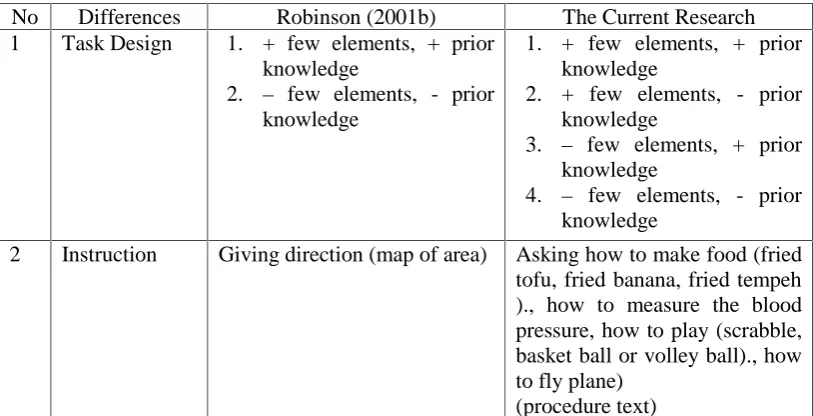
In the previous study that mentioned above, Robinson only designed two types of
task, as followed:
1. + few elements, + prior knowledge (simple task)
2. –few elements, - prior knowledge (complex task)
Since Robinson (2001b: 30) assumes that the effects of complexity differentials
should be revealed by the fact that the cognitively simpler, less
resource-demanding task will involve a lower error rate, and/or be completed faster, and
be less susceptible to interference from competing tasks than the more complex
task. it is true that variance in task performance should also result from repeating
the same task, whether simple or complex, since task practice and automatization
recude resource demands. Therefore, the current research was designed tasks into
Task 1: + Few Elements, + Prior Knowledge (Simple task with prior
knowledge).
Task 2: + Few Elements, - Prior Knowledge (Simple task with no prior
knowledge).
Task 3: - Few Elements, + Prior Knowledge (Complex task with prior
knowledge).
Task 4: - Few Elements, - Prior Knowledge (Complex task with no prior
knowledge.
Note:
- : complex task
+ : simple task
+ Few Elements= has few elements
- Few Elements= has many elements
+ Prior Knowledge= has background knowledge/schemata
- Prior Knowl edge= has no background knowledge/schemata
There have been other many studies about the variables of the dimension. They
are as follows:
2.4.1 Few Elements vs. Many Elements
As previously described, the resource-directing dimension of task includes three
components: +/–few elements, +/– reasoning demand, and +/–here and now.
Among these three components , the manipulation of a number of elements is
regarded to be more inclusive than the other two components (+/– reasoning
according to number of elements (+/–few elements) are expected to involve the
other two components of the resource-directing dimension, namely, giving
reasons (+/– reasoning demands) and using present or past references (+/–here
and now) (Mahpul, 2014: 32).
The Cognition Hypothesis states that identifying few easily distinguished
elements within a task is simpler than identifying many similar elements (+/- few
elements). It can be claimed that relatively few researches have investigated the
+/- few elements of The Cognition Hypothesis. In determining the difference
between + few elements (few elements) and – few elements (many elements),
some previous researches can be considered. Robinson (2001b) manipulated the
factor +/- few elements in an oral interactive task. He used two map tasks in his
research; simple and complex. He describes the tasks detail (p. 41), one map task
(the simpler version) required the speaker to give directions from A to B using a
map convering a small area. While the complex version required them to give
directions from A to B using a map of a larger area. From the research, it is
revealed that the task containing few elements will increase fluency, but decrease
accuracy and complexity. Meanwhile task containing many elements will increase
accuracy and complexity, but decrease fluency.
Mahpul (2014: 59) describes four tasks manipulated the number of elements
(+/-few elements and planning time (+/- planning time). In this part, the current study
focused on the description of the number of elements. Mahpul comprised two
many elements tasks; the first task consisted of pictures of six different types of
participants to discuss. The second task of many elements consisted of six
different houses for rent. six types of houses and the participants were only
provided with instructions of how to perform the task (e.g., specifications, price,
facilities, location, etc.). While for few elements (+ few elements) tasks: first, he
comprised two different pictures of Blackberry mobile phone devices; second, he
design the few elements task by giving two different pictures of houses were
provided for the participants to describe and then. It was chosen as a familiar. The
written instructions about performing the task included telling the participants to
provide their partners with information about the houses (e.g., price, location,
facilities).
2.4.2 Prior Knowledge
Schema theory is an explanation of how readers use prior knowledge to
comprehend and learn from text (Rumelhart, 1980 in An, 2013: 130). Robinson
(2001b: 36) states that the facilitating effect of +prior knowledge on task
performance receives support from research outside the field of SLA (e.g.
Anderson 1981; Britten and Tresser 1982; Joseph and Dwyer 1984) as well as
from within it for its effect on L2 reading and listening comprehension (e.g. Barry
and Lazarte 1998; Carrel and Wise 1998; Urwin 1999). Good and Butterworth
(1980) found prior knowledge (of familiar route) resulted in significantly more
fluent first language (L1) speech production on a route description task than no
prior knowledge (describing an unfamiliar route).
Similary, Chang (1999) Robinson (2001b: 36) in a small-scale study of six
familiarity led to significantly greater fluency (words per error free T-unit, and
words per minute), but had no effect on accuracy (error rate per T -unit). There is
some evidence, however that prior knowledge may interact with proficiency level
in facilitating task performance. Chalpham (1996) in Robinson (2001b: 36) found
prior knowledge of a domain did not facilitate performance for subjects taking
reading tests who were at a low level of proficiency, but increasingly facilitated
performance for subjects at higher levels of proficiency. Robinson (2001b: 47)
argues that it is also possibly the result of the differentials in assumed shared prior
knowledge, since less complex and explicit noun phrase could be used as referring
expressions on the simple version where such knowledge was available.
Mahpul (2014: 110) suggests that the manipulation of task complexity (cognitive
factors) within the resource depleting dimensions (e.g., prior knowledge) may
enable participants to perform tasks more easily. In addition, familiarity with the
task or the effect of repeating similar tasks led the participants to perform tasks more
easily (p: 152). Therefore, prior knowledge became one of variable used in the current
research.
2.4.3 Number of Elements and Prior Knowledge
To examine the effects of tasks made complex on two dimensions simultaneously,
Robinson (2001b) in Robinson (2005: 15), operationalized task complexity using
a direction giving map task. In the simpler condition, a small map of an area
known to the Japanese L1 participants (their own college campus) was used. In
the complex condition, an authentic street map of a much larger area likely to be
unknown to the participants (the downtown area of Nihombashi in central Tokyo)
B, both of which were marked on their maps, to a partner who had only point A
marked on their map. This was therefore one-way (since information giver was
instructing the partner on how to get to point B) closed (since there was a definite
correct solution) interactive task (since the partner was able toask questions about
the directions they were given). This research used a repeated-measure design, in
which half the participants performed the task in the sequence simple-complex,
and half in the reverse sequence.
2.5 Complexity, Accuracy, and Fluency (CAF)
Research on fluency, accuracy, and complexity in second (L2) and foreign
language learners’ production has a long tradition in the SLA field since it is
assumed that their measures can reveal the level of learner’s proficiency in target
language. Their indicators are usually used for observing differences in learners’
written and oral discourse over time, which permits to evaluate language
development in terms of each of the above mentioned language aspects. Within
this wide field we are especially interested in the assessment of progress in
complexity of FL oral performances (Evnitskaya, 2008: 2).
CAF emerge as principal phenomena of the psycholinguistic mechanisms and
process underlying the acquisition, representation and processing L2 knowledge
Housen and Kuiken (2009: 3). As indicated, in TBLT research complexity,
accuracy, and fluency are regarded as the manifestations of learners’ language
performance (Mahpul, 2014: 39). Skehan (1996) in Mahpul (2014: 23) predicts
that tasks which are made more difficult (more cognetively engaging), will
resources are forced to primarly focus on meaning rather than on form. Therefore,
the speaking performance of this research was measured in terms of CAF. They
are explained as follows:
1. Complexity
Complexity is defined as the capacity to use more advanced language, with the
possibility that such language may no be controlled so effectively. This may also
involve a greater willingness to take risk and use fewer controlled language
subsystems. This area is also taken to correlate with a greater likelihood of
restructuring, that is, change and development in the interlanguage system
(Skehan & Foster, 1999 in Mahpul, 2014: 41).
Ellis and Barkhuizen (2005) in Inoue (2010: 3) argues that complexity is ‘the
extent to which learners produce elaborated language’and is often concerned with
syntactic and lexical aspects of narrative performance. This research also analyzed
complexity in terms of syntactic and lexical complexity. Some researchers use
T-unit for analysis, however, Ellis and Barkhuizen (2005) in Inoue (2010: 3)
recommend using C-units or AS-units because they can take sub-clausal units into
account. In addition, Foster, et.,al. (2000: 365) defined AS-unit is a single
speaker’s utterance consisting of an independent clause, or sub-clausal unit,
together with any subordinate clause (s) associated with either. They also pointed
in Inoue (2010: 3) that AS-Unit are more appropriate for analyzing spoken
language than the other two units, C units or T-Units. This is because AS-units
can clearly distinguish among false starts, repetitions, and self-corrections.
Aditionally, Mahpul (2014: 43) argues that AS-Units are more appropriate to
employed AS-units since that unit is necessary in the measures (the number of
words per AS-unit). Despite complexity having been measured in different way,
there are two common features, 1) syntactical or structural complexity, and, 2)
lexical complexity. In the current research, syntactic complexity was measured by
means of the total number of clauses per AS-Units and by a subordination index:
the ratio of subordinate clauses per total number of clauses. While lexical
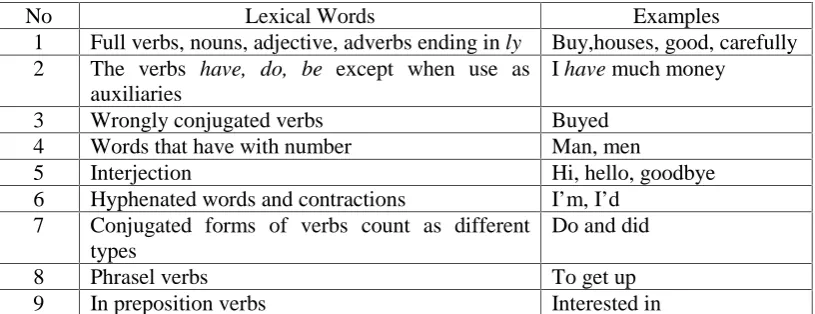
complexity was measured by calculating the ratio of lexical words to total number
of words (Mahpul, 2014: 41).
2. Accuracy
Accuracy is the ability to avoid error in performance, possibly reflecting higher
levels of control in the language as well as a conservative orientation, that is,
avoidance of challenging structure that might provoke error (Skehan & Foster,
1999 in Mahpul, 2014: 43). Regarding accuracy, it was calculated by means of the
total number of errors per AS-Units (Michel, Kuiken & Vedder 2007: 8), and the
number of lexical errors as well as the total number of omissions (of articles,
verbs, and subjects), both in relation to the number of AS units. In adition,
Mahpul (2014: 69) argues Accuracy, also calculated manually by determining
percentage of Error-Free Clauses.
3. Fluency
Fluency is the rapid, smooth, accurate, lucid, and efficient translation of thought
or communicative intention into language under the temporal constraints of
on-line processing (Lennon, 2000 in Mahpul, 2014: 45). In measuring fluency, Yuan
of syllables within each narrative, divided by the total number of seconds used to
complete the task and multiplied by 60; Rate B, the same calculation as for Rate
B, but repetitions, reformulations, false starts, and comments in the L1 were
excluded from the calculation. The advantage of both measures is that they take
into account the amount of speech (the number of syllables) and the length of
pauses (the total number of seconds), Rate B being more precise since it excludes
elements such as repetitions or reformulations and through which learners
sometimes try to gain time. Similary, Mahpul (2014: 70) argues that to calculate
Speech Rate A, the number of syllables2 used per minute was determined, with
the following rules applied.
1. Ing forms such as, doing, saying, etc., counted as two syllables.
2. The constructions such as, isn‟t, doesn‟t, didn‟t, were calculated as two
syllables.
3. Syllables in Indonesian words were counted (Speech Rate A).
4. Epenthesis (insertion of sounds in the middle of words) does not count as a
syllable, e.g., speak /sәpi:k/, instead of /spi:k/.
5. Past /ed/ form was not regarded as a syllable (e.g., looked). But past /ed/ was
calculated as a syllable for the verbs ending with t or d (e.g., “wanted”,
“landed”), each counted as two syllables.
Speech Rate B was also calculated in a similar way to Speech Rate A, but
syllables which appeared as repetitions, self-corrections, false starts, and in
Indonesian or local words were excluded. Therefore, the current research focuses
2.6 Previous Studies on Task Complexity
There were many researches conducted concerning the manipulation of task
complexicty in the term of CAF. Robinson (1995: 100) examined difference in
production of oral narative discourse by 12 adult second language learners of
English on narative tasks that simulated the ability to describe events in
Here-and-Now versus There-and-Then. A MANOVA showed sifnificant differences
between the two conditions. The more complex There-and-Then condition elicited
greater accuracy and a higher ratio of lexical to grammatical words. There was
also a trend suggesting greater utterence lenght for narrative performed under the
simpler Here-and Now condition. These results support the claim that somplex
tasks elicit less fluent, but more accurate and complex production than do simpler
tasks.
Ortega (1999) in Salimi & Dadaspour (2012: 730) studied whether planning time
results in an increased focus on form. She found that planning for the claim that
planning before doing an L2 task can promote an increased focus on form since
learners allocate conscious attention during pre-task planning to formal aspects of
the language needed to perform a task. Ortega believes that the Planning time
before the task has two facilitative impacts. First, planning time removes some of
the cognitive load and communicative pressure of a given task. The second effect
of planning is that it gives the learner devoted to formal properties of the
language.
Foster & Skehan (1999) in Salimi & Dadaspour (2012: 730) studied the impact of
the study indicated that the teacher-led condition made significant effects on
accuracy whereas the solitary planning condition led to more complexity, fluency
and turn length. Group-based planning did not lead to performance significantly
different from the control group. Finally, there was little effect on performance as
a result of the language vs. content planning condition.
Iwashita, et al. (2001) in Salimi & Dadaspour (2012: 730) tried to answer this
question: Are different task characteristics and performance conditions (involving
assumed different levels of cognitive demand) associated with different levels of
fluency, complexity, or accuracy in test candidate responses? They were required
to produce oral narratives from picture strips that had been designed to differ in
their cognitive demands. These four dimensions of task were considered:
adequacy (whether the set of pictures was complete or incomplete); immediacy
(here-and-now task or there-andthen task); perspective (whether the participant
was speaking as if the story had happened to him / her or not) and planning time
(as either 3.5 minutes or 0.5 minute). No significant eff ect for any of the
measures (accuracy, fluency and complexity) was found, with the single exception
of an effect for accuracy in the immediacy dimension.
Ishikawa (2006) in Salimi & Dadaspour (2012: 731) examined the effect of task
complexity and language proficiency on task-based writing performance. Task
complexity was manipulated along here-and-now / there-and-then dimension. The
results showed that increasing task complexity for high-proficient learners had
positive effects on accuracy, structural complexity and fluency, though; it had
for low-proficient learners, however, showed the positive effects on accuracy,
fluency, lexical and structural complexity.
Gilabert (2007a: 215) studied the effects of manipulating the cognitive complexity
of L2 oral tasks on language production. It specifically focuses on self-repairs,
which are taken as a measure of accuracy since they denote both attention to form
And an attempt at neing accurate. By means of a repeated meaures design, 42
lower-intermediate students were asked to perform three different tasks types
(anarrative, and instruction-giving task, and adecision-making task) for which two
degrees of cognitive complexity were established. The narrative task was
manipulated along +/− Here-and-Now, an instruction-giving task manipulated
along +/−elements, and the decision-making task which is manipulated along
+/−reasoning demands. Repeated measures ANOVA sareused for the calculation
of differences between degrees of complexity and among task types. One-way
ANOVA are used to detect potential differences between low proficiency and
high-proficiencyparticipants. Results show an overall effect of Task Complexity
on self-repairs behavior across task types, with different behaviors existing among
the three task types. No differences are found between the self-repair behavior
between low and high proficiency groups.
Kuiken & Vedder (2007) in Salimi & Dadaspour (2012: 731) investigated the
effects of cognitive task complexity on written production for accuracy and
lexical variation by using specific measures of writing proficiency regarding the
type of errors made by the students and the frequency band of the words they
students of Italian and French produced fewer lexical errors in the complex task.
However, the students of French made significantly more Appropriateness and
Other errors in complex tasks than in simple tasks. In addition, the students of
Italian used more high frequent words in complex task whereas the students of
French used more infrequent words in complex task.
Michel, et al. (2007: 1) concerned the influence of complexity in monologic
versus dialogic task in Dutch L2. The study puts the Robinson Cognition
Hypothesis to the test with respect to its predictions of the effects or changes in
task complexity (+/- few elements) and task condition (+/- monologic) on L2
performance. The performance of the L2 learners was analysed with regard to
linguistic complexity, accuracy and fluency. As predicted by the Cognition
Hypothesis, the complex task generated more accurate though less fluent speech.
Linguistic complexity, however, was only marginally affected. Dialogic tasks
triggered more accurate and fluent output though it was structurally less complex.
The interaction of task complexity and task condition showed effects on measures
of accuracy only: in the monologic but not in the dialogic condition task
complexity did promote accuracy.
Robinson (2007: 193) studied task complexity, theory of mind, and intentional
reasoning: Effects on L2 speech production, interaction, uptake and perceptions of
task difficulty. Three interactive tasks, increasing in the complexity of
resource-directing reasoning demands on speaker/storyteller attribution of and linguistic
reference to, the thoughts and intentions of characters in narrative stimuli were