Constructing an Innovative Design Model by Design
Thinking to Evaluate New Product Development
Effectiveness of Product-service System
Wan-Li Wei
*, Ya-Fen Tsai , Ching-Jung Fang
Ming Chuan University, Taoyuan County, Taiwan *Corresponding Author: [email protected]
Copyright © 2014 Horizon Research Publishing All rights reserved.
Abstract
Service design is a revolution to drive industry to be innovative. Design thinking, however, is the most effective way for the innovation during the process of service design. Service innovation, design methods, or tools of new product development are made for customers to create new value and expected to construct user-concerted product service system by macroscopic viewpoints of design and service experiences. Therefore, this research aims at constructing an objective systemic innovative design model through in-depth interview and grounded theory to discuss innovative factors of new product development and limitations of innovation for customer needs-oriented design thinking index construction and to review the completeness of current industrial product service system. The contributions of this research show six aspects of innovative design model as rules or principles of innovative development on new product development of industry including innovative design basis, innovative design development, innovative design capabilities, innovative design barriers, innovative design risks and effectiveness evaluation. For the aspect of innovative design basis, designer characteristics are the most influential beginning for product innovative design. For the aspect of innovative design development, the most significant is design process thinking model. For the aspect of innovative design capabilities, the most significant is designers’ capabilities training. For the aspect of innovative design barriers, innovative known limitations and unknown restrictions are both important. For the aspect of innovative design risks, the most significant is product design rick management. For the aspect of effectiveness evaluation, the most significant is new product development effectiveness evaluation. Therefore, a systemic innovative design model based on six aspects is constructed to be a criterion of product innovative development of design for domestic industry. Product service system is a fully achievement for design service, and design service is a sequence of innovative journey that brings not only innovation for technology and products on newproduct development by design thinking but also commercial opportunities for industries with effectiveness.
Keywords
Design Thinking, Product-service System, Innovation, Grounded Theory1. Introduction
The pursuit of innovation, no doubt, has become a global trend of widespread and integrated thinking nowadays in the world. Most of Taiwanese companies are aware of innovation-driven, and there are operational innovation, product and service innovation, strategic innovation and management innovation of four internal innovations [1], however, new product design (NPD) and the schedule of production are the most of important [2]. A company needs to involve innovation in whatever in-house design or outsourcing projects of new product development to fulfill the requirements of the market. That means Innovation is an important driver for business growth and market needs for many firms [3], they have to do the quick actions to the market by innovative thinking and take technical viewpoint to fulfill the requirements of end customer.
2. Literature Review
2.1. Design Thinking
process. Tim Brown, the president and CEO of IDEO, affirmed that design thinking has three phases of a circle process including inspiration, ideation and implementation (Fig. 1) by integrative thinking: balancing desirability with viability and feasibility [6]. Designers spend time in design stage prototyping possible solutions, testing and receiving feedback as they design to come out a feasible solution, thereby make it into production in delivery stage. The elements of design thinking require designers to toggle back and forth between analysis and synthesis, and then to operate in the concrete and abstract worlds. Designers usually engage in four types of work: observations, frameworks, imperatives and solutions that can help to improve design thinking capabilities (Fig.2) [7].
Figure 1. IDEO design thinking process [6]
Figure 2. Design thinking elements [7]
2.2. Restrictions, Barriers and Risk Management of New Product Development
Innovation is built upon good creativity. Creativity is a function of three components: expertise, creative-thinking skills, and motivation. However, organizations routinely kill creativity with fake deadlines or impossibly tight ones [8]. Innovation or creative mind needs to be encouraged by companies and leaders and supported by technology, meanwhile, adequate resources and sufficient authorization in addition to good relationship corporate with members, enough know-how, professional skills, reasonable schedule, proper equipments and well management plan. If parts of
them are insufficient, it will be known restrictions or unknown barriers of innovation to cause a new product development into failure [9]. Risks in the business environment occur that have a negative impact on the project objectives when materialized such as cost, quality, schedule, customer satisfaction, etc. Internal risks of a firm can be classified as operational risks, technology risks, and organizational risks; and external risks of a firm can be classified as market risks and supplier risks [10]. A company should reduce the negative risks while pursuing positive risks and make sure uncertainties and hazards are all under control [11].
2.3. New Product Development Effectiveness
'Product' means object or service created and offered by a company to consumer. New product is the complete process of bringing a new product to market started from customers’ needs including planning, design, production, and sales. New product development process can be divided into six phases: product planning, concept development, system design, detail design, testing & refinement and production [12], however, most important of them is product concept selection. The organization needs to identify customer needs, establish target specification, generate product concepts, select a product concept, test product concept, set final specs and plan downstream development. Each flow of concept development stage needs to be inspected, reviewed and revised repeatedly.
Jacoby and Rodriguez [13] present a 'ways to grow' model for new product definition attributed by innovation that helps managers assess innovation efforts. Product innovative attributes categorized into four types including extend innovation, create innovation, manage innovation and adapt innovation based on offerings or users. For example, create innovation is new offerings to new users, and adapt innovation is existing offerings for new users.
2.4. Product Service System
improving resource and functional efficiency of each element [23]. There are eight types of PSS business models: product-related service and advice and consultancy of Product-oriented services; product lease, product renting or sharing, and product pooling of User-oriented service; activity management, pay per service unit and functional result of Result-oriented service [22].
2.5. Summarizing
Creativities may usually restricted by a firm due to prompt productivity, effectiveness, process control and management or other important principles in the organization, and creativities get killed by time pressure [8]. Furthermore, a systematic design model provides designers more precisely design process and reduces faults in selection to enhance new product development effectiveness [26].
3. Methods
3.1. Grounded Theory
Grounded theory refers to theory that is developed inductively from a corpus of data. The grounded theory approach consists of a set of steps whose careful execution is thought to "guarantee" a good theory as the outcome. The
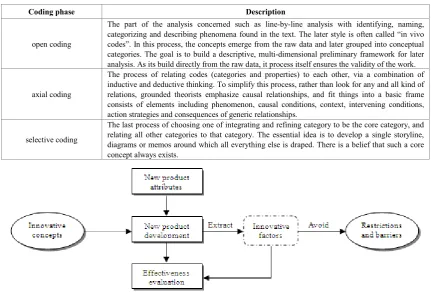
quality of a theory can be evaluated by the process by which a theory is constructed [27]. There are three phases coding implementation for collected data analysis of grounded theory practice: open coding, axial coding and selective coding (Table 1).
3.2. Research Tool
The above issue judgment based on non-quantifiable information can be conducted by qualitative analysis with in-depth interview, and Fig. 3 shows the study concept in this paper. There are several new product attributes, and innovative concepts will be generated during new product development process (NPD process). Designers extract innovative factors and avoid known innovative restrictions or unknown innovative barriers during this process. Innovative factors will affect new product development effectiveness.
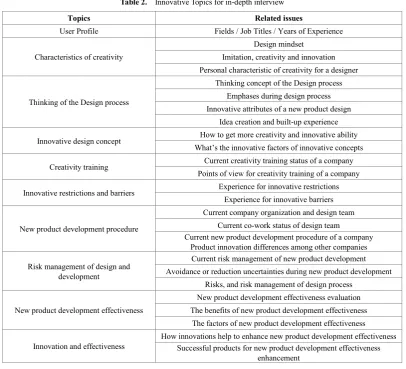
[image:3.595.89.521.418.714.2]This study is used semi-structured interview for primary data collecting by open-ended topics with semi-conducted format listed as Table 2. Six experts with working experience in the design industry and education were invited by purposive sampling and proceeded in-depth interview to share their insight on how to increase the level of innovation and effectiveness in the design process and how to reduce any risks in the NPD process.
Table 1. Practical data coding of Grounded theory
Coding phase Description
open coding
The part of the analysis concerned such as line-by-line analysis with identifying, naming, categorizing and describing phenomena found in the text. The later style is often called “in vivo codes”. In this process, the concepts emerge from the raw data and later grouped into conceptual categories. The goal is to build a descriptive, multi-dimensional preliminary framework for later analysis. As its build directly from the raw data, it process itself ensures the validity of the work.
axial coding
The process of relating codes (categories and properties) to each other, via a combination of inductive and deductive thinking. To simplify this process, rather than look for any and all kind of relations, grounded theorists emphasize causal relationships, and fit things into a basic frame consists of elements including phenomenon, causal conditions, context, intervening conditions, action strategies and consequences of generic relationships.
selective coding
The last process of choosing one of integrating and refining category to be the core category, and relating all other categories to that category. The essential idea is to develop a single storyline, diagrams or memos around which all everything else is draped. There is a belief that such a core concept always exists.
Table 2. Innovative Topics for in-depth interview
Topics Related issues
User Profile Fields / Job Titles / Years of Experience
Characteristics of creativity
Design mindset Imitation, creativity and innovation Personal characteristic of creativity for a designer
Thinking of the Design process
Thinking concept of the Design process Emphases during design process Innovative attributes of a new product design
Idea creation and built-up experience
Innovative design concept How to get more creativity and innovative ability
What’s the innovative factors of innovative concepts
Creativity training Current creativity training status of a company
Points of view for creativity training of a company
Innovative restrictions and barriers Experience for innovative restrictions
Experience for innovative barriers
New product development procedure
Current company organization and design team Current co-work status of design team Current new product development procedure of a company
Product innovation differences among other companies
Risk management of design and development
Current risk management of new product development Avoidance or reduction uncertainties during new product development
Risks, and risk management of design process
New product development effectiveness
New product development effectiveness evaluation The benefits of new product development effectiveness
The factors of new product development effectiveness
Innovation and effectiveness How innovations help to enhance new product development effectiveness Successful products for new product development effectiveness enhancement
3.3. Interviewee Selection
Table 3. The profile of interviewees
Interviewee Gender Field / Job Title Experience Years of
A Male Industrial PC / project manager 18
B Female Design Firm / Designer (Founder) 20
C Male Cultural and Creative Industry / Director 3
D Male Design Firm / Designer (CEO) 19
E Male Design Firm / Designer (Director) 10
F Male Design Dept. of University / Professor 14
In order to increase validity of this study, a purposive sampling is considered to fully understand the topics for innovation, product design and development process in diversified design fields and focuses on the representative works of the interviewees (Table 3).
4. Discussion
4.1. Coding Phases
The qualitative analysis of this study is aimed at requiring empirical results of experts during their design process and from their specific viewpoints in the industry with different perspective and aspects by in-depth interview to review the effectiveness of new product development. The data analysis of open coding phase for this research is line-by-line analysis; all items are named or labeled as a01, a02, a03… of any events, things, objects or interactions. To remark from "a" to "f" is the sequence of six interviewees, and the serial number 01, 02, 03...is the order of coding.
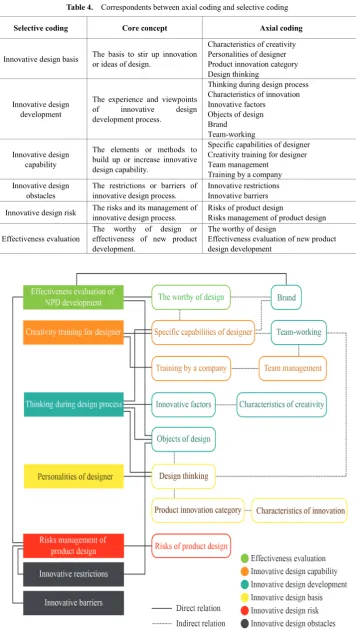
[image:4.595.59.297.490.669.2]Table 4. Correspondents between axial coding and selective coding
Selective coding Core concept Axial coding
Innovative design basis The basis to stir up innovation or ideas of design.
Characteristics of creativity Personalities of designer Product innovation category Design thinking
Innovative design development
The experience and viewpoints of innovative design development process.
Thinking during design process Characteristics of innovation Innovative factors
Objects of design Brand
Team-working
Innovative design capability
The elements or methods to build up or increase innovative design capability.
Specific capabilities of designer Creativity training for designer Team management
Training by a company Innovative design
obstacles The restrictions or barriers of innovative design process. Innovative restrictions Innovative barriers
Innovative design risk The risks and its management of innovative design process. Risks of product design Risks management of product design
Effectiveness evaluation The worthy of design or effectiveness of new product development.
The worthy of design
Effectiveness evaluation of new product design development
4.2. Clarify Relationship with Core Categories and Axial Concepts
Furthermore, innovative design model and new product development effectiveness enhancement can be shown the relationship between six core categories and twenty axial concepts (Fig. 4).
1. Innovative design basis
For innovative design basis aspect shows that a designer has to understand what kind of innovation for a new product design, ideas of innovation is not unfailing created by the designer, there must be some characteristics of creativity before an innovation is generated since innovation could not happen without creativity [9]. Through the designer's personality, coupled with design thinking approach, the difference between the properties of the product for innovation, which is the emphasis on the use who experienced product and service concepts for IDEO began to advocate the spirit of the past decade human-centered design thinking. The essence of design thinking is innovation, and all interviewees have mentioned that one of the designer's personalities was to know how to do the observation, it also pointed out the positive first step to implement the design thinking: field observations.
2. Innovative design development
Thinking during design process of innovative design development aspect is the key factor as shown in Fig. 4. The respondents agreed that teamwork by key necessity for its existence. Thomas Edison is a great inventor owned up to 400 patents of his inventions including light bulb, telegraph, telephone and phonograph, etc. However, these inventions are accomplished by a group teamed with 14 people, Francis Fehl, an assistant of Edison, said that “Edison” is actually meant to a collection of power from many people. It obviously shows the importance and necessary of teamwork. Although interviewee C said the creation by oneself could clarify responsibilities, but he still agreed that the achievements of innovation by team-working is better than them by one person.
3. Innovative design capability
Innovative design capability aspect displays specific capability is absolutely an essential condition of a designer for self-learning and it also shows the worthy of design. Interviewees thought companies or leaders had responsibilities to do the team management as well as pay attention to employees or team members’ creativity training. Stanford Graduate School of Business in America added a five-day team management class into advanced leader course in order to teach students design strategy. That means
creative personality requirement of industry is noted by education field and good team management of a leader can form an enthusiastic team and members can be inspired with specific capabilities.
4. Innovative design obstacles
There are two aspects of innovative design obstacles: innovative restrictions and innovative barriers. Obstacles may occur at any time in the new product development process. These obstacles may come from internally of the organization, for example, design proposals are not accepted by leaders, Interviewee A has mentioned about it. Other interviewees have talked about obstacles externally of the organization, such as schedule, customers’ requirements, and market acceptance, etc. Design should turn back to the original purpose of project in known innovative restrictions conditions, and through well risk management to get the maximum benefit. Furthermore, for unknown innovative barriers, there should be a stop loss point in order to minimize the damage.
5. Innovative design risk
Product design risk and risk management are both the aspects of innovative design risk. Interviewee E said that a good way for risks reduction is to catch the clients’ needs precisely and complete the project on time could avoid fine or penalty. The study result shows that risk management of innovative design is also one of the effectiveness evaluations for new product development. All interviewees have emphasized the importance of project on time expected by the customers and should be noticed that degree of difficulty of production would have influence on project schedule, therefore, how to reduce risk by effectively improving producing technology and controlling cost in the meantime enhance new product development effectiveness are definitely the first mission of a company.
6. Effectiveness evaluation
For the effectiveness evaluation aspect, effectiveness of new product development is the most important; however, the influence of the worthy of design on specific personalities of designers and brand are also cannot be negligible. To evaluate the effectiveness of new product development needs to review the original purpose of design.
4.3. Product-service System Evaluation
Table 5. Partial results of evaluation new product development effectiveness of PSS cases Service Design Rule
Case (PSS type) Evaluation result
human-centered
design co-create touch points keep improving
IDEO-shopping cart www.ideo.com
(Product-oriented: product related service)
This case is less considered about Innovative design obstacles and Innovative design risk. For future mass production, there are still some difficulties regarding processing and cost needed to be overcome.
A new shopping cart concept created as sustaining innovation finished within five days in order to understand the usage, perception and insufficient status of current shopping cart
by gathering
feedback from users. (Innovative design basis)
The team analyzed consumer shopping behavior and observed shopping routes in the mall to feel their inconvenient and requirements, in the meanwhile, the team also consulted stakeholders viewpoints regarding shopping cart, such as cashier, guard, managers of the mall, and consumers. (Innovative design development)
Considering the security of cart moving and child sitting, an opened design for the front frame with several baskets of new cart allowed consumers to buy different goods separately at the same time. Consumers could call service center via remote calling device embedded with the cart to find the goods quickly. By integrating with RFID technology, consumers could easily know what they should pay in advance before going to the cashier by screening the barcode. (Innovative design capability)
To achieve taking more fun and leisurely during shopping in the mall, the team collected and fulfilled four major requirements for consumers to increase better shopping experience, shopping security, shopping convenience, payment convenience and real-time goods searching. (Effectiveness evaluation)
5. Conclusions
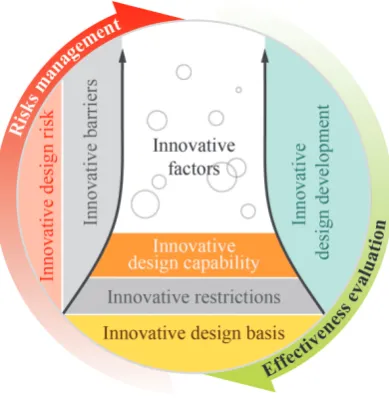
Innovation has been a fuzzy and abstract concept in the past, the result of this study revealed different considerations in new product design and development process for six aspects of innovative design model as rules or principles of innovative development on new product development of industry: innovative design basis, innovative design development, innovative design capabilities, innovative design barriers, innovative design risks and effectiveness evaluation within a product life cycle to construct a innovative design model (Fig. 5).
Figure 5. Systematic Innovative Design Model
Innovative design model shows a new product development is under the risk of innovative design. It starts from the basis of innovative design, and the designer's personality will affect his observations, creativity, problem-solved ability, as well as the ability to communicate
and persuade. Then, in the exclusion of the known innovative restrictions carried out the development of innovative design by innovative design capabilities and innovative factors, but some unknown innovative barriers and the risks of new product development will occur during the process. Those innovative obstacles or risks can be eliminated, avoided or reduced uncertain loss by proper risk management.
If companies do not evaluate the relative response for innovative risks, it may even threaten the survival of enterprises throughout the product development process. PSS is an achievement for a sequence of innovative journey that brings not only innovation for technology and products on new product development by design thinking but also commercial opportunities for industries with effectiveness.
Acknowledgements
The authors gratefully acknowledge the support for this research provided by part of the National Science Council under Grants No. NSC 102-2410-H-130-064.
REFERENCES
[1] Leavy, B. Design thinking-a new mental model of value innovation, Strategy & Ledarship, Vol.38, No.3, pp 5-14, 2010.
[2] Zhang, Q., Lim, J. S. and Cao, M. Innovation-driven learning in new product development: a conceptual model, Industrial Management & Data Systems, Vol.104, No.3, pp 252-261, 2004.
[image:7.595.80.275.469.669.2][4] Azadegan, A., Bush, D. and Dooley, K. J. Design creativity: static or dynamic capability? International Journal of Operations & Production Management, Vol.28, No.7, pp 636-662, 2008.
[5] Eury, M. A journey in design thinking and learning, Training & Development, Vol.39, No.3, pp 24-26, 2012.
[6] Brown, T. Design thinking. Harvard Business Review, 2008. [7] Beckman, S. L. and Barry, M. Developing Design Thinking Capabilities, Step Inside Design, Vol.24, No.4, pp 82-87, 2008.
[8] Amabile, T. M. How to kill creativity, Harvard Business Review, Vol.76, No.5, pp 76-87, 1998.
[9] Cumming, B. S. Innovation overview and future challenges, European Journal of Innovation Management, Vol.1, No.1, pp 21-30, 1998.
[10] Park, Y. H. A study of risk management and performance measures on new product development, Asian Journal on Quality, Vol.11, No.1, pp 39-48, 2010.
[11] Robert, S. How Risky is your Company? Harvard Business Review, pp 85-94, 1999.
[12] Ulrich, K. T. and Eppinger, S. D. Product Design and Development, 4th Ed., Holt, McGraw-Hill, New York, 2009. [13] Jacoby, R. and Rodriguez, D. Innovation, growth, and getting to where you want to go, Design Management Review, Vol.18, No.1, pp 10-15, 2007.
[14] Shostack, G.L. Breaking free from product marketing, Journal of Marketing, Vol.41, pp 73-80, 1997.
[15] Mont, O. Product service systems (AFR Report No. 288), Stockholm, Swedish: Lund University, Swedish Environmental Protection Agency, 2000.
[16] Tukker, A. and Tischner, U. Product-services as a research field: past, present and future. Reflections from a decade of research. Journal of Cleaner Production, Vol.14, pp 1552-1556, 2006.
[17] Chase, R.B. The customer contact approach to services: theoretical bases and practical extensions, Operations Research, Vol.29, No.4, pp 698-706, 1981.
[18] Baines, T.S., Lightfoot, H.W., Benedettini, O. and Kay, J.M. The servitization of manufacturing: a review of literature and reflection on future challenges, Journal of Manufacturing Technology Management, Vol.20, No.5, pp 547-567, 2009. [19] Goedkoop, M.J., van Halen, C.J.G., te Riele, H.R.M. and
Rommens, P.J.M. Product Service Systems, Ecological and Economic Basics, VROM, The Hague: NL, 1996.
[20] Richard J.C., Chris J.B. and Samir D. Evaluating existing approaches to product-service system design: A comparison with industrial practice, Journal of Manufacturing Technology Management, Vol.23, No.3, pp 272-298, 2012. [21] Tukker, A. Eight types of product-service system: eight ways
to sustainability? Experiences from SusProNet, Business Strategy and the Environment, Vol.13, No.4, pp 246-260, 2004.
[22] Mont, O. Clarifying the concept of product–service system, Journal of Cleaner Production, Vol.10, pp 237-245, 2002. [23] Chen, W. L., Chiang, Y. M., Chang, S. M. Application of
Systematic Design Strategy to Design Stationery, Journal of Professional Mechanical Engineers, Vol.3, No.1, pp 1-7, 2010.
![Figure 1. IDEO design thinking process [6]](https://thumb-us.123doks.com/thumbv2/123dok_us/8782842.905196/2.595.73.285.244.581/figure-ideo-design-thinking-process.webp)