© 2016, IRJET ISO 9001:2008 Certified Journal
Page 923
Isolation of Mycophenolic Acid by Optimization of Downstream Process
Parameters using Statistical Approach
Umesh Luthra
1, Yogesh Patel
2, Aditi Trivedi
3, Dharmendra Singh
41-4
Ipca Laboratories Ltd., Biotech R&D, Kandivali (W), Mumbai-400067.
---***---Abstract -
Product recovery is an important aspect in all the biotechnological processes. Mycophenolic acid is a secondary metabolite produced as a result of fermentation by Penicillium brevicompactum. The isolation of the product from the fermentation broth is a challenging task. Various steps combined with different parameters need to be optimized to get the desired results. In the current study the various parameters for the downstream processing of MPA have been studied using the statistical approach. The solvent for extraction was optimized initially using the one variable at a time method The solvent showing maximum recovery was toluene. Further the factors pH, solvent volume and extraction temperature were studied using full factorial design. Analysis of the experiment showed that the pH and the temperature of the solvent show maximum impact on the yield.Key Words
:
Downstream processing, solventextraction, full factorial design, mycophenolic acid
1.INTRODUCTION
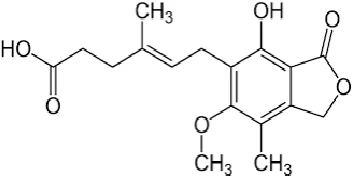
Mycophenolic acid (MPA) is a secondary metabolite produced by Penicillium brevicompactum which has antibiotic and immunosuppressive activity. MPA and its derivative Mycophenolate mofetil (MMF) have diverse biological properties like anti-neoplastic, anti-inflammatory and anti-psoriasis. MPA is a starting material of mycophenolate mofetil ("MMF"), of the following formula which is the 2-morpholinoethyl ester derivative of MPA that is approved for prophylaxis of rejection in patients receiving allogenic organ transplants. Fig. 1 represents the structure for mycophenolic acid [1].
Fig -1 : Structure of Mycophenolic acid
Mycophenolic acid is produced as a secondary metabolite as a result of fermentation by Penicillium brevicompactum. The crude product MPA is further processed by downstream processing to produce pure crystals of MPA which can be further utilized to synthesize APIs.
Downstream processing is an important aspect of all
biotechnological processes and has significant
[image:1.595.48.225.653.741.2]© 2016, IRJET ISO 9001:2008 Certified Journal
Page 924
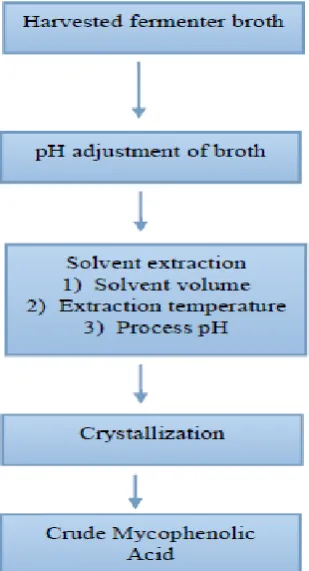
Fig -1: Steps for isolation of MPA
Although, strategies of purification depend on desired use of the final product and in most cases several different processes like cell separation, solvent extraction, decolorization, chromatographic purification etc. are involved in purification of fermentation products. All these processes have significant effect on the cost of the final product and may even account for more than 60% of total cost for production [3]. Therefore, development of a simplified and cost effective downstream process for microbial fermentation products is a major challenge for their commercialization.
Classical one point optimization techniques may prove to be a tedious and time consuming task while optimizing mycophenolic acid (MPA) recovery from fermentation broth and this also may not be able to explain the effect of interaction among different solvents on MPA recovery. Statistical experimental design techniques are very useful tools when more than one factor is studied at a time. These statistical models help in understanding the interactions among the different variables at various levels and in calculating the optimal level of each variable [4]. The current study deals with the optimization of the various process parameters involved in the isolation of mycophenolic acid at the various stages of the downstream processing of MPA using the statistical approach.
2. MATERIAL AND METHODS
The fermentation process for the production of Mycophenolic acid was carried out using the
microorganism, Penicillium brevicompactum. The
harvested fermentation broth was then further processed for downstream purification to get crude MPA.
2.1 Procedure
The harvested fermenter broth was stirred for 30 minutes and the pH was monitored. The desired pH was adjusted by addition 7.0 % with dilute HCl. All the above procedure was carried out at ambient temperature. After the adjustment of the pH the solution was cooled to 25-30°C and stirred for one and a half to two hours. The broth was filtered using Buchner funnel with cloth (mesh size - 800) and the activity of the cake and the filtered volume was analyzed through HPLC.
Then in the 10L round bottom flask with an overhead stirrer, thermometer pocket and re-flux condenser was charged with 2.5 kg of the filtered cake. A specific amount of solvent was added to the flask and the stirring and heating was started. The required temperature was maintained for one and a half to two hours. The mixture was filtered and the cake extraction was repeated twice. The activity of the cake was checked using HPLC.
The aqueous layer was separated from the filtrate. The distillation process was started using reduced pressure and the volume was concentrated to 4-5 litres. Vacuum applied was 720 to 730 mm. The concentrated mass was in the slurry form. The temperature of the mass was 90-100°C and maintained for 30 minutes. The reaction mixture was then cooled to 0-5°C and maintained for one and a half to two hours. The reaction mass was filtered and washed with 200*2 ml chilled toluene. It was then dried in vacuum oven at temperature 60°C and vacuum was 720-730 mm. The assay purity of product was checked by HPLC.
2.3 Quantification of the product by HPLC
[image:2.595.43.198.110.396.2]© 2016, IRJET ISO 9001:2008 Certified Journal
Page 925
2.4 Experiments
In the current study, the solvent was first optimized using the classical method of One variable at a time experiment. Solvents play an important role in the product extraction and isolation step of the downstream processing. It is involved in the removal of the related impurities that vary markedly from the product.
The solvents used for the study were methanol, ethyl acetate, isopropyl alcohol, isobutanol, acetone and toluene. All the solvents were utilized as per the procedure stated above. Once the solvent was finalized with OVAT then finalize solvent was used to optimize other parameters.
2.4.1 Full Factorial Design
The two level factorial design is considered to be a multivariable sequential search technique in which the effects of two or more factors are studied simultaneously and the responses are analyzed statistically to arrive at a decision [5, 6]. A two level three factorial design was carried out on the basis of the results obtained from OVAT. The parameters taken into consideration were
1. Initial pH of the broth before study 2. Solvent wash study
3. Extraction process temperature
[image:3.595.308.514.134.312.2]The initial pH of the broth was measured after the harvested broth was stirred for 30 minutes. The pH under study was initially i.e 6.5 and was adjusted to 3.5with dilute hydrochloric acid. The second parameter for the study was the temperature at which the solvent wash is carried out. The solvent was added and the temperature was maintained at either 30°C or 65°C. This step was repeated twice to extract the compound of interest. The last parameter for the study was the solvent volume and the number of washes to be carried out for the maximum extraction of MPA. For the experiment the volume of solvent used was 3 times the volume of cake and 2 washes of solvent and 4 times volume of cake and 2 washes was taken into consideration. The design of the experiment is depicted in table 1. Experiment was designed using Design expert software (Stat-Ease Inc., Version 8.0.7.1)
Table -1: Experimental design for full factorial for 3 variables
3. RESULT AND DISCUSSION
Mycophenolic acid (MPA) and its derivatives such as mycophenolate mofetil (MMF), have diverse biological properties such as antineoplastic,immunosuppressive, antifungal anti-inflammatory, antiviral, and antipsoriasis activity[7]. MPA has inhibitory effect on inosine monophosphate dehydrogenase enzyme “IMPDH”. This is the rate-limiting enzyme in denovo biosynthetic pathway of purine nucleotides. MPA stops the biosynthesis of DNA and RNA and cell reproductivity [8].
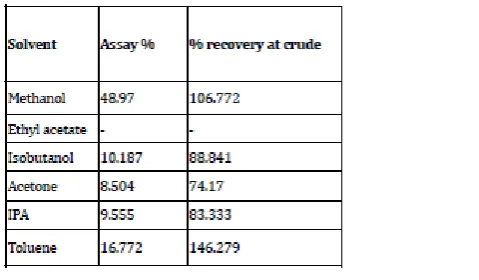
MPA is a secondary metabolite commercially derived from fermentation. The fermented broth is then subjected to downstream processing includes various treatments to produce a pure product which is free from the impurities. The filtered cake from the harvested fermenter broth was mixed with the solvent and stirred for one and a half to two hours. The cake was washed a number of times to get maximum extraction. The results of the assay and the percentage recovery using each solvent is represented in table 2.
[image:3.595.311.551.626.766.2]© 2016, IRJET ISO 9001:2008 Certified Journal
Page 926
Among the solvents analyzed it was observed that assay and recovery of toluene extraction mass was the highest. The lowest assay and recovery is with isopropyl alcohol (IPA) whereas ethyl acetate does not show any recovery. As the assay purity for toluene is maximum the purification of the product will be easier and the yield will be higher at the later stages. One possible reason for toluene to give maximum recovery is that it is highly non-polar solvent as compared to the other solvents used. As the polarity of the other solvents is higher the number of impurities in the other solvents is more as compared to toluene.
3.1 Full Factorial Experiment
[image:4.595.306.523.86.314.2]The full factorial experiment was performed using toluene as the solvent after optimizing it with the OVAT. The other factors taken into consideration in the experiment are pH, temperature of extraction and solvent volume. The experimental run along with the yield is represented in table 3.
Table -3: Experimental design for full factorial experiment for 3 variables with yield.
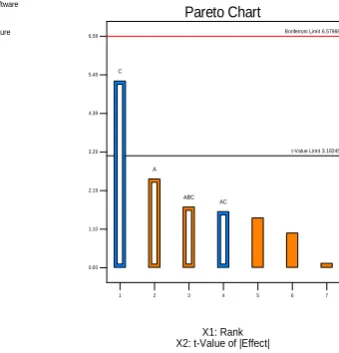
The result was analyzed using the half normal plot and pareto chart is represented in fig. 3 and 4 respectively.
Design-Expert® Software R1
Shapiro-Wilk test W-value = 0.964 p-value = 0.637 A: Solvent temperature B: Solvent volume C: pH
Positive Effects
Negative Effects
Half-Normal Plot
X2: Half-Normal % Probability X1: |Standardized Effect| 0.00 0.40 0.81 1.21 1.61 2.02 2.42 2.82 3.23 3.63 0
10 20 30 50 70 80 90 95
A
C
AC ABC
Fig -3: Half normal plot for screening through full factorial design
The plot shows that the factor C has a negative impact on the MPA yield and the factor A has a positive effect on the MPA yield. This implies that decreasing the pH below the lower value i.e 3.5 will give better yield whereas increasing the temperature above 65°C would give better yield of MPA.
Design-Expert® Software R1
A: Solvent temperature B: Solvent volume C: pH
Positive Effects
Negative Effects
Pareto Chart
X2: t-Value of |Effect|X1: Rank 0.00
1.10 2.19 3.29 4.39 5.48 6.58
1 2 3 4 5 6 7
Bonferroni Limit 6.57968
t-Value Limit 3.18245 C
A
[image:4.595.37.239.396.554.2]ABC AC
Fig -4: Pareto chart for screening through full factorial design.
[image:4.595.342.512.443.620.2]© 2016, IRJET ISO 9001:2008 Certified Journal
Page 927
3.2 Verification of the significant factors
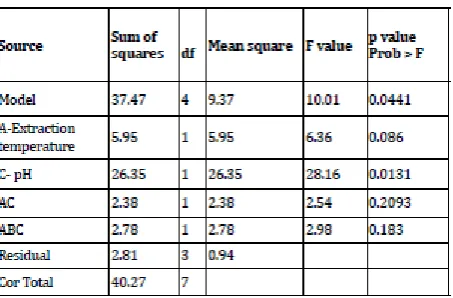
[image:5.595.38.265.178.327.2]ANOVA was used to verify the significant factors obtained through the above analysis. It is depicted in table 4.
Table -4: ANOVA analysis
In this analysis, the outstanding effects are incorporated into the “model” and the smaller effects are pooled together to estimate the error called “residual”. “Cor total” values are the total sum of squares corrected for the mean. It represents the total system variation using the average response as a baseline [10]
Abbreviations: df: degree of freedom
R-squared - 0.9303 . Adj R-squared- 0.8373
Pred R-Squared 0.5043 Adeq Precision 8.545
The variables which scored a Probability (P) value less than 0.05 were considered as influential factors affecting the response. Values greater 0.100 indicate that the factors are not significant. The model F value of 10.01 implies that the model is significant. There is only a 4.41% chance that a ‘Model F value” this large could occur due to noise.“Adeq Precision” measures the signal to noise ratio. A ratio greater than 4 is desirable. The obtained ratio of 8.545 indicates an adequate signal. This model can be used to navigate the design space. Analysis of the three factors and their interactions indicate that the factor C is the most significant factor impacting the yield of MPA.
4. CONCLUSION
Solvent selection through OVAT showed that toluene is the best solvent giving the maximum yield of mycophenolic acid. The less polar nature of this solvent makes it the most suitable solvent among the other solvents studied. Full factorial run using the three factors namely, extraction temperature, solvent volume and the pH for extraction was carried out. The maximum yield of MPA was 9.85 g/l obtained in run 2. The analysis through pareto and half normal plot showed that the pH of extraction and the extraction temperature are the most
significant factors having the maximum impact on the yield. Since the pH of the solvent is on the negative scale reducing the pH below 3.5 would show better results. The extraction temperature needs to be raised above 65°C to improve the yield since this factor is on the positive side of the scale. According to ANOVA, pH is the most significant factor. A statistical approach to design the extraction process and to optimize the parameters for the process is a very easy and time saving process.It helps in screening a large number of factors involved in the process with maximum output.
REFERENCES
[1] Patent No. EP 2024506 A1, Method for reducing
impurity level in mycophenolic acid fermentation.
[2] Patent No. US 8685322 Method for the purification of
bio-molecules.
[3] Shabtai Y, Mukmenev I, “Enhanced production of
pigment-free pullulan by a morphogenetically arrested Aureobasidium pullulans (ATCC 42023) in a two-stage fermentation with shift from soybean oil to sucrose”, Appl Microbiol Biotechnol, Vol. 43, pp. 595-603, 1995.
[4] Dirk WB (2000) Experimental design for fermentation
media development: statistical design or global random search? J Biosci Bioeng 90: 473-483.
[5] Duta, F.P., F.P. de Franca and L.M.D.A. Lopes,
“Optimization of culture conditions for
exopolysaccharides production in Rhizobium sp. using the response surface method”, Electron. J. Biotechnol., Vol. 9, pp. 391-399, 2006.
[6] Anbu, P., S.C.B. Gopinath, A. Hilda, T. Lakshmipriya and
G. Annadurai, “Optimization of extracellular keratinase production by poultry farm isolate Scopulariopsis brevicaulis”. Biores. Technol., Vol. 98: pp. 1298-1303, 2006.
[7] Sadhukhan, A.K., Murthy, M.V.R., Kumar, R.A., R Ajaya
Kumar, Mohan, E.V.S. G Vandana, G., Bhar, C. Rao, K.V, “Optimization of mycophenolic acid production in solid state fermentation using response surface methodology”, Journal of Industrial Microbiology and Biotechnology, Vol. 22, pp.33-38, 1991.
[8] Ardestani, F, Fatemi, S.S.A., Yakhchali, B., “Enhanced
mycophenolic acid production by Penicillium brevicompactum with enzymatically hydrolysed casein”, World academy of Science, Engineering and Technology, Vol. 73, pp. 254-257, 2011.
[9] Scholtes, P.R., The Team Handbook, pp. 2-25. Madison,
WI: Joiner Associates, 1988.,
[10] Anderson, M.J. and P.J. Whitcomb,DOESimplified: