© 2016, IRJET | Impact Factor value: 4.45 | ISO 9001:2008 Certified Journal | Page 2425
OPTIMIZED SENSOR NODES OF WIRELESS SENSOR NETWORK BY
FAULT NODE RECOVERY ALGORITHM
Chauhan Ajitkumar
1, Asst. Prof
.
Jignesh V. Patel
21
PG Scholar, EC Dept., SPCE, Visnagar, Gujarat, India.
2
Assistant Professor, EC Dept., SPCE, Visnagar, Gujarat, India.
---***---Abstract -
This paper proposes an issues FNR algorithm to
upgrade the lifetime of a remote sensor system when a few of the sensor nodes close down. The calculation depends on the grade diffusion algorithm joined with the genetic algorithm. The calculation can bring about fewer substitutions of sensor nodes furthermore, more reused routing ways. In our simulation, we describe the packet delivery ratio and packet drops for different active and faulty nodes using grade diffusion algorithm and genetic algorithm. Here increase the packet delivery ratio and decrease the packet drop.
Key Words: Genetic algorithm, grade diffusion (GD) algorithm, directed diffusion algorithm (DD), wireless sensor networks (WSNs)
1. INTRODUCTION
Late advances in smaller scale preparing, remote and battery innovation, and savvy sensors have upgraded information preparing remote correspondence, and discovery capacity. In sensor arranges, every sensor node has constrained remote computational energy to process and exchange the live information to the base station or information accumulation focus. Subsequently, to build the sensor range and the transmission range the remote sensor arrange more often than not contains numerous sensor nodes. By and large, every sensor node has a low level of battery power that can't be recharged. At the point when the vitality of a sensor node is depleted, remote sensor system breaks will show up, and the fizzled hubs won't transfer information to alternate hubs amid transmission handling [1] [4] [7]. Along these lines, the other sensor nodes will be loaded with expanded transmission preparing.
This paper proposes an issue FNR algorithm upgrade the lifetime of a remote sensor system (WSN) when a portion of the sensor nodes close down, either in light of the fact that they no more have battery vitality or they have come to their operational edge. Utilizing the
FNR calculation can bring about less substitutions of sensor nodes and more reused steering ways. Hence, the calculation not just improves the WSN lifetime be that as it may, likewise lessens the expense of supplanting the sensor nodes.
2. RELATED WORK
2.1 Directed Diffusion Algorithm
C. Intanagonwiwat et al. introduced the Directed Diffusion (DD) algorithm. The guided directed diffusion algorithm fundamental mean to decrease the information transfer transmission to control power utilization. Directed Diffusion is intended for heartiness, scaling and vitality effectiveness. The DD algorithm is information driven and question driven transmission convention. In the DD algorithm, first the sink node gives intrigued inquiries in type of credit quality sets to other sensor node by television the question parcels to whole system. At that point, the sensor nodes just send the gathered information back to the sink node when it coordinates the questions [7].
The wireless sensor system may come up short because of a taking after reason, including the accompanying: the WSN detecting range may encounter a release; the directing way may encounter a break; the batteries of some sensor nodes may be exhausted; requiring more hand-off nodes or the nodes wear out after the WSN has been being used a drawn out stretch of time.
2.2 Grade Diffusion Algorithm
© 2016, IRJET | Impact Factor value: 4.45 | ISO 9001:2008 Certified Journal | Page 2426 sensor nodes transmission effect. In Grade Diffusion
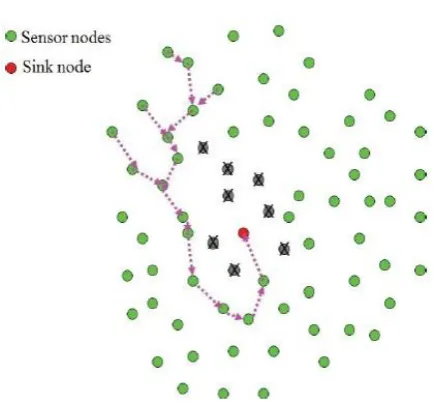
algorithm the source hub will show the information parcels to all neighbors and after that the neighbors will telecast it its neighbors and after that information bundles got by the sink hub. The sensor hubs transmit the outcome information to sink hub as indicated by GD calculation. The Fig.1 demonstrates the sensor hubs steering ways. In the event that the WSN might be come up short because of assortment of variables that is appeared in Fig.2. The outside hubs exchange occasion information to sink hubs through within hubs in WSN.
[image:2.595.309.533.90.292.2]The Grade Diffusion algorithm is proposed to settle the force utilization and transmission directing issue in WSNs. In GD algorithm dole out the evaluation for the sensor hubs and upgrade the directing table for every hub. Here, the information transmission happens from higher evaluation nodes to lower grade nodes. The Grade Diffusion algorithm is quick and totally makes the evaluation table in every sensor node taking into account the whole wireless sensor system [4].
[image:2.595.40.252.412.607.2]Fig -1: Wireless sensor node routing
Fig -2: Wireless sensor node routing path when some nodes are not functioning
3. FAULT NODE RECOVERY ALGORITHM
The proposed algorithm is Fault Node Recovery
algorithm with the help of Grade Diffusion Algorithm
and Genetic Algorithm. The Fault Node Recovery
algorithm creates the routing table using DD
algorithm and replaces the sensor node using the GA.
This algorithm not only reuses the more routing
paths to enhance the WSN lifetime but also reduces
the replacement cost.
3.1 Bth Calculation
The Fault Node Recovery algorithm for WSNs
based on the grade diffusion algorithm combined
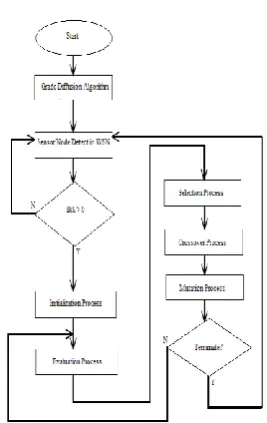
with the genetic algorithm. In Fig.3, the FNR
algorithm creates the grade value, routing table, a set
of neighbour nodes and payload value for each
sensor node using directed diffusion algorithm.
© 2016, IRJET | Impact Factor value: 4.45 | ISO 9001:2008 Certified Journal | Page 2427 Fig -3: Fault Node Recovery algorithm flowchart
(1)
On the off chance that Bth is bigger than zero thealgorithm will be conjured and supplant the non-working sensor nodes by utilitarian nodes chose by the genetic algorithm. At that point the wireless sensor network can bear on to fill in the length of the administrators will supplant sensors. In (1), evaluation is the evaluation estimation of each sensor node. The variable Nioriginal is the quantity of sensor nodes with the evaluation esteem i. The Ninow is the quantity of sensor gestures as yet working at current time with grade value i. The parameter β is set by the client and must have esteem somewhere around 0 and 1. On the off chance that the quantity of sensor nodes that capacity for every evaluation is not exactly β, Ti will get to be 1 and Bth will be bigger than zero. At that point the FNR algorithm will compute the sensor hubs to supplant utilizing genetic algorithm.
3.2 Genetic Algorithm
The 5 steps in the Genetic Algorithm are:
1. Initialization 2. Evaluation 3. Selection 4. Crossover and 5. Mutation
3.2.1 Initialization
[image:3.595.334.542.301.343.2]In the initialization step, the genetic algorithm produces chromosomes and every chromosome is an expected arrangement. The quantity of chromosomes is resolved by populace size, which is characterized by the client, every chromosome is a mix arrangement and the chromosome length is the quantity of sensor nodes that are exhausted or non-working. The qualities are either 0 or 1. A 1 means the node ought to be supplanted and a 0 implies that the node won't be supplanted. Fig.4. speaks to a chromosome. The chromosome length is 10 and the quality is 0 or 1. Here, there are 10 sensor nodes not working and their node numbers are 9, 7, 10, 81, 23, 57, 34, 46, 66, and 70.
Fig -4: Chromosome and its gene
3.2.2 Evaluation
The qualities of the chromosome give the data about the substitution of node. In the FNR algorithm, the objective is additionally reuse the all the more steering ways and supplant the least sensor nodes. The wellness quality is computing as per a wellness capacity and the parameters of the wellness capacity are the chromosomes qualities. The wellness capacity appeared as (2),
(2)
Where,
Ni = the number of replaced sensor nodes and their grade value at i
Pi = the number of reusable routing paths from sensor nodes with their grade value at i
TN = total number of sensor nodes in the original WSN
TP = total number of routing paths in the original WSN
3.2.3 Selection
© 2016, IRJET | Impact Factor value: 4.45 | ISO 9001:2008 Certified Journal | Page 2428 having most minimal fitness value and holds the
[image:4.595.334.541.137.224.2]chromosomes having high fitness value. The chose chromosome which is having most elevated fitness quality will be send to the mating pool. The most exceedingly awful chromosomes will be erased and new chromosomes will be made to supplant them after the hybrid stride, appeared in Fig.5.
Fig -5: Selection Step
3.2.4 Crossover
[image:4.595.39.256.203.335.2]
The crossover step in Genetic algorithm is to shift the programming of chromosomes from one era to next. One-point crossover system has been utilized here as a part of this algorithm. The two individual chromosomes will be chosen from mating pool to produce another arrangement of arrangement. A cross point is chosen between the first and last qualities of the guardian people and afterward the part of every person on either side of the hybrid point is traded and develop, as appeared in Fig.6.
Fig -6: Crossover Step
3.2.5 Mutation
In this algorithm, we just flip a quality arbitrarily in the chromosome, as appeared in Fig.7. The chromosome with the best fitness quality is the arrangement after cycle. The mutation step can present qualities not found in the first people and keeps the GA from meeting too quick. In the proposed algorithm the sensor hubs will be supplant
in the chromosome with the quality of 1 all together show signs of improvement system lifetime.
Fig -7: Mutation Step
4. Simulation
The simulation of fault node recovery algorithm described in the below section has been performed to verify the methods and results.
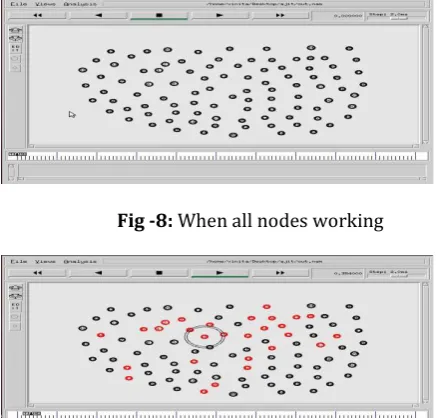
[image:4.595.309.528.398.607.2]In fig.8 and fig.9 show the different network when all nodes working and the network show the 50 nodes are dead. Here we define the faulty nodes using grade diffusion algorithm.
Fig -8: When all nodes working
Fig -9: When 50 nodes dead
[image:4.595.41.246.509.620.2]© 2016, IRJET | Impact Factor value: 4.45 | ISO 9001:2008 Certified Journal | Page 2429 Fig -10: When 50 nodes given Genetic
Fig -11: When 25 nodes given Genetic
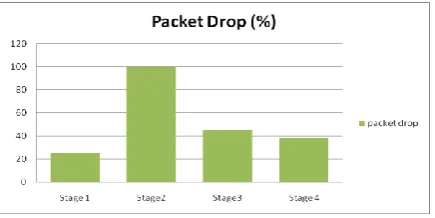
[image:5.595.37.255.547.656.2]In the below simulation plots we describe the packet drop and packet delivery ratio for different network stages. In the stage 1when all nodes are working then highest packet delivery ratio and lowest packet drop calculating. In the stage 2 when 50 nodes are dead then show the lowest packet delivery and highest packet drop. In the stage 3 when 50 nodes given to Genetic then packet deliver ratio more than stage 2 and less then stage 1 and also packet drop is less then stage 2 more than stage 2. In the stage 4 when 25 nodes given to Genetic then packet delivery more than stage-3 and less then stage-1, and also show the packet drop is less then stage 3 more than stage 1.
Fig -12: Time Vs Packet Delivery Ratio
Fig -13: Time Vs Packet Drop
5. CONCLUSIONS
In the real wireless sensor networks organizes, the sensor nodes use battery power supplies and accordingly have restricted vitality assets. Our system proposes a faulty node recovery and replacement algorithm for WSN based on the grade diffusion algorithm combined with genetic algorithm. The FNR algorithm, requires replacing fewer sensor nodes and reuses the most routing paths, increasing the WSN lifetime and reducing the replacement cost.
In the simulation, using the fault node recovery algorithm we describe the packet delivery ratio and packet drop for the different network when few nodes are working and dead. We increase the packet delivery ratio and decrease the packet drop for wireless sensor network.
REFERENCES
[1] S. Corson and J. Macker, Mobile Ad Hoc Networking (MANET): Routing Protocol Performance Issues and Evaluation Considerations. New York, NY, USA: ACM, 1999.
[2] Ch.Srilakshmi “A Genetic Replacement Algorithm for Optimizing Wireless Sensor Networks” IEEE International Conference on Science, Engineering and Management Research 2014
[3] M. Gen and R. Cheng, Genetic Algorithms and Engineering Design. New York, NY, USA: Wiley, 1997. [4] Z. He, B. S. Lee, and X. S. Wang, “Aggregation in sensor networks with a user-provided quality of service goal,” Inf. Sci., vol. 178, no. 9, pp. 2128–2149, 2008.
© 2016, IRJET | Impact Factor value: 4.45 | ISO 9001:2008 Certified Journal | Page 2430 [7] T. P. Hong and C. H. Wu, “An improved weighted
clustering algorithm for determination of application nodes in heterogeneous sensor networks,” J. Inf. Hiding Multimedia Signal Process., vol. 2, no. 2, pp. 173–184, 2011.
[8] C. Intanagonwiwat, R. Govindan, D. Estrin, J. Heidemann, and F. Silva, “Directed diffusion for wireless sensor networking,” IEEE/ACM Trans. Netw., vol. 11, no. 1, pp. 2–16, Feb. 2003.
[9] W. H. Liao, Y. Kao, and C. M. Fan, “Data aggregation in wireless sensor networks using ant colony algorithm,” J. Netw.Comput.Appl., vol. 31, no. 4, pp. 387–401, 2008.
[10] J. Pan, Y. Hou, L. Cai, Y. Shi, and X. Shen, “Topology control for wireless sensor networks,” in Proc. 9th ACM Int. Conf. Mobile Comput. Netw., 2003, pp. 286–299. [11] “A self-managing fault management in WSNs,” Beenu Baby and Joe Mathew Jacob, ISSN vol 1 July 2013.
[12] H. C. Shih, S. C. Chu, J. Roddick, J. H. Ho, B. Y. Liao, and J. S. Pan, “A reduce identical event transmission algorithm for wireless sensor networks,” in Proc. 3rd Int. Conf. Intell. Human Comput.Interact., 2011, pp. 147–154.
BIOGRAPHIES
Chauhan Ajit1 M.E. research scholar Department of ECE, Sankalchand Patel College of Engineering, Visnagar, Gujarat, India.