
Somatostatin receptor (SSTR) subtype-selective
analogues differentially suppress in vitro
growth hormone and prolactin in human
pituitary adenomas. Novel potential therapy for
functional pituitary tumors.
I Shimon, … , M D Culler, S Melmed
J Clin Invest.
1997;
100(9)
:2386-2392.
https://doi.org/10.1172/JCI119779
.
Previously, we have shown somatostatin receptor (SSTR) subtype-specific regulation of
growth hormone (GH), thyroid-stimulating hormone, and prolactin (PRL) secretion in human
fetal pituitary cultures, where GH and thyroid-stimulating hormone are mediated by both
SSTR2 and SSTR5, whereas SSTR2 preferentially mediates PRL secretion. We now
tested SSTR subtype-selective analogues in primary human GH- and PRL-secreting
pituitary adenoma cultures. Analogue affinities determined by membrane radioligand
binding in cells stably expressing human SSTR forms were either SSTR2 or
SSTR5-selective. Analogues preferential either for SSTR2, including octreotide, lanreotide, and
novel compounds with improved affinity for SSTR2, or new SSTR5-selective compounds
suppressed GH in tumor cell cultures (up to 44% of control; P < 0.0005). However, novel
analogues from both groups were 30-40% more potent than octreotide and lanreotide in
suppressing GH (P < 0.05). Heterologous analogue combinations containing both
SSTR2-and SSTR5-selective compounds were more potent in decreasing GH than analogues used
alone (P < 0.05), or than combinations of compounds specific for the same receptor subtype
(P < 0.005). In contrast, SSTR2-selective analogues did not suppress PRL release from six
cultured prolactinomas studied. However, new SSTR5-selective analogues suppressed in
vitro PRL secretion (30-40%; P < 0.05) in four of six prolactinomas. These results suggest
that both SSTR2 and SSTR5 are involved in GH regulation in somatotroph adenoma cells,
whereas SSTR5 exclusively regulates PRL […]
Research Article
Find the latest version:
J. Clin. Invest.
© The American Society for Clinical Investigation, Inc. 0021-9738/97/11/2386/07 $2.00
Volume 100, Number 9, November 1997, 2386–2392 http://www.jci.org
Somatostatin Receptor (SSTR) Subtype-selective Analogues Differentially
Suppress In Vitro Growth Hormone and Prolactin in Human Pituitary Adenomas
Novel Potential Therapy for Functional Pituitary Tumors
Ilan Shimon,* Xinmin Yan,* John E. Taylor,‡ Martin H. Weiss,§ Michael D. Culler,‡ and Shlomo Melmed*
*Department of Medicine, Cedars-Sinai Research Institute, UCLA School of Medicine, Los Angeles, California 90048; ‡Biomeasure Inc.,
Milford, Massachusetts 01757; and §Department of Neurosurgery, University of Southern California School of Medicine, Los Angeles,
California 90033
Abstract
Previously, we have shown somatostatin receptor (SSTR) subtype-specific regulation of growth hormone (GH), thy-roid-stimulating hormone, and prolactin (PRL) secretion in human fetal pituitary cultures, where GH and thyroid-stim-ulating hormone are mediated by both SSTR2 and SSTR5, whereas SSTR2 preferentially mediates PRL secretion. We now tested SSTR subtype-selective analogues in primary human GH- and PRL-secreting pituitary adenoma cultures. Analogue affinities determined by membrane radioligand binding in cells stably expressing human SSTR forms were either SSTR2 or SSTR5-selective. Analogues preferential either for SSTR2, including octreotide, lanreotide, and novel compounds with improved affinity for SSTR2, or new SSTR5-selective compounds suppressed GH in tumor cell cultures (up to 44% of control; P , 0.0005). However, novel
analogues from both groups were 30–40% more potent than octreotide and lanreotide in suppressing GH (P , 0.05).
Heterologous analogue combinations containing both SSTR2-and SSTR5-selective compounds were more potent in de-creasing GH than analogues used alone (P, 0.05), or than
combinations of compounds specific for the same receptor subtype (P , 0.005). In contrast, SSTR2-selective
ana-logues did not suppress PRL release from six cultured pro-lactinomas studied. However, new SSTR5-selective ana-logues suppressed in vitro PRL secretion (30–40%; P , 0.05)
in four of six prolactinomas. These results suggest that both SSTR2 and SSTR5 are involved in GH regulation in somato-troph adenoma cells, whereas SSTR5 exclusively regulates PRL secretion from prolactinoma cells. Thus, somatostatin analogues with improved selective binding affinity for these receptor subtypes may be effective in the treatment of either GH- or PRL-secreting adenomas. (J. Clin. Invest. 1997. 100:
2386–2392.) Key words: prolactinoma • acromegaly • somato-statin receptor • prolactin • growth hormone
Introduction
Prolactinomas and growth hormone (GH)1-cell adenomas are
the most common functioning pituitary adenomas (1, 2), to-gether comprising 80% of these tumors. These monoclonal mi-cro- or macroadenomas (3) are treated either medically or sur-gically. Prolactinomas are treated effectively with dopamine agonists in z 70% of patients (1, 4, 5). However, one-third of
treated patients do not achieve normal prolactin (PRL) levels while on bromocriptine, more often in those harboring inva-sive macroadenomas with high baseline PRL levels. These pa-tients are usually referred for pituitary surgery, as there are no effective medical alternatives to dopamine agonists for treat-ing PRL-secrettreat-ing tumors. GH-cell adenomas are less respon-sive to the available treatment modalities, and only 50–60% of patients are cured after pituitary surgery (6, 7). However, sur-gical remission rates decline sharply when these tumors are lo-cally invasive. Moreover, normalization of GH and IGF-I lev-els occurs only in about half of acromegalic patients treated with the long-acting somatostatin analogue, octreotide (7–9).
Somatostatin exerts its biological effects through a family of G protein–associated receptors with seven transmembrane domains. At least five somatostatin receptor (SSTR) subtypes have been cloned (10), and are termed SSTRs 1–5. The human pituitary gland expresses SSTR1, 2, and 5 (11, 12), whereas hu-man pituitary adenomas contain SSTR1, 2, 3, and 5 (11–14). The clinically available somatostatin analogues, octreotide and lanreotide (15), which are used to control GH secretion in ac-romegalic patients, bind efficiently to SSTR2 and with lower affinity to SSTR5.
Recently, we have studied anterior pituitary hormone regu-lation selectively mediated by different SSTR subtypes using receptor-specific somatostatin analogues in primary human fe-tal pituitary cultures (16), and we determined the role of both SSTR2 and SSTR5 in GH and thyroid-stimulating hormone regulation. However, PRL secretion was suppressed in fetal pituitary cultures only by SSTR2-specific compounds. More-over, we have demonstrated expression of both SSTR2 and SSTR5 receptor subtypes in tumor tissue derived from patients harboring GH- and PRL-cell adenomas (13, 14). To investigate the involvement of SSTR2 and SSTR5 in GH and PRL regula-tion in human somatotroph and lactotroph adenomas and their potential for therapeutic application, we examined in vitro ef-fects on GH and PRL secretion from somatotrophinomas and prolactinomas using novel SSTR subtype-preferential analogues for these receptors. Availability of these new compounds di-rected against specific SSTR subtypes has allowed us to iden-tify novel candidates for peptidometic therapy of these tumors.
Address correspondence to Shlomo Melmed, M.D., Division of En-docrinology and Metabolism, Cedars-Sinai Medical Center, 8700 Beverly Blvd., B-131, Los Angeles, CA 90048. Phone: 310-855-4691; FAX: 310-967-0119; E-mail: [email protected]
Received for publication 19 May 1997 and accepted in revised form 25 August 1997.
Methods
Somatostatin analogues.Somatostatin-14, 23014 (lanreotide), BIM-23023, BIM-23052, BIM-23268, BIM-23190, and BIM-23197 were provided by Biomeasure Inc. (Milford, MA). The amino acid struc-tures of these analogues and the radioligand receptor binding assays to determine the specific binding affinities of the compounds for the different human SSTRs have been reported previously (16). SMS 201-995 (octreotide) was obtained from Novartis (East Hanover, NJ). Analogues were dissolved in 0.01 M acetic acid and 0.1% BSA, and frozen at 2208C until used. Table I summarizes the binding affinities for SSTR2 and SSTR5 of the different somatostatin analogues used. The compounds can be classified as those selectively preferential for SSTR2 (octreotide, lanreotide, BIM-23023, -23190, and -23197) or for SSTR5 (BIM-23052, -23268). Somatostatin-14 has high affinity for both receptor subtypes. The affinities of all the analogues (except somato-statin-14) for SSTR1, 3, and 4 are very low, and are not shown in Table I.
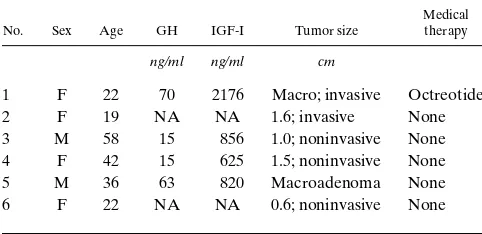
Adenoma cell culture. Six GH-secreting pituitary adenomas and six PRL-secreting tumor specimens were obtained at the time of trans-sphenoidal surgery. The collection and use of tumor samples were in accordance with the guidelines of the local committee on human re-search. Clinical characteristics of the patients are presented in Tables II and III. Tumor specimens were cultured as described (16). Briefly, specimens were washed in DME with 0.3% BSA, minced, and enzy-matically dissociated using 0.35% collagenase and 0.1% hyaluroni-dase (Sigma Chemical Co., St. Louis, MO) for 1 h. Cell suspensions were filtered and resuspended in low glucose DME with 10% FBS and antibiotics before seeding in 48-well tissue culture plates (z 5 3
104 cells/well; 50–80 wells/tumor) in 0.5 ml medium for 96 h, at 378C,
5% CO2. Medium was changed before treatment to serum-free
de-fined DME, and cell cultures were treated for 3 h with 10–100 nM so-matostatin analogues (six to eight wells for each analogue), combina-tions of compounds, or control (vehicle solution only), after which medium was frozen for later hormone measurements.
For the GH-cell adenoma culture studies we used the two clini-cally available somatostatin analogues, octreotide and lanreotide, and somatostatin-14, and compared them to novel analogues with prefer-ential binding for either SSTR2 23190, -23197) or SSTR5 (BIM-23268, which we found to be more effective than BIM-23052). The compounds used to study the PRL-secreting adenomas included oc-treotide or lanreotide, somatostatin-14, and one or more representa-tives from the two receptor-selective analogue groups. Most of the tu-mors did not respond to 10 nM concentrations, and thus were treated with 100 nM analogues. For combination studies, submaximal ana-logue concentrations (40–50 nM) were used.
Hormone assays. Human GH levels were measured by RIA and PRL by immunoradiometric assay (both obtained from Diagnostic Products Corp., Los Angeles, CA), after appropriate sample dilutions.
Statistical analysis. Data were analyzed by one-way ANOVA with planned contrasts, and two-sided P values , 0.05 for the con-trasts between hormone suppression by novel analogues and octreo-tide/lanreotide were considered significant. Results are expressed as mean6SEM.
Results
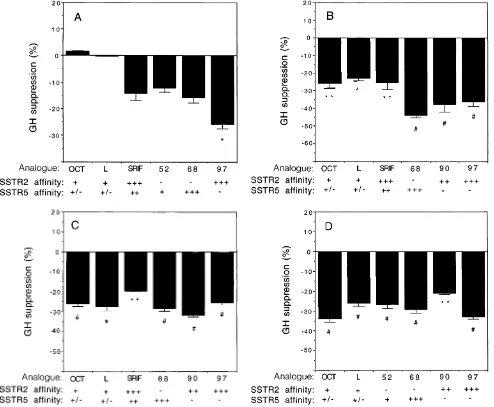
GH-cell tumor cultures. Specimens cultured from six patients with GH-secreting adenomas were studied. Somatotroph ade-noma cells obtained from patient 1 (Table II) did not respond to either octreotide or lanreotide (10 nM; Fig. 1 A), and BIM-23197 was the only somatostatin analogue that significantly suppressed in vitro GH secretion from this tumor (26%; P ,
0.05). This patient had recurrent resection of an invasive macroadenoma, and did not respond to preoperative octreo-tide administration. Cell cultures derived from tumor 2 were treated with 100 nM concentrations of the different analogues. Octreotide, lanreotide, and somatostatin-14 decreased GH se-cretion by z 25% (P, 0.05; Fig. 1 B), whereas the novel
com-pounds BIM-23268, -23190, and -23197 suppressed GH by 36– 44% (P, 0.0001). BIM-23268 was the most potent hormone suppressor in this experiment, suppressing GH better than oc-treotide and lanreotide (P , 0.05). Somatostatin analogues (100 nM) suppressed GH release from adenomatous cell cul-tures of patient 3 pituitary adenoma (Fig. 1 C). Octreotide, lanreotide, and somatostatin-14 inhibited GH in this tumor by 19–27% of control levels (P, 0.0001), and BIM-23190 and -23268 by z 30% (P , 0.0001). Both SSTR2-selective
ana-logues (BIM-23190, -23197; 100 nM) and SSTR5-selective for-mulations (BIM-23052, -23268) suppressed GH release in vitro (21–33%, P , 0.0001; and z 28%, P , 0.0001, respectively) in
cultures derived from tumor 4 (Fig. 1 D). However, this somato-troph adenoma did not further suppress GH when treated with the novel compounds compared with octreotide (34% suppression of control GH; P , 0.0001) or lanreotide (26%; P , 0.0001).
Thus, novel somatostatin analogues with improved binding affinity for either SSTR2 or SSTR5 potently suppressed in vitro GH secretion from pituitary somatotroph adenomas, and usually did so more effectively than the current clinically used compounds, octreotide and lanreotide (P, 0.05) (See also pa-tients 5, 6; Fig. 2, B and C). Interestingly, an octreotide-resis-tant tumor (in vivo; tumor 1) responded in vitro to some of the novel analogues tested, but not to octreotide.
[image:3.612.57.299.74.211.2]Analogue combinations. GH-cell adenoma cultures from patient 3 were used to determine possible additive effects of
Table I. SSTRs Binding Affinity of Somatostatin Analogues
Compound
Receptor subtype affinity (nM)*
SSTR2 SSTR5
Somatostatin-14 0.23 0.88
Octreotide 0.56 7
Lanreotide 0.75 5.2
BIM-23023 0.42 4.2
BIM-23190 0.34 11.1
BIM-23197 0.19 9.8
BIM-23052 11.9 1.2
BIM-23268 15.1 0.37
*Subtype affinity was determined by radioligand membrane receptor binding assays in Chinese hamster ovary cells expressing human SSTR2 gene or SSTR5 cDNA (16).
Table II. Clinical Characteristics of Acromegalic Patients
No. Sex Age GH IGF-I Tumor size
Medical therapy
ng/ml ng/ml cm
1 F 22 70 2176 Macro; invasive Octreotide
2 F 19 NA NA 1.6; invasive None
3 M 58 15 856 1.0; noninvasive None
4 F 42 15 625 1.5; noninvasive None
5 M 36 63 820 Macroadenoma None
6 F 22 NA NA 0.6; noninvasive None
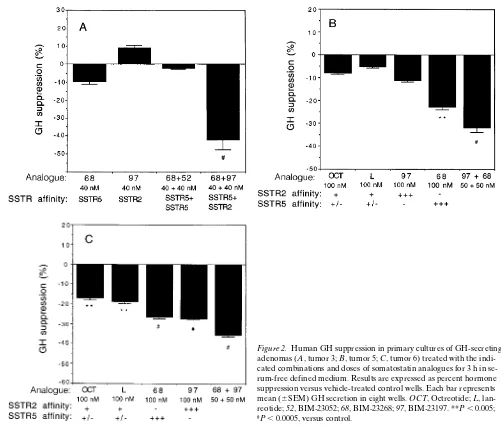
[image:3.612.56.297.606.723.2]somatostatin analogues selective for the two different receptor groups on hormone secretion. For these studies submaximal analogue concentrations (40 nM) were used. Additive effec-tiveness (GH suppression, 41%; P , 0.0001) was demonstrated
[image:4.612.56.559.71.186.2]by combining an SSTR2-selective analogue (BIM-23197) to-gether with a compound selective for SSTR5 (BIM-23268; 40 nM), compared with treatment by a combination of two SSTR2-selective analogues (BIM-23190, -23197; both 40 nM)
Table III. Clinical Characteristics of Prolactinoma Patients
No. Sex Age PRL Tumor size DA therapy Indication for surgery In vitro SSTR5 response
ng/ml cm
7 M 64 742 1.5: noninvasive None Patient preference 1
8 M 33 1249 3.0; invasive Bromocriptine Drug compliance 1
9 M 41 1514 . 3.0; invasive Bromocriptine DA resistance 1
10 M 33 2862 3.4; invasive Bromocriptine DA resistance 1
11 F 29 67 2.7; noninvasive None Patient preference 2
12 F 27 150 0.9; noninvasive Bromocriptine DA intolerance 2
DA resistance, Dopamine agonist resistance, defined as failure of PRL levels and tumor size to normalize on up to 20 mg bromocriptine daily.
[image:4.612.58.552.286.693.2]which inhibited GH release by only 32% (P, 0.01), or treat-ments by a single somatostatin analogue (either BIM-23268 or BIM-23197; each 40 nM). Similarly, this combination of SSTR2- (BIM-23197) and SSTR5-selective (BIM-23268, both 40 nM) analogues was more potent in suppressing GH in vitro (42%; P , 0.005) than combined treatment with two SSTR5-selective compounds (BIM-23268, -23052; 40 nM) or ana-logues used alone (Fig. 2 A). This observation was confirmed in two other GH-secreting tumors (tumors 5 and 6; Fig. 2, B
and C). In cultures derived from both adenoma specimens, novel SSTR2- (BIM-23197) and SSTR5-selective (BIM-23268; 100 nM) analogues were more effective than octreotide and lanreotide in suppressing GH (P, 0.005), and combinations of these novel compounds (50 nM each) were 30–40% more potent (P, 0.05) than equimolar concentrations of each ana-logue used alone. Thus, these results support the observation that both SSTR2 and SSTR5 independently regulate GH in human somatotroph adenomas.
PRL-cell adenomas. Six PRL-secreting pituitary adenomas were cultured and treated with somatostatin analogues with different binding affinities for SSTR2 and SSTR5. Adenoma
cells obtained from patients 7–10 (males harboring macro-prolactinomas, three of them invasive with serum PRL . 1,000 ng/ml; Table III) responded to SSTR5-selective analogues by suppressing in vitro PRL secretion (Fig. 3). SSTR2-preferen-tial compounds did not suppress PRL release from these ade-nomatous cell cultures. BIM-23052 and BIM-23268 (10 nM) suppressed PRL secretion by 33 and 36%, respectively (P,
0.005), in cell cultures from tumor 7 (Fig. 3 A). PRL release from tumor 8 lactotrophs was inhibited by treatment with 10 nM BIM-23268 (38% versus controls; P , 0.005; Fig. 3 B). Tu-mor 9 cell cultures were treated with 10 and 100 nM somato-statin analogues (Fig. 3 C), and both BIM-23268 and somato-statin-14 dose-dependently suppressed PRL by 29 and 32%, respectively (P, 0.05). In vitro PRL release from tumor 10 was suppressed by both BIM-23052 and -23268 by . 30% (P,
[image:5.612.49.550.316.748.2]0.0005; Fig. 3 D), whereas BIM-23190 and -23197 modestly stimulated PRL secretion. Interestingly, these four PRL-secreting adenomas did not respond to the clinically available drugs, octreotide and lanreotide, nor to novel analogues with even higher affinities for SSTR2. However, lactotroph tumors obtained from patients 11 and 12 (females with noninvasive
Figure 2. Human GH suppression in primary cultures of GH-secreting adenomas (A, tumor 3; B, tumor 5; C, tumor 6) treated with the indi-cated combinations and doses of somatostatin analogues for 3 h in se-rum-free defined medium. Results are expressed as percent hormone suppression versus vehicle-treated control wells. Each bar represents mean (6SEM) GH secretion in eight wells. OCT, Octreotide; L, lan-reotide; 52, BIM-23052; 68, BIM-23268; 97, BIM-23197. **P, 0.005;
adenomas immunostained for PRL, circulating PRL , 200 ng/ml, and in vitro PRL secretion; Table III) did not respond to any of the somatostatin analogues examined.
PRL-secreting tumor 8 (Table III and Fig. 3 B) secreted GH in addition to PRL. While PRL secretion was only inhib-ited by an SSTR5-selective compound, GH release in the same experiment was suppressed by both SSTR2- (BIM-23197, 10 nM) and SSTR5-specific (BIM-23268) analogues, thus further confirming the observations in pure GH-secret-ing tumors.
Discussion
This study using primary cell cultures of human secreting pitu-itary adenomas shows that somatostatin suppression of GH se-cretion in adenomatous cells is mediated through ligand bind-ing to both SSTR2 and SSTR5. In contrast, PRL release from lactotroph adenoma cells is reduced via selective binding to
SSTR5 exclusively. Moreover, novel somatostatin analogues with enhanced binding affinity to either SSTR2 or SSTR5 sup-press GH secretion from GH-cell adenomas in vitro more po-tently than the currently available analogues, octreotide and lanreotide, and combinations of SSTR2- and SSTR5-selective compounds may control hormonal oversecretion more effi-ciently, especially in cases of invasive and resistant tumors.
[image:6.612.56.550.53.458.2]Somatotroph adenomas studied by different groups were found to express both SSTR2 and SSTR5 (11–14). Previously, we have shown that GH secretion from human fetal somatotrophs is mediated via these two receptors (16). We now show that both SSTR2- and SSTR5-selectively preferential analogues also mediate somatotroph adenoma cell GH secretion. Thus, GH regulation by somatostatin in normal (fetal) and pitu-itary adenoma cells in vitro is similar. Moreover, in almost all adenomas studied, including one GH-cell adenoma previously tested (16), the new somatostatin analogues with enhanced SSTR2 binding affinities were more effective in suppressing
GH compared with the clinically used drugs, octreotide and lanreotide. Some adenomas responded more favorably to SSTR2-preferential analogues, while in others BIM-23268 (SSTR5-selective) suppressed GH more potently. This may re-sult from variable expression levels of SSTR2 and 5 on somato-troph adenoma cells derived from different pituitary tumors. The additive effect of SSTR2- and SSTR5-selective ligand bind-ing on GH regulation in tumor cells may be even more impor-tant clinically, as it may provide a powerful medical tool to treat acromegaly, which is more efficient than the current results achieved with the available somatostatin compound, octreotide (7–9).
Somatostatin suppresses in vitro PRL secretion from pro-lactinomas in culture (17–19). However, in vivo somatostatin and octreotide do not alter serum PRL levels in prolactinoma patients (20, 21). As we have already shown the PRL suppres-sive effects of novel somatostatin analogues in human fetal lac-totrophs (16), we now studied the ability of novel SSTR2- and SSTR5-selective analogues to inhibit PRL release from human prolactinoma cells. Lactotroph adenomas usually express both SSTR2 and SSTR5 (11–14). However, only SSTR5-selective agonists (BIM-23052, -23268) suppressed PRL release from adenomatous cells. Somatostatin-14, which binds both SSTR2 and 5 with high affinity, was also effective in one tumor (Fig. 3 C). Remarkably, two of the responding tumors were resis-tant to dopamine agonists in vivo (Table III). The structure of BIM-23268, a compound discovered to have the highest affinity and greatest specificity thus far observed for human SSTR5, differs from the other cyclic octapeptide analogues, including octreotide and lanreotide, in that the intramolecular disulfide bridge begins and ends at the NH2 and COOH terminals of the
peptide (positions 1 and 8) rather than positions 2 and 7 (16, 22). Interestingly, analogues with improved affinity for SSTR2 (BIM-23190, -23197) tended to mildly stimulate PRL secretion (Fig. 3, A, C, and D). Thus, in PRL-secreting tumors SSTR2 and SSTR5 mediate opposite effects on PRL release. Tumor 8 (Fig. 3 B) demonstrates the differential suppressive effects of SSTR2 and SSTR5 on GH and PRL in pituitary adenomatous cells. In this tumor GH regulation was mediated via both re-ceptor subtypes, while SSTR5 exclusively mediated PRL sup-pression. Thus, SSTR5-selective ligands may be effective in vivo in suppressing both hormones from pituitary adenomas secreting both GH and PRL. Two PRL-secreting adenomas did not respond to SSTR5-selective formulations, probably be-cause of low SSTR5 expression levels on lactotroph mem-branes.
In contrast to human fetal cultures which responded solely to SSTR2-selective analogues (16), in the present study only SSTR5-related compounds suppressed adenomatous PRL se-cretion. Different profiles of SSTR subtype expression in mam-mosomatotrophs, the bihormonal primitive stem cells that se-crete both PRL and GH in the human fetal pituitary until 24 wk of gestation (23), or receptor or postreceptor signal transduc-tion defects in lactotroph adenoma cells could explain this phe-nomenon. Recently, SSTR2 expression in human benign pros-tatic tissue was reported, while primary prostate cancers preferentially expressed SSTR1 (24). Thus, SSTR2 may medi-ate physiologic PRL secretion in the human fetus, whereas SSTR5 appears to be an important mediator of PRL suppres-sion in prolactinoma cells.
In contrast to pituitary adenomas which express SSTR5 (11, 12, 14), other human endocrine tumors affected by
somato-statin, including carcinoids, insulinomas, glucagonomas, and pheochromocytomas express SSTR1, 2, 3, and 4 (25, 26) but not SSTR5 (26). Thus, the observed effect of SSTR5-selective analogues on adenomatous PRL secretion is probably unique, in that this group of analogues may not be useful for the treat-ment of other somatostatin-responsive endocrine tumors. Fur-thermore, potential extrapituitary effects of clinically useful SSTR5 analogues may thus differ from those of the more com-monly targeted SSTR2-specific formulations.
Current efforts to improve medical treatment for PRL- and GH-secreting adenomas include development of long-acting drug formulations to suppress PRL and GH effectively while minimizing patient inconvenience and discomfort. For prolac-tinomas the long-acting dopamine agonist, cabergoline, was found to be more potent than bromocriptine in suppressing PRL levels to normal (4). Sandostatin LAR (27) and slow-release lanreotide (15), depot formulations of somatostatin an-alogues administered every 28 and 14 d, respectively, are cur-rently being evaluated in acromegalic patients. Our results in this study suggest a potential new approach to improve medi-cal therapeutic modalities for these types of functional ade-nomas, using combinations of novel somatostatin formulations with higher affinity for two of the SSTRs relevant to pituitary hormone regulation.
In this study somatostatin analogues with selective affinity for SSTR5 suppressed PRL secretion from prolactinomas in culture. Remarkably, all four responsive tumors were mac-roprolactinomas obtained from male patients. Thus, these SSTR5-specific compounds may be effective in the treatment of PRL-secreting pituitary adenomas, and should be tested in vivo in patients with dopamine agonist–resistant prolactino-mas. SSTR2- and SSTR5-selective analogues with improved receptor affinity will hopefully normalize GH levels in pa-tients with invasive and resistant GH-cell tumors, and should be tested as drug combinations to ultimately achieve im-proved tumor shrinkage.
Acknowledgments
This work was supported by National Institutes of Health grant DK-50238 (S. Melmed) and by the Doris Factor Molecular Endocrinology Laboratory.
References
1. Molitch, M.E. 1995. Prolactinoma. In The Pituitary. S. Melmed, editor. Blackwell Science, Inc., Cambridge, MA. 443–477.
2. Thorner, M.O., M.L. Vance, E. Horvath, and K. Kovacs. 1992. The ante-rior pituitary. In Williams Textbook of Endocrinology. J.D. Wilson and D.W. Foster, editors. W.B. Saunders Co., Philadelphia, PA. 221–310.
3. Herman, V., J. Fagin, R. Gonsky, K. Kovacs, and S. Melmed. 1990. Clonal origin of pituitary adenomas. J. Clin. Endocrinol. Metab. 71:1427–1433.
4. Webster, J., G. Piscitelli, A. Polli, C.I. Ferrari, I. Ismail, and M.F. Scan-lon. 1994. A comparison of cabergoline and bromocriptine in the treatment of hyperprolactinemic amenorrhea. N. Engl. J. Med. 331:904–909.
5. Berezin., M., I. Shimon, and M. Hadani. 1995. Prolactinoma in 53 men: clinical characteristics and modes of treatment (male prolactinoma). J. Endo-crinol. Invest. 18:436–441.
6. Fahlbusch, R., J. Honegger, and M. Buchfelder. 1992. Surgical manage-ment of acromegaly. Endocrinol. Metab. Clin. N. Am. 21:669–692.
7. Ezzat, S., P.J. Snyder, W.F. Young, L.D. Boyajy, C. Newman, A. Kliban-ski, M.E. Molitch, A.E. Boyd, L. Sheeler, D.M. Cook, et al. 1992. Octreotide treatment of acromegaly: a randomized, multicenter study. Ann. Intern. Med.
117:711–718.
multi-center trial in 103 patients—a clinical research multi-center study. J. Clin. Endocrinol. Metab. 80:2768–2775.
9. Melmed, S., K. Ho, M. Thorner, A. Klibanski, and S. Reichlin. 1995. Re-cent advances in pathogenesis, diagnosis and management of acromegaly. J. Clin. Endocrinol. Metab. 80:3395–3402.
10. Reisine, T., and G.I. Bell. 1995. Molecular biology of somatostatin re-ceptors. Endocr. Rev. 16:427–442.
11. Panetta, R., and Y.C. Patel. 1995. Expression of mRNA for all five hu-man somatostatin receptors (hSSTR1-5) in pituitary tumors. Life Sci. 56:333–342. 12. Miller, G.M., J.M. Alexander, H.A. Bikkal, L. Katznelson, N.T. Zervas, and A. Klibanski. 1995. Somatostatin receptor subtype gene expression in pitu-itary adenomas. J. Clin. Endocrinol. Metab. 80:1386–1392.
13. Greenman, Y., and S. Melmed. 1994. Heterogenous expression of two somatostatin receptor subtypes in pituitary tumors. J. Clin. Endocrinol. Metab.
78:398–403.
14. Greenman, Y., and S. Melmed. 1994. Expression of three somatostatin receptor subtypes in pituitary adenomas: evidence for preferential SSTR5 ex-pression in the mammosomatotroph lineage. J. Clin. Endocrinol. Metab. 79: 724–729.
15. Caron, P., I. Morange-Ramos, M. Conge, and P. Jaquet. 1997. Three years follow-up of acromegalic patients treated with intramuscular slow-release lanreotide. J. Clin. Endocrinol. Metab. 82:18–22.
16. Shimon, I., J.E. Taylor, J. Dong, R.A. Bitonte, S. Kim, B. Morgan, D.H. Coy, M.D. Culler, and S. Melmed. 1997. Somatostatin receptor subtype speci-ficity in human fetal pituitary cultures: differential role of SSTR2 and SSTR5 for growth hormone, thyroid-stimulating hormone and prolactin regulation. J. Clin. Invest. 99:789–798.
17. Ishibashi, M., and T. Yamaji. 1985. Mechanism of the inhibitory action of dopamine and somatostatin on prolactin secretion from human lactotrophs in culture. J. Clin. Endocrinol. Metab. 60:599–606.
18. Ishibashi, M., and T. Yamaji. 1985. Effects of hypophysiotropic factors on growth hormone and prolactin secretion from somatotroph adenomas in
cul-ture. J. Clin. Endocrinol. Metab. 60:985–993.
19. Pellegrini, I., R. Rasolonjanahary, G. Gunz, P. Bertrand, S. Delivet, C.P. Jedynak, C. Kordon, F. Peillon, P. Jaquet, and A. Enjalbert. 1989. Resistance to bromocriptine in prolactinomas. J. Clin. Endocrinol. Metab. 69:500–509.
20. Lamberts, S.W.J., M. Zweens, J.G.M. Klijn, C.C.J. Van Vroonhoven, S.Z. Stefanko, and E. Del Pozo. 1986. The sensitivity of growth hormone and prolactin secretion to the somatostatin analogue SMS 201-995 in patients with prolactinomas and acromegaly. Clin. Endocrinol. 25:201–212.
21. Bronstein, M.D., M. Knoepfelmacher, B. Liberman, R. Marino, Jr., O.A. Germek, and A.V. Schally. 1987. Absence of suppressive effect of somato-statin on prolactin levels in patients with hyperprolactinemia. Horm. Metab. Res. 19:271–274.
22. Coy, D.H., and J.E. Taylor. 1996. Receptor-specific somatostatin ana-logs: correlations with biological activity. Metabolism. 45(Suppl. 1):21–23.
23. Asa, S.L., K. Kovacs, E. Horvath, N.E. Losinski, F.A. Laszlo, I. Domo-kos, and W.C. Halliday. 1988. Human fetal adenohypophysis. Electron micro-scopic and ultrastructural immunocytochemical analysis. Neuroendocrinology.
48:423–431.
24. Reubi, J.C., B. Waser, J.C. Schaer, and R. Markwalder. 1995. Somato-statin receptors in human prostate and prostate cancer. J. Clin. Endocrinol. Metab. 80:2806–2814.
25. Kubota, A., Y. Yamada, S. Kagimoto, A. Shimatsu, M. Imamura, K. Tsuda, H. Imura, S. Seino, and Y. Seino. 1994. Identification of somatostatin re-ceptor subtypes and an implication for the efficacy of somatostatin analogue SMS 201-995 in the treatment of human endocrine tumors. J. Clin. Invest. 93: 1321–1325.
26. Vikic-Topic, S., K.P. Raisch, L.K. Kvols, and S. Vuk-Pavlovic. 1995. Ex-pression of somatostatin receptor subtypes in breast carcinoma, carcinoid tu-mor, and renal cell carcinoma. J. Clin. Endocrinol. Metab. 80:2974–2979.
![Figure 3. Human PRL suppression in primary cultures derived from four PRL-secreting adenomas treated with the indicated somatostatin ana-logues (A–D [tumors 7–10], 10 nM; C and D, 100 nM) for 3 h in serum-free defined medium](https://thumb-us.123doks.com/thumbv2/123dok_us/8217110.820544/6.612.56.550.53.458/figure-suppression-cultures-secreting-adenomas-indicated-somatostatin-defined.webp)
