© 2016, IRJET | Impact Factor value: 4.45 | ISO 9001:2008 Certified Journal
| Page 1112
One Step Ahead Data into the Cloud
Dipal V. Modi
1, Syed Khizer
2, Pravin S. Metkewar
31
MBA – IT, Student, SICSR, Affiliated to Symbiosis International University (SIU), Pune, Maharashtra, India
2
Assistant Professor, Department of Computer Science, College of Computer, Qassim University, Al – Qassim,
Kingdom of Saudi Arabia (KSA)
3
Associate Professor, SICSR, affiliated to Symbiosis International University (SIU), Pune, Maharashtra, India
---***---Abstract -
Write of this paper is to present a BusinessIntelligence in Cloud – One Step Ahead Data into the Cloud. In this we analyse which types of problems or challenges of business intelligence in cloud, how to resolve them…? There are many challenges when we use cloud in business intelligence. So, how to solve it, how to control it, and most important how to moving data to cloud. For that we have to use huge amount of cloud environment.
Key Words: Cloud, Business Intelligence, BI, Data, cloud environment, Cloud BI, BI in the cloud.
1.INTRODUCTION
As we all know that since last few years we all used some storage spaces like hard disks, floppy disk, compact disk, magnetic tape, pen drive to store the data. But from last few years we used cloud as a storage and there is huge amount of storage capability. There are many authors who are already working on this topic because this is a very vast topic. When we moving data to the cloud there are many challenges which is phase by us. But for that we have to knowledge about cloud, we have to knowledge about business intelligence, how to move data to cloud.
Cloud computing is new paradigm in the providing of information resources that works on principles on-demand, offers scalability and services are charged depending on time of use. In this way companies can save money by using application, on-line. Companies that use business intelligence on principle of cloud computing are facing many challenges, such as safety in operation, the availability of certain application, performance, integration, regulatory issues and limitation of bandwidth on the network. Also management of application for business intelligence can facilitated through cloud computing approach.
1.1 What is Business Intelligence?
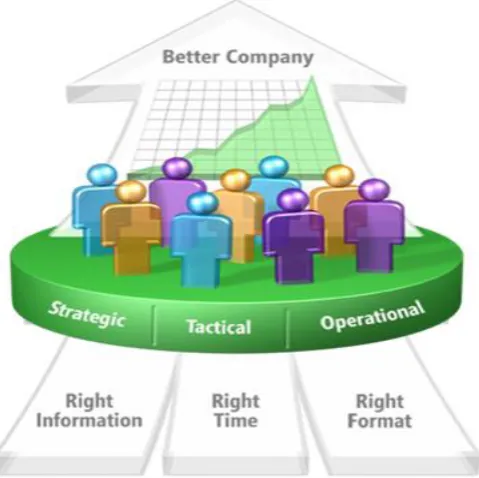
Business Intelligence (BI) is a wide range of applications and technologies for gathering, storing, analysing, and providing access to data to help clients make better business decisions. BI is a system that collects, integrates, analyses and presents business information to support better business decision making. BI is an environment where business users receive information that is reliable, secure, consistent, understandable, easily manipulated and timely...facilitating more informed decision making. With the help of Business Intelligence, we can improve our management process, Operational process, and predict the future. The Golden rule of BI is “Get the right information from the right people at the right time” and “Give the right information to the right people at the right time”.
[image:1.595.313.553.494.733.2]© 2016, IRJET | Impact Factor value: 4.45 | ISO 9001:2008 Certified Journal
| Page 1113
1.2 What is Cloud?
Cloud Computing is a huge storage of data and there is no involvement any hardware or any software. Your data is store in somewhere else company’s network and you can access that data from anywhere and anytime. Cloud computing is also change over time; it has been divided into three broad service categories: Infrastructure-as-a-Service (IaaS), Platform-as-a-Service (PaaS) and Software-as-a-Service (SaaS). In simple term cloud computing means storing and accessing data over the internet without use our computer’s internal memory or hard drive. The market was already generating more than $100 billion a year in 2012. It might be more than $500 billion by the year 2020.
Cloud Computing has a variety of characteristics with the main ones being:
Shared Infrastructure – In this virtualized programming model is utilized which is empowering the sharing of physical administrations and systems administration capacities. Cloud framework is paying little mind to sending model, tries to benefit as much as possible from the accessible foundation over various clients.
Shared Infrastructure – In this virtualized programming model is utilized which is empowering the sharing of physical administrations and systems administration capacities. Cloud framework is paying little mind to sending model, tries to benefit as much as possible from the accessible foundation over various clients.
Dynamic Provisioning - It permits the present interest necessities. This is done naturally utilizing programming robotization, empowering the development and withdrawal of administration ability, when it is required. This dynamic scaling should be done while keeping up of dependability and security.
Network Access – We can access from anyplace and at whatever time over the web from an expansive scope of gadgets utilizing guidelines based APIs (for instance, Bank Transaction API). Arrangements of administrations in the cloud incorporate everything from utilizing business applications to the most recent application on the freshest cell phones.Cloud Computing offers a number of benefits as some of these benefits can be emphasized6:
Costs - The cloud guarantees to diminish the expense of securing, conveying, and keeping up registering power, an advantage of specific significance in times of financial instability.
Access - The cloud guarantees widespread access to powerful registering and capacity assets for anybody with a system access gadget.
Collaboration - The cloud introduces a domain where clients can create programming based administrations that upgrades coordinated effort and encourages more prominent data sharing, inside the office, as well as among other government and private elements.
Scalability and Capacity - The cloud is a dependably on figuring asset that empowers clients to their particular needs. Boundlessly versatile, distributed computing permits IT bases to be extended effectively and conveniently without the need of making real capital speculations.
Customization - Distributed computing offers a stage of gigantic potential for making and correcting applications to address a differences of undertakings and difficulties.
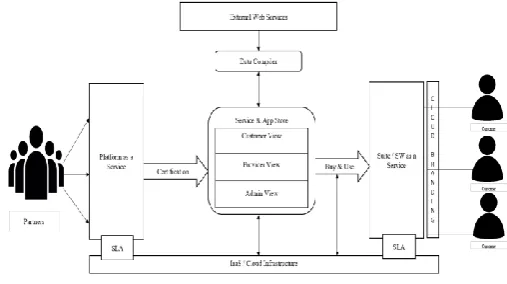
Resource Maximization - Distributed computing facilitates the weight on IT assets effectively extended meager, especially essential for organizations confronting deficiencies of qualified IT experts.Fig -2: Infrastructure of Cloud
[image:2.595.312.566.494.636.2]© 2016, IRJET | Impact Factor value: 4.45 | ISO 9001:2008 Certified Journal
| Page 1114
Now, we can understand the above figure properlythat firstly there are many partner in the market who can provide cloud to store our data. Partners uses PaaS to see that which platform is used in this application and after that there is a certification which gives the authorization that this is good for our application. After that data goes into the Service & App store where there are three types of view i.e. Customer view where customer or people can view and use the application. Next is Provider view where which provider is providing this platform for particular application.
After that Admin view is to see the customer statistics for admin here admin can control on the application. If everything is done properly then that application is ready for Buy & Use and it is going to SaaS where we can use software as live service or project. SLA (Service License Agreement) is connected with PaaS and SaaS. SLA gives us the license agreement that this application is ready to use and anyone can use with the help of multiple services.
The data is also stored in IaaS, here Infrastructure is also coming into the picture and here if we can use very huge infrastructure for some of the application or software so that time we can use IaaS. And last that application is used by the customer. So, basically here most important thing is when data is coming for storage that time data compiler which compile the data and only fact and structured data can go next stage. So, loss of control over data is decreases and security is increases.
Below are four different types of clouds:
Public cloud: It is open to overall population over web like Google cloud. Anybody can utilize this cloud and getting data.
Private cloud: Here foundation and information is overseen inside by big business and it is not available to overall population outside and it is just restricted just in that specific venture.
Hybrid cloud: It is having highlights both of open cloud and private cloud. For instance, association may store their accomplished information on open cloud and operational information on private cloud.
Community cloud: It is when association having comparative necessity offer one cloud among them.2. RESEARCH METHODOLOGY
Due to relatively new nature of the subject Cloud computing in the domain of Business Intelligence, there is not enough secondary data available. As we all know that right now strategies based BI does not work so we use cloud computing for storing data. Once we store the data on cloud
after thatwe are feel free because over there our data isvery safe and secured. There are many tight securities like encryption, decryption, biometric scanning etc. So, in cloud only recognized person can assess those data.
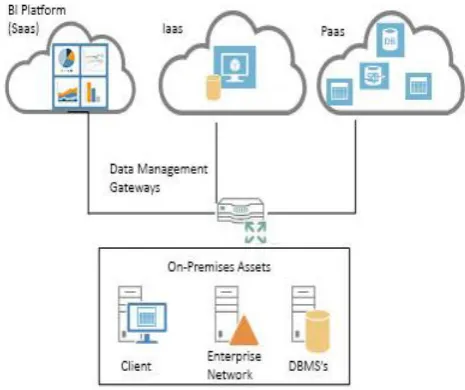
Fig -3: Cloud Services
As we can see in above image there is a client, enterprise network and DBMS’s, they all are connected with Data Management Gateways and SaaS, IaaS and PaaS along with gateways and that is cloud so, person can access his/her data from anytime and anywhere whenever it is needed.
When we purchase cloud from vendor we have to check all things like It’s bandwidth, it’s capacity, good backup plan, it’s data storage time, it is a local vendor or local brand cloud or recognized vendor and recognized brand cloud, we have to see all these things because once we deploy on cloud after that is some problem occurs that time we can’t do anything because there are many user’s data which is store in that cloud.
Cloud infrastructure consists of servers, storage devices, network, cloud management software, deployment software. So, there are many things involve here and all are depending on each other. Like is server is not there then there is no use of cloud, if server is there and storage device is not there then there is also no use of cloud so, everything would be connected with each other.
2.1 Data Movement
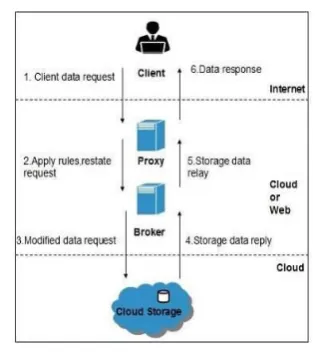
The below diagram is shown how client request for data to cloud and how cloud works:
[image:3.595.310.543.163.358.2]© 2016, IRJET | Impact Factor value: 4.45 | ISO 9001:2008 Certified Journal
| Page 1115
2.
After requesting from client proxy apply some rulesand check that is the same client which isupload or store his / her data kind of authentication.
Fig -4: Data Movement Process
3. The Broker modified that data request and execute it. In that if there is some error occurred then solved by broker and request to cloud manager.
4. Once all things are correct then storage data can reply and give data to broker.
5. Once data is coming from storage then broker gives to proxy.
6. And at last finally client getting or show his data.
2.1 Limitations
The below are the limitations of moving data over the cloud. In that here our main focus on Loss of control over data & Security / Trust issue.
Loss of control over data Security / Trust issue Lack of management buy in Lack of budget
Lack of integrated business solution
The above points shown limitation while we moving data into the cloud. See, every coin has two sides so, there might be somewhere if cloud is useful for some people so cloud is un-useful for some people. It there is a start-up company so it can’t afford a huge or a branded vendor cloud so, there might be chance of lack of budget. Sometimes if there is a huge amount of data so, it can be loss of control over data there are chances to loose our important data.
2.1 Benefits
Reduced Maintenance overhead
Reduction in total cost of ownership Limited in house capability
Focus on core business
Flexible infrastructureWith including limitations there are benefits is also there for moving data into the cloud. Cloud computing uses less electricity. When you run your own data centre, your servers won't be fully-utilized. Idle servers waste energy. So a cloud service provider can charge you less for energy used than you're spending in your own data centre.
When you run your own servers, you're looking at up-front capital costs. But in the world of cloud-computing, financing that capital investment is someone else's problem. When you run your own servers, you need to buy more hardware than you need in case of failure. In extreme cases, you need to duplicate everything.
Moving to the cloud will save your money, not just for your cloud security needs, but for many other types of data centre workloads.
3. CONCLUSIONS
The cloud is just a metaphor for the internet. Cloud computing means storing and accessing data and programs over the internet instead of hard drive. By moving over data into the cloud, cloud platform provides information security which is agreed based upon Service Level Agreement (SLA).
This environment charge customer per transaction, monitoring will be possible at anytime, anywhere by sitting at any remote location.
REFERENCES
[1] Galina Ilieve, Tanya Yankova, Stanislava Klisarova, Cloud Business Intelligence: Contemporary Learning Opportunities in MIS training, Conference Paper – September 2015, DOI: 10.13140/RG.2.1.4332.9763 [2] Apeksha Hooda, Business Intelligence Over Cloud,
International Journal of Management, Volume 5, Issue 2, February (2014), pp. 90-100
[3] https://www.researchgate.net/publication/287994990
_A_Framework_for_Context-Aware_Cloud_Business_Intelligence
[4] http://www.webroot.com/in/en/business/resources/a rticles/cloud-computing/five-financial-benefits-of-moving-to-the-cloud
[image:4.595.75.233.148.325.2]© 2016, IRJET | Impact Factor value: 4.45 | ISO 9001:2008 Certified Journal
| Page 1116
[6] GTSI Corp., Cloud computing, Building a framework for Successful transition, 2009
[7] https://en.wikipedia.org/wiki/Cloud_computing [8] https://en.wikipedia.org/wiki/Business_intelligence
BIOGRAPHIES
Author’s Name: Dipal V. Modi Author’s Profile: He is pursuing MBA – IT from Symbiosis Institute of Computer Studies and Research (SICSR), Pune, India.
Author’s Name: Syed Khizer Author’s Profile: He is Associate Professor in the Department of Computer Science at Qassim University, Al – Qassim, Kingdom of Saudi Arabia.
Author’s Name: Pravin S. Metkewar
Author’s Profile: He is working as Associate Professor in the Department of Computer Science at Symbiosis Institute of Computer Studies and Research, Pune, Maharashtra. He has presented and published 30 research paper and 2 books in his account.