International Journal of Emerging Technology and Advanced Engineering
Website: www.ijetae.com (ISSN 2250-2459, ISO 9001:2008 Certified Journal, Volume 6, Issue 8, August 2016)
199
Experimental Study on Cellular Light Weight Wall (CLW)
M. Arvind
1, P. Muthukrishnan
2, S. Premanand
31Assistant Professor, 2,3IV year, Department of Civil Engineering, S.A. Engineering College, Chennai, India
Abstract—Now-a-days there are so many technologies involved in the recent development of concrete. In which, Cellular Lightweight Walls (CLW) is one of the recent emerging technology in making concrete. By using this type of construction have found so many advantages compared to the red brick and hollow blocks. This paper mainly focused on making CLW using Fly-ash. This paper also focused on the innovative idea of using virgin polypropylene fiber to make the structure stronger and stiffer and using de-shuttering solution to make the structure remove safe from shuttering and also to avoid damages on the surface of the structure. Hence were oil is not applied of the surface of the shutter. Fly ash is a waste product from thermal power plants, were (C) grade fly ash are used. The density is considerably reduced by using foam. When we use this type of construction we achieve large volume by less amount of mixture. The manufacturing process of this type of construction does not involve any high cost techniques. Manufacturing process of CLW is similar to normal mix and in this additionally foam generating machine is used. CLW based housing is fire proof, termite proof, thermally insulated, sound proof, environment friendly.
Keyword—-Cellular Light Weight Wall; Fly –ash; Virgin Polypropylene fiber; De-shuttering solution.
I. INTRODUCTION
Lightweight Construction Methods (LCM) also known as foam concrete (FC) were developed more than 60 years ago and since then have been used internationally for different construction applications. LCM has been used in the building industry for applications such as apartments, houses, schools, hospitals, and commercial buildings. Cellular Light weight walls are the upcoming popular construction material in India and all across the globe. It is also known as Light Weight walls. To counteract the labour and construction cost, Cellular Light weight walls are made. It helps in building all types of infrastructures, including small, medium and huge. They are cost effective and also save several days in construction. They are the most modern and innovative part of building marvel in today’s high technology revolution.
A.Types Of Lightweight Concrete
Lightweight concrete can be prepared either by injecting air in its composition or it can be achieved by omitting the finer sizes of the aggregate or even replacing them by a hollow, cellular or porous aggregate. Particularly, lightweight concrete can be categorized into three groups:
i) No-fine concrete
ii) Lightweight aggregate concrete iii) Aerated/Foamed concrete
B.Applications
The applications of LCM in civil infrastructure are diversified and include:
• Cast in-place for units of low cost terrace houses, high-rise buildings, and bungalows.
• Panels and partition walls of various dimensions either pre-cast or poured in place.
• All types of insulation works, including cavity walls.
• Roofing and ceiling panels. • Sound proofing applications.
• Void filling and infill sections between beams of suspended floors.
• Crash barriers.
• Explosion-resistant structures. • Highway sound barriers
C.Benefits
There are number of benefits of CLW. These include: • Reduces the dead weight of a structure from 1/3rd
to 1/2 the weight of normal concrete.
• Produces high strength and the lifespan of the structure is increased compared with normal construction
• Can be nailed, planed, drilled and sawed. • Provides excellent heat and sound insulation. • Can be applied with all traditional surface finishes:
paint, tiles, bituminous membranes, carpets, etc. • Moisture/water resistant and fire resistant.
D.Weight Reduction
The density of foam concrete ranges from 250 to 1,800 kg/m3, as compared to 2,400- 2,600 kg/m3 for conventional concrete. Therefore, the weight of a structure built with foam would undoubtedly be reduced significantly, leading to tremendous savings in the use of reinforcement steel in the foundations and structural members.
E.Thermal Insulation
International Journal of Emerging Technology and Advanced Engineering
Website: www.ijetae.com (ISSN 2250-2459, ISO 9001:2008 Certified Journal, Volume 6, Issue 8, August 2016)
200
F.Fire Rating
A 13 to 15 cm (5-6 inch) thick wall made of 1,100 kg/m3 density LCM has a fire endurance of 5-7 hours. The same degree of endurance is achievable with a 400 kg/m3 density LCM that is only l0 cm thick. LCM is non-combustible, and the air embedded in LCM attributes to the high fire-rating.
G.Sound Insulation
Cellular light weight wall (CLW) is a perfect impact and air-borne sound absorbing concrete and thus is highly suitable for partition walls and floor screeds/foundations.
H.Savings In Material
A reduction in dead weight contributes substantially to savings in reinforcement steel in foundations. Therefore, the overall quantity of steel reinforcement can be reduced by as much as 10%. Savings are also substantial in transportation as well as in raw materials. Casting very slender walls can optimize the amount of concrete used, which also results in using a very thin layer of plaster.
I. Savings In Manpower
Only a few semi-skilled workers are needed to produce CLW for the casting/pouring of panels. In producing LCM, steel works, formworks, brick laying and cement renderings do not constitute major site activities, and therefore the related workers are not required. Workers are only needed to set up cost saving and reusable formworks, and then to remove them for the next erection /casting. and then to remove them for the next erection /casting.
J. Life Span Of Cellular Light Weight Concrete
Cellular Light Weight concrete has a life-time span (minimum 100 years). Previous investigation has shown that sectioned blocks of cellular.
II. METHODOLOGY
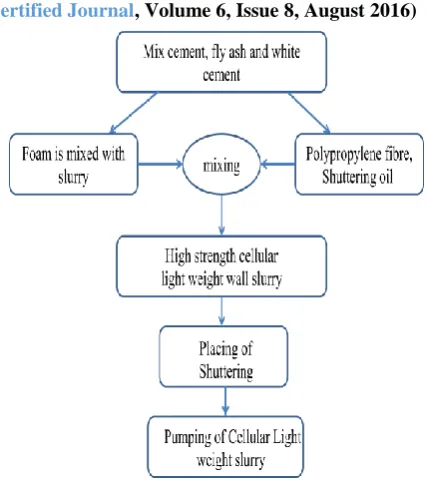
[image:2.595.323.537.118.359.2]The materials used are ordinary Portland cement of grade 53, Fly-ash of grade C, White cement, virgin polypropylene fibre& De-shuttering solution. These are the ingredients are used for the preparation of slurry and the main ingredient used is FOAM. Foam is used to make the slurry density to drop by creating air bubbles inside the slurry paste. Creating bubbles makes the density of the slurry very low and also it forms as a light weight structure.
Fig. 1. Flow chart for preparing CLW
III. MIXING PROCEDURE
A.Foaming Agent
The foaming agent is based on a protein hydrolisation and is biodegradable. It causes no chemical reaction with the surrounding matrix but serves solely as a wrapping material for the air to be encapsulated in the concrete (mortar).
The containments holding foaming agent must be kept airtight and under temperatures not exceeding 25°C. Once diluted in 40 parts of potable water, the emulsion must be used soonest. The weight of the foam should be minimum 80 g/l, the containment should be as close as possible to 10 Litres in volume, to check the weight (density) of the foam. Under no circumstances must the foaming agent be brought in contact with any oil, fat, chemical or other material that might harm its function (Oil has an influence on the surface-tension of water).
[image:2.595.318.549.594.728.2]International Journal of Emerging Technology and Advanced Engineering
Website: www.ijetae.com (ISSN 2250-2459, ISO 9001:2008 Certified Journal, Volume 6, Issue 8, August 2016)
201
B.Production Procedures
[image:3.595.54.277.227.363.2]The extremely high stability and stiffness of the cellular light weight wall (C.L.W) foam allows density of 1000 kg/m3 to 1800 kg/m3, to be produced with an optimum ratio of strength-to density. The possible wide range of densities achievable thus offers diversified applications, such as cellular light weight wall.
Fig. 3. Cellular Light Weight Foam Slurry
C.Curing
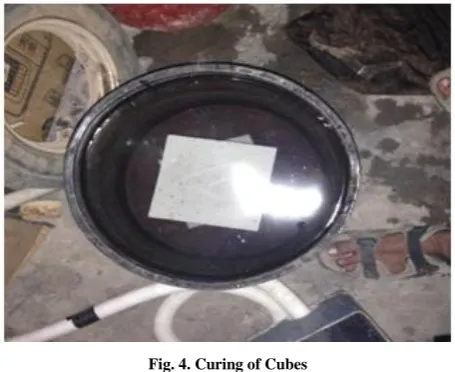
Cellular light weight walls (CLW) requires a curing means and period identical to that of conventional concrete. It is essential, as in conventional concrete, that cement-based elements have moisture for hydration at an early age. This is particularly true in the presence of direct sunlight that is known to cause rapid dehydration of concrete surfaces; curing compound can be applied as an alternative barrier.
Fig. 4. Curing of Cubes
IV. RESULTS AND DISCUSSIONS
In this chapter, discussion will be focused on the performance of cellular light weight wall concept.
The results presented in this chapter are regarding the compressive test, density, water absorption, pH test for different trial mixes of the cellular lightweight sample blocks.
A.Strength And Density Comparison
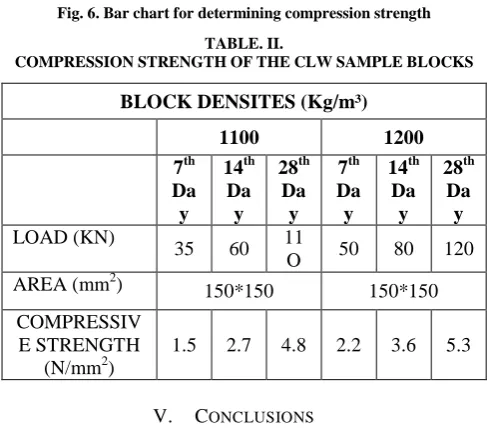
The purpose of this test is to identify the performance of cellular light weight wall in term of density and compressive strength. The results are presented in Table. I and illustrated in Figure 5. It can be seen that compressive strength for cellular light weight wall (CLW) are low for lower density mixture. As a result, compressive strength will also decrease with the increment of those voids. The required compressive strength of cellular light weight wall is 37.45 MPa at 28 days as a non load bearing wall. The compressive strengths obtained from these mixtures carried out are higher than 3.45 MPa and therefore it is acceptable to be produced as non-load bearing wall.
B.Compressive Strength
[image:3.595.50.278.498.684.2]International Journal of Emerging Technology and Advanced Engineering
Website: www.ijetae.com (ISSN 2250-2459, ISO 9001:2008 Certified Journal, Volume 6, Issue 8, August 2016)
[image:4.595.315.547.133.306.2]202
Compressive strength at 28 days for1:40, therefore it can be concluded that of the ratio between 1:30 and 1:40 can be applied to the foam agent and water. But as for the 1:25 ratio, the compressive strength is slightly lower to the previous two mixtures with compressive strength of 5.5MPa. This is because, during the mixing process, it can be seen that the foam are not perfectly produced. It is not fully expanded as the other mixture with 1:40 and 1:30 ratio. 1:25 ratio should not be recommended for future preparation since that the water was insufficient to dilute the foam agent correctly. It has been set to get the most suitable and economic mixture. The three mixture were prepared with different water cement ratio of 1: 0.45 to see the effect of this variable on aerated lightweight concrete behaviour.Fig. 5. Strength comparison between CLW & Red brick
TABLE. I.
COMPARISON OF GENERAL PROPERTIES
SL.
NO PARAMETERS
CELLULAR LIGHT WEGHT WALL
BURNT CLAY BRICK
1 Density (Kg/m3) 900-1800 1900-2200
2 Compressive
strength (N/mm2) 3-5 2.2-2.4
3 Water Absorption 8-12% 20%
4 Drying Shrinkage (mm/m)
No Shrinkage
No Shrinkage
Fig. 6. Bar chart for determining compression strength
TABLE. II.
COMPRESSION STRENGTH OF THE CLW SAMPLE BLOCKS
BLOCK DENSITES (Kg/m³)
1100 1200
7th Da y
14th Da
y 28th
Da y
7th Da y
14th Da
y 28th
Da y LOAD (KN)
35 60 11
O 50 80 120
AREA (mm2) 150*150 150*150
COMPRESSIV E STRENGTH
(N/mm2)
1.5 2.7 4.8 2.2 3.6 5.3
V. CONCLUSIONS
[image:4.595.309.553.311.526.2] [image:4.595.50.280.314.521.2]International Journal of Emerging Technology and Advanced Engineering
Website: www.ijetae.com (ISSN 2250-2459, ISO 9001:2008 Certified Journal, Volume 6, Issue 8, August 2016)
203
REFERNCES[1] P.S.Bandari et.al., Cellular light weight concrete using fly-ash, ISSN 2319-8753, vol.3, Issue 11, November 2014, IJIRSET. [2] K.Krishna bhavani siram, Cellular light-weight concrete blocks as
a replacement of burnt clay bricks, ISSN 2249-8958, Volume-2, Issue-2, December 2014, IJEAT.
[3] Sagar W.Dhengare et.al., Cellular light weight concrete, ISSN-3347-4482, Vol.16, April 2015, JIAATS.
[4] T.I.T Noor hasanah et.al., New light weight construction material: Cellular mat using recycled plastic, Vols.594-594 (2014) pp 503-510(2014).
[5] Nahro Radi Husein et.al., An experimental study on using light weight web sandwich panel as a floor and a wall, ISSN:2278-3075, Volume-3, Issue-7, December 2013, IJITEE.
[6] S.Geetha et.al., Characteristics of light weight composite wall panels with polypropylene fibres, eISSN:2319-1163/pISSN:2321-7308, IJRET.
[7] Felix A.Oginni, Continental application of foamed concrete technology, ISSN:2231-0843, Article No.BJAST.2015.040. [8] Ali J.Hamad, Material, Protection, Properties and application of
aerated light weight concrete, IJMSE Vol.2, No.2 December 2014. [9] K.Krishna bhavani siram Foam concrete-The present generation’s building solution, ISSN 2249-6866, Vol.3, ISSUE 4, OCT 2013 IJCSEIERD.
[10] Md Azree othuman mydin et.al, An experimental investigation of mechanical properties of light weight foamed concrete concrete subjected to elevated temperature upto 600°c, Vol.1(4)-December 2010.
[11] Nagesh.Mustapure et.al., Experimental investigation on cellular light weight concrete blocks for varying grades of density, Issue(online):2348-7550, Volume.no.02, Issue No.08, August 2014, IJATES.
[12] N.Narayanan et.al.,Structure and properties of aerated concrete, Cement&concrete composite 22(2000), 13 April 2000.
[13] Md Azree othuman mydin et.al., Effect of polypropylene fibre content of flexural strength on light weight concrete at ambient
and elevated temperature, ISSN:0976-8610, AASR,2012,
3(5):2837-2846.
[14] Prof.ChetnaM.Vyas et.al., Fly ash and recycled coarse aggregate in concrete, Volume-4, Issue-5, May 2013, IJETT.
[15] Neville.A.M, Properties of concrete, 5th edition,2011.
[16] M.S.Shetty, Concrete technology theory and practice, Published by S.Chand& company, Ram nager, New delhi.
[17] IS 516-1959 ―Method of tests for strength of concrete‖, Bureau of Indian standards, New Delhi.
[18] IS 456:2000-Plain and reinforced concrete-Code of practice. [19] IS 2185(PART-4):2008- Concrete masonry units – specifications,
part-4 Performed foam cellular concrete blocks.