R
EDUCING
C
OMPLEXITY IN
D
EVELOPING
W
IRELESS
S
ENSOR
N
ETWORK
S
YSTEMS
U
SING
M
ODEL
-D
RIVEN
D
EVELOPMENT
Aymen J. Salman
School of Computing, Science and Engineering
College of Science and Technology
University of Salford, Salford, UK
Submitted in Partial Fulfilment of the Requirements of the
Degree of Doctor of Philosophy
II
Table of Contents
TABLE OF CONTENTS ... II
LIST OF FIGURES ... VI
LIST OF TABLES ...VIII
LIST OF CODE SNIPPETS ... X
LIST OF EQUATIONS ... XI
LIST OF ABBREVIATION ... XII
ACKNOWLEDGMENTS ... XIV
DECLARATION ... XV
ABSTRACT ... XVI
KEYWORDS ... XVIII
CHAPTER 1: THESIS INTRODUCTION AND RESEARCH METHODOLOGY ... 1
1.1 INTRODUCTION ... 1
1.2 MOTIVATION ... 1
1.2.1 Research Motivation ... 1
1.2.2 Motivations for a Proposed Solution ... 2
1.3 ANALYSIS OF CHALLENGES IN WSNDEVELOPMENT ... 3
1.3.1 Challenging Dimensions of WSN Application Development ... 4
1.3.2 Potential Developers of WSN Application ... 6
1.3.3 Demonstration Case Study (Scenario) ... 8
1.4 RESEARCH PROBLEM ... 9
1.5 RESEARCH AIM AND OBJECTIVES ... 9
1.6 RESEARCH SCOPE ... 10
1.7 CONTRIBUTIONS TO KNOWLEDGE ... 10
1.8 RESEARCH METHODOLOGY ... 12
1.9 PUBLICATIONS ... 15
1.10 THESIS OUTLINE... 15
CHAPTER 2: BACKGROUND AND OVERVIEW ... 17
2.1 INTRODUCTION ... 17
2.2 WIRELESS SENSOR NETWORK ... 17
2.2.1 Most Popular WSN Hardware ... 18
2.2.2 TinyOS ... 19
2.3 HOW CAN COMPLEXITY BE SOLVED? ... 20
III
2.3.2 Domain-Specific Language (DSL) ... 22
2.4 APPROACHES TO DEFINING WSNDEVELOPMENT ABSTRACTION -RELATED WORK ... 23
2.4.1 Embedded Operating Systems ... 23
2.4.2 Customised Platform... 24
2.4.3 Model-Driven Development ... 27
2.4.4 Principal Findings ... 32
2.5 FORMULATED DESIGN REQUIREMENTS ... 37
2.6 CHAPTER SUMMARY ... 38
CHAPTER 3: SENNET META-MODEL ... 39
3.1 INTRODUCTION ... 39
3.2 MODELLING AND META-MODELLING ... 39
3.3 SENNET META-MODEL ... 41
3.3.1 Application Configuration in SenNet Mata-Model ... 43
3.3.2 Network Configuration in SenNet Mata-Model ... 45
3.4 ISO/IEC29182–SENSOR NETWORK REFERENCE ARCHITECTURE ... 45
3.5 APPLICATION TYPES SUPPORTED BY THE SENNET META-MODEL ... 47
3.6 CHAPTER SUMMARY ... 49
CHAPTER 4: SENNET LANGUAGE - INTERNAL VIEW ... 50
4.1 INTRODUCTION ... 50
4.2 SENNET INTERNAL VIEW ... 50
4.3 CODE PARSING COMPONENT (CPC) ... 52
4.3.1 Lexical and Syntactical Analysis Stage ... 53
4.3.2 Semantic Analysis Stage ... 55
4.4 CODE GENERATION COMPONENT (CGC) ... 55
4.4.1 Why Use TinyOS as a Foundation for SenNet?... 56
4.4.2 Code Generation Process ... 59
4.5 SENNET EXTENSIBILITY AND UPDATE PROCESS ... 65
4.6 CHAPTER SUMMARY ... 66
CHAPTER 5: SENNET LANGUAGE - PROGRAMMING VIEW ... 67
5.1 INTRODUCTION ... 67
5.2 SENNET LANGUAGE ... 67
5.3 SENNET COMPONENTS ... 69
5.3.1 Code Parsing Component (CPC) ... 69
5.3.2 Code Generation Component (CGC) ... 70
5.4 SENNET APPLICATION GENERAL SYNTAX AND DEVELOPMENT STEPS ... 72
5.4.1 Job Types ... 74
5.4.2 Network Elements ... 78
IV
5.4.4 Job Action ... 80
5.5 CHAPTER SUMMARY ... 82
CHAPTER 6: SENNET EVALUATION ... 83
6.1 INTRODUCTION ... 83
6.2 PROOF OF CONCEPT CASE STUDY ... 83
6.3 SENNET EVALUATION PLAN ... 89
6.3.1 Languages under Test ... 90
6.4 SCOPE OF APPLICATION FUNCTIONALITY... 91
6.5 APPLICATION SOURCE CODE ANALYSIS ... 92
6.5.1 Node-Level Applications ... 94
6.5.2 Network-Level Applications ... 96
6.5.3 Results Summary ... 98
6.6 BUSINESS CASE STUDY APPLICABILITY ... 101
6.6.1 Scenario 1 - Light Monitoring in Tunnels ... 101
6.6.2 Scenario 2 - Temperature Monitoring for Smart Homes ... 105
6.7 USER STUDY EXPERIMENT ... 108
6.7.1 Goals/Questions/Metrics ... 108
6.7.2 Question Rating Scales and Metrics Benchmarking ... 113
6.7.3 Experiment Tasks ... 116
6.7.4 Experiment Participants ... 117
6.7.5 Experiment Materials, Tools and Equipments ... 120
6.7.6 Experiment Protocol ... 120
6.7.7 Experiment Results Discussion... 121
6.8 EVALUATION SUMMARY ... 126
CHAPTER 7: DISCUSSION, CONCLUSION AND FUTURE WORK ... 129
7.1 INTRODUCTION ... 129
7.2 DISCUSSION (RESEARCH OUTCOMES) ... 129
7.3 CONCLUSION ... 132
7.4 LIMITATIONS ... 133
7.5 FUTURE WORK ... 134
REFERENCES ... 135
APPENDIX A: CONFERENCES AND TRAINING COURSES ... 155
APPENDIX B: SURVEYS ... 156
B.1 SAMPLE OF RESEARCH ARTICLES REFERRED TO WSNPROGRAMMING COMPLEXITY ... 156
B.2 SAMPLE OF RESEARCH ARTICLES REFERRED TO WSNNOVICE DEVELOPERS ... 157
B.3 SAMPLE OF RESEARCH DOCUMENTS REFERRED TO DOMAIN EXPERTS ... 157
V
APPENDIX D: SENNET GRAMMAR ... 163
APPENDIX E: SENNET CGC IMPLEMENTATION ... 168
E.1 APPCGENERATOR.XTEND ... 168
E.2 CGENERATOR.XTEND ... 169
E.3 HEADERGENERATOR.XTEND ... 172
E.4 MAKEFILEGENERATOR.XTEND ... 172
APPENDIX F: APPLICATION SOURCE CODE ANALYSIS SCENARIOS IMPLEMENTATION 173 F.1 SINGLE NODE SENSEFORWARD SCENARIO ... 173
F.1.1 SenNet Version ... 173
F.1.2 nesC Version ... 173
F.1.3 HCM Operands and Operators Statistics ... 175
F.2 NETWORK-LEVEL SENSEFORWARD SCENARIO ... 176
F.2.1 SenNet ... 176
F.2.2 nesC ... 176
F.2.3 HCM Operands and Operators Statistics ... 178
F.3 NETWORK-LEVEL EVENT-BASED SCENARIO ... 179
F.3.1 SenNet ... 179
F.3.2 nesC ... 179
F.3.3 HCM Operands and Operators Statistics ... 181
APPENDIX G: BUSINESS CASE STUDY APPLICABILITY SCENARIOS - NESC IMPLEMENTATION ... 182
G.1 SCENARIO-1 ... 182
G.2 SCNEARIO-2 ... 183
APPENDIX H: USER STUDY EXPERIMENT ... 185
H.1 ETHICAL APPROVAL LETTER ... 185
H.2 PRE-EXPERIMENT QUESTIONS ... 186
H.3 POST-EXPERIMENT QUESTIONS ... 186
VI
List of Figures
FIGURE 1-1:WSNAPPLICATION DEVELOPERS TECHNOLOGY BACKGROUND AND PROGRAMMING SKILLS ... 7
FIGURE 1-2:RESEARCH PARADIGM ... 12
FIGURE 1-3:RESEARCH MAIN STAGES ... 14
FIGURE 2-1:WSNDEVELOPMENT APPLICATIONS APPROACHES ... 23
FIGURE 3-1:WSNMETA-MODEL ... 42
FIGURE 3-2:THE DIFFERENCE BETWEEN SYNCHRONOUS /ASYNCHRONOUS PROGRAMMING MODELS (“GETTING STARTED WITH TINYOS,” N.D.) ... 44
FIGURE 3-3:PHYSICAL OPERATIONAL ACTIVITY MODEL ... 47
FIGURE 3-4:GENERAL SENSOR NETWORK SYSTEM FUNCTIONALITY DIAGRAM ... 47
FIGURE 4-1:SENNET IMPLEMENTATION ARCHITECTURE ... 51
FIGURE 4-2:HIGH-LEVEL SENNET FUNCTIONALITY MODEL ... 52
FIGURE 4-3:GENERAL NESCMODULE PROGRAM STRUCTURE ... 56
FIGURE 4-4:SENSOR NODE PROGRAMMING CONVENTIONAL PROCESS... 58
FIGURE 4-5:CODE GENERATORS TRIGGERING PROCESS ... 60
FIGURE 4-6:THE CGENERATOR ALGORITHM TO IMPLEMENT SENSEJOB JOB TYPE ... 61
FIGURE 4-7:THE CGENERATOR ALGORITHM TO IMPLEMENT NETWORKDATAPROCESSING JOB ... 62
FIGURE 4-8:SENNET UPDATING AND EXPANDING PROCESS ... 65
FIGURE 5-1:GENERAL WSNAPPLICATION DEVELOPMENT STEPS USING SENNET ... 67
FIGURE 5-2:SENNET WORKING MECHANISM ... 68
FIGURE 5-3:SENNET’S MAIN FEATURES ... 69
FIGURE 5-4:SENNET EDITOR VIEWS ... 70
FIGURE 5-5:SENNET IDEFEATURES (A)IDELANGUAGE HELPER,(B)IDEERROR MESSAGE EXAMPLE ... 70
FIGURE 5-6: NESCGENERATED FILES FOR SENNET APPLICATION ... 71
FIGURE 5-7:GENERAL SENNET APPLICATION AND JOB STRUCTURE ... 73
FIGURE 5-8:SENNET JOB DEVELOPMENT STEPS ... 74
FIGURE 5-9:JOB TYPES SENNET META-MODEL ... 75
FIGURE 5-10:NETWORK ELEMENTS SENNET META-MODEL ... 78
FIGURE 5-11:STARTENDJOB SENNET META-MODEL ... 80
FIGURE 5-12:JOBACTION SENNET META-MODEL ... 81
FIGURE 6-1:CASE STUDY DEVELOPMENT USING TEXT-BASED EDITOR VIEW... 85
FIGURE 6-2:CASE STUDY DEVELOPMENT USING TREE-BASED EDITOR VIEW ... 86
FIGURE 6-3:TINYOSCOMPONENT GRAPH FOR ASAMPLE OF THE GENERATED NESCFILES ... 86
FIGURE 6-4:THE THREE IRIS-XM2110USED TO VALIDATE THE GENERATED FILES CODE ... 87
FIGURE 6-5:SENNET EVALUATION PLAN ... 90
FIGURE 6-6:SCREEN SNAPSHOT FOR SFSCENARIO USING SENNET ... 96
FIGURE 6-7:SCREEN SNAPSHOT FOR NETWORK-LEVEL SENSEFORWARD SCENARIO USING SENNET ... 97
VII
FIGURE 6-9: NESC AND SENNET LOCSTATISTICS ... 99
FIGURE 6-10:SENNET SAVING IN LOC ... 99
FIGURE 6-11:SENNET SAVING PERCENTAGES ACCORDING TO HCMFORMULAS ... 100
FIGURE 6-12:SAMPLE SCREENSHOT FOR THE SENNET EDITOR FOR SCENARIO-1 ... 104
FIGURE 6-13:SAMPLE SCREENSHOT FOR THE TINYOSCOMPONENT GRAPH FOR SCENARIO-1 ... 105
FIGURE 6-14:SAMPLE SCREENSHOT FOR THE SENNET EDITOR FOR SCENARIO-2 ... 107
FIGURE 6-15:SAMPLE SCREENSHOT FOR THE TINYOSCOMPONENT GRAPH FOR SCENARIO-2 ... 108
FIGURE 6-16:GOALS/QUESTIONS/METRICS MAPPING FOR THE USER STUDY ... 113
FIGURE 6-17:PARTICIPANTS’STUDY BACKGROUND ... 118
FIGURE 6-18:PARTICIPANTS’CURRENT TECHNOLOGY FIELD OF INTEREST ... 118
FIGURE 6-19:PARTICIPANTS’PROGRAMMING EXPERIENCE ... 119
FIGURE 6-20:PARTICIPANTS USING GPL VS.DSL ... 119
FIGURE 6-21:USER STUDY EXPERIMENT GOALS FINAL RESULTS... 126
FIGURE 6-22:SENNET VS. NESCUSABILITY ... 126
VIII
List of Tables
TABLE 1-1:SUMMARY OF WSNAPPLICATION CHALLENGES ... 4
TABLE 1-2:POTENTIAL WSNDEVELOPER GROUPS ... 6
TABLE 1-3:MAPPING RESEARCH CHALLENGES TO RESEARCH OBJECTIVES AND CONTRIBUTIONS ... 11
TABLE 2-1:SAMPLE OF THE MOST USED WSNPLATFORMS 2002-2012(THANG,2015) ... 19
TABLE 2-2:COMMUNICATION TYPES SUPPORTED BY TINYOS... 19
TABLE 2-3:THE SEVEN ARCHETYPE IDENTIFIED BY BAI,DICK,&DINDA (2009) ... 25
TABLE 2-4:THE DRAWBACKS OF THE AVAILABLE STRATEGIES TO DEFINE DEVELOPMENT ABSTRACTION ... 33
TABLE 2-5:APPLICATION DEVELOPMENT APPROACHES SUMMARY ... 35
TABLE 2-6:SUMMARY OF THE CONCLUDED DESIGN REQUIREMENTS ... 38
TABLE 3-1:ISO/IEC29182-4MAIN FUNCTIONAL ENTITIES (ISO/IEC,2013) ... 46
TABLE 3-2:SENNET META-MODEL MAPPING TO ISO/IEC29182FUNCTIONAL ENTITIES ... 46
TABLE 3-3:MAPPING SENNET META-MODEL TO TAXONOMY CRITERIA (OPPERMANN,BOANO, ET AL.,2014) .... 49
TABLE 4-1:SAMPLE OF SENNET TO NESCCODE MAPPING ... 63
TABLE 6-1:GENERAL SENNET EVALUATION PLAN ... 90
TABLE 6-2:SENNET ASSESSMENT ACCORDING TO BAI CLASSIFICATION ... 92
TABLE 6-3:EMPTY APPLICATION LOC&HCMSTATISTICS... 95
TABLE 6-4:SENSEFORWARD APPLICATION SCENARIO STATISTICS ... 96
TABLE 6-5:NETWORK-LEVEL SENSEFORWARD APPLICATION SCENARIO STATISTICS... 97
TABLE 6-6:NETWORK-LEVEL EVENTBASED APPLICATION SCENARIO STATISTICS ... 98
TABLE 6-7:LOCFINAL STATISTICS ... 99
TABLE 6-8:HCMSTATISTICS ... 100
TABLE 6-9:SENNET SAVING IN TERMS OF HCMFORMULAS ... 100
TABLE 6-10:GOAL/QUESTION/METRIC MAPPING FOR THE USER STUDY... 113
TABLE 6-11:TYPE-1QUESTIONS SAMPLE ... 114
TABLE 6-12:TYPE-2QUESTIONS SAMPLE ... 114
TABLE 6-13:USER SURVEY QUESTION TYPES ... 115
TABLE 6-14:METRICS MEASUREMENT METHODS AND POSSIBLE VALUES ... 116
TABLE 6-15:THE CORRELATION BETWEEN GOALS,QUESTIONS,METRICS AND TASKS ... 117
TABLE 6-16:PARTICIPANTS’CATEGORISED GROUPS ACCORDING TO TECHNOLOGY INTEREST... 119
TABLE 6-17:PARTICIPANTS’KNOWLEDGE OF WSNTECHNOLOGY ... 120
TABLE 6-18:THE EXPERIMENT TIME TABLE ... 121
TABLE 6-19:THE CRONBACH’S ALPHA INDEX FOR THE WHOLE DATA SET (23QUESTION FEEDBACK) ... 122
TABLE 6-20:INTRODUCTORY QUESTIONS RESULTS ... 122
TABLE 6-21:SENNET AND NESCTASK COMPLETION TIMES (M122 AND M123) ... 124
TABLE 6-22:USER STUDY EXPERIMENT METRICS RESULTS ... 125
TABLE 6-23:FINAL USER STUDY EXPERIMENT GOALS RESULTS ... 126
X
List of Code Snippets
LISTING 4-1:SENNET TREE-BASED EDITOR VIEW INITIALISATION... 53
LISTING 4-2:EBNFSAMPLE RULE ... 53
LISTING 4-3:SAMPLE OF SENNET GRAMMAR SHOWING TERMINAL RULES ... 54
LISTING 4-4:SAMPLE OF SENNET GRAMMAR SHOWING PARSER RULES ... 54
LISTING 4-5:SAMPLE OF SENNET GRAMMAR SHOWING SEMANTIC RULES ... 55
LISTING 4-6:PSEUDOCODE OF GENERATED NODES-NAMING PROCESS ... 59
LISTING 4-7:PSEUDOCODE OF THE GENERATED NESC CODE FOR THE NODEDATAPROCESSING ... 61
LISTING 5-1:GENERAL SENNET APPLICATION SYNTAX ... 72
LISTING 5-2:SENSEJOB COMMAND GENERAL SYNTAX ... 76
LISTING 5-3:SENSENOWJOB COMMAND GENERAL SYNTAX ... 76
LISTING 5-4:NODEDATAPROCESSING COMMAND GENERAL SYNTAX ... 77
LISTING 5-5:NETWORKDATAPROCESSING COMMAND GENERAL SYNTAX ... 77
LISTING 5-6:JOBTARGETNODE COMMAND GENERAL SYNTAX ... 79
LISTING 5-7:JOBTARGERNETWORK COMMAND GENERAL SYNTAX ... 79
LISTING 5-8: START/ENDTRIGGER COMMAND GENERAL SYNTAX ... 80
LISTING 5-9: JOBACTION COMMAND GENERAL SYNTAX ... 81
LISTING 5-10:CONDITIONAL ACTION COMMAND SYNTAX ... 81
LISTING 6-1:SENNET APPLICATION FOR CASE STUDY SCENARIO ... 85
LISTING 6-2:SAMPLE OF THE NESCCONFIGURATION FILES ... 87
LISTING 6-3:SAMPLE OF THE NESCMODULE FILES ... 87
LISTING 6-4:AMSG.H HEADER FILE ... 88
LISTING 6-5:SAMPLE OF THE NESCMAKEFILE ... 89
LISTING 6-6:EMPTY APPLICATION -SENNET VERSION... 94
LISTING 6-7:EMPTY APPLICATION - NESCVERSION ... 95
LISTING 6-8:SENNET APPLICATION FOR SCENARIO-1 ... 102
XI
List of Equations
XII
List of Abbreviation
3SUF 3-Scale User Feedback 5SUF 5-Scale User Feedback ADC Analog-to-Digital Convertor
AM Active Message
AN Analysis
ANTLR ANother Tool for Language Recognition
ArchWiSeN Architecture for Wireless Sensor and Actuator Networks AST Abstract Syntax Tree
ATL Atlas Transformation Language BPML Business Process Modelling Language
CFG Context-Free Grammar
CG Code Generation
CGC Code Generation Component
CIM Computation-Independent Model
CPC Code Parsing Component
CTP Collection Tree Protocol
DA Data Aggregation
DARPA Defence Advanced Research Projects Agency
DE Domain Experts
DF Data Fusion
DI Dependency Injection
DSL Domain-Specific Language
DSML Domain-Specific Modelling Language DSN Distributed Sensor Network
EMF Eclipse Modelling Framework ENBNF Extended Backus-Naur Form ENVML Environment Modelling Language Eobject Eclipse Object
EOS Embedded Operating Systems
EU End Users
FQAD Framework for Qualitative Assessment of DSLs
G Group of Nodes-Level
GCC GNU Compiler Collection
GPL General Programming Language
GQM Goal/Question/Metric
HAA Hardware Abstraction Architecture HAL Hardware Adaptation Layer
HCM Halstead Code Complexity Measurement HIL Hardware Interface Layer
HPL Hardware Presentation Layer
XIII IoT Internet of Things
IQ Introductory Questions
JVM Java Virtual Machine
LOC Lines of Code
LWiSSy Domain Language for Wireless Sensor and Actuators Networks Systems
M2T Model-to-Text
MCL M-Core Control Language
MCU Microcontroller Unit
MDA Model-Driven Architecture
MDD Model-Driven Development
MOF Meta Object Facility Moppet-FM Moppet-Feature Modelling Moppet-PE Moppet-Performance Estimation
N Node-Level
ND Novice Developers
Net Network-Level
NODEML Node Modelling Language
OMG Object Management Group
OTAP Over the Air Programming PIM Platform-Independent Model PSM Platform-Specific Model
PTIR Participant’s Tasks Implementation Results SAML Software Architecture Modelling Language SenNet Sensor Network
SMS Systematic Mapping Study
SNRA ISO/IEC 29182 – Sensor Network Reference Architecture SOA Service-Oriented Architecture
SOAP Simple Object Access Protocol SUS System Usability Scale
T2M Text-to-Model
ULP Ultra-Low Power
UML Unified Modelling Language
UX User Experience
VM Virtual Machine
WSAN Wireless Sensor and Actuator Network
WSN Wireless Sensor Network
XIV
ACKNOWLEDGMENTS
First of all, over the past three years, I have received valuable support and encouragement from my supervisor at the University of Salford. Therefore, I need to state my unwavering gratitude to Dr Adil Al-Yasiri, who has provided me with perpetual support, expert advice, and for showing unlimited patience and trust in myself.
I would like to thank my father (Dr Jaber Aziz) and my mother for their love, care and support in making me the person that I have become, and to give my endless thanks for their persistent encouragement throughout the duration of my education, both past and present, although my appreciation cannot compare with their sacrifices and the unconditional motivation that they have instilled.
Without the unwavering support, patience and understanding of my loving family (Maisa & Mustafa), this PhD would not have been possible. You will get me back soon!
I gratefully acknowledge the generous financial support of The Iraqi Ministry of Higher Education and Al-Nahrain University in sponsoring me through my research.
XV
DECLARATION
I unequivocally declare that the contents of the present research are of original quality, apart from any specific references that are made regarding other researchers. This thesis has not been previously submitted for consideration to my current university or any other one. The entire content of the research is my own personal work and nothing has been formulated in collaboration with any other person, unless this is clearly specified.
Signature: Date: / /
XVI
ABSTRACT
Wireless Sensor Network (WSN) is a collection of small and low-powered gadgets called sensor nodes (motes), which are capable of sensing the environment, collecting and processing the sensed data, and communicating with each other to accomplish a specific task. Moreover, all sensed and processed data are finally handed over to a central gathering point called a base station (sink), where all collected data are stored and can be reviewed by the user.
Most of the current methods concerning WSN development are application or platform-dependent; hence it is not a trivial task to reuse developed applications in another environment. Therefore, WSN application development is a challenging and complex task because of the low-level technical details and programming complexity. Furthermore, most WSN development projects are managed by software engineers, not application field experts or WSN end users. Consequently, WSN solutions are considered expensive, due to the amount of effort that has to be put into these projects.
XVII Various tests and user study have been used to evaluate SenNet’s usability and functional suitability. Evaluation results found that SenNet could save 88.45% of the LOC required to be programmed by a developer, and 87.14% of the required vocabularies. Furthermore, results showed that SenNet could save 92.86% and 96.47% of the program length and volume respectively. Most of the user study participants (96%) found SenNet to be usable and helps to achieve the required WSN application with reduced development effort. Moreover, 82% of the participants believe that SenNet is functionally suitable for WSN application development. Two real-world business case studies developed were used to assess SenNet’s appropriateness to develop WSN real applications, and how it can be used to develop applications related to data processing tasks.
XVIII
KEYWORDS
1
Chapter 1:
Thesis Introduction and Research
Methodology
1.1
Introduction
In recent years, WSNs have received considerable attention in the research community and this is one of the most researched technology areas in the last decade (Rawat, Singh, Chaouchi, & Bonnin, 2014). In terms of business opportunities, it is expected that the WSN market will grow from $0.45 billion in 2011 to $2 billion in 2021 (Harrop, 2012; Harrop & Das, 2012). A Wireless Sensor Network (WSN) can be defined as a group of sensor nodes (motes); each node consists of one or more sensors, memory to store the sensed data, a radio for sending and receiving data and a processor. The essential capabilities of the sensor node are to sense, compute and communicate data from the environment in which the motes are working. The aim of a WSN is to combine all these functions into one single small chip. Generally, WSNs have limitations in terms of resources, such as power and memory. These limitations and the uncontrolled nature of this type of network have hampered efforts to develop the technology and, due to its compact nature, one of the complex tasks in a WSN is its programming and application development (De-Farias, Brito, et al., 2016; De-Farias, Li, et al., 2016; Lopes & Martins, 2016).
The general practice of Application development in WSNs is far removed from Software Engineering practices and standards, which are built monolithically, becoming very complex to understand and managed through the development phase (Intana, Poppleton, & Merrett, 2014). Therefore, a clear separation of concerns is required.
1.2
Motivation
1.2.1 Research Motivation
According to an MIT Technology Review article (Culler, 2003), WSN was considered to be
2 endeavours on different aspects related to WSN technology. Today WSNs have been produced for an extensive variety of applications for environment monitoring, industries, health, building, structural monitoring, military and security surveillance (Bellifemine et al., 2011; Yaacoub et al., 2013; Zhang et al., 2011; Zouinkhi et al., 2014).
WSN is becoming more and more integrated into larger computing infrastructures (Julien & Wehrle, 2013). Despite the challenges that WSN developers experience at every step in their application development, the research community is continuously working to introduce new solutions for WSN challenges. It has been noted that many programming approaches have been proposed, and many operating systems have been introduced as an abstraction level, such as TinyOS, Contiki and LiteOS, to be used by application developers.
In the face of all the efforts spent in this field, up to now designing and implementing software for WSN has been considered a complicated and challenging task (Antonopoulos et al., 2016; Cecchinel et al., 2016; Delamo et al., 2015; Essaadi et al., 2017; Lopes & Martins, 2016; Ouadjaout et al., 2016).
De-Farias et al. (2016) argue that the challenges in WSN application development are due to the lack of appropriate abstraction layers used to reduce complexity in application development. Accordingly, more research should be focused on this area. The motivation of this research is to make further contribution to this field and present an approach to WSN application development in order to reduce the complexity found in this area.
1.2.2 Motivations for a Proposed Solution
Many technologies, techniques and methods can be integrated and formed in a way to produce solutions for our research problem. But, some factors have encouraged us to build and introduce the proposed solution in this research:
3 proposal (Essaadi et al., 2017). A DSL may allow users with minimum knowledge to program and develop the required application or configure the system appropriately (Meana-Llorián et al., 2016).
• Many researchers focused on using TinyOS (Levis et al., 2005) embedded operating system and nesC (Gay et al., 2003) programming language as foundation for their research projects by defining an abstraction development or programming (Essaadi et al., 2017), such as the work in Ravichandran et al. (2016) and Tei et al. (2015). Using TinyOS and nesC as a basis to build an application development abstraction is very useful (Salman & Al-Yasiri, 2016a, 2016b) because:
1. Utilising TinyOS components and services. TinyOS is one of the most frequently used operating systems in WSN applications because of its maturity and continuous technical support. So, there is no need to re-build new components similar to TinyOS components.
2. TinyOS presents a Hardware Abstraction Architecture (HAA) (Handziski et al., 2004) that includes a Hardware Presentation Layer (HPL), a Hardware Adaptation Layer (HAL) and a Hardware Interface Layer (HIL). This HAA enables TinyOS to support a broad range of sensor node hardware types. The updated list of supported hardware can be found on the TinyOS website1; more detailed discussion regarding HAA can be found in section 4.4.1.
1.3
Analysis of Challenges in WSN Development
The research community has investigated in depth the different challenges of developing WSN applications, such as the work presented by Mottola & Picco (2011b), Randhawa (2014), Malavolta & Muccini (2014), Kumar et al. (2014), Mahmood et al. (2015), and Essaadi et al. (2017).
In this thesis two problems are identified, the first is the complexity in application development caused by the nature of the WSN technology and the limitations of the existing application development environments and processes. The second problem is related to the type of developers, and their knowledge gap in WSN programming skills and technology background,
4 which needs to be filled to enable those developers to build WSN applications successfully. In the following sections these two problems are explained and analysed in depth.
1.3.1 Challenging Dimensions of WSN Application Development
The main WSN application development challenges can be presented in two dimensions: accidental complexity and inherent complexity; the main difficulties incorporated within these dimensions are shown in Table 1-1.
Table 1-1: Summary of WSN Application Challenges
Dimension Challenging Aspects
Accidental Complexity
AC1 The lack of adequate development methodologies AC2 Restricted Software Architectures
AC3 WSN programming complexity
WSN Inherent Complexity
IC1 In-network processing or distributed computing IC 2 Sensor node mobility
IC 3 Network Robustness IC 4 Location awareness IC 5 Multiple Gateway setups
1.3.1.1 Accidental Complexity Dimension
This dimension represents the limitation in programming tools and techniques because of the overall complexity of WSN development (Cecchinel et al., 2016; Essaadi et al., 2017). This has led to a gap between application developers on the one side, and application users or application domain experts on the other. Despite the importance and value of WSNs, software application development is nevertheless viewed as one of the primary challenges that faces WSN deployment (Ferro, Silva, & Lopes, 2015; Lopes & Martins, 2016), and many of the proposed software architectures for WSN have fallen short when it came to deployment, because of:
5 they are focused on the implementation steps, and they do not use any software methodology through their development. Moreover, to date, there is no de facto
standard for application development in the WSN domain (Delicato, Pires, & Zomaya, 2014).
AC2. The existing restricted software architectures. WSN applications’ software architectures can adopt many architectural styles according to the required application nature, such as service-oriented architecture (SOA), distributed database, or mobile agent architecture. The ISO/IEC 29182 standard (ISO/IEC, 2014a) has defined a reference architecture for WSN, which highlights middleware as the most common architectural style for WSN applications. Each one of these architectural styles needs a special type of requirement in addition to a specific programming characteristic. Many researchers have proposed various types of fixed software architectures and their suitable programming approaches. Most proposed architectures are restricted to a specific architectural form or template that may not fit with all WSN applications, such as in WASP (Bai et al., 2011). Where fixed seven-standard architectural templates have been defined, and each one supports a set of WSN activities, the developer has to start the application developing process by choosing the most appropriate architecture template, where the developer will be restricted to the WSN activities that are given by this architecture template.
AC3. WSN programming complexity. Developers have to deal with the status of the sensor node in terms of memory addresses and registers, because of the limited resources in this technology (Cecchinel et al., 2016; Essaadi et al., 2017; Mottola & Picco, 2011), which leads to the fact that the programming details are too complex, difficult to learn and maintain. Most of the current proposed programming solutions and development processes do not have the required abstraction level that satisfies domain application experts and average developers. A sample of academic articles that recognise this type of difficulty shown in APPENDIX B.1.
1.3.1.2 Inherent Complexity Dimension
6 IC1. In-network processing or distributed computing (Chandra & Dwivedi, 2015; Malavolta
& Muccini, 2014; Tei et al., 2015).
IC2. Sensor node mobility: Most of the current proposed solutions consider static nodes only (Beal, Dulman, Usbeck, Viroli, & Correll, 2012; Gu, Ren, Ji, & Li, 2016; Malavolta & Muccini, 2014).
IC3. Show robustness in the network when hardware fails or message loss (Afanasov, Mottola, & Ghezzi, 2014; Chandra & Dwivedi, 2015; Mottola & Picco, 2011).
IC4. Location awareness, where Malavolta & Muccini (2014) surveyed 16 different MDD and DSML projects and found that 13 out of 16 did not support location awareness. IC5. Multiple Gateway (Sink) setup in shared sensor network, and how the network will
decide the data to which Sink node should be forwarded (Beal et al., 2012; De-Farias, Li, et al., 2016).
1.3.2 Potential Developers of WSN Application
The main factors needed to develop a successful WSN application can be broken down into:
• WSN technology background: which represents information related to low-level details, such as sensor node hardware types, sensors hardware types, available routing protocol, how to convert sensor readings into an acceptable informative data form, sensor nodes communication details, memory details included in the sensor nodes, besides the reading and writing mechanisms.
• WSN programming skills: which represents the ability to use a low-level programming language to program all the above details.
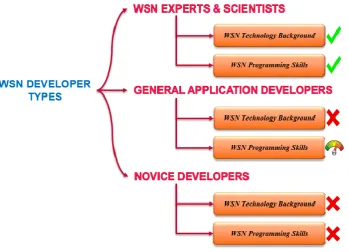
According to the literature, potential WSN application developers can be categorised as below and shown in Table 1-2 and Figure 1-1:
Table 1-2: Potential WSN Developer Groups
Potential Developer Groups PD1 WSN Experts & Scientists
PD2 General Application Developers & Programmers
7
Figure 1-1: WSN Application Developers Technology Background and Programming skills
PD1. WSN Experts & Scientists: This group includes the researchers and scientists responsible for developing this technology, who therefore have all the required information for WSN technology low-level details and programming.
PD2. General Application Developers & Programmers: This group of developers includes general developers and programmers who have experience in general programming languages such as C, C++ and Java (Elsts, 2013). This group may have some skills in low-level programming, or they may acquire these skills quickly, but they do not have a WSN technology background.
8 is a gap between the WSN application high-level requirements (the application-level knowledge) and the complexity of operations in the underlying network infrastructure (the network-level knowledge). Many researchers concentrate their research efforts on facilitating the WSN application development process for DE, such as the work presented in APPENDIX B.3.
Members of PD2 and PD3 are lacking in WSN technology background and programming experience. Therefore, members of these groups should acquire technical background and learn new programming languages to program sensor network applications. According to Robins, Rountree, & Rountree (2003), beginner programmers take about ten years of practice to write an application efficiently, which means that there is a big difference between a programmer that can write an application and another that can program the application in an efficient way. Therefore, the gap between beginners and experts is huge in WSN application development, because WSN developers not only need to improve their programming skills, but also to acquire technology background.
According to the aforementioned facts, this research is targeting PD2 and PD3 among potential WSN developers.
1.3.3 Demonstration Case Study (Scenario)
Considering these application development challenges in the WSN technology, it is clear that PD2 and PD3 of the potential developers in WSN will have difficulty in developing a successful application without hiring a highly expensive WSN developer expert. That will lead to many small projects ending before they start. As an example, take the extracted piece of code (Buonadonna, Tolle, & Gay, 2010) shown in APPENDIX C. This source code is part of the program that has to be implemented to develop a Base station application (Sink). From a beginner developer’s2 point of view, this piece of code will be a spaghetti code, which will not
be an easy task to be developed or maintained by a beginner developer such as Domain-Expert or a general application developer.
2 Beginner Developer: this term will be used through the course of this thesis to denote PD2 and PD3
9
1.4
Research Problem
The function of a WSN is to observe the surrounding environment (Marques, da Silva Teofilo, & Rosa, 2013), whereas the original vision of WSN consisted of a large number of randomly distributing small devices over a large area to enable ad hoc measurements (Oppermann, Boano, & Römer, 2014). WSNs have had a high impact on our daily life activities, and as a result, the research community has tried to invest most of their knowledge and their research efforts to leverage and abstract the development and the programming of WSN applications. However, according to the WSN application development challenges presented in sections
1.3.1 and 1.3.2 it has been noticed that these efforts have not solved the complexity of the application development for WSNs and could not make it affordable for all types of developers. Taking all the factors mentioned above into account, the following research problem has been identified:
“How can developers who have no or limited knowledge of WSN technology background and programming skills be empowered to efficiently develop a WSN application using a development abstraction that provides the required expert knowledge for the WSN technical low-level details and programming experience”.
1.5
Research Aim and Objectives
In accordance with the field of WSN programming and the application development challenges and limitations that were discussed in the previous sections, our research aim is to:
“Investigate the possibility to reduce the complexity in WSN application development by introducing a new application development abstraction using model-driven development.” According to the research problem statement and research aim, three of the research objectives have been addressed:
10 O2. Define syntax and semantics for a new Domain-Specific Language (DSL) that can be used to facilitate the development process for WSN applications, especially for developers with limited or no WSN programming experience and technology background. The new DSL required characteristics can be summarised as:
A. Provide a high-level abstraction for complex tasks and operations. B. Embed data processing tasks and activities.
O3. Ensure the new model and language is usable and fit for purpose to develop WSN applications.
1.6
Research Scope
Our research focus to help beginner developers to develop their required projects (small to medium size projects) as they are facing difficulty in developing a successful application without hiring a highly expensive WSN developer expert. That will lead to many small projects ending before they start. Besides, focusing on the environmental monitoring applications, because they are considered the essential application types that related to WSN technology.
1.7
Contributions to Knowledge
Our most significant research contribution can be summarised as defining a new development abstraction that helps developers who do not have the required knowledge and skills to develop their required WSN applications. Introducing a high-level and flexible development environment will encourage and give developers the necessary confidence to develop different WSN applications, which will lead to a high impact on WSN technology uses. Therefore, our research contribution can be divided into three sub-contributions:
11 CK2. SenNet Language. Use Model-Driven Development (MDD) to embed the SenNet Meta-Model and produce a SenNet language that can be used to facilitate the development process for WSN applications, especially for developers with limited or no WSN programming experience and technology background. The main SenNet characteristics are summarised below; more details regarding this sub-contribution can be found in Chapter 4 and Chapter 5, and this step contributes to O2.
A. Using the macro-programming mechanism to abstract complex tasks and operations for the purpose of capturing the required application logic and the flow of data. B. Enable developers to develop a node and network level applications, providing them
with different modelling scopes (node, group of nodes, and network).
C. Generate ready-to-deploy single node nesC source code for all sensor nodes that comprise the SenNet application.
D. Define network and node-level data processing functions and present them as ready-to-use tasks.
CK3. Usability and Functional Suitability Evaluation. Investigate and prove the new language’s usability by beginner developers (i.e., developers with no or limited knowledge of WSN technology background and programming experience). In addition, evaluate the new language capability to reflect WSN domain concepts and scenarios. The proposed model (SenNet Meta-Model) is evaluated inherently, as it is deep-rooted in SenNet language. More details regarding this sub-contribution can be found in Chapter 6. This step contributes to O3.
Table 1-3 shows the main WSN challenges that are targeted and how they are mapped into research objectives, as well as to the contribution of this thesis.
Table 1-3: Mapping Research Challenges to Research Objectives and Contributions
Research Challenges
Accidental Complexity Dimension
Inherent Complexity Dimension
Potential Developers
AC1 AC2 AC3 IC1 IC2 IC3 IC4 IC5 PD1 PD2 PD3
12
1.8
Research Methodology
The aim of this research is to investigate the research problem identified in section 1.3 and propose a development and programming abstraction that will enable beginner developers to develop their required applications for the WSN domain. Scientific experimental research strategy has been adopted for our research as shown in Figure 1-2. Our research uses the qualitative/quantitative method, as the research problem formalisation uses historical data (documents analysis), while the final results were produced quantitatively using analytical methods, experiments and quantitative user study. The research strategy followed is scientific experimental. According to Novikov & Novikov (2013), scientific research includes three main phases:
• Design Phase: This phase includes deciding the problem domain, formalising the research
problem and identifying research aim and objectives.
• Technological Phase: This phase includes preparing the required theory, developing the
proposed system and finally applying the evaluation methods.
• Reflexive Phase: This phase is related to finalising the results and preparing the final
guidelines, then presenting them to the research community.
Strategy Methodological
Research
Data Collection
Final Results Historical (Literature Review)
Reviewing Existing Solutions
ISO/IEC 29182 Reviewing new
Technologies
Controlled Experiments
Scientific Experimental Qualitative Quantitative
Figure 1-2: Research Paradigm
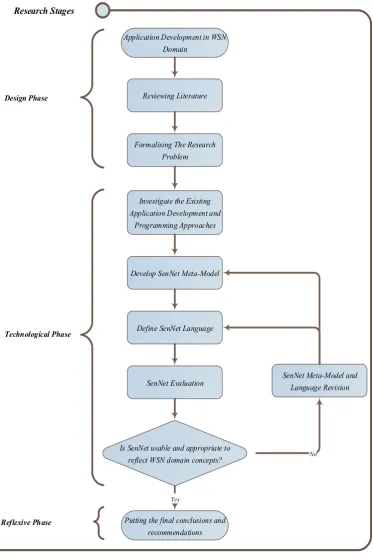
Each phase has been divided into a number of stages; a brief description of each stage can be found below, and Figure 1-3 shows the research stages as a flowchart.
1. Design Phase
13 B. Reviewing Literature: Investigate earlier researchers’ work about WSN application development and programming to get a good understanding and to know the state of the art of WSN; furthermore, to highlight the drawbacks of this technology.
C. Formalising the Research Problem: This stage identified the needs of WSN for new techniques to develop WSN applications, recognising the urgent need to enable beginner developers to play a bigger role in the process of developing WSN applications and maintenance. In accordance with these findings, the research aim has been addressed as defining a new semantic model and a new DSL for the WSN domain, as well as a set of intentions such as enabling in-network processing in the suggested language.
2. Technological Phase
A. Investigate the Existing Application Development and Programming Approaches: This stage was the investigation and analysing work that was applied to current application development techniques related to WSN, and highlighting their limitations. B. Develop SenNet Meta-Model: This stage was identifying a semantic model that reflects the main WSN application activities, tasks and their logical relationships to network elements, by analysis of the ISO/IEC29182: Sensor Network Reference Architecture (SNRA) standard, as well as the application development methods and techniques proposed by the research community.
C. Define SenNet Language: This stage was defining the required SenNet language syntax and semantics. This was done using MDD and macro-programming techniques to increase the level of abstraction that would be offered to the developers.
D. Evaluating the Proposed Language: The assessment and verification of SenNet language are crucial to this research, where its usability and functional suitability should be ensured. Many assessments and testing methods were applied to examine SenNet language according to a predefined evaluation plan.
E. SenNet Meta-Model and Language Revision: According to the findings and outputs of the evaluation plan, amendments and modifications were applied to the proposed SenNet meta-model and language. This stage helps to enhance the results that are produced by this research.
3. Reflexive Phase
14
Research Stages
Technological Phase
Reviewing Literature Application Development in WSN
Domain
Formalising The Research Problem
Investigate the Existing Application Development and
Programming Approaches
Develop SenNet Meta-Model
Define SenNet Language
SenNet Meta-Model and Language Revision
Putting the final conclusions and recommendations Is SenNet usable and appropriate to
reflect WSN domain concepts?
Yes
No
SenNet Evaluation Design Phase
[image:32.595.116.490.74.635.2]Reflexive Phase
15
1.9
Publications
• Salman, A. J., & Al-Yasiri, A. (2016). SenNet: A Programming Toolkit to Develop Wireless Sensor Network Applications. In 2016 8th IFIP International Conference on New Technologies, Mobility and Security (NTMS) (pp. 1–7). Larnaca-Cyprus: IEEE.
http://doi.org/10.1109/NTMS.2016.7792476.
• Salman, A. J., & Al-Yasiri, A. (2016). Developing Domain-Specific Language for Wireless Sensor Network application development. In 2016 11th International Conference for Internet Technology and Secured Transactions (ICITST) (pp. 301–308). Barcelona, Spain: IEEE. http://doi.org/10.1109/ICITST.2016.7856718.
1.10
Thesis Outline
The remainder of this thesis is organised as follows:
Chapter 2
This chapter presents a general background for Wireless Sensor Network (WSN) and lists the most popular platforms and Embedded Operating Systems (EOS) used in the WSN domain. It then outlines how the complexity problem can be solved using Software Engineering and explains the main approaches used to resolve this issue. Next, it discusses the main strategies and approaches used to define application development solutions in the WSN domain, before summarising the considered solutions in terms of a set of feature criteria. Finally, it outlines the final design requirement, which is set up as the main design requirement for our proposed solution.
Chapter 3
16
Chapter 4
This chapter discusses how SenNet works (internal view), by considering first the Text-to-Model (T2M) transformation rules, which include the lexical and syntactical analysis stage and the semantic analysis stage. This is followed by explaining the Model-to-Text (M2T) transformation rules and process, which constitute the source code generation process. Finally, it discusses how SenNet can be updated and expanded.
Chapter 5
This chapter presents our proposed application development (SenNet) from a user’s (beginner developer) point of view. SenNet’s main components are illustrated: CPC and CGC components; then SenNet editor, general application syntax, and the main tasks offered are discussed.
Chapter 6
This chapter outlines first the evaluation plan adopted to evaluate SenNet and prove its usability and functional suitability. Many methods have been included in this assessment plan, which are discussed in detail later in this chapter, such as user study and the source code complexity analysis that is measured by calculating the LOC and HCM metrics to evaluate SenNet source code using four different scenarios. Finally, we summarise all the results according to a set of defined metrics at the beginning of this chapter, which shows that SenNet is usable and suitable to develop WSN applications.
Chapter 7
17
Chapter 2:
Background and Overview
2.1
Introduction
This chapter gives a general WSN background including the most popular WSN platform and TinyOS as one of the successful embedded operating systems in the WSN domain. This is followed by discussing how the complexity problems could be solved using Software Engineering principles, giving a brief description of the main approaches used to address this problem (MDD and DSL). Finally, we have outlined the general strategies used by the research community to define a development abstraction.
2.2
Wireless Sensor Network
The beginnings of WSNs date back to the 1980s, when the first trend in WSNs was the Distributed Sensor Network (DSN) project prepared by the Defence Advanced Research Projects Agency (DARPA) (Wang & Balasingham, 2010). Later, with the engineering revolution in semiconductors and communications, the new WSN began in a couple of projects targeting environment monitoring, such as the WSN deployment at Great Duck Island in 2002 (Mainwaring, Culler, Polastre, Szewczyk & Anderson, 2002).
18
• Logistics and supply chain management
• Automation, monitoring, and control of industrial production processes
• Health care and medical applications at home and in hospitals
• Critical infrastructure protection and public safety
• Automation and control of commercial buildings and smart homes
• Automation and control of agricultural processes
• Intelligent transportation and traffic
• Environmental monitoring, forecasting, and protection
• Facility management
• Asset management
• Defence and military applications
• Homeland security
2.2.1 Most Popular WSN Hardware
A sensor node performs the required functionality by integrating several components: a low-power microcontroller unit (MCU) including RAM (for data saving) and ROM (for code saving) small memory chip, Analog-to-Digital Convertor (ADC) and a radio transceiver for data communication. Different sensors can be attached to the sensor node using an expansion connector. The most used power sources for this type of devices or nodes are batteries or solar sources. The main MCUs used in this technology are ATmega128 (Atmel, 2006) and MSP430 (Texas Instruments, 2008), manufactured by Atmel and Texas Instruments respectively. These two MCUs became the source for producing many WSN platforms, and this is due to several factors: Ultra-Low Power (ULP) energy consumption, scientific and research community support, open source compilers based on the GNU Compiler Compiler (GCC) compiler type, and the support of the TinyOS operating system (Kouche, 2013).
IRIS3, Mica24, and MicaZ5 are WSN platforms that use an 8-bit ATmega MCU from Atmel, with a slight difference for each one, such as in the internal memory or the frequency speed of the radio transceiver. TelosB (Polastre, Szewczyk, & Culler, 2005) is another WSN platform
19 that uses 16 bit MSP430 MCU from Texas Instruments. This platform is one of the more popular platforms in the research community.
SunSPOT (Simon, Cifuentes, Cleal, Daniels, & White, 2006) and IMote2 (Nachman, Huang, Shahabdeen, Adler, & Kling, 2008) are popular platforms too. SunSpot was developed by Sun Microsystems and uses a Squawk Java Virtual Machine (JVM) that runs directly on the ATMEL920T MCU. IMote2 is a WSN platform developed by Intel using an XScale processor PXA271. This platform is different from the usual WSN platforms that focus on low power and resources, it focusses on high computation activities, such as audio and video processing. This platform is one of the successful examples that ported to work with TinyOS.
Table 2-1: Sample of the Most Used WSN Platforms 2002-2012 (Thang, 2015)
Platform Year MCU OS & Programming
Mica2 2002 ATMega 128L 8bit TinyOS, nesC, SOS, MantisOS
BTnode 2003 ATMega 128L 8bit TinyOS, nesC, C, NutOS
MicaZ 2004 ATMega 128L 8bit TinyOS, nesC
TelosB 2005 T1 MSP430 16 bit C, nesC, Contiki, TinyOS, SOS, MantisOS
Eyes 2006 T1 MSP430 16 bit C, PEEROS
IMote2 2007 Intel PXA271 16 bit C, nesC, Linux, TinyOS
SHIMMER 2008 MSP430 16 bit TinyOS, nesC
Zolertia Z1 2011 MSP 430 16 bit C, nesC, TinyOS, Contiki
WaspMote 2012 ATMega1281 8 bit C, WASPMote ISE, WASP firmware
2.2.2 TinyOS
Many embedded operating systems have developed to support embedded systems generally and WSN particularly. TinyOS (Levis et al., 2005) is one of the open-source operating systems designed particularly for WSN, which are built from a set of reusable components. It supports an event-driven concurrency model due to the use of split-phase technique (this technique is explained in section 3.4.1) and a new scheduler design. Moreover, many other facilities such as Hardware Abstraction Architecture (HAA) (this architecture is described in more details in section 4.4.1) lead to TinyOS supporting multiple microcontroller families. Levis & Gay (2009), summarised the main TinyOS communication types as shown in Table 2-2.
Table 2-2: Communication Types Supported by TinyOS
Communication type Single/Multi-hop
Serial Over serial
Active message (AM) Single-Hop
Collection Tree Protocol (CTP) Multi-Hop
20 TinyOS is considered the de facto operating system for WSN (Akyildiz & Vuran, 2010; Ouadjaout et al., 2016). Delamo et al. (2015) have surveyed IEEE Xplore, ACM Digital Library and Google Scholar systematically, finding that TinyOS returns 85% of the references concerning WSN, and argued the high popularity of using TinyOS was because it was maintained by relevant research groups and companies. Accordingly, most of the proposed new abstractions developed to reduce complexity in WSN application development used TinyOS and nesC as a foundation to build their abstracted solutions (Essaadi et al., 2017).
TinyOS is implemented in the nesC (Gay et al., 2003) language that supports the TinyOS components and concurrency model. The nesC language manipulates TinyOS components in a way similar to objects that encapsulate the state and couple the state with functionality. nesC is an extension version of C language, but it differs from C language in how components are linked to each other (Mozumdar, Gregoretti, Lavagno, Vanzago, & Olivieri, 2008). This language is considered challenging and complex (Luo, Abdelzaher, He, & Stankovic, 2006), since the developer should program more than one program file to develop an application (minimum three files) (Ravichandran et al., 2016), and the difficulty appears when a developer is trying to link new codes with existing ones (Levis, 2006).
2.3
How Can Complexity be Solved?
In the context of software systems, there is an opinion that “Software entities are more complex
for their size than perhaps any other human construct” (Brooks, 1987, p.11). At this stage, the role of software engineering is to reduce complexity, which can be achieved through developing different tools, processes and methodologies.
Generally, in software engineering there are two directions to reduce complexity for a particular domain application, the first direction is to raise the level of abstraction, while the second direction is to increase the level of concreteness. Raising the level of concreteness will solve the problem partially, as it will address the complexity problem towards a particular type of applications, but not all domain applications. Therefore, raising the level of abstraction can represent the right solution to solve or reduce complexity in software projects (Kunii & Hisada, 2000).
Abstraction can be defined as “A cognitive process of the human brain that enables us to focus
21 Abstraction is a powerful and traditional way to shield the users of software systems against complexity, such as when an operating system hides the complexity of the underlying hardware (Jörges, 2013). Moreover, it allows developers and programmers to express their problems in a simple form by hiding complex and irrelevant implementation details (Áemília, Ľubomír, Sergej, & Ján, 2011; Damaševičius, 2006; Kollár, Pietriková, & Chodarev, 2012).
2.3.1 Model-Driven Development (MDD)
In day-to-day work, users and developers face a huge and constantly changing variety of platforms, tools, platforms and languages that need to be mastered (Jörges, 2013). As an additional level of abstraction, models allow the specification of a software system apart from the actual concrete implementation.
Models, modelling and model transformation have become the basis of the MDD approach (Geihs, Reichle, Wagner, & Khan, 2009; S.J. Mellor, Clark, & Futagami, 2003; Skubch, Wagner, Reichle, & Geihs, 2011; Weise, Zapf, Khan, & Geihs, 2009), where a developer should develop a model for the required developed system, then transform this model into a real system (executable software entity). This is applicable due to the revolution of generating code; code generation can fill the gap between the system abstraction (model) and the concrete implementation (Jörges, 2013). This is considered a specific form of model-to-text (Czarnecki & Helsen, 2006; Oldevik, Neple, Grønmo, Aagedal, & Berre, 2005) or model-to-source transformation (Hemel, Kats, Groenewegen, & Visser, 2010; Selic, 2003). The code generator is one of the specifications of Model-Driven Development (MDD) (Bézivin, 2005; Seidewitz, 2002). Currently, models are not only used for documentation and visualisation purposes (Jörges, 2013), but are also promoted as development artefacts.
Therefore, MDD can be used to develop special languages that focus on specific domains using one of these approaches:
• Using Model-Driven Architecture (MDA) approach.
22 2.3.2 Domain-Specific Language (DSL)
A domain-specific language (DSL) is a language tailored to a specific domain (Mernik, Heering, & Sloane, 2005). Using DSL is considered one of the most frequent techniques used to raise the level of abstraction (Mernik et al., 2005; Sun, Demirezen, Mernik, Gray, & Bryant, 2008). Mernik et al. (2005, p. 321) argued that DSL was “enabling of software development
by users with less domain and programming expertise, or even by end-users with some domain, but virtually no programming expertise”. In addition, it is bridging the gap between business users and developers by encouraging collaboration through using shared vocabulary, because the main reason for software projects failing is the lack of communication between users (who know the problem domain) and developers (who develop the software system) (Ghosh, 2011b). Fowler (2009) classified DSL’s according to the implementation approach:
• Internal DSL (also known as embedded DSL) is a DSL implemented as an extension to
an existing GPL, such as Ruby (Carlson & Richardson, n.d.) and Haskell (Hudak et al., 1992). This type of DSL can access all host language constructs and infrastructure such as tools and libraries. Therefore, it is not necessary to build a new compiler or interpreter.
• External DSL is a DSL represented in a separate language to the main programming
language it is working with. The advantage of external DSLs is that the developer of the DSL may define any possible syntax independently from the general syntax of the host language.
Using DSL offers many advantages, such as easier collaboration with business users, easier in maintaining and updating the DSL code, users focus on a tiny surface area of the application code, and it increases users’ and developers’ productivity (Ghosh, 2011b).
23
2.4
Approaches to Defining WSN Development Abstraction -
Related Work
WSN application development and deployment are typically performed very close to the hardware level, and this leads to developers needing to focus on low-level system details (Mottola & Picco, 2011). Researchers have proposed different development abstractions to overcome WSN application development difficulties, with the ultimate goal of making application development easy (Sugihara & Gupta, 2008). These various development techniques facilitate the applications’ development process, as some of them deal with how to access the sensed data in the sensor node, and another group are concerned with how to give orders and pass these along to the sensor nodes. Many surveys in the literature have focused on these techniques, such as Chandra & Dwivedi (2015), Essaadi et al. (2017), Farias et al. (2016), Laukkarinen, Suhonen, & Hännikäinen (2012), Malavolta & Muccini (2014), Mohamed & Al-Jaroodi (2011a), and Mottola & Picco (2011b). Figure 2-1 illustrates the current approaches used by the research community to define a development abstraction that concludes with setting a customised development and programming language that would help developers and users to develop WSN applications.
Model-Driven Development
(MDD) Embedded OS Customised
Platform
Approaches to Define Development Abstraction
Figure 2-1: WSN Development Applications Approaches
2.4.1 Embedded Operating Systems
24 programming languages in the WSN domain based on C language, while Mantis (Bhatti et al., 2005), TinyOS 2.x (The TinyOS 2.x Working Group, 2005), Nano-RK (Eswaran, Rowe & Rajkumar, 2005) and RETOS (Cha et al., 2007) are considered thread-driven operating systems. Furthermore, some operating systems are designed to support both of these strategies, such as Contiki (Dunkels, Grönvall & Voigt, 2004) and LiteOS (Cao, Abdelzaher, Stankovic & He, 2008). The generated application using this type of abstraction is a node-specific application (Laukkarinen et al., 2012).
2.4.2 Customised Platform
Programming the sensor nodes is more complicated than programming conventional computer systems due to their constrained resources, high dynamics and inaccessible deployment environments (Leelavathi, Shaila, Venugopal, & Patnaik, 2013). Some researchers develop a customised software architecture, hardware, or both of them to enable users to use these specialised designs to develop their required applications. To allow users to use these customised architectures, researchers define a set of tailored instructions (DSL) that enable users to interact with these architectures to develop their applications.
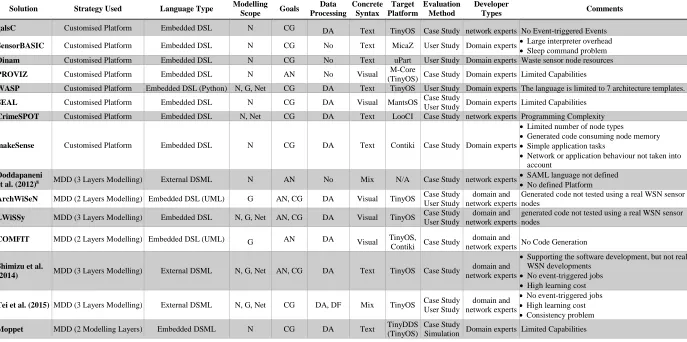
The galsC (Cheong & Liu, 2005) is a node-level programming language developed for event-driven applications, which is a hybrid language that uses synchronous event-event-driven model and an asynchronous message passing model using TinyGALS middleware (Cheong, Liebman, Liu, & Zhao, 2003). This middleware and the defined language is based on the TinyOS operating system and nesC language. Using this language is considered very complex since it takes the sensor node as basic computation, communication, and actuation unit (Luo et al., 2006).
BASIC (Miller, Dinda & Dick, 2009) is a node-level imperative loop oriented programming language that was developed for simple WSN applications targeting domain experts and novice programmers. BASIC is implemented using uBASIC6 interpreter developed using C language
for embedded devices. One of BASIC’s limitations is that it suffers a large interpreter overhead and the application source code should include the sleep command because it is not put the system in low-power by default (Elsts, Judvaitis, & Selavo, 2013).
25 In 2009 Bai, Dick, & Dinda surveyed the existing WSN applications and identified eight characteristics for WSN applications: mobility, sampling, transmission, actuation, interactivity, data interpretation, data aggregation, and heterogeneity. Accordingly, they designed a fixed seven archetypes template as illustrated in Table 2-3, and presented a simple language called WASP that is targeted to one of these seven archetype templates. These seven templates and the simple WASP commands are designed for domain experts. The user has to start by choosing the most appropriate template according to the required application nature, after the user has started configuring the choosing template using WASP language. WASP compiler is written in Python and translates the language into the nesC program for TinyOS. The authors of WASP language have performed a user study to evaluate their language using 28 novice programmers. This language has many limitations, for example, to develop an application, the developer would be limited to the available functionalities offered by the selected archetype template. In addition, to program a network, WASP offers the developer a facility to define a job that will be assigned to all sensor nodes in the network.
Table 2-3: The Seven Archetype identified by Bai, Dick, & Dinda (2009)
26 separately. Finally, the configuration interface does not allow the programmer to fine-tune low-level parameters for the sensor node (Kovatsch, Mayer, & Ostermaier, 2012).
PROVIZ (Chandrasekar, Uluagac, & Beyah, 2013; Ravichandran et al., 2016) is a suggested framework for graphical programming WSN applications, besides WSN network analysis (Chandra & Dwivedi, 2015). This framework uses a special service-oriented middleware called M-core (Valero, Uluagac, Venkatachalam, Ramalingam, & Beyah, 2012) installed on top of the TinyOS, which offers M-Core Control Language (MCL). MCL is a security domain-specific language that was developed using Python, where the final graphical presentation of the WSN will be translated into nesC program code using MCL. The network visualisation interface was implemented using QI GUI C++7. This framework focused on the network analysis and simulation rather than application development, as regarding application tasks and activities, this framework is offering limited capabilities.
SEAL (Elsts, Bijarbooneh, Jacobsson, & Sagonas, 2015; Elsts et al., 2013) is a node-level high abstract DSL that was proposed to be part of a new environment which included MantsOS middleware and ProFuNTG tools implemented for novice programmers and domain experts to help them develop WSN applications without help from WSN experts. The SEAL language includes two executable statements: read and use; three types of components can also be defined (sensors, actuators, and output). Python is used to write the SEAL language compiler, which generates the required code in C language that will be run by MantsOS middleware. The SEAL editor used Google Blockly to offer visual programming.
CrimeSPOT (De Roover, Scholliers, Amerijckx, D’Hondt, & De Meuter, 2013) is a declarative rule-based DSL for programming WSN applications on top of LooCI (Hughes et al., 2012), event-driven and component-based middleware that works with SunSPOT sensor nodes. CrimeSPOT enables the programming both of node and network level facilities. It also provides temporal facilities for working with data.
makeSense Framework (Daniel et al., 2013; Oppermann, Romer, Mottola, Picco, & Gaglione, 2014) is a unified programming framework and a compilation chain, offering high-level abstraction development that generates code ready for deployment on WSN nodes. This framework was built using Java targeting domain experts who have knowledge in Business Process Modelling Language (BPML). The authors define three layers: the first layer is a visual