EAuctions: A construction industry
perspective on achieving stakeholder
satisfaction and value creation
Ingirige, MJB, Amaratunga, RDG and Kulatunga, U
Title EAuctions: A construction industry perspective on achieving stakeholder satisfaction and value creation
Authors Ingirige, MJB, Amaratunga, RDG and Kulatunga, U
Type Conference or Workshop Item
URL This version is available at: http://usir.salford.ac.uk/9744/ Published Date 2010
USIR is a digital collection of the research output of the University of Salford. Where copyright permits, full text material held in the repository is made freely available online and can be read, downloaded and copied for noncommercial private study or research purposes. Please check the manuscript for any further copyright restrictions.
6
thINTERNATIONAL CONFERENCE ON INNOVATION in AEC
2009
E-AUCTIONS: A CONSTRUCTION INDUSTRY PERSPECTIVE
ON ACHIEVING STAKEHOLDER SATISFACTION AND VALUE
CREATION
Bingunath Ingirige
Udayangani Kulatunga
Dilanthi Amaratunga
School of the Built Environment University of Salford Salford M5 4WT, UK
Abstract
Increasing competition and lower margins in construction projects motivates and on certain occasions forces the various stakeholders in construction to engage in the continuous search for new and advanced methods of improving effectiveness and efficiency. Among these methods, e-Auctions appear to be gaining popularity among contractors, subcontractors and suppliers of materials and services and most often favoured by clients. E-Auctions are internet based reverse auctions carried out for bidding and is identified as a highly promoted form of B2B e-commerce. Although this technique emerged outside the construction industry, for instance in retail supply chains and in defence, it is beginning to make an impact within the construction industry too. E-Auctions are particularly becoming more popular among large scale construction contractors in their process of selecting suppliers, sub contractors and other service providers. The suppliers involved in e-Auctions can progressively lower their bid value during a given period of time of the e-Auction. In the majority of cases, e-Auctions have replaced negotiations for supplier selections and price settings and claimed to save considerable portions of money involved in bidding and construction. However, errors of judgements made by suppliers during the e-Auction can lead to reduced quality of work, lengthy negotiations and disputes within the construction industry. As a result of promoting “lowest price” against the “best value”, e-Auctions are being criticised for hampering the good practices in the construction and creating further fragmentation. The paper contextualises this debate and addresses how best the technological improvements within a B2B setting can be leveraged to realise multi-stakeholder value and satisfaction in the construction industry.
Key Words: construction industry, e-Auction, ebusiness, stakeholder satisfaction,
Introduction
Hjelt and Bjork (2006) the pressures to take IT and the Internet into effective use for the data interchange between the different partners in the supply chain has thus been low, compared to other industries (i.e. the production of cars or mobile phones). On the other hand the increased competitiveness in the industry demands construction organisations to up lift its efficiency by reducing construction cost, time, and increasing quality of the product (Hampson and Brandon, 2004; Foresight Construction Associate Programme Panel, 2001). Due to this competition contractors in particular are targeting marginal profits thus constantly searching new ways to reduce the associated costs of construction as well as bidding. One of the ways of reducing the bidding cost is through the use of web based technologies. O’Malley (1998) saw the web being “a giant bidding war,” which increases efficiency, speed, and accuracy of contracts. Among the web based technologies, e-Auctions are one of the most highly promoted forms (Tulder and Mol, 2002) that can leverage competitiveness in bidding According to Tulder and Mol (2002) the savings arise as a result of supply chain optimisation between buyers and sellers rather than wiping out players from the market.
E-Auctions are downward pricing, or reverse auctions performed in real time over the Internet (Baatz, 1999; Jap 2003). The e-Auction process is conducted on-line with pre-qualified suppliers being invited to compete on predetermined and published award criteria (Jap, 2003). e-Auctions need to be carried out after developing the brief completely and in occasions where the requirements can be accurately specified by the clients (Construction industry council, 2006). OGC (2003) confirms e-Auctions can be on any combination of criteria, normally converted to a “price equivalent.” This allows bidders to introduce new or improved values to their bids, in a visible and competitive environment (OGC, 2003). A review of literature on ‘e-Auctions’ show that although it borrows insights from areas such as e-tendering (see RICS guidance note, 2006; Alshawi and Ingirige, 2003, Nitithamyong, P and Skibniewski, 2006) collaborative commerce (Ruikar, 2006; Ruikar et al, 2005) and Electronic Data Management (EDM) systems (Hjelt and Bjork, 2006; Sulankivi, 2004, O’Brien and William, 2000; Howard et al 1998) a systematic study evaluating its effectiveness and efficiency as a tool to leverage overall stakeholder satisfaction has not been conducted. This paper addresses this gap by conducting a case study of the use of e-auctions within a large petrol station retail client, engaged in the selection of suppliers for construction and maintenance of petrol stations. We thereby comment on the effectiveness and efficiency of e-Auctions as an Internet based tool for tendering.
Literature review and proposition
the lowest price via e-Auctions contradicts the recommendations made by Egan report to select the contractors on best value (Construction industry council, 2006).
Business to Business (B2B) transactions that utilises the Internet infrastructure have gained popularity in many industries. For instance Parente et al (2004) states that “Dow Chemical Company as a seller uses online auctions to meet new customers and as a buyer the company routinely saves 2 – 5% and sometimes as much as 20% on purchases” (2004: 288). The majority of the B2B online auctions are supplier initiated. But the purpose of the buyer provided auctions is to make purchases. These auctions are called reverse auctions (Parente et al, 2004). A reverse auction has one buyer and many sellers. The primary factor behind the growth of e-Auctions in the construction industry is their ability to create immediate cost savings to its clients (Settoon and Wyld 2003). Many clients claim large cost savings, including intermediaries who are promising to deliver savings of up to 20% (Stein et al, 2003). e-Auctions appear to deliver fast measurable savings, therefore have great appeal to clients interested in reducing costs (Emiliani, 2000). If executed well, clients and suppliers can share savings and enjoy improved quality, delivery and performance, including opportunities to expand the relationship into other products and value-added services (Emiliani, 2000).
Since the e-Auction takes place within a specified time period, time and temporal efficiencies can be achieved (Settoon and Wyld, 2003). One of the most timintensive activities in construction contracts is price negotiation (Emiliani, 2000). e-Auctions can simplify and support negotiations (Settoon and Wyld 2003; Emiliani, 2000) and in some circumstances replace a post-tender bid clarification process which can be very costly to both client and suppliers (webOGC-e-Auctions, 2003; Emiliani, 2000). One of the distinguishing features of e-Auction process is the possible requirement for bidders to disclose their prices to each other which increase the transparency (Jap, 2002). Further, e-Auctions facilitate multiple rounds of bidding as the bidders can lower their bid by focusing on the offers made by their competitors. e-Auction events have a major advantage geographically by allowing bidders to participate from all over the world (Emiliani, 2000). This could mean increased competition resulting in lower construction costs (Emiliani, 2000).
Emiliani and Stec (2002b) report that there are three terms being used to describe the savings that result from an e-Auction depending on the point at which the savings are made. They are referred to as (1) identified savings; (2) estimated savings; (3) achievable savings. Overall there is a tendency that poor historical cost data can lead to inaccurate savings being recorded. These terms are used interchangeably to describe the maximum achievable savings that exist at the conclusion of an e-Auction event (Emiliani and Stec, 2002b). They have led clients reporting greater savings than they are actually achieving. Too few bidders in an e-Auction would create little competition, but too many bidders could also be problematic, as some bidders may feel that the competition is too high (Jap, 2002). This situation could discourage suppliers from bidding, in which case the overall cost savings could be adversely affected (Jap, 2002).
suppliers (Emiliani and Stec 2002b). Software packages and suppliers databases required to conduct an e-Auction event could contain errors therefore providing the client with unnecessary additional costs (Emiliani and Stec 2002b). The possibility of going global with an e-Auction event may also incur additional costs i.e. additional travelling expenses and qualification time for new suppliers (Emiliani and Stec 2002b).
The e-Auction event is based on the premise that the client is being overcharged by its current suppliers and will ultimately achieve the lowest price (Stein et al. 2003). Therefore, a major concern with the introduction of e-Auctions is that bidders may react to the pressure of an e-Auction environment and submit bids that are not fully compatible with the client’s requirements (Jap, 2003). Thus, a reduction in quality may become apparent due to suppliers being forced down in price. This may lead to clients awarding contracts to bidders who may not be able to supply the necessary goods or services at the e-Auction price (AGC, 2001) and may increase the possibility of additional costs occurring due to non-performance must be taken into consideration (Emiliani and Stec 2002b). During an e-Auction, the bidder has the opportunity of reducing the price in successive bids. As a result of this, the bidder may not offer the best or the lowest price which can be offered. In such instances, the client is not guaranteed with the lowest price. Thus, AGC (2001, p2) argues that “winning bids may simply be an established increment below the second lowest bid, not the lowest responsible and responsive price”.
Emiliani (2000) believes downward price online auctions will replace the core skill of negotiation possessed by human workers. Negotiation processes recognise the value and quality of project relationships (AGC, 2001), thus the e-Auction approach to negotiation is said to have adverse effects (Griffiths, 2003; Jap, 2001, 2003; AGC, 2001). Such cost saving achievements will inevitably result in a deterioration of other factors, such as quality, delivery, reliability, flexibility and overall dependability (Jap, 2001). These factors are crucial to any successful contract and would therefore create tension in the relationship (Jap, 2001). The fast-paced, dynamic bidding, along with the need to respond quickly to competitor’s bids, yields tense negotiation and pressures on suppliers to cut prices vigorously (Jap, 2001). The gains of the client are derived from the losses of the supplier (Emiliani and Stec, 2002a). This may improve the short-term competitiveness of clients and suppliers however they do not contribute in any meaningful way to long-term competitiveness (Fujimoto, 1999). Evidence shows that renegotiation costs in e-Auctions are marginally high (Wang, 2000). Further, post e-Auction bid analysis could be more time consuming than anticipated and may also result in a change in price (Emiliani and Stec 2002b). Supporters from the supply side of the construction industry, for example in the electrical and mechanical construction business counteract this argument according to Langford and Murray (2008). Accordingly, they argue that clients should employ strict pre-qualification checks on their suppliers before allowing them to compete an online forum. Also the productivity challenge set by Egan can also be achieved using these tools.
However according to Stein et al (2003), suppliers level of distrust increased although the client gained a lot of benefits out of the e-auctions. Further some of the EC regulations, DTI and directives of the OGC are pushing some of the Public clients towards adopting reverse auctions. Annon (2004)
From the above discussion, the following proposition is articulated.
address the overall stakeholder satisfaction and value creation as long term orientated goals of e-auctions.”
The above proposition helps in raising the following two research questions: 1. Are there any ‘real’ cost savings and time savings as a result of e-auctions? 2. Is there an overall value creation for the various stakeholders as a result of
e-Auctions?
We address the above questions by discussing a case of a large petrochemical company that conducts e-auctions within their procurement process. This case is used to test the effectiveness and efficiency of e-Auctions and their ability to address overall stakeholder satisfaction and value creation.
Background and sampling
The research was conducted from of a major petrochemicals company in UK. The petrochemicals industry has been an early adopter of e-Auctions and the selected company has conducted e-Auction events across all its major businesses for a full range of goods and services.
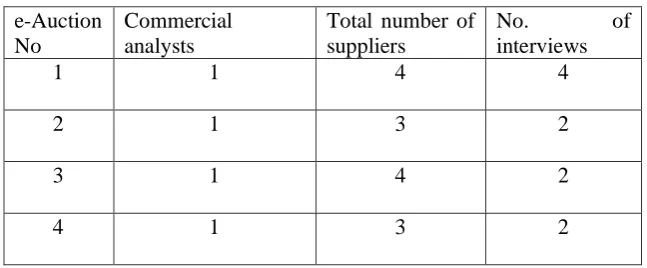
[image:6.595.141.465.535.669.2]There are two principle reverse auction formats used by this petrochemical company. They are Standard (no normalisation) and Transformation where prices are normalised in real time. Transformation bidding allows all value-add (non-priced) factors of a bidder’s proposal (e.g. technical proposal, performance, experience, etc) to be considered in real time. Further, during a live e-Auction event, the company used a “rank feedback”. This method provided the suppliers’ rank or the overall position within the total bids submitted. However identities of other bidders are never revealed. During the period of the study, four e-Auction events were evaluated. For each event, one commercial analyst represents the case study organisation to run and analyse the e-Auction. Number of suppliers was offered bids for each e-Auction, among which few were selected to carry out interviews for the study. Table 1 shows the number of interviews carried out for the study.
Table 1: Sample of the interviews carried out
e-Auction No
Commercial analysts
Total number of suppliers
No. of interviews
1 1 4 4
2 1 3 2
3 1 4 2
4 1 3 2
Data Collection
carried out with the suppliers. Contract documents and the case study company’s e-Auction documents i.e. guidelines, and rules were reviewed and any financial effects noted. Further, archival documents such as pre-estimates and previous price paid for goods and services were also noted. Throughout the data collection, the researcher monitored the client’s activities to ensure that no major events or initiatives occurred to disrupt or alter supplier’s perceptions and attitudes.
Case study discussion and analysis
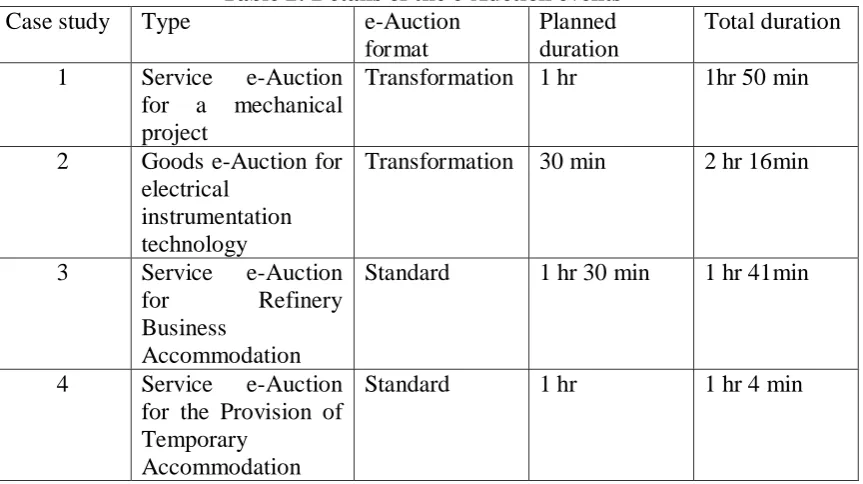
[image:7.595.105.537.273.515.2]The e-Auction events are usually scheduled to last for no more than 1 hour, however bids received in the last few minutes of an auction automatically trigger overtime. This extended the auction period as necessary as there are no limit to the number of overtimes. Table 2 shows the details of the e-Auction events.
Table 2: Details of the e-Auction events
Case study Type e-Auction format
Planned duration
Total duration
1 Service e-Auction for a mechanical project
Transformation 1 hr 1hr 50 min
2 Goods e-Auction for electrical
instrumentation technology
Transformation 30 min 2 hr 16min
3 Service e-Auction for Refinery Business
Accommodation
Standard 1 hr 30 min 1 hr 41min
4 Service e-Auction for the Provision of Temporary
Accommodation
Standard 1 hr 1 hr 4 min
Suppliers are pre-qualified as necessary and issued with an enquiry document, inviting them to submit a technical paper bid, which was followed by an Online Bid (OLB). Clarification and equalisation of the technical paper bids are carried out by the senior commercial analyst, which determined the weighting for the transformation factor for the OLB. This was based on anticipated growth, completeness of design etc. (Or weighting for the transformation factor was calculated based on anticipated growth, completeness of design etc.). Training to the suppliers was provided as necessary and a workshop demonstration was carried out for case study 2 to shortlist the suppliers.
The case study organisation’s savings process for recording the savings from an e-Auction event is as follows. It must be noted that this process may differ from other company policies.
1. Establish “Historical Price” i.e. previous price paid, estimated costs, or average price of paper bids.
2. Establish “Final e-Auction Price” of winning supplier (contract award). 3. Deduct “Final e-Auction Price” from “Historical Price”
From the four e-Auctions under consideration, only one event took the historic cost as the price paid previously. In all the other three events, historic cost was calculated as follows:
Historic cost = Total value of initial paper bid No of suppliers
Table 3: The comparison of Historic price and e-Auction price.
Case study Historic price (£)
e-Auction price (£)
1 2,500,000 2,253,494
2 2,700 2,338
3 1,250,000 1,000,000
4 40,000 31,025
As indicated in Table 3, in all four e-Auction events, the “e-Auction price” was lower than the “historic price” thus resulting in a cost saving. However, as mentioned above, in majority of the events, historic cost was purely based on the average price of the paper bid submissions. Such calculations may not provide accurate historic data as they are not based on a properly estimated price by considering the facts like changing market conditions and inflation. Thus, in the majority of events, inaccurate historic cost has subsequently reported inaccurate accounting of savings. Further, the cost saving reported by the client has ignored the indirect costs associated with the e-Auction such as telecommunication, arranging training and workshops for suppliers, fees paid for services such as for purchasing software to run the e-Auction. Moreover, additional manpower was used by the client to run the e-Auction which has again incurred additional cost to the client.
It was evident that the main intention of the suppliers was to win the bid to safeguard work and to secure work in the long run. As one supplier commented:
“…..the order book is rarely full so we need the work to retain the long term workforce”.
In order to win the bid, suppliers have adopted various strategies as lowering their overhead and profits. Further, the suppliers claimed that the price reduction of the bids were not due to the efficiency of electronic transactions as all the electronic transactions need to be followed up with hard copies. However, all the suppliers adhered to the original specification given by the client and not reducing the technical specification to win the bid.
Even though the bid was awarded to the lowest price, none of the commercial analysts expects any post contract claims due to poor performance of work. Further, none of them wanted to increase the bid price as the contract awarded price being lower than their pre determined price. Majority of the commercial analysts believed that the time was saved due to negotiations.
Conclusions
The findings of this research suggest that at an operational level, e-Auctions have provided cost savings to the client through reduced overhead and profit margins of suppliers. Mainly it provided a transparent suppliers’ bidding process indicating all the prices and the final award being made to the contractor with the lowest bid. The system sometimes faces a major drawback as it was noted that the methods of calculating the historic prices were not robust and that it was often impossible to glean related cost savings attributed to the engagement of additional manpower, training and development, extra workshop costs and costs of providing increased telecommunication facilities. Thus, it was evident from the study, that clients whose support was overwhelming for using the e-Auction technique often reported and perceived higher cost savings than the actual that they realised. A further problem that was encountered was that suppliers used the transparency of the e-Auction process to their advantage by tactically increasing the prices just to be the lowest quote on the suppliers’ bidding prices, which was effectively not the “lowest price” that they could offer but a competitive price to win a bid. This tactical behaviour of parties often results in the client not realising the optimum value of the project. e-Auctions appear to be an essential tool for procurement needs, when used in the correct circumstances. They are particularly effective for material components, i.e. nuts and bolts. However to use an e-Auction for the procurement of a construction contract is a complex decision. The success of which depends on a variety of conditions yet to be clearly identified and understood. This paper details results of one major Petrochemical company that carries out e-Auctions. A multi case study approach taking into consideration several types of auctions as well as both intrinsic and extrinsic values of stakeholders will increase the validity and reliability of results. Therefore, while acknowledging e-Auction as an essential tool for various construction procurement needs, the study also emphasises the need for using e-Auctions within a culture of stakeholder trust and cooperation. Therefore the study proposes a socio technical solution for stakeholder satisfaction and value creation at a more strategic level.
6. REFERENCES
Alshawi, M. and Ingirige, B. (2003), “Web enabled project management: an emerging paradigm in construction”, Automation in construction, Vol. 12, pp. 349 – 364.
AGC (2001). “White paper on Reverse Auctions for Procurement of Construction,”
Located at
http://www.agc.org/content/public/pdf/Member_Resources/ReverseAuction
Annon (2004) DTI backs e-Auctions – contract journal 26th May 1
Baatz, E. (1999), ``Online auctions start to pick up steam'', Purchasing Magazine, 21 October 1999. Located at http://www.manufacturing.net/pur/article/CA147836. Accessed 14 December 2003
Egan, J., (1998) Rethinking Construction. Department of the Environment, London. HMSO.
Emiliani, M. (2000). “Business to Business Online Auctions: Key Issues for Purchasing Process Improvement,” Supply Chain Management, 5(4), pp. 176- 186.
Emiliani, M. (2001), “A mathematical logic approach to the shareholder vs stakeholder debate,” Management Decision, Vol. 39 No. 8, pp. 618-22.
Emiliani, M. (2003), The inevitability of conflict between buyers and sellers,” Supply Chain Management, 8(2), pp. 107-115.
Emiliani, M. and Stec, D. (2001), ’’Online reverse auction purchasing contracts’’, Supply Chain Management, Vol. 6 No. 3, pp. 101-5.
Emiliani, M. and Stec, D. (2002a). “Squaring Online Reverse Auctions With The CAUX Round Table Principles for Business,” Supply Chain Management, 7(2), pp. 92-100.
Emiliani, M. and Stec, D. (2002b). “Realising Savings from Online Reverse Auctions,” Supply Chain Management, 7(1), pp. 12-23.
Foresight Construction Associate Programme Panel, 2001, Constructing the future, Department of Trade and Industry, UK, (accessed 10 June 2005), available from:
Hampson K and Brandon P, 2004, Construction 2020: A vision for Australia’s property and construction industry, CRC Construction innovation, Australia.
Hejlt, M. And Bjork, B.C. (2006), “Experiences of EDM usage in construction projects”, ITCON, Vol. 11, pp 113 - 125
Jap, S.D. (2001), “The Impact of Online, Reverse Auctions on Buyer-Supplier Relationships,” working paper, MIT Sloan School of Management.
Jap, S.D. (2002), “Online, Reverse Auction: Issues, Themes, and Prospects for the Future,” Journal of the Academy of Marketing Science-Marketing Science Institute Special Issue on Marketing to and Serving Customers Through the Internet: Conceptual Frameworks, Practical Insights and Research Directions
Langford, D. And Murray, M. (2006), “Procurement in the context of commercial management”, in Commercial Management of Projects, D. Lowe, and R. Lerringer, (Eds), Blackwell Publishing.
Nitithamyong, P and Skibniewski, M.J. (2006), “Success/failure factors and performance measures of web-based construction project management systems: professionals' viewpoint”, ASCE Journal of Construction Engineering and Management, Vol. 132. 1, pp. 80–87
Office of Government Commerce (OGC), (2003). “eAuctions.” Located at
Office of Government Commerce Buying Solutions, (n.d.). “Reverse Auction
Framework.” Located at
Accessed 22 December 2003.
O’Malley, C. (1998). “Internet: Do I Hear a Bid,” Popular Science, 253, Nov 1998, 52, 52
Parente, D.H., Venkataraman, R., Fizel, J. And Millet, I (2004), “A conceptual research framework for analysing online auctions in a B2B environment”, Supply chain management: an international journal, Vol. 9.1, pp 287 – 294.
Ruikar, K.D. (2006), “E-Commerce in construction”, ITCON, Vol. 11, 73 – 95.
Settoon, R., Wyld, D. (2003). “The Ski Slope to Prosperity: An Analysis of the Potential Impact of Reverse Auctions in Government Procurement in Five Southeast Asian Nations,” Asia Pacific Journal of Marketing and Logistics, 15(3), 3-19.
Stein, A., Hawking, P., Wyld, D. (2003). “The 20% Solution?: A Case Study on the Efficacy of Reverse Auctions,” Management Research News, 26(5), 1-20.
Tulder, R.V. and Mol, M. (2002). “Reverse Auctions or Auctions Reversed: First Experiments by Philips,” European Management Journal, Vol 20, No. 5, pp. 447-456.
Wyld, D. C. (2000). The Auction Model: How the Public Sector Can Leverage the Power of E-Commerce through Dynamic Pricing - A Research Monograph Published by The PriceWaterhouseCoopers (Later IBM) Endowment for the Business of Government. Located at