International Journal of Emerging Technology and Advanced Engineering
Website: www.ijetae.com (ISSN 2250-2459,ISO 9001:2008 Certified Journal, Volume 3, Issue 11, November 2013)
233
Unequal Clustering Energy Efficient Stable Election Protocol in
Wireless Sensor Network
Santosh Ahirwar
1, Pushpraj Tanwar
2 1,2Electronics & Communication Engineering Department, Radharaman Institute of Technology & Science, Bhopal, India
Abstract—A Wireless Sensor Network has wide applications and its critical battery power is used in sensing, processing and transmitting data to the base station. So many protocols were proposed to efficiently use the battery power to extend the lifetime of the wireless sensor network. In this paper, we propose a new protocol Unequal Clustering Energy Efficient Stable Election Protocol (UCEESEP) in Wireless Sensor Network. We analyze and compare the results of other protocols like LEACH, SEP, ESEP and TEEN with UCEESEP. Simulation result shows that performance of our protocol gives significant energy efficiency and more network lifetime compared to other protocols.
Keywords— Wireless Sensor Networks, Clustering, Unequal Clustering, Low Energy, UCEESEP.
I. INTRODUCTION
Wireless sensor networks (WSNs) [1] consist of distributed electromechanical sensing devices, called sensor nodes that send and receive data packets in wireless manner. Modern advanced technologies in microelectronic mechanical systems (MEMS) [14][15] and wireless communication technologies have developed small sized, low- cost, low-power, and multifunctional smart sensor nodes in a wireless sensor network (WSN) [12]. Sensors cooperate together to monitor physical or environmental conditions such as temperature, humidity, sound, vibration, motion, radiation, and pressure.
The modern sensor [14][15] networks are bi-directional, also enabling self-controlling of sensor node activities [12]. Earlier, the developments and usage of wireless sensor networks were motivated by military applications such as battlefield surveillance; today such networks are used in many industrial and consumer applications, such as industrial process monitoring and control, machine health monitoring, healthcare applications, traffic control and home automation and so on. The WSN [1] is built of "nodes" – from a few to several hundreds or even thousands, where each node is connected several sensors. Each such sensor node has typically several parts: a radio transceiver with an internal antenna or connection to an external antenna, a microcontroller, an electronic circuit for interfacing with the sensors and an energy source, usually a battery or an embedded form of energy harvesting.
The cost of sensor nodes is variable, depending on the functionality, applications and complexity of the individual sensor nodes. The cost of sensor depends on the functionality, complexity of the individual sensor nodes. Size and cost constraints on sensor nodes result in corresponding constraints on resources such as energy, memory, computational speed and communications bandwidth. The topology of the WSNs can vary from a simple star network to an advanced multi-hop wireless mesh network. The propagation technique between the hops of the network can be routing or flooding. Cluster based protocols have been originally proposed in the context of wire line networks to resolve the scalability issues. However, clustering is used with WSNs to reduce the energy consumption.
II. BACKGROUND
In this paper we reviewed and analyzed some modern energy efficient protocols [6][11] like LEACH, SEP, ESEP and TEEN.
1.LEACH (Low Energy Adaptive Clustering Hierarchy)
LEACH [2] is a proactive routing protocol. In a network hundreds and thousands of sensor nodes dispersed randomly for even distribution of load among nodes. These nodes sense data, transmit it to their associated cluster heads (CHs) which receive, aggregate and then send this data packets to the Base Station (BS). All the sensor nodes deployed in an environment are homogeneous and constrained in limited battery power. To distribute the burden or work among nodes, improve network life clusters are formed. Sensor nodes are made to become CHs on turns [9]. Nodes randomly elect themselves as CHs and it is done in a way that each node becomes CH once in the time period of 1
/
𝑃round. CHs selection is done on probabilistic basis [2], each sensor node generates a random number 𝑟inclusive of 0 and 1, if generated value is less than threshold computed by formula given below [2], and then this node becomes CH.
T
n=
{
𝑃
𝑃 𝑟 𝑑
𝑃
if n ϵ G
International Journal of Emerging Technology and Advanced Engineering
Website: www.ijetae.com (ISSN 2250-2459,ISO 9001:2008 Certified Journal, Volume 3, Issue 11, November 2013)
234
Where,
T
n = ThresholdP = desired change (probability) of being CH
r = current round number
G = set of nodes which are not became CH in 1/P round Using this threshold, each node will be a CH in 1/P rounds, thus probability remaining nodes are CH must be increased, since there are fewer nodes that are eligible to become CH.
Advantages of LEACH:
LEACH [2] strategy is completely distributed, it reduces energy consumption 4 to 8 times lower in case where packets are relayed in multi-hop transmission, and at last, all the nodes in the network die at about the same time due to LEACH fair distribution of CH role.
In LEACH [2] method, the control information from the base station is not required for sensor nodes.
LEACH [2][9] reduces 7 to 8 times low overall energy dissipation as compared to direct transmissions and minimum transmission energy routing.
In completely distributed network, sensor nodes do not require knowledge of global network.
Limitation of LEACH:
LEACH is not ideal for large geographical areas.
2. SEP (Stable Election Protocol )
SEP [3] method is an improvement of LEACH [2] method which is based on the heterogeneity of networks. In SEP method, some of the high energy nodes are referred to as advanced nodes and the probability of advanced nodes to become CHs is more as compared to that of normal nodes. SEP protocol is based on two levels of heterogeneity. Let,
m
= fraction of the total number of nodesn
, whichare deployed with
α
times more energy than the others. These powerful nodes are as advanced nodes,
Remaining (
1 − m) × n
as normal nodes. Probability of normal nodes to become CHs is
P
nor=
Probability of advanced nodes to become CHs is
P
adv=
Where,
P
opt is the optimal probability of each node to become CH. In SEP [3] method, CHs selection is done randomly on the probability basis of each node.Sensor nodes sense data and transmit it to their CH and CH transmit it to the Base Station (BS). By increasing or
P
𝑎𝑑𝑣, system can be further improved. SEP [3] method results in high stability time period and enhanced network lifetime due to advance nodes however two level heterogeneity also gives increased throughput.Advantage of SEP:
In SEP [3] strategy, sensor nodes do not need any global knowledge of energy at each selection round.
Limitations of SEP:
The limitation of SEP [3] strategy is that the cluster head selection among sensor nodes is not dynamic, which results that the sensor nodes that are far away from the powerful nodes will die first.
3. ESEP (Enhanced Stable Election Protocol)
ESEP [4] is the extension and improvement of SEP method. ESEP has three levels of heterogeneity unlike SEP has two levels. ESEP [4] considers three types of nodes, normal nodes, intermediate nodes and advance nodes. Where, advance nodes are some of total nodes with an additional energy as in SEP. Intermediate nodes are some nodes with some extra energy greater than normal nodes and less than advance nodes, and normal nodes are the remaining nodes. As in SEP, in ESEP CHs are selected depending on basis of probability of each type of node.
Advantage of ESEP:
The advantage of ESEP [4] is that, the power saving is little enhanced due to three levels of heterogeneity as compared to SEP.
The limitation of ESEP is same as in SEP.
4. TEEN (Threshold Sensitive Energy Efficient sensor Network protocol)
International Journal of Emerging Technology and Advanced Engineering
Website: www.ijetae.com (ISSN 2250-2459,ISO 9001:2008 Certified Journal, Volume 3, Issue 11, November 2013)
235
The nodes sense their environment continuously and store the sensed data value for transmission up to the hard threshold. Whenever the sensed data value becomes equal or greater than hard threshold, then sensor nodes transmit the data packets to their CHs. For the next time, data packets are transmitted if there is any difference between the sensed data value and previously saved data value is greater than or equal to soft threshold. So, in TEEN [5] routing protocol, energy consumption as well as throughput is reduced, network lifetime is enhanced and stability time period are improved than other protocols.
Advantages of TEEN:
TEEN [5] is well suited for the time critical data sensing applications.
It is quite efficient in terms of energy consumption and response time.
Soft threshold [6] value can be varied, depending on the criticality of the sensed data value and the target application. A smaller soft threshold value gives a more accurate result of the sensor network.
Limitations of TEEN:
If the threshold values are not reached, the nodes will never communicate. The user will not get any data from the sensor network at all and it will not come to know even if all the sensor nodes die.
Cluster heads (CHs) always wait for data packets from their nodes by keeping its transmitter on.
In LEACH, SEP, ESEP, TEEN, clusters are formed of equal size, and according to requirements, attribute values can be changed at the time of cluster selection. SEP and ESEP are heterogeneity aware protocols which improve stability period and network lifetime but here a limitation of heterogeneity is this that throughput is also increased which decrease network lifetime. To improve energy efficiency, accuracy and to enhance network lifetime, our proposed protocol UCEESEP is observed to be better than other protocols.
III. PROPOSED PROTOCOL
In this section we describe our new proposed protocol UCEESEP (Unequal Clustering Energy Efficient Stable Election Protocol) which is based on unequal clustering [7][8]. Clusters in the wireless sensor network are not of equal sized in our proposed protocol UCEESEP unlike LEACH, SEP, ESEP and TEEN as these are based on the equal sized clustering.
Formation of Cluster:
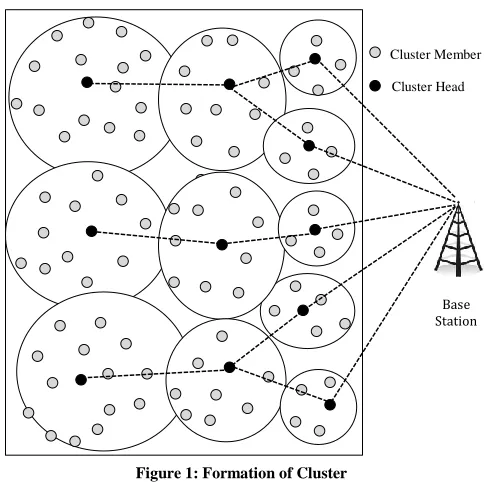
[image:3.612.331.574.246.487.2]In Wireless Sensor Network [1], all sensor nodes are grouped into many clusters and one cluster head is selected in each group of cluster. All sensor nodes sense their environment and the sensed values are transmitted to their associated cluster heads (CHs) and finally the collected sensed data packets are transmitted to the base station (BS) [1] as shown in figure 1.
Figure 1: Formation of Cluster
Clustering [6] provides an efficient and effective way to enhance the lifetime of a wireless sensor network. The clustering algorithms discussed in previous section usually utilize two techniques, selection of cluster heads with more residual energy and rotating cluster heads (CHs) on the probability basis periodically, for distribution of energy consumption among sensor nodes in each cluster and enhance the network lifetime. When cluster heads cooperate with other cluster heads to forward their data packets to the base station, the cluster heads nearer to the base station are loaded with high data packet transmission traffic and tend to die early, leaving areas of the network uncovered and causing network partition. To address the problem, we propose an Unequal Clustering Energy Efficient Stable Election Protocol (UCEESEP) mechanism for periodical data packet gathering in wireless sensor networks. As shown in the figure 1, it groups the sensor nodes into clusters of unequal size, and clusters closer to the base station have smaller in size than those farther away from the base station.
Cluster Member
Cluster Head
International Journal of Emerging Technology and Advanced Engineering
Website: www.ijetae.com (ISSN 2250-2459,ISO 9001:2008 Certified Journal, Volume 3, Issue 11, November 2013)
236
Thus cluster heads nearer to the base station can preserve some energy for the inter-cluster data packet forwarding.
In the network cluster formation phase [16], the base station (BS) broadcasts a signal at a fixed power level. Each node can compute its approximate distance from the BS based on the received signal strength. It not only helps the sensor nodes to select the proper power strength level to communicate with the base station (BS), but also helps to produce clusters of unequal sizes [16]. Unequal clusters [7][8] are produced on the basis of the unequal clustering formula given below.
R
ci=
( 𝑐
)
Where,
R
ci= range of competition radius in the network for cluster,d
max = maximum distance from the sensor node to the base station in the network,d
min = minimum distance from the sensor node to the base station in the network,d
i = distance from node i to the base station in the network,c
= weighted factor whose value is between 0 to 1,R
max = maximum value of competition radius.The competition radius of the node is determined by
d
i. If diis larger, then theR
ci is smaller. The diameter of cluster in the network dominated by node i isFormation of cluster heads and network:
After formation of cluster of unequal size based on the distance from the base station, cluster head is selected. Before cluster head selection we categorize sensor nodes in the network. UCEESEP is a reactive routing protocol, as transmission of data packets consumes more energy than sensing and transmission is done only when a specific threshold limit is reached and it has three levels of heterogeneity. For three levels of heterogeneity [4], sensor nodes with different energy levels are:
1) Advanced Nodes 2) Intermediate Nodes 3) Normal Nodes
Advance nodes are some of total nodes having with an additional energy (advance nodes having energy greater than all other nodes). Intermediate nodes are some nodes having with some extra energy greater than normal nodes and less than advance nodes, while normal nodes are the remaining nodes. In the energy model of UCEESEP, we consider following:
Energy for normal nodes = 𝐸
Energy for advance nodes 𝐸adv = 𝐸 + α
Energy for intermediate nodes 𝐸int = 𝐸 (1 + μ) where,
μ
α factor for advanced nodes which has α times more energy than normal nodes.
Total energy of normal nodes = 𝑛.𝑏 (1 + 𝛼) Total energy of advance nodes = 𝑛𝐸 (1 𝑏𝑛) Total energy of intermediate nodes = 𝑛. .𝐸 (1 + 𝛼) finally Total Energy of all the nodes = 𝑛𝐸 .(1 𝑏𝑛) + 𝑛. .𝐸 .(1 + 𝛼) + 𝑛.𝑏.(1 + 𝜇) = 𝑛.𝐸 (1 + 𝛼 + 𝑏𝜇) where,
n = total number of nodes,
m = proportion of advanced nodes, 𝑏 = proportion of intermediate nodes,
The optimal probability for normal nodes to be selected as cluster head (CH) is calculated as
𝑃
𝑃
+ 𝛼 + 𝑏 𝜇
The optimal probability for intermediate nodes to be selected as cluster head (CH) is calculated as
𝑃
𝑃 + 𝜇
+ 𝛼 + 𝑏 𝜇
The optimal probability for advanced nodes to be selected as cluster head (CH) is calculated as
𝑃
𝑃 + 𝛼
+ 𝛼 + 𝑏 𝜇
Where, 𝑃 = optimal probability
The cluster head selection in our proposed protocol UCEESEP, we have some improvement over ESEP method. We have taken threshold level as a parameter for consideration. Each node generates a random number between 0 and 1, if generated value is less than threshold then this node becomes cluster head (CH).
The threshold level for normal nodes is calculated as
{
𝑃
𝑃 *𝑟 𝑑𝑃 +
𝐸
𝐸 𝑓 𝑃
𝑒𝑟 𝑒 G
’
= set of normal nodes that have not became cluster head in the previous round.𝐸 Energy of node at current time.
International Journal of Emerging Technology and Advanced Engineering
Website: www.ijetae.com (ISSN 2250-2459,ISO 9001:2008 Certified Journal, Volume 3, Issue 11, November 2013)
237
The threshold level for intermediate nodes is calculated as
{
𝑃
𝑃 *𝑟 𝑑𝑃 +
𝐸
𝐸 𝑓 𝑃
𝑒𝑟 𝑒
G
’’
= set of intermediate nodes that have not became cluster head in the previous round.The threshold level for advanced nodes is calculated as
{
𝑃
𝑃 *𝑟 𝑑𝑃
+
𝐸
𝐸 𝑓 𝑃
𝑒𝑟 𝑒
G’’’ = set of advanced nodes that have not became cluster head in the previous round.
Here is an improvement in our proposed protocol UCEESEP by considering the ratio of energy of node at current time to energy of node at initial time.
Average total number of cluster heads per round = 𝑛.(1 − − 𝑏).P𝑛o𝑟 + 𝑛.𝑏.P 𝑛 + 𝑛. .P𝑎𝑑v = 𝑛.P 𝑝
UCEESEP has better aspect of energy consumption and network lifetime improvement due to energy heterogeneity and ratio of current energy to initial energy of the nodes.
Functioning of network:
In UCEESEP, at the beginning of each round, cluster head changes take place. At cluster change time, the cluster head transmits the following parameters [10]:
Report Time (TR): The time period during which each sensor node transmits reports successively.
Attributes (A): The set of physical or parameters about which information is being sent.
Hard Threshold (HT): The upper limit of value for the sensed attribute beyond which, the node sensing this value must switch its transmitter on and report to their cluster head.
Soft Threshold (ST): The lowest sensed value below which the nodes switch their transmitters on and transmit data to their cluster head.
All sensor nodes keep on sensing their environment continuously. As the parameters from attributes reaches hard threshold limit, transmitter is turned on and the data packets are transmitted to their cluster heads, however this is for the first time when this condition takes place [10]. The sensed data value is stored by the sensor node is called Sensed Value.
The next time, sensor nodes transmit data packets if and only if sensed value equals or exceeds the upper limit of the hard threshold value or if there any small difference between currently sensed value and the previously sensed value equals or exceeds the limit of soft threshold. So, by considering hard threshold and soft threshold, number of data packet transmissions can be minimized, as the data packet transmission will only take place when sensed value limits the hard threshold [10]. And further transmissions takes place by soft threshold, as it will minimize transmissions when there is a small change in value. Some of important functions of our proposed protocol UCEESEP are summarized below:
1) UCEESEP is applicable in time critical data in which it reaches to the user almost instantaneously.
2) Sensor nodes keep sensing on continuously but data packet transmission is not continuously as data transmission consumes more energy as compared to sensing and processing, so energy consumption is much more less than that of other networks.
3) When the cluster head changes take place, the value of threshold is calculated with current and initial energy of the sensor node, so it is a better method for cluster head selection in UCEESEP protocol and values of hard threshold, soft threshold, report time and attributes are transmitted afresh, so user can predict the occurrence of sensed data values and what parameters to be sensed according to application. 4) The attributes can be changed by the user depending
on requirement, as attributes are broadcasted at the time of cluster change take place.
5) As UCEESEP use unequal clustering so it balances the energy consumption among sensor nodes enhances the network lifetime.
The limitation of UCEESEP is that if threshold is not reached, the base station will not receive any information or data packets from sensor network and even if one or all the nodes of the network die, system will not come to know about this shortcoming. So, UCEESEP is not useful for those types of applications where a data is required continuously.
IV. SIMULATION &PERFORMANCE EVALUATION
International Journal of Emerging Technology and Advanced Engineering
Website: www.ijetae.com (ISSN 2250-2459,ISO 9001:2008 Certified Journal, Volume 3, Issue 11, November 2013)
238
Performance metrics used in our simulations are as follows:
1) Number of alive nodes during each round. 2) Number of dead nodes during each round.
3) Number of packets sent from cluster heads to the base station, throughput.
[image:6.612.342.555.249.428.2]We have taken some initial parameter settings for simulation of LEACH, SEP, ESEP and TEEN as well as the same parameter settings for our proposed protocol UCEESEP.
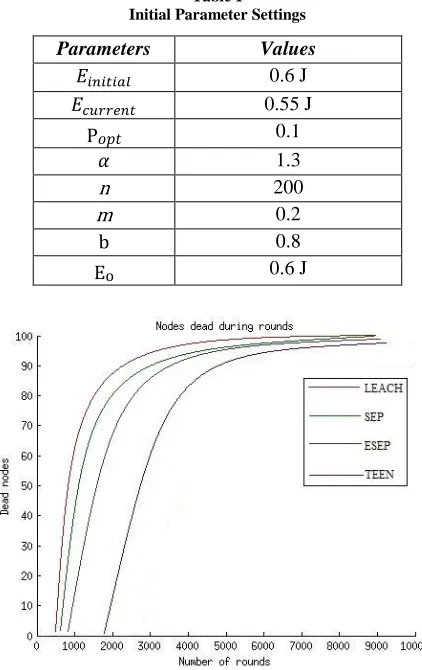
Table 1 Initial Parameter Settings
Parameters Values
𝐸 0.6 J
𝐸 0.55 J
P 𝑝 0.1
𝛼 1.3
n 200
m 0.2
b 0.8
[image:6.612.62.273.269.604.2]Eo 0.6 J
Figure 2: nodes dead per round in LEACH, SEP, ESEP & TEEN
Initially our network consisting of 200 nodes, placed randomly in a region and a base station (BS) located at the outside of that region as considered.
Simulating in MATLAB, we initially started with some parameters like Einitial as 0.6 Joule, Ecurrentas 0.55 Joule, Popt
as 0.1, α as 1, n as 200, m as 0.2, b as 0.8 and Eo as 0.6 Joule.
On the next simulation, we changed our parameters setting to different values. Figure 2 plots the graph of nodes dead during each round. In figure 2, LEACH protocol is shown as the red curve, SEP protocol is shown as the green curve, ESEP protocol is shown as the gray curve and TEEN protocol is shown as the purple curve. As shown in the figure 2 TEEN protocol has better performance as nodes dies later as compared to other protocol. Our proposed protocol UCEESEP is taken as separate graph in figure 5.
Figure 3: nodes alive per round in LEACH, SEP, ESEP & TEEN
Figure 4: throughput of LEACH, SEP, ESEP & TEEN
[image:6.612.342.555.447.639.2]International Journal of Emerging Technology and Advanced Engineering
Website: www.ijetae.com (ISSN 2250-2459,ISO 9001:2008 Certified Journal, Volume 3, Issue 11, November 2013)
239
[image:7.612.61.274.251.425.2]The graph of nodes alive during each round in figure 3 is the complementary of the graph of nodes dead during each round. Again TEEN performs better as compared to other protocol as shown in the graph. The graph plotted for nodes alive during each round of UCEESEP is shown as separate graph in figure 6. The graph of figure 4 plots the data packets send to the base station as throughput. Again the same colored curve are used for LEACH, SEP, ESEP and TEEN protocols.
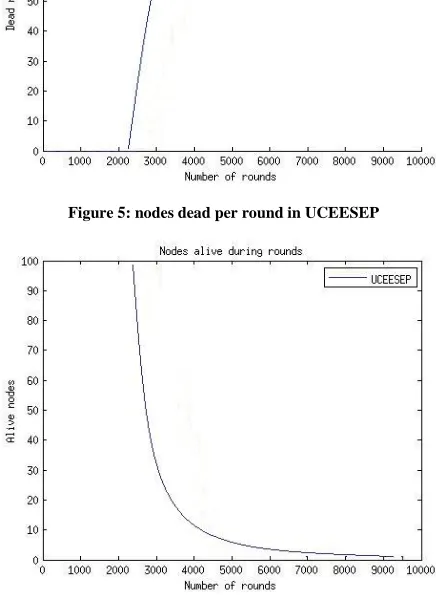
[image:7.612.342.556.259.442.2]Figure 5: nodes dead per round in UCEESEP
Figure 6: nodes alive per round in UCEESEP
To evaluate the performance of UCEESEP in MATLAB, we considered the same initial parameter settings and the next parameter setting as used in LEACH, SEP, ESEP and TEEN.
As shown in figure 5, the graph plotted for nodes dead during each round in UCEESEP curve shows that our proposed protocol performs better than LEACH, SEP, ESEP and TEEN as less nodes die after each rounds as compared to other protocols.
As shown in figure 5, the graph plotted for nodes alive during each round in UCEESEP curve shows that our proposed protocol performs better than LEACH, SEP, ESEP and TEEN as more nodes alive after each rounds as compared to other protocols.
Figure 7: throughput of UCEESEP
In our MATLAB simulation, we considered the same parameter setting to compare UCEESEP with LEACH, SEP, ESEP and TEEN. The throughput of UCEESEP as the graph of data packet sent to the base station, shown in figure 7 is better than LEACH, SEP, ESEP and TEEN. The curve of UCEESEP throughput shows our proposed protocol sends more data packets to the base station as compared to other protocols discussed above.
After comparison of UCEESEP with LEACH, SEP, ESEP and TEEN, we evaluated that using our proposed protocol UCEESEP, better energy efficiency, enhanced network lifetime and throughput.
V. CONCLUSION &FUTURE WORK
[image:7.612.59.277.333.631.2]International Journal of Emerging Technology and Advanced Engineering
Website: www.ijetae.com (ISSN 2250-2459,ISO 9001:2008 Certified Journal, Volume 3, Issue 11, November 2013)
240
In comparison with SEP, LEACH, ESEP and TEEN it can be concluded that our protocol UCEESEP will perform well in small as well as large sized networks and best suited for time critical applications.
However UCEESEP is not suitable where frequent information is received from wireless sensor network. Our future direction will be to overcome this limitation in this protocol. Finally, in future, the concept and implementation of mobile base station can be introduced in UCEESEP to perform the next level of technology of wireless sensor network.
REFERENCES
[1] I.F. Akyildiz, W. Su, Y. Sankarasubramaniam, and E. Cayirci, "A Survey on Sensor Network", IEEE Communication Magazine 40, 8 (August 2004), pp. 102-114.
[2] Ningbo Wang, Hao Zhu, ―An Energy Efficient Algorithm Based on LEACH Protocol‖, International Conference on Computer Science and Electronics Engineering (ICCSEE), 2012, pp. 339-342.
[3] Islam, M M, Matin, M A, Mondol, T K, ―Extended Stable Election Protocol (SEP) for three-level hierarchical clustered heterogeneous WSN‖, IET Conference on Wireless Sensor Systems (WSS 2012), pp. 1-4.
[4] Kashaf, A, Javaid, N., Khan, Z.A, Khan, I.A., ―TSEP: Threshold-Sensitive Stable Election Protocol for WSNs‖, 10th International Conference on Frontiers of Information Technology (FIT), 2012, pp. 164 - 168.
[5] Arati Manjeshwar, Agrawal, D.P., ―TEEN: a routing protocol for enhanced efficiency in wireless sensor networks‖, Proceedings 15th International conference on Parallel and Distributed Processing Symposium., 2001, pp. 2009 – 2015.
[6] Aliouat, Z, Harous, S., ―An efficient clustering protocol increasing wireless sensor networks life time‖, International Conference on Innovations in Information Technology (IIT), 2012, pp. 194 – 199. [7] Ruihua Zhang, Lei Ju, Zhiping Jia, Xin Li, ―Energy Efficient Routing
Algorithm for WSNs via Unequal Clustering‖, 14th International Conference on High Performance Computing and Communication & 2012 IEEE 9th International onference on Embedded Software and Systems (HPCC-ICESS), 2012 IEEE, pp. 1226 – 1231.
[8] Chengfa Li, Mao Ye, Guihai Chen, Jie Wu, ―An energy-efficient unequal clustering mechanism for wireless sensor networks‖, IEEE International Conference on Mobile Adhoc and Sensor Systems Conferenc Improved LEACH Protocol for Wireless Sensor Networks e, 2005, pp. 8-604.
[9] Kumar, N., Kaur, J., ―An efficient clustering protocol increasing wireless sensor networks life time‖, 7th International Conference on Wireless Communications, Networking and Mobile Computing (WiCOM), 2011, pp. 1-5.
[10] Baghyalakshmi, D., Ebenezer, J., SatyaMurty, S.A.V., ―Low latency and energy efficient routing protocols for wireless sensor networks‖, International Conference on Wireless Communication and Sensor Computing, ICWCSC 2010, pp. 1-6.
[11] Johnson, M., Healy, M., van de Ven, P., Hayes, M.J., Nelson, J., Newe, T., Lewis, E., ―A comparative review of wireless sensor network mote technologies‖, Sensors, 2009 IEEE, pp. 1439-1442. [12] Gaddam, A., Mukhopadhyay, S.C., Sen Gupta, G., Guesgen, H.,
―Wireless Sensors Networks based monitoring: Review, challenges and implementation issues‖, 3rd International Conference on Sensing Technology, ICST 2008, pp. 533-538.
[13] Popovici, E., Magno, M., Marinkovic, S., ―Power management techniques for Wireless Sensor Networks: A review‖, 5th IEEE International Workshop on Advances in Sensors and Interfaces (IWASI), 2013, pp. 194 – 198.
[14] Young, D.J., ―Interface electronics for MEMS-based wireless sensing applications‖, International Symposium on VLSI Design Automation and Test (VLSI-DAT), 2010, pp. 130-133.
[15] Warneke, B.A., Pister, K.S.J., ―MEMS for distributed wireless sensor networks‖, 9th International Conference on Electronics, Circuits and Systems, 2002, pp. 291- 294 vol.1.