International Journal of Emerging Technology and Advanced Engineering
Website: www.ijetae.com (ISSN 2250-2459, ISO 9001:2008 Certified Journal, Volume 9, Issue 7, July 2019)
33
Mechanical Properties of Al 6061-B4C Metal Matrix
Composites Fabricated by Stir Casting Process
Vasanth Kumar H S
1, Dr. U. N. Kempaiah
2, Dr. G. Mallesh
3 1Assistant Professor, Department of Mechanical Engineering, Government Engineering College, Kushalnagar.
2Professor, Department of Mechanical Engineering, UVCE, Bangalore University, Bangalore.560001 3Professor, Department of Mechanical Engineering, Sri Jayachamarajendra College of Engineering, Mysusru.570006 Abstract— Composite materials are the combinations of
two or more materials which are different in form and chemical composition. These materials are gradually gaining more importance as a structural material in the present engineering design and development activities because they offer very attractive mechanical properties such as high strength to weight ratio higher thermal and corrosive resistance etc. A wide range of metals and their alloys such as Aluminum, Titanium and Magnesium are used in combination with different reinforcements like SiC, B4C, TiC TiO2, TiB, TiB2, B4C, ZrO2, ZrB etc. to develop light weight MMC’s. Among these, aluminium and their alloys are extensively used for commercial applications such as construction, transportation aerospace industries marine and similar engineering activities because of its unique properties.
In the present study, attempts are made to synthesize Al 6061-B4C MMC’s by varying the weight percentage of
reinforcement to study the mechanical and tribological properties. EDX and XRD results confirms the formation of B4C particles in the composite and it is evident from the SEM images that B4C particles are homogenously distributed in the base metal. Further, results revealed that mechanical and tribological properties were enhanced with the addition of B4C particles.
Keywords— Aluminium alloy, B4C, Mechanical and Tribological properties, Stir Casting Process.
I. INTRODUCTION
In the present day engineering design and development activites many Scientists, Researchers and Engineers are striving hard to develop new and better engineering materials, which accomplishes high strength, low weight and energy efficient materials since the problems of environment and energy are major threshold areas. The development of new materials is growing day by day to replace the conventional materials in aerospace, marine engineering, automobile engineering industries etc., Hence, composite materials are found to be an alternative.
Composite materials are the combination of two are more materials which are different in form and chemical composition these are classified as Polymer Matrix Composite (PMC’s), Ceramic Matrix Composites (CMC’s) and Metal Matrix Composites (MMC’s) among these composites metal matrix composites are extensively used in many engineering and general applications due to its
Higher strength-to-weight ratio, Higher stiffness, Better fatigue, wear and corrosive resistance, High temperature capabilities and ease of manufacturing.
A variety of metals and their alloys such as Aluminium, Magnesium and Titanium are comprehensively used as matrix materials. Among these Aluminium alloys have been used extensively, because of their excellent strength, low density, corrosion resistance and toughness.Similarly, many researchers have attempted to develop aluminium based metal matrix composites using different reinforcements such as SiC, B4C, B4C, TiC, TiO2, TiB2
etc., are added to the matrix to get required MMC’s. Among these reinforcements, B4C emerged as an
exceptional reinforcement due to its high strength to density ratio, possesses high hardness and avoid the formation of interfacial reaction products with aluminium. Hence, in this research work attempts are made to develop Al 6061-3, 6, 9 and 12 wt.% B4C MMC’s by stir casting
process to evaluate Tensile strength, Hardness, Impact
strength and wear characteristics of the composites as per ASTM standards.
II. LITERATURE REVIEW
A literature survey is the sources of background information which are relevant to a particular area of research. It provides a methodology, description and critical assessment of each work. Present research is mainly focused on the development, estimation of mechanical and tribological properties of Al 6061 reinforced with SiC, B4C, B4C, TiC, TiO2, TiB2 Metal matrix composites to
International Journal of Emerging Technology and Advanced Engineering
Website: www.ijetae.com (ISSN 2250-2459, ISO 9001:2008 Certified Journal, Volume 9, Issue 7, July 2019)
34
Saikeerthi S. P et.al. [1] developed Al 6061-B4C/SiCcomposites using stir casting process with a stirring speed of 400 rpm about 5 minutes to evaluate the tensile, hardness, impact and flexural strength of the composite by varying the particle size and wt.% of the reinforcement. It is found that addition of the B4C/SiC and increase in the
particle size the mechanical properties of the composites developed were enhanced.
V. Auradi et.al. [2]developed Al 6061-B4C composites
using pre-heated B4C particles and K2TiF6 flux to
overcome the problem of agglomeration and clustering of the particles for different wt.% of the reinforcement particles. XRD, EDX and SEM analyses was conducted to know presence and distribution of the reinforcement in the composites. It is evident from the results that B4C particles
were present and uniformly distributed in the composites developed. Further, addition of the B4C particles to the melt
leads to decrease in the grain size and hence improves the mechanical properties.
B Stalin et.al. [3] synthesized LM4- B4C (400 mesh)
composites for 5, 10 and 15 wt.% of reinforcement by stir casting process to evaluate mechanical behavior of MMC’s. SEM and XRD tests confirms the presence and uniform distribution of B4C in the matrix alloy. It is noticed
that mechanical properties were improved with the addition of 10 wt.% of the reinforcement. It is also evident that absorption of energy found to be increased by increasing percentage of reinforcement.
G B Veeresh Kumar et. al. [4] fabricated Al6061-SiC and Al7075-B4C composites using stir casting route by maintaining a temperature of 720oC with a stirring speed of 400 rpm about 10 minutes to study the micro structure, mechanical and wear properties. It is observed that addition of the reinforcement in both the alloy increase mechanical, tribological properties but Al7075-B4C has better properties compared to Al 6061-SiC.
Kaliselvan et al [5]synthesizedAl 6061-B4C composites
by adding K2TiF6 flux using stir casting process with argon
gas environment to study the mechanical properties of the composites. It is noticed that addition of K2TiF6 results in
good wettability between the particles and matrix. Further, mechanical properties like hardness increased from 51.3 HV to 80.8 HV and tensile strength enhanced from 185 MPa to 215 MPa.
Gopal Krishna U B et.al. [6] developed AMC’s using B4C using stir casting process to study the mechanical
characteristics of the composites for different wt.% of the reinforcement as per ASTM standards.
It is observed from the results that B4C particles
homogeneous distributed in the matrix and perceived the presence of particles in the matrix. Further, it is noticed that tensile strength and hardness of the composites were enhanced with the addition of 12 and 8 wt. of the reinforcement respectively.
A G Rao et. al. [7] Al 6061 - B4C composite with the
addition of K2TiF6 and Mg2Si using centrifugal casting
process was developed to study the mechanical and physical properties. It is noticed that addition of salts improves the wettability between the matrix and reinforcement. Increase in the speed and centrifugal force during manufacturing of the composites enhances the mechanical properties.
B Ravi et. al. [8] developed Aluminium Matrix Composites using Boron Carbide using centrifugal casting technique by varying the wt.% of the reinforcement to study the mechanical properties. It is evident from the results that tensile strength was enhanced from 117 MPa to 145 MPa and hardness value increased from 62 HV to 68 HV.
Yong Zhao et. al. [9] developed AA 6061- B4C
composites using friction stir process to study the microstructure and mechanical properties. Results reveled that with increasing number of FSP passes, the dispersion of B4C particles becomes more uniform, further by way of
four FSP passes, the expected AA6061/B4C surface
composite layer is successfully fabricated with homogeneously distributed B4C particles.
Vijaya Ramnath et. al. [10] Al6061 B4C-SiC composite
were produced with stir cast route for different particle size (Viz 37μ, 44μ, 63μ, 105μ, 250μ) by maintaining melt temperature at 800°C during the process preheated B4C
particles and degassing agents C2Cl6 were added into the
vortex with a stirring speed of 300rpm. It was observed from the XRD analysis the B4C particles are
homogeneously dispersed in the matrix. Further it is noticed that hardness of the composite was maximum at 250 µ at 12 wt.% and an increment in tensile strength at 105 µ for 8 wt.% of B4C.
International Journal of Emerging Technology and Advanced Engineering
Website: www.ijetae.com (ISSN 2250-2459, ISO 9001:2008 Certified Journal, Volume 9, Issue 7, July 2019)
35
III. FABRICATION OF AL 6061-B4CCOMPOSITESSeveral manufacturing techniques are used to synthesize metal matrix composites. The most commonly used techniques are liquid, solid and gaseous state [18], these processes includes Squeeze casting, Powder metallurgy, Spray forming, Diffusion bonding, Sinter-forging, Stir casting, In-Situ process. Among these manufacturing processes stir casting is generally accepted as a promising route to manufacture metal matrix composites in large volumes with minimum cost. Hence in this research work, stir casting technique is used to develop Al 6061-B4C MMC’s.
A. Stir Casting
[image:3.612.352.537.143.288.2]Stir casting process is an extensively used method to fabricate MMC’s in liquid state in which molten metal is mixed in the furnace by means of mechanical stirring [19]. It is noticed that almost all the composites were manufactured by this process using up to 30% volume fraction of reinforcement [20,21]. It is evident from the literature that use of stir casting process enables better mixing of matrix and reinforcement in the MMC’s. Different components of stir casting process are as shown in Fig.1 and Fig.2.
Fig. 1. Components of stir casting process
Fig. 2. Stir casting process Set-Up
[image:3.612.349.538.440.648.2]Al 6061 rods and 3, 6, 9 and 12 wt.% of B4C are weighed as per the wt.% of the reinforcement and fed into the graphite crucible and heated using an electrical During stirring preheated B4C is gradually poured into the molten metal and stirring was continued about 10-12 minutes the melt was poured into a preheated cast iron molds shown in Fig.3. After solidification process castings were obtained as shown in Fig.4 and machining of different wt. % of B4C composites using wire cut EDM, CNC turning and milling was carried out as per different ASTM standards to conduct mechanical tests.
[image:3.612.94.262.443.590.2]International Journal of Emerging Technology and Advanced Engineering
Website: www.ijetae.com (ISSN 2250-2459, ISO 9001:2008 Certified Journal, Volume 9, Issue 7, July 2019)
[image:4.612.325.561.109.609.2]36
Fig. 4. Al 6061-Different wt. % of B4C MMC’s.
B. Microstructure Characteristics of Al 6061-B4C Composites
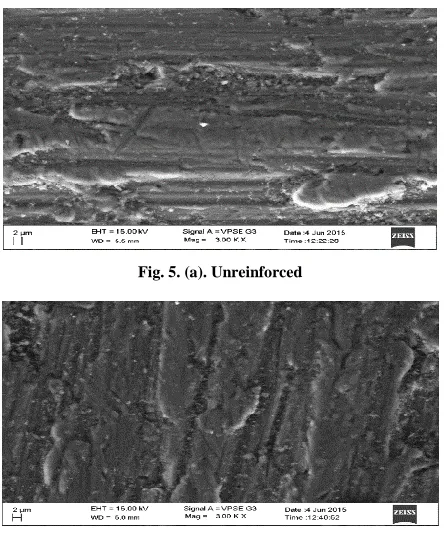
The SEM micrographs of Al 6061- B4Ccomposites are presented in Fig.5 (a-e). It is noticed from the micrographs that all the castings are free from defects such as porosity, shrinkages and slag inclusions which highlights the quality of castings and B4C particles are distributed homogeneously in the composites which is an essential requirement to achieve better mechanical properties.
Fig. 5. (a). Unreinforced
Fig. 5. (b). 3 % B4C
Fig. 5. (c). 6 % B4C
Fig. 5. (d). 9 % B4C
Fig. 5. (e). 12 % B4C
IV. ASTMSTANDARD MECHANICAL TESTING METHODS
A. Tensile Strength
[image:4.612.64.272.119.294.2] [image:4.612.58.280.428.697.2]International Journal of Emerging Technology and Advanced Engineering
Website: www.ijetae.com (ISSN 2250-2459, ISO 9001:2008 Certified Journal, Volume 9, Issue 7, July 2019)
37
B. Impact Strength
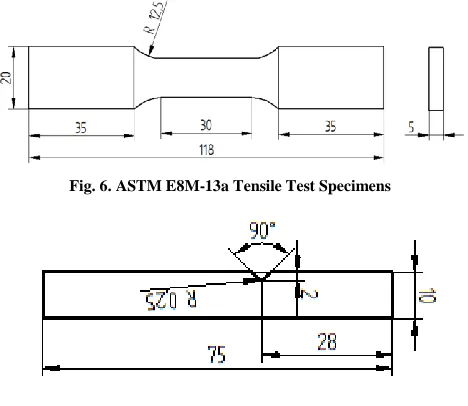
Ability of the material to resist a sudden/shock loads is known as impact strength. Izod or Charpy impact tests are used to measure the impact energy required to fracture the specimen. In this study ASTM E23 standard is used to determine the impact resistance of Al 6061 reinforced with different wt. % of B4C composite system. The standard size of impact test specimen is as shown in Fig.7.
C. Hardness
[image:5.612.387.500.131.320.2]Hardness is the property of a material that resist plastic deformation by indentation. Vickers hardness test (VHN) is the most versatile since only one indenter is used for a range of loads for different materials. The tests were conducted for different wt.% of B4C as per ASTM E-384 standard shown in Fig.8.
Fig. 6. ASTM E8M-13a Tensile Test Specimens
Fig.7. ASTM E-23 Impact Test Specimens
Fig.8. ASTM E-384 Hardness Test Specimens
V. RESULTS AND DISCUSSIONS
A. Tensile Strength
[image:5.612.53.287.329.532.2]International Journal of Emerging Technology and Advanced Engineering
Website: www.ijetae.com (ISSN 2250-2459, ISO 9001:2008 Certified Journal, Volume 9, Issue 7, July 2019)
[image:6.612.53.288.134.275.2]38
Fig. 9. Tensile strength of Al 7075- B4C composite system
It is also evident that increase in the wt.% of the reinforcement there was noticeable decrease in the percentage of elongation due to the addition of hard particles B4C which leads to the formation of brittle phase in the composite in turn enhances the load carrying capacity.
B. Impact Strength
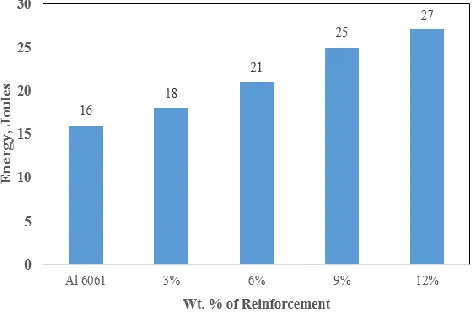
[image:6.612.50.288.506.663.2]Izod impact tests were conducted as per ASTM standard to know the impact strength of the composites. It is observed from the results that a gradual improvement in the impact strength of the composite as percentage of reinforcement increases. The improvement in the impact strength is due to the resistance in flowing energy of the reinforcing particles at the molecule level. It is observed from the Fig.10 that impact strength of the composite developed is enhanced by 41% compared to base alloy.
Fig. 10. Impact strength of Al 7075- B4C composite system
C. Hardness
Vickers hardness tests were conducted as per ASTM standard to know the hardness number of Al 7075- B4C composites. Fig. 11 represents hardness number of 3,6,9 and 12 wt.% of B4C reinforcement. It is observed from the results that addition of Alumina enhances the hardness of the composite. Presence of B4C particles in the composite helps to resist the movement of dislocation within the matrix, minimization of inter atomic distance and better bonding between the matrix and the reinforcement.
Fig. 11. Hardness test results
VI. CONCLUSIONS
Al 6061 reinforced with different wt.% of B4CAMC’s were synthesized using stir casting process.
SEM images shows the clear and uniform distribution of B4C in the matrix alloy and the presence of the reinforcement in the composite developed and
Mechanical tests on Al 6061 - B4CAMC’s were carried out using different ASTM standards to evaluate mechanical behaviour.
Mechanical properties such as Tensile strength, Impact strength and Hardness of Al 6061 - B4C composites were enhanced with the addition of reinforcement.
REFERENCES
[1] Miller, W. S., L. Zhuang, J. Bottema, A_J Wittebrood, P. De Smet, A. Haszler, and A. Vieregge. "Recent development in aluminium alloys for the automotive industry." Materials Science and Engineering: A 280, no. 1 (2000): 37-49.
International Journal of Emerging Technology and Advanced Engineering
Website: www.ijetae.com (ISSN 2250-2459, ISO 9001:2008 Certified Journal, Volume 9, Issue 7, July 2019)
39
[3] Ramnath, B. Vijaya, C. Elanchezhian, R. M. Annamalai, S. Aravind, T. Sri Ananda Atreya, V. Vignesh, and C. Subramanian. "Aluminium metal matrix composites-a review." Rev. Adv. Mater. Sci 38 (2014): 55-60.
[4] Moghaddama, K. Shirvani, H. Abdizadehb, and H. R. Baharvandic. "mechanical and structural behavior of aluminium matrix composite reinforced by B4C under different processing temperature and
volume fraction of reinforcement."
[5] Bindumadhavan, P. N., T. K. Chia, M. Chandrasekaran, Heng Keng Wah, Loh Nee Lam, and O. Prabhakar. "Effect of particle-porosity clusters on tribological behavior of cast aluminium alloy A356-SiCp metal matrix composites." Materials Science and Engineering: A 315, no. 1-2 (2001): 217-226.
[6] Hong, Soon-Jik, Hong-Moule Kim, and Byong Sun Chun. "Effect of clustering on the mechanical properties of SiC particulate-reinforced aluminium alloy 2024 metal matrix composites." Materials Science and Engineering: A 347, no. 1-2 (2003): 198-204.
[7] Auradi, V., G. L. Rajesh, and S. A. Kori. "Processing of B 4 C Particulate Reinforced 6061Aluminum Matrix Composites by Melt Stirring Involving Two-step Addition." Procedia materials science 6 (2014): 1068-1076.
[8] Stalin, Dr B., and C. Murugan. "Evaluation of Mechanical Behavior of Aluminium Alloy Boron Carbide MMC International Conference on Emerging Engineering Trends and Science (ICEETS–2016)." 2348-8360.
[9] Kumar, G B Veeresh, C. S. P. Rao, N. Selvaraj, and M. S. Bhagyashekar. "Studies on Al6061-SiC and Al7075-Al2O3 metal matrix composites." Journal of Minerals and Materials Characterization and Engineering 9, no. 01 (2010): 43.