ORIGINAL RESEARCH ARTICLE
CREATION OF MOROCCAN ISLAMIC INDEXES BY THE METHOD OF FILTERING ACCORDING TO
THE STANDARDS OF ICB SECTOR CLASSIFICATION « INDUSTRY CLASSIFICATION
BENCHMARK »
1
Amin Akhrif and
2Faris Hamza
1
Doctoral Studies Center « ENCG » - Tangier,
University Abdelmalek Essaidi
2
Professor of Higher Education, Faculty of Juridical, Economic and Social Sciences – Tetuan,
University Abdelmalek Essaidi
ARTICLE INFO ABSTRACT
Islamic indexes have been launched since a decade on many markets including American and English markets. The goal of this optic is to propose to investors a means of diversification of their portfolios in order to invest in accordance with the Sharia principles. The objective of this paper is to present Islamic indexes on an international scale and to create Moroccan Islamic indexes by both methods of quantitative and qualitative filtering according to the principles of ICB sector classification « Industry Classification Benchmark ». The creation of the two Moroccan Islamic indexes will be realized on collected information in 2016 about listed companies on the Casablanca stock exchange.
Copyright © 2019,Amin Akhrif and Faris Hamza. This is an open access article distributed under the Creative Commons Attribution License, which permits unrestricted use, distribution, and reproduction in any medium, provided the original work is properly cited.
INTRODUCTION
Part 1: Stock market indexes
Chapter 1: Presentation of Casablanca stock exchange and their indexes
The creation of Casablanca stock exchange can be situated around 1929. In this period, the stock exchange was named the clearing office of securities. The importance of securities market and the establishment of exchange controls has motivated authorities of the time to improve and regulate its organization and operation. In 1948, the clearing office of
securities became listingoffice of securities.
Stock market indexes: MASI & MADEX: The follow-up of the stock exchange situation means a pertinent indicators battery able to reflect permanently securities progress.
*Corresponding author: Amin Akhrif
Doctoral studies center « ENCG » - Tangier, University Abdelmalek Essaidi
The stock market indexes are calculated in a scientific way on the basis of a sample representative of publicly listed securities. The stock exchange performance is generally measured by many indexes:
Principal index: measures the global performance of the stock exchange. This index is calculated start from the whole or the majority of companies listed on the stock exchange.
Sector indexes: measure the performance of a subset of companies having common characteristics. These indexes are calculated start from companies included in the targeted subset (for instance companies of services sector as banks, insurance companies.... etc).
In morocco and till 2001, the performance of Casablanca stock exchange was measured by stock exchange global index named ICB of which the bedrock has been differentiated in comparison with the new stock exchange progresses. Also, since January 2002, two new indexes was established, more adapted to the new modernized stock market configuration.
ISSN: 2230-9926
International Journal of Development Research
Vol. 09, Issue, 01, pp.25468-25475, January, 2019
Article History:
Received 09th October, 2018
Received in revised form 26th November, 2018
Accepted 04th December, 2018 Published online 30th January, 2019
Key Words:
Islamic finance – Islamic market indexes – Sharia - Filtering criteria – Quantitative and qualitative filtering
Citation: Amin Akhrif and Faris Hamza. 2019. “Creation of moroccan islamic indexes by the method of filtering according to the standards of icb sector
classification « industry classification Benchmark »”, International Journal of Development Research, 09, (01), 25468-25475.
The MASI
For the country of Morocco, the MASI "Moroccan All Shares Index" takes into consideration all the listed values on the Casablanca stock exchange. It allows to have a global idea on the market performance and the enthusiasm of all investors. All companies listed on the Casablanca stock exchange are evaluated in the MASI.
The MASI is constituted by 74 companies (Source:
www.casablanca-bourse.com)
The MADEX
The MADEX or "Morocan Most Active Shares Index" gathers most active values of the Moroccan stock market. The MADEX operates like the French index CAC 40 that gathers the 40 most bigger companies of the Parisian stock exchange. The MADEX represents 62% of the MASI.
The impact of creating the two Moroccan indexes
The creation of MASI & MADEX have involved massive introduction of many big companies. This is due to the fact that new indexes & their sector recomposition allow the investor to anticipate the progress of the price in terms of economical activity of the sector. The sample of every sector index is composed of values whole belonging to this sector. The composition update of every sector sample is realized every year, in order to take account of the progress of economical conditions & of the growth of some sectors.
In general, both indexes have allowed:
The rise of the competitiveness of Casablanca stock
exchange at international scale;
The offer of securities introduced in the Stock exchange
has became more important;
Important entries of currency in the stock exchange.
Chapter 2: Presentation of the main Islamic indexes at the international scale
DJIM Index: Launched in February 1999, the Dow Jones Islamic Market index (Dow Jones since 2010) reflects the progress of companies belonging to 66 countries in the world representing Islamic finance criteria. The family DJMI gathers more than 90 indexes spread according to geographic areas, activity sectors and size of companies.
The FTSE Sharia global equity index series: Born from a merger between the FTSE and Yasaar consulting company.
This series covers the indexes of DIFX1Sharia, the SGX2 100
and the FTSE Bursa Malaysia index (FTSE since 2010).
S&P Index series: The Standard & Poor"s agency has launched in 2006 the Islamic version of its reference indexes as well as other new ones.
MSCI index: Launched in march 2007, Islamic indexes family of "Morgan Stanley Capital International" ensures an important geographic coverage.
1Dubaï International Financial Exchange 2
Singapore Exchange
Stoxx: The Stoxx company, belonging to both six groups and German stock exchange, has launched in 23 February 2011 the first stock market indexes in continental Europe "the Stoxx 2011". It gathers "the STOXX Europe Islamic Index" and its two under-indexes "the STOXX Europe Islamic 50" and "EURO STOXX Islamic 50". The three indexes of this family are selected through the filtering process of 600 companies of the index "the STOXX Europe 600 Index".
Other indexes: Previously, we have presented the main indexes at international scale. However, other Islamic stock market indexes exist but with a limited coverage at national scale :
Taiwan stock exchange: The Islamic index has been launched in November 2008 in partnership with the FTSE.
Indian stock exchange: The Islamic index "Parsoli Islamic Equity (PIE)" launched in partnership with Parsoli institution.
Karachi stock exchange of Pakistan: The first Islamic index has been launched in September 2008 in partnership with investment company Al Meezan.
Malaysia stock exchange: The last Islamic index was replaced in 2007 by two indexes "the Bursa Malaysia
EMAS3Sharia Index" and "the FTSE Bursa Malaysia Hijrah
Sharia Index". Both of them have been launched in partnership with the FTSE and destines respectively to Malaysian and international investors.
Kuwait stock exchange: among many Islamic stock market indexes, the stock exchange has "the Kuwait Sharia Criteria Index4".
Part 2: Creation of Islamic indexes on the Moroccan financial place
Chapter 1: selection criteria and principles of Islamic indexes
A value could be integrated in the Islamic index if it's in accordance with the basic principles of Sharia. For this, we install quantitative & qualitative filters in order to integrate a value into the index. But the finale decision revert to the Sharia committees that valid the conformity of values included in the index.
Qualitative filtering: In terms of Sharia, it is prohibited to invest in sectors such as weapons, alcohol, tobacco, drugs, peek. Are prohibited as well pornography, debauchery, chance games and investment in the conventional insurance and financial institutions with operations of lending or borrowing with interest. To Judge if a company could succeed or not the qualitative filtering, we have to verify if its area of activity is present within a list that gathers sectors and under-sectors of activities judged illicit by the Sharia committee. This
classification is named ICB5 (Next table)
3Expressway Monitoring Advisory System
4Abdelbari El Khamlichi ; Ethique et performance : le cas des indices
boursiers et des fonds d’investissement en finance islamique. Université d’Auvergne – Clermont-Ferrand I, 2012.
5
ICB codes of 23 prohibited sectors by the Sharia committee of Dow Jones
ICB codes Designation 2717 Defense
3535 Distillers & winemakers 3577 Food products 3745 Leisure products 3785 Tobacco
5337 Retailers & food wholesalers 5553 Audiovisuel and entertainment 5555 Media agency
5752 Chance and money games 5753 Hotels
5755 Leisure services 5757 Restaurants and bars 8355 Banks
8532 Insurance 8534 Insurance broker
8536 Insurance, real estate and damages 8538 Reinsurance
8575 Life insurance
8733 Real estate and development 8773 Consumer finance
8775 Specialized financial activities 8777 Investment services
8779 Hypothecary financings
Quantitative filtering: This second filtering consists to sort retained companies after succeeding the first filtering and keep only those who present a solid financial structure.
These quantitative filtering concern next levels:
Level of debts; Level of receivables;
Level of liquidities generating interest.
The level of debts: The goal is to measure the level of indebtedness to be sure that the company is moderated indebted (or preferably non indebted). In fact, one of the main keys that distinguish the Islamic finance is the prohibition of borrowing with interest and practice of discount, reason for why the level of company indebtedness is taken into consideration.
We explain this point by the next table:
Debt Thresholds in the case of three Islamic indexes
The level of receivables
The company should not have a receivables level exceeding these thresholds. If the majority of stocks is in the form of receivables, The company's current asset is heavily dominated by cash flows with risk that these receivables could be unrecoverable.
Receivables Thresholds in the case of three Islamic indexes
Level of cash
Based on the principle that interests are prohibited in Islamic finance, the next filter defines maximum level of cash the company should have. So, it is forbidden to invest in companies of which one of the main activities is about bank deposits, or in companies of which majority of assets are cash.
Cash Thresholds in the case of three Islamic indexes
Chapter 2: creation of two Islamic stock market indexes
Section 1: qualitative filtering: MASI & MADEX
Qualitative filtering of MASI: According to the codes of ICB standards, qualitative filtering allowed to eliminate the next companies:
Eliminated companies Prohibition codes according ICB BCP Code 8355 : Banks
Alliances Code 8733 : Real estate and development WAFA Assurance Code 8532 : Insurance
Attijariwafa BANK Code 8355 : Banks BMCE BANK Code 8355 : Banks Lesieur cristal Code 3577 : Food products Centrale Danone Code 3577 : Food products UNIMER Code 3577 : Food products Dari couspate Code 3577 : Food products Cartier SAADA Code 3577 : Food products Saham Assurance Code 8532 : Insurance
AFMA Code 8532 : Insurance AGMA Lahlou-Tazi Code 8532 : Insurance
CIH Code 8355 : Banks CDM Code 8355 : Banks BMCI Code 8355 : Banks
Brasseries du Maroc Code 3535 : Distillers & winemakers Oulmes Code 3577 : Food products
LABEL VIE Code 5337 : Retailers & food wholesalers Balima Code 8733 : Real estate and development Salafin Code 8773 : Consumer financing Maghrebail Code 8773 : Consumer financing Eqdom Code 8773 : Consumer financing Maroc Leasing Code 8773 : Consumer financing Taslif Code 8773 : Consumer financing AXA crédit Code 8773 : Consumer financing DIAC Salaf Code 8773 : Consumer financing Zellidja S.A Code 5753 : Hotels (holdings)
Risma Code 5753 : Hotels Cosumar Code 3577 : Food products
Atlanta Code 8532 : Insurance
The first selection has eliminated 33 companies (45% of values)
Qualitative filtering of MADEX: According to the codes of ICB standards, qualitative filtering allowed to eliminate the next companies:
Eliminated companies Prohibition codes according ICB
BCP Code 8355 : Banks
Alliances Code 8733 : Real estate and development WAFA Assurance Code 8532 : Insurance
Attijariwafa BANK Code 8355 : Banks BMCE BANK Code 8355 : Banks Lesieur Cristal Code 3577 : Food products Cartier SAADA Code 3577 : Food products Saham Assurance Code 8532 : Insurance AFMA Code 8532 : Insurance
CIH Code 8355 : Banks
LABEL VIE Code 5337 : Retailers & food wholesalers Risma Code 5753 : Hotels
Cosumar Code 3577 : Food products Atlanta Code 8532 : Insurance
Res Dar Saada Code 8733 : Real estate and development Douja Prom Addoha Code 8733 : Real estate and development
The first selection has eliminated 16 companies (34,7%
of values)
Section 2: quantitative filtering: MASI & MADEX
The second filter consists in sorting retained companies after succeeding the first filter and keeps only those with a solid financial structure.
These quantitative filters concern the three next ratios:
R1 : level of debts
R2 : level of receivables
R3 : cash generating interests
Level of debts
This ratio is used to measure the level of debt in order to make sure that company is modestly indebted. We must retain only those of which ratios are less than 33%. Ce ratio est utilisé
pour mesurer le niveau d‘endettement pour s'assurer que l'entreprise est modérément endettée. Il consiste à ne retenir que celles dont ces ratios sont inférieurs à 33%.
MASI
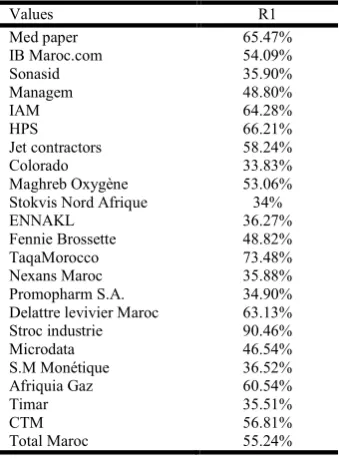
The application of ratio number 1 "R1" on 41 remained values allows us to eliminate 23 values (56% of values):
Example of calculation (Company : Maghreb Oxygène)
Total of debts
Financing debts : 129.207.041,70 dh (Table 12)
Current liabilities debts : 94.350.266,15 dh (Table 12)
[image:4.595.45.280.132.298.2]Total : 223.557.307,85 dh
Table 11. Eliminated values of MASI (R1)
Values R1
Med paper 65.47%
IB Maroc.com 54.09%
Sonasid 35.90%
Managem 48.80%
IAM 64.28%
HPS 66.21%
Jet contractors 58.24%
Colorado 33.83%
Maghreb Oxygène 53.06%
Stokvis Nord Afrique 34%
ENNAKL 36.27%
Fennie Brossette 48.82%
TaqaMorocco 73.48%
Nexans Maroc 35.88%
Promopharm S.A. 34.90%
Delattre levivier Maroc 63.13%
Stroc industrie 90.46%
Microdata 46.54%
S.M Monétique 36.52%
Afriquia Gaz 60.54%
Timar 35.51%
CTM 56.81%
Total Maroc 55.24%
Table 12. Liabilities balance sheet 2016 (Company:Maghreb Oxygène) Source: https://www.cdgcapitalbourse.ma/static/ attached/cdgkb/MOX_ETATS_FINANCIERS_2016.pdf
PASSIF Exercice Exercice précédent
CAPITAUX PROPRES
Fin
anceme
nt
pe
rma
n
en
t
Capital social du personnel 81250000,00 81250000,00
moins : actionnaires, capital souscrit non appelé dont versé
Prime d'émission de fusion d'apport 40990021,11 40990021,11
Ecarts de réévaluation
Réserve légale 8125000,00 8125000,00
Autres réserves 53105500,00 53105500,00
Report à nouveau (2) 3561817,24 870476,14
Résultat net en instance d'affectation (2)
Résultat net de l'exercice (2) 9349819,09 5941341,10
Total des capitaux propres (a) 196382157,44 190282338,35
Capitaux propres assimilés (b)
Subventions d'investissement
Provisions réglémentées
Dettes de financement (c) 129207041,70 127137104,30
Emprunts obligatires 100000000,00 100000000,00
Autres dettes de financement
Autres dettes de financement : (consignations) 29207041,70 27137104,30
PROVISIONS DURABLE POUR RISQUES ET CHARGES (d)
Provisions pour charges
Provisions pour risques
ECARTS DE CONVERSION - PASSIF (e)
Augmentation des créances immobilisées
Diminution des dettes de financement
TOTAL I (a+b+c+d+e) 325589199,14 317419442,65
[image:4.595.349.519.270.500.2]PA
SS
IF
C
IRCULAN
T
DETTES DU PASSIF CIRCULANT (I) 94350266,15 71358609,86
Fournisseurs et comptes rattachés 52911598,39 33780159,14
Clients créditeurs, avances et acomptes
Personnel 1861614,48 1841427,66
Organismes sociaux 2645837,62 2439229,02
Etat 34766142,52 31066815,21
Comptes d'associés
Autres créances 201911,36
Comptes de régularisation-passif 1963163,78 1942020,57
AUTRES PROVISIONS POUR RISQUES ET CHARGES (g) 416560,41 621613,26
ECART DE CONVERSION - PASSIF (h) (Element circulants) 103089,57 56613,94
TOTAL II ( I+g+h) 94869916,13 72036837,06
Trésorer
ie TRESORERIE PASSIF 845462,97 14441345,80
Crédit d'escompte
Crédit de trésorerie
Banques (soldes créditeurs) 845462,97 14441345,80
TOTAL III 845462,97 14441345,80
[image:5.595.43.561.51.236.2]TOTAL I+II+III 421304578,24 403897625,5
Table 13. Assets balance sheet 2016 (Company: Maghreb Oxygène) Source: https://www.cdgcapitalbourse.ma/static/ attached/cdgkb/MOX_ETATS_FINANCIERS_2016.pdf
Exercice Exercice précédent
ACTIF Brut Amortissement et
provisions Net Net
ACTIF
IM
MOBILISE
IMMOBILISTAION EN NON VALEUR(a)
Frais préliminaires
Charges à repartit sur plusieurs exercices
Primes de remboursement des obligations
IMMOBILISATION INCORPORELLES (b) 2515172,08 151372,08 2363800,00 2363800,00
Immobilisation en recherche et développement
Brevet marques, droit et valeurs similaires 151372,08 151372,08
Fonds commercial
Autres immobilisations incorporelles 2363800,00 23638000,00
IMMOBILISATION CORPORELLES (c) 625674473,25 449536398,16 176138075,09 172998596,06
Terrains 9752785,86 9752765,86 9752765,86
Constructions 40097916,73 26999022,04 1309894,69 13070781,59
Installations techniques, matériel et outillage 538613074,30 388192337,26 150420737,04 145629316,96
Matériel de transport 18331916,31 18063606,78 268309,53 464411,61
Mobiliers, matériel de bureau et aménagement divers 17343904,78 16069352,08 1274552,7 1464902,48
Autres immobilisations corporelles 212080,00 212080,00
Immobilisation corporelles en cours 1322815,27 1322815,27 2616417,54
IMMOBILISATION FINANCIERS (d) 51197054,11 111000,00 51086054,11 46831054,11
Prêts immobilisées 25495402,82 25495402,82 21240402,82
Autres créances financières 1388051,29 1388051,29 1388051,29
Titres de participation 24313600 111000 24202600 24202600
Autres titres immobilisés
ECART DE CONVERSION -ACTIF €
Diminution des créances immobilisées
Augmentation des dettes de finance
TOTAL I (a+b+c+d+e) 679386699,44 449798770,24 229587929,20 222193450,17
ACTIF
C
IRC
ULA
NT
STOCKS (f) 35726131,42 538190,72 35187940,70 36495387,31
Marchandises 25724662,85 538190,72 25186471,93 26232896,02
Matières et fournitures consommables 7624049,61 7624049,61 7504328,58
Produit en cours 58704,00 58704,00 128841,00
Produit interm et produits résid.
Produit finis 2318715,16 2318715,16 2629321,71
CREANCE DE L'ACTIF CIRCULANT (g) 178742456,46 30805636,36 147936820,10 143240034,07
Fournis, débiteurs, avances et acomptes 1079893,29 1079893,29 4180661,96
Clients et comptes rattaches 170344400,47 30805636,36 139538764,11 132929370,92
Personnel 1596684,43 1596684,43 20611972,96
Etat 5487561,93 5487561,93 3664914,39
Compte d'associés
Autres débiteurs 138294,67
Compte de régularisation actif 233916,34 233916,34 264819,18
TITRES ET VALEUR DE PLACEMENT (h)
ECART DE CONVERSION -ACTIF (i) (Elément circulants) 29560,41 29560,41 79613,26
TOTAL II (f+g+h+i) 214498148,29 31343827,08 183154321,21 179815034,64
Trésorer
ie
TRESORERIE-ACTIF 8562327,83 8562327,83 1889140,70
Chèque et valeurs à encaisser 3878767,13 3878767,13 1595081,12
Banques, T.G &CP 4558580,70 4558580,70 169059,58
Caisses réglés d'avances et ,,,,,,,,, 125000,00 125000,00 125000,00
TOTAL II 8562327,83 8562327,83 1889140,70
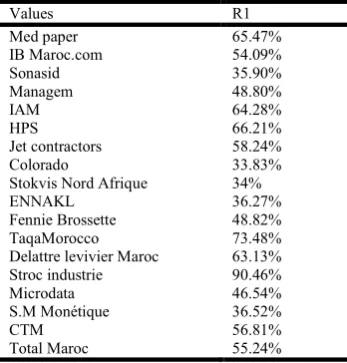
MADEX index: The application of ratio number 1 "R1" on 30 remained values allows us to eliminate 18 values (60% of values):
Table 14. Eliminated values of MADEX (R1)
Values R1
Med paper 65.47%
IB Maroc.com 54.09%
Sonasid 35.90%
Managem 48.80%
IAM 64.28%
HPS 66.21%
Jet contractors 58.24%
Colorado 33.83%
Stokvis Nord Afrique 34%
ENNAKL 36.27%
Fennie Brossette 48.82%
TaqaMorocco 73.48%
Delattre levivier Maroc 63.13% Stroc industrie 90.46%
Microdata 46.54%
S.M Monétique 36.52%
CTM 56.81%
Total Maroc 55.24%
2- Level of receivables
For this ratio, receivables taken into consideration are both current and log-term. The company should not have a receivables level exceeding 70% of assets. If the majority of company's assets are receivables, the current asset of company is mostly dominated by cash flow with the risk that these receivables are unrecoverable. Pour ce ratio, les créances prises en compte sont à la fois celles courantes et à long terme. La société ne doit pas avoir un niveau de créance dépassant 70% de ses actifs. Si la majorité des actifs de la société est sous forme de créances, l’actif circulant de l’entreprise se trouve majoritairement dominé par des flux de trésorerie avec le risque que ces créances soient irrécouvrables.
MASI index: The application of ratio number 2 "R2" on 18 remained values allows us to eliminate 2 values (11,11% of values):
Table 15. Eliminated values of MASI (R2)
Values R2
Réalisations mécaniques 76.44%
INVOLYS 77.25%
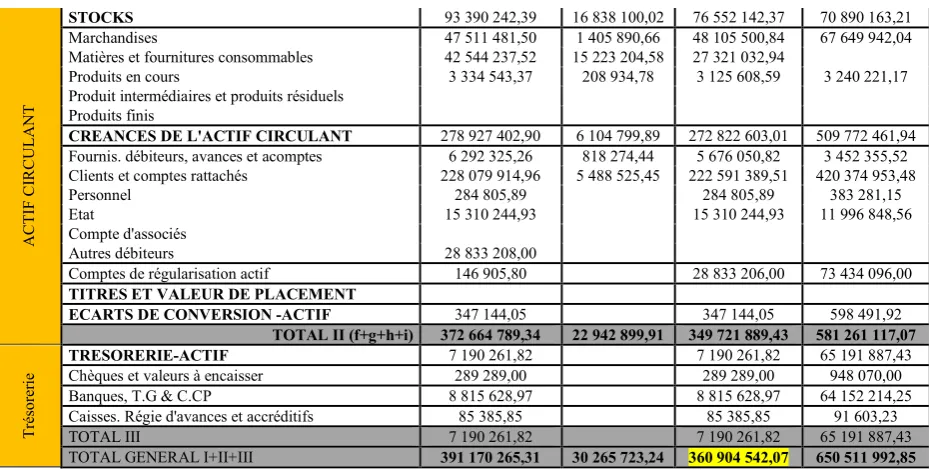
Example of calculation (Company : Maghreb Oxygène)
Total of receivables : 3.064.636,09 dh + 278.927.402,90dh = 281.992.038,99dh (Table 16)
Total of assets : 360.904.542,07 dh (Table 16)
The ratio R2 : 281.992.038,99 / 360.904.542,07 = 78,13
[image:6.595.65.534.442.732.2]% 78,13 % is more than 70%. So, the company must be eliminated
Table 16. Assets balance sheet 2016 (Company : Réalisations Mécaniques) Source : https://www.cdgcapitalbourse.ma/static/ attached/cdgkb/SRM_ETATS_FINANCIERS_2016.pdf
BILAN ACTIF
ELEMENTS Brut Amortissement
et provisions Net Exercice N-1
ACTIF
IM
MOBILISE
IMMOBILISTAION EN NON VALEUR
Frais préliminaires
Charges à repartir sur plusieurs exercices
Primes de remboursement des obligations
IMMOBILISATIONS INCORPORELLES 51 951,32 48 575,32 3 376,00 7 484,30
Immobilisations en recherche et développement
Brevet marques, droit et valeurs similaires 51 951,32 48 575,32 3 376,00 7 484,30
Fonds commercial
Autres immobilisations incorporelles
IMMOBILISATIONS CORPORELLES 8 198 626,74 7 274 248,01 924 378,73 989 878,01
Terrains
Constructions 1 199 181,39 1 140 711,90 58 469,49 118 219,04
Installations techniques, matériel et outillage 4 601 552,82 3 972 480,80 629 092,02 693 400,65
Matériel de transport 254 663,03 121 954,70 132 708,33
Mobilier, matériel de bureau et aménagement divers 2 143 229,50 2 039 120,61 104 108,89 178 258,32
Autres immobilisations corporelles
Immobilisations corporelles en cours
IMMOBILISATION FINANCIERS 3 064 636,09 3 064 636,09 3 061 626,04
Prêts immobilisées
Autres créances financières 3 064 636,09 3 064 638,09 3 061 626,04
Titres de participation
Autres titres immobilisés
ECART DE CONVERSION -ACTIF
Diminution des créances immobilisées
Augmentation des dettes de finance
TOTAL I (a+b+c+d+e) 11 315 214,15 7 322 823,33 3 992 390,82 4 058 988,35
MADEX index: The application of ratio number 2 "R2" on 12 remained values allows us to eliminate 2 values (16,66% of values):
Table 17. Eliminated values of MADEX (R2)
Values R2
Réalisations mécaniques 76.44%
INVOLYS 77.25%
3- Level of cash
Cash means cash on hand or deposited with a bank. While securities paying interests are a short-term investing values. The reason for introducing this sort criterion is double. First, in order to eliminate companies of which one of the main activities consist to invest in bank deposits or in financial instruments (with the limit of 50%), allowing generation of interests. The second reason avoids investing in companies of which securities would be mostly represented by cash, so the investor would not buy a share but directly cash. For both indexes MASI & MADEX, no value exceeds 50%.
Finally, we end up at a list containing 16 values (MASI) and 10 values (MADEX) compatible according the rules of filtering used by the Sharia Committee
[image:7.595.337.530.321.429.2]MASI index
Table 18. MASI values after filtering
Values R1 R2 R3
Minière Touissit 7.04% 37.14% 4.22%
SNEP 26.41% 51.37% 1.87%
Lafargelholcim 10.67% 9.34% 2.05% Afric industries S.A 13.94% 46.32% 0.34% Aluminium du Maroc 31.41% 50.96% 8.45% Auto Nejma 29.47% 18.33% 10.15%
Sothema 31.34% 38.45% 0.13%
M2M Group 14.86% 45.77% 15.44%
SMI 12.98% 53.35% 0.27%
Rebab company 0.60% 15.68% 1.31%
Lydec 25.46% 12.34% 2.67%
Ciments du Maroc 12.36% 17.71% 18.67% SODEP-Marsa Maroc 30.47% 15.68% 24.12%
Auto Hall 29.67% 48.41% 0.033%
Disway 26.06% 56.49% 6.19%
Delta-holding 14.75% 56.46% 0.10%
MADEX index
Table 19. MADEX values after filtering
Values R1 R2 R3
Minière Touissit 7.04% 37.14% 4.22%
SNEP 26.41% 51.37% 1.87%
Lafargelholcim 10.67% 9.34% 2.05% M2M Group 14.86% 45.77% 15.44%
Lydec 25.46% 12.34% 2.67%
Ciments du Maroc 12.36% 17.71% 18.67% SODEP-Marsa Maroc 30.47% 15.68% 24.12% Auto Hall 29.67% 48.41% 0.033%
Disway 26.06% 56.49% 6.19%
Delta-holding 14.75% 56.46% 0.10%
Section 3: Results "creation of MIASI & MAMISI": In summary, the following schemes synthesize all stages that allowed us to select compatible values in order to create new Islamic indexes on the Moroccan financial place.
1- Creation of the first new Islamic index "IMASI" start from "MASI"
Creation of a new Islamic index composed by 16 values "IMASI" IMASI : Islamic Moroccan All Shares Index The IMASI represents 22%
of the MASI
2- Creation of the second new Islamic index "MIMADEX" start from "MADEX"
Creation of a new Islamic index composed by 10 values " MIMADEX"
MIMASI : Moroccan Islamic Most Active Shares Index The MIMADEX represents 22% of the MASI
ACTIF
C
IRC
ULA
NT
STOCKS 93 390 242,39 16 838 100,02 76 552 142,37 70 890 163,21
Marchandises 47 511 481,50 1 405 890,66 48 105 500,84 67 649 942,04 Matières et fournitures consommables 42 544 237,52 15 223 204,58 27 321 032,94 Produits en cours 3 334 543,37 208 934,78 3 125 608,59 3 240 221,17
Produit intermédiaires et produits résiduels
Produits finis
CREANCES DE L'ACTIF CIRCULANT 278 927 402,90 6 104 799,89 272 822 603,01 509 772 461,94
Fournis. débiteurs, avances et acomptes 6 292 325,26 818 274,44 5 676 050,82 3 452 355,52 Clients et comptes rattachés 228 079 914,96 5 488 525,45 222 591 389,51 420 374 953,48
Personnel 284 805,89 284 805,89 383 281,15
Etat 15 310 244,93 15 310 244,93 11 996 848,56
Compte d'associés
Autres débiteurs 28 833 208,00
Comptes de régularisation actif 146 905,80 28 833 206,00 73 434 096,00
TITRES ET VALEUR DE PLACEMENT
ECARTS DE CONVERSION -ACTIF 347 144,05 347 144,05 598 491,92
TOTAL II (f+g+h+i) 372 664 789,34 22 942 899,91 349 721 889,43 581 261 117,07
Trésorer
ie
TRESORERIE-ACTIF 7 190 261,82 7 190 261,82 65 191 887,43
Chèques et valeurs à encaisser 289 289,00 289 289,00 948 070,00
Banques, T.G & C.CP 8 815 628,97 8 815 628,97 64 152 214,25
Caisses. Régie d'avances et accréditifs 85 385,85 85 385,85 91 603,23
TOTAL III 7 190 261,82 7 190 261,82 65 191 887,43
[image:7.595.55.270.637.802.2]Conclusion
The study of filtering criteria used in Islamic finance allowed us to notice how the investor according to the Sharia responds to a logic at the same time financial and extra-financial. In this way, besides the interest granted to the company activity sector, the choice is made resorting to the financial ratios to retain only that respect, or at least the closest, of Islamic finance principles. The application of these standards of filtering allows to conclude that compatible values with the Sharia are in acceptable limit (21,62% for the MASI and 21,37% for the MADEX). At the end, we note that this application has been made with companies data at one time and remains only indicative. The results may in no circumstances be considered as definitive in view of the fact that company data could be regularly modified. In practice, this kind of filtering is regularly made. For example, the committee of Sharia of Islamic Dow Jones updates every quarter the composition of its Islamic index with the establishment of a values list to include and those to exclude if non conformed.
REFERENCES
CHERIF Karim, La Finance Islamique : Analyse des produits
financiers Islamique, Genève, Octobre 2008, 109 p
BENHAYOUN N. ET AL, Islamic Banking Challenges Lie in
the Growth of Islamic Economy of the Free Interest Loans Policy: Evidences from Support Vector Machine Approach,
Journal of Finance and Risk Perspectives, Vol.3, Issue 1, pp.19-31, 2014
Abdel Wahab Mahmoud, (2005), « Les banques islamiques »,
Revue Dialogues N°49.
Annual reports of Zawya 2013 2014
Al Khawarizmi Group, sukuks reports of 2013 IIFM sukuk issuance database
Abdel Wahab Mahmoud, (2005), « Les banques islamiques »,
Revue Dialogues N°49.
La Finance Islamique et le Maroc : une histoire qui se finit par commencer / Abdelilah NGHAIZI/Cahiers de la finance islamique n°3
Annual reports of Islamic banks 2008, 2009, 2010, 2011 and 2012
GALLOUX M., Finance islamique et pouvoir politique. Le
cas de l’Égypte moderne, Paris, PUF, 1997
Les Afriques international weekly N°311-19 au 25 février 2015
The Banker, Top 500 Islamic Financial Institutions, FT Business, London, November 2010
Web sources
www.jeuneafrique.com www.governement.lu Source: www.dummies.com www.saphirnews.com www.mfw4a.org www.letemps.com www.lesechos.fr www.financialafrik.com http://togotribune.com
www.leconomistemaghrebin.com www.agenceecofin.com