ORIGINAL RESEARCH ARTICLE
E-REGISTRATION APPLICATION TO SUPPORT THE
LOCAL TAX SERVICE
*
Sumartono, Soesilo Zauhar and Hermawan
Administrative Faculty, Brawijaya University, Jln. MT.Haryono 163, Malang, Indonesia
ARTICLE INFO ABSTRACT
The study mainstreamed analysis about the government commitment in improving local taxation services through e-registration, essential determinants of online service in taxation, and the supporting and inhibiting elements to strengthen community orientation at the e-participation. Through the observation and data analysis methods from purposive sampling, this study produced findings that there are many factors that support the success of e-government in taxation such as national policy, public official capacity, value of benefit. In addition, some elements such as cultural resistance, coordination complexity, IT infrastructure, make the application of e-Registration in the tax sector in the local areas is not effective and unable to reach the level of taxpayers satisfaction in public service delivery process.
Corresponding author:
Copyright ©2017,Sumartono et al. This is an open access article distributed under the Creative Commons Attribution License, which permits unrestricted use,
distribution, and reproduction in any medium, provided the original work is properly cited.
INTRODUCTION
Declaration of e-Government in Indonesia was started and introduced through Presidential Instruction Number 6 Year
2001 Dated April 24 2001 about Telematics
(Telecommunication, Media and Informatics) stated that governmental apparatus should use telematics technology to support good governance and accelerate the democratic process. Then, through the Presidential Instruction of The Republic of Indonesia Number 3 Year 2003 issued Policy and National Strategy of e-government Development, stated that each governor and major/regent demanded to take the needed steps suitable with their task, function and authorities for the implementation of e-Government nationally. There are several critical factors that underlying the adoption of e-government in Indonesia for social change as stated by Javidian and
Mollayaaghobi (2011: 126); “The importance of
communication to relationships between governments and citizens forms the basis of the argument that information and communication Technologies present a significant opportunity for transformation and social change. The implementation of IT in taxation also give space for employee to make them improve their performance, that is the achievement of
effectiveness and efficiency of taxation sector service in the local areas (Witarsyah, Et al, 2017; TIME-E, 2014), giving the positive changes to the public organizations capacity in their mission achievement (Cordella, et al, 2015; El Kheshin and Abdelsalam, 2016), and to foster positive relationships between the government and its citizens in particular matters which are mandatory enforcing citizenoriented- participation (Nica, 2015). Prior to the development of information technology in the public organization, the Directorate General of Taxation (DGT) in Indonesia using the system of taxation services manually. The process of service to the Taxpayer is done directly by Taxpayers come directly to the KPP to settle its tax obligations. The process takes a relatively long time because the data input process is done manually by tax officers. In general, services in the KPP have obstacles due to the unavailability of information technology based service systems. Facilities that have been provided by the DGT in implementing the online tax administration system is one of efforts by DGT to improve the quality of local services in the taxation field or the shift from traditional service to online service in the local e-government context (Sa, et al 2016a ; 2016b).
ISSN: 2230-9926
International Journal of Development Research
Vol. 07, Issue, 07, pp.13947-13952, July,2017
Article History: Received 05th April, 2017
Received in revised form 27th May, 2017 Accepted 26th June, 2017
Published online 31st July, 2017
Citation: Sumartono, Soesilo Zauhar and Hermawan. 2017. “e-Registration Application to Support The Local Tax Service”, International Journal of
Development Research, 7, (07), 13947-13952.
ORIGINAL RESEARCH ARTICLE Open Access
Keywords: E-Registration, Taxation,
Service system by using online system is one of the real manifestations by DGT to provide easier and faster service to taxpayers. The DGT uses computerized technology through database and online based system to simplify and accelerate the service process in the taxation field. Some e-Government applications provided by DGT include: online registration Registration), electronic SPT SPT), online reporting (e-filing), and online payment (e-Billing). Some of these online applications are provided by DGT for the purpose of providing affordability, affordability, and relatively faster service time in the process of managing and inputting tax data by taxpayers. E-Registration or Online Taxpayer Registration System is an application system as part of Information System with
hardware and software based connected by data
communication device used to manage the document registration process (Terblanche and Juanita Tertia, 2014; Money Life, 2015) . In taxation this system is divided into two parts, the system used by taxpayer who serves as an online taxpayer registration and the system used by tax officers who function to process the registration of taxpayers.
In accordance with Law Number 28 Year 2007 that complemented Law Number 16 Year 2006 concerning General Provisions and Tax Procedures, Taxpayer Identification Number is a means in tax administration that used as self-identification or taxpayers identity in exercising tax rights and obligations. Each taxpayer is only given one Taxpayer Identification Number and used to maintain the order in tax payment and in the supervision of tax administration. Application of e-Registration shall be regulated pursuant to Regulation of Directorate General of Taxation Number PER-20 / PJ / PER-2013 and based on Decree of Directorate General of Taxes Number SE-60 / PJ / 2013 concerning Implementation Guidelines for Application of e-Registration within DGT (Directorate General of Taxation, 2008: 8- 9). Application of e-Registration gives many benefit and easiness for taxpayer who want to solve their taxation obligation, especially in the registration process of Taxpayer Identification Number. The main purpose of e-Registration system is to facilitate Taxpayers to register, update, delete and any information, anytime and anywhere.
And also to improve services for the communities and also streamline the operation and administration of DGT. The determined targets that will be achieved such as: taxpayer data storage to be centralized, easy to track movement for taxpayers, facilitate registration for taxpayers, provide security of taxpayer data and generate unique data for taxpayers. The e-Registration system can be accessed by the taxpayer at www.pajak.go.id, after the taxpayer clicks the registration application menu of the e-Registration. The e-Registration system has been effective since 2005 until now, but in the application of e-Registration in DGT has not been able to achieve maximum result. This is due to the occurrence of several factors that hinder the implementation process. Whereas the application of e-Registration is one of the real efforts of DGT to improve the service quality in the field of taxation. Where taxpayers as service users always demand the existence of prime service that ends on the taxpayers satisfaction.
Problem Formulation
Based on the issues previously mentioned, then the following issues are formulated; How is the implementation of e-Government in local government to improve the public
services quality? What are the driving and impeding factors for the implementation of e-Government in local government (for example, the case in Pratama Tax Office)?
Urgency
The implementation failure of e-Registration application in regional offices (KPP Pratama) in achieving the service quality improvement, encourage researchers to trace the various factors that cause the e-Registration application not effective, unable to reach the taxpayers satisfaction level in delivering the public service process. It is necessary to analyze what are the factors that hinder the implementation of e-Registration applications to get the right solution. From the problem analysis that becomes obstacle factor can be done using evaluation process of the implemented policy implementation. This study aims to provide solutions and completion to problems that arise in the e-government application in the taxation sector of local government, especially e-Registration. So that the implementation of e-Registration application in the future can achieve the service quality improvement desired by public organization. Beside that it will impact on the effectiveness level of tax revenues in local area which indicated there are still many leaks.
Research purposes
The study purpose is to provide a view about the evaluation of the implementation of e-Government to improve the public services quality among others: analysis of the e-regsitration application in the local area. Analyzing the driving and obstructing factors of public participation in the e-registration implementation in the local area (Pratama Tax Office) in improving the tax services quality.
Method
To generate valid and relevant data this study collected data from purposive sampling sources. Source of data obtained from the key informants namely Head of Service Section, Head of Data and Information Processing Section, KPP Pratama employees and the community as Taxpayers. Data collection was done by interview supported by observation, documentation study, field note and literature study.
RESULTS AND DISCUSSION
the best performance in terms of achieving taxpayer satisfaction level. Registered taxpayers have the right to obtain tax information services such as: socialization, education, consultation, class-tax, or other forms of counseling for free and obtain educational tools or materials such as books, booklets, leaflets, starter-kit NPWP or education means in other forms provided by the Directorate General of Taxes to assist Taxpayers to carry out their tax obligations. The information services provided by the Directorate General of Taxes are held to support the implementation of the application process or registration of tax Payer NPWP through the e-Registration application system.
Procedures and forms of registration and NPWP provision through e-Registration application as follows: Taxpayers open the website of the Directorate General of Taxation at http://www.pajak.go.id address, as follows;
Click the e-Registration application menu, so at the
display appears on-line tax registration
Fill in all the registration account columns in accordance
with the predefined instructions
Open e-mail used to register NPWP, then you will get
direct notification from the DGT about your registration application NPWP through e-Registration application.
Once your account is open, fill in your identity data in
accordance with the instructions provided in the e-Registration application display
Upload all the requirements requested for registration of
NPWP via the e-Registration application, then click Save
To improve the quality of service to Taxpayers to create excellent service, it is necessary to build a service culture as part of applying the values of the Ministry of Finance that is professionalism and service in the DGT. In order to build a serving culture it should be filled with the following principles (Arabia, 2008; DNA, 201):
Complaint information system. Complaints and data
received from the public either by telephone, facsimile, SMS or e-mail to the DGT Headquarters Complaint Center through other media, are managed in a complaint data bank.
Continuous service improvement. The success main
indicator and build the DGT image is the perfection of service. The service quality must be continuously improved in order to realize the expectations and build trust of all taxation stakeholders to DGT.
Bureaucratic reform. Bureaucracy reform is needed to
strengthen the commitment of all personnel in the DGT. Reforms include the most basic aspects of mindset, action patterns, clothing and speech in communicating.
Service mindset. There needs to be a mindset change
from every DGT employee, so that the development of serving culture in line with the changing of technology application.
Leader model. The respective office unit leaders are
responsible for providing examples, directing,
supervising and supervising the employees in their area in serving taxpayers.
The service process to taxpayers in registering and providing NPWP through e-Registration application in regional tax office felt faster and easier.
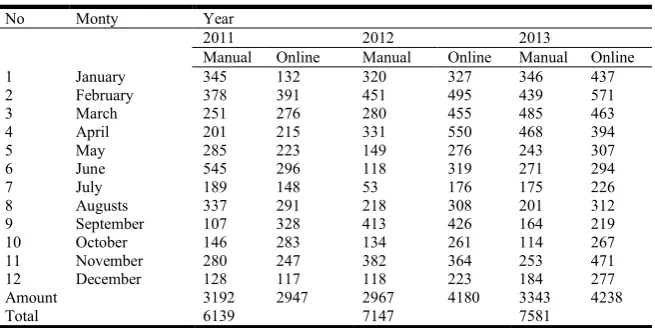
When viewed from the number of registered taxpayers before and after using the e-Registration applications continue to increase significantly. For example, the number of registered taxpayers in KPP Pratama manually increased from 2011 to 2013 has increased significant amount. However, the number of registered Taxpayers manually has not been able to offset the number of online registered taxpayers with e-Registration applications since 2011 to 2013, the following table is the number of taxpayers registered in KPP Pratama Ponorogo manually and online: Based on the above table, it appears that the registration number and provision of taxpayer identity to the taxpayers directly (manual) came to KPP Pratama higher in the previous year when compared with the number of taxpayers who register manually in the next two years. The number of registered taxpayers using the e-Registration application each year shows significant increase.
Supporting factors
There are some elements that most influential to the successful implementation of e-Government in a local public organization.
Central policy. The existence of support from the central
government to local public officials. In Indonesia as an effort to improve the tax service quality currently gets the main sponsor from Directorate General of Taxes, as the head office which has full responsibility for the performance of tax institutions under it. Support from the DGT is manifested through the delivery of information, counseling and socialization directly to the employees / tax officers and taxpayers.
Public official Capacity. There is ability and capabilities
of local public officials in realizing the success of e-Government, which is influenced by three elements, namely:
- Sufficient financial resources. Before the implementation
of e-Registration application in the local area, DGT has prepared the availability of necessary financial resources. For example, allocate funding sources obtained from the government to develop e-Government within the DGTfrom the central government is allocated to the local tax office to meet the needs of facilities (eg internet network creation, computer purchase) and conduct the process of socialization to employees and taxpayers.
Adequate IT infrastructure. The availability of adequate
information technology infrastructure is a significant contributing factor in improving the service quality provided. The infrastructure such as the availability of electronic media such as laptops, PCs, smart phones, which is enough for all employees and taxpayers, and the availability of wide and high speed. internet network
HR with competency, expertise and IT interest. The
availability of human resources who have competence, expertise and have a passion for IT is a driving factor that is very influential to improve the service quality in local area, especially in terms of services using online applications.
In this case, the determination of application value of the e-Registration for registration and NPWP provision is not from the provider, but from the taxpayer, or in term of Shanshan (2014) Service Quality under User Satisfaction Orientation. For that matter, the provider should select program that has high value for public benefit (Osmani, 2015). The local tax office should be careful in selecting the priority of what kind of Government application that has high value (eg e-Registration, e-SPT, e-Billing, e-Filing and so on) in which case it should be chosen which application that really bring great benefits and important value according to the taxpayer.
Inhibiting factors
Based on the explanation and data in the background, it can be concluded that the implementation of registration and NPWP provision through e-registration each month still experience increase and decrease. In this study, there are three main inhibiting factors; cultural, coordination, infrastructure, as follows:
Cultural obstacles
Resistance and rejection toward e-government. For some taxpayers, the presence of e-registration for the NPWP registration considered as giving difficulties, where in their process still considered as complicated. In several developing countries, difficulty in application of e-registration producing rejection even frustration from part of the document owner to use the online registration (The Hindu, 2013, Agbatogun, et al, 2010). Some communities chose to register NPWP directly to the KPP to solve their taxation problems. The lack awareness and award toward e-government. The understanding level of taxpayer about the benefit of information technology are lack. Many taxpayers as the service user do not understand how to use the e-registration application to register NPWP and considered as troublesome. Reluctant to share data and information. Based on the regulation of Directorate General of Tax, it was explained that each taxpayer has difficulties to report, register and pay tax for their wealth. But the fact in field shoed many taxpayer do not want to pay the tax by hiding their wealth. To decrease the violation done by tax payer in reporting and tax payment, KPP Pratama Ponorogo through Account Representative through survey to the societies directly and data collecting suitable with the area, with goal the taxpayer want to make NPWP for reporting and tax payment for their wealth.
Coordination obstacles
Central and Regional technical conflicts. Another obstacle arising from the implementation of e-Registration application in the local area is the error of online system from the center, so the implementation process of e-Registration is deliberately dismissed from the central DGT office. This system repair process is done by DGT for approximately 2 months. Unilateral system repair process is often without this notice, KPP Pratama can not do the registration process and giving NPWP online through e-Registration application. In this case is required a regulation which Governing the development of on-line services (ICCIT, 2015).
Uneven budget allocation. The budget allocation in DGT environment is still uneven, where KPP Pratama Ponorogo as the regional branch office has not got funds that suitable with the needs. So that KPP unable to meet the needs of computer facilities as one of the main access facilities of application of e-Registration and other DGT online system for employees and taxpayer. Taxpayer with lower middle economy unable to buy laptop or computer as the main supporting tool of e -Registration. So that KPP Pratama Ponorogo must have a special budget provided to provide computer facilities to facilitate taxpayers in accessing DGT online applications.
Age uniformity. Since the enactment of Regulation of Director General of Taxation Number PER-20 / PJ / 2013 regarding application of e-Registration, apply same standard for tax service staff. This is actually an obstacle for some employees who are elderly. Most of the old employees still want a manual application because they unable to use an online application.
Infrastructural obstacles
Digital inequality. Taxpayers recorded in the regional tax office are predominantly people living in rural areas. People living in rural areas generally do not understand the procedure of using online applications such as internet. While taxpayers who live in the city are used to use internet and IT.
[image:4.595.142.470.79.243.2]Infrastructuresdo not support. The computer or laptop is the primary means used to access the e-Registration application. In addition to computers and laptops, internet network is also a factor driving the implementation of online applications well. Based on the existing situation in the field, the computers number in KPP Pratama are not sufficient, where there are still Table 1. Taxpayer amount registered manually and online
No Monty Year
2011 2012 2013
Manual Online Manual Online Manual Online
1 January 345 132 320 327 346 437
2 February 378 391 451 495 439 571
3 March 251 276 280 455 485 463
4 April 201 215 331 550 468 394
5 May 285 223 149 276 243 307
6 June 545 296 118 319 271 294
7 July 189 148 53 176 175 226
8 Augusts 337 291 218 308 201 312
9 September 107 328 413 426 164 219
10 October 146 283 134 261 114 267
11 November 280 247 382 364 253 471
12 December 128 117 118 223 184 277
Amount 3192 2947 2967 4180 3343 4238
Total 6139 7147 7581
many computers in the KPP damaged, so the performance process of some employees is still not maximal.
Lack of network system. Not all taxpayers able to use the online application due to uneven Internet network provided by DGT.Network in urban area is already running well, but for taxpayers who live in rural areas can not access the e-Registration application to register NPWP due to network Internet that is not available in the countryside.
It can be concluded that, implementation of e-Registration in the local area unable to achieve the expected efficiency and effectiveness. Where cultural factors, coordination, and infrastructure have very significant impact on the success rate of e-Registration implementation in field.
Conclusion
This study aims to analyze the implementation of IT application in the regional tax office by taking focus of the
registration application and provision of Taxpayer
Identification Number (NPWP) through e-Registration application to improve the service quality. The study results showed:
Implementation of e-Registration applications in local
area, especially those conducted by KPP Pratama able to improve the public services quality, in accordance with the service quality theory of Zeithaml. Where the e-Registration implementation can improve the service quality with affordable prices and faster time, and able to provide services results more than the registration manually.
Implementation of the registration and provision of
NPWP through e-Registration application in improving the public service quality is influenced by the driving factors and inhibiting factors. While the driving factors in the e-Registration implementation in KPP Pratama include: support, capacity and value (benefits). While the inhibiting factors on the application of e-Registration applications in KPP Pratama include: culture, leadership and infrastructure.
Lack of taxpayer awareness about IT and unsupported infrastructure condition becomes the main problem that hampered the successful e-Registration implementation in KPP Pratama in order to improve the public service quality. So
we need an evaluation process of e-Registration
implementation policy to solve the problems that arise in the e-Registration application. So in the process of e-e-Registration application can then be integrated optimally to achieve the service quality desired by the public organizations.
Suggestions
Based on the implementation of registration and provision of NPWP through e-Registration application in KPP Pratama then there are recommendations or suggestions to support the successful e-Registration implementation in achieving public service quality improvement, among others:
It needs synergy between human resources (HR),
infrastructure condition and service system to support the successful implementation of e-Government programs to achieve improved service quality in public organizations.
And must provide services based on program implementation procedures and regulations governing the program implementation.
To achieve success on application of e-Registration
better, it is expected the supervision and responsibility from KPP Pratama as service provider. For example by giving counseling and dissemination continuously to the taxpayer about the procedure of using e-Registration application. So that taxpayer as service user can achieve satisfaction with the service quality improvement of taxation through e-Registration application.
Provide supporting infrastructure such as access to
computer facilities in the office environment required by taxpayers to use the e-Registration application. Due to the absence of computer facilities become the main reason for taxpayers not to use e-Registration application in NPWP registration process.
Improving oversight both internally and externally in
order to improve the service quality and image of local
government, especially clean, transparent and
accountable KPP Pratama, so it needs to be considered how to avoid errors in the implementation, and act decisively to the taxpayer who has not fulfilled tax obligations suitable with the provisions of applicable legislation.
REFERENCES
Alaba O. Agbatogun, Peter A. Ajelabi, Leeds City College, Lawunmi M. OyewusinObafemi, 2010. Cognition and Emotions in Nigerian Undergraduates’Frustration during e-Registration, Contemporay Educational Technology, 1(4), 335-347
Arabia 2000, 2008. DNRD enhances servicing capabilities with the pioneering e-Complain system. 01/17 , Database: Newspaper Source Plus, Dubai, Jan. 16th,
Cordella, Antonio; Tempini, Niccolò, 2015. E-government and organizational change: Reappraising the role of ICT and bureaucracy in public service delivery. In Government Information Quarterly. July
DNA (Daily News & Analysis) 2011. Soon, e-complain to help lodge FIR; Training for police officials in home department's software has already begun,Sept 12, Athena Information Solutions Pvt. Ltd.
El Kheshin, Sara Abdelsalam. Middlesex University, 2016. Determinants of e-government services adoption in developing countries (Egypt), British Library EThOS International Conference on Computer and Information
Technology (ICCIT), 2015 Regulatory requirements compliance in e-Government service development: 2015 18th International Conference on. :254-259 Dec
Javidian Z, & Mollayaaghobi, S. S., 2011. Evaluating & Improving Electronic Trust Factors in E-Government (Case Study: Mashhad Electronic City). Journal of Contemporary Research in Business, Volume 3, 126-135 4.
Money Life, 2015. How e-registration can bring transparency in real estate marketAugust 20, Athena Information Solutions Pvt. L
Nica, Elvira, 2015. Sustainable Development and Citizen-centric e-Government ServiceEconomics, Management, and Financial Markets,Vol. 10(3), pp. 69–74, ISSN 1842-3191
Sa, Filipe; Rocha, ALvaro; Cota, Manuel PeRez, 2016a. From the quality of traditional services to the quality of local e-Government online services: A literature review, . In: Government Information Quarterly. Jan, Vol. 33 Issue 1, p149, 12 p.; Elsevier B.V.
_________, 2016b. Potential dimensions for a local e-Government services quality model. In Telematics and Informatics. May 2016 33(2):270-276
Shanshan, Shang, 2014. Assessment of E-government Service Quality under User Satisfaction Orientation: The Establishment of E-Govqual Model, in: Asian Journal of Business Management, Vol 6, Iss 2, Pp 111-117 Maxwell Science Publication
Technology, Informatics, Management, Engineering & Environment Technology, Informatics, Management, Engineering, and Environment (TIME-E), 2014, The adoption factors of using e-Government service (Study case in Malaysia), 2nd International Conference on. :326-330 Aug, 2014; IEEE
Terblanche, Juanita Tertia, 2014. Design of an e-registration prototype using HCI principles : with specific reference to tax registration / JT Terblanche, North-West University The Hindu, 2013. e-registration faces resistance from
document writers, August 17, Financial Times Ltd Witarsyah, Deden; Teddy Sjafrizal; Mohd Farhan MD Fudzee;
Mohamad Aizi Salamat, 2017. The Critical Factors Affecting e-Government Adoption in Indonesia: A Conceptual Framework, in;International Journal on
Advanced Science, Engineering and Information
Technology, Vol 7, Iss 1, Pp 160-167; Indonesian Society for Knowledge and Human Development (INSIGHT).