AAA+ ClpB chaperone as a potential virulence factor of
pathogenic microorganisms: Other aspect of its chaperone
function
Joanna Krajewska, Sabina Kędzierska-Mieszkowska*
Department of Biochemistry, University of Gdańsk, Gdańsk, Poland
Email:
Received 12 November 2013; revised 13 December 2013; accepted 26 December 2013
Copyright © 2014 Joanna Krajewska, Sabina Kędzierska-Mieszkowska. This is an open access article distributed under the Creative Commons Attribution License, which permits unrestricted use, distribution, and reproduction in any medium, provided the original work is properly cited. In accordance of the Creative Commons Attribution License all Copyrights © 2014 are reserved for SCIRP and the owner of the intellectual property Joanna Krajewska, Sabina Kędzierska-Mieszkowska. All Copyright © 2014 are guarded by law and by SCIRP as a guardian.
ABSTRACT
We describe and discuss the most recent findings on the activity and function of the oligomeric AAA+ cha- perone ClpB from the Hsp100 protein family in pa- thogenic microorganisms. Pathogens are exposed to significant stress during infection of the host cells, frequently resulting in protein aggregation. The fact that ClpB is usually up-regulated in pathogens to- gether with its immune reactivity suggests that ClpB acting as a protein disaggregase may be important for pathogen invasion and virulence. However, the spe-cific function of ClpB in pathogenicity is still unclear. Since it is known that ClpB does not exist in mam- mals, it may serve as a potential target for the devel- opment of an effective therapy against several major bacterial diseases that do not respond to conventional antibiotics.
KEYWORDS
AAA+ ATPase; ClpB; Molecular Chaperone; Virulence; Pathogens
1. INTRODUCTION
1.1. ClpB, an AAA+ ATPase Chaperone
Bacterial molecular chaperone ClpB solubilizes and reactivates stress-agregated proteins in collaboration with the DnaK chaperone system by forming a bichaperone network that is crucial for the development of bacterial thermotolerance [1,2]. Yeast proteins Hsp104 (located in the cytosol) and Hsp78 (found in the mitochondrial ma-
trix), and plant Hsp101 are among the eukaryotic homo- logues of the bacterial ClpB. ClpB is a representative of the Hsp100 protein family that belongs to the AAA+ superfamily of ATPases (ATPases Associated with a va-riety of cellular Activities) [3]. For example, AAA+ AT-Pases are involved in assembling and disassembling of large protein complexes which are involved in cellular processes such as replication, recombination and DNA repair, intracellular transport and organelle biogenesis. They also play a key function in the posttranslational protein quality control system that takes care of the state of protein folding and the proper functioning of the cells. AAA+ proteins may have one (AAA-1) or two non-identical modules AAA (AAA-1, AAA-2; nucleo- tide binding domains). Each of them is composed of two subdomains: the N-terminal that is the core module and the C-terminal domain. The core consists of 200 - 250 amino acid residues, which form a characteristic second-ary structure conserved in the evolution, the α-β-α type [4,5]. The core module contains two classical motifs, Walker A (GX4GKT/S) and Walker B (hy4DE), which are
responsible for nucleotide binding and hydrolysis. In ad- dition, the AAA module contains sensor-1 and sensor-2 motifs. These motifs are associated with the movement of AAA domains because they link ATP hydrolysis to conformational changes in the substrate binding domains of ClpB protein [6]. The C-terminal domain, located in the core of the AAA module, consists of at least three
α-helices, and therefore is called the α-helix domain. De- pending on the number of AAA modules, AAA+ ATPas- es can be divided into two classes. Class I includes pro- teins having both AAA-1 and AAA-2 modules (e.g. ClpA, ClpB/Hsp104). The AAA+ ATPases belonging to Class II contain only one AAA module, which corres-
*
ponds to AAA-2 (e.g. ClpX, ClpY) [7]. AAA modules tend to oligomerize forming predominantly hexameric ring-shaped structures in which the individual subunits have the same orientation. Subunits of the hexameric ring can communicate with each other and react to con- formational changes after nucleotide binding through α- helical domain interactions. Hexamers are the biologi- cally active forms of AAA+ proteins. Bacterial ClpB pro- tein contains all characteristic sequence motifs of AAA+ ATPases.
1.2. Structure, Function and Isoforms of the ClpB Chaperone
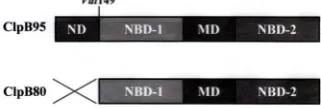
Like other Hsp100 proteins, ClpB forms barrel-shaped hexamers in the presence of ATP [8]. Each ClpB proto- mer is composed of an N-terminal domain, two ATP- binding modules (NBD-1, NBD-2 or AAA-1, AAA-2 modules), and an inserted coiled-coil middle domain (MD). Both NBD domains have been shown to bind and hydrolyze ATP. ATP binding to the NBD domaines stabilizes oligomeric structure of ClpB and its interac- tion with the protein substrates [9,10]. ATP hydrolysis provides energy necessary for remodeling aggregated proteins. The most characteristic elements of the ClpB hexameric ring are a central channel and a long “coiled- coil” segment corresponding to MD located outside the hexamer. The unique MD with a length of about 120 amino acid residues distinguishes the ClpB protein from other Hsp100. It consists of two motifs: Motif 1 that con- tains helices 1, 2, and Motif 2 that is composed of helices 2, 3 and 4. Each of these motifs resembles a leucine zip- per structure that is otherwise characteristic for the known eukaryotic transcription factors. However, unlike the classical leucine zipper motif, Motifs 1 and 2 present in the sructure of ClpB are composed of two anti-paral- lel α-helices with only three consecutive repeats of a leucine occurring every 7 amino acid residues [11]. It has been demonstrated that MD is a mobile element of ClpB. Its position and degree of mobility significantly affect this protein’s chaperone activity and in turn the protein disaggregation and reactivation processes [11]. Removal of even a small fragment of MD destabilizes oligomeric states of ClpB and causes loss of its chaperone activity [12]. According to recent reports, MD (in particular Motif 1) mediates the interactions between subunits of ClpB, thus stabilizing the oligomeric structure of the protein; MD also links the ATPase activities of both NBD domains, especially in the presence of a protein substrate [13]. It has been also demonstrated that MD is essential for synergistic interaction with the system Hsp70/DnaK system, and it determines the species spe- cificity of ClpB/Hsp104, required for cell suvival at high temperatures [14,15].
Recent finding on biological function of ClpB sug- gests that the unique chaperone activity of ClpB revers- ing aggregation is linked to translocation of protein sub- strates through the narrow central channel within the hexameric ring-shaped structure of ClpB [16].
The ClpB chaperone from Escherichia coli (ClpBEc)
as well as the yeast protein, Hsp104, have been the most intensely studied Hsp100 proteins in recent years be- cause of their unique function in reactivation of protein aggregates formed under stress conditions. The clpBEc
gene contains an internal translation-initiation site and is expressed in vivo as two proteins: a full-length 95-kDa ClpB (ClpB95) and a N-terminal-truncated 80-kDa iso- form (ClpB80, ClpB∆N) [17] (Figure 1). The internal initiation site is located near the N-terminus of the first nuclotide-binding domain in ClpB. Thus, the N-terminal domain of ClpB95 is not present in ClpB80. The bio- logical function of the N-terminal truncated isoform in reactivation of protein aggregates has been discovered relatively recently [18]. It was found that ClpB95 and ClpB80 cooperate in reactivation of proteins and form a highly efficient chaperone system. It is assumed that the functional cooperation between ClpB isoforms arises from interactions between them, because ClpB95 and ClpB80 associate into hetero-oligomers, which form with a higher efficiency than the homo-oligomers of ClpB95. Thus, it is very likely that the ClpB95/80 hetero-associa- tion boosts the aggregate-reactivation potential of ClpB and that E. coli produces two variants of ClpB to optim- ize its activity. The two isoforms of ClpB chaperone act- ing together also enhanced the solubility and enzymatic activity of β-galactosidase trapped in inclusion bodies [19]. This result supports an important role of synergistic cooperation between the two ClpB isoforms in aggregate reactivation.
[image:2.595.343.504.592.646.2]The discovery of disaggregation activity of ClpB (Hsp104) chaperone revealed new therapeutic possibili- ties. For example it gave rise to new strategies in the treat- ment of neurodegenerative diseases. It was shown that the insoluble aggregates, which appear in neuronal cells and are associated with neurodegenerative diseases, con-
tain, besides Hsp70 and Hsp40, such proteins as: VCP/ p97, torsin A and the 19S proteasomal complexes. These proteins belong to the AAA+ family of proteins similarly to ClpB. Currently, it is believed that chaperones play a protective role in neurodegenerative diseases. However, there may be another side of the chaperone function (chaperone-linked negative side effect). Namely, ClpB has been shown to be up-regulated in many pathogenic bacteria during infection of the host organism, which helps the pathogen to overcome host defenses.
2. ROLE OF THE CLPB MOLECULAR
CHAPERONE IN PATHOGENIC
BACTERIA
—
OTHER ASPECT OF ITS
FUNCTION
The data accumulated over the last few years regarding several bacterial pathogens suggest that ClpB chaperone may play an important role in their virulence. However, currently it is not clear what specific role ClpB plays during bacterial infection. ClpB has been shown to be required for invasiveness and/or survival of many pa- thogens such as Mycoplasma pneumoniae, Porphyro-
monas gingivalis, Listeria monocytogenes, Mycobacte-
rium tuberculosis, and Francisella tularensis [20-24]. The clpB mutant of Leptospira interrogans has been also shown to be avirulent compared to its parental strains [25]. The loss of ClpB function in L. interrogans has also resulted in bacterial growth defects under oxidative and heat stresses. The authors demonstrated that the Leptos-
pira ClpB is essential for survival under stress conditions and also during an in vivo infection. Pathogenic bacteria are exposed to a significant stress during infection of the host, frequently resulting in protein aggregation. The fact that ClpB is usually up-regulated in pathogens suggests that ClpB activity as a protein disaggregase may be im- portant for their virulence. In the case of pathogens such as Mycoplasma pneumoniae and Francisella tularensis it has been also shown that ClpB elicits immune respon- siveness in experimentally infected laboratory animals [20,26]. Similarly, human sera collected from patients suffering from tularemia or infected with M. pneumoniae
strongly recognized ClpB chaperone in contrast to unin- fected controls. Our studies on the biolgical function of the ClpB from other pathogenic bacterium, Leptospira interrogans, and its potential role in pathogenesis of lep- tospirosis also suggest that ClpB of bacterial pathogens possesses an immunogenic potential. We have found that a Leptospira recombinant ClpB protein was recognized by sera collected from infected animals (unpublished data), and thus it is able to activate the host immune sys-tem. All of these results may indicate the involvement of ClpB function in the infection process.
Sequence alignment of ClpBEc and ClpB from some
bacterial pathogens using the Clustal software shows that ClpB proteins of pathogenic bacteria have a similar do- main organization to that of ClpBEc with all charasteristic
AAA+ motifs (Walker A, Walker B, sensor-1, sensor-2). For example, the total sequence identity between ClpBEc
and the Leptospira interrogans ClpB is 52% (27.7% within ND, 45.3% within MD, 72% within NBD-1, and 65.7% within NBD-2). Similarity with orthologs from the pathogen L. borgpetersenii and the saprophyte L. biflexa is 95% and 62%, respectively [25]. It is tempting to speculate that the low sequence similarity between
Leptospira interrogans ClpB and ClpB from the sapro- phytic species, L. biflexa, indicates the presence of a yet unknown element in this protein, that can determine ClpB’s virulent properties. It would be intriguing to com- pare in greater detail the biochemical properties of ClpB proteins from the pathogenic and saprophytic species of
Leptospira.
To date, there is only one published report on detailed biochemical studies of ClpB activity isolated from a pa- thogenic bacterium [27]. These studies were done by Prof. Zolkiewski’s group with Ehrlichia chaffeensis
ClpB and show that there are several differences between species in the functioning of ClpB proteins. It was found that the basal ATPase activity of Ehrlichia chaffeensis
ClpB was similar to that of the ClpBEc. However, while
the ATPase of ClpBEc was activated in the presence of
casein or poly-lysine, the ATPase of ClpB from Ehrlichia
did not respond to the activators. Moreover, it was dem- onstrated that: 1) Ehrlichia ClpBcan reactivate some ag- gregated substrates even in the absence of the DnaK sys- tem, while ClpBEc requires the co-chaperones to disag-
gregate a substrate; 2) the ClpB from Ehrlichia does not rescue the growth-defect of the clpB-null E. coli under heat-shock. Thus Ehrlichia ClpBcan not function in the
E. coli cells and substitute for ClpBEc. A lack of com-
plementation effect may confirm species-specificity of ClpB proteins and suggests that the substrates recognized by ClpB of pathogens during infection of the host differ from the proteins aggregated upon heat shock in E. coli
bacteria. The ClpC and ClpXP from Porphyromonas gin-
givalis have been found to be essential for survival under heat shock and during entry into host epithelial cells [21]. All of these data suggest that molecular chaperones play importat roles in invasion and virulence of bacterial pa- thogens, as 1) they help the pathogen to overcome stress- full conditions to which it is exposed within the host cells, and 2) they represent major targets of the host’s immune system.
Since it is known that ClpB does not exist in mammals, and taking into account its potential role in virulence, it is reasonable to consider it as a potential therapeutic tar- get in antibacterial therapies. Thus, ClpB offers new hope in the fight against pathogenic bacteria. Under- standing the function of ClpB in pathogens and dissect- ing its biochemical properties may improve the devel- opment of treatment of several major bacterial diseases, particularly those which do not respond to conventional antibiotics. For treatment of diseases caused by patho- genic bacteria, interfering with the function of the clpB
gene could provide a new direction in antimicrobial ther- apies as taking ClpB as a therapeutic target could be more successful than using currently available antibiotics. Therefore, studies on the biological role and biochemical mechanism of ClpB in pathogens are so important and should be continued to demonstrate if ClpB is in fact important during infection due to its role as molecular chaperone taking part in reactivation of protein aggre- gates.
ACKNOWLEDGEMENTS
We thank Katarzyna Potrykus for critical reading of the manuscript and helpful discussion.
REFERENCES
[1] Zolkiewski, M. (1999) ClpB cooperates with DnaK, DnaJ, and GrpE in suppressing protein aggregation. The Jour-nal of Biological Chemistry, 274, 28083-28086.
[2] Squires, C.L., Pedersen, S., Ross, B.M. and Squires, C. (1991) ClpB is the Escherichia coli heat shock protein F84.1.Journal of Bacteriology, 173, 4254-4262.
[3] Neuwald, A.F., Aravind, L., Spouge, J.L. and Koonin, E.V. (1999) AAA+: A class of chaperone-like ATPases associated with the assembly, operation, and disassembly of protein complexes. Genome Research, 9, 27-43.
[4] Hanson, P.I. and Whiteheart, S.W. (2005) AAA+ proteins: Have engine, will work. Nature Reviews Molecular Cell Biology, 6, 519-
[5] Ogura, T. and Wilkinson, A.J. (2001) AAA+ superfamily ATPases: Common structure-diverse function. Genes Cells, 6, 575-597.
[6] Maurizi, M.R. and Li, C.C. (2001) AAA proteins: In search of a common molecular basis. EMB0 Reports, 2, 980-985.
[7] Dougan, D.A., Mogk, A., Zeth, K., Turgay, K. and Bukau, B. (2002) AAA+ proteins and substrate recognition, it all depends on their partner in crime. FEBS Letters, 529, 6-
10.
[8] Akoev, V., Gogol, E.P., Barnett, M.E. and Zolkiewski, M. (2004) Nucleotide-induced switch in oligomerization of the AAA+ ATPase ClpB. Protein Science, 13, 567-574.
[9] Weibezahn, J., Schliker, C., Bukau, B. and Mogk, A. (2003) Characterization of a trap mutant of the AAA+ chaperone ClpB. The Journal of Biological Chemistry, 278, 32608
-32617.
[10] Schlieker, C., Weibezahn, J., Patzelt. H., Tessarz, P., Strub, C., Zeth, K., Erbse, A., Schneider-Mergener, J., Chin, J.W., Schultz, P.G., Bukau, B. and Mogk, A. (2004) Substrate recognition by the AAA+ chaperone ClpB. Nat. Struct. Journal of Molecular Biology, 11, 607-615.
[11] Lee,S.,Sowa, M.E., Watanabe, Y.H., Sigler, P.B., Chiu. W., Yoshida. M. and Tsai, F.T. (2003) The structure of ClpB: a molecular chaperone that rescues proteins from an aggregated state. Cell, 115, 229-240.
[12] Kędzierska, S.,Akoev, V., Barnett, M.E. and Zolkiewski, M. (2003) Structure and function of the middle domain of ClpB from Escherichia coli. Biochemistry, 42, 14242-
[13] Del Castillo,U., Alfonso, C., Acebrón, S.P., Martos, A., Moro, F., Rivas, G. and Muga, A. (2011) A quantitative analysis of the effect of nucleotides and the M domain on the association equilibrium of ClpB. Biochemistry, 50, 1991-2003.
[14] Sielaff, B. and Tsai, F.T. (2010) The M-domain controls Hsp104 protein remodeling activity in an Hsp70/ Hsp40- dependent manner. Journal of Molecular Biology, 402,
30-37.
[15] DeSantis, M.E. and Shorter, J. (2012) The elusive middle domain of Hsp104 and ClpB: Location and function. Bi-ochimica et Biophysica Acta, 1823, 29-39.
[16] Weibezahn,J., Tessarz, P., Schlieker, C., Zahn, R., Mag- lica. Z., Lee, S., Zentgraf, H., Weber-Ban, E.U., Dougan, D.A., Tsai, F.T., Mogk, A. and Bukau, B. (2004) Ther-motolerance requires refolding of aggregated proteins by substrate translocation through the central pore of ClpB. Cell, 119, 653-665.
[17] Squires,C.L., Pedersen, S., Ross, B.M. and Squires, C. (1991) ClpB is the Escherichia coli heat shock protein F84.1. Journal of Bacteriology, 173, 4254-4262.
[18] Nagy, M., Guenther, I., Akoyev, V., Barnett, M.E., Za-vodszky, M.I., Kedzierska-Mieszkowska, S. and Zol-kiewski, M. (2010) Synergistic cooperation between two ClpB isoforms in aggregate reactivation. Journal of Mo-lecular Biology, 396, 697-707.
[19] Guenther, I., Zolkiewski, M. and Kedzierska-Mieszko- wska, S. (2012) Cooperation between two ClpB isoforms enhances the recovery of the recombinant β-galactosidase from inclusion bodies. Biochemical and Biophysical Re-search Communications, 426, 596-600.
[20] Kannan, T.R., Musatovova, O., Gowda, P. and Baseman, J.B. (2008) Characterization of a unique ClpB protein of Mycoplasma pneumoniae and its impact on growth. In-fection and Immunity, 76, 5082-5092.
[21] Capestany, C.A., Tribble, G.D., Maeda, K., Demuth, D.R. and Lamont, R.J. (2008) Role of the Clp system in stress tolerance, biofilm formation, and intracellular invasion in Porphyromonas gingivalis. Journal of Bacteriology, 190,
1436-
[22] Chastanet, A., Derre, I., Nair, S. and Msadek, T. (2004) clpB, a novel number of the Listeria monocytogenes CtsR regulon, is involved in virulence but not in general stress tolerance. Journal of Bacteriology, 186, 1165-1174.
[23] Estorninho, M., Smith, H., Thole, J., Harders-Westerveen, J., Kierzek, A., Butler, R.E., Neyrolles, O. and Stewart, G.R. (2010) ClgR regulation of chaperone and protease systems is essential for Mycobacterium tuberculosis para- sitism of the macrophage. Microbiology, 156, 3445-3455.
[24] Meibom, K.L., Dubail, I., Dupuis, M. et al. (2008) The heat-shock protein ClpB of Francisella tularensis is
in-volved in stress tolerance and is required for multiplica-tion in target organs of infected mice. Microbiology, 67, 1384-1401.
[25] Lourdault, K., Cerqueira, G.M., Wunder Jr, E.A. and Pi- cardeau, M. (2011) Inactivation of clpB in the pathogen Leptospira interrogans reduces virulence and resistance to stress conditions. Infection and Immunity, 79, 3711-3717.
[26] Havlasova, J., Hemychowa, L., Brechta, M., Hubalek, M., Lenco, J., Larsson, P., et al. (2005) Proteomic analysis of anti-Francisella tularensis LVS antibody response in mur- ine model of tularemia. Proteomics, 5, 2090-2103.
[27] Zhang, T., Kedzierska-Mieszkowska, S., Liu, H., Cheng, C., Ganta, R.R. and Zolkiewski, M. (2013) Aggregate- reactivation activity of the molecular chaperone ClpB from Ehrlichia chaffeensis. PLOS One, 8, E62454.
[28] Qoronfleh, M.W., Bortner, C.A., Schwartzberg, P. and Wilkinson, J. (1998) Enhanced levels of Staphylococcus aureus stress protein GroEL and DnaK homologs early in infection of human epithelial cells. Infection and Immun-ity, 66, 3024-3027.