Accelerometer Data
Rene Mayrhofer and Hans Gellersen
Lancaster University, Computing Department, South Drive, Lancaster LA1 4WA, UK {rene,hwg}@comp.lancs.ac.uk
Abstract. Small, mobile devices without user interfaces, such as Blue-tooth headsets, often need to communicate securely over wireless net-works. Active attacks can only be prevented by authenticating wireless communication, which is problematic when devices do not have any a priori information about each other. We introduce a new method for device-to-device authentication by shaking devices together. This paper describes two protocols for combining cryptographic authentication tech-niques with known methods of accelerometer data analysis to the effect of generating authenticated, secret keys. The protocols differ in their de-sign, one being more conservative from a security point of view, while the other allows more dynamic interactions. Three experiments are used to optimize and validate our proposed authentication method.
1
Introduction
Applications envisioned for ubiquitous computing build upon spontaneous inter-action of devices, such that a device can make serendipitous use of the services provided by peer devices that may not be known a priori. In many scenarios, it will be desirable to verify and secure spontaneous interactions in order to as-certain that devices become paired as intended and protected against attacks on their wireless link. In a managed network environment, device-to-device au-thentication would be based on prior knowledge of each other or access to a trusted third party, but neither can be assumed to be available in wireless ad hoc networks for ubiquitous computing. As a consequence, secure device pairing requires the user to be in the loop, for example to enter a shared secret such as a PIN code into both devices. A challenge is to find mechanisms for users to pair devices that are not only secure but also scale well for use in ubiquitous computing. Specific challenges are that devices will, in many cases, be too small to reasonably include key pads and displays, and that required user attention must be minimal to be acceptable for spontaneous and short-lived interactions. Pairing of a mobile phone with a headset for interaction over a wireless chan-nel is a familiar example: we would like to achieve such interaction in a spon-taneous manner (i.e. not requiring pre-configuration of phone and headset for each other) but also ensure that it is secure. The wireless communication chan-nel between the devices is susceptible to attacks ranging from eavesdropping to
A. LaMarca et al. (Eds.): Pervasive 2007, LNCS 4480, pp. 144–161, 2007. c
man-in-the-middle (MITM). If an attacker were successful in establishing them-selves between, in this case, phone and headset, during the pairing process, then they would obtain complete control over all phone calls. To safeguard against such attacks, a so-calledout-of-band channel is used during pairing in order to authenticate communication over the primary channel. The out-of-band channel must be limited such that it is user-controllable that only the intended devices can communicate over it for the purposes of authentication. Note that authen-tication and the subsequent pairing can be anonymous or “ephemeral” [1], i.e. based on information only shared over the out-of-band-channel rather than ac-tual device identities.
In this paper we contribute a method for device-to-device authentication that is based on shared movement patterns which a user can simply generate by shaking devices together. Using embedded accelerometers, devices can recognize correlation of their movement and use movement patterns for authentication. From a user perspective, jointly shaking is a simple technique for associating devices [2]. In our method, it simultaneously serves as out-of-band mechanism. Shaking has a number of characteristics on which we can build for our purposes:
– It isintuitive. People are familiar with shaking objects as manual interaction that does not require learning, for instance from shaking of medicine, or musical instruments. This means that shaking is unobtrusive in the sense that it does not require the user’s full attention while being performed.
– It is vigorous. While there are many motion patterns that could be per-formed with two devices, shaking tends to produce the highest continuous acceleration values. While bouncing will produce larger accelerations, they only occur as short spikes. Shaking provides acceleration larger than most activities – and can thus be detected by simple thresholding – for as long as necessary to pair devices (and as long as the user will not get tired).
– It isvarying. As we will show below in our first experiment (in section 7.1), the activity of shaking can be surprisingly different for different people. We do not use shaking patterns as identification, but still benefit from large differences in acceleration values, because this generates high entropy from an attacker’s point of view.
It is important to note that users do not have to follow a particular pattern of shaking but that they can shake as they like; we do not attempt to identify people by their shaking patterns, but use it as a source of shared device movement.
Both protocols use standard techniques of sensor data processing and time series analysis: sampling, alignment, and feature extraction. After extracting appropriate features, our cryptographic protocols ensure that authentication is only possible if both devices have access to the same feature values. Specifi-cally, they protect against MITM attacks on the wireless communication chan-nel by using additional information gathered from the extracted features. This approach is general, so that other sensors than accelerometers can be used with similar methods, apart from changes in domain-specific heuristics. Sensor-based authentication offers potential benefits to small, mobile devices that communi-cate wirelessly and do not have traditional user interfaces. Examples are mobile phones, smarts cards, key fobs, and generally accessories like headsets, watches, or glasses.
2
Related Work
First concepts on secure device pairing suggested direct electrical contact [3], while other suggestions to implement an out-of-band channel include a “physical interlock” and the “Harmony” protocol [4], ultrasound [5], visual markers and cameras [6], audio messages [7], the GSM short message service (SMS) [8], key comparison, distance bounding and integrity codes [9], or manual input [10,1]. The DH-DB protocol proposed in [9] might also be applicable to an interac-tive challenge-response scheme based on sensor data such as accelerometer data. These approaches, with the exception of using camera phones, have in common that they scale poorly from a user point of view. That is, they tend to be ob-trusive and require the user’s attention. In our approach, we implement a low bandwidth private channel over similar accelerometer readings, and use it for authenticating a device pairing.
3
Design of the Acceleration-Based Pairing Method
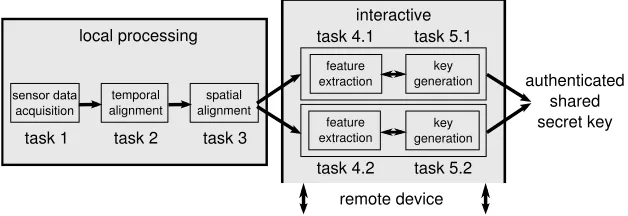
Figure 1 shows our architecture for authenticating device pairings with shaking patterns. Both protocols make use of the same three pre-processing tasks 1 to 3. They are executed locally on each device and result in “active” time series seg-ments of equidistant samples. Our two protocols differ in tasks 4 and 5, which can both be interactive, i.e. communicate with the remote device to which the pairing is in process.
For protocol 1, tasks 4.1 and 5.1 are actually executed in parallel: after gen-erating a secret key with standard Diffie-Hellman (DH) key agreement (which is the first phase of task 5.1), the devices exchange their time series segments via an interlock protocol. Then they compare their locally generated segment with the one received from the remote device to check if they are similar enough. If they pass this check, the second phase of task 5.1 derives the secret session key that will be used for consecutive secure communication. This design is conservative from a security point of view and, due to the non-interactive feature extraction and comparison, allows the devices to use different means of verification. The disadvantage of splitting task 5.1 into two phases is potentially a larger delay for authentication, and the disadvantage of using DH is higher computational load. Protocol 2 executes its tasks 4.2 and 5.2 in order: discrete (in contrast to the real-valued samples) feature vectors are extracted in task 4.2, which act as input to the interactive key agreement in task 5.2. This is an iterative process. In each time step, feature vectors generated by 4.2 are checked for matches in task 5.2. After sufficient iterations, a secret shared key can be generated out of the collected matching feature vectors in task 5.2. This design has the advantages of more dynamic key agreement, with devices being able to “tune into” other device’s key streams, and of being less computationally expensive. On the other hand, it does not provide forward secrecy and protection against offline attacks as protocol 1 does, and is more unconventional and thus less well studied from a security point of view.
For both protocols, there is a trade-off between usability and security that can be exploited by applications and users depending on their requirements. Tasks 4 and 5 are described in more detail in sections 5 and 6, respectively.
sensor data
acquisition
temporal alignment
spatial alignment local processing
feature extraction
key generation interactive
authenticated shared secret key
remote device key generation feature
extraction
task 1 task 2 task 3
[image:4.595.141.455.560.668.2]task 4.2 task 5.2 task 4.1 task 5.1
4
Pre-processing of Accelerometer Data
The three pre-processing tasks, executed as consecutive steps, are used to sample and segment the sensor data so that feature extraction can build on normalized time series.
Task 1: Sensor data acquisition. This first task is conceptually straight forward, but requires careful implementation. Sensor data is assumed to be available in the form of time series of acceleration values in all three dimensions, sampled at equidistant time steps. These must be taken locally and not be communicated wirelessly — for security purposes, it is critical not to leak any of this raw data, which can be difficult considering the possibility of powerful side-channel attacks (see e.g. [14]). Our practical experience shows a sample rate between 100 and 600 Hz to be appropriate.
Task 2: Temporal alignment. As the two devices sample accelerometer time series independently in task 1, we require temporal synchronization for compar-ison. We assume that devices are equipped with sufficiently accurate real-time clocks, so that differences in sampling rates and drift will not be issues. This reduces temporal alignment from an arbitrarily complex problem to triggering the authentication procedure and tosynchronizing the starting points for time series comparison.
Triggering can be explicit by direct user input, e.g. pressing an “authenticate now” button on both devices within a short time frame or bumping both devices against the table or each other, or implicit, simply by starting to shake both devices. We prefer the second protocol due to its ease of use, although it is more difficult to implement. Synchronization can be at asample level, i.e. within less than half the sample width, or at anevent level, i.e. based on the onset of detected (explicit or implicit) events with the respective device. We use the latter, because it does not require time synchronization between the devices — shaking events can be detected locally at each device without communication, which is beneficial from a security point of view.
For both triggering and synchronization, we detect motion and align those parts of the time series where shaking is detected, which we callactive segments, by their start times. Segments are considered active when the variance of a sliding window exceeds a threshold. Practical experiments show good results at a sample rate betweenf = [128; 512]Hz with a sliding window of v =f /2 samples, i.e.
1/2second, and a variance threshold aroundTσ = 750.
have to assume that the alignment of the devices changes during the transition,1 we can not directly apply this result. Instead, we reduce the three dimensions to a single: by taking only the magnitude over all normalized dimensions, i.e. the length of the vector, we solve the alignment problem. This approach requires considerably less resources than other methods such as principal component analysis (PCA) or modeling using domain-specific knowledge.
The result of these steps is that, when shaken together, both devices will extract active segments of one-dimensional acceleration magnitude vectors. Even without synchronized clocks, the start times of these independent time series are typically synchronized within a few samples (on the event level).
5
Feature Extraction for Authentication Purposes
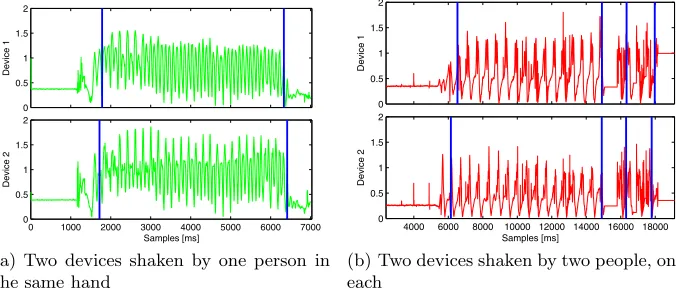
Two devices that are shaken together will experience similar, but not exactly the same movement patterns. Even assuming noise-free sampling of accelera-tions, the two accelerometers must have physically separate centers. Whenever rotation is part of the movement, these separate centers will necessarily experi-ence different accelerations, thus causing different sensor time series even if the devices remain fixed in relation to each other. The problem of verifying that two devices are shaken, or more generally, moved together therefore becomes a classi-fication problem. Figure 2 shows examples of spatially aligned sensor time series used as input to feature extraction with detected borders of active segments.
0 0.5 1 1.5 2
Device 1
0 1000 2000 3000 4000 5000 6000 7000 0
0.5 1 1.5 2
Device 2
Samples [ms]
(a) Two devices shaken by one person in the same hand
0 0.5 1 1.5 2
Device 1
4000 6000 8000 10000 12000 14000 16000 18000 0
0.5 1 1.5 2
Device 2
Samples [ms]
[image:6.595.128.466.437.585.2](b) Two devices shaken by two people, one each
Fig. 2.Example time series after spatial alignment with detected active segments
In deciding if time series are similar enough for authentication, the aim of the feature extraction task is twofold: a) to extract feature values that are robust to small variations in the shaking patterns and to sampling noise and b) to extract
1When a user picks up the two devices to shake them, they will most probably be aligned
a sufficiently large feature vector for use in the authentication protocol. In our approach, the feature vector will be used to authenticate a key or to directly generate a key, and thus it needs to be of high entropy from an attacker’s point of view, i.e. involve a large amount of uncertainty.2As indicated in section 1, we argue that shaking is an appropriate movement for creating entropy: it creates varying sensor readings, because it is one of the human movement patterns that includes the highest frequency components. Slower movements will intuitively not generate as much entropy.
There is an extensive body of literature on feature extraction from accelerom-eter data. Particularly relevant to our problem are the described uses of the co-herence measure by Lester et al. [13] and cross-covariance by Aylward et al. [16]. Both suggest sliding, windowed variances on each device for activity detection, as used in our current implementation for task 2. Huynh and Schiele compare different features for activity recognition and suggest the use of quantized FFT coefficients [17]. For task 4, we select the most promising of the recently sug-gested features: coherence and quantized FFT coefficients.
5.1 Coherence
We adopt the approach that was previously used by Lester et al. to distinguish between two devices worn by the same person (on different parts of the body) and two devices worn by two people walking in-step. They used coherence averages and showed that simple, non-calibrated, cheap accelerometers are suitable for analyzing human motion. Coherence is approximated by the magnitude squared coherence (MSC) as
Cxy(f) =
Pxy(f) Pxx(f)·Pyy(f)
with (cross-) power spectra
Pxy(f) = 1 n
n−1
k=0
xk(f)·y¯k(f)
computed over FFT coefficients xk(f) = F F T(ak(t)·h(t)) and yk(f) = F F T(bk(t)·h(t)) using the standard von-Hann window h(t) = 1−cos(22πt/w)
That is, it is computed as the power spectrum correlation between two signals split into n (optionally overlapping) averaged slices ak and bk of the signals a
andb, respectively, normalized by the signal power spectra. Note that, although the signalsa andb in time domain are real, their FFT coefficients xandy are complex. By using squared magnitudes,Cxyis also real-valued. By¯xwe refer to
the conjugate complex ofx. Because the significance of coherence values depends on the number of averaged slices n – the more slices, the lower the coherence
2The authentication protocol is said to be computationally secure if an attacker’s
values are for the same signals –, we reduce longer time series to a maximum length of 3 seconds. This is a compromise between sufficient variability for robust classification and quick user interaction. The final value is computed simply by averaging up to a cut-off frequencyfmax
Cxy= 1 fmax
fmax
0
Cxy(f)df
With this heuristic, we thresholdCxyto create a binary decision of similarity for
our authentication protocol. As explained below, our experiments have shown that, with a sampling rate ofr= 256Hz and windows ofw= 256samples with an overlap of7/8and a cut-off frequency offmax= 40Hz, coherence provides good
distinction between two devices being shaken by one person from two devices being shaken by two people, one each.
5.2 Quantized FFT Coefficients
Coherence is a powerful measure of similarity, but, due to its use of continuous values, does not lend itself to directly creating cryptographic key material out of its results. Keys must be bit-for-bit equal, and thus be based on discrete instead of continuous values. By retaining basic features of the coherence measure and condensing them into discrete feature vectors, we can use those for a different way of comparing two accelerometer time series. Coherence is based on FFT coefficients, so it seems logical to quantize them into discrete values.
Huynh and Schiele compared different features with different window sizes and found that pairwise adding of neighboring FFT coefficients and grouping into exponential bands performed best in recognizing activities with moderate to high intensity levels, while other features like pairwise correlation or spectral energy were worse [17]. They also reported that the highest FFT peaks could generally be found up to the tenth coefficient, which backs our own findings that coefficients above 20 Hz do not contribute significantly.
We compared four variants of FFT-based feature vectors: linearly or exponen-tially quantized coefficients used either directly of added pairwise. Our experi-ments have shown that pairwise added, exponentially quantized FFT coefficients performed best, as also suggested in [17]. When aiming for equivalence of feature vectors, there is however an additional complication: small differences of values near the boundaries of quantization bands can lead to different feature values, although the FFT coefficients are only marginally different. Our solution is to quantize each FFT vector into multiple candidate feature vectors with differ-ent offsets. These offsets range from 0 to the value of the smallest quantization band. The similarity criteria in this case is simply the percentage of matching candidate feature vectors out of all vectors sent to another device. Thresholding this percentage produces a binary decision for the authentication protocol. We achieved best results for distinguishing shaking by one person from shaking by two people, one device each, withb = 6exponentially scaled bands for quanti-zation,k= 4candidates, and a cut-off frequency offmax= 20Hz at a sampling
6
Authentication Protocols
The two feature vectors generated in task 4 constitute, if equivalent, a shared secret password. This shared string is not directly suitable to act as a secret key for cryptographic primitives, because it is neither of defined length (e.g. 128 bits) nor distributed uniformly. But it is possible to create a cryptographically secure secret key via interactive protocols, authenticated by the feature vectors.
The choice of features directly influences requirements on the cryptographic protocols. To compute the coherence measure, both vectors need to be available completely to both devices.3Therefore, the time series must be exchanged during the interactive protocol — in a way that does not reveal them to an attacker. Our first authentication protocol uses asymmetric cryptography to achieve this. Feature vectors composed of quantized FFT coefficients, on the other hand, do not allow for additional differences — authentication should only proceed if both vectors are bit-for-bit equal. The advantage is that cryptographic key material can be created using only symmetric cryptography, which is more suitable for embedded devices.
For the formal descriptions of our protocols, we use the following notation:c= E(K, m)describes the encryption of plain textmunder keyKwith a symmetric cipher,m=D(K, c)the corresponding decryption,H(m)describes the hashing of messagem with some secure hash, andm|n the concatenation of strings m andn. The notationM[a:b]is used to describe the substring of a messageM starting at bitaand ending at bitb. The symbol⊕describes bit-wise XOR and
|S| the number of elements in a set S. If a messageM is transmitted over an insecure channel, we denote the received messageMto point out that it may have been modified in transit, by noise or attack.Crefers to some publicly known constant. We useAESas a block cipher forEandDandSHADBL-256as a secure hash forH, which is a double execution of the standardSHA-256message digest to safeguard against length extension and partial-message collision attacks [18] and is defined asSHADBL-256 = SHA-256 ((SHA-256 (m))|m).
6.1 Protocol 1: Diffie-Hellman and Interlock*
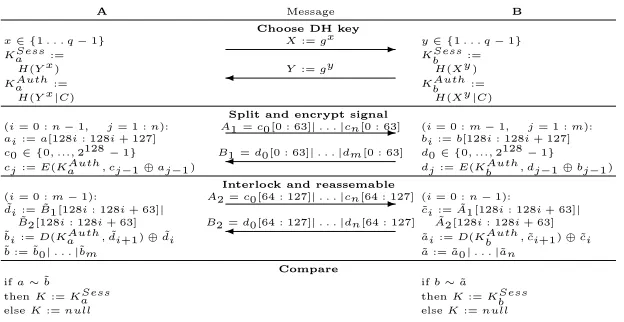
Fig. 3 shows our first authentication protocol, which is based on a standard Diffie-Hellman (DH) key agreement (introduced in their seminal article [19]) followed by an exchange of the condensed time series and comparison locally at each device.
Using DH key agreement, devices A and B generate two – supposedly – shared keysKAuthandKSess, where it is impossible to infer one from the other (under
the assumption that the hash function does not allow to find a pre-image). Creating two keys, one for authentication, one as session key, provides forward secrecy. Because DH is susceptible to MITM, the devices need to verify that their keys are equivalent. The unique key property of DH guarantees with a
3For security reasons, both devices should independently decide if authentication was
A Message B Choose DH key
x∈ {1. . . q−1} X:=gx y∈ {1. . . q−1}
KSessa := - KSess
b :=
H(Y x) Y:=gy H(Xy)
KAutha := KAuthb :=
H(Y x|C) H(Xy|C)
Split and encrypt signal
(i= 0 :n−1, j= 1 :n): A1 =c0 [0 : 63]|. . .|cn[0 : 63] (i= 0 :m−1, j= 1 :m):
ai:=a[128i: 128i+ 127] - bi:=b[128i: 128i+ 127]
c0∈ {0, ...,2128−1} B1 =d0 [0 : 63]|. . .|dm[0 : 63] d0∈ {0, ...,2128−1}
cj:=E(KAutha , cj−1⊕aj−1 ) dj:=E(KAuthb , dj−1⊕bj−1 )
Interlock and reassemable
(i= 0 :m−1): A2 =c0 [64 : 127]|. . .|cn[64 : 127](i= 0 :n−1):
˜
di:= ˜B1 [128i: 128i+ 63]| - ci˜ := ˜A1 [128i: 128i+ 63]|
˜
B2 [128i: 128i+ 63] B2 =d0 [64 : 127]|. . .|dn[64 : 127] A˜2 [128i: 128i+ 63] ˜
bi:=D(KAutha ,di˜+1)⊕di˜ ai˜ :=D(KAuthb ,˜ci+1)⊕˜ci
˜
b:= ˜b0|. . .|˜bm a˜:= ˜a0|. . .|˜an
Compare
ifa∼˜b ifb∼˜a
thenK:=KSessa thenK:=KSessb
[image:10.595.143.455.146.307.2]elseK:=null elseK:=null
Fig. 3.Protocol 1: Diffie-Hellman key agreement followed by exchange of the complete time series via interlock*
very high probability, that, ifKAuth
a =KbAuth, there can be no attacker E with KAuth
e1 =KaAuthandKeAuth2 =KbAuth, and subsequently, noK Sess
e1 =KaSessand KSess
e2 =KbSess.
This verification is done with an extendedinterlock protocol. Interlock [20] is not used widely, but is an efficient (in terms of message length) method to verify that two parties share the same key. By using this key as an input to a block cipher and splitting packets in halves, a MITM can only decrypt these packets after having received both halves. The interlock protocol then demands that A and B will only send their second halves after they have received the first halves from the respective other side. This has the effect that both sides must commit themselves to their values, by sending the first halves of the encrypted blocks, before they can receive, and subsequently decrypt, the other side’s message. Thus, interlock can be seen as a commitment scheme (see e.g. [21] for a definition) based on block ciphers. An attacker E is now left with only two options: either to forward the original packets, or to create packets on its own. In the former case, A and B will be unable to decrypt the messages properly, because they do not share the same key. In the latter case, E must guess the contents of the messages, and encrypt them with the appropriate keys, before it has access to the actual messages. When the messages sent by A and B have an entropy of ebits. this leaves E with a single2−e chance of remaining undetected.
cipher textsc anddwith lengths of n+ 1andm+ 1blocks are then split into two messages by concatenating the first halves of all cipher blocks into the first messagesA1 and B1 and the second halves of all cipher blocks into the second messagesA2andB2. This ensures that E can not decrypt any of the blocks, and can therefore not even learn parts of the plain text messages.
After exchanging their messages aandb, A and B verify thata∼b, that is, that they are similar enough under their chosen criteria. We use coherence as described in section 5, but other suitable features can be used without changes to the protocol. Because of this possibility, we do not try to minimize the message lengths as e.g. suggested in [13]. In fact, A and B could use completely different similarity criteria, and could still authenticate using the same protocol. This is important for practical implementations, because different generations of devices will need to be compatible with each other.
The MANA III scheme described in [10] serves a similar purpose as this pro-tocol, but using different cryptographic primitives. While we employ a block cipher, the MANA III scheme uses a MAC. Both constructions build on a mu-tual commitment to an authenticator string before transmitting parts of it.
6.2 Protocol 2: Candidate Key Protocol
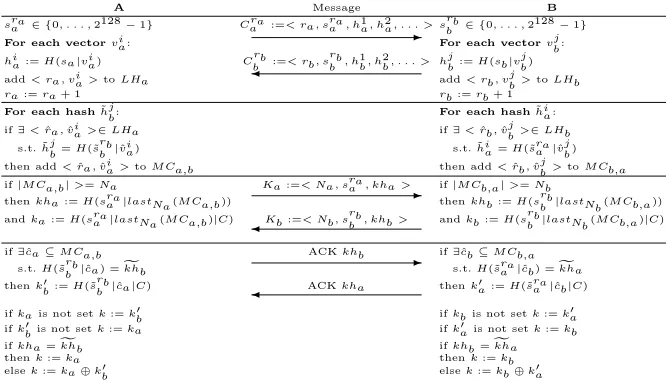
In our second protocol, which we call the candidate key protocol (CKP), the shared secret key is generated from sensor data instead of by DH. As depicted in Fig. 4, feature vectorsv are hashed to generatecandidate key parts h. If the feature extraction task produces multiple “parallel” feature vectorsvi for each time window, as suggested above in section 5, then these yield multiple candidate
A Message B
sraa ∈ {0, . . . ,2128−1} Cara:=< ra, sraa , h1a , h2a , . . . > srbb ∈ {0, . . . ,2128−1}
For each vectorvia: - For each vectorvjb:
hia:=H(sa|via) Crb
b :=< rb, s
rb
b , h
1
b, h
2
b, . . . > h
j
b:=H(sb|v
j
b)
add< ra, via >toLHa add< rb, vjb>toLHb
ra:=ra+ 1 rb:=rb+ 1
For each hash˜hj
b: For each hashhi˜a:
if∃<ra,ˆ ˆvia >∈LHa if∃<rb,ˆ vˆj
b>∈LHb
s.t.˜hj
b=H(˜s
rb
b |viˆa) s.t.hi˜a=H(˜sraa |vˆjb)
then add<ra,ˆ viˆa >toM Ca,b then add<ˆrb,vˆjb>toM Cb,a
if|M Ca,b|>=Na Ka:=< Na, sraa , kha > if|M Cb,a|>=Nb
thenkha:=H(sraa |lastNa(M Ca,b)) - thenkhb:=H(srbb |lastNb(M Cb,a))
andka:=H(sraa |lastNa(M Ca,b)|C) Kb:=< Nb, srbb , khb > andkb:=H(srb
b |lastNb(M Cb,a)|C)
if∃ˆca⊆M Ca,b ACKkhb if∃cbˆ ⊆M Cb,a
s.t.H(˜srb
b |ˆca) =khb
- s.t.H(˜sra
a |ˆcb) =kha
thenkb:=H(˜srb
b |ˆca|C) ACKkha thenka :=H(˜sara|cbˆ|C)
ifkais not setk:=kb ifkbis not setk:=ka
ifkbis not setk:=ka ifkais not setk:=kb
ifkha=khb ifkhb=kha
thenk:=ka thenk:=kb
[image:11.595.130.463.463.656.2]elsek:=ka⊕kb elsek:=kb⊕ka
key partshi. The one-way hashes are a simple way to communicate that a device has generated a certain feature vector without revealing it. To make dictionary attacks harder, we use the standard method of prepending random salt valuess before hashing. When B receives such candidate key parts from A, it can check its own history of recently generated feature vectorsLHto check for equals. When B has generated the same feature vector, it is stored in a list of matching key parts M C specific to each communication partner. As soon as enough entropy has been collected in this list, B concatenates all feature vectors, appendsC, hashes the resulting string, and sends a candidate key K to A. If no messages have been lost in transit, A should be able to generate a key with the same hash, and thus the same secret key, which it acknowledges to B. If messages have been lost, A can simply ignore a candidate key and create its own later on.
CKP is again a general protocol and can be used with any feature vectors. Here we apply it to quantized FFT coefficients, which work well for accelerometer data. A more thorough analysis of CKP itself will be provided separately.
7
Experimental Evaluation
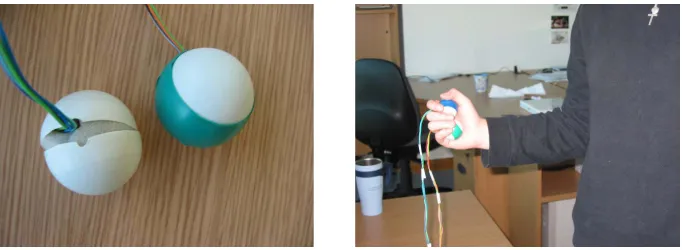
[image:12.595.130.471.531.656.2]We conducted three experiments, two to optimize parameters for the feature extraction tasks described in section 5, and one to validate our assumption of ease of use. All three experiments used four simple ADXL202JE accelerometers, two on each device, mounted at an angle of 90◦so that all three dimensions could be measured with a maximum acceleration of 2 g. The accelerometers are fixed with compressed foam inside ping-pong balls (see Fig 5), and sampled at roughly 600 Hz. By choosing balls as “device” shapes and orienting the accelerometers randomly inside the balls, each data set has different orientations. The subjects were also asked to pick the devices up at the start of each sample, so that orientations change between samples. Although the accelerometers were wired to enable higher sampling rates, the attached cables were lightweight, flexible, and long enough so as not to disturb movements of subjects.
7.1 Experiment 1: Single Subjects Data Collection
The first experiment was explorative and aimed to discover how people typically shake small, lightweight objects. 51 people, 19 female aged between 20 and 55, 32 male aged between 20 and 58, of different professions, including cafeteria staff and other non-office workers, were asked to shake both ping-pong balls, explicitly without further instructions. For each subject, 30 samples of roughly 5 seconds were taken: 5 each with both balls in the left, both in the right hand, one ball in each hand, and while either standing or sitting. This extensive data set of 1530 samples shows surprisingly large differences in style, frequency, and vigor of the shaking patterns. Samples with both balls in one hand serve as our “positive” data set where authentication should be successful. The cases where one ball was shaken in each hand are “neutral”: because a single person is performing the motion, authentication could, but does not have to succeed.
7.2 Experiment 2: Pairs Trying to “hack” Authentication
The second experiment served to establish our “negative” data set of cases where authentication should not be successful. It was organized as a competition with a small prize to motivate participants to try harder. The goal was for a pair of subjects to produce shaking patterns as similar as possible to each other. 8 different pairs contributed 8 complete data sets of 20 samples each and 4 incomplete sets with less samples: 5 samples each for both subjects using their left hands, both their right, one subject left, the other right, and vice versa. Each sample has roughly 15 seconds, because some time was allowed for starting the motion and synchronization. For more flexibility in moving together, the pairs were only standing but not sitting. Immediate feedback after each sample was provided to the pairs in the form of the similarity values for both protocols, so that they could adapt their shaking patterns appropriately for highest values.
Data from these two experiments was used to find parameters for detecting active segments for the temporal alignment task, and to optimize parameter combinations for the feature extraction task. The parameters for feature extrac-tion reported in secextrac-tion 5 have been found by a full parameter search using this extensive data set. For coherence, we use the parameter combination that generates the maximum difference of coherence averages between all positive and negative samples. Due to the larger parameter search space with higher dimensionality, for the second protocol we use the combination that minimizes
4eP +eN. eP is the percentage of false positives, i.e. the number of successful
authentications for pairs, and eN is the percentage of false negatives, i.e. the
0.2 0.3 0.4 0.5 0.6 0.7 0.8 0.9 1 0
0.1 0.2 0.3 0.4 0.5 0.6 0.7 0.8 0.9 1
Coherence threshold
Proportion of false positives/false negatives
false positives (two subjects, but above threshold) false negatives (one subject, but below threshold)
(a) Protocol 1
0 0.2 0.4 0.6 0.8 1
0 0.1 0.2 0.3 0.4 0.5 0.6 0.7
Matching feature vectors threshold
Proportion of false positives/false negatives
false positives (two subjects, but above threshold) false negatives (one subject, but below threshold)
[image:14.595.130.466.146.291.2](b) Protocol 2
Fig. 6.Thresholds for coherence and the number of matching FFT slices control the trade-off between false positives and false negatives w.r.t. all positive/negative samples
Figure 6 shows the traoff between false positives and false negatives, pending on the thresholds. Unsurprisingly, the percentage of false positives de-creases with increasing thresholds for both protocols. For protocol 1, shown in Fig. 6a, false negatives begin to increase noticeably at a threshold of around0.6, while for protocol 2, shown in Fig. 6b, they remain nearly constant. The thresh-old, either for coherence or for the percentage of matching candidate feature vectors, can be set by the application, or possibly even by the user. From a secu-rity point of view, we obviously prefer to restrict the number of false positives to zero. With a coherence threshold of0.72and a threshold of84%matching parts, we achieve false negatives rates of 10.24% and 11.96%, respectively, with no false positives. These false negatives are sufficiently low to provide user friendly interaction, as also shown by our third experiment. The feedback of a failed authentication is immediate, and users just need to shake the devices again.
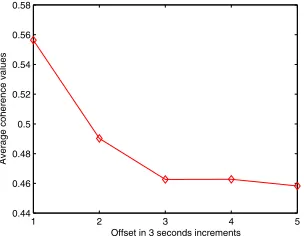
There is room for improving the results for our first protocol using coherence. As explained in section 5, we only use 3 seconds for comparing the time series. If active segments are longer than this, we can choose freely which parts to use. Figure 7 shows the average coherence values for our “negative” data sets, depending on the offset of the compared time series parts. Number 1 corresponds to the first 3 seconds, number 2 to the time series between 3 and 6 seconds, etc. The graph shows that two people tend to loose synchronization the longer the common movement needs to be sustained. We could exploit this fact by skipping the first few seconds and comparing later parts, at the expense of forcing users to shake devices longer. The results given above were generated by taking the beginning of the active segments, and thus with the most difficult parts.
1 2 3 4 5 0.44
0.46 0.48 0.5 0.52 0.54 0.56 0.58
Offset in 3 seconds increments
[image:15.595.222.374.149.270.2]Average coherence values
Fig. 7.Average coherence values depending on the segment offset show that people tend to synchronize their movements better at the beginning of their coordinated motions
generated on average 526.86 different feature vectors, with a minimum of 140 and a maximum of 1037. Aggregated over all subjects, there were 5595 different vec-tors for the left hands, 4883 for the right, and 7988 and 7770 for device 1 and 2, respectively. Overall, 12220 different feature vectors were generated during the first experiment, corresponding to an entropy of 13.58 bits per feature vector. If we assume an attacker to know which device, person, and hand are involved in a protocol run, this entropy decreases to around 7 to 10 bits, depending on the person. Overlapping feature vectors will have even less entropy, but we can still assume to generate at least 7 bits entropy per second using our second protocol.
7.3 Experiment 3: Single Subjects Live Usability Validation
method is easy enough to learn within a few minutes from printed instructions and trial&error, and that it can be used intuitively after this brief learning pe-riod. The fact that a few subjects performed significantly better after being shown suggests that the printed instructions need to be improved.
8
Conclusions
We have proposed two protocols for authentication based on accelerometer data that generate secret keys between two devices when they are shaken together. Although using similar techniques for accelerometer data analysis, it is evident that the protocols achieve their aim very differently, from a security as well as from a protocol point of view. We consider the first protocol more secure, but the second to be more scalable. That is, if a large number of devices are in range of the wireless network, a device using protocol 1 may need to run Diffie-Hellman key agreement with a considerable number of other devices to find that which it is shaken together with. For the second protocol, it only needs to broadcast its candidate key parts stream, and the matching device can “tune in”, i.e. synchronize, to this key stream. On the other hand, the security level of our CKP-based protocol 2 is limited to the entropy of the feature vectors, and is susceptible to offline attacks. When (pessimistically) estimating the entropy rate at around 7 bits per second, 20 seconds of shaking should be sufficient to achieve a security level of 128 bits. Users or applications may choose lower security levels. Another potential issue in terms of security of protocol 2 is that secure hash functions, the cornerstone of our design, have been subjected to considerably less theoretical analysis than the DH construction or block ciphers which are used in protocol 1. New attacks on hash functions are being discovered [22], although the SHA-256 family of hashes, including the even more conservative
SHADBL-256, is still considered secure. Additionally, protocol 1 utilizes these well-studied cryptographic primitives within a conservative design. An attacker has a one-off chance for an online attack – to guess the whole time series – and is thus significantly less likely to be successful than an offline attack on protocol 2. Although we can not currently quantify the security level against such unlikely online attacks, the security level of protocol 1 against offline attacks is 128 bits even after only 3 seconds of shaking (assuming DH to be secure). By introducing two protocols with different design, application developers can decide on this well-known trade-off between security and performance according to their requirements. Protocol 2 offers benefits for devices with limited resources, large wireless networks, and quick interaction, while we recommend using protocol 1 for higher security demands.
compatible to older devices. We note that our cryptographic protocols are also suitable for use with other types of sensors, while pre-processing and feature extraction tasks would most likely need to be modified.
Potential applications for our pairing protocols are manifold; coupling a mo-bile phone with a Bluetooth headset, establishing a transient secure connection between two smart cards for exchanging digital money, or passing access rights between key chains are prominent examples. 3D accelerometers are now being embedded into off-the-shelf mobile devices like the “Nokia 5550 Sport” and can immediately be used for authentication with our protocols. In our experiments described in section 7, we intentionally used simple, cheap accelerometers that are suitable for mass deployment.
The user interaction for authenticating devices is limited to just shaking them together for a few seconds, and is thus unobtrusive. By combining the explicit user interaction – taking two devices into one hand and shaking them as an indication that they should pair – with implicit authentication, we limit the burden placed on users. Connections are secured by default, not only as an option.
Full source code of our implementation including a demonstration application as well as our data sets are available as open source athttp://www.openuat.org.
Acknowledgments
We gratefully acknowledge support by the Commission of the European Union under the FP6 Marie Curie Intra-European Fellowship program contract MEIF-CT-2006-042194 “CAPER”, and especially thank Kristof van Laerhoven for in-sightful discussions on analyzing accelerometer data and providing sensor boards.
References
1. Hoepman, J.H.: The emphemeral pairing problem. In: Proc. 8th Int. Conf. Finan-cial Cryptography, Springer-Verlag (2004) 212–226
2. Holmquist, L.E., Mattern, F., Schiele, B., A., P., Beigl, M., Gellersen, H.W.: Smart-its friends: A technique for users to easily establish connections between smart artefacts. In: Proc. UbiComp 2001, Springer-Verlag (2001) 116–122
3. Stajano, F., Anderson, R.: The resurrecting duckling: Security issues for ad-hoc wireless networks. In: Proc. 7th Int. Workshop on Security Protocols, Springer-Verlag (1999) 172–194
4. Kindberg, T., Zhang, K., Im, S.H.: Evidently secure device associations. Technical Report HPL-2005-40, HP Laboratories Bristol (2005)
5. Kindberg, T., Zhang, K.: Validating and securing spontaneous associations between wireless devices. In: Proc. ISC’03: 6th Information Security Conf., Springer-Verlag (2003) 44–53
6. McCune, J.M., Perrig, A., Reiter, M.K.: Seeing-is-believing: Using camera phones for human-verifiable authentication. In: Proc. IEEE Symp. on Security and Privacy, IEEE CS Press (2005) 110–124
8. Nicholson, A.J., Smith, I.E., Hughes, J., Noble, B.D.: LoKey: Leveraging the sms network in decentralized, end-to-end trust establishment. In: Proc. Pervasive 2006, Springer-Verlag (2006) 202–219
9. Čagalj, M., Čapkun, S., Hubaux, J.P.: Key agreement in peer-to-peer wireless networks. IEEE (Special Issue on Cryptography and Security)94(2006) 467–478 10. Gehrmann, C., Mitchell, C.J., Nyberg, K.: Manual authentication for wireless
devices. RSA Cryptobytes7(2004) 29–37
11. Castelluccia, C., Mutaf, P.: Shake them up! In: Proc. MobiSys 2005: 3rd Int. Conf. on Mobile Systems, Applications, and Services, ACM Press (2005) 51–64
12. Hinckley, K.: Synchronous gestures for multiple persons and computers. In: Proc. UIST ’03: 16th ACM Symp. on User Interface Software and Technology, ACM Press (2003) 149–158
13. Lester, J., Hannaford, B., Borriello, G.: “Are you with me?” – Using accelerometers to determine if two devices are carried by the same person. In: Proc. Pervasive 2004, Springer-Verlag (2004) 33–50
14. Batina, L., Mentens, N., Verbauwhede, I.: Side-channel issues for designing secure hardware implementations. In: Proc. IOLTS: IEEE Online Testing Symp. (2005) 15. Lukowicz, P., Junker, H., Tröster, G.: Automatic calibration of body worn
accel-eration sensors. In: Proc. Pervasive 2004, Springer-Verlag (2004) 176–181 16. Aylward, R., Lovell, S.D., Paradiso, J.A.: A compact, wireless, wearable sensor
network for interactive dance ensembles. In: Proc. BSN 2006: Int. Workshop on Wearable and Implantable Body Sensor Networks, IEEE CS Press (2006) 65–68 17. Huynh, T., Schiele, B.: Analyzing features for activity recognition. In: Proc.
Soc-EUSAI 2005. ACM Int. Conf. Proceeding Series, ACM Press (2005) 159–163 18. Ferguson, N., Schneier, B.: Practical Cryptography. Wiley Publishing (2003) 19. Diffie, W., Hellman, M.E.: New directions in cryptography. IEEE Trans. on
Infor-mation TheoryIT-22(1976) 644–654
20. Rivest, R.L., Shamir, A.: How to expose an eavesdropper. Commununications of ACM27(1984) 393–394
21. Vaudenay, S.: Secure communications over insecure channels based on short au-thenticated strings. In: Proc. CRYPTO 2005, Springer-Verlag (2005)