Specialization Patterns in Trade and Technology
Thesis submitted in accordance with the requirements for the degree of
Do c t o r o f Ph ilo so ph y
by Maria Luisa Mancusi
Supervisor: Prof. John Sutton
The London School of Economics and Political Science University of London
United Kingdom
All rights reserved
INFORMATION TO ALL USERS
The quality of this reproduction is dependent upon the quality of the copy submitted.
In the unlikely event that the author did not send a complete manuscript and there are missing pages, these will be noted. Also, if material had to be removed,
a note will indicate the deletion.
Dissertation Publishing
UMI U190370
Published by ProQuest LLC 2014. Copyright in the Dissertation held by the Author. Microform Edition © ProQuest LLC.
All rights reserved. This work is protected against unauthorized copying under Title 17, United States Code.
ProQuest LLC
789 East Eisenhower Parkway P.O. Box 1346
82
/+l
different ways to the completion of this thesis.
I first wish to thank my supervisor, Prof. John Sutton, for his advice and guidance throughout this work: I have learnt from him more than I can show in this thesis.
Academic, administrative and IT support staff at the London School of Economics and at the Suntory and Toyota International Centres for Economics and Related Disciplines have always been helpful and have provided an enriching working environment from which I highly benefited.
I also thank my friends, who often had to prove very understanding. Among them very special thanks are due to Elisabetta Falcetti, whose contribution to this thesis has been decisive. I shared with her all the frustrations and the excitements of research in the past years and if I am finally concluding this work it is also because she always gave me good reasons for doing it.
I am highly indebted to my family and my husband’s family. My parents and my brother are a continuous source of strength and my husband’s family has always given me unconditional support, regardless of the numerous difficulties it has been going through.
Finally, my greatest gratitude goes to Carlo, my husband, because he has bom the burden of this work as much as I did and, most importantly, because he put his trust in me and made me trust myself.
ABSTRACT
This thesis focuses on the hypothesis of increasing returns and path- dependence in technological development, which originates in the supposedly localised nature of external economies from knowledge creation, and looks at its implications in the innovation literature and in recent models of endogenous technological change, specialization and growth.
Chapter 1 provides an empirical assessment of the hypothesis of increasing returns and path-dependence. A recontracting process formalises the idea that in the presence of strong national externalities a country’s pattern of technological specialization tends to polarise towards extreme values thus leading to the emergence of a bimodal distribution. This prediction is found to be at variance with the data. However, reinforcing effects appear to be at work in situations of strong disadvantage. This might be the effect of scarce past research experience limiting countries’ ability to absorb external knowledge.
The analysis of Chapter 1 is further developed in Chapter 2, where differences across technological fields are accounted for, to allow for the possibility that only some of them may be subject to increasing returns.
Chapter 3 compares technology and trade specialization patterns for a group of advanced countries. The analysis shows that their relationship is weak: this weakens the case for self-reinforcing mechanisms in technological change leading to persistence in trade patterns.
Chapter 4 finds that the elasticity of innovation to international spillovers is positive and significant, thus suggesting they may be an important force leading to mobility in technology and trade specialization patterns. Absorptive capacity positively affects the elasticity to spillovers, but its effect depends on the position of the country with respect to the world technological frontier: the larger the gap of a country with the technological leaders, the lower is its ability to absorb and exploit external knowledge, but the larger is its potential to increase this ability.
1 TECHNOLOGICAL SPECIALIZATION IN INDUSTRIAL COUNTRIES:
PATTERNS AND DYNAMICS... 24
1.1 In t r o d u c t io n... 24
1.2 In c r e a s in gr e t u r n s, p a t h-d e p e n d e n c ea n dt e c h n o l o g ic a la c c u m u l a t io n ..3 0 1.3 Te c h n o l o g yd y n a m ic sa n dr e c o n t r a c t in gp r o c e s s e s... 32
1.4 Em p ir ic a lm o d e l l in go ft e c h n o l o g ic a ls p e c ia l iz a t io n...38
1.4.1 Patent data...39
1.4.2 Specialization in technologies: definition and measurement....43
1.5 Th eev o l u t io no ft h et e c h n o l o g ic a ls p e c ia l iz a t io np r o f il e...4 6 1.5.1 Changes in the degree o f specialization...49
1.5.2 Intra-distribution dynamics...55
1.6 Co n c l u d in g Re m a r k s... 67
Ap p e n d k A: Th e In t e r n a t io n a l Pa t e n t Cl a s s if ic a t io n...71
Ap p e n d k B: Mo d e lsf o rd is t r ib u t io nd y n a m ic s... 73
B. 1 Markov chains...74
B.2 Distribution dynamics... 77
B.3 Discretisation...78
B.4 Mobility indices...81
B.5 Estimation...84
2 GEOGRAPHICAL CONCENTRATION AND SPECIALIZATION DYNAMICS IN DIFFERENT TECHNOLOGICAL FIELDS... 95
2.1 In t r o d u c t io n... 95
2.2 So u r c e so fin c r e a s in gr e t u r n sa n dd if f e r e n c e sa c r o s sf ie l d s... 98
2.3 Tr e n d sa n dg e o g r a p h ic a lc o n c e n t r a t io nint e c h n o l o g yf ie l d s...102
2.4 Dis t r ib u t io nd y n a m ic s... 106
2.4.1 Changes in the shape o f the cross-sectional distributions...109
2.4.2 Intra-distribution dynamics...I l l 2.5 Co n c l u s io n s...118
Ap p e n d k: Ta b l e sa n d Fig u r e s...122
3 TECHNOLOGY AND TRADE SPECIALIZATION DYNAMICS: A
COMPARATIVE ANALYSIS... 133
3.1 In t r o d u c t io n... 133
3.2 Te c h n o l o g ya n dt r a d e...136
3.2.1 The treatment o f technology in trade theory...136
3.2.2 Empirical analyses o f trade specialization and technology...140
3.3 Da t aa n dm e a s u r e m e n ti s s u e s... 145
3.4 Tr a d ea n dt e c h n o l o g ys p e c ia l iz a t io nint h e G5 c o u n t r ie s... 149
3.4.1 An overview o f specialization patterns...150
3.4.2 The relationship between RCA and RTA at different aggregation levels 156 3.4.3 Comparing mobility...159
3.5 Co n c l u s io n s...166
Ap p e n d k... 168
4 INTERNATIONAL SPILLOVERS AND ABSORPTIVE CAPACITY: A CROSS COUNTRY CROSS-SECTOR ANALYSIS BASED ON EUROPEAN PATENTS AND CITATIONS...175
4.1 In t r o d u c t io n... 175
4 .2 Re l a t e dl it e r a t u r e... 178
4.2.1 Knowledge spillovers: definition and measurement...179
4.2.2 International knowledge spillovers...182
4.2.3 Benefiting from spillovers: the role o f absorptive capacity...185
4.3 Th ee m p ir ic a lm o d e l... 186
4.3.1 Knowledge spillovers...187
4.3.2 The basic specification...190
4.3.3 Knowledge accumulation at the firm level and absorptive capacity...195
4 .4 Th ed a t a... 197
4.5 Es t im a t io n...206
4.5.1 Fixed effects non-linear regression models fo r count data...208
4.5.2 Empirical results from the entire sample...212
4.5.3 Empirical results at the industry level...216
4.5.4 Leaders vs. “followers"...218
4.6 Co n c l u s io n s... 221
Ap p e n d k...223
LIST OF TABLES
Ta b l e 1.1 So m em o b il it yin d ic e s... 65
Ta b l e 1.2 So m esim pl ec r o s s-s e c t io n a lr e g r e s s io n s...69
Ta b l e 1.3 Fiv es ta testr a n s it io np r o b a b il it ym a t r ic e s...93
Ta b l e 2.1 Th ea v e r a g es t a n d a r d Gin ic o e f f ic ie n t (a v e r a g ed e g r e eo fg e o g r a p h ic a l CONCENTRATION) AND THE AVERAGE GROWTH RATE OVER THE PERIOD 1982-1996 FOR THE 30 F IS IR TECHNOLOGIES... 105
Ta b l e 2.2 Mo b il it yin d ic e s... 115
Ta b l e 2.3 Est im a t e dt r a n s it io np r o b a b il it ym a t r ic e s... 122
Ta b l e 2.4 Co r r e s p o n d e n c eb e t w e e nt h e Fr a u n h o fe r In s t it u t ec l a s s if ic a t io na n dt h e IP C ... 123
Ta b l e 3.1 So m eba sics u m m a r ys t a t is t ic s...151
T a b l e 3.2 S im p le l i n e a r c o r r e l a t i o n s b e t w e e n RTAa n d RCAa t t w o d i f f e r e n t AGGREGATION LEVELS OVER THREE SUB-PERIODS...157
T a b l e 3.3 S im p le l i n e a r c o r r e l a t i o n s b e t w e e n RTAa n d RCAin h ig h , m e d rjm a n d l o w PATENTING INTENSITY SECTORS... 158
Ta b l e 3.4 On e-y e a rt r a n s it io np r o b a b il it ym a t r ic e s... 160
Ta b l e 3.5 Mo b il it yin d ic e s... 162
Ta b l e 3.6 Mo b il it yin d ic e sf r o m 5 -y e a rt r a n s it io np r o b a b il it ym a t r ic e s... 164
Ta b l e 3.7 ISIC Re v. 2 m a ins e c t o r s, a sg r o u p e db yt h e O E C D ... 170
Ta b l e 3.8 ISIC Re v. 2 s e c t o r so r d e r e db yd e c r e a s in gp a t e n t in gin t e n s it y... 171
Ta b l e 3.9 Th el is to fm ic r o-s e c t o r s: Ch e m i c a l s... 171
Ta b l e 4.1 Nu m b e ra n dd is t r ib u t io no fp a t e n t sint h es a m pl eb ya p p l ic a n t’sc o u n t r y OF RESIDENCE AND BY INDUSTRY...199
Ta b l e 4.2 Pe r c e n t a g es h a r eo fc it a t io n sb yt y p e... 200
Ta b l e 4.3 Pe r c e n t a g ed is t r ib u t io no fin t e r n a t io n a lc it a t io n sb yc o u n t r y... 203
Ta b l e 4.4 Pe r c e n t a g ed is t r ib u t io no fin t e r n a t io n a lc it a t io n sb yc o u n t r yw it h in EACH INDUSTRY...205
Ta b le 4.5 Su m m a r ys t a t is t ic sfo rt h ec o m p l e t es a m p l e... 206
Ta b l e 4.6 Re g r e s s io nr e s u l t sfo rt h ee n t ir es a m p l efro mt h el in e a ra n dn o n-l in e a r m o d e l s...215
Ta b l e 4.7 Re g r e s sio nr e s u l t sa tt h ein d u s t r yl e v e lf ro mt h el in e a ra n dn o n-l in e a r m o d e l s...216
Ta b l e 4.8 Reg r e s s io nr e su l t sfo rd if f e r e n tg r o u p so fc o u n t r ie s...219
LIST OF FIGURES
F i g u r e 1.1 S t a t i o n a r y d i s t r i b u t i o n s , p(x), w i t h h ig h l o c a l i s e d e x t e r n a l i t y e f f e c t
(K> 1), WHEN A=0 (— ) AND A>0 (- - - ) ... 37
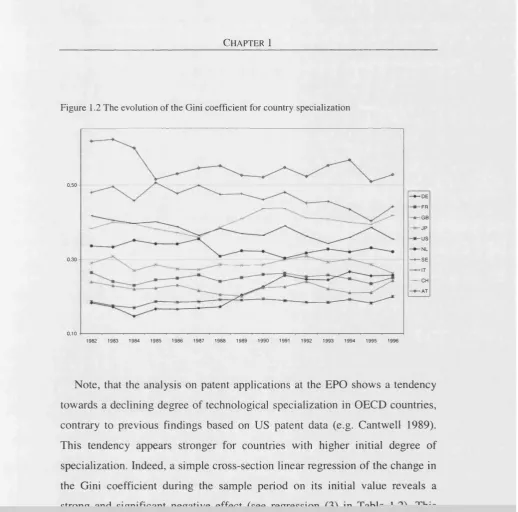
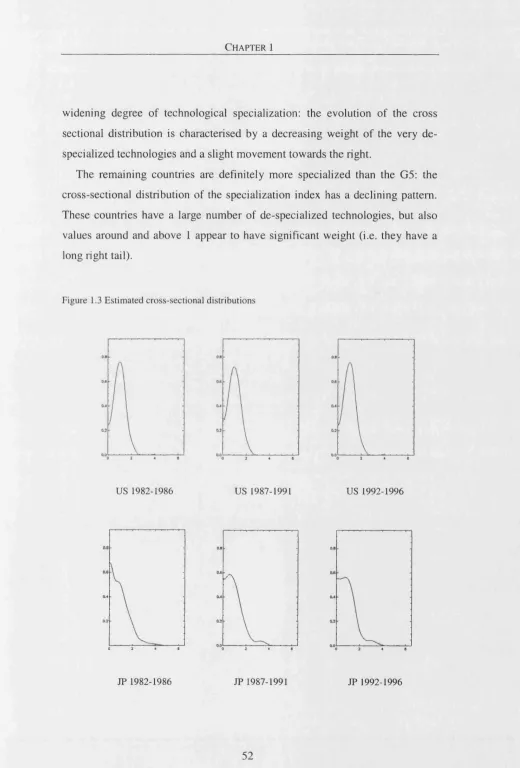
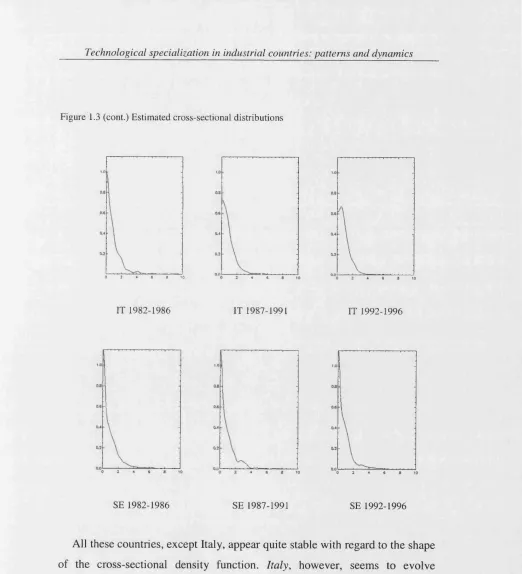
Fig u r e 1.2 Th ee v o l u t io no ft h e Gin ic o e f f ic ie n tf o rc o u n t r ys p e c ia l iz a t io n... 5 0 Fig u r e 1.3 Es t im a t e dc r o s s-s e c t io n a ld is t r ib u t io n s...52
F i g u r e 1.4 U S c r o s s - s e c t i o n a l d i s t r i b u t i o n s o f t h e RTAin d e x o b t a i n e d e x c l u d i n g U S PATENTS FROM THE WORLD TOTALS. THE DISTRIBUTIONS ARE ESTIMATED FOR THREE SUB PERIODS: 1 9 8 2 -1 9 8 6 ,1 9 8 7 -1 9 9 1 ,1 9 9 2 -1 9 9 6 ...54
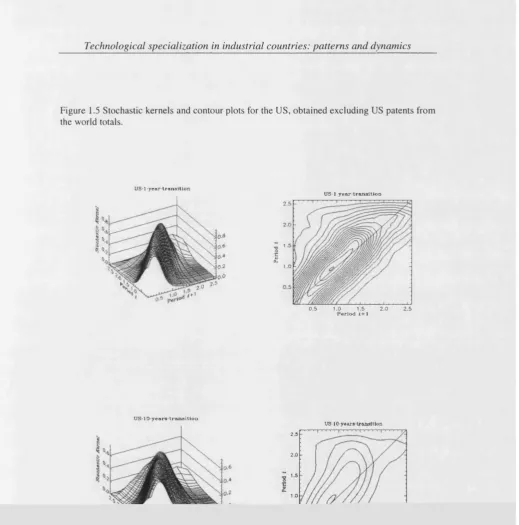
Fig u r e 1.5 St o c h a s t ick e r n e l sa n dc o n t o u rplo tsf o rt h e U S , o b t a in e de x c l u d in g U S PATENTS FROM THE WORLD TOTALS...61
Fig u r e 1.6 An e m p ir ic a lc r o s s-s e c t io nd is t r ib u t io n... 74
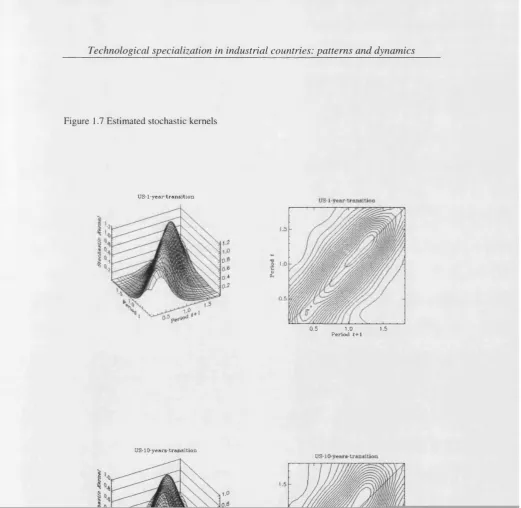
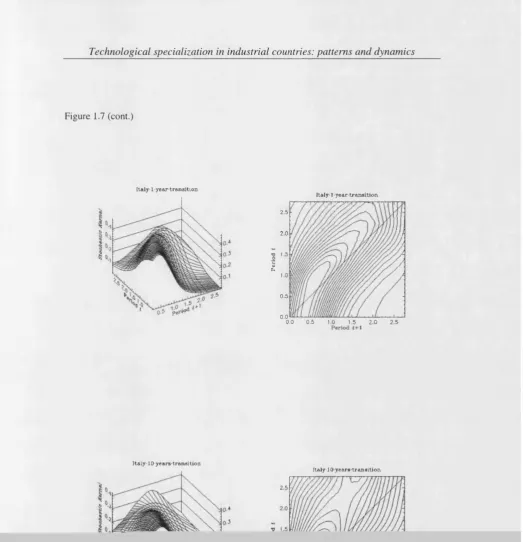
Fig u r e 1.7 Es t im a t e ds t o c h a s t ick e r n e l s...89
Fig u r e 2.1 Th e Gin ic o e f f ic ie n tc a l c u l a t e df o rt e c h n o l o g ic a lf ie l d s...104
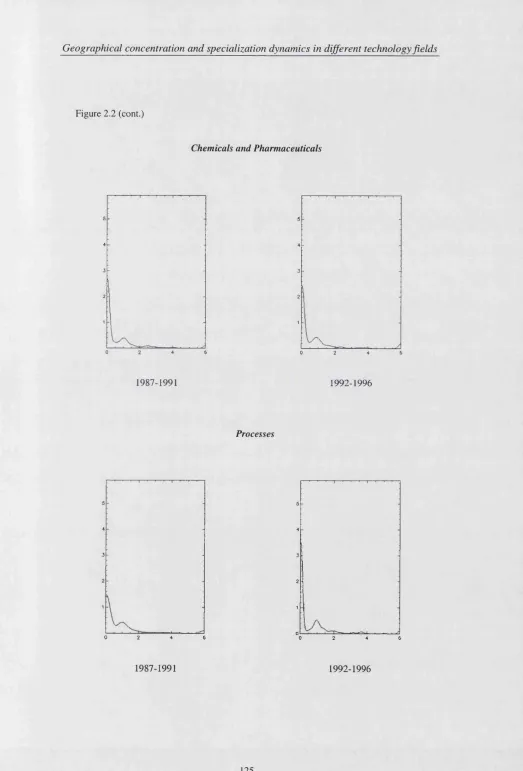
Fig u r e 2.2 Cr o s s-s e c t io n a ld is t r ib u t io n s... 124
Fig u r e 2.3 Ma r k o vs t o c h a s t ick e r n e l s... 127
Fig u r e 3.1 Es t im a t e dc r o s ss e c t io n a ld is t r ib u t io n s... 152
F i g u r e 3.2 C o n d i t i o n e d RCAd y n a m ic s f o r t h e U n ite d S t a t e s ...165
Fig u r e 3.3 Th e F IS IR c o n c o r d a n c eb e t w e e nt h e In t e r n a t io n a l Pa t e n t Cl a s s if ic a t io n a n dt h e St a n d a r d In t e r n a t io n a l Tr a d e Cl a s s if ic a t io n...169
Fig u r e 4.1 Re l a t iv eim p o r t a n c eo fn a t io n a la n din t e r n a t io n a ls p il l o v e r sint h e THREE INDUSTRIES...217 Fig u r e 4.2 El a s t ic it yo fp a t e n t st oa b s o r p t iv ec a p a c it y... 22 0
The theory of technological accumulation, as developed in Cantwell (1989) maintains that even over long time periods countries will keep and even reinforce their relative technological position: established patterns of technological specialization will be rather stable and characterised by areas of clear technological strength and areas of clear technological weakness. The assertion rests on the view that technological change is a cumulative rather than a random process for two main reasons. The first reason is that the directions of technical changes are often defined by the state-of-the-art of the technology already in use: each firm’s learning is local (in the technological space) and specific to the firm’s own search history. The second reason is that the probability of technological advances by firms and countries is, among other things, a function of technological levels already achieved by them. In particular, countries’ technological accumulation in individual sectors rests on complementarities and interdependencies that give rise to a structured set of technological externalities, which are highly specific to particular spatial and
Introduction
institutional contexts. These externalities reproduce or even increase over time (Dosi et al, 1990). Thus technological change is a self-reinforcing process, that is a process subject to increasing returns.
Self-reinforcing processes in economics (in particular, in the economics of technology) and the implications of increasing returns have been formalised and studied by Arthur in a series of papers (Arthur, 1994). He shows how, in the presence of positive feedback, the probability of further steps along the same path increases with each move down that path, because the relative benefits of such steps compared to once-possible options increase over time. As a consequence, actors have strong incentives to continue down a specific path once initial steps are taken in that direction. Sequencing is critical in that different earlier events (different sequences) may produce different outcomes: history matters. Processes that are unable to shake free of their history, are said to yield path-dependent outcomes.
Although arguments about technology have provided the most fertile ground for exploring the conditions leading to increasing returns, economists also have applied increasing returns arguments to economic change more broadly. A prominent development in recent discussions of economic growth has centred on endogenous growth theory (Aghion and Howitt, 1998). This strand of research argues that increasing returns associated with economic applications of knowledge help accounting for the puzzle of growth rates (notably in developed countries during the post-World War II period) far greater than what measured increases in inputs of capital and labour could explain. Unlike capital and labour, many aspects of knowledge are non-rival: their use in one firm does not prevent their use in another. The introduction of a new good may then give rise to positive technological external effects when the invention reveals new technical possibilities which competitors can incorporate into the next generation of their own products without paying a fee to the original inventor.
Positive technological external effects may also be the source of positive
feedback and path-dependence in the dynamics of specialization in open economies. Indeed, arguments about increasing returns have gained wide acceptance in recent analyses of international trade. Researchers began by focusing on economic trends which appeared anomalous from the perspective of traditional trade theory. If comparative advantage results from natural features of different countries, one would expect most trade to occur between quite different countries, such as North-South trade of manufactured goods for raw materials. Most international trade, however, is North-North: developed economies trade primarily with other developed countries, including extensive exchanges within particular industries. Again, increasing returns may provide an explanation. Knowledge-intensive sectors will be prone to positive feedback. Countries that gain a lead in a particular field, for whatever reason, may consolidate that lead over time. The result is a high degree of specialization. Even countries with similar initial endowments develop divergent areas of economic strength. Comparative advantage is not simply given, it is often created through a sequence of events unfolding over time.
Within the literature on endogenous technological change, the reinforcement of initial specialization patterns results either from sector-specific leaming-by- doing (e.g. Krugman, 1987) or from research and development (e.g. Grossman and Helpman, 1991, ch. 8) in the absence of international knowledge spillovers. Whether patterns of trade exhibit path-dependence and lock-in depends on the cross-border mobility of technology, which also determines whether there is convergence or persistent differences in levels of per capita output across countries. The importance of the issue has motivated a series of empirical studies on the scope of knowledge spillovers. The effect of international knowledge spillovers has been evaluated by assessing the impact of a pool of external knowledge on either total factor productivity (i.e. within a standard production function framework) or directly on innovative performance (i.e. in a knowledge production function framework). The pool of
Introduction
external knowledge is usually represented as the amount of R&D conducted elsewhere weighted by some measure of proximity in the technological or geographical space, taken to be representative of the intensity of knowledge flows between the source and the recipient of spillovers. Contributions within this strand of research widely differ on the way such knowledge flows are inferred. These differences are then reflected in an equally wide range of results.
Inferring flows of knowledge from flows of goods, Coe and Helpman (1995) find that international spillovers from foreign R&D positively affect productivity growth. Their methodology has been criticised because knowledge spillovers may be confounded with rent externalities and some authors have provided econometric evidence that casts doubt on the effectiveness of trade as a mechanism for knowledge transfer (Keller, 1998; Eaton and Kortum, 1996 and 1999). Other studies have inferred the intensity of knowledge flows from geographical distance (e.g. Bottazzi and Peri, 2003) or from the distance in the technological position of the source and destination countries (e.g. Branstetter, 2001). These studies mainly suggest that spillovers are more intra-national rather than international in scope. Finally, recent studies have employed patent citations as “paper trail” of knowledge flows, although the discussion has mostly been focused on the goodness of citations as a proxy of knowledge flows rather than on the impact of national vs. international spillovers when the intensity of knowledge flows are inferred from the intensity of citations (a notable exception is a recent paper by Peri, 2003). The findings on the scope of knowledge spillovers still remain inconclusive: while a border or geographical distance effect seems to emerge from some studies, others have found that this has been decreasing in time (Keller, 2000) or that the reach of knowledge flows depends on the sector/technology involved and on whether they originate from a technological leader (Peri, 2003). However, with only few very recent exceptions (Griffith, Redding and Van Reenen, 2001; Griffith, Harrison and
Van Reenen, 2003), have these studies investigated the extent to which the effectiveness of international knowledge flows depends on the recipient country’s ability to understand and benefit from external knowledge.
This thesis contributes to the above mentioned strands of economic literature in a number of ways. Empirically, if the explanation of the stability in trade specialization patterns was indeed based on the reinforcing effects characterising technological progress (due to either sector-specific learning by doing or to localised knowledge externalities), persistence should be particularly pronounced in technological specialization, where learning and the positive external effects in the form of knowledge spillovers from R&D have their most direct and strongest impact. It is then interesting to study the empirical dynamics of technological specialization in industrial countries in order to verify whether it shows any of the implications of increasing returns. The evidence is shown to be at variance with these implications (chapter 1). In particular, technological specialization patterns appear to be characterised by high mobility. This is consistent with the empirical finding of substantial mobility in recent trade analyses (Proudman and Redding, 1998 and 2000) and calls for greater attention to the forces leading to mobility in specialization patterns, such as international knowledge spillovers. There are, however, two qualifications to these findings. First, high persistence is found in situations of strong disadvantage. A possible interpretation is that the inability of countries to move out of such situations is related to their scarce past research experience, which limits their ability to absorb external knowledge. Second, there are indications of differences across technological fields in the dynamics of technological specialization: in one case this dynamics shows features compatible with the existence of self-reinforcing mechanisms (chapter 2). Technology and trade specialization patterns are then directly compared for a group of advanced countries. Their relationship is weak and mobility in technological specialization is higher than in trade specialization, thus further
Introduction
weakening the case for self-reinforcing mechanisms in technological change leading to persistence in trade patterns (chapter 3).
Drawing on the previous findings, the last part of the thesis (chapter 4) then looks at the effectiveness of international spillovers in determining a country’s innovative performance. The empirical analysis is performed on highly disaggregated data, accounting for differences across technological fields, and the elasticity of innovation to spillovers is modelled as a function of absorptive capacity (Cohen and Levinthal 1990). The elasticity of innovation to international spillovers is found positive and significant, thus suggesting they may be an important force leading to mobility in technology and trade specialization patterns. Furthermore, absorptive capacity positively affects the elasticity to spillovers. This provides a potential explanation to the observed dynamics of technological specialization and suggests the importance of incorporating into theoretical models the determinants of the ability to benefit from spillovers.
Looking at the contributions of each chapter in detail, chapter 1 provides an empirical assessment of the relevance of the hypothesis of path-dependence in the sectoral technological development of open economies, a hypothesis related to the supposedly localised nature of external economies from knowledge creation in the innovation literature and in recent models of endogenous technological change, specialization and growth.
The evolution of technological specialization is illustrated with reference to a recontracting process, which formalises the idea that in the presence of strong national externalities (when international spillovers are absent or weak) countries should display the tendency to specialize in selected technologies or, equivalently, patterns of technological specialization should display the tendency to polarise towards extreme values thus leading to the emergence of a bimodal distribution (i.e. one should observe increasing overall specialization in technologies). Established technological specialization profiles should then
display persistence, with particularly low mobility between the extreme ends of specialization: the event of a technology moving from high (low) to low (high) specialization should be extremely unlikely. This tendency should be particularly pronounced for countries with already unbalanced initial specialization patterns.
In the empirical analysis I represent a country’s pattern of international specialization in technologies through the distribution of the country’s relative innovative output shares across technologies. Innovative output is measured using patent applications at the European Patent Office (EPO) and relative shares are obtained as a modified version of the Balassa (1965) index of revealed comparative advantage: the resulting measure of specialization is the Revealed Technological Advantage (RTA). The pattern of international technological specialization at any one point in time can be characterized by the distribution of RTA across technologies. Evaluating its dynamics over time requires an analysis of the evolution of the entire cross-section distribution. This involves two different, but related issues. On one hand, there is the issue of the changes in the overall degree of international technological specialization, which may be evaluated by analysing the evolution of the external shape of the RTA distribution. Do we observe an increasing specialization in a limited subset of technologies (a polarisation of the RTA distribution towards extreme values), or has the degree of specialization remained broadly unchanged? On the other hand, there is the issue of persistence versus mobility in international technological activities. This addresses questions related to the intra-distribution dynamics, such as: what is the probability that a technology moves from the upper (lower) quartile of the RTA distribution to the lower (upper) quartile?
The evolution of the RTA distribution is modelled adopting a distribution dynamics approach (Quah 1993a, 1996a, 1996b, 1996c), whose features make it particularly suited to study the two issues just described. The issue of
Introduction
changes in the external shape of the distribution is addressed by estimating the distribution of RTA across technologies in subsequent periods. Intra distribution dynamics include information on switches in ranks and on the distance traversed when such switches happen. A way to quantify this phenomenon in the sequence of RTA distributions is to assume that the process governing the evolution of the specialization level of a country in a technology is a General Markov Chain. The law of motion of the sequence of distributions can then be described by a first order time-invariant autoregressive process, where the operator mapping the distribution from period t to period t+k gives the conditional distribution of the specialization index at time t+k, given its value at time t. This operator is a Markov stochastic kernel or, when the continuous state space is partitioned into a finite number of intervals, a Transition Probability Matrix. Both can be estimated non-parametrically from the data and provide an interpretation of persistence as a measure of the probability that the RTA index of a country in a technology remains close to its initial value as time passes by.
The empirical dynamics of technological specialization emerging from the analysis of industrial countries does not seem to support the idea that there are cumulative and reinforcing mechanisms at work, which could then generate path-dependence in the original technology and, hence, trade specialization patterns. Countries do not show increasing specialization in a limited subset of technologies (a polarisation towards the extreme values of the distribution representing the specialization pattern), but rather the opposite. Technological specialization displays significant mobility: fluctuations around and far from initial levels happen with a probability almost always higher than 0.5. It is high specialization levels that display the lowest persistence as they tend to revert towards low levels. Both overall mobility and reversion from above are more pronounced for countries with higher overall degree of specialization.
These results are not in line with the core predictions of the theories of
technological accumulation and path-dependence cited above, and cast doubt on the often alleged causality from hysteresis in technology to hysteresis in trade specialization. They suggest the importance of directly evaluating the effect of the forces capable of inducing changes in the international specialization over time, such as international knowledge spillovers. One feature of mobility emerging from the empirical analysis also deserves particular attention. Situations of initial complete or high de-specialization are characterised by relatively high persistence: it seems to be mostly difficult for a country to improve specialization in technologies where it is in a very disadvantaged position. This finding might signal that in the absence of a sufficiently high absorptive capacity, originated from previous experience in a technology, countries find it extremely difficult to overcome their weaknesses. Even if R&D spillovers were international in scope (a fact which could generate mobility in technology and trade specialization patterns), countries need to have some prior level of knowledge, R&D investment, or complementary assets in the relevant technology in order to understand and employ knowledge produced elsewhere.
The findings of chapter 1 call for the analysis of the relative importance of national vs. international knowledge spillovers and of the role of absorptive capacity in determining a country’s innovative performance. This is done in chapter 4. Before that, however, two limitations of the empirical analysis of chapter 1 are considered. The evidence of substantial mobility in patterns of technological specialization is obtained without taking into account differences across technological fields. If only some technologies are subject to increasing returns (Arthur, 1994), then pooling the observations from all fields might obscure the signs of reinforcing effects in a subset of them. This issue is discussed in chapter 2. Finally, one of the reasons why the evidence of chapter 1 weakens the case for causality from hysteresis in technological development to hysteresis in trade specialization patterns is that mobility in technology
Introduction
appears higher than that emerging from analogous trade analyses (Proudman and Redding, 1998 and 2000). However, no direct comparison can be done because the analysis of chapter 1 is focused on technologies, which do not have a direct correspondence with industries or product groups. Chapter 3 takes care of this issue.
The aim of chapter 2 is to verify whether there exist technology specificities that might affect the evolution of a country’s ability to innovate persistently in a particular field or to catch-up with actual leaders. Knowledge characteristics, cost structures, learning and externality effects may differ across technological fields and this may determine different technology dynamics, which might, or might not be characterised by reinforcing effects. In particular, the more the knowledge base in a technology field is complex, cumulative and firm-specific, the more one should expect a country in a relatively advantaged position to be able to reinforce it in the future and one with a relatively disadvantaged position to find it difficult to catch-up. The issue is then to see whether there is any field of technology where high de-specialization implies lock-in and, contrary to the generalised findings of chapter 1, high specialization induces positive reinforcing effects because of increasing returns in the creation of new knowledge.
The aim is achieved by studying the evolution of the cross-country distribution of revealed technological advantages in each of the following technological fields: electronics, instruments, chemicals and pharmaceuticals, processes, machinery, consumer goods and civil engineering. If technological specialization in any of these fields is characterised by reinforcing effects, then the distribution should again show a tendency towards polarisation: countries should display either high or low specialization in the field and their specialization level should persist over time. In trying to assess these tendencies, one immediate difficulty arises: the fields are quite widely defined. This is due to both features of the data and methodological constraints. As a
consequence each field might comprise quite substantial heterogeneity because it includes high-tech, fast-growing segments together with old, stagnant segments. The dynamics of the two might be very different and such differences might be hidden in the aggregation. In spite of this limitation, the field of electronics shows some distinctive features that are consistent with the existence of reinforcing effects: countries tend to display either high or very low specialization in the field and to maintain their relative position over time.
Chapter 3 studies the relationship between a country’s pattern of specialization in trade and its pattern of specialization in technology. Patterns of trade are determined not only by differences in technology and by technological change, but also by other factors, among which differences in relative factor endowments (Harrigan, 1997; Gustavsson et al, 1999). Therefore, one should expect, a priori, that the empirical similarities between the two patterns are limited. However, it is interesting to verify whether the size of the correlation between the two specialization patterns is affected by the aggregation level adopted. Empirical trade analyses are almost invariantly performed on highly aggregated industry data. If the correlation between technology and trade specialization patterns at this aggregated level is reasonably high, it will be valid to draw inferences from patterns of trade specialization as to underlying mechanisms such as path-dependence, which operates on technology. If instead the correlation is low, then such inferences are problematic. Chapter 3 then complements chapter 1 in that it directly compares mobility in technology and trade specialization: if any mechanism of path-dependence were at work, persistence in technological specialization should be at least as high as in trade specialization.
The analysis of chapter 3 is focused on the five most industrialised countries. As in the previous chapters, I use patents as a measure of innovative output and map their classification (the International Patent Classification, EPC) and the Standard International Trade Classification (SITC Rev. 3) into a
Introduction
common classification. Technology and trade specialization patterns and dynamics can be directly compared using this correspondence. The central theme emerging is that the correlation between technology and trade specialization patterns is extremely weak when using aggregated data, but positive and significant, although still low, when using disaggregated data. At such level of detail, technology and trade specialization levels show tendency towards convergence in the long run. Furthermore, persistence in technological specialization is significantly lower than persistence in trade specialization in the short-run, but becomes similar over a five-year horizon. The main implications are therefore that it is important to work with disaggregated data and to study the forces that lead to mobility in specialization patterns, in particular the role of international knowledge spillovers, emphasised by theory of dynamic comparative advantage and endogenous technological change.
The impact of knowledge spillovers is evaluated in chapter 4 within a knowledge production function framework using data on 135 micro-sectors in the chemicals, electronics and machinery industries for six major industrialised countries (US, Japan, Germany, France, UK and Italy) over the period 1981- 1995.1 assume that in country h firms operating in micro-sector i produce new knowledge using both their own R&D and external knowledge originated either elsewhere in the same country or in another country. To proxy new knowledge I use data on European patents. I then use patent citations to trace knowledge flows within and across countries among the 135 micro-sectors. Such flows are then used to obtain national and international knowledge spillover pools. Quite importantly, the national spillover pool is obtained using only citations to other national firms and institutions, hence excluding self citations (i.e. citations to previous patents by the same applicant firm), which cannot be regarded as a “paper trail” of knowledge flows and which account for a large proportion of overall national citations.
Results from different empirical studies seem to suggest that knowledge
spillovers are mainly intranational rather than international in scope (Jaffe et al, 1993; Branstetter, 2001; Maurseth and Verspagen, 2002). In one of these studies, Maurseth and Verspagen (2002) employ citations by patent applications at the European Patent Office (EPO) to trace knowledge flows across European regions: they find that patents are more likely to cite other national patents rather than foreign patents. In this chapter I show that this result arises because cross citations between European regions exclude all citations directed towards the world technological leaders (US and Japan). Once these are included in the analysis the home country effect disappears and the share of international citations is found to be particularly high in countries below the technological frontier. Consistently, international spillovers are always found to be effective in increasing innovative productivity.
The chapter then addresses a second issue, so far often neglected in the literature on spillovers: the positive externality generated by international technology flows will crucially depend on the destination country’s ability to understand and exploit external knowledge. Such ability is a function of the country’s past experience in research, an idea analogous to the concept of absorptive capacity introduced by Cohen and Levinthal (1990) in the context of firms’ learning and innovation. The importance of incorporating this component into the analysis is suggested by the empirical dynamics of technological specialization emerging from the analysis of chapter 1.
The role of prior R&D experience in improving the ability of firms to understand and employ external knowledge has only been investigated in a few studies so far (see Griffith, Redding and Van Reenen, 2001; Griffith, Harrison and Van Reenen, 2003). The novelty here lies in the use of self-citations to measure the effect of absorptive capacity in enhancing the ability to benefit from spillovers. A self citation indicates that the firm did some research in the past and that it has now generated a new idea building upon previous research in the same or in a related technology field. As such, self citations are a clear
Introduction
indication of accumulation of knowledge internal to the firm.
The empirical results show that absorptive capacity increases the elasticity of a country’s innovation to both national and international spillovers. However, its effect is different depending on the position of the country with respect to the world technological frontier: the larger the gap of a country with the technological leaders, the lower is its ability to absorb and exploit external knowledge, but the larger appears its potential to increase this ability.
c o u n t r i e s: Pa t t e r n s a n d d y n a m i c s
1.1 Introduction
In the past two decades a series of studies on innovation has worked under the hypothesis that technological change is, to a large extent, a cumulative activity. In a well known paper, Dosi (1988) suggests the existence of technological paradigms. A ‘technological paradigm’ defines contextually the needs that are meant to be fulfilled, the scientific principles utilised for the task, the material technology to be used. In other words, a technological paradigm can be defined as a pattern of solution of selected problems, based on highly selected principles derived from prior knowledge and experience. A technological trajectory can then be defined as technological progress along the economic and technological trade-offs defined by the paradigm.
This concept is very different from the identification of technology with information, easy to re-produce and re-use (Arrow, 1962). It recognises the highly differentiated nature of firms and of their search process (firm-specific nature of technology), which is pursued in areas that enable them to use and
Technological specialization in industrial countries: patterns and dynamics
build upon their existing technological base (local learning). “What the firm can hope to do technologically in the future is heavily constrained by what it
was capable o f doing in the past”’, put it simply, “(technological) development over time ceases to be random, but is likely to be constrained to zones that are
closely related technologically to existing activities” (Dosi et al., 1990, pp. 84- 85).
Another fundamental property of technological change relates to the forms and degrees of private appropriability of technological advances. As suggested by the classical and Schumpeterian traditions, varying degrees of private appropriation of the benefits of the innovation are both the incentive to and the outcome of the innovative process. In other words, each technology embodies a specific balance between its public good aspects and its private (i.e. economically appropriable) features. (Dosi et al., 1990, p. 89).
Finally, according to this view, differences in national rates of technological accumulation are influenced by strictly country-specific factors, among which: differences in the technological and institutional context, and technological externalities which act as a collective asset to single industries or group of industries within each national economy. “These technological externalities affect the dynamics o f innovation and imitation in each individual sector, and
the overall pattern o f technological accumulation in each country. (...) (They)
are highly specific to particular spatial and institutional contexts; that they
reproduce or even increase over time” (Dosi et al., 1990, p. 107).
This last idea is close to those included in Arthur’s work on increasing returns, path-dependence and self-reinforcing mechanisms in economics. It is well known that allocation problems with increasing returns tend to exhibit multiple equilibria. Arthur points out two new properties: inflexibility in that once an outcome (a dominant technology) begins to emerge it becomes progressively more “locked in”; and non-ergodicity in that historical “small events” are not averaged away and “forgotten” by the dynamics: they may
decide the outcome.
The role of technological change and the possibility of increasing returns have become a key issue also in growth and trade theory. Both of them have become the focus of attention in recent empirical analyses of changes in the overall degree of countries’ specialization and of the extent to which initial patterns of specialization persist over time. The theoretical literature on trade and growth typically yields ambiguous conclusions concerning both these issues. In particular, within the literature emphasising the endogeneity of technological change sector-specific leaming-by-doing or localised knowledge flows are typically forces for persistence, while technology transfer across countries give rise to mobility (see, for example, Grossman and Helpman,
1991).
In endogenous growth theory models the creation of knowledge through private R&D yields positive external effects: part of the new knowledge adds to a public stock, accessible to all firms doing R&D themselves, thus reducing every firm’s costs of future R&D. Over time, the public stock of knowledge grows, allowing more differentiated or higher quality products to be introduced without a continual increase in the amount of resources spent in R&D activities. This is referred to as knowledge spillovers, so called because the benefit of innovation accrues not only to the innovator, but “spills over” to other firms by raising the level of knowledge upon which new innovations can be based. Thus, knowledge spillovers serve as endogenous engine of economic growth.
The distribution of countries’ output per capita and their comparative advantages are then determined by the process of technical progress in one country being independent from that in the others. Perfect technology diffusion (i.e. new ideas flowing as quickly to other countries as they flow within countries) favours the convergence of per capita output levels and leaves factor endowments as the sole determinants of trade patterns. However, if there are
Technological specialization in industrial countries: patterns and dynamics
impediments to technology diffusion across national borders and the rate of knowledge spillover is much stronger within nations than across them1, differences in levels of per capita output across countries will be persistent and the patterns of trade can exhibit path-dependence and lock-in (as a consequence of reinforcing effects characterising a country’s technological change). Small initial inter-country differences lead then to divergence in specialization patterns and growth2.
According to the theory the origin of persistence in the trade patterns of industrial countries may lie in the nature of technological progress or in the relatively stable position of advanced countries in the international economy. In the first case, stability in trade patterns arises as a consequence of technological progress being path-dependent and subject to localised knowledge spillovers, whereas in the second case knowledge spillovers may be pervasive and persistence is generated by stability in relative factor endowments. Understanding which of the two explanations applies is of primary importance, not least because they have different theoretical and normative implications.
If the actual specialization profile of a country is determined by its past strengths and weaknesses, industrial and technology policies targeted at selected industries and technologies in order to change the sectoral distribution of the country’s comparative advantages would have lasting effects. Under the assumption that the government can identify the more promising technological trajectories, it can then pursue the deepening of specialization along those
1 Jaffe (1989), Jaffe et al. (1993), Bottazzi and Peri (2003) suggest this, among others. Keller (2000) finds evidence pointing to the relevance of geographical proximity, but also shows that the detrimental effect of geographical distance on international technology diffusion has fallen by about 20 percent over the period 1970-1995.
2 If a country acquires a temporary advantage in an R&D intensive sector, it can innovate in that sector at a faster rate than other countries. This is because the knowledge base on which domestic firms build their innovations grows faster than anywhere else, given that it cannot quickly spread to foreign competitors. Hence the country can build on an initial advantage, eventually developing a position of enduring comparative advantage.
technologies, by shifting resources towards them.
Therefore, whether international trade patterns persist or exhibit mobility over time (and whether there is increasing or decreasing specialization over time) is an empirical question. Empirically, if the explanation of the stability in trade specialization were based on the nature of technology, then persistence should be particularly pronounced in technological specialization, where the positive external effects in the form of knowledge spillovers from R&D have their most direct and strongest impact.
This chapter provides an empirical assessment of the relevance of the hypothesis of path-dependence in the sectoral technological development of open economies, a hypothesis related to the supposedly localised nature of external economies from knowledge creation in the innovation literature and in recent models of endogenous technological change, specialization and growth.
In the analysis I represent a country’s pattern of international specialization in technologies through a distribution of relative innovative output shares across technologies and then refer to its dynamics as the evolution of the entire distribution over time. This very general specification is consistent with a wide range of possible technology dynamics and allows determining the degree of persistence versus mobility in patterns of international technological specialization from the observed data. It also allows determining whether the observed dynamics is consistent with path-dependence in its strongest version (i.e. reinforcing effects leading to polarization and, possibly, lock-in).
This purpose is here achieved applying the dynamic tools offered by distribution dynamics modelling (Quah, 1993a, 1996a, 1996b, 1996c) to the analysis of the evolution of the technological specialization profile of industrial countries in the last two decades. This approach is appropriate to study the evolution of a country’s specialization pattern as a process where the state of the system determines the probability of the next action (see Arthur, 1994, pp.
119-120).
Technological specialization in industrial countries: patterns and dynamics
Countries do not show increasing specialization in a limited subset of technologies (a polarization towards the extreme values of the distribution representing the specialization pattern). However, for most countries the relative stability in the degree of specialization hides significant intra distribution mobility. In particular, high specialization levels are not persistent in time; rather, they revert towards lower levels, the reversion being faster and more pronounced for smaller countries (i.e. countries with higher overall degree of specialization). By contrast, higher persistence is found in situations of initial complete or high de-specialization.
These results have implications on the relationship between technological change, growth, and trade of countries, and complement the studies on the empirical patterns of trade dynamics. They are not in line with a theory of technological accumulation and path-dependence, and are consistent with the findings in Stolpe (1995), which cast doubt on the often alleged causality from hysteresis in technology to hysteresis in trade specialization. The results might also help explaining the finding of high mobility in trade patterns emerging from recent empirical studies on trade dynamics3.
The chapter is organized as follows. Section 2 provides a brief review of the literature on path dependence and technological specialization. Section 3 shows how technology dynamics can be seen as a recontracting process whose stationary distribution is characterised by strong specialization/de specialization if national externalities are strong. Section 4 defines the technological specialization profile of a country and explains how it can be measured. Section 5 studies the evolution of the overall degree of technological specialization through changes in an inequality index and the non-parametric estimation of the density functions representing the specialization patterns of ten OECD countries. The same section then studies intra-distribution
3 See Proudman and Redding (1998,2000) and Brasili et al. (2000).
movements (i.e. changes in time of a country’s specialization in a particular technology field) through the estimation of Markov stochastic kernels and transition probability matrices. Section 6 concludes. Empirical methods are presented in the Appendix.
1.2 Increasing returns, path-dependence and technological
accumulation
During the past twenty years economists have exhibited a growing interest in the idea of increasing returns on a wide range of subjects, including the spatial location of production, the development of international trade, the causes of economic growth and the emergence of new technologies4.
Arguments about technology have provided the most fertile ground for exploring the conditions conducive to increasing returns. As Brian Arthur (1994) and Paul David (1986) have stressed, under conditions often present in complex, knowledge-intensive sectors, a particular technology may achieve a decisive advantage over competitors, although it is not necessarily the most efficient alternative in the long run. Once an initial advantage is gained, positive feedback effects may lock in this technology, excluding competitors.
This last idea is illustrated in Arthur’s model of competing technologies (Arthur, 1989). The author explores the dynamics of allocation under increasing returns, within a model where agents choose between technologies competing for adoption and where each technology improves as it gains in adoption. It shows that the economy, over time, can become locked-in by “random” historical events to a technological path that is not necessarily efficient, not possible to predict from usual knowledge of supply and demand
4 It should be noted that the ideas developed in this research are not entirely new. The concept of increasing returns received attention already in the work of Alfred Marshall.
Technological specialization in industrial countries: patterns and dynamics
functions, and not easy to change by standard tax or subsidy policies. Rational expectations about future agents’ technology choices can exacerbate this lock- in tendency.
In the presence of positive feedback, the probability of further steps along the same path increases with each move down that path. This is because the relative benefits of the current activity compared to once-possible options increase over time or, alternatively, the costs of switching to some previously plausible alternative rise. As a consequence, actors have strong incentives to focus on a single alternative and to continue down a specific path once initial steps are taken in that direction. The general point is that sequencing is critical in such processes. Earlier events matter much more than later ones, hence different sequences may produce different outcomes: history matters.
The same ideas underlie the theory of technological accumulation, according to which technological change exhibits reinforcing effects due to geographically bonded and sector specific learning by doing or knowledge externalities. According to this view a country’s ability to innovate and its pace of technological progress in a field depend on its historical leads and lags. As a consequence, “international patterns o f technological advantage, having been established, will remain relatively stable over periods o f ten or even twenty
years, under the assumption that only the emergence o f new technological
paradigms and industries can, in the long term, generate important changes in
the specialization trajectories o f both firms and countries” (Cantwell 1989). Cantwell (1989), Archibugi and Pianta (1992a, 1992b, and 1994), Stolpe (1995) and recent studies by Amendola et al. (1998) and Laursen (2000) have analysed the technological specialization profiles of advanced countries, trying to establish whether there is evidence of their stability over time. With the exception of Stolpe (1995) they all employ static methods of analysis5. The
5 Cantwell (1989), Amendola, Guerrieri and Padoan (1998) and Laursen (2000) employ the
findings these studies reach are mixed, depending on the specific sample and measure of specialization used. However, an overall picture of stability in technological specialization patterns emerges, with the exception of France and the UK and with the US showing a tendency towards an overall increase in its degree of specialization. This result is somewhat mitigated in Stolpe (1995) and Laursen (2000), who provide a comparison between stability in technology and trade specialization patterns and find the first to be lower than the latter, thus suggesting relatively low persistence in technological specialization.
1.3 Technology dynamics and recontracting processes
The evolution of technological specialization and the possibility of geographically bounded self-reinforcing effects in innovative activities can be illustrated with reference to a recontracting process, which considers a total allocation of fixed size divided among K categories. Transitions of units between categories are possible, with probabilities that depend, in general, on the market shares or numbers in each category. Thus self-reinforcement is possible.
The simplest way to illustrate some of the basic implications of national external effects for the dynamics of technological specialization is within a stylised model where labour is the only factor employed in the production of new knowledge, the labour market is perfectly competitive, and the economy’s R&D labour force is given and equal to 2N.
Galtonian regression model, which may suffer of the well-known Galton’s fallacy (Hotelling 1932; Friedman 1992; and Quah 1993b). In Archibugi and Pianta (1992a, 1992b, and 1994) changes over time of the profile and degree o f specialization are analyzed by looking, respectively, at the correlation coefficients o f specialization vectors at different time periods and at the evolution of the chi-square index over time. Only Stolpe (1995) uses the same methodology employed here to assess the evolution of patterns o f technological specialization in OECD countries, albeit with an emphasis on the distinct dynamics within individual industries.
Technological specialization in industrial countries: patterns and dynamics
To keep things simple, consider the case where K, the number of technological fields in which the workers can be employed, is equal to 2 (field 1 and field 2). Workers decide with which technology to work and can move from one to the other. In this setting, a comparative advantage in new knowledge production is due to higher labour productivity in one of the two technology fields and increasing returns to scale can take the form of a positive externality for all innovators active in a field.
Under the assumption that transitions can be made only one unit at a time, the resulting reallocation of labour between the two technologies can be characterised as a stochastic recontracting process similar to the one studied by Weidlich and Haag (1983), and later taken up by Arthur (1994). This can be modelled as a one-dimensional stochastic process in time, because the relative shares of the two technological fields in the total innovative activity of the model economy require one state variable only. Given the configuration {721,722} at a given time t, consisting of the numbers 721 and 722 of workers
employed with technology 1 and 2, respectively, the state variable n is such that:
72i + 722 = 2 N
n i= N + n
- N < n < N
and 72j - 722 =
and 722 - N - n
and 0 <7 2 ^ 7 2 2 <2N
(1)
Let 12(72) denote the probability that a worker moves from technology 1 to
technology 2, and £>2 1(72) the probability that a worker moves from technology 2
to technology 1, in unit time (i.e. pn(n) and £>2 1(22) are the individual transition
probabilities) and consider a population of economies (each consisting of a labour force equal to 2N). The function
p[nh n2;t] = p(n\t) (2)
denotes the probability that one sample economy has the configuration {ni, ^2}
at time t. Of course, the condition
has to be satisfied at all times.
The equation of motion for p{n\t) can be derived considering that the individual transition probabilities induce “nearest neighbour” transitions of the configuration {«i,«2} only. The transition {n\,ri2} —» {«i+l,«2- l} , or
equivalently n —> n+1, is effected by a transition from technology 2 to technology 1 by one of the « 2 members working with technology 2.
Analogously, a transition {m, n2} —> {«i-l, «2+l}> or equivalently n —> n -1, is
effected by a transition from technology 1 to technology 2 by one of the n\ members working with technology 1.
Correspondingly, the transition probabilities for the whole configuration are given by6
w (n -^ n + l) = (n) = n2P2i(n) = ( N - n)p2\(n)
w (n ^ > n -\) = w i (n) = nxp l2 (n) = (N + n)pl2 (n) (4) w (n—>ri) = 0 for n '^ n ± 1
and the equation of motion for p(n;t) is equal to
6 The model can be generalised to multiple transitions for the case in which m members of the labour force simultaneously change the technology they work with. Methods o f solution become more complicated and are discussed in Weidlich and Haag (1983).
N
]T/?(w;0 = l (3)
- N
Technological specialization in industrial countries: patterns and dynamics
= [w^ (in +1 )p(n +1;0 - (n)p{n\t)]
+ [w^ (ti - l)p(/i - l;f) - («) p(n\t)]
The interpretation of equation (5) is the following: the change in time of the probability of state n is due to the probability fluxes into and out of state n, that is the probability fluxes from or towards states (n+1) and (n -1). Equation (5) has also an important property: an arbitrary initial distribution finally develops into a stationary equilibrium distribution p(n), that is the recontracting process shows convergence in distribution (Weidlich and Haag, 1983: p. 9).
In an interesting illustrative example, Weidlich and Haag (1983) show that the stationary distribution can show either a centralising tendency or a bimodal shape, where the modes are towards the end states of complete specialization into one of the two technologies, depending on the strength of the national, technology specific external effects. In this example, the probabilities of a worker moving from one technology to the other are:
P21 (w) = v exP(S+Kn) = v exp(5 + lot)
~ (6)
P\2 (w) = v exp[-(5 + k«)] = v exp[-(S + ioc)]
where k = Nk, x = n /N (-1 < jc< 1 ), and 5, k and v are parameters whose
effect on the transition probabilities can be described as follows:
a) The parameter 5 allows for a “preference bias”. A positive 8 increases the probability that a worker moves from technology 2 to technology 1, and reduces the probability of moving from 1 to 2. The opposite happens for a negative 8. In the present setting the parameter 8 could signal that workers are more productive in one of the two technologies, giving the country an ex-ante
comparative advantage in that technology7.
b) The parameter k is the national external effect8. A positive K enlarges
the transition probability in favour of the technology with the largest share of workers and reduces the transition probability in the opposite direction. This effect grows for growing \x\ or for growing imbalance in the shares of the two technologies. Through the term kx, the probabilities pij(n) depend on the present configuration.
c) The parameter v determines the frequency of switches, or the time scale in which changes of technology by workers occur.
From equation (6), transition probabilities for the whole configuration can be derived as in (4), which substituted into the equation of motion for p(x;t), allow obtaining the stationary distribution p(x) (see Weidlich and Haag, 1983: section 2.4). Its properties depend on the chosen values of k and 5, and are
independent of v. In the absence of conformity, a larger population in one technology increases the chance of switches to the other; hence there is a centralising tendency. This is offset by the conformity effect, which reinforces a concentration of one type.
When k is small (k< 1 ) , centralisation dominates and the stationary distribution is unimodal. The independent preferences of the individual workers, described by 5, play the main role. For 5 = 0, the most probable outcome (the mode of the distribution) is one with n = 0, or n\ = ri2, i.e. equal
specialization in technologies 1 and 2. When 5 > 0 (the case of comparative advantage in technology 1), the mean value of the distribution is shifted to the right (E (n)> 0), but the shape of the distribution remains approximately the same.
7 Indeed, higher productivity in, say, technological field 1 would imply higher wages from a job in technological field 1, hence higher probability o f switching from field 2 to field 1.
8 Arthur (1994) refers to this as the “conformity” effect, while Weidlich and Haag (1983) call it “adaptation” parameter.
Technological specialization in industrial countries: patterns and dynamics
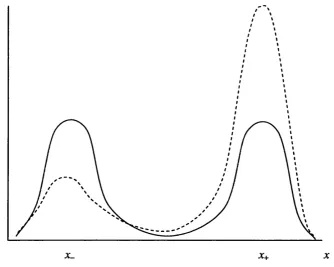
As K increases ( k> 1) the distribution bifurcates and becomes bimodal, with maxima corresponding to the relative prevalence of one technology over the other. For 5 = 0, the two modes have equal height: equal specialization in the two technologies is unlikely, while specialization in either of the two is most probable. In the case when 5 > 0 a large probability peak corresponding to a value x+ close to the boundary x = +1 is found, while there is still a now small probability peak at a value jc_ close to the boundary x = -1 (Figure 1.1). This second peak implies that, because of previous history, a stable configuration jc_ exists in contradiction to the sign and magnitude of the individual preference parameter 5 of all members of the economy.
Figure 1.1 Stationary distributions, p(x), with high localised externality effect (k> 1 ) , when 8=0 (— ) and 8>0 (— )
p(x)
x
[image:39.595.107.442.429.696.2]To sum up, the recontracting process presented in this section formalises the idea that in the presence of strong national externalities (when international spillovers are absent or weak) countries should display the tendency to specialize in selected technologies, either because they have a comparative advantage in such technologies or because of hysteresis. In a setting with more than two technologies one should then expect the specialization pattern of countries to evolve towards areas of clear specialization and areas of clear de specialization, the tendency being stronger for countries with already unbalanced initial specialization patterns. This means one should observe increasing overall specialization in technolog