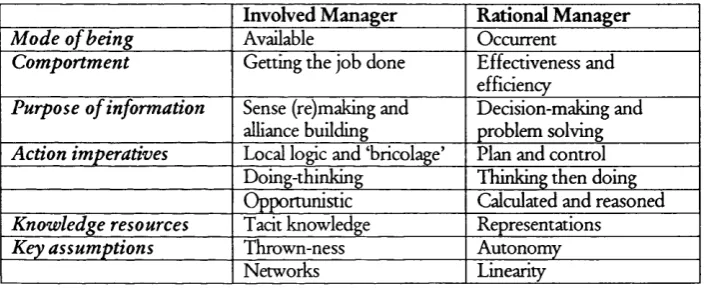
Department of Information Systems
London School of Economics & Political Science
INFORMATION AND KNOWLEDGE IN COMPETITIVE
STRATEGIZING:
TOWARDS AN INVOLVED PERSPECTIVE
AFSOUN HATAMI
October 2007
UMI Number: U506B53
All rights reserved
INFORMATION TO ALL USERS
The quality of this reproduction is dependent upon the quality of the copy submitted.
In the unlikely event that the author did not send a complete manuscript and there are missing pages, these will be noted. Also, if material had to be removed,
a note will indicate the deletion.
Dissertation Publishing
UMI U506B53
Published by ProQuest LLC 2014. Copyright in the Dissertation held by the Author. Microform Edition © ProQuest LLC.
All rights reserved. This work is protected against unauthorized copying under Title 17, United States Code.
ProQuest LLC
789 East Eisenhower Parkway P.O. Box 1346
ir is e s
DECLARATION
I certify that the thesis I have presented for examination for the PhD degree of the London School of Economics and Political Science is solely my own work other than where I have clearly indicated that it is the work of others.
The copyright of this thesis rests with the author, Afsoun Hatami. Quotation from it is permitted, provided that full acknowledgement is made. This thesis may not be reproduced without the prior written consent of the author.
ACKNOWLEDGEMENTS
ABSTRACT
Current research indicates that global companies still struggle in integrating managerial know-how well. The academic literature addresses the importance of information technologies (ITs) and socio-cultural aspects in organizations. This research looks at the managerial level to explore the ways in which executives leverage management information and knowledge in strategizing activities with regards to information systems (IS). Two problems are identified: first, a predominant view on IS as ITs, and as separate entities from strategizing with a typical response being a call for ‘strategic alignment’; second, a predominant rational view on the manager.
Based on two qualitative case studies, the IS strategizing framework (Galliers & Newell 2003) will serve the sense-making process with specific consideration given to exploration and exploitation strategies, and socio- technical elements of an information infrastructure (II). Interpretivism and the hermeneutic circle guide the analysis of empirical findings from interviews and observation.
Key findings reveal the prevalence of subsystems among senior managers with the ambidextrous use of deliberate and emergent IS to achieve efficiency and flexibility (Galliers 2007). The ontological assumptions of the ‘involved manager’ (Introna 1997) are used to explain the prevalence of subsystems and reveal attributes of ambidextrous managers (O’Reilly & Tushman 2004). The study implies that IS and strategic actors’ involved mindsets are immanent to the strategizing process. Secondary findings show organizational implications of managerial subsystems to lead to widening cross-cultural gaps and political tensions. The study suggests conceptualizing IS as immanent to managerial knowledge work processes with deeper consideration to the human agent as the involved manager.
TABLE OF CONTENTS
DECLARATION FO RM ... 2
A C K N O W LED G EM EN TS... 3
ABSTRACT...4
1
INTRODUCTION... 10
1.1 Research Motivation...11
1.1.1 Problem Domain - The Practice...13
1.1.2 Problem Domain - The Literature...18
1.1.3 Emerging Issues for Research... 19
1.2 Research Design & Objective ...21
1.2.1 Defining Key T erm s... 22
1.2.2. Choices of Methodology and M ethod... 26
1.2.3 Empirical W o rk ... 27
1.2.4 Expected Contributions... 27
1.3 Thesis S tru ctu re... 28
2
STRATEGIZING & STRATEGIC ACTORS... 30
2.1 Perspectives on S trateg y ...31
2.1.1 Strategy as Process: Deliberate and Emergent Views...33
2.1.2 Strategizing as Decision-Making... 36
2.1.3 Decision-Making as Problem Solving & Sense-Making... 38
2.2 M anagerial Information & K now ledge... 43
2.2.1 Managerial Work & Management Information...43
2.2.2 Knowledge-based Capabilities... ... 50
2.3 Perspectives on Strategic A c to rs... 53
2.1.1. Managerial M indsets... 53
2.1.2. Alternative Perspectives on the Manager... 58
Chapter S um m ary... 64
3
INFORMATION SYSTEMS... 66
3.1 Strategic Information S ystem s... 67
3.1.1. Culture...70
3.1. Enabling Context...72
3.1.1. The Role of Technology... 74
3.1.2. Social N etw orks...77
3.1.3. Information Systems and Knowledge Strategies... 83
3.2. O ngoing Learning and Organizational M emory... 85
3.3.1 Organizational M emory... 86
4
THEORETICAL FRAMEWORK & METHODOLOGY
90
4.1. Theoretical Framework & Research O b jectiv e... 90
4.1.1 Understanding IS Theory in Context... 95
4.2. Philosophical Assum ptions... 98
4.2.1. Ontology & Epistemology... 98
4.2.2. Interpretivism & Hermeneutic Inquiry... 102
4.2.3. Mode of Analysis... 106
4.3. Research Strategy ...I ll 4.3.1. Data Collection... 112
4.3.2. Qualitative Interviews... 113
4.3.3. Observation... 114
4.3.4. Potential Challenges... 117
C hapter Summary...118
5
BACKGROUND TO CASE STUDIES... 119
5.1. Overview of the Em pirical W ork... 119
5.1.1. Case Selection...122
5.1.2. Gaining Access...124
5.2. Case Studies: Initial Empirical M aterial...127
5.2.1. Hydro Power Company ... 128
5.2.2. Private Client Services... 137
5.3. Overview of Initial Findings ...144
C hapter S um m ary... 146
6
EMPIRICAL FINDINGS... 147
6.1. Revisiting the F ram ew ork... 148
6.2. M ain F in d in g s...154
6.2.1. Case 1: H P C ... 154
6.2.2. Case 2: P C S ...173
6.3. Summary of the Findings ...186
6.3.1. Supporting Theories...189
7 ANALYSIS & DISCUSSIONS...192
7.1 Analyzing the Case C o m p an ies...194
7.1.1. HPC-Analysis... 195
7.1.2. PCS - Analysis ...205
7.1.3. Reflecting on Both Cases...211
7.2. Inform ation Systems in Strategizing ... 216
7.2.1. Decision-making & Information Systems... 217
7.2.2. Ambidextrous IS-Business Strategizing... 221
7.2.3. Strategic Actors... 227
7.2.4. Summary... 245
7.3. U nintended C onsequences... 246
7.3.1. Managerial & Organizational Disintegration... 247
7.3.3. Towards Integration... 260
7.4. Summary & Implications... 266
8
CONCLUSIONS...273
8.1. Thesis Overview & Contributions... 273
8.1.1. Contributions to Theory and the Framework...282
8.1.2. Contributions to Methodology...288
8.1.3. Contributions to Practice...289
8.2 Challenges & Limitations ... 292
8.2.1 Limitations due to Theory and Methodology... 292
8.2.2 Limitations in Conducting the Empirical W o rk ...296
8.3 Conclusions & Suggestions for Further R e se a rc h ... 298
APPENDIX... 305
A. Overview of Preliminary Research & Case S tu d ie s... 305
B. Pilot S tu d ies...306
C. H PC Case S tu d y ... 309
D. PCS Case S tu d y ...310
E. Interview Questions & G u id es... 313
TABLE OF FIGURES
C H A PTER 1
Figure 1.1: General scope of the research...17
Figure 1.2: Key research components...22
Figure 1.3: The structure of the thesis... 29
CH A PTER 2 Figure 2.1: Tacit and explicit knowledge...51
Figure 2.2: Characteristics of the three approaches to making decisions... 54
Figure 2.3: Two ontological views on the manager... 60
CH A PTER 3 Figure 3.1: Distinction between IS/ IT strategy ...68
Figure 3.2: Knowledge Network Reference Model... 78
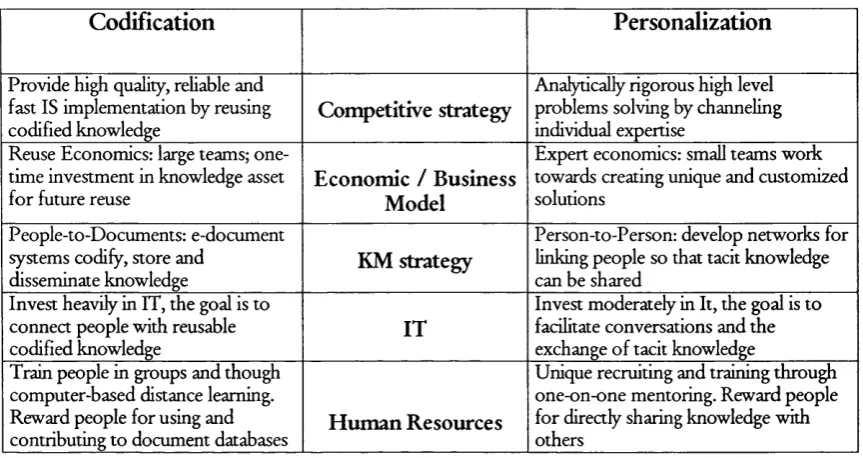
Figure 3.3: Two approaches to Knowledge Management Strategy... 84
CH A PTER 4 Figure 4.1: Illustrating the research context... 91
Figure 4.2: Theoretical framework - IS strategizing framework;... 92
Figure 4.3: Key components of analysis ... 93
Figure 4.4: Four paradigms of social research...102
Figure 4.5: The hermeneutic circle...107
Figure 4.6: Summary of chapter 4 ... 118
CH A PTER 5 Figure 5.1: Overview on the empirical w o rk ... 120
Figure 5.2: The case companies... 121
Figure 5.3: Details of the Case Companies...127
Figure 5.4: Traditional business strategy... 130
Figure 5.5: From control to drift - Phases of a strategizing process... 130
Figure 5.6: Scope of servicing and managerial w o rk ... 131
Figure 5.7: Steps of new business strategy... 132
Figure 5.8: Intentions of the new business strategy...132
Figure 5.9: Evaluation Criteria - H P C ...133
Figure 5.10: Initial findings - H P C ...134
Figure 5.11: Knowledge work at P C S ... 139
Figure 5.12: Areas of expertise - P C S ... 140
Figure 5.13: Initial findings - PCS ... 142
Figure 5.14: Common characteristics of both case companies... 143
Figure 5.15: Differences in their IS and infrastructures...144
Figure 5.16: Sample of knowledge w o rk ...146
CH APTER 6 Figure 6.1: IS strategizing framework... 150
Figure 6.2: Exploitation and exploration-based I S ... 151
Figure 6.3: Common base for case analysis...152
Figure 6.4: The IS strategizing framework in the research context... 152
Figure 6.6: Overview of initial findings - H P C ...187
Figure 6.7: Overview of initial findings - PCS... 188
Figure 6.8: Supporting concepts and theories...189
Figure 6.9: Initial interpretations... 170
CHAPTER 7 Figure 7.1: Structure of the arguments (Preview)...193
Figure 7.2: Structure of lrgum ents...215
Figure 7.3: Representation of the findings and basis for interpretation... 216
Figure 7.4: Suggesting link between the two forms of IS strategies... 223
Figure 7.5: Alternative interpretation... 236
Figure 7.6: Two ontological views on the manager... 237
Figure 7.7: Intentionality and comportment... 240
Figure 7.8: Overview of the arguments ... 268
Figure 7.9: View on IS, strategizing and strategic actors as parts of the same involvement whole... 271
CHAPTER 8 Figure 8.1: Subsystems as a result of ambidextrous use of IS and involved mindsets 280 Figure 8.2: Towards an ambidextrous view...284
Figure 8.3: Suggested extension of the framework: the ambidextrous manager...286
Figure 8.4: Summary of contributions... 303
APPENDIX Table A-l: Overview of the Empirical Work 2001-2006... 305
Table A-2: HPC List of Interviewees... 309
Table A-3: PCS List of Interviewees... 310
CHAPTER 1 INTRODUCTION
1.1 Research Motivation and Scope...11
1.1.1 Problem Domain - The Practice... 13
1.1.2 Problem Domain - The Literature...18
1.1.3 Emerging Issues for Research... 19
1.2 Research Design & Objective ...21
1.2.1 Defining Key Term s... 22
1.2.2 Choices of Methodology and M ethod... 26
1.2.3 Empirical W ork...27
1.2.4 Expected Contributions... 27
1.3 Thesis Structure... 28
This chapter introduces the dissertation by providing a background on the problem domain in theory and practice. It
outlines the research design and states the objectives.
1 IN TR O D U C T IO N
This research investigates the ways in which senior managers at two global companies
leverage information and knowledge in competitive strategizing. In this context, Galliers
and Newells (2003) IS strategizing framework is used in two case studies to explore the
role of information systems (IS) in achieving efficiency and flexibility in strategizing. The
thesis argues that the strategic information systems (SIS) literature tends to underplay the
situated involvement of strategic actors in how IS may be leveraged. This under-researched
element significantly influences the dynamics of a number of other factors, which affect
how IS are leveraged in strategizing. To this end, supporting theories on human agency are
considered with a view to contributing to a richer understanding of the relationship
between actors and IS in competitive strategizing. Furthermore, the study sheds light on
how managerial and organizational contexts reinforce one another in the shaping of
unintended consequences. First, this chapter provides a background to the problem
domain in practice and highlights relevant debates in the current literature. The research
objective and design are then presented The final section outlines the expected
1.1 RESEARCH MOTIVATION AND SCOPE
This research stems from the intellectual curiosity to explore how experienced managers in
global organizations leverage information and knowledge in strategizing processes. This
subject has been under ongoing debate across multiple disciplines, e.g. strategic
management, organizational theory and information systems (IS) (Sabherwal & Chan 2001;
Hoskisson et al 1999; Porter & Millar 1985; McFarlan 1984; Wiseman 1985; Venkatraman
et al 1993; Weick 1995; Wemerfelt 1984; Barney 1991; Davenport & Prusak 1989;
Mintzberg 1978; Argyris & Schon 1978; Walsham 1993; Earl 1989; Galliers 1991; Galliers
& Sutherland 1991; Ciborra 1994). There are, however, several shortcomings in the
literature and a multitude of practical challenges concerning the role of IS in strategizing.
The IS literature tends to propose ways to exploit the value of IT as a strategic opportunity
to create competitive advantage (e.g., Porter & Millar 1985). This tendency depends on the
conceptualization of IS, which affects how IS are used in business strategizing. Generally,
there has been a gap in perspectives between academic literature and practitioners in how
IS may serve managers in strategizing. Despite advancements in ICTs and the pool of
available literature, practitioners criticize IT as providing ‘cookie-cutter’ solutions, and the
literature as being ‘too theoretical’ in assisting in the solution of their problems.
There appears therefore to be an opportunity to re-examine such challenges in the real
world. A journey through the literature and a preliminary investigation revealed the need
for research from different perspectives. A major challenge has been to translate the many
concerns from the boundary-less practice into conceptually distinct domains in the
literature. This thesis attempts to provide a richer understanding of some of the real world
problems on solid conceptual grounds. As a result, it is hoped to encourage different
thinking and bring practitioners closer to possible solutions. So, some key questions
include:
• Given the advancements in ICTs and the growing uncertainties of competitive
environments, how much do IS influence the jobs of top managers?
More specifically:
• How much are top managers, or key decision makers, able to influence the
usefulness of systems in leveraging information and knowledge in their particular
context?
• How much do decision makers include centrally available IS in their practice-based
• Are companies, which provide their top managers with management IS (MIS) and
ICTs able to compete more effectively and efficiently compared to those that do
not have them?
These questions will be unfolded into key concepts IS, human agents and strategizing,
where their dynamic relationships will be explored from competing perspectives. The key
concepts will be defined and discussed in the literature review chapters (chapters 2 and 3),
and then brought together into a cohesive and integrative framework in chapter 4. The
framework will be applied across two companies in practice to gather new insights.
The general scope of competitive strategizing in this research is well represented by the
resource-based view (RBV) of the firm (Wemerfelt 1984), which argues that competitive
advantage (Teece et al 1997) may be created through path-dependent internal processes on
the organizational, managerial and technological levels. Here, what determines sustainability
of competitive advantage stems from the dynamic nature of firms’ core competencies (Lei
et al 1996) and strategic flexibility (Hitt et al 1998; Sanchez & Heene 1997). The
assumptions behind many of the arguments in this thesis stem from the knowledge-based-
view (KBV) of the firm (Grant 1996; Spender & Grant 1996), which conceptualizes firms
as heterogeneous and bearers of tacit, social and path-dependent knowledge (Kogut &
Zander 1992). This tacitness and social complexity is an important determinant of a firm’s
competitive advantage, since knowledge is seen as transient and a core ingredient of
ongoing learning and innovation (Nonaka 1994; Nonaka & Takeuchi 1995). Specifically,
this tacit dimension of knowledge (Polanyi 1966) has made the study of strategy and IS
complex. Tacit knowledge is linked to personal knowledge (ibid). Thus, a central and
intrinsic argument in this thesis is Polanyi’s assertion that we know more than we can tell’
(Polanyi 1966: 4). Information and knowledge are seen as distinct constructs, since there is
always a certain level of interpretive ambiguity due to specific contexts and individual
perspectives (i.e. Zack 1998). Therefore, knowledge-based thinking is argued to be
important for understanding a number of central topics in the strategizing process.
Furthermore, the research concerns the interaction between managerial and organizational
levels, viewing them as overarching and mutually reinforcing. The organizational level
concerns the firm’s information and knowledge platform embedded within socio-technical
structures and processes. The managerial level concerns managerial use of IS and focuses
Section 1.2.1 outlines the definitions on the key terms, whose underlying assumptions are
discussed in more detail in chapters 2 and 3. Chapter 2 discusses the assumptions taken on
strategizing, management information, and knowledge in this research. Chapter 3 reviews
the literature on IS and wider organizational consequences of the use of IS in organizations.
The use’ of information and knowledge through IS includes the gathering, creation,
sharing and transfer thereof. A holistic view is taken, where IS may or may not include
information technologies (IT). Chapter 3 also reviews socio-technical elements of
information infrastructures (IIs), which facilitate an enabling context for strategizing.
Notably, while appreciating the conceptual distinctions of information and knowledge, they
will be used interchangeably to refer to the kinds of information and knowledge managers
use in their strategizing context.
1.1.1 Problem Domain - The Practice
The job of top managers has become increasingly uncertain. According to Beck (2000),
uncertainties and challenges have always existed, yet they have changed form and intensity.
For example, the elements of managers’ work that may be exposed to risks and hazards
have widened, requiring these executives to be more prepared to respond to a wide array of
uncertainties and unintended consequences while having to meet conflicting demands. The
struggle is exacerbated where local demand and global visions intersect and require a
platform for efficient knowledge transfer and responsiveness (Grant 1996; Subramaniam &
Venkatraman 2001). Organizational collaborate arrangements have been put in place to
reduce uncertainties and pressures and enable greater speed and transparency. On the
supply side, in an attempt to capitalize on this need, ICT provides tools to facilitate
decision making and global collaboration.
The broader research motivation stems from the question: How do senior managers juggle
conflicting demands posed by internal corporate environments and by external competition
in their everyday strategizing? More specifically, what is the role of IS therein? To what
extent are IS used, in what form and ways? The literature emphasize the strategic
importance of IS to multinational corporations (Matsumoto & Wilson 2004), for example
to support the transfer of knowledge and expertise, global efficiency and local
responsiveness (ibid.). Specifically, the SIS literature argues that IS considers the choice of
system applications to be delivered to the business (Orlikowski 1996), whereby IT
institutions have already developed a global IS, others have been less agile (Matsumoto &
Wilson 2004).
At the same time, managers tend either to be skeptical in adopting ICTs in strategy, or they
embrace them, but then gradually drift away towards more informal means to organizing
management information (Land 1991). The consequences of such drift are not to be
neglected on the organizational level. Assuming they drift from formal systems towards
other informal means (ibid.), which cannot be centrally controlled and monitored, the
managerial know-how remains hidden from the organization as a whole or gets lost when
individuals leave. Thus, with increased mobility of knowledge workers and low retention
levels, there are challenges in building cohesive organizational learning and memory (Walsh
& Ungson 1991). In this context, many organizations adopt even more IS to address
particular issues (Matsumoto & Wilson 2004). Hence, sophisticated structures of
information processing and communication mechanisms have been suggested and
commercialized to alleviate the problems of knowledge dispersion and potential loss
(Boland & Tenkasi 1995). However, the strategic applicability of ICTs has faced
controversies in terms of efficiency and flexibility. When corporations integrate business
processes with external partners, suppliers and customers, unforeseeable demands have to
be considered that are difficult to control. Business units require ICT to deliver services
with the flexibility to accommodate unforeseen circumstances. Hence, the strategizing jobs
of managers face increasingly conflicting elements, such as in achieving economies of scale
through centralization while remaining responsive to business needs (Gupta 1987).
Overall, despite advancements in ICTs, organizations still struggle with leveraging IS (Weill
& Broadbent 1998; Sauer & Willcocks 2002; Tinaikar 2006). This is the point of departure
to refer to some examples from the preliminary investigation conducted during the earlier
stages of this research to examine the scope of the problem domain in practice.
Preliminary Investigation
Due to the broad nature of the topic, it is appropriate to present three real case scenarios
from practice as an opening case for this investigation. As part of a preliminary research,
the researcher held a number of conversations with experienced managers and conducted a
series of semi-structured interviews with senior managers in companies with global
presence (see Appendix for a list of the companies). The section below presents a series of
comments are selected as an opening case for further investigation that follows in this
study. The comments come from two consultants at a global strategy consulting firm,
several top managers at a global IT and Engineering Firm, and a director of the Human
Resources division at a global Petrochemical Company.
Problem scenario 1: stra teg izin g a ctivities and IS
Strategy consultants had an interest in better understanding the IS needs of strategizers in
their everyday decision-making across various industries and cultures. While the IT industry
offers many ‘solutions’, the consultants were well aware of the managers’ frustrations with
these applications. The consultants wanted more solid academic research. They saw a wide
gap between research which is seen as ‘too academic’ and the ‘cookie-cutter solutions’
provided in the commercial sphere..
Contributions from these discussions include how managers in two different cultures use IS in competitive
strategizing. New insights may also he gained by combining perspectives from recent business management
literature with appropriate philosophical underpinnings. Attention w ill be given to the socio-technical
organizational context and hcrwmanagers from German and US operating units operate in this system.
Problem scenario 2: Knowledge sharing and transfer fo r ongoing learning
A key concern of an HR director at a global petrochemical company was to find a way to
foster ‘continued development and distribution o f tacit knowledge within and between teams' and to find
means for the organization to capture the ‘collective tacit knowledge o f the team as a whole’ in
decision making processes. Few efforts have been made in the literature to examine the
influence of organizational mechanisms on knowledge sharing within multi-national
companies (Foss & Pedersen 2002). Traditional ways of transferring knowledge have been
rotations of knowledge workers, exchange and training programs. But knowledge transfer
poses a continuous challenge, the more so in attempting to harness IS as a component of
firms’ core capabilities.
This scenario is considered because it is linked to the managerial level concern from scenario 1.
Contributions may relate to hone managerial knowledge may be shared and transferred through an enabling
context.
Problem scenario 3: Environments o f constant change
At the IT and engineering firm, conversations were held with executives whose
allocate resources throughout the global offices. Surprisingly, none of the interviewees
showed interest in utilizing IS tool or knowledge management systems. They showed
scepticism towards most commercialized ICTs. They seemed rather burdened by the
monetary and time investment. The board of executives was undergoing political
challenges, which may have affected their perceptions towards IS. One member of the
strategy team emphasized that IT systems may provide useful tools on the operational level
with predictable nature of work. However, not so much to the task of devising strategies
and making decisions in environments with uncertain elements: ‘the problem is that I don’t
know what I don’t know’ (strategy team member) - if one does not know what he needs to
know, then systems, regardless of their sophistication, may not be able to be leveraged.
Hence, weaknesses are not always on the part of systems, but also on the side of the
human agents and the contextual requirements.
Contributions may spring from a closer examination o f the use o f IS as an embedded part o f managers’
strategizing work as opposed to a study o f IS and strategy in vacuum. The role o f personal knoudedge is
emphasized
The overall concerns were non-ICT related. Most interviewees believed that the IT
industry is competitive enough to provide them with a wide range of options. The most
frequent questions: H ow do I find out what I do not know?’, and ‘how can I know more
of that which is not known to everyone else?’ A major dilemma in all cases has been coping
with the daily emergence of challenges from external changes and organizational politics
that affect information interpretation, sense-making and attitudes towards decisions. It is
argued that these have a strong influence on what choices are made and what is given
priority (Wilson 2003). O n the one hand, environmental changes and emergence of new
demands raise issues that require flexibility and responsiveness of IS (Brynjolfsson & Hitt
2000; Hitt et al 1998). O n the other hand, in order to maintain control over the course of
decisions, top-down IS are used to monitor progress, measure performance, and maintain
authority. A continuous challenge has been to put an order, a structure, or a system around
tacit knowledge while conforming to top-down impositions of organizational II. While top-
own corporate-driven coordination systems may provide a supportive platform, they are
also seen as vehicles to reinforce centralized surveillance.
The above arguments encouraged the researcher to follow up on the topic more rigorously.
Of course, these questions cannot be fully answered, but academic research can usefully
scenarios, which may be explored in a way as to addressing the underpinnings of the
problem scenarios. The following questions arise:
• How do managers leverage IS in their strategizing activities in terms of exploitation and/or exploration strategies?
• Are corporate IS and personal knowledge perceived as ‘aligned’, ‘embedded’, or
‘integrated’ (as each introduces different assumptions)?
• How are corporate infrastructures organized/designed to support strategizing
activities, and are they perceived as being supportive at all?
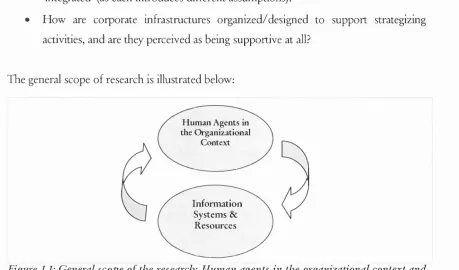
The general scope of research is illustrated below:
Human Agents in the Organizational
Context
Information Systems & Resources
Figure 1.1: General scope of the research: Human agents in the organizational context and IS resources re-enforcing interaction
This research attempts to introduce a new perspective to an established debate by:
• Taking a neutral view on strategizing, IS, and the human agent; in other words, to
be open as to deliberate versus emergent strategies, not to conceive IS as ‘SIS’, and
not to confine ourselves to viewing strategizers as rational decision-makers.
• Choosing a theoretical framework, which allows the flexibility to explore the dynamic interaction among IS and strategizing activities; and to account for those
elements in the strategizing process that have an effect on decisions, i.e. emerging
unintended consequences
• Choosing a research methodology that keeps a critical eye on the interview data
collected instead of accepting it as the ‘truth’.
Before embarking on the research design, a brief overview of how the literature has been
[image:19.595.37.496.176.446.2]1.1.2 Problem Domain - The Literature
The problem domain has been well-documented in the IS literature in terms of strategic
alignment of organizations’ systems and IT with business strategies for some two decades
(Earl 1989; Henderson & Venkatraman 1991). An important component in competitive
strategizing has been argued to be having efficient and effective global communications to
exhibit responsiveness to markets, transfer of learning, and managing change (Bartlett &
Ghoshal 1989). The importance of information sharing to business strategizing success has
been addressed (Lee & Whang 2000) along the lines of creating a flexible information
infrastructure (II) to guide workers in new competitive environments (Porter & Millar 1985;
Powell et al 2004; Galliers 1993). The role of an enabling II has been suggested to help
knowledge workers through decision-making processes and implement their business
strategies (Alavi & Leidner 1999; Galliers 2004).
Creating a ‘strategic alignment’ between a firms’ IS and business strategy is well argued and
critiqued in the literature (Galliers & Newell 2003, Ciborra 2000, Earl 1996). The term is
also known as ‘integration’ (Weill & Broadbent 1998), a ‘bridge’ (Ciborra 1997), ‘linkage’
(Henderson & Venkatraman 1989), to name a few. According to Cross (2000: 36):
Information and communication technologies are driving managers to rethink and reshape their business strategies, their use of technology, relations with suppliers and customers. The convergence of new technological hypercompetitive markets and ‘heat-seeking’ financial and human capital that quickly lead to new and untested business models now threatens a number of traditional business and processes.
Despite the widespread acceptance of business and IT alignment concept, it is not
adequately clarified in literature. There have been problems in terms of underlying
assumptions of strategic alignment on theoretical and methodological grounds (Hackney et
al. 2000). The first problem starts with strategy itself. The ambiguous nature of the strategy
process itself makes it difficult to study. The process of strategy is conceived as emergent
(Mintzberg & Waters 1985) and continually changing (Pettigrewl985, Hamel 1996). This
emergent nature introduces a host of unintended consequences (Robey & Boudreau 1999)
that cannot be accounted for. These arise as a result of organizational dynamics and
turbulent external environments. The tradition of strategic alignment is in the design school
(Chandler 1962; Ansoff 1965; Porter 1980), which takes a positivist and rational view of
Furthermore, it is argued that although there are some examples of enablers and inhibitors
of alignment (Luftman 1996; Bum 1993), there is little about the impacts of misalignment
on the firm (Avison et al. 2004). There is literature that asserts that IS alignment is not the
real issue because IS are pervasive in business and should not be regarded as separable
from business strategy (Smaczny 2001). Smaczny uses the term ‘fusion’ to describe the
integration of IS and business strategies. Advocates to strategic alignment assume that IIs
can be deliberately aligned with the emerging needs of management (Maes 1999; Ciborra
1997; Galliers & Newell 2003). For these reasons, the concept has even been argued to be
inexpedient (Maes 1999). Smaczny (2001) claims that there are no studies showing how
organizations actually achieve alignment and even goes as far as questioning whether
alignment is the right way to look at the issue. Critics argue that modes of alignment
assume organizations are based on mechanistic principles, that strategy is a structured
process and human thinking and actions are controllable concepts. They argue that in an
era which is dominated by uncertainty and the need for flexibility, strategizing is ‘messy’
and an articulation of the strategic intent is difficult (Ciborra 1997). A planning-oriented
approach to business objectives may not be the most suitable way to look at the issue.
A remaining problem is that challenges of competitive business environments cannot be
met with more technological support systems and communication tools. Even though
there are plenty of attempts to ‘fit’ or ‘align’ technologies with business strategies (e.g.,
Venkatraman et al 1993), still there are internal and external dynamics that lead to
unintended consequences and drift, and affect the effectiveness of ICTs in strategies
(Ciborra 2000; 1999). The next section makes explicit the need for this research.
1.1.3 Emerging Issues for Research
It is somewhat paradoxical that the more the postmodern society advances its information capabilities and
technobgcal competencies, the more sustainable business advantages seem to rely on raw human talent and
cultural values. (Morosini 2000:259)
There is little literature which takes into account influencing factors of the organizational
milieux that shape IS. Context includes elements that are difficult to understand and
categorize, e.g. elements of culture, attitudes, moods, incentives, reward systems, politics,
and so on. Often, despite advanced IS and clear strategies, a major source of uncontrollable
consequence comes from knowledge workers themselves. Arguably, they may rely too
much on ICTs in their work at the cost of considering the intervening elements of the
information - as in engaging in rent-seeking behavior (Mudambi & Navarra 2004; Foss &
Pederson 2004). Nevertheless, assuming it was possible to devise the right strategies, to
adopt the right technologies and to align these in the right way, still there is the human
agent in the game that has a key role to play. While the socio-technical view is a step
further to addressing IS requirements in organizational reality, it tends not to account for
the complex role of the human agent in the strategizing process. Additionally, there has
been reliance on quantitative measures of outcomes, which lead to results that have limited
applicability across different contexts (i.e. Mingers 2001). A source of frustration among
practitioners has been the difficulty to communicate management specific information and
knowledge in a way that is interpreted by the receiver the way they were meant to be
understood (Maes 1994). Among others, different mindsets affect communication across
cultural contexts and may turn misinterpretations to unnecessary conflict (Whitley &
Introna 1996). While the knowledge-based view (KBV) of the firm and managerial
capabilities (Teece et al 1997) address the human side of the equation, their influence in
business strategizing and IS has been largely under-developed. Most studies have focused
on organizational and analytical levels with limited focus on the micro-level strategizing (i.e.
manager’s ability to leverage IS in a useful manner as suggested by Fardal, 2007).
Emphasis on the contextual nature of decision-making has been made by Mintzberg (1978),
Isenberg (1987) and Mintzberg and Waters (1983) to further highlight the role of the firm’s
implicit or tacit knowledge acquired throughout its history, and which it is not explicitly
aware of. But little attention has been given to this area in the IS literature that also
considers the human agent and their approaches to strategizing. Specifically, this thesis
challenges the underlying assumptions of the rational top manager who is in control of
strategic intentions by reflecting on an alternative ontological position of the manager,
arguing that agents in organizations are bound to situations that are influenced by cultural
political and power-behavioural factors (Mintzberg 1987; Pettigrew 1987; Prahalad &
Hamel 1990). Whether it is technology that acts on organizations, or humans that
determine how technology is used, is a long-standing debate in the IS literature (Mumford
2000). A common element that has been covered by the literature to facilitate an enabling
context has been culture, such as a knowledge sharing culture (Nonaka 2000; Alavi &
Leidner 2001; Davenport & Prusak 1998). In terms of creating an enabling context,
literature considers the relationship between business strategies, IS and culture as a way to
create superior performance (Shore & Venkatachalam 1995). However, few researchers
have looked into how cross-cultural thinking about strategizing may influence the dynamics
The arguments in this section set the context in which IS are studied This is the point of
departure to set out the research objective and design.
1.2 RESEARCH DESIGN & OBJECTIVE
This section outlines the research objective and design. Decisions had to be made in
regards to the theoretical framework, methodology and empirical work. The interest of
this research is to explore the ways in which IS are used by senior managers in the process
of strategizing to gain competitive advantage. Notably, there is an attempt to bridge
strategic management and IS literature. The purpose of the strategy literature is to inform
the context of IS and the factors that may influence its study. A question that has been
debated in the IS literature is, how are managers able to use IS to be efficient and respond
quickly to changing environments (Galliers 2000)? - hence, the question of achieving
efficiency and innovation (Clark & Staunton 1989; March 1991; McElroy 2000).
The concern is not to see how IT may help to formulate grand strategic plans, but rather to
examine strategizing as an ongoing process with the role of IS therein. This invites a
holistic interpretation of IS in strategizing with a multi-disciplinary approach. While key
concepts are based on the IS literature (e.g. Earl 1989, 1993, 1996; Weick 1995; Checkland
1981; Galliers 2001; Galliers & Newell 2003; Whitley & Introna 1996; Introna 1997;
Ciborra 1997; Walsham 1993; Pettigrew 1985; Whittington 1993; Nonaka & Takeuchi 1995;
Von Krogh et al 2000), the integration of relevant thinking from Strategy and
Organizational Sciences (e.g. Leavitt 1965; Mintzberg 1973, 2000; Mintzberg & Waters
1985; Finkelstein & Hambrick 1996; Prahalad & Hamel 1990; Child 1972; Miller & Friesen
1984; Eisenhardt 1989a/b; Senge 1992; Hammer 1990; McFarlan 1984; Morton 1991)
provide valuable insights. Hence, the research appreciates the interconnectivity of the
different theoretical disciplines to account for the interdependence of processes in practice.
Research Objective
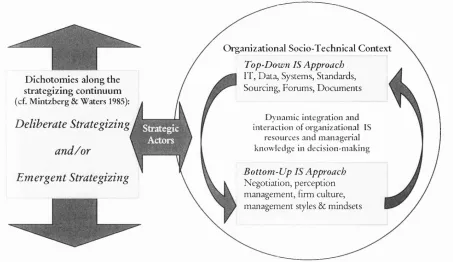
Dichotomies along the strategizing continuum
(cf. Mintzberg & Waters 1985):
Deliberate Strategizing
and/or
Em ergent Strategizing
Organizational Socio-Technical Context
Top-Down IS Approach
IT, Data, Systems, Standards, Sourcing, Forums, Documents
Dynamic integration and interaction of organizational IS
resources and managerial knowledge in decision-making
Bottom-Up IS Approach
[image:24.595.47.500.75.337.2]Negotiation, perception management, firm culture, management styles & mindsets
Figure 1.2: Key research components: strategizing, IS approaches, and strategic actors, corresponding to the conceptual framework (see chapter 4)
The research refers to Galliers and Newell’s (2003 and the recently amended version in 2007) IS strategizing framework, which is seen as relevant in addressing the range of issues
this research is concerned with. It is important to note that while the research refers to ‘the
theoretical framework’, it is by no means thought to be a model or framework in its traditional sense. But rather it should be seen as a useful sense-making devise (Weick 1995)
to guide the exploration process and inform the empirical work. It invites the opportunity
to gather data in the real world while keeping a solid theoretical grounding. At the same
time, the findings may provide arguments, which would suggest an expansion of the
framework to incorporate key lessons and suggest areas for further research. It is hoped
that it will help make sense of the problem situation in relation to its contextual forces that
shape IS. More importantly, it does not rule out the consideration of emerging elements by
setting rigid criteria. Chapter 4 justifies this choice in more detail.
1.2.1 Defining Key Terms
Before embarking further, it is necessary to explicitly outline the researcher’s position on
the key terms used throughout this thesis. Detailed discussion is provided in the literature
In this research, strategizing will be examined within a competitive context. When the
research talks about competitive strategizing, it refers to everyday managerial processes,
where managers find themselves involved in competing in their environment to close a deal
and build their business. The meaning of competitive is implicit to the organizational
climate in which managers ponder. The climate is characterized by high levels of
uncertainty and unpredictability, fast changes in terms of human agents (i.e. mobility and
unpredictable behavior of participants within and across business units) and relevant
technologies, information overload as well as the changing meaning of already existing
information, which changes the strategic relevance of information. As a result, these are
seen as shaping the direction of strategizing in organizations.
Before considering the role of IS in strategizing, first it is necessary to understand the
requirements of strategizing processes in their particular context. Throughout this thesis,
strategizing will be viewed as processual (Pettigrew 2003b) and emergent (Mintzberg 1987;
Galliers 2004; Ciborra 2002), thus strategizing and organizing (Whittington 1993). Hence the
term ‘strategizing’ is preferred to ‘strategy’ (Mintzberg 1987; Galliers 2004; Ciborra 2002).
Here, ‘process’ implies that human agents are involved in decision-making, sense-making
and sense-giving, problem-solving, and negotiating (Weick 1995; Wilson 2003). This
process is assumed to involve various types of information, knowledge, as well as
competing interests for resources, all determining the manner in which IS are used
Generally, the goal of IS is seen to facilitate making decisions faster and more effectively
(Eisenhardt 1989b) by gathering, creating and sharing information and knowledge in more
efficient ways.
As a further note, the strategic planning literature distinguishes between long-range
strategic and short-range tactical (Mintzberg 1994). It is necessary to acknowledge that
tactics, referring to the details of things, is irrelevant to the emergent view on strategizing
and in the context of this exploratory research. Specifically, the very meaning of emergent
strategizing suggests that one can never be sure in advance what is a strategy or tactic
(Mintzberg 1994), or in this research, what is strategizing or ‘tacticizing’. According to
Rumelt, ‘one person’s strategy is another’s tactics - that what is strategic depends on where
you sit’ (1979: 197). Furthermore, the temporal aspect implies that what seemed tactical
yesterday may not be so tomorrow (Mintzberg 1994). Thus, the term tactical will not be
relevant to the goal of this thesis, which, as it will be unveiled, puts into question the very
view will be proposed based on a traditionally competing ontology, which will form the
main theoretical contribution of this thesis.
In this context of strategizing, the research examines the use of information, knowledge
and relevant systems by human agents as a way to shape their journey towards a desired
goal. The process towards a desired goal is seen as thinking, sensing and doing of work ‘in-
order-to’ manifest desired perception into reality. The term information is defined as a
message that is communicated between a sender and a receiver to change the way the
receiver perceives something (Sanchez 2001). According to Davenport et al (1998), data
becomes information when the sender adds meaning by contextualizing, condensing or
categorizing it. More specifically, this research refers to managerial information (Introna
1997), which may be conceived as ‘management understanding in-the-world, in-order-to
get the job done’ (Introna 1997: 156). Knowledge is a far more complex concept and is
discussed in chapters 2 and 3. Knowledge will be regarded as transient and a core
ingredient of ongoing learning and innovation (Nonaka 1994; Nonaka & Takeuchi 1995).
Specifically, the research keeps a curious eye on the meaning of the term tacit knowledge
(Polanyi 1966), a phenomenon which has made the study of strategy and IS interesting and
complex. Tacit knowledge will be linked to personal knowledge (ibid.) and a central and
intrinsic argument in this thesis is Polanyi’s assertion that we know more than we can tell*
(Polanyi 1966: 4). Nevertheless, information and knowledge have a certain level of
interpretive ambiguity due to specific contexts and individual perspectives (i.e. Zack 1998).
Notably, what is most relevant to this research is the use of managerial information and the
more tacit and personal dimension of knowledge by human agents while they are involved
in strategizing. Hence, the focus will be on the use, not as much on the content. Here,
Bladder (1995) provides supportive taxonomies such as knowing, embedded and
encultured, which will be especially insightful points of departure towards a holistic
understanding in the analysis. In this context, the goal of information systems (IS) is seen
as a tool to support human agents in forming more effective decisions and actions more
efficiently (Eisenhardt 1989b). This means gathering, creating and sharing information and
knowledge in a more efficient manner, taking into account internal and external influencing
factors. The research does not assume IS to be strategic in themselves.
Nevertheless, this research puts forward the interrelation between strategizing, the human
agent, and management IS. The field of IS is viewed as multi-disciplinary and with multiple
focus (Ciborra 2004). The analysis examines the use of IS in strategizing by considering the
advocating the rational school of thought. Throughout the thesis, the justification for the
‘how’ (the why behind the how) will shift from the what’ (i.e., IS) towards the who’ (i.e.,
human agent), in order to explain the why’ (i.e., the ways IS are used in strategizing). While
the w ho’ component becomes relevant towards the latter part of the thesis, it is necessary
to introduce the different views earlier in the thesis in chapter 2. In this research, the who’
will be referred to as the human agent, the strategizer, or the strategic actor,
interchangeably. These will be experienced or senior managers and business developers in
large organizations, who have considerable responsibility and authority over their decisions,
actions and their use of IS. Notably, this definition differs from the more general IS-user in
the IS literature, where her/his primarily role is within the realm of IT, e.g. the IS
developer, Chief Technology Officer (CTO), or Chief Information Officer (CIO) (e.g.,
Earl 1989; 1993; 1996). The differences lies in that the manager is not obliged to use
management IS, where as CTOs, Engineers or administrators may be dependent on the use
of IS/IT due to the nature of their work.
Specifically, the assumptions behind the human agent are discussed from traditionally
competing perspectives, including Mintzberg’s (1971; 19980; 1983; 1985; 2000) analysis on
the manager and managerial work, as well as Heideggerian phenomenology (1962; 1988)
based on Introna’s (1997) interpretation (see chapter 2). While their underlying
philosophies appear to be in conflict at first, this research will show the value from
conceiving them as complementary by analysing different ontological positions. Specifically,
the meaning of the human agent is well depicted by Ciborra (2004: 19):
Human existence is an essential ingredient of what information is, how the life- world gets encountered, defined, and reshuffled, and - last but not least - how technology gets used everyday.’
Nevertheless, the role of the human agent will be shown to have a far more central and
multi-dimensional impact on the usefulness of IS in the organizational dynamics than
discussed in the mainstream IS literature.
Two other key terms that will be used frequently are ‘ambidextrous’ and ‘immanent’ (see
chapter 2). The former is used in reference to the ‘ambidextrous strategizing’, a way to
articulate the simultaneous use of tools as well as two modes of ‘being’ that have been
considered as competing in the traditional research i.e. deliberate IS versus emergent IS
strategies, dwelled versus intent (as of strategizing), rational versus involved (human agents).
The term ‘immanent’ is a philosophical reference used by Chia and Holt’s (2006) discussion
1.2.2 Choices of Methodology and Method
The choice of methodology inevitably determines the ways in which data are interpreted
and analyzed. Empirical studies in strategizing and IS face contradictory pressures (Balogun
et al. 2003). While recent European thinking has been more receptive to developing a
holistic view on IS (Mingers 2001), the paradigm in IS research has been largely influenced
by US business school and consulting practices. These take a predominantly IT-based view
on IS and positivistic methodologies take centre stage. Although empirical studies based on
quantitative data have been fruitful, they are as valuable as they are related to the specific
context and under the set of assumptions they were studied. On the other hand, the social
study of IS considers IS in the realm of social systems, where the distinctive nature of
knowledge involves intangible and unobservable complexities. At the same time,
quantitative methods to measure data become very difficult (Godfrey & Hill 1995) because
they have the tendency to separate the problem from its wider context (Hackney et al. 2000)
and so pose analytical limitations to inquiry.
This research appreciates phenomena in their wider context and finds interpretivism as
particularly valuable to allow new understanding to emerge. Hence, qualitative case study
methods are seen as being most appropriate to account for more subjective and
unobservable factors in organizations (Collis 1991; Hitt et al. 1998). The aim is not to
provide a solution, but to use the opportunities interpretivism provides to shed light on a
subject which has traditionally been associated with the rational school of thought.
Specifically, interpretivism allows the incorporation of philosophical conceptual
underpinnings, which will be especially helpful to our analysis. The hermeneutic circle is
especially powerful in creating an interpretive feedback process between the practice and
the theoretical framework, whereby relevant literature informs the process. Hermeneutic
techniques helped to identify and describe issues associated with the use of organisational
knowledge at the strategic level (Alavi & Leidner 1999; Nonaka 1994).
The methods to collect the empirical data are qualitative interviews and observation. The
analysis was based on interpretive and hermeneutic analysis (Gadamer 1975; Boland 1991).
Document research was also conducted, not as the primary method, but during the early
stages to learn about the organizations and the way they do business. While the majority of
interviews are semi-structured, these include opportunistic unstructured and conversations.
Nevertheless, the research methodology will be justified in chapter 4 and methodological
1.2.3 Empirical Work
The empirical work considers two case studies. These are different in many regards, such as
their industries, elements of their IIs, and predominant forms of IS. The common ground
on which they are selected is their competitive business strategy in business development.
The comparison draws attention to the relationship between IS and business strategizing,
specifically with regard to exploitation and exploration approaches to strategies and using
IS. In case study 1, a hydro-power generation company, the researcher conducted
interviews at the German and USA locations. While not a cross-cultural study, those
elements that influenced the use of IS included cross-cultural differences. In case study 2, a
private bank based in the US, data collection methods included observation. The nature of
investigation in this case was more situated and more involved in the day-to-day
strategizing processes on the managerial level. The consideration of different contexts was
not meant to establish generalizations, but to explore the components of the theoretical
framework across contexts. This was an attempt to find out about differences and
similarities in the ways in which strategic actors engage in strategizing through IS (e.g.
Eisenhardt 1989b). The researcher believes that it is through comparison, where finer
distinctions in the exploration process emerge.
1.2.4 Expected Contributions
This thesis is one of the first detailed applications of the IS strategizing framework in
managerial strategizing across two cultural contexts. As a result, the strengths and
weaknesses of the framework will be revealed in the process, albeit these will be specific to
the particular context of this research. Furthermore, the use of interpretivism, through the
hermeneutic circle, will be especially powerful in drawing meaning from the empirical
findings, and reflecting back on the framework to potentially incorporate extensions.
Section 1.1 outlined some concerns from the preliminary investigation to identify potential
contributions to practice. The following was found to interest senior managers the most:
• What do managers really need in terms of IS to get their jobs done and remain
flexible, considering the conflicting demands? (Strategy Consultant, UK; IT &
Engineering Firm, U K );
• Why is it difficult to share knowledge organization-wide? To what extent could
centralized IS help to capture managerial know-how for ongoing organizational
• What hinders the openness to share knowledge and collaborate? (IT & Engineering
Firm, UK).
While the IS strategizing framework will be used as the primary lens, supporting theories
from the literature will inform the hermeneutic process in reaching deeper levels of
understanding. To this end, the direction of this research will address the following:
• Potential limitations underlying the assumptions of strategic alignment;
• The consideration of the human agent from alternative perspectives to the
rational-view: the analysis will carefully introduce the integration of a different ontology as a
way to understand the essence of the problem domain;
• The research does not attempt to draw a distinct line between the concerns of
organizational versus managerial levels, but rather will leave room to consider
emerging topics as of unintended consequences that may affect the use of IS.
While this research is not aimed to answer to a specific question, it aims to provide new
understanding of the underlying issues to a complex problem, which has been extensively
researched but not fully understood. More specifically, the findings will suggest a shift of
focus from IS resources towards the usefulness of existing IS, i.e. the ability of human agents
to make any IS useful while pondering in their competitive context. It is in this spirit where
the research tales am involved perspective on strategizing and the use of IS therein.
Chapter 8 will reveal interesting implications to the field of management IS (MIS) and
strategic IS (SIS). For example, future research may re-examine the strategic attribute of
SIS from an involved perspective to determine how IS may be developed or managed in a
way to become more useful to strategizing senior managers.
1.3 THESIS STRUCTURE
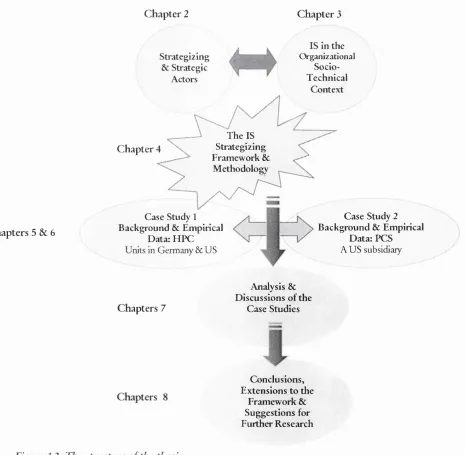
The thesis is organized in eight chapters (see figure below). Following this introductory
chapter, the next two chapters attempt to establish the context for the research framework,
which is introduced in chapter 4. Chapters 2 and 3 examine relevant concepts from the
strategic management, information systems and organizational theory literature. While
chapter 2 discusses concepts in relation to the managerial level, e.g. strategizing, decision
making and management information, chapter 3 reviews the literature in information
systems to set the organizational context within which strategizing takes place. Chapter 2
makes explicit relevant complexities and embeddedness of information and knowledge
collaborative arrangements by reviewing IIs and underlying components such as ICTs and
culture, and how these relate to organizational learning and memory. Chapter 4 synthesizes
the concepts to portray a coherent picture of what the thesis is about and reveals the
chosen epistemology in the form of the IS strategizing framework. Furthermore, the
chapter justifies the choices of methodology and methods.
Having introduced the context, the framework, and methods of inquiry, chapter 5 will give
the background to the two case studies, and chapter 6 presents the findings. A critical
analysis is conducted in chapter 7, where the findings are related to the literature. With the
help of supporting concepts, the chapter points out how the analysis may contribute to the
conceptual framework. Chapter 8 concludes and reflects on the overall process, outlines
contributions of this study and suggests areas for further research.
Chapter 2 Chapter 3
Chapters 5 & 6
Analysis & Discussions of the Chapters 7 Case Studies
Conclusions, Extensions to the
[image:31.595.36.501.309.764.2]Framework & Suggestions for Further Research
Figure 13: The structure o f the thesis
The IS Strategizing Framework &
Methodology
. . IS in the Strategizing Organizational
& Strategic
Sw
Socio-Actors Technical
Context
Chapter 4
Case Study 2 Background & Empirical
Data: PCS A US subsidiary Case Study 1
Background & Empirical Data: HPC
CHAPTER 2 STRATEGIZING & STRATEGIC ACTORS
2.1. Perspectives on Strategy... 31
2.1.1 Strategy as Process: Deliberate and Emergent Views...33 2.1.2 Strategizing as Decision-Making...36 2.1.3 Decision-Making as Problem Solving & Sense-Making... 38
2.2. Managerial Information & K now ledge...43
2.2.1 Managerial Work & Management Inform ation... 43 2.2.2 Knowledge-based Capabilities ...50
2.3. Perspectives on Strategic A cto rs... 53
2.3.1. Managerial M indsets... 53 2.3.2. Alternative Perspectives on the M anager...58
Chapter Sum m ary... 64
This chapter reviews the literature on the concepts that set out the context o f this research. These are strategizing, management information and
knowledge, and human agents.
2 INTRODUCTION
The research explores the ways in which IS are used by managers in competitive
strategizing. IS are seen as vehicles through which management information (MI) and
knowledge may be leveraged. The premise of this literature review chapter is that in order
to understand the role of IS in strategizing; first, an understanding of the nature of
managerial work should be established. Data, MI and knowledge are regarded as
ingredients of managerial work. The purpose of this chapter is to define these key
concepts. Chapter 3 will then discuss how an enabling context through information
infrastructures (IIs) and information systems (IS) many support the dynamics of the
2.1 PERSPECTIVES O N STRATEGY
Strategy has been approached from several theoretical traditions in how it may impact the
ability of firms and managers to gain sustainable competitive advantage (Porter 1980;
Kogut & Zander 1992; Penrose 1959; Chandler 1962; Pettigrew 1985; Prahalad & Hamel
1990; Wemerfelt 1984). Perspectives range from the classic industrial economics to more
integrative perspectives on emerging issues (Heracleous 2003; Carpenter & Sanders 2007).
The implication of each perspective leads to different conclusions. Generally, two common
theoretical conceptualizations in the literature are the exploration versus the exploitation
strategies based on the top-down versus bottom-up tradition. Notably, there has been
limited empirical investigation of the interaction between the two, and more specifically, their
integration (He & Wang 2004).
Competitive strategy is concerned with matching internal capabilities of a company and its
external environment (Porter 1996; Wemerfelt & Kamani 1987; Hoskisson et al 1999). The
general position of this research is in the resource-based view of the firm (RBV) (Grant
1991; Barney 1991; Teece et al. 1997), which implies that the sources of competitive
advantage reside within organizations. There are many views on what these sources are.
Barney (1991), for example, groups resources into physical, human and capital categories
and talks about imitability, obtaining tangible or intangible resources that are not easily
imitated by other firms. Grant (1991) added to these technological, financial, and
reputational resources. Unlike resources, capabilities are based on developing, carrying, and
exchanging information through the firm’s human capital. Concepts such as ‘core
competence’ (Hamel 1991), ‘capabilities-based competition’ (Stalk et al. 1992), and
‘dynamic capabilities’ (Teece et al 1997; Nonaka 1994) emphasize human capital as being of
strategic importance to firm behavior and performance (Nahapiet & Ghoshal 1998; Lado
& Wilson 1994; Teece et al 1997; Pfeffer 1998). The RBV argues that organizations should
develop core competencies, which are rare and difficult to imitate (Prahalad & Hamel
1990). Capabilities refer to a firm’s capacity to deploy resources, usually in combination,
using organizational processes, to affect a desired end (Amit & Schoemaker 1993). Teece
(1992) defines capabilities as a set of differentiated skills, complementary assets, and
Besides developing unique internal resources, the literature argues that the RBV needs to
also consider the external environments (Amit & Schoemaker 1993). According to Porter
(1991: 108): resources are only meaningful in the context of performing certain activities to
achieve certain competitive advantages’. He suggests that the competitive value of
resources can be enhanced or eliminated by changes in technology, competitor behavior, or
buyer needs which an inward focus on resources will overlook (ibid). Along these lines,
more recent views on strategy center on the ‘dynamic strategy’ concept (Carpenter &
Sanders 2007). It is argued that strategy needs to embrace the rapidly changing macro
environments of globalization and technological advances. The underlying assumption is
that change is inevitable and strategy must thus be flexible in its formulation and
implementation in order to take account of a firm’s changing situation in the dynamic
environment.
These assumptions affect the conceptualization of the practice of strategy on the
managerial level. Mintzberg (1980, 1994, 1975) rev