Algebraic methods for chromatic
polynomials
Philipp Augustin Reinfeld
2 Abstract: The chromatic polynomials of certain families of graphs can be calcu-lai ed by a transfer matrix method. The transfer matrix commutes with an action of the symmetric group on the colours. Using représentation theory, it is shown that the matrix is équivalent to a block-diagonal matrix. The multiplicities and the sizes of the blocks are obtained.
Using a repeated inclusion-exclusion argument the entries of the blocks can be calculated. In particular, from one of the inclusion-exclusion arguments it follows that the transfer matrix can be written as a linear combination of operators which, in certain cases, form an algebra. The eigenvalues of the blocks can be inferred from this structure.
The form of the chromatic polynomials permits the use of a theorem by Beraha, Kahane and Weiss to determine the limiting behaviour of the roots. The theorem says that, apart from some isolated points, the roots approach certain curves in the complex piane. Some improvements have been made in the methods of calculating these curves.
Contents
1 Introduction 11
1.1 Overview 11
2 Modules and colourings 14
2.1 Some représentation theory 14 2.2 The symmetric group 17
2.3 The module of colourings Vk{B) 24
2.4 The irreducible submodules of Vk(B) 27
2.4.1 The complété graph case 29
2.4.2 A change of basis 32 2.4.3 The général case 34
2.5 Examples 34 2.6 A new module 40
3 The compatibility matrix method 44
3.1 Bracelets 44 3.2 The compatibility matrix method 47
3.3 Décomposition of the compatibility matrix 49
C O N T E N T S 4 3.4 Réduction to the complété base graph 52
3.5 The S m opérât ors 54
3.6 Change of basis 57 3.7 Action of S m (&) on the irreducible submodules of Vk{b) 59
3.8 Examples 64 3.9 Summary 75
4 Explicit calculations of chromatic poiynomials 79
4.1 A catalogue of U^ 80
4.1.1 The case b > 3 and d = 3 81
4.1.2 The case b = 3 and d > 3 83
4.2 Two Examples 85 4.3 Permutations of the vertex sets 89
4.4 Réduction of base graphs 90 4.5 Generalised dodecahedra 92 4.6 Four more families of cubic graphs 100
4.6.1 The family (468)n 102
4.6.2 The family (477)n 106
4.6.3 The family (567)n 110
4.6.4 The family (666)n 114
5 Equimodular curves 119
5.1 A theorem of Beraha, Kahane and Weiss 120
C O N T E N T S 5 5.3 The résultant 123
5.4 Equimodular curves 125 5.4.1 Examples 127 5.5 Dominance 129 5.6 Numerical computations 131
5.6.1 The path of length three with the identity linking set . . . . 132
5.6.2 Generalised dodecahedra 136
5.6.3 The family (468)n 138
5.6.4 The family (477)n 140
5.6.5 The family (567)n 142
5.6.6 The family (666)n 144
6 The operator algebras and 146
6.1 A binary opération for matchings 147
6.2 The operator algebra Ab{k) 147
6.3 A minimal generating set 149 6.4 The operator algebra A^ik) 152
6.5 The level b — 1 for the identity linking set 155
A Newton's formula 164
B The H-sériés catalogue 165
C O N T E N T S 6
D Maple programs 177
D.l The program EquiDominantPoints 177
List of Tables
2.1 Summary of Example 2.10 39
4.1 The induced graphs \ni\(Lnijii)\'R.j\ in case of the family Dn 93
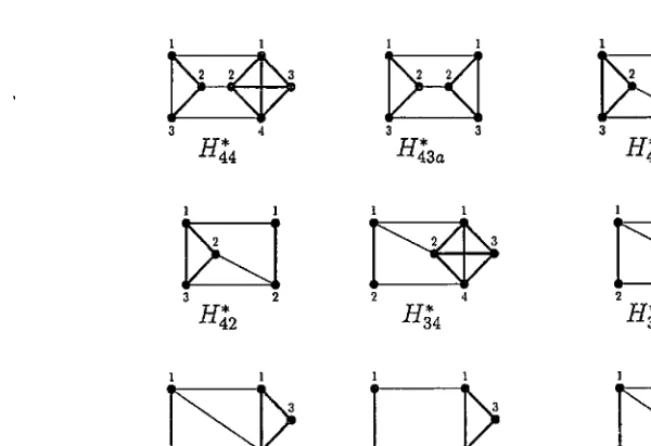
4.2 The graphs of the H-series 94
4.3 The graphs of the #*-series 95 4.4 The induced graphs (£7^,7^)17^1 in case of the family (468)n . . . 103
4.5 The induced graphs (-^,7^)17^1 in case of the family (477)„ . . . 107 4.6 The induced graphs 17^1 (1^,7^)17^1 in case of the family (567)n . . . I l i 4.7 The induced graphs ^(L-jz^n^i7^1 in case of the family (666)n . . . 115
6.1 The matrices Ufo , Ufo and Ufo in the case b — 3 154
For Amalia, who left too early.
Acknowledgements
First of all, I would like to thank Norman Biggs for being such a excellent Super-visor. He has supported, guided and encouraged me, and he has also kept my feet on the ground when it was necessary. I am very grateful for his time and patience throughout my PhD.
Next I would like to thank the rest of the department. In particular Jan van den Heuvel, Mark Baltovic, Jackie Everid and David Scott for always having an open ear and good advice.
Thanks also to Robert Shrock, of Stony Brook University, New York, for finding the time and the financial support for me to visit and work with him.
I am indebted to the UK Engineering and Physical Sciences Research Council (EP-SRC) , the London School of Economies and Politicai Science and the Department of Mat hématies for financial assistance throughout my PhD.
My parents have also been a source of moral and financial support throughout my studies. They have always given my sisters and myself unconditional support and the security and warmth of a true family. I must also thank Maria del Mar for her most wonderful support, patience and understanding over the last three years. Finally I would like to finish by praising the European Union for providing a frame-work and some financial support for my studies abroad. In particular I have to thank the English university system for its openness and flexibility: recognizing my German high school degree and allowing me to study in England; covering my tuition fees; fully validating my year of studies in Italy; and ali with a minimal amount of bureaucracy. I hope that this openness and flexibility becomes common practice throughout the European Union.
Statement of originality
Most of the work presented in this thesis is a continuation of work by N.L. Biggs [5], [8], [7], [9], [4] and [6]. The work appearing in this thesis is entirely my own except where stated otherwise. In particular:
• The observation that the compatibility matrix commutes with the action of the symmetric group has also been exploited by M.H. Klin and C. Pech; see [9].
• The Examples 3.7, 3.8 and 3.9 have been published in [9]. They are due to me.
• The chromatic polynomial for the generalised dodecahedron was obtained by S.C. Chang [11]. Here, the polynomial is calculaied in a différent way, to illustrâte the compatibility matrix method.
• The Lemmas 6.12, 6.14 and Corollaries 6.13 and 6.15 are joint work with Jan van den Heuvel.
Chapter 1
Introduction
1.1 Overview
A graph B consista of two sets; a vert ex set and a edge set whose members are unordered pairs of vertices. We say a pair of vertices are adjacent if they are an edge. Given a set of k "colours", usually the first k positive integers, a proper vertex ft-colouring of the graph B is a fonction from the vertex set into the set of colours such that adjacent vertices take différent "colours" under the colouring. We omit the words "proper" and "vertex", and just speak of a /c-colouring of B.
The chromatic polynomial P(B, k) corresponding to a graph B is the polynomial function which evaluated at a positive integer k equals the number of /c-colourings of B.
In theory, the standard method of deletion-and-contraction allows us to fìnd the chromatic polynomial for any given finite graph. However this method is not very élégant in the sense that it requires exponentially many steps (in the number of edges). In general there is no efficient method.
In this thesis we are studying the chromatic polynomials for families of graphs with a cyclic symmetry using a transfer matrix method. These families of graphs consist of n copies of a "base graph" arranged in a "ring". Adjacent copies of the "base graph" have extra edges between them according to a "linking set".
1 . 1 . OVERVIEW 1 2 Although the deletion-and-contraction method destroys the symmetry in the first step, it has been used to obtain a transfer matrix via a recursion relation by D.A. Sands (in an unpublished thesis, 1972), N.L. Biggs and G.H.J. Meredith in [1], J. Salas and A.D. Sokal in [21], and by R. Shrock and co-workers in [25], [13] and a sériés of other works.
Here, in this work we use and develop a slightly différent transfer matrix method which enables us to utilize the symmetry to a maximum. This method was intro-duced by N.L. Biggs in [2], and recently used and developed in [5], [8], [7], [19], and [9].
This transfer matrix commutes with an action of the symmetric group permuting the colours. Using représentation theory, it is shown that the matrix is équivalent to a block-diagonal matrix. The multiplicities and the sizes of the blocks are obtained. Using a repeated inclusion-exclusion argument the entries of the blocks can be calculated (Chapters 2 and 3).
In particular, from one of the inclusion-exclusion arguments it follows that the transfer matrix can be written as a linear combination of operators which, in certain cases, form an algebra. In Chapter 6 parts of the structure of this algebra are investigated.
In Chapter 4 many examples are discussed in détail. In particular the chromatic polynomials of the family of the so-called generalized dodecahedra and four similar families of cubic graphs are obtained.
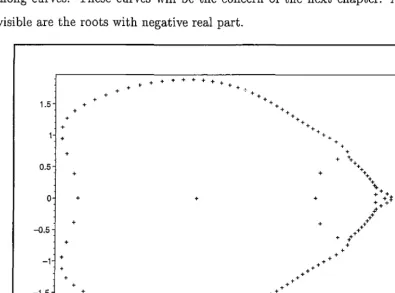
The form of the chromatic polynomials permits the use of a theorem by Beraha, Kahane and Weiss to determine the limiting behaviour of the roots as the number of copies of the "base graph" goes to infinity. The theorem says that, apart from some isolated points, the roots approach certain curves in the complex plane. Chapter 5 contains calculations based on [4] and [6] by N.L. Biggs. The results here are by no means complete, and many phenomena observed in the limiting curves described in the examples of Chapter 5 remain to be analyzed.
1 . 1 . OVERVIEW 13 and in a sériés of works, and by J. Salas and A.D. Sokal in, for example, [21] and [15].
The chromatic polynomials for this type of graphs have also been the focus of research in statistical mechanics. This is due to the fact that the zero-temperature partition function of the k~state Potts antiferromagnet on the graph B is equal to
P(B,k); [13] and [22]. In particular the behaviour of the roots of P(B,k) as the number of vertices goes to infinity is of paramount interest.
Chapter 2
Modules and colourings
The first part of this chapter gives a brief outline of some basic results of
represen-tation theory, in particular of the Symmetrie group. This is based on the books by G.D. James [16], W. Ledermann [17] and B.E. Sagan [20]. In the second part this
theory is applied to the modules obtained when the Symmetrie group SymÄ acts
on the set of /c-colourings of a graph.
2.1 Some representation theory
Let G be a (finite) group written multiplicatively. We denote the identity element of G by e. Let V be a vector space over C of dimensión n. A representation of G
on y is a group homomorphism p : G —• Aut(V) where Aut(K) is the group of automorphisms of V. By choosing a particular basis for V it follows that p assigns to every g E G a non-singular n x n matrix A(g) with coefficients in C. We say that A(g), or A, is a matrix representation of G with degree n corresponding to p.
We denote by CG the group algebra consisting of all finite linear combinations
Y^zgg feec)
geG
2 . 1 . SOME REPRESENTATION THEORY 15 with the componentwise addition, and multiplication given by
Y,**
9)
h =( Z )
zsz*)
,gEG ) \heG J / € G \gh=f }Denote by End (y) the algebra of homomorphisms on V. Then a representation of
G can be extended to a representation of CG. That is p : CG —y End(T^) is an algebra homomorphism defined as:
P =J2Z9P(9)
\geG J g£G
with zg € €. This makes V into a CG-module. The two notions of a representation
of CG - CG-module V and the algebra homomorphism p : CG —End("K) - are equivalent and we use them interchangeably. We denote by Matn the algebra of all nxn matrices with coefficients in C. Then, as before, by choosing a particular basis for V it follows that p : CG —» Matn is the corresponding matrix representation. A subspace U of V is a submodule of V if U is invariant under the action of
CG. A module V is irreducible if its only submodules are V itself and the zero module, otherwise we cali V reducible. We say that two matrix representations
A(x) and B(x) are equivalent if there exists a non-singular matrix T such that
T~1A(x) T = B{x). Let A{x) be the matrix representation corresponding to p.
Then, from the above definition of reducibility, it follows that A{x) is reducible if it is equivalent to a representation of the form
D{ x) O E{x) F{x)
where O is an all-zero matrix. Otherwise A{x) is irreducible.
We say that a matrix is the direct sum of the matrices Ai, A2,..., Ai if A is the
diagonal block matrix diag(Ai, A2, ..., Ai). We write: i A = A\ ® A2 © ... © Ai ~ ^J^ A{.
i-1
Maschke's Theorem asserts that over the field C every matrix representation is
completely reducible, that is for some choice of the basis of V it follows that
i A{x) = diag(A10z),A2(z)>--->A(z)) =
2 . 1 . SOME REPRESENTATION THEORY 16 where the Ai(x) are irreducible représentations. Equivalently, the corresponding CG-module V is the direct sum of l irreducible submodules.
Let A = (a,ij) and B be matrices of degrees n and m respectively. Then the tensor product, direct product or Kronecker product A® B is the nm x nm matrix obtained by replacing the entry a^- in A by the matrix a¿¿¿?. With this notation we can write every matrix représentation A (x) as:
A(z) = 0(/m i<g>A¿(x)) i
where the Ai{ x) are now inequi valent, irreducible représentations of degree and
multiplicity mi in A (a;), and Imi is the identity matrix of size mi.
Let A be a matrix représentation of CG. Then C(A) is the commutant algebra of
A. This is the subalgebra of Matn consisting of ali T satisfying A(x)T = TA(x) for ali x G CG. If A is irreducible then Schur's Lemma asserts that C(A) only consists of scalar multiples of the identity matrix.
If A(x) = Im®B(x) where B is irreducible then T e C(A) is of the form X 0 In
where X e Matm and n is the degree of B(x). By a change of basis, that is reordering the basis vectors, it can be shown that T is équivalent to In ® X. In
general the following lemma holds.
Lemma 2.1 Let A(x) be any matrix représentation ofCG of the form: i
A(x) = ($(Irni®Ai(x))
¿=i
where the Ai(x) are inequivalent, irreducible représentations of degree ni and mul-tiplicity mi in A (x). Then every T € C(A) is équivalent to a matrix of the form:
i
i~l with Xi e Matmi.
i
Proof: Let A = @Bi(x) where Bf(x) = (Im i® A i { x) ) . If T e C{A) then
2 . 2 . T H E SYMMETRIC GROUP 1 7
Bi Tn T12
T2I T22
•• ru
BiJ \Tn Tl2 ...
fTn T12 Î21 T22
Tl2
Tu T21
Bi Bi
aj v ä V
implies that = TijBj. The matrices Bi and Bj are inequivalent by assumption. Thus from Schur's Lemma follows that Tij is the zéro matrix if i ^ j. Again Schur's Lemma and the argument preceding this lemma imply that Tu = X i ® Ini where XI E Matmi. Rearranging the order of the basis vectors it follows that Tu is
équivalent to In. <g) X^. •
2.2 The symmetric group
Let us now focus on the symmetric group and its représentations. A permutation
of a set K is a bijection from K into itself. We can assume that K is the set of numbers {1,2,..., k}. Then a permutation tu can be expressed as a product of disjoint cycles. For example:
/ l 2 3 4 5 6 7 8 \ , W W W N = (1587) (2) (34) (6), y 5 2 4 3 8 6 1 7 y
where 1-cycles are often omitted. For any two functions g and / their composition is defined as (g o f)(x) = g}{x) = g(f(x)). In particular, the composition of two permutations is a sequence of instructions read from right to left. For example (12)(23) = (123). The set of ail permutations of the set {l,2,...,/c} together with the composition of functions is the symmetric group Symk of degree k. The
2 . 2 . T H E SYMMETRIC GROUP 18 The sequence A = (Ai, À2,..., A*) is a partition of A; e N if Ai, À2, ... ÀA are
k
non-negative integers, with A* = k. For example (5,3,1,1,0,0,0,0,0,0) is a
i=1
partition of 10. We usually omit the zeros and order Ài, A2, ... A/ such that Ai > A2 > • • • > A;. For example we write (5,3, l2). If A is a partition of k we write A h i For two partitions A and fi of k we say that A dominates fi and write
A y fi if for ali j 3 j
I > >
¿=1 i=l If A y ¡i and A ^ fi then we write \ y ji.
Example 2.1: The partial ordering y of the eleven partitions of 6 is as follows: (6)
(5,1)
(3,l3)
(4,2)
(3,2,1)
(22,l2)
(2, 1«)
(l6)
(4, l2)
The diagram [A] corresponding to A = (Ài, A2,..., Àj) h k where A; / 0 is the array
{(ij) \iJeZ, 1 <i<U 1 < i < Ai}.
If (i,j) G [A] then (i,j) is called a node of [A]. The rfi1 row (column) consists
2 . 2 . T H E SYMMETRIC GROUP 19 replacing each node in [À] by a " x ". For example:
x x x x x x x
is the diagram [À] for A = (5,2 ,1). x x
x
Let À h k and let X be a set. A X-tableau is a fonction t : [À] —> X c N U {0}. Unless stated otherwise we assume that X = {1,2,..., If a À-tableau is a bijection we dénoté it by a lowercase i, if it is not a bijection we dénoté it by a capital T. We can construct a A-tableau t by replacing each node in [A] by an integer with no repeats.
Example 2.2:
1 2 2 1 1 3 3 1 3 2 2 3 , , , , and 3 3 2 2 1 1
are the (2,1)-tableaux.
Example 2.3:
1 2 3 4 5 4 1 7 8 5 6 7 6 3
ii = ti =
8 9 2 9
10 10 are (5, 22, l)-tableaux.
Define the action of the symmetric group Symfc on the set of À-tableaux by:
(to,t)(iJ) = oj{t(iJ)) for ail (i,j) G [A]
for any Co 6 Symfc and A-tableau t. Writing u)t instead of (CJ, t) we get for example:
2 . 2 . T H E SYMMETRIC GROUP 2 0 where ti and t2 are as in Example 2.3. For a given t we denote by Ct the subgroup
of Symfc which fixes setwise the elements in each column of t. That is
Ct = {u £ Symk | V(«J) E [A] 3(pJ) E [A] such that ut(itj) = t{p,j)}.
We cali Ct the column-stabilizer of t. Similarly we define the row-stabilizer Rt of t
as:
Rt = {cj e Sym^. | V(i,j) E [A] 3(i,p) E [A] such that ut(i,j) =
Defìne the équivalence relation ~ on the set of A-tableaux by t ~ t' if and only if
tot = t' for some LJ E Rt- Therefore t ~ t! if and only if the set of entries in row
i is the same for t and t' for ali i. We denote by {t} the équivalence class of t
under this relation and cali it a tabloid. Roughly speaking {t} is obtained from t
by ignoring the order of the elements in each of the respective rows, i.e. the rows in { i } are unordered sets. This means the A-tabloid {t} is a partition of the set X
corresponding to A. The parts of {£} are its rows. We indicate a tabloid {t} by drawing lines between the rows of t.
Example 2.4: The (2, l)-tabloids are:
1 2 2 1 1 2 1 3 3 1 1 3 J l ) ! 3
and
Example 2.5: The tabloids corresponding to the tableaux t\ and t2 given in
Example 2.3 are:
1 2 3 4 5 4 1 7 8 5
r -, 6 7 6 3
{ti} = and {t2} =
8 9 2 9
2 . 2 . T H E SYMMETRIC GROUP 2 1 Let Mx be the vector space over C spanned by the À-tabloids. The action of Sym^
on the À-tableaux induces an action on the À-tabloids. For every choice of two À-tableaux t and t' there exists a u G Symfc such that t = ut'. It follows that Mx
is generated by one À-tabloid under this action of CSym^. This makes Mx into a
cyclic CSym^-module. Its dimension is
k\
dim(M) =
À1!À2!...Afcr
For a given t define the signed column sum Kt G CSym*. as Kt — X) sign(o;) w. u>€Ct
Then the polytabloid et G Mx is defined as et =
Kt{t}-3 1 5
Example 2.6: Let A = (3,2) and i = then Kt = e— (23)—(14)+(23)(14) 2 4
and
3 1 5 2 1 5 3 4 5 2 4 5 e* = ~ - +
2 4 3 4 2 1 3 1
The vector space spanned by the polytabloids et for a given À is a submodule of Mx. We call this submodule the Specht module Sx corresponding to the partition
A.
Example 2.7: Let À = (2,1) then:
1 2 3 2 2 1 3 1
eh = , eÎ2 = 5 et3 =
1 00 2 3
2 1
3 2 1 2 3 1 2 1 2 3 1 3
eu = > ets = 7 ei6 =
There are several linear relationships between these polytabloids. For example,
etl = -et6, et2 = — etA, eÎ3 = — ets and eÎ3 = etl — ef2. In fact, the Specht module is of dimension two and the polytabloids etl and et2 are a basis. Acting with
CSym3 on this basis gives:
2 . 2 . T H E SYMMETRIC GROUP 2 2 For a given partition À of k, a tableau t is called a standard tableau if the numbers increase along the rows and down the columns of t. A tabloid {t} is a standard tabloid if there is a standard tableau in the équivalence class The polytabloid
et is a standard polytabloid if t is standard.
The set of polytabloids et, where t is standard, forms a basis for <SA (Theorem 2.5.2 [20]). The matrix représentation corresponding to Sx with respect to this basis is
called Young's naturai représentation. In Example 2.7 the standard basis consists of etx and eÎ3, and Young's naturai représentation is generated by:
For a given partition À and a set X = {xi, ar2,..., xi} with X\ < x2 < • • • < dénoté by T : [A] —¥ X a tableau of shape A but with possible repeated entries. Let jjl — (fii, /¿2, • • •, fJ>h) l~ k be a second partition of k with fa = 0 if i > L Here the parts are not necessarily arranged in descending order and zéro parts are not omitted. We say that T is a À-tableau of type ¡i if the entry xappears & times in
T. Unless stated otherwise we assume that X = {1,2 ,...,&}.
Example 2.8: For k = 9, À = (5,2,2) and ¡i = (3,0,2,4), two possible À-tableaux of type ¡jl are:
It can easily be checked that for example
^ ( l 3) = ¿ ^ ( l 2 3) ¿ ^ ( l 2) =
1 3 3 1 4 1 1 1 4 4
T i = 4 4 1 4
T2= 3 3 4 4
2 . 2 . T H E S Y M M E T R I C G R O U P 2 3
Theorem 2.2 For any given fi\~ k, the Specht modules Sx with X>z fi are ali the irreducible submodules of M?. The dimension nx of Sx is equal to the number of standard X-tableaux and its multiplicity m\ as irreducible submodule of Ai^ is equal to the number of semistandard X-tableaux of type fi.
Proof: The statement is a combination of Theorem 4.13, Theorem 8.4 and
Theo-rem 14.1 (Young's Rule) in [16]. •
Lemma 2.3 Let X be any partition of k. Then, k
dim(<SA) = nx = k\ JJ^W
¿=i
where, k
j n ( A i - À j + j - o i
Xi(A) = , . ^ for i = 1,2,..., k - 1 and xk{X) = —.
(A i + k-i)\ Afc!
Proof: Let A = (Ai, À2,..., X{) be a partition of k with l non zero parts.
k—1 k
k n n ^ - A j + j - o
A ) = ^ ^
ncAi H- fc—*>i
¿=1
ff n (A Ì-A J+J-O n ff n i i - o
¿=1 j-i+l t=1 j=l+1 j-i+i
ri(K+k-iy. n (*-«•)!
¿=1 i=l+1
ri ri ( x i - x j + j - i ) 1 fe-i
1 k 11 Ò)\ 11 1
Z—1 ì-l+l
n ri - X j + j ~ i ) 2=1 j-i+l
ri( k+i-iy. ¿=1
2 . 3 . T H E MODULE OF COLOURINGS VK(B)
2.3 The module of colourings
Vk{B)
2 4
A graph B consists of a vert ex setV = {v i,v2ì... ,Vb} and a subset of unordered
pairs of vertices called the edge set of B. In the following, we exclude the possibility that {u, v} is in the edge set. That is, we deal only with loop-less graphs. We say that two vertices v and w of B are adjacent if {v, w} is in the edge set of B. We usually assume that V = {1,2,...,6}.
The graph with edge set consisting of ali possible unordered pairs of vertices (but excluding the case {T;, W}) is called a complete graph and we denote it by Kb. Its vertex set is denoted by Vij,.
Let B be a graph with vertex set V. Throughout this section we regard the naturai number k as fixed and we denote by K = {1, 2,... k} the set of colours. A
k-colouring of B is a function a : V —>• {1,2,... k} satisfying ^ a(ii;) whenever {ti, w} is in the edge set of B. That is, adjacent vertices in B take différent colours. We denote the set of ali colourings of B by Tk(B). In the case where B is the complete graph on b vertices, I\(b) — Vk{K\,) is the set of injections from V& into
K.
Every function 6 : V —K induces a partition = {Ri, R2ì..., i£r} of V", written as 9 |= 71, by letting two vertices v and w be in the same part Ri if and only if
9(v) = 9{w).
An independent set R is a subset of the vertex set V such that no pair of vertices of
R are an edge of B. Note that ali singletons are independent sets. A collection of disjoint non-empty independent sets whose union is V is called a colour-partition
of V. We write colour-partitions as sets and separate the independent sets by " | ". For example, in case of the path on four vertices there are fìve colour-partitions:
^ = {1121314}, K2 = {13|2|4}, = {1|24|3}, = {14|2|3} and K5 = {13|24}.
2 . 3 . T H E MODULE OF COLOURINGS Vk(B) 2 5 a | = ^ f o r some K 6 U(B).
The symmetric group Symfc acts on Tk{B) in the obvious way. That is, for any oj £ Synifc and a € Tk(B),
(w, a)(t>) = for all v G V.
Two colourings a and /? lie in the same orbit under Sym^ if and only if they induce the same colour-partition.
Denote by VA(£) the vector space of complex-valued functions defined on rk(B).
If B = Kb we write Vk{b). The standard basis for 14(1?) consists of the functions [a] for every a G Rk(B) defined as follows
! 1 if a = ft 0 otherwise.
The action of Symk on r ^ B ) induces an action on (B). This makes Vk(B) into
a CSym¿.-module.
For any colour-partition 7Z the cyclic submodule of Vk(B) spanned by the set {[a] | a |= 1Z} will be denoted by (1Z). Since for every [a] G Vk{B) we have that
[CM] G (71) for exactly one 71 G II(B), it follows that Vk(B) is the direct sum of the (11).
For any 71 e 11(B), let be the partition (k - \7l\, I17*1) of k. Recall that MXk^
is the CSym¿.-module generated by the A*, ^-tabloids.
Theorem 2.4 The CSymk-modules (7Z) and MXk<n are isomorphic.
Proof: Let t be any A/^-tableau. Then t' is in the equivalence class {t} if and only if
i'(z, 1) = t(x, 1) for alii = 2,3,..., \7l\ + 1.
2 . 3 . T H E MODULE OF COLOURINGS Vk(B) 2 6
a |= 7Z. This bijection clearly respects the action of CSymfc. Hence follows the
result. •
Since Vk(B) is the direct sum of the (7Z) it follows from Theorem 2.4 that:
Corollary 2.5 The CSyrn¡.-modules Vk(B) and 0 MXk-n are isomorphic. neii(B)
•
Prom Theorem 2.2 and Lemma 2.3 we know the decomposition of the MXk'n in terms of irreducible submodules. This allows us to deduce the structure of Vk{B).
Denote by Ak,b the partition (k — b, l6) of ft, where b = \V\. Then Ak)<ji h for all
7Z e n(£). Prom Theorem 2.2 and Corollary 2.5, it follows that every irreducible composition factor of Vk(B) is isomorphic to some Sx with A >:
Ak,b-Let 0 < t < b and n h £. Denote by tt* the partition (A; — £, 7Ti, 7r2,..., ni) of k.
Then irk >: Ak,b and every A y Xktb is of the form nk for some 0 < £ < b and -k h £.
As a result of Lemma 2.3, the dimension n\ of <SA is given by k
dim(<SA) =nx = k\ JJ^iA)
¿=1 where
n ( A z - A j + i - o
j=i+i JL
^i(A) = M , , zr. for i = 1,2,..., k - 1 and xk(X) = —.
(Aj +/c — i)\ Ak\
Assume b + 2 < k and replace A by irk. If £ = 0 then nwk = 1. If £ > 1, it follows that
n ( f c - ^ + j - i )
-
^
t^:Xl{ir } ~~ (2k-£-l)\
Yl(k-£-7Tj^j) _
~
&
'Xi(7Tk) =
and Xi(iTk) —
Xi-I(TT) for i = 2 , 3 , . . . , ^ + l
2 . 4 . T H E IRREDUCIBLE SUBMODULES OF 14(2?) 2 7
k
The dimension of <5* can then be written as fc!
J\
i =
'7T' Zi(A) = J7 _ M75")) where hi(ir) —iti+Î-i.
To find the multiplicity m^k in VK(B) of the submodule isomorphic to <S7r'!, we have to add up the numbers of semistandard 7rfc-tableaux of type Àk,Ti for all % £ n(£). If 71 is a given colour-partition, then any irk y Xk,n is of the form 7Tk = (k —
7Ti, 7T2, ..., 7TI) for some 0 < £ < \7Z\ and ir\~L Every ^-tableaux T of type X^N has k — \1Z\ times the entry 1 and each of the entries 2,3,...,|7£| + 1 exactly once. A necessary condition for T to be semistandard is that all the entries 1 are in the first row and the first k — \%\ columns. The entries not equal to 1 in the first row have to be in increasing order along the row. If T satisfies this necessary condition then T is semistandard if and only if the restriction of T to [IR] is a standard IT
tableau (assuming that k > |7£|). Hence the multiplicity of <S7r& in MXk>n is ( ' ^ » V
Now, summing over the set of colour-partitions gives the multiplicity in VK(B) of
the submodule isomorphic to «S71- .
Theorem 2.6 Every irreducible submodule of VK(B) is isomorphic to some S** with 0 < £ < b and -N h L If £ = 0 the dimension of SN is one. If £ > 0 the dimension of S^ is
and N^ is the dimension of S*. The number of submodules in VK(B) isomorphic to i
~J\ II $ ^ M ) where HI(7r) = ^ + £ - %
S*K is
•
2.4 The irreducible submodules of
Vk(B)
2 . 4 . T H E IRREDUCIBLE SUBMODULES OF 14(2?) 28 Recali that for every 1Z € 11(5) the submodule (7Z) of Vk(B) is generated by the
set {[a] | a f= 1Z}> Since 14(B) is equal to the direct sum of the (7Z) we can decompose each of the (7Z) separately.
Let 7Z be a colour-partition with b independent sets. That is 1Z — { R i F o r every a |= 1Z we denote by a : {1,2,..., b} —)• K the injection defined by a(i) =
a(Ri) (see diagram).
The injection a is a colouring of the complete graph K T h i s induces a bijection between the colourings in 1^(2?) that induce the colour-partition 1Z E IÌ(jB) and the colourings in Fk(b). This bijection respects the action of the symmetric group, and we have:
Lemma 2.7 Let B be a graph. For each 1Z £ 11(5) the homomorphìsm
{1Z)-ì Vk{\TZ\) givenby [cx]H>[a]
¿5 a CSymk~module isomorphism. •
It follows that finding the irreducible submodules of (1Z) is equivalent to finding the irreducible submodules of 14(|7£|).
Note that the above isomorphism depends on the labelling of the independent sets of 1Z. In order to avoid confusion later, let us define the following: The independent sets {Ri}bi=zl are labelled such that
min (Ri) < min (Rj) if i < j.
2 . 4 . 1 . T H E COMPLETE GRAPH CASE
2.4.1 The complete graph case
2 9
We are now going to find the irreducible submodules of Let 0 < £ < b and 7r h £ be given. For the rest of this section let i be a fixed 7rfe-tableau. Let T : [ir*] {0} UVb be a ^-tableau of type Ak,b- That is T is a surjection
with kernel of size k — b. Denote by %ktxkb the set of ^-tableaux of type Xk,b-We define the action of Symfc on 7 b by
{u>,T)(i,j) = T(i',/) where w *(»',/) = t{i, j) for all (i,j) e [TT^]
for every u G Symk. This agrees with the definition given in [20] Page 80, and
makes Tlxkixkb into a CSymfc-module.
We are going to show that 7^k,xkb a nd are isomorphic as CSymfc-modules. Then we use results from [20] Section 2.9 to deduce the decomposition of Vfc(6) in terms of irreducible submodules.
For every T E define olt : Vb —> K as qt(i>) = t(i,j) where T(i}j) = v
for all v E Vb- This is an injection and hence a colouring of Kb.
Example 2.9: Let b = 7, £ = 5 and ir = (22,1). If
6 7 8 9 10 ... k 0 3 6 0 0 . . . 0 4
1 2 5 2
t = and T =
3 4 1 0 5 7 then &t = (3, 2,7, k, 1,8,5), that is a assigns the colour 3 to vertex 1, colour 2 to
vertex 2, and so on.
Lemma 2.8 Let 0 < £ < b and TT b- £. Then T Q>T defines a bijection between the sets 7i*,Afcfc andTk(b).
Proof: Let a be any colouring in Tk{b). Define the ^-tableau T by T(i,j) = v
2 . 4 . 1 . T H E COMPLETE GRAPH CASE 30
injections it follows that T is well defined. Clearly, T is of type Xk>b. It follows that
aT = a, and hence Q>t defìnes a surjection between the sets 7^i X k b and rk(b) .
Suppose that a, ¡3 e Tk{b) with a ^ fi. Then there exists v G Vb such that
a(v) ^ f}(v) From the definition of &t it follows that a(v) = t(i,j) with T(i}j) — v
and P(v) = t(i',f ) with T'tfJ') = v. Since t is an injection it follows that
{hj) {i'tf)i a nd since v ^ 0 it follows that T ^T'. It follows that ax defìnes
an injection between the sets rk(b) and %kt\khi and hence a bijection. •
Lemma 2.9 Let 0 < i < b and 7r h l. For any T G %ktXk>b
LO OÙT = TTUT f0T aM w € Symk.
Proof: For every v € Vb we have
&ut(v) = t(i,j) where (u,T){i,j) = v
= ut(i',j') where T{i'J') = (u,T)(i,j) = v = U Oìt(V).
•
Corollary 2.10 Let 0 < t < b and ir i. ThenT >->• [QÌT] defìnes an isomorphism
between the CSymk-modules %ktXkb and Vk{b). •
Following [20] Section 2.9, we define for every given T E T^kìXk b the homomorphism
eT : M*k Vk(b) b y eT({t}) = ] T M se{T]
and cyclic extension using cyclicity of M*k. That is, for every ^-tableau t' there
exists awG Symfc such that t' = ut. Then
M W ) = *r({«*}) = « M W ) = OJ Y ,
2 . 4 . 1 . T H E COMPLETE GRAPH CASE 3 1
The 7rfc-tabloid {T} is defined in the obvious way. Note that in [20] Section 2.9 the homomorphism 9T is into %ktxkbt but with Corollary 2.10 we can extend it into Vfc(6). From the cyclic extension it follows that 9T respects the action of Symk. In
particular
QT(et) = = MtW = *t Y, I^l-se{T}
Denote by 0T : S*k Vk{b) the restriction of 6T to S*k .
We say that a tableau T E T\,\k b is almost semistandard if none of its columns
has a repeated entry. In particular every semistandard tableau is also almost semistandard. From [20] Proposition 2.9.4 it follows that 9t is non-zero, i.e. is not the zero map, if and only if T is almost semistandard. Thus, the image Im(^) is an irreducible submodule of Vk(b) isomorphic to . Denote this irreducible submodule by z4(tt> T, b).
Let Xkb be the set of semistandard 7rfc-tableaux of type A I n [20] Theorem 2.10.1 it has been shown that
I r e
is a basis of Hom(<S7r\ Vk(b)). It follows that the Uk(n,T,b) are non-identical for different T E 73, > . " j
Ak,b
Lemma 2.11 Let 0 < £ < b, n h £ and T E x . Then Uk(ir,T,b) is an irreducible submodule of Vk{b) isomorphic to S*k with basis
| ^ ^ fe] I w £ Symk such thatujt is a standard irk-tableau j. se{T}
Moreover, the Uk(ir,T, b) are non-identical for different T E AFCB and
{i'M*,T,b) I 7 6 75^}
is the complete set of submodules of Vk(b) isomorphic to Snk.
Proof: Recall that the set {et | tot is standard } is the standard basis for <S7ffc. From eut = ujet ([20] Lemma 2.3.3) using 9T it follows that the
[
a5l
2 . 4 . 2 . A CHANGE OF BASIS 3 2
with tot being standard form a basis of Uk(TT, T, b).
Further, since {ST | T G A } is a basis of H o m ^ * , Vk{b)) it follows that:
• £4(tt, T, b) ? Uk(7T, T', 6) for T, T G with T + T.
• {Uk(7r, T, b) | T G TjtAjfcfc} comPlete set of submodules of Vk(b)
f.
isomorphic to SK .
•
For every T G 6 let ET,t = *t £ Then, by [20] Lemma 2.3.3:
SG{T}
ujET,t = ^«t [<*s] = «wt ^ [was] = Etm
S<={T} 5€{T}
for all w G Symfc, as required, and
Uk(7r,T,b) = j w i ? ^ | wt is a standard 7rfc-tableau for some u G Symfc j .
Lemma 2.12 Let be N. Then
•
2.4.2 A change of basis
Let X Ç Vb and let g : X —K be an injection. We define the function [X | g] G
Vk(b) by
(
1 if OÎX = g0 otherwise
for every a G F^ (6) where ax is the restriction of a to X. Equivalently
[X
19]
= £
2.4.2. A CHANGE OF BASIS 33 Let us proceed by expressing the irreducible submodules Uk{ir,T,b) of VA(6) in ternis of linear combinations of [X \ g]. Let 0 < t < b and 7r 1- t be given. For the rest of this section let t be a fixed 7rfc-tableau. For every tableau T G %kM<b dénoté by % : [tt] Vb U {0} the restriction of T to [ir]. That is, Tv{i,j) = T(i + 1J ) for ail (i,j) E [TT]. Dénoté by XT the image of Tn. If T is semistandard of type \k,b then XT Ç Vb and Tn is a standard tableau. Dénoté by gx : XT —>- K the restriction of ar to XT. That is, gr{x) = t(i,j) where T(i,j) = x
for ail x E XT. Similarly, deiine tv to be the restriction of t to [7r]. Observe that
the image of gT as a set is independent of T and depends only on the choice of t.
where Rt„ is the row-stabilizer corresponding to the tableau tn.
Proof: First observe that = XT for ail S E {T}. Partition {T} into r =
7TiÎ7r2!... irt]. parts B\, . . . , Br each of size (k — t)(k — t — 1)... (k - b + 1) by
letting
Let B be any of these parts. Then as = ots' on XT for ail S', S e B. Dénoté by
g¡3 : Xt — K the restriction of as to X
t-For every a with a = as on XT for some S € B there exists a S' € B such that
a = as> on Vj,. Thus
Let S'y S E {T}. Let x be any element of XT- Then as(x) = t(i,j) and as>{x) = t(i'J') where S(i,j) — x and S'(i',j') = x. Since the rows of S and S' are equal as sets it follows that i = i'. Hence as{x) and as'(x) are in the same row i of tv and
thus uas{x) — as'(x) for some u E Rtn. This holds for ail x E XT and the resuit Lemma 2.13 Let T E 7?* x . Then
Se {T} u€Rt,
S, S' e B if and only if 5V = S
2 . 4 . 3 . T H E GENERAL CASE 3 4 For every T £ XK ^ follows that EX,T — «t J2 P^r I U9T] and by [20] Lemma
ueRtn
2.3.3 it follows that, as required,
7ET>t =/i7i \-Xt I = K-rt [Xt I U 9 t\
u€Rtn we-yRtn
=Kit ]C [Xt I ^ISt] ~ ETilt.
2.4.3 The general case
Let us now return to the general case, i.e. B is not necessarily a complete graph with b vertices.
Denote by Uk(n} T, 1Z) the irreducible submodule of (7Z) isomorphic to ¿4(7r, T, \7Z\)
obtained via the isomorphism in Lemma 2.7.
Since Vk{B) is the direct sum the (1Z) with 1Z e 11(B) it follows that:
Theorem 2.14 Let B be any graph. Then
MB)= ©VHkOr.B) 0<t<b
7rH£
where
Wfc(7T,B)= 0 0 Uk(n,T,K).
•Ren(B) rer°fc ,
\K\>£ 77
Each submodule Z4(7r,T, is isomorphic to ¿>*h, and yVk(^,B) is the direct sum
of all irreducible submodules ofVk(B) isomorphic to S^. •
We say that Wk(^-> B) is the submodule of Vk(B) at level £ and partition 7r b L If
B is the complete graph Kb then we write Wk{7r, b).
2.5 Examples
2 . 5 . E X A M P L E S 3 5
At level i — 0 there is only the empty-partition 7r = (). We assume that
f = 1 2 ... k •
There is only one semistandard tablean T = 0 0 . . . 0 1 2 3 in Afc 3. The tabloid {X} contains all (fc)-tableaux of type X^. Then Kt = e and Z4((),T,3) consists of one element
ET,%
= X) = ]C M»
se{T} aerfc(3)
that is the all-one function. The submodule Wfc((),3) is equal to í/fc((), T, 3). At level i = 1, again there is only one partition ir = (1). We assume that
2 3 ... k
t =
1
There are three semistandard tableaux in TP. n , :
0 0 ... 0 2 3 0 0 ... 0 1 3
TI = } T2 =
1 2 and
0 0 ... 0 1 2 T3 =
3
Then Kt = e ~ (12), and
= E [«] - E M. ET2¡t = [a] - ¿ 2 [a]
a(l)=l a(l)=2 a(2)=l a(2)=2
and
s«* = E M - E M
a(3)=l a(3)=2
where a(i) = j means that a assigns the colour j to vertex i. The submodule Uk{{ 1), Ti, 3) is generated by the polytabloids coErut = Er^ut with cot being
1 3 4 ... A; 1 2 4 ... k 1 2 3 ... k - 1
5 , . . . ,
2 . 5 . EXAMPLES 36 Similarly Z4((1),T2,3) and Z4((1),T3,3). From Theorem 2.6 it follows that each of them is of dimension n^-i,!) = k — 1 respectively. The submodule Wfc((l), 3) is the direct sum of these three irreducible submodules.
At level t = 2 there are two partitions, ir = (2) and 7r = (l2). For 7r = (2) we 3 4 5 . . . *
assume that t = . There are (£) 1 = 3 semistandard tableaux in 1 2
0 0 0 ... 0 3 0 0 0 ... 0 2
Ti = , T2 =
1 2 1 3 and
0 0 0 ... 0 1 T3 =
2 3
Then Kt = (e - (13))(e - (24)) = e - (13) - (24) + (13)(24), and
E>
T,, = ( E M + E M) - ( E H + E H)
a(l)=l a(2)=l Q(1)=3 a(2)=3 a(2)=2 q(1)=2 a(2)=2 a(l)=2
- ( E M + E H) + ( E m + E M).
q(1)=1 a( 2)=1 a(l)=3 a(2)=3 a(2)=4 a(l)=4 a(2)=4 ct(l)=4
= ( E M + E w) - ( E M + E [«
a(l)ssl q(3)=1 a(l)=3 a(3)=3 a(3)=2 q(1)=2 a(3)=2 Q(1)=2
- ( E H + E M) + ( E N + E [«:
û(1)=1 o( 3)=1 a(l)=3 a(3)=3 a(3)=4 Q(1)=4 a(3)=4 a(l)=4
2 . 5 . EXAMPLES 3 7 3 4 ... k
For 7T = (l2) we assume that t = l . There are Q)l = 3 semistandard 2
tableaux in 771 \ {k-2,l£),Aki3
0 0 0 ... 0 3 0 0 0 ... 0 2
Ti= 1 , T2= 1
2 3 and
0 0 0 ... 0 1 T3= 2
3
Then Kt = €~ (12) - (13) - (23) + (123) + (132) and for example
E
Tu
t = E M - £ M - £ H - E H + E H + E
M-û(l)=l a(l)=2 ct(l)—3 a ( l ) = l <x(l)=2 a(l)=3 a(2)=2 a(2)=l a(2)=2 û(2)=3 q(2)=3 a(2)=l
Similarly £r2,t and Er3it- Each of the irreducible submodules Z4((12),T\,3)3 Z4((12),T2,3) and Z4((12),T3,3) is of dimension n( f c_2,= \(k - 2){k - 1). The submodule V\4((l2),3) is the direct sum of these three irreducible submodules. At level £ = 3 there are three partitions 7T = (3), 7r = (2,1) and ir = (l3). For
4 5 6 7 ... À;
7r = (3) we assume that t = . There is only one semistandrd 1 2 3
0 0 0 0 ... 0 .
tableau T = in 3,3)^3- The tabloid (T) contains ail 1 2 3
tableaux with 1, 2 and 3 in the second row in any order, and ^ [as] is the sum
5 6 { T }
over ali clourings using the colours 1, 2 and 3. It follows that
Et ,t = « t £ M
a{V)={ 1,2,3}
with Kt = e ~ (14) - (25) - (36) + (14)(25) + (14)(36) + (25)(36) - (14)(25)(36). The irreducible submodule ¿4((3), T, 3) is of dimension n^k-3,3) = — 5)(A; — 1 )k,
2 . 5 . EXAMPLES 3 8
4 5 6 ... k
For 7r = (2,1) we assume that ¿ = 1 2 • There are two semistandrd 3
tableaux in 7g_3|2|1)|AM:
0 0 0 0 ... 0 0 0 0 0 ... 0
Ti = 1 2 and T2 = 1 3
3 2 Writing colourings of Ks as three-tuples, that is (h, i, j) is the colouring that assigns
colour h to vertex 1, colour i to vertex 2 and colour j to vertex 3 it follows that: [as] - ( 1 , 2 , 3 ) + (2,1,3) and £ [as] = (1,3,2) + (2,3,1)
and Erut = «¿((1, 2,3) + (2,1,3)) and £T2,t = ( ( 1 , 3 , 2) + (2,3,1)) where «, = (e - (13) - (14) - (34) + (134) + (143)) (e - (25)).
The irreducible submodules Z4((2,1), Ti, 3) and ¿4((2,1), T2,3) both are of dimen-sion ^(£-3,2,1) = \(k — 4){k — 2)k. The submodule Wk({2,1),3) is the direct sum of these two irreducible submodules.
4 5 ... k
For 7r = (l3) we assume that t = . There is one semistandard tableau 2
0 0 0
'(/5-3,l3),Afc,3'
T = 1 in 13) A tT h e n { T } = T and ETìt = «t(l, 2,3) where 2
3
«Ì is the alternating sum of the elements of the group of permutations of the set {1,2,3,4}. The dimension of Z4((13),T,3) is n{k_3|1s) = |(/c - 3)(k - 2)(k - 1). The submodule Wfc((l3), 3) is equal to ¿4((13),T, 3).
The Table 2.1 summarizes this example. The module 14(3) is the direct sum of 14 irreducible submodules 3). Adding their dimensions up gives k(k — 1)
2 . 5 . EXAMPLES 3 9
1
7T
nTk0
0
1
1
1
(i)
3
k-1
2
(2)
3
\k{k -3)
2
(I
2)
3
i(k-l){k-2)3
(3)
1
Jfc(fc-l)(fc-5)
3 (2,1)
2
|fc(fc-2)(A!-4)
3
(I
3)
1
\(k-l){k-2)(k-Z)Table 2.1: Summary of Example 2.10
Example 2.11: Let B be the path of length three, i.e. with three vertices and two edges. There are two colour-partitions 71 = {1|2|3} and V = {1,3|2}. The submodule (71) is equal to 14(3) and (V) is isomorphic to Vjt(2). The decomposition of (7Z) in terms of irreducible submodules has been obtained in Example 2.10. A decomposition of (V) can be obtained similarly and thus:
At level i = 0 there is only the empty partition 7r = (). For V there is only one semistandard tableau T e T^Xk2 and Uk((), T, V) contains only one element u-p = ^ MJ that is the all-one function in (V) (Similarly u-R. = [aD- Then
a\=P a\=TZ
the submodule Wk{Q,B) is the direct sum of Uk{Q,T,7l) and Z4(()JT',7?) where the second has been obtained in the previous example. They are spanned by the two functions Un and up respectively.
At level £ = 1 again there is only one partition ir = (1). For V there are two semistandard (k — 1, l)-tableaux of type Ajt)2:
0 0 ... 0 2 0 0 ... 0 1
Xi = and T2 =
1 2
Then Wfc((l), B) is the direct sum of five irreducible submodules:
U
k((l),T
uV),
Z4((1),T
2,7>), Z 4 ( (
U
k( ( l ) , T ^ )
and
U
k{{
1 ) , ^ ) ,
2 . 6 . A NEW MODULE 4 0 At level t = 2 there are two partitions ir = (2) and ir = (l2). For V there is only
one semistandard (k — 2,2)-tableau and one semistandard (k — 2, l2)-tableau both of type \k,2'
0 0 ... 0 0 0 0 ... 0
and l 1 2
2
Then Wk((2),B) is the direct sum of four irreducible submodules:
Z 4 ( ( 2 ) , T , n ¿4((2),TÎ,ft), Uk((2)X,K) and Uk(( 2 ) , ^ ) ,
where the last three have been obtained in the previous example. Each of them is of dimension n(jt_2,2) = \k(k — 3). Similarly, Wk{{l2),B) is the direct sum of four irreducible submodules:
Z4(( l2) , T , n Uk( ( l2) , T i ^ Uk((l2)X,K) and ¿ 4 ( ( i2) , T ^ ) , where the last three have been obtained in the previous example. Each of them is of dimension n^-2,i2) = - !)(& — 2).
At level £ = 3 there are three partitions % — (3), ir = (2,1) and ir = (l3). For V ail submodules Uk(,KìTìV) are zero-modules. Thus the Wk(ix,B) are the same as
in Example 2.10.
Adding up the dimensions of ali the W^ir, B) gives k(k — l)(k — 2) 4- k(k — 1) =
dim(V*(£))
2.6 A new module
In the previous sections we considered the CSym^-modules Uk(ir}T, \7l\) which are generated by the set
{ET,t 11 is a standard ^-tableau}
2 . 6 . A NEW MODULE 4 1 Let X = {rci, x2) • • • be such that Xi < x2 < ... < xt. We let Sym£ act on X by
(7> = f°r all ^ £ X and every 7 G Sym^. We write yx{ instead of (7,2:1). This induces an action of Sym€ on the set
{Te%^\T[w]=X}.
That is, for every 7 G Sym£
(7, T)(p, q) = 7Xi where x{ = T(p, q) for all (p, q) G [ir].
Thus Sym£ acts on the indices of Tn. We write 7T instead of (7, T). Let T G %*t\k b with T[7r] = X. Then T induces a ir tableaux t by replacing the entry xi in X\ by i. For example
0 x7 ••• 0 x8 0
1 3 5
t = 2 6 corresponds to T =
x2 x5 4
X4
For fixed X, this incuces a bijection between the set of tabloids {T} with T G %K}XK b and T[n] = X, and the set of 7r tabloids {t}. This Bijection commutes with the action of Syme. It follows that the CSym¿-module generated by the set
{ Y , s I T £ T„k,Xk<b with T{TT] = X}
•?<={T}
together with the action
(%£*)= £ *
is isomorphic to Mv.Now, let t be any irk tableau. Recall the action of Sym^. on defined on
Page 29, we get that the column stabilizer Ct permutes the positions rather than
the entries of the elements of %kiXk b. It follows that Ct is the column stabilizer for every elements in 7vk,\kb- Thus
I T ( e 7 ^ , 6 with T[TT] = X)
2 . 6 . A NEW MODULE 4 2
generates a CSym¿-module isomorphic to S7r. With the €Symk isomorphism from
Corollary 2.10 it follows that
E M I T E with T[TT] = X } 5e{T}
generates a CSymrmodule isomorphic to Sn.
Lemma 2.15 There exists some Qt € CSymk such that Kt = Qt^u- a
Proof: The column stabilizer Ct7r is a subgroup of Ct Let Dt be a (left) transversal
of Ct,, in Ct (i.e a complete set of (left) coset representatives). Then
Qt = Y^ sign (5) 5
5<=Dt
•
Corollary 2.16 For every T E with XT C Vj, the set
| ElT,t | 7 e Sym^
together with the action (7, Er,t) ^ E-?T,t generates a CSymg-module isomorphic to
•
Example 2.12: Let 6 = 3. As in Example 2.10, for 7r = (2,1) we assume that 4 5 6 ... /c
t = 1 2 . There are two semistandrd tableaux in 7^_3j2ji)jAfc 3: 3
0 0 0 0 ... 0 0 0 0 0 ... 0
T i = I 2 and T2= 1 3
3 2 Writing colourings of as three-tuples, that is (h, i,.;') is the colouring that assigns
colour h to vertex 1, colour i to vertex 2 and colour j to vertex 3 it follows that:
[as] = (1,2,3) + (2,1,3) and £ [a5] = (1,3,2) + (2,3,1)
2 . 6 . A NEW MODULE 4 3
and ETut = ««((1,2,3) +(2,1,3)) and ET2it = «t((l, 3,2) + (2,3,1)) where
Let Qt = (e - (14) - (34)) (e - (25)) and = (e- (13)). Then:
((12), Erut) = QÎ((2, 1,3) - (2,3,1) + (1, 2,3) - (3,2,1)) = ETl)ti
((12), ET2it) = Qt((3,1,2) - (1,3,2) + (3,2,1) - (1,2,3)) = -ETut - ET2,t,
((123), ETut) = Qt((3,1,2) - (1,3,2) + (3, 2,1) - (1,2,3)) = -ETut - ET,it
and ((123),ET2it) = Qt{(2,1,3) - (2,3,1) + (1,2,3) - (3,2,1)) = ETut.
It can easily be checked that they indeed generate a matrix representation for Sym3 corresponding to IR = (2,1). Hence ETLLT and ETXìÌ together with the action
(7, ET,Ì) ElTìt generate an irreducible submodule isomorphic to S ^ K « , = ( £ - (13)) (e - (14) - (34)) (e - (25)).
Chapter 3
The compatibility matrix method
In this chapter we shall describe the compatibility matrix method, introduced by N.L. Biggs in [2], and recently used and developed in [5], [8], [7], and [9]. We show how it can be used to obtain the chromatic polynomials for certain families of graphs.
The compatibility matrix commutes with the action of the Symmetrie group. Using
the results from Representation Theory, introduced in the previous chapter, we show that the matrix is équivalent to a block-diagonal matrix, and the multiplicities and the sizes of the blocks are obtained. Using a repeated inclusion-exclusion
argument the entries of the blocks can be calculated.
This method has previously been used by Biggs and co-workers in [7] and [9] in the case where the "base graph" is the complété graph K^. Here this approach will be extended for général "base graphs".
3.1 Bracelets
Given a graph B, a set L Ç V x V and an integer n > 3 the bracelet Ln(B) is the
graph constructed as follows. Take n disjoint copies of B and link them by extra edges according to the rule: For every i = 1,2,..., n and each pair (v, w) € L join
3 . 1 . BRACELETS 4 5
the vertex v in the ith copy of to the vertex w in the (i + l)th copy of B, with the convention that n + 1 = 1. We obtain a "ring" of n copies of B linked by edges in the manner prescribed. The graph B is called base graph and the set L is called a linking set The edges corresponding to L, that is the edges not part of a base graph, are also called linking edges.
Example 3.1: Let B be the complete graph n = 5 and
¿ = { ( 1 , 1 ) , ( 2 , 2 ) , ( 3 , 3 ) }
be the "identity" linking set. The graph £5(3) is shown in Figure 3.1. The edges of the fìve copies of the complete graph are drawn as thick lines, the edges cor-responding to the linking set are drawn as thin lines. In general, let B be the
Figure 3.1: L5(3)
complete graph Ki, and
3 . 1 . BRACELETS 4 6 be the "identity" linking set. The resulting graph is denoted by Bn(b). For b = 2
the resulting bracelet is also called the ladder graph [5]. The case b — 3 has been covered in [10]. The chromatic polynomial in the case 6 = 4 has been obtained in [7] and [11], and the cases b = 5,6 have been treated by this method in [12].
Example 3.2: Let B be the complete graph and
L = {(1,2), (1,3), (2,1), (2,3), (3,1), (3, 2)}.
The resulting graph is a cyclic octahedron denoted by Hn. Its chromatic polynomial
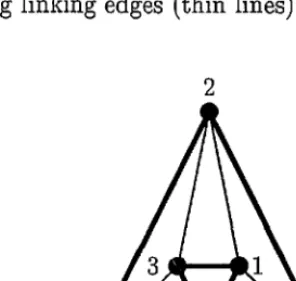
has been obtained in [9]. Figure 3.2 shows two adjacent copies of (thick lines) with the corresponding linking edges (thin lines).
[image:46.758.286.434.415.556.2]2
Figure 3.2: Two copies of and the linking set of the cyclic octahedron
Example 3.3: Let B be the cyclic graph Cb on b vertices and
L =
{(1,1), (2,2),..., (6,
b)}
be the "identity" linking set. The resulting graph is denoted by Cn(ò).
Example 3.4: Let B be a path with vertex set V = {1,2,3,4} (1 and 4 being the end-vertices). For L = {(1,1), (3, 2), (4,4)} the resulting cubic graph with 4n
vertices is a generalised dodecahedron and is denoted by Dn. In particular D5 is
3 . 2 . T H E COMPATIBILITY MATRIX METHOD 4 7
3 4
2
1
2
[image:47.758.309.406.177.279.2]4 3 1
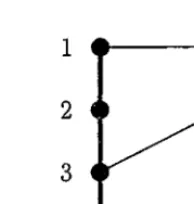
Figure 3.3: Two copies of path of length four and the linking set of the generalised dodecahedron
the linking edges (thin lines) are shown in Figure 3.3. To calculai e the chromât ic polynomial of Dn was a longstanding problem motivated by the question of whether
chromatic roots can have a negative real part. D.A. Sands (in an unpublished thesis, 1972), Haggard (1976) obtained the chromatic polynomial of D5. In 2001 S.C. Chang [11] calculated the chromatic polynomial for the general Dn and showed
the existence of roots with negative real part for Dn for n > 6.
The n-fold symmetry of the bracelets allows us to use the compatibility matrix method, described in the next section, to calculate their chromatic polynomials.
3.2 The compatibility matrix method
Recali that Tjfc(B) is the set of proper /c-colourings of a graph B. Vk(B) is the vector space of complex-valued functions defined on Tk(B). We say that a pair
(QÌ, J3) of members of Tjt(B) is compatible with L if:
This means that if one copy of B is coloured according to a, a second copy of B
3 . 2 . T H E COMPATIBILITY MATRIX METHOD 48
The compatibility operator TL = Ti(k) is defìned by the matrix whose entries are
I
l if (a,ß) is compatible with L;0 otherwise.
It is convenient to use the same symbol TL for the linear operator represented by the matrix TL, with respect to the standard basis of Vk{B). The connection
between TL and the chromatic polynomial P(Ln(B)\k) arises from the following
theorem [5].
Theorem 3.1 The number of k-colourings ofLn(B) is equal to the trace ofTL(k)n. Proof: Let a, /?, 7 , . . . , r be n colourings in Tk(B). Colour the first copy of B with a, the second copy with ß and so on up to the nth copy coloured with r. The resulting colouring of Ln(B) is a proper /¡-colouring if and only if
(XLWPL)^ • • • pL)Ta =
1-The number of proper ft-colourings of Ln(B) is equal to the sum of this product
over ali possible combinations of a, ß, 7 , . . . , r in Tk{B):
E P ÌM T L) * . . . (TL)ra = = tr(2T).
a,ß, 7,...,r a
•
Observe, that for the moment k is stili a fìxed integer. Only later we will be able
to show that the trace of Ti(k)n is indeed of the form of a polynomial in k and
hence we can replace k with the complex variable
Since the trace of a matrix is equal to the sum of the eigenvalues multiplied by the
corresponding algebraic multiplicities it follows [5]:
Corollary 3.2 Suppose that Ai(&), À . . . , As(k) are the eigenvalues ofTL(k)
and
mi(k)ìm2(k),... ,ms(k) are the corresponding algebraic multiplicities. Then the
number of proper k-colourings of Ln(B) is equal to
Ê
mi(k)xm-i=l
3 . 3 . DÉCOMPOSITION OF THE COMPATIBILITY MATRIX 4 9
3.3 Décomposition of the compatibility matrix
Recali from the previous chapter that we defined the action of the symmetric group Sym* on Tk(B) by
(a;, a)(v) = cu(a(v)) for every v € V
for ali cu G Symj. and A G IV Clearly, for every OJ G Symfc, if (ce,/?) is compatible with L then so is (eoa, ufi), Let be the matrix représentation corresponding to the CSymfc-module Vk(B) with respect to the canonical basis. That is
I
l if ufi = a 0 otherwise.It can easily be checked that T^k) A(to) — A{w) T^k) for ail lj G Symk . This
means that TL(k) belongs to the commutant algebra C(A) of A(u). Moreover, this
holds for any linking set L. Let b = \V\. From Lemma 2.1 and Theorem 2.6 it follows that Ti(k) is équivalent to a matrix of the form
© ( i r ® NI),
0<t<b 7rK
where /n is the identity matrix of size nnk and N£ is a m^k x mnk matrix with
entries depending on k.
Theorem 3.3 For any given base graph B and any linking set L the number of k-colourings of Ln(B) is equal to
b
E * ( * ) Mwz)". e=o TTI--£
where r}^(k) = 1 if 1 = 0 and
t
vAk) = ir Il (k-hi(7r)) with /^(tt) = ^ + t - i if
i= 1
NI is a matrix of size nn with entries depending on k, and
neu(B)
3 . 3 . DÉCOMPOSITION OF THE COMPATIBILITY MATRIX 5 0 Proof: From the argument preceding this theorem and from Theorem 3.1 it follows that for any given k E N the number of /c-colourings of Ln(B) is equal to
tr ® (ir ® (JVZ)B) = E E * ( * ) t r( ^ )n o<l<b £=0 ir\-£
TTl-i
where ty(k) = n^k is the size of IVÌ independent of B, given in Theorem 2.6. Also
from Theorem 2.6 follows the size of • Recali from Theorem 2.14 that Vk{B) is the direct sum of the submodules Wfc(7r, B)
where
W*(*,B)= 0 0 Uk(n,T,K)
•ReTHB)
for ail partitions 7r h t with 0 < t < b.
It follows that each iVJ corresponds to the submodule The rows and columns of N£ correspond to the Uk(7r,T, \1Z\).
Observe that the r\^(k) are independent of L and they are given by an explicit formula. The matrix NI is dépendent on L and our main task is to explain how to calculai e it.
Example 3.5: Let B be the complete graph and L any linking set. In Ex-ample 2.10 we expressed the module 14(3) as a direct sum of seven submodules Wjb(7T, 3). Each of them is the direct sum of irreducible submodules. The number and the dimension of these irreducible submodules for each of the Wki^, 3) has been given in Table 2.1. It follows that the sizes of the matrices NI are as shown in the following table:
7T 0 (1) (2) (l2) (3) (2,1) (l3)
size of NI 1 x 1 3 x 3 3 x 3 3 x 3 l x l 2 x 2 1 x 1
3 . 3 . DECOMPOSITION OF THE COMPATIBILITY MATRIX 51 equal to
tr{N^)71 + {k - 1) tr(Af))«
Hb \k{k - 3) tr(iVf)» + \(k ~ 1 )(k - 2) tr(ivf >)» + ^A;(Jfc-l)(fc-5) tr(7V[3))n
Later (Theorem 3.13), we will show that the entries of the matrices N£ are poly-nomials in k over C. It follows that tr(A^J)n is a polynomial in k and hence
b
P(Ln(B); k) = J2 E tr(^)n G
¿=0 7r(-£
Replacing fc with the complex variable z we can make P(Z/n(£?); 2;) € €[2;] into a polynomial with complex variable 2 such that that P(Ln(B); z) is the number of
proper z-colourings for all 2 E N. Hence P(Ln(B)\ z) is the chromatic polynomial
of Ln(B). In order to find tr^N^)71 it is convenient if we can find the eigenvalues
A I ( £ , TT; k), \2(L, 7R; & ) , . . . , AS( L: 7R; k)
and the corresponding algebraic multiplicities mi(L, 1r),m2(L, 7r),..., ms(L, 7r) of
JVJ. The