0095-1137/11/$12.00 doi:10.1128/JCM.01067-11
Copyright © 2011, American Society for Microbiology. All Rights Reserved.
Alaska Sentinel Surveillance Study of
Helicobacter pylori
Isolates
from Alaska Native Persons from 2000 to 2008
䌤
Adrienne H. Tveit,
1Michael G. Bruce,
2* Dana L. Bruden,
2Julie Morris,
2Alisa Reasonover,
2Debby A. Hurlburt,
2Thomas W. Hennessy,
2and Brian McMahon
1Alaska Native Medical Center, Anchorage, Alaska,1and Arctic Investigations Program, Centers
for Disease Control and Prevention, Alaska Native Medical Center, Anchorage, Alaska2
Received 25 May 2011/Returned for modification 30 June 2011/Accepted 21 July 2011
Helicobacter pyloriinfection is more common in Alaska Native persons than in the general U.S. population,
with seroprevalence to H. pyloriapproaching 75%. Previous studies in Alaska have demonstrated elevated proportions of antimicrobial resistance amongH. pyloriisolates. We analyzedH. pyloridata from the Centers for Disease Control and Prevention’s sentinel surveillance in Alaska from January 2000 to December 2008 to determine the proportion of culture-positive biopsy specimens with antimicrobial resistance from Alaska Native persons undergoing endoscopy. The aim of the present study was to monitor antimicrobial resistance
ofH. pyloriisolates over time and by region in Alaska Native persons. Susceptibility testing ofH. pyloriisolates
to metronidazole, clarithromycin, amoxicillin, and tetracycline was performed using agar dilution. Suscepti-bility testing for levofloxacin was performed by Etest. Overall, 45% (532/1,181) of persons undergoing upper endoscopy were culture positive forH. pylori. Metronidazole resistance was demonstrated in isolates from 222/531 (42%) persons, clarithromycin resistance in 159/531 (30%) persons, amoxicillin resistance in 10/531 (2%) persons, and levofloxacin resistance in 30/155 (19%) persons; no tetracycline resistance was documented. The prevalence of metronidazole, clarithromycin, and levofloxacin resistance varied by region. Female patients were more likely than male patients to demonstrate metronidazole (P< 0.05) and clarithromycin (P< 0.05) resistance. No substantial change in the proportion of persons with resistant isolates was observed over time. Resistance to metronidazole, clarithromycin, and levofloxacin is more common amongH. pyloriisolates from Alaska Native persons than those from elsewhere in the United States.
Helicobacter pyloriis the major cause of gastric and duodenal
ulcers and is associated with chronic active gastritis (27). In-fected persons are at increased risk for mucosa-associated lym-phoid tissue (MALT) lymphoma and gastric adenocarcinoma (2, 15). Over half of the world’s population is currently infected
withH. pylori; rates of approximately 40% seropositivity have
been found among persons living in industrialized countries, compared to 80 to 90% among persons living in developing countries (1, 7). In Alaska, the overall seroprevalence among Alaska Native persons is approximately 75% (range among regions, 64 to 81%) (23).
Previous studies have demonstrated elevated proportions of resistantH. pyloriisolates from Alaska compared with the rest of the United States (7, 10, 12, 18, 21). We analyzed data from the Centers for Disease Control and Prevention’s (CDC)H.
pylorisentinel surveillance system in Alaska from 1 January
2000 to 31 December 2008 to determine the proportion ofH.
pylori culture-positive biopsy specimens from Alaska Native
persons undergoing upper endoscopy and to determine the susceptibility ofH. pyloriisolates to antibiotics (metronidazole, clarithromycin, levofloxacin, amoxicillin, and tetracycline) commonly used in the treatment of H. pylori infections in Alaska.
MATERIALS AND METHODS
The CDCH. pylorisentinel surveillance system is based at hospitals located in 5 Alaska regions: Southcentral, Interior, Bristol Bay, Yukon-Kuskokwim Delta, and Norton Sound. The hospitals in the Southcentral (Anchorage) and Interior (Fairbanks) regions are 75- to 150-bed tertiary care facilities located in urban settings. The hospitals in the other 3 regions are smaller secondary care facilities located in remote, rural settings, accessible only by boat or plane. Antral and fundal biopsy specimens are obtained from patients undergoing esophagogas-troduodenoscopy (EGD) and sent to the CDC Arctic Investigations Program (AIP) laboratory for culture and antimicrobial susceptibility testing of theH. pyloriisolates. We analyzedH. pyloridata from four of the five sentinel surveil-lance sites: the Alaska Native Medical Center (ANMC) in Anchorage, Kanaka-nak Hospital in Dillingham, the Yukon-Kuskokwim Delta Regional Hospital (YKDRH) in Bethel, and the Norton Sound Regional Hospital (NSRH) in Nome. Data from the Interior region were not included in the analysis due to the low number of specimens submitted over the study period.
Sentinel surveillance.Participating physicians at the sentinel surveillance sites were asked to collect biopsy specimens from all Alaska Native patients under-going EGD. For persons with multiple endoscopies during the surveillance period, results from the earliest EGD were used. Because sites collected fundal specimens with differing frequencies, only the antral specimens were used in determining the proportion of specimens that wereH. pyloripositive and resis-tant to antimicrobials. Variables available for analysis included age, gender, ethnicity, region of residence, urban/rural residence, facility site, and antimicro-bial susceptibility results. For determination of urban or rural residence, cities were classified according to population; Anchorage, Fairbanks, Juneau, and surrounding communities were considered urban, while all other cities were considered rural. EGD results from nonnative persons were excluded from the analysis.
Laboratory testing. (i) Biopsy and culture.Tissue samples from biopsy spec-imens were tested by aCampylobacter-like organism (CLO) test (Ballard Medical Products, Draper, UT) for the detection of urease and cultured by previously described techniques (18). Biopsy specimens were stained with Diff-Quik (Mer-cedes Medical, Sarasota, FL) stain for identification ofH. pyloriisolates and with hematoxylin and eosin stain for histological evaluation.
* Corresponding author. Mailing address: Arctic Investigations Pro-gram, Centers for Disease Control and Prevention, 4055 Tudor Centre Drive, Anchorage, AK 99508. Phone: (907) 3400. Fax: (907) 729-3429. E-mail: [email protected].
䌤Published ahead of print on 3 August 2011.
3638
on May 16, 2020 by guest
http://jcm.asm.org/
(ii) Susceptibility testing.MIC testing was performed according to the guide-lines of the Clinical and Laboratory Standards Institute (CLSI) (22) by agar dilution (as previously described [6]) from January 2000 through December 2008 for metronidazole, amoxicillin, clarithromycin, and tetracycline. MIC testing for levofloxacin by Etest started in August 2004 for all isolates.
(iii) MIC breakpoints.CLSI breakpoints were used to define resistance ofH. pyloriisolates to clarithromycin (MICⱖ1g/ml). The CLSI does not designate breakpoints for other antimicrobials used in the treatment ofH. pylori.We used the following breakpoints for resistance, derived from prior studies: a metronidazole MIC of⬎8g/ml, an amoxicillin MIC ofⱖ1g/ml, a levofloxacin MIC ofⱖ2g/ml, a clarithromycin MIC ofⱖ1g/ml, and a tetracycline MIC ofⱖ2g/ml (7, 13).
Statistical analysis.Categorical and continuous variables were compared be-tween groups using the chi-square and Kruskal-Wallis tests, respectively. Trends across age groups and study years were examined by the Cochran-Armitage test. Statistical analyses were conducted using SAS software version 9.2 (SAS Insti-tute, Cary, NC).Pvalues were two-tailed, and values of⬍0.05 were considered statistically significant.
RESULTS
A total of 1,799 specimens were obtained from 1,181 Alaska Native persons who underwent EGD. If persons underwent multiple EGDs in the same year, only the first EGD was used
for this analysis (n⫽1,181). Over the 9 years of surveillance, 58% (n⫽687) of EGDs were done at the ANMC in Anchor-age, 20% (n⫽236) at the YKDRH in Bethel, 15% (n⫽176) at Kanakanak Hospital in Dillingham, and 7% (n⫽82) at the NSRH in Nome. The mean age of participants was 51 years (range, 3 to 96 years), and 52% (n⫽617) were male.
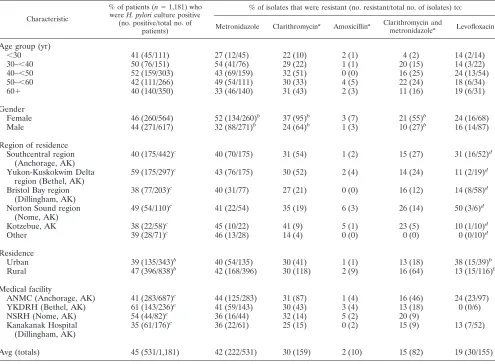
[image:2.585.44.539.91.455.2]Among 1,181 patients, 531 (45%) tested H. pyloriculture positive. Among patients withH. pylori-positive cultures, the proportions of isolates demonstrating resistance to metronida-zole, clarithromycin, levofloxacin, and amoxicillin were 42% (222/531), 30% (159/531), 19% (30/155), and 2% (10/531), respectively. No patients were infected withH. pyloriisolates that demonstrated resistance to tetracycline (Table 1). CLO testing was performed on 80% (n⫽940) of persons and was in concordance with culture results 86% (n ⫽ 811) of the time. Results of histologic evaluations ofH. pyloripresence were available for 78% (n ⫽ 924) of persons and were in agreement with the culture results 85% (n ⫽ 781) of the time. The performance of these and other tests for the TABLE 1. H. pyloriantimicrobial susceptibility among isolates collected from Alaska Native persons between
1 January 2000 and 31 December 2008
Characteristic
% of patients (n⫽1,181) who wereH. pyloriculture positive
(no. positive/total no. of patients)
% of isolates that were resistant (no. resistant/total no. of isolates) to:
Metronidazole Clarithromycina Amoxicillina Clarithromycin and
metronidazolea Levofloxacin
Age group (yr)
⬍30 41 (45/111) 27 (12/45) 22 (10) 2 (1) 4 (2) 14 (2/14)
30–⬍40 50 (76/151) 54 (41/76) 29 (22) 1 (1) 20 (15) 14 (3/22)
40–⬍50 52 (159/303) 43 (69/159) 32 (51) 0 (0) 16 (25) 24 (13/54)
50–⬍60 42 (111/266) 49 (54/111) 30 (33) 4 (5) 22 (24) 18 (6/34)
60⫹ 40 (140/350) 33 (46/140) 31 (43) 2 (3) 11 (16) 19 (6/31)
Gender
Female 46 (260/564) 52 (134/260)b 37 (95)b 3 (7) 21 (55)b 24 (16/68)
Male 44 (271/617) 32 (88/271)b 24 (64)b 1 (3) 10 (27)b 16 (14/87)
Region of residence Southcentral region
(Anchorage, AK)
40 (175/442)c 40 (70/175) 31 (54) 1 (2) 15 (27) 31 (16/52)d
Yukon-Kuskokwim Delta region (Bethel, AK)
59 (175/297)c 43 (76/175) 30 (52) 2 (4) 14 (24) 11 (2/19)d
Bristol Bay region (Dillingham, AK)
38 (77/203)c 40 (31/77) 27 (21) 0 (0) 16 (12) 14 (8/58)d
Norton Sound region (Nome, AK)
49 (54/110)c 41 (22/54) 35 (19) 6 (3) 26 (14) 50 (3/6)d
Kotzebue, AK 38 (22/58)c 45 (10/22) 41 (9) 5 (1) 23 (5) 10 (1/10)d
Other 39 (28/71)c 46 (13/28) 14 (4) 0 (0) 0 (0) 0 (0/10)d
Residence
Urban 39 (135/343)b 40 (54/135) 30 (41) 1 (1) 13 (18) 38 (15/39)b
Rural 47 (396/838)b 42 (168/396) 30 (118) 2 (9) 16 (64) 13 (15/116)b
Medical facility
ANMC (Anchorage, AK) 41 (283/687)e 44 (125/283) 31 (87) 1 (4) 16 (46) 24 (23/97)
YKDRH (Bethel, AK) 61 (143/236)e 41 (59/143) 30 (43) 3 (4) 13 (18) 0 (0/6)
NSRH (Nome, AK) 54 (44/82)e 36 (16/44) 32 (14) 5 (2) 20 (9)
Kanakanak Hospital (Dillingham, AK)
35 (61/176)e 36 (22/61) 25 (15) 0 (2) 15 (9) 13 (7/52)
Avg (totals) 45 (531/1,181) 42 (222/531) 30 (159) 2 (10) 15 (82) 19 (30/155)
a
The total number of isolates for this column is the same as the number listed in the metronidazole column. b
P⬍0.05. c
P⬍0.001; rates in the Yukon Kuskoqwim Delta were higher than in all other regions. d
P⫽0.002; Southcentral and Norton Sound regions versus all other regions. e
P⬍0.001; rates at the NSRH and YKDRH were higher than at the ANMC and Kanakanak Hospital.
on May 16, 2020 by guest
http://jcm.asm.org/
presence of H. pylori isolates in this population has been previously investigated (8).
The distributions of MIC values differed between the anti-microbials tested (Fig. 1). The distribution of amoxicillin MICs was unimodal, compared to the bimodal distributions of levo-floxacin, clarithromycin, and metronidazole. For
metronida-zole, the MICs were distributed across the entire scale. Very
fewH. pyloriisolates had MICs of levofloxacin and
clarithro-mycin around the resistance cutoff, leading to a greater differ-entiation between resistant and susceptible strains.
Metronidazole.Overall, 42% (222/531) ofH. pylori culture-positive patients had isolates resistant to metronidazole. Fe-males were more likely to have metronidazole-resistant H.
pyloriisolates than males (52% [134/260] versus 32% [88/271],
respectively; odds ratio [OR]⫽2.6;P⬍0.0001) (Fig. 2). There was no statistically significant trend in the proportion of iso-lates demonstrating metronidazole resistance over the time period of the study; resistance varied by year from 30% to 51% of isolates (Fig. 3). Urban and rural areas had similar levels of metronidazole resistance at 40% (54/135) and 42% (168/396), respectively. The proportion of isolates demonstrating metro-nidazole resistance among referral hospitals was highest at the ANMC at 44% (185/283). Persons 30 to 40 years of age dis-played the highest proportion of metronidazole-resistant iso-lates (54%), followed by the age groups of 50 to 60 years (49%) and 40 to 50 years (43%) (Table 1).
Clarithromycin. Overall, 30% (159/531) of persons were found to have H. pylori isolates resistant to clarithromycin. Females were more likely to have clarithromycin-resistantH.
[image:3.585.43.542.70.423.2]pyloriisolates than males (37% [95/260] versus 24% [64/271],
[image:3.585.42.284.554.700.2]FIG. 2. Percentages of persons in Alaska withH. pyloriisolates with antimicrobial resistance by patient sex, 2000 to 2008.
FIG. 1. MICs of commonly prescribed antibiotics forH. pyloriisolates from Alaska Native persons, 2000 to 2008.
on May 16, 2020 by guest
http://jcm.asm.org/
respectively; OR⫽1.7;P⫽0.001) (Fig. 2). The proportion of isolates resistant to clarithromycin varied by year from 12% to 36%; however, no statistically significant trend over the time period of the study was noted (Fig. 3). We observed no statis-tically significant differences in clarithromycin resistance by age group, urban versus rural residence, or referral hospital (Table 1).
Levofloxacin.Overall, 19% (30/155) of patients were found to have H. pylori isolates resistant to levofloxacin. Persons living in urban areas were approximately 5 times more likely to be infected with levofloxacin-resistant isolates than persons living in rural areas (38% [15/39] versus 13% [15/116], respec-tively; OR ⫽ 4.2; P ⫽ 0.0005). The proportion of isolates resistant to levofloxacin varied by year from 10% to 31%; however, no statistically significant trend over the time period of the study was noted (Fig. 3). There were no differences between persons infected with levofloxacin-resistant isolates and those infected with levofloxacin-susceptible isolates by age group, gender, or treatment hospital; however, differences by region of residence were noted (Table 1).
Multidrug resistance. Overall, 15% (82/531) ofH. pylori -positive isolates demonstrated resistance to both metronida-zole and clarithromycin. Persons infected with isolates resis-tant to metronidazole were more likely than persons infected with metronidazole-susceptible isolates to be infected with iso-lates that were also resistant to clarithromycin (37% [82/222] versus 25% [77/309]; OR⫽5.2;P⫽0.002). Among 24 persons infected with isolates resistant to both metronidazole and clarithromycin, 10 (42%) were infected with isolates that were additionally resistant to levofloxacin, compared to 9 (12%) of the 74 persons whose isolates were susceptible to both. Fe-males were more likely than Fe-males to be infected with isolates resistant to both metronidazole and clarithromycin (21% [55/ 260] versus 10% [27/271]; OR⫽2.4;P⫽0.0004) (Fig. 2).
Of 155 persons tested for levofloxacin resistance between 2004 and 2008, 10 (6.4%) had isolates that were resistant to levofloxacin, clarithromycin, and metronidazole. Nine of the 10 persons with isolates resistant to levofloxacin, clarithromycin, and metronidazole were female, and all 10 persons were adults between the ages of 23 and 52 years. Biopsy specimens ob-tained from patients receiving care at the Alaska Native Med-ical Center accounted for 80% (8/10) of the
triple-drug-resis-tant isolates; however, only 40% (4/10) of the patients resided in the Anchorage area. Of the isolates resistant to levofloxacin (n⫽30), none were resistant to amoxicillin or tetracycline.
Amoxicillin and tetracycline. Overall, 2% (10/531) of H.
pyloriisolates were resistant to amoxicillin. The proportion of
isolates resistant to amoxicillin varied by year from 0% to 4%, and no statistically significant trend over the time period of the study was noted (Fig. 3). Five of the 10 patients infected with
H. pyloriisolates displaying resistance to amoxicillin were
be-tween the ages of 50 and 60 years, and 9 patients resided in rural areas; however, these results were not statistically signif-icantly different (Table 1). There were no patients infected
withH. pyloriisolates resistant to tetracycline.
DISCUSSION
Data from four of five hospitals participating in the Alaska
H. pylori sentinel surveillance network demonstrated a high
proportion of culture positivity (45%) among EGD specimens obtained from Alaska Native persons over the 9-year surveil-lance period; persons living in the western region of Alaska had the highest proportion of culture positivity (59%). No distinct trends in antimicrobial resistance over time were seen; however, overall, the percentages of isolates demonstrating full resistance to metronidazole, clarithromycin, both metronida-zole and clarithromycin, and levofloxacin were high (42, 30, 15, and 19%, respectively). Antimicrobial resistance was more commonly found amongH. pyloriisolates from Alaska Native persons than among those from persons elsewhere in the United States (12, 19, 21). Studies performed by Duck et al. (patients undergoing endoscopy at 11 different hospitals across the United States) (12) and Meyer et al. (meta-analysis of 20
H. pylorieradication trials across the United States) (21)
dem-onstrated significantly lower proportions of isolates with resis-tance to clarithromycin or metronidazole than were found in Alaska Native persons. This is likely due to a higher endemicity
ofH. pyloriinfection in the Alaska Native population and to
rates of antimicrobial prescription that are the same as or slightly higher than in the rest of the United States (4). To our knowledge, this long-standing H. pylori sentinel surveillance system for antimicrobial resistance is unique.
[image:4.585.43.280.69.210.2]We found that the proportion of H. pylori isolates from Alaska Native persons demonstrating resistance to levofloxacin (19%) was at least twice as high as rates reported in Canada and countries in Western Europe (with the exception of Italy) (3, 9, 26) and comparable to rates reported in Jamaica and Korea (13, 16). No data are currently available on levofloxacin or quinolone resistance among H. pylori isolates from the United States, with the exception of Alaska. A study per-formed by Carothers et al. which looked atH. pyloriisolates collected from 1998 to 2002 found that 8.8% of patients living in the urban setting of Anchorage, AK, who presented for EGD were infected with levofloxacin-resistantH. pyloriisolates (10). Our surveillance data (which cover a later time period) show substantially higher overall levofloxacin resistance (19%) than in the study by Carothers et al. In our study, the propor-tion of isolates demonstrating levofloxacin resistance was ap-proximately three times higher (P ⬍ 0.05) among persons residing in an urban (38%) than in a rural (13%) setting. The high proportion of levofloxacin resistance rates in Alaska could FIG. 3. Antimicrobial resistance trends from H. pylori isolates
among Alaska Native persons, 2000 to 2008.
on May 16, 2020 by guest
http://jcm.asm.org/
be due to increased usage of fluoroquinolone antibiotics in the urban city of Anchorage. Due to the broad-spectrum coverage of levofloxacin and the ease of transition from intravenous to oral therapy, as well as the ease of oral, once-daily adminis-tration by patients, levofloxacin is prescribed frequently at the ANMC for respiratory and complicated urinary tract infec-tions. Prescription of levofloxacin has occurred more fre-quently at the ANMC than in rural village clinics and may account for the significant difference in H. pylori resistance between the urban and rural areas (CDC, unpublished data). A study by Bott et al. in Anchorage, AK, revealed that while overall prescription rates for fluoroquinolones were low, visit-based prescriptions for fluoroquinolones to persons 5 to 17 years of age increased from 1992 to 2004. An increase in rates of prescription of antimicrobials may contribute to the high rates of antimicrobial resistance (4).
We found that among Alaska Native persons, the proportion of clarithromycin-resistantH. pyloriisolates (30%) was approx-imately three times higher, and the proportion of metronida-zole-resistant isolates (42%) was two times higher, than in previous U.S. studies (12). These rates of resistance from Alaska are more consistent with rates found in developing countries. Our data support previous studies in Alaska and other parts of the world that demonstrate a high proportion of
H. pyloriisolates resistant to metronidazole and clarithromycin
(6, 14, 18, 23, 24, 25). Neither metronidazole- nor clarithromy-cin-resistant isolates were associated with a particular age group or place of residence (urban versus rural).
An increase in the multidrug resistance ofH. pyloriisolates to commonly prescribed antibiotics has been previously docu-mented (5, 6, 20, 28). In this study, persons infected with isolates resistant to metronidazole were more likely to have isolates resistant to clarithromycin as well. Additionally, per-sons infected with isolates resistant to metronidazole and clarithromycin were more likely to have isolates resistant to levo-floxacin than persons infected with isolates susceptible to both antibiotics. Treatment forH. pylori in persons with H. pylori
isolates resistant to multiple classes of antibiotics may result in higher treatment failure rates. Indeed, documented resistance to clarithromycin has been associated with higher treatment failure rates in Alaska and other parts of the world (17, 18). Data from our study demonstrate that persons infected withH.
pyloriisolates resistant to three antimicrobial agents used to
treat this infection (n ⫽ 10), metronidazole, clarithromycin, and levofloxacin, lived in both rural (n⫽6) and urban (n⫽4) Alaska. Due to a high proportion ofH. pyloriisolates demon-strating clarithromycin resistance, the most common treatment regimen used forH. pyloriinfection in Alaska has been qua-druple therapy with metronidazole, tetracycline, omeprazole, and bismuth. Treatment regimens for H. pylori are selected from a limited formulary specific to the treatment facility. Medical providers are limited to the medications on a closed formulary when choosing a medication regimen. The high rates of prevalence of antibiotic-resistantH. pyloriisolates, particu-larly those with multidrug resistance, in this population are of high concern.
We found that female subjects were more likely than males to be infected with isolates resistant to metronidazole and clarithromycin, as well as to both metronidazole and clarithro-mycin (Fig. 2). It has been shown in prior studies in Alaska and
elsewhere that the increased resistance ofH. pyloriisolates in females may be due primarily to the increased prescription of metronidazole for gynecological infections (6, 11).
There were a number of limitations to this study. The find-ings may not be representative of the population of Alaska, as only Alaska Native people were included; the Alaska Native population is 20% of the population of the entire state of Alaska (U.S. Census, 2000). In addition, the Alaska sentinel surveillance sites do not cover the entire state of Alaska. Med-ical providers performing EGDs in the sentinel sites were not required to send in biopsy samples to the CDC for culture and susceptibility testing. Reliance on volunteer participation by physicians rather than mandatory reporting or delivery of a randomized sample may lead to a participation bias. Samples were analyzed based on culture testing. This sentinel surveil-lance for antimicrobial resistance did not collect information on endoscopic findings, such as duodenal ulcers, gastric ulcers, gastric cancer, gastric lymphoma, or nonulcer dyspepsia. We also did not have access to previousH. pyloritreatment histo-ries.
With the new findings and sustained high numbers of H.
pylori isolates displaying antimicrobial resistance, continued
surveillance in Alaska Native persons is warranted. The data from this surveillance system have been useful for informing empirical treatment ofH. pyloriinfections in Alaska. Plans are in place for inclusion of these data in hospital antibiograms.
REFERENCES
1.Bardhan, P. K.1997. Epidemiological features ofHelicobacter pylori infec-tion in developing countries. Clin. Infect. Dis.25:973–978.
2.Bayerdorffer, E., et al.1995. Regression of primary gastric lymphoma of mucosa-associated lymphoid tissue type after cure of Helicobacter pylori infection. Lancet345:1591–1594.
3.Best, L. G., D. Haldane, and S. Veldhuyzen van Zanten.2004.Helicobacter pyloriantibiotic resistance in Canadian populations. Gastroenterology126: 1293.
4.Bott, A. M., M. G. Bruce, L. Bulkow, J. Coleman, and T. W. Hennessy.2009. Trends in antimicrobial prescribing rates for Alaska Native and American Indian persons⬍18 years of age residing in the Anchorage region. Int. J. Circumpolar Health68:337–346.
5.Boyanova, L., et al. 2006. Antibacterial resistance in Helicobacter pylori strains isolated from Bulgarian children and adult patients over 9 years. J. Med. Microbiol.55:65–68.
6.Bruce, M. G., et al. 2006. Alaska sentinel surveillance for antimicrobial resistance inHelicobacter pyloriisolates from Alaska native persons, 1999-2003. Helicobacter11:581–588.
7.Bruce, M. G., and H. I. Maaroos.2008. Epidemiology ofHelicobacter pylori infection. Helicobacter13(Suppl. 1):1–6.
8.Bruden, D. B., et al.Diagnostic accuracy of tests forHelicobacter pyloriin an Alaska Native population. World J. Gastroenterol., in press.
9.Cabrita, J., et al.2000. Features and trends inHelicobacter pyloriantibiotic resistance in Lisbon area, Portugal (1990-1999). J. Antimicrob. Chemother. 46:1029–1031.
10.Carothers, J. J., et al.2007. The relationship between previous fluoroquin-olone use and levofloxacin resistance inHelicobacter pyloriinfection. Clin. Infect. Dis.44:e5–e8.
11.Ching, C. K., et al.1996. Prevalence of metronidazole resistantHelicobacter pyloristrains among Chinese peptic ulcer disease patients and normal con-trols in Hong Kong. Gut38:675–678.
12.Duck, W. M., et al.2004. Antimicrobial resistance incidence and risk factors amongHelicobacter pylori-infected persons, United States. Emerg. Infect. Dis.10:1088–1094.
13.Kim, J. M., J. S. Kim, N. Kim, H. C. Jung, and I. S. Song.2005. Distribution of fluoroquinolone MICs inHelicobacter pyloristrains from Korean patients. J. Antimicrob. Chemother.56:965–967.
14.Koch, A., M. Bruce, and P. Homoe.2008. Infectious diseases, p. 265–290.In T. K. Young and P. Bjerregaard (ed.), Health transitions in Arctic popula-tions. University of Toronto Press, Toronto, Canada.
15.Kusters, J. G., A. H. van Vliet, and E. J. Kuipers.2006. Pathogenesis of Helicobacter pyloriinfection. Clin. Microbiol. Rev.19:449–490.
16.Lee, M. G., et al.2004. Antibiotic sensitivity ofHelicobacter pyloriin Jamaica. West Indian Med. J.53:374–377.
on May 16, 2020 by guest
http://jcm.asm.org/
17.Liou, J. M., et al.2010. Levofloxacin-based and clarithromycin-based triple therapies as first-line and second-line treatments forHelicobacter pylori in-fection: a randomised comparative trial with crossover design. Gut59:572– 578.
18.McMahon, B. J., et al. 2006. Reinfection after successful eradication of Helicobacter pylori: a 2-year prospective study in Alaska Natives. Aliment. Pharmacol. Ther.23:1215–1223.
19.McMahon, B. J., et al.2003. The relationship among previous antimicrobial use, antimicrobial resistance, and treatment outcomes forHelicobacter pylori infections. Ann. Intern. Med.139:463–469.
20.Megraud, F.2004.H.pyloriantibiotic resistance: prevalence, importance, and advances in testing. Gut53:1374–1384.
21.Meyer, J. M., et al.2002. Risk factors forHelicobacter pyloriresistance in the United States: the surveillance ofH. pyloriantimicrobial resistance partner-ship (SHARP) study, 1993-1999. Ann. Intern. Med.136:13–24.
22.National Committee for Clinical Laboratory Standards.2000. Performance standards for antimicrobial susceptibility testing. M100-S10. National Com-mittee for Clinical Laboratory Standards, Wayne, PA.
23.Parkinson, A. J., et al.2000. High prevalence ofHelicobacter pyloriin the Alaska native population and association with low serum ferritin levels in young adults. Clin. Diagn. Lab. Immunol.7:885–888.
24.Sacco, F., M. G. Bruce, B. J. McMahon, and D. Bruden.2007. A prospective evaluation of 200 upper endoscopies performed in Alaska Native persons. Int. J. Circumpolar Health66:144–152.
25.Suzuki, H., T. Nishizawa, and T. Hibi.2010.Helicobacter pylorieradication therapy. Future Microbiol.5:639–648.
26.Tankovic, J., C. Lascols, Q. Sculo, J. C. Petit, and C. J. Soussy.2003. Single and double mutations ingyrAbut not ingyrBare associated with low- and high-level fluoroquinolone resistance in Helicobacter pylori. Antimicrob. Agents Chemother.47:3942–3944.
27.Tytgat, G. N., and E. A. Rauws.1990.Campylobacter pyloriand its role in peptic ulcer disease. Gastroenterol. Clin. North Am.19:183–196. 28.Zullo, A., et al. 2007. Primary antibiotic resistance inHelicobacter pylori
strains isolated in northern and central Italy. Aliment. Pharmacol. Ther. 25:1429–1434.