Clinical Impact of Laboratory Implementation of Verigene BC-GN
Microarray-Based Assay for Detection of Gram-Negative Bacteria in
Positive Blood Cultures
Tamar Walker,aSandrea Dumadag,bChristine Jiyoun Lee,bSeung Heon Lee,aJeffrey M. Bender,cJennifer Cupo Abbott,b Rosemary C. Shea
Department of Pathology, Keck School of Medicine of the University of Southern California, Los Angeles, California, USAa; University of Southern California School of Pharmacy, Los Angeles, California, USAb; Department of Pediatrics, Keck School of Medicine of the University of Southern California, Los Angeles, California, USAc
Gram-negative bacteremia is highly fatal, and hospitalizations due to sepsis have been increasing worldwide. Molecular tests that supplement Gram stain results from positive blood cultures provide specific organism information to potentially guide therapy, but more clinical data on their real-world impact are still needed. We retrospectively reviewed cases of Gram-negative bacteremia in hospitalized patients over a 6-month period before (nⴝ98) and over a 6-month period after (nⴝ97) the imple-mentation of a microarray-based early identification and resistance marker detection system (Verigene BC-GN; Nanosphere) while antimicrobial stewardship practices remained constant. Patient demographics, time to organism identification, time to effective antimicrobial therapy, and other key clinical parameters were compared. The two groups did not differ statistically with regard to comorbid conditions, sources of bacteremia, or numbers of intensive care unit (ICU) admissions, active use of immu-nosuppressive therapy, neutropenia, or bacteremia due to multidrug-resistant organisms. The BC-GN panel yielded an identifi-cation in 87% of Gram-negative cultures and was accurate in 95/97 (98%) of the cases compared to results using conventional culture. Organism identifications were achieved more quickly post-microarray implementation (mean, 10.9 h versus 37.9 h;P< 0.001). Length of ICU stay, 30-day mortality, and mortality associated with multidrug-resistant organisms were significantly lower in the postintervention group (P<0.05). More rapid implementation of effective therapy was statistically significant for postintervention cases of extended-spectrum beta-lactamase-producing organisms (Pⴝ0.049) but not overall (Pⴝ0.12). The Verigene BC-GN assay is a valuable addition for the early identification of Gram-negative organisms that cause bloodstream infections and can significantly impact patient care, particularly when resistance markers are detected.
B
loodstream infection remains one of the deadliest andcostli-est conditions in the United States, more than doubling be-tween 2000 and 2008 and becoming the sixth most common
reason for hospitalization (1). Gram-negative bacteremia has
be-come an ever more pressing public health concern, as numbers
across the globe continue to rise (2,3). Although Gram-negative
organisms are only responsible for⬃30% of cases of
hospital-acquired infections, they account for 70% of such cases in
inten-sive care units (ICU) in the United States (4). These organisms,
including multidrug-resistant (MDR) Pseudomonas aeruginosa
and extended-spectrum beta-lactamase (ESBL) or
carbapenem-resistant Enterobacteriaceae (CRE), are associated with higher
mortality rates (1,3,4).
A timely and appropriate antimicrobial therapy selection is of particular importance. Delays in effective therapy and ineffective empirical therapy are associated with increased patient mortality
(4–7). Growing evidence suggests that appropriate, early
antibi-otic therapy can improve patient outcomes (3,4,6,8). New rapid
molecular technologies have been utilized in hospitals as a way to more quickly identify microorganisms from bloodstream infec-tions and their resistance markers since traditional culture meth-ods have identification and susceptibility turnaround times of at least 1 to 2 days from the time that a blood culture flags positive
(9). These new technologies also add costs to the clinical
microbi-ology laboratory but are implemented with the assumption that they will result in improved patient outcomes, assist antibiotic stewardship efforts, and provide a net financial benefit to the hos-pital. Some studies have shown significant cost benefits and
re-duced lengths of stay when the information is used in conjunction
with appropriate and timely antibiotic stewardship (2,7–10).
Ad-ditionally, previous studies provide evidence that rapid organism identification and susceptibility determination can have a positive impact on patient care by deescalating antibiotic therapy, decreas-ing mortality, and decreasdecreas-ing hospital and ICU stays. Most of these studies, however, have been conducted for bacteremia
caused by Gram-positive organisms (2,7,8,10–12).
In this study, we seek to assess the impact of an automated molecular assay, the Verigene blood culture gram-negative (BC-GN) test (Nanosphere Inc., Northbrook, IL, USA), in a real-world clinical scenario. The BC-GN assay is designed to identify com-mon Gram-negative pathogens from positive blood cultures and detect key resistance mechanisms. In this study, we assessed the clinical performance of the BC-GN assay and its impact on anti-biotic therapy selection and patient outcomes.
Received3 March 2016Returned for modification24 March 2016
Accepted14 April 2016
Accepted manuscript posted online20 April 2016
CitationWalker T, Dumadag S, Lee CJ, Lee SH, Bender JM, Cupo Abbott J, She RC. 2016. Clinical impact of laboratory implementation of Verigene BC-GN microarray-based assay for detection of Gram-negative bacteria in positive blood cultures. J Clin Microbiol 54:1789 –1796.doi:10.1128/JCM.00376-16.
Editor:P. Bourbeau
Address correspondence to Rosemary C. She, [email protected]. Copyright © 2016, American Society for Microbiology. All Rights Reserved.
on May 16, 2020 by guest
http://jcm.asm.org/
MATERIALS AND METHODS
Study design.This was a retrospective analysis of bacteremia cases in hospitalized patients before and after the implementation of a microar-ray-based early identification system (Verigene BC-GN; Nanosphere) at Keck Medical Center, which includes a 401-bed adult tertiary care hospi-tal and a 60-bed adult cancer hospihospi-tal in Los Angeles, CA. The Verigene BC-GN test is performed on positive blood culture bottles for the detec-tion ofEscherichia coli,Klebsiella pneumoniae,Klebsiella oxytoca, Pseu-domonas aeruginosa, Acinetobacter spp., Citrobacter spp.,Enterobacter
spp.,Proteusspp., and antibiotic resistance genes CTX-M, IMP, KPC, NDM, OXA, and VIM. Records for patients with blood cultures that were positive for Gram-negative bacteria from May to November 2013 were compared to those from December 2014 to May 2015 during which the BC-GN panel was performed. Cases were excluded if they were a subse-quent bacteremia episode from a study patient or if the patient was not admitted to the hospital. Mixed infections were included. Patient demo-graphics, time to organism identification, time to effective antimicrobial therapy, and other key clinical parameters were compared. Acute physi-ology and chronic health evaluation II (APACHE II) scores were deter-mined for patients admitted to the ICU to assess their disease severity (13). Microbiological analysis.As per routine laboratory protocol, blood cultures were performed using the BacT/Alert three-dimensional (3D) system with blood drawn into FA, FN, or PF bottles (bioMérieux, Dur-ham, NC). Gram stain results of blood cultures were called in to the provider within 15 min of the culture flagging positive. BC-GN was per-formed immediately after initial Gram stain if Gram-negative bacilli were seen and if it was a first-time positive for a patient within a 3-day period. BC-GN panel targets were reported if positive. If the BC-GN panel was negative for all panel targets, results were reported in the patient medical record as “Negative forE. coli,K. pneumoniae,K. oxytoca,P. aeruginosa,
Acinetobacterspp.,Citrobacterspp.,Enterobacterspp., andProteusspp. by Verigene nucleic acid test. Identification and susceptibility results to fol-low.” The microbiology laboratory is staffed 24 h a day by dedicated mi-crobiology personnel with few exceptions during staffing shortages. Pos-itive results of phenotypic testing indicating ESBL or CRE (as described below) are called in within 15 min to the provider for all inpatients per hospital policy. Results of the BC-GN panel were called in within 15 min to the provider if they were positive for any of the resistance mechanisms (CTX-M, KPC, NDM, OXA, VIM, or IMP) as indicating a likely ESBL- or carbapenemase-producing organism. During the preintervention and postintervention study periods, the antimicrobial stewardship pharmacist reviewed all bacteremia cases on a daily basis to identify opportunities for antimicrobial de-escalation.
Conventional identification of positive blood culture broths was per-formed on all samples as part of standard practice. Throughout the study periods, evaluation consisted of subculture to a solid medium at the time of initial Gram stain. Identification and susceptibility testing of isolated colonies were performed using the Vitek 2 system (bioMérieux). Confir-matory testing for ESBL and carbapenemase production was routinely performed if the susceptibility pattern met the criteria outlined in Clinical and Laboratory Standards Institute (CLSI) guidelines (14). For ESBL con-firmation, Etest with cefotaxime, ceftazidime, and cefepime with and without clavulanic acid was performed according to the manufacturer’s recommendations (AB Biodisk, Solna, Sweden). Confirmation of carbap-enemase production was performed using the modified Hodge test with ertapenem and meropenem discs according to CLSI guidelines (14). Based on institutional antibiogram data, during the years studied, ESBL rates were in the range of 15% to 20% forE. coliandK. pneumoniae.
Data analysis.Multidrug resistance in enteric Gram-negative rods andP. aeruginosawas defined as nonsusceptibility to at least one agent in three or more classes of drugs as detailed elsewhere (15). For the purposes of this study, the time of positive blood culture was defined as the time the provider was notified by telephone and provided with the initial Gram stain result. Time to effective antimicrobial therapy was defined as the time of positive blood culture to the administration time of the first
anti-microbial with known susceptibility based onin vitrosusceptibility testing results. The time to de-escalation of therapy was defined as the time of positive blood culture to the time of administration of the most narrow-spectrum antimicrobial based on the culture and susceptibility report. A suboptimal or inappropriate antibiotic is defined as a drug with no known coverage of the organism in its spectrum of activity or resistance based on
in vitrosusceptibility testing results. Recurrence of bacteremia was defined as having a second positive blood culture for the same Gram-negative organism at least 7 days and no more than 6 months after the first positive culture. Length of stay data were analyzed only for patients who survived until hospital discharge.
We performed statistical analysis for dichotomous data with the Fisher exact test. The Studentttest was used for the comparison of continuous outcomes with normal distributions, and the Mann-Whitney U test was performed for nonparametric continuous outcomes. All tests were two-tailed with an alpha level of 0.05 considered statistically significant. Uni-variate and multiUni-variate analyses were performed using the Cox propor-tional hazards regression to evaluate the independence of factors that may affect the outcome of ICU length of stay, including age, gender, disease severity, intervention (BC-GN implementation), and preinfection length of stay. Multivariate logistic regression analysis was performed to assess the independence of factors that may be associated with 30-day mortality in patients who had an ICU stay. The factors that were considered in-cluded intervention with BC-GN implementation, age, gender, ICU length of stay, and disease severity. Statistical analysis was performed us-ing R version 3.2.2. This study protocol was approved by the institutional review board of the University of Southern California.
RESULTS
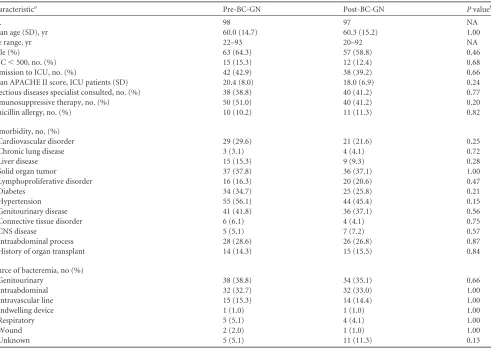
Patient characteristics.There were 98 bacteremia episodes from 98 distinct patients in the pre-BC-GN group and 97 bacteremia episodes from 97 distinct patients in the post-BC-GN group. Pa-tient populations for the two groups were not statistically different with regard to age, gender, or comorbid conditions. APACHE II scores for ICU patients did not statistically differ between the
pre-intervention and postpre-intervention groups (20.4 versus 18.0;P⫽
0.242). The frequencies of immunosuppressive therapy,
neutro-penia (absolute neutrophil count of⬍500/l), penicillin allergy,
and bacteremia with MDR organisms were similar between the two groups as well. Sources of bacteremia did not differ signifi-cantly and were most commonly intraabdominal, intravascular
line, and genitourinary (Table 1).
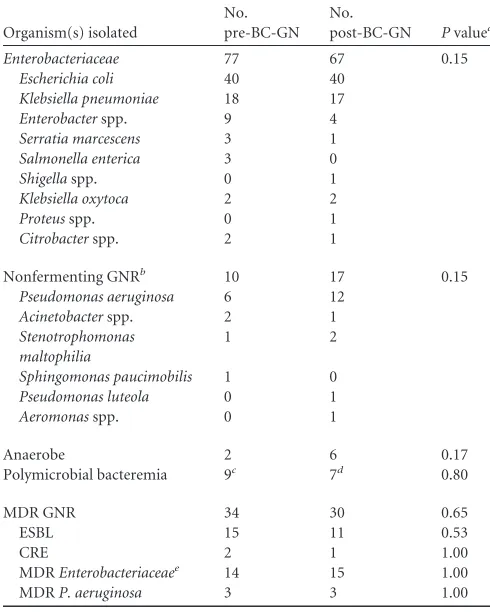
Microbiology results.The most commonly identified
organ-isms in each group wereE. coli,K. pneumoniae, andP. aeruginosa
(Table 2). Numbers of ESBL, CRE, MDREnterobacteriaceae, and
MDRP. aeruginosawere not statistically different between the two
groups. Microarray-based identification with the BC-GN assay
was achieved an average of 3.5 h (⫹/⫺1.8 h) after Gram stain was
completed. Mean time to at least genus-level identification of the organism was significantly less after the implementation of the
BC-GN panel (37.9 h versus 10.9 h;P⬍0.001).
Overall, 84 of 97 (86.6%) cases were accurately identified by
the BC-GN panel. One case ofShigellabacteremia was
misidenti-fied asE. coliby the BC-GN panel, a limitation that is noted by the
manufacturer. This patient was admitted with acute gastroenteri-tis and dehydration 4 days after the onset of symptoms. A stool culture that was performed the day after admission was negative. The misidentification had minimal clinical impact, as the patient received ciprofloxacin and metronidazole empirically, which was continued until completion of the 10-day course despite the change in identification. Twelve (12.4%) of the 97 cases were not identified by BC-GN assay because the organism was not a panel
on May 16, 2020 by guest
http://jcm.asm.org/
target (n⫽11) or because the BC-GN panel did not agree with
culture (n⫽1). This disagreement consisted of an isolate
identi-fied asK. pneumoniaeby standard culture but not identified by the
BC-GN panel. Nonpanel targets included 6 cases of strict
anaer-obes (BacteroidesorParabacteroidesspp.), 4 nonfermenter
Gram-negative bacilli, and oneSerratia marcescensisolate.Overall, these
12 cases took 55.9 h, on average, after blood cultures turned pos-itive for identification. Six of the patients were on suboptimal antimicrobial coverage; five of these patients were switched to effective antimicrobial therapy an average of 71.0 h after cultures turned positive. There were 3 mixed infections with 2 different Gram-negative rods, and the BC-GN panel detected both organ-isms in one case. The BC-GN assay correctly identified the negative organism in both of the 2 cases that contained one Gram-negative and one Gram-positive organism.
The Verigene BC-GN assay detectedblaCTX-Min 11 isolates;
nine were confirmed as ESBL, and two were ESBL indeterminate by phenotypic testing. For the purposes of this study, all 11 were considered ESBL-positive organisms based on their multidrug re-sistance profiles, which included rere-sistance to third-generation
cephalosporins along with the detection ofblaCTX-M. The BC-GN
panel was negative forblaCTX-Min all 56Enterobacteriaceaeisolates
that were not suspected to be ESBL by routine susceptibility
test-ing. The BC-GN panel detectedblaKPCin oneK. pneumoniae
iso-late that was also positive by the modified Hodge test. Only two
other isolates (bothP. aeruginosa) in the remaining 84 isolates that
could be identified by the BC-GN assay were nonsusceptible to a carbapenem; these tested negative for carbapenemase genes on the BC-GN panel.
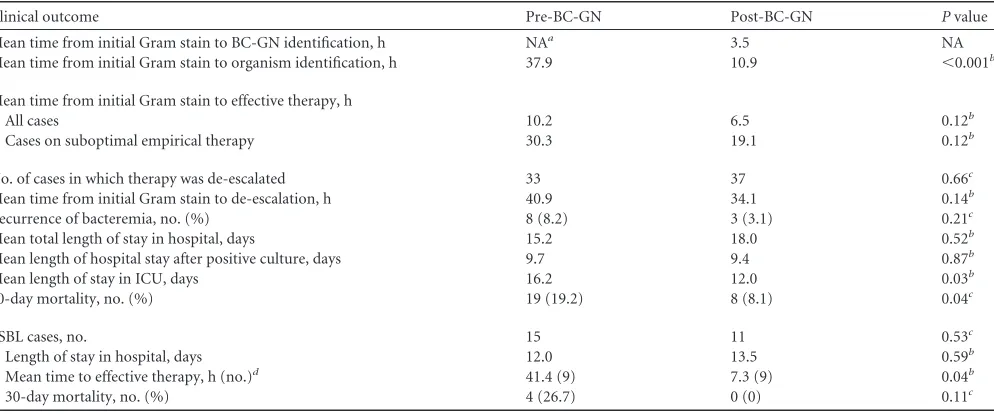
Clinical outcomes.In the pre-BC-GN implementation group, 32 patients were not on effective antibiotic coverage at the time of positive blood culture and were switched to appropriate coverage
at a mean of 30.3 h (⫹/⫺28.2 h) after initial Gram stain results
were called (Table 3). In the post-BC-GN group, 33 patients were
switched to adequate coverage in a mean of 19.1 h (⫹/⫺34.7 h)
after Gram stain results were called, and results were not
statisti-cally significant (P⫽0.123). No significant difference was found
in the recurrence of bacteremia in the pre-BC-GN group (8/98
[8.2%]) versus the post-BC-GN group (3/97 [3.1%]) (P⫽0.213,
Fisher exact test).
[image:3.585.51.542.85.434.2]For cases of ESBL or CRE organisms, prior to BC-GN imple-mentation, 6 of 17 cases were already on effective therapies. There were 4 total mortalities at 30-days, 2 of which were patients who expired while on antibiotics to which their Gram-negative isolate
TABLE 1Clinical characteristics of patients included in the study preimplementation and postimplementation of microarray-based identification of Gram-negative organisms from blood culture broths using BC-GN
Characteristica Pre-BC-GN Post-BC-GN Pvalueb
No. 98 97 NA
Mean age (SD), yr 60.0 (14.7) 60.3 (15.2) 1.00
Age range, yr 22–93 20–92 NA
Male (%) 63 (64.3) 57 (58.8) 0.46
ANC⬍500, no. (%) 15 (15.3) 12 (12.4) 0.68
Admission to ICU, no. (%) 42 (42.9) 38 (39.2) 0.66
Mean APACHE II score, ICU patients (SD) 20.4 (8.0) 18.0 (6.9) 0.24
Infectious diseases specialist consulted, no. (%) 38 (38.8) 40 (41.2) 0.77
Immunosuppressive therapy, no. (%) 50 (51.0) 40 (41.2) 0.20
Penicillin allergy, no. (%) 10 (10.2) 11 (11.3) 0.82
Comorbidity, no. (%)
Cardiovascular disorder 29 (29.6) 21 (21.6) 0.25
Chronic lung disease 3 (3.1) 4 (4.1) 0.72
Liver disease 15 (15.3) 9 (9.3) 0.28
Solid organ tumor 37 (37.8) 36 (37.1) 1.00
Lymphoproliferative disorder 16 (16.3) 20 (20.6) 0.47
Diabetes 34 (34.7) 25 (25.8) 0.21
Hypertension 55 (56.1) 44 (45.4) 0.15
Genitourinary disease 41 (41.8) 36 (37.1) 0.56
Connective tissue disorder 6 (6.1) 4 (4.1) 0.75
CNS disease 5 (5.1) 7 (7.2) 0.57
Intraabdominal process 28 (28.6) 26 (26.8) 0.87
History of organ transplant 14 (14.3) 15 (15.5) 0.84
Source of bacteremia, no (%)
Genitourinary 38 (38.8) 34 (35.1) 0.66
Intraabdominal 32 (32.7) 32 (33.0) 1.00
Intravascular line 15 (15.3) 14 (14.4) 1.00
Indwelling device 1 (1.0) 1 (1.0) 1.00
Respiratory 5 (5.1) 4 (4.1) 1.00
Wound 2 (2.0) 1 (1.0) 1.00
Unknown 5 (5.1) 11 (11.3) 0.13
a
ANC, absolute neutrophil count; CNS, central nervous system.
bAllPvalues were determined by the Fisher exact test, except for mean age, which was analyzed by the Student’s unpairedttest, and the APACHE II score, which was analyzed by
the Mann Whitney U test. NA, not applicable.
on May 16, 2020 by guest
http://jcm.asm.org/
tested resistant. Post-BC-GN, 2 of 12 were already on effective therapy. One patient did not receive effective therapy, as the
or-ganism (KPC-producingK. pneumoniae) tested as pan-resistant
to all drug classes. Of the remaining ESBL or CRE cases, antibiotic regimens were optimized significantly faster after initial Gram
stain results in the post-BC-GN group (n⫽9; mean, 8.9 h) than in
the pre-BC-GN group (n⫽9; mean, 42.7 h;P⫽0.008). Of 15
ESBL bacteremia cases in the pre-BC-GN group, 4 died at 30 days compared to none of the 10 cases that had follow-up data in the
post-BC-GN group (P⫽0.113).
The numbers of cases with antibiotic de-escalation following positive blood culture results were not significantly different (33
preintervention versus 36 postintervention;P⫽0.552) and
nei-ther was the mean time to de-escalation (40.9 h preintervention
versus 34.1 h postintervention;P⫽0.139). There was no
differ-ence in the frequencies of infectious disease consults (38.8%
ver-sus 41.2%, respectively;P⫽0.771). No statistically significant
differences were found between the preintervention and
postint-ervention groups with regard to overall length of stay in the hos-pital or length of hoshos-pital stay after time of positive blood culture (Table 3). Length of stay in the ICU was significantly shorter in the
post-BC-GN group, with a mean stay of 12.0 days (n⫽38)
com-pared with 16.2 days in the pre-BC-GN group (n⫽42;P⫽0.033).
Statistical significance remained after other factors were con-trolled for in the multivariate analysis. Disease severity (APACHE II score) and preinfection length of stay were significantly associ-ated with an increased length of ICU stay but only with hazard
ratios of 0.97 for both (Table 4). Thirty-day mortality was
signif-icantly higher in the preintervention group (19.2% versus 8.1%;
P⫽0.037). Among patients who had an ICU stay, 30-day
mortal-ity did not statistically differ between the preintervention and
postintervention groups (P⫽0.073). Upon multivariate logistic
regression analysis, there was a statistically significant association between intervention with BC-GN and decreased 30-day
mortal-ity (odds ratio, 0.81; 95% confidence interval, 0.67 to 0.98;P⫽
0.035), but age, gender, APACHE II score, and ICU length of stay were not independently associated with 30-day mortality in ICU
patients (Table 5). MDR organism bacteremia, including that
caused by ESBL and CRE organisms, was associated with 12 of the 19 deaths in the pre-BC-GN group compared to 1 of the 8 cases in
the post-BC-GN group (P⫽0.033).
Cost analysis.The cost per Verigene BC-GN test was calcu-lated to be $99 based on an average wage plus benefits of $56/h for a trained technologist, 30 min of hands-on technologist time from reagent preparation to results reporting, 4 quality control car-tridges run every month, and the contracted price for one test cartridge and utility tray. At our institution, internal accounting models base the cost for each additional day in the hospital for the same patient on the daily cost of nursing care. For regular inpa-tient stays, this cost is estimated to be $1,400 per painpa-tient per day. For ICU stays, it is estimated to be $2,800 per patient per day. Figures are based, in part, on the fact that the nurse to patient ratio is 1:1 in our ICUs and 1:2 in our standard medical or surgical inpatient units. Using the statistically significant difference found
in ICU length of stay (Table 3), for each patient with an episode of
Gram-negative bacteremia who had an ICU admission, the BC-GN assay would be associated with an average net savings of $11,661.
DISCUSSION
As infectious disease diagnostic technologies for bloodstream in-fections continue to develop, there is a potential for more rapid implementation of appropriate therapy and subsequent improved patient outcomes. However, a test such as the BC-GN adds an additional step to a typical blood culture work-up, increasing la-bor and reagent costs. It is therefore imperative for lala-boratories to understand if and how such testing impacts patient outcome in order to justify its use. Compared to other studies that have used simulated samples, proposed theoretical benefits from antimicro-bial interventions, and/or excluded polymicroantimicro-bial cultures, this study aimed to provide a practical reference for the effects of this technology on laboratory turnaround times and patient care in a
real-world hospital setting (16–22). While others have bundled
rapid bloodstream infection diagnostics with improved
steward-ship practices for their analyses (9,17), it has been shown that
antimicrobial stewardship interventions for Gram-negative
bac-teremia alone can improve outcomes (23). From a laboratory
[image:4.585.39.284.107.413.2]per-spective, it was encouraging that our data demonstrated a positive
TABLE 2Microbiological findings for the patients included in this study preimplementation and postimplementation of microarray-based identification of Gram-negative organisms from blood culture broths using BC-GN
Organism(s) isolated
No. pre-BC-GN
No.
post-BC-GN Pvaluea
Enterobacteriaceae 77 67 0.15
Escherichia coli 40 40
Klebsiella pneumoniae 18 17
Enterobacterspp. 9 4
Serratia marcescens 3 1
Salmonella enterica 3 0
Shigellaspp. 0 1
Klebsiella oxytoca 2 2
Proteusspp. 0 1
Citrobacterspp. 2 1
Nonfermenting GNRb 10 17 0.15
Pseudomonas aeruginosa 6 12
Acinetobacterspp. 2 1
Stenotrophomonas maltophilia
1 2
Sphingomonas paucimobilis 1 0
Pseudomonas luteola 0 1
Aeromonasspp. 0 1
Anaerobe 2 6 0.17
Polymicrobial bacteremia 9c 7d 0.80
MDR GNR 34 30 0.65
ESBL 15 11 0.53
CRE 2 1 1.00
MDREnterobacteriaceaee 14 15 1.00
MDRP. aeruginosa 3 3 1.00
a
AllPvalues were determined by the Fisher exact test.
bGNR, Gram-negative rod.
c
Value includes five cases with two mixed enteric GNR, one case with CREK. pneumoniaeandEnterococcus faecalis, one case withE. coli,P. aeruginosa, and viridans streptococcus, one case withE. coliandBacteroides fragilis, and one case with ESBLE. coli,P. aeruginosa, andAeromonas hydrophila.
d
Value includes four cases with two mixed enteric GNR, one case withK. pneumoniae
andStaphylococcus epidermidis, one case withE. coliand viridans streptococcus, and one case with four nonfermenter GNRs and aMicrobacteriumsp.
eCategory exclude ESBL or CRE cases.
on May 16, 2020 by guest
http://jcm.asm.org/
clinical impact based on the BC-GN test with the antimicrobial stewardship practices that were already in place.
The BC-GN assay performed well when a panel target was pres-ent in the positive blood culture broth, which at our medical cen-ter was the case in nearly 9 out of every 10 cases of Gram-negative bacteremia. In the minority of cases that could not be identified by BC-GN assay, cases were managed similar to practices used before BC-GN implementation, with prolonged time to appropriate an-tibiotic therapy in half of these cases. The exclusions of anaerobic targets and other organisms with important susceptibility
consid-erations, e.g.,Stenotrophomonas maltophilia, are a downside of
such kit-based molecular tests. Such a disadvantage is not the case with methods such as mass spectrometry-based identification di-rect from blood culture broth. Also, failure to detect some mixed infections is a known limitation of the BC-GN assay that was
con-sistent with our findings (19,24). The discordance seen in the case
in which BC-GN was negative for panel targets but conventional
methods identifiedK. pneumoniaecould possibly have been
Kleb-siella variicola, a species that the BC-GN panel does not recognize
but that is identified asK. pneumoniae with conventional
bio-chemical identification (17, 25). However, this isolate was
un-available for further testing in this retrospective analysis. In our study, we did not see issues with the identification of ESBL organ-isms, as all phenotypically confirmed ESBL organisms were CTX-M positive.
Similar to other studies, we observed that the use of this assay significantly shortened the identification time of Gram-negative rods by more than 1 day on average, even after including the turnaround time results of all Gram-negative cases tested and not
just panel targets. On a practical level, it required⬃3.5 h from the
time of Gram stain on the positive blood culture broth to entry of BC-GN results into electronic medical records. This is longer than the 2 to 2.5 h cited in most studies because we included samples that had delayed turnaround times due to gaps in laboratory
cov-erage (9,18,19). During the implementation of the assay at our
institution, providers were notified of the assay and its interpreta-tion via laboratory bulletin. Also, in the initial stages, the labora-tory concomitantly notified providers of the positive blood cul-ture result and that BC-GN results would be available in several hours. Providers at our institution had already become
accus-TABLE 3Clinical outcomes preimplementation and postimplementation of microarray-based identification of Gram-negative organisms from blood culture broths using BC-GN
Clinical outcome Pre-BC-GN Post-BC-GN Pvalue
Mean time from initial Gram stain to BC-GN identification, h NAa 3.5 NA
Mean time from initial Gram stain to organism identification, h 37.9 10.9 ⬍0.001b
Mean time from initial Gram stain to effective therapy, h
All cases 10.2 6.5 0.12b
Cases on suboptimal empirical therapy 30.3 19.1 0.12b
No. of cases in which therapy was de-escalated 33 37 0.66c
Mean time from initial Gram stain to de-escalation, h 40.9 34.1 0.14b
Recurrence of bacteremia, no. (%) 8 (8.2) 3 (3.1) 0.21c
Mean total length of stay in hospital, days 15.2 18.0 0.52b
Mean length of hospital stay after positive culture, days 9.7 9.4 0.87b
Mean length of stay in ICU, days 16.2 12.0 0.03b
30-day mortality, no. (%) 19 (19.2) 8 (8.1) 0.04c
ESBL cases, no. 15 11 0.53c
Length of stay in hospital, days 12.0 13.5 0.59b
Mean time to effective therapy, h (no.)d 41.4 (9) 7.3 (9) 0.04b
30-day mortality, no. (%) 4 (26.7) 0 (0) 0.11c
aNA, not applicable.
b
The Mann-Whitney U test was performed.
cThe Fisher exact test was performed.
d
[image:5.585.46.543.86.293.2]This category excludes cases that never received adequate antimicrobial coverage (n⫽2, pre-BC-GN group only) and cases already on adequate empirical therapy.
TABLE 4Association of various factors with length of ICU stay is shown by results of univariate and multivariate analysesa
Factor
Univariate analysisb Multivariate analysisb
HR 95% CI Pvalue HR 95% CI Pvalue
Intervention 1.62 1.03–2.54 0.04 1.79 1.07–2.98 0.03
Preinfection length of stay 0.97 0.95–0.99 0.001 0.97 0.95–0.98 0.0001
Age 1.01 0.99–1.03 0.22 1.0 0.98–1.01 0.90
Sex (female) 0.64 0.40–1.03 0.06 0.69 0.41–1.15 0.15
Time to effective therapy 1.01 0.78–1.32 0.94 1.02 0.75–1.38 0.90
Disease severity (APACHE II) 1.00 0.97–1.02 0.74 0.97 0.93–1.0 0.06
Mortality 1.03 0.57–1.65 0.91 1.43 0.83–2.48 0.20
a
Hazard ratio values of⬎1 are associated with shortened length of stay.
bHR, hazard ratio; CI, confidence interval.
on May 16, 2020 by guest
http://jcm.asm.org/
[image:5.585.41.544.604.706.2]tomed to rapid identification of blood cultures for Gram-positive organisms by fluorescent hybridization probes or Verigene BC-GP. Despite educational efforts, providers took several months to gain confidence with the BC-GN test algorithm, thereby reducing its initial impact. As antimicrobial stewardship programs at our institution and other institutions expand, even greater clinical and financial impact may be expected from sepsis panels like the BC-GN.
The shortened turnaround time for organism identification seemed to have the highest impact on patients with ESBL in-fections at our institution. With immediate communication of ESBL-positive results to providers, many cases resulted in a prompt switch to an appropriate antibiotic regimen. Prior to implementation of the BC-GN test, significant delays in initi-ation of appropriate antimicrobial therapy were noted. The impact of the BC-GN assay was pronounced in ESBL cases in our study, likely because the prevalence of ESBL-producing organisms is significant yet low enough that empirical Gram-negative coverage typically involves a cephalosporin-based reg-imen. For all cases in this study, there was an overall trend toward more rapid implementation of effective antibacterial therapy after BC-GN implementation that, while not statisti-cally significant, may still be clinistatisti-cally significant given that delays in appropriate antibiotic administration are associated
with an increased risk of mortality (6).
Another significant finding in this study was that after BC-GN assay implementation, length of ICU stay for patients with Gram-negative bacteremia was shortened by more than 4 days on aver-age. We did not examine costs specific to our study patients, but decreased lengths of stays in practical terms would decrease hos-pital costs. At our institution, the cost savings from BC-GN
im-plementation would amount to ⬃$11,661 per Gram-negative
bacteremia case with ICU admission. Although length of ICU stay has not been frequently examined in studies specific to the BC-GN microarray panel, our findings are similar to those from one study that included the BC-GN and BC-GP panels and to another study on antibiotic-resistant Gram-negative bacteria rapidly identified by mass spectrometry and direct from blood culture broth
suscep-tibility (21,26). Conversely, we did not find significant change in
the time to de-escalation of broad-spectrum antibiotics or in length of hospital stay. We believe that these observations were, in large part, due to a major limitation of commercially available molecular assays, which is that resistance marker results, particu-larly when negative, provide incomplete information for
thera-peutic decisions (20, 27). Patients in this study were generally
continued on empirical therapeutic regimens until full
suscepti-bility testing results were completed. Additionally, uncertainty re-garding antibiotic choice was likely one reason that hospital length of stay was not impacted, as providers again awaited conventional susceptibility results before deciding on an antibiotic regimen for patient discharge. Direct from blood culture susceptibility testing and promising new molecular approaches are much needed to fill
this gap (26, 28). Although the multiple comorbidities seen in
patients at a tertiary care center may have decreased the possibility of earlier discharge, others have shown that, with rapid suscepti-bility results and antimicrobial stewardship, decreased hospital
length of stay is achievable (26).
We also found that 30-day mortality was reduced by more than half after implementation of the BC-GN assay. This finding has been reported by others who used the Verigene system but com-bined data from Gram-negative and Gram-positive panel testing
or who used mass spectrometry-based rapid identification (21,
29). While in this retrospective analysis we cannot definitively
assert that the decrease in 30-day mortality is a direct result of the BC-GN test being implemented, the trend toward more timely administration of effective antibiotic therapy, the significantly de-creased length of stay in the ICU, and the significantly fewer deaths associated with MDR organisms suggest that more rapid identifi-cation of Gram-negative organisms and major resistance mecha-nisms played an important role. This finding is also supported by the fact that inappropriate antibiotic coverage has been linked with increased mortality in hospitalized patients with ESBL or
MDR organism bacteremia (6,30,31).
This findings of this study were based on adult patients in a tertiary care center and may not be applicable to all hospital set-tings. The rate of drug-resistant organisms, choice of empirical antibiotic therapy, and antibiotic stewardship practices may differ by institution. Moreover, factors such as infection control prac-tices and responsiveness of providers to microbiology results may also influence outcomes that cannot be controlled for in a retro-spective analysis. Because the data were collected soon after im-plementation of the microarray technology, they may not reflect the full impact of the test as providers gained confidence in the assay with time and experience. It should also be noted that the preimplementation and postimplementation study periods were not the same time of year for the two groups. The postintervention time frame included the winter season, but most patients pre-sented for cancer or surgical care unrelated to seasonal infections, e.g., respiratory virus infection. The preintervention time frame included the summer months when a limited number of medical residents and fellows start their training at the medical center; this may have had a limited impact on the study results. Cost-effec-tiveness was not the main focus of this study but may be examined further in future efforts.
As anticipated, the Verigene BC-GN performed well when panel targets were present in positive blood cultures, and it reduced turnaround time for the identification of most Gram-negative organisms that were causing bacteremia as well as ESBL and CRE organisms. It dramatically decreased the turn-around time for the identification of ESBL and CRE organisms and was associated with more rapid administration of appro-priate antimicrobial therapy in these cases. Although hospital length of stay was not impacted after implementation of this assay, length of stay in the ICU, 30-day mortality, and deaths related to MDR organisms were significantly reduced. Imple-mentation of such assays with more intense, real-time
antimi-TABLE 5Multivariate logistic regression analysis to assess independence of the association of intervention (BC-GN
implementation) and other factors with 30-day mortality in patients with an ICU staya
Factor Odds ratio 95% CI Pvalue
Intervention 0.81 0.67–0.98 0.03
Length of stay, ICU 1.00 1.00–1.00 0.94
Age 1.01 1.00–1.01 0.11
Sex (female) 1.07 0.88–1.30 0.48
APACHE II 1.01 0.99–1.02 0.36
aModeling was constructed such that odds ratios of⬎1 are associated with increased
30-day mortality and those of⬍1 are associated with decreased 30-day mortality.
on May 16, 2020 by guest
http://jcm.asm.org/
[image:6.585.40.286.106.173.2]crobial stewardship may further impact time to appropriate therapy and de-escalation of broad-spectrum therapy. Future studies to assess the impact of such testing in different health care settings are still needed.
REFERENCES
1.Elixhauser A, Friedman B, Stranges E.2011. Septicemia in U.S. hospitals, 2009. Agency for Healthcare Research and Quality, Rockville, MD.http: //www.hcup-us.ahrq.gov/reports/statbriefs/sb122.pdf.
2.Hill JT, Tran KD, Barton KL, Labreche MJ, Sharp SE.2014. Evaluation of the nanosphere Verigene BC-GN assay for direct identification of gram-negative bacilli and antibiotic resistance markers from positive blood cul-tures and potential impact for more-rapid antibiotic interventions. J Clin Microbiol52:3805–3807.http://dx.doi.org/10.1128/JCM.01537-14. 3.Kaye KS, Pogue JM.2015. Infections caused by resistant gram-negative
bacteria: epidemiology and management. Pharmacotherapy35:949 –962.
http://dx.doi.org/10.1002/phar.1636.
4.Peleg AY, Hooper DC.2010. Hospital-acquired infections due to gram-negative bacteria. N Engl J Med362:1804 –1813.http://dx.doi.org/10.1056 /NEJMra0904124.
5.Martinez RM, Bauerle ER, Fang FC, Butler-Wu SM.2014. Evaluation of three rapid diagnostic methods for direct identification of microorgan-isms in positive blood cultures. J Clin Microbiol52:2521–2529.http://dx .doi.org/10.1128/JCM.00529-14.
6.Kang CI, Kim SH, Park WB, Lee KD, Kim HB, Kim EC, Oh MD, Choe KW.2005. Bloodstream infections caused by antibiotic-resistant gram-negative bacilli: risk factors for mortality and impact of inappro-priate initial antimicrobial therapy on outcome. Antimicrob Agents Chemother49:760 –766.http://dx.doi.org/10.1128/AAC.49.2.760-766 .2005.
7.Goff DA, Jankowski C, Tenover FC.2012. Using rapid diagnostic tests to optimize antimicrobial selection in antimicrobial stewardship programs. Pharmacotherapy 32:677– 687.http://dx.doi.org/10.1002/j.1875-9114 .2012.01137.x.
8.Sango A, McCarter YS, Johnson D, Ferreira J, Guzman N, Jankowski CA.2013. Stewardship approach for optimizing antimicrobial therapy through use of a rapid microarray assay on blood cultures positive for
Enterococcusspecies. J Clin Microbiol51:4008 – 4011.http://dx.doi.org/10 .1128/JCM.01951-13.
9.Ward C, Stocker K, Begum J, Wade P, Ebrahimsa U, Goldenberg SD. 2015. Performance evaluation of the Verigene (Nanosphere) and Film Array (BioFire) molecular assays for identification of causative organisms in bacterial bloodstream infections. Eur J Clin Microbiol Infect Dis34: 487– 496.http://dx.doi.org/10.1007/s10096-014-2252-2.
10. Perez KK, Olsen RJ, Musick WL, Cernoch PL, Davis JR, Land GA, Peterson LE, Musser JM.2013. Integrating rapid pathogen identifi-cation and antimicrobial stewardship significantly decreases hospital costs. Arch Pathol Lab Med137:1247–1254.http://dx.doi.org/10.5858 /arpa.2012-0651-OA.
11. Aitken SL, Hemmige VS, Koo HL, Vuong NN, Lasco TM, Garey KW. 2015. Real-world performance of a microarray-based rapid diagnostic for Gram-positive bloodstream infections and potential utility for antimicro-bial stewardship. Diagn Microbiol Infect Dis81:4 – 8.http://dx.doi.org/10 .1016/j.diagmicrobio.2014.09.025.
12. Bauer KA, West JE, Balada-Llasat JM, Pancholi P, Stevenson KB, Goff DA.2010. An antimicrobial stewardship program’s impact with rapid polymerase chain reaction methicillin-resistantStaphylococcus aureus/S. aureusblood culture test in patients withS. aureusbacteremia. Clin Infect Dis51:1074 –1080.http://dx.doi.org/10.1086/656623.
13. Knaus WA, Draper EA, Wagner DP, Zimmerman JE.1985. APACHE II: a severity of disease classification system. Crit Care Med13:818 – 829.http: //dx.doi.org/10.1097/00003246-198510000-00009.
14. Clinical and Laboratory Standards Institute.2013. Performance stan-dards for antimicrobial susceptibility testing; 23rd informational supple-ment. CLSI M100-S23. Clinical and Laboratory Standards Institute, Wayne, PA.
15. Magiorakos AP, Srinivasan A, Carey RB, Carmeli Y, Falagas ME, Giske CG, Harbarth S, Hindler JF, Kahlmeter G, Olsson-Liljequist B, Pater-son DL, Rice LB, Stelling J, Struelens MJ, Vatopoulos A, Weber JT, Monnet DL.2012. Multidrug-resistant, extensively drug-resistant and pandrug-resistant bacteria: an international expert proposal for interim
standard definitions for acquired resistance. Clin Microbiol Infect18: 268 –281.http://dx.doi.org/10.1111/j.1469-0691.2011.03570.x. 16. Siu GK, Chen JH, Ng TK, Lee RA, Fung KS, To SW, Wong BK, Cheung
S, Wong IW, Tam MM, Lee SS, Yam WC.2015. Performance evaluation of the Verigene Gram-positive and Gram-negative blood culture test for direct identification of bacteria and their resistance determinants from positive blood cultures in Hong Kong. PLoS One10(10):e0139728.http: //dx.doi.org/10.1371/journal.pone.0139728.
17. Bork JT, Leekha S, Heil EL, Zhao L, Badamas R, Johnson JK.2015. Rapid testing using the Verigene Gram-negative blood culture nucleic acid test in combination with antimicrobial stewardship intervention against Gram-negative bacteremia. Antimicrob Agents Chemother59: 1588 –1595.http://dx.doi.org/10.1128/AAC.04259-14.
18. Tojo M, Fujita T, Ainoda Y, Nagamatsu M, Hayakawa K, Mezaki K, Sakurai A, Masui Y, Yazaki H, Takahashi H, Miyoshi-Akiyama T, Totsuka K, Kirikae T, Ohmagari N.2014. Evaluation of an automated rapid diagnostic assay for detection of Gram-negative bacteria and their drug-resistance genes in positive blood cultures. PLoS One9:e94064.http: //dx.doi.org/10.1371/journal.pone.0094064.
19. Han E, Park DJ, Kim Y, Yu JK, Park KG, Park YJ. 2015. Rapid detection of Gram-negative bacteria and their drug resistance genes from positive blood cultures using an automated microarray assay. Diagn Microbiol Infect Dis81:153–157.http://dx.doi.org/10.1016/j .diagmicrobio.2014.10.009.
20. Uno N, Suzuki H, Yamakawa H, Yamada M, Yaguchi Y, Notake S, Tamai K, Yanagisawa H, Misawa S, Yanagihara K.2015. Multicenter evaluation of the Verigene Gram-negative blood culture nucleic acid test for rapid detection of bacteria and resistance determinants in positive blood cultures. Diagn Microbiol Infect Dis83:344 –348.http://dx.doi.org /10.1016/j.diagmicrobio.2015.08.004.
21. Suzuki H, Hitomi S, Yaguchi Y, Tamai K, Ueda A, Kamata K, Tokuda Y, Koganemaru H, Kurihara Y, Ishikawa H, Yanagisawa H, Yanagihara K.2015. Prospective intervention study with a microarray-based, multi-plexed, automated molecular diagnosis instrument (Verigene system) for the rapid diagnosis of bloodstream infections, and its impact on the clin-ical outcomes. J Infect Chemother21:849 – 856.http://dx.doi.org/10.1016 /j.jiac.2015.08.019.
22. Mancini N, Infurnari L, Ghidoli N, Valzano G, Clementi N, Burioni R, Clementi M.2014. Potential impact of a microarray-based nucleic acid assay for rapid detection of Gram-negative bacteria and resistance mark-ers in positive blood cultures. J Clin Microbiol52:1242–1245.http://dx .doi.org/10.1128/JCM.00142-14.
23. Pogue JM, Mynatt RP, Marchaim D, Zhao JJ, Barr VO, Moshos J, Sunkara B, Chopra T, Chidurala S, Kaye KS.2014. Automated alerts coupled with antimicrobial stewardship intervention lead to decreases in length of stay in patients with gram-negative bacteremia. Infect Control Hosp Epidemiol 35:132–138. http://dx.doi.org/10.1086 /674849.
24. Dodemont M, De Mendonca R, Nonhoff C, Roisin S, Denis O.2014. Performance of the Verigene Gram-negative blood culture assay for rapid detection of bacteria and resistance determinants. J Clin Microbiol52: 3085–3087.http://dx.doi.org/10.1128/JCM.01099-14.
25. Rosenblueth M, Martinez L, Silva J, Martinez-Romero E.2004.Klebsiella variicola, a novel species with clinical and plant-associated isolates. Syst Appl Microbiol27:27–35.http://dx.doi.org/10.1078/0723-2020-00261.
26. Perez KK, Olsen RJ, Musick WL, Cernoch PL, Davis JR, Peterson LE, Musser JM.2014. Integrating rapid diagnostics and antimicrobial stew-ardship improves outcomes in patients with antibiotic-resistant Gram-negative bacteremia. J Infect69:216 –225.http://dx.doi.org/10.1016/j.jinf .2014.05.005.
27. She RC, Alrabaa S, Lee SH, Norvell M, Wilson A, Petti CA.2015. Survey of physicians’ perspectives and knowledge about diagnostic tests for bloodstream infections. PLoS One10(3):e0121493.http://dx.doi.org/10 .1371/journal.pone.0121493.
28. Evans SR, Hujer AM, Jiang H, Hujer KM, Hall T, Marzan C, Jacobs MR, Sampath R, Ecker DJ, Manca C, Chavda K, Zhang P, Fernandez H, Chen L, Mediavilla JR, Hill CB, Perez F, Caliendo AM, Fowler VG, Jr, Chambers HF, Kreiswirth BN, Bonomo RA. 2016. Rapid molecular diagnostics, antibiotic treatment decisions, and developing approaches to inform empiric therapy: PRIMERS I and II. Clin Infect Dis62:181–189.
http://dx.doi.org/10.1093/cid/civ837.
29. Huang AM, Newton D, Kunapuli A, Gandhi TN, Washer LL, Isip J, Collins CD, Nagel JL.2013. Impact of rapid organism identification via
on May 16, 2020 by guest
http://jcm.asm.org/
matrix-assisted laser desorption/ionization time-of-flight combined with antimicrobial stewardship team intervention in adult patients with bacte-remia and candidemia. Clin Infect Dis57:1237–1245.http://dx.doi.org/10 .1093/cid/cit498.
30. Kang CI, Kim SH, Park WB, Lee KD, Kim HB, Kim EC, Oh MD, Choe KW.2004. Bloodstream infections due to extended-spectrum beta-lactamase-producingEscherichia coliandKlebsiella pneumoniae: risk fac-tors for mortality and treatment outcome, with special emphasis on anti
microbial therapy. Antimicrob Agents Chemother48:4574 – 4581.http: //dx.doi.org/10.1128/AAC.48.12.4574-4581.2004.
31. Cordery RJ, Roberts CH, Cooper SJ, Bellinghan G, Shetty N. 2008. Evaluation of risk factors for the acquisition of bloodstream infections with extended-spectrum beta-lactamase-producingEscherichia coliand
Klebsiellaspecies in the intensive care unit; antibiotic management and clinical outcome. J Hosp Infect68:108 –115.http://dx.doi.org/10.1016/j .jhin.2007.10.011.