952
©IJRASET (UGC Approved Journal): All Rights are Reserved
Pathfinding using RSSI for a Fire fighting Robot
Baktawar R. Bulsara1, Nikita C. Date2, Payal B. Gaikwad3, Pranoti N. Dahiwal4
1, 2, 3, 4
Computer Engineering Department, B.V.C.O.E.W., SPPU
Abstract: In this project, we propose navigation algorithms for outdoor environments, which permit robots to travel from one static node to another along a planned path in the sensor field, namely the Circular path finding algorithms. Using this, the robot can navigate without the help of map, GPS or extra sensor modules, only using the received signal strength indication (RSSI) and ESP. Therefore, our algorithms have the advantage of being cost‐effective. In addition, a path planning algorithm to schedule mobile robots’ travelling paths is presented, which focuses on signal strength for finding path by considering the
RSSI‐algorithm. The simulations and experiments conducted with an autonomous mobile robot show the effectiveness of the
proposed algorithms in an outdoor environment.
Keywords: Firefighting, Robot, Software-Hardware, RSSI, Wi-Fi, Search.
I. INTRODUCTION
First, a routing protocol must exist that can connect and pass messages in from the initial location of the robot to its final destination, by creating hot-spot using ESP-8266. Hybrid sensor networks with static and mobile nodes open a new frontier in the research into wireless sensor networks (WSN). Static nodes support environmental sensing and network communication. Mobile nodes have more resources for sensing and computing and can move to particular locations to perform more complicated missions such as rescuing the soldiers in war, rescue the people in Accidents, Exploring on others planets etc.
II. PURPOSE
With the development in the field of robotics, human intrusion has become less and robots are being widely used for safety purpose. In our day-to-day life, fire accidents have become common and sometimes may lead to hazards that make it hard for the firemen to protect human life. In such cases, a fire fighting robot is used to guard human lives, wealth, and surroundings from the fire accidents.
III.PROJECT SCOPE
The scope of our project is to design and implement firefighting robot by using software and hardware. The ultimate goal is that the ideas and planning demonstrated through this model system can then be easily upgraded. As the system is to be implemented for large dataset, there are a number of performance specifications that have to be met to ensure the system co-operates correctly and efficiently. Most importantly, The Development of two factor authentications System interface must send and receive the appropriate information at the time of sending and receiving signals getting from fire sensor. The interface in turn, must be able to multi-task and have numerous threads running at the same time in order to serve multiple users throughout the system functions. Presently we are focusing on small set of databases for demo purpose and we are using one robot and one fire sensor.
IV.LITERATURE SURVEY
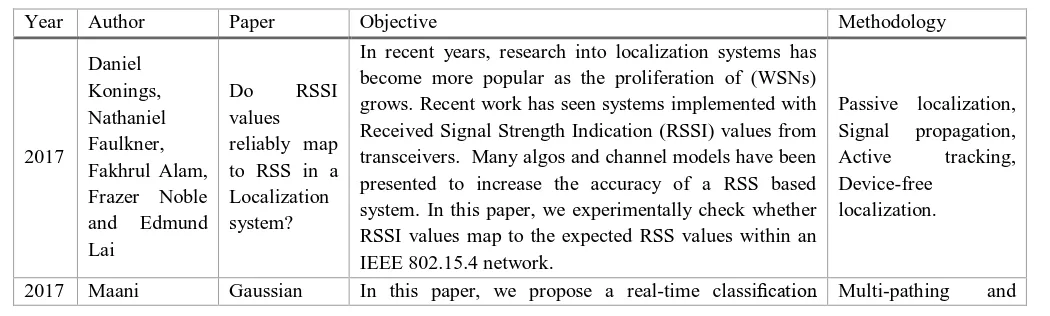
The literature survey is done by us by referring some IEEE papers and some journal papers. The papers surveyed are represented in the table below.
TABLE 1- LITERATURE SURVEY
Year Author Paper Objective Methodology
2017
Daniel Konings, Nathaniel Faulkner, Fakhrul Alam, Frazer Noble and Edmund Lai
Do RSSI
values reliably map to RSS in a Localization system?
In recent years, research into localization systems has become more popular as the proliferation of (WSNs) grows. Recent work has seen systems implemented with Received Signal Strength Indication (RSSI) values from transceivers. Many algos and channel models have been presented to increase the accuracy of a RSS based system. In this paper, we experimentally check whether RSSI values map to the expected RSS values within an IEEE 802.15.4 network.
Passive localization,
Signal propagation,
Active tracking,
Device-free localization.
[image:2.612.46.571.583.741.2]953
©IJRASET (UGC Approved Journal): All Rights are Reserved
Ghaffari Jadidi, Mitesh
Patel, and
Jaime Valls
Miro
Processes Online Observation Classification
for
RSSI-based
Low-cost Indoor
Positioning Systems.
scheme to cope with noisy Radio Signal Strength Indicator (RSSI) measurements utilized in indoor positioning systems. RSSI values are often converted to distances for position estimation.
shadowing effects,
finding a unique
sensor model using both parametric and nonparametric
methods, Robot
Operating System
(ROS).
2017
Khaled A.
Ghamry, Mohamed A.
Kamel, and
Youmin Zhang
Multiple
UAVs in
Forest Fire
Fighting Mission Using Particle Swarm Optimization
In this paper, it is assumed that the fire spots are already
detected and their co-ordinates will be sent to the fire fighting UAVs teams. Once the fire fighting team(s)
receive relevant information, the team begins to solve the task assignment problem using the auction-based algorithm. The objective of the algorithm is to assign each UAV to each fire spot according to their relative
distances.
Fire lookouts,
Satellites, manned
aerial vehicles,
UAVs. 2016 Thorsten Nowak, Markus Hartmann, Tobias Zech, Jörn Thielecke
A Path Loss
and Fading
Model for
RSSI-based Localization
in Forested
Areas
A prospective approach tracking tiny lightweight
animals is to capture field-strength measurements
utilizing a wireless sensor network. Apriori knowledge of propagation channel characteristics is essential for precise localization. Hence, in this paper a channel model for forested areas is proposed.
Path loss model,
Fading, Cross Fading.
2016 Mustafa Engin
Embedded
and Real
Time System
Design: A
Case Study
Fire Fighting Robot.
This paper presents the author's experiences using a
low-cost microcontroller evaluation board and a
commercially available real-time operating system in the laboratory component of an undergraduate embedded and real-time system design course.
Embedded and
real-time systems,
Encoders to get
feedback.
2013 Xiuyan Zhu,
Yuan Feng
RSSI-based Algorithm
for Indoor
Localization
With the development of wireless sensor networks and smart devices, the number of WIFI access point in these buildings is increasing, as long as a mobile smart device can detect three or three more known WIFI hotspots’ positions, it would be relatively easy to realize self-localization. The paper proposes an improved RSSI-based algorithm, the experimental results show that
compared with original RSSI-based localization
algorithms the algorithm improves the localization accuracy and reduces the deviation.
Wireless node
localization, RSSI.
2008
Charalampos Papamanthou,
Franco P.
Preparata, and Roberto Tamassia
Algorithms for Location Estimation
Based on
RSSI Sampling
In this paper, we re-examine the RSSI measurement model for location estimation and provide the first
detailed formulation of the probability distribution of the position of a sensor node. We also show how to use this probabilistic model to efficiently compute a good estimation of the position of the sensor node by sampling multiple readings from the beacons and then
RSSI, Probability
954
©IJRASET (UGC Approved Journal): All Rights are Reserved
minimizing a function with an acceptable computational
effort.
V. SYSTEM ARCHITECTURE
The architecture in Figure 1I shows the overall description of our system. We need a robot (i.e. a 4-wheel platform) that consists of a motor driver, 2 motors and an ESP module. We also need to install the smoke sensor at various points in the room. The sensors will be connected to the ESP module. Both the ESP modules need to be connected using Wi-Fi connection.
FIG.1 SYSTEM ARCHITECTURE
VI.UML DIAGRAMS
There are a few UML diagrams that will explain our system model better.
A. Activity diagram
955
©IJRASET (UGC Approved Journal): All Rights are Reserved
B. Class diagram
FIG.3 CLASS DIAGRAM
C. Data Flow Level 0 diagram (DFD Level 0)
FIG.4 DATA FLOW DIAGRAM LEVEL 0 D. Data Flow Level 1 diagram (DFD Level 1)
956
©IJRASET (UGC Approved Journal): All Rights are Reserved
E. Sequence diagram
FIG.6 SEQUENCE DIAGRAM
F. State chart diagram
957
©IJRASET (UGC Approved Journal): All Rights are Reserved
G. Use-Case diagram
FIG.8 USE-CASE DIAGRAM
VII. MATHEMATICAL MODEL
Let S be a closed system defined as, S = {I, O, A, DD, NDD, Su, Fa} where,
I = Input State = {Fire sensor value} O = Output State
= {Path traced by RSSI} A = Set of actions
= {F1, F2, F3, F4}
where,
F1 = Getting fire sensor value
F2 = Compare fire sensor value with threshold value F3 = Activate robot
F4 = Calculate path using RSSI DD = Deterministic data
= {Path found by robot using RSSI} NDD = Non-deterministic data
= {Sensor signal} Su = Success State = {Su1, Su2} where,
Su1 = {Success in getting fire sensor values correctly} Su2 = {Success in tracing path using RSSI}
Fa = {Fa1, Fa2} where,
958
©IJRASET (UGC Approved Journal): All Rights are Reserved
The state transition diagram according to our mathematical model is as shown in Figure 9.
FIG.9 STATE TRANSITION DIAGRAM
VIII. CONCLUSION
This robot will help in detecting fire easily and also try to extinguish it without much hassle. The ESPs installed will send a signal to the robot which will activate the robot to trace the path towards where the fire is detected. We look forward to develop this robot with the help of hardware components and software programming using Proteus and Arduino IDE.
IX.ACKNOWLEDGEMENT
First and foremost, we would like to express our gratitude to Prof. P. D. Kale, our internal guide, for her guidance and support throughout the project. Without her cooperation, it would have been extremely difficult for us to complete the project part of this semester. We would also like to thank the H.O.D. of the Computer department, Prof. D. D. Pukale, as well as the entire teaching and non-teaching staff of the Computer department for giving us an opportunity to work on such an exciting project. Last, but not the least, we are extremely grateful to our family, friends and colleagues who have supported us right from the inception of the project. Thank you for all your encouragement and support.
REFRENCES
[1] Daniel Konings, Nathaniel Faulkner, Fakhrul Alam, Frazer Noble and Edmund Lai, “Do RSSI values reliably map to RSS in a Localization system?”, 978-1-5090-5541-8/17/ ©2017 IEEE.
[2] Maani Ghaffari Jadidi, Mitesh Patel, and Jaime Valls Miro, “Gaussian Processes Online Observation Classification for RSSI-based Low-cost Indoor Positioning Systems”, arXiv:1609.03130v2 [cs.NI] 2017 IEEE.
[3] Khaled A. Ghamry, Mohamed A. Kamel, and Youmin Zhang, “Multiple UAVs in Forest Fire Fighting Mission Using Particle Swarm Optimization”, International Conference on Unmanned Aircraft Systems (ICUAS), 2017
[4] Thorsten Nowak, Markus Hartmann, Tobias Zech, Jörn Thielecke, “A Path Loss and Fading Model for RSSI-based Localization in Forested Areas”, 978-1-5090-0470-6/16/ ©2016 IEEE.
[5] Mustafa Engin, “Embedded and Real Time System Design: A Case Study Fire Fighting Robot”, 5th Mediterranean Conference on Embedded Computing MECO, 2016.
[6] Xiuyan Zhu, Yuan Feng, “RSSI-based Algorithm for Indoor Localization”, Communications and Network, Vol. 5, pp. 37-42, 2013 IEEE.