Scienze
Scienze
1. Humanity from African Naissance to Coming Millennia. Colloquia in Human Biology and Pa-laeoanthropology, edited by Phillip V. Tobias, Michael A. Raath, Jacopo Moggi-Cecchi, Gerald A. Doyle, 2001
2. Marco Masseti, Uomini e (non solo) topi. Gli animali domestici e la fauna antropocora, 2002 3. Alia: Antropologia di una comunità dell’entroterra siciliano, a cura di Brunetto Chiarelli, Ren-zo Bigazzi, Luca Sineo, 2002
4. Paolo Mantegazza. Medico, antropologo, viaggiatore, a cura di Cosimo Chiarelli, Walter Pa-sini, 2002
5. Alberto Mario Simonetta, Breve storia della biologia dalle origini al XX secolo, 2002
6. Alberto Mario Simonetta, Short history of Biology from the origins to the 20th Century, 2003 7. Attilio Gaudio, L’odyssée de l’Homme en marche: voyage anthropologique. Connaissances actuel-les et méthodes de recherche, 2004
Mainland and
Insular Lacertid Lizards:
a Mediterranean Perspective
Edited by
Claudia Corti
Pietro Lo Cascio
Marta Biaggini
Firenze University Press
2006
Marta Biaggini. – Firenze : Firenze university press, 2006. (Monografie. Scienze; 8) http://digital.casalini.it/8884535239 ISBN-10: 88-8453-523-9 (online) ISBN-13: 978-88-8453-523-8 (online) ISBN-10: 88-8453-524-7 (print) ISBN-13: 978-88-6453-122-9 (print) 597.95 (ed. 20)
Lacertidi – Mare Mediterraneo <bacino>
© 2006 Firenze University Press Università degli Studi di Firenze Firenze University Press
Borgo Albizi, 28, 50122 Firenze, Italy http://epress.unifi.it/
Printed in Italy
Introduction
Nick Arnold & Wolfgang Böhme Preface – Prefazione
Marta Biaggini, Claudia Corti & Pietro Lo Cascio
Morphology, mitochondrial DNA and the relationships of the Zagros lizard, Lacerta zagrosica Rastegar-Pouyani and Nilson 1998 (Squamata: Lacertidae)
E. Nicholas Arnold, Goran Nilson& Nasrullah Rastegar-Pouyani 7 Distribution of lacertid lizards in a Tuscan agro-ecosystem (Central Italy)
Marta Biaggini, Leonardo Dapporto, Emanuele Paggetti & Claudia Corti 13 Population heterogeneity and conservation of the Aeolian wall lizard, Podarcis
raffonei
Massimo Capula 23
Reproductive cycles in Mediterranean lacertids: plasticity and constraints
Miguel Angel Carretero 33
Intraspecific variation of preferred temperatures in the NE form of Podarcis hispanica*
Miguel A. Carretero, Elena Marcos & Pablo de Prado 55
Podarcis lizards in an agro-environment in Tuscany (Central Italy): preliminary data on the role of olive tree plantations
Francesca Graziani, Roberto Berti, Leonardo Dapporto & Claudia Corti 65 Patterns of shape and size sexual dimorphism in a population of Podarcis
hi-spanica* (Reptilia: Lacertidae) from NE Iberia
Antigoni Kaliontzopoulou, Miguel A. Carretero, Gustavo A. Llorente, Xavier
Santos & Carmelo Llorente 73
The micro-insular distribution of the genus Podarcis within the Aeolian Archi-pelago: historical vs. palaeogeographical interpretation
Pietro Lo Cascio & Claudia Corti 91
Preliminary data on the ecology of Podarcis filfolensis of Lampione Islet (Pela-gian Islands, Channel of Sicily, Italy)
Ana Catarina Luz, Camila Monasterio & Luís Vicente 111 Differentiation within Syrian populations of the lizard Mesalina brevirostris
Werner Mayer, Jiří Moravec & Mihaela Pavličev 125
A complex case of interaction between lizards and plants. The dead horse arum (Dracunculus muscivorus) and the Balearic lizard (Podarcis lilfordi) Valentín Pérez-Mellado, Núria Riera, José Ángel Hernández-Estévez,
Viviana Piccolo & Catherine Potter 133
Aspects of the evolutionary history of Podarcis taurica (Pallas 1814), P. gaigeae (Werner 1930) and P. milensis (Bedriaga 1882) in Greece
Nikos Poulakakis, Petros Lymberakis, Efstratios Valakos, Panagiotis Pafilis,
Eleftherios Zouros & Moysis Mylonas 161
Adult body length and sexual size dimorphism in Lacerta agilis boemica (Repti-lia, Lacertidae): between-year and interlocality variation
Evgeny S. Roitberg & Ella M. Smirina 175
Distribution and ecological preferences of lacertids in Calabria (Southern Italy)
Emilio Sperone, Antonella Bonacci & Sandro Tripepi 189 Genetic diversity within Corsican and Sardinian specimens of the Tyrrhenian
Wall Lizard, Podarcis tiliguerta, estimated using mtDNA sequences Raquel Vasconcelos, D. James Harris, Miguel A. Carretero, Catarina Pinho, Claudia Corti, Massimo Capula, Lara Bassu, Giovanna Spano & Michael
Delauguerre 199
Developmental stability of sand lizard (Lacerta agilis L.) under optimal and non-optimal conditions
Lacertid lizards have long been a fruitful field of scientific enquiry with many peo-ple working on them over the past coupeo-ple of hundred years. The scope of the field has steadily increased, beginning with taxonomy and anatomy and gradually spreading so that it includes such topics as phylogenetics, behaviour, ecology, and conservation. All these now coexist side by side, resulting in a lot of reciprocal illumination. The series of symposia on lacertid lizards of the Mediterranean basin which have taken place every three years since 1992 have been an important forum for such interactions and a stimulus to further investigations. This volume, which stems from the 2004 meeting in the Aeolian Islands, fulfils both these roles.
One theme that has been developed over the years and was particularly emphasised in 2004 is the insular populations of lacertids in the Mediterranean. Large numbers of these exist and are important for a number of reasons. Island lizard communities are simpler than those on mainlands and at least appear to be more easily understood. In-sular lacertids also provide a useful comparison with other more famous island lizard groups, like Anolis iguanids in the Caribbean. When these two sets of communities are considered, along with those on other archipelagos, such as the Canaries, Cape Verdes and Mascarenes, it is apparent that there is no simple repeating story. For example, Mediterranean lacertids lack the high species numbers found on the larger Caribbean islands. Whereas these sometimes have dozens of species of Anolis, it seems unlikely that even the largest Mediterranean islands had more than four or so species, even before they were colonised by people. Mediterranean islands also lack the giant lizards that occurred in many other archipelagos and sometimes survive today. The differences between these various island groups appears to a considerable extent to be the result of history, both of the islands and of the taxa concerned.
In the present volume a wide range of island topics are considered, including the sys-tematics of the species concerned, from both morphological and molecular viewpoints, interaction with other taxa, and conservation. The last topic is especially important, as island lizards across the world have often been vulnerable to extinction, once they came into contact with people and the animals they introduced. In the Mediterranean area, classical examples are Podarcis lilfordi in the eastern Balearics, and Podarcis raffonei on the Aeolian Islands. The main apparent causes of these two partial extinction events have turned out to be different, respectively introduced predators and interaction with a competitor, P. sicula, which also hybridises with the threatened species. Understanding such factors is of course an essential first and necessary step to controlling them.
C. Corti, P. Lo Cascio, M. Biaggini, Mainland and insular lacertid lizards: a mediterranean perspective,
ISBN 978-88-8453-523-8 (online), ISBN 978-88-6453-122-9 (print) © 2006 Firenze University Press
The volume also has papers on the more positive aspects of human influence, specifically the benign effects of traditional agriculture on at least some reptile species. Olive trees, cork oaks and the banks and walls of loose rocks that crisscross the Medi-terranean scene all often contribute to elevated lizard populations.
Nor is more basic biology neglected and there are articles on morphology, repro-duction, development and theremoregulation. Finally, it is good to see one paper on non-Mediterranean species is included. For, to fully understand the lacertids of this region, it is necessary to appreciate their close relatives in Africa, Asia and the archi-pelagos of the northeastern Atlantic Ocean.
An important additional point that should be clearly appreciated at this place is the role of the senior editor of this book, Claudia Corti. As well as to her primary editorship, a large task in itself she is coauthoring no less than five original papers out of 16 contained in this book. This demonstrates the continuing high degree of energy she is able to invest in this fascinating field of research. Moreover, it was she who started, by inviting a small number of colleagues to Florence, the first initiative that gave rise to the origin of this successful working group. The consequence was the first Mediterranean lacertid meeting on Lesvos Island, Greece, in 1992, followed by many others, all of them resulting in a nice proceedings volume like the present one. This activity which is not only dealing with European lizards but which is a truly European initiative, cannot be estimated highly enough.
Most promising is that the next Mediterranean lacertid meeting which is sched-uled for June 2008 will be held again in Greece. It will certainly be as successful and prolific in terms of increasing our knowledge on Mediterranean lacertids in all their facets outlined above, as its many predecessors.
In the charming scenario of the Castle of Lipari Island – carrying traces of 7,000 years of Mediterranean history – the prestigious Archaeological Museum hosted the “5th Symposium on the Lacertids of the Mediterranean Basin”. The Sicilian Regional Council kindly offered us this unique venue which was the only one feasible for host-ing an international meethost-ing on the island. Indeed the Museum could well represent the site where Mediterranean natural history crosses human history. The history of the Mediterranean is based on this crossroad where landscape dynamics and struc-tures, faunal and floristic composition, as well as changes in biodiversity have been smoothed over time.
The Aeolian Archipelago well embodies this metaphor. One of the most threat-ened species of the Mediterranean herpetofauna, Podarcis raffonei, occurs on these islands, where it survives in very small fragments of territory not suitable for exploita-tion. This species also represents a paradigm: even if the risk of an imminent extinc-tion is well documented, it is not yet included in any annex of the EU Directive 43/92, as well as the islets where it occurs are still seriously unprotected. More work is still therefore needed to fill the gap between science and conservation.
Current trends in herpetological researches dedicated to conservation are gaining appropriate space by taxonomical, zoogeographical, biological and ecological studies, which have been improved since the first edition of the Symposiums: Greece (1992), Portugal (1995), Croatia (1998), Spain (2001), and Italy (2004). We hope that sev-eral other meetings will take place in the future and that an increasing number of col-leagues will improve the knowledge on the Lacertids of the Mediterranean.
It is a pleasure for us to present “Mainland and Insular Lacertid Lizards: a Mediter-ranean Perspective”, which includes reviewed articles submitted to the 5th Internation-al Symposium on the Lacertids of the Mediterranean Basin. We would like to express our sincere gratitude to all the participants, as well as the institutions and/or associa-tions which provided us with their support: Societas Herpetologica Italica, Presidenza della Regione Siciliana, Provincia Regionale di Messina, Museo Archeologico Region-ale “L. Bernabò Brea”, Riserva NaturRegion-ale Orientata “Le Montagne delle Felci e dei Porri”, Società Elettrica Liparese, Associazione Nesos. We would like also to thank Francesca Graziani, Giuseppe Allegrino, Emanuele Paggetti, for their help during the Symposium; Riccardo Gullo, for his warm hospitality; Maria Letizia Molino, for the great care shown under several circumstances; the referees which kindly reviews all the
papers, Baldo Conti and Riccardo Petrini, for their important help during the final editing of the volume and Cinzia Giuliani for the last graphic corrections.
Marta Biaggini, Claudia Corti & Pietro Lo Cascio
Prefazione
Nel suggestivo scenario del Castello dell’Isola di Lipari – le cui mura recano i segni di 7000 anni di storia mediterranea – un prestigioso museo archeologico ha ospitato per alcuni giorni il “5th Symposium on the Lacertids of the Mediterranean Basin”. La scelta di questa sede si deve alla gentile opportunità concessa dalla Regione Siciliana, che ha messo a disposizione l’unica struttura esistente nell’isola adatta a ospitare un congresso interna-zionale; ma si presta bene, se vogliamo, a incarnare la metafora della storia naturale che incontra la storia dell’uomo. E su questo incontro, sui suoi intensi interscambi, si basa la storia del Mediterraneo, la struttura e la dinamica dei suoi paesaggi, la composizione delle sue faune e delle sue flore. Talvolta, anche la perdita di biodiversità, forse qui apparente-mente meno drammatica che in altri luoghi, perché attutita dal tempo e nel tempo.
In questo senso, anche la scelta di Lipari e dell’Arcipelago Eoliano incarna una meta-fora. Queste isole ospitano una delle specie più minacciate dell’erpetofauna mediterranea, che sopravvive in piccoli lembi di territorio mai sfruttati dall’uomo. E anche un para-digma: il rischio di imminente estinzione per Podarcis raffonei è documentato da seri con-tributi scientifici, e tuttavia la specie non è ancora stata inclusa in allegato alla Direttiva 43/92, né gli isolotti dove sono ancora presenti le sue poche popolazioni risultano soggetti a concrete misure di tutela. Questo ci racconta come molto lavoro ancora sia necessario per ottenere importanti risultati nel raccordo tra conoscenze scientifiche e applicazioni nella conservazione.
Parte delle attuali tendenze nelle ricerche erpetologiche, dedicate alla conservazione della specie e dei loro habitat, trova infatti oggi opportunamente spazio accanto agli studi tassonomici, zoogeografici, biologici ed ecologici, che hanno caratterizzato dall’inizio e con un crescente livello di interesse le ormai numerose edizioni di questo Symposium: dopo la Grecia (1992), il Portogallo (1995), la Croazia (1998), la Spagna (2001) e l’Italia (2004), ci auguriamo che molte altre occasioni ci vedano riuniti, insieme a un sempre maggiore numero di colleghi, per fare “il punto” delle conoscenze disponibili sui Lacertidi dell’area mediterranea.
Siamo dunque lieti di presentare i risultati in un volume dove, per precisa scelta edi-toriale, vengono pubblicati lavori che sono stati sottoposti a revisione e al quale abbiamo voluto dare il titolo di “Mainland and Insular Lacertid Lizards: a Mediterranean Perspec-tive”. La nostra gratitudine va a tutti i partecipanti e a chi ha reso possibile, a vario titolo, l’organizzazione e lo svolgimento del 5th International Symposium on the Lacertids of the Mediterranean Basin: Societas Herpetologica Italica, Presidenza della Regione Siciliana, Provincia Regionale di Messina, Museo Archeologico Regionale “L. Bernabò Brea”, Riserva Naturale Orientata “Le Montagne delle Felci e dei Porri”, Società Elettrica Liparese, As-sociazione Nesos. Un sentito ringraziamento va ancora a Francesca Graziani, Giuseppe Allegrino, Emanuele Paggetti, per la loro collaborazione durante il simposio; a Riccardo Gullo, per la sua cordiale ospitalità; a Maria Letizia Molino, per la sensibilità e l’attenzio-ne dimostrate in più di un’occasiol’attenzio-ne; ai colleghi che hanno provveduto al controllo dei testi, a Baldo Conti e Riccardo Petrini, per il significativo contributo dato alla fase definitiva di editing e Cinzia Giuliani per le indispensabili correzioni apportate alle figure.
relationships of the Zagros lizard,
Lacerta
zagrosica
Rastegar-Pouyani and Nilson 1998
(Squamata: Lacertidae)
E. Nicholas Arnold
1, Goran Nilson
2& Nasrullah Rastegar-Pouyani
31 Department of Zoology, Natural history Museum, Cromwell Road, London SW7 5BD (U.K.) 2Göteborg Natural History Museum, Box 7283, S-402 35 Göteborg (Sweden)
3Department of Biology, Faculty of Science, Razi University, 67149 Kermanshah (Iran)
Lacerta zagrosica, which inhabits rock exposures at altitudes of over 2000 m in the Zagros mountains, is described more fully, including skeletal, hemipenial and other internal features. It lacks the distinctive features of Omanosaura and other Eremiiniae, and a phylogenetic analysis of mor-phological data of the Lacertinae, based on 64 characters (equivalent to 83 binary ones), fails to associate it with any of the other taxa. But 620 bp of mitochondrial DNA (fragments of the cyt b and 12S rRNA genes) place L. zagrosica firmly and convincingly with its geographical neighbour, the ground-dwelling Lacertabrandtii, although it shows a divergence of 10% from this species. Morphological differences from L. brandtii are consider-able and may be largely related to the different functional demands of the habitats of the two species.
Keywords: morphology, mitochondrial DNA, relationship, Lacerta zagrosica.
Introduction
The Zagros lizard, Lacerta zagrosica Rastegar-Pouyani & Nilson 1998, was de-scribed from high altitudes, above 2000 m, in the Zagros Mountains of western Iran and is also discussed by Nilson et al. (2003). Among its more distinctive external fea-tures are a flattened head and body, single postnasal scale, masseteric scale sometimes discernible, six or seven pairs of chin shields, maximum of 10 enlarged ventral scales across the mid-body, and digits strongly compressed laterally. Relationships of L. za-grosica are unclear. Its habitat and some aspects of its anatomy, including its flattened head and body, suggest it may related to other rock-dwelling taxa in the Lacertinae,
C. Corti, P. Lo Cascio, M. Biaggini, Mainland and insular lacertid lizards: a mediterranean perspective,
ISBN 978-88-8453-523-8 (online), ISBN 978-88-6453-122-9 (print) © 2006 Firenze University Press
of which the geographically closest are members of Darevskia (formerly termed the
Lacerta saxicola group) in northern Iran and the Caucasus. Alternatively, it could pos-sibly have affinities with Omanosaura, a member of the Eremiinae that is found in the northern Oman area of Arabia, to the south of the range of L. zagrosica, and also includes a rock-dwelling form, O. cyanura.
To provide a broader basis for assessing the relationships of L. zagrosica, its mor-phology has been investigated more thoroughly than before, particularly the internal anatomy. In addition, 620 base pairs of mitochondrial DNA (291 base pairs of cyto-chrome b and 329 base pairs of 12S rRNA) of L. zagrosica have been compared with homologous DNA sequence of a wide range of lacertid lizards including 56 species in the Lacertinae. Methods used for DNA extraction, amplification, and phylogenetic analysis, employing Maximum Parsimony and Maximum Likelyhood approaches, are described by Carranza et al. (2004).
Morphology of
L
acerta zagrosicaMany external features of L. zagrosica have already been described (Rastegar- Pouyani & Nilson 1998, Nilson et al. 2003). The anatomical terms used here are ex-plained by Arnold (1973, 1989).
Material examined. 3 km northwest of Fereydun Sahr, about 140 km northwest of Esfahan city, Esfahan province, west-central Iran (32°58’N; 50°04’E). GNM Re.ex. 5614, female; GNM Re.ex 5615, male (GNM = Göteborg Natural History Museum, Sweden).
Size and shape. Up to about 68 mm from snout to vent; head and body strongly de-pressed; digits laterally compressed, and toes 3-5 on hind feet kinked in the vertical plane.
Skull. About seven premaxillary teeth in adults; pterygoid teeth apparently absent; nasal process of premaxilla slender; septomaxilla without anterior and posterior pro-cesses; postorbital and postfrontal bones separated and postorbital short; maxillary- jugal suture not stepped. Supraocular osteoderms incomplete and fenestrated in adults; no ossification of temporal scales.
Postcranial skeleton. 26 presacral vertebrae in male, 27 in female; 7 posterior presacral vertebrae with short ribs; medial loop of clavicle continuous or inter-rupted posteriorly; interclavicle cruciform with the arms more or less perpendicu-lar to the sagittal axis; sternal fontanelle oval; a single pair of inscriptional ribs; 5 or 6 pygal vertebrae; pattern of tail vertebrae AB type, with one to three anterior autotomic vertebrae that have a large pair of transverse processes and a smaller posterior one, the two pairs being parallel to each other and perpendicular to the main axis of the tail.
Scaling. Rostral separated from frontonasal scale; row of supraciliary granules com-plete; outer edge of parietal scale not reaching the lateral border of the parietal table of skull. Nostril in contact with first upper labial scale; a single postnasal scale; no con-tact between supranasal and anterior loreal scales above nostril; five upper labial scales in front of subocular; no transparent window in lower eyelid; first upper temporal scale may be large; masseteric scale sometimes discernible. Six or seven chin shields on each side, if seven, the last two arranged laterally.
Dorsal scales small, flattish and smooth, 58-61 in a transverse row across mid-body. Collar smooth-edged; eight complete longitudinal rows of rectangular, non-imbricate, ventral scales, with sometimes a short additional row on each side at mid-body, raising the maximum number of ventral scales across belly to ten in at least some individuals; preanal scale broad and sometimes triangular, bordered in front by one or two semicircles of smaller scales; median longitudinal rows of scales under the tail not laterally expanded. Toes strongly laterally compressed, a single row of narrow tubercular scales ventrally and often a partial posterior row as well.
Colouring. Details are given elsewhere (Rastegar-Pouyani & Nilson 1998, Nilson
et al. 2003). Distinctive features include: no narrow light stripes on dorsum, concolor morph absent; ocelli present in shoulder region and often along flanks, at least in males; underside with dark spots and often blue, the throat undifferentiated.
Internal features. Nasal vestibule not elongate. Primitive ‘Lacertide’ pattern of ul-nar nerve, in which it is completely independent of the brachial trunk and the nerves originating from it, and follows a superficial course in the lower limb.
Hemipenis. Lobes with plicae, the apical section of each longer than the basal one, sulcal lips on lobe sulci small; no armature or folding of the lobes in the retracted hemipenis; microornamentation consisting of crown-shaped tubercles.
Chromosomes. Not yet studied.
Reproduction. Almost unknown. Scars on some females indicates that males bite their flanks during copulation; studied female contains three eggs.
Relationships
Lacerta zagrosicalacks the derived state of the ulnar nerve and a hemipenial ar-mature. As these are characteristic features of Omanosaura and nearly universal in other members of the Eremiinae (Arnold 1989, Harris et al. 1998), L. zagrosica is unlikely to belong to these groups. Nor does it have the characteristic features of the Gallotiinae, including fused postorbital and postfrontal bones, C-type tail vertebrae, patch of large soft spines on the hemipenis near the lobe bifurcation, and frequent vocalisation. L. zagrosica is therefore more likely to belong to the Lacertinae and has some features widespread in this group, including a polymorphic clavicle in which the
medial loop is sometimes interrupted posteriorly, tail vertebrae with an AB pattern and a sometimes a masseteric scale.
Within the Lacertinae, the combination of morphological features found in L. zagrosica does not obviously associate it with any other species or species group. It showed no close relationship with any of 21 such distinctive units, when it was in-cluded with them in a phylogenetic analysis based on 64 morphological characters (equivalent to 83 binary ones). This is perhaps not unexpected, as the tree produced by this analysis shows very little structure in the Lacertinae as a whole.
A separate phylogenetic analysis was carried out using mitochondrial DNA se-quence of Lacerta zagrosica and members of the same 21 units including a total of 56 species and 138 individuals of Lacertinae. In contrast to the morphological analysis,
L. zagrosica is firmly placed as the sister of Lacerta brandtii, with a high bootstrap value. This well supported relationship is likely to be valid, particularly as there is no strong conflicting morphological hypothesis. The association between L. zagrosica and
L. brandtii is not unexpected, given the close geographical proximity of the two forms in West Iran. This case underlines the great lability of many morphological features in Lacertinae. No less than 15 out of the 64 features used in phylogenetic analysis show differences between the two species. These differences appear to be related to the disparate functional problems of living on often steep rock exposures and exploiting crevices, as L. zagrosica does, and dwelling mainly on the ground in the manner of L. brandtii (Arnold 1973, 1989, 1998a, 1998b).
Acknowledgements
We are very grateful to Salvador Carranza (University of Barcelona) for arranging sequencing of the DNA of Lacerta zagrosica and incorporating it into a tree of lacertid relationships. Roberto Portela Mínguez (Natural History Museum, London) made radiographs of the studied material.
References
Arnold E.N. 1973. Relationships of the Palaearctic lizards assigned to the genera La-certa, Algyroides and Psammodromus (Reptilia: Lacertidae). Bulletin of the British Museum (Natural History), Zoology 25: 289-366.
Arnold E.N. 1989. Towards a phylogeny and a biogeography of the Lacertidae: rela-tionships within an Old-world family of lizards derived from morphology. Bulle-tin of the British Museum (Natural History), Zoology 55: 209-257.
Arnold E.N. 1998a. Cranial kinesis in lizards, variations, uses and origins. Evolutio-nary Biology 30: 323-356.
Arnold E.N. 1998b. Structural niche, limb morphology and locomotion in lacertid lizards (Squamata, Lacertidae); a preliminary survey. Bulletin of the Natural Hi-story Museum, London (Zoology) 64: 63-89.
Carranza S., Arnold E.N. & Amat F. 2004. DNA phylogeny of Lacerta (Iberolacerta) and other lacertine lizards (Reptilia: Lacertidae): did competition cause long-term mountain restriction. Systematics and Biodiversity 2: 57-77.
Harris D.J., Arnold E.N. & Thomas R.H. 1998. Relationships of lacertid lizards (Reptilia: Lacertidae) estimated from mitochondrial DNA sequences and mor-phology. Proceedings of the Royal Society of London (B) 265: 1939-1948. Nilson G., Rastegar-Pouyani N., Rastegar-Pouyani E. & Andrén C. 2003. Lacertas of
the South and central Zagros Mountains, Iran, with description of two new taxa. Russian Journal of Herpetology 10: 11-24.
Rastegar-Pouyani N. & Nilson G. 1998. A new species of Lacerta (Sauria: Lacertidae) from the Zagros mountains, Esfahan province, West-Central Iran. Proceedings of the California Academy of Sciences 50: 267-277.
in a Tuscan agro-ecosystem (Central Italy)
Marta Biaggini
1,*, Leonardo Dapporto
2, Emanuele Paggetti
1& Claudia Corti
1,31Dipartimento di Biologia Animale e Genetica, Università di Firenze, Via Romana 17 – 50125 Firenze
(Italy)
2Centro Interdipartimentale Museo di Storia Naturale e del Territorio, Università di Pisa, Via Roma 79
– 56011 Calci, Pisa (Italy)
3California Academy of Sciences, 875 Howard Street, San Francisco, CA 94103-3009 (U.S.A.)
The intensification of agricultural practices, during the last decades, has re-sulted in enormous changes in the landscape structure in Western Europe. The use of chemicals, the extension of the exploited area and the loss of many undisturbed environmental elements (such as woodlots, grass field margins, riparian strips) have brought to an impoverished wildlife, especially in ar-able landscapes. The protection of the remaining natural and semi-natural habitat patches or the creation and maintenance of new semi-natural areas may represent a promising way for conservation in agro-ecosystems.
In this paper we presented some aspects of a wider research mainly focused on arthropod fauna. The study was performed in Tuscany, Central Italy, during a whole year (from May 2003 to May 2004). Our aim was to determine if there are significant differences in lizard abundance and diversity in rela-tion to ground cover features and land uses of six different micro-habitats, most of which typically occurring in Tuscan agro-ecosystems. In particular, two different agricultural managements were compared. We registered three lacertid species in the study area: Podarcis sicula, P. muralis and Lacerta bilineata. Their distribution resulted to be actually linked to the above men-tioned characteristics and it stressed the importance of semi-natural habitats in order to enhance the presence of lacertid lizards in arable landscapes.
Keywords: Lacertidae, agro-ecosystem, Italy.
Introduction
During the last century, the intensification of land use has considerably changed the environment in Western Europe (Nentwig 2003). The traditional landscape char-acterized by a mosaic of pastures, prairies and woodlots has been replaced by an
artifi-* Corresponding author: [email protected]
C. Corti, P. Lo Cascio, M. Biaggini, Mainland and insular lacertid lizards: a mediterranean perspective,
ISBN 978-88-8453-523-8 (online), ISBN 978-88-6453-122-9 (print) © 2006 Firenze University Press
cial one in which the new agricultural practices, developed for large-scale production, have led to a great expansion of cultivated areas and to the loss of most undisturbed portions of land (Wilcove et al. 1986, Andrén 1994, Maisonneuve & Rioux 2001). Such processes have lead most often to landscape simplification and decreasing spe-cies richness (Meeus et al. 1990, Moser et al. 2002).
The protection of the remaining natural and semi-natural habitat patches or the creation and maintenance of new semi-natural areas may represent a promising way for conservation in agricultural landscapes (Greaves & Marshall 1987, Duelli & Obrist 2003, Pfiffner & Luka 2003, Woodcock et al. 2005). Indeed, the few areas which escaped from the intensification of farming management, provide a promising source of populations for the enhancement of biodiversity in depleted areas. Small uncultivated zones in form of grass borders, hedges or riparian strips can assure refuge for many animals and, even, the possibility of flow and exchange among individuals living in separated areas.
The present study, that is part of a wider research mainly focused on arthropod fauna, aimed at determining if there are significant differences in lizard abundance and diversity in relation to ground cover and land use characteristics of some micro-habitats, most of which typically present in Tuscan agricultural landscapes. In particu-lar, we tried to investigate the effects of undisturbed environmental elements (field margins, riparian strips and hedgerows) on the presence of lacertid lizards. Further-more, we focused on the possible consequences of two different agricultural manage-ments: intensive agriculture and experimental cultivation, with organic farming and presence of undisturbed grass strips within the cultivated area.
Materials and Methods
Study sites
The study was carried out in the Valdera area, Central Tuscany (Italy). The region is subjected to high anthropic pressure and the landscape is characterised by wide intensively managed arable areas. Most of the land is destined to cereal production and the remaining areas at field margins are covered with woodlots, riparian strips and hedgerows.
The climate is mesothermal, humid, Mediterranean (Pinna 1977); the mean an-nual temperature is 12.7 °C (with extreme values of –10 °C and +40 °C in winter and summer, respectively) and the average annual rainfall is 678 mm, with maximum falls in autumn and spring (data derive from the meteorological station inside the experi-mental centre).
• an intensively managed wheat field (F) with a bramble bush hedge on one of its sides;
• a woodlot (W) formed by an oak coppice, with trees reaching the height of 8-10 m. The underwood is mainly made by butcher’s broom and thorn-bush;
and 4 units with different land use and vegetation features inside the experimental centre “S. Elisabetta” (Vicarello di Volterra – Pisa), belonging to the Experimental Institute for Soil Study and Conservation of Florence. These sites have been classified as follow:
• grass strips (GS): inserted in the cultivated area. The strips (4.40 × 60 m) are over-grown with a continuous cover of herbaceous vegetation, growing up to 50 cm in spring;
• cultivated strips (CS): alternated with the grasscovered strips, they are devoted to organic farming of cereals (17 × 60 m);
• meadow (M): situated close to the strips (GS and CS) and a shrubby lot. The prevalent essence is couch grass, some small cement structures are also present;
• riparian strip (R): the banks are overgrown with a thick vegetation, made up of herbaceous species and bramble bushes, which hides the ditch-bed. The ditch-bed is less than 1m wide and it dries out during summer.
Sampling procedures
Data derive from animals occasionally fallen into pitfall traps set for arthropod fauna sampling. Sampling was carried out in 6 different sites (see above) during a whole year (from May 2003 to May 2004). We placed a total of 30 traps in the in-vestigated area (4 traps in W, CS, GS and R, 6 in F, and 8 in M). In each site traps were located in grids of 30 × 10 m on average and their distribution was planned in order to obtain data which were representative of the whole detected area, considering factors such as closeness to semi-natural vegetation and presence of refuge function elements. Each trap consisted of a plastic tank (ø = 8 cm; h = 10 cm)filled with a solution of vinegar (with attractive function) and acetylsalicylic acid (with preserva-tive function); every tank was buried in the ground so that its border was just at the ground level. A non-transparent plastic cover was placed 10 cm above each trap to prevent flooding from rainwater and evaporation of the inside solution. Traps were emptied and replaced once every 15 days.
Field observations of free ranging animals were performed, too. Moreover we regis-tered individuals occasionally captured in water tanks set inside the experimental area and used for rainfall, runoff and sediment sampling. Collecting tanks were situated at the bottom of 15 cultivated experimental plots. Tanks checking and field observations were carried out contemporarily to pitfall sampling.
Statistical analyses
In order to highlight possible differences in the lacertid lizard abundance of dif-ferent land uses, we compared the number of lizards collected in the 6 surveyed sites using Kruskall-Wallis test. We employed the multiple comparison tests (post hoc test) to determine what sites differed significantly (Siegel & Castellan 1988). We verified with the Monte Carlo method (10000 iterations) as suggested by Mundry & Fischer (1998) for small samples.
Furthermore, focusing on the two examined agricultural managements, we com-pared the number of specimens captured in the traps of the intensive field (F) and in those of the experimentally cultivated area. For this purpose we put together the data collected in the grass strips and in the cultivated ones (GS+CS). We used a Mann-Whitney U-test verified with the Monte Carlo method (with 10000 iterations) for this analysis.
Results
During our study we recorded all the three lacertid species living in Tuscany ( Po-darcis sicula, P. muralis and Lacerta bilineata) (Vanni & Nistri 2006). Fig. 1 shows the species distribution obtained from the total number of individuals captured by pitfall traps in each of the six investigated sites. The most abundant species was P. sicula: it was captured especially in the meadow and in the grass strips, inside the
Fig. 1. Total number of individuals fallen in the pitfall traps, in each of the six investigated sites (M = meadow; GS = grass strips; CS = cultivated strips; R = riparian strip; W = woodlot; F = intensive wheat field). 0 5 10 15 20 25 30 M GS CS R W F N um be ro f i nd iv id ua
ls Podarcis siculaPodarcis muralis
Lacerta bilineata Podarcissp.
experimentally cultivated area.P. muralis was found in five of the six surveyed habi-tats, too, but only in the traps close to shrubs or structures like walls. P. muralis was the only species found inside the intensive agriculture field where it was captured next to the field margin (bramble bushes); it was the most abundant species in the woodlot. Lacerta bilineata, as expected, was encountered much less frequently than the two other species. It was observed only one time between the meadow and the riparian strip, where dense vegetation is present; we found just a juvenile individual in one of the meadow traps. Such a low amount of captures may be due to the big body size of this species that could affect its capturability by pitfall traps. It has to be said that in few cases it was impossible to determine the specimens because of their bad state of conservation. As a matter of facts, the attractive solution we used for arthropod sampling resulted to be damaging for the vertebrates occasionally fallen into pitfall traps.
Kruskall-Wallis test performed on the number of individuals found in the traps revealed that there were differences in lacertid lizard abundance among the six in-vestigated sites (Chi-square = 17.33, Monte Carlo sig. P = 0.001) (Fig. 2). Post-hoc comparisons showed a significant difference only between GS and F.
The comparison between the two different agricultural managements showed that the experimental one, with presence of grass undisturbed strips, allowed a signifi-cantly higher presence of lacertids in the cultivated area (GS+CS vs F, n1 = 8, n2 = 6, Mann Whitney test: U = 9.000, Monte Carlo sig. P = 0.047) (Fig. 3).
Fig. 2. Kruskall-Wallis test performed on the total number of individuals fallen into the pitfall-traps in the six investigated sites (M = meadow; GS = grass strips; CS = cultivated strips; R = riparian strip; W = woodlot; F = intensive wheat field). Boxplots show median, interquartile, and extreme values.
6 4 4 4 4 8 N = F W R CS GS M 12 10 8 6 4 2 0 -2 5 N um be ro f i nd iv id ua ls *** Habitat
Discussion
Loss and degradation of natural habitats, unsustainable land use, increasing pres-ence of invasive species, climatic changes and pollution are indicated as the main causes of the general decline of reptiles (Gibbons & Stangel 1999). Among these constrains, the loss of natural habitats can be considered the most serious threat for herpetofauna (Gibbons et al. 2000). However, anthropic activity is not always incom-patible with the presence and conservation of these vertebrates. For example, it is well known that open areas, subjected to a moderate disturbance, can favour the presence of some reptiles (Hódar et al. 2000, Germaine & Wakeling 2001, Smart et al. 2005). In the same way, artificial elements such as dry-stone walls, typical of the Mediter-ranean agro-environments, and stone heaps due to land improvement, can represent important refuges for reptiles and their prey, sometimes allowing concentrations of individuals higher than in natural conditions (McNeely 1995, La Mantia 1997). Such situations, however, are typical of traditionally cultivated areas where moderate ex-ploitation and conservation of natural and semi-natural zones are carried out. Our data seems to be in accordance with these evidences: inside the experimental centre, characterised by nonintensive management and presence of undisturbed habitats, it was possible to find all the three lacertid species living in Tuscany (Podarcis sicula, P. muralis and Lacerta bilineata) (Vanni & Nistri 2006). Moreover, the grass strips within the organically cultivated area were the place with the highest number of captures as well as the preferred habitat of P. sicula. On the other hand, the intensively cultivated
Fig. 3. Mann-Whitney U-test performed on the total number of individuals fallen into the pitfalltraps in the experimental managed field (GS+CS, in grey) and in the intensive wheat field (F, in white).
7 8 N = 10 8 6 4 2 0 -2 ** GS+CS F N um be ro f i nd iv id ua ls Habitat
area sheltered only a few individuals of P. muralis andjust very close to the vegetated field margin. Such results, even if they have to be considered preliminary, suggest the importance of maintaining semi-natural areas inside agricultural landscapes in order tofavour the presence of natural populations of lacertid lizards.
Distribution and abundance of the three lizard species seemed to be strictly linked to the land use, vegetation and moisture features of the surveyed sites (Fig. 1). Our data seem to confirm that open spaces (the meadow and the grass strips) can be con-sidered the most suitable habitats for P. sicula, according to its biological characteris-tics. On the contrary, P. muralis showed to prefer more moisten habitats (the wood-lot), with a more complex vegetation structure (Rugiero 1993, Corti & Lo Cascio 2002). As already known, L. bilineata can be found in agricultural habitats too, but only near ecotonal zones with high grass soil cover and green vegetated hedgerows.
Acknowledgements
Thanks to the Experimental Institute for Soil Study and Conservation of Flor-ence (ISSDS), Council for Research and Experimentation in Agriculture for giving us the possibility of performing large part of our study in the experimental centre “S. Elisabetta”; we are particularly thankful to Paolo Bazzoffi, Director of the Soil Physic Section of ISSDS. We also thank the Taddei’s for access to their fields.
References
Andrén H. 1994. Effects of habitat fragmentation on birds and mammals in land-scapes with different proportion of suitable habitat: a review. Oikos 71: 355-366. Corti C. & Lo Cascio P. 2002. The lizards of Italy and adjacent areas. Frankfurt am
Main, Chimaira.
Duelli P. & Obrist M.K. 2003. Regional biodiversity in an agricultural landscape: the contribution of seminatural habitat islands. Basic Appl. Ecol. 4: 129-138.
Forman R.T.T. 1995. Land mosaics: the ecology of landscapes and regions. Cam-bridge, Cambridge University Press.
Germaine S.S. & Wakeling B.F. 2001. Lizard species distributions and habitat occu-pation along an urban gradient in Tucson, Arizona, USA. Biological Conservation 97: 229-237.
Gibbons J.W., Scott D.E., Ryan T.J., Buhlmann K.A., Tuberville T.D., Metts B., Greene J.L., Mills T.M., Leiden Y.A., Poppy S.M. & Winnw C.T. 2000. The glo-bal decline of reptiles, dejà vu amphibians. Biol. Sci. 50: 653-666.
Gibbons J.W. & Stangel P.W. 1999. Conserving amphibian and reptiles in the new millennium. In: Proceedings of the Partners in Amphibian and Reptile Conserva-tion (PARC) Conference, 2-4 June 1999, Atlanta, G.A., Aiken, S.C.: Savannah River Ecology Laboratory. Herp Outreach Publication 2.
Greaves M.P. & Marshall E.J.P. 1987. Field margins: definitions and statistics. In: Way J.M. & Greig-Smith P.W. (eds), Field margins. Proc. British Crop Protection Council, March 1986, London, Monogr. 35: 3-10.
Hódar J.A., Pleguezuelos J.M. & Poveda J.C. 2000. Habitat selection of the common chameleon (Chamaleo chamaleon) (L.) in an area under development in southern Spain: implications for conservation. Biological Conservation 94: 63-68.
La Mantia T. 1997. Il ruolo degli elementi diversificatori negli agroecosistemi medi-terranei: valorizzazione e relazioni con le popolazioni di vertebrati. Naturalista si-ciliano, S. IV, XXI (Suppl.), pp. 123-157.
Maisonneuve C. & Rioux S. 2001. Importance of riparian habitats for small mammal and herpetofaunal communities in agricultural landscapes of southern Québec. Agriculture, Ecosystems and Environment 83: 165-175.
McNeely J.A. 1995. How traditional agro-ecosystems can contribute to conserving biodiversity. In: Halladay P. & Gilmour D.A. (eds). Conserving Biodiversity Out-side Protected Areas. IUCN, Gland, Switzerland.
Meeus J., Wijermans M. & Vroom M. 1990. Agricultural landscapes in Europe and their transformation. Landscape and Urban Planning 18: 289-352.
Moser D., Zechmeister H.G., Plutzar C., Sauberer N., Wrbka T. & Grabherr G. 2002. Landscape patch shape complexity as an effective measure for plant species richness in rural landscapes. Landscape Ecology 17: 657-669.
Mundry R. & Fischer J. 1998. Use of statistical programs for nonparametric tests of small samples often leads to incorrect P values: examples from Animal Behaviour. Animal Behaviour 56: 256-259.
Nentwig W. 2003. Management of biodiversity in agroecosystems. Basic and Applied Ecology 4: 105-106.
Pfiffner L. & Luka H. 2003. Effects of low-input farming systems on carabids and epigeal spiders – a paired farm approach. Basic Appl. Ecol. 4: 117-127.
Pinna M. 1977. Climatologia. UTET, Torino.
Rugiero L. 1993. Habitat of three lacertid species in some plain environment from central Italy. Bol. Asoc. Herpetol. Esp. 4: 18-21.
Siegel S. & Castellan N.J.J. 1988. Non Parametric Statistics for the Behavioral Sci-ences. McGraw Hill, New York.
Smart R., Whiting M.J. & Twine W. 2005. Lizards and landscape: integrating field sur-veys and interviews to asses the impact of human disturbance on lizard assemblages and select reptiles in a savanna in South Africa. Biological Conservation 122: 22-31.
Vanni S. & Nistri A. 2006. Atlante degli Anfibi e dei Rettili della Toscana. Edizioni Regione Toscana.
Wilcove D.S., McLellan C.H. & Dobson A.P. 1986. Habitat fragmentation in the temperate zone, pp. 237-255. In: Soulé M.E. (ed.). Conservation Biology: the Sci-ence of Scarcity and Diversity. Sinauer Associates Inc., Sunderland, M.A.
Woodcock B.A., Westbury D.B., Potts S.G., Harris S.J. & Brown V.K. 2005. Estab-lishing field margins to promote beetle conservation in arable farms. Agric. Eco-syst. Environ. 107: 255-266.
of the Aeolian wall lizard,
Podarcis raffonei
Massimo Capula
Museo Civico di Zoologia, Via Ulisse Aldrovandi 18 – I-00197 Roma (Italy); e-mail: [email protected]
The conservation status of Podarcis raffonei, native to the Aeolian Islands (north-east of Sicily, Tyrrhenian Sea), is assessed analyzing its genetic struc-ture and evidencing factors affecting the survival of the species. Genetic vari-ation in the species is quite low and genetic subdivision is high, as compared to other lacertid lizards. The four remaining populations of P. raffonei are under severe threat from the effects of habitat alteration, interspecific com-petition, collecting and trade, very low population density and inbreeding, population fragmentation, and apparent loss of genetic variation. Possible management and conservation measures are suggested.
Keywords: Podarcis raffonei, Lacertidae, population heterogeneity, conservation, Aeolian Islands.
Introduction
Podarcis raffonei (Mertens 1952) is a lacertid lizard endemic to the Aeolian Islands (north-east of Sicily, Thyrrhenian Sea) (Fig. 1). The species is genetically and mor-phologically related to P. wagleriana Gistel 1868, a lizard endemic to Sicily, Egadi Islands and Stagnone Islands (Capula 1994a, b; Capula et al. 2001). The Aeolian Islands are also inhabited by Podarcis sicula (Rafinesque 1810), but the occurrence of this species in the Archipelago is probably due to introduction by humans in proto-historical times (Capula 1994a, Corti & Lo Cascio 1999, Lo Cascio & Corti 2004).
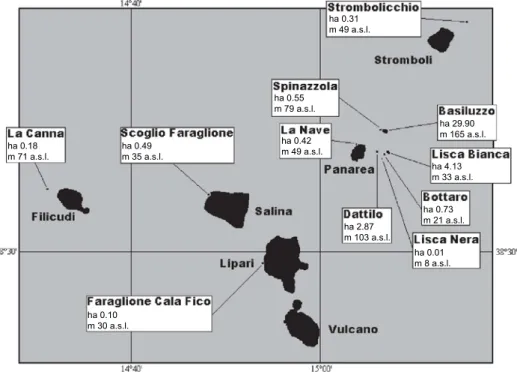
P. sicula occurs on all large islands as well as on some islets of the Aeolian Archipelago (Capula 1992, 1993, 1994a; Corti et al. 1998; Corti & Lo Cascio 1999), while P. raffonei is currently confined to one large island (Vulcano, 2120 ha), where it occurs sympatrically with P. sicula, and to three islets (Scoglio Faraglione, 0.5 ha, 0.3 km west of Salina; La Canna, 1 ha, 1.5 km west of Filicudi; Strombolicchio, 0.19 ha, 1.6 km north-east of Stromboli), where it is the only extant lacertid lizard (Capula
C. Corti, P. Lo Cascio, M. Biaggini, Mainland and insular lacertid lizards: a mediterranean perspective,
ISBN 978-88-8453-523-8 (online), ISBN 978-88-6453-122-9 (print) © 2006 Firenze University Press
Fig. 1. Adult male Podarcis raffonei antoninoi (Vulcano Island).
Fig. 2. Distribution of Podarcis raffonei in the Aeolian Islands. 1, Vulcano; 2, Scoglio Faraglione, near Salina; 3, La Canna, near Filicudi; 4, Strombolicchio, near Stromboli. Insert shows location of the Aeo-lian Islands.
et al. 2002) (Fig. 2). The following subspecies are currently recognized: P. r. raffonei
(Strombolicchio), P. r. antoninoi (Vulcano), P.r. alvearioi (Scoglio Faraglione), P. r. cucchiarai (La Canna) (Capula 1994a, b; Turrisi & Vaccaro 1998).
Because of (i) the extremely low density of P. raffonei on the smallest islets of the Aeolian Archipelago (Scoglio Faraglione, La Canna, Strombolicchio, each with an area of 2 < ha) (Capula et al. 2002, Capula & Lo Cascio 2006), and (ii) its complete absence from the large islands – with the exception of Vulcano, where the species is at present extremely rare and nearly reaching the extinction – the Aeolian wall lizard was categorised as critically endangered (Capula et al. 2002).
In this paper, the status of P. raffonei is assessed by reviewing the existing infor-mation on the genetic and morphological structure of the species, and by providing management recommendations to ensure its conservation in the Aeolian Islands.
Materials and Methods
Population heterogeneity
The genetic structure of P. raffonei populations occurring on Vulcano Island and on Scoglio Faraglione, La Canna and Strombolicchio islets was analyzed and discussed using allozyme variation data at 26 gene loci (αGpd, Ldh-1, Ldh-2, Mdh-1, Mdh-2,
Me-1, Me-2, Idh-1, Idh-2, 6Pgd, Gapd, Sod-1, Np, Got-1, Got-2, Ck, Ak, Ada, Ca,
Mpi, Gpi, Pgm-1, Pgm-2,Gp-1, Gp-2,Gp-4) provided by Capula (1994a, 2004). The genetic variability for each population and for the species as a whole was estimated using the following parameters: mean number of alleles per locus (A), percentage of loci polymorphic (P, at the 99% level), observed mean heterozygosity (Ho),
ex-pected mean heterozygosity (He) in Hardy-Weinberg equilibrium (unbiased estimate;
Nei 1978). The distribution of genetic variation within and among populations was assessed using Wright’s F-statistics (Wright 1965, 1978). The genetic relationships among the populations studied were evaluated using Nei’s (1972) standard genet-ic identity (I) and standard genetic distance (D). All genetic variability, F-statistics, and genetic distance measures were calculated by the computer program BIOSYS-1 (Swofford & Selander 1989).
Conservation status
Information concerning the conservation status and the factors affecting the sur-vival of P. raffonei is based on field investigations carried out on all large islands of the Aeolian Archipelago(Lipari, Salina, Vulcano, Stromboli, Filicudi, Alicudi, Pana-rea) and on six islets (Basiluzzo, Bottaro, Lisca Bianca, La Canna, Scoglio Faraglione,
Strombolicchio) during a 16-year research period (1989-2004). All observations were carried out during springtime (April, May) and at the end of summer (September). To describe the main causes affecting the survival of P. raffonei, data gathered from the literature concerning the species (Capula 1993, 1994a, 2004; Capula & Luiselli 1997; Capula et al. 2002; Corti & Lo Cascio 1999, 2002; Lo Cascio & Pasta 2004; Luiselli et al. 2004; Capula & Lo Cascio 2006) were also analyzed and discussed.
Results and Discussion
Population heterogeneity
The small and geographically fragmented populations of P. raffonei are character-ized by very low levels of genetic variability and by a genetic structure more subdi-vided than that of other Podarcis species studied to date. According to Capula (2004) 22 of the 26 presumptive gene loci scored (85%) were found to be monomorphic and fixed for the same allele in all the samples of P. raffonei, and four loci only (15 %) were found to be polymorphic (6Pgd, Ca, Mpi, Pgm-2).
All the analysed samples of P. raffonei show noticeably low values of polymorphism and heterozygosity (see Table 1). The overall mean number of alleles per locus was 1.05, and the proportion of polymorphic loci (P) averaged 4.8 (Capula 2004). The observed heterozygosity (Ho) showed a similar trend, ranging from 0.000 (La Canna)
to 0.018 (Vulcano) and averaging 0.011. The Aeolian wall lizard shows values of poly-morphism and heterozygosity noticeably lower than those detected in the phyloge-netically related P. wagleriana from Sicily (P = 15; Ho = 0.037; Capula 1994a) and the average ones calculated by Capula (1990) for nine species of the genus Podarcis (P = 13; Ho = 0.053). This is probably because three out of four extant P. raffonei
popula-tions occur on tiny fringing islands, each characterized by a very limited area (< 2 ha) and separated by a short linear distance and shallow channel depth from the mother island; on the other hand, the populations occurring on Vulcano Island – which is
Table 1. Genetic variability parameters in Podarcis raffonei populations. A, mean number of alleles per locus; P, mean proportion of polymorphic loci; Ho, observed mean heterozygosity; He, expected mean
heterozygosity; (SE), standard error.
Population A P Ho (SE) He (SE)
Vulcano 1.1 7.7 0.018 0.014 0.016 0.012
Scoglio Faraglione 1.0 3.8 0.008 0.008 0.008 0.008
La Canna 1.0 0.0 0.000 0.000 0.000 0.000
the only large Aeolian island inhabited by the species – are extremely fragmented and are characterized by a very small number of individuals (Capula 1994a, Capula et al. 2002). The severe reduction in genetic variability pointed out in P. raffonei was also evidenced by molecular analyses (Oliverio et al. 1998). However, it must be noted that the results by Oliverio et al. (1998) concerning the phylogenetic relationships of
P. raffonei are in disagreement with those pointed out by allozyme (Capula 1994a, b), mtDNA (Harris & Arnold 1999), and morphometric analyses (Capula etal. 2001). According to Capula (1994a, b), Harris & Arnold (1999) and Capula et al. (2001) P. raffonei is phylogenetically related to P. wagleriana, while the results by Oliverio et al.
(1998) would indicate a strict relationship between P. raffonei and P. muralis (Laurenti 1768). However, on a subsequent paper Oliverio et al. (2000) proposed a very differ-ent phylogenetic scenario, biogeographically not congrudiffer-ent neither with that reported by Oliverio et al. (1998) nor with that by Capula (1994a, b), Harris & Arnold (1999) and Capula et al. (2001), suggesting a close affinity between P. raffonei and P. til-iguerta (Gmelin 1789).
The values of standard genetic identity and genetic distance for each pairwise comparison are given in Table 2. Nei’s standard genetic distance (D) between the P. raffonei populations ranged from 0 to 0.041, averaging 0.020. Despite the large geo-graphic distance and the wide sea channel separating the islands of Vulcano, Scoglio Faraglione and La Canna, the values of genetic distance between the samples from these islands were quite low (average D = 0.0003). On the other hand, the compari-son between the Strombolicchio sample and the other Aeolian samples gave the high-est distances (average D = 0.040). The individuals of this population are characterized by a unique electrophoretic allele (Pgm-2105) and are large-sized and morphologically
recognizable from those occurring on the other Aeolian Islands (Capula et al. 2001, Capula 2004).
According to Capula (2004) the levels of genetic subdivision observed in P. raf-fonei exceded values known for other lizard species (McKinney et al. 1972, Sites & Greenbahum 1983, Sarre et al. 1990). The estimated standardized variance in gene frequency (FST) is highly significant (Capula 2004), with a value (0.610) much higher
Table 2. Values of Nei’s (1972) standard genetic identity (above the diagonal) and standard genetic di-stance (below the diagonal) among populations of Podarcis raffonei (Vu= Vulcano, SF= Scoglio
Faraglio-ne, LC= La Canna, St= Strombolicchio).
Population Vu SF LC St
Vu ---- 1.000 0.999 0.961
SF 0.000 ---- 1.000 0.961
LC 0.001 0.000 ---- 0.960
----than those calculated by Capula (1994a, 1996) for the related insular lacertid lizards
P. wagleriana (FST = 0.153) and P. tiliguerta (FST = 0.460), and very high for vertebrates in general (Gorman et al. 1975, Wright 1978, Ragghianti & Wake 1986). These data are congruent with the results of the geometric morphometric analyses (Capula et al. 2001). According to the landmark based morphometric analyses of the dermal skulls of twentytwo adult males Podarcis raffonei from the four islands of the Aeolian Archi-pelago (Capula et al. 2001), the P. raffonei populations are morphologically highly differentiated to each other (see, e.g., Fig. 3). This is probably due to geographic isola-tion of populaisola-tions in different islands, and to genetic drift and effects.
Genetic and morphometric data (Capula et al. 2001, Capula 2004) indicate that geographic variation in P. raffonei is distributed into two population groups. The first group includes the very close populations from the southern (Vulcano) and west-ern (La Canna, Scoglio Faraglione) Aeolian Islands; the second group includes the populations from Strombolicchio, off the north-eastern coast of Stromboli, i.e. the northernmost island of the Aeolian Archipelago. Genetic variability is very low, and genetic and morphometric subdivision is high. According to these results the subspe-cies antoninoi and cucchiarai should be synonymized with alvearioi. Therefore the following subspecies should be now recognized: P. r. raffonei (Strombolicchio), P. r. alvearioi (Vulcano, La Canna, Scoglio, Faraglione).
Fig. 3. Ordination of adult males P. raffonei (circle: Strombolicchio, n = 5; square: Scoglio Faraglione, n = 3; rhombus: Vulcano, n = 5) along the first two relative warps (RW1, RW2; 31.07% and 25.50% of vari-ation explained respectively) for the cranial dermal skulls (see Capula et al. 2001 for more information).
Conservation status
Investigations carried out by Capula et al. (2002) and Capula (2004) in the Aeo-lian Islands gathered evidence strongly indicating that the endemic P. raffonei is close to extinction. According to these authors, each of the three tiny islands inhabited only by P. raffonei supports a very small number of lizards (Strombolicchio and Scoglio Faraglione: 200-400 individuals; La Canna: 20-30 individuals; Capula & Lo Cascio 2006). On the other hand, on Vulcano the species occurs in two localities only, and it is nearly reaching extinction probably because of competitive exclusion by the very abundant lizard P. sicula (Capula 1993, Capula et al. 2002, Capula & Lo Cascio 2006, Capula unpublished personal observations). Direct evidence for the decline of the Aeolian wall lizard is scarce because there are no previous data (i.e. prior to 1994) on the original distribution and demography of the species, but the decline is indicat-ed indirectly by several factors. According to Capula et al. (2002) and Capula (2004), six main pressures on the species can be listed as contributory factors to extinction: (1) habitat alteration (fire, over-grazing, agricultural practices, touristic activities); (2) competitive exclusion by the lacertid lizard P. sicula, introduced by humans in histori-cal times; (3) collecting and trade; (4) very low population density and inbreeding; (5) very reduced gene flow between populations, due to high geographic fragmentation and isolation; (6) apparent decline in genetic variability. The amount of genetic vari-ation is believed to be positively correlated to fitness (Lande 1988, Lynch 1996), and so the small populations of P.raffonei are genetically highly vulnerable to environmen-tal changes and human impacts. All of the above factors probably affect the survival of this insular species and underline the urgent need for implementation of conservation measures (Reid & Miller 1989).
Podarcis raffonei and its habitat are still not protected by the Italian law or by any international convention concerning conservation and protection of vertebrate fauna. The species requires urgent protection as it can be considered the most threatened liz-ard in Italy and possibly in the whole Europe (Capula et al. 2002, Corti & Lo Cascio 2002, Lo Cascio & Pasta 2004). Podarcis raffonei may yet be saved from extinction if the following recommendations are acted upon:
• The last wild populations should be officially protected as soon as possible by cre-ating natural reserves.
• Collection and trade for commercial purposes should be forbidden by full legal protection to reduce the risk of depletion of wild populations.
• Habitat conservation measures should be instigated by monitoring and managing areas where the natural habitat of the species still persists.
• Control of the presence of alien fauna and prevention of intentional or accidental introductions of predators (e.g.Hierophis viridiflavus) and competitor species (e.g. Podarcis sicula) is required.
• Continuity of scientific studies on relict populations should be promoted in order to document annual fluctuations in population parameters.
• It is necessary to avoid habitat stress on the islands inhabited by the species and to provide for habitat restoration.
• It is necessary to prevent gene flow between islands.
• Since the existing wild populations are composed by a small number of individuals and thus are vulnerable to stochastics impacts, it is urgent to plan captive breeding programmes.
• Documented gene banks should be established adjacent to protected areas by cre-ating effective ex situ populations (IUCN 1998).
• Podarcis raffonei should be included in the IUCN Red List of Threatened Species as “Critically Endangered” (see Capula et al. 2002; Capula & Lo Cascio 2006).
Acknowledgements
The author is gratefully indebted to Arianna Ceccarelli (Roma), Sara Chiantini (Roma), and Ernesto Filippi (Roma) for direct help in the field and technical help in the laboratory. Particular thanks are due to Claudia Corti (Firenze), Luca Luiselli (Roma), and Pietro Lo Cascio (Lipari) for providing useful information, documents and helpful comments on the manuscript.
References
Capula M. 1990. Struttura genetica di Podarcis sicula, P. wagleriana e P. filfolensis: aspetti tassonomici ed evolutivi (Reptilia, Sauria, Lacertidae). Tesi di Dottorato, Dottorato di Ricerca in Biologia Animale, Università degli studi di Bologna, Bologna, pp. 354. Capula M. 1992. Competitive exclusion between Podarcis lizards from Tyrrhenian
islands: Inference from comparative species distributions, pp. 89-93. In: Korsós Z. & Kiss I. (eds). Proceedings of the Sixth Ordinary General Meeting of the Societas Europaea Herpetologica. Budapest.
Capula M. 1993. Natural hybridization in Podarcis sicula and P. wagleriana (Reptilia: Lacertidae). Biochemical Systematics and Ecology 21: 373-380.
Capula M. 1994a. Genetic variation and differentiation in the lizard, Podarcis wagleria-na (Reptilia: Lacertidae). Biological Journal of the Linnean Society 52: 177-196. Capula M. 1994b. Evolutionary relationships of Podarcis lizards from Sicily and the
Maltese Islands. Journal of Zoological Systematics and Evolutionary Research 32: 180-192.
Capula M. 1996. Evolutionary genetics of the insular lacertid lizard Podarcis tiliguer-ta: genetic structure and population heterogeneity in a geographically fragmented species. Heredity 77: 518-529.
Capula M. 2004. Low genetic variation in a critically endangered Mediterranean lizard: conservation concerns for Podarcis raffonei (Reptilia, Lacertidae). Italian Journal of Zoology 71, Suppl. 1: 161-166.
Capula M. Chiantini S. & Loy A. 2001. Geometric morphometrics and geographic variation in the insular lacertid lizards Podarcis raffonei, P. sicula and P. wagleriana. 11th Ordinary General Meeting of Societas Europaea Herpetologica (SHE), Zalec,
Slovenia, July 13-17, 2001, Abstracts, Biota, 2, Supplement: 58.
Capula M. & Lo Cascio P. 2006. Podarcis raffonei, pp. 480-485. In: Sindaco R., Doria G., Razzetti E. & Bernini F. (eds). Atlante degli Anfibi e dei Rettili d’Italia / Atlas of Italian Amphibians and Reptiles, Sindaco R., Doria G., Razzetti E., Bernini F. (eds), Societas Herpetologica Italica, Edizioni Polistampa, Firenze.
Capula M. & Luiselli L. 1997. Population dynamics of Podarcis raffonei. Herpetology ’97, Abstracts of the Third World Congress of Herpetology, 2-10 August 1997, Prague: 246.
Capula M., Luiselli L., Bologna M.A. & Ceccarelli A. 2002. The decline of the Aoelian wall lizard, Podarcis raffonei: causes and conservation proposals. Oryx 36: 66-72. Corti C. & Lo Cascio P. 1999. I lacertidi italiani. L’Epos, Palermo, pp. 87.
Corti C. & Lo Cascio P. 2002. The Lizards of Italy and Adjacent Areas. Chimaira Verlag, Frankfurt-am-Main, pp. 165.
Corti C., Lo Cascio P., Vanni S., Turrisi G.F. & Vaccaro A. 1998. Amphibians and reptiles of the circumsicilian islands: new data and some considerations. Boll. Mus. Reg. Sci. Nat. Torino 15 (1997): 179-211.
Gorman G.C., Soulé M., Yang S.Y. & Nevo E. 1975. Evolutionary genetics of insular Adriatic lizards. Evolution 29: 52-71.
Harris D.J. & Arnold E.N. 1999. Relationships of wall lizards, Podarcis (Reptilia: La-certidae) based on mitochondrial DNA sequences. Copeia 1999: 749-754. IUCN 1998. Guideliness for Re-introductions. Prepared by the IUCN/SSC
Re-intro-duction Specialist Group, Gland, Switzerland, and Cambridge, United Kingdom. Lande R. 1988. Genetics and demography in biological conservation. Science 241:
1455-1460.
Lo Cascio P. & Corti C. 2004. The micro-insular distribution of the genus Podarcis
within the Aeolian Archipelago: a possible historical interpretation, pp. 23-24. In: Corti C. & Lo Cascio P. (eds). Abstract book of the 5th International Symposium on the Lacertids of the Mediterranean Basin, Firenze University Press, Firenze. Lo Cascio P. & Pasta S. 2004. Il patrimonio biologico del Isole Eolie: dalla conoscenza