Solid-State Dynamics and Education
(http://www.eduphys.ethz.ch/)Head
Prof. Dr. A. Vaterlaus
Academic Staff
Dr. Yves Acremann Audra Baleisis Andreas Fognini Dr. Christian Helm Andreas Lichtenberger Dr. Thomas Michlmayr Martin Mohr Gerard Salvatella-Orgilles Dr. Guillaume Schiltz Dr. Clemens Wagner
Master Students
Christoph Wetli
Technical Staff
54 Solid-State Dynamics and Education
6.1 Formative Assessment in High School Teaching of Physics
A. Lichtenberger, C. Wagner, A. Vaterlaus
Among a few other techniques formative assessment has been recognized as one of the most promising tools to improve teaching. It has a very broad definition, which has been recently summarized in five tenets (D. Wiliam in ”The Nature of Learning”. Edited by Dumont H, Istance D, Benavides F, OECD, 2010.)
1. Engineering classroom activities that elicit evidence of learning
2. Clarifying, sharing and understanding learning intentions and criteria for success 3. Providing feedback that moves learners forward
4. Activating students as instructional resources of each other 5. Activating students as owners of their own learning
Based on these tenets we have derived a model of formative assessment, which can be applied to high school teaching of physics. It consists of four different strategic lines (see Fig.6.1).
Figure 6.1: Model of formative assessment. It is composed of four lines, the formative classroom activities (fostering conceptual thinking), the monitoring tool (students self-assessment), the diagnostic tool (detection of misconceptions) and the formative use of summative assessment.
First, regular instructions have to be supplied with formative classroom activities. These activities pursue different goals. They provide direct feedback for the student about how he has absorbed the new material. The teacher immediately gets feedback about the effectiveness of his instructions. However, since formative activities focus on concept learning they also shift the teaching goal from solving numerical problems towards understanding physics concepts. Central to formative assessment is that students self-assess their own learning. It is important that students can estimate the difference between their actual knowledge and the learning goals. To support this kind of self-reflection we develop a monitoring tool, which allow the students to assess the difference in an easy and efficient manner. The diagnostic tool is used to verify the impressions about teaching and learning teachers and students have. It is designed to detect the proper acquisition of concepts, however, also misconceptions are detected, which are still present. To eliminate the misconception all applications of a diagnostic tool are followed by a reflective lesson. During these lessons students have time to work on specific concepts and to catch up. The detailed analysis of concept knowledge and misconceptions is one of the main goals in our implementation of the model. Not only students get an individual feedback but also the teacher gets a feedback about the performance of the class. This feedback should be used to remove ambiguities from teacher’s instructions to make them as clear as possible.
6.2 A model of concept learning
C. Wagner
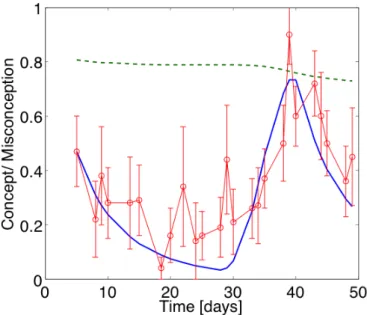
In order to get a better understanding of concept learning and in particular of misconception unlearning we started to model this transition. Our new approach consists of two variables, one for the concept and one for the misconception. The evolution of a concept has a learning term and an unlearning term. The same also holds for the evolution of mis-conceptions. However, learning of concepts is hampered in the presence of strong misconceptions and misconceptions foster the unlearning of concepts. In contrast, solid concepts suppress the development of misconceptions. Putting these conditions into mathematical terms we get a model to simulate the transition from a high misconception and a low concept level (misconception fixed point) to a low misconception and a high concept level (concept fixed point). The model was then fitted to a data set recorded by Andrew Heckler and Eleanor Sayre (Am. J. Phys. 78 (2010) 768-777). The authors investigated concept learning at the undergraduate level at the University of Ohio. Every few days different students (in the average 12) were asked to solve the same problem in electric circuit theory. We used the time course of concept learning to determine the parameters of the model (see Fig.6.2).
Figure 6.2: Concept learning. Data points (red circles) are obtained by A. Heckler et al. The blue line corresponds to the fitted concept level whereas the green dashed line represents the misconception level. Lecturing electric circuit theory took place between day 28 until day 39.
56 Solid-State Dynamics and Education
6.3 E-Learning and teaching support
G. Schiltz, A. Vaterlaus
6.3.1 Strategic activities
21 courses have been supplemented by the learning management system Moodle in 2011. 12 introductory lectures (service and internal), 4 teacher training courses and 5 MSc lectures with a total of 3575 students were affected. Moodle was mainly used to support the course organization and to serve as a repository for course material. For some lectures, however, supplementary pedagogical scenarios, such as self-assessment tests, formative evaluations and collaborative tasks have been set up. Two training sessions, one for teaching assistants in exercise classes and one for teaching assistants in laboratory classes have been developed and carried out in 2011 by members of the LFKP in co-operation with the LET (Lehrentwicklung und Technologie). 18 participants successfully participated in these courses.
6.3.2 Innovedum/Filep projects
The following projects ended in 2011. Based on the positive results achieved during the funding period, all of them are now transferred to the regular teaching portfolio.
• ”Fachdidaktik II” (A. Vaterlaus).
• ”Erweiterte Physik-Vorlesungsexperimente” (B. Batlogg). • ”Br¨uckenpodcast” (W. Wegscheider).
6.3.3 Learning support
Concept questions as formative assessment tools were successfully used in 5 lectures (fig6.3).
Figure 6.3: Students answering concept questions with flash cards
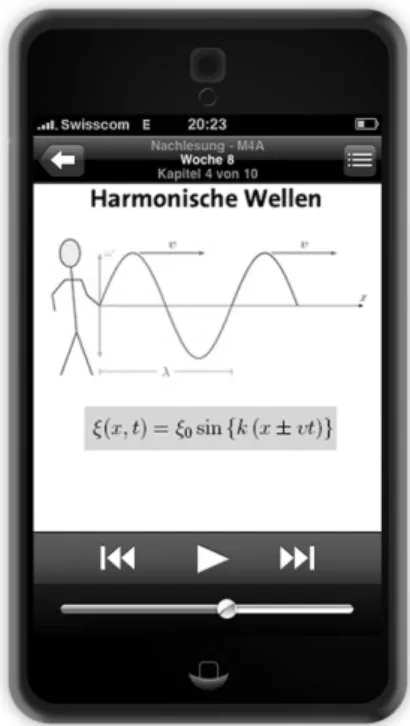
Summary podcasts (audio/visual weekly summary) were provided for 4 lectures (fig6.4).
6.3.4 Promotion and Network
The teaching activities pursued at the department have been communicated to a greater public (3 conference presen-tations, 2 community presentations). Results related to the summary podcasts were discussed in two publications: Schiltz, G. / Br¨andle U. / Reinhardt, A. / Valkering, M. (2011) Lehr- und Lerntechnologie an der ETH Z¨urich. In:
Figure 6.4: Weekly summary podcast on iPhone
Dittler U. (ed.): E-Learning: Einsatzkonzepte und Erfolgsfaktoren des Lernens mit interaktiven Medien, 3rd edition. M¨unchen: Oldenbourg, p. 35-47. Schiltz, G. (2011) Bridging lectures with summary podcasts. In: Yu, Fu-Yun et al. (eds.): Proceedings of the 19th International Conference on Computers in Education ICCE 2011: November 28, 2011 - December 2, 2011 : Chiang Mai, Thailand. Chiang Mai: National Electronics and Computer Technology Center, p. 771-773.
58 Solid-State Dynamics and Education
6.4 Ultrafast demagnetization observed by spin resolved photoemission spectroscopy
A. Fognini, T. Michlmayr, G. Salvatella, C. Wetli, U. Ramsperger, Y. Acremann, A. Vaterlaus in collaboration with
C. Stamm, M, Beye, A. Eschenlohr, A. F¨ohlisch (Helmholtz Zentrum Berlin) F. Sorgenfrei, M. Dell’Angela, W. Wurth (University of Hamburg)
N. Gerasimova (DESY)
S. de Jong, R. Kureja, A. Scherz, J. St¨ohr, H.A. D¨urr (SLAC) J. Raabe (PSI)
G. Sch¨onhense (University of Mainz)
Magnetism and its dynamical properties are at the basis of our information society. On long time scales and large length scales ferromagnetic cores of transformers prove essential for the electric power grid. On the nanosecond and nanometer scale magnetic domains are used to store information on hard disk drives. One of the forefront areas in modern magnetism is the use of ultrashort infrared or optical photon pulses to manipulate the magnetization. It has been observed that the magnetization of a ferromagnet seams to drop within less than a picosecond after excitation by a femtosecond laser pulse. This phenomenon is surprising as demagnetization requires the transfer of angular momentum from the spin system to the lattice of the solid. At room temperature the spin orbit coupling is expected to be too weak to explain ultrafast demagnetization.
Since optical photons trigger the sample through electronic excitations, the fundamental questions revolve around the processes and timescales associated with energy and angular momentum transfer between the three fundamental thermodynamic reservoirs of the sample: the electronic system, the spin system and the lattice. The sum of the magnetic moment of all the electrons forms the magnetization, which is macroscopically measurable. Only a small fraction of the electrons close to the Fermi energy is relevant for the transport aspects of magnetism. These electrons cause phenomena like giant resistance and the optical Kerr effect. In thermal equilibrium magneto-optical Kerr measurements show the spin polarization of electrons close to the Fermi energy, which is proportional to the magnetization of the solid. In the case of ultrafast demagnetization processes it is not clear if the electrons close to the Fermi energy loose their spin polarization at the same time as all the other valence electrons.
The most direct way of measuring demagnetization processes is to detect the spin polarization of photoelectrons. All other optical methods like magneto-optical Kerr as well as circular dichroism measurements depend on the delicate band structure of the valence band, which is altered by the infrared pump beam. In contrast spin polarized photo-electron spectroscopy offers direct insight into the true magnetization of the ferromagnet. In order to obtain a reliable measure of the magnetization, which is a Brillouin zone average over all filled spin polarized band states, one needs to employ high-energy ”probe” photons in the form of the soft x-rays available at a free electron laser (FEL). As spin is conserved in elastic photoemission with linearly polarized radiation, the spin polarization of the elastic valence electrons provide an accurate measure of the magnetization, or more precisely, a measurement of the spin part of the magnetization.
In our experiment a ferromagnetic sample is exposed to a 800 nm pump laser beam. The pump pulse of 100 fs duration excites a 10 nm Fe film serving as the magnetic sample. After a variable time delay the probe pulse from the free electron laser in Hamburg (FLASH) excites photoelectrons from the sample (see figure6.5). As the FEL probe pulse has a photon energy of 180 eV it excites electrons from the valence band and core electrons. As the high energy electrons scatter with valence electrons on the way to the surface a cascade of lower energy electrons is created. This cascade carries an average spin polarization of the valence band. In order to measure the spin polarization of the photoelectrons a Mott spin polarimeter is used.
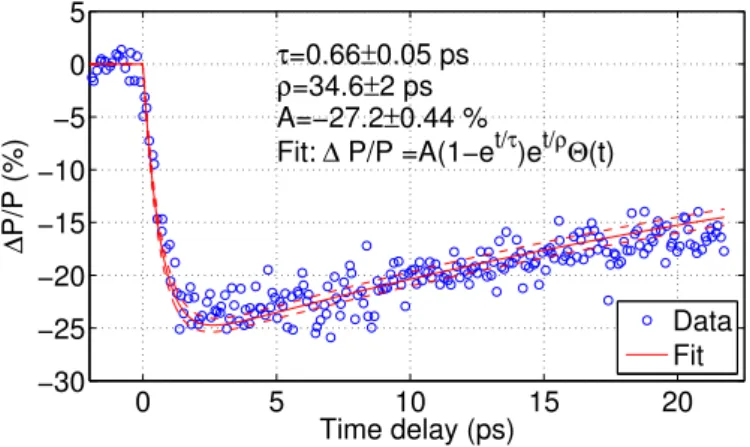
In 2011 we had two beam times at FLASH. During our first beamtime at FLASH in March 2011 we successfully demonstrated the feasibility of time and spin resolved photoemission experiments using FEL radiation. This exper-iment had the goal of confirming the existence of ultrafast demagnetization processes in iron. The FEL induced photoelectrons were collected by an electrostatic lens and transferred into the Mott spin polarimeter. As this exper-iment did not contain an energy filter the detected electrons were mostly part of the cascade. Figure6.6 shows the time dependence of the spin polarization after demagnetization by the 800 nm laser pulse. The spin polarization drops
800 nm pump and FEL probe energy analyzer coil Mott spin polarimeter
sample
channel electron multipliers
Figure 6.5: Principle of the experiment: The ferromagnetic sample is exposed to the laser pump beam followed by the FEL pulse. The pump- and probe beams are collinear. The FEL pulse photo-excites electrons which are energy analyzed and accelerated into the Mott spin polarimeter. The spin polarization is measured along the magnetization direction of the sample.
0 5 10 15 20 −30 −25 −20 −15 −10 −5 0 5 Fit: ∆ P/P =A(1−et/τ)et/ρΘ(t) τ=0.66±0.05 ps ρ=34.6±2 ps A=−27.2±0.44 % ∆ P/P (%) Time delay (ps) Data Fit
Figure 6.6: Results from our first beamtime at FLASH in March 2011. The spin polarization drops as a function of the pump probe delay time within less than a picosecond. As more data points were taken on the transition, the noise level is smaller around zero delay time than for longer delay times. The time resolution is limited by the timing jitter between the FEL and the 800nm laser, which will be improved.
within less than a picosecond and slowly recovers on the 100ps time scale. This clearly demonstrates the feasibility of time and spin resolved photoemission experiments and shows that the magnetization indeed drops within less than a picosecond after excitation. Here we are not just looking at the spin polarization of electrons close to the Fermi energy, but at the cascade electrons which represent an average of the whole valence band.
For our second beam time in July 2011 we added a hemispherical electron energy analyzer to the experimental setup. This way we can select the energy of the photoelectrons before detection in the Mott spin polarimeter. For future experiments we intend to detect the demagnetization effect for different parts of the valence band. During the second beam time the timing diagnostic system at FLASH was improved so we achieved a higher temporal resolution than during the first beam time. We can see that the spin polarization of the cascade electrons decays within less than 100 fs after excitation by the pump pulse.