EDEXCEL NATIONAL CERTIFICATE
UNIT 10:
PROPERTIES AND APPLICATIONS OF ENGINEERING
MATERIALS
NQF LEVEL 3
OUTCOME 2 - TUTORIAL 2
PROPERTIES and PROCESSING OF MATERIALS
2 Understand material properties and the effects of processing on the structure and behaviour of engineering materials
Mechanical properties: strength (tensile, shear, compressive); hardness; toughness; ductility; malleability; elasticity; brittleness
Physical properties: density; melting temperature
Thermal properties: expansivity; conductivity
Electrical and magnetic properties: conductivity; resistivity; permeability; permittivity
Effects of processing metals: recrystallisation temperature; grain structure e.g. hot working, cold working, grain growth; alloying elements in steel e.g. manganese, phosphorous, silicon, sulphur, chromium, nickel
Effects of processing thermoplastic polymers: polymer processing temperature; process parameters e.g. mould temperature, injection pressure, injection speed, mould clamping force, mould open and closed time
Effects of processing thermosetting polymers: process parameters e.g. moulding pressure and time, mould temperature, curing
Effects of processing ceramics: e.g. water content of clay, sintering pressing force, firing temperature
Effects of processing composites: fibres e.g. alignment to the direction of stress, ply direction; de-lamination; matrix/reinforcement ratio on tensile strength; particle reinforcement on cermets
Effects of post-production use: smart materials e.g. impact (piezoelectric), electric field (electro-rheostatic), magnetic field (magneto-(electro-rheostatic), temperature (shape memory alloys), colour change (temperature or viscosity)
CONTENTS
1. Electrical Conductivity and Resistivity. 2. Magnetic Properties.
3. Dielectric Properties.
4. Thermal Properties.
Melting Temperature
5. Ceramics.
6. Sintering and Powder Technology
7. Composites (Cermets, particle and fibre).
1. ELECTRICAL PROPERTIES
ELECTRICAL CONDUCTIVITY
In electric theory the current flowing through a resistor is governed by Ohms Law V = IR where V is the voltage difference between the terminals, I the current flowing between the terminals and R the resistance measure in Ohms. Resistance creates and dissipates heat and the power lost as heat is P = I R Watts.
Electronic resistors are manufactured have a specific resistance to a given degree of accuracy. They are manufactured to withstand various degrees of heat and temperature as well as environmental conditions. Here are some examples of resistors used in electronics.
There are instances where the heat generation is desirable such as in electric heaters. In other instances resistance is undesirable such as in electric wire transmission lines.
Often we need a material that does not conduct electricity so that electric conductors are insulated
from the surroundings for safety. This might be the insulation on a conductor wire or the materials of electric tools and equipment. Fixed insulators for high voltage work like those shown below will be made from ceramics while others working at low voltages are often made of plastic. Here are some examples of electric insulators.
Resistivity (also called volume resistivity) is a property that allows us to calculate the resistance of a uniform length of material. The best conductor of electricity is silver but this is too expensive for use as wiring in homes and factories so copper is the best compromise followed by aluminium. The
For reference here is a table of approximate resistivity values of materials.
Name electrical resistivity
ρ Ω m CONDUCTORS Aluminium 26.5 x 10⁻⁹ Brass (70Cu/30Zn) ≈80 x 10-9 Bronze (90Cu/10Sn) 300 x 10-9 Carbon ≈ 8 x 10⁻⁴ Cobalt 60 x 10-9 Copper 17 x 10-9 Gold 24 x 10-9 Iron, pure 100 x 10-9 Lead 210 x 10-9 Nickel 590 x 10-9 Platinum 110 x 10-9 Silver 16 x 10-9 Sodium 45 x 10-9 Steel, mild 150 x 10-9 Tin 110 x 10-9 Titanium 530 x 10-9 Zinc 59 x 10-9 RESISTANCE WIRE
Constantan (45 Ni/55 CU) 470 x 10-9 Nichrome (80Ni/ 2 Cr) 1.1 x 10⁻⁶ INSULATORS Glass 1 x 10¹² Mica 9 x 10¹³ Quartz (fused) 10.5 x 10¹⁷ Rubber 1 x 10¹³ PET 1 x 10²⁰ Teflon 1 x 1024 Polycarbonate 1 x 10¹³
It should be remembered that materials chosen for their electrical resistivity are also chosen for their other properties such as cost, ease of manufacture, melting point and ability to survive environmental and operating conditions. For example oxide films on the surface of materials like copper and aluminium can produce a high resistance to electric current.
Most materials will break down and conduct when the voltage exceeds a certain value (the
breakdown voltage). Air for example will ionise and conduct and this is seen as arcing. Transformers contain oil for cooling purposes and the oil must insulate the windings but will breakdown at a certain level.
SELF ASSESSMENT EXERCISE No.1
1. Calculate the resistance of a copper wire 5 m long and 0.3 mm diameter. The resistivity is 1.7 x 10⁻⁸ Ohm metre. (Answer 1.202 )
2. Calculate the resistance of a nichrome wire 2 m long and 0.2 mm diameter given = 108 x 10-8
(Answer 68.75 )
3. The heating element of a 1 kW electric heater is a bar made from SILICA that encapsulates a spiral resistance wire that generates the heat. What would be a suitable material for the wire? What are the properties required from the wire and the silica?
4. What would be the ideal properties of a material for the body of an electric hand drill? Suggest a suitable material.
5. In electrical equipment that requires high reliability, the pins and sockets of plugs and connectors are gold plated. Why is this?
2. MAGNETS
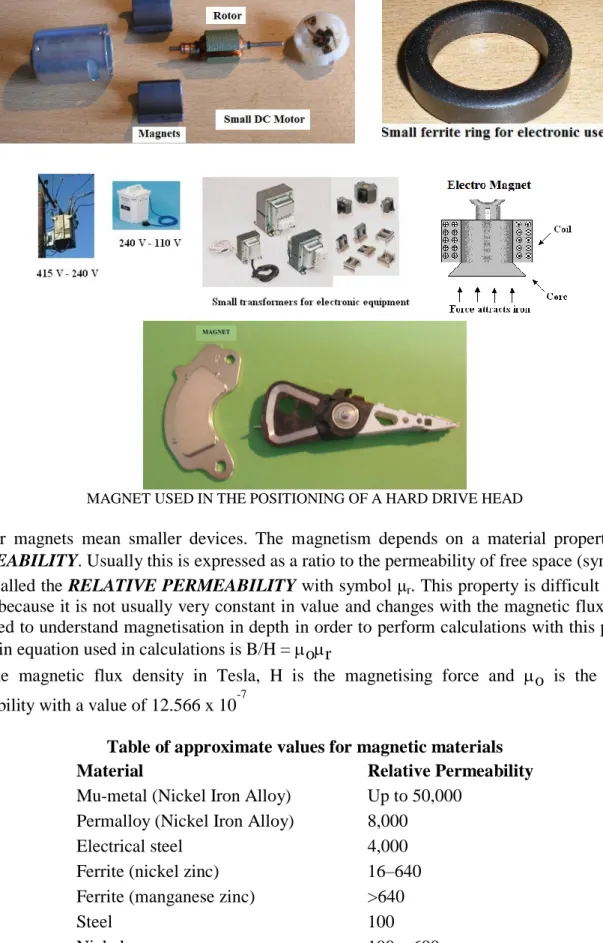
Magnetic devices are widely used as either permanent magnets or electro-magnets in a diverse range of items including electric transformers, motors, generators, electro-magnets, loud speakers, computer drives, audio devices and fridge magnets.
MAGNET USED IN THE POSITIONING OF A HARD DRIVE HEAD
Stronger magnets mean smaller devices. The magnetism depends on a material property called
PERMEABILITY. Usually this is expressed as a ratio to the permeability of free space (symbol o) and is called the RELATIVE PERMEABILITY with symbol μr. This property is difficult to list as a table because it is not usually very constant in value and changes with the magnetic flux density. You need to understand magnetisation in depth in order to perform calculations with this property. The main equation used in calculations is B/H = or
B is the magnetic flux density in Tesla, H is the magnetising force and o is the absolute permeability with a value of 12.566 x 10⁻⁷
Table of approximate values for magnetic materials
Material Relative Permeability
Mu-metal (Nickel Iron Alloy) Up to 50,000 Permalloy (Nickel Iron Alloy) 8,000
Electrical steel 4,000
Ferrite (nickel zinc) 16–640
The main magnetic material is Iron used to make steel and ferrite. The permeability depends very much on the structure and composition of the alloy. When choosing a magnetic material you need to consider the cost, the way it will be formed and the environmental conditions it will be used in. There are a range of magnetic materials that go under various names. Rare earth metals are used to make small powerful magnetic devices and gets its name from the section of the periodic tables called rare earth elements. The following is a summary of some of the materials.
Alnico Magnets - A magnetic alloy largely made from Aluminium, Iron, Cobalt and Nickel. This is a relatively low cost material. It can be used at high operating temperatures and has very good corrosion resistance.
Rare Earth Magnets – made from Samarium, Cobalt, Neodymium, Iron and Boron. Both Samarium Cobalt and Neodymium magnet alloys are powdered metals which are compacted in the presence of a strong magnetic field and are then sintered.
Neodymium Magnets (Rare Earth) - or Neo, is made up of Neodymium, Iron and Boron and is moderate in price but has poor corrosion resistance so they usually have a protective coat. They are only used at 80°C to 200°C. Premium grade versions are quite expensive. This magnetic material is extremely powerful and its use in Hard Disc Drives and motors has resulted in much miniaturisation. Neodymium permanent magnets usually offer the best value when comparing price and performance.
Samarium Cobalt Magnets (Rare Earth) - made up largely of Cobalt and Samarium. Because it is difficult to process it is the most expensive of the rare earth magnets. This permanent magnetic material offers high resistance to corrosion and it can withstand high operating temperatures, up to 350°C. Samarium Cobalt magnetic materials are used extensively in the aerospace market or in areas of industry where performance is the priority concern and cost is secondary. Samarium Cobalt magnets is the second most powerful magnetic material and it exhibits excellent resistance to demagnetization.
Ceramic Magnets (Ferrite) – made from Strontium and Ferrite. Ferrite is one of the most cost effective magnetic materials manufactured in industry. The low cost is due to the cheap, abundant raw materials used to make large quantities of products.
Bonded Magnets - made from Ceramic, Neodymium, Iron, Boron or Samarium and Cobalt powders which are bonded in a plastic matrix. They can be formed by injection or compression moulding into accurate complex shapes. Bonded magnet materials have a moderate resistance to corrosion and a low tolerance to heat because of the binder material. Bonded magnet materials are commonly used in automotive parts because they lend themselves to large production quantities and complex shape can be produced at a low cost.
Flexible Magnets (Rubber) - manufactured by mixing Ferrite or Neodymium magnet powders with synthetic or natural rubber and rolling or extruding them. They are versatile and low cost. Applications are micro-motors, gaskets, novelties, signs, and displays. Ferrite flexible magnet material is very low energy and it does not usually replace fully dense magnet materials. Flexible Neodymium material is higher in strength, but is made in limited quantities and the cost is high.
SELF ASSESSMENT EXERCISE No. 2
1. Calculate the permeability of a ferrite material with a relative permeability of 250.
(314.15 x 10⁻⁶)
Do some research in order to answer the following questions.
2. What kind of material is used to make the cores of large electric transformers? 3. Which magnetic material would be used to form the core of inductor?
4. Which magnetic material would be used to form a flat flexible fridge magnet? 5. Which magnetic material is commonly used to make electric guitar pickups? 6. Which magnetic material is commonly used in computer hard disc drives?
3. PERMITTIVITY
This is a property that governs how much static electricity (electro-static charge) can be stored on an electric capacitor. It is usually expressed as the ratio to the value for free space (symbol εo). The main equation used in calculations with this property is C = εoεrA/d
C is the capacitance in Farads and A the area of the capacitor plates and d the distance between them. εo is the absolute permittivity with a value of o =8.85 x 10⁻¹²
Capacitors are used in many electronic devices. The pictures show a few examples. In basic form it is two parallel conducting plates separated by a material called a dielectric. It is the permittivity of the dielectric that governs the charge stored. Increasing the permittivity increases the charge that can be stored so high values mean smaller devices.
Here is a table of some common materials.
MATERIAL r Free Space 1.000 Air 1.006 Paper 2 approx. Glass 7 approx. Mica 4 approx. Ceramic 6 approx. Plastics various
The pictures show a range of electronic capacitors.
An ideal dielectric will have a very high resistance so the resistivity and breakdown voltage is also very important.
SELF ASSESSMENT EXERCISE No. 3
1. Calculate the permittivity of a mica with a relative permittivity of 6.
(53.1 x 10⁻¹²)
Do some research in order to answer the following questions. 2. What kind of dielectric material has high breakdown voltages?
3. If a simple capacitor has two metal plates separated by air. A mica sheet is inserted between the plates. What will be the affect on the capacitance value?
4. THERMAL PROPERTIES MELTING POINT
This is the temperature at which the material melts. THERMAL CONDUCTIVITY
This is a property that governs how well a material conducts heat. The formula for the heat flow rate conducted through a wall of area A is given by the following formula.
= λ A /t
is the heat flow rate in Watts. λ is the thermal conductivity in W/m K t is the thickness of the wall.
is the temperature difference between the two sides of the wall.
As with electrical conductivity, sometimes we need materials that are good conductors and sometimes we need good insulators. Good conductors are needed for heat exchangers and good insulators are needed for lagging and insulating buildings.
Typical Heat Exchanger Design Roofing Insulation THERMAL PROPERTIES OF COMMON MATERIALS You will find a full table on the web site www.freestudy.co.uk under resources.
Name Melting Point
Tm K
Specific Heat c J/kg
Coeff. Of Linear
expansion α 1/K Thermal Conductivity λ W/mK Aluminium 932 913 23 x 10-6 201 Copper 1356 385 17 x 10-6 385 Iron, pure 1810 106 12 x 10-6 80 Steel, mild 1700 420 15 x 10-6 63 Alumina, ceramic 2300 800 9 x 10⁻⁶ 29 Brick, building 9 x 10⁻⁶ 0.6 Carbon, graphite 3800 710 7.9 x 10⁻⁶ 5.0 Concrete 3350 12 x 10-6 0.1 Glass wool 1400 670 0.04 Kapok 0.03 Melamine formaldehyde 1700 40 x 10-6 0.3 Nylon 470 1700 100 x 10-6 0.25 Polystyrene 510 1300 70 x 10-6 0.08 Wood, oak (with grain) 0.15
WORKED EXAMPLE No. 1
Calculate the heat transfer through a flat copper plate 200 mm tall by 300 mm wide and 25 mm thick when the surface temperatures are 150oC and 55oC.
SOLUTION
W 780 87 0.025 55 150 0.3 x 0.2 x 385 t θ θ A Φ h c SELF ASSESSMENT EXERCISE No. 4
1. Which one of the materials listed in the table is the best conductor and which the best insulator? 2. A heat exchanger is used to heat water on the outside of the tubes with hot gas on the inside of
the tubes. Think of 4 properties that the tube material must have in order to do this successfully for a long period of time. Suggest a suitable material.
3. Calculate the heat loss through a flat sheet of glass 2 m x 1 m and 5 mm thick when the surface temperatures are 20oC and 5 oC. (Answer 6 kW)
4. Find and name a suitable material for insulating the loft of a house. What other important property would it need besides insulation?
5. Insulated freight containers for transporting refrigerated goods usually have walls made from Glass Fibre skins separated by a layer of insulation. Find out what a suitable material would be for this.
THERMAL EXPANSION
When solids and liquids are heated, the molecules vibrate more and take up more space so the material expands. Consider first the expansion in one direction.
If a bar of material of length Lo has its temperature increased by degrees, the increase of length is L.
This is directly proportional to the original length L and to the temperature change . It follows that :-
L = constant x Lo
The constant of proportionality is called the coefficient of linear expansion ().
L = Lo
WORKED EXAMPLE No. 2
A thin steel band 850 mm diameter must be expanded to fit around a disc 851 mm diameter. Calculate the temperature change needed. The coefficient of linear expansion is 15 x 10-6 per oC SOLUTION
Initial circumference of ring = D = x 850 = 2670.35 mm Required circumference = x 851 = 2673.50 mm L = 2673.50 - 2670.35 = 3.15 mm L = L 3.15 = 15 x 10-6 x 2670.35 x = 3.15/(15 x 10-6 x 2670.35) = 78.6 Kelvin SUPERFICIAL EXPANSION
This is about the change in area of a flat shape. Consider a flat plate of metal with area Ao. The change in area is ΔA and this is directly proportional to the temperature change so:-
A = constant x Ao The constant is the coefficient of superficial expansion β
A = β Ao Note β = 2α
WORKED EXAMPLE No. 3
A steel sheet has an area of 500 cm2 at 20oC. Calculate the area when it is heated to 300 oC. The coefficient of superficial expansion is 30 x 10-6 per oC
CUBICAL EXPANSION
Since a material expands in all direction the volume changes. The change in volume is ΔV.
This is directly proportional to the original volume Vo and to the temperature change . It follows that :-
V = constant x Vo
The constant of proportionality is called the coefficient of cubical expansion expansion (γ).
L = γ L
Note that γ = 2 α
WORKED EXAMPLE No. 4
Calculate the change in volume of 1 m3 of water when it is heated from 10 oC to 80 oC. The coefficient of cubical expansion is 210 x 10-6 per oC
SOLUTION
V = 210 x 10-6 x 1 x (80 -10) = 14.7 x 10⁻³ m3 or 14.7 dm3 or 14.7 litre
SELF ASSESSMENT EXERCISE No. 5
1. Which material in the table of properties expands the most and which the least when heated the same amount?
2. A brass bar is 600 mm long and 100 mm diameter. It is heated from 20 oC to 95oC. Calculate the change in length. is 18 x 10-6 per oC. (Answer 0.81 mm)
3. A steel ring is 50 mm diameter and 2 mm thick. It must be fitted onto a shaft 50.1 mm diameter. Calculate the temperature to which it must be heated in order to fit on the shaft. The initial temperature is 20 oC and the coefficient of linear expansion is 15 x 10-6 per oC.
(Answer 133.3 K)
4. A stub shaft 85.2 mm diameter must be shrunk to 85 mm diameter in order to insert it into a housing. By how much must the temperature be reduced? Take the coefficient of linear expansion is 12 x 10-6 per oC. (Answer -195.6 K)
5. A tank contains 40 m3 of oil at 10oC. Calculate the volume at 40oC given γ = 700 x 10-6 per oC
5. CERAMICS
Ceramics are non metallic materials such as glass and stone. The properties of ceramics are hardness, high melting point, high electrical resistance, high thermal resistance, high thermal capacity and high resistance to degradation by corrosion and chemicals. There are a wide range of products. Here is a partial list.
Bottles and glasses.
Sanitary ware (WCs, Sinks and so on like in the picture).
Tableware.
Electrical insulators.
Cooker hobs.
Parts for heaters.
Hair rollers and curlers.
Parts for electronics.
Fire bricks and tiles.
High tech applications such as coating turbine blades and space shuttle tiles. Here are some more pictures of just a few of the many things made from ceramic.
Halogen Lamp Holder The raw material for pottery items is clay - a mixture of fine particles and water. To make pottery the clay is formed into the required shape and heated in a furnace until it dries and loses its water content. Then the temperature is raised until the particles fuse without melting. Typically the products are passed through a heated tunnel kiln in which they are preheated, sintered and then cooled slowly to avoid cracking.
The moulded product is called greenware and needs to be converted into a strong durable form. Any trapped water will convert to steam at 100oC and destroy the ceramic so the kiln is kept below this temperature until all the water has evaporated. In the kiln the following structural changes take place.
The temperature is then raised up to a maximum of 800oC in order to burn off any impurities in the clay. Hotter than this and the surface starts to fuse and seal the bulk material so any impurities will cause damage. Rapid heating creates stresses leading to cracks. Between 800-900°C sintering begins. This is the stage where clay particles begin to cement themselves together to create a hard material called bisque. Between 1100-1200°C the silicate materials change into glass. Particles melt and form crystals resulting in shrinkage. Cooling must be slow to avoid cracking during the shrinkage.
Other ceramics such as glass are produced by melting the minerals (largely silica) and moulding them or shaping them by some other method.
6. SINTERING and POWDER TECHNOLOGY
Many ceramics are produced by a process called sintering. In general this is a process in which powders (and sometimes fibres) of suitable materials are heated and pressed together. The materials do not melt but molecules diffuse from one to the other to bond them. The result is often a porous material which can be useful in making filters. The picture shows the structure of such a material.
The process is also used to produce metallic objects of complex moulded shapes that require no machining to finish them resulting in reduced material wastage.High pressure moulding reduces the porosity and produces components very similar to cast or wrought components. The majority of structural components are based mainly on iron based powder. Iron and copper are easy to compress to form high density material with adequate strength for handling during sintering, but do not produce very high strength sintered parts. For higher strengths, powder with alloys is used but these are harder to press and require a greater pressing force. Materials such as stainless steels with chromium and nickel elements require very high temperatures and long sintering times. The picture shows some examples of components produced this way.
SELF ASSESSMENT EXERCISE No. 6 1. Define a ceramic material.
2. Explain why a sintered material may be porous and give an example of something in which this is useful.
3. What are the properties of ceramics that make them so suitable for bathroom fittings (sinks, toilets, tiles and so on)?
4. What are the properties of ceramics that make them suitable for use as a halogen lamp holder? 5. What are the properties of ceramics that make suitable for use in storage heaters?
6. List 3 advantages of powder technology over machining to manufacture a gear wheel.
7. COMPOSITES
A composite material is a combination of two or more materials to obtain the best properties of both. There are broadly two classifications, PARTICLE and FIBRE.
PARTICLE COMPOSITES
This is a material in which particles of one material is fixed in a matrix of another. Some of the simplest examples are materials used for the construction industry. Here are some examples.
Tarmac– a matrix of gravel held in a matrix of tar, ideal for roads.
Mortar and Concrete– sand, gravel and stone bonded into a matrix of cement that sets and forms a
light material strong in compression. Since it can be moulded or laid down wet, it is an ideal building material.
Particle composites are used in engineering to make a range of hard cutting tools. The main product is called cermet.
Cermets – This is a material in which ceramic powder is bonded in a metallic matrix to get the best properties from both such as hardness, high working temperatures and strength. The ceramic materials are often oxides, borides and carbides. The metals are nickel, molybdenum and cobalt. The volume of a typical cermet is about 20% to bond the ceramic particles.
Cermets are used widely in electronics to make resistors and capacitors for high temperature use. Cermets are also used to make dies and cutting tips for tools used in machining and sawing of hard materials. Particles of very hard ceramic materials are embedded in a metal. They have good resistance to oxidation and keep their hardness at high temperatures. Typically the cermet contains titanium carbide and titanium nitride. For example, tungsten carbide embedded in cobalt make very hard cutting tools and dies. They can be compacted into the required shape and then heated to sinter them. This means the cobalt is hot enough to re-crystallise and form a matrix around the tungsten. The pictures show examples of cutting tools with cermet tips.
FIBRE COMPOSITES Examples are:
Reinforced concrete.
Glass reinforced plastics (GRP)
Carbon fibres.
Aramid fibres.
Natural composites such as wood.
Concrete is very brittle and weak in tension so it is normally only used for support structures (columns and solid floors). By adding steel rods, the structure becomes
stronger in tension and withstands some bending. Hence bridges, unsupported floors and other structures where some bending occurs can be made to take the tension. The resulting structure is lighter than steel on its own. Brittle materials fail by cracks spreading through them with little resistance. Adding fibres prevents the crack opening and spreading.
Glass and carbon fibres when made new are very strong and flexible and if they are imbedded in a matrix of plastic (thermosetting) they retain their high tensile strength. The result is a very strong flexible and light structure. Many things are made from these materials such as boat hulls, tennis rackets, fishing poles and racing cycle frames like the one shown.
Many GRP products are made from sheets of chopped fibres laying in random directions. This is formed into the shape required often in a mould and pasted with epoxy resin. All the air must be forced out of the fibres and resin forced in either with rollers, brushes or with a vacuum process. A gel coat is often used to form an outer layer with a smooth coloured finish. You can see the process on this video link
http://www.youtube.com/watch?v=bwQCzyvVSvs
CALCULATING THE DENSITY OF A COMPOSITE
Consider a cylindrical rod made with fibres and a matrix material such as the carbon fibre rod shown. Let the volume of the fibre be Vf and the volume of the matrix be Vm.
The total volume of the composite is Vc Vc = Vf + Vm. Convert to mass by multiplying by the density of each material. The mass of the fibre is mf = f Vf
The mass of the matrix is mm = m Vm The mass of the composite is mc
WORKED EXAMPLE No. 5
A GRP contains 70% glass fibre by volume. The glass has a density of 2100 kg/m3 and the resin has a density of 1300 kg/m3. Calculate the density of the resulting composite.
SOLUTION
Vf/Vc = rf = 0.7 1- Vf/Vc = rm = 0.3
c = 2100 x 0.7 + 1300 x 0.3 = 1860 kg/m3
CALCULATING THE TENSILE STRENGTH OF A COMPOSITE Consider a cylinder of composite material subjected to a tensile force Fc.
The force in the composite Fc is the sum of the force taken by the fibres Ff and the matrix Fm. This is only true if the fibres are firmly bonded to the matrix and do not slip.
Fc = Ff + Fm
For each material the force is the stress () x area (A) hence cAc = fAf + mAm
Divide through by Ac and c = fAf/Ac + mAm/Ac
The ratio Af/Ac is the volume fraction rf and Am/Ac is the volume fraction rm
Hence the stress of the composite is c = f rf + m rm
WORKED EXAMPLE No. 6
A rod of composite material contains 40% carbon fibre by volume. The tensile strength of the fibre is 3.4 GPa and the tensile strength of the resin is 60MPa. Calculate the tensile strength of the composite.
SOLUTION
rf = 0.4 rm = 1 – 0.4 = 0.6
f = 3.4 x 10⁹ N/m2 m = 60 x 106 N/m2
8. LAMINATES
An important type of composite material is those made up from laminated layers of either the same or different materials glued to each other in layers to obtain an overall structure with the combined properties of each layer. For example one layer may make the material water proof as in laminate flooring. Other examples are snow boards and skis that need to be strong and flexible. Many aircraft parts are made from sheets of laminated material.
PLYWOOD
Grainy materials like wood have strength in one direction only so if they are layered with the grain at 90o to each other, equal strength is obtained in both.
TYRES
An ideal tyre must have strength, good grip, not wear and not puncture. For this reason a tyre consists of laminated layers of Rayon, Nylon and Steel in a rubber matrix with cross plies to produce strength in all directions.
Tire Laminate Flooring Plywood
It is very important that laminated structures do not come apart between any layers (de – lamination) so appropriate bonding materials must be used. This can occur due to stress or environmental conditions such as chemical spills.
SELF ASSESSMENT EXERCISE No. 7
1. A GRP contains 60% glass fibre by volume. The glass has a density of 2100 kg/m3 and the resin has a density of 1300 kg/m3. Calculate the density of the resulting composite. (1780 kg/m3)
2. A rod of composite material contains 30% carbon fibre by volume. The tensile strength of the fibre is 3.5 GPa and the tensile strength of the resin is 60MPa. Calculate the tensile strength of the composite. (1.092 GPa)
3. Explain how a material that is strong in one direction and weak in another may be formed to be strong in both directions.
4. Find out what materials are used to manufacture snow boards and how they are joined together. Explain the desired properties that are produced as a result of this process.
9. SMART MATERIALS - POST PRODUCTION USES
The structures and types of smart materials were described in outcome 1. The syllabus item is “The effects of post-production use”. This phrase does not make a lot of sense to the author and has been construed as meaning “post-production uses”. Here we will look at some uses for these materials. PIEZOELECTRIC
The two important affects of this material is that it produces an electric charge when stressed and changes dimensions when an electric charge is applied. This makes it very useful in the electronics industry.
Electronic oscillators/timers - Quartz can be cut into precise crystals and used in electronic oscillators to regulate the frequency. The crystal resonates at the frequency defined by its dimensions and so it can be used to regulate or filter electronic oscillations. A good post production use is in quartz in watches.
Transducers – Many transducers involve making electrical measurements based on some form of mechanical movement or stress. If the thing being measured can be made to stress the piezoelectric material, a charge will be produced that forms the basis of the electrical signal that can be electronically processed to display the thing being measured. Here are some examples.
Strain Gauge – The piezo-resistive material forms the basis of gauges fixed to structures so that any changes in dimensions produce a change in resistance that is electronically processed to indicate the strain. This can be applied to a variety of instruments where the strain is produced by some other affect.
Force Gauge - Force produces strain so the strain gauge is the basis of many weighing systems. The gauge can be incorporated into many systems such as Torque measurement. The picture shows a button load cell.
Pressure Transducer – The pressure deforms a surface with piezoelectric material on it and so the electric charge represents the pressure. A typical sensor is shown.
Accelerometers – Acceleration produces a force which produces strain and hence
strain gauges form the basis of instruments to measure acceleration. This forms the basis of many systems ranging from navigation to computer toys.
Vibration monitor – This is fundamentally a microphone that converts vibrations into a proportional electric signal.
Audio Devices – Microphones pick up air vibrations so a piezoelectric material will produce an electric signal representing the sound. When an oscillating electric signal is applied to piezoelectric material, it vibrates so simple loudspeakers and tone generators are made from this material. The picture shows an audio alarm using this principle.
Igniters – When a piezoelectric material is struck the high fast rate of
strain produces a large charge of electricity that is sufficient to produce a spark between two electrodes and this is used in devices for igniting gas flames such as that shown.
ELECTRO-RHEOSTATIC (ER) FLUIDS
In outcome 1 it was explained that ER Fluids change their viscosity in the presence of an electric field. This may be used to change a liquid into a gel or almost solid structure. Here are some applications.
Hydraulic Valves – The change in the fluid is very quick so valves can be made to open and close very quickly at a flick of a switch.
Clutches and Brakes – The plates of the clutch are locked together by applying a charge to the fluid
separating them. If one set of plates is fixed, the system is a brake.
Shock Absorbers – Many shock absorbers consist of a piston sliding inside a cylinder full of fluid.
The fluid is forced through holes to produce a damping force. Increasing the viscosity of the fluid increases the resistance to motion so the stiffness of the shock absorber can be controlled electrically if the fluid is ER.
Robots – The joints of a robot can be locked by solidifying the fluid in them. MAGNETO-RHEOSTATIC (MR) FLUIDS
It was explained in outcome 1 that MR fluids change their viscosity in the presence of a magnetic field. The applications are similar to those of ER fluids except that the change is produced by using an electromagnet instead of directly applying the electric charge to the fluid. Dampers and shock absorbers containing MR fluids are used in a variety of things like washing machines to damp out vibrations. Here are additional applications.
Prosthetics – Artificial limbs make use of damping devices (shock absorbers) and MR fuids are
better for this than ER fluids.
Body Armour – It may become possible in the near future to make bullet proof clothes containing
MR fluid.
Exercise machines - The stiffness or resistance in an exercise machine is sometimes electrically controlled with MR dampers.
SHAPE-MEMORY ALLOYS (SMA)
The structure of SMA was covered in tutorial 1. A SMA can be bent or stretched in the cold state and will keep the shape until heated above the transition temperature and it then returns to its original shape and keeps that shape when cooled again. Some SMA materials behave slightly differently and on cooling retain some of the deformation. One of the most popular memory metals is called Nitinol. It is mainly produced as wire and thin sheets before being turned into products. You can download a very good tutorial on this material on this web site.
http://www.ccmr.cornell.edu/education/modules/documents/Nitinol.pdf
There is a lot of information about Nitinol manufacture and properties at this link.
Nitinol is super elastic, biocompatible and resistant to fatigue. Here are some applications:-
Glasses – The alloy has a low transition temperature is makes it ideal for the frames for optical glasses which are almost indestructible except at cold temperatures. The picture demonstrates the super elastic properties at normal temperatures.
Stents - are spring like devices inserted into arteries and veins to stop them narrowing. Nitinol is ideal as it stretches easily and is biocompatible.
Teeth Brace - In dentistry the tooth brace has an archwire that is bent into the shape of the patient’s teeth. When the wire warms up in the mouth it tries to change shape and pushes on the teeth to gently force them into a new shape. The transition temperature for this use must be less than the body temperature (typically 27oC).
Thermostats – When used in devices like electric kettles, the change in shape can be made to switch
off the power at say 98oC and this is an example of a thermostat. This implies that SMA can be made to have a range of transition temperatures. There are many applications for these devices such as anti-scalding valves can be used in taps (water faucets) and shower heads.
Aircraft - Variable Geometry e.g. to reduce engine noise.
Pipe Couplings - oil line pipes for industrial applications, water pipes and similar types of piping for consumer/commercial applications.
Muscle wire – This is nitinol wire that actually shortens in length when electrically powered. They can lift thousands of times their own weight. The direct linear motion is ideal for robotic use and small motors or solenoid activated devices. You can see a small robot in action with this wire at this link.
http://www.youtube.com/watch?v=k9f-W6Xi_Wo
COLOUR CHANGING MATERIALS
Thermochromic – Some substances change colour with temperature and this property is called Thermochromism. This has many uses such as indicating if a drink is too hot. There are two basic types, liquid crystals and leuco dyes. Leuco dyes allow wider range of colours to be used, but their response temperatures are more difficult to set with accuracy.
Liquid crystals – are the name given to the material used in liquid crystal displays (LCD) but the optical properties are controlled by an electric field. These are widely used in display screens for many electronic devices.
Photochromic – Some materials change colour with light intensity. Glasses that darken in bright sunlight are an example. Usually, they are colourless in a dark place, and when sunlight or ultraviolet radiation is applied the molecular structure of the material changes and it exhibits colour. When the relevant light source is removed the colour disappears. This is used with T shirts to make logos appear. The picture shows colour changing threads. These materials may be purchased from http://www.mindsetsonline.co.uk Electroluminescent – These are materials that emit light of various colours
SELF ASSESSMENT EXERCISE No. 8
1. Make a list of piezoelectric materials and give one application for each. 2. Make a list of the ER fluids available and give one use for each.
3. Make a list of the MR fluids available and give one use for each. 4. Make a list of the SMA materials available and give one use for each.
5. Define the meaning of thermochromatic, photochromic and electroluminescent.
6. The SMA Nitinol stands for nickel, and tin and the “nol” part stands for something also. Find out what this is.