G
G
G
E
E
E
N
N
N
E
E
E
R
R
R
A
A
A
L
L
L
C
C
C
A
A
A
R
R
R
G
G
G
O
O
O
S
S
S
E
E
E
C
C
C
U
U
U
R
R
R
I
I
I
N
N
N
G
G
G
G
G
G
U
U
U
I
I
I
D
D
D
E
E
E
L
L
L
I
I
I
N
N
N
E
E
E
S
S
S
F
F
F
O
O
O
R
R
R
P
P
P
U
U
U
L
L
L
P
P
P
A
A
A
N
N
N
D
D
D
P
P
P
A
A
A
P
P
P
E
E
E
R
R
R
P
P
P
R
R
R
O
O
O
D
D
D
U
U
U
C
C
C
T
T
T
S
S
S
T
T
T
r
r
r
a
a
a
n
n
n
s
s
s
p
p
p
o
o
o
r
r
r
t
t
t
o
o
o
n
n
n
r
r
r
o
o
o
a
a
a
d
d
d
a
a
a
c
c
c
c
c
c
o
o
o
r
r
r
d
d
d
i
i
i
n
n
n
g
g
g
t
t
t
o
o
o
t
t
t
h
h
h
e
e
e
E
E
E
u
u
u
r
r
r
o
o
o
p
p
p
e
e
e
a
a
a
n
n
n
s
s
s
t
t
t
a
a
a
n
n
n
d
d
d
a
a
a
r
r
r
d
d
d
E
E
E
N
N
N
1
1
1
2
2
2
1
1
1
9
9
9
5
5
5
‐
‐
‐
1
1
1
:
:
:
2
2
2
0
0
0
1
1
1
0
0
0
2
Contents
Page
1. INTRODUCTION AND PREAMBLE ... 3
2. BASIC CARGO SECURING PRINCIPLES ... 4
2.1 Designing acceleration forces ... 4
2.2 Method of cargo securing ... 4
2.3 Lashings ... 5
2.4 Lashing points ... 5
2.5 Cargo Transport Units (CTU) ... 5
2.5.1 Side walls ... 5
2.5.2 Headboard ... 7
2.5.3 Rear wall ... 7
2.6 Pulp and paper products ... 8
2.7 Sliding ... 8
2.7.1 Friction factor ... 9
2.7.2 Determination of friction factor ... 9
2.7.3 Use of anti‐slip material for standing paper reels ... 10
2.8 Tipping ... 11
2.8.1 Determination of effective breadth/length ... 12
3. GENERAL CARGO SECURING INSTRUCTIONS FOR PULP AND PAPER PRODUCTS ... 13
3.1 Cargo securing arrangements to prevent movements sideways ... 13
3.1.1 Sideways ‐ blocking ... 13
3.1.2 Sideways ‐ lashing ... 14
3.1.3 Sideways ‐ blocking and lashing ... 14
3.2 Cargo securing to prevent movements in forward direction ... 15
3.2.1 Forward direction ‐ one layer ‐ blocking ... 16
3.2.2 Forward direction ‐ one layer ‐ lashing ... 17
3.2.3 Forward direction ‐ one layer – blocking and lashing ... 17
3.2.4 Forward direction ‐ multiple layers ‐ blocking ... 18
3.2.5 Forward direction ‐ multiple layers ‐ lashing ... 19
3.2.6 Forward direction ‐ multiple layers ‐ blocking and lashing ... 20
3.3 Cargo securing to prevent movements in backward direction ... 20
3.3.1 Backward direction ‐ one layer – blocking ... 21
3.3.2 Backward direction ‐ one layer ‐ lashing ... 21
3.3.3 Backward direction ‐ multiple layers ‐ blocking ... 22
3.3.4 Backward direction ‐ multiple layers ‐ lashing ... 23
4. HOW TO USE THE TABLES IN THE QUICK LASHING GUIDE ... 24
5. OTHER EQUIPMENT FOR CARGO SECURING ... 26
5.1 Edge protectors ... 26
5.2 Wedges ... 28
6. EXAMPLE ... 29
ANNEXES Annex I – Abbreviations and Acronyms……….…36
Annex II – List of Figures………..37
Annex III ‐ Quick Lashing Guide: Safe Load Securing for Road Transport – In accordance with EN 121951:2010………..………..…..39
3
1.
Introduction
and
Preamble
This document presents general cargo securing instructions for pulp and paper products and is produced in co‐operation between CEPI ‐ Confederation of European Paper Industries – and MariTerm AB. The guidelines are to be seen as industry best practices and will, when applied correctly, promote safe transport of paper products. The guidelines are meant for all persons involved in a transport chain that plan, prepare, supervise or check transport in order to ensure safe transportation. The guidelines are valid for transport on road and are based on the European standard EN 12195‐1:2010 – Load restraining
on road vehicles – Safety – Part 1: Calculation of securing forces. It is important to bear in mind that individual countries might have specific requirements ‐ VDI guideline 2700 part 9 in Germany for instance ‐ relative to cargo securing not covered in these instructions. It is therefore always necessary to consult the relevant authorities to enquire about the possible existence of such specific requirements. These cargo securing guidelines do not substitute relevant, valid regulations, laws and guidelines. Additional or deviating procedures might be required to ensure compliance to local regulations, or to meet requirements set by local conditions for traffic and infrastructure. Equally, deviations from these instructions might be necessary due to shape, consistency or any other properties of the products that are to be secured for transit.
These cargo securing guidelines lose their validity, if relevant national or international regulations and standards, especially the EN 12195‐1, are amended.
The operations for loading and securing of the loads (positioning of anti‐slip mats and edge protections, lashing and tensioning), and then for unloading, should always be undertaken in such a way that the safety of all the persons involved is guaranteed.
Note that this document may serve as a basic instruction directed to those with experience of cargo securing for further processing adapted to each specific company. Many different arrangements are shown and the cargo securing arrangement that best suits the actual product and cargo transport unit (CTU) is to be chosen.
These guidelines are intended to help all persons involved in a transport chain related to the pulp and paper industry to apply the European standard EN 12195‐1:2010 – Load restraining on road vehicles –
Safety – Part 1: Calculation of securing forces.
The users of these guidelines are encouraged to acquire this EU standard from the European standardisation body CEN or one of its National Standardisation Bodies.
Neither CEPI nor any person acting on CEPI’s behalf can by any means be liable for non‐compliance with the European standard EN12195‐1:2010 resulting from the use of these guidelines and the information contained therein.
4
2.
Basic
cargo
securing
principles
The basic cargo securing principles, such as acceleration forces, lashing devices and friction factors, are described below.
Beyond that, the permitted load balancing as well as the axial load must be considered. These areas are not described in these cargo securing guidelines.
2.1
Designing
acceleration
forces
The cargo shall be secured against the following acting forces:
Figure 1. Acceleration forces
2.2
Method
of
cargo
securing
The cargo shall be prevented from sliding and tipping in all directions by blocking or lashing or by a combination of these two methods. These instructions for pulp and paper products are based on the principles that are described in the European standard EN 12195‐1:2010. Note that individual countries might have specific requirements relative to cargo securing that are not covered in these instructions, and it is therefore necessary to consult the relevant authorities to enquire about the possible existence of such specific requirements. Note that load securing regulations need to fulfill the requirements as referred to in paragraph 1 (Introduction and Preamble) for each individual country, and region within a country, where the load is in transit. It might be necessary to adapt to the maximum required load security level of any country or region for the whole duration of all transit.
5
2.3
Lashings
All arrangements in these instructions are based on lashings with a lashing capacity (LC) of at least 1600 daN (1 daN ≈ 1 kg) and a standard tension force (STF) of minimum 400 daN during the entire transport. It is favourable with as high pre‐tension (STF) as possible but please note that all products not always manage this. Therefore, the pre‐tension should always be measured. For some paper grades, a pre‐ tension higher than 500 daN can cause edge damages to paper reels.
Figure 2. Typical content of webbing strap label, marked in accordance with EN 12195‐2
Reference: SpanSet
The required number of lashings to prevent the cargo from sliding and tipping sideways, forward and backward is found in the Quick Lashing Guide, which is enclosed as an Appendix to these instructions. If the pre‐tension is increased from 400 daN to 500 daN the values in the table in the Guide for top‐over lashings will increase by 25 %.
2.4
Lashing
points
The lashings points in the CTUs shall have a lashing capacity of at least 2000 daN.
2.5
Cargo
Transport
Units
(CTU)
The cargo transport units, vehicles and swap bodies, should meet the requirements according to the European standards EN 12642, EN 12640 and/or EN 283.
The amount of cargo securing arrangement in the different CTUs depends on the type of cargo as well as the strength in side walls, headboard and rear wall. The trailer types marked in green in the sketches below have strong side walls, the yellow marked trailer has sides for bottom blocking only and the sides of the red marked trailer are to be regarded as weather protection only. Additional information for each type of trailer is outlined below.
Note that if the side walls are used for blocking cargo it is important that the number of slats according to the test certificate is used. The slats are to be placed so that the cargo weight is uniformly distributed over the full length of the sides. Also note that headboard, side walls and rear wall shall be used with caution for blocking of cargo which is exposed to the headboard/side walls/rear wall with a linear load, for example paper reels.
2.5.1 Side walls
The vehicles are grouped into the following categories depending on the strength in the side walls:
EN 12642 code XL with strength 40 % of payload (0.4 P)
EN 12642 code L with strength 30 % of payload (0.3 P)
6 Side walls ‐ EN 12642 code XL
If the side walls are built according to EN 12642 code XL the side walls are able to take up 40 % of the payload (0.4 P). The design acceleration sideways is 0.5 g. Thus, if the static friction factor is at least 0.1, the side walls are strong enough to withstand the sideway sliding forces. Note that curtain sides should be used with care if the forces from the cargo are not uniformly spread.
Side walls ‐ EN 12642 code L
If the side walls are built according to EN 12642 code L the side walls in a box trailer are able to take up 30 % of the payload (0.3 P). The design acceleration sideways is 0.5 g. Thus, if the static friction factor is at least 0.2 the side walls are strong enough to withstand the sideway sliding forces. Note that side walls in a curtainsider built according to EN 12642 code L is regarded as a weather protection only.
Side walls ‐ No strength
When cargo is transported in a cargo transport unit without strong sides, certificate or not proved, the entire cargo weight has to be secured against sideway movements by lashings for example according to the Quick Lashing Guide.
Comparison of strength requirements of CTU side walls, headboard and rear wall
Figure 3. Strength requirements of CTU side wall, headboard and rear wall
BOX‐TYPE TRAILER COVER/STAKE TRAILER CURTAINSIDER
EN 12642 code L P = 30% of payload P1= 24% of payload P2= 6% of payload P = 0% of payload Headboard: P = 40 % of payload, maximum 5 tonnes Rear wall: P = 25 % of payload, maximum 3.1 tonnes EN 12642 code XL P = 40% of payload 0.75 H P = 40% of payload 0.75 H P = 40% of payload 0.75 H Headboard: P = 50 % of payload Rear wall: P = 30 % of payload
7 2.5.2 Headboard
The following strength in the headboard is possible (stowed tightly and uniformly):
EN 12642 code XL with strength 50 % of payload (0.5 P)
EN 12642 code L with strength 40 % of payload (0.4 P), maximum 5000 daN
Unmarked CTU or cargo not stowed tightly against the headboard, 0 % of payload
Headboard ‐ EN 12642 code XL
If the headboard is built according to EN 12642 code XL the headboard is able to take up 50 % of the payload (0.5 P). The design acceleration in forward direction is 0.8 g. Thus, if the calculated friction factor is at least 0.3 the headboard is strong enough to withstand the sliding forces in forward direction of a full payload.
Headboard ‐ EN 12642 code L
Headboards built in accordance with EN 12642 code L are able to withstand a force corresponding to 40 % of the vehicle’s payload (0.4 P). However, for vehicles with a payload of more than 12.5 tonnes, the strength requirement is limited to a force of 5000 daN. With respect to this limit the table below shows the cargo weight in tonnes that is permitted to be blocked against a headboard with a limited strength of 5000 daN for different friction factors. If the cargo weight is larger than relevant table value additional lashings are required.
Figure 4. Load weight prevented from sliding by a L headboard as function of the friction factor
Friction factor
Cargo weight possible to block against the headboard in forward direction
(tonne) 0.15 7.8 0.20 8.4 0.25 9.2 0.30 10.1 0.35 11.3 0.40 12.7 0.45 14.5 0.50 16.9 0.55 20.3 0.60 25.4 Headboard ‐ No strength
When cargo is transported in a cargo transport unit with a headboard with no strength, or when it is not stowed tightly against the headboard, the entire cargo weight has to be secured against forward movement by lashings according to the Quick Lashing Guide.
2.5.3 Rear wall
The following strength in the rear wall is possible:
EN 12642 code XL with strength 30 % of payload (0.3 P)
EN 12642 code L with strength 25 % of payload (0.25 P), maximum 3100 daN
8 Rear wall ‐ EN 12642 code XL
If the rear wall is built according to EN 12642 code XL the rear wall is able to take up 30 % of the payload (0.3 P). The design acceleration in backward direction is 0.5 g. Thus, if the friction factor is at least 0.2 the rear wall is strong enough to withstand the sliding forces in backward direction of the full payload. Rear wall ‐ EN 12642 code L
Rear walls built in accordance with EN 12642 code L are able to withstand a force corresponding to 25 % of the vehicle’s payload (0.25 P). However, for vehicles with a payload of more than 12.5 tonnes, the strength requirement is limited to a force of 3100 daN. With respect to this limit, the table below shows the cargo weight in tonnes that is permitted to be blocked against a rear wall with a limited strength of 3100 daN for different friction factors. If the cargo weight is larger than the relevant table value, additional lashings are required.
Figure 5. Load weight prevented from sliding by a L‐ rear wall as function of the calculated friction factor
Friction factor
Cargo weight possible to block against the rear wall in backward direction
(tonne) 0.15 9.0 0.20 10.5 0.25 12.6 0.30 15.8 0.35 21.0 0.40 31.6
Rear wall ‐ No strength
When cargo is transported in a cargo transport unit with a rear wall with no strength or when it is not stowed tightly against the rear wall, the entire cargo weight has to be secured against backward movement by lashings according to the Quick Lashing Guide.
2.6
Pulp
and
paper
products
These instructions consider the following product types:
1. Standing reels with eye to sky 2. Lying reels with eye to side 3. Lying large reels with eye forward 4. Pallets of sheeted paper
5. Pallets with tissue paper rolls (light weight and height > 2 m) 6. Packages of pulp bales
A solid load unit is required for transporting pulp and paper products. This must be equally suitable for transport, handling and storage.
2.7
Sliding
In many cases, sliding is prevented by means of friction between the contact surfaces or by a combination of friction and lashing. Different material contacts have different friction factors.
9 2.7.1 Friction factor
The table below shows recommended values for the (calculated) friction factor (92.5% of the static friction) taken from the European standard EN 12195‐1:2010. The friction factor is valid if the contact surfaces are dry or wet, swept clean and free from frost, ice and snow. In other cases the general friction factor max µ = 0.2 for road transport and max µ = 0.3 for sea transport should be used. It has to be
ensured that the used friction factors are applicable for the actual transport.
Note that any value for the friction factor for paper reels or pulp is not mentioned in the European standard. If the friction is not measured and rubber mats are not used, the friction factor thus is max µ = 0.2 for road transport and max µ = 0.3 for sea transport.
Figure 6. Material combination in contact surface and calculated friction factor Material combination in contact surface Friction factor µ, dry or wet SAWN TIMBER/WOODEN PALLET Sawn wood ‐ fabric base laminate/plywood 0.45 Sawn wood ‐ grooved aluminium 0.40 Sawn wood ‐ shrink film 0.30 Sawn wood ‐ stainless steel sheet 0.30 PLANED WOOD Planed wood ‐ fabric base laminate/plywood 0.30 Planed wood ‐ grooved aluminium 0.25 Planed wood ‐ stainless steel sheet 0.30 PLASTIC PALLETS Plastic pallet ‐ plywood/plyfa/wood 0.20 Plastic pallet ‐ grooved aluminium 0.15 Plastic pallet ‐ smooth steel sheet 0.15 Anti‐slip material Rubber 0.60 Other material* as certified* *)
When special materials for increased friction are applied, a certificate about the friction factor µ is required.
Source: EN12195‐1
The above table is taken from the EN 12195‐1 and lists only a limited number of materials. Friction coefficients for paper have to be used on a “as certified” basis. The friction coefficient will depend on product type and truck floor conditions.
In case of direct lashings (loop, spring and straight lashings), where the cargo may move a little before elongation of the lashings provides the desired restraint force, the dynamic friction applies, which is to be
taken as 75 % of the friction factor. This effect is included in the lashing tables in the Quick Lashing Guide.
2.7.2 Determination of friction factor
Two alternative methods are given in the standard for determination of friction factors; inclination or pulling tests.
10
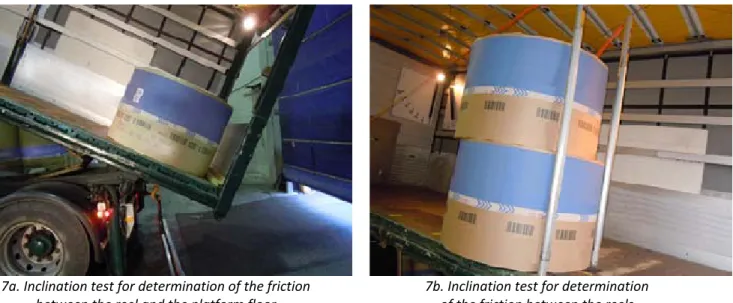
The inclination test means that between the cargo and the floor is obtained by inclination of a platform until the cargo starts to slide and the angle of inclination, , is measured. The friction factor is given by = 0.925 tan . Five tests have to be done and the highest and lowest result shall be ignored. The medium of the three remaining values is the friction to be used.
Figure 7. Practical inclination tests for determination of the friction.
7a. Inclination test for determination of the friction
between the reel and the platform floor
7b. Inclination test for determination
of the friction between the reels
The conditions for implementing the pulling test are found in EN 12195‐1:2010, Annex B.
Note that the basic conditions and test results of practical tests should be documented according to instructions in EN 12195‐1:2010, Annex E. Practical inclination tests may be carried out by anyone, directly at the site with for example a lorry with a tilting platform and an instrument for measuring the inclination angle.
Measured friction factors for material contacts not found in the table above may be used for the design of cargo securing arrangements.
2.7.3 Use of anti‐slip material for standing paper reels Only use anti‐slip material for which the manufacturer guarantees or demonstrates (measured and documented) a coefficient of sliding friction of at least µ = 0.6.
Suitability of the anti‐slip material must have been demonstrated in field trials. For reasons of safety, anti‐slip material should be used only once, unless multi‐use is expressly approved by the manufacturer.
Anti‐slip mats should be at least 150 mm in width. A minimum of two strips should be laid on the platform bed, in the longitudinal direction of the vehicle. The length of both strips should protrude from the reels to ensure that the friction factor is achieved.
Figure 8. Positioning of anti‐slip material for standing reel to apply friction in‐ forward and backward direction (seen from the top) 8a.
11
Note that the outer edges of the reels must come to lie on the anti‐slip material in such manner that the anti‐slip material protrudes by approximate at least 1 cm.
The last reels in the row must additionally be secured against backward slipping, e.g. by means of form‐ locking (to the rear) or by placing anti‐slip material (µ ≥ 0.6) under the rear reel as well in order to prevent the reel from touching the floor when the vehicle is tipped backwards.
When positioning the anti‐slip material, a strict safe working procedure must be in operation that prevents any loading of material during the positioning of the anti‐slip material.
8b.
Figure 9. Load in “zig‐zag” positioning with the proper lashing option
2.8
Tipping
The risk of tipping for a single cargo unit or a stack of units is determined by dividing the height, H, by the breadth, B, or length, L, of the cargo unit or stack of units. During road transport there is a tipping risk if: Sideways: H/B > 2 Forward: H/L > 1.25 Backward: H/L > 2
12
H
B
Figure 10. Definition of H/B/L of the cargo unit for tipping
H L
H L
10a.Definition of H/B for tipping
sideways
10b.Definition of H/L for forward
tipping
10c. Definition of H/L for backward
tipping
Note that it is the effective breadth/length to be used in the formulas above. The measurement of the effective breadth/length is explained below.
2.8.1 Determination of effective breadth/length
If the cargo is not rigid in form (reels, bales, etc.) and there is uncertainty of the effective breadth/ length, the cargo can be tested by an inclination test. The effective breadth/length is calculated as H × tan , where is the tipping angle measured from the inclination test.
Figure 11. Practical inclination test.
11a. 11b.
Inclination test for determination the effective breadth/length
For example, a reel with the diameter 900 mm (B or L) and the width 1330 mm (height H) should tip at an inclination of 34.1° (arctan (900/1330)). Rubber is put underneath the reel so that the reel will tip before it slides. The reel tips at an inclination of 30.7° and shows that the effective diameter is 790 mm (1330 × tan 30.7) instead of the actual 900 mm. This means that the reel is somewhat soft in the outer edges and that 88 % (790/900 = 0,877 ≈ 88 %) of the diameter of the reel only is to be regarded in the design of cargo securing arrangement to prevent tipping.
13
3.
General
cargo
securing
instructions
for
pulp
and
paper
products
General cargo securing instructions to prevent sideways, forward and backward movement of pulp and paper products are described below. Note that the level of cargo securing arrangement for blocking and/or lashing of cargo depends on the strength of the side walls, headboard and rear wall. The blocking arrangement shall be adapted to the actual CTU as well as required number of lashings to the tables according to the Quick Lashing Guide and the lashing capacity (LC) and pre‐tension (STF) in the securing device. Also note that each section is dealing with one direction only; sideways, forward or backward, and that the cargo securing arrangement may need to be complemented to be sufficient for all movements in all directions.
3.1
Cargo
securing
arrangements
to
prevent
movements
sideways
The cargo securing arrangement to prevent movement in sideway direction depends on the strength in the sidewalls. The following alternatives are covered below:
CTUs with strong sides
CTUs with sides for bottom blocking only
CTUs with no strength in sides
Note that the sketches below show cargo securing arrangements to prevent sideway movements only and that blocking or lashing may be required for forward/backward movements.
If the cargo is blocked against strong walls without any free space sideways no securing is required for sideway movements. Note that CTUs marked in yellow in section 2.4 have sides suitable for bottom blocking only and lashing may be required for an upper layer and/or to prevent tipping.
Figure 12. Blocking against sidewalls
12a. 12b. 12c. 12d.
Blocking against side walls if the walls are strong
3.1.1 Sideways ‐ blocking
Any free void space in the transverse direction is to be filled out by empty pallets, dunnage bags etc. Note that a blocking arrangement should have a height of at least 50 mm to prevent sliding.
14 3.1.2 Sideways ‐ lashing
If blocking is not possible the cargo must be lashed to prevent both sliding and tipping sideways.
Figure 13. Sideways lashing
13a. Top‐over lashing; the lashing
angle has to be considered, see
section 4
13b. Top‐over lashing 13c. Lashing of a second layer with top‐
over lashing; the lashing angle has to be
considered, see section 4
3.1.3 Sideways ‐ blocking and lashing Figure 14. Sideways blocking and lashing
14a.
14b.
A combination of lashing and blocking with wedge beds for lying large reels with eye forward
Securing of lying large reels with eye forward is blocked by wedges sideways and secured by the required number of top‐over lashings according to the Quick Lashing Guide, see Appendix. Also spring lashings may be needed to prevent forward movements depending on the friction factor. Preferably, rubber (in the sense of Anti‐Slip Material) is put underneath as well as in the wedge beds.
15
Figure 15. Securing of lying large reels with eye forward
15a. 15b.
Securing of lying large reels with wedge beds for blocking sideways and required number of top‐over lashings.
Spring lashings may be required to prevent forward movements depending on the friction factor.
Preferably, rubber is put underneath as well as in the wedge beds.
3.2
Cargo
securing
to
prevent
movements
in
forward
direction
The required securing arrangement to prevent movements in the forward direction depends on the cargo weight, friction factor and the strength in the headboard. The following headboard alternatives are possible:
EN 12642 code XL with strength 50 % of payload (0.5 P)
EN 12642 code L with strength 40 % of payload (0.4 P), maximum 5000 daN
Unmarked CTU or cargo not stowed tightly against the headboard, 0 % of payload
The cargo should, as far as possible, be stowed tightly against the headboard. If the cargo is stowed in multiple layers which are not blocked against the headboard, the cargo also has to be secured by further means, such as lashings or filling material to prevent it from sliding and/or tipping forward.
If the cargo is blocked against the headboard with sufficient strength without any free space, no additional securing is required in forward direction. See the table in section 2.4.2 for possible cargo weight to be blocked against a headboard built according to EN 12642 code L.
Note the sketches below show cargo securing arrangements to prevent forward movements only and that blocking or lashing may be required for sideways/backward movements.
16
Figure 16. Blocking against headboard
16a. Lying reels 16b. Pallets
Blocking against headboard with sufficient strength
16c. Standing reels on pallets 16d. Standing reels
3.2.1 Forward direction ‐ one layer ‐ blocking
Any free space is to be filled out with empty pallets, dunnage bags etc.
Figure 17. Forward direction ‐ blocking
17
Alternatively, to prevent sliding and tipping forward, the cargo can be stowed in accordance with Figure 18.
Figure 18. Forward direction – stowage
Stowage pattern to prevent sliding and tipping in forward direction
3.2.2 Forward direction ‐ one layer ‐ lashing
If the CTU is unmarked or if due to weight distribution the cargo is not stowed tightly against the headboard and backward, the cargo must be secured by lashings to prevent forward movement.
Figure 19. Forward direction ‐ one layer – lashing
19a. Securing by spring lashing in forward direction 19b. Securing by top‐over lashings to prevent inter alia forward
movement
3.2.3 Forward direction ‐ one layer – blocking and lashing
If the CTU is unmarked or if due to weight distribution the cargo is not stowed tightly against the headboard, the cargo may be secured by a combination of blocking and lashing to prevent forward sliding and tipping.
18
Figure 20. Forward direction – combination of blocking and lashing
Combination of blocking and lashing; blocking by stanchions and supporting lashings
3.2.4 Forward direction ‐ multiple layers ‐ blocking
The bottom layer must always be blocked against the headboard or blocked by pallets, dunnage bags etc. and/or lashed.
If the multiple layers are not blocked against the headboard, the multiple layers may be bottom blocked by the bottom layer. A threshold of minimum 50 mm (up on the cargo if palletised cargo) made of cargo from the bottom layer/layers with either different heights or raised by timber or pallets. Blocking may also be done by panel/fence if this is strong enough.
Figure 21. Forward direction – multiple layers blocking
min 50 mm min 50 mm
21a.Blocking of a second layer with reels of different height 21b. Blocking of a second layer by bottom layer
raised by pallets or battens
19
21c. Blocking of second layer by a threshold created by raising
the bottom layer with extra pallets. This can be applied if there
is no tipping risk and if the cargo is well attached to the pallet.
21d. Blocking by panel/fence in forward direction
3.2.5 Forward direction ‐ multiple layers ‐ lashing
The cargo in multiple layers may also be prevented from forward movement by lashings. In the case of lying reels with eye to the side, each reel in the front section of the second layer is to be lashed together with the two reels below with a round‐turn lashing. Alternatively the reels are secured by top‐ over lashings. Pallets in a multiple layer may be secured by spring lashings.
Figure 22. Forward direction – multiple layers lashing
22a. Securing by top‐over lashings
22b. Securing of a second layer by spring lashing 22c. Securing of a second layer by a spring lashing with two
20
H L
3.2.6 Forward direction ‐ multiple layers ‐ blocking and lashing
If H/L >1 (see figures below), the front section in the upper layer has to be secured to prevent forward tipping. Note that L in the figure is the effective length, see section 2.7.1.
Figure 23. Forward direction ‐ multiple layers blocking and lashing
Combination of blocking and top‐over lashing
3.3
Cargo
securing
to
prevent
movements
in
the
backwards
direction
The required securing arrangement to prevent movements in the backwards direction depends on the cargo weight, friction factor and the strength in the rear wall. The following alternatives are possible:
EN 12642 code XL with strength 30 % of payload (0.3 P)
EN 12642 code L with strength 25 % of payload (0.25 P), maximum 3100 daN
Unmarked rear wall or cargo not blocked against the rear wall, 0 % of payload
If the cargo is blocked against a rear wall with sufficient strength and without any free space in backward direction, no additional securing is required. See the table in section 2.4.3 for possible cargo weight to be blocked against a rear wall built according to EN 12642 code L.
Note that the sketches below show cargo securing arrangements to prevent backward movements only and that blocking or lashing may be required for sideways/forward movements.
Figure 24. Cargo securing arrangements to prevent backward movements
24a.
24b.
21 3.3.1 Backward direction ‐ one layer – blocking
Any free space in backward direction has to be filled out with empty pallets, dunnage bags etc.
Figure 25. Backward direction – blocking options
25a. Blocking by empty pallets 25b. Blocking by dunnage bags
The load must be secured to avoid fall out of the container when opening the door. 3.3.2 Backward direction ‐ one layer – lashing
Figure 26. Backward direction – one layer lashing
26a. Securing by spring lashing 26b. Securing by spring lashing with two parts
26c. Securing by spring lashing with help of a round‐turn lashing
22
min 50 mm
min 50 mm
min 50 mm
3.3.3 Backward direction ‐ multiple layers – blocking
If the multiple layers are not blocked against the rear wall, the multiple layers may be bottom blocked. A threshold of minimum 50 mm made of cargo from the bottom layer/layers with either different heights or raised by timber or pallets. Blocking may also be done by panel/fence.
Figure 27. Backward direction – multiple layers blocking
27a. Blocking by empty pallets 27b. Blocking of a second layer by the bottom layer raised by pallets or battens
27c. Bottom blocking of a second layer by reels of different
height
27d. Blocking by panel/fence
Lying reels in the rear end sections should be secured by wedges with a minimum height equal to 1/3 to the radius. However, the height of the wedges does not have to exceed 200 mm if lashings are used to prevent the reel from rolling over the wedges. At least 2 wedge beds are to be placed behind each row.
Figure 28. Backward direction – rear end section blocking
23
3.3.4 Backward direction ‐ multiple layers ‐ lashing
The multiple layer/layers could alternatively be secured by lashings; spring lashings or top‐over lashings, to prevent backward movements.
Figure 29. Backward direction – multiple layers lashing
29a. Securing by spring lashing 29b. Securing by top‐over lashings
24
4.
How
to
use
the
tables
in
the
Quick
Lashing
Guide
The Quick Lashing Guide (according to DIN EN 12195‐1) is enclosed as an Appendix to this document and is used either to design the required number of lashings for a specific cargo securing arrangement, or to decide if completed cargo securing arrangement is sufficient or not. The latter alternative is the easiest and is thus recommended. In any case, all cargo security shall be checked and verified against required securing methodology for the operating conditions of the CTU.
If lashings are used to prevent both sliding and tipping, then;
1. Calculate the number of lashings required to prevent sliding
2. Calculate the number of lashings required to prevent tipping
3. The highest number of these two values gives the minimum required number of lashings
Note the fact that the acting forces are equal for sideways and backward sliding and all unblocked cargo which are top‐over lashed to prevent sideways sliding is already sufficiently secured for backward sliding.
Number of lashings: Calculate the required number of lashings by dividing the cargo weight by the actual figure found in the tables in the Quick Lashing Guide.
Conversion factor: When using cargo securing devices with other lashing capacity (LC) and pre‐tension (STF) than specified in the Quick Lashing Guide the table values are to be multiplied with the conversion factors given in the Quick Lashing Guide.
Friction factor: If the combination of materials is found in the friction table or if it is measured, this value may be used provided that the surfaces are swept clean and are free from frost, ice and snow. Otherwise the friction factor (μ) = max. 0.2 shall be used for road transport and max. 0.3 for sea transport.
Cargo in multiple layer: When calculating the number of required top‐over lashings for cargo stowed in more than one layer, the following steps should be followed:
1. Determine the number of lashings to prevent sliding using the weight of the entire section and the friction for the bottom layer.
2. Determine the number of lashings to prevent sliding using the weight of the section’s upper layer and the friction between the layers.
3. Determine the number of lashings for the entire section which is required to prevent tipping. 4. The largest number of lashings in step 1 to 3 is to be used.
H/B and H/L: H/B for tipping sideways and H/L for tipping in forward and backward direction. Note that
if the cargo is not rigid in form (reels, bales, etc.) the effective breadth/length is to be used in the calculations, see section 2.7.1.
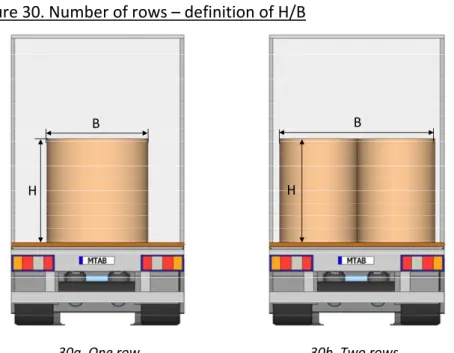
Number of rows: Number of cargo rows seen from behind.
25
Figure 30. Number of rows – definition of H/B H B H B H B
30a. One row 30b. Two rows
30c. Three rows
Top‐over lashing: When using the tables for top‐over lashings the angle (see examples), is of great importance. The tables are valid for the angle between 75° ‐ 90. If the angle is between 30° ‐ 75 twice the number of lashings are required. If the angle is below 30 another cargo securing method should be used.
Figure 31. Top‐over lashing – angle
Spring lashing: It is important that the angle between the loading platform and the lashing strap does not exceed 45° if the tables shall be valid.
The spring lashing can be done in different ways. However, if the lashing is not applied to the upper edge of the load, the tipping limits of the load weight is reduced.
For example, if the spring lashing is placed half way up the load, then it will only secure half the load weight indicated in the table from tipping.
Figure 32. Spring lashing ‐ angle
26
5.
Other
equipment
for
cargo
securing
5.1
Edge
protectors
Edge protectors are used to protect the cargo from damage caused by the lashings.
Figure 33. Edge protectors usage
To protect the edges of paper reels from damage, corner protections with extra space should be used. Without suitable edge protectors it is impossible to lash cargo with needed forces (tension) without damaging the paper reels. Using the wrong kind of protectors will also increase the risk of damaging the reel.
Figure 34. Example of a damaged reel edge
Requirements for suitable corner protectors for paper reels Minimum requirements:
Internal edge (see figures 35a and 35b)
Stiff and strong
Stress resistant
Temperature range ‐20° C to 30° C Figure 35. Internal edge
35a. 35b.
27 Recommended requirements:
Belt guide bars (see figure 37.)
Identification marking, “branding / product name” (see figure 38.)
One curved leg preferred
suitability for daily use
Figure 36. Belt guide bars Figure 37. Identification,
marking, “branding / product name”
Figure 38. One curved leg 38a. 38b.
Not suitable protectors:
Edge protectors without internal edge are not suitable to protect the fragile reel edge Figure 39. Internal edge missing
39a. 39b.
28
Cardboard protectors are not protecting reels against tension of the lashing belts.
Figure 40. Cardboard protectors
Some plastic protectors are too soft, and are not designed to withstand a lashing tension force. Remarks:
The material is not suitable to protect reels against lashing tension. These edge protectors have to be rejected as not suitable!
Figure 41. Soft material 41a. 41b.
5.2
Wedges
Wedges are designed in plastic or wood in a ratio of 3:4:5. Lying reels in the rear end sections should be secured by wedges with a minimum height equal to 1/3 to the reel radius, however, maximum 200 mm. Wedges are to be fixed and an example of a wedge bed is shown below.
Figure 42. Wedge description
3 5 4
29 11 sections 2 rows 1 2 3 4 5 6 7 8 9 10 11
6.
Example
28 standing paper reels in eleven sections and two rows are loaded and secured in different ways in different trailer types. Six of the reels are stowed in a second layer, according to the figure below.
Figure 43. Example – standing paper reels 43a. 43b. Layer 2 (second) Layer 1 (bottom) group 1 group 2
group 5 group 4 group 3
43c.
30 The following data is applied:
Dimensions of paper reels Diameter ø (B and L) (m) Width W (H) (m) Weight (kg)
1.20 1.30 850
Friction factor µ between platform/ bottom layer µ between the layers
0.4 0.3
Note that the diameter ø is equal to the effective breadth B and length L and the width W equal to the
height H in the calculations below. The assumed friction factors are an example only. If the friction factor is not measured, 0.2 should be used for paper reels as paper reels are not found in the friction table. When rubber is used, 0.6 is applied.
Lashings with lashing capacity (LC) 1600 daN and pre‐tension (STF) 400 daN are used.
Decide with the help of the Quick Lashing Guide if the securing arrangements according to examples below are sufficient for transport on road when the cargo is stowed and secured in the following types of cargo transport units:
A. Box trailer with strong headboard, sides and rear wall according to EN 12642 code XL.
B. Curtainsider with headboard and rear wall according to EN 12642 code L and non‐strong sides. C. Curtainsider with headboard and rear wall according to EN 12642 code L and non‐strong sides.
Rubber is put underneath the reels and a friction factor of = 0.6 is achieved.
A. Is the securing arrangement below in a box type trailer with headboard, side walls and rear wall with strength according to EN 12642 code XL sufficient for transport on road?
Figure 44. Box trailer with strong headboard, sides and rear wall
A. Cargo securing arrangement of 28 standing reels (23.8 tonnes) in partly 2 layers in a box trailer with strong headboard,
side walls and rear wall with strength according to EN 12642
31
The reels are blocked against a strong headboard and strong side walls. The second layer is blocked forward and backward by the bottom layer where the sections in front of and behind are raised by pallets. Two spring lashings are used to prevent backward movements.
A1. Sideways with strong sides according to EN 12642 code XL
Blocking against strong side walls without any free space sideways prevents sliding and tipping sideways. No additional securing sideways is needed. It is assumed that the side walls are capable of taking up linear loads.
A2. Forward direction with strong headboard according to EN 12642 code XL
Sliding entire load: Blocking against the headboard prevents sliding and tipping in a forward direction. The strength in the headboard is 50 % of the payload (0.5 P). With a coefficient of friction of assumed 0.4 and a design acceleration of 0.8 g means that the headboard is strong enough for blocking of reels in forward direction. It is assumed that the headboard is capable of taking up linear loads.
Sliding layer 2: Blocking by the threshold made of the reels in section 6, which is raised by pallets with a height of approximate 15 cm, prevents sliding in a forward direction.
Tipping: There is no tipping risk forward; H/L = (1.30‐0.15) / 1.20 0.96 < 1.25.
A3. Backward direction; cargo not stowed tightly to the strong rear wall
Sliding entire load: According to the Quick Lashing Guide, one spring lashing prevents 15 tonnes from sliding in backward direction (friction factor µ = 0.4). 2 spring lashings prevent 2 15 = 30 tonnes from sliding backwards => 2 spring lashings are thus sufficient.
Sliding layer 2: Blocking by the threshold made of the reels in section 10, which is raised by pallets with a height of approximate 15 cm, prevents sliding in backward direction.
Tipping: There is no tipping risk backward, neither in layer 1 nor in layer 2; H/L = 1.30/1.20 1.08 < 2 and H/L = (1.30‐0.15) / 1.20 0.96 < 1.25.
Thus, the cargo securing arrangement A according to the sketch above is sufficient in a box type trailer for transport on road.
32
B. Is the securing arrangement below in a curtainsider with headboard and rear wall with strength according to EN 12642 code L and non‐strong sides sufficient for transport on road?
Figure 45. Curtainsider with headboard and rear wall
B. Cargo securing arrangement of 28 standing reels (23.8 tonnes) in partly 2 layers in a curtainsider with
headboard and rear wall according to EN 12642 code L and non‐strong side walls.
The reels are secured by 13 top‐over lashings and corner protections according to the sketch. The second layer is blocked forward by reels in the bottom layer where the section in front of the upper layer is raised by pallets.
B1. Sideways with non‐strong sides
According to the Quick Lashing Guide one top‐over lashing prevents 2.9 tonnes from sliding sideways at friction factor 0.4 and 1.1 tonne cargo at friction factor 0.3.
Sliding:
Sections with one layer: cargo weight; 20.85 = 1.7 tonne per section; 1 top‐over lashing prevents 2.9 tonnes from sliding sideways => 1 lashing per section is thus sufficient.
Sections with double layers: Bottom layer: weight of the entire section and the friction between the reels and the bottom layer; 40.85 = 3.4 tonnes per section; 1 top‐over lashings prevent 2.9 tonnes from sliding sideways => 1 top‐over lashing is thus not sufficient for the middle section.
Upper layer: weight of the section’s upper layer and the friction between the layers; 20.85 = 1.7 tonne per section; 1 top‐over lashing prevents 1.1 tonne from sliding sideways => 1 top‐over lashing is thus not sufficient for the upper reels in the middle section and one extra lashing on this section is required.
Tipping:
Sections with one layer, two rows: H/B = 1.30/2.40 0.54 => No tipping risk.
Sections with two layers, two rows: H/B = 2.60/2.40 1.08, table value 1.2 to be used. According to the Quick Lashing Guide one top‐over lashing prevents 4.1 tonnes from tipping. 1 top‐over lashing per section is thus sufficient to prevent the sections from tipping sideways.
33
B2. Forward direction with a headboard with limited strength according to EN 12642 code L
Sliding entire load: Blocking against the headboard with limited strength, maximum 5 tonnes. According to the table in section 2.5.2, the headboard is able to block 12.7 tonne cargo at friction factor 0.4. The 13 top‐over lashings prevent 130.63 = 8.19 tonnes from sliding forward. In total 12.7+ 8.19 = 20.89 tonne cargo is thus prevented from sliding in forward direction. As the total weight is 23.8 tonnes the arrangement is thus not sufficient to prevent forward sliding.
Sliding layer 2: Blocking by the threshold made of the reels in section 6, which is raised by pallets with a height of approximate 15 cm, prevents sliding in forward direction.
Tipping: There is no tipping risk forward; H/L = (1.30‐0.15) / 1.20 0.96 < 1.25.
B3. Backward direction cargo not stowed tightly to the rear wall
According to the Quick Lashing Guide one top‐over lashing prevents 2.9 tonnes from sliding backward at friction factor 0.4 and 1.1 tonne cargo at friction factor 0.3.
Sliding entire load: The required 13 top‐over lashings to prevent sliding sideways prevent: 132.9 = 37.7 tonnes from sliding backward. The 13 top‐over lashings are thus sufficient to also prevent sliding backward of the 23.8 tonne reels.
Sliding layer 2: The 5 top‐over lashings for the upper layer in group 3 prevent: 51.1 = 5.5 tonnes from sliding backward. The 5 top‐over lashings are thus sufficient to also prevent sliding backward of the 5.1 tonne reels in layer 2 in group 3.
Thus, the cargo securing arrangement B according to the sketch above is not sufficient in a curtainsider with headboard and rear wall with limited strength according to EN 12642 code L and non‐strong sides for transport on road.
34
C. An alternative to the above securing arrangement B in a curtainsider with headboard and rear wall with limited strength according to EN 12642 code L and non‐strong sides are to use rubber underneath the reels. The friction factor is then at least 0.6 between the platform and the bottom layer and between the layers. Is the cargo securing arrangement below sufficient for transport on road?
Figure 46. Curtainsider with headboard and rear wall, with rubber put underneath the reels
C. Cargo securing arrangement for 28 standing reels (23.8 tonnes) with rubber underneath in partly 2 layers in a
curtainsider with headboard and rear wall according to EN 12642 code L and non‐strong side walls. Rubber is used
underneath the reels.
The reels are secured by 11 top‐over lashings.
C1. Sideways with non‐strong sides
According to the Quick Lashing Guide, there is no risk of sliding at friction factor 0.6. The risk of wandering should be taken into consideration.
Sliding entire load: No risk of sliding. Consideration of the wandering risk has been taken by at least one lashing per 4 tonne cargo weight.
Sliding layer 2: No risk of sliding. Consideration of the wandering risk has been taken by at least one lashing per 4 tonne cargo weight.
Tipping:
Sections with one layer, two rows: H/B = 1.30/2.40 0.54 => No tipping risk.
Sections with two layers, two rows: H/B = 2.60/2.40 1.08. For the nearest higher table value 1.2, one top‐over lashing prevents 4.1 tonnes of cargo from tipping sideways. The 3 lashings thus prevent 34.1 = 12.3 tonne cargo from tipping sideways => 3 lashings are thus sufficient to prevent the 10.2 tonnes of cargo in group 3 from tipping.