Semantic Feature Extraction Using Multi-Sense Embeddings and Lexical Chains by
Terry L. Ruas
A dissertation submitted in partial fulfillment of the requirements for the degree of
Doctor of Philosophy
(Computer and Information Science) in the University of Michigan-Dearborn
2019
Doctoral Committee:
Professor William Grosky, Chair
Assistant Professor Mohamed Abouelenien
Rajeev Agrawal, US Army Engineer Research and Development Center Associate Professor Marouane Kessentini
Associate Professor Luis Ortiz Professor Armen Zakarian
Terry L. Ruas [email protected]
ORCID iD 0000-0002-9440-780X
DEDICATION
To my father, Júlio César Perez Ruas, to my mother Vládia Sibrão de Lima Ruas, and my dearest friend and mentor William Grosky.
This work is also a result of those who made me laugh, cry, live, and die, because if was not for them, I would not be who I am today. . .
ACKNOWLEDGEMENTS
First, I would like to express my gratefulness to my parents, who always encouraged me, no matter how injurious the situation seemed. With the same importance, I am thankful to my dear friend and advisor Prof. William Grosky, without whom the continuous support of my Ph.D. study and related research, nothing would be possible. His patience, motivation, and immense knowledge are more than I could ever have wished for. His guidance helped me during all the time spent on the research and writing of this dissertation. I could not have asked for better company throughout this challenge. If I were to write all the great moments we had together, one book would not be enough.
Besides my advisor, I would like to thank the rest of my dissertation committee: Dr. Mohamed Abouelenien, Dr. Rajeev Agrawal, Dr. Marouane Kessentini, Dr. Luis Ortiz, and Prof. Armen Zakarian, for their insightful comments and encouragement, but also for the hard questions which inspired me to widen my research from various perspectives.
My sincere thanks also goes to Prof. Akiko Aizawa, who was my supervisor during my Ph.D. internship at the National Institute of Informatics (NII) in Tokyo, Japan. The connections and experiences I had there were essential for my growth as a researcher. Working in her lab helped me polish and mature my research work, assisting me in becoming a better scholar.
I also would like to thank my dear friend Edward Williams, the person who first introduced me to the University of Michigan during a conference in Argentina in 2013. I had a pleasure to share with him countless lunches and talks during my stay in the United States. If was not for him, I would probably still be working in my previous job at IBM in Brazil.
I would like to leave a special appreciation to Charles Henrique Porto Ferreira, whom I had the pleasure to work with during my last year as a doctoral student. His visit provided stimulating discussions, great quality time, and an amazing perspective on how to conduct research with integrity and organization. Anyone who has the opportunity to work with him should feel honored.
Last, but not the least, I would like to thank my dear friends in Brazil, which I chose to be my family. It would not be fair to list them risking leaving someone out. For this reason, I express my gratitude to all of them, who directly and indirectly made my journey easier during tough times.
TABLE OF CONTENTS
DEDICATION ii
ACKNOWLEDGEMENTS iii
LIST OF TABLES viii
LIST OF FIGURES x
LIST OF ABBREVIATIONS xii
ABSTRACT xv CHAPTER I. Introduction 1 1.1 Problem Context 2 1.2 Main Objectives 4 1.3 Dissertation Structure 5
II. Background and Related Work 7
2.1 Word Sense Disambiguation 7
2.1.1 Related Work in Word-Sense Disambiguation 9 2.1.2 Keyword Extraction and Related Work 10
2.2 Lexical Chains 12
2.2.1 Related Work in Lexical Chains 15
2.3 Word Embeddings 17
2.3.1 Multi-Sense Embeddings 20
2.3.2 Related Work in Word Embeddings 22
2.3.3 Related Work in Multi-Sense Embeddings 25 2.3.4 Related Work in Document Classification and Embeddings 29 III. Exploring Multi-Sense Embeddings and Lexical Chains 32
3.1 Semantic Architecture Representation 32 3.2 Synset Disambiguation, Annotation, and Embeddings 34 3.2.1 Most Suitable Sense Annotation (MSSA) 35 3.2.2 Most Suitable Sense Annotation N Refined (MSSA-NR) 39 3.2.3 Most Suitable Sense Annotation - Dijkstra (MSSA-D) 42 3.2.4 From Synset to Embeddings (Synset2Vec) 43
3.2.5 Complexity Analysis 44
3.3 Extending Lexical Chains 45
3.3.1 Flexible Lexical Chains II (FLLC II) 49 3.3.2 Fixed Lexical Chains II (FXLC II) 52 3.3.3 From Lexical Chains to Embeddings (Chains2Vec) 53
3.3.4 Building Lexical Chains 54
IV. Experiments and Validation Tasks 59
4.1 Word Similarity Task 59
4.1.1 Training Corpus 59
4.1.2 Hyperparameters, Setup and Details 60 4.1.3 Benchmark Details for Word Similarity Task 63
4.1.4 No Context Word Similarity 65
4.1.5 Context Word Similarity 74
4.2 Further Discussions and Limitations on MSSA 77
4.3 Document Classification Task 80
4.3.1 Datasets Details 80
4.3.2 Machine Learning Classifiers 82
4.3.3 Word Embedding Models Characteristics 85 4.3.4 Document Embeddings Models Characteristics 86
4.3.5 Experiment Configuration 87
4.3.6 Document Classification Task Results 90
4.3.7 Lexical Chains Behavior Analysis 98
4.4 Further Discussions and Limitations on FLLC II and FXLC II 102
V. Final Considerations 106
5.1 Future Directions 111
5.1.1 Scientific Paper Mining and Recommendation 111 5.1.2 Related Work in Scientific Paper Mining and
Recom-mendation 114
VI. Early Findings and Contributions 119
6.1 Word Sense Disambiguation Techniques 119
6.1.1 Path-Based Measures: Wu & Palmer 119 6.1.2 Information Content-Based Measures: Jiang & Conrath 120
6.1.4 Hybrid Measures: Zhou 121 6.2 Best Synset Disambiguation and Lexical Chains Algorithms 122 6.2.1 Best Synset Disambiguation Algorithm (BSD) 124 6.2.2 Flexible Lexical Chains Algorithm (FLC) 128 6.2.3 Flexible to Fixed Lexical Chains Algorithm (F2F) 130 6.2.4 Fixed Lexical Chains Algorithm (FXLC) 131 6.2.5 Distributed Semantic Extraction Mapping 133 6.2.6 Semantic Term Frequency-Inverse Document Frequency
(TF-IDF) 134
6.3 Proof-Of-Concept Experiments 135
6.3.1 Semantic Extraction Based on Lexical Chains 136 6.3.2 Semantic Extraction - Reuters-21578 Benchmarking 139 6.3.3 Keyconcept Extraction through Lexical Chains 144
LIST OF TABLES
Table
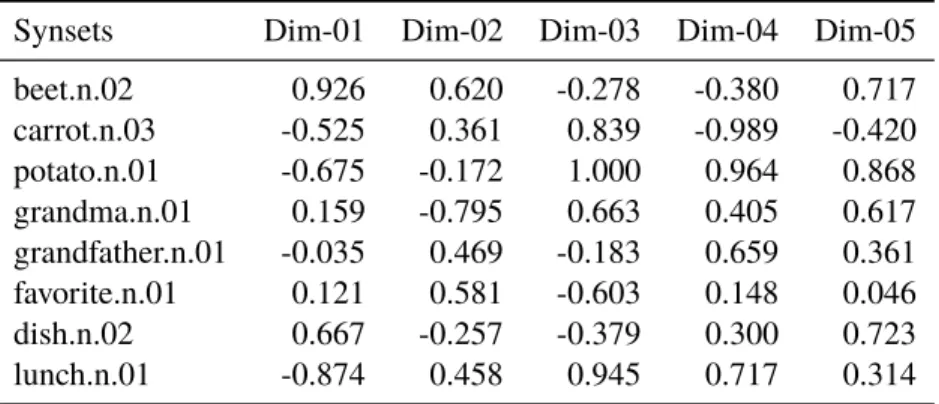
3.1 Sentence example transformation from words into synset. 55 3.2 Sample of related synsets extracted from WordNet. 56
3.3 Lexical chains construction. 56
3.4 Fictional pre-trained synset embeddings model. 57
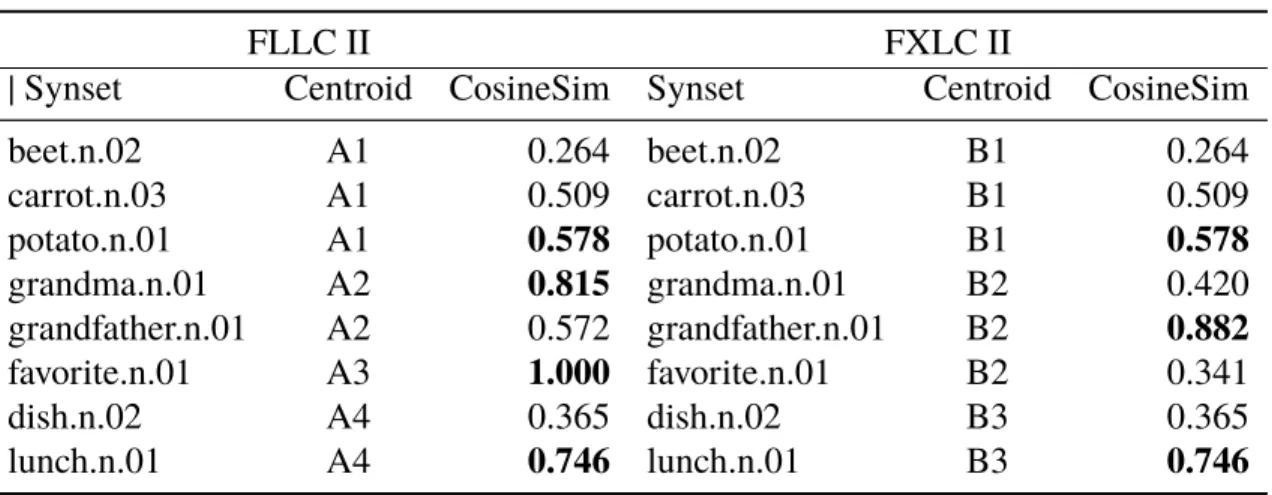
3.5 Vector average for lexical chainscentroids. 57
3.6 Cosine similarity between lexical chains elements and theircentroids. 58 3.7 Final chains for FLLC II and FXLC II algorithms. 58 4.1 Dataset token details. WD10 - English Wikipedia Dump 2010 (April);
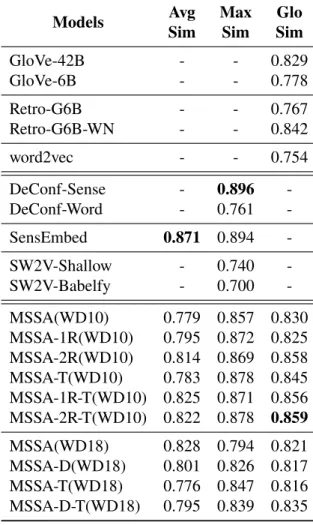
WD18 - English Wikipedia Dump 2018 (January). 60 4.2 Spearman correlation score (ρ) for the RG65 benchmark. Highest results
reported inboldface. 68
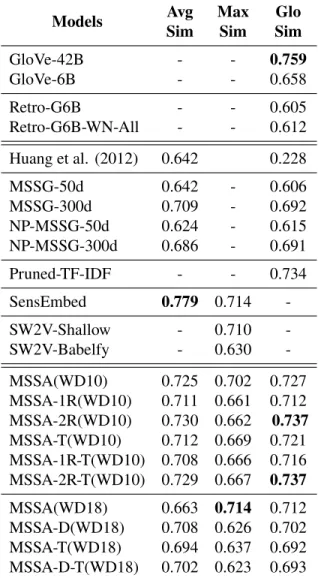
4.3 Spearman correlation score (ρ) for the MEN benchmark. The results of Chen et al. [32] and word2vec are reported in Mancini et al. [99] (MSSG/NP-MSSG). Highest results reported inboldface. 69 4.4 Spearman correlation score (ρ) for the WordSim353 benchmark. Huang
et al. [73] results are reported in Neelakantan et al. [122] (MSSG/NP-MSSG). Highest results reported inboldface. 71 4.5 Spearman correlation score (ρ) for the SimLex999 benchmark. Chen et al.
[32] and word2wec results are reported in Mancini et al. [99] (MSSG/NP-MSSG). Highest results reported inboldface. 73 4.6 Spearman correlation score for the MC28 benchmark. Highest results
reported inboldface. 74
4.7 Spearman correlation score (ρ) for the SCWS benchmark. Huang et al. [73] results are reported in Neelakantan et al. [122] (MSSG/NP-MSSG).
Highest results reported inboldface. 76
4.8 Technical details about the datasets after pre-processing 82
4.9 Grid-search configuration parameters. 84
4.10 Word embeddings used and their main characteristics. * For USE, Cer et al. [29] report its training data as a collection of sources from Wikipedia, web news, web question-answer pages discussion forums and Stanford
4.11 Classification accuracy for BOW approach against the proposed tech-niques for each classifier and dataset. Values inbold represent the best result of that row. Underlined values represent the best value for that dataset. K-NN - K Nearest Neighbors; RF - Random Forest; LR - Logis-tic Regression; SVM - Support Vector Machine; NB - Naïve Bayes. 92 4.12 Classification accuracy for word embeddings models against proposed
techniques for each classifier and dataset. Values in bold represent the best result of that row. Underlined values represent the best value for that dataset. K-NN - K Nearest Neighbors; RF - Random Forest; LR - Logistic Regression; SVM - Support Vector Machine; NB - Naïve Bayes. 94 4.13 Classification accuracy for document embeddings models against
pro-posed techniques for each classifier and dataset. Values inboldrepresent the best result of that row. Underlined values represent the best value for that dataset. KNN K Nearest Neighbors; RF Random Forest; LR -Logistic Regression; SVM - Support Vector Machine; NB - Naïve Bayes. 97 6.1 Toy Example I - Ignoring single occurrences of synsets. 134 6.2 Toy Example II - Considering single occurrences of synsets having a 0
relative distance from themselves. 134
6.3 Toy Example III - Considering single occurrences of synsets and first synset of a chain having a 0 relative distance of themselves. 135
6.4 Wikipedia Dataset Details. 136
6.5 Experiments using lexical chains algorithms and traditional approaches. 138
6.6 Reuters-21578 Dataset topic distribution. 140
6.7 Sample Reuters-21578 (R8) Dataset topic distribution. 140 6.8 Silhouette values using Complete-Linkage for R8. 142 6.9 Silhouette values using Single-Linkage for R8. 142 6.10 Silhouette values using Average-Linkage for R8. 142 6.11 Distribution of synsets obtained through BSD and FLC. 145
6.12 MediaWiki categories sample. 146
LIST OF FIGURES
Figure
2.1 Skip-gram and CBOW architectures. The skip-gram predicts context words given the current word, and CBOW predicts the word considering
its context [109] 19
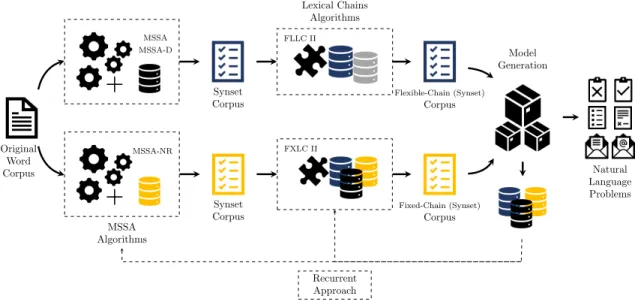
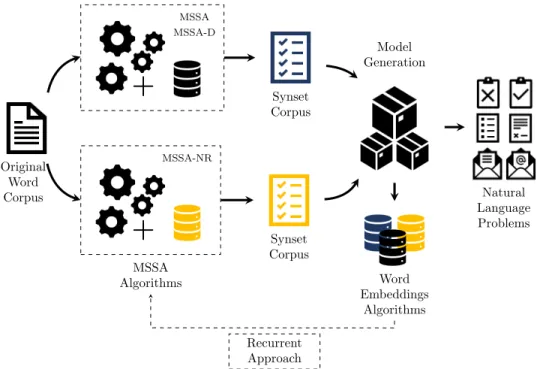
3.1 System architecture for extracting semantic features using MSSA and
lexical chains algorithms. 33
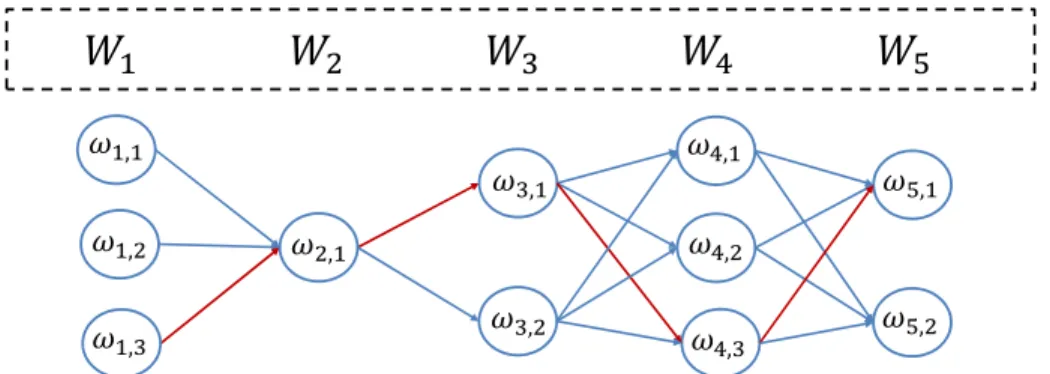
3.2 System architecture of MSSA, MSSA-D and MSSA-NR. 36 3.3 MSSA-D illustration of the shortest path from w1 to w5 through their
respective word-senses. 42
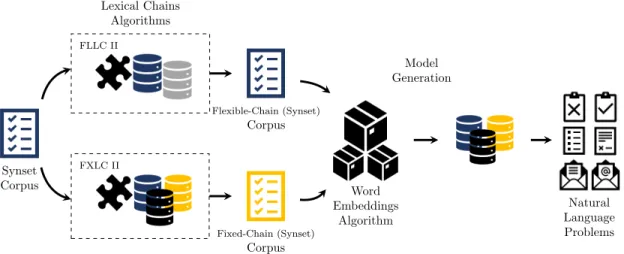
3.4 System architecture for building lexical chains. 48
4.1 Workflow of document classification. 88
4.2 Document classification ranking considering BOW and lexical chains
techniques. 93
4.3 Document classification ranking considering state-of-the-art for word
em-beddings and lexical chains techniques. 95
4.4 Document classification ranking considering state-of-the-art for document
embeddings and lexical chains techniques. 98
4.5 Accuracy for fixed lexical chains for variable chunk size and number of multiple recurrent passes for word embeddings models. 99 4.6 Accuracy for flexible lexical chains for multiple recurrent passes for word
embeddings models. 100
4.7 Accuracy for fixed lexical chains for variable chunk size and number of multiple recurrent passes for document embbedings models. 101 4.8 Accuracy for flexible lexical chains for multiple recurrent passes for
doc-ument embeddings models. 102
6.1 BSID through FSID and LSID evaluation process. 127 6.2 Flexible Lexical Chains example construction diagram. 130 6.3 Flexible to Fixed Lexical Chains construction diagram. 131
6.4 Fixed Lexical Chains construction diagram. 133
6.5 Scatter plot between mean individual silhouette and Adjusted Rand Index
for proposed techniques (Table 6.5 data). 139
6.6 Consistency and Dissimilarity using Complete-Linkage for R8. 143 6.7 Consistency and Dissimilarity using Single-Linkage for R8. 143
6.8 Consistency and Dissimilarity using Average-Linkage for R8. 144
6.9 Keyword survey average rankings. 147
LIST OF ABBREVIATIONS
AI Artificial Intelligence
ACL Association for Computational Linguistics ACM Association for Computing Machinery BOW Bag-of-Words
BSD Best Synset Disambiguation
BERT Bidirectional Encoder Representations from Transformers biLM bidirectional Language Model
BoMW Bag-of-Meta-Words BOWR Bag-of-Words-Raw BOWN Bag-of-Words-WordNet BOWS Bag-of-Words-Synsets BOWB Bag-of-Words-Best BSID Best SynsetID
CBOW Continuous Bag-of-Words CNN Convolutional Neural Network CRF Conditional Random Fields
CNN-MSSG Convolutional Neural Network Multi-Sense Skip-Gram CWS Context Word Similarity
ELMo Embeddings from Language Models F2F Flexible to Fixed Lexical Chains
FCM Features Combination Meta-Word Model FLC Flexible Lexical Chains
FSID Former SynsetID FXLC Fixed Lexical Chains
FLLC II Flexible Lexical Chains II FXLC II Fixed Lexical Chains II GloVe Global Vectors
IC Information Content IR Information Retrieval LC Lexical Chains LR Logistic Regression
IDC International Data Corporation
IEEE Institute of Electrical and Electronics Engineers K-NN K-Nearest Neighbors
LDA Latent Dirichlet Allocation LSID Latter SynsetID
ML Machine Learning
MWE Multiword Expressions MeSH Medical Subject Headings MSSA Most Suitable Sense Annotation
MSSA-D Most Suitable Sense Annotation - Dijkistra MSSA-NR Most Suitable Sense Annotation - N Refined MSSG Multi-Sense Skip-Gram
MT-DNN Multi-Task Deep Neural Network NB Naïve Bayes
NIM Naïve Interval Meta-Word Model NLP Natural Language Processing
NLU Natural Language Understanding NLTK Natural Language Toolkit NCWS No Context Word Similarity
NP-MSSG Non-Parametric Multi-Sense Skip-Gram
NASARI Novel Approach to a Semantically-Aware Representation of Items OOV Out-of-Vocabulary PI Principal Investigators PV Paragraph Vectors POC Proof-of-Concept POS Part-of-Speech Ph.D. Doctor of Philosophy
PV-DM Distributed Memory Model of Paragraph Vectors PV-DBOW Distributed Bag-of-Words of Paragraph Vectors RF Random Forests
RSS Recommender Systems RIS Research Information Systems RCV1 Reuters Corpus Volume I skip-gram Continuous Skip-Gram SANs Spreading Activation Networks
SPR Scientific Paper Mining and Recommendation STM Semantic Topic Model
SVM Support Vector Machine
SCWS Stanford Context Word Similarity
tf-idf term frequency-inverse document frequency USE Universal Sentence Encoder
WN WordNet
ABSTRACT
The relationship between words in a sentence often tell us more about the underlying semantic content of a document than its actual words individually. Natural language understanding has seen an increasing effort in the formation of techniques that try to produce non-trivial features, in the last few years, especially after robust word embeddings models became prominent, when they proved themselves able to capture and represent semantic relationships from massive amounts of data. These recent word embeddings models represent words, sentences, and entire documents in a dense n-dimensional space that can be used in any problem involving natural language text. Although, the new dense vector representations indeed leverage the baseline in natural language processing arena, they still fall short in dealing with intrinsic issues in linguistics, such as polysemy and homonymy. Systems that make use of natural language at its core, can be affected by a weak semantic representation of human language, resulting in inaccurate outcomes based on poor decisions (e.g. tutoring systems, recommender systems, health companions).
In this subject, word sense disambiguation and lexical chains have been exploring alternatives to alleviate several problems in linguistics, such as semantic representation, definitions, differentiation, polysemy, and homonymy. However, little effort is seen in com-bining recent advances in token embeddings (e.g. words, sentences, documents) with word sense disambiguation and lexical chains. To collaborate in building a bridge between these areas, this work proposes two collections of algorithms to extract semantic features from large corpora as its main contributions. The first group of contributions is composed of three
techniques, namely Most Suitable Sense Annotation (MSSA), Most Suitable Sense Annota-tion - Dijkistra (MSSA-D), and Most Suitable Sense AnnotaAnnota-tion - N Refined (MSSA-NR). These approaches are focused on disambiguating and annotating each word by its specific sense, considering the semantic effects of its context. The algorithms in this category com-bine the benefits of word embeddings, lexical structures, and word sense disambiguation in a mutual self-improving system. While MSSA works in a local context, trying to choose the best representation for a word, MSSA-D adopts a global approach, in which it considers the most similar word-senses from the first to the last word in a document. In MSSA-NR, we propose a novel recurrent approach that can be applied to refine the semantic representation results of either MSSA or MSSA-D. The second group offers another two new techniques, called Flexible Lexical Chains II (FLLC II) and Fixed Lexical Chains II (FXLC II), which derive the semantic relations between consecutive words in a document. These original techniques’ target is to uncover the implicit semantic links between words using their lex-ical structure, incorporating multi-sense embeddings, word sense disambiguation, lexlex-ical chains, and the prior knowledge from lexical databases. In the FLLC II version, the se-mantic lexical chains are assembled dynamically, as long as there is a sese-mantic relation that connects two adjacent words. In FXLC II, these semantic lexical chains are built using pre-defined chunks, which will hopefully describe their semantic content.
A few natural language problems are selected to validate the contributions of this work, in which our techniques outperform state-of-the-art systems. All the proposed algorithms can be used separately as independent components or combined in one single system to improve the semantic representation of words, sentences, and documents. Additionally, they can also work in a recurrent form, refining even more their results.
CHAPTER I
Introduction
Semantic analysis is arguably one of the oldest challenges in Natural Language Pro-cessing (NLP), still present in almost all its downstream applications, and many real-world problems. Even among humans, the precise definition of semantics is not a consensus, which leads to multiple interpretations of text, making computational semantics even more challenging [136].
Despite being a classical problem, the popularity of semantic analysis continues to draw the attention of many research projects in different areas of study, under the rubric of semantic computing. For example, Grosky and Ruas [60] analyzed 2,872 multimedia publications (e.g. papers, journals, reports) between 2005 and 2015, revealing an increas-ing trend in publications involvincreas-ingsemantics and contextual aspectsin different areas of multimedia. In these publications, methods applying different techniques try to capture semantic characteristics of text documents using state-of-the-art approaches, such as latent semantic analysis, word embeddings, machine learning, and artificial neural networks.
As we are aware, data production is reaching numbers never seen before in the world. Documents being uploaded in online repositories, instant text messages, ubiquitous com-puting, the internet itself, and many other channels are used every second, encouraging even more this scenario. In 2013, we had reached the mark of 4.4 zettabytes(1021bytes), by 2020 this number is expected to be close to 44 zettabytes, and in 2025 we have a forecast of 175 zettabytes, according to International Data Corporation (IDC) [138]. In fact, some reports state that about 90% of all data available today was produced in the last two years [21].
Following the accelerated growth in data production, the need for developing methods that are able to extract useful information from it has also become essential. More specif-ically, Natural Language Understanding (NLU) is a real-world necessity for any intelligent system willing to achieve true synergy between humans and machines. The race for such an objective has become evident in the last few years, especially after robust word embeddings models became prominent, when they proved themselves able to capture and represent se-mantic relationships from massive amounts of data. Nevertheless, traditional models often fall short in intrinsic issues of linguistics, such as polysemy and homonymy.
As a consequence of this accelerated data production, textual documents provide the ideal scenario for semantic feature extraction methods. However, their large quantity also brings certain difficulties in uncovering useful information underneath it. From a different perspective, even though our ability to produce data has grown rapidly, our efficiency in semantically analyzing it did not, which leads to what is called the semantic deficiency gap[67, 151]. In this work, we contribute in trying to solve this problem by proposing new techniques that will hopefully produce more robust semantic features to be used for solving natural language problems.
1.1
Problem Context
The relationships between words in a sentence often tell us more about the latent semantic content of a document than its individual words. Recent advances in the NLP arena, more specifically those using word embeddings, try to incorporate semantic aspects into their word vector representations by considering the context of words and how they are distributed in a document collection. Unfortunately, the amount of data available does not equal the semantic information we are currently able to extract. Even though word embeddings techniques alleviate some problems (e.g scalability) of traditional count-based methods, such as Bag-of-Words (BOW), they still fall short in properly dealing with common challenges in linguistics (e.g. polysemy, homonymy).
Extending the problem of identifying the relationships between words in a sentence to entire documents, text classification provides a scenario even more challenging. Text mining [15] is a sub-area of machine learning (ML) that intends to automatically extract knowledge from text documents. Its usefulness can be extended to several areas in the NLP domain, such as detecting spam emails [42, 68], authorship identification [72, 189], and text summarization [7, 95]. Among these areas, text classification has received considerable attention and has been the subject of several recent research topics [188, 82, 49, 50, 165]. In the document classification task, one has to create a model using features extracted from a set of text data, often referred to as a training set, that is capable of inferring the correct labels of unseen text documents. The success of this model depends on the balance between accuracy and generalization of the basis approximation function and the quality of the extracted features. Feature extraction from text data is a research topic all its own in document classification, due to its unstructured nature, which provides an interesting scenario for the proposed techniques in this work.
After recent contributions [109, 110, 130], word embeddings techniques have received much attention in the NLP community. These approaches represent words or phrases as real vectors which can be used to extract relationships between them. The overall performance of these algorithms has demonstrated superior results in many different NLP tasks, such as: chunking [39], meaning representation [20], machine translation [110], relation simi-larity [74, 111], sentiment analysis [166], word-sense disambiguation (WSD) [26, 32, 120], word similarity [31, 74, 122], and topic categorization [132].
Notwithstanding their robustness, however, most traditional word embedding approaches fail to deal with polysemy and homonymy problems [91]. Recently, researchers have been trying to improve their representations by producing multiple vectors (multi-sense em-beddings) based on the word’s sense, context, and distribution in the corpus [73, 140]. Another concern with traditional techniques is that they often neglect exploring lexi-cal structures with valuable semantic relations, such as: WordNet (WN) [48],
Concept-Net [94], and BabelConcept-Net [121]. Some publications take advantage of these structures and combine them into multi-sense vector representations, improving their overall per-formance [74, 75, 91, 99, 133, 145].
In addition to ignoring valuable prior knowledge from lexical databases, traditional word embeddings often neglect the semantic relationship between consecutive words (i.e. word order) in their representation. As a response to the absence of word order, the construction of lexical chains presents itself as a viable option [179, 58, 148, 149].Lexical chainsare defined as sequences of related words delineating portions of text for a specific topic in a cohesive manner [118]. A text in which its sentences are semantically connected often produces a certain continuity in its ideas, providing good cohesion among its sentences. Cohesion, which illustrates how well lexically or grammatically structured a text is, often occurs in words close to each other in a text, especially those adjacent to one another [62]. Even though the applicability of lexical chains is quite diverse, we see little work in combining and comparing them with recent advances in NLP, more specifically with word embeddings [164, 58, 100].
The novelty of this work relies on the proposition of a complete modular recurrent pro-cess that incorporates the benefits of WSD, multi-sense word embeddings, prior knowledge from lexical databases, and lexical chains. Others have worked on these topics separately, in rare occasions combining two areas (e.g. WSD and word embeddings, lexical chains and word embeddings), but not with all of them nor with the same cohesion here proposed. Details of the overall system architecture are discussed in Chapter III, in which we explain the general idea of the main contributions proposed and how their constituent components can also be used in a stand-alone fashion.
1.2
Main Objectives
The main objective in this work is to decrease the semantic deficiency gap between natural language text and their real semantic content. For this, we propose a collection of
novel approaches that incorporate WSD, multi-sense word embeddings, semantic relations from lexical databases, and lexical chains. This has been accomplished through five specific objectives, as follows:
1. The development of multiple unsupervised word sense disambiguation and annotation algorithms. These help us to identify the most suitable word-sense of a given word considering the influence of its immediate neighbors;
2. The development of multiple unsupervised algorithms to extract the semantic relations between words in text documents. These relations are extracted by building lexical chains in a dynamic or fixed manner;
3. A modular system combining the proposed algorithms in a single recurrent process. The word sense disambiguation and lexical chains algorithms are designed to work as stand-alone components or integrated as part of one end-to-end system;
4. The validation of the proposed techniques via particular NLP tasks, such as word similarity, document classification, document retrieval, and keyword extraction tasks. State-of-the-art benchmark systems are used as a form of comparison in each task; and
5. A collection of lightweight multi-sense word embeddings models for the proposed techniques. The generated models, which are at least 75% smaller than the compared pre-trained models, are publicly available1 so they can be used in various natural language problems.
1.3
Dissertation Structure
This dissertation is structured as follows.
Chapter II presents the necessary background for the comprehension of this dissertation. This includes the topics of: WSD, lexical chains, and word embeddings. Besides the introductory theory, this chapter also presents some of the related work in each field and the NLP downstream tasks publications associated with them.
Chapter III brings the main contributions of this work, starting from a more general perspective to a more detailed one. The overall architecture is presented and each component is followed by a detailed explanation of its internal mechanisms and peculiarities. The early versions of the proposed techniques are also included in Section 6.2.
Chapter IV contains the experiments performed to validate the proposed techniques in the word similarity and document classification tasks. In addition, this chapter also includes some deeper discussions about the performed experiments and exposes the main limitations of each approach, while providing insights on how to mitigate them. The experiments for document retrieval and keyword extraction, considering our early techniques, are described in Section 6.3.
Chapter V discusses the final considerations about the proposed techniques, experiments, and their most relevant constraints. Furthermore, solid future directions about this work and how the main contributions presented can be applied in other problems are also explored.
Chapter VI presents the early versions and experiments of the proposed techniques in Chapter III, and their respective related work.
CHAPTER II
Background and Related Work
This chapter presents the necessary background related to the main contributions of this work. This includes the topics of: WSD, lexical chains, and word embeddings. Besides the introductory concepts, this chapter also presents the related work in each field as well.
2.1
Word Sense Disambiguation
The meaning of a sentence in a document is more easily determined if its constituent words exhibit cohesion with respect to their individual semantics. The multiple interpreta-tions of words make it hard to provide a common definition for them, especially if all human vocabulary is considered. Weaver [178] first introduces the problem of WSD as a language translation issue, in which he states “[. . . ] the obvious fact that a multiplicity of languages impedes cultural interchange between the peoples of the earth, and is a serious deterrent to international understanding”. Even in simple sentences, the multiple senses of a word can bring high ambiguity into play. Let us consider the following sentence:
The good person likes the club.
it is not clear if the termclubis related to the sense ofbaseball club,clubhouse,golf club, or any other appropriate sense. Moreover, good and personsuffer similar problems with respect to their multiple meanings. Systems that are able to differentiate between the many word senses, can leverage the semantic representation of words in any natural language problem (e.g. document classification, sentiment analysis).
Mallery [98] describes WSD as an AI-complete problem. In other words, WSD has the same difficulty of fundamental problems of artificial intelligence (AI) [175]. The hardship in solving WSD problems comes from several aspects in linguistics, in which two play an important role in computer science [120]: (i) word representation and (ii) knowledge dependency. Word representation is related to how we represent all possible word senses for each word, how granular a word sense should be, how to deal with the recursive representation of a word sense definition, the domain-oriented versus unrestricted nature of texts, etc. Knowledge dependency pertains to the prior knowledge of words and how to properly represent their true meaning. In addition, the creation of lexical databases is an expensive and time-consuming task [123], especially because each time the context changes, a new disambiguation process must be considered. To this circumstance, Gale et al. [54] give the name ofknowledge acquisition bottleneck.
The association between senses and words has an important role in any task involving WSD. Saying that, the bridge between knowledge representation and words can come from different resources, such as lexical databases, machine-readable dictionaries, thesauri, raw corpora, annotated corpus, ontologies, and collocation corpora [120]. Once the relation between words and their senses is considered, one has to decide which sense better represents a word in a given circumstance. In this context, we suggest two broad groups in which word senses are evaluated to better describe a word: (i) no word embeddings-based sense disambiguation, and (ii) word embeddings-based sense disambiguation. In the first group (i), two words are said to be similar (or dissimilar) given a specific metric [108]:
Path-based. Path-based approaches are represented by functions that describe how two concepts are related (path and position) in the lexical database [181];
Information content-based. Information Content (IC) approaches assume that every word sense has incorporated some amount of information. Similarity scores in this category are calculated taking into account the IC for each word sense [77];
Feature-based. Feature-based measures do not specifically rely on a lexical database. Instead, they use properties from a lexical structure to calculate their similarity scores, such as glosses1in WordNet [177]; and
Hybrid. Hybrid measures combine more than one approach. Similarity scores in this category can use IC with feature-based measures, IC with path-based measures, and other combinations [190].
In the second group (ii), are all techniques that use word embeddings during the WSD process. The proposed techniques in Chapter III follow research segment (ii) and are based in a multi-source knowledge representation, composed of raw corpora, annotated corpora, and a lexical database. For more details on the metrics and references in group (i), Section 6.1 provides an extensive explanation for each example above.
2.1.1 Related Work in Word-Sense Disambiguation
Word Sense Disambiguation (WSD) is the task of selecting the most suitable word-sense (i.e. meaning) of a given word in a specific context. Navigli [120] presents an extensive study in the WSD arena, in which he proposes an unsupervised WSD algorithm based on generating Spreading Activation Networks (SANs) from word senses of a thesaurus and the relations between them. Meng et al. [108] explore the theory behind state-of-the-art techniques for semantic similarity measures in four main categories: path length-based, information content-based, feature-based, and hybrid measures. AlAgha and Nafee [5] propose an approach to improve document clustering, exploring the semantic knowledge offered in Wikipedia. The authors discuss this hypothesis, comparing the results using WordNet and Wikipedia, claiming that the latter is more robust for finding the semantic clusters.
In [134], several measures of similarities (e.g. normalized Google distance, normalized compression distance, cosine distance, latent semantic similarity) are applied to
rize words, sentences, paragraphs, and documents according to their lexical and semantic similarities. Bär et al. [6] present a detailed study on how several text similarity measures work. They explore these measures in the context of the semantic text similarity task. In their report, they propose an architecture that combines text similarity measures in a unified classification framework. As part of their semantic evaluation and text reusability detection, they argue that text similarity should not be considered a static entity. Instead, one has to carefully define in which levels and perspectives two documents are similar or not. In [170], they perform a comprehensive review of the methods related to XML-based semi-structured semantic analysis and disambiguation. Although their work is more fo-cused on XML, they provide an overview about the semantic disambiguation field as well, covering traditional WSD methods, potential application scenarios that could benefit from it (e.g. data clustering, semantic-aware indexing), and discuss current ongoing challenges in the area.
Even though there are more references in the WSD arena, they incorporate word embed-dings, in their core activity, to differentiate among multiple word senses. For this reason, it is better to include these contributions after the word embeddings field is properly introduced in Section 2.3.
2.1.2 Keyword Extraction and Related Work
The task of keyword extraction from documents can be done using several different approaches (e.g. most frequent word, human tagging), including using semantic analy-sis. Saratlija et al. [158] propose a fully unsupervised keyphrase extraction method to build topic-related word clusters from documents’ keywords. These selected keywords are ex-panded into valid lexical keyphrases with a reported accuracy of 44.5%. Hasan and Ng [65] conduct a survey on state-of-the-art approaches for keyphrase extraction. They perform a systematic evaluation and analysis of keyphrase extraction algorithms on standard datasets. Their results show that, despite the robustness of traditional weighting schemes (e.g. tf-idf)
for keyphrase extraction, alternative approaches should not be ignored.
In [102], the authors develop an algorithm to extract keywords based on the co-occurrence distribution of words from a single document. This is done without the need of an actual corpus, in comparison to traditional term frequency-inverse document fre-quency (tf-idf) approaches, in which they claim to achieve comparable results. Silva and Lopes [163], use statistical and language independent methods to describe the core content of documents, based on the automatic extraction of single words and Multiword Expres-sions (MWE). They conclude that, by introducing the median of a word’s length for each MWE and the preference for (2 or 4)-grams, the quality of documents, with respect to precision and recall, increases approximately 11% and 9% respectively. Zhang et al. [187] present a small survey relating lexical chains, semantic fields, and complex networks. The latter approach allows for a deeper investigation via discourse coherence analysis, showing encouraging results. In [12], a survey and categorization of keyword extraction methods are presented, focusing on supervised, unsupervised, and graph-based approaches.
In the field of Semantic Topic Model (STM), Ercan and Cicekli [45] select the most representative and significant sentences from a text to summarize them. Their approach makes use of co-located lexical chains to better represent lexical cohesion clues and uses them as the core representation of a text. The proposed summarization algorithm achieves better results in comparison with other ones in the same category. In a more ambitious approach, Chen and Lin [30] use Google similarity distance to measure keywords in web-pages and find potential future terms to suggest to the user. Their methodology does not require the user to type any keywords. Instead, they track what the user is searching for based on the webpages recently browsed. This is accomplished with an average precision and recall above 50%. In the medical arena, Jonnalagadda et al. [81] design a hybrid ap-proach (i.e. supervised and unsupervised) for extracting clinical concepts from the i2b2/VA corpus2. Their approach uses Conditional Random Fields (CRF) to extract information
from medical statements and estimates the relatedness between words in the corpus and the training/testing corpora.
2.2
Lexical Chains
Lexical cohesion is more likely to occur between words close to each other in a text, especially those contiguously ordered. The semantic similarity between these groups of words is classified as a lexical chain [118]. Morris and Hirst [118] first introduced the term lexical chainsas an extension of lexical cohesion[62]. A text in which many of its sentences are semantically connected often produces a certain degree of continuity in its ideas, providing good cohesion among its sentences.
The definition used for lexical cohesion states that coherence is a result of cohesion, not the other way around [28, 62]. In other words, cohesion is related with a set of words that belong together due to some abstract or concrete relation. Coherence, in the other hand, is more concerned with the actual meaning in the whole text [118]. In this work, we seek to obtain lexical cohesion through the proposal of new algorithms for building lexical chains, which will hopefully bring some coherence to a document representation. However, it is important to mention that the very presence of lexical cohesion will not, by any means, assure this document superior coherence in relation to another [105].
Halliday and Hasan [62] divide cohesion into two major categories: grammatical and lexical cohesion. In grammatical cohesion, they include five general categories of cohesive devices: reference, substitution, ellipsis and conjunction. Lexical cohesion, on the other hand, is related to semantic construction of a text portion and groups: reiteration (i.e. repetition, synonyms, superordinate and general words) and collocation. Whererepetition is a linguistic artifact to obtain lexical cohesion through the (near) duplication of words. Synonyms are constructions (e.g. words, phrases) that can be replaced by others with the same or similar meaning. Superordinates are words that represent a higher level of abstraction, providing less specific information about something and are quite different
from synonyms since they cannot be easily switched in a document. General words refer to a set of words where each word can be used to refer the same topic/event. Finally, collocation is the juxtaposition of two or more words that are often used together in a sentence (e.g. orthogonal projection, ice cream) [105].
As Halliday and Hasan [62] state, “Cohesion does not concern what a text means; it concerns how the text is constructed as a semantic edifice”. In other words, cohesion is related to the structure of a document through a semantic perspective. Morris and Hirst [118] define that lexical chains make use of these structures to compute, in a non-domain-specific environment, the semantic context for interpreting words, concepts and sentences. While lexical cohesion is more focused on the relationships of word pairs, lexical chains extend this notion to a successive number of adjacent words. There are two main reasons why lexical chains are important for computational text understanding systems [118]:
• They provide a feasible context to assist in the ambiguity and narrowing problems to a specific meaning of a word; and
• They provide clues to determine coherence and discourse, thus a deeper semantic-structural meaning of the text.
The method presented in [118] is the first to bring the concept of lexical cohesion to the computational world via lexical chains. Using their intuition, they identify lexical chains in text documents and build their structure considering [62] observations. For this task, they consider five text documents, totaling 183 sentences from different and non-specific sources. Repetitive words (e.g. high frequency words, pronouns, propositions, verbal auxiliaries) are not considered as prospective chains elements, since they do not bring much semantic value to the structure themselves.
Lexical chains are built according to a series of relationships between words in a text document. In the seminal work of Morris and Hirst [118], they consider an external thesaurus (Roget’s Thesaurus [143]) as their lexical database to extract these relations. A
lexical chain is formed by a sequence of words {w1, w2, . . . , wn} appearing in this order, such that any two consecutive wordswi, wi+1possess the following properties3[118]:
• Two words share one common category in their index;
• The category of one of these words points to the other word;
• One of the words belongs to the other word’s entry or category;
• Two words are semantically related; and
• Their categories agree to a common category.
As for the quality of a built chain, three factors can be considered to measure how strong a lexical chain is [118]: reiteration, length, anddensity. Reiteration illustrates how often a lexical chain occurs, the length is related to the number of tokens on it, and density is the ratio of words in the lexical chain to the words in the text document. Since our main objective is to evaluate how the proposed lexical chains perform in downstream tasks, we leave the evaluation of their strength to a future opportunity.
We consider the five characteristics defined in [118] to build our lexical chains and validate their quality in the document classification problem. These characteristics can be observed in various text documents, especially in scientific/academic ones, where theories and experiments have to be explained in great details through several different perspectives. The very notion of cohesion is accepted as a good tool for text analysis to capture information beyond pure syntax [157]. For example, in the sentence “the code in my programs is more cohesive thanks to the new version of Java”, the set {code, programs, cohesion, J ava} expresses a successive chain of semantically related terms representing an association with computers or programming languages. In a larger scope, other characteristics can be explored, such as how the structural distribution of related chains, present in documents, can be used to summarize and recommend related scientific papers.
The proposed algorithms (Chapter III) explore how these lexical cohesive characteristics, presented in [62, 118], can be extended, considering sets of cognitive synonyms, instead of just words. The next section presents some of the related work that apply and extend lexical chains in various scenarios.
2.2.1 Related Work in Lexical Chains
The use of lexical chains in NLP tasks (e.g. text similarity, word sense disambiguation, document clustering) has been widely studied in the literature. In [7], lexical chains are used to produce summaries from texts. They propose a technique based on four steps: segmentation of original text, construction of lexical chains, identification of strong chains, and extraction of significant sentences. Their results show improvements for both precision and recall, when compared to Microsoft Summarizer. Silber and McCoy [162] also investigate text summarization, but their approach for constructing the lexical chains runs in linear time, in comparison with [7], which does not.
Some authors use WordNet to improve the search and evaluation of lexical chains. Bu-danitsky and Hirst [24, 25] compare several measurements of semantic distance and relat-edness using lexical chains in conjunction with WordNet. Their study concludes that the similarity measure of Jiang and Conrath [77] presents the best overall result. Moldovan and Novischi [115] study the use of lexical chains for finding topically related words for ques-tion answering systems. This is done considering the glosses for each synset4 in WordNet. According to their findings, topical relations via lexical chains improve the performance of question answering systems when combined with WordNet. In [71], they explore the benefits of using WordNet to improve document clustering based on an explicit matching between terms found in the text and the lexical database. They improve their clustering re-sults incorporating background knowledge into the representation of documents. McCarthy et al. [103] present a methodology to categorize and find the most predominant synsets in
unlabeled texts using WordNet. Different from traditional approaches (e.g. BOW), they consider relationships between terms not occurring explicitly. They obtained a WSD preci-sion of 64% on all noun-tasks related against the baseline (SemCor5and SENSEVAL26).
In [159], WordNet is used for document clustering, exploring the benefits of incorpo-rating hypernyms and synonyms into their approach. However, they reported poor results when using only Part-of-Speech (POS) tags for document clustering. Pedersen et al. [127] proposeWordNet::Similarity, an application developed in Perl to calculate the relatedness of concepts via WordNet through different measures of similarity. Ercan and Cicekli [44] explore the effects of lexical chains in the keyword extraction task through a supervised machine learning perspective. Their methodology obtains superior results when consider-ing a decision tree induction algorithm, based on lexical chains and text-only features. Guo and Diab [61] hypothesize that if the semantics of words are known in advance (i.e. prior knowledge), it is possible to get a better statistical inference concerning a document’s overall idea. Their STM approach combines explicit semantic information and word distribution information, presenting better results than traditional Latent Dirichlet Allocation (LDA) models.
In more recent works, Pradhan et al. [134] apply several measures of similarities (e.g. normalized Google distance, normalized compression distance, cosine distance, latent se-mantic similarity) to categorize sentences, words, paragraphs, and documents according to their lexical and semantic similarities. Their integrated approach, combining kernel-based and cosine-based similarity, provides better results if compared to the traditional cosine sim-ilarity. Wei et al. [179] combine lexical chains and WordNet to extract a set of semantically related words from texts, and use them for clustering. Their approach uses an ontological hierarchical structure to provide a more accurate assessment of similarity between terms during the WSD task.
While covering many aspects in the lexical chains arena, the current literature still
5http://web.eecs.umich.edu/ ˜mihalcea/downloads.html#semcor
presents opportunities for expansion. Most authors rely on machine learning techniques to improve their semantic extraction, which are highly dependent on the available corpus. Others ignore the context-effect present within the text. The meaning of a word is directly affected by its surroundings, so the textual neighborhood of a word should be used to decide what is its best semantic representation. Moreover, prior knowledge from external lexical databases have much to offer with respect to semantic relationships besides trivial artifacts, such as hypernyms and hyponyms.
Those inspecting lexical chains often build them using words individually, or using some common/direct synonym. Although these are interesting approaches, they are only focused on the word itself, leading to an alternative BOW representation. Semantic and contextual aspects are difficult to extract, but important elements of effective human communication to track. In the last eleven years, the interest in these topics, and their contributions to traditional approaches, have been increasing among distinct scientific communities. In [60], 2,872 records (e.g. papers, journals) in the multimedia field are examined revealing an increasing number of articles exploring semantic and contextual aspects in different areas as a common trend. Finally, little effort is seen in combining the benefits of word embeddings and lexical chains, which could leverage the semantic representation of textual documents.
2.3
Word Embeddings
The distributed representation of words from documents has received substantial atten-tion from the NLP community in the last few years, especially after the extremely popular word2vec approach was proposed [109, 110]. However, the idea that words with similar contexts should have similar meanings goes back to the 20th century in theDistributional Hypothesis[64]. Later, the presence of these words would be described using count-based methods (e.g. BOW [155]). Due to its simplistic and naive methodology, the BOW approach has some drawbacks, such as data sparsity, loss of word order, and high dimensionality, to
name a few. Bengio et al. [13] try to solve the latter problem (dimensionality) proposing a neural probabilistic language model that learns a representation while keeping a compact probability distribution of word sequences through back-propagation [153]. Collobert and Weston [33] later define a faster general single Convolutional Neural Network (CNN) ar-chitecture, showing that multitask learning and semi-supervised learning can improve the generalization in shared tasks, such as: POS tagging, morphological segmentation, named entity recognition, and word similarity. Besides these, other language prediction models are also popular in the NLP community [20, 174, 176, 191].
The fundamental objective in word embeddings techniques is to find word representa-tions in a vector space that will improve the performance in solving various natural language problems. Two techniques deserve special attention in this scenario, called Continuous Skip-Gram (skip-gram) and Continuous Bag-of-Words (CBOW) [109, 110]. In the skip-gram training model, one uses an input word to predict its context, while in the CBOW variation the converse happens, in which given a context the model tries to find the most probable word to appear. Figure 2.1 shows an example of both architectures in a high-level per-spective. The input and output layers are one-hot encoded, and have the same number of dimensions. However, the projection layer, usually significantly smaller than the vocabulary size, can be of any dimension desired.
The values used to encode each dimension of the vector are the weights used in the activation function in the artificial neural network. The training objective of the skip-gram is to maximize the log probability in Equation 2.1 [110].
1 T T X t=1 X −c≤j≤c, j6=0 logp(wt+j|wt) (2.1)
wherecis the size of the context window (consideringwtas the center) andp(wt+j|wt)is
Projection Input Output 𝑤𝑡−2 Skip-gram CBOW Projection Input Output 𝑤𝑡−1 𝑤𝑡+1 𝑤𝑡+2 𝑤𝑡−2 𝑤𝑡−1 𝑤𝑡+1 𝑤𝑡+2 𝑤𝑡 𝑤𝑡
Figure 2.1: Skip-gram and CBOW architectures. The skip-gram predicts context words given the current word, and CBOW predicts the word considering its context [109]
. p(wO|wI) = exp(vwO0 >vwI) PW w=1exp(vw0 >vwI) (2.2)
wherevw andv0w are the input and output vector representation of wrespectively and W
is the size of the vocabulary considered. However, as W increases, it is not feasible to calculate Equation 2.2. Morin and Bengio [116] propose a binary tree representation for the output layer with the W words as its leaves, resulting in an effective approximation of the softmax function, called hierarchical softmax. Thusp(wO|wI)can be redefined as Equation 2.3 shows [110]. p(w|wI) = L(w)−1 a j=1 σ([[n(w, j+ 1) =ch(n(w, j))]]·vn0(w,j)>vwI) (2.3)
wheren(w, j)is the j-th node on the path from the root towandL(w)the length of this path, for n(w,1) = rootand n(w, L(w)) = w; ch(n) is a fixed child of noden and[[x]] is 1 if x is true and -1 on the contrary; σ(x) = 1/(1 + exp(−x)). Additionally, vw has one representation for w and one representation v0n for every inner node n of the binary
tree. This approximation implies thatΣWw=1p(w|wI) = 1, so the computation of p(wO|wI)
is proportional toL(wO), which is no greater thanlogW. Mikolov et al. [110] use a binary
Huffman tree to calculate the hierarchical softmax because of its assignments for short codes to frequent words, resulting in a more efficient training step. An alternative to hierarchical softmax is the negative sampling, described in [110]. The methodology used in CBOW is somehow similar to the one used for skip-gram, but instead of starting with a wordw to predict its surroundings, we would consider the context to derive a target word.
Even though the traditional word2vec technique is robust enough in representing words in a vector space, the proposed techniques in Chapter III make use of a multi-sense notation. Thus, if for a given word there are multiple synonyms (polysemy), we want to represent all of those that are somehow related with the overall meaning of the document.
2.3.1 Multi-Sense Embeddings
In a standard single n-dimensional vector representation as word2vec, there will be just one embedding for each token to calculate any similarity measure between them. In a multi-vector representation, each word is associated with a set of senses, each with a vector representation. Hence, the similarity of these word-senses need to be calculated in a different way. Both representations make use of several benchmarks to evaluate their performance in NLP tasks (e.g. word similarity, document similarity). These benchmarks can be grouped into two categories: with or without context information. In the first category, a similarity score is given for two words in isolation, without any extra information about them. In the second category, each word is presented with a sentence to better help contextualize its semantic content.
Considering the multi-vector representation, Reisinger and Mooney [140] propose two metrics: AvgSimandMaxSim. In AvgSim, the word similarity is calculated considering the average similarity of all word-senses for the pair, as shown in Equation 2.4.
AvgSim(u, w) = 1 N M N X i=1 M X j=1 d(e(u, i), e(w, j)) (2.4)
whereuandware the words to be compared;N andM are the total number of available senses for u andv, respectively; d(e(u, i), e(w, j)) is the similarity measure between the word-sense embeddings sets, denoted ase(u, i)ande(w, j), between theith sense of word u and jth sense of wordw. In MaxSim, the similarity is the maximum value among all pairs of word-sense embeddings, as illustrated in Equation 2.5. In this work, we consider thecosine similarityas the default similarity measure between any two vectors.
M axSim(u, w) = max
1≤i≤N,1≤j≤Md(e(u, i), e(w, j)) (2.5)
Reisinger and Mooney [140] also propose AvgSimC and MaxSimC. These take into account the similarity of two words when their context is available. In this scenario, the context is represented as sentences in which the target words are used. For tasks with this setup, two words are evaluated with respect to their similarity and each of them has a sentence illustrating their use. Both AvgSimC and MaxSimC are described in Equations 2.6 and 2.7 respectively. AvgSimC(u, w) = 1 N M N X i=1 M X j=1 P(u, cu, i)P(w, cw, j)d(e(u, i), e(w, j)) (2.6) M axSimC(u, w) =d(ek(u, i), ek(w, j)) (2.7)
where P(u, cu, i) = d(e(u, i), cu) is defined as the similarity of the ith sense of word u
sentence where u is used. Different from single word vector representations, our model produces vectors for each word-sense, so when we calculate the average vector of cu, we need only to consider all available word-sense vectors. ek(u, i) = argmaxd(e(u, i), cu)is the maximum similarity obtained among all word-sensese(u, i), with respect to its context cu. All these terms are defined analogously forwandj as well. It is important to mention
that the context defined for AvgSimC and MaxSimC are not related with the sliding context window presented in our approach (Section 3.2, or the sliding window in word2vec).
Huang et al. [73] also defend that word representations should be discriminated consid-ering their surrounding words (local context) and their role in the entire document (global context). Their training model produces two vector types, one representing each word-sense and another for the word in the entire document, evaluated throughLocalSimandGlobalSim respectively [122]. Unlike [73, 122], our approach does not produce global vectors during the training step, only local ones. Therefore, to obtain a global representation of a word, we average all word-sense vectors of u and w available to calculate their similarity, as Equation 2.8 shows.
GlobalSim(u, w) =d(ˇµ(u, i),µˇ(w, j)) (2.8)
whereµˇ(u, i)andµˇ(w, j)represent the average of all word-sense vectors foruandw. As for LocalSim, we can use the original MaxSimC instead, since they work under the same assumptions [140].
2.3.2 Related Work in Word Embeddings
It is undeniable that word2vec’s contributions with continuous skip-gram and CBOW from Mikolov et al. [109, 110] brought a legion of new publications to NLP, or more specifically, to the word embeddings field. Its popularity is due to, among other things, its efficient log-linear neural network language model and its low dimensionality vector repre-sentation. Both approaches produce vector representations of words, and those with similar
contexts tend to have similar values. This theory is firstly introduced in theDistributional Hypothesis[64] and later refined by Firth [52], which states that “a word is characterized by the company it keeps”. In the CBOW training model, one tries to predict a word given its neighboring context, while skip-gram does the converse, predicting the context given a tar-get word. As influential as word2vec, Global Vectors (GloVe) [130] builds a co-occurrence matrix of the words in a corpus, which is based on word frequency. While word2vec is focused on fixed context windows to derive its vectors, GloVe takes advantage of a global perspective. As for their results, both word2Vec and GloVe present similar results in various NLP tasks [161, 75, 34]. Our approaches make use of word2vec’s predictive model to train a disambiguated corpus into specific word-sense vectors that can be applied to several NLP tasks. This allows us to deal with one of the most important problems in traditional word embeddings techniques, the one vector representation per word property.
Extending word2vec’s techniques (skip-gram and CBOW), Paragraph Vectors (PV) is an unsupervised framework that learns continuous distributed vector representations for any size of text portion (e.g. phrases, paragraphs, documents) [87, 36]. This technique alleviates the inability of word2vec to embed documents as a unique object. Differently than word2vec, PV produces a fixed length n-dimensional vector representation for each entire textual segment, instead of just the words in the corpus. Le and Mikolov [87]’s algorithm is also available in two different forms: Distributed Bag-of-Words of Paragraph Vectors (PV-DBOW) and Distributed Memory Model of Paragraph Vectors (PV-DM). The PV-DBOW works with the same principle as the skip-gram model, in which one tries to predict the context given a target word. In this approach, the context words are not considered as input, but instead, the model predicts words randomly sampled from the paragraph in the output. For this reason, there is no need to keep track of the word vectors of the context, causing this model to store less data. The PV-DM training model is similar to the CBOW approach in which the context is used to predict a target word. However, in both training models, an extra feature vector representing the text segment (called paragraph-id) is added
to the context sliding window. The paragraph-id and word vectors are then averaged or concatenated to predict the target word. This forces the model to remember the missing words from the context when performing the prediction of these words. The paragraph-id vector is shared throughout the entire document for each sliding window, representing the meaning of the document as a whole.
Following the opposite direction of paragraph vectors, some publications move from a direct document representation to a sub-word one. In fastText [17], they extend the skip-gram model by proposing a word representation obtained from a sum of then-grams of its constituent sub-word vectors. For example, using n = 3, the word kiwi would be represented as {ki, kiw, iwi, wi} and the word kiwi itself, as a special case. Adopting a similar method, Peters et al. [131] propose to represent words from their constituent characters with Embeddings from Language Models (ELMo). ELMo uses a two layer deep bidirectional Language Model (biLM) with character convolutions as a linear function of their internal states. Due to its architecture, ELMo does not keep word vectors in their models, but only characters. This allows ELMo to handle any Out-of-Vocabulary (OOV) words, since its vectors are computed as an average of all biLM layers. More recently, the Universal Sentence Encoder (USE) [29] is proposed with two encoding models to represent any text as vectors, one focused on accuracy (transformer architecture) and the other on inference (deep averaging network). The former builds a sub-graph that uses attention mechanisms to compute the context representations of words in a text, considering their ordering and identity. The latter, average words and bi-grams embeddings, which are later used in a feed-forward deep neural network to produce new embeddings. In Section 4.3 we compare our proposed techniques, trained in a simple word2vec implementation, against the aforementioned state-of-the-art word embeddings models.
Encouraged by the robustness of word embeddings, Oele and Noord [124] combine word-sense, context, and word-definition embeddings to support their disambiguation sys-tem. They extend Lesk’s algorithm [89] in two different scenarios using AutoExtend [145]
as their embedding training algorithm, the first using a distributional thesauri, and the second using WordNet hierarchical structure. In [129], they propose a multi-stage system that learns single vector word representations, calculates word similarity graphs, infers word-senses using ego-network clustering, and aggregates word vectors with their prospec-tive word-sense vectors. In contrast to these approaches, we use only single vector word embeddings to support our disambiguation process a single time. Once our annotated corpus is trained using a traditional word embeddings implementation, we can perform our disambiguation step considering the specific word-sense embeddings directly. In addition, we do not rely on any extra parameters, other than those required in a standard word2vec implementation. The WSD technique proposed in Section 3.2 is inspired by Ruas and Grosky [148] approach, which produces word-sense representations for a given word based on its context. Even though disambiguation is a crucial component in our techniques, the presented experiments and discussions focus more on how the combination of WSD and word embeddings can be mutual beneficial in the word similarity and document classifica-tion tasks [75]. We do have future plans to compare our WSD technique with alternative methods and see how this affects the overall experimental results in Sections 4.1 and 4.3, but for now this is beyond our scope. For more details of the WSD field, we suggest [120]’s survey, in which supervised, unsupervised, and knowledge-based approaches are discussed in depth.
2.3.3 Related Work in Multi-Sense Embeddings
Nearly all publications using single vector word embeddings suffer from the same problem, in that words having multiple senses are represented through a unique vector. In other words, polysemy and homonymy are not handled properly. For example, in the sentence “This club is great!” it is not clear if the term club is related to the sense of baseball club, clubhouse, golf club, or any other sense. Systems that use standard word embeddings, like word2vec or GloVe, will most likely represent all possible meanings for
the termclubin one single dimensional vector. Section 2.3.1 provides more information on how multi-sense embeddings are used and measured in NLP tasks.
Some researchers try to solve this representation limitation producing separate vectors for each word-sense. Even though the number of publications in this area is still small, their early findings demonstrate encouraging results in many NLP challenges [91]. As explained in Section 2.3.1, [73, 140] are one of the earliest publications that discuss multi-sense embeddings and how to properly measure them. Huang et al. [73] introduce a neural network language model capable of distinguishing the semantics of words, considering their global (entire document) and local (surrounding words) contexts. Reisinger and Mooney [140] follow a probabilistic approach to produce a multi-prototype vector space model, using word-sense discovery to evaluate a word’s context. They set a number,K, of clusters to represent the different contexts where the word is used. We, on the other had, combine the prior knowledge of WordNet and word embeddings to extract the many meanings of a word in an unsupervised manner. Since we produce a vector representation for each word-sense, the global meaning of a word in a document is the average of all senses for that word. This way, we do not need to rely on cluster parameters, which would increase the complexity of our approach. Trask et al. [173] extend [73]’s model by leveraging supervised NLP labels, instead of relying on unsupervised clustering techniques to produce specific word-sense vectors. We follow a similar idea and let the words define their own senses according to the context where they are located. However, our approach also takes advantage of the lexical structure in WordNet, which helps us to identify the implicit relationships between the words. In addition, our model’s results can be fed into a word embeddings technique and re-used to improve itself recurrently, with respect to the disambiguation and embeddings steps (Section 3.2.2).
Other techniques also take advantage of probabilistic models to learn their own rep-resentation for each sense. Tian et al. [172] design an efficient expectation maximization algorithm integrated with the skip-gram model to avoid the issues of clustering-based
![Figure 2.1: Skip-gram and CBOW architectures. The skip-gram predicts context words given the current word, and CBOW predicts the word considering its context [109]](https://thumb-us.123doks.com/thumbv2/123dok_us/9217855.2805963/36.918.179.795.111.484/figure-architectures-predicts-context-current-predicts-considering-context.webp)