E
FFICIENT
K
NOWLEDGE
M
ANAGEMENT
FOR
N
AMED
E
NTITIES FROM
T
EXT
Sourav Dutta
Dissertation
for Obtaining the Degree of
Doctor of Engineering (Dr.-Ing.) Faculty Of Mathematics and Computer Science
SAARLAND UNIVERSITY
Saarbrücken, Germany September, 2016
D
EAN Prof. Dr. rer. nat. Frank-Olaf SchreyerD
ATE 09 March, 2017P
LACE Saarbrücken, GermanyExamination Board
C
HAIRMAN Prof. Dr. Dietrich KlakowS
UPERVISOR ANDProf. Dr.-Ing. Gerhard Weikum
F
IRSTR
EVIEWERS
ECONDR
EVIEWER Prof. Dr. techn. Wolfgang NejdlT
HIRDR
EVIEWER Prof. Dr.-Ing. Klaus BerberichA
BSTRACT
The evolution of search from keywords to entities has necessitated the efficient har-vesting and management of entity-centric information for constructing knowledge bases catering to various applications such as semantic search, question answering, and information retrieval. The vast amounts of natural language texts available across diverse domains on the Web provide rich sources for discovering facts about named entities such as people, places, and organizations.
A key challenge, in this regard, entails the need for precise identification and disam-biguation of entities across documents for extraction of attributes/relations and their proper representation in knowledge bases. Additionally, the applicability of such repos-itories not only involves the quality and accuracy of the stored information, but also storage management and query processing efficiency. This dissertation aims to tackle the above problems by presenting efficient approaches for entity-centric knowledge acquisition from texts and its representation in knowledge repositories.
This dissertation presents a robust approach for identifying text phrases pertaining to the same named entity across huge corpora, and their disambiguation to canonical entities present in a knowledge base, by using enriched semantic contexts and link vali-dation encapsulated in a hierarchical clustering framework. This work further presents language and consistency features for classification models to compute the credibility of obtained textual facts, ensuring quality of the extracted information. Finally, an encoding algorithm, using frequent term detection and improved data locality, to represent entities for enhanced knowledge base storage and query performance is presented.
K
URZFASSUNG
Die Weiterentwicklung der Schlagwortsuche hin zu Entitäten erfordert die effiziente Sammeln und Verwalten von Informationen zur Konstruktion von Wissensbasen. Diese Wissensbasen sind die Grundlage für verschiedene Anwendungen, wie etwa semantis-che Susemantis-che, maschinelle Beantwortung von Fragen oder Informationsrückgewinnung. Die großen Mengen von Texten in natürlicher Sprache, die über verschiedene Domä-nen hinweg im World Wide Web verfügbar sind, bietet dabei eine reiche Information-sQuelle zum Auffinden von Fakten über benannte Entitäten wie Personen, Orte, und Organisationen.
Wesentliche Herausforderungen in dieser Hinsicht sind die genaue, dokumentüber-greifende Identifikation und Disambiguierung verteilten Entitäten, die zur Extraktion von Attributen/Relationen benötigt werden sowie deren geeignete Repräsentation in Wissensbasen. Die Anwendbarkeit solcher Wissensbasen hängt dabei nicht nur von der Qualität und Genauigkeit der gespeicherten Informationen ab, sondern auch von der Speicherplatzverwaltung und der effizienten Bearbeitung von Anfragen. Ziel dieser Dissertation ist die Auseinandersetzung mit den zuvor beschriebenen Problemen. Dazu werden effiziente Verfahren zur entitätszentrischen Wissensaquise aus Texten und deren Repräsentation in Wissensbasen vorgestellt.
Diese Dissertation stellt ein robustes Verfahren zur Identifikation von Textphrasen vor, die sich auf die gleiche Entität beziehen und über große Korpora verteilt sein können. Außerdem wird die Disambiguierung und Kanonisierung von Entitäten mittels eines hierarchischen Clusteranalyseverfahrens beschrieben, das auf angereichertem seman-tischem Kontext und Linkvalidierung beruht. Einen weiteren Teil dieser Arbeit stellen Sprach- und Konsistenzmerkmale dar, die in Klassifizerungsmodellen verwendet wer-den, um die Glaubwürdigkeit von Fakten zu bestimmen und somit die Qualität der extrahierten Informationen zu gewährleisten. Schlussendlich wird ein Kodierungsalgo-rithmus zur Repräsentation von Entitäten präsentiert, der auf der Erkennung von häu-figen Termen und einer verbesserten Datenlokalität beruht, um dadurch eine bessere Speicherplatzverwaltung und Abfrageperformanz der Wissensbasis zu ermöglichen.
S
UMMARY
Entity attributes and their relationships are valuable assets for various modern day applications such as semantic search, question answering, and other information extraction tasks. The huge amount of natural language texts across diverse domains on the Web, such as Wikipedia, news articles, blogs, and forums, provide rich sources for harnessing entity and event related information. The harvested knowledge is then succinctly represented, typically as a labeled graph structure, by large knowledge bases such as YAGO, DBPedia, Freebase, etc., forming the backbone of Web-scale applications. Crucial challenges in the construction of such knowledge repositories not only involve scalability and robustness to tackle petabytes of text data, but also accurate detection and disambiguation of the discovered entities for proper representation, credibility of obtained facts to ensure quality, and superior query performance of the knowledge stores for real-time interaction. This dissertation makes the following contributions for efficient knowledge management for named entities, such as people, locations, and organizations, extracted from text.
Cross-document entity co-reference resolutioninvolves the identification of textual expressions referring to the same entity, possibly with different surface forms, present across documents within a corpus. The linguistic diversity among documents, scalabil-ity for tackling large data volumes, and the presence of multiple entities with similar representations further complicates the task at hand. Existing approaches combining text snippets to capture context, external feature inclusion, and vector-space similarity for clustering, tend to be computationally expensive with limited performance accu-racy, and suffer in terms of robustness. The proposedCROCSmethod addresses the problems by intelligent construction ofsemantic summariesbetter capturing entity context by using texts, co-occurring mentions, and external features encapsulated within a sampling-based hierarchical clustering framework for enhanced performance quality and robustness. Experimental analysis on large real-life news corpora demon-strates significant improvements in co-reference resolution accuracy (even for sparse “long tail” entities) and run-time forCROCSover state-of-the-art methods.
Entity linkingcorresponds to the disambiguation of discovered named entities and linking them to pertinent entries, if present, in a knowledge base. It enables the dy-namic growth of repositories with emerging facts about already known entities, or the incorporation of newly extracted entities currently absent in the knowledge base.
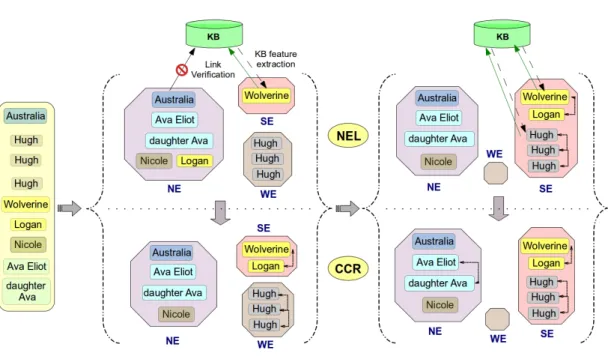
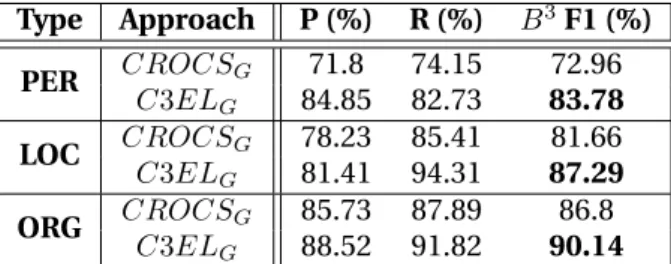
disregard the interaction synergies between entity contexts present across documents, leading to performance degradation and poor disambiguation of emerging or sparsely represented entities. This dissertation proposes theC3ELframework forjointly per-forming co-reference resolution and entity linking by iteratively harnessing enhanced mention contexts and external features to enable global propagation of information for precisely linking known entities and identifying previously unknown emerging en-tities. Empirical results on large text datasets show significant improvements in entity co-reference resolution and linking accuracies, particularly for “long tail” entities. Text credibility analysismeasures the veracity of information presented within a text snippet, thereby lending credibility to the facts extracted from such sources to be incorporated in knowledge bases. The presence of deceptive entity attributes and relationships within a knowledge store would severely impact its applicability in real-life scenarios. Previous works consider language model and user-centric features to classify text as truthful or otherwise. However, these approaches tend to utilize overly domain-specific information and fail to provide evidence as to why a text should not be considered credible. This work presents a credibility analysis framework by using limited information for constructinglanguage models,user-sentiment features, and consistency featuresto classify text snippets as credible or not. Further, the approach not only provides observed inconsistencies asevidencefor the classification decision, but is also shown to be robust and domain-independent. Evaluations on user reviews from real-world forums depict enhanced credibility classification accuracy of the framework over existing approaches.
Encoding of knowledge basesforms a key step for efficient storage of the underlying graphical structure representing the knowledge base, wherein a dictionary mapping the original entity strings to numerical identifiers (ID) is constructed for downstream index construction and query processing by an RDF engine. Current RDF engines gen-erally employ appearance order or hash based ID assignment to terms, and hence fail to capture semantic relationships across entities for possible join query optimizations. Moreover, such strategies also incur high storage and load costs from sub-optimal com-pression due to possible large ID assignment to highly frequent terms. This dissertation proposes theKOGN ACframework for efficient encoding of knowledge base terms based on approximatefrequent item detection(enabling index compression) and onto-logical similaritybased term clustering to assign close IDs to semantically related terms (capturing data locality) to enhance join query performance. Integration ofKOGN AC into state-of-the-art RDF engines and column-stores demonstrates improved storage requirements, query runtime, and I/O scan costs on various benchmarks.
Keywords:
Cross Document Co-Reference Resolution, Named Entity Linking, Knowl-edge Base, Credibility, RDF Term Encoding, Classification Models, Clustering, Semantic Context, Ontology, RDF Engines, TextZ
USAMMENFASSUNG
Entitätsattribute und deren Beziehungen sind wichtige Komponenten für moderne Anwendungen, wie etwa semantische Suche, maschinelle Beantwortung von Fragen und anderen Informationsextraktionsaufgaben. Die immense Menge an Texten in natürlicher Sprache, beispielsweise in der Wikipedia, in Nachrichtenartikeln, Blogs und Foren, die im World Wide Web über mehrere Domänen hinweg verfügbar ist, bietet eine reiche Quelle, um entitäts- und ereignisbezogene Informationen zu gewinnen. Große Wissensbasen, wie zum Beispiel YAGO, DBPedia, Freebase, etc., repräsentieren das gesammelte Wissen üblicherweise als beschriftete Graphstruktur und bilden das Rückgrat für “Web-Scale”-Systeme. Wichtige Herausforderungen bei der Konstruktion solcher Wissensbasen beinhalten nicht nur die Skalierbarkeit und Robustheit von Verfahren, um Petabytes an Text zu verarbeiten, sondern auch die genaue Erkennung und Disambiguierung von erkannten Entitäten, um diese geeignet zu repräsentieren. Darüber hinaus muss die Plausibilität von Fakten in Betracht gezogen werden, um die Qualität einer Wissensbasis zu gewährleisten. Schlussendlich ist auch eine hervorra-gende Abfrageperformanz entscheidend, um mit einer Wissensbasis in Echtzeit zu interagieren. Diese Dissertation macht dabei die folgenden Beiträge zum effizienten Wissensmanagement von benannten Entitäten, wie zum Beispiel Personen, Orte, und Organisationen, die aus Text extrahiert wurden.
Dokumentübergreifende Entitätskoreferenz-Auflösungbeinhaltet die Identifikation von sprachlichen Ausdrücken, die sich auf die gleiche Entität beziehen, jedoch möglicher-weise in verschiedenen Ausdrucksmöglicher-weisen vorliegen und über mehrere Dokumente innerhalb eines Korpus verteilt sind. Die linguistische Diversität von zwischen Doku-menten, die nötige Skalierbarkeit, um große Datenvolumen zu handhaben, und das Auftreten von mehreren Entitäten mit ähnlichen Repräsentationen sind dabei erschw-erende Faktoren. Existierschw-erende Verfahren kombinieren Textausschnitte zur Erfassung von Kontextinformationen, externe Merkmale, und vektorraumbasierte Ähnlichkeits-maße zur Clusteranalyse. Solche Verfahren sind jedoch oft nicht robust, äußerst rechen-intensiv und haben eine geringe Genauigkeit. Die vorgeschlageneCROCS-Methode adressiert diese Probleme mittels einer intelligenten Konstruktion vonsemantischen Zusammenfassungen, die den Kontext der Entitäten besser darstellen, indem sie In-formationen aus Text, dem gleichzeitigen Vorkommen von Entitäten, sowie externe Merkmale in einem stichprobenbasierten, hierarchischen Clusteranalyseverfahren
nicht häufig auftretende Entitäten) und der Laufzeit vonCROCSgegenüber anderen aktuellen Methoden.
Entitätsverlinkungbezieht sich auf die Disambiguierung von gefundenen benannten Entitäten und das Verlinken derer mit Einträgen aus einer Wissensbasis. Solche Ver-linkungen ermöglichen ein dynamisches Wachsen von Wissensbasen entweder mit neu aufkommenden Fakten über schon bekannte Entitäten oder mit neu extrahierten Entitäten, die noch nicht in der Wissensbasis vorhanden sind. Aktuelle Methoden nutzen Überlappungen zwischen Kontextinformationen von Entitäten, semantische Beziehungsmaße, Ähnlichkeit zu Wikipediaartikeln oder kohärenzbasierte Graphalgo-rithmen. Solche Methoden tendieren jedoch dazu, die Interaktionssynergien zwischen Entitäskontexten zu ignorieren, die sich über mehrere Dokumente verteilen. Dies resultiert in einem Performanzverlust und schlechter Disambiguierung von neu aufk-ommenden und seltenen Entitäten. Diese Dissertation stellt denC3ELAnsatz vor, welcher Koreferenz-Auflösung und Entitätsverlinkung inKombination durchführt, indem sich bessere Kontextinformationen und externe Merkmale iterativ zu Nutze gemacht werden, um eine globale Informationsausbreitung zum genauen Verlinken von bekannten Entitäten und Identifikation von zuvor unbekannten und neu aufkom-menden Entitäten zu ermöglichen. Empirische Resultate mit großen Textdatensätzen zeigen signifikante Verbesserungen der Entitätskoreferenz-Auflösung und eine höhere Genauigkeit bei der Entitätsverlinkung speziell bei seltenen, sogenannten “long tail” Entitäten.
Glaubwürdigkeitsanalysen von Textenuntersuchen die Glaubhaftigkeit von Informa-tion, die in einem Textausschnitt vorliegen, und beurteilen somit die Glaubwürdigkeit der daraus extrahierten Fakten, die in eine Wissensbasis übernommen werden sollen. Die Übernahme von irreführenden Entitätsattributen oder -relationen würde die An-wendbarkeit von Wissensbasen negativ beeinflussen und einschränken. Zur Klassifika-tion eines Textes als wahrheitsgetreu oder nicht ziehen vorherige Arbeiten in diesem Gebiet Sprachmodelle und benutzerspezifische Merkmale in Betracht. Sie tendieren dabei aber zu stark dazu, domänenspezifische Informationen einzusetzen, und scheit-ern daran, Evidenzen bereitzustellen, die begründen, wieso ein Textausschnitt glaub-würdig ist. Diese Arbeit stellt ein Verfahren vor, das lediglich eine begrenzte Menge an Information zur Konstruktion vonSprachmodellen, Sentimentmerkmalen(“Sentiment” für Empfindung, Gefühl), und Konsistenzmerkmalenbenötigt, um damit Textauss-chnitte als glaubhaft oder nicht zu klassifizieren. Des Weiteren bietet dieser Ansatz nicht nur beobachtete Inkonsistenzen alsEvidenzfür die Klassifikationsentscheidung an, sondern ist auch robust und domänenunabhängig. Evaluationen auf Basis von Benutzerbeurteilungen mit realen Forendaten zeigen verbesserte Klassifikationsergeb-nisse im Vergleich zu existierenden Verfahren.
Die Kodierung von Wissensbasenist ein entscheidender Schritt zum effizienten Spe-ichern der zugrunde liegenden Graphstrukturen, die eine Wissensbasis repräsen-tieren. Zur Anfragebearbeitung und nachgelagerten Indexkonstruktion durch eine RDF-Datenbank wird ein Katalog konstruiert, der die ursprünglichen Entitätszeichen-ketten auf numerische Identifikatoren (ID) abbildet. Aktuelle RDF-Datenbanken be-nutzen dafür die Reihenfolge des Erscheinens oder hashbasierte Zuweisungen zur ID-Vergabe an Terme. Sie scheitern aber daran, semantische Beziehungen zwischen Entitäten zu erfassen, die eine verbesserte Optimierung von JOIN-Anfragen zulassen würden. Des Weiteren leiden solche Strategien an höheren Speicherplatzanforderun-gen und höherer Last aufgrund suboptimaler Kompression durch die Vergabe zu großer IDs an häufig auftretende Terme. Zur effizienten Kodierung von Termen in Wissensbasen stellt diese Dissertation dasKOGN ACSystem vor. Basierend auf einer approximiertenErkennung von häufigen TermenundTermclustern ontologisch ähn-licher Termewerden nahe beieinander gelegene IDs an semantisch verwandte Terme vergeben, um dadurch die Performanz von JOIN-Anfragen zu verbessern. Die Inte-gration vonKOGN ACin aktuelle RDF- und spaltenorientierte Datenbanken hat in mehreren Experimenten verbesserte Speicherplatzanforderungen, kürzere Anfrage-laufzeiten und geringere E/A Kosten gezeigt.
Stichwörter:
Dokumentübergreifende Entitätskoreferenz-Auflösung, Benannte Entitätsverlinkung, Wissensbasen, Glaubwürdigkeit, RDF Term Kodierung, Klassifikationsmodelle, Clustern, Semantischer Kontext, Ontologie, RDF-Datenbank, Textverarbeitung
A
CKNOWLEDGEMENTS
I would like to extend my heartfelt thanks and regards to my supervisorProf. Dr-Ing. Gerhard Weikumfor his enormous support and guidance throughout the period of my doctoral studies. Without his invaluable insights, continuous counsel, and the encouragement to pursue a steady research direction, this work would certainly not have been possible.
I am immensely grateful to theInternational Max Planck Research School for Computer Science (IMPRS-CS)and theMax Planck Institute for Informatics (MPI-INF), Germany for providing a superb and stimulating research environment enabling me to focus primarily on my Ph.D. studies, and also a strong platform for evolving as a researcher. I would also like to thank Google Inc., for funding my studies through the Google European Doctoral Fellowship.
My colleagues and friends at the Databases and Information Systems group at Max Planck Institute ensured a cheerful atmosphere and much needed motivation during stressful time-periods — a big thank you to all! A special thanks to Mr. Patrick Ernst for helping me with the translation for the German portions of this dissertation.
I would also like to thank my parents for their unwavering support in all my decisions at all times. Most importantly, thank you so much Nikita for sharing your life with me and always reassuring and standing with me; before, during my Ph.D., and forever — a journey to cherish.
T
ABLE OF
C
ONTENTS
Abstract i
Abstract (German) iii
Summary v
Summary (German) vii
Acknowledgements xi
Table of Contents xiii
1 Introduction 1
1.1 Motivation . . . 1
1.2 Challenges . . . 3
1.3 Contributions . . . 4
1.4 Organization . . . 6
2 Background and Related Work 7 2.1 Named Entity Recognition and Classification . . . 7
2.2 Co-Reference Resolution . . . 9
2.3 Fact Extraction . . . 10
2.4 Fact Verification . . . 12
2.5 Entity Disambiguation and Linking . . . 13
2.6 Knowledge Base Construction . . . 15
3 Efficient Cross-Document Co-Reference Resolution 17 3.1 Introduction . . . 17
3.1.1 Approach and Contributions . . . 19
3.2 Related Work . . . 20
3.3 CCR Computational Framework. . . 21
3.4 Intra-Document Co-Reference Resolution . . . 22
3.5 Knowledge Enrichment. . . 22
3.5.1 Enrichment Strategies . . . 23
3.6 Similarity Computation. . . 27
3.6.1 Bag-of-Words Model (BoW) . . . 28
3.6.2 Key-phrases Model (KP) . . . 28
3.7 Hierarchical Clustering . . . 29
3.7.1 Active Spectral Clustering . . . 30
3.7.2 Balanced Graph Partitioning. . . 30
3.7.3 Specifics of Clustering . . . 30
3.7.4 Stopping Criterion . . . 31
3.8 Experimental Evaluation . . . 32
3.8.1 Parameter Tuning . . . 33
3.8.2 John-Smith Corpus: Long-Tail Entities . . . 33
3.8.3 WePS-2 Corpus: Web Contents . . . 34
3.8.4 New York Times Corpus: Web Scale . . . 35
3.8.5 Sensitivity Studies . . . 35
3.8.6 Algorithmic Variants . . . 38
3.9 Summary . . . 39
4 Joint Entity Co-Reference Resolution and Linking 41 4.1 Introduction . . . 41
4.1.1 Approach and Contributions . . . 43
4.2 Related Work . . . 45
4.3 Joint CCR-NEL Framework . . . 46
4.4 Pre-Processing Stage . . . 47
4.5 Interleaved NEL & CCR Approach . . . 48
4.5.1 Named-Entity Linking (NEL) Module. . . 51
4.5.2 Cross-Document CR (CCR) Module . . . 52
4.6 Finalization Stage . . . 53
4.7 Experimental Evaluation . . . 54
4.7.1 Parameter Tuning & Sensitivity Study. . . 56
4.7.2 CCR Performance Results . . . 57
4.7.3 Named-Entity Linking (NEL) Results . . . 58
4.7.4 Comparison with Joint Models . . . 59
4.7.5 Algorithmic Baseline Study . . . 61
4.8 Summary . . . 62
5 Credibility of Entity-Centric Texts 63 5.1 Introduction . . . 63
5.1.1 Approach and Contributions . . . 65
5.2 Related Work . . . 65
5.3 Entity Review Text Credibility Analysis . . . 66
5.3.1 Language Model. . . 67
5.3.2 Behavioral Model . . . 68
Table of Contents
5.3.4 Credibility Detection Framework . . . 70
5.4 Experimental Evaluation . . . 73
5.4.1 Review Credibility Classification . . . 75
5.5 Summary . . . 77
6 Efficient RDF Encoding of Knowledge Bases 79 6.1 Introduction . . . 79
6.1.1 Approach and Contributions . . . 81
6.2 Related Work . . . 82
6.3 TheKOGN ACAlgorithm . . . 86
6.4 Frequency Based Encoding. . . 88
6.4.1 Frequent Term Identification . . . 88
6.4.2 Frequent Term Encoding . . . 90
6.5 Locality Based Encoding . . . 93
6.5.1 Term Similarity for Data Locality . . . 94
6.5.2 Infrequent Term Encoding . . . 97
6.6 Experimental Evaluation . . . 98
6.6.1 Count-Min + Misra-Gries Evaluation . . . 99
6.6.2 Effectiveness ofKOGN ACEncoding . . . 101
6.7 Summary . . . 104
7 Conclusion 105 7.1 Contributions . . . 105
7.2 Outlook and Future Directions . . . 106
Bibliography 109
List of Algorithms 129
List of Figures 131
1
I
NTRODUCTION
The area of Information Extraction (IE) involves the task of extracting information from unstructured or semi-structured data from vast amounts of digital information expressed in natural language texts. The proliferation of knowledge sharing across domains in the form of Web pages, text documents, blogs, news articles, and commu-nities like Wikipedia has opened rich avenues to systematically harvest and represent entity related attributes and relationships as machine-readable knowledge repositories. The advent of knowledge bases such as DBPedia, YAGO, and Freebase, has enabled the precise representation of obtained facts and subsequent concise querying catering to modern-day applications likesemantic search,question answering, andmachine translationto name a few. As a consequence, the intelligent understanding of nat-ural language and the expressed sentiments by machines is necessitated for query reporting, analytics, and automated discovery and acquisition of further knowledge. To this end, this dissertation discusses the related state-of-the-art methods and research challenges, and proposes new efficient algorithms to tackle the inherent problems in entity-centric knowledge harvesting and management from text documents.
1.1
Motivation
Identification ofnamed entitiessuch as persons, locations, organizations, events, prod-ucts, etc., along with their senses from texts forms the basic building block for the extraction of facts for construction of knowledge stores [Weikum and Theobald, 2010]. Given the linguistic diversity across documents and varied surface forms of entities (such as acronyms and aliases), disambiguation of mentions to proper entities is cru-cial to obtain a holistic view of the information related to an entity. The problem of cross-document co-reference resolution(CCR) to identify and link textual mentions denoting the same entity across documents, provides a primary module for informa-tion extracinforma-tion. For example, consider the following text snippets obtained from two documents to form the input to an IE pipeline.
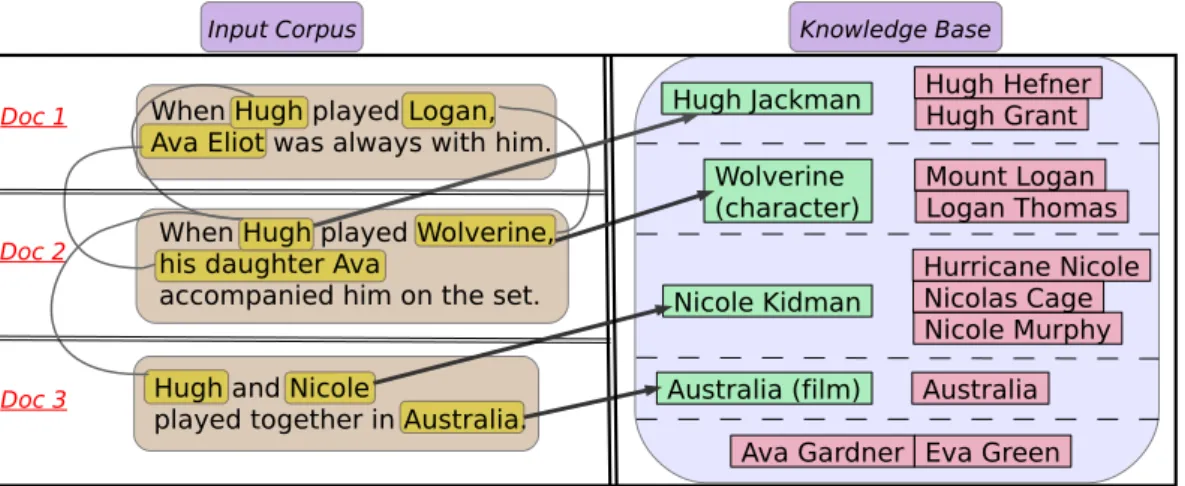
T1:Hugh Jackman was thrilled to play the role of Wolverine.
T2:Hugh was accompanied by daughter Eva on the movie sets.
Named entity recognition(NER) techniques are initially used to extract the mentions (phrases referring to named entities) present in the texts, i.e.,Hugh Jackman,Wolverine, Hugh, andEva. The ensuing CCR procedure should identify that the mentionsHugh JackmanandHughrefer to the same entity – hence facts obtained from the text snippets pertain to the same person. However, the sheer amount of such available data along with the unstructured and noisy nature, poses a challenge in terms of computational efficiency. The presence of possibly large numbers of entities with the same or similar name (e.g., “Hugh”) further complicates the precise identification and disambiguation of co-referent mentions across documents.
The generation of new entities and relationships for already known entities neces-sitates the periodic maintenance of knowledge bases to reflect the dynamic world. To enable proper knowledge aggregation, an important aspect is to determine if the identified entity is already present in the knowledge base, referred to as the task of named entity linking(NEL). Although disambiguation can be performed based on prior popularity, context similarity, and semantic coherence of entities, such approaches fail to capture sparsely represented entities or newly emerging entities currently absent in the knowledge repository. In our example, theout-of-knowledge-base entity“Eva” would thus be incorrectly linked to some other entity, leading to mis-representation of the father-daughter relationship (obtained from the text) between “Hugh” and “Eva”. Hence, a good disambiguation method needs to sift the “long tail” entities for proper and accurate representation of extracted facts.
The proliferation of platforms for user expressivity such as social media and blogs has led to the surge of available facts pertaining to entities. Unfortunately, such sources are increasingly prone to non-credible, erroneous, and biased data and viewpoints. Extraction and incorporation of possibly deceptive information would thus impair the quality of knowledge repositories. This further necessitates not only the proper detection and disambiguation of entities, but also efficient approaches for credibility analysis of the textual information presented and the extracted facts therefrom.
For exposition, considering the example entityHugh Jackman, assume attributes and re-lationships such asactor,bornIn Australia,playedIn XM en, andmarriedT o Deborra−
F urness, to have been extracted from the text documents. The harnessed informa-tion is then intrinsically represented as a labeled graph structure with the entities forming the nodes (labeled with attributes) and the relations among entities denoted as edges (labeled with relations). The underlying graphical structure of knowledge bases is generally cast into triplets using theResource Description Framework(RDF)
1.2. Challenges
format for efficient management by RDF engines [Neumann and Weikum, 2008] or column stores [Sidirourgoset al., 2008] and SPARQL (and its extensions) based query processing [Harbiet al., 2015]. Succinct representation of entities for proper storage management and optimized query processing is thus pivotal for entity oriented an-alytics [Suchanek and Weikum, 2014] and complex question answering likeactor Hugh Jackman married to ?orWhich Australian actor has the well-known screen alias Logan?. This enables knowledge repositories to cater to modern applications like Google Knowledge Graph search [Singhal, 2012], IBM Watson Question Answering system [IBM, 2012], etc., for natural language and keyword basedsemantic search.
Entity-centric knowledge acquisition and subsequent representation of extracted facts and relations as machine readable knowledge bases undergo several life-cycle stages: 1. collect and builda knowledge base of facts/attributes pertaining to entities and
their inter-relationships from natural language texts and other Web sources; 2. validatethe obtained facts to remove possible discrepancies and errors;
3. efficiently managethe collected information for proper storage and enhanced query answering performance; and
4. expand and updatethe knowledge repository with new facts and relations coming into existence.
The next section discusses the associated challenges for entity based knowledge ex-traction and management.
1.2
Challenges
Scalable Entity Resolution.Efficient state-of-the-art methods for entity co-reference resolution (CR) within documents use syntactic and linguistic features [Leeet al., 2013] or multi-phase sieves [Leeet al., 2011] to capture the similarities between mentions. These methods have been shown to provide high accuracy. Further, cross-document CR (CCR) approaches have been proposed using vector-space cosine similarity to compute similarities between mention contexts. However, such methods are computationally expensive involving pair-wise mention comparisons, rendering them impractical for CCR tasks at Web scale. Moreover, the distinction between multiple entities with the same textual representation (e.g., several persons with name “Hugh”) or of the same entities with different surface forms (e.g., name “Robert” abbreviated to “Bob”) requires precise representation of the mention attributes and contexts across documents. Text based similarity measures alone are unable to capture the contextual and semantic similarities across documents and suffer fromscalabilityissues.
High Quality Entity Disambiguation.The process of disambiguating and linking a discovered entity to an entry already present in a knowledge base, a variant of the record-linking task, involves the semantic relatedness, situational context and feature
similarities between the current entity and the candidates entities in the KB. Pro-cedures for correct mapping of surface strings to unique entities based on context coherence and syntactic similarity suffer from the lack of information propagation across documents leading to performance degradation in the face of noise and linguis-tic diversity.
Incompleteness or Long Tail of Entities.The dynamic nature of information gener-ation entails the emergence of new entities and/or relgener-ationships for already known entities. The presence of sparsely represented entities or novel entities currently absent from knowledge repositories aggravates the performance of entity co-reference resolu-tion and linking strategies based on rules or prior knowledge. Precise disambiguaresolu-tion of such new or emerging entities poses significant challenges.
Information Veracity.Although Web documents such as news articles, forums, blogs, etc., provide rich sources of information, they inherently suffer from noise and more im-portantly from possibly biased, misrepresented, or non-credible statements – severely limiting the purpose and applicability of knowledge repositories. Human curated do-mains such as Wikipedia partially solve the problem, but fail to represent all possible entities and relationships. Hence, there is an immense need for automated approaches to assess information credibility for detecting possible candidate facts as discrepant and/or biased. Existing strategies adopting bigram language models and user activity based features exhibit limited accuracy and tend to be limited to specific domains.
Succinct Representation of Knowledge Bases.The real-time characteristics of Web applications harnessing knowledge bases requires efficient loading and query process-ing performance of such repositories. Knowledge bases, in the form of labeled graph structures, tend to optimize storage, querying, and I/O costs. Existing frameworks for storing and indexing knowledge bases by RDF engines or column stores (with various compression techniques) ignore input data distribution and data locality (semantic similarity), thus are expensive in terms of computation and storage.
1.3
Contributions
This dissertation addresses the aforementioned challenges in the domain of knowledge acquisition and management from natural language texts, thus advancing the state-of-the-art by proposing the following novel methodologies.
• CROCS: Robust entity co-reference resolution across documents – CROCS pro-vides an improved framework for cross-document co-reference resolution geared for Web scale and “long tail” entity mentions. The performance enhancement stems from the construction of summary snippets to capture entity contexts from documents, use of external features for enrichment, and entity context similarity computation,
1.3. Contributions
judiciously combined within a hierarchical clustering architecture (Chapter3). Ad-ditionally, robustness and correctness for sparsely represented entities is achieved by selective feature inclusion and sampling strategies. The proposed method was published in TACL 2015 [Dutta and Weikum, 2015a].
•C3EL: Framework for joint entity co-reference resolution and linking –Although, interactions between co-reference resolution and entity disambiguation have been shown to be beneficial, such frameworks do not exist for tackling the problem across documents. C3EL presents a novel framework for jointly tackling CCR and NEL for extending the coverage of entity-centric information available. In this context, we propose iterative steps of co-reference resolution and disambiguation to enable global entity context propagation for improved performance on both tasks (Chapter4). The adoption of modules from the CROCS approach and external entity linking systems, coupled with link validation step and information feedback, achieves a higher accuracy for both the tasks compared to existing methods. C3EL demonstrates significant gains, especially in detecting out-of-knowledge base entities. The work was presented at EMNLP 2015 [Dutta and Weikum, 2015b].
•Credibility analysis of texts with limited information –This work proposes a credi-bility framework utilizing language, user, and text sentiment based features for con-structing consistency features to score and classify the veracity of information present in natural language texts. In this context, our method uses limited information in con-trast to existing approaches employing large number of features (difficult to obtain in real-life scenarios), to deliver better classification accuracy and domain-independence with limited re-training (Chapter5). Furthermore, possible inconsistencies present in the texts are extracted as evidence for the non-credible classification decision, a novel feature in the field of credibility analysis research. The results were presented at ECML-PKDD 2016 [Mukherjeeet al., 2016].
•KOGNAC: Efficient encoding of knowledge bases –Entity attributes and relation-ships present in knowledge bases are typically represented as graphs and are generally stored and queried using RDF engines. For efficient storage and computation, mod-ern RDF engines and column stores encode entity strings by assigning numerical identifiers based on appearance order or hash based methods. KOGNAC proposes a new encoding strategy for improving the indexing and storage requirements, query performance, and I/O scan costs in RDF engines (Chapter6). The mapping of entity strings to identifiers based on approximate frequency estimation for assigning smaller identifiers to common entities enables better compression in the framework. Further, the use of ontological distance based entity semantic similarity measure enhances the index data locality for improved join query runtime. Integration of the proposed approach with state-of-the-art RDF engines is observed to significantly enhance query performance for large knowledge bases. The KOGNAC framework was presented at IJCAI 2016 [Urbaniet al., 2016].
1.4
Organization
The remainder of this dissertation is organized as follows.Chapter2introduces the related tasks and problems pertaining to entity co-reference resolution and linking, credibility analysis of textual snippets, and storage of knowledge bases for knowl-edge management of named entities from texts. It further discusses state-of-the-art approaches in this domain and their limitations, which we aim to alleviate in this dis-sertation.Chapter3presents an efficient algorithm to perform cross-document entity co-reference resolution at Web-scale for robustly dealing with sparsely represented or emerging entities.Chapter4proposes a novel joint framework for interleaved entity co-reference resolution and linking with iterative knowledge propagation, specifically to cope with out-of-knowledge base entities.Chapter5discusses language and user based consistency models to compute the credibility of text snippets, for enriching the quality of knowledge repositories.Chapter6puts forth an intelligent encoding strategy, based on term frequency estimation and semantic similarity, for RDF style storage and query performance efficiency of knowledge bases.Chapter7finally concludes the dissertation summarizing the contributions and possible directions of future work, followed by a list of references to existing methodologies.
2
B
ACKGROUND &
R
ELATED
W
ORK
This chapter provides an overview of state-of-the-art approaches in Information Ex-traction for automated knowledge acquisition from natural language texts.
2.1
Named Entity Recognition and Classification
Identifying information units such as persons, locations, organizations, events, and numeric expressions from unstructured texts forms the basis of entity discovery and relation extraction and is referred to as the task ofNamed Entity Recognition(NER). Automated approaches involving the detection of single or multi-word expressions denoting a real world entity for NER across vast heterogeneous digital data is thus an essential task for Information Extraction.
Classical methods for NER relied majorly on hand-crafted rules based on linguistic features from words, like punctuations, capitalizations, morphological representa-tions, dictionary based pattern matches, and grammatical rules [Mikheevet al., 1999; Cohen and Sarawagi, 2004]. The use of document level term statistics [Thielen, 1995; Da Silvaet al., 2004] to detect mention boundaries pertaining to named entities was also proposed across various domains and languages. The emergence of major scien-tific events and communities such as MUC-6, ACE, CoNLL, LREC, etc., have provided impetus to the expanse of research on natural language processing (NLP).
Linguistic rules obtained from dependency parser and multi-sieve strategies [Leeet al., 2011] have been proposed to efficiently tackle the problem of NER. A typical approach in unsupervised methodologies involves clustering of named entities based on context and semantic patterns using hyponyms and hypernyms [Evans, 2003] from lexical resources such as WordNet. Semi-supervised techniques likebootstrappinginvolve the use of domain specific seed words to initiate the learning process. Regular expres-sion based patterns and syntactic relations along with feature incluexpres-sion from external repositories such as Wikipedia [Cucchiarelli and Velardi, 2001] and user generated
forums and blogs [Liuet al., 2011] have been shown to provide accurate contextual evidences in text to detect entity mentions. Such semi-supervised learning methods aimed to combine sparse training data with large collections of additional unlabeled data (e.g., unlabeled Web pages). With the growth in human-annotated corpora, super-vised learning techniques such as Hidden Markov Models (HMM) [Bikelet al., 1997], Decision Trees [Sekine and Nobata, 2004], Support Vector Machines (SVM) [Asahara and Matsumoto, 2003], and Conditional Random Fields (CRF) [McCallum and Li, 2003] were used for NER by learning disambiguation rules based on discriminative feature spaces. Another fundamental building block from machine learning involve models for joint segmentation and labeling. Semi-Markov structured classifier for NER and subsequent normalization using semantic indexing was proposed for joint NER and normalization of entities [Leaman and Lu, 2016]. A comprehensive survey on NER techniques and their evaluations can be found in [Nadeau and Sekine, 2007].
The use of entity semantic classes to identify entities via multi-label classification for unstructured text was proposed in [Ling and Weld, 2012]. Recent methods explored the viability of neural network embeddings, leveraging lexicon based information to obtain state-of-the-art results for the task of NER [Passoset al., 2014]. The use of conditional random fields (CRF) and long short term memory (LSTM) for neural network embedding based architecture was put forth in [Lampleet al., 2016]. Ranking approaches to combine entity recognition and their linking to KB by merging candidate mentions from both NER and linking have been shown to provide significant error reduction [Sil and Yates, 2013]. A probabilistic graphical model based approach to jointly perform NER and disambiguation capturing mention span and KB mapping was presented in [Nguyenet al., 2016].
Named Entity Classification(NEC), a closely related task, involves the tagging of dis-covered entities into rigid designated object types such as person, date, location, etc., based on predominant entity type classes. Each of the types can further be sub-divided into fine-grained subtypes, e.g., location can be further categorized as city, state, and country [Fleischman and Hovy, 2002]. Clustering of discovered terms based on con-text and attribute similarities [Da Silvaet al., 2004; Etzioniet al., 2005], along with dictionary based approaches have been proposed to providePOS tagsto the entities, thereby allowing for separate downstream processing [Ratinov and Roth, 2009]. An active research issue in NLP is to extend this line of analysis into semantic role labeling (SRL) [Moschittiet al., 2008] for mapping sentences to knowledge representations. A hierarchical multi-type classification of named entities based on gazetteer features and joint evidence was presented by [Yosefet al., 2012]. To handle new or emerging entities, discovering and semantically typing such entities based on an integer linear program formulation was shown to achieve high performance [Nakasholeet al., 2013]. A collection of recent NER and NEC methods and their multi-lingual applications can be found in [Sekine and Ranchhod, 2016].
2.2. Co-Reference Resolution
2.2
Co-Reference Resolution
Identifying and cross-linking named entities in Web contents is at the heart of infor-mation acquisition for knowledge-enhanced search, recommendations, and analytics. Among various IE tasks, extracting actionable intelligence from an ever-increasing amount of data depends critically upon Coreference Resolution (CR) for identifying noun phrases occurring within a document that refer to the same real-world entity. This enables the consolidation of information pertaining to a particular entity for effective knowledge base population.
Traditional CR methods are based on rules or supervised learning using different kinds of linguistic features like syntactic paths between mentions, the distance between mentions, and their semantic compatibility as derived from co-occurrences in news and Web corpora [Haghighi and Klein, 2009;Leeet al., 2013], for identifying the best an-tecedent (preceding name or phrase) for a given mention (name, phrase, or pronoun). To harness context features, first-order probabilistic models over mention clusters were proposed in [Culottaet al., 2007]. The use of hierarchical Dirichlet process to obtain the referent mentions for unsupervised CR approaches was presented by [Haghighi and Klein, 2007], which was later extended to a fully generative Bayesian model [Ng, 2008]. Syntactic features derived from deep parsing of sentences and noun group pars-ing, with semantic features obtained by mapping mentions to background knowledge resources such as Wikipedia and YAGO were used for CR in [Rahman and Ng, 2011a; Ratinov and Roth, 2012] to identify entity candidates. Recent methods adopted the paradigm of multi-phase sieves, applying a cascade of rules to narrow down the choice of antecedents for a mention [Haghighi and Klein, 2009;Raghunathanet al., 2010]. Cluster-ranking and ensemble based methods [Rahman and Ng, 2011b] extended this paradigm for connecting mentions with a preceding mention cluster by incrementally expanding groups of mentions, and exploiting relatedness features derived from se-mantic types and Wikipedia category names. The closely related task of person name disambiguation deals with only person names, title, nicknames, and surface forms variations [Chen and Martin, 2007]. An overview of CR methods was given by [Clark and González-Brenes, 2008;Ng, 2010].
The task of CR, when extended to process multiple documents across corpora is known asCross-Document Co-reference Resolution(CCR), and involves the compu-tation of equivalence classes of entity mentions across documents. CCR can essen-tially be viewed as a clustering problem, using a similarity metric between mention features. However, standard clustering lacks awareness of entity contexts and inter-dependencies and suffer from high computational complexity. Early work on CCR such as [Bagga and Baldwin, 1998;Gooi and Allan, 2004] used IR-style similarity measures (tf-idf cosine, KL divergence, etc.) over features like the ones used in intra-document CR. Baron and Freedman [Baron and Freedman, 2008] proposed a CCR method involv-ing full clusterinvolv-ing coupled with statistical learninvolv-ing of parameters. Several CCR methods
have harnessed co-occurring entity mentions, especially for the task of disambiguating person names [Mann and Yarowsky, 2003;Niuet al., 2004;Chen and Martin, 2007; Baron and Freedman, 2008]. However, these methods do not utilize knowledge bases, but use information extraction (IE) methods on the input corpus; thus facing substan-tial noise due to quality variance on stylistically diverse documents like Web articles.
More recent works such as [Singhet al., 2010] are based on probabilistic graphical models for jointly learning the mappings of all mentions into equivalence classes. A large scale distributed inference mechanism based on Markov chain Monte Carlo method to introduce sub-entity and super-entity variables representing clusters for distributing or collecting entities was presented by [Singhet al., 2011]. To obtain richer semantic features, additional knowledge resources such as Wikipedia and FrameNet corpora have also been considered in the context of CCR [Suchaneket al., 2007;Baker, 2012]. In general, CCR methods tend to “featurize” entities by context patterns around it and compute the similarity between entity pairs. The entity mentions are then grouped into clusters such that the similarities among members within the same cluster are maximal while similarities across data members from different clusters are minimal. An orthogonal approach on CCR based on the use of latent features derived from matrix factorizations combined with parameter-free graph clustering was recently proposed in [Ngomoet al., 2014]. The use of other knowledge contexts such ascross-mediafeatures for CCR was also shown to be efficient in practice [Zhanget al., 2015]. A wide range of features capturing evidence for both entity merging and arguing against merging, can significantly improve machine learning-based CCR as reported in [Mayfieldet al., 2009]. The use of external features to develop global learning model to enhance CCR performance was presented in [Ng, 2016]. An interesting review and evaluation of existing CCR techniques has been presented in [Beheshtiet al., 2016].
2.3
Fact Extraction
A key process in the creation of knowledge bases involves models and algorithms for transforming Web pages, text sources, and other unstructured data into explicit facts and relationships across the discovered entities as unary, binary, or higher ar-ity relations. In general, fact extractionaims at extraction of triples in the form of
hsubject, predicate, objecti(SPO) denoting unary/binary relations. As such, methods for harvesting relational facts can be categorized into different paradigms such as rule-based (for semi-structured data), pattern and statistics rule-based (for natural language texts), or joint inferencing based learning for combining best of both worlds.
Rule-based strategies exploit regularities in the structures of digital resources, centered around regular expressions over DOM trees [Kushmericket al., 1997;Sahuguet and Azavant, 2001; Arasu and Garcia-Molina, 2003]. Textual patterns based on natural language rules such as the occurrence of noun phrases as subjects or objects related
2.3. Fact Extraction
to verb phrases have been used for clustering approaches to identify relationships among entities [Hindle, 1990]. Part-of-Speech enriched lexico-syntactic patterns like Hearst patterns [Hearst, 1992] and their extensions capturing predefined relation types have been shown to achieve high precision for obtaining facts from free text. The du-ality of facts and patterns[Brin, 1998] iteratively enables the automatic identification of linguistic patterns and subsequent detection of fact candidates, based on a small start set ofseed facts. The extension of such models by employing machine learning techniques such as Hidden Markov Model (HMM) and classifiers to arrive at good extraction rules have been pursued by systems such as RoadRunner [Crescenzi and Mecca, 2004] and SEAL [Wang and Cohen, 2009]. The use of attribute-value pair tem-plates from external knowledge sources such as Wikipedia infoboxes have also been proposed for fact extraction during construction of knowledge bases like DBPedia and YAGO, with careful noise elimination based on frequency or learning techniques [Weld
et al., 2008]. The use of distant entity labels enabling proper fact segmentation for fact extraction was presented in [Sutton and McCallum, 2004]. Under the ambit of OpenIE, the use of Wikipedia as data source for enhanced fact extraction was studied by [Wu and Weld, 2010]. Fact gathering indeclarative IEcombining the process of extraction and inferencing encapsulated fact using datalogs was also presented [Shenet al., 2007]. Subsequently, query languages such as AQL [Reisset al., 2008] were developed for interfacing with such fact stores based on pattern matching and dictionary lookups. To manage the uncertainty of extracted fact by rule based systems, [Michelakiset al., 2009] proposed the use of parametric exponential model to capture the interaction between compositional rules, while the refinement of text based rules using ranking approaches in the context of data provenance was presented by [Liuet al., 2010].
Statistical analysis such as frequency, confidence, etc., for pattern co-occurrences, and consistency constraints for reducing errors, with the use of structured ontological sources to boost the scope and precision of pattern-based fact extraction techniques have also been proposed [Udreaet al., 2007;Zhuet al., 2009]. Extensions in this domain for the use of lexical dependency parsers, proximity, entity disambiguation, and incor-poration of negative patterns [Suchaneket al., 2006;Bunescu and Mooney, 2007] have been shown to enhance robustness and expressivity. Distant supervision approaches for relation extraction to tackle the lack of labeled data was explored in [Mintzet al., 2009]. Scalable knowledge harvesting based on n-gram-itemset for obtaining richer patterns using constraint reasoning was depicted by [Nakasholeet al., 2011].
Amalgamation of precision oriented rule-based methods and recall oriented pattern-based approaches was proposed by [Lin and Pantel, 2001]. Pattern based methods were further augmented with joint reasoning by the use of Markov Logic Networks [ Domin-goset al., 2007] and other relational learning methods for grounding rules against base facts and newly extracted candidate facts. This, in combination with patterns from existing knowledge bases enabled the learning of new facts, patterns, and constraints with high precision and efficiency [Suchanek, 2008]. The union of patterns, word
dis-ambiguation, and ontological reasoning was shown to produce high performance even in scenarios of unstructured documents [Suchaneket al., 2009]. A tutorial to automatically construct and maintain a comprehensive knowledge base was presented in [Weikum and Theobald, 2010].
The paradigm ofOpen IEaims at the extraction of entity attributes expressed in verb form from Web pages, rather than based on predefined canonical relations. The use of POS tags to locate verbs and the use of dependency parsers [Mausamet al., 2012] or language clauses [Corro and Gemulla, 2013] thereafter, allowed the identification of subjects and objects connected to the verb phrases. The use of nominal attributes for capturing patterns and ontologies was studied in [Yahyaet al., 2014]. The process of OpenIE enables the extraction of large number of meaningful facts, however suffer from noise due to the absence of consistency reasoning on the extracted data.
2.4
Fact Verification
The deluge of digital information available on the Web provides rich resources for ex-traction of entity attributes and relationships. However, the credibility of such sources and the extracted facts remains a major concern for assessing the quality of the ob-tained data. As such, the presence of noisy, biased, or deceptive claims tend to severely impact the performance of modern knowledge bases, and calls for efficient approaches to verify the extracted information. Traditional methods involving dedicated human fact-checkers or crowd-sourcing approaches based on cognitive heuristics such as reputation, endorsement, and consistency [Metzger and Flanagin, 2013] suffer from expensive computations, corroboration of multiple sources, and possible absence of contextual information. Hence, automated methods for characterizing the credibility of information have broadly considered classification strategies based on linguistic, user activity, and psychological features.
Distributional difference in the wordings between authentic and fake texts to learn latent topics and word-level features for training SVM classifiers was proposed in [ Mi-halcea and Strapparava, 2009;Ottet al., 2011;Ottet al., 2013]. Additionally, linguistic features such as text sentiment[Yoo and Gretzel, 2009],readability score[Huet al., 2012],textual coherence[Mihalcea and Strapparava, 2009], and rules based on Prob-abilistic Context Free Grammar (PCFG) [Fenget al., 2012] have also been studied. Entity and user based features to capture background information like name, descrip-tion, history, locadescrip-tion, etc., [Limet al., 2010;Wanget al., 2011;Mukherjeeet al., 2012; Mukherjeeet al., 2013b;Rahmanet al., 2015] were employed to train regression models on extracted features to classify facts as credible or deceptive. Similar works for fact checking on social media also considered ad-hoc features like extreme sentiments, user activity (number of posts, friends etc.), length, deviation from community mean, burstiness, and simple language features like content similarity, presence of literals,
2.5. Entity Disambiguation and Linking
numerals, capitalizations, and POS tags, for learning classification models. Supervised approaches using user sentiment, POS tags, and entity types from sentences to train random forest classifiers obtaining a ranking score for credibility analysis was studied by [Hassanet al., 2015]. Wu et al. [Wuet al., 2014] provided an interesting approach for fact checking and completion based on reverse engineering by “perturbing” and re-formulation the extracted facts as queries to observe their effects on the obtained results. The effect of majority opinion and their propagational pattern for analyzing the perception of truthfulness of facts in social media was studied in [Li and Sakamoto, 2015]. However, such methods are rarely generalizable and provide no concrete evi-dence as to why a relation is deemed non-credible.
2.5
Entity Disambiguation and Linking
The dynamic nature of digital contents available on the Web leads to the discovery of new entities or the emergence of new relationships about already known entities, that needs to be extracted and updated in the existing knowledge bases (KB) for pre-cisely modeling the real world. A crucial challenge in this regard is to distinguish between different entities having the same surface forms (e.g., multiple persons with the same name “John”) and/or between same entities represented in different forms (e.g., acronyms, aliases, etc.) – referred to as the task ofNamed Entity Disambiguation (NED). The presence of noise and context based word-sense ambiguity further compli-cates the proper alignment of mentions to real-life entities. For example, the mention “apple” might refer to either the fruit or the company depending on the textual context.
The related task ofWikificationinvolves the disambiguation of all words and phrases having a corresponding Wikipedia article, catering to a broader scope for disambiguat-ing common nouns and phrases onto concepts, while NED restricts itself to mentions denoting individual entities. Although Wikification enables more words of a text to be associated with their meaning, useful for downstream applications and joint inference methods, the absence of all word senses from Wikipedia limits its applicability. The task ofNamed Entity Linking(NEL) offers a broader scope than NED, by not only disambiguating and mapping entity mentions to canonical correct entries in a KB if present, but also dealing with the case when there is no entry in the reference KB and marking such entities as absent (i.e., link tonull) [Alhelbawy and Gaizauskas, 2014].
Naïve approaches involved defining a similarity measure between the surface forms of entity strings and possible target entities by using traditional measures such as Jaccard similarity, edit distance, and Jaro-Winkler distance, operating on flexible notions of token representation (e.g., stemmed words, POS-tagged words, N-grams, etc.) [Koudas
et al., 2006] and contexts. Machine learning techniques were employed to consider the joint disambiguation of multiple entities with mutual re-inforcement [Singla and Domingos, 2006]. However, such strategies not only fail to capture semantic similarities
between mentions, but also disregards the presence of existing knowledge sources.
Initial works using semantic similarity for NEL proposed the disambiguation of named entities to Wikipedia articles using textual context similarity, word-category associa-tion, and HTML redirect links [Bunescu and Pa¸sca, 2006;Cucerzan, 2007]. The incor-poration of disambiguation confidence along with the notion of semantic similarity of entities to corresponding Wikipedia pages was studied in [Milne and Witten, 2008]. A supervised learning approach for obtaining a similarity prior and modeling the pair-wise coherence of entity candidates as a probabilistic factor graph (with entity-entity relatedness measure) was used for heuristically solving an integer linear program (ILP) formulation in [Kulkarniet al., 2009]. External lexical and encyclopedic resources were also used to capture semantic similarity across candidate entities [Poesioet al., 2008]. Further, ontological distance similarity based NEL have also been studied [Hassell
et al., 2006]. The combination of WordNet and Wikipedia to leverage both semantic knowledge and taxonomy was proposed in [Shenet al., 2012]. A tabular comparison of several NEL methodologies and setup can be found in [Hoffart, 2015].
Extending the context and semantic similarity between mentions to incorporate the global coherence within a document in an iterative manner, [Ratinov et al., 2011] disambiguated mentions independently for an optimization step taking into account the semantic relatedness, disambiguation confidence, and link-likelihood of a phrase to train a classifier. An ensemble of classifiers to improve NEL accuracy was shown to exhibit high accuracy in [Zuoet al., 2014]. A scalable Gibbs sampling based approach for probabilistic entity linking was also proposed [Houlsby and Ciaramita, 2014]. A novel phrase-unigram language model to efficiently capture high-order dependencies in lexical features from noisy free-text documents was shown to significantly improve “long tail” entity linking [Jinet al., 2014].
Graph models have also been proposed for collective approaches to model entity inter-dependencies for disambiguation based on relationship contexts. The use of local dependency and semantic relatedness between mentions and the candidate entities to construct a referent graph for collective inference of the correct reference node in the graph was presented in [Hanet al., 2011]. The problem of NEL was cast as dense subgraph finding, and the use of strongly interconnected components based on Wikipedia link structures and content similarities to obtain a coherence weighted graph for candidate entity generation was studied by [Hoffartet al., 2011]. Representing all possible entity candidates as nodes and their initial association confidences as edges, the use of PageRank algorithm for candidate ranking was recently shown to be quite effective [Alhelbawy and Gaizauskas, 2014] in practice. In fact, collective ranking and collaborative ranking among candidate entities to ensure semantic similarity for NEL was recently proposed [Chen and Ji, 2011;Zhaoet al., 2016]. Re-ranking of candidate Wikipedia entities based on mutual relationship between the entities of a document was incorporated in SemLinker to offer a more robust disambiguation [Chartonet al.,
2.6. Knowledge Base Construction
2014]. A detailed overview of current NEL methods, challenges and their evaluations was presented in [Hacheyet al., 2013;Shenet al., 2015].
2.6
Knowledge Base Construction
Knowledge Bases (KB) provide a coherent integration of knowledge extracted from diverse Web sources into structured machine-readable format for varied applications, and has received tremendous interest with the emergence of repositories such as YAGO, NELL, DBPedia, Google Knowledge Graph, etc., constructed from Wikipedia, Web, and/or specific domains. The process ofKnowledge Base Construction(KBC) incorporates procedures for entity and mention discovery, fact and relationship ex-traction, and veracity of information collected, along with updates pertaining to the emergence of new entities and facts.
Traditional knowledge sources such asCyc[Lenat, 1995] andWordNet[Fellbaum, 1998] were created by manually compiling lexical and word-sense information, yielding high-quality repositories on intensional knowledge containing general concepts, semantic classes, and relationships within a taxonomical structure. However, such resources were labor intensive and lacked extensional knowledge about individual entities and their relationships. Construction of KB using co-operative strategies across documents across domains was initially proposed in [Mansell, 2002]. A moderated approach to factor in expert opinion into knowledge bases was presented in [van Astet al., 2004].
The emergence of automatically constructed KB of facts about named entities, their semantic classes, and their mutual relationships containing millions of entities and billions of facts, forms the backbone of modern Web of Linked Data [Heath and Bizer, 2011]. Initial works for enhanced extraction and knowledge management activity cycle was presented by [Sterner, 2000;Matthee and Viktor, 2001]. Automated approaches adopt diverse methodologies such as: use of semi-structured Wikipedia infoboxes to extract entity attributes and WordNet for taxonomy structure (e.g., YAGO [Suchanek
et al., 2007]), statistical learning and inferencing based on linguistic and dependency path features (e.g., DeepDive [Niuet al., 2012]), coupled learning (e.g., NELL [Laoet al., 2011]), probabilistic approaches using distributed inference algorithm with graph construction and hypergraph sampling [Niepertet al., 2012], or a combination of natural language processing tools (e.g., KELVIN [McNameeet al., 2013]). A brief survey of recent algorithms and trends in knowledge base construction can be found in [Ji and Grishman, 2011;Suchaneket al., 2012].
Knowledge bases are most easily represented as a labeled graph structure, where the entities denote vertices and the edges model the relationships between the entities. KBs are generally stored ashsubject, predicate, objecti(SPO) triples according to the Re-source Description Framework(RDF) data model [Klyne and Carroll, 2006] with SPARQL
based query interface. RDF engines such as RDF-3X [Neumann and Weikum, 2008] and TriAD [Gurajadaet al., 2014] then implement the index structures and dictionaries to represent the graph. However, existing RDF engines focus on individual triples rather than providing a graph oriented representation of the data, and thus the implementa-tion of core graph-based query tasks are time-inefficient. To this end, several general purpose graph databases and column-stores such as MonetDB [Sidirourgoset al., 2008] and Neo4j [Robinsonet al., 2015], have been proposed to represent the entities and relationships as attribute labeled multigraphs in native data structures. An intro-ductory survey of RDF engines and graph databases with performance comparisons on benchmark queries has been presented in [Abreuet al., 2013].
RDF Representation: The storage of RDF terms, representing the KB entities and relationships, in their original format is both space and compute inefficient since these are typically long strings (e.g., URIs). As such, all existing approachesencodethe URIs and literals in a judicious manner, typically by mapping them to fixed-length integer IDs, with the original strings retrieved only during execution.
The fastest method to perform such dictionary encoding uses hashcodes of the terms as numerical IDs, but suffer from hash collisions wherein different terms receive the same ID. Systems adopting hash-based approaches (e.g., 4Store [Harris et al., 2009] and Stardog (goo.gl/zSalQl) address this problem by calculating lengthy hash codes with cryptographic functions like SHA-1 to practically remove the possibility of collisions. Unfortunately, this strategy makes the encoding process rather slow since cryptographic functions are expensive to compute and the resulting IDs are unnecessarily long.
Most of the current large-scale RDF engines follow a different approach where the IDs are assigned with counters. TripleBit [Yuanet al., 2013], for example, splits the dictionary table into two tables, one for the predicates and the other for the objects and subjects, and assigns new IDs when new terms appear in the input. Sesame [Broekstra
et al., 2002], another very popular RDF store, encodes all the namespaces in a separate data structure and encodes the terms using a 32 bit counter. RDF-3X [Neumann and Weikum, 2008] – perhaps the most scalable among current RDF engines – adopts a different solution by sorting the terms and stores the mapping using a traditional disk-based B-Tree. Recent methods like TriAD [Gurajadaet al., 2014] employ graph partitioning techniques for clustering together related terms for term ID assignment. Scalable parallel approaches using MapReduce for dictionary encoding have also been proposed [Urbaniet al., 2013].
In the remainder of this dissertation, additional background concepts and existing approaches specific to the different stages of knowledge harvesting have also been presented within the ambit of the pertaining chapters.
3
E
FFICIENT
C
ROSS-DOCUMENT
C
O-REFERENCE
R
ESOLUTION
Acquisition of relevant and associated information pertaining to an entity involves the task ofCross-Document Co-Reference Resolution(CCR) for precise identification of mentions, present in texts within a corpus, that refer to the same real-life entity, enabling the construction of semantic resources such as Knowledge Bases (KB). How-ever, the enormous amount of documents involved in Web-scale corpora imposes a prohibitive computational complexity on existing CCR approaches.
This chapter presents an efficient and scalable approach for CCR across documents within huge collections from diverse sources, thereby handling Web-scale corpora. It harnesses enriched mention contexts by considering co-occurring mentions as well as distant features from external knowledge sources. The proposed method adopts a sampling-based hierarchical clustering procedure to provide an efficient CCR approach alleviating the above problem. Experimental results on benchmark datasets show our proposed algorithm to outperform state-of-the-art methodologies for CCR.
3.1
Introduction
Motivation.Knowledge bases such as Google Knowledge Graph, DBPedia, and YAGO to name a few, provide rich semantic resources containing huge collections of entities such as people, places, celebrities, organizations, movies, and events, along with their properties and inter-relationships. The construction of such huge repositories involves information extraction from multiple documents across varied sources for individual entities forming the knowledge base entries. This enables efficient performance for applications involving entity search, semantic search, question answering, and others.
Perhaps the most important value-adding component in this setting is provided by therecognitionanddisambiguationof named entities in Web and user contents to aggregate meaningful facts pertaining to the corresponding entity only, sifting out other entities with same or similar surface forms.