This is the author manuscript accepted for publication and has undergone full peer review but has not DOI: 10.1002/adma.201801541
Article type: Communication
Highly Stretchable and Tough Hydrogels Below Water Freezing Temperature
Xavier P. Morelle1,2, Widusha R. Illeperuma1, Kevin Tian1, Ruobing Bai1,2, Zhigang Suo1,2,
and Joost J. Vlassak1*
Dr. X. P. Morelle1,2, Dr. W. R. Illeperuma1, K. Tian1, R. Bai1,2, Prof. Z. Suo1,2, Prof. J. J. Vlassak1
1
John A. Paulson School of Engineering and Applied Sciences, Harvard University, Cambridge, MA 02138, USA
2
Kavli Institute for Bionano Science and Technology
*E-mail: [email protected]
Keywords: tough hydrogels, sub-zero temperatures, ice-salt solution slurry phase, freezing point depression, non-freezing ionic devices
Abstract
Hydrogels consist of hydrophilic polymer networks dispersed in water. Many applications of hydrogels rely on their unique combination of solid-like mechanical behavior and water-like transport properties. If the temperature is lowered below 0°C, however, hydrogels freeze and become rigid, brittle, and non-conductive. Here we demonstrate a general class of hydrogels that do not freeze at temperatures far below 0°C, while retaining high stretchability and fracture toughness. These hydrogels are synthesized by adding a suitable amount of an ionic compound to the hydrogel. The present study focuses on tough polyacrylamide-alginate double network hydrogels equilibrated with aqueous solutions of calcium chloride. The resulting hydrogels can be cooled to temperatures as low as -57°C without freezing. In this temperature range, the hydrogels can still be stretched more than four times their initial length and have a fracture toughness of 5000 Jm-2. It is anticipated that this new class of hydrogels will prove useful in developing new applications operating under a broad range of environmental and atmospheric conditions.
Hydrogels are crosslinked networks of hydrophilic polymer chains dispersed in water. The polymer network gives the hydrogels solid-like mechanical properties, while the aqueous phase enables fast diffusion, endowing the hydrogels with liquid-like transport properties. Along with these attributes, many hydrogels are also biocompatible, making them traditional materials of choice for tissue engineering and drug delivery systems.[1] Recent works have considerably enlarged the range of applications of hydrogels by improving their stretchability and toughness up to the level of natural rubbers.[2, 3] The combination of exceptional toughness, large stretchability, optical transparency, and high ionic conductivity has led to the development of many new applications in the field of hydrogels, including stretchable and transparent ionic conductors,[4] fire-resistant fabrics,[5] stretchable electroluminescent devices,[6] ionic skin and touch panels,[7, 8] and soft robotic actuators.[9] However, in all these applications, the hydrogels lose their desirable properties once the temperature decreases below the freezing point of water, severely limiting their use in this temperature range. Recently, organic liquids such as propylene or ethylene glycol have been used to synthesize hybrid organo-hydrogels with an improved working temperature range.[10] There are concerns, however, about the environmental impact and health hazard as a result of the toxicity of these liquids.[11] Here, we present another class of hydrogels that retain their stretchability, toughness, and conductivity at temperatures far below 0°C.[12] These non-freezing hydrogels rely on the colligative property of ionic compounds such as calcium chloride (CaCl2) to depress the freezing point of the aqueous phase.[12-14, 15] Freezing point
depression is of course a well-known phenomenon with many applications in cold environments. For example, CaCl2 is widely used to prevent roads from icing over.[15] The
same phenomenon also allows a number of organisms, including many insects and some wood frogs, to survive extremely cold weather conditions by preventing the formation of ice
have been measured at temperatures below 0°C, but their mechanical behavior has not been studied.[17] In the present study, we synthesized a series of polyacrylamide-alginate double network hydrogels, and soaked them in three different aqueous CaCl2 solutions (see
Experimental section for preparation details and Figure S1 in supplementary). Depending on the concentration of the CaCl2 soaking solution, these hydrogels froze over a range of
temperatures from 0⁰C down to approximately -57°C. We measured the mechanical response of these CaCl2–containing double network hydrogels over a broad range of temperatures,
from ambient down to -70°C, and distinguished three types of behavior depending on the state of the gel: (i) regular hydrogel behavior when the aqueous phase is in the liquid state, (ii) slurrygel behavior when the aqueous phase is in a partially frozen state that consists of a mixture of ice crystals and salt solution and (iii) frozen gel behavior when the aqueous phase is fully frozen. We also characterized the temperature dependence of the fracture toughness of these hydrogels. We discovered that a high fracture toughness (~5000 Jm-2) can be obtained at temperatures as low as -50°C (see Table S1 in supporting information). In particular, slurry gels were found to have the highest toughness in subzero temperature conditions. By focusing on the gradual evolution of the fracture process in the slurry gels, we identified crack pinning and deflection, as well as distributed initiation of micro-damage, as additional toughening mechanisms. Finally, we confirmed that CaCl2-containing hydrogels
retain good ionic conductivity at low temperatures, and explored potential applications of these non-freezing hydrogels by demonstrating a simple touch sensing ionic panel that works at subzero temperatures.
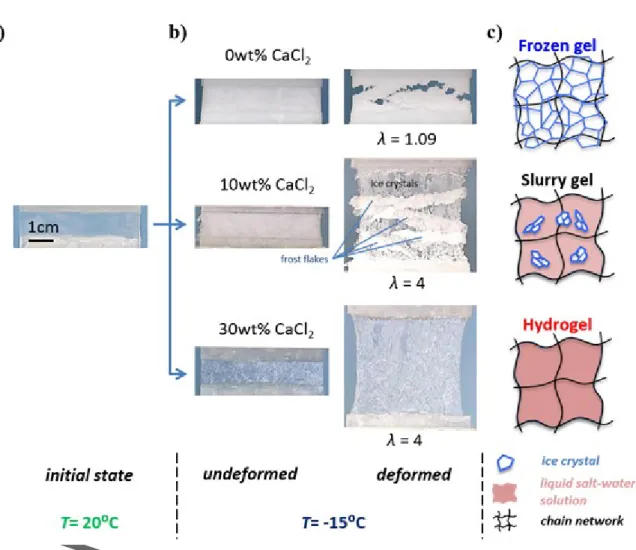
Figure 1. Hydrogel behavior in subzero environment illustrated for three different CaCl2
-containing gels: a) the initial state at room temperature, b) the undeformed and deformed state at -15°C, and c) the corresponding molecular pictures. This illustrates the three physical states for a hydrogel below the freezing point of water: at -15⁰C, the 0 wt% CaCl2 gel is in
the frozen state forming an opaque aggregate of ice crystals and polymer chains, the 10 wt%
CaCl2 gel is in the slurry state with a mixture of ice crystals and salt solution in a polymer
network, and the 30 wt% CaCl2 is in the regular hydrogel state with an aqueous phase in the
liquid state. The frozen gel and slurry gel form a frost layer on their surfaces after cooling.
Figure 1 illustrates the three distinct types of behavior observed for hydrogels with different CaCl2 concentrations at the same sub-zero temperature. Despite similar behavior at room
temperature, the three hydrogels behave very differently when they are cooled to -15°C and deformed in tension (similar observations in compression are shown in Figure S2 in supporting information). While the gel soaked in 30 wt% CaCl2 behaves like a regular
10 wt% solutions behave differently. For the sake of brevity, we will refer to these different gel compositions in the rest of this manuscript by the concentration of their soaking solution, even if the actual ionic content in the gel may be slightly different. At -15°C, the hydrogel with 0 wt% CaCl2 is frozen solid, forming an opaque aggregate of ice crystals and polymer
chains. The frozen gel is stiff and brittle, and fractures at a relatively small strain (~ 9%). At the same temperature, the hydrogel with 10 wt% CaCl2 is a slurry gel: a gel consisting of a
mixture of ice crystals and salt solution embedded in a polymer network. While the gel has lost most of its optical transparency, it remains as stretchable as the 30 wt% gel. The slurry gel behavior occurs over a wide range of temperatures. This observation is consistent with the binary phase diagram of CaCl2 and water (Figure 2a), and leads to the experimental phase
diagram of the polyacrylamide-alginate double network gel soaked in aqueous CaCl2
solutions shown in Figure 2b. The slurry gel state corresponds to the two-phase region in the CaCl2-water phase diagram – both areas are shaded in grey in the respective phase diagrams.
As a hydrogel is progressively cooled through the two-phase region, the increasing opacity of the gel reflects the increasing volume fraction of ice crystals.
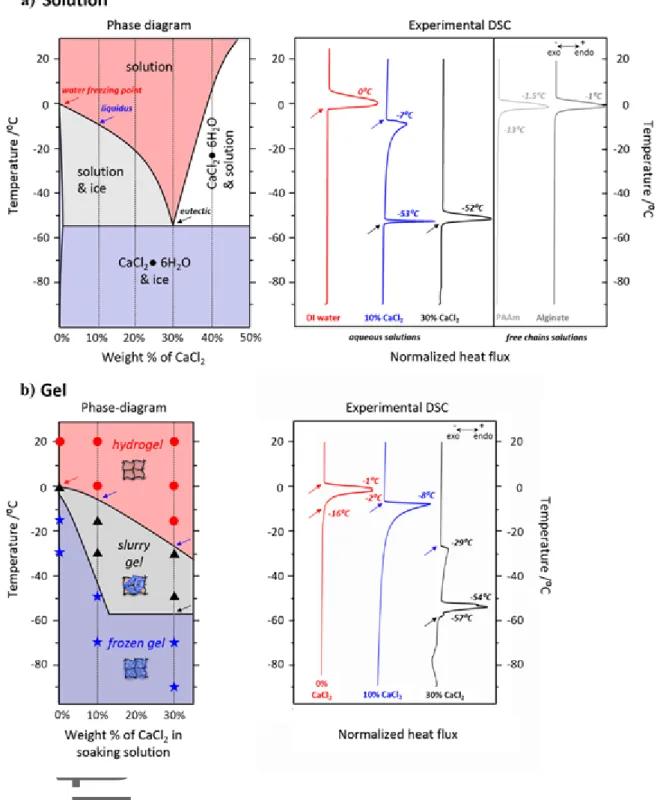
Figure 2. Phase diagram and experimental DSC of the aqueous CaCl2 solution and the
CaCl2-containing gel. a) aqueous CaCl2 solution case: the theoretical phase diagram (left) is
compared to the experimental DSC results (right). b) CaCl2-containing gel case: the
experimentally built phase diagram (left) is compared to the experimental DSC results for the three gel compositions (right). The small arrows highlight the correspondence between the phase boundaries in the phase diagram and the fusion enthalpy peaks in the experimental DSC runs.
To construct the phase diagram in Figure 2b, we first collected all the experimental observations from the mechanical testing under different temperatures performed on hydrogels soaked in 0wt%, 10wt% and 30wt% CaCl2 solutions, and identified the state of
each gel based upon its mechanical response and optical transparency. These observations provided a discrete sampling of the phase diagram, depicted by the symbols in Figure 2b. In a second step, we characterized each gel composition and its various components using dynamic scanning calorimetry (DSC) from -90°C to room temperature to obtain a more accurate measurement of the boundaries of the various phase regions. We also performed DSC analyses on aqueous CaCl2 solutions to identify the phase boundaries for the aqueous
system, which were found to be consistent with the reported phase diagram [13] with only minor experimental deviations. Aqueous solutions of polyacrylamide and alginate were independently thermally characterized (Figure 2a right) to assess the effect of the polymer chains on the freezing point of the solutions. Comparison of Figures 2a and b demonstrates that the DSC curve for the 0 wt% CaCl2 gel can be regarded as the superposition of the
curves for its constituents, with a double peak, a small shoulder, and a small shift of the liquidus to lower temperature. These peaks in the DSC curve indicate that the hydrogel behaves like a ternary system rather than a simple binary. The calorimetry data in Figure 2b shows that the slurry region of the hydrogel is shifted to significantly higher CaCl2
concentrations compared to the two-phase region of the aqueous CaCl2 solution. Indeed, it is
clear from the two distinct and separate peaks of the DSC curve that the 30 wt% CaCl2 gel
has not yet reached the eutectic composition. We hypothesize that this shift is the result of interactions of CaCl2 with the alginate and polyacrylamide polymer chains in the gel and an
indication that the equilibrium concentration of CaCl2 inside the gel is lower than in the
compositions, we estimated the actual concentration of CaCl2 inside the 10 wt% and 30 wt%
CaCl2 gel batches respectively as 5-7 wt% and 20-23 wt% of CaCl2.
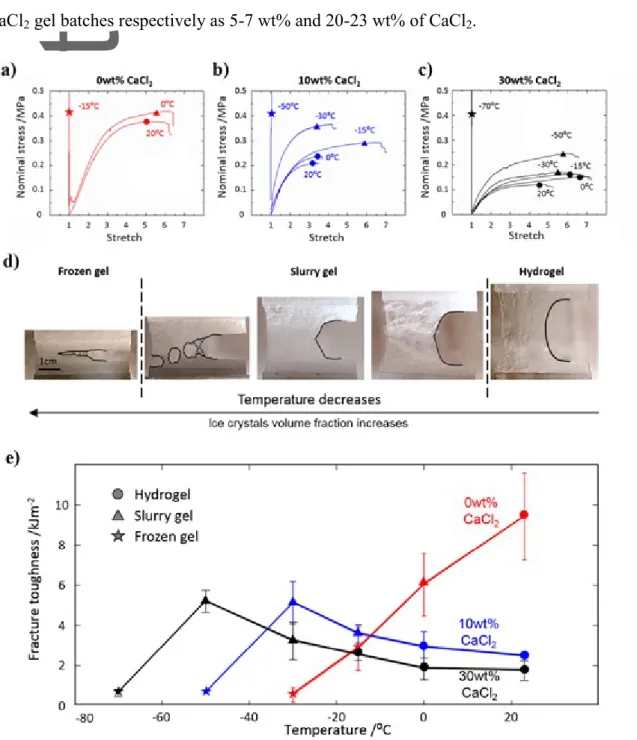
Figure 3. Mechanical characterization and fracture patterns of gels with different CaCl2
content as function of temperature. The stress-stretch curves is measured at different temperatures for the three gels: a) 0wt% CaCl2, b) 10wt% CaCl2, and c) 30wt% CaCl2. d) The
evolution of crack propagation profile in different CaCl2 containing gels as the temperature
decreases, and thus as the volume fraction of ice increases. Gel type and associated testing conditions from left to right are: (i) 30 wt% at -70°C, (ii) 30 wt% at -70°C (undercooled), (iii) 10 wt% at -50°C (undercooled), (iv) 0 wt% at 0°C, (v) 30 wt% at -30°C. e) The fracture toughness of the three gels is characterized as a function of temperature. For each testing condition, symbols (circle, triangle and star) indicate the corresponding physical state of the gel (hydrogel, slurry and frozen state respectively).
Figures 3a-c show the evolution of the stress-stretch curves with decreasing temperature for the 0 wt%, 10 wt% and 30 wt% CaCl2 gels, respectively (for complete experimental data, see
Figure S3 in supporting information). At room temperature, the 0 wt% CaCl2 gel has the
highest strength and stretchability. When the temperature is reduced to -15°C, however, this gel becomes stiff and brittle. The 10 wt% and 30 wt% CaCl2 gels, on the other hand, retain
their stretchability at temperatures down to at least -30⁰C and -50⁰C, respectively. For all gels, both the elastic modulus and the strength gradually increase as the temperature decreases. This stiffening effect can be explained by the gradual increase of the volume fraction of ice crystals in the slurry gel (Figure 3d). The ice crystals stiffen the gel, while still allowing large deformation to occur through shear yielding between them, similar to the toughening of polymer nanocomposites.[18] Interestingly, the presence of ice crystals tends to improve the stretchability before the gels become brittle (see evolution of fracture stretch in Table S2 in supplementary). A careful inspection of post-mortem specimens showed a large number of sized cavities dispersed throughout the specimens (Figure S4). These micro-cavities may nucleate due to the triaxial state of stress that builds up around stiff ice crystals. A similar mechanism of cavitation and fracture has been reported in adhesively bonded elastic and viscoelastic layers.[19, 20] From the study of adhesively bonded materials, cavitation first appears when the hydrostatic stress is approximately ten times larger than the shear modulus of the elastic layer.[20] The cavities grow and eventually coalesce, leading to catastrophic cohesive failure of the adhesive layer.[19] Growth of these cavities provides an additional energy dissipation mechanism that may explain the increased stretchability observed in the slurry state. This mechanism leads to the apparent “ductile” failure mode mechanism with macroscopic void growth and coalescence observed experimentally in specimens with large volume fractions of ice in the slurry state (see Figure 3d and Movie S5).
the application of repeated cooling cycles to very low temperature. Indeed, repeated formation of ice crystals eventually leads to a permanent weakening of the gel network, creating local defects that facilitate the nucleation of cavities upon deformation.
To characterize the fracture toughness of the gels as a function of temperature, we measured the stress-stretch curves of notched specimens and determined the critical stretch at which fast fracture takes place (Table S2). We calculated the corresponding energy release rate by integrating the area under the nominal stress-stretch curve of a pure shear specimen without a pre-crack (from Figure 3a, b and c) up to the critical stretch of the notched specimens, following the method devised by Rivlin and Thomas.[3, 21] The results show the temperature dependence of the fracture toughness for each gel (Figure 3e and Table S1). As expected, the fracture toughness of the 0 wt% CaCl2 gel reduces dramatically as the temperature is lowered
below 0°C. By contrast, the fracture toughness of the 10 wt% and 30 wt% gels increases as the gels enter the slurry state. The fracture toughness of these gels eventually drops as the gels are fully frozen. For all gels, the slurry state exhibits a relatively high toughness, ranging from 3000 to 6000 J/m2. In practical applications, the amount of salt added to a hydrogel can be adjusted to fulfill the requirements in terms of modulus, stretchability, and fracture toughness depending on the targeted temperature range.
Figure 4. Different failure scenarios and the associated fracture mechanisms in the three states of a gel. a) For a frozen gel, brittle fracture occurs by fast propagation of a sharp crack following the straightest and weakest path between ice crystals. b) For a slurry gel, the fracture varies with the volume fraction of ice crystals, but typically shows a stick-slip propagation following a zig-zag path. A relatively large not fully blunted crack opening is observed (the middle and top right picture). Crack pining, crack deflection and micro-cavitation have been identified as associated toughening mechanisms, sometimes leading to the coalescence of multiple macro-cracks in some samples (top left). c) For a regular tough hydrogel, a large blunted crack is observed during the crack propagation. The gels shown here to illustrate the fracture scenario of each of sub-water-freezing state of gels have been tested with the following conditions, from left to right: (a) 0 wt% CaCl2 at -50°C, (b-left) 30
wt% CaCl2 at -70°C (undercooled), (b-right and crack path) 10 wt% CaCl2 at -30°C, and (c)
30 wt% CaCl2 at -30°C.
In order to better understand the toughening mechanism associated with the slurry gels, we compare the crack propagation and failure scenarios in the three states of the hydrogel (Figure 4). A regular hydrogel fails through the propagation of a large blunted crack (Figure 4c and Movie S2). Slurry gels and frozen gels, however, exhibit significantly different failure mechanisms. In the frozen gel, a sharp crack propagates rapidly through the specimen once it is loaded, following the straightest and weakest path between ice crystals, resulting in a
relatively low fracture toughness (Figure 4a and Movie S3). The fracture behavior of slurry gels varies depending on the amount of ice crystals in the gel, but is typically characterized by crack pinning and deflection as the crack path encounters stiff ice crystals. Such features, observed in all slurry gels, lead to a discontinuous crack propagation, and sometimes a less blunted crack tip compared to the regular hydrogel state (Figure 4b right and Movie S4). The final fracture path in a slurry gel tends to zigzag and creates rough crack surfaces. The amplitude of that zigzag and the degree of roughness of the crack surface varies depending on the ice volume fraction (i.e. the higher the volume fraction, the larger the zigzag). More specifically, in some slurry gels with a large volume fraction of ice, multiple macro-cracks grow upon loading, and eventually coalesce (Figure 4b left and Movie S5). These macro-cracks are assumed to initiate at the dispersed micro-cavities observed ahead of the crack tip (Figure S4) as mentioned earlier.
During the experiments, we observed significant undercooling of the slurry gels below the eutectic temperature, which can have a significant impact on the stability of subzero mechanical behavior of hydrogels. As shown in Figure S5 (and Movie S5), a 30 wt% CaCl2
gel can stay in an undercooled slurry state, and exhibit high stretchability and fracture toughness at temperatures as low as -70⁰C if it is not cooled down long enough to reach
thermodynamic equilibrium. The undercooled gels are thermodynamically unstable, and consequently have stress-stretch curves that vary inconsistently with the storage time at -70°C (see Figure S5c). To avoid this undercooling effect, all the testing specimens in this study were first cooled to -90°C for 45 minutes before heating them to the target testing temperature. To conclude, the slurry state of CaCl2-containing hydrogels at subzero
temperatures can indeed provide unforeseen mechanical property improvements, but caution must be taken to ensure that the material is not in a thermodynamically unstable state due to a
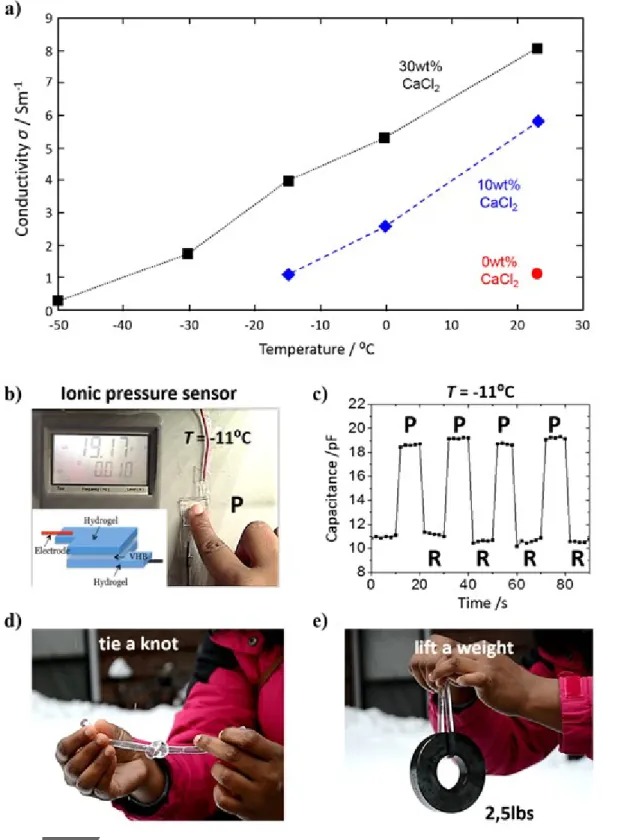
Figure 5. Applications of the stretchable, tough and anti-freezing hydrogel at low temperature. a) The conductivity as a function of temperature for the 0wt%, 10wt% and 30wt% CaCl2 gels. b) A stretchable ionic touch sensor is fabricated by sandwiching a layer of
dielectric elastomer (3M VHB) between two layers of 30wt% CaCl2 gels. c) The capacitance
outdoor snowing conditions (associated video can be found in supplementary information Movie S1). The weight used is 2.5lbs (1.13kg).
The CaCl2-containing gels maintain their ionic conductivity at temperatures well below the
freezing point of water (Figure 5a). This ability, together with their high stretchability and toughness at low temperatures, opens up a range of applications in low-temperature environments. Here, we demonstrated a simple ionic touch sensor that takes advantage of both attributes. The touch sensor consists of a dielectric elastomer layer sandwiched between two hydrogel layers (Figure 5b). The hydrogel layers consist of 30 wt% CaCl2 hydrogels,
while the elastomer is VHB 4905 (3M, Maplewood MN). The architecture of the touch sensor is based on a sensor described previously by Sun et al.[7] Figure 5c illustrates the response of the sensor when operated at a temperature of -11°C. The capacitance of the sensor changes reversibly by approximately 50% upon touching, which is readily measured using a capacitance meter. The response of the sensor does not degrade when cycled repeatedly at subzero temperatures. One can readily envision use of this sensor in applications under a broad range of environmental conditions, including stretchable and rollable keypads and pressure sensors for soft robotics.
In summary, we have developed a class of hydrogels that retain high stretchability, high fracture toughness and good conductivity at temperatures far below the freezing point of water. We adopted a well-known strategy for depressing the freezing point of water and applied it to a tough hydrogel by soaking the gel in various aqueous solutions of CaCl2. The
experimental phase diagram of the CaCl2-containing hydrogel differs slightly from that of the
aqueous CaCl2 solution due to the presence of the polymer network. Depending on the
temperature and the CaCl2 content, the gels can be classified into three types: regular
hydrogel, slurry gel, and fully frozen gel. We measured the stress-stretch curves and fracture toughness of the hydrogel as a function of temperature and CaCl2 content. Slurry gels exhibit
introduction of additional toughening mechanisms in the slurry gels, which include crack pinning, crack deflection, and energy dissipation through micro-cavitation. Finally, we demonstrated a stretchable ionic touch sensor that functions at temperatures well below the freezing point of water. We anticipate that this class of hydrogels will enable a broad range of applications under low-temperature conditions.
Experimental Section
Hydrogel synthesis: All chemicals were received and used without further purification. The
following substances were purchased from Sigma Aldrich: acrylamide (AAm, A8887), ammonium persulfate (APS, A9164), N,N,N‟,N‟-tetramethylenediamine (TEMED, T7024), N,N‟-methylenebis(acrylamide) (MBAA, M7279), calcium sulfate dihydrate (CaSO4∙2H2O,
C3771) and calcium chloride (CaCl2, C1016). Sodium alginate was purchased from FMC
Biopolymer (Manugel GMB). Polyacrylamide-alginate double-network hydrogels were prepared following the method described by Sun et al.[3] First, 40.54g of AAm and 6.76g of sodium alginate powder were dissolved in 300mL of distilled water to form an aqueous solution. The solution was stirred overnight for complete mixing. Afterwards, MBAA, TEMED, APS and CaSO4∙2H2O in quantities of 0.0006, 0.0025, 0.01 and 0.022 times the
weight of AAm were added to the solution in sequence. The prepared pre-gel solution was then degassed, quickly poured into 50x40x1.65 mm3 acrylic molds, and covered with a glass plate. The samples were kept at room temperature for 24h to allow complete polymerization. Afterwards, the samples were taken out of the molds and were either directly used for testing (referred as 0 wt% CaCl2 gels) or soaked in 10 wt% or 30 wt% CaCl2 solutions for at least 5
days. To ensure that the concentration of CaCl2 in the external solution remained nearly
constant before and after soaking the hydrogel, we prepared the CaCl2 solution with a volume
that the precise control of the water content for the different gel compositions is difficult and was not the focus of the present study. Instead, we chose to use a simple and easily reproducible method for preparing the different gel compositions. Extensive research on the effect of water content has been conducted and discussed in prior work[3,22]. Eventually, considering the 0 wt% CaCl2 gel as the reference state, the volumetric swelling ratios reached
by the 10 wt% and 30 wt% CaCl2 gels were ~1.78 and ~2.20 respectively.
Mechanical testing: A minimum of three specimens were used for all test conditions. The
nominal stress-stretch curves were tested using the pure shear setup,[3, 21] both at ambient and sub-zero temperatures (i.e. 20°C, 0°C, -15°C, -30°C, -50°C and -70°C), see Figure S3 for the full set of data. A thin sheet of hydrogel sample with a rectangular shape (50mm width and 10mm length) was fixed to two rigid acrylic grips, and mounted in an Instron 5966 tensile tester with a 500 N load cell. The temperature of the ambient environment was controlled by an Instron 3119-600 environmental chamber supplied with liquid nitrogen. Tensile tests were performed at a strain rate of 1 min-1, and video-recorded with a digital camera (Canon 7D). The nominal stress was computed by dividing the applied load on the sample by its initial cross-sectional area (the product of width times thickness), while the stretch was calculated by dividing the deformed length by the initial length of the sample. To avoid undercooling of the hydrogel samples, specimens were first held at -90°C for 45 min and then 20 min at the final testing temperature to ensure equilibrium conditions for each experiment (see Figure S5 in supplementary).
To measure the fracture toughness, specimens were cut using a fresh razor blade to create a 20mm notch extending from the edge of the specimen. The stress-stretch curves of identical specimens with and without notch were then measured. The critical stretch for fast fracture of the notched specimens was measured and the associated critical energy release rate was then
( ) , (1)
where H is the initial length of the sample and W(λ) is the area below the nominal stress stretch curve of the unnotched sample integrated up to the critical stretch λc of the notched
sample.
Thermal characterization: Samples were characterized using a differential scanning
calorimeter (TA Instruments, DSC Q200) with a refrigerated cooling system (TA Instruments, RCS90). Samples were contained in hermetically sealed aluminum pans (TA Instruments, Tzero Aluminium Hermetic Pan) for testing, with an empty pan used as inert reference. The DSC was operated under a 40μLmin-1 nitrogen flow rate and data were captured at a rate of 1Hz. Samples were first equilibrated at 25°C and then cooled at a rate of 5°Cmin-1 to -90°C. After an isothermal period of at least 90min, samples were heated up at 1°Cmin-1 to the initial equilibration temperature (25°C).
Conductivity measurement: The current passing through a rectangular gel specimen was
measured as a function of applied voltage (5 measurements ranging from 0.1 to 1V) with a 2-point probe set up. Sample dimensions were measured to within 0.1 mm. The conductivity of the sample was deduced from the slope of current versus voltage. The measurement was performed for each gel composition at temperatures ranging from room temperature to -50°C.
Ionic touch sensor demonstration: We fabricated a sensor that can detect the pressure of
finger touch in a design similar to previous work.[7] The sensor consists of a 20mm20mm0.5mm acrylic elastomer (VHB 4905, 3M), covered with two 30 wt% CaCl2
hydrogels of 20mm20mm0.2mm on each side. Copper wires were used to connect the hydrogels to metallic electrodes and the electrodes to a capacitance meter (LCR/ESR meter, Model 885, BK Precision). The capacitance meter was set to a sinusoidal measurement signal with a maximum voltage of 1 V and a frequency of 100 Hz. To demonstrate the sensing
ability at low temperature, we attached the sensor to a glass plate, and recorded the change of capacitance as a result of repeated touches at -11⁰C.
Supporting Information
Supporting Information is available from the Wiley Online Library.
Acknowledgements
This work was supported by the MRSEC (DMR-1420570) at Harvard University and by the National Science Foundation through grant CMMI-1404653. X. P. M. was supported by the Cabeaux-Jacobs BAEF post-doctoral fellowship for one year at Harvard University.
Received: ((will be filled in by the editorial staff)) Revised: ((will be filled in by the editorial staff)) Published online: ((will be filled in by the editorial staff)) References
[1] a) R. Langer, Nature1998, 392, 5; b) K. Y. Lee, D. J. Mooney, Chemical reviews
2001, 101, 1869; c) J. L. Drury, D. J. Mooney, Biomaterials 2003, 24, 4337.
[2] a) J. P. Gong, Y. Katsuyama, T. Kurokawa, Y. Osada, Advanced Materials2003, 15, 1155; b) K. J. Henderson, T. C. Zhou, K. J. Otim, K. R. Shull, Macromolecules 2010, 43, 6193; c) J. Li, W. R. Illeperuma, Z. Suo, J. J. Vlassak, ACS Macro Letters2014, 3, 520. [3] J.-Y. Sun, X. Zhao, W. R. Illeperuma, O. Chaudhuri, K. H. Oh, D. J. Mooney, J. J. Vlassak, Z. Suo, Nature2012, 489, 133.
[4] C. Keplinger, J. Y. Sun, C. C. Foo, P. Rothemund, G. M. Whitesides, Z. Suo, Science
2013, 341, 984.
[5] W. R. Illeperuma, P. Rothemund, Z. Suo, J. J. Vlassak, ACS applied materials &
interfaces2016, 8, 2071.
[6] a) C. Larson, B. Peele, S. Li, S. Robinson, M. Totaro, L. Beccai, B. Mazzolai, R. Shepherd, Science 2016, 351, 1071; b) C. H. Yang, B. Chen, J. Zhou, Y. M. Chen, Z. Suo,
Advanced Materials2016, 28, 4480.
[7] J. Y. Sun, C. Keplinger, G. M. Whitesides, Z. Suo, Advanced Materials2014, 26, 7608.
[8] C.-C. Kim, H.-H. Lee, K. H. Oh, J.-Y. Sun, Science 2016, 353, 682.
[9] M. Wehner, R. L. Truby, D. J. Fitzgerald, B. Mosadegh, G. M. Whitesides, J. Lewis, R. J. Wood, Nature2016, 536, 451.
[10] H. Gao, Z. Zhao, Y. Cai, J. Zhou, W. Hua, L. Chen, L. Wang, J. Zhang, D. Han, M. Liu, Nature Communications2017, 8.
[11] a) G. Wieslander, D. Norbäck, T. Lindgren, Occupational and Environmental
Medicine2001, 58, 649; b) D. A. Pillard, Environmental toxicology and chemistry1995, 14,
311; c) J. R. Fowles, M. I. Banton, L. H. Pottenger, Critical reviews in toxicology2013, 43, 363; d) A. Mohiley, J. Franzaring, O. Calvo, A. Fangmeier, Environmental Science and
[12] W. ILLEPERUMA, Z. Suo, J. J. VLASSAK, Google Patents WO2017040851A1,
2017.
[13] M. R. Conde, International Journal of Thermal Sciences2004, 43, 367.
[14] a) W. H. Rodebush, Journal of the American Chemical Society1918, 40, 1204; b) Ketcham, S.A., Minsk, L.D., Blackburn, R.R., and Fleege, E.J. (1996). Manual of practice for an effective anti-icing program: A guide for highway winter maintenance personnel.
FHWA-RD-95-202: Federal Highway Administration; c) O. C. C. OxyChem, Calcium Chloride
Product Datasheet,
http://www.oxy.com/OurBusinesses/Chemicals/Products/Documents/CalciumChloride/173-01791.pdf, accessed : March, 2018.
[15] Wisconsin Transportation Information Center, Wisconsin Transportation Bulletin
n°22,
http://epdfiles.engr.wisc.edu/pdf_web_files/tic/bulletins/Bltn_022_prewetting_antiicing.pdf,
in Techniques for Winter Road Maintenance, 2005, accessed : March 2018.
[16] a) W. Block, Functional Ecology1991, 5, 284; b) J. G. Duman, D. W. Wu, L. Xu, D. Tursman, T. M. Olsen, The Quarterly Review of Biology1991, 66, 387; c) I. K. Voets, Soft
Matter 2017, 13, 4808.
[17] Y. Bai, B. Chen, F. Xiang, J. Zhou, H. Wang, Z. Suo, Applied Physics Letters2014, 105, 151903.
[18] a) A. Kinloch, S. Shaw, D. Tod, D. Hunston, Polymer1983, 24, 1341; b) R. A. Pearson, A. F. Yee, Journal of Materials Science1986, 21, 2475; c) H. E. Meijer, L. E. Govaert, Progress in polymer science2005, 30, 915; d) A. Kinloch, R. Mohammed, A. Taylor, C. Eger, S. Sprenger, D. Egan, Journal of Materials Science2005, 40, 5083.
[19] a) A. J. Crosby, K. R. Shull, H. Lakrout, C. Creton, Journal of Applied Physics2000, 88, 2956; b) H. Lakrout, P. Sergot, C. Creton, The Journal of Adhesion1999, 69, 307. [20] K. Brown, C. Creton, The European Physical Journal E: Soft Matter and Biological
Physics2002, 9, 35.
[21] R. Rivlin, A. G. Thomas, Journal of Polymer Science Part A: Polymer Chemistry
1953, 10, 291.
[22] a) E. Zhang, R. Bai, X. P. Morelle, Z. Suo, Soft Matter2018, 14, 3563; b) J. Li, Y. Hu, J. J. Vlassak, Z. Suo, Soft Matter2012, 8, 8121; c) W. Hong, Z. Liu, Z. Suo,
Table of contents entry :
The present study demonstrates a general class of hydrogels that do not freeze at temperatures far below 0⁰C, while retaining high stretchability and fracture toughness.
The resulting hydrogels can be cooled to -57°C without fully freezing, and can still be stretched more than four times their initial length, with a fracture toughness of 5000 Jm-2. Keywords: tough hydrogels, sub-zero temperatures, ice-salt solution slurry phase, freezing point depression, anti-freezing ionic devices.
X. P. Morelle, W. R. Illeperuma, K. Tian, R. Bai, Z. Suo, J. J. Vlassak*