Introduction
The majority of human city-dwellers experience daily problems in traffic. Cars congest the roads leading into and out of urban centres and pedestrians queue at stations, elevators and super-market checkouts. Some of these problems arise accidentally, for example as a result of parked cars or road works, but many problems occur at human-designed infrastructure, for example one-lane bridges, car parks, crosswalks and building entrances. This seems to suggest that, although engineers and architects base the planning and design of human infrastructure on ample study of car movement and behaviour of pedestrian crowds, they are not able to keep up with the changing demands of our daily life and traffic problems remain. To most of us, waiting in line seems an unavoidable part of life, but it might be a fairly re-cent phenomenon; traffic jams were probably far and between in cavemen societies and in times when most transportation was by horse-drawn carriage.
Modern humans in densely-populated areas are not the only ones to experience congestion problems. Long before early hu-mans left Africa, other group-living animals, the social insects, had to live with high-volume traffic flow. Among the oldest fos-silized social insects are members of now extinct taxa of the tropical stingless bees (Hymenoptera, Apidae, Meliponini). The remarkable thing is that these amber bees are workers, sterile females, which were trapped in tree resin probably while col-lecting this material for nest construction. These workers were citizens of insect cities with division of labour between an egg-laying queen and the workers that built and maintained the nest. Densely-populated insect societies have been around for at least 80 million years (e.g. Engel 2001).
Like human cities, social insect cities have complex internal infrastructure and, sometimes, external trail systems (in ants and termites). The link between the city environment and the outside world are the city’s entrances. They facilitate the flow of incoming and outgoing traffic. In this paper we investigate how one group of social insects, the stingless bees, organizes traffic flow in and out of their colony. First, we analyze whether the size of the nest entrance is correlated with colony size. Second, we test whether species-specific entrance size results in ade-quate traffic flow. Third, we investigate whether the shape of
the entrance plays a role in traffic flow. Throughout the paper we compare the architectural solutions used by stingless bees with human solutions for similar problems.
Stingless bee cities: a short introduction
Stingless bees live in colonies of several hundreds to tens of thousands of workers headed usually by one reproducing queen. Since all workers are offspring of the queen and most do not participate in reproduction (Koedam et al. 1996, 2001), their interests concerning foraging, colony growth and maintenance are largely aligned. Therefore, we might expect that the design of the nest reflects the requirements of the colony as a whole and not the individual preference of one or few architects (note the difference with human cities). In addition, the nest building and maintenance is a continuous and self-organized process. This means that no leader is giving orders (unlike in human building activities) and that no blueprint or recipe is followed strictly (unlike some burrow excavation by solitary insects or web building by spiders), but that hundreds of individual worker bees make their own decisions on where and how to change the nest structure. These individual decisions are based solely on local information obtained by builders that lack a big plan (and possibly some genetic predispositions) [see papers in Detrain et al. (1999) for an introduction on the role of self-organization in social insects].
Since foraging takes place outside the insect city, entrances of sufficient size and number are needed to facilitate traffic flow. The larger and more conspicuous the entrance, the easier the bees move in and out of the colony. On the other hand, pre-dators and parasites benefit from large entrances, and pressure to limit their access may have driven the size of the city’s en-trances down. Similarly, maintenance of high temperature and not too low humidity in the nest is essential for optimal brood development. We can expect that nest entrance architecture, e.g. size, number, shape and conspicuousness, has been under pressure of natural selection and that the design is a compromi-se between foraging requirements, adequate defence and main-tenance of internal conditions. If this is the case, the entrance might represent a bottleneck to the colony’s traffic flow. We test
How stingless bees solve traffic
problems
Jacobus C. Biesmeijer
E. Judith Slaa
Dirk Koedam
KEY WORDSMelipona, Trigona, traffic flow, flight activity, social insect, nest architecture Entomologische Berichten 6 (1-2): -13
In this paper we examine to what extend the size and shape of stingless bee
nest entrances can be explained as being a compromise between traffic flow
optimization and adequate defence. Small bee colonies have small entrances
that are easily defendable. The trade-off is that traffic jams and collisions
are common at very high foraging activity. The shape of the entrance of
large bee colonies tends to be such that there is limited overlap in take-off
and landing areas and, as a result, no or few traffic jams. Large entrances
are probably easily located by predators and parasites, which may explain
why such colonies are highly defensive.
this hypothesis with tropical stingless bees. The several hund-red species present a stunning array of species-specific nest en-trance designs (Biesmeijer & Slaa 2003; see also Wille & Miche-ner 1973, MicheMiche-ner 1974, Camargo & Pedro 2003), the function of which has not been explained (figure 1 shows some examples).
Explaining variation in entrance size
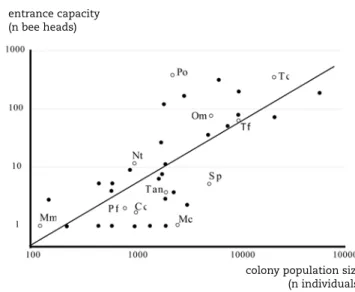
We can derive two predictions from our hypothesis that en-trance size is a compromise between colony size (to facilitate traffic flow), defence (to limit predation and parasitism) and nest microclimate. The first prediction is that colony size and total entrance size are positively related. If there are no costs to a large entrance size, small colonies could have large entrances without having problems defending the colony, and large colo-nies could have small entrances without having traffic flow pro-blems. A review of published records and personal observations revealed that entrance size increases with colony size (figure 2). Colony size explains 52% of the variation in entrance size. Addi-tional support for the hypothesis that the entrance is shaped by traffic and defence, is that many of the species that are posi-tioned high above the regression line are very defensive (figure 2, abbreviations Om, Po, Tc) and thus can afford a larger en-trance size. On the other hand, many of the species positioned below the regression line (e.g. Mc, Pf, Cc) are ‘timid’ or weakly defensive bees. They do not attack intruders, but defend the co-lony from the inside, for instance by blocking the small en- trance.
This brings us to the second prediction, which is that bees with large entrances are more defensive than bees with relati-vely small entrances. Levels of defensiveness have been defined by Wille & Michener (1973). They use a four-point scale that ran-ges from timid bees that never leave the colony for defence, but rather stay in and defend the colony from the inside (level 1), through to species of which few bees fly out and may bite the intruder (level 2), and species of which many fly out, but only few actually attack and bite the intruder (level 3), to the most defensive group of species that massively leave the colony and
attack the intruder (level 4). We correlated defensiveness with relative entrance size and found that all bees with large entran-ces (>10 bee heads wide) are defensive (at least level 2), whereas bees with small entrances (<10 bee heads wide) can display any level of defensiveness, from being timid to being easily excited by disturbance (figure 3).
Traffic jams and collisions
The observed correlations seem to suggest that the entrance size may indeed be a compromise between adequate defence and smooth traffic flow. If this is the case, then having a small entrance should be costly and traffic flow should be hampered, especially if foraging activity is very high. Traffic problems might include traffic jams or collisions. To assess whether traf-fic jams are more prominent at high traftraf-fic flow rates we video-recorded arriving and departing bees at the nest entrance of 16 stingless bee species at various traffic flow rates. Undisturbed traffic is characterized by a random sequence of bees entering and leaving the nest, whereas a non-random ‘aggregated’ se-quence of bees going in and out is indicative of traffic jams. Think of how we pass road works that leave only one lane open. Several cars will pass from one direction, followed by a series of cars from the other direction and so forth. When arriving at such a point we try to take advantage of the flow by quickly fol-lowing the car in front of us passing the blockade and making passing impossible for the cars at the opposite end. In stingless bees with narrow nest entrances a similar situation might deve-lop at high traffic flow rates. Pressure of bees moving in and out builds up and the side with highest pressure (i.e. most bees pu-shing forward) wins and those bees move. This lowers the pres-sure and allows the other side to move so that a series of in- and outgoing bees alternate. We analyzed the sequence of arri-vals and departures using the runs-test (Siegel & Castellan 1988).
Figure 1. Some examples of stingless bee nest entrances. a The one-bee-wide entrance of a Melipona quadrifasciata Lepeletier colony with a spider lurking nearby, b four bees fit in the entrance of a
Scaura latitarsis (Friese) nest, c a funnel entrance with a large lower lip of a Tetragona perangulata Cockerell nest, dScaptotrigona pectoralis
tend to have a tubular opening with a small lower lip. Photos: Koos Biesmeijer
Enkele voorbeelden van nestopeningen van angelloze-bijennesten. a Slechts één bij tegelijk past in de opening van dit Melipona quadrifasciata-nest, b
vier bijen tegelijk passen in de opening van dit Scaura latitarsis-nest, c de trompetopening met grote onderlip van een Tetragona perangulata-nest,
dScaptotrigona pectoralis heeft een buisvormige opening met een zeer kleine onderlip.
a b
c d
Figure 2. Nest entrance size in stingless bees increases with colony size. The line represents the results from the regression analysis (y = 0.003x1.05, R2 = 0.52). Data are compiled from Wille & Michener (1973), Roubik (1979, 1983) and personal observations. Nest entrance size was measured relative to the head width of each bee species and reflects the number of bees (bee heads) that simultaneously fit in the entrance. Each symbol represents a different species with the species mentioned in the text represented by open symbols and abbreviat-ions that are explained in table 1.
De grootte van de nestopening neemt toe met het aantal bijen in de kolonie. De lijn geeft de regressie weer (y = 0.003x1.05, R2 = 0.52). De gegevens zijn afkomstig uit Wille & Michener (1973), Roubik (1979, 1983) en observaties van de auteurs. De nestopening wordt uitgedrukt in aantal keren de kop-breedte van de bewoners. Elk symbool geeft een andere soort weer. De soor-ten die genoemd worden in de tekst zijn aangegeven met open symbolen en hun afkortingen, zoals vermeld in tabel 1.
colony population size (n individuals) entrance capacity
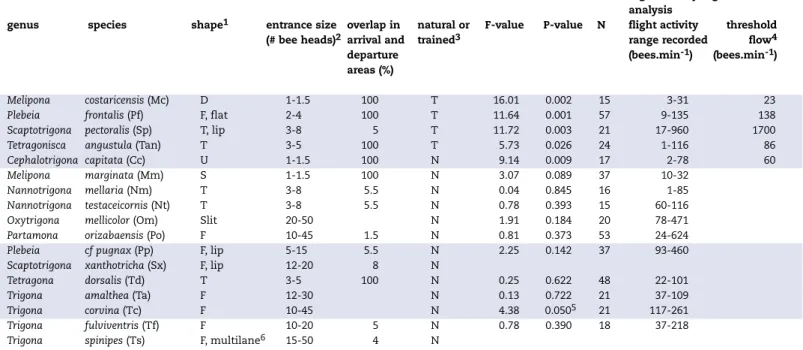
Some species with relatively small entrances, i.e. only few bees can enter and leave the nest simultaneously, already expe-rience traffic problems at low flow rate, whereas few species with large entrances show negative effects of high traffic flow (compare P-values of regression analysis in table 1). To assess traffic organization at very high flow rates we trained bees of four species (indicated with a T in the upper part of table 1) to highly profitable sugar water feeders. All trained nests had to deal with traffic jams at high flow rates. These ‘rush hour’ flow rates are probably rare under natural conditions and will mostly involve one-way traffic, for instance at the start of foraging in the morning or during colony defence. However, in some small-entrance species (Melipona costaricensis Friese, Tetragonisca an-gustula Latreille and Cephalotrigona capitata (Smith)) the thres- hold flow rate for traffic jams has been observed under natural foraging activity during peak flowering (note that these are the species that fall below the line in figure 2).
Slow-motion replay of activity in two species showed that collisions are more prominent at higher flow rates and that both outgoing traffic and incoming traffic can be affected (figure 4; linear regression (one-tailed), Plebeia frontalis Friese (N=14): in-coming traffic F=72.1, P<0.0001; outgoing traffic F=26.8, P<0.0001; P. cf pugnax (N=6): incoming traffic F=0.59, P=0.24; outgoing traf-fic F=5.36, P=0.03). In other words, the percentage of bees that can enter and leave without delay decreases at higher traffic flow rates.
Table 1. Relative measures of entrance size, the percentage of overlap in landing and departing areas, and the results of a regression analysis on the relation between flight activity and traffic flow.
Relatie tussen de relatieve grootte van de nestopening, overlap in start- en landingsbanen en resultaten van een regressieanalyse van de relatie tussen vliegacti-viteit en de mate van filevorming.
entrance features flight activity regression
analysis
genus species shape1 entrance size overlap in natural or F-value P-value N flight activity threshold
(# bee heads)2 arrival and trained3 range recorded flow4
departure (bees.min-1) (bees.min-1)
areas (%)
Melipona costaricensis (Mc) D 1-1.5 100 T 16.01 0.002 15 3-31 23
Plebeia frontalis (Pf) F, flat 2-4 100 T 11.64 0.001 57 9-135 138
Scaptotrigona pectoralis (Sp) T, lip 3-8 5 T 11.72 0.003 21 17-960 1700
Tetragonisca angustula (Tan) T 3-5 100 T 5.73 0.026 24 1-116 86
Cephalotrigona capitata (Cc) U 1-1.5 100 N 9.14 0.009 17 2-78 60
Melipona marginata (Mm) S 1-1.5 100 N 3.07 0.089 37 10-32
Nannotrigona mellaria (Nm) T 3-8 5.5 N 0.04 0.845 16 1-85
Nannotrigona testaceicornis (Nt) T 3-8 5.5 N 0.78 0.393 15 60-116
Oxytrigona mellicolor (Om) Slit 20-50 N 1.91 0.184 20 78-471
Partamona orizabaensis (Po) F 10-45 1.5 N 0.81 0.373 53 24-624
Plebeia cf pugnax (Pp) F, lip 5-15 5.5 N 2.25 0.142 37 93-460
Scaptotrigona xanthotricha (Sx) F, lip 12-20 8 N
Tetragona dorsalis (Td) T 3-5 100 N 0.25 0.622 48 22-101
Trigona amalthea (Ta) F 12-30 N 0.13 0.722 21 37-109
Trigona corvina (Tc) F 10-45 N 4.38 0.0505 21 117-261
Trigona fulviventris (Tf) F 10-20 5 N 0.78 0.390 18 37-218
Trigona spinipes (Ts) F, multilane6 15-50 4 N
1 D= entrance hole surrounded by a strongly punctuated area consisting of a mud-resin mixture; F=funnel shaped entrance (sometimes flattened to a horizontal slit, i.e. ‘flat’); lip= the lower side of the tube or funnel is extended into a lip; S=radial stripes surrounding the entrance hole; Slit=vertical slit in hollow tree not modified by the bees; T=Tube built of cerumen (wax-resin mixture)
2 entrance size given as number of bee heads that simultaneously fit in the entrance hole. The entrance hole data are from Roubik (1979, 1983) and Wille & Michener (1973), with additional records measured from calibrated digital photos taken by the authors. The width of bee heads was compiled from the same literature sources, with additional records taken from bees captured by the authors and measured using electronic calipers
3 unmodified flight activity was video-recorded for most species (N=Natural). Care was taken to capture the range from low to high activity. Bees of four species were trained (T) to highly profitable sugar water feeders to boost flight activity to levels rarely, if ever, reached under natural conditions 4 threshold flow is the flow where the regression line crossed the point where traffic jams are formed (runs test modified z = -1.96)
5 the positive significant relation for T. corvina is probably accidental and may be due to the, for this species, relatively low flight activity that was recor-ded
6 vertical slits divide the large opening into a series of parallel slits (see text for details).
Figure 3. Stingless bees with larger entrances are more defensive. Levels of defensiveness after Wille & Michener (1973): 1-timid, 2-few fly out and bite, 3-many fly out, few bite, 4-many fly out and bite. Each small point represents a single species, the large dot fifteen species. y = 0.57e1.01x, R2 = 0.66
Hoe groter de nestopening des te defensiever de angelloze bijensoort. Defensiviteit werd gemeten volgens Wille and Michener (1973): 1-timide, 2-enkele bijen vliegen uit en bijten, 3-veel bijen vliegen uit, enkele bijten, 4-veel bijen vliegen uit en vele bijten. De grote stip geeft 15 soorten weer, de andere stippen elk één soort. y = 0.57e1.01x, R2 = 0.66
level of defensiveness entrance capacity
Clever architecture: entrance shape facilitates
traffic flow
Adequate defence against predators and parasites is essential for the survival of the colony and bees cannot compromise on that. However, the immediate surrounding of an entrance hole may be shaped in many different ways, e.g. it may be tubular, funnel-like (i.e. like a trumpet), or include a ‘lower lip’ (see figure 1). This made us wonder whether the total shape of the en-trance structure has any significance for traffic control. It might, for example, lead to a better use of the limited entrance space by guiding arriving and departing bees to different parts of the entrance. To test this idea we video-recorded frontally the en-trances of 14 species with enen-trances including simple holes,
tu-bes, funnels, and slits (for details see table 1). Then, while play-ing back the tapes, we plotted for each species the location of arrival and departure of all bees on a transparent sheet placed on the monitor. Then we determined the area that enclosed all arrival locations and the area that enclosed all departure locati-ons and calculated the percentage of all arrival locatilocati-ons that fell within the departure area and the percentage of all departu-res that fell within the arrival area. The average of these two va-lues represented the percentage overlap in arrival and departu-re adepartu-reas (table 1).
In species with simple holes or tubes of small diameter the arriving and departing bees have to use the whole entrance (overlap in areas 100%) and separation in arrival and departure areas is impossible. Larger entrance holes, independent of the shape of the entrance, allow for a separation in landing and de-parture areas; the arriving bees tend to fly in through the centre of the hole, whereas the departing bees walk out to the margin and take off from there (figure 5; only 5% overlap in landing and departure areas).
The external shape of the entrance seems to have an addi-tional function in organizing traffic flow. Bees with funnel en-trances (e.g. Partamona orizabaensis Strand) and tubes with lower lips (e.g. Scaptotrigona pectoralis (Dalla Torre)) use these extensi-ons as a platform during high traffic flow, when departing bees walk to the outer margin and take-off from there. In this way the departing bees interfere less with arriving bees (figure 1). At low traffic flow the platform is not used and departing bees take off from the edge of the actual entrance hole (figure 1c). The se-paration of landing and take-off areas is a result of the bee’s in-nate attraction to dark centres when arriving at the nest, and its attraction to UV-rich light during take-off (Biesmeijer et al. 2005). Dark centers are part of more than 90% of stingless bee
entran-Figure 4. Undisturbed entry and departure decreases with traffic flow in aPlebeia cf pugnax, and bPlebeia frontalis. Traffic sequences were analyzed from video recordings. Disturbances included anything from having to avoid nest mates to head-on collisions.
Bij drukker vliegverkeer hebben meer bijen problemen met landen en ver-trekken. aPlebeia cf pugnax, en bPlebeia frontalis. Vliegverkeer werd vastgelegd op video. Verstoringen bij landing en vertrek variëren van kleine uitwijkingen tot frontale botsingen.
Figure 5. a Separation of landing and departing areas in the large tubular nest entrance of Nannotrigona testaceicornis (Lepeletier), b arriving bees fly into the dark opening, whereas departing bees leave from the margin of the tube. Photo: Koos Biesmeijer
a De brede opening van een Nannotrigona testaceicornis nest heeft grotendeels gescheiden landings- en vertrekbanen, b de aankomende bijen vliegen het don-kere gat in, terwijl de vertrekkende bijen opvliegen vanaf de rand van de buis.
flow rate (bees.min-1)
Plebeia cf pugnax Plebeia frontalis % of undisturbed bees arri vals de partur es a b
ces (58 species included) and are also found in nectar guides of flowers (54% of the flowers in four different regions of the world have dark centers) and in the pitchers of carnivorous plants (86% of 81 species have dark centers; Biesmeijer et al. 2005). At-traction to dark spots is shared by flies, beetles and solitary Hy-menoptera and is thought to be related to nest finding, mate finding or aggregation (Dafni et al. 1997, Dafni & Giurfa 1999).
Multilane traffic
Arguably the most architecturally elaborate nest entrance is that of Trigona spinipes Fabricius (figure 6). This species makes one of the largest nests among the stingless bees with probably up to 80,000 worker bees. A steady stream of bees travels to and from the nest from dawn till dusk. According to the general re-lationship we found between colony size and entrance size (fi-gure 2) a colony of 80,000 bees would need an entrance fitting more than 500 bees simultaneously, in other words a 10-cm wi-de hole. The entrance hole found in T. spinipes colonies, however, is only up to half that size. The clever architectural solution the-se bees have resorted to is well-known: multiple lanes (figure 6). The large tubular entrance has several vertical walls that divide the entrance in multiple vertical slits. The walls specifically in-crease the surface area from which departing bees can take-off. The space between the walls is about two bees wide so that ar-riving bees can land in any of the openings. The overlap bet-ween landing and departing areas is even a bit lower than for open tubes and funnels (table 1). Humans use this solution re-gularly when large numbers of people have to pass a narrow space or have to be checked, examples are toll booths on the highway and in the underground, checkouts in the supermar-ket. This is not too different from the bees, where incoming tra-vellers are being checked by guard bees. However, T. spinipes has not yet ‘invented’ one-way traffic through the slits. This potenti-ally makes traffic flow more efficient, but would need the use of special traffic signals (as in the human examples above) or spe-cific design.
In short, the entrance hole of a T. spinipes nest is much smal-ler than expected from its colony size. Traffic flow is still smooth because of the multiple take-off and landing strips that are more effective than one large open tube and easier to defend against intruders (although more guards may be needed to pro-tect all slits).
Why are humans experiencing traffic problems?
It seems that stingless bees have evolved species-specific solu-tions to their traffic problems and that we can explain part of the variation in entrance designs in terms of adaptations to traffic flow and adequate defence. Small bee cities have small entrances that are easily defendable without much fighting or injury to worker bees. The trade-off is that traffic jams and colli-sions are common at (very) high foraging activity. Large bee cities have larger entrances, but the shape of their entrance is adapted to the (innate and learned) visual preferences of their foragers. This results in separation of take-off and landing are-as, more efficient use of opening space and smaller entrances than expected from their colony sizes. Their large entrances are easily visible and may attract predators and parasites, which may explain why all species with large colonies are highly defensive.Stingless bees seem capable of organizing their traffic relati-vely smoothly, i.e. few jams under natural traffic flow, while kee-ping adequate defence precautions. On the other hand, why do we, intelligent human beings, spend part of most days of our lives waiting in line? We employ thousands of engineers with
ample resources to design our highways, bridges, junctions and buildings, but are regularly disappointed in the result. Part of the problem may be that we build new infrastructure on top of old structures that were not built to accommodate high traffic volumes. The entrance gates to medieval cities were a very po-pular and successful compromise between traffic flow and de-fence (figure 7). Now that dede-fence is less of a concern and traffic has increased dramatically, these gates have lost their function in traffic organization. Similarly, we have to live with the narrow roads in old cities, because of space limitations and the realiza-tion that historic features are important for tourism and education.
For most modern traffic jams, however, history is no excuse. The main lecture theatre at the University of Leeds, for example, has few exits, one being a 50 meter long narrow corridor where hundreds of students have to get in and out within a few minu-tes several times a day because all classes end and start simul-taneously. Although signs encourage people to walk on the left side of the corridor, the spatial organization of the student traf-fic is different each time. It may be outgoing left, incoming right or vice versa and even multiple lanes may be formed, e.g. right and left outgoing and incoming traffic in the middle. It seems that the architects simply have not realized the extent of the student traffic and that insufficient background work was done during planning. Could our understanding of stingless bee traf-fic organization help us design better entrances and exits to our large buildings? The lane separation in bees with large tubular and funnel entrances is aided by their visual responses. When the lanes of returning bees are formed, they continue in the tu-be and into the colony. The ‘keep left’ signs in the corridor have the same purpose of orienting people to different sides of the corridor upon entry, but are less effective. We think that small architectural or signal improvements might solve the problem. The trick being that all students arriving should subconsciously choose the same side to enter. Simple behaviour experiments can reveal what they are attracted to, e.g. a brighter or lighter-coloured side of the corridor.
Recently, simulation models of pedestrian traffic have been developed by planning engineers and physicists that effectively capture pedestrian behaviour and are able to 1) generate real world emergent patterns, e.g. dynamic lane formation, fire es-cape responses and oscillations of the passing direction in bot-tlenecks, and 2) suggest improved designs for footpaths, bottle-necks, and intersections using evolutionary optimisation tech-niques (e.g. Helbing et al. 1997, 2000). In these models pedestri-ans move according to simple rules that are very similar to the ones obeyed by stingless bees, and other social insects such as ants (and particles moving in air or in liquid). The improved de-signs that are suggested by these models are sometimes
coun-Figure 6. Nest entrance of Trigona spinipes. Note the vertical walls that divided the entrance into multiple departure and landing lanes. Photo: Koos Biesmeijer
De nestingang van Trigona spinipes. De tussenschotten zorgen ervoor dat er meer ruimte is voor landing en vertrek dan in een wijd open ingang.
terintuitive and differ from the solutions implemented by tradi-tional engineers. For example, it was found that placing a con-crete pillar a few meters in front of an emergency exit door led to a smooth flow of people around both sides of the pillar and out of the building, and to a quicker escape overall than the tra-ditional emergency exit with wide open access, where crowding of people trying to get out led to jams and much slower evacua-tion. These and other studies show that using examples from nature (e.g. biology, physics, and chemistry) might improve planning and design of human infrastructure (see also Dussu-tour et al. 2004).
Social insects and humans have had to find optimal soluti-ons for very similar traffic and defence problems. The main dif-ferences being that the insect cities have evolved in millions of years of natural selection and are built through self-organizing processes, whereas human cities are a relatively new phenome-non with few centuries of history and are built mainly by speci-alist engineers with potentially a complete overview of the needs and conditions of the infrastructure. We think we have shown that the stingless bees have evolved remarkable soluti-ons for their traffic problems and would argue that our infra-structure may improve from lessons in insect city life.
Acknowledgements
We thank Vera L. Imperatriz-Fonseca and Paulo Noguera-Neto (USP, São Pau-lo) and Arbofilia (El Sur de Turrubares, Costa Rica) for their hospitality and for allowing us to work with their bees and two anonymous referees for help-ful comments on this paper. The work was supported by WOTRO, the Nether-lands Foundation for the advancement of Science (JCB), the University of Utrecht (EJS) and FAPESP (grant 98/14231-2; DK).
Figure . A fortified entrance gate to the historic city of York, England. Note that a traffic light has been installed to avoid traf-fic jams, something that was unnecessary when the gate was built. Photo: Koos Biesmeijer
Een poort in de stadsmuur van de oude stad York in Engeland. Het stoplicht is een recente toevoeging die nodig is door de toename van verkeer sinds de bouw van de oude stad.
References
Biesmeijer JC & Slaa EJ 2003. Voedselcompetitie tussen angelloze bijen: vriendjespolitiek en chemische oorlogvoering. Entomologische Berichten 63: 123-129.
Biesmeijer JC, Giurfa M, Koedam D, Potts SG, Joel D & Dafni A 2005. Convergent evolution: Floral guides, stingless bee nest entrances, and insectivorous pitchers. Naturwissen-schaften 92:444-450.
Camargo JMF & Pedro SRM 2003. Meliponini neotropicais: o gênero Partamona Schwarz, 1939 (Hymenoptera, Apidae, Apinae) - bio-nomia e biogeografia. Revista Brasileira de Entomologia 47: 311-372.
Dafni A & Giurfa M 1999 The functional ecology of floral guides in relation to insects beha-viour and vision. In: Wasser SP (ed) Evoluti-onary theory and processes: Modern per-spectives. Kluwer: 363-383.
Dafni A, Lehrer M & Kevan PG 1997. Spatial flo-wer parameters and insect spatial vision. Biological Review 72:239-282
Detrain C, Deneubourg JL & Pasteels JM (eds) 1999. Information processing in social in-sects. Birkhäuser, Basel.
Dussutour A, Fourcassié V, Helbing D & Deneubourg JL 2004. Optimal traffic organi-zation in ants under crowded conditions.
Nature 428:70-73.
Engel MS 2001. A monograph of the Baltic am-ber bees and evolution of the Apoidea (Hy-menoptera). Bulletin of the American mu-seum of Natural History 259.
Helbing D, Farkas I & Vicsek T 2000. Simulating dynamical features of escape panic. Nature 407:487-490
Helbing D, Keltsch J & Molnar P 1997. Modelling the evolution of human trail systems. Nature 388:47-49.
Koedam D, Velthuis PH, Krift T van der & Doh-men MR 1996. Morphology of reproductive and trophic eggs and their controlled re-lease by workers in Trigona (Tetragonisca) an-gustula Illiger (Apidae, Meliponinae). Physio-logical Entomology 21: 122-296
Koedam D, Velthuis HHW, Dohmen MR & Impe-ratriz-Fonseca VL 2001. The behaviour of laying workers and the morphology and vi-ability of their eggs in Melipona bicolor bico-lor. Physiological Entomology 26:254-259. Michener CD 1974. The social behavior of bees.
Harvard University Press
Roubik DW 1979. Nest and colony characteris-tics of stingless bees from French Guiana (Hymenoptera: Apidae). Journal of the Kansas Entomological Society 52:443-470. Roubik DW 1983. Nest and colony
characteris-tics of stingless bees from Panama (Hy-menoptera: Apidae). Journal of the Kansas Entomological Society 56:327-355. Siegel S & Castellan NJ 1988. Nonparametric
statistics for the behavioral sciences. McGraw,
Wille A & Michener CD 1973. The nest architec-ture of stingless bees with special reference to those of Costa Rica. Revista de Biologia Tropical 21 supplement 1.
Received 10 August 2005, accepted 22 Novem-ber 2006.
Samenvatting
Hoe angelloze bijen verkeersproblemen oplossen
Sociale insecten leven in grote kolonies van waaruit ze foerageren. Over het algemeen heeft een kolonie één (of enkele) opening(en) waardoor alle foerageersters in en uit gaan. Deze in-gang is echter ook een zwakke plek in de kolonie en maakt het gemakkelijker voor predatoren en parasieten om binnen te komen. In dit artikel analyseren we of de grootte en vorm van de ingang van angelloze bijenkolonies (figuur 1) gezien kan worden als een compromis tussen efficiënt vliegverkeer en adequate verdediging. Globaal hebben grotere kolonies inderdaad een grotere ingang (figuur 2). Bijen met een grotere ingang zijn over het algemeen defensiever (figuur 3), hetgeen aangeeft dat er extra kosten verbonden zijn aan een grote opening. Een kleine opening brengt ook kosten met zich mee; bij zeer hoge vliegactiviteit (gesimuleerd door middel van training op kunstbloemen) vindt er filevorming plaats (tabel 1) en komen meer botsingen voor (figuur 4), wat bij een grotere nestopening niet gebeurt. Architectuur van de opening helpt bij het organizeren van de verkeersstroom. Bij buis- en trechtervormige ope-ningen vindt automatisch een scheiding van landings- en vertrekbanen plaats door de visue-le voorkeuren van de in- en uitvliegende bijen (figuur 5). Trigona spinipes, een soort met zeer grote kolonies (tot 80.000 bijen), heeft een zeer speciale opening: scheidingswanden in de grote ronde opening bieden extra landings- en vertrekplaatsen vergeleken met een open gat en levert mogelijkerwijs een betere verdediging tegen vijanden (figuur 6). De nestopeningen van angelloze bijen lijken inderdaad een adequaat compromis tussen efficiënte verkeers-doorstroming (files slechts bij zeer hoge activiteit) en verdediging. Tot slot bespreken we hoe onze architecten inspelen op verkeersproblemen (figuur 7).
Jacobus C. Biesmeijer & E. Judith Slaa Institute of Integrative and Comparative Biology University of Leeds LS2 9JT Leeds United Kingdom [email protected] Dirk Koedam Laboratorio de Abelhas Universidade de São Paulo São Paulo