Factors That Hinder Teachers’ Use of Constructivism in Teaching
and Learning of Science at Junior High School in Ghana
Yin Annafo
Science Department, Wesley College of Education, Kumasi-Ghana Charles Agyei Amoah
Science Department, OLA College of Education, Cape Coast-Ghana Kennedy Ameyaw Baah
Science Department, Wesley College of Education, Kumasi-Ghana Humphrey Darkeh Assem
Science Department, Wesley College of Education, Kumasi-Ghana Abstract
The purpose of the study is to find out the factors hinder the teachers’ use of constructivism in teaching and learning of science in their classroom and extent to which the methodology topics in science for Colleges of Education in Ghana equip basic teachers with the constructivist’s pedagogy so that a strong background for the promotion of constructivist-based teacher training courses could be considered. A descriptive survey design was employed for this study. The sample size for the study was 200 JHS science teachers from Kumasi Metropolis in the Ashanti Region. The main instrument used for the collection of data in this study was the close-ended questionnaire. The study revealed that factors that hinder the teachers’ use of constructivism in teaching and learning of science in their classroom include large class size, inadequate supply of teaching and learning materials, the nature and structure of national examinations and truancy. The concept of constructivism is less popular if not missing in the curriculum of the Colleges of Education in Ghana. Again, the methodology course as indicated in the results does not adequately discuss the constructivists` epistemology well enough to make prospective teachers well informed about the concept. It was recommended that pre-service teacher education programs should focus more on helping prospective teachers to have an in-depth knowledge about the constructivist pedagogy so that a strong background for the promotion of the constructivist-based teaching courses could be considered.
Keywords: Constructivism, methodology, prospective teachers Introduction
The way science is taught and learned in our schools should greatly be influenced by the meaning and Nature of Science. Science may be defined as the way of learning which involves first-hand experience, inquiry, problem solving, interpretation and communication of findings (Burnie, 2008). It is also the process of obtaining knowledge through observation and experimentation.
From the above, it can be deduced that as humans explore their immediate environment, as active-knowledge searching creatures that transform and interpret experience using developed Biological and mental structures, he/she associates meaning to phenomenon and occurrences that he/she encounters, and this knowledge so generated through observing, experimenting, analysing, classifying, manipulating, calculating etc. is considered as scientific knowledge.
Humans assimilate new knowledge by producing cognitive structures that are similar to the experiences they are engaged in. They then accommodate themselves to these newly developed knowledge structures and use them within their collection of experiences as they continue to interact with the environment. Knowledge, for that matter scientific knowledge, is therefore not separate from experience but rather embedded within experiences and interpreted by the learner.
Although teachers can facilitate learning, research evidence indicates that students must construct the understanding themselves. Science ideas are not parcels that can be sent by a teacher to a student in ready-to-use form (Reddy, 1979).
Science ideas are complex constructions that the teachers (or book authors) code into words or symbols and students then have to decode, process, and accommodate into useful understanding.
The effort made by a student into decoding the information and making sense of it cannot be substituted by even the most excellent presentation given by the teacher. Further, construction of knowledge by the individual is a social enterprise. Just as scientists work collaboratively in research groups and discuss their findings at professional meetings and in refereed journal articles, students should be given the opportunity to collaboratively work on science problems, to discuss their solutions with peers, to argue their point of view, and to ask questions
and to challenge the views presented by others.
Despite research evidence demonstrating that individuals learn best when actively engaged in the learning process, the norm in most science courses in Ghana is different.
Structurally, the J.H.S. syllabus in Ghana is made of five columns namely Unit, Specific objectives, Content, Teaching and Learning activities and evaluation. The Unit column, thus, column one, contains major topics to be treated for the year.
The second column shows the specific objectives for each unit. Each specific objective starts with “the
pupil will be able to...”.This in effect, means the teacher will seek to address the learning problems of each
individual pupil. It means individualizing ones instruction as much as possible such that the majority of the pupils will be able to master the objectives of each unit of the syllabus. According to the syllabus, the teaching of science should be activity-oriented for two important reasons. The activity approach challenges the learners to develop their own ideas and also makes the subject more meaningful and relevant to them (CRDD, 2007).
The syllabus further spells out the role of the teacher as a facilitator or co-learner rather than a “teacher”. He or she should also motivate the pupils in various ways to sustain their interest as they begin to work on activities for each unit. Consistent with the constructivists approach to teaching and learning, the Ghanaian Junior High School science syllabus (CRDD, 2007), provides suggestions in the fourth column for teacher-learner activities that can be used to ensure maximum teacher-learner participation in lessons. It states clearly that the general aims of the subject can only be most effectively achieved when teachers create learning situations and provide guided opportunities for pupils to acquire as much knowledge and understanding of science as possible through their own activities. Teachers are encouraged to avoid rote learning and drill-oriented methods and rather emphasize participatory teaching and learning.
Instruction in most cases has tended to stress knowledge acquisition to the detriment of other higher level behaviours such as application, analysis and so on.
The focus of the new form of teaching and learning as indicated in the new syllabus and in all others, is to move teaching and learning from didactic acquisition of “knowledge” and rote memorisation to a new position where pupils will be able to apply their knowledge, develop analytical thinking skills, and use their knowledge in a variety of ways to solve problems.
The recent Junior High School science curriculum in Ghana as seen in many countries however detests “transmission of instruction”; rather emphasis is placed on learner centered activities aimed at developing a scientific way of life through curiosity and investigative habits in the learner.
Teaching and learning methods which emphasize the inquiry method and social constructivism-that learners construct their own knowledge and understandings based on what they already know and the socio-cultural context in which they find themselves has been claimed by most education analysts to be very suitable for helping pupils develop positive attitudes and process skills through hands-on and minds-on activities (UNESCO, 2005). Though the Ghanaian J.H.S. science curriculum is one that appears to encourage these methodologies to a greater extent, the constructivists and the inquiry methods seem less popular among the Ghanaian J.H.S. science teacher. Teaching is largely by exposition with little opportunities for learners to engage in practical and problem-solving activities, which generate deeper understanding (Anamuah-Mensah et al. 2008).
Commenting on the same issue, Fredua-Kwarteng and Ahia (2005) indicated that in the Junior High Schools in Ghana, students are not taught to view science as a form of knowledge concerned with understanding natural phenomena, leading to both knowledge validation and construction.
In other words, the objectives of science instruction at all levels should be inquiry and construction of knowledge based on both the physical and biological environment.
At the Junior High School (J.H.S.) level, all the students in J.H.S. 3 are required to pass Integrated Science in their Basic Education Certificate Examination (BECE) before they are admitted to Senior High School. Therefore, teachers at that level teach basic science concepts, scientific terms and facts, and to a limited extent science process/inquiry skills. The method of teaching usually consists of direct lectures or direct-teaching, which requires the students to listen attentively throughout the period of the instruction. After the lectures, learners are expected to complete exercises that require regurgitation of the facts gleaned from the lectures. Occasionally, students do hands-on learning activities or investigations with the students much more likely to follow specific instructions in completing an activity or investigation than designing or implementing their own investigations. Usually, such activities or investigations are not about what students can observe in their environment and the point of reference of those learning activities are culturally and environmentally distant to the students. Hence, students` interest is not stimulated to enjoy science as a form of knowledge construction but only at best as a validation of some “divine” knowledge. The ultimate result is that, science learning in the Junior High Schools in Ghana is reduced to rote learning and memorization of facts.
The quantitative aspect of education rather than the qualitative aspect seems to have become the main focus of attention in recent years for policy makers and governments (UNESCO, 2005). Quality of education seems to have become a subordinated priority to quantity of education as a result of policies seeking to improve
educational access in Ghana. In many cases, it seems educational expansion is in terms of infrastructure at the expense of quality.
The Colleges of Education in Ghana basically offer three-year pre-university teacher training programmes to trainees in order to equip them with skills and knowledge to teach science in the basic schools. Several changes have taken place in the curriculum of Colleges of Education in Ghana since independence. Within the last decade, the introduction of a general programme was to ensure that teachers are trained to teach all subjects at the basic level including science irrespective of one`s course background before being admitted to the College of Education.
The programme, with particular reference to science, is made up of two major areas: the Content area which comprises topics from Physics, Chemistry, and Biology aimed at consolidating students` knowledge of the science they learned while in the secondary school, and the methodology section which is also aimed at equipping trainees with basic knowledge and practice in the use of effective methods of teaching and learning science. The methodology section involves topics such as:
i. Nature of Science, which discusses the meaning of science, science and technology, science and traditional belief system, and the scientific method. One important aspect of science education that the syllabus is silent about is the philosophy and history of science.
ii. Instructional methods and planning of teaching science is one major topic which covers a greater percentage of the syllabus. It is intended to provide basic knowledge and practice in the use of effective methods in the teaching and learning of science. Trainees here are to be exposed to good practices in the teaching and learning of science. Some of the instructional strategies discussed in this section include, the activity method, discovery, field trip, demonstration, games, and discussion.
Even though some of the methods listed here have some features of constructivism, it could be presumed that most trainees leave College with little or no knowledge at all about the theory of constructivism, since time allocated to the teaching of nature of science in the whole course is not enough. Also some important features that seem to be lacking in the trainees’ science curriculum is the psychology and theories of learning as well as Constructivist beliefs especially related to curriculum, use of instructional strategies and assessment techniques.
This makes the prospective teachers learn instructional techniques without the ability to link them with how children learn in order to promote achievement among the children.
Melby (1963), commenting on a similar issue indicated that teaching is not merely lesson-having, nor merely dispensing subject-matter. What he thinks is needed to make the art complete is the involvement of the student in the teaching and learning process where the student is given the chance to participate fully in the process.
Good science teaching, especially at the basic level must be based on observation and experiment. It is also important to note that children naturally have distinctive ways of behaving in an attempt to take an interest in their environment. Such behaviours include, playing, collecting objects, creativity, and showing curiosity about objects and events. Teachers therefore need to observe such behaviours and create learning situations in which the children`s natural behaviour could be utilised, modified or developed to enhance the acquisition of scientific knowledge.
It is against this background that this study seeks to investigate the basic school science teachers` epistemological beliefs about the Nature of Science and science learning.
Statement of the Problem
The Chief Examiner’s report for science shows poor performance in science among Junior High and Senior High students almost every year, in the Ghanaian national examinations (Chief examiner`s report, B.E.C.E/WASSCE, 2013-2015). The abysmal performance of Ghanaian grade eight students in Mathematics and Science (Anamuah-Mensah, Mereku and Ampiah, 2009) also serves as evidence of the state of science teaching and learning in Ghana. Several reasons including lack of equipment, large class sizes, and lack of interest in the subject on the part of the pupils and several other reasons have been cited as causes of this problem yet the problem continues to persist even in areas where the above reasons are not the case. This problem of poor performance indicates failure of students to understand science concepts and skills presented to them in class as well as the failure of science teachers to facilitate student learning. This problem could be attributed to the methodological topics that pre-service teachers are exposed to at the Colleges of Education in Ghana.
However, one important area that has not received much consideration in the search for causes of students poor performance in science in Ghana has been the science teacher`s epistemological beliefs of science teaching and learning.
Many scholars (Bybee, 1993; Levitt, 2002; Pajares, 1992) believe that the implementation of any reform heavily depends on teachers. Paradoxically, however, they are also viewed as major obstacles to change due to their traditional beliefs and methods of teaching. It is against this background that this study seeks to find out the factors that hinder the teachers’ use of constructivism in teaching and learning of science in their classroom and
the extent to which the methodology topics in science for Colleges of Education in Ghana equip basic teachers with the constructivist’s pedagogy so that a strong background for the promotion of constructivist-based teacher training courses could be considered.
Purpose of the Study
The purpose of the study is to find out the factors hinder the teachers’ use of constructivism in teaching and learning of science in their classroom and extent to which the methodology topics in science for Colleges of Education in Ghana equip basic teachers with the constructivist’s pedagogy so that a strong background for the promotion of constructivist-based teacher training courses could be considered.
Research Questions
1. What factors hinder the teachers’ use of constructivism in teaching and learning of science in their classroom?
2. To what extent does the methodology course in science support the concept of constructivism in the Colleges of Education in Ghana?
Methodology
A descriptive survey design was employed for this study. The target population for the study comprise all the public Junior High School science teachers in the Ashanti Region of Ghana. The choice of public school teachers was based on the assumption that most of the teachers in the public schools are trained professionals who have studied various teaching methods as against their colleagues in the private schools who are mostly untrained or non professionals. Although the study targeted all Junior High School science teachers in the Ashanti Region of Ghana, it was practically impossible due to constraints such as time, logistics, accessibility and fund. The study therefore, was limited to only the J.H.S. science teachers in the Kumasi metropolis of the Ashanti Region.
Two science teachers each from one hundred selected public Junior High School (J.H.S.) in the Kumasi Metropolis in the Ashanti region were used for this study. The Kumasi Metropolitan schools comprise one hundred and seventy-one (171) public Junior High Schools scattered over twenty-two (22) educational circuits in ten (10) sub-metros with a total of about three hundred and forty-two (342) science teachers.
The hundred schools were selected using simple random sampling technique by the lottery method. The choice of Kumasi Metropolis was informed by the heterogeneous nature of most of the communities in which the schools are found, which gives the assurance that the classroom pupils from both affluent and less endowed homes are all represented. Schools in the sub-metros also comprise both deprived and the endowed. This mode is in answer to critics of constructivism who think the method works only for a certain class of pupils from good socio-economic background.
The main instrument used for the collection of data in this study was the close-ended questionnaire. The questionnaire was designed on a 4-point Likert scales ranging from strongly agree to strongly disagree. This format was meant to offer the respondents fixed alternative responses and the respondents were required to give their answers by choosing the alternative most appropriate to their view.
The questionnaire was subjected to reliability and validity. Reliability was checked by using Test-Retest Method. In this approach the questionnaire items were administered to a group of teachers outside the research area. The same items were re-administered to the same group of teachers after a period of two weeks. The test-retest results were then compared and the relationship between the score noted. This was done and the correlation coefficient was 0.8.
The items for the survey were subjected for face validity. This was done by careful scrutiny by lecturers in the Department of Science education, University of Education, Winneba. This resulted in the cancellation of some items as well as the modification of others.
Interviews were also conducted as well as documents and records analyzed. Results/Discussion
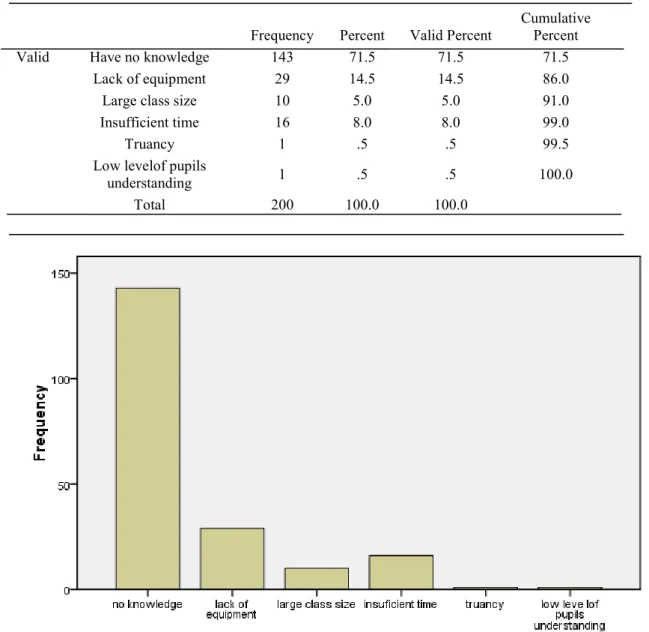
Factors that Hinder Teachers’ use of Constructivism in Teaching and Learning in their Classroom Several reasons were given alongside the fact that majority of the teachers were not quite familiar with the contemporary constructivist`s pedagogy. As to why some of the teachers too, though having knowledge about constructivism failed to use the concept in their science teaching was attributed to a number of factors. Table 1 and Figure 1 provide the summary of the factors that hinder the teachers’ successful use of the constructivists teaching.
Table 1: Frequency Distribution of Factors that Hinder the Teachers Successful use of Constructivism Frequency Percent Valid Percent
Cumulative Percent
Valid Have no knowledge 143 71.5 71.5 71.5
Lack of equipment 29 14.5 14.5 86.0
Large class size 10 5.0 5.0 91.0
Insufficient time 16 8.0 8.0 99.0
Truancy 1 .5 .5 99.5
Low levelof pupils
understanding 1 .5 .5 100.0
Total 200 100.0 100.0
Figure 1: Factors that hinder teachers’ successful use of constructivism
From table 1, lack of equipment, insufficient time and large class size appear to be the major hindrance for teachers’ inability to use the constructivists teaching pedagogy in their classrooms. Only 0.5% of the respondents attributed their inability to truancy and low level of pupils.
It is one thing having constructivists’ knowledge as a teacher and another, the ability to effectively implement that knowledge in your teaching activities. Majority of the few teachers who appeared to have some knowledge about the concept were unable to use it to the benefit of their students. Several reasons were given to this effect and these include lack of science equipment, large class size, low intellectual level of pupils, and insufficient time among others.
Other factors such as the need to cover curriculum and preparing students on examinations are some of the possible factors that may influence teacher classroom practice as well as teachers’ beliefs about teaching and learning of science.
A similar survey of teachers conducted in New Zealand revealed that their teaching time focused on the content or product of science instead of the process of science (Hipkins, Barker, & Bolstad, 2005). When asked, teachers reported that this choice was reinforced by the assessment practices that were currently in place (Hipkins, Barker & Bolstad, 2005).
Unfortunately, since the NOS content did not appear on any national assessment tools, “some Senior High School science teachers are selectively dropping this aspect of the curriculum in order to better prepare students for assessment in the content-focused standards” (Hipkins Barker & Bolstad, 2005).
this pattern, examination-directed teaching. Teachers struggle to complete the curriculum in order to achieve good results for their students and their schools.
This has resulted in the common practice of basic science teachers in Ghana buying past examination questions and spending instructional time to solve them with students instead of nurturing students’ natural curiosity through frequent use of enquiry-based teaching model.
Table 2: The Extent to which the Methodology Course in Science Supports the Concept of Constructivism in the Colleges of Education in Ghana
Frequency Percent Valid Percent Cumulative percent
Valid No knowledge 143 71.5 71.5 71.5
At college of education 17 8.5 8.5 80.0
A t the university 11 5.5 5.5 85.5
A t workshop 29 14.5 14.5 100.0
Total 200 100.0 100.0
From Table 2, the results indicate that out of the 200 respondents in this study, seventeen (17) teachers representing 8.5% learnt about constructivism at their College of Education. Eleven (11) teachers, representing 5.5% encountered the concept at degree level, with 29 teachers representing 14.5% doing so at workshops and in-service trainings. The large majority of the teachers, one hundred and forty-three (143), representing 71.5% have never encountered the concept of constructivism before.
The implication of this is that since majority of the teachers teaching at the basic level are trained at the Colleges of Education, their lack of adequate knowledge in the concept of constructivism suggests that the concept is not adequately addressed by the curriculum at the Colleges of Education.
Conclusions
The purpose of the study is to find out the factors hinder the teachers’ use of constructivism in teaching and learning of science in their classroom and extent to which the methodology topics in science for Colleges of Education in Ghana equip basic teachers with the constructivist’s pedagogy so that a strong background for the promotion of constructivist-based teacher training courses could be considered. It can therefore be concluded that factors that hinder the teachers’ use of constructivism in teaching and learning of science in their classroom include large class size, inadequate supply of teaching and learning materials, the nature and structure of national examinations and truancy. The concept of constructivism is less popular if not missing in the curriculum of the Colleges of Education in Ghana. The methodology course as indicated in the results does not adequately discuss the constructivists` epistemology well enough to make prospective teachers well informed about the concept. Recommendation
1. Pre-service teacher education programs should focus more on helping prospective teachers to have an in-depth knowledge about the constructivist pedagogy so that a strong background for the promotion of the constructivist-based teaching courses could be considered.
References
Anamuah-Mensah, J., Mereku, D.K. & Ampiah, J.G. (2009). TIMSS 2007 Ghana Report: Findings from IEA’s
trends in international mathematics and science study at the eighth grade. Accra: Adwinsa Publications
(Gh) Ltd
Anamuah-Mensah, J., Buckler, A., Moon, B., Ricketts, K. & Wolfenden, F. (2008). Building an effective ‘Open Education Resource’ (OER) Environment for Teacher Education in Sub- Saharan Africa: The TESSA
Experience. A paper presented at PCF4, University of London
Burnie, D. (2008). "Science." Microsoft Student 2009 [DVD]. Redmond, WA: Microsoft Corporation. Bybee, R.W. (1993). Leadership, responsibility, and reform in science education. Science Educator, 2, 1-9. CRDD. (2007). Teaching syllabus for integrated science (Junior High School ). Accra: CRDD
Fredua-Kwarteng, Y. and Ahia, F. (2005, January 08). Ghana Flunks at Maths and Science: analysis(1). Retrieved November 15, 2010. From ghanaweb.com.
Hipkins, R., Barker, M., & Bolstad, R. (2005). Teaching the ‘nature of science’: Modest adaptations or radical reconceptions? International Journal of Science Education, 27(4),243-254.
Levitt, K. E. (2002). An analysis of elementary teachers’ beliefs regarding the teaching and learning of science.
Science Education, 86(1), 1-22
Melby, E. O. (1963). The teacher and learning.Center for applied research in education, Inc., 70 Fifth Avenue, New York, N.Y. 10011. 118
Pajares, M. F. (1992). Teachers’ beliefs and educational research: Cleaning up a messy construct. Review of
Reddy, M. J. (1979). The conduit metaphor: A case of frame conflict in our language aboutlanguage. In A. Ortony (Ed.), Metaphor and Thought (2nd ed.). Cambridge, England:Cambridge University Press.
UNESCO (2005). Education for all. The quality imperative. Paris: UNESCO
West Africa Examination Council (2013). Chief Examiners’ Report on Basic Education Certificate Examination. Accra:Wisdom Press.
West Africa Examination Council (2014). Chief Examiners’ Report on Basic Education Certificate Examination. Accra:Wisdom Press.
West Africa Examination Council (2015). Chief Examiners’ Report on Basic Education Certificate Examination. Accra:Wisdom Press.