Towards a Framework for the Autonomic Management of Virtualization-Based
Environments
Dan Marinescu and Reinhold Kroeger
Wiesbaden University of Applied Sciences
Distributed Systems Lab
Kurt-Schumacher-Ring 18, D-65197 Wiesbaden, Germany
{
dan.marinescu,kroeger
}
@informatik.fh-wiesbaden.de
Abstract
Over the past years, virtualization has emerged again, making its place in the data centers. However, data cen-ters are already facing management problems due to the increased system complexity. Virtualization increases this complexity even more. To address these management prob-lems, computing systems should be able to manage them-selves. In this paper, we propose a modular framework for the autonomic management of virtualization-based en-vironments. This framework is virtualization-technology in-dependent and permits plugging in various controller ap-proaches.
1. Introduction
System virtualization is a technique first developed in the mid 1960’s. It consists of an indirection layer that is in-troduced between the hardware and the operating system, called virtual machine monitor (VMM) or hypervisor. The VMM partitions the hardware in logical units, called virtual machines (VMs). Inside a VM, a so-called guest operating system is running. The VMM controls and synchronizes the access of guest OSs to hardware resources. As such, it is possible to run multiple, possibly different OSs in parallel on the same hardware. Although a flourishing technology in the 1970’s, the 1980’s and 1990’s brought a drop in hard-ware prices which meant that it was affordable to run one application per computing system, and thus virtualization was slowly forgotten [10]. Over the past years howvever, virtualization has emerged again, nowadays being used on both server (e.g. VMware ESX [19], Xen [23]) and desk-top systems (e.g. VMWare Workstation [20], Virtual Box [18]). The new paradigm states: one application per virtual machine, several virtual machines per computing system.
The adoption of virtualization in the data center is
tak-ing place at a high pace. The possibility of consolidattak-ing a bundle of under-utilized server boxes into one server sys-tem is certainly one of the reasons. Besides server consol-idation, it is the way maintenance and system management are simplified that makes this technology attractive for sys-tem administrators. However, virtualization does not reduce the complexity of a system. In fact, having multiple virtual machines running on top of several physical machines actu-ally increases the overall system complexity. This matches the theory of the ever increasing complexity of computing systems, which will finally lead to systems which cannot be managed by human experts (system administrators) any more. However, such systems exist in the nature since mil-lions of years. In [6], the authors proposed the human auto-nomic nervous system (ANS) as an inspiration source. The ANS manages low-level, yet vital body functions like heart rate or body temperature without conscious control. Simi-larly, computing systems should be able to manage them-selves, based on some high-level goals defined by a hu-man system administrator. The field of reseach that deals with this kind of systems is called autonomic computing, the essence of which is self-management. According to [6], there are four aspects of self-management:
• self-configuration, the capability of computing
sys-tems to install and configure themselves
• self-optimization, the property of computing systems
to continuously seek to improve their operation
• self-healing, the property of computing systems to
de-tect, diagnose and repair local problems
• self-protection, the property of computing systems to
defend themselves in the face of a malicious attack or cascading failures
For the purpose of this paper, we will mainly focus on the self-optimization aspect for the management of
virtualization-based environments, assuming that quality-of-service levels of the services, provided by the VMs, have to be fulfilled [3].
Virtualization-based environments are a great area of application for autonomic computing. On one hand, the increased complexity caused by the use of virtualization makes autonomic computing a necessity in large data cen-ters. On the other hand, most of the server virtualization technologies that currently exist provide management fea-tures like the allocation of resources (memory, CPU shares and others) at run-time and live migration of virtual ma-chines [2]. These features are great control knobs (actua-tors) that can be used for system self-optimization. Also monitoring and debugging capabilities are enhanced by the introduction of an indirection layer between the operating system and the hardware. What is missing is an intelligent controller that can take decisions based on the data gath-ered through monitoring resulting in dynamically allocated resources through the previously mentioned actuators. This paper deals with aspects related to the development of such an intelligent controller.
2. Related work and limitations
Various publications deal with the autonomic
manage-ment of virtual environmanage-ments. Policy-based approaches
have been a popular way to manage computing systems, and virtualization-based systems are no exception. In [12], the authors present a system called VIOLION, which uses the Xen hypervisor for virtualization. The system comprises one monitor daemon per physical machine and one adapta-tion manager. The adaptaadapta-tion manager uses the data gath-ered by the monitor daemon to dictate virtual machine re-source allocation. Another policy-based approach has been published by Grit et al. [4]. Here, the authors use and extend Shirako, a Java-based toolkit for resource leasing services, to explore algorithmic challenges when using policies for the adaptive hosting of virtual machines on computer clus-ters.
Control theory has also been used to autonomically
man-age virtual environments. Zhang et al. [24] present a
control-theoretic model for VM adaptation, based on the idea that the VMs are responsible for adjusting their demand for resources, with respect to efficiency and fairness. In [9], the authors use a feedback-control strategy to address dy-namic resource allocation problems. The approach uses an infrastructure based on Xen, RUBiS [11] and TPC-W [16]. Time series analysis can be used to forecast the behaviour of a virtualization-based system. Bobroff et al. [1] present a mechanism for the dynamic migration of virtual machines based on the forecasted load. Menasc`e et al. [8] use an ap-proach based on utility functions [21] for the dynamic CPU allocation to virtual machines. The authors test their
ap-proach by means of simulations, using historical data. These publications represent the first steps taken by the research community to develop various strategies for an in-telligent controller based on different control paradigms. It is however hard to objectively evaluate these strategies. The various publications use different architectures, per-form different tests and some even only use historical data and simulation to test how their strategies perform. In this context, it is impossible to say that one approach performs better than another, or that some approach is more adequate in a specific situation than the other approaches. The main reason for this is that automated management of VM en-vironments is not mature yet but still in its infancy. We argue that the only way to solve this problem is to design a common framework for the development and evaluation of autonomic computing strategies for virtualization-based distributed environments.
3. Architecture of the framework
A framework for developing and evaluating autonomic computing strategies for virtualization-based distributed en-vironments must fulfill the following requirements:
1. Support for service level management
2. Separation of control algorithms from the management framework
3. Support for different virtualization technologies 4. Support for a common evaluation mechanism 5. Scalability
(1) means that the framework should provide support for managing services hosted in virtual machines. This in-volves monitoring various QoS parameters and making sure that these parameters conform to a certain Service Level Objective (SLO).
(2) basically assures that the management framework is responsible for dealing with aspects like monitoring and ex-ecution of tasks, while a separate intelligent controller de-fines management tasks based on gathered monitoring data. As such, a framework should support different types of in-telligent controllers by providing a generic controller inter-face.
(3) requires the framework to support different virtu-alization technologies (e.g. VMware ESX or Xen), trans-parently for the controller. Thus, from a controller’s per-spective, the framework is acting as an abstraction layer on top of the virtualization technology. Generic interfaces for monitoring and task execution should simplify plugging in adapters for various virtualization technologies.
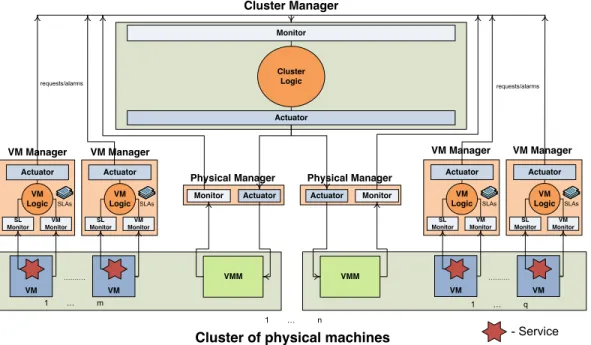
Cluster of physical machines VM Manager VM SL Monitor VM Monitor VM Logic Actuator SLAs VM SL Monitor VM Monitor VM Logic Actuator SLAs VM Manager VM Manager Actuator Monitor Cluster Logic VM SL Monitor VM Monitor VM Logic Actuator VM Manager SLAs VM SL Monitor VM Monitor VM Logic Actuator SLAs Actuator Monitor Physical Manager VMM Actuator Monitor Physical Manager VMM Cluster Manager 1 !""""""""""# 1 !""""""""""$ 1 !""""""""""% - Service requests/alarms requests/alarms
Figure 1. The architecture of the framework
(4) means that the framework has to support a consistent mechanism for tracing and comparing management deci-sions. Only this way different self-management approaches can be evaluated against each other.
(5) states that the framework should be scalable with re-spect to the number of physical and virtual machines that it can manage. New physical or virtual machines dynamically added to the cluster must be recognized by the framework.
Figure 1 depicts the design of our framework with re-spect to the requirements discussed above. The framework
is used to manage a cluster of nphysical machines, each
hosting a number between0andmvirtual machines. Each
virtual machine has aVM Manager, each physical machine
has aPhysical Manager and the entire cluster is managed
by oneCluster Manager.
The Physical Manager is the simplest component of the framework. It’s job is to monitor the resource utilization
of the physical machine through itsMonitormodule.
Be-sides monitoring, the Physical Manager also executes
com-mands coming from the Cluster Manager through its
Actu-atormodule. Both the Monitor and the Actuator modules
monitor respectively control the physical machine through
theVMM.
The VM Manager monitors parameters like CPU utiliza-tion and available memory with respect to the virtual
ma-chine through the VM Monitor module. It also monitors
the service/application running inside the virtual machine
through theSL Monitormodule. We assume that each
vir-tual machine hosts only one service, e.g. a web server, a
mail server or a database; we argue that this is common practice in a server consolidation scenario. The two
moni-tors feed the gathered data to theVM Logicmodule, which
uses this data to determine whether the service is running at the required parameters. If this is not the case, the VM Logic tries to determine which of the VM’s resource is the bottleneck (i.e. memory, CPU, etc.). When such a
bottle-neck is determined, the VM Manager uses theVM
Actua-tor module to request a larger amount of the resource that
causes the bottleneck from the Cluster Manager (i.e. request more memory, a larger CPU share etc.).
The Cluster Manager has a global view of both avail-able and allocated resources, generated using the data
gath-ered from the Physical Managers. TheCluster Logic
mod-ule uses this global view to determine how requests from the VM Manager can be fulfilled. Thus, the Cluster Logic module is actually what we previously referred to as the intelligent controller. After a decision has been taken, the Cluster Manager dictates commands to the Physical
Man-ager(s) through itsActuatormodule.
It can be easily observed that this framework fulfills the previously defined requirements. First, the way that the VM Manager is designed specifically addresses the service running in the “managed” virtual machine. Various Clus-ter Logic components that use different self-management strategies can be easily plugged into the framework. Fur-thermore, different virtualization technologies can be ad-dressed by simply developing the necessary adapters for each virtualization technology. It is possible to use
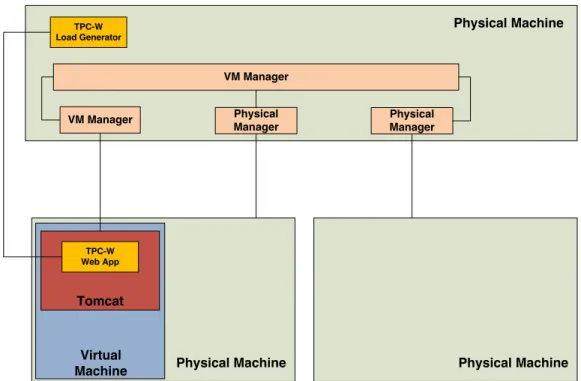
stan-VM Manager Physical Machine TPC-W Load Generator Physical Manager Virtual Machine TPC-W Web App Tomcat Physical Machine Physical Manager VM Manager Physical Machine
Figure 2. The testbed
dard benchmarking tools to generate load for the services running inside the virtual machines and then use the VM Monitor component to evaluate how these services are per-forming. This way, different intelligent controllers can be evaluated with respect to how the services are performing under various loads. Last, adding new physical and virtual machines to the cluster can be done by simply registering with the cluster manager.
4. Implementation
We have implemented a prototype of the framework in Java using Xen as the virtualization technology. Our proto-type implementation is based on the Self Manager Core that has been developed in the Distributed Systems Lab of Wies-baden University of Applied Sciences [15, 14]. The VM Manager uses JMX [5] to monitor the parameters of a Xen-based virtual machine (the VM Monitor component) and the response times of an Apache Tomcat server running inside the virtual machine (the SL Monitor component). The VM Logic is implemented as an expert system and uses the data from the SL Monitor and the VM Monitor to feed Jess [13], a rule engine. The rule engine matches the data against a rule set. We have developed a basic set of rules, which is used by Jess to determine the bottlenecked resource when the response times of the service are higher than a given threshold. For the Physical Manager, an adapter has been
implemented that uses the API [22] to manage Xen-based physical machines. This involves both monitoring and dynamically allocating resources. Both the VM Man-ager and the Physical ManMan-ager communicate with the Clus-ter Manager using Java RMI. The ClusClus-ter Manager provides support for plugging-in different Cluster Logic components through a messaging interface. More implementation de-tails can be found in [7].
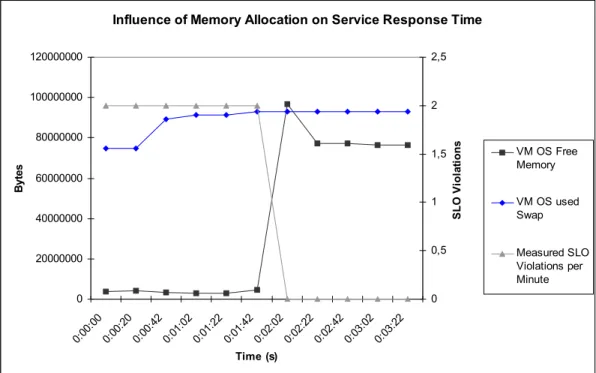
We have tested the framework in a lab environment us-ing a Java implementation of the TPC-W benchmarkus-ing standard [17]. This testbed can be observed in Figure 2. The TPC-W e-commerce application suite is hosted inside a Tomcat server running on top of a virtual machine managed by the VM Manager. Two physical machines are managed by two different Physical Managers, with one of them host-ing the virtual machine. The two Physical Managers, the VM Manager and the Cluster Manager are hosted on a third physical machine, which also hosts the TPC-W load gener-ator. This machine is not part of the “under-management” cluster. When the TPC-W load generator is started, the VM Manager is able to observe a dramatic increase in the response times of the Tomcat service and determines the memory as being the bottleneck. After more memory is given, the response times of the Tomcat service decrease up to an acceptable level. This behaviour is shown in Figure 3 and proves that the VM Manager is able to successfully determine the resource causing the bottleneck. Distributed
Influence of Memory Allocation on Service Response Time 0 20000000 40000000 60000000 80000000 100000000 120000000 0:00 :00 0:00 :20 0:00 :42 0:01 :02 0:01 :22 0:01 :42 0:02 :02 0:02 :22 0:02 :42 0:03 :02 0:03 :22 Time (s) B yt es 0 0,5 1 1,5 2 2,5 S L O V io la ti o n s VM OS Free Memory VM OS used Swap Measured SLO Violations per Minute
Figure 3. Influence of available memory on SLO violations
tests including migrating a VM on a secong physical ma-chine when necessary are currently underway.
5. Conclusion and outlook
In this paper, we have argued that virtualization-based environments are an important application area for auto-nomic computing, but still in its infancy at the moment. Fur-thermore, it is hard to objectively evaluate the currently pub-lished autonomic computing approaches for virtualization-based environments. The main contribution of this paper is the design of a framework for developing and evaluat-ing autonomic computevaluat-ing strategies for virtualization-based environments. Using this framework, different controller strategies can be easily developed, plugged-in and evalu-ated against each other. Our framework is not virtualization technology-bound, instead adapters for various virtualiza-tion technologies can be easily developed and plugged into the framework.
We are currently working on different approaches for an intelligent controller. We have discovered that our resource allocation problem belongs to the family of knapsack prob-lems. Knapsack problems are known to be NP-hard. This means that we are dealing with an NP-hard optimization problem. This is an important discovery, since it is com-monly believed that, for NP-hard optimization problems, no algorithm exists that finds an optimal solution in polynomial time. As such, for our resource allocation problem, we can
either use heuristics or approximation algorithms. While for the moment we are working on two different heuristic-based algorithms, in the future we plan to design an intel-ligent controller that uses an approximation algorithm and thus has a guaranteed performance ratio. Details about the design and evaluation of these controllers as a Cluster Logic component in our framework will be made available in a fu-ture publication.
References
[1] N. Bobroff, A. Kochut, and K. Beaty. Dynamic placement of virtual machines for managing sla violations. InIntegrated Network Management, 2007. IM ’07. 10th IFIP/IEEE Inter-national Symposium on, pages 119–128, 2007.
[2] C. Clark, K. Fraser, S. Hand, J. G. Hansen, E. Jul, C. Limpach, I. Pratt, and A. Warfield. Live migration of virtual machines. InProceedings of the 2nd ACM/USENIX Symposium on Networked Systems Design and Implementa-tion (NSDI), pages 273–286, Boston, MA, May 2005. [3] M. Debusmann, M. Schmid, and R. Kroeger. Model-Driven
Self-Management of Legacy Applications. In L. Kutvonen and N. Alonistioti, editors,5th IFIP International Confer-ence on Distributed Applications and Interoperable Systems (DAIS 2005), Athens, Greece, June 2005, pages 56–67. IFIP, Springer, June 2005.
[4] L. Grit, D. Irwin, A. Yumerefendi, and J. Chase. Virtual machine hosting for networked clusters: Building the foun-dations for autonomic orchestration.
[5] Java Management Extensions. http://java.sun. com/javase/technologies/core/mntr-mgmt/ javamanagement/Last visited 11.12.2007.
[6] J. O. Kephart and D. M. Chess. The vision of autonomic computing.Computer, 36:41–50, 2003.
[7] D. Marinescu. Design and evaluation of self-management approaches for virtual machine-based environments. Mas-ter’s thesis, Wiesbaden University of Applied Sciences, DCSM, February 2008.
[8] D. A. Menasce and M. N. Bennani. Autonomic virtualized environments. InICAS ’06: Proceedings of the Interna-tional Conference on Autonomic and Autonomous Systems, page 28, Washington, DC, USA, 2006. IEEE Computer So-ciety.
[9] P. Padala, K. G. Shin, X. Zhu, M. Uysal, Z. Wang, S. Sing-hal, A. Merchant, and K. Salem. Adaptive control of virtu-alized resources in utility computing environments. In Eu-roSys ’07: Proceedings of the 2007 conference on EuEu-roSys, pages 289–302, New York, NY, USA, 2007. ACM Press. [10] M. Rosenblum and T. Garfinkel. Virtual machine monitors:
current technology and future trends. Computer, 38(5):39– 47, 2005.
[11] RUBiS. http://rubis.objectweb.org/Last vis-ited 11.12.2007.
[12] P. Ruth, J. Rhee, D. Xu, R. Kennell, and S. Goasguen. Auto-nomic live adaptation of virtual computational environments in a multi-domain infrastructure. InAutonomic Computing, 2006. ICAC ’06. IEEE International Conference on, pages 5–14, 2006.
[13] Sandia National Laboratories. http://herzberg.ca.sandia.gov/ (Last visited 31.01.2008).
[14] M. Schmid. Ein Ansatz fuer das Service Level Management in dynamischen Architekturen. In T. Braun, G. Carle, and B. Stiller, editors,KiVS 2007 - Kommunikation in Verteil-ten Systemen - Industriebeitraege, Kurzbeitraege und Work-shops, pages 255–266. VDE Verlag, March 2007.
[15] M. Schmid and K. Geihs. Self-Organisation in the Context of QoS Management in Service Oriented Architectures. In K. Boudaoud, N. Nobelis, and T. Nebe, editors,Proceedings of the 13th Annual Workshop of HP OpenView University Association, Hosted by University of Nice at Cote d’Azur May 21 - 24, 2006, pages 153–164, Stuttgart, May 2006. Infonomics-Consulting.
[16] TPC-W. http://www.tpc.org/tpcw/ Last visited 11.12.2007.
[17] TPC-W Java Implementation. http://www.ece. wisc.edu/∼pharm/tpcw.shtml Last visited
11.12.2007.
[18] Virtual Box. http://www.virtualbox.org/ Last visited 11.12.2007.
[19] VMware ESX. http://www.vmware.com/ products/vi/esx/Last visited 11.12.2007.
[20] VMware Workstation. http://www.vmware.com/ products/ws/Last visited 11.12.2007.
[21] W. E. Walsh, G. Tesauro, J. O. Kephart, and R. Das. Utility functions in autonomic systems. InAutonomic Computing, 2004. Proceedings. International Conference on, pages 70– 77, 2004.
[22] The Xen API. http://wiki.xensource.com/ xenwiki/XenApiLast visited 11.12.2007.
[23] Xen Source.http://www.xensource.com/Last vis-ited 11.12.2007.
[24] Y. Zhang, A. Bestavros, M. Guirguis, I. Matta, and R. West. Friendly virtual machines: leveraging a feedback-control model for application adaptation. InVEE ’05: Proceedings of the 1st ACM/USENIX international conference on Virtual execution environments, pages 2–12, New York, NY, USA, 2005. ACM Press.