Executive summary
Electrical Energy Storage, EES, is one of the key technologies in the areas covered by the IEC. EES techniques have shown unique capabilities in coping with some critical characteristics of electricity, for example hourly variations in demand and price. In the near future EES will become indispensable in emerging IEC-relevant markets in the use of more renewable energy, to achieve CO2 reduction and for Smart Grids.
Historically, EES has played three main roles. First, EES reduces electricity costs by storing electricity obtained at off-peak times when its price is lower, for use at peak times instead of electricity bought then at higher prices. Secondly, in order to improve the reliability of the power supply, EES systems support users when power network failures occur due to natural disasters, for example. Their third role is to maintain and improve power quality, frequency and voltage.
Regarding emerging market needs, in on-grid areas, EES is expected to solve problems – such as excessive power fl uctuation and undependable power supply – which are associated with the use of large amounts of renewable energy. In the off-grid domain, electric vehicles with batteries are the most promising technology to replace fossil fuels by electricity from mostly renewable sources. The Smart Grid has no universally accepted defi nition, but in general it refers to modernizing the electricity grid. It comprises everything related to the electrical system between any point of electricity production and any point of consumption. Through the addition of Smart Grid technologies the grid becomes more fl exible and interactive and can provide real-time feedback. For instance, in a Smart Grid, information regarding the price of electricity and the situation of the power
system can be exchanged between electricity production and consumption to realize a more effi cient and reliable power supply. EES is one of the key elements in developing a Smart Grid. In October 2010, the IEC MSB (Market Strategy Board) decided to establish a project team to plan future IEC activities in EES. This White Paper summarizes present and future market needs for EES technologies, reviews their technological features, and fi nally presents recommendations for all EES stakeholders.
Acknowledgments
This paper has been prepared by the Electrical Energy Storage project team, a part of the Special Working Group on technology and market watch, in the IEC Market Strategy Board, with a major contribution from the Fraunhofer Institut für Solare Energiesysteme.
Table of contents
List of abbreviations
7
Section 1 The roles of electrical energy storage technologies
in electricity use
9
1.1 Characteristics of electricity 9
1.2 Electricity and the roles of EES 9
1.2.1 High generation cost during peak-demand periods 9
1.2.2 Need for continuous and fl exible supply 10
1.2.3 Long distance between generation and consumption 10
1.2.4 Congestion in power grids 11
1.2.5 Transmission by cable 11
1.3 Emerging needs for EES 11
1.3.1 More renewable energy, less fossil fuel 11
1.3.2 Smart Grid uses 13
1.4 The roles of electrical energy storage technologies 13
1.4.1 The roles from the viewpoint of a utility 13
1.4.2 The roles from the viewpoint of consumers 15
1.4.3 The roles from the viewpoint of generators of renewable energy 15
Section 2 Types and features of energy storage systems
17
2.1 Classifi cation of EES systems 17
2.2 Mechanical storage systems 18
2.2.1 Pumped hydro storage (PHS) 18
2.2.2 Compressed air energy storage (CAES) 18
2.2.3 Flywheel energy storage (FES) 19
2.3 Electrochemical storage systems 20
2.3.1 Secondary batteries 20
2.3.2 Flow batteries 24
2.4 Chemical energy storage 25
2.4.1 Hydrogen (H2) 26
2.5 Electrical storage systems 27
2.5.1 Double-layer capacitors (DLC) 27
2.5.2 Superconducting magnetic energy storage (SMES) 28
2.6 Thermal storage systems 29
2.7 Standards for EES 30
2.8 Technical comparison of EES technologies 30
Section 3 Markets for EES
35
3.1 Present status of applications 35
3.1.1 Utility use (conventional power generation, grid operation & service) 35
3.1.2 Consumer use (uninterruptable power supply for large consumers) 37
3.1.3 EES installed capacity worldwide 38
3.2 New trends in applications 39
3.2.1 Renewable energy generation 39
3.2.2 Smart Grid 43
3.2.3 Smart Microgrid 44
3.2.4 Smart House 45
3.2.5 Electric vehicles 46
3.3 Management and control hierarchy of storage systems 48
3.3.1 Internal confi guration of battery storage systems 49
3.3.2 External connection of EES systems 49
3.3.3 Aggregating EES systems and distributed generation (Virtual Power Plant) 50
3.3.4 “Battery SCADA” – aggregation of many dispersed batteries 50
Section 4 Forecast of EES market potential by 2030
53
4.1 EES market potential for overall applications 53
4.1.1 EES market estimation by Sandia National Laboratory (SNL) 53
4.1.2 EES market estimation by the Boston Consulting Group (BCG) 53
4.1.3 EES market estimation for Li-ion batteries by the Panasonic Group 55
4.2 EES market potential estimation for broad introduction of renewable energies 55
4.2.1 EES market potential estimation for Germany by Fraunhofer 56
4.2.2 Storage of large amounts of energy in gas grids 56
4.2.3 EES market potential estimation for Europe by Siemens 58
4.3 Vehicle to grid concept 60
4.4 EES market potential in the future 61
Section 5 Conclusions and recommendations
65
5.1 Drivers, markets, technologies 65
5.2 Conclusions regarding renewables and future grids 66
5.3 Conclusions regarding markets 67
5.4 Conclusions regarding technologies and deployment 67
5.5 Recommendations addressed to policy-makers and regulators 68
5.6 Recommendations addressed to research institutions and companies carrying out R&D 69
5.7 Recommendations addressed to the IEC and its committees 70
Annex A Technical overview of electrical energy storage technologies
72
Annex B EES in Smart Microgrids
74
Br Bromine
BMS Battery management system
CAES Compressed air energy storage
Cd Cadmium
Ce Cerium
CHP Combined heat and power
CO2 Carbon dioxide
Cr Chromium
CSP Concentrated solar power
DLC Double layer capacitor
EES Electrical energy storage
EMS Energy management system
EV Electric vehicle
FB Flow battery
FES Flywheel energy storage
H2 Hydrogen
HEV Hybrid electric vehicle
HFB Hybrid fl ow battery
HP High pressure
LA Lead acid
Li-ion Lithium ion (battery)
LP Low pressure
Me-air Metal-air
NaS Sodium sulphur
NiCd Nickel cadmium
NiMH Nickel metal hydride
PCM Phase change material
PHS Pumped hydro storage
List of abbreviations
Technical and
scientifi c terms
PV Photovoltaic
R&D Research and development
RE Renewable energy/ies
RES Renewable energy systems
RFB Redox fl ow battery
SCADA Supervisory control and data acquisition
SMES Superconducting magnetic energy storage
SNG Synthetic natural gas
UPS Uninterruptable power supply
V2G Vehicle to grid
V2H Vehicle to home (appliances)
VRFB Vanadium redox fl ow battery
Zi-air Zinc air
Zn Zinc
IEA International Energy Agency
IEC International Electrotechnical Commission Fraunhofer
ISE Fraunhofer Institute for Solar Energy Systems
MSB (IEC) Market Strategy Board
SEI Sumitomo Electric Industries
SMB (IEC) Standardization Management Board
TEPCO Tokyo Electric Power Company
Organizations,
institutions and
companies
1.1
Characteristics of electricity
Two characteristics of electricity lead to issues in its use, and by the same token generate the market needs for EES. First, electricity is consumed at the same time as it is generated. The proper amount of electricity must always be provided to meet the varying demand. An imbalance between supply and demand will damage the stability and quality (voltage and frequency) of the power supply even when it does not lead to totally unsatisfi ed demand. The second characteristic is that the places where electricity is generated are usually located far from the locations where it is consumed 1. Generatorsand consumers are connected through power grids and form a power system. In function of the loca-tions and the quantities of power supply and de-mand, much power fl ow may happen to be con-centrated into a specifi c transmission line and this may cause congestion. Since power lines are al-ways needed, if a failure on a line occurs (because of congestion or any other reason) the supply of electricity will be interrupted; also because lines are always needed, supplying electricity to mobile ap-plications is diffi cult. The following sections outline the issues caused by these characteristics and the consequent roles of EES.
1
However, in the future there will be an increase in distributed generation (as mentioned for example in sections 3.1 and 3.2), where consumption and generation are typically close together.
1.2
Electricity and the roles of EES
1.2.1 High generation cost duringpeak-demand periods
Power demand varies from time to time (see Figure 1-1), and the price of electricity changes accordingly. The price for electricity at peak-demand periods is higher and at off-peak periods lower. This is caused by differences in the cost of generation in each period.
During peak periods when electricity consumption is higher than average, power suppliers must complement the base-load power plants (such as coal-fi red and nuclear) with less cost-effective but more fl exible forms of generation, such as oil and gas-fi red generators. During the off-peak period when less electricity is consumed, costly types of generation can be stopped. This is a chance for owners of EES systems to benefi t fi nancially. From the utilities’ viewpoint there is a huge potential to reduce total generation costs by eliminating the costlier methods, through storage of electricity generated by low-cost power plants during the night being reinserted into the power grid during peak periods.
With high PV and wind penetration in some regions, cost-free surplus energy is sometimes available. This surplus can be stored in EES and used to reduce generation costs. Conversely, from the consumers’ point of view, EES can lower electricity costs since it can store electricity bought at low off-peak prices and they can use it during off-peak periods in the place of expensive power. Consumers who charge batteries during off-peak hours may also sell the electricity to utilities or to other consumers during peak hours.
Section 1
The roles of electrical energy storage technologies
in electricity use
1.2.2 Need for continuous and fl exible supply
A fundamental characteristic of electricity leads to the utilities’ second issue, maintaining a continuous and fl exible power supply for consumers. If the proper amount of electricity cannot be provided at the time when consumers need it, the power quality will deteriorate and at worst this may lead to a service interruption. To meet changing power consumption appropriate amounts of electricity should be generated continuously, relying on an accurate forecast of the variations in demand. Power generators therefore need two essential functions in addition to the basic generating function. First, generating plants are required to be equipped with a “kilowatt function”, to generate suffi cient power (kW) when necessary. Secondly, some generating facilities must possess a frequency control function, fi ne-tuning the output so as to follow minute-by-minute and second-by-second fl uctuations in demand, using the extra power from the “kilowatt function” if necessary. Renewable energy facilities such as solar and
wind do not possess both a kW function and a frequency control function unless they are suitably modifi ed. Such a modifi cation may be a negative power margin (i.e. decreasing power) or a phase shift inverter 2.
EES is expected to be able to compensate for such diffi culties with a kW function and a frequency control function. Pumped hydro has been widely used to provide a large amount of power when generated electricity is in short supply. Stationary batteries have also been utilized to support renewable energy output with their quick response capability.
1.2.3 Long distance between generation and consumption
Consumers’ locations are often far from power generating facilities, and this sometimes leads to higher chances of an interruption in the power supply. Network failures due to natural disasters (e.g. lightning, hurricanes) and artifi cial causes (e.g. 2 In Germany such a modifi cation, called “system services”,
must be implemented in large wind power generators. Figure 1-1 | Comparison of daily load curves (IEEJ – The Institute of Energy Economics, Japan, 2005)
overload, operational accidents) stop electricity supply and potentially infl uence wide areas.
EES will help users when power network failures occur by continuing to supply power to consumers. One of the representative industries utilizing EES is semi-conductor and LCD manufacturing, where a voltage sag lasting for even a few milliseconds impacts the quality of the products. A UPS system, built on EES and located at a customer’s site, can keep supplying electricity to critical loads even when voltage sag occurs due to, for example, a direct lightning strike on distribution lines. A portable battery may also serve as an emergency resource to provide power to electrical appliances.
1.2.4 Congestion in power grids
This issue is a consequence of the previous problem, a long distance between generation and consumption. The power fl ow in transmission grids is determined by the supply and demand of electricity. In the process of balancing supply and demand power congestion can occur. Utility companies try to predict future congestion and avoid overloads, for example by dispatching generators’ outputs or ultimately by building new transmission routes. EES established at appropriate sites such as substations at the ends of heavily-loaded lines can mitigate congestion, by storing electricity while transmission lines maintain enough capacity and by using it when lines are not available due to congestion. This approach also helps utilities to postpone or suspend the reinforcement of power networks.
1.2.5 Transmission by cable
Electricity always needs cables for transmission, and supplying electricity to mobile applications and to isolated areas presents diffi culties. EES systems such as batteries can solve this problem with their mobile and charge/discharge capabilities. In remote places without a power grid connection recharging an electric vehicle may present a challenge, but EES
can help realize an environmentally friendly transport system without using conventional combustion engines.
1.3
Emerging needs for EES
There are two major emerging market needs for EES as a key technology: to utilize more renewable energy and less fossil fuel, and the future Smart Grid.
1.3.1 More renewable energy, less fossil fuel
On-grid areas
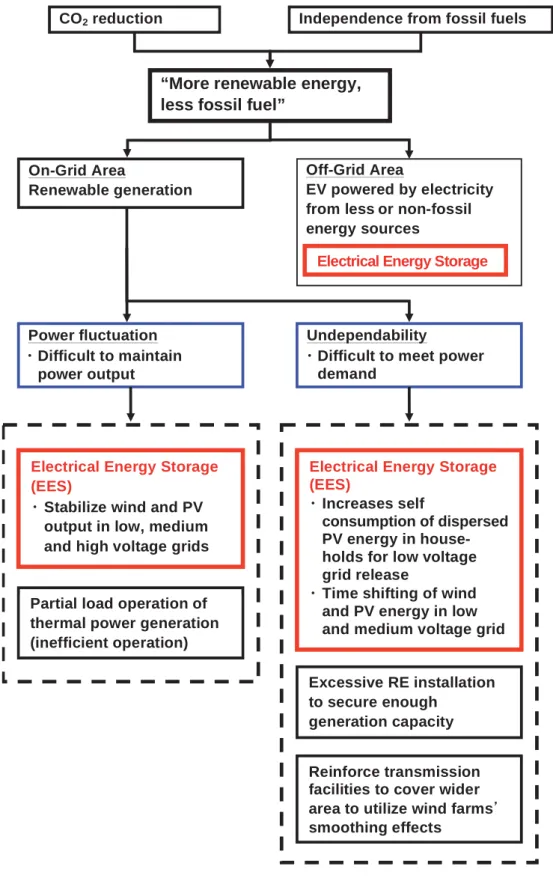
In on-grid areas, the increased ratio of renewable generation may cause several issues in the power grid (see Figure 1-2). First, in power grid operation, the fl uctuation in the output of renewable generation makes system frequency control diffi cult, and if the frequency deviation becomes too wide system operation can deteriorate. Conventionally, frequency control is mostly managed by the output change capability of thermal generators. When used for this purpose thermal generators are not operated at full capacity, but with some positive and negative output margin (i.e. increases and decreases in output) which is used to adjust frequency, and this implies ineffi cient operation. With greater penetration of renewable generation this output margin needs to be increased, which decreases the effi ciency of thermal generation even more. Renewable generation units themselves in most cases only supply a negative margin 3. If EES
can mitigate the output fl uctuation, the margins of thermal generators can be reduced and they can be operated at a higher effi ciency.
Secondly, renewable energy output is undepend-able since it is affected by weather conditions. Some measures are available to cope with this.
3
With extra investment in advanced control schemes and regulation they can also be made to provide a positive margin.
“More renewable energy, less fossil fuel”
On-Grid Area
Renewable generation
Off-Grid Area
EV powered by electricity from less or non-fossil energy sources
Power fluctuation Difficult to maintain power output
Undependability
Difficult to meet power demand
Partial load operation of thermal power generation (inefficient operation) Electrical Energy Storage (EES)
Stabilize wind and PV output in low, medium and high voltage grids
Electrical Energy Storage (EES)
Increases self
consumption of dispersed PV energy in house-holds for low voltage grid release
Time shifting of wind and PV energy in low and medium voltage grid
Excessive RE installation to secure enough
generation capacity
Reinforce transmission facilities to cover wider area to utilize wind farms smoothing effects
CO2 reduction Independence from fossil fuels
Electrical Energy Storage
One is to increase the amount of renewable gen-eration installed, i.e. provide overcapacity, so that even with undependability enough power can be secured. Another is to spread the installations of renewable generators over a wide area, to take ad-vantage of weather conditions changing from place to place and of smoothing effects expected from the complementarity of wind and solar generators. These measures are possible only with large num-bers of installations and extension of transmission networks. Considering the cost of extra renewable generation and the diffi culty of constructing new transmission facilities, EES is a promising alterna-tive measure.
Off-grid areas
In off-grid areas where a considerable amount of energy is consumed, particularly in the transport sector, fossil energy should be replaced with less or non-fossil energy in such products as plug-in hybrid electric vehicles (PHEVs) or electric vehicles (EVs) (see Figure 1-2). More precisely, fossil fuels should be replaced by low-carbon electricity produced mainly by renewable generation. The most promising solution is to replace petrol or diesel-driven cars by electric ones with batteries. In spite of remaining issues (short driving distance and long charging time) EES is the key technology for electric vehicles.
1.3.2 Smart Grid uses
EES is expected to play an essential role in the future Smart Grid. Some relevant applications of EES are described below.
First, EES installed in customer-side substations can control power fl ow and mitigate congestion, or maintain voltage in the appropriate range.
Secondly, EES can support the electrifi cation of existing equipment so as to integrate it into the Smart Grid. Electric vehicles (EVs) are a good example since they have been deployed in several regions, and some argue for the potential of EVs
as a mobile, distributed energy resource to provide a load-shifting function in a smart grid. EVs are expected to be not only a new load for electricity but also a possible storage medium that could supply power to utilities when the electricity price is high.
A third role expected for EES is as the energy storage medium for Energy Management Systems (EMS) in homes and buildings. With a Home Energy Management System, for example, residential customers will become actively involved in modifying their energy spending patterns by monitoring their actual consumption in real time. EMSs in general will need EES, for example to store electricity from local generation when it is not needed and discharge it when necessary, thus allowing the EMS to function optimally with less power needed from the grid.
1.4
The roles of electrical energy
storage technologies
Generally the roles for on-grid EES systems can be described by the number of uses (cycles) and the duration of the operation, as shown in Figure 1-3. For the maintenance of voltage quality (e.g. compensation of reactive power), EES with high cycle stability and short duration at high power output is required; for time shifting on the other hand longer storage duration and fewer cycles are needed. The following sections describe the roles in detail.
1.4.1 The roles from the viewpoint of a utility
1) Time shifting
Utilities constantly need to prepare supply capacity and transmission/distribution lines to cope with annually increasing peak demand, and consequently develop generation stations that produce electricity from primary energy. For some utilities generation cost can be reduced by storing electricity at off-peak times, for example at
night, and discharging it at peak times. If the gap in demand between peak and off-peak is large, the benefi t of storing electricity becomes even larger. Using storage to decrease the gap between daytime and night-time may allow generation output to become fl atter, which leads to an improvement in operating effi ciency and cost reduction in fuel. For these reasons many utilities have constructed pumped hydro, and have recently begun installing large-scale batteries at substations.
2) Power quality
A basic service that must be provided by power utilities is to keep supply power voltage and frequency within tolerance, which they can do by adjusting supply to changing demand. Frequency is controlled by adjusting the output of power generators; EES can provide frequency control functions. Voltage is generally controlled by taps of transformers, and reactive power with phase modifi ers. EES located at the end of a heavily loaded line may improve voltage drops by discharging electricity and reduce voltage rises by charging electricity.
3) Making more effi cient use of the network
In a power network, congestion may occur when transmission/distribution lines cannot be reinforced in time to meet increasing power demand. In this case, large-scale batteries installed at appropriate substations may mitigate the congestion and thus help utilities to postpone or suspend the reinforcement of the network.
4) Isolated grids
Where a utility company supplies electricity within a small, isolated power network, for example on an island, the power output from small-capacity generators such as diesel and renewable energy must match the power demand. By installing EES the utility can supply stable power to consumers. 5) Emergency power supply for protection and
control equipment
A reliable power supply for protection and control is very important in power utilities. Many batteries are used as an emergency power supply in case of outage. 0,1 s 1 s 15 s 1 min 15 min 1 h 8 h 1 / month 1 / day 12 / day 30 / h 30 / min 5 / sec Duration Number of uses Electricity supply reserve Timeshift Primary Regulation Power Quality
Figure 1-3 | Different uses of electrical energy storage in grids, depending on the frequency and duration of use [eus06]
1.4.2 The roles from the viewpoint of consumers
1) Time shifting/cost savings
Power utilities may set time-varying electricity prices, a lower price at night and a higher one during the day, to give consumers an incentive to fl atten electricity load. Consumers may then reduce their electricity costs by using EES to reduce peak power needed from the grid during the day and to buy the needed electricity at off-peak times. 2) Emergency power supply
Consumers may possess appliances needing continuity of supply, such as fi re sprinklers and security equipment. EES is sometimes installed as a substitute for emergency generators to operate during an outage. Semiconductor and liquid-crystal manufacturers are greatly affected by even a momentary outage (e.g. due to lightning) in maintaining the quality of their products. In these cases, EES technology such as large-scale batteries, double-layer capacitors and SMES can be installed to avoid the effects of a momentary outage by instantly switching the load off the network to the EES supply. A portable battery may also serve in an emergency to provide power to electrical appliances.
3) Electric vehicles and mobile appliances
Electric vehicles (EVs) are being promoted for CO2 reduction. High-performance batteries such as nickel cadmium, nickel metal hydride and lithium ion batteries are mounted on EVs and used as power sources. EV batteries are also expected to be used to power in-house appliances in combination with solar power and fuel cells; at the same time, studies are being carried out to see whether they can usefully be connected to power networks. These possibilities are often abbreviated as “V2H” (vehicle to home) and “V2G” (vehicle to grid).
1.4.3 The roles from the viewpoint of generators of renewable energy 1) Time shifting
Renewable energy such as solar and wind power is subject to weather, and any surplus power may be thrown away when not needed on the demand side. Therefore valuable energy can be effectively used by storing surplus electricity in EES and using it when necessary; it can also be sold when the price is high.
2) Effective connection to grid
The output of solar and wind power generation varies greatly depending on the weather and wind speeds, which can make connecting them to the grid diffi cult. EES used for time shift can absorb this fl uctuation more cost-effectively than other, single-purpose mitigation measures (e.g. a phase shifter).
In this section the types of EES system and their features are listed. A brief classifi cation is followed by a description of the various EES types with their advantages and disadvantages. Finally the main technical features are summarized.
2.1 Classifi cation of EES systems
A widely-used approach for classifying EES systems is the determination according to the form of energy used. In Figure 2-1 EES systems are classifi ed into mechanical, electrochemical, chemical, electrical and thermal energy storage systems. Hydrogen and synthetic natural gas (SNG) are secondary energy carriers and can be used to store electrical energy via electrolysis of water to produce hydrogen and, in an additional step, methane if required. In fuelSection 2
Types and features of energy storage systems
cells electricity is generated by oxidizing hydrogen or methane. This combined electrolysis-fuel cell process is an electrochemical EES. However, both gases are multi-purpose energy carriers. For example, electricity can be generated in a gas or steam turbine. Consequently, they are classifi ed as chemical energy storage systems. In Figure 2-1 thermal energy storage systems are included as well, although in most cases electricity is not the direct input to such storage systems. But with the help of thermal energy storage the energy from renewable energy sources can be buffered and thus electricity can be produced on demand. Examples are hot molten salts in concentrated solar power plants and the storage of heat in compressed air plants using an adiabatic process to gain effi ciency.
Fi gure 2-1 | Classifi cation of electrical energy storage systems according to energy form
(Fraunhofer ISE)
Electrical energy storage systems
Mechanical
Pumped hydro - PHSCompressed air - CAES
Flywheel - FES
Secondary batteries
Lead acid / NiCd / NiMh / Li / NaS
Double-layer Capacitor - DLC Superconducting magnetic coil - SMES Flow batteries
Redox flow / Hybrid flow
Hydrogen
Electrolyser / Fuel cell / SNG
Sensible heat storage
Molten salt / A-CAES
Electrochemical
Chemical
Electrical
2.2
Mechanical storage systems
The most common mechanical storage systems are pumped hydroelectric power plants (pumped hydro storage, PHS), compressed air energy storage (CAES) and fl ywheel energy storage (FES).2.2.1 Pumped hydro storage (PHS)
With over 120 GW, pumped hydro storage power plants (Figure 2-2) represent nearly 99 % of world-wide installed electrical storage capacity [doe07], which is about 3 % of global generation capacity 4. Conventional pumped hydro storage
systems use two water reservoirs at different elevations to pump water during off-peak hours from the lower to the upper reservoir (charging). When required, the water fl ows back from the upper to the lower reservoir, powering a turbine with a generator to produce electricity (discharging). There are different options for the upper and lower reservoirs, e.g. high dams can be used as pumped hydro storage plants. For the lower reservoir fl ooded mine shafts, other underground cavities and the open sea are also technically
4
The largest PHS plant in the world, with 2 100 MW peak power, is the Bath County hydroelectric pumped storage plant located in Virginia, USA [bat85].
possible. A seawater pumped hydro plant was fi rst built in Japan in 1999 (Yanbaru, 30 MW) [fuj98].
PHS has existed for a long time – the fi rst pumped hydro storage plants were used in Italy and Switzerland in the 1890s. By 1933 reversible pump-turbines with motor-generators were available 5. Typical discharge times range from
several hours to a few days. The effi ciency of PHS plants is in the range of 70 % to 85 %. Advantages are the very long lifetime and practically unlimited cycle stability of the installation. Main drawbacks are the dependence on topographical conditions and large land use. The main applications are for energy management via time shift, namely non-spinning reserve and supply reserve.
2.2.2 Compressed air energy storage (CAES)
Compressed air (compressed gas) energy storage (Figure 2-3) is a technology known and used since the 19th century for different industrial applications including mobile ones. Air is used as storage
5
Adjustable-speed machines are now being used to improve effi ciency.
medium due to its availability. Electricity is used to compress air and store it in either an underground structure or an above-ground system of vessels or pipes. When needed the compressed air is mixed with natural gas, burned and expanded in a modifi ed gas turbine. Typical underground storage options are caverns, aquifers or abandoned mines. If the heat released during compression is dissipated by cooling and not stored, the air must be reheated prior to expansion in the turbine. This process is called diabatic CAES and results in low round-trip effi ciencies of less than 50 %. Diabatic technology is well-proven; the plants have a high reliability and are capable of starting without extraneous power 6. The advantage of CAES is its
large capacity; disadvantages are low round-trip effi ciency and geographic limitation of locations [nak07].
6
In an adiabatic CAES process, currently under develop-ment, the released heat is retained in thermal storage (e.g. porous stones) and used again during expansion in a turbine.
2.2.3 Flywheel energy storage (FES)
In fl ywheel energy storage (Figure 2-4) rotational energy is stored in an accelerated rotor, a massive rotating cylinder. The main components of a fl ywheel are the rotating body/cylinder (comprised of a rim attached to a shaft) in a compartment, the bearings and the transmission device (motor/ generator mounted onto the stator 7). The energy is
maintained in the fl ywheel by keeping the rotating body at a constant speed. An increase in the speed results in a higher amount of energy stored. To accelerate the fl ywheel electricity is supplied by a transmission device. If the fl ywheel’s rotational speed is reduced electricity may be extracted from the system by the same transmission device. Flywheels of the fi rst generation, which have been available since about 1970, use a large steel rotating body on mechanical bearings. Advanced FES systems have rotors made of high-strength carbon
7
The stator is the static part of the assembly at the top of the tower.
fi laments, suspended by magnetic bearings, and spinning at speeds from 20 000 to over 50 000 rpm in a vacuum enclosure. The main features of fl ywheels are the excellent cycle stability and a long life, little maintenance, high power density and the use of environmentally inert material. However, fl ywheels have a high level of self-discharge due to air resistance and bearing losses and suffer from low current effi ciency.
Today fl ywheels are commercially deployed for power quality in industrial and UPS applications, mainly in a hybrid confi guration. Efforts are being made to optimize fl ywheels for long-duration operation (up to several hours) as power storage devices for use in vehicles and power plants.
2.3 Electrochemical
storage
systems
In this section various types of batteries are described. Most of them are technologically mature for practical use. First, six secondary battery types are listed: lead acid, NiCd/NiMH, Li-ion, metal air, sodium sulphur and sodium nickel chloride; then follow two sorts of fl ow battery.
2.3.1 Secondary batteries Lead acid battery (LA)
Lead acid batteries are the world’s most widely used battery type and have been commercially deployed since about 1890. Lead acid battery systems are used in both mobile and stationary applications. Their typical applications are emergency power supply systems, stand-alone systems with PV, battery systems for mitigation of output fl uctuations from wind power and as starter batteries in vehicles. In the past, early in the “electrifi cation age” (1910 to 1945), many lead acid batteries were used for storage in grids. Stationary lead acid batteries have to meet far higher product quality standards than starter batteries. Typical service life is 6 to 15 years with a cycle life of 1 500 cycles at 80 % depth of discharge, and they achieve cycle effi ciency levels of around 80 % to 90 %. Lead acid batteries offer a mature and well-researched technology at low cost. There are many types of lead acid batteries available, e.g. vented and sealed housing versions (called valve-regulated lead acid batteries, VRLA). Costs for stationary batteries are currently far higher than for starter batteries. Mass production of lead acid Figure 2-4 | Flywheel energy storage [act11]
Field Replaceable Bearing Cartridge Magnetic Bearing Integrated into Field Circuit Air-Gap Armature Smooth Back-Iron, No Slots & Low Loss
Field Coil Flywheel Motor/Generator Rotor No Permanent Magnets Enables High Tip-Speed and
High Output Power
batteries for stationary systems may lead to a price reduction.
One disadvantage of lead acid batteries is usable capacity decrease when high power is discharged. For example, if a battery is discharged in one hour, only about 50 % to 70 % of the rated capacity is available. Other drawbacks are lower energy density and the use of lead, a hazardous material prohibited or restricted in various jurisdictions. Advantages are a favourable cost/performance ratio, easy recyclability and a simple charging technology. Current R&D on lead acid batteries is trying to improve their behaviour for micro-hybrid electric vehicles (cf. section 3.2.5) [etg08] [lai03]. Nickel cadmium and nickel metal hydride battery (NiCd, NiMH)
Before the commercial introduction of nickel metal hydride (NiMH) batteries around 1995, nickel cadmium (NiCd) batteries had been in commercial use since about 1915. Compared to lead acid batteries, nickel-based batteries have a higher power density, a slightly greater energy density and the number of cycles is higher; many sealed construction types are available.
From a technical point of view, NiCd batteries are a very successful battery product; in particular, these are the only batteries capable of performing well even at low temperatures in the range from -20 °C to -40 °C. Large battery systems using vented NiCd batteries operate on a scale similar to lead acid batteries. However, because of the toxicity of cadmium, these batteries are presently used only for stationary applications in Europe. Since 2006 they have been prohibited for consumer use. NiMH batteries were developed initially to replace NiCd batteries. Indeed, NiMH batteries have all the positive properties of NiCd batteries, with the exception of the maximal nominal capacity which is still ten times less when compared to NiCd and lead acid. Furthermore, NiMH batteries have much higher energy densities (weight for weight). In portable and mobile applications sealed NiMH
batteries have been extensively replaced by lithium ion batteries. On the other hand, hybrid vehicles available on today’s market operate almost exclusively with sealed NiMH batteries, as these are robust and far safer than lithium ion batteries. NiMH batteries currently cost about the same as lithium ion batteries [etg08] [smo09] [dah03]. Lithium ion battery (Li-ion)
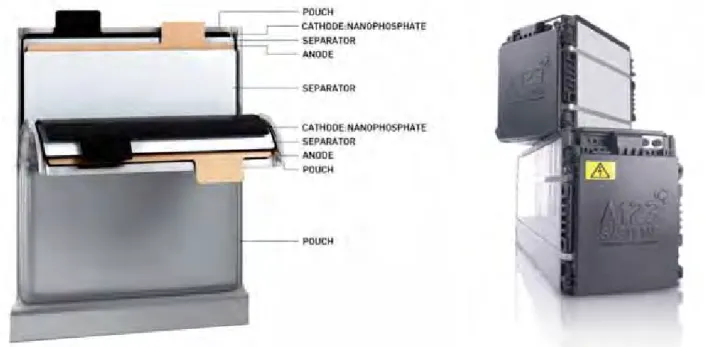
Lithium ion batteries (Figure 2-5) have become the most important storage technology in the areas of portable and mobile applications (e.g. laptop, cell phone, electric bicycle, electric car) since around 2000. High cell voltage levels of up to 3.7 nominal Volts mean that the number of cells in series with the associated connections and electronics can be reduced to obtain the target voltage. For example, one lithium ion cell can replace three NiCd or NiMH cells which have a cell voltage of only 1.2 Volts. Another advantage of Li-ion batteries is their high gravimetric energy density, and the prospect of large cost reductions through mass production. Although Li-ion batteries have a share of over 50 % in the small portable devices market, there are still some challenges for developing larger-scale Li-ion batteries. The main obstacle is the high cost of more than USD 600/kWh due to special packaging and internal overcharge protection circuits.
Lithium ion batteries generally have a very high effi ciency, typically in the range of 95 % - 98 %. Nearly any discharge time from seconds to weeks can be realized, which makes them a very fl exible and universal storage technology. Standard cells with 5 000 full cycles can be obtained on the market at short notice, but even higher cycle rates are possible after further development, mainly depending on the materials used for the electrodes. Since lithium ion batteries are currently still expensive, they can only compete with lead acid batteries in those applications which require short discharge times (e.g. as primary control backup). Safety is a serious issue in lithium ion battery technology. Most of the metal oxide electrodes
are thermally unstable and can decompose at elevated temperatures, releasing oxygen which can lead to a thermal runaway. To minimize this risk, lithium ion batteries are equipped with a monitoring unit to avoid charging and over-discharging. Usually a voltage balance circuit is also installed to monitor the voltage level of each individual cell and prevent voltage deviations among them. Lithium ion battery technology is still developing, and there is considerable potential for further progress. Research is focused on the development of cathode materials [etg08] [esp11]. Metal air battery (Me-air)
A metal air electrochemical cell consists of the anode made from pure metal and the cathode connected to an inexhaustible supply of air. For the electrochemical reaction only the oxygen in the air is used. Among the various metal air battery chemical couples, the lithium air battery is most attractive since its theoretical specifi c energy excluding oxygen (oxygen is not stored in the battery) is 11.14 kWh/kg, corresponding to about
100 times more than other battery types and even greater than petrol (10.15 kWh/kg). However, the high reactivity of lithium with air and humidity can cause fi re, which is a high safety risk.
Currently only a zinc air battery with a theoretical specific energy excluding oxygen of 1.35 kWh/ kg is technically feasible. Zinc air batteries have some properties of fuel cells and conventional batteries: the zinc is the fuel, the reaction rate can be controlled by varying air fl ow, and oxidized zinc/ electrolyte paste can be replaced with fresh paste. In the 1970s, the development of thin electrodes based on fuel-cell research made small button prismatic primary cells possible for hearing aids, pagers and medical devices, especially cardiac telemetry. Rechargeable zinc air cells have a diffi culty in design since zinc precipitation from the water-based electrolyte must be closely controlled. A satisfactory, electrically rechargeable metal air system potentially offers low materials cost and high specifi c energy, but none has reached marketability yet [wor02] [atw11].
Figure 2-5 | Typical Li-ion prismatic cell design and battery modules (A123, IEC MSB/EES Workshop, 2011)
Sodium sulphur battery (NaS)
Sodium sulphur batteries (Figure 2-6) consist of liquid (molten) sulphur at the positive electrode and liquid (molten) sodium at the negative electrode; the active materials are separated by a solid beta alumina ceramic electrolyte. The battery temperature is kept between 300 °C and 350 °C to keep the electrodes molten. NaS batteries reach typical life cycles of around 4 500 cycles and have a discharge time of 6.0 hours to 7.2 hours. They are effi cient (AC-based round-trip effi ciency is about 75 %) and have fast response.
These attributes enable NaS batteries to be economically used in combined power quality and time shift applications with high energy density. The NaS battery technology has been demonstrated at around 200 sites in Japan, mainly for peak shaving, and Germany, France, USA and UAE also have NaS batteries in operation. The main drawback is that to maintain operating temperatures a heat source is required, which uses the battery’s own stored energy, partially reducing the battery performance. In daily use the temperature of the battery can almost be maintained by just its own reaction heat, with
appropriately dimensioned insulation. Since around 1990 NaS batteries have been manufactured by one company in Japan, with a minimum module size of 50 kW and with typically 300 kWh to 360 kWh. It is not practical for the present to use only one isolated module. Because 20 modules are combined into one battery the minimal commercial power and energy range is on the order of 1 MW, and 6.0 MWh to 7.2 MWh. These batteries are suitable for applications with daily cycling. As the response time is in the range of milliseconds and NaS batteries meet the requirements for grid stabilization, this technology could be very interesting for utilities and large consumers [esp11] [kaw11].
Sodium nickel chloride battery (NaNiCl) The sodium nickel chloride (NaNiCl) battery, better known as the ZEBRA (Zero Emission Battery Research) battery, is – like the NaS battery – a high-temperature (HT) battery, and has been commercially available since about 1995. Its operating temperature is around 270 °C, and it uses nickel chloride instead of sulphur for the positive electrode. NaNiCl batteries can withstand limited overcharge and discharge and have potentially better safety characteristics and a
Gas Tight Seal
(TCB – thermal compression bonding) Insulator (alpha-Alumina) Sodium Safety Tube Beta-Alumina Sulfur Electrode Sulfur Housing (with corrosion protection layer) Main pole Main pole Thermal enclosure Thermal enclosure Cell
Figure 2-6 | NaS Battery: Cell design and 50 kW module (NGK, IEC MSB/EES Workshop 2011)
Battery Cell Sodium Na Sulfur S Beta Alumina tube – +
higher cell voltage than NaS batteries. They tend to develop low resistance when faults occur and this is why cell faults in serial connections only result in the loss of the voltage from one cell, instead of premature failure of the complete system. These batteries have been successfully implemented in several electric vehicle designs (Think City, Smart EV) and are an interesting opportunity for fl eet applications. Present research is in developing advanced versions of the ZEBRA battery with higher power densities for hybrid electric vehicles, and also high-energy versions for storing renewable energy for load-levelling and industrial applications [esp11].
2.3.2 Flow batteries
In conventional secondary batteries, the energy is charged and discharged in the active masses of the electrodes. A fl ow battery is also a rechargeable battery, but the energy is stored in one or more electroactive species which are dissolved in liquid electrolytes. The electrolytes are stored externally in tanks and pumped through the electrochemical cell that converts chemical energy directly to electricity and vice versa. The power is defi ned by the size and design of the electrochemical cell whereas the energy depends on the size of the tanks. With this characteristic fl ow batteries can be fi tted to a wide range of stationary applications. Originally developed by NASA in the early 70s as EES for long-term space fl ights, fl ow batteries are now receiving attention for storing energy for durations of hours or days with a power of up to several MW. Flow batteries are classifi ed into redox fl ow batteries and hybrid fl ow batteries.
Redox fl ow battery (RFB)
In redox flow batteries (RFB) two liquid electrolyte dissolutions containing dissolved metal ions as active masses are pumped to the opposite sides of the electrochemical cell. The electrolytes at the negative and positive electrodes are called anolyte and catholyte respectively. During charging and
discharging the metal ions stay dissolved in the fluid electrolyte as liquid; no phase change of these active masses takes place. Anolyte and catholyte flow through porous electrodes, separated by a membrane which allows protons to pass through it for the electron transfer process. During the exchange of charge a current flows over the electrodes, which can be used by a battery-powered device. During discharge the electrodes are continually supplied with the dissolved active masses from the tanks; once they are converted the resulting product is removed to the tank. Theoretically a RFB can be “recharged” within a few minutes by pumping out the discharged electrolyte and replacing it with recharged electrolyte. That is why redox fl ow batteries are under discussion for mobile applications. However, up to now the energy density of the electrolytes has been too low for electric vehicles.
Today various redox couples have been investigated and tested in RFBs, such as a Fe-Ti system, a Fe-Cr system and a polyS-Br system (Regenesys installation in UK with 15 MW and 120 MWh, but never commissioned) [jos09]. The vanadium redox flow battery (VRFB, Figure 2-7) has been developed the furthest; it has been piloted since around 2000 by companies such as Prudent Energy (CN) and Cellstrom (AU). The VRFB uses a V2+/V3+ redox couple as
oxidizing agent and a V5+/V4+ redox couple in
mild sulphuric acid solution as reducing agent. The main advantage of this battery is the use of ions of the same metal on both sides. Although crossing of metal ions over the membrane cannot be prevented completely (as is the case for every redox flow battery), in VRFBs the only result is a loss in energy. In other RFBs, which use ions of different metals, the crossover causes an irreversible degradation of the electrolytes and a loss in capacity. The VRFB was pioneered at the University of New South Wales, Australia, in the early 1980s. A VRFB storage system of up to 500 kW and 10 hrs has been installed in Japan
by SEI. SEI has also used a VRFB in power quality applications (e.g. 3 MW, 1.5 sec.).
Hybrid fl ow battery (HFB)
In a hybrid fl ow battery (HFB) one of the active masses is internally stored within the electrochemical cell, whereas the other remains in the liquid electrolyte and is stored externally in a tank. Therefore hybrid fl ow cells combine features of conventional secondary batteries and redox fl ow batteries: the capacity of the battery depends on the size of the electrochemical cell. Typical examples of a HFB are the Zn-Ce and the Zn-Br systems. In both cases the anolyte consists of an acid solution of Zn2+ ions. During charging Zn is deposited
at the electrode and at discharging Zn2+ goes
back into solution. As membrane a microporous polyolefi n material is used; most of the electrodes are carbon-plastic composites. Various companies are working on the commercialization of the Zn-Br hybrid fl ow battery, which was developed by Exxon
in the early 1970s. In the United States, ZBB Energy and Premium Power sell trailer-transportable Zn-Br systems with unit capacities of up to 1 MW/3 MWh for utility-scale applications [iee10]. 5 kW/20 kWh systems for community energy storage are in development as well.
2.4
Chemical energy storage
In this report chemical energy storage focuses on hydrogen and synthetic natural gas (SNG) as secondary energy carriers, since these could have a signifi cant impact on the storage of electrical energy in large quantities (see section 4.2.2). The main purpose of such a chemical energy storage system is to use “excess” electricity to produce hydrogen via water electrolysis. Once hydrogen is produced different ways are available for using it as an energy carrier, either as pure hydrogen or as SNG. Although the overall effi ciency of hydrogen and SNG is low compared to storage technologies such as PHS and Li-ion, Figure 2-7 | Schematic of a Vanadium Redox Flow Battery (Fraunhofer ISE)
chemical energy storage is the only concept which allows storage of large amounts of energy, up to the TWh range, and for greater periods of time – even as seasonal storage. Another advantage of hydrogen and SNG is that these universal energy carriers can be used in different sectors, such as transport, mobility, heating and the chemical industry.
2.4.1 Hydrogen (H2)
A typical hydrogen storage system consists of an electrolyzer, a hydrogen storage tank and a fuel cell. An electrolyzer is an electrochemical converter which splits water with the help of electricity into hydrogen and oxygen. It is an endothermal process, i.e. heat is required during the reaction. Hydrogen is stored under pressure in gas bottles or tanks, and this can be done practically for an unlimited time. To generate electricity, both gases fl ow into the fuel cell where an electrochemical reaction which is the reverse of water splitting takes place: hydrogen and oxygen react and produce water, heat is released and electricity is generated. For economic and practical reasons oxygen is not stored but vented to the atmosphere on electrolysis, and oxygen from the air is taken for the power generation. In addition to fuel cells, gas motors, gas turbines and combined cycles of gas and steam turbines are in discussion for power generation. Hydrogen systems with fuel cells (less than 1 MW) and gas motors (under 10 MW) can be adopted for combined heat and power generation in decentralized installations. Gas and steam turbines with up to several hundred MW could be used as peaking power plants. The overall AC-AC effi ciency is around 40 %. Different approaches exist to storing the hydrogen, either as a gas under high pressure, a liquid at very low temperature, adsorbed on metal hydrides or chemically bonded in complex hydrides. However, for stationary applications gaseous storage under
high pressure is the most popular choice. Smaller amounts of hydrogen can be stored in above-ground tanks or bottles under pressures up to 900 bar. For larger amounts of hydrogen, underground piping systems or even salt caverns with several 100 000 m³ volumes under pressures up to 200 bar can be used. Up to now there have not been any commercial hydrogen storage systems used for renewable energies. Various R&D projects carried out over the last 25 years have successfully demonstrated the feasibility of hydrogen technology, such as a project on the self-sufficient island of Utsira in Norway. Another example is a hybrid power plant from Enertrag in Germany which is currently under construction [ene11]. Wind energy is used to produce hydrogen via electrolysis if the power cannot be directly fed into the grid. On demand, the stored hydrogen is added to the biogas used to run a gas motor. Moreover the hydrogen produced will be used for a hydrogen refi lling station at the international airport in Berlin.
Water electrolysis plants on a large scale (up to 160 MW) are state-of-the-art for industrial applications; several were built in different locations (Norway, Egypt, Peru etc.) in the late 1990s.
2.4.2 Synthetic natural gas (SNG)
Synthesis of methane (also called synthetic natural gas, SNG) is the second option to store electricity as chemical energy. Here a second step is required beyond the water splitting process in an electrolyzer, a step in which hydrogen and carbon dioxide react to methane in a methanation reactor. As is the case for hydrogen, the SNG produced can be stored in pressure tanks, underground, or fed directly into the gas grid. Several CO2 sources are conceivable for the methanation process, such as fossil-fuelled power stations, industrial installations or biogas plants. To minimize losses in energy, transport of the gases CO2 (from the CO2 source) and H2 (from the electrolysis plant)
to the methanation plant should be avoided. The production of SNG is preferable at locations where CO2 and excess electricity are both available. In particular, the use of CO2 from biogas production processes is promising as it is a widely-used technology. Nevertheless, intermediate on-site storage of the gases is required, as the methanation is a constantly running process. Recently this concept “power to methane” has been the subject of different R&D projects (e.g. in Germany, where a pilot-scale production plant is under construction [kuh11]).
The main advantage of this approach is the use of an already existing gas grid infrastructure (e.g. in Europe). Pure hydrogen can be fed into the gas grid only up to a certain concentration, in order to keep the gas mixture within specifi cations (e.g. heating value). Moreover, methane has a higher energy density, and transport in pipelines requires less energy (higher density of the gas). The main disadvantage of SNG is the relatively low effi ciency
due to the conversion losses in electrolysis, methanation, storage, transport and the subsequent power generation. The overall AC-AC effi ciency, < 35 %, is even lower than with hydrogen [ste09]. A comprehensive overview of the combined use of hydrogen and SNG as chemical energy storage is shown in Figure 2-8 [wai11].
2.5
Electrical storage systems
2.5.1 Double-layer capacitors (DLC)Electrochemical double-layer capacitors (DLC), also known as supercapacitors, are a technology which has been known for 60 years. They fill the gap between classical capacitors used in electronics and general batteries, because of their nearly unlimited cycle stability as well as extremely high power capability and their many orders of magnitude higher energy storage capability when compared to traditional capacitors. This technology still exhibits a large Figure 2-8 | Overall concept for the use of hydrogen and SNG as energy carriers [wai11]
development potential that could lead to much greater capacitance and energy density than conventional capacitors, thus enabling compact designs.
The two main features are the extremely high capacitance values, of the order of many thousand farads, and the possibility of very fast charges and discharges due to extraordinarily low inner resistance which are features not available with conventional batteries.
Still other advantages are durability, high reliability, no maintenance, long lifetime and operation over a wide temperature range and in diverse environments (hot, cold and moist). The lifetime reaches one million cycles (or ten years of operation) without any degradation, except for the solvent used in the capacitors whose disadvantage is that it deteriorates in 5 or 6 years irrespective of the number of cycles. They are environmentally friendly and easily recycled or neutralized. The effi ciency is typically around 90 % and discharge times are in the range of seconds to hours.
They can reach a specifi c power density which is about ten times higher than that of conventional batteries (only very-high-power lithium batteries can reach nearly the same specifi c power density), but their specifi c energy density is about ten times lower.
Because of their properties, DLCs are suited especially to applications with a large number of short charge/discharge cycles, where their high performance characteristics can be used. DLCs are not suitable for the storage of energy over longer periods of time, because of their high self-discharge rate, their low energy density and high investment costs.
Since about 1980 they have been widely applied in consumer electronics and power electronics. A DLC is also ideally suited as a UPS to bridge short voltage failures. A new application could be the electric vehicle, where they could be used as
a buffer system for the acceleration process and regenerative braking [esp11].
2.5.2 Superconducting magnetic energy storage (SMES)
Superconducting magnetic energy storage (SMES) systems work according to an electrodynamic principle. The energy is stored in the magnetic fi eld created by the fl ow of direct current in a superconducting coil, which is kept below its superconducting critical temperature. 100 years ago at the discovery of superconductivity a temperature of about 4 °K was needed. Much research and some luck has now produced superconducting materials with higher critical temperatures. Today materials are available which can function at around 100 °K. The main component of this storage system is a coil made of superconducting material. Additional components include power conditioning equipment and a cryogenically cooled refrigeration system.
The main advantage of SMES is the very quick response time: the requested power is available almost instantaneously. Moreover the system is characterized by its high overall round-trip effi ciency (85 % - 90 %) and the very high power output which can be provided for a short period of time. There are no moving parts in the main portion of SMES, but the overall reliability depends crucially on the refrigeration system. In principle the energy can be stored indefi nitely as long as the cooling system is operational, but longer storage times are limited by the energy demand of the refrigeration system.
Large SMES systems with more than 10 MW power are mainly used in particle detectors for high-energy physics experiments and nuclear fusion. To date a few, rather small SMES products are commercially available; these are mainly used for power quality control in manufacturing plants such as microchip fabrication facilities [iea09].
2.6
Thermal storage systems
Thermal (energy) storage systems store available heat by different means in an insulated repository for later use in different industrial and residential applications, such as space heating or cooling, hot water production or electricity generation. Thermal storage systems are deployed to overcome the mismatch between demand and supply of thermal energy and thus they are important for the integration of renewable energy sources.
Thermal storage can be subdivided into different technologies: storage of sensible heat, storage of latent heat, and thermo-chemical ad- and absorption storage [sch08]. The storage of sensible heat is one of the best-known and most widespread technologies, with the domestic hot water tank as an example. The storage medium may be a liquid such as water or thermo-oil, or a solid such as concrete or the ground. Thermal energy is stored solely through a change of temperature of the storage medium. The capacity of a storage system is defi ned by the specifi c heat capacity and the mass of the medium used.
Latent heat storage is accomplished by using phase change materials (PCMs) as storage media. There are organic (paraffi ns) and inorganic PCMs (salt hydrates) available for such storage systems. Latent heat is the energy exchanged during a phase change such as the melting of ice. It is also called “hidden” heat, because there is no change of temperature during energy transfer. The best-known latent heat – or cold – storage method is the ice cooler, which uses ice in an insulated box or room to keep food cool during hot days. Currently most PCMs use the solid-liquid phase change, such as molten salts as a thermal storage medium for concentrated solar power (CSP) plants [iee08]. The advantage of latent heat storage is its capacity to store large amounts of energy in a small volume and with a minimal temperature change, which allows effi cient heat transfer.
Sorption (adsorption, absorption) storage systems work as thermo-chemical heat pumps under vacuum conditions and have a more complex design. Heat from a high-temperature source heats up an adsorbent (e.g. silica gel or zeolite), and vapour (working fl uid, e.g. water) is desorbed from this adsorbent and condensed in a condenser at low temperatures. The heat of condensation is withdrawn from the system. The dried adsorbent and the separated working fl uid can be stored as long as desired. During the discharging process the working fl uid takes up low-temperature heat in an evaporator. Subsequently, the vapour of the working fl uid adsorbs on the adsorbent and heat of adsorption is released at high temperatures [jäh06]. Depending on the adsorbent/working fl uid pair the temperature level of the released heat can be up to 200 °C [sch08] and the energy density is up to three times higher than that of sensible heat storage with water. However, sorption storage systems are more expensive due to their complexity.
In the context of EES, it is mainly sensible/latent heat storage systems which are important. CSP plants primarily produce heat, and this can be stored easily before conversion to electricity and thus provide dispatchable electrical energy. State-of-the-art technology is a two-tank system for solar tower plants, with one single molten salt as heat transfer fl uid and storage medium [tam06]. The molten salt is heated by solar radiation and then transported to the hot salt storage tank. To produce electricity the hot salt passes through a steam generator which powers a steam turbine. Subsequently, the cold salt (still molten) is stored in a second tank before it is pumped to the solar tower again. The main disadvantages are the risk of liquid salt freezing at low temperatures and the risk of salt decomposition at higher temperatures. In solar trough plants a dual-medium storage system with an intermediate oil/salt heat exchanger is preferred [tam06]. Typical salt mixtures such as Na-K-NO3 have freezing temperatures > 200 °C, and storage materials and containment require a higher
volume than storage systems for solar tower plants. The two-tank indirect system is being deployed in “Andasol 1-3”, three 50 MW parabolic trough plants in southern Spain, and is planned for Abengoa Solar’s 280 MW Solana plant in Arizona. Apart from sensible heat storage systems for CSP, latent heat storage is under development by a German-Spanish consortium – including DLR and Endesa – at Endesa’s Litoral Power Plant in Carboneras, Spain. The storage system at the pilot facility is based on sodium nitrate, has a capacity of 700 kWh and works at a temperature of 305 °C [csp11]. In adiabatic CAES the heat released during compression of the air may be stored in large solid or liquid sensible heat storage systems. Various R&D projects are exploring this technology [rwe11] [bul04], but so far there are no adiabatic CAES plants in operation. As solid materials concrete, cast iron or even a rock bed can be employed. For liquid systems different concepts with a combination of nitrate salts and oil are in discussion. The round-trip effi ciency is expected to be over 70 % [rad08]. Of particular relevance is whether a pressurized tank is needed for the thermal storage, or if a non-pressurized compartment can be used. In liquid systems, a heat exchanger can be used to avoid the need for a large pressurized tank for the liquid, but the heat exchanger means additional costs and increases the complexity. A dual-media approach (salt and oil) must be used to cover the temperature range from 50 °C to 650 °C [bul04]. Direct contact between the pressurized air and the storage medium in a solid thermal storage system has the advantage of a high surface area for heat transfer. The storage material is generally cheap, but the pressurized container costs are greater.
2.7
Standards for EES
For mature EES systems such as PHS, LA, NiCd, NiMH and Li-ion various IEC standards exist. The standards cover technical features, testing and system integration. For the other technologies
there are only a few standards, covering special topics. Up to now no general, technology-independent standard for EES integration into a utility or a stand-alone grid has been developed. A standard is planned for rechargeable batteries of any chemistry.
Standardization topics for EES include: terminology
basic characteristics of EES components and systems, especially defi nitions and measuring methods for comparison and technical evalu-ation
– capacity, power, discharge time, lifetime, standard EES unit sizes
communication between components – protocols, security
interconnection requirements
– power quality, voltage tolerances, frequency, synchronization, metering safety: electrical, mechanical, etc. testing
guides for implementation.
2.8
Technical comparison of EES
technologies
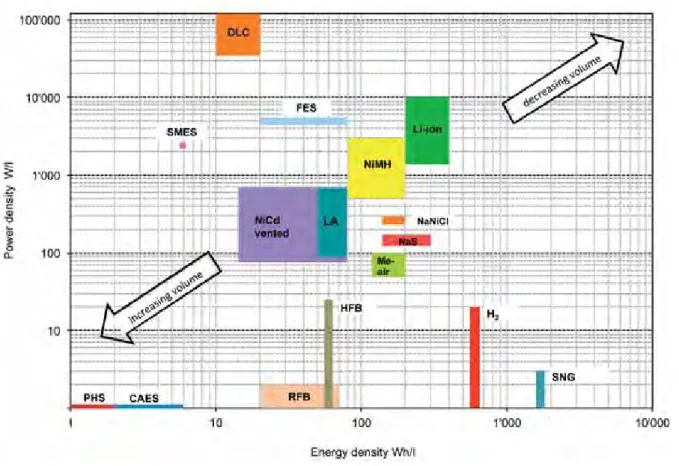
The previous sections have shown that a wide range of different technologies exists to store electrical energy. Different applications with different requirements demand different features from EES. Hence a comprehensive comparison and assessment of all storage technologies is rather ambitious, but in Figure 2-9 a general overview of EES is given. In this double-logarithmic chart the rated power (W) is plotted against the energy content (Wh) of EES systems. The nominal discharge time at rated power can also be seen, covering a range from seconds to months. Figure 2-9 comprises not only the application areas of today’s EES systems but also the predicted range in future applications.
Not all EES systems are commercially available in the ranges shown at present, but all are expected to become important. Most of the technologies could be implemented with even larger power output and energy capacity, as all systems have a modular design, or could at least be doubled (apart from PHS and some restrictions for underground storage of H2, SNG and CAES). If a larger power range or higher energy capacity is not realized, it will be mainly for economic reasons (cost per kW and cost per kWh, respectively).
On the basis of Figure 2-9 EES technologies can be categorized as being suitable for applications with:
Short discharge time (seconds to minutes): double-layer capacitors (DLC), superconducting magnetic energy storage (SMES) and fl ywheels (FES). The energy-to-power ratio is less than 1 (e.g. a capacity of less than 1 kWh for a system with a power of 1 kW).
Medium discharge time (minutes to hours): fl ywheel energy storage (FES) and – for larger capacities – electrochemical EES, which is the dominant technology: lead-acid (LA), Lithium ion (Li-ion) and sodium sulphur (NaS) batteries. The technical features of the different electrochemical techniques are relatively similar. They have advantages in the kW - MW and kWh - MWh range when compared to other technologies. Typical discharge times are up to several hours, with an energy-to-power ratio of between 1 and 10 (e.g. between 1 kWh and 10 kWh for a 1 kW system). Batteries can be tailored to the needs of an application: tradeoffs may be made for high energy or high power density, fast charging behaviour or long life, etc. Long discharge time (days to months):
hydrogen (H2) and synthetic natural gas (SNG). For these EES systems the energy-to-power ratio is considerably greater than 10.
Figure 2-9 | C omparison of rated power, energy content and discharge time of different EES technologies (Fraunhofer ISE)
![Figure 1-3 | Different uses of electrical energy storage in grids, depending on the frequency and duration of use [eus06]](https://thumb-us.123doks.com/thumbv2/123dok_us/1946225.2787594/13.892.178.715.765.987/figure-different-electrical-energy-storage-depending-frequency-duration.webp)
![Figure 2-3 | Underground CAES [rid11]](https://thumb-us.123doks.com/thumbv2/123dok_us/1946225.2787594/18.892.154.739.192.590/figure-underground-caes-rid.webp)