Zurich Open Repository and Archive University of Zurich Main Library Strickhofstrasse 39 CH-8057 Zurich www.zora.uzh.ch Year: 2018
Low skill products by high skill workers: the distributive effects of trade in developing countries
Menendez, Irene ; Owen, Erica ; Walter, Stefanie
Abstract: The canonical models of trade in the IPE literature predict that low skill workers are the primary beneficiaries of free trade in the developing world. But empirical evidence shows that high skill workers benefit from and support free trade more in these contexts. We argue that although developing countries have a comparative advantage in low skill products, these products are produced by workers that are highly skilled relative to the average worker in these countries. As a result, trade benefits relatively high skill workers, especially those exposed to trade. This explains why inequality is rising in these countries and why this group is most supportive of free trade. We illustrate some micro- and macro-level implications of our argument using cross-national survey data and aggregate data on trade and inequality. The findings have important implications for the political economy of trade in developing countries.
Posted at the Zurich Open Repository and Archive, University of Zurich ZORA URL: https://doi.org/10.5167/uzh-161811
Conference or Workshop Item Accepted Version
Originally published at:
Menendez, Irene; Owen, Erica; Walter, Stefanie (2018). Low skill products by high skill workers: the distributive effects of trade in developing countries. In: American Political Science Association. Annual Meeting, Boston, 30 August 2018 - 2 September 2018, online.
Low skill products by high skill workers:
The distributive effects of trade in emerging and developing countriesγ
Irene Menendez,* Erica Owen** and Stefanie Walter***
August 2018
The canonical models of trade in the IPE literature predict that low skill workers are the primary beneficiaries of free trade in the developing world. But empirical evidence shows that high skill workers benefit from and support free trade more in these contexts. We argue that although developing countries have a comparative advantage in low skill products, these products are produced by workers that are highly skilled relative to the average worker in these countries. As a result, trade benefits relatively high skill workers, especially those exposed to trade. This explains why inequality is rising in these countries and why this group is most supportive of free trade. We illustrate some micro- and macro-level implications of our argument using cross-national survey data and aggregate data on trade and inequality. The findings have important implications for the political economy of trade in developing countries.
γ This draft was prepared for APSA 2018. We thank Raymond Hicks, Peter Rosendorff, participants of EPSA
2018 and IPES 2017 for comments. *
Institute for Advanced Study in Toulouse, [email protected] **
University of Pittsburgh, [email protected] *** University of Zurich, [email protected]
Motivation
How does free trade affect workers in developing countries and emerging markets, and what does this mean for developing country politics? Most research on these issues, especially in political science, builds on the canonical factoral model of trade (also referred to as the Heckscher-Ohlin or Stolper-Samuelson models; for a review see for example Krugman & Obstfeld, 2009). This model argues that trade will benefit the abundant factor of production in an economy, and hurt the scarce factor of production. Because low-skilled labor is the abundant factor of production in developing countries, this model predicts that trade will predominantly benefit low-skilled workers, whereas high-skilled labor and capital will be harmed by international trade.1 As a result, trade is expected to reduce both poverty and inequality in developing countries.
Many arguments about the politics of trade in developing countries and developing country politics more generally build on this premise. For example, Milner and Kubota (2005) argue that democratization leads to trade liberalization in developing countries because it empowers labor, for whom trade liberalization is beneficial. Dutt and Mitra (2005) argue that in labor abundant developing countries, left governments will be more likely to liberalize trade because it benefits the majority of workers. And Boix (2003) argues that when labour-abundant economies open themselves up for trade, inequality decreases and democratization becomes more likely. More generally, the assumption that trade benefits workers and reduces inequality underpins arguments ranging from the politics of trade liberalization in developing countries (Dutt & Mitra, 2005; Milner & Kubota, 2005; Milner & Judkins, 2004; Milner & Mukherjee, 2018; Rogowski, 1989), over trade and redistribution (Bardhan et al., 2006), to the relationship between trade/globalization and regime type (Acemoglu & Robinson, 2006;
1
The exact expectations of HO depend on how factors of production are defined. The traditional model assumes two (or three) factors of production: labor, capital (and land). In this set-up, trade is expected to benefit labor in developing countries (e.g., Milner & Kubota, 2005), as well as land owners depending on context. Another set-up has three factors of production: high skill labor, low skill labor and capital. In this model, trade is expected to benefit low-skill labor in developing countries (e.g., Milner & Mukherjee, 2009). See Wood (1997) on the impact of number of factors and goods on relative wages.
Ahlquist & Wibbels, 2012; Boix, 2003; Kono, 2008; Mansfield et al., 2002; O’Rourke & Taylor, 2006; Rommel, 2018; Tavares, 2008).
The empirical evidence, however, gives rise to skepticism about the validity of the claim that trade reduces inequality in developing countries. Although there is ample empirical evidence that developing countries indeed specialize in products that have a low level of skill-intensity, such as textiles, low-technology manufacturing, or unrefined agricultural products (Balassa, 1979; Schott, 2003), the evidence also shows that international trade has increased income inequality within countries (Anderson, 2005; Lang & Tavares, 2018; Milanovic, 2005). Importantly, this is true not just in the developed world, as the factoral model would suggest, but also in developing countries (Goldberg & Pavcnik, 2004, 2007). A number of recent works have found that trade is associated with rising inequality (e.g., Ha, 2012; Helpman et al., 2017; Rudra & Tobin, 2017) and skill premiums (Acemoglu, 2003; Feenstra & Hanson, 1997; Robbins & Gindling, 1999) in developing countries. Likewise, a large body of survey research finds that contrary to the factoral model’s predictions, the well-educated in emerging markets and developing countries view free trade and investment significantly more favorably than the less-educated (Ardanaz et al., 2013; Beaulieu et al., 2005; Pandya, 2010;
Urbatsch, 2013).5 Rather than finding more support for free trade among the well-educated in
developed countries, and more support among the less well-educated in developing countries,
as the factoral model suggests, skilled workers in all countries are more likely to support
free trade (Margalit, 2012; Mayda & Rodrik, 2005).7
Because so many theoretical arguments about the effect of trade (and globalization more generally) on developing country politics builds on assumptions about the distributional
5 A number of arguments have been put forward for this finding, including the role of consumer interests (Baker, 2003, 2005), inequity aversion (Lü et al., 2012), or non-economic and cultural attitudes (Margalit, 2012; Spilker et al., 2016). Margalit (2012) concludes that the fact that survey data consistently reveals a pattern at odds with a factor-based explanation, means that the factoral model is insufficient for explaining variation in mass attitudes on trade openness.
7
However, Jäkel and Smolka (2013, 2017) do find support for factoral theories in a sample of developed and developing countries.
effects of trade, this contradiction between theoretical prediction and empirical evidence is no
trivial matter.8 To provide a better understanding of the distributional effects of international
trade in developing countries, our paper draws on new developments in international trade theory (Helpman et al., 2004a; Melitz, 2003) to address the puzzle that although developing countries specialize in “low-skill” products, the low-skilled in these countries do not disproportionally benefit from free trade. These models suggest that only productive firms are able to benefit from the opportunities that free international exchange offers – and that this
holds everywhere, irrespective of countries’ level of development.9 Because productive firms
tend to hire “high-quality” workers (Helpman et al., 2010), these models, usually referred to as “new new trade theory” (NNTT), suggest that free trade benefits these workers, at the expense of those workers who are not able to find jobs in productive, internationally competitive firms.10
We argue that this implies that more skilled, well-educated workers everywhere benefit more from free trade and globalization than less skilled, less-educated workers. However,
education levels11 (and therefore skill) have to be understood in relative terms: Someone who
is well-educated compared to the rest of the population in a developing country context, may not necessarily be considered well-educated in a developed country context. For example, someone who is able to read and write fluently may be in the upper half of the education distribution in a developing country, but the same skill, absent additional qualifications, would put that person in the lower half of the education distribution in a developed country. This explains why workers in developing countries, who are high-skilled in relative terms, often produce products that are considered low-skilled in absolute terms. Because NNTT
8
The factoral model is also inconsistent with other empirical regularities, such as the fact that workers with similar skills tend to receive higher wages when they work in exporting firms (Helpman et al., 2017; Munch & Skaksen, 2008).
9
Another set of relevant models focuses on vertical integration and fragmented production (Feenstra & Hanson, 1996; Grossman & Rossi-Hansberg, 2008).
10
For a review of these models and their implications for political economy research, see Kim and Osgood (2018).
11
Education levels are one aspect of skill. For a discussion of how to measure different factors of production, see Leamer (1984) and Midford (1993).
predicts aggregate utility gains of trade liberalization, our argument is consistent with the observation that poverty has often decreased in countries that have opened up their economies. However, because the already privileged classes, who tend to be better educated, disproportionally benefit from free trade, it suggests that inequality is higher in economically open economies.
The paper proceeds as follows: the next section lays out our argument that in order to understand both specialization and the distributional effects of trade in developing countries, we need to distinguish between absolute and relative skills. We then illustrate our argument. First, we show that relative skills matter on the micro-level by examining how relative skill shapes support for free trade. We then move to the macro-level and explore the impact of trade openness on inequality using cross-national data for developing countries. The conclusion discusses what our argument implies for political science research on the causes and consequences of globalization
Theoretical Argument
The factoral model implies that a country will have a comparative advantage in those products that are intensive in the use of the relatively abundant factors of production. This suggests that abundant countries will have a comparative advantage in capital-intensive goods, land-abundant countries will have a comparative advantage in land-capital-intensive goods and so on. Because in developing countries and, to a lesser extent, emerging markets, average education levels are significantly lower than in developed countries, low-skilled labor tends to be the abundant factor of production in these economies, which is why they
specialize in the production of less skill-intensive products.16 In contrast, developed countries
concentrate on the production of capital-intensive and/or skill intensive products, which rely on capital and highly-skilled labor, the abundant factor of production in developed countries.
These predictions have been validated by numerous studies – developed countries export more capital- and skill-intensive goods and import more low-skill products, whereas the opposite holds for developing countries (Schott, 2004).
Much of the existing literature takes the finding that developing countries have a comparative advantage in low-skilled products to imply that the low-skilled disproportionally benefit from free trade in these countries (Leamer, 1984; Midford, 1993; Rogowski, 1989). This leads to the optimistic prediction that free trade results both a reduction of poverty and in inequality in these countries. However, while there is considerable evidence that the rise in free trade has also coincided with an unprecedented reduction in poverty (Winters et al., 2004; Winters & Martuscelli, 2014),17 there is little evidence that trade reduces inequality. To the contrary, most studies on the subject find that trade increases inequality (Anderson, 2005; Lang & Tavares, 2018; Milanovic, 2005). This means that contrary to the factoral model’s predictions, those that are better off in the society benefit disproportionally from free trade, that the less privileged strata of society benefit less from (or are even hurt by) international trade than the better-off, or both.
Absolute vs. relative skills
We argue that in order to understand this apparent contradiction – that developing countries produce low-skill products, yet the low-skilled do not seem to benefit from free trade – we need to think about the concept of “skills” more carefully.
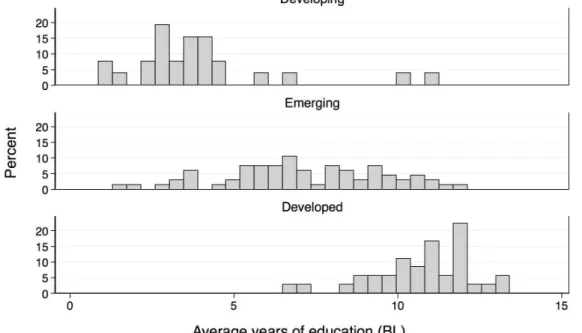
Figure 1 presents the distribution of average years of education for developing, emerging and developed countries. Based on the Barro and Lee (2013) dataset for 129 countries with a population greater than 500,000 in the year 2005, it shows the distribution of
17
Some research suggests that globalization, and specifically trade, leads to reductions in poverty only under certain conditions (Kosack & Tobin, 2015; Rudra & Tirone, 2017)
average years of schooling in each set of countries.18 Figure 1 demonstrates that the average skill level in developing countries is significantly lower than those for emerging markets, and especially developed countries. This is in line with the argument that developing countries will specialize in low-skill products. However, the evidence in this figure strongly suggests that what it means to be a skilled worker is likely to differ significantly in different types of countries.
Figure 1. Distribution of average years of schooling in 2005
We therefore introduce a conceptual distinction between absolute and relative
skill-levels. Absolute skill-levels refer to how skilled a person is overall, irrespective of where he or she lives, or how many other people have these skills. All university graduates are highly skilled in this definition, and everyone who has completed only primary school is low-skilled in absolute terms. Absolute skills can thus be placed on a universal scale that is the same irrespective of context.
18
In this graph developing countries are those with a GDP per capita below $875, emerging markets are those countries with a GDP per capita between $876 and $10,725, and developed countries have a GDP per capita greater than $10,275. This is based on the classification of the World Bank for the year 2005.
However, we argue that we need to consider relative skills to gauge the distributive
effects of international trade. Relative skill-level, in contrast to absolute skills, takes context
into account. It denotes a person’s skill level relative to the skill-level of the person’s peers, for example everyone living in the same country. Whereas all university graduates are likely to be on the higher end of the skill-distribution, for example, they are particularly highly skilled in contexts where few people attend university, and less high-skilled in relative terms in which a high number of people not only have a university degree, but also a Ph.D. Likewise, a person who has only completed primary school will be at the bottom of the national skill distribution in countries in which secondary school is mandatory, but will be places higher up in the skill distribution in countries where only few people complete primary school and a majority cannot read or write. In short, what it means to be skilled depends on the context.
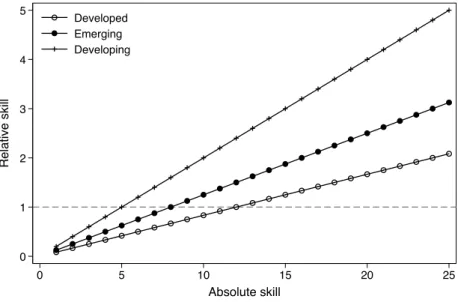
Figure 2. Hypothetical comparison of relative and absolute skills
To illustrate this point, we graph relative versus absolute skill for hypothetical individuals in three countries in Figure 2. Absolute skill is measured using years of education and relative skill is equal to years of education divided by the country average. We present hypothetical measures of relative skill for an individual in a developed, emerging, and
0 1 2 3 4 5 R e la ti ve ski ll 0 5 10 15 20 25 Absolute skill Developed Emerging Developing
developing country, which have an average of approximately 12, 8 and 5 years of schooling respectively (Barro & Lee, 2013). What Figure 2 demonstrates is that an individual with 10 years of schooling, will have dramatically different relative skill depending on which country he or she is in.
Skills, comparative advantage, and the distributive effects of trade
What does this mean for countries’ comparative advantage and the distributive effects of trade? In the aggregate, the absolute skill level of a country’s workers matter for countries’ factor endowments, which in turn determine countries’ comparative advantage and production pattern (Heckscher & Ohlin, 1991). In absolute terms, for example, developed countries tend to have more workers who are high-skilled, because the average worker in a developed country has received more education than the average worker in a developed country. Countries in which a majority of workers has high skills in absolute terms, will specialize in intensive products, whereas countries in which a majority of workers has absolute skill-levels at the lower end of the universal skill-scale, will specialize in less skill-intensive products. Absolute skills thus determine the kind of products that are being produced, as predicted by the Heckscher-Ohlin model. In other words, comparative advantage is determined by the relative abundance of workers of a particular skill level.
Absolute skill levels tell us less about who will benefit and who will be hurt by free trade, however. Although “low-skill” products are typically produced by workers with low skill-levels in absolute terms, they are not necessarily low-skilled relative to other workers in their country. In relative terms, the skill-level of workers performing the same task or producing the same product differs across countries. For example, assembly line work that produces a low-skill intensive product in a developed country will likely be performed by workers who are relatively low-skilled compared with all workers in that country. However, assembly-line workers who perform the exact same task and produce the same low-skill
intensive product are likely to be relatively more skilled in the context of a developing country: Working in transnational factories often requires an ability to read and write, and possibly even to speak English, which is much rarer in a developing country such as Bangladesh or Nigeria than in a developed country such as Germany or the UK. Assembly-line workers or call center workers thus tend to be more high-skilled in relative terms in developing countries than in developed countries. Because the overall distribution of skills varies across developed and developing countries, “low-skill products” that would be produced by low-skilled workers in developed countries are actually produced by people who are relatively high-skilled in comparison to the vast majority of people in that country (see also Feenstra & Hanson, 1996).
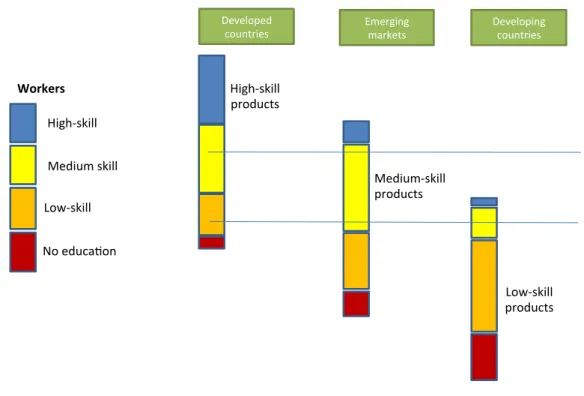
Figure 3: Absolute and relative skills and production patterns in developed countries, emerging markets, and developing countries
Figure 3 illustrates this point in a stylized manner. It shows that the skills necessary for carrying out a certain task or producing a certain product that would be low skill in a developed country are likely to be medium-high skill in developing countries relative to the entire population. Put differently, a person with 10 years of education (less than high school)
Developed% countries% Emerging% markets% Developing% countries% High;skill%% Medium%skill% Low;skill% No%educa,on% High;skill% products% Medium;skill% products% Low;skill% products% Workers'
in a developed country will be relatively low-skill, while a person with 10 years of education in a developing country will have completed primary and some secondary schooling, making that person relatively higher skill.
What explains this relative-skill premium? The trade literature offers a number of alternative mechanisms, all of which suggest that trade liberalization will increase demand for relatively more highly skilled workers. This includes arguments on trade-induced (Acemoglu) or offshoring-induced (Feenstra & Hanson, 1996, 1999) skill-biased technological change. Another mechanism is suggested by new new trade theory, which holds that the most productive firms benefit from free trade, irrespective of the country’s factor endowments (Helpman et al., 2004b; Melitz, 2003). These export-oriented firms employ predominantly “high ability” workers (Helpman et al., 2010). This implies that on average, those working in export-oriented firms should be better educated than workers in the nontradables sector or workers in import-competing firms, and that they also receive higher wages. This is consistent with empirical evidence that foreign-owned firms in developing countries tend to pay higher wages than domestic firms (Brown et al., 2004; Graham, 2000), and that this wage-premium is higher for better educated workers (Lipsey & Sjöholm, 2004). It is also consistent with the finding that after significant trade liberalization reforms in Mexico, employment shifted from skilled to unskilled intensive sectors (as predicted by Mexico’s comparative advantage in low-skilled labor in absolute terms), but that each sector at the same time increased its relative share of skilled labor – relatively high-skilled workers who then produced low-skill products (Gonzaga et al., 2006).
Of course, these firms, who tend to produce and export low-skilled products, will often not only employ workers who are high-skilled in relative terms, but also some workers that are high-skilled in absolute terms (for example managers or developers). But the key point is that on average, the winners from free trade and globalization in a developing country are likely to be high-skilled in relation to the average worker in their country.
At the same time, new new trade theory also predicts that not all relatively skilled workers will benefit equally from free trade. Rather, as in developed countries, this skill-premium will be concentrated among those workers that are actually exposed to the global production networks that free trade offers (Helpman et al., 2017; Rommel & Walter, 2018; Walter, 2017).
Implications for the political economy of trade
Overall, our argument is that in developing countries, low-skill products, that is products with a low skill-intensity, are produced by workers that are relatively high-skilled compared to the country’s overall skill distribution. The difference in overall skill levels across countries thus explains both why developing countries specialize in products with a low-level of skill-intensive – because of their lower level of education in absolute terms – and why it is the better educated, relatively high-skill workers that tend to benefit most from and therefore most strongly support free trade. Our argument suggests that rather than benefitting unskilled workers most, international trade predominantly benefits the relatively skilled, more
educated, workers in both developing and developed countries.20 Other than assumed by the
factoral model, the high-skilled in developing countries are not doing worse when living in an open economy, and trade liberalization does not equalize incomes within a society, but tends to exacerbate existing inequality.
This has a number of implications for the political economy of trade and research on developing country politics more generally. On the micro-level, we should expect the relatively higher skilled – the more privileged parts of society – to benefit more from trade (in terms of wages/income) and to be more supportive of trade liberalization than lower skilled citizens. This is in line with the ample evidence produced by survey research that more
20
Note that we are not suggesting that low or no-skill workers are harmed by trade. Indeed, they could still find themselves better off through the channel of consumer interests.
skilled individuals in developing countries show more support for trade liberalization than less skilled individuals (e.g., Ardanaz et al., 2013; Margalit, 2012; Mayda & Rodrik, 2005; Pandya, 2010). But it contradicts the premises of some prominent works on the effects of trade and economic globalization on regime stability in developing countries (e.g., Acemoglu & Robinson, 2006; Boix, 2003), and on the effect of democratization on trade policy (e.g., Milner & Kubota, 2005).21 Our argument thus also has more far-reaching implications for macro-level arguments.
The remainder of this paper explores two of these implications empirically in an effort to illustrate the relevance of our argument.
At the micro-level, we expect that those who are more skilled in relative terms are more likely to benefit from trade and thus are more likely to support free trade. Moreover, we expect this effect to increase the more exposed respondents are to trade and exports, in particular. At the macro-level, our argument implies that trade will lead to greater inequality in developing countries, and that this effect should be due to increasing exposure to exports, rather than openness to trade more generally.
Micro-level evidence: Support for trade
To look at attitudes toward free trade, we primarily rely on the PEW Global Attitudes Project (GAP) and the 2013 International Social Survey Program (ISSP). This allows us to get variety in terms of the developing countries in our sample and also allows for variation in question wording and potential control variables. We focus on results from PEW because of the greater number of developing countries. The 2014 PEW GAP includes 33 developing and emerging markets, respectively. We consider developing and emerging countries to be those with a
21
In fact, recent research shows that FDI can stabilize autocratic regimes precisely because it benefits the middle class in developing countries (Rommel, 2018).
GDP per capita below $15,000.23 We supplement with the ISSP because it offers additional control variables.
First, we present descriptive evidence on the difference between skill and relative skill. Our primary measure of relative skill is equal to an individual’s years of education divided by the average years of education in the individual’s country. Data on years of education are
reported in the survey and country-averages are taken from Barro and Lee (2010).24 This
measure of relative skill has a very intuitive meaning: individuals with a score above 1 are relatively skilled compared to the average individual in their country, and those with a score below 1 are relatively less skilled compared to the average individual in their country.
In Figure 4, we present individuals’ relative skill versus absolute skill from the 2014 wave of the PEW GAP. We separate countries by income level based on World Bank income group classifications. The dashed lines at 10 years of schooling and a relative skill score of 1 are included to facilitate comparison across country groups. Figure 4 clearly demonstrates that 10 years of schooling in developing (i.e. low and lower-middle income) countries represents someone who is relatively skilled, whereas in the high-income group (developed countries), a person with 10 years of schooling would be less skilled relative to other workers in his/her country. In other words, Figure 4 illustrates the presence of substantial differences in skill level in relative terms across countries, and suggests the importance of thinking of skill in relative terms, as suggested by our theory. Additionally, Figure 4 suggests that there is a great deal of heterogeneity in relative versus absolute skill, especially in the lower- and upper-middle income groups.
Figure 4. Relative vs. Absolute Skill in the 2014 PEW sample
23
Argentina, Bangladesh, Brazil, Chile, China, Colombia, Egypt, El Salvador, Ghana, India, Indonesia, Jordan, Kenya, Lebanon, Malaysia, Mexico, Nicaragua, Nigeria, Pakistan, Peru, Philippines, Poland, Russia, Senegal, South Africa, Tanzania, Thailand, Tunisia, Turkey, Uganda, Ukraine, Venezuela, Vietnam.
One limitation of the above measure is that it defines relative skill in terms of the average citizen in a country (one data point), rather than considering the entire distribution of skill in a country. Therefore, we consider two further measures of relative skill.
Relative skill 2 is calculated as the percent of workers in a country j that respondent i is more skilled than using the most recent data from the International Labor Organization (ILO) prior to the survey year. This is based on four categories of education from the ILO:
less than basic, basic, intermediate and advanced.25 Thus, for an individual with a less than
basic education, Relative skill 2 is coded as zero. For an individual with a basic education, Relative skill 2 is equal to the percent of the labor force in country j with a less than basic education; for an individual with an intermediate education, Relative skill 2 is equal to the percent of the labor force with a basic or less than basic education, and so on. Because ILO data is available for a smaller number of countries, the sample using Relative skill 2 has only
25
The less than basic category includes those with no schooling or incomplete primary education; the basic category is complete primary and incomplete secondary; the intermediate category includes upper secondary and incomplete higher education. Advanced is complete higher education. Based on classification in the ILO: https://www.ilo.org/ilostat-files/Documents/description_EDU_EN.pdf
25 countries.
Our third measure of relative skill is a percentile ranking of skill level based on sample characteristics. To compute Relative skill 3, we rank all the respondents in a country based on years of education and compute the percentile ranking of skill for the individual. Thus, an individual with a relative skill score of 60 percent is more skilled than 60 percent of respondents in the sample in their country. The advantage of this measure is that it is more fine-grained relative to the measure based on the ILO data. The disadvantage of this measure is that it is based on the sample in the survey, which is more educated relative to the population of every country (calculated by comparing mean years of education in sample to mean years in Barro and Lee). However, for our purposes, this biases against finding evidence in favor of our hypothesis as it flattens the distribution of relative skill.
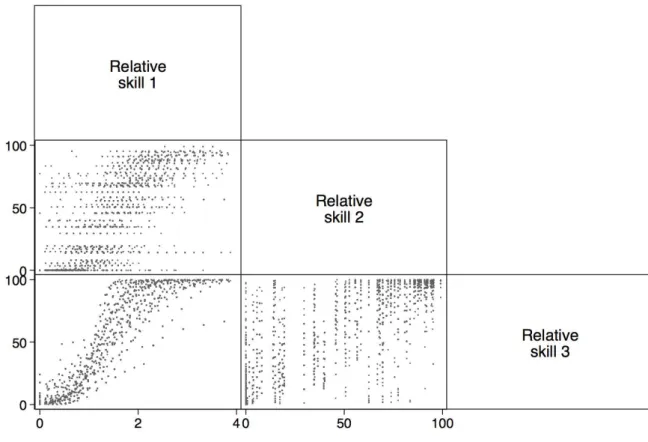
Figure 5 presents the correlation matrix for the three measures of relative skill in the
PEW data.26 The correlation between Relative skill 1 and 2 is 0.77, between Relative skill 1
and 3 is 0.83, and between Relative skill 2 and 3 is 0.77.
26
We remove 204 observations that have a relative skill 1 score above 4 (Nigeria – 6 observations, Pakistan – 6 observations, Senegal – 184 observations, and Uganda – 8 observations). 99 percent of the sample has a relative skill 1 score of 3.86 or less. We do this to facilitate presentation and to eliminate potential outliers. The results remain robust if these observations are included.
Figure 5. Scatterplot matrix of measures of relative skill: PEW 2014
To test our theory, we examine whether those who are relatively skilled are more likely to support free trade, and whether this effect is greater among workers that are more exposed to trade.
Our dependent variable is a binary variable coded one for those respondents who support free trade. Support for free trade is based on the question: “What do you think about
the growing trade and business ties between (survey country) and other countries – do you
think it is a very good thing, somewhat good, somewhat bad or a very bad thing for our country?” Other studies that have utilized this question include Jäkel and Smolka (Jäkel & Smolka, 2017). Respondents who said “very good” or “somewhat good” are coded as one, those who respond somewhat bad or very bad are coded as zero. 86.8 percent of respondents in the estimation sample support free trade.
Our primary independent variable is the measure of relative skill. To test our theory, we also need to measure exposure to trade, specifically exports. The absence of information
on individual sector of employment make it difficult to match information on trade exposure at the individual level. Thus we interact relative skill with country-level exports as a percent of GDP. We focus on exports, rather than trade openness in general, because exports are the channel through which relatively skilled workers benefit more. If our theory is correct, the effect of relative skill on support for free trade should be larger among countries that export as a larger portion of the economy.
The advantage of PEW is that it includes a diverse group of countries in terms of region and development levels. The limitation of PEW is that the survey contains few control variables compared to other surveys commonly used to analyze attitudes toward trade. We
control for Age. We include dummy variables equal to one for those who are unemployed
(Unemployed), one for women (Female), and a dummy variable equal to one for those who
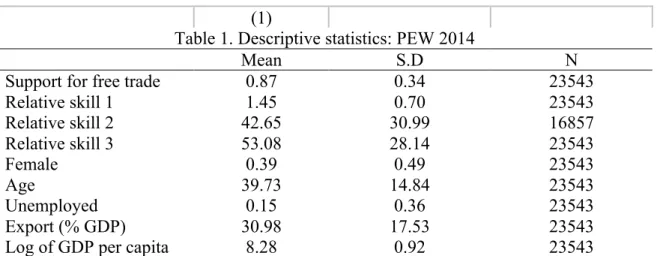
indicate belief in a free market economy (Belief in market).27 Descriptive statistics are
presented in Table 1.
We estimate a multilevel model to account for the fact that individuals are nested within countries. Thus we include random effects by country. This specification takes into consideration the fact that individuals in the same country share a common background and
likely are not independent. We also include survey weights to account for sampling.28 Thus,
for individual i in country j, our specification is:
Pr !=1 =!!+!!!"#$%&'"!"#$!!"+!!!"#$%&!!+!!!!"#$%&!!"#$!!" ×!"#$%&!!+!!!"# +!!!"#$%"+!!!"#$%&'(#)+!!!"##!"#$%&+!!!"#!"#!"#!"#$%!!
+!!!+!!"
If our argument is correct, the coefficient on the interaction term, Β4, should be
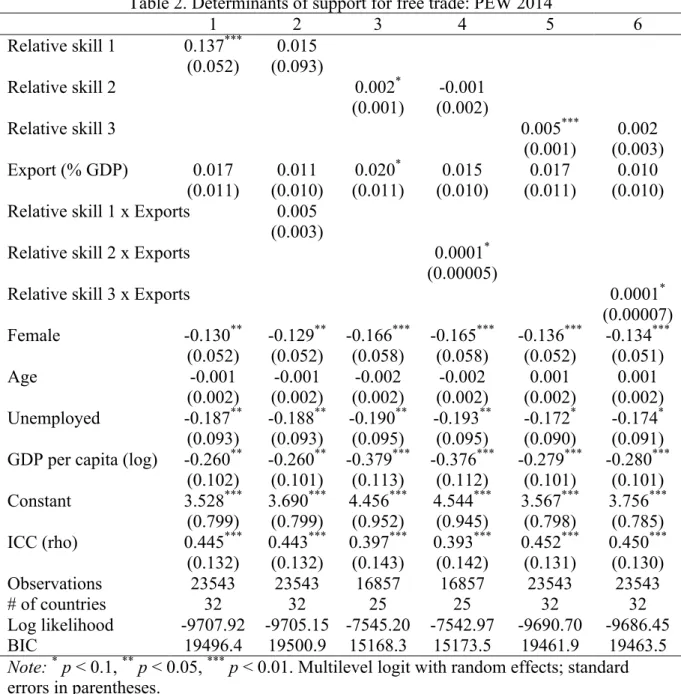
positive and different from zero.29 The results are presented in Table 2. For each measure of
27
For instance, Mansfield et. al (2014) find that belief in a market economy generates greater support for free trade. Those who agree with the statement “Most people are better off in a free market economy, even though some people are rich and some are poor” are coded as one.
28
We use the melogit command in stata with probability weights. 29 Zu represents country-specific random effects.
relative skill, we first present the unconditional model and then the interactive model. In the unconditional models, the coefficient on relative skill is positive and statistically significant for all three measures (Models 1, 3 and 5). This suggests that those who are relatively skilled are more likely to support free trade, as suggested by our argument.
(1)
Table 1. Descriptive statistics: PEW 2014
Mean S.D N
Support for free trade 0.87 0.34 23543
Relative skill 1 1.45 0.70 23543 Relative skill 2 42.65 30.99 16857 Relative skill 3 53.08 28.14 23543 Female 0.39 0.49 23543 Age 39.73 14.84 23543 Unemployed 0.15 0.36 23543 Export (% GDP) 30.98 17.53 23543
Log of GDP per capita 8.28 0.92 23543
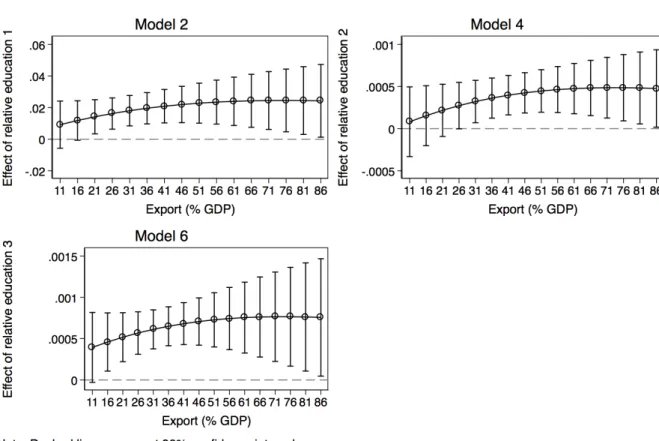
Our argument further suggests that the effect of relative skill should be greater as exposure to exports increases. In other words, the coefficient on the interaction between exports and relative skill should be positive. In all three interactive models, the coefficient on exports is positive. It is statistically significant in Models 4 and 6. We present the marginal effects plots of relative skill, conditional on exports, for each model in Figure 6. In the sample, exports as a percent of GDP range from 11.0% (Brazil) to 86.4% (Vietnam). The level of exports by country is presented in the Appendix Figure A1.
Table 2. Determinants of support for free trade: PEW 2014 1 2 3 4 5 6 Relative skill 1 0.137*** 0.015 (0.052) (0.093) Relative skill 2 0.002* -0.001 (0.001) (0.002) Relative skill 3 0.005*** 0.002 (0.001) (0.003) Export (% GDP) 0.017 0.011 0.020* 0.015 0.017 0.010 (0.011) (0.010) (0.011) (0.010) (0.011) (0.010)
Relative skill 1 x Exports 0.005
(0.003)
Relative skill 2 x Exports 0.0001*
(0.00005)
Relative skill 3 x Exports 0.0001*
(0.00007) Female -0.130** -0.129** -0.166*** -0.165*** -0.136*** -0.134*** (0.052) (0.052) (0.058) (0.058) (0.052) (0.051) Age -0.001 -0.001 -0.002 -0.002 0.001 0.001 (0.002) (0.002) (0.002) (0.002) (0.002) (0.002) Unemployed -0.187** -0.188** -0.190** -0.193** -0.172* -0.174* (0.093) (0.093) (0.095) (0.095) (0.090) (0.091)
GDP per capita (log) -0.260** -0.260** -0.379*** -0.376*** -0.279*** -0.280***
(0.102) (0.101) (0.113) (0.112) (0.101) (0.101) Constant 3.528*** 3.690*** 4.456*** 4.544*** 3.567*** 3.756*** (0.799) (0.799) (0.952) (0.945) (0.798) (0.785) ICC (rho) 0.445*** 0.443*** 0.397*** 0.393*** 0.452*** 0.450*** (0.132) (0.132) (0.143) (0.142) (0.131) (0.130) Observations 23543 23543 16857 16857 23543 23543 # of countries 32 32 25 25 32 32 Log likelihood -9707.92 -9705.15 -7545.20 -7542.97 -9690.70 -9686.45 BIC 19496.4 19500.9 15168.3 15173.5 19461.9 19463.5
Note: *p < 0.1, **p < 0.05, ***p < 0.01. Multilevel logit with random effects; standard errors in parentheses.
The marginal effect of relative skill is generally increasing across the level of exports. At low levels of exposure to exports, the effect of relative skill is not different from zero, but as exports increase, the effect becomes more positive. This initial evidence is suggestive of support for our argument. However, given the general higher level of support for free trade on this particular item, there is less room to improve predictive accuracy and thus the substantive effects are somewhat muted.
Figure 6. Marginal effect of relative education conditional on exports: PEW 2014
To probe the robustness of our claim, we also illustrate our argument using
data from the 2013 National Identity wave of the ISSP.30 The ISSP contains a smaller set of
emerging markets, and this set in general has higher income per capita than those in the PEW sample. As above, we define emerging and developing countries as those with a GDP per
capita below %15,000.31 We again use a dummy variable to measure support for free trade.
The ISSP asks: “Do you agree that the country should limit imports to protect jobs?” Those who disagree with the statement are coded as 1 and those who agree are coded as 0. In this sample, the level of support for free trade is only 16.4 percent. Thus question wording appears to matter a great deal between the ISSP and PEW, and suggests very different levels of
overall support for free trade in developing and emerging countries. In the ISSP, we are able
30
The countries are: Croatia, Georgia, Hungary, India, Latvia, Lithuania, Mexico, Philippines, Russia, South Africa and Turkey.
31
Note we are unable to compute Relative skill 2 for over half the sample due to missing data and thus we do not present results for that model.
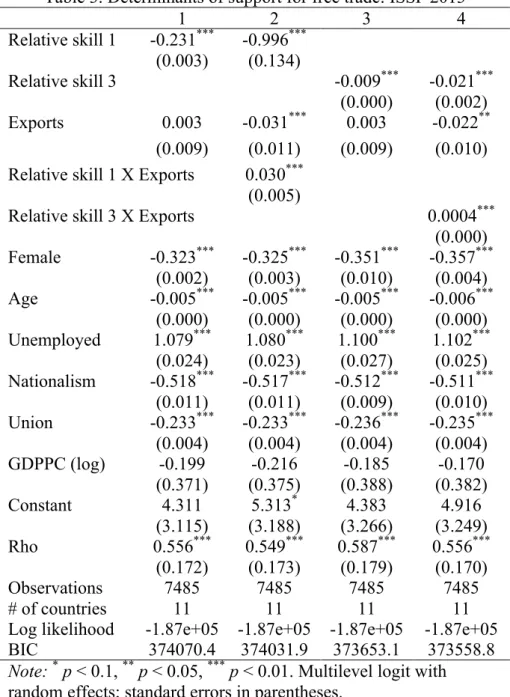
to control for nationalist sentiment (e.g. Mansfield and Mutz 2009). The results are presented in Table 3. Even in the smaller sample, we generally find evidence in support of our
hypothesis, though there are some caveats.
Table 3. Determinants of support for free trade: ISSP 2013
1 2 3 4 Relative skill 1 -0.231*** -0.996*** (0.003) (0.134) Relative skill 3 -0.009*** -0.021*** (0.000) (0.002) Exports 0.003 -0.031*** 0.003 -0.022** (0.009) (0.011) (0.009) (0.010)
Relative skill 1 X Exports 0.030***
(0.005)
Relative skill 3 X Exports 0.0004***
(0.000) Female -0.323*** -0.325*** -0.351*** -0.357*** (0.002) (0.003) (0.010) (0.004) Age -0.005*** -0.005*** -0.005*** -0.006*** (0.000) (0.000) (0.000) (0.000) Unemployed 1.079*** 1.080*** 1.100*** 1.102*** (0.024) (0.023) (0.027) (0.025) Nationalism -0.518*** -0.517*** -0.512*** -0.511*** (0.011) (0.011) (0.009) (0.010) Union -0.233*** -0.233*** -0.236*** -0.235*** (0.004) (0.004) (0.004) (0.004) GDPPC (log) -0.199 -0.216 -0.185 -0.170 (0.371) (0.375) (0.388) (0.382) Constant 4.311 5.313* 4.383 4.916 (3.115) (3.188) (3.266) (3.249) Rho 0.556*** 0.549*** 0.587*** 0.556*** (0.172) (0.173) (0.179) (0.170) Observations 7485 7485 7485 7485 # of countries 11 11 11 11
Log likelihood -1.87e+05 -1.87e+05 -1.87e+05 -1.87e+05
BIC 374070.4 374031.9 373653.1 373558.8
Note: *p < 0.1, **p < 0.05, ***p < 0.01. Multilevel logit with random effects; standard errors in parentheses.
The most notable difference between the ISSP and PEW results is that in the unconditional model (Models 1 and 3) the coefficient on relative skill is negative and
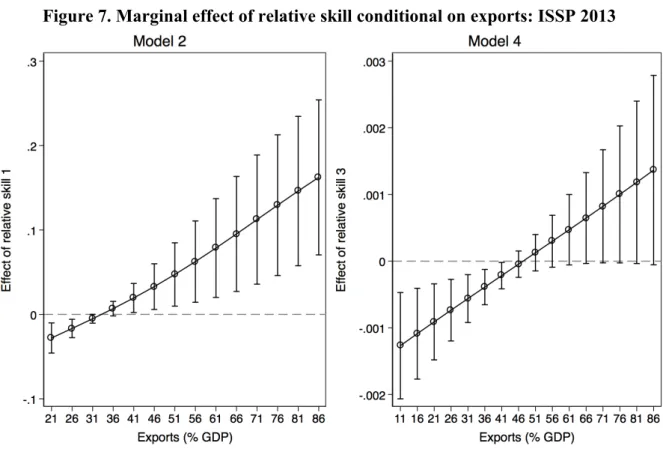
statistically significant. This is contrary to our expectations, but the difference may be explained by the variation levels of support for free trade across the two surveys. However, in line with our theory, the interactive model sheds a positive and statistically significant coefficient. The marginal effects plots are presented in Figure 7. In Model 2, the marginal effect of Relative skill 1 is increasing in the level of exports, and is positive and different from zero at medium to high levels of exports. Thus, at medium to high levels of exports, the effect of increasing relative skill it terms of years relative to the mean, leads to an increased probability of support for free trade. In Model 4, at low levels of exposure to exports, the effect of relative skill is negative, while at medium to high levels of support, the effect is not different from zero.
Figure 7. Marginal effect of relative skill conditional on exports: ISSP 2013
On the macro-level, we examine how changes in openness are related to changes in inequality in a sample of developing economies. We use aggregate data assembled from over 70 developing countries from 1960 to 2016. The Standardized World Income Inequality Database (SWIID) provides estimates of LIS-comparable Gini indices of net and market
inequality for a large sample of developed and developing countries (Solt, 2009).32 The data
focus primarily on the decades spanning 1970-2010, during which many developing countries underwent significant trade liberalization that increased their exposure to global markets (Goldberg & Pavcnik, 2007).
Dependent and independent variables
We rely on two dependent variables to test the above claims. A first dependent variable is an estimate of market income inequality. Specifically, we use the Gini index of pre-tax and transfer inequality made available by the SWIID that covers 45 countries from 1960 to 2016. Our argument has implications for inequality of pay among workers employed in the manufacturing (tradable) sector.33 Given this, the measure of market inequality best approximates our theoretical concerns. Coverage of developing countries using the measure of market inequality, however, is considerably reduced. To maximize coverage of developing countries, a second dependent variable is a measure of inequality of net (disposable) income. This variable covers 73 developing countries over the same time period.
Measuring inequality for cross national and over time analysis is notoriously difficult, because available data are typically not comparable due to underlying differences in parameters (population covered, geography, employment status) or the welfare definition used (market income or consumption). While existing datasets address this issue in different ways,
32
In essence, it pools together a number of available datasets (including major cross-national inequality databases, national statistical offices and scholarly articles) and uses the LIS data – arguably the golden standard in cross-national research – as baseline to which other datasets are standardized.
33
Using measures of wage inequality comes at the cost of lower comparability and coverage – particularly acute in developing countries.
the SWIID uses available information from a number of sources to apply multiple imputation to compute estimates for missing country-year observations. Thus these data provide better coverage and more comparable data than most other datasets. Given the limitations associated with measuring inequality in developing countries, this is particularly important for our purposes.
Our argument implies that levels of income inequality should increase with trade openness. We measure exposure to international competition using a measure of
manufactured exports as a percentage of merchandise exports.34 This captures the bulk of
manufacturing across most countries – and developing countries in particular – and comprises commodities in the Standard International Trade Classification (SITC) sections 5 (chemicals), 6 (basic manufactures), 7 (machinery and transport equipment), and 8 (miscellaneous manufactured goods), excluding division 68 (non-ferrous metals). Because developing countries tend to export agricultural products, we include measures of trade in food and agriculture to address the possibility that our mechanism works in sectors beyond
manufacturing.35 Because exports and imports are highly correlated, we also include a
measure of manufactured imports. Data are available from the World Development Indicators (WDI). Although extensively used in the literature, measures of trade volume (imports and exports as a % of GDP) conflate the effect of imports and exports, as well as the effects of trade in goods and services, both of which may operate differently in the context of
developing countries. Nonetheless, we include a measure of trade volume to account for the
possibility that trade in sectors other than manufacturing is driving the results.
The measure of trade (export) exposure closely speaks to our theoretical argument. In most developing countries, the manufacturing (tradable) sector is low-skill (and thus reflects comparative advantage). According to our argument, low-skill exports in developing
34
For presentational purposes, the measure is divided by 100 and thus rescaled as a fraction of GDP. 35
Food exports/imports comprise commodities in SITC sections 0 (food and live animals), 1 (beverages and tobacco), and 4 (animal and vegetable oils and fats) and SITC division 22 (oil seeds, oil nuts, and oil kernels).
countries are being produced by relatively high-skill workers. This implies that exports in manufacturing, in particular, should be positively associated with levels of income inequality in developing countries.
We include a number of controls, including a binary indicator for whether a country is democratic (above a Polity value of 6), the log of GDP per capita to control for differences in levels of development, and measures of GDP and population growth. For the net income inequality analysis, we also include a number of political variables to account for the effect of political institutions on redistribution, including whether the government is left-leaning (Huber & Stephens, 2012; Levitsky & Roberts, 2011) and whether representatives are elected according to proportional representation or plurality (Iversen & Soskice, 2006). We deliberately refrain from including a large number of controls at this stage, as our purposes are mainly illustrative.
Empirical method
The above argument implies that trade exposure increases inequality in developing countries. We classify countries by income group (based on the World Bank classification), and group
low-income, low-middle, and upper-middle-income countries as developing.36 This broad
sample makes it possible to maximize variation within developing countries, where economic and political data are limited.
We estimate a linear model that tests the effect of increased exposure on income inequality across our sample of developing economies. Our baseline specification includes
36
For the market income inequality analysis, developing countries include Brazil, China, Colombia, Dominican Republic, Egypt, Georgia, Guatemala, India, Mexico, Panama, Paraguay, Peru, Romania, Serbia, South Africa. For the net income inequality analysis, the sample includes Albania, Algeria, Angola, Argentina, Bangladesh, Belize, Bolivia, Botswana, Brazil, Bulgaria, Burkina Faso, Cabo Verde, Cambodia, Central African Republic, China, Colombia, Congo, Costa Rica, Croatia, Dominican Republic, Ecuador, El Salvador, Fiji, Georgia, Ghana, Grenada, Guatemala, Guinea Bissau, Guyana, Honduras, India, Jamaica, Kazakhstan, Kyrgyzstan, Lebanon, Lesotho, Macedonia, Madagascar, Malawi, Mali, Mauritius, Mexico, Moldova, Mozambique, Namibia, Nepal, Nicaragua, Niger, Nigeria, Pakistan, Panama, Papua New Guinea, Paraguay, Peru, Philippines, Romania, Russia, Saint Lucia, Samoa, Senegal, Sierra Leone, South Africa, Sri Lanka, Tajikistan, Tanzania, Thailand, Tunisia, Turkey, Turkmenistan, Ukraine, Vanuatu, Vietnam, Zambia.
country fixed effects and a set of control variables. We lag all independent variables by one year in order to account for the wage stickiness and other labor market frictions that
characterize wage negotiations.37 Given the propensity for cycles and macroeconomic
volatility in the developing world, we also include period effects in subsequent specifications to control for common shocks.
Thus we estimate a fixed effects time-series cross-sectional model that exploits the within country correlation between trade and inequality. This is appropriate for both theoretical and empirical reasons. In line with the theory, the test is concerned with how within-country changes in trade exposure in developing economies in past decades affect changes in market inequality. Although inequality moves slowly over time, a large share of
the variation in inequality is temporal rather than cross-sectional.38 Empirically, the FE
specification focuses on within country variation to rule out unobserved heterogeneity as well as potential omitted variable bias within countries. This largely addresses the endogeneity of trade. Countries that open to trade may be different than others in terms of institutions, norms and culture. Countries with corporatist regimes that foster wage compression (Katzenstein, 1985) or those that can credibly promise compensation (Adserà & Boix, 2002) may, for example, be more likely to liberalize.
We employ clustered standard errors that are robust to serial correlation. Researchers using cross-sectional data over time face serial correlation problems. Employing clustered standard errors addresses this problem, although too few clusters (our measure of market inequality limits our sample of developing countries to 15) can lead to biased standard errors (Angrist & Pischke, 2008: 293-325). The issue of what number of clusters is critical for inference is as yet unclear (Angrist & Pischke, 2008: 319-24), and existing evidence also
37
Particularly in developing countries, where labor market regulations are on average stronger than in developed economies (Djankov et al., 2002). MOSLEY?
38
Regressing our DV on a set of country dummies shows that a large part of variation (over 80%) is not explained by between-country differences.
finds that clustered standard errors are reasonably good at correcting for serial correlation in panels even when the number of clusters is low (Hansen 2007).
Results
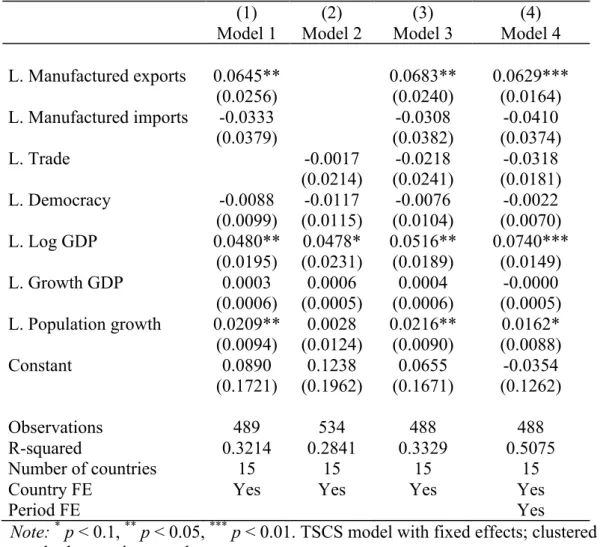
Table 4 shows the estimates of the effect of our measure of trade exposure on market
income inequality. Model 1 reports our main results using Manufactured exports (and
imports). In line with our theory, the findings in model 1 indicate that the effect of Manufactured exports is positive and statistically significant, indicating that all else equal, increasing manufactures exports are positively related to market income inequality in developing countries.
Model 2 reports estimates of the effect of trade volume. In line with factoral models, the coefficient of trade volume is negative (but not statistically significant). Model 3 adds trade volume to the basic specification. In line with expectations, Manufactured exports sheds a positive and statistically significant coefficient (not so Trade Volume), while manufactured imports appears to be negatively related with market income inequality. Model 4 adds period effects to control for the role of common shocks, and shows that results are unchanged.
The substantive effect of increasing manufactured exports is considerably large. Based on results from model 4, a 1 unit increase in manufactured exports increases inequality by about 2 gini points. This effect is equivalent to about 25% of 1 standard deviation of market income inequality, and amounts to about half the increase in market income inequality in the
US between 1980-1990.39
Control variables behave largely as expected. Logged GDP is positively related with market income inequality, while GDP growth and population growth are both positively
39
For presentational purposes, Manufactured exports is scaled as a fraction of gdp, so that a unit increase amounts to an increase of 1-100.
related. Democracy is negatively associated with market income inequality, though not significant.
Table 4. Effect of trade exposure on market income inequality in developing countries.
(1) (2) (3) (4)
Model 1 Model 2 Model 3 Model 4
L. Manufactured exports 0.0645** 0.0683** 0.0629*** (0.0256) (0.0240) (0.0164) L. Manufactured imports -0.0333 -0.0308 -0.0410 (0.0379) (0.0382) (0.0374) L. Trade -0.0017 -0.0218 -0.0318 (0.0214) (0.0241) (0.0181) L. Democracy -0.0088 -0.0117 -0.0076 -0.0022 (0.0099) (0.0115) (0.0104) (0.0070) L. Log GDP 0.0480** 0.0478* 0.0516** 0.0740*** (0.0195) (0.0231) (0.0189) (0.0149) L. Growth GDP 0.0003 0.0006 0.0004 -0.0000 (0.0006) (0.0005) (0.0006) (0.0005) L. Population growth 0.0209** 0.0028 0.0216** 0.0162* (0.0094) (0.0124) (0.0090) (0.0088) Constant 0.0890 0.1238 0.0655 -0.0354 (0.1721) (0.1962) (0.1671) (0.1262) Observations 489 534 488 488 R-squared 0.3214 0.2841 0.3329 0.5075 Number of countries 15 15 15 15
Country FE Yes Yes Yes Yes
Period FE Yes
Note: *p < 0.1, **p < 0.05, ***p < 0.01. TSCS model with fixed effects; clustered standard errors in parentheses.
Table 5 presents findings using the measure of net income inequality, which considerably expands coverage of developing countries. Overall, the results are qualitatively similar, and show that manufactured exports yield a positive and statistically significant
coefficient across all specifications. Manufactured Exports is thus associated across
developing countries with increased net inequality. Imports appear to be positively related to net income inequality, though this effect turns negative when including period fixed effects. Model 2 shows that – as with market income inequality – the effect of trade volume on disposable income inequality is negative (though not statistically significant). Note also that
we control for government ideology and electoral rule, both important determinants of inequality. In line with existing arguments, both Left leaning governments and proportional representation are associated with decreasing levels of net income inequality.40 The results hold when period effects are included in model 4. The substantive effect is somewhat reduced, but still large. A 1 unit increase in manufactured exports leads to an increase of about 1 gini point, or over 10% of 1 standard deviation of net income inequality.
Table 5. Effect of trade exposure on disposable income inequality in developing countries.
(1) (2) (3) (4)
Model 1 Model 2 Model 3 Model 4
L. Manufactured exports 0.0367** 0.0398** 0.0322** (0.0166) (0.0168) (0.0156) L Manufactured imports 0.0091 0.0060 -0.0132 (0.0226) (0.0227) (0.0203) L. Trade -0.0058 -0.0202 -0.0212 (0.0091) (0.0153) (0.0132) L. Democracy -0.0077 -0.0087 -0.0071 -0.0033 (0.0058) (0.0061) (0.0055) (0.0040) L. PR -0.0000*** -0.0000 -0.0000* -0.0000 (0.0000) (0.0000) (0.0000) (0.0000) L. Ideology (Left) -0.0102* -0.0108* -0.0100* -0.0061 (0.0061) (0.0059) (0.0057) (0.0043) L. Log GDP 0.0286 0.0408** 0.0327 0.0629*** (0.0196) (0.0200) (0.0208) (0.0195) L. Growth GDP -0.0001 0.0000 0.0000 -0.0003 (0.0002) (0.0002) (0.0002) (0.0002) L. Population growth -0.0022 -0.0038 -0.0023 -0.0037 (0.0039) (0.0036) (0.0039) (0.0033) Constant 0.2118 0.1477 0.1932 -0.0127 (0.1483) (0.1543) (0.1549) (0.1401) Observations 1,054 1,244 1,040 1,040 R-squared 0.2014 0.2071 0.2074 0.3613 Number of countries 73 78 73 73
Country FE Yes Yes Yes Yes
Period FE Yes
Note: *p < 0.1, **p < 0.05, ***p < 0.01. TSCS model with fixed effects; clustered standard errors in parentheses.
40
In tests not reported here, we include measures of exports in food products, which constitute an important share of exports in many developing countries. Mirroring results in model 1, the coefficient on Food Exports is positive and statistically significant, indicating that increases in food exports drive increases in market income inequality over time. Moreover, the effect of Manufactured Exports on inequality becomes stronger.
To better illustrate our results, Figure 8 plots changes in inequality in response to our measure of manufactured exports across our sample of developing countries, based on residualized regressions (from models 3 in Tables 4 and 5) that partial out the effect of within-country observables, such as political or economic institutions. Consistent with expectations, Figure 8 shows that the relationship between manufactured exports and inequality is positive across both measures. Although not causal, our results rule out a number of important factors that might be driving changes in inequality within countries.
Figure 8. Relationship between manufactured exports and (a) market and (b) net income inequality in developing economies, 1960-2015.
Our purpose here is to provide illustrative evidence on our macro-level implication that complements the evidence at the micro-level. Consistent with expectations, the findings show that trade – in the form of manufactured exports – and inequality move together within our sample of developing countries over time.
Concerns may of course arise with respect to the exogeneity of trade. While ruling out all sources of endogeneity bias with non-experimental data is difficult, our approach rules out all alternative explanations based on time-invariant country characteristics and common time shocks, as well as important time-varying factors identified in the literature. In principle, it is possible to instrument openness with a variable that is correlated with trade liberalization but is not correlated with the processes that lead to greater inequality. Yet in practice the task is difficult, because many features of trade are likely to be correlated with features that drive inequality.41
In addition, one might be worried that other reforms that came with structural change (not just trade) in most developing countries also drive inequality. One way of addressing this would involve exploiting the timing of reforms in developing countries to identify the effect of trade, because most developing countries opened to trade in the period 1970-1990, and subsequently liberalized capital accounts (Goldberg & Pavcnik, 2007). A more direct way of addressing this would control for the different features of liberalization. Giuliano et al. (2013) provide measures of regulation in a number of sectors (including domestic financial, capital account, electricity and communications, agriculture, trade (tariffs) and current account transactions) in a large number of developing countries. We hope to be able to incorporate such data in order to better identify the effect of trade.
Conclusions
In this paper, we argue that in order to understand the politics of trade in developing countries, we must think about what it means to be a skilled worker in different contexts. In particular, we offer an argument of distributional consequences in which relatively skilled workers in emerging and developing countries benefit from free trade, contrary to the
41
Limitations of the IV strategy include strong assumptions on the exclusion restriction. Moreover, instrumenting for trade using spatial instruments (Autor, Lang and Tavares) may work less well for comparative settings (PSRM paper).
predictions of the factor model. We argue that less developed countries specialize in low skill products, but these products are produced by workers that are relatively high-skilled when compared to a given country’s overall skill distribution. This raises demand for such high-skilled workers and drives levels of inequality within countries. Our theory can help explain two key puzzles from the factor-based perspective: (1) evidence that more skilled workers in developing countries are more likely to support free trade and (2) trade has led to rising inequality in developing countries.
To examine the plausibility of our argument, we use cross-sectional survey and aggregate data for emerging and developing countries to illustrate one micro and one macrolevel implication of our argument. First, we demonstrate using PEW data, and to a lesser extent ISSP data, that relatively skilled workers are more likely to support free trade, and this effect larger in countries that export more (as a percent of GDP). Second, we illustrate using two measures of inequality, that exports specifically are the channel through which trade leads to higher inequality in developing and emerging countries.
By distinguishing between absolute and relative skill levels across countries, our argument and findings help explain both why developing countries specialize in low-skill products and why it is the better educated that benefit most from economic globalization in both developing and developed countries, ultimately driving levels of inequality.
Like most research on trade and inequality in developing countries, our analysis is limited by the fact that our outcomes of interest (at both micro- and macro-levels) are available for a limited sample of developing countries. Thus our findings should be seen as a first step in a broader agenda that seeks to shed light on the links between trade and inequality in emerging and developing countries. In addition, a further implication of our argument is that the effect of skill on support for free trade should be particularly pronounced among individuals that are directly exposed to the international economy in their workplace. In future research, we hope to be able to draw on data that increases our coverage of developing countries and which
provides information on individual sector of employment in comparable fashion. We also need to explore additional sources of data on attitudes toward trade in developing countries in order to get more coverage in terms of countries and in terms of types of questions.
Of course trade is not the only channel through which inequality is rising in both developed and developing countries. Additional aspects of globalization, including fragmented production and offshoring also benefit relatively skilled workers in all countries, to say nothing of the impact of skill-biased technological change, which can also increase skill premiums and inequality. Because our paper focuses on the canonical model of Heckscher-Ohlin, we emphasize the trade channel.
We conclude by spelling out some broader implications of our research. An important literature in international political economy predicts that skill-level should be negatively (positively) correlated with support for free trade in skill-scarce (skill-abundant) countries. In turn, trade should reduce inequality in skill-scarce developing countries, as the relative abundance of low-skill workers increases demand for less-skilled workers. Although other factors (such as skill-biased technological change and fragmented production) certainly matter, the relative distribution of skills across countries is likely to be an important factor that deserves more attention than it has received in the literature in international political economy. Although preliminary, our findings suggest that the relationship between skill-level and demand for free trade in developing (and developed) economies should be assessed in relative terms.
Our findings have implications for macro-level political economy. Existing work has emphasized how democratic institutions (Kono, 2006; Milner & Kubota, 2005; Milner & Mukherjee, 2009; Tavares, 2008) and partisanship of government (Dutt & Mitra, 2005; Milner & Judkins, 2004) affect the aggregation of preferences, and thus policy outcomes over trade. More recently, Hicks, Milner and Tingley (2014) identify a role for party elites to shape
preferences and thus votes in a referendum on CAFTA-DR. A next step in this project to consider how our argument about relative skills changes expectations about the politics of trade in emerging and developing countries.