Options-based negotiation management of PPP-BOT infrastructure projects
Meghdad Attarzadeh, Ph.D.1*; David K.H. Chua, Ph.D.2; Michael Beer, Dr.-Ing.3; Ernest L SAbbott, Ph.D.4
Abstract
The success of PPP-BOT projects largely depends on effectively mitigating the impact of a variety of risks and uncertainties, especially those influencing the revenue over time. Revenue instability is one of the main obstacles of PPP form of procurement. Government support, which is established as a clause in the concession agreement, should be carefully designed and well formulated. Options which arise from certain clauses in the contract are more valuable for risky projects. The purpose of this paper’s proposed model is to evaluate early fund generation options and also to calculate equitable bounds for a guaranteed revenue for the project sponsor under uncertainty and risk. The model is specially designed to alleviate the concern of revenue risk. To illustrate its applicability the methodology is then applied to a freeway PPP project and a power plant PPP project in Iran. The results show that the value of these options can indeed be significant and by applying the proposed systematic negotiation mechanism both public and private sectors can take advantage of its flexibility at the negotiation table. The proposed mechanisms can facilitate negotiations on the verge of a break down as well as accelerating ongoing negotiations that have become moribund.
1 *Corresponding author, Former Research Scholar, Department of Civil and Environmental Engineering, National
University of Singapore (NUS), No.1 Engineering Drive 2, Singapore 117576; Research Fellow, School of Civil and Environmental Engineering, Nanyang Technological University (NTU), N1-01a-29, 50 Nanyang Avenue, Singapore 639798, Phone: (65) 83436549, E-mail: [email protected], [email protected]
2 Professor, Department of Civil and Environmental Engineering, National University of Singapore (NUS), No.1
Engineering Drive 2, Singapore 117576. E-mail: [email protected]
3 Professor and Head, Institute for Risk and Reliability, Leibniz Universität Hannover, Germany, Institute for Risk
and Uncertainty, University of Liverpool, UK, International Joint Research Center for Engineering Reliability and Stochastic Mechanics (ERSM), Tongji University, Shanghai, China, E-mail: [email protected]
4 Research Fellow, Department of Civil and Environmental Engineering, National University of Singapore (NUS), 10
Page | 1
Options-Based Negotiation Management of PPP-BOT Infrastructure Projects
Abstract
The success of PPP-BOT projects largely depends on effectively mitigating the impact of a variety of risks and uncertainties, especially those influencing the revenue over time. Revenue instability is one of the main obstacles of PPP form of procurement. Government support, which is established as a clause in the concession agreement, should be carefully designed and well formulated. Options which arise from certain clauses in the contract are more valuable for risky projects. The purpose of this paper’s proposed model is to evaluate early fund generation options and also to calculate equitable bounds for a guaranteed revenue for the project sponsor under uncertainty and risk. The model is specially designed to alleviate the concern of revenue risk. To illustrate its applicability the methodology is then applied to a freeway PPP project and a power plant PPP project in Iran. The results show that the value of these options can indeed be significant and by applying the proposed systematic negotiation mechanism both public and private sectors can take advantage of its flexibility at the negotiation table. The proposed mechanisms can facilitate negotiations on the verge of a break down as well as accelerating ongoing negotiations that have become moribund.
Introduction on Government Support
For Public Private Partnership (PPP)-Build Operate Transfer (BOT) projects, the majority of funding will come from banks and financial institutions in the form of loan capital. In this case, the project revenue will be used to reimburse loans, finance maintenance and operational costs. Thus the project promoters are concerned not only with the expected future income but also with the
Page | 2
risk factors influencing the revenue over time. The higher the risk and uncertainty of the revenue and profit, the higher the return required (Ye and Tiong, 2000). The success of PPP-BOT projects largely depends upon effectively mitigating the impacts of a variety of risks and uncertainties. Moreover, since the debt repayments depend on the ability of the project to generate cash flows, lenders are also concerned with the financial performance of the project. They are unwilling to lend unless the majority of the risks involved in the project life-cycle are adequately addressed (specifically the revenue risk). Their goal is to find a balance between the degree of secured debt and the interest rate.
Revenue instability and cash flow volatility, which derive from revenue uncertainty, are the most frequently cited obstacles of PPP-BOT arrangements (Ye and Tiong, 2000; Attarzadeh, 2007). Shortfall in government support, good cash flows with reasonable returns, and predictable risk scenarios have been identified as main reasons of recent PPP-BOT project failures (Kumaraswamy and Morris, 2002; Carbonara et al., 2014a). Project pro forma cash flow is more sensitive to revenue instability and high revenue instability would generate unpredictability. Quantity of production is important cause of revenue instability and cash flow volatility (Attarzadeh, 2014). This effectively highlights the importance of mechanisms aimed at providing flexibility in addressing financial risks associated with revenue instability and managing revenue risk. With a reduced financial cost, the concessionaire has a greater willingness to invest which may result in a lower tariff for the end user. It also increases the bidders’ competitiveness in the tender process.
In practice (Zhang, 2005; Tiong et al., 1992), PPP-BOT projects are more likely to fail in the development phase than in the other phases. Due to the high risk and uncertainty in some of these projects, there is little common ground for negotiations to arrive at an amiable position. In
Page | 3
such circumstance the government is pushed to take up more risks of the project so that the private sector can afford a better expected return. Thus, government support plays an important role in risk-return trade-off and project success. Since each party of a PPP-BOT project has its own objectives and concerns, each has a different risk-return trade-off analysis. However, the design of government support is still an open issue and a hot topic for research. It is difficult to assess and provide the appropriate level of government support especially under uncertainties and risks.
In addition to cash subsidies, there are a number of government support initiatives that could be offered to concessionaire, each with its own characteristics. These may be classified broadly into two categories: guarantee support and financial and incentives support. There are several types of support that fall under the rubric ‘guarantee support’. These include, inter alia, equity, debt, exchange rate, minimum demand, minimum revenue (MRG), tariff/toll and maximum interest rate guarantees. Similarly, ‘financial and incentive supports’ include direct capital contributions (e.g. grants, subordinated loans (extra loan), debt and equity investment), shadow toll/tariff, concession period extension, revenue enhancements, reduction of front-end cost, free use of project site and associated facilities, preferential tax incentives (e.g. tax breaks, tax exemption for a certain number of years), comfort letter, interest-free financing, option to defer, to abandon, to alter, to switch and the growth option (Vassallo, 2006; Brandão and Saraiva, 2008; Carbonara et al., 2014b; Attarzadeh, 2014).
The major objective of financial and incentives support from government is to directly improve the financial conditions of private investors through reduction in the private investment amount. The major side effect of the guarantee support and financial and incentives support is to reduce the perception of risk for financial institutions, which, in turn, reduces the financial cost
Page | 4
of the project (Fishbein and Babbar, 1996; Attarzadeh, 2014). Effectively, these mechanisms should reduce the cash flow volatility, add flexibility to the project and allow for better management of the concession items which are subject to risks and uncertainties. The effectiveness of these mechanisms is one of the main concerns of existing studies (Ford et al., 2002; Galera and Solino, 2010; Sun and Zhang, 2015). Additionally, a PPP-BOT contract could be designed, by government supports and incentives, to induce the promoter firm to invest in the best quality and achieve best efficiency. Host governments must be able to identify when to offer incentives for PPP-BOT projects. The support should be consistent with the projects’ viability to increase the private sector’s participation and motivation. One or more forms of government support is applicable under limited circumstances and could contribute to fend off project bankruptcy (Ho and Liu, 2002; Ye and Tiong, 2000). As can be seen, the guarantees and financial and incentives supports provided by government are represented as risk mitigation strategies and mechanisms to infrastructure concessions. Such government guarantees can reduce project risks and uncertainties and therefore increases the project’s value. However, they create an uncertain future commitment for the government, which is not free of cost. A study shows that guarantee costs can average as much as a third of the amount guaranteed (Lewis and Mody, 1998). The cost of the guarantees must be estimated and compared with the equivalent subsidies in order to ascertain which of the approaches are more effective in reducing the project risk and uncertainty.
In some circumstances, even when a project is expected to be entirely profitable, the project sponsors may encounter a lack of available fund in the ramp-up phase in order to service loans and cover the O&M costs. In such cases, the project sponsors are looking for the most cost-effective option available for revenue generation to meet the cash obligations and effectively reduce
long-Page | 5
term costs. Nevertheless, planning for this option must be done carefully to avoid revenue instability issues at the early stage of the project’s operation and effectively cover revenue shortfalls. The concession agreement, therefore, needs to be regulated for the early stages of operation phase in order to yield the necessary revenue for full cost recovery of operation and maintenance expenditures and debt services. However, very few researchers have proposed a reasonable way to control the revenue instability and cash flow volatility, specifically in the ramp-up phase of PPP-BOT projects.
The MRG put options have been studied as a way to manage the revenue risk and also guarantees a minimum level of revenue. The key limitations of this method are its requirement for the concessionaire to assume a risk premium which it is probable unwilling to do and MRG put options as a contract’s contingent clauses does not create symmetric payoffs for parties involved in the project. This support and incentive scheme enhances the cash flow to Project Company by limiting the downside. However, in order to avoid giving away too much to the concessionaire, the host government would also attempt to counterbalance the grant by introducing additional repayment obligations, such as demanding a reduction and placement of a cap on the tariff/toll rates to benefit the end user. Alternatively, the government could seek additional revenue by imposing higher taxes on the concessionaire or even call for direct participation as a sharing mechanism in the upside of the project returns. Therefore, during the negotiation stage with investors, the host government should seek agreement on the equitable amount of MRG once such scenario takes place. This is similar to the hedging feature of real options (RO). Thus these supports and repayments could be formulated as options that the government provides for Project Company by real options valuation and analysis (ROV/ROA) (Hemming, 2006; Chiara et al., 2007).
Page | 6
Significance of Research and Contribution to the Body of Knowledge
The methodology developed in this paper contributes to the literature in two main aspects: First, this study proposes the early fund generation (EFG) option and presents a means for valuing of EFG option as an incentive to offset construction acceleration by concessionaire. Under the conditions of revenue instability during the early stage of project operation, the situation can be improved through a mechanism that permits the project company to generate fund from the project operation as early as possible instead of short-term borrowings. This will allow the project company to continue to operate as it is receiving a steady income. The purpose of EFG option is to raise the necessary funds for the project by delivering project’s services/products at the earlier possible time which lead to reduce the revenue risk in the ramp-up phase. Specifically, this option could be applied in the first years of operation where operating revenues are not sufficient to meet the debt service obligations and O&M costs.
Second, this study proposes guaranteed upper and lower bound of revenue (MinMax-GR) option as a revenue risk management model for PPP-BOT projects based on the options strategy. This is as a means to hedge against the risk of revenue uncertainty in PPP-BOT projects and enhance project’s financial viability. It provides a framework for the concessionaire to share a certain percentage of losses in a form of win-win solution, i.e. the government captures a portion of the income when the concessionaire’s revenue exceeds certain levels. In particular, a procedure is proposed to calculate equitable bound for a guaranteed revenue (GR) for project sponsor under uncertainties and risks. It includes a method to determine a fair value as maximum GR against the predetermined minimum GR, which contributes to estimate max guaranteed equity rate of return, i.e. the value of the call option equals the value of the put option. By adopting this option, it is possible to limit the revenue risk to a certain range through introducing an upper and lower bound
Page | 7
for revenue. MinMax-GR option is a combination of a call option and a put option, a cap and a floor for revenue. It isolates the concessionaire from both sides of the revenue spectrum, obligates the underwriter to cover the entire loss while allowing it to capture all of the excess profits, so that the option underwriter can ensure a chance of earning profits. A MinMax-GR option is best suited to projects with cash flows that are subject to revenue volatility throughout its life cycle, especially in the ramp-up phase. Ultimately, the government grant minimum revenue guarantee (MRG) in exchange for sharing upside revenue. So, when the MinMax-GR option model is applied, the loss that could occur because of the costs caused by revenue risks can be controlled within a set of range, associated with upper and lower guaranteed equity rate of return and revenue.
The remainder of this paper has the following structure. After an overall review of the government support, relevant research on real options application is analysed and discussed. Following this, the valuation process of two proposed options as well as real option models are presented in detail. On this basis, an illustrative example and a case study are conducted to demonstrate the application of the proposed options and the relevant evaluation methods in PPP a freeway and a power plant project. This is followed by a discussion on the theoretical and practical implications of the findings/results, main managerial implications of the study and its advantages to engineering/management decision makings. The final section summarizes the study, draws conclusions and suggests further areas of research.
Background to Real Options in Infrastructure Development
The use of real options in infrastructure development while still in its infancy, has gained popularity. Rather than focusing on the detailed theory of real options and its application in the context of infrastructure projects that have been elaborated in much of the literature, this paper demonstrates the studies dealing with guarantee support and financial and incentive supports.
Page | 8
Research, albeit not a lot has been conducted into various aspects related to government guarantees in infrastructure development and PPP projects (Garvin & Ford, 2012; Pellegrino et al., 2013). A real option pricing model to evaluate the impact of the government debt guarantee and the developer negotiation option on the financial viability of the privatized infrastructure projects was developed by Ho and Liu (2002). Valuing the government guarantees and their financial impact on BOT toll road from both the government and sponsor’s perspective has been studied by Wibowo (2004), who finds that the guarantees are not cost free, if compared with equivalent subsidies, however, some guarantees are proven to be more effective in the negotiations, in term of reducing risk of the project sponsor having negative NPVs. Garvin and Cheah (2004) focused on the methods of valuing private investments in public infrastructure and evaluated the deferment option, concluding that the selection of a valuation model depends critically upon the characteristics of a project's variables and that informed judgment remains an integral part of the decision-making process. A real option model to evaluate several options including government guarantees in a power plant project in India was developed by Cheah and Liu (2005), who found that RO approach demonstrates a great promise in capturing and evaluating flexibilities. Their work was extended to include Monte Carlo simulation (Cheah and Liu, 2006) to evaluate government guarantees and subsidies as real options. Liu and Cheah (2009) illustrated the analysis of two types of options: the incentive scheme, guarantee, and repayment feature, the placement of a cap on the tariff/toll rates. They demonstrated that a negotiation band incorporating these option values could be constructed which would enlarge the feasible bargaining range for both parties to prevent a total negotiation breakdown. Qiu and Wang (2011) developed a model to examine the incentives, efficiency and regulation in BOT contracts. With real option theory, Liu et al. (2014) analysed government’s guarantee of
Page | 9
restrictive competition in PPP projects, and constructs an evaluation model for restrictive competition. The results illustrate the significance of the valuation to both host government and investors, and provide them with a clear reference when negotiating on the level of restrictive competition. Shan et al. (2010) presented collar option, which is a combination of a put and call option, as a technique to manage revenue risks. Furthermore, its potential features were derived from an exploration of existing risk management practices in real toll projects. Based on the discounted cash flow (DCF) analysis and the real option valuation, Jeong et al. (2015) developed a model to evaluate the financial viability of a BOT project for highway service areas in South Korea. Based on the NPV method and real option pricing model, Li et al. (2016) proposed a method for assessing the investment value of a privately-owned public rental housing project.
Some of the researchers focused specifically on the analysis of necessity of MRG to enhance the financial feasibility of PPP-BOT projects. Huang and Chou (2006) developed a compound option pricing model. The combination of MRG and the option to abandon in the pre-construction phase were studied as a series of European style call options. Vassallo and Solino (2006) described the applied model and results of the MRG mechanism implementation in Chile. Chiara et al. (2007) presented least-squares Monte Carlo method for quantifying the value of a MRG as Bermudan (American) options in a BOT project. This approach is presented and illustrated to determine the fair value of the real option. Galera and Solino (2010) developed a real option-based methodology to value minimum traffic guarantee of highway concessions. Ashuri et al. (2012) applied the real options theory to price MRG and traffic revenue cap (TRC) options as compound options in BOT projects and determined their effects on the concessionaire’s economic risk profile. Carbonara et al. (2014 a,b) developed a real option-based model that uses a new mechanism for setting the revenue guarantee level secured by the
Page | 10
government, which balances the private sector’s profitability needs and the public sector’s fiscal management interests and uses the concept of fairness for structuring MRGs. The model uses Monte Carlo simulation to take into account uncertainty which is applied to a toll road project in Italy. It was found that government support is often needed to make the project attractive to private investors and that the developed model can be, for both public and private sectors, a valid tool for defining the fair value of the minimum amount of revenue secured by the government. Using a revised NPV financial evaluation model and the Monte Carlo simulation technique, Sun and Zhang (2015) established a model to determine the optimum solution of MRG level and the royalty collection rate from the operational revenue to automatically balance the risks and rewards between public and private sectors under the fixed concession period for BOT projects.
PPP-BOT projects are characterized by high capital outlays, long lead times, and long operation periods, which make the forecast of cash flows more difficult and expose participants to high level of financial risk and uncertainty. The purpose of proposing Fuzzy numbers (fuzzy set theory) is to provide an alternative approach to conventional probability for treating uncertainties in the simulation input including the parameters of the PDFs/CDFs. Possibility analysis entails the uncertain variables in input of simulation (or financial) model (uncertainties) expressed as membership function using fuzzy logic (uncertain variable follows a specific membership function) (Dubois and Prade, 1988; Pedrycz and Gomide, 1998; Ferrero and Salicone 2002, 2006; Klir and Yuan, 1995; Klir et al., 1997; Attarzadeh, 2014; Attarzadeh et al., 2017).
From the above literature review, it can be deduced that although PPP and real options application has become a hot topic in construction management research, study on revenue instability and cash flow volatility, especially during the early stage of project operation and also
Page | 11
evaluation and analysis of equitable guaranteed bound of cash flow, remains surprisingly scarce. Research on guarantees tends to focus on MRG, demand guarantee, and price guarantee. These types of guarantees reflect investors’ concerns over the shortage of market demand. On the other hand, research on EFG option and equitable upper bound for guaranteed revenue for project sponsor, which would arguably take place under the scenario of an increased market demand, is scarce. Quantitative modelling and analysis of these options are even scarcer. This research intends to fill this gap by modelling and analysis of EFG and upper and lower bound for guaranteed revenue options as real options and developing a framework to assess the value of flexibility. Therefore a win-win prospect can be achieved in PPP concession contracts for both parties. However, little research to date has focused on these aspects.
Real Options Valuation and Analysis
An option may be defined as an opportunity to take a beneficial action, within a bounded time frame, when a favourable condition occurs. Accordingly, option theory studies on how to model and price this opportunity which is typically either a contractual right or system flexibility (Zhao and Tseng, 2003; Chiara et al., 2007; Chiara and Garvin, 2008). Options mechanism is a hedging opportunity which limits risks and uncertainties and encourages private sector participation. Although there is an option cost to the government, this is considerably less than if the government carries the whole project costs. Using the options mechanism it is possible that the private party could reach common ground in the negotiations a lot earlier because there are obvious financial advantages for them. Options add value to the project in such a way that a specific project with a negative net present value (NPV) could be acceptable if the value of the options for the concessionaire outweighs the negative value of the NPV.
Page | 12
Government support, as a clause in the concession agreement, is a government liability and an asset of the project company. So it is vital for both parties to estimate and quantify the value of the support (so-called options valuation). Generally, the value of such an option is considerable. Failing to consider the value of the option by the government may unknowingly provide the concessionaire with excessive support. Consequently, the concessionaire will be over subsidized. Alternatively, failing to consider the value of the option by the concessionaire may unwittingly ignore or assign a conservative value to the option in view of its ambiguity. Accordingly, the concessionaire will either underestimate or overestimate the investment value.
The value of options is often hard to quantify. Usually it is estimated by the difference between the value of cash flow with support and the value of cash flow without support. The most important evaluation criterion for measure the financial viability of PPP-BOT projects is the equity value. The value of government support is reflected in equity value, with the aim of scenarios comparison and decision makings. By incorporating these options the negotiation bound can be constructed which would enlarge the feasible bargaining range for both parties. It is possible that a feasible bargaining range may not even exist between the public and the private sectors if the value of options as the incentive schemes and the repayment features is omitted. This advantage facilitates decision making under uncertainties and risks.
Real option theory is option theory applied to non-financial or real assets (Myers, 1984). Real option analysis overcomes some of the shortcomings of conventional NPV/Internal Rate of Return (IRR) DCF analysis and capital budgeting methods to price investments with flexibilities (Lander and Pinches, 1998). There are two types of options: the call and the put. An option gives the right, but not the obligation to either buy (call option) or sell (put option) the underlying asset at a certain price (strike price) on a specified future date (expiry date). For this right, the buyer of
Page | 13
the option pays a premium upfront (non-refundable) to the seller (or writer) of the option. The selling or buying of an asset at the strike price is termed “exercising the option”. As can be seen, the option buyer has unlimited gain and limited loss (premium). In contrast, the option seller has limited gain (premium) and unlimited loss (Damodaran, 2001).
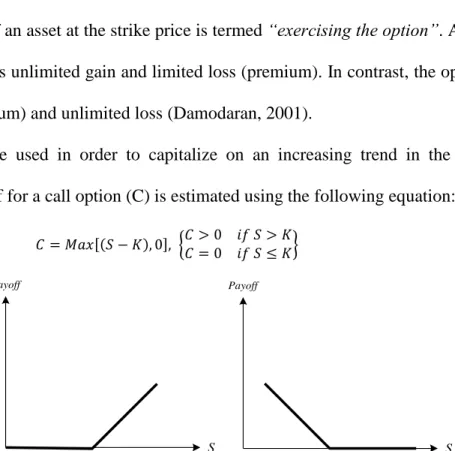
Call options are used in order to capitalize on an increasing trend in the market (risky project). The payoff for a call option (C) is estimated using the following equation:
𝐶 = 𝑀𝑎𝑥[(𝑆 − 𝐾), 0], {𝐶 > 0 𝑖𝑓 𝑆 > 𝐾𝐶 = 0 𝑖𝑓 𝑆 ≤ 𝐾} (1)
Where S is the current price (market price) and K is the strike price (or exercise price). (See Figure 1)
In contrast, the put options are used in order to capitalize on a decreasing trend in the market (risky project). The payoff for a put option (P) is estimated using the following equation:
𝑃 = 𝑀𝑎𝑥[(𝐾 − 𝑆), 0], {𝑃 > 0 𝑖𝑓 𝐾 > 𝑆𝑃 = 0 𝑖𝑓 𝐾 ≤ 𝑆} (2)
As can be seen, an option provides an opportunity for the decision maker to take some action after the risks and uncertaities are revealed. For instance, the owner of a call option will exercise the option only after learning that the current price S is greater than exercise price K.
In the PPP-BOT context the underlying cash flow is the underlying asset. For instance the highway traffic volume (a non-financial variable) is considered as the underlying asset in
Payoff
K S
Payoff
K S
Page | 14
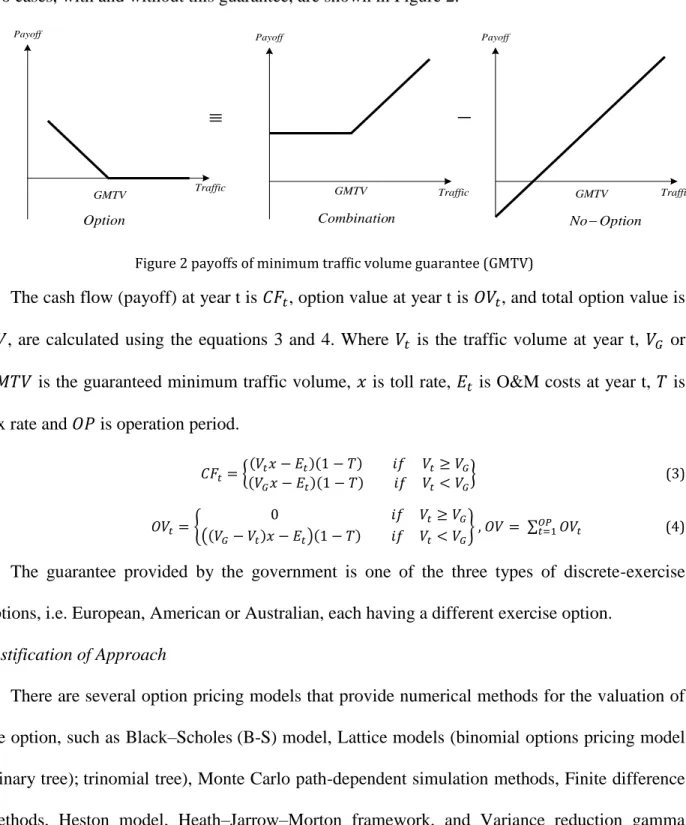
trasportation projects. The strike price is linked to the guaranteed cash flow. The current price is linked to the expected cash flow (Charo et al., 2003; Galera and Solino, 2010). For instance, the payoff of guaranteed minimum traffic volume (GMTV) as a put option and also the payoffs of two cases, with and without this guarantee, are shown in Figure 2.
Figure 2 payoffs of minimum traffic volume guarantee (GMTV)
The cash flow (payoff) at year t is 𝐶𝐹𝑡, option value at year t is 𝑂𝑉𝑡, and total option value is
𝑂𝑉, are calculated using the equations 3 and 4. Where 𝑉𝑡 is the traffic volume at year t, 𝑉𝐺 or
𝐺𝑀𝑇𝑉 is the guaranteed minimum traffic volume, 𝑥 is toll rate, 𝐸𝑡 is O&M costs at year t, 𝑇 is tax rate and 𝑂𝑃 is operation period.
𝐶𝐹𝑡= {(𝑉(𝑉𝑡𝑥 − 𝐸𝑡)(1 − 𝑇) 𝑖𝑓 𝑉𝑡≥ 𝑉𝐺 𝐺𝑥 − 𝐸𝑡)(1 − 𝑇) 𝑖𝑓 𝑉𝑡< 𝑉𝐺} (3) 𝑂𝑉𝑡= { 0 𝑖𝑓 𝑉𝑡≥ 𝑉𝐺 ((𝑉𝐺− 𝑉𝑡)𝑥 − 𝐸𝑡)(1 − 𝑇) 𝑖𝑓 𝑉𝑡< 𝑉𝐺} , 𝑂𝑉 = ∑ 𝑂𝑉𝑡 𝑂𝑃 𝑡=1 (4)
The guarantee provided by the government is one of the three types of discrete-exercise options, i.e. European, American or Australian, each having a different exercise option.
Justification of Approach
There are several option pricing models that provide numerical methods for the valuation of the option, such as Black–Scholes (B-S) model, Lattice models (binomial options pricing model (binary tree); trinomial tree), Monte Carlo path-dependent simulation methods, Finite difference methods, Heston model, Heath–Jarrow–Morton framework, and Variance reduction gamma
Payoff
GMTV Traffic
Payoff Payoff
Option Combination NoOption
Traffic Traffic
Page | 15
model (Mun, 2002; Damodaran, 2012; Hull, 2012). Almost all option pricing models are based on the stochastic differential equation. The B-S model and the binomial lattice model are the most common classic methods for pricing options (Black and Scholes, 1973; Cox et al., 1979).
Real options gained popularity through the work of Black and Scholes on European style option valuation based on partial differential equations (1973). It is this standard model that this study has selected. Although B-S option pricing model has been developed for financial options and therefore has several limitations in assessing real options, it is essential to state the related assumptions when adapted to price real options. Readers refer to Black and Scholes (1973) for the B-S pricing formulas for call and put options. More details on standard B-S model’s assumptions are given by Kodukula and Papudesu (2006), Martins et al. (2014) and Jeong et al. (2015).
Early Fund Generation Option
The design of concession period for PPP-BOT projects is important for revenue risk management and financial viability analysis. The concession period may have a single-period structure or a two-period structure, its length may be fixed or variable, and it may be combined with incentive schemes. Different designs reflect different revenue risk management strategies. The single-period concession structure is for a fixed period of time, independent of whether this time is used for construction or operation. Reducing the construction period automatically allows the concessionaire to earn additional and earlier revenue streams, and is in the best interest of the concessionaire independent of any government incentives. Thus, the project company assumes revenue and completion risk and the EFG option is unnecessary. While the two-period concession structure could, to some extent, reduce the revenue and completion risk exposure to
Page | 16
the project company, depending on the incentive schemes (Ye and Tiong, 2003; Ng et al., 2007). Here, the authors consider the later alternative.
The value of completing a PPP-BOT project early is a challenging issue, especially for the concessionaire. This may lead to an increase in cost but it brings the revenue stream on earlier, which enhances the profitability of the project. It is necessary to evaluate benefits and disbenefits of early completion of the project. This paper assumes that early completion of the project will result in earlier revenue stream and it is possible to compress project construction time which may result in an increase in overall project cost, although good project management and innovative construction methods can reduce construction time and not increase costs. It is also assumed that the government compensate the concessionaire with additional operating period equivalent to EFG period. An example of this is BOT power plant project which is completed earlier than scheduled commercial operation date (COD). This enabled the industries in the host country and region to produce goods and services earlier than originally planned. Early project completion is a win-win option for all parties involved as each benefits from the early use of the facility.
The EFG is a put option written to the sponsor of the project by the government, the project construction cost or savings, or revenue stream generated earlier (the underlying cash flow) is considered as the underlying asset, the current price is expected construction cost or revenue stream, and the exercise price is project construction cost or revenue stream based on the contract. If the actual construction duration (𝐶𝐷) is shorter than the contracted construction duration (𝑡𝑐), the government would have to grant the concessionaire with additional operating period equivalent to EFG period. Otherwise, the government would not have to compensate the concessionaire.
Page | 17
The EFG option needs to be evaluated by both government and concessionaire. Figure 3 represents the typical cumulative cash flow of PPP-BOT project including the EFG option. Figure 4 illustrates the typical components in the life-cycle of a PPP-BOT project including the EFG option. The concession period in two cases of without and with EFG option are calculated by equations 5 and 6 respectively:
𝐶𝑃 = 𝐶𝐷 + 𝑂𝑃 (5)
𝐶𝑃′= 𝐶𝐷′+ 𝐷
𝐸𝐺+ 𝑂𝑃′ (6)
where 𝐶𝐷/𝐶𝐷′ is the construction duration, 𝑂𝑃/𝑂𝑃′ is the operation period, and 𝐶𝑃/𝐶𝑃′ is the concession period in two cases of without and with EFG option respectively. 𝐷𝐸𝐺 is the duration of EFG.
Figure 3 Cumulative cash flow of PPP-BOT project including the EFG
Time CP OP Construction duration CD' Early Fund Generation (EFG) Period C u m u la ti v e C as h F lo w CD Concession period (CP')
Operation period (OP')
j=1,…, CD l=1,…, DEG Construction Period Operation Period i=1,…, OP
Transfer date End of the economic life
m=1,…, PEL
Time
Feasibility
Study Process Tender Effective date Concession Contract (Awarded) Financial Closing date Concession Period n=1,…,CP Pre-Concession Period Post-Concession Period Early Fund Generation Period
Page | 18
The present value, PV, of a discrete uniform series of the net benefits value from project operation, 𝑅, at the discount rate 𝑟, starting at time 𝑎 and continuing through time 𝑏, is estimated by equation 7: (Reinschmidt and Trejo, 2006)
𝑃𝑉 =𝑅𝑟[(1+𝑟)1 𝑎−(1+𝑟)1 𝑏] (7)
Under the simplifying assumption that the benefits, 𝑅, are constant in time over the operation period of BOT-PPP project, PV at time zero (0) (start of construction) is estimated by equation 8:
𝑃𝑉𝑏(𝑟, 𝐶𝐷) =𝑅0[1−(1+𝑟) −𝐶𝑃]
𝑟(1+𝑟)𝐶𝐷 (8)
The PV of a uniform series of costs over the construction period from time 𝑎 to time 𝑏 is:
PVc =𝐶𝑟[(1+𝑟)1 𝑎−
1
(1+𝑟)𝑏] (9)
With a = 0 and b = CD then:
PVc(r, CD )=Cr0[1 −(1 + r)−CD] (10)
The total NPV of the project, difference of present value of the benefits and present value of the costs, is estimated as following:
𝑃𝑉(𝑟, 𝐶𝐷)= 𝑃𝑉𝑏(𝑟, 𝐶𝐷)− 𝑃𝑉𝑐(𝑟, 𝐶𝐷) (11)
The IRR, 𝑟0, is calculated by setting the total net PV to zero, and solving for 𝑟. The IRR is then compared with the hurdle rate to determine whether the project construction acceleration is economically desirable and justifiable.
The PV of the benefit stream discounted at 𝑟0 for the project at shorter construction duration,𝐶𝐷′< 𝐶𝐷, is estimated as follows.
𝑃𝑉𝑏(𝑟0, 𝐶𝐷′) =𝑅0[1−(1+𝑟0)−𝐶𝑃′]
𝑟0(1+𝑟0)𝐶𝐷′ (12)
The ratio of the discounted present value of the net benefits for the accelerated project,
Page | 19
𝑃𝑉𝑏(𝑟0, 𝐶𝐷). The percentage increase in present value of the project benefits due to shortening
the construction duration from 𝐶𝐷 to 𝐶𝐷′is:
∇= 100 [𝑃𝑉𝑏(𝑟0,𝐶𝐷′)
𝑃𝑉𝑏(𝑟0,𝐶𝐷)− 1] = 100 {[(1 + 𝑟0) 𝐶𝐷−𝐶𝐷′
] [1−(1+𝑟0)−𝐶𝑃′
1−(1+𝑟0)−𝐶𝑃] − 1} (13)
In order to be financially feasible, the maximum acceptable percentage increase in discounted cost to complete project earlier is the percentage increase in discounted benefits gained from earlier completion. So, at the discounted rate 𝑟0, Equation 13 is also the maximum percentage increase in the present value of the project costs. In the case 𝐶𝑃 = 𝐶𝑃′ then the percentage increase in present value of the project benefits due to shortening the construction duration from
𝐶𝐷 to 𝐶𝐷′ is:
∇𝐶𝑃=𝐶𝑃′= 100{[(1 + 𝑟0)𝐶𝐷−𝐶𝐷′] − 1} (14)
The EFG option value is formulated as follows:
𝑂𝑉𝐸𝐹𝐺 = { ∇ × 𝑃𝑉 0 𝑖𝑓𝑏(𝑟, 𝐶𝐷) 𝑖𝑓 𝐶𝐷 < 𝑡𝐶𝐷 ≥ 𝑡𝑐
𝑐} (15)
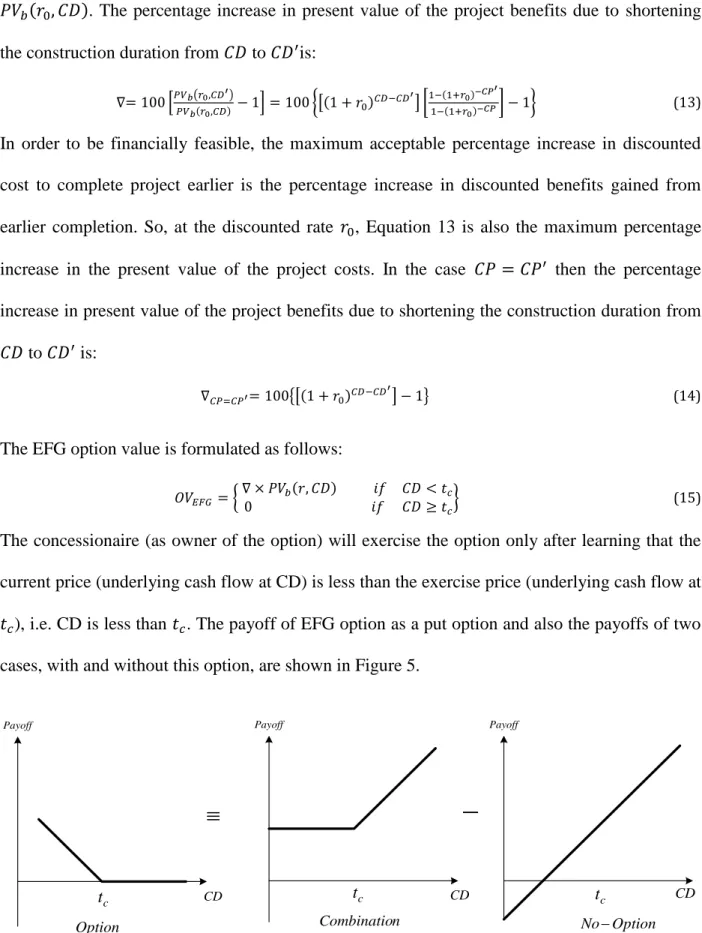
The concessionaire (as owner of the option) will exercise the option only after learning that the current price (underlying cash flow at CD) is less than the exercise price (underlying cash flow at
𝑡𝑐), i.e. CD is less than 𝑡𝑐. The payoff of EFG option as a put option and also the payoffs of two cases, with and without this option, are shown in Figure 5.
Figure 5 Payoffs of Early Fund Generation (EFG) Option
Payoff
c
t
Payoff Payoff
Option Combination NoOption
CD
c
t CD tc
Page | 20
Guaranteed Upper and Lower Bound of Revenue Option
Achieving an appropriate investment return over the concession period is a very important aspect that influences success of the PPP project. This fact has pushed many governments involved in concession programmes in the past decade to include revenue risk mitigation mechanisms to encourage private participation. Currently, the government usually grants the concessionaire a minimum revenue guarantee (MRG). This is a right to build and operate the project in which the government compensates for any revenue shortfall in the life-cycle cash flow. The revenue guarantee put option contributes to estimate minimum return for concessionaire, which is called guaranteed minimum rate of return on equity (Min-GEROR), 𝑟𝑓, and measured by free cash flow to equity (FCFE) ( see equation 16).
𝐹𝑟𝑒𝑒 𝑐𝑎𝑠ℎ 𝑓𝑙𝑜𝑤 𝑡𝑜 𝑒𝑞𝑢𝑖𝑡𝑦 (𝐹𝐶𝐹𝐸) = 𝑅𝑒𝑣𝑒𝑛𝑢𝑒 – 𝑂&𝑀 𝑐𝑜𝑠𝑡𝑠 – 𝑑𝑒𝑏𝑡 𝑠𝑒𝑟𝑣𝑖𝑐𝑒 – 𝑖𝑛𝑐𝑜𝑚𝑒 𝑡𝑎𝑥 (16) Despite the important advantages of this mechanism, it still has some drawbacks as it requires an upfront premium payment. Guaranteed Upper and Lower Bound of Revenue (MinMax-GR) overcomes this barrier by answering the question on how to determine an equitable cap of revenue to defray the cost of the floor under the uncertainty. The revenue call option (Max-GR) contributes to estimate equitable maximum return for concessionaire, which is called guaranteed maximum rate of return on equity (Max-GEROR), 𝑟𝑐, in order to limit the concessionaire’s profit to an acceptable/reasonable level. By this arrangement the government captures a portion of the income when the concessionaire’s revenue exceeds certain levels. The focus of this section is determining equitable guaranteed upper and lower bound for revenue and the corresponding guaranteed rate of return for project sponsors.
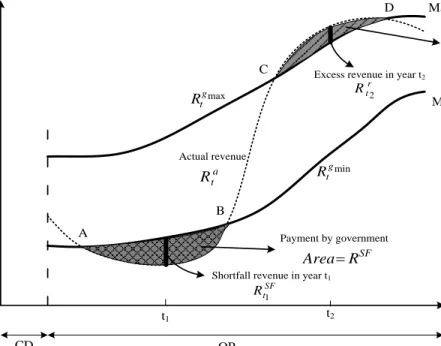
Under MRG the government subsidizes the shortfall in revenue. It is a put option written to the sponsor of the project by the government. If the actual revenue in year t (𝑅𝑡𝑎) does not reach
Page | 21
the level that has been guaranteed (𝑅𝑡𝑔𝑚𝑖𝑛), as revenue floor for project sponsor, the government would have to make up any shortfall in revenue. Otherwise, the government would not have to pay any subsidy. The option value is formulated as follows:
𝑅𝑡𝑆𝐹={ (𝑅𝑡 𝑔𝑚𝑖𝑛− 𝑅 𝑡 𝑎) 𝑖𝑓 𝑅 𝑡 𝑎< 𝑅 𝑡 𝑔𝑚𝑖𝑛 0 𝑖𝑓 𝑅𝑡𝑎≥ 𝑅𝑡𝑔𝑚𝑖𝑛 } (17) 𝑅𝑆𝐹 = ∑ 𝑅 𝑡𝑆𝐹 𝑂𝑃 𝑡=𝐶𝐷+1
𝑅𝑡𝑆𝐹, shortfall in revenue in year t, is the value of the option in year t and 𝑅𝑆𝐹 is the total value
of the option over the operation period.
Conversely, under revenue call option, if the actual revenue in year t (𝑅𝑡𝑎) surpasses the pre-specified maximum level that has been guaranteed 𝑅𝑡𝑔𝑚𝑎𝑥 (as revenue cap for project sponsor); the government would then have the right to call for excess cash flow. The government could equitably demand a cut in tariff rates to benefit the end users, boost taxes, or even directly participate in the upside of the project as repayment. The option value is formulated as follows:
𝑅𝑡𝑟={ (𝑅𝑡 𝑎− 𝑅 𝑡 𝑔𝑚𝑎𝑥 ) 𝑖𝑓 𝑅𝑡𝑎≥ 𝑅𝑡𝑔𝑚𝑎𝑥 0 𝑖𝑓 𝑅𝑡𝑎< 𝑅𝑡𝑔𝑚𝑎𝑥 } (18) 𝑅𝑟 = ∑ 𝑅 𝑡𝑟 𝑂𝑃 𝑡=𝐶𝐷+1
𝑅𝑡𝑟, excess cash flow as repayment in year t, is the value of the option in year t and 𝑅𝑟 is the
Page | 22
Figure 6 Minimum and maximum revenue guarantee, shortfall and excess revenue
Figure 6 graphically illustrates the aforementioned discussion, including Min and Max revenue guarantee and the actual revenue equations. In this case, the government has to pay to the concessionaire the shortfall revenue in the period between A and B. Moreover, the government will call for excess revenue in the period between C and D.
Fuzzy set theory: dealing with uncertainty and risk
The determination of cash flow components as per the financial model is subject to uncertainty and risk, hence, Fuzzy technique was employed to address the uncertainties involved in cash flow estimation. Zadeh (1965, 1975) introduced the concept of Fuzzy set theory. Based on the extension principle, the arithmetic of fuzzy numbers can be derived. Generally, a fuzzy interval is represented by two Fuzzy numbers and a membership function, usually either a triangular or a trapezoidal one (TFN or TpFN) is used for uncertainty modelling, i.e. a process to represent subjective estimation of cash flow under uncertainties and risks and model uncertain variables as fuzzy numbers.
($) R CD OP Actual revenue a t R Year (t) Min-GR Max-GR min g t R max g t R
Shortfall revenue in year t1
SF t R 1 Payment by government SF R Area t1 t2
Excess revenue in year t2 r
t R
2
Call for excess revenue by government r R Area A B C D
Page | 23
For the purpose of evaluating these two forms of guarantee and determine an equitable cap of guaranteed revenue, B-S model (Black and Scholes, 1973) is applied. To achieve this aim, the following steps are proposed. MRG and the linked cash flow is determined (put option-floor) based on the developed financial model for Min-GEROR,𝑟𝑓. Fuzzy set theory is applied for representing the subjective judgements of the decision maker, i.e. uncertainty modelling. The value of the MRG under assumed scenarios for uncertain variables is determined by using Equation 17 and representing the uncertain parameters corresponding to different scenarios as Fuzzy numbers. Then by assuming the same value of put option for call option, and using Equation 18, the cap of guaranteed revenue and linked cash flow for assumed scenarios are calculated (call option-cap). Subsequently yearly revenue-cap (YR-cap) and equity internal rate of return (EIRR) linked to the assumed scenarios (Max-GEROR,𝑟𝑐) are calculated based on the developed financial model and represented as Fuzzy numbers. Finally, by utilizing the Level Rank Method of defuzzification (Moller and Beer, 2004), the YR-cap and EIRR (call option-cap, defuzzified) at specific µ-cut/α-confidence level is determined as a crisp value. The concept of the Level Rank Method is based on the α-discretization. The membership scale of the fuzzy variable is discretized with the aid of chosen α-levels, and then the arithmetic mean of the interval centres of the α-level sets is computed as defuzzification result.
The following illustrative example is used to show the concept and the applicability of the proposed option model, calculation methodology and its analysis. In the Iranian statute, “law on construction and development of roads and transportation infrastructures projects”, the government is permitted to subsidize projects, as cash subsidy, up to 50% of project investment. The government is also permitted to provide equity up to the maximum 10% of project investment. If the ratio of the actual annual income over expected annual income is less than
Page | 24
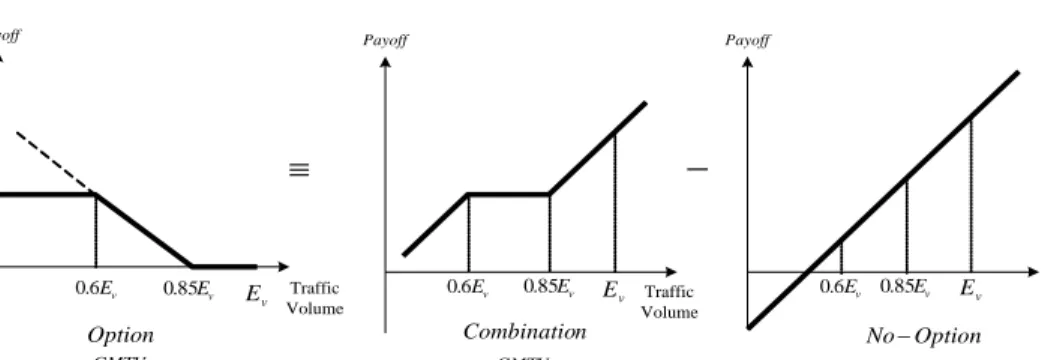
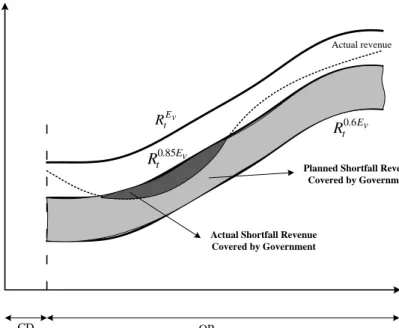
0.85, the government will make up the shortfall up to the maximum of 25% of the project’s expected revenue. This is classified as MRG as a mechanism that aims for risk allocation. The Saveh-Salafchegan freeway was constructed under this law with government involvement at 60% and private sector involvement at 40% of the project investment. This project now in operation (Iranian statute, 1987; Attarzadeh, 2007). The structure of this kind of governmental support is shown in Figure 7 and Figure 8. 𝐸𝑣 is expected traffic volume.
The proposed method in this section is applied to find the equitable guaranteed bound of revenue (cap) under the uncertainty of traffic volume for the case study, Saveh-Salafchegan freeway project. Fuzzy set theory is applied for modelling of the uncertainty in the decision making process, i.e. to model uncertain variables as fuzzy numbers. The traffic volume as uncertain variable is represented by triangular fuzzy number “T.F.N” Ẽ𝑣 𝑇𝑟𝑖: 〈4.38,7.3,10.293〉 million vehicles/year. Figure 9 demonstrates equitable guaranteed bound of cash flow resulted from call and put options.
Figure 7 Bundle of options of minimum traffic/revenue guarantee based on the Iranian statute for Iranian toll road/highway projects Payoff v E 6 . 0 Payoff Payoff
Option Combination NoOption
GMTV GMTV Traffic Volume Traffic Volume Traffic Volume v E 85 . 0 v E 0.6Ev 0.85Ev Ev 0.6Ev 0.85Ev Ev
Page | 25
Figure 8 Estimated revenue and minimum and maximum guaranteed revenue based on the Iranian statute for Iranian toll road/highway projects
Figure 9 Equitable guaranteed bound of revenue resulted from call and put options for Saveh-Salafchegan freeway project
Based on the real options analysis, the fair bound cap is determined as (1.25𝐸𝑣, 1.41𝐸𝑣). The result shows if the ratio of the actual annual revenue over expected annual revenue is more than 1.25 (i.e. Actual traffic volume exceeds the expected traffic volume), the government will share the revenue in excess of 1.25 of the expected annual revenue with concessionaire up to the
($) R CD OP Estimated Revenue v E t R Year (t) Min-GR Max-GR v E v E t R0.85 v E t R0.6 v E 85 . 0 v E 6 . 0
Planned Shortfall Revenue Covered by Government
Actual revenue
Actual Shortfall Revenue Covered by Government
Page | 26
maximum of 16%. If the ratio of actual annual revenue over expected annual revenue is more than 1.41, the government will take the revenue in excess of 1.41 of the expected annual revenue. The illustrative case of Iranian toll road/highway projects shows that there are three sets of incentive mechanism in PPP-BOT scheme which can be applied as options to manage traffic volume uncertainty and vulnerability. First, extending or reducing the concession period based on the evolution of traffic. Second, renegotiate the economic terms of the contract when there is a substantial variation in the traffic volume from the original contract (e.g.: through MRG). Third, if the traffic volume is outside the agreed minimum and maximum bound a sharing mechanism is triggered (Attarzadeh, 2007; Vassallo and Gallego, 2005).
Case Study
A detailed case study is considered in this section to illustrate the application of the real option models that were developed in the previous sections. ROV is applied to examine two governmental supports and incentives for a BOT project. Information on this case was gathered from project stakeholders such as government agency, Project Company and financial institution.
The South Isfahan Power Plant (SIPP) project was constructed as Iran’s first private power plant. The Energy Conversion Agreement (ECA) contract was signed in middle of 2002 and the project is now in the operational stage. The first unit of this power plant was synchronized in middle of 2005. The whole project was operational by mid-2006. Before this project was launched, the government controlled all the power plants in the country. An Iranian-German consortium implemented the project under a BOT scheme. The power plant is located 60 kilometers from the historical city of Isfahan in central Iran. The nominal capacity of the plant at ISO and design condition is estimated at 954 and 734 megawatts respectively. The project was implemented at a base cost of M€320.
Page | 27
The SIPP comprises six 159-megawatt power generation units which were brought on stream as each unit was completed. The public and private sectors benefit from the EFG option by faster construction and earlier operation of the project. The EFG option was design as an incentive to the concessionaire. It was agreed that the government compensate the concessionaire EFG period which is the period of saved time in construction phase.
The original construction period was 4 years and the earlier completion period was 1 year. The concessionaire operates the project for a period of 21 years. Only the first year includes EFG. (𝑟0 = 0.16, 𝐶𝑃 = 24 , 𝐶𝑃′ = 25, 𝐶𝐷 = 4, 𝐶𝐷′= 3, 𝐷𝐸𝐺 = 1, 𝑂𝑃 = 20, 𝑂𝑃′ = 21).
The percentage increase in discounted benefits gained from earlier completion was 16% (Equation 14). The percentage increase in discounted cost to complete project earlier was 8%. So the net benefit was 7% of the PW of the yearly net benefit which is equal to M€2.23. EFG option contributes to secure the return for concessionaire at minimum acceptable rate based on free cash flow to equity (rate of return on equity).
The overall contractual package also included granted guaranteed minimum revenue which contributes to secure the minimum return on equity (Min-GEROR), 𝑟𝑓 = 15%. Now the question is that what would be a fair guaranteed maximum revenue and estimated corresponding maximum return (Max-GEROR), 𝑟𝑐, under the uncertainty of quantity of production (yearly generated energy). Through Max-GR the government captures a portion of the income when the concessionaire’s revenue exceeds certain levels.
Page | 28
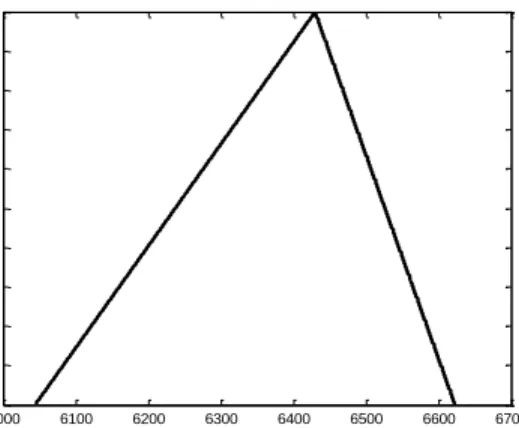
Figure 10 Membership function of quantity of production (yearly generated energy (GWH))-uncertain random variable
Since the input parameters include uncertain random variables, the actual revenue and corresponding cash flow is also treated as uncertain random variable. Fuzzy set is utilized to model this uncertainty. The membership function of an uncertain random variable, quantity of production (yearly generated energy (GWH)), is represented in Figure 10. The quantity of production as Fuzzy variable (GWH) is: Tr.F.N, 〈6044.2, 6430, 6430, 6622.9 〉. A total of three different scenarios (optimistic, most likely and pessimistic scenarios) have been constructed in order to capture this uncertainty in a fuller picture. The option value of Min-GR and Max-GR are estimated by equations 17 and 18 respectively. B-S model is utilized to determine a fair cap of revenue and estimate equitable rate of return, 𝑟𝑐. The risk-free interest rate and standard deviation are assumed 5% and 25% respectively. By using the Excel solver the cash flow linked to Min-GR which secures the Min-GEROR, 𝑟𝑓 = 15%, under three assumed scenarios is determined. Then again by using the Excel solver and assuming the same value of put option for call option, Max-GR and the linked cash flow for three assumptions are calculated and corresponding Max-GEROR is estimated.
60000 6100 6200 6300 6400 6500 6600 6700 0.1 0.2 0.3 0.4 0.5 0.6 0.7 0.8 0.9 1
Page | 29
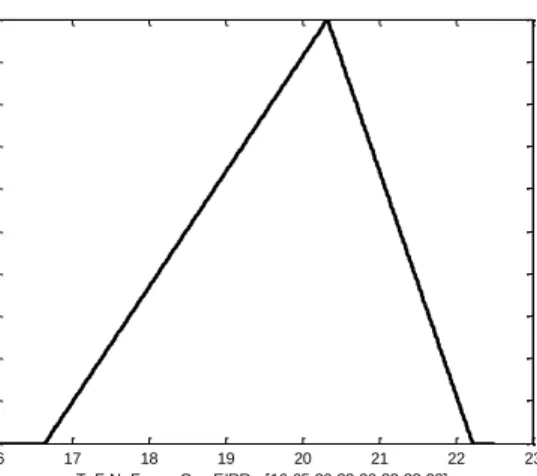
Figure 11 Fuzzy representation of cap-EIRR resulted from three scenarios cash flows linked to Max-GR
Figure 12 Fuzzy representation of guaranteed EIRR (bound within floor and cap)
Figure 13 the guaranteed bound of revenue (M€) resulted from call and put options during the operation period 16 17 18 19 20 21 22 23 0 0.1 0.2 0.3 0.4 0.5 0.6 0.7 0.8 0.9 1 Tr.F.N, Fuzzy Cap-EIRR =[16.65 20.33 20.33 22.22] 14 15 16 17 18 19 20 0 0.1 0.2 0.3 0.4 0.5 0.6 0.7 0.8 0.9 1 Tr.F.N, EIRR bound =[15 16.03 16.03 19.50] 73.00 78.00 83.00 88.00 93.00 98.00 1 2 3 4 5 6 7 8 9 10 11 12 13 14 15 16 17 18 19 20 R e ve n u e (M € ) OPeration Period-Year Guaranteed Revenue-Call-Defuuzified (Cap)
Current Price at Most Likely Scenario (ER)
Guaranteed Revenue-Put Exercise Price (Floor)
Page | 30
Consequently yearly revenue-cap (YR-cap) and equity internal rate of return (EIRR) linked to three scenarios are calculated and represented as Fuzzy numbers (See Figure 11). Finally, by utilizing the Level Rank Method of defuzzification, the YR-cap and EIRR (call option-cap, defuuzified) at specific µ-cut/α-confidence level is determined as a crisp value. The fair cap of EIRR is determined: 𝑟𝑐 = 19.5%. The guaranteed EIRR (bound within floor and cap) is represented as Fuzzy number (See Figure 12). The guaranteed bound of revenue resulted from call and put options during the operation period as final result is shown in Figure 13. The guaranteed bound of revenue has been established for SIPP project based on the described procedure and computation method. Setting a higher floor threshold secures not only timely debt repayment but also an acceptable rate of return on equity. Conversely setting a lower floor threshold may lead to weaken timely debt service and realize a partial debt guarantee. To make the case study more concrete, however, the key parameters will be altered in the subsequent sensitivity analyses to examine their impact on the value of the options. Therefore financial models for different scenarios are constructed in a spreadsheet environment.
Sensitivity Analysis of Option Values
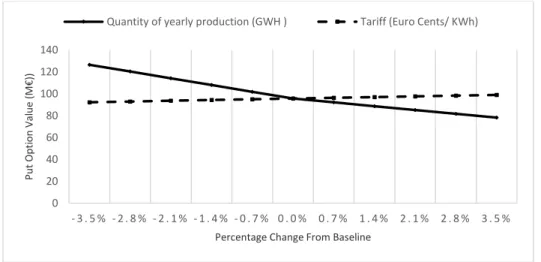
In practice, it is always sensible to study how sensitive the estimated option values are to the key input parameters such as supply, demand and tariff distributions. By varying the factors of uncertainty, the sensitivity analysis of guarantee value provides better insights and leads to a more consistent view of the appropriate level of guarantee. This is particularly significant in a PPP negotiation context. Figures 14 and 15 show the results of the sensitivity analyses of put and call option values, subject to changes in the quantity of yearly production and tariff. It should be emphasized that the range of values shown here is sufficient to support the arguments presented below. It is not difficult to re-run the analysis and adjust the range of values for sensitivity
Page | 31
analysis. As can be seen, the value of put option is almost equally sensitive to the quantity of yearly production and tariff. On the other hand, the value of call option seems to be more sensitive to only the quantity of yearly production, although changes in either will significantly affect project NPV. It should be noted that the standard deviations of these two variables determine the volatility of the project cash flow, which is a key determinant of the value of the two options evaluated. The findings essentially underline the differences in risks that the government and the project sponsor are encountered.
Figure 14 Sensitivity Analysis of Put Option Value over the Whole Operation Period
Figure 15 Sensitivity Analysis of Call Option Value over the Whole Operation Period
0 20 40 60 80 100 120 140 - 3 . 5 % - 2 . 8 % - 2 . 1 % - 1 . 4 % - 0 . 7 % 0 . 0 % 0 . 7 % 1 . 4 % 2 . 1 % 2 . 8 % 3 . 5 % P ut O pti o n V al ue (M € ))
Percentage Change From Baseline
Quantity of yearly production (GWH ) Tariff (Euro Cents/ KWh)
0 100 200 300 400 500 600 700 800 - 3 . 5 % - 2 . 8 % - 2 . 1 % - 1 . 4 % - 0 . 7 % 0 . 0 % 0 . 7 % 1 . 4 % 2 . 1 % 2 . 8 % 3 . 5 % C al l O pti o n V al ue (M € ))
Percentage Change From Baseline
Page | 32
Implications and Limitations of the Case Study and Current Research
The above case study of a power plant project effectively illustrates how EFG and MinMax-GR options can be considered and evaluated as a put/call option by real option valuation. The results show the significance of the valuation of these options to both host government and investors, and provide them with a clear reference when negotiating on the level of government support. It is interesting to note that with the increasing of tariff, the value of put option increases while the value of call option decreases. Another important point to note is that the valuation methodology proposed and demonstrated in this paper can be easily integrated into the classical discounted cash flow setting that is conveniently implemented in spreadsheets. Consequently, the information embedded in such models is very transparent and facilitates a better and fairer negotiation between the two parties.
PPP projects are so complicated, while on the other hand, real option models have to minimise the real conditions, require a high level of knowledge from staff, but produce little practical recommendations to the practice. Although, this study confirms that ROV is stronger evaluation approach than simple NPV, the case study demonstrates that it suffers from a few realistic limitations. First, RO models are technically more demanding. Second, RO models are mathematically more complex. Third, RO models suffer from the fact that estimation of assumptions/input parameters, such as volatility, is problematic. All these add to the complexity of RO models. Intelligibly, practitioner would prefer a model that is more intuitive to facilitate decision making. Finally, the case study presented in this paper only illustrates a few factors of uncertainty, which are the quantity of production and tariff.
Page | 33
Conclusion and Recommendations
PPP-BOT projects’ commissioning has not been without trouble due to multiple uncertainties embedded in these projects. Consequently, private investors require some options for mitigation of these risks and setting the revenue through government support. Host governments often provide subsidies, guarantees or alternative forms of support as incentives specially designed to alleviate the concern of revenue risk and to attract private sector participation. The project would have faced cancellation simply due to a negotiation breakdown when individual parties focus solely on risks and not properly factoring the value of the support package into their considerations. Thus project stakeholders should take a holistic view of risk and value in the negotiation process. Mechanisms for sharing the risk between the public and private sectors as a way to overcome the revenue risks are necessary. Value can be created by incorporating flexibility in different stages of a project life cycle.
This study indicated that government support, which can be interpreted as a form of call/put option, plays important roles in PPP-BOT project success and should be carefully designed and formulated. The aim of this research was to conduct an investigation into how real option analysis can be applied in modelling the contractual/ managerial flexibilities to mitigate and manage the revenue risk in PPP projects. The model developed in this paper adds to the literature by proposing a valuation method for EFG option. Furthermore, it contributes in the calculation of feasible and equitable bound for a guaranteed revenue which is in interest of both parties. With real option theory, a methodology is presented to grant a MRG in exchange for sharing upside revenue under supply/demand uncertainty. The approach presented in this paper makes use of fuzzy set theory to address uncertainties in simulation of a cash flow model. EFG and MinMax-GR supports are modelled as real options. The proposed methodology is then applied to the cases
Page | 34
of the freeway and power plant projects in Iran (illustrative example and case study) to show its applicability and illustrate how to evaluate the EFG option. It also shows how a negotiation band for a guaranteed revenue can be constructed, which would enlarge the feasible bargaining range for both parties. These features are evaluated using a combination of real option and spreadsheet-based financial models. The risk implications found in the case has also been discussed.
Effectively there are some advantages associated with these options and their value can indeed be significant relative to the basic net present value of no-option scenario and properly applicable in PPP projects. By incorporating these option values, many of the risk factors that affect the project’s revenue can be mitigated. It provides useful interpretations of the meaning and importance of government guarantees and also highlights other aspects of flexibility in the design and execution of a project. The proposed model in the context of infrastructure investments is simply meant for decision making. The result of this method is intuitive and much preferred by practitioners.
The presented equations for valuation model of EFG option provide a quick estimate of the trade-off between project time and costs, to estimate the maximum percentage by which one could increase costs in order to shorten the delivery time. The results also showed that through MinMax-GR option the government guaranteed the minimum revenue for the concessionaire which led to reducing the financial costs of the project, mitigating financial fluctuations, facilitating concession financing, and increasing the bidder’s competitiveness in the tender process. In return the concessionaire had to share extra revenues with the government if the collected revenues surpassed the threshold established in the bidding terms. It made the revenue risk distribution fairer and lenders felt more comfortable in lending to project (higher bankability). It was also effective in reducing renegotiation pressures by the concessionaire.
Page | 35
Despite the important advantages of this mechanism, it may cause negative implications for the public budget in the case of an economic recession. Furthermore, in the case that the total collected revenue throughout the project’s life cycle will not be sufficient to recoup the concessionaire’s investment, a direct government subsidy is necessary to make the project financially viable. So, a guaranteed bound of revenue option has limited applicability in such cases.
In spite of these findings, there remain some limitations to this study and the following areas are recommended for further research: Firstly, the project value based on real option analysis approach will be inadequate if the future cash flow, such as revenue and operating costs, is inappropriately projected. Moreover, it is still not easy to properly estimate project cash flow volatility in infrastructure investment since obtaining proper data about infrastructure investment is no mean task. For further studies, these limitations and possible solutions could be investigated. Secondly, the scope of this paper has been limited to the evaluation of the EFG and MinMax-GR options. It is desirable to consider other types of government support which could be offered to concessionaire as options. Future work could focus on the evaluation of these options by real options valuation. The cost of the guarantees to the government must be estimated and compared with the equivalent subsidies in order to ascertain which approach is more effective in reducing the project risk and uncertainty. This issue still remains to be addressed in future work.
References
Ashuri, B., Kashani, H., Molenaar, K., Lee, S., and Lu, J. (2012). “Risk-Neutral Pricing Approach for Evaluating BOT Highway Projects with Government Minimum Revenue