HiSpeed
®Plasmid Purification Handbook
HiSpeed Plasmid Midi and Maxi Kit
For rapid purification of transfection grade
plasmid DNA
Trademarks: QIAGEN®, Effectene®, EndoFree®, HiSpeed®, PolyFect®, SuperFect®(QIAGEN Group); DH5a®(Invitrogen Corp.);
pBluescript®(Stratagene Inc.); Triton®(Rohm and Haas Company); pGEM®(Promega Corp.).
Registered names, trademarks, etc. used in this document, even when not specifically marked as such, are not to be considered unprotected by law.
Contents
Kit Contents 4
Storage Conditions 5
Technical Assistance 5
Quality Control 5
Product Use Limitations 6
Product Warranty and Satisfaction Guarantee 6
Safety Information 7
Introduction 8
Principle and procedure 8
Equipment and Reagents to Be Supplied by User 11
Important Notes 12
Protocol
Plasmid or Cosmid DNA Purification Using HiSpeed Plasmid Midi
and Maxi Kits 17
Troubleshooting Guide 23
Appendix A: Agarose Gel Analysis of the Purification 29
Appendix B: Composition of Buffers 31
Ordering Information 33
HiSpeed Plasmid HiSpeed Plasmid HiSpeed Plasmid Midi Kit (25) Maxi Kit (10) Maxi Kit (25)
Catalog no. 12643 12662 12663
HiSpeed Tips 25 HiSpeed Midi 10 HiSpeed 25 HiSpeed
Tips Maxi Tips Maxi Tips
QIAfilter Cartridges 25 QIAfilter Midi 10 QIAfilter Maxi 25 QIAfilter Maxi
Cartridges Cartridges Cartridges
Caps for QIAfilter 25 10 25
20 ml Syringes 25 – –
30 ml Syringes – 10 25
5 ml Syringes 25 10 25
QIAprecipitator 25 10 25
QIAprecipitator QIAprecipitator QIAprecipitator
Midi Modules Maxi Modules Maxi Modules
Buffer P1 1 x 220 ml 1 x 110 ml 1 x 280 ml Buffer P2 1 x 220 ml 1 x 110 ml 1 x 280 ml Buffer P3 1 x 220 ml 1 x 110 ml 1 x 280 ml Buffer QBT 1 x 110 ml 1 x 110 ml 1 x 280 ml Buffer QC 3 x 190 ml 3 x 240 ml 2 x 850 ml Buffer QF 1 x 170 ml 1 x 170 ml 1 x 420 ml Buffer TE 1 x 30 ml 1 x 30 ml 1 x 30 ml LyseBlue 1 x 220 µl 1 x 110 µl 1 x 280 µl RNase A* 1 x 22 mg 1 x 11 mg 1 x 28 mg Handbook 1 1 1
Kit Contents
* Provided as a 10 mg/ml or 100 mg/ml solution.Storage Conditions
HiSpeed Plasmid Kits should be stored dry and at room temperature (15–25°C). HiSpeed Tips, QIAfilter Cartridges, and QIAprecipitator Modules can be stored for at least two years without showing any reduction in performance, capacity or quality of separation. After addition of RNase A, Buffer P1 should be stored at 8°C and is stable for six months. Other buffers and RNase A stock solution can be stored for two years at room temperature.
Technical Assistance
At QIAGEN we pride ourselves on the quality and availability of our technical support. Our Technical Services Departments are staffed by experienced scientists with extensive practical and theoretical expertise in molecular biology and the use of QIAGEN products. If you have any questions or experience any difficulties regarding any aspect of HiSpeed Plasmid Kits, or QIAGEN products in general, please do not hesitate to contact us.
QIAGEN customers are also a major source of information regarding advanced or specialized uses of our products. This information is helpful to other scientists as well as to the researchers at QIAGEN. We therefore also encourage you to contact us if you have any suggestions about product performance or new applications and techniques. For technical assistance and more information please call one of the QIAGEN Technical Service Departments or local distributors (see back cover).
Comprehensive background information on plasmid preparation procedures and common plasmid applications — in addition to kit selection guides, frequently asked questions, and information about our purification technologies — can be found on our plasmid Web page www.qiagen.com/goto/plasmidinfo .
Quality Control
In accordance with QIAGEN’s ISO-certified Total Quality Management System, each lot of HiSpeed Plasmid Kits is tested against predetermined specifications to ensure consistent product quality.
Product Use Limitations
HiSpeed Plasmid Midi and Maxi Kits are developed, designed, and sold for research purposes only. They are not to be used for human diagnostic or drug purposes or to be administered to humans unless expressly cleared for that purpose by the Food and Drug Administration in the USA or the appropriate regulatory authorities in the country of use. All due care and attention should be exercised in the handling of many of the materials described in this text.
Product Warranty and Satisfaction Guarantee
QIAGEN guarantees the performance of all products in the manner described in our product literature. The purchaser must determine the suitability of the product for its particular use. Should any product fail to perform satisfactorily due to any reason other than misuse, QIAGEN will replace it free of charge or refund the purchase price. We reserve the right to change, alter, or modify any product to enhance its performance and design. If a QIAGEN product does not meet your expectations, simply call your local Technical Service Department. We will credit your account or exchange the product — as you wish.
A copy of QIAGEN terms and conditions can be obtained on request, and is also provided on the back of our invoices. If you have questions about product specifications or performance, please call QIAGEN Technical Service or your local distributor (see back cover).
Safety Information
When working with chemicals, always wear a suitable lab coat, disposable gloves, and protective goggles. For more information, please consult the appropriate material safety data sheets (MSDSs). These are available online in convenient and compact PDF format at www.qiagen.com/ts/msds.asp where you can find, view, and print the MSDS for each QIAGEN kit and kit component.
The following risk and safety phrases apply to components of the HiSpeed Midi and Maxi Kits.
Buffer P2
Contains sodium hydroxide: irritant. Risk and safety phrases:* R36/38, S13-26-36-46 Buffer P3
Contains acetic acid: irritant. Risk and safety phrases:* R36/38, S13-26-36-46 Buffers QBT, QC, QF
Contain isopropanol: flammable. Risk and safety phrases:* R10 RNase A
Contains ribonuclease: sensitizer. Risk and safety phrases:* R42/43, S23-24-26-36/37 24-hour emergency information
Emergency medical information in English, French, and German can be obtained 24 hours a day from:
Poison Information Center Mainz, Germany Tel: +49-6131-19240
Introduction
HiSpeed Plasmid Purification Kits will dramatically change the way you isolate nucleic acids. The ultrafast purification protocol, based on the remarkable selectivity of patented QIAGEN Resin, allows the isolation of ultrapure, supercoiled plasmid DNA with high yields in less than one hour, and without centrifugation. No expensive equipment such as ultracentrifuges and HPLC, or toxic reagents such as phenol and ethidium bromide are required. Plasmid and cosmid DNA purified with HiSpeed Tips is suitable for use in demanding applications such as transfection, automated or manual sequencing, and enzymatic modifications. QIAGEN continually strives to streamline and further develop nucleic acid purification to offer a complete plasmid purification system, for all requirements. Select the optimum plasmid kit for your requirements by visiting our online selection guide at www.qiagen.com/products/plasmid/ selectionguide . For transfection, QIAGEN also offers the advanced PolyFect®,
SuperFect®, and Effectene®transfection reagents. These reagents, combined with the
high-quality plasmid DNA obtained from QIAGEN, QIAfilter, HiSpeed®, and
EndoFree®Plasmid Kits, provide optimal transfection results (for ordering information,
see pages 33–36).
Principle and procedure
QIAGEN plasmid purification protocols are based on a modified alkaline lysis procedure, followed by binding of plasmid DNA to QIAGEN Anion-Exchange Resin under appropriate low-salt and pH conditions. RNA, proteins, dyes, and low-molecular-weight impurities are removed by a medium-salt wash. Plasmid DNA is eluted in a high-salt buffer and then concentrated and dehigh-salted by isopropanol precipitation. No expensive equipment such as ultracentrifuges and HPLC, or toxic reagents, such as phenol and ethidium bromide are required.
Each disposable HiSpeed Tip packed with QIAGEN Resin HS is designed to operate by gravity flow, reducing the amount of hands-on time required for the purification procedure. DNA binding, washing, and elution steps proceed markedly faster than with conventional QIAGEN-tips and the increased capacity enables higher yields from high-copy plasmids.
QIAfilter Cartridges enable rapid and efficient clearing of bacterial lysates without centrifugation. They have a syringe format and lysates are cleared by pushing the liquid through a filter (Figure 3, page 15). QIAfilter Cartridges completely remove KDS* precipitates for efficient clearing in a fraction of the time needed for conventional centrifugation. Plasmid DNA from the filtered lysate is then efficiently purified using a HiSpeed Tip. The QIAprecipitator Module revolutionizes the isopropanol precipitation step, making it fast, easy, and risk-free. Plasmid DNA eluted from the HiSpeed Tip is mixed with isopropanol and applied to the QIAprecipitator Module using the syringe provided. The precipitated DNA is trapped in the QIAprecipitator as a thin layer, which allows thorough drying and removal of alcohol by simply pushing air through the QIAprecipitator with a syringe. The DNA is then simply eluted from the QIAprecipitator into a microcentrifuge tube with Buffer TE or water (Figure 4, page 15).
Pelleted bacteria
Alkaline lysate
Ultrapure plasmid DNA
Collect DNA using QIAprecipitator Elute Clear lysate by filtration using QIAfilter Cartridge Bind DNA, wash, elute on HiSpeed Tip Add isopropanol
HiSpeed Procedure
Equipment and Reagents to Be Supplied by User
When working with chemicals, always wear a suitable lab coat, disposable gloves, and protective goggles. For more information, consult the appropriate material safety data sheets (MSDSs), available from the product supplier.
For all protocols:
■ Standard microbiological equipment for growing and harvesting bacteria (e.g., inoculating loop, culture tubes and flasks, 37°C shaking incubator, and centrifuge with rotor and tubes or bottles for harvesting cells)
■ QIArack or equivalent holder (see “Setup of HiSpeed Tips”, page 15)
■ Isopropanol
Important Notes
Please take a few moments to read this handbook carefully before beginning the DNA preparation. If QIAGEN plasmid purification kits are new to you, please visit our plasmid resource page at www.qiagen.com/goto/plasmidinfo and click on the link “General Considerations for Optimal Results”. Also be sure to read and follow the appropriate detailed protocol.
Plasmid size
Plasmids and cosmids up to 50 kb in size can be purified using HiSpeed Plasmid Kit. For larger constructs QIAGEN Plasmid Kits or the Large-Construct Kit are recommended Plasmid/cosmid copy number
Plasmid and cosmids vary in copy number, depending on the origin of replication they contain, their size, and the size of insert.
The HiSpeed Kit is suitable for isolation of both high- and low-copy plasmids. However, in the case of low-copy plasmids, the quantity of plasmid in the lysate can be limited and may lead to lower yields. Furthermore, since the QIAprecipitator requires a minimum volume of 500 µl for elution, the final DNA concentration may be considerably lower than for high-copy plasmids. For more details, visit our plasmid resource page at www.qiagen.com/goto/plasmidinfo and click on the link “General Considerations for Optimal Results”.
Host strains
The strain used to propagate a plasmid can have a substantial influence on quality of the purified DNA. Host strains such as DH1, DH5a®, and C600 yield high-quality DNA
with QIAGEN protocols. The slower growing strain XL1-Blue also yields DNA of very high quality.
Strain HB101 and its derivatives, such as TG1 and the JM100 series, contain large amounts of carbohydrates that are released during lysis and can inhibit enzyme activities if not completely removed. In addition, some strains, such as JM101, JM110, and HB101, have high levels of endonuclease activity and yield DNA of lower quality. If the quality of purified DNA is not as expected, a change of host strain should be considered. If difficulty is encountered with strains such as TG1 and Top10F, we recommend either reducing the amount of culture volume or doubling the volumes of Buffers P1, P2, and P3 in order to improve the ratio of biomass to lysis buffers for optimized lysis conditions.
Culture media
QIAGEN plasmid purification protocols are optimized for use with cultures grown in standard Luria Bertani (LB) medium to a cell density of approximately 3–4 x 10⁹
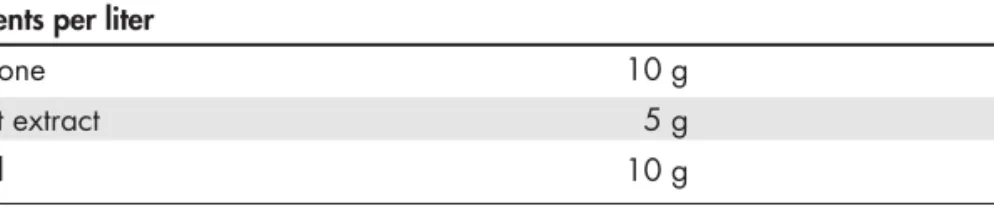
cells/ml, which typically corresponds to a pellet wet weight of approximately 3 g/liter medium. Please note that a number of slightly different LB culture broths, containing different concentrations of NaCl, are commonly used. We recommend growing cultures in LB medium containing 10 g NaCl per liter (Table 2) to obtain the highest plasmid yields.
Rich media are not recommended for plasmid preparation with QIAGEN-tips. If rich media must be used, growth time must be optimized, and culture volumes reduced. For more details, visit our plasmid resource page at www.qiagen.com/goto/plasmidinfo and click on the link “General Considerations for Optimal Results”.
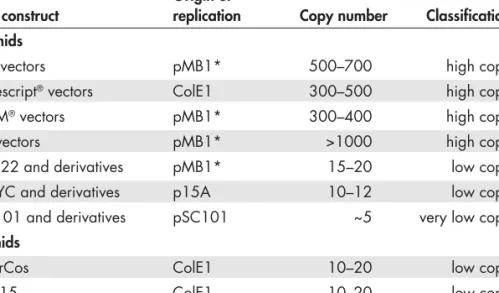
Table 1. Origins of Replication and Copy Numbers of Various Plasmids and Cosmids Origin of
DNA construct replication Copy number Classification
Plasmids
pUC vectors pMB1* 500–700 high copy
pBluescript®vectors ColE1 300–500 high copy
pGEM®vectors pMB1* 300–400 high copy
pTZ vectors pMB1* >1000 high copy
pBR322 and derivatives pMB1* 15–20 low copy
pACYC and derivatives p15A 10–12 low copy
pSC101 and derivatives pSC101 ~5 very low copy
Cosmids
SuperCos ColE1 10–20 low copy
pWE15 ColE1 10–20 low copy
* The pMB1 origin of replication is closely related to that of ColE1 and falls in the same incompatibility group. The high-copy plasmids listed here contain mutated versions of this origin.
Culture volume
Do not exceed the maximum recommended culture volumes given at the beginning of each protocol. Using larger culture volumes will lead to an increase in biomass and can affect the efficiency of alkaline lysis, leading to reduced yield and purity of the preparation.
The protocol for HiSpeed Midi and Maxi Kits is optimized for use with cultures grown in standard Luria Bertani (LB) medium (see page 13), grown to a cell density of approximately 3–4 x 10⁹ cells per ml. We advise harvesting cultures after
approximately 12–16 hours of growth, which typically is the transition from logarithmic into stationary growth phase. It is best to assess the cell density of the culture, and if that is too high, reduce the culture volumes accordingly or increase the volumes of Buffers P1, P2, and P3. A high ratio of biomass to lysis buffers will result in poor lysis conditions and subsequently low DNA yield and purity. For determination of cell density calibration of each individual spectrophotometer is required to facilitate accurate conversion of OD600measurements into the number of cells per ml. This can be achieved
by plating serial dilutions of a culture onto LB-agar plates in the absence of antibiotics. The counted colonies are used to calculate the number of cells per ml, which is then set in relation to the measured OD600values.
Capacity of HiSpeed Tips
The maximum binding capacity of HiSpeed Midi and Maxi Tips is 200 µg and 750 µg respectively. Actual yields will depend on a number of variables such as, culture volume, culture medium, plasmid copy number (see Table 1, page 13), size of insert, and host strain. Expected yields are given in the first section of the protocol. A final DNA concentration of up to 0.4 µg/µl (Midi) or 1.5 µg/µl (Maxi) can be expected if eluting a high-copy plasmid with 500 µl of Buffer TE. However, the final concentration of low-copy vectors may be considerably lower. Low-copy vectors or dilute samples may be concentrated by vacuum centrifugation or ethanol precipitation. For more details, visit our plasmid resource page at www.qiagen.com/goto/plasmidinfo and click on the link “General Considerations for Optimal Results”.
Table 2. Composition of Luria Bertani Medium Contents per liter
Tryptone 10 g
Yeast extract 5 g
NaCl 10 g
Setup of HiSpeed Tips
HiSpeed Tips can be held upright in a suitable collection vessel such as a tube or flask, using the tip holders provided with the kit (Figure 2A). Alternatively, HiSpeed Tips can be placed in the QIArack (cat. no. 19015), which has a removable collection tray for collecting liquid flow-through (Figure 2B). HiSpeed Maxi Tips fit in the QIArack and not in standard 50 ml collection tubes.
A B
Figure 2Setup of HiSpeed Tips
■
A with tip holder or■
B with the QIArack.Figure 1HiSpeed Midi and Maxi Tips.
Figure 4The QIAprecipitator in use.
Analytical gel analysis
The success of the plasmid purification procedure can be monitored on an analytical gel (see Figure 5, page 29). We recommend removing and saving aliquots where indicated during the purification procedure (samples 1–4). If the plasmid DNA is of low yield or quality, the samples can be analyzed by agarose gel electrophoresis to determine at what stage of the purification the problem occurred (see page 29). Convenient stopping points in protocols
The purification procedure can be stopped and continued later by freezing the cell pellets obtained by centrifugation. The frozen cell pellets may be stored at –20°C for several weeks. In addition, the DNA eluted from the HiSpeed Tip may be stored overnight at 2–8°C,* after which the protocol can be continued. These stopping points are indicated by the symbol ƒ.
Using LyseBlue reagent
LyseBlue is a color indicator which provides visual identification of optimum buffer mixing. This prevents common handling errors that lead to inefficient cell lysis and incomplete precipitation of SDS, genomic DNA, and cell debris. This makes LyseBlue ideal for use by researchers who have not had much experience with plasmid preparations as well as experienced scientists who want to be assured of maximum product yield.
LyseBlue can be added to the resuspension buffer (Buffer P1) bottle before use. Alternatively, smaller amounts of LyseBlue can be added to aliquots of Buffer P1, enabling single plasmid preparations incorporating visual lysis control to be performed. LyseBlue reagent should be added to Buffer P1 at a ratio of 1:1000 to achieve the required working concentration (e.g., 10 µl LyseBlue into 10 ml Buffer P1). Make sufficient LyseBlue/Buffer P1 working solution for the number of plasmid preps being performed.
LyseBlue precipitates after addition into Buffer P1. This precipitate will completely dissolve after addition of Buffer P2. Shake Buffer P1 before use to resuspend LyseBlue particles. The plasmid preparation procedure is performed as usual. After addition of Buffer P2 to Buffer P1, the color of the suspension changes to blue. Mixing should result in a homogeneously colored suspension. If the suspension contains localized regions of colorless solution or if brownish cell clumps are still visible, continue mixing the solution until a homogeneously colored suspension is achieved.
Upon addition of neutralization buffer (Buffer P3 or Buffer N3), LyseBlue turns colorless. The presence of a homogeneous solution with no traces of blue indicates that SDS from the lysis buffer has been effectively precipitated.
Protocol: Plasmid or Cosmid DNA Purification Using
HiSpeed Plasmid Midi and Maxi Kits
This protocol is for preparation of up to 200 µg of high- or low-copy plasmid or cosmid DNA using the HiSpeed Plasmid Midi Kitor 750 µg using the HiSpeed Plasmid Maxi Kit.
A final DNA concentration of up to 0.4 µg/µl (Midi) or 1.5 µg/µl (Maxi) can be expected, if eluting a high-copy plasmid with 500 µl of Buffer TE. However, the final concentration of copy vectors may be considerably lower. If higher yields of low-copy plasmids are desired, the lysates from two QIAfilter Cartridges can be loaded onto one HiSpeed Tip. In addition, eluates from low-copy vectors or dilute samples can be concentrated by spinning in a centrifuge under vacuum, or ethanol precipitation. Low-copy plasmids that have been amplified in the presence of chloramphenicol should be treated as high-copy plasmids when choosing the appropriate culture volume. Maximum Recommended Culture Volumes*
HiSpeed Plasmid HiSpeed Plasmid
Midi Kit Maxi Kit
High-copy plasmids 50 ml 150 ml
Low-copy plasmids 150 ml 250 ml
* For high-copy plasmids, expected yields are 100–200 µg for the HiSpeed Plasmid Midi Kit and 300–750 µg for the HiSpeed Plasmid Maxi Kit. For low-copy plasmids, expected yields are 30–100 µg for the HiSpeed Plasmid Midi Kit and 50–250 µg for the HiSpeed Plasmid Maxi Kit using these culture volumes.
† The maximum recommended culture volume applies to the capacity of the QIAfilter Cartridge. If higher yields of low-copy plasmids are desired, the lysates from two QIAfilter Cartridges can be loaded onto one HiSpeed Tip.
Important notes before starting
■ New users are advised to familiarize themselves with the detailed protocol provided in this handbook. In addition, extensive background information is provided on our plasmid resource page www.qiagen.com/goto/plasmidinfo .
■ Optional: Remove samples at the steps indicated with the symbol ☞in order to monitor the procedure on an analytical gel (see page 29)
■ Blue(marked with a ▲) denotes values for the HiSpeed Plasmid Midi Kit; red
Plasmid Midi
Things to do before starting
■ Add the provided RNase A solution to Buffer P1 before use. Use one vial of RNase A (centrifuge briefly before use) per bottle of Buffer P1, to give a final concentration of 100 µg/ml.
■ Check Buffer P2 for SDS precipitation due to low storage temperatures. If necessary, dissolve the SDS by warming to 37°C.
■ Pre-chill Buffer P3 at 4°C.
■ Optional: Add the provided LyseBlue reagent to Buffer P1 and mix before use. Use one vial LyseBlue (centrifuge briefly before use) per bottle of Buffer P1 to achieve a 1:1000 dilution. LyseBlue provides visual identification of optimum buffer mixing thereby preventing the common handling errors that lead to inefficient cell lysis and incomplete precipitation of SDS, genomic DNA, and cell debris. For more details see “Using LyseBlue reagent” on page 16.
Procedure
1. Pick a single colony from a freshly streaked selective plate and inoculate a starter culture of 2–5 ml LB medium containing the appropriate selective antibiotic. Incubate for approx. 8 h at 37°C with vigorous shaking (approx. 300 rpm). Use a tube or flask with a volume of at least 4 times the volume of the culture. 2. Dilute the starter culture 1/500 to 1/1000 into selective LB medium. For high-copy
plasmids inoculate ▲ 50 ml or ● 150 ml medium. For low-copy plasmids, inoculate ▲150 mlor ●250 ml medium. Grow at 37°C for 12–16 h with vigorous shaking (approx. 300 rpm).
Use a flask or vessel with a volume of at least 4 times the volume of the culture. The culture should reach a cell density of approximately 3–4 x 10⁹ cells per
milliliter, which typically corresponds to a pellet wet weight of approximately 3 g/liter.
3. Harvest the bacterial cells by centrifugation at 6000 x gfor 15 min at 4°C. Remove all traces of supernatant by inverting the open centrifuge tube until all medium has been drained.
ƒ If you wish to stop the protocol and continue later, freeze the cell pellet at –20°C.
4. Resuspend the bacterial pellet in ▲ 6 mlor ●10 ml Buffer P1.
For efficient lysis it is important to use a vessel that is large enough to allow complete mixing of the lysis buffers. Ensure that RNase A has been added to Buffer P1. If LyseBlue reagent has been added to Buffer P1, vigorously shake the buffer bottle before use to ensure LyseBlue particles are completely resuspended. The bacteria should be resuspended completely by vortexing or pipetting up and down until no cell clumps remain.
5. Add ▲ 6 mlor ● 10 ml Buffer P2, mix thoroughly by vigorously inverting the sealed tube 4–6 times, and incubate at room temperature (15–25°C) for 5 min. Do not vortex, as this will result in shearing of genomic DNA. The lysate should appear viscous. Do not allow the lysis reaction to proceed for more than 5 min. After use, the bottle containing Buffer P2 should be closed immediately to avoid acidification from CO2in the air.
If LyseBlue has been added to Buffer P1 the cell suspension will turn blue after addition of Buffer P2. Mixing should result in a homogeneously colored suspension. If the suspension contains localized colorless regions or if brownish cell clumps are still visible, continue mixing the solution until a homogeneously colored suspension is achieved.
During the incubation prepare the QIAfilter Cartridge:
Screw the cap onto the outlet nozzle of the QIAfilter Midi or QIAfilter Maxi
Cartridge.
Place the QIAfilter Cartridge into a convenient tube or a QIArack.
6. Add ▲ 6 ml or ●10 mlchilled Buffer P3 to the lysate, and mix immediately and
thoroughly by vigorously inverting 4–6 times. Proceed directly to step 7. Do not incubate the lysate on ice.
Precipitation is enhanced by using chilled Buffer P3. After addition of Buffer P3, a fluffy white precipitate containing genomic DNA, proteins, cell debris, and KDS becomes visible. The buffers must be mixed completely. If the mixture appears still viscous and brownish, more mixing is required to completely neutralize the solution. It is important to transfer the lysate into the QIAfilter Cartridge immediately in order to prevent later disruption of the precipitate layer.
If LyseBlue reagent has been used, the suspension should be mixed until all trace of blue has gone and the suspension is colorless. A homogeneous colorless suspension indicates that the SDS has been effectively precipitated.
7. Pour the lysate into the barrel of the QIAfilter Cartridge. Incubate at room temperature for 10 min. Do not insert the plunger!
Important: This 10 min incubation at room temperature is essential for optimal performance of the QIAfilter Cartridge. Do not agitate the QIAfilter Cartridge during this time. A precipitate containing proteins, genomic DNA, and detergent will float and form a layer on top of the solution. This ensures convenient filtration without clogging. If, after the 10 min incubation, the precipitate has not floated to
Plasmid Midi
8. Equilibrate a ▲ HiSpeed Midior ● HiSpeed MaxiTip by applying ▲ 4 mlor
●10 ml Buffer QBT and allow the column to empty by gravity flow.
Flow of buffer will begin automatically by reduction in surface tension due to the presence of detergent in the equilibration buffer. Allow the HiSpeed Tip to drain completely. HiSpeed Tips can be left unattended, since the flow of buffer will stop when the meniscus reaches the upper frit in the column.
9. Remove the cap from the QIAfilter outlet nozzle. Gently insert the plunger into the
▲ QIAfilter Midior ● QIAfilter MaxiCartridge and filter the cell lysate into the
previously equilibrated HiSpeed Tip.
Filter until all of the lysate has passed through the QIAfilter Cartridge, but do not apply extreme force. Approximately ▲15 mlor ●25 mlof the lysate is generally recovered after filtration.
☞ Remove a ▲300 µlor ●120 µlsample of the filtered lysate and save for an analytical gel (sample 1) in order to determine whether growth and lysis conditions were optimal.
10. Allow the cleared lysate to enter the resin by gravity flow.
☞ Remove a ▲ 300 µlor ●120 µlsample of the flow-through and save for an analytical gel (sample 2) in order to determine the efficiency of DNA binding to the QIAGEN Resin.
11. Wash the ▲HiSpeed Midior ●HiSpeed MaxiTip with ▲20 mlor ●60 mlBuffer QC.
Allow Buffer QC to move through the HiSpeed Tip by gravity flow.
☞ Remove a ▲400 µlor ●240 µl sample of the wash fraction and save for an analytical gel (sample 3).
12. Elute DNA with ▲5 mlor ●15 mlBuffer QF.
Collect the eluate in a tube with a minimum capacity of ▲10 mlor ●30 ml.
☞ Remove a ▲100 µl or ●60 µl sample of the eluate and save for an analytical gel (sample 4).
ƒ If you wish to stop the protocol and continue later, store the eluate at 4°C. Storage periods longer than overnight are not recommended.
13. Precipitate DNA by adding ▲3.5 ml or ●10.5 ml (0.7 volumes) room-temperature isopropanol to the eluted DNA. Mix and incubate at room temperature for 5 min.
All solutions should be at room temperature in order to minimize salt precipitation.
Plasmid Midi
and Maxi Kits
14. During the incubation remove the plunger from a ▲20 mlor ●30 mlsyringe and attach the ▲QIAprecipitator Midi Moduleor ●QIAprecipitator Maxi Moduleonto the outlet nozzle. Do not use excessive force, bending, or twisting to attach the QIAprecipitator!
Important:Always remove the QIAprecipitator from the syringe before pulling up the plunger!
15. Place the QIAprecipitator over a waste bottle, transfer the eluate/isopropanol mixture into the ▲ 20 mlor ●30 mlsyringe, and insert the plunger. Filter the eluate/isopropanol mixture through the QIAprecipitator using constant pressure. Alternatively, the QIAprecipitator attached to the ▲20 mlor ●30 mlsyringe can be placed on a QIAvac 24 Plus or QIAvac 6S manifold. Use of VacConnectors (cat. no. 19407) is recommended for vacuum processing, in order to raise the QIAprecipitator above the level of adjacent luer extensions. Switch on vacuum to draw the eluate/isopropanol mixture through the QIAprecipitator. Switch off the vacuum once all the liquid has been drawn through.
Important:Complete the QIAprecipitator procedure (steps 16–21) within 10 min. To prevent detachment of the QIAprecipitator and subsequent loss of DNA and alcohol, do not use excessive force when pushing liquid through the QIAprecipitator.
16. Remove the QIAprecipitator from the ▲20 mlor ●30 mlsyringe and pull out the plunger. Re-attach the QIAprecipitator and add 2 ml 70% ethanol to the syringe. Wash the DNA by inserting the plunger and pressing the ethanol through the QIAprecipitator using constant pressure.
Alternatively, if you are using the vacuum procedure, add 2 ml 70% ethanol, and switch on vacuum to draw the ethanol through the QIAprecipitator. Keep vacuum on for 3 min. Proceed to step 18.
17. Remove the QIAprecipitator from the ▲20 mlor ●30 mlsyringe and pull out the plunger. Attach the QIAprecipitator to the ▲20 ml or ●30 ml syringe again, insert the plunger, and dry the membrane by pressing air through the QIAprecipitator quickly and forcefully. Repeat this step.
18. Dry the outlet nozzle of the QIAprecipitator with absorbent paper to prevent ethanol carryover.
Plasmid Midi
19. Remove the plunger from a new 5 ml syringe and attach the QIAprecipitator onto the outlet nozzle. Hold the outlet of the QIAprecipitator over a 1.5 ml collection tube. Add 1 ml of Buffer TE to the 5 ml syringe. Insert the plunger and elute the DNA into the collection tube using constant pressure.
Ensure that the outlet of the QIAprecipitator is held over the collection tube when Buffer TE is poured into the syringe, as eluate can drip through the QIAprecipitator before the syringe barrel is inserted.
Be careful, as residual elution buffer in the QIAprecipitator tends to foam when expelled.
Alternatively, if a higher DNA concentration is desired and a reduction in yield of up to 10% is acceptable, elute with 500 µl Buffer TE. Lower volumes of elution buffer are not recommended, since incomplete wetting of the QIAprecipitator membrane will lead to reduced DNA yields.
Water or buffers commonly used to dissolve DNA (e.g., Tris, may also be used for elution).
Note: TE Buffer contains EDTA which may inhibit downstream enzymatic or sequencing reactions.
Note: Store DNA at –20°C when eluted with water as DNA may degrade in the absence of buffering and chelating agents.
20. Remove the QIAprecipitator from the 5 ml syringe, pull out the plunger and reattach the QIAprecipitator to the 5 ml syringe.
21. Transfer the eluate from step 19 to the 5 ml syringe and elute for a second time into the same 1.5 ml tube.
This re-elution step ensures that the maximum amount of DNA in the QIAprecipitator is solubilized and recovered.
Be careful, as residual elution buffer in the QIAprecipitator tends to foam when expelled.
Determination of yield
To determine the yield, DNA concentration should be determined by both UV spectrophotometry at 260 nm and quantitative analysis on an agarose gel. For reliable spectrophotometric DNA quantification, A260readings should lie between 0.1 and 1.0.
Agarose gel analysis
We recommend removing and saving aliquots during the purification procedure (samples 1–4). If the plasmid DNA is of low yield or quality, the samples can be analyzed by agarose gel electrophoresis to determine at what stage of the purification procedure the problem occurred (see page 29).
Troubleshooting Guide
Poor yields and quality can be caused by a number of different factors. For optimal plasmid preparation conditions, particular attention should be paid to the lysis conditions as described in the protocol. In addition, adhering to our recommendations with respect to plasmid copy number, capacity of QIAGEN-tip, culture volume, and culture media will ensure consistent and optimal results.
The following troubleshooting guide as well “General Considerations for Optimal Results” provided on our Web page www.qiagen.com/goto/plasmidinfo may be helpful in solving any problems that may arise. The scientists at QIAGEN Technical Service are always happy to answer any questions you may have about either the information and protocols in this handbook or molecular biology applications (see back cover for contact information).
This troubleshooting guide is divided into three sections: The first details general troubleshooting relevant to all HiSpeed Plasmid Kits, the second is specifically for QIAfilter Cartridges, and the third for QIAprecipitator Modules.
Comments and suggestions
Low or no DNA yield
No DNA in lysate (sample 1)
a) Plasmid did not Please read ”Growth of Bacterial Cultures” on our Web propagate page www.qiagen.com/goto/plasmidinfo , and check
that the conditions for optimal growth were met. b) Alkaline lysis If cells have grown to very high densities or a larger
was inefficient amount of cultured medium than recommended was used, the ratio of biomass to lysis reagent is shifted. This may result in poor lysis conditions, because the volumes of Buffers P1, P2, and P3 are not sufficient for setting the plasmid DNA free efficiently. Reduce culture volume or increase volumes of Buffers P1, P2, and P3. Also, insufficient mixing of lysis reagents will result in reduced yield. Mix thoroughly after addition of Buffers P1, P2, and P3 to achieve homogeneous suspensions. Use LyseBlue to visualize efficiency of mixing.
Comments and suggestions
d) Lysate incorrectly Check Buffer P2 for SDS precipitation resulting from low prepared storage temperatures and dissolve the SDS by warming. The bottle containing Buffer P2 should always be closed immediately after use. Lysis buffers prepared in the laboratory should be prepared according to the instructions on page 32.
If necessary, prepare fresh Buffers P1, P2, and P3. DNA in flow-though fraction (sample 2)
a) Column was Check the culture volume and yield against the capacity overloaded of the HiSpeed Tip, as detailed at the beginning of the
protocol. Reduce the culture volume accordingly. b) SDS (or other ionic Chill Buffer P3 before use. If the lysate is cleared by
detergent) was in lysate centrifugation, load onto HiSpeed Tip promptly after centrifugation. If lysate is too viscous for effective mixing of Buffer P3, reduce culture volume or increase volumes of Buffers P1, P2, and P3.
Use LyseBlue to visualize efficiency of mixing.
c) Inappropriate salt Ensure that any buffers prepared in the laboratory or pH conditions were prepared according to the instructions provided
in buffers on page 32.
d) Column flow was Store HiSpeed Tips at room temperature (15–25°C). uneven If stored under cold, damp conditions for prolonged
periods of time, the resin may clump. This problem can be overcome by shaking the column before use. DNA in Buffer QC wash fraction (sample 3)
a) Column was Check the culture volume and yield against the capacity overloaded of the HiSpeed Tip, as detailed at the beginning of the
protocol. Reduce the culture volume accordingly. b) Buffer QC was Check pH and salt concentration of Buffer QC. Recover
incorrect DNA by precipitation, and purify on a new HiSpeed Tip as detailed in “Purification of Plasmid DNA Prepared by Other Methods” on our Web page www.qiagen.com/ goto/plasmidinfo .
Comments and suggestions No DNA in eluate (sample 4)
a) No DNA in the lysate See section “No DNA in lysate” page 23.
b) Elution Buffer QF Check pH and salt concentration of Buffer QF. Recover was incorrect DNA by eluting with fresh buffer.
c) DNA passed through See previous two sections. in the flow-through
or wash fraction
Contaminated DNA/poor-quality DNA
a) Genomic DNA Mixing of bacterial lysate was too vigorous. The lysate in the eluate should not be vortexed after addition of Buffers P2 and P3 to prevent shearing of chromosomal DNA. Reduce culture volume if lysate is too viscous for gentle mixing. b) RNA in the eluate RNase A digestion was insufficient. Check culture
volume against recommended volumes, and reduce if necessary. Check that the RNase A provided with the kit has been used. If Buffer P1 is more than 6 months old, add more RNase A. Recover DNA by precipitating the eluate, digesting with RNase A, and purifying on a new HiSpeed Tip.
c) Nuclease Check buffers for nuclease contamination and replace contamination if necessary. Use new glass- and plasticware, and wear
gloves.
d) Lysis time was too long Ensure that the lysis step (Buffer P2) does not exceed 5 min.
e) Too much cell Check the culture volume and yield against the capacity material in the of the HiSpeed Tip. Reduce the culture volume alkaline lysis accordingly or alternatively increase the volumes of
Buffers P1, P2, and P3.
f) Plasmid DNA is nicked/ DNA was poorly buffered. Redissolve DNA in TE buffer, sheared/degraded pH 8.0, to inhibit nuclease activity and maintain stable
pH during storage.
Comments and suggestions Poor DNA performance
a) Residual protein Check culture volume against the recommended volumes and reduce if necessary. Ensure that the bacterial lysate is cleared properly by centrifugation at ≥20,000 x gfor 45 min, or using a QIAfilter Cartridge.
Extra DNA bands on analytical gel
a) Dimer form of plasmid Dimers or multimers of supercoiled plasmid DNA are formed during replication of plasmid DNA. Typically, when purified plasmid DNA is electrophoresed, both the supercoiled monomer and dimer form of the plasmid are detected upon ethidium bromide staining of the gel (see Figure 5, page 29). The ratio of these forms is often host dependent.
b) Plasmid has formed This species runs faster than closed circular DNA on a denatured supercoils gel and is resistant to restriction digestion (see Figure 5, page 29). Do not incubate cells for longer than 5 min in Buffer P2. Mix immediately after addition of Buffer P3.
c) Possible deletion Some sequences are poorly maintained in plasmids. mutants Check for deletions by restriction analysis. Cosmid clones, in particular, should always be prepared from freshly streaked, well-isolated colonies, since cosmids are not stable in E. colifor long periods of time. Blocked QIAGEN-tip
Lysate was turbid Ensure that the lysate is clear before it is loaded onto the column. Ensure that Buffer P3 is chilled before use. To clear a blocked HiSpeed Tip, positive pressure may be applied, (e.g., by using a syringe fitted into a rubber stopper with a hole).
QIAfilter Cartridges
QIAfilter Cartridge clogs during filtration
a) Too large culture Use no more than the culture volume recommended in
volume used the protocol.
b) Inefficient mixing Mix well until a fluffy white material has formed and the after addition lysate is no longer viscous.
Comments and suggestions
c) Mixing too vigorous After addition of Buffer P3 the lysate should be mixed after addition immediately but gently. Vigorous mixing disrupts the of Buffer P3 precipitate into tiny particles which may clog the
QIAfilter Cartridge.
d) QIAfilter Cartridge After addition of Buffer P3 the lysate should be poured was not loaded immediately into the QIAfilter Cartridge. Decanting immediately after after incubation may disrupt the precipitate into tiny addition of Buffer P3 particles which may clog the QIAfilter Cartridge. e) QIAfilter Cartridge Pour the lysate into the QIAfilter Cartridge immediately
was agitated during after addition of Buffer P3 and do not agitate during the
incubation 10 min incubation.
Agitation causes the precipitate to be disrupted into tiny particles, instead of forming a layer.
f) Incubation after Ensure incubation is performed at room temperature addition of Buffer P3 Buffer P3 on ice instead of in the QIAfilter Cartridge. on ice instead of at RT Precipitate flotation is more efficient at room
temperature than on ice.
g) Incubation time after Incubate with Buffer P3 as indicated in the protocol. addition of Buffer P3 If the precipitate has not risen to the top after the 10 min too short incubation, carefully run a sterile pipet tip or sterile spatula around the cartridge wall to dislodge the precipitate before continuing with the filtration. Lysate not clear after filtration
Precipitate was forced Filter until all of the lysate has passed through the through the QIAfilter QIAfilter Midi or Maxi Cartridge, but do not apply
Cartridge extreme force. Approximately 15 ml (Midi) or 25 ml
(Maxi) of the lysate are typically recovered.
QIAprecipitator Modules
DNA does not perform well
Eluate contains Ensure that the membrane is dried by pressing air residual alcohol through the QIAprecipitator at least twice. Dry the outlet
Comments and suggestions QIAprecipitator clogs during use
a) Too much DNA applied Do not load eluate from several columns on the to the QIAprecipitator QIAprecipitator.
b) QIAprecipitator Midi Use the size of QIAprecipitator corresponding to the Module was used for HiSpeed Tip being used.
precipitation of eluate from a HiSpeed Maxi Tip
c) Ethanol was used for Use of ethanol instead of isopropanol for precipitation precipitation instead leads to a finer precipitate that can clog the module. of isopropanol
QIAprecipitator casing breaks, causing leakage
a) Excessive exposure of Prolonged incubation with alcohol may weaken the joint QIAprecipitator between upper and lower part of the QIAprecipitator. to alcohol Complete steps 15–21 within 10–15 min.
b) QIAprecipitator Do not apply excessive force, bending, or twisting attached with when attaching the QIAprecipitator to the syringe. excessive force
c) QIAprecipitator inlet Do not stress the inlet by resting one edge of the was bent during QIAprecipitator on a hard surface (e.g., the edge of processing a sink) and depressing the syringe plunger. Always
apply gentle, even, pressure perpendicularly to the QIAprecipitator.
Appendix A: Agarose Gel Analysis of the Purification
ProcedureDNA yields and quality can be readily analyzed by agarose gel electrophoresis. Poor yields and quality can be caused by a number of different factors. To determine at what stage of the procedure any problem occurred, save fractions from different steps of the purification procedure (see below and Table 3), and analyze by agarose gel electrophoresis.
Preparation of samples
Remove aliquots from the cleared lysate (sample 1), flow-through (sample 2), combined Buffer QC wash fractions (sample 3), and Buffer QF eluate (sample 4), as indicated in each protocol and in Table 3. Precipitate the nucleic acids with 1 volume of isopropanol, rinse the pellets with 70% ethanol, drain well, and resuspend in 10 µl TE buffer, pH 8.0.
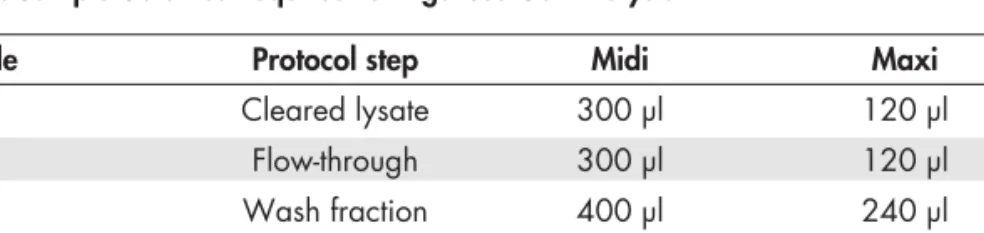
Table 3. Sample Volumes Required for Agarose Gel Analysis
Sample Protocol step Midi Maxi
1 Cleared lysate 300 µl 120 µl
2 Flow-through 300 µl 120 µl
3 Wash fraction 400 µl 240 µl
4 Eluate 100 µl 60 µl
Agarose gel analysis
Run 2 µl of each sample on a 1% agarose gel for analysis of the fractions at each stage of the plasmid purification procedure. Figure 5 shows an analytical gel of the different fractions, together with examples of problems that can arise at each step. If you find that you have a problem with a particular step of the protocol, turn to the hints in the relevant section of the troubleshooting guide on pages 23–28. If the problem remains unresolved, or if you have any further questions, please call QIAGEN Technical Service. L: Cleared lysate containing supercoiled and open circular plasmid DNA and degraded RNA (sample 1).
F: Flow-through fraction containing only degraded RNA is depleted of plasmid DNA which is bound to the QIAGEN Resin (sample 2).
W: Wash fraction, in which the remaining traces of RNA are removed without affecting the binding of the DNA (sample 3).
E: The eluate containing pure plasmid DNA with no other contaminating nucleic acids (sample 4).
M: Lambda DNA digested with HindIII.
Lanes 1–5 illustrate some atypical results that may be observed in some preparations, depending on plasmid type and host strain.
Lane 1: Supercoiled (lower band) and open circular form (upper band) of the high-copy plasmid pUC18 with an additional band of denatured supercoiled DNA migrating just below the supercoiled form. This form may result from prolonged alkaline lysis with Buffer P2 and is resistant to restriction digestion.
Lane 2: Multimeric forms of supercoiled plasmid DNA (pTZ19) which may be observed with some host strains, and should not be mistaken for genomic DNA. Multimeric plasmid DNA can easily be distinguished from genomic DNA by a simple restriction digestion: linearization of a plasmid sample displaying multimeric bands will yield a single defined band with the size of the linearized plasmid monomer (see lane 3). Lane 3: Linearized form of plasmid pTZ19 after restriction digestion with EcoRI. Lane 4: Sample contaminated with bacterial chromosomal DNA, which may be observed if the lysate is treated too vigorously (e.g., vortexing during incubation steps with Buffer P2 or P3). Genomic DNA contamination can easily be identified by digestion of the sample with EcoRI. A smear is observed, in contrast to the linear band seen after digestion of multimeric plasmid forms.
Lane 5: EcoRI digestion of a sample contaminated with bacterial genomic DNA which gives a smear above the plasmid DNA.
Appendix B: Composition of Buffers
Buffer Composition Storage
Buffer P1 (resuspension buffer) 50 mM Tris·Cl, pH 8.0; 2–8°C, after
10 mM EDTA; addition of
100 µg/ml RNase A RNase A
Buffer P2 (lysis buffer) 200 mM NaOH, 1% SDS (w/v) 15–25°C Buffer P3 (neutralization buffer) 3.0 M potassium acetate, 15–25°C
pH 5.5 or 2–8°C
Buffer FWB2 (QIAfilter wash buffer) 1 M potassium acetate 15–25°C pH 5.0
Buffer QBT (equilibration buffer) 750 mM NaCl; 15–25°C
50 mM MOPS, pH 7.0; 15% isopropanol (v/v); 0.15% Triton®X-100 (v/v)
Buffer QC (wash buffer) 1.0 M NaCl; 15–25°C
50 mM MOPS, pH 7.0; 15% isopropanol (v/v)
Buffer QF (elution buffer) 1.25 M NaCl; 15–25°C
50 mM Tris·Cl, pH 8.5; 15% isopropanol (v/v)
Buffer QN (elution buffer) 1.6 M NaCl; 15–25°C
50 mM MOPS, pH 7.0; 15% isopropanol (v/v) TE 10 mM Tris·Cl, pH 8.0; 15–25°C 1 mM EDTA STE 100 mM NaCl; 15–25°C 10 mM Tris·Cl, pH 8.0; 1 mM EDTA
Preparation of buffers
Buffer compositions are given per liter of solution. Do not autoclave MOPS- or isopropanol-containing buffers; sterilize by filtration instead.
Buffer calculations are based on Tris base adjusted to pH with HCl (Tris·Cl). If using Tris·Cl reagent, the quantities used should be recalculated.
P1: Dissolve 6.06 g Tris base, 3.72 g Na2EDTA·2H2O in 800 ml distilled water.
Adjust the pH to 8.0 with HCl. Adjust the volume to 1 liter with distilled water. Add 100 mg RNase A per liter of P1.
P2: Dissolve 8.0 g NaOH pellets in 950 ml distilled water, 50 ml 20% SDS (w/v) solution. The final volume should be 1 liter.
P3: Dissolve 294.5 g potassium acetate in 500 ml distilled water. Adjust the pH to 5.5 with glacial acetic acid (~110 ml). Adjust the volume to 1 liter with distilled water.
FWB2:Dissolve 98.2 g potassium acetate in 500 ml distilled water. Adjust the pH to 5.0 with glacial acetic acid (~36 ml). Adjust the volume to 1 liter with distilled water.
QBT: Dissolve 43.83 g NaCl, 10.46 g MOPS (free acid) in 800 ml distilled water. Adjust the pH to 7.0 with NaOH. Add 150 ml pure isopropanol and 15 ml 10% Triton X-100 solution (v/v). Adjust the volume to 1 liter with distilled water. QC: Dissolve 58.44 g NaCl and 10.46 g MOPS (free acid) in 800 ml distilled water.
Adjust the pH to 7.0 with NaOH. Add 150 ml pure isopropanol. Adjust the volume to 1 liter with distilled water.
QF: Dissolve 73.05 g NaCl and 6.06 g Tris base in 800 ml distilled water and adjust the pH to 8.5 with HCl. Add 150 ml pure isopropanol. Adjust the volume to 1 liter with distilled water.
QN: Dissolve 93.50 g NaCl and 10.46 g MOPS (free acid) in 800 ml distilled water and adjust the pH to 7.0 with NaOH. Add 150 ml pure isopropanol. Adjust the volume to 1 liter with distilled water.
STE: Dissolve 5.84 g NaCl, 1.21 g Tris base, and 0.37 g Na2EDTA·2H2O in 800 ml
distilled water. Adjust the pH to 8.0 with HCl. Adjust the volume to 1 liter with distilled water.
Note: Always recheck pH of buffers after preparation. Preparation of LB medium
Dissolve 10 g tryptone, 5 g yeast extract, and 10 g NaCl in 800 ml distilled water. Adjust the pH to 7.0 with 1 N NaOH. Adjust the volume to 1 liter with distilled water. Sterilize by autoclaving.
Ordering Information
Product Contents Cat. no.
HiSpeed Plasmid Kits
HiSpeed Plasmid Midi Kit (25) 25 HiSpeed Midi Tips, 12643
25 QIAfilter Midi Cartridges, 25 QIAprecipitator Midi Modules, plus Syringes, Reagents, Buffers
HiSpeed Plasmid Maxi Kit (10) 10 HiSpeed Maxi Tips, 12662
10 QIAfilter Maxi Cartridges, 10 QIAprecipitator Maxi Modules, plus Syringes, Reagents, Buffers
HiSpeed Plasmid Maxi Kit (25) 25 HiSpeed Maxi Tips, 12663
25 QIAfilter Maxi Cartridges, 25 QIAprecipitator Maxi Modules, plus Syringes, Reagents, Buffers QIAGEN Plasmid Kits
QIAGEN Plasmid Midi Kit (25) 25 QIAGEN-tip 100, 12143
Reagents, Buffers
QIAGEN Plasmid Midi Kit (100) 100 QIAGEN-tip 100, 12145
Reagents, Buffers
QIAGEN Plasmid Maxi Kit (10) 10 QIAGEN-tip 500, 12162
Reagents, Buffers
QIAGEN Plasmid Maxi Kit (25) 25 QIAGEN-tip 500, 12163
Reagents, Buffers
QIAGEN Plasmid Maxi Kit (100) 100 QIAGEN-tip 500, 12165
Reagents, Buffers
QIAGEN Plasmid Mega Kit (5) 5 QIAGEN-tip 2500, 12181
Reagents, Buffers
QIAGEN Plasmid Mega Kit (25) 25 QIAGEN-tip 2500, 12183
Reagents, Buffers
QIAGEN Plasmid Giga Kit (5) 5 QIAGEN-tip 10000, 12191
Ordering Information
Product Contents Cat. no.
QIAfilter Plasmid Maxi Kit (10) 10 QIAGEN-tip 500, Reagents, 12262
Buffers, 10 QIAfilter Maxi Cartridges
QIAfilter Plasmid Maxi Kit (25) 25 QIAGEN-tip 500, Reagents, 12263
Buffers, 25 QIAfilter Maxi Cartridges
QIAfilter Plasmid Mega Kit (5) 5 QIAGEN-tip 2500, Reagents, Buffers, 12281
5 QIAfilter Mega-Giga Cartridges
QIAfilter Plasmid Giga Kit (5) 5 QIAGEN-tip 10000, Reagents, Buffers, 12291
5 QIAfilter Mega-Giga Cartridges EndoFree Plasmid Kits
EndoFree Plasmid Maxi Kit (10) 10 QIAGEN-tip 500, Reagents, 12362
10 QIAfilter Maxi Cartridges, Endotoxin-free Buffers
EndoFree Plasmid Mega Kit (5) 5 QIAGEN-tip 2500, Reagents, 12381
5 QIAfilter Mega-Giga Cartridges, Endotoxin-free Buffers
EndoFree Plasmid Giga Kit (5) 5 QIAGEN-tip 10000, Reagents, 12391
5 QIAfilter Mega-Giga Cartridges, Endotoxin-free Buffers
QIAprep Spin Kits
QIAprep Spin Miniprep Kit (50) 50 QIAprep Spin Columns, Reagents, 27104
Buffers, Collection Tubes (2 ml)
QIAprep Spin Miniprep Kit (250) 250 QIAprep Spin Columns, Reagents, 27106
Buffers, Collection Tubes (2 ml) CompactPrep Plasmid Kits*
CompactPrep Plasmid Midi Kit (25)* 25 CompactPrep Midi Columns, 12743
Extender Tubes, Reagents, Buffers, 25 QIAfilter Midi Cartridges
CompactPrep Plasmid Midi Kit (100)* 100 CompactPrep Midi Columns, 12745
Extender Tubes, Reagents, Buffers, 100 QIAfilter Midi Cartridges
CompactPrep Plasmid Maxi Kit (25)* 25 CompactPrep Maxi Columns, 12763
Extender Tubes, Reagents, Buffers, 25 QIAfilter Maxi Cartridges
Ordering Information
Product Contents Cat. no.
CompactPrep Plasmid Maxi Kit 100 CompactPrep Maxi Columns, 12765
(100)* Extender tubes, Reagents, Buffers,
100 QIAfilter Maxi Cartridges
CompactPrep Plasmid Midi Core Kit 100 CompactPrep Midi Columns, 12845
(100)* Extender tubes, Reagents, Buffers
CompactPrep Plasmid Maxi Core Kit 100 CompactPrep Maxi Columns, 12865
(100)* Extender tubes, Reagents, Buffers
Large-Construct Kit
QIAGEN Large-Construct Kit 10 QIAGEN-tip 500, 12462
ATP-Dependent Exonuclease†,
Reagents, Buffers Transfection reagents
PolyFect Transfection For 25–65 transfections in 60 mm 301105
Reagent (1 ml) dishes or 50–100 transfections
in 6-well plates
Effectene Transfection For 40 transfections in 60 mm dishes 301425
Reagent (1 ml) or 160 transfections in12-well plates
SuperFect Transfection For 40 transfections in 60 mm dishes 301305
Reagent (1.2 ml) or 160 transfections in 12-well plates
Accessories
QIArack 1 rack for 12 x QIAGEN-tip 20, 19015
8 x QIAGEN-tip 100, 6 x QIAGEN-tip 500 or 6 x HiSpeed Midi Tips, 4 x QIAGEN-tip 2500 or 4 x HiSpeed Maxi Tips, and 10 QIAfilter
Midi or Maxi Cartridges
QIAvac 24 Plus Vacuum manifold for processing 19413
1–24 spin columns: QIAvac 24 Plus Vacuum manifold, Luer Plugs, Quick Couplings
Ordering Information
Product Contents Cat. no.
VacConnectors (500) 500 disposable connectors for use 19407
with luer connectors
Luer Adapter Set* For processing 1–24 QIAGEN spin 19541
columns on QIAvac 6S: 6 adapters with 4 luer connectors each, 24 plugs
QIAfilter Midi Cartridges (25) 25 QIAfilter Midi Cartridges 19743
QIAfilter Maxi Cartridges (25) 25 QIAfilter Maxi Cartridges 19763
RNase A 2.5 ml (100 mg/ml; 19101
7000 units/ml solution)
Plasmid Buffer Set Buffers P1, P2, P3, QBT, QC, QF, 19046
RNase A; for 100 plasmid mini-, 25 midi-, or 10 maxipreps
EndoFree Plasmid Buffer Set Buffers P1, P2, P3, QBT, QC, QN, 19048
ER, TE, Endotoxin-free H2O, RNase A;
for 10 plasmid mega- or 5 gigapreps (endotoxin-free)
Buffer P1 500 ml Resuspension Buffer 19051
(RNase A not included)
Buffer P2 500 ml Lysis Buffer 19052
Buffer P3 500 ml Neutralization Buffer 19053
Buffer QBT 1000 ml Equilibration Buffer 19054
Buffer QC 1000 ml Wash Buffer 19055
Buffer QF 1000 ml Elution Buffer 19056
QIAGEN Companies
Please see the back cover for contact information for your local QIAGEN office.
QIAGEN Distributors
Argentina Tecnolab S. A. Tel: (011) 4555 0010 Fax: (011) 4553 3331 E-mail: [email protected] Web site: www.tecnolab.com.arBrazil
Uniscience do Brasil Tel: 011 3622 2320 Fax: 011 3622 2323 E-mail: [email protected] Web site: www.uniscience.com
Chile
Biosonda SA Tel: 562 209 6770 Fax: 562 274 5462 E-mail: [email protected] Web site: www.biosonda.cl
Croatia
INEL Medicinska Tehnika d.o.o. Tel: (01) 2984-898 Fax: (01) 6520-966 E-mail: [email protected] Cyprus Scientronics Ltd Tel: 02-357 22 765416 Fax: 02-357 22 764614 E-mail: [email protected] Czech Republic
BIO-CONSULT spol. s.r.o. Tel/Fax: (420) 2 417 29 792 E-mail: [email protected] Web site: www.bioconsult.cz
Egypt Clinilab Tel: 52 57 212 Fax: 52 57 210 E-mail: [email protected] Estonia PEAI-Est OÜ Tel: (051) 65 830 Fax: (07) 383 360 E-mail: [email protected] Greece BioAnalytica S. A. Tel: (210)-640 03 18 Fax: (210)-646 27 48 E-mail: [email protected] Web site: www.bioanalytica.gr
Hungary
Kasztel-Med Co. Ltd. Tel: (01) 385 3887 Fax: (01) 381 0695 E-mail: [email protected] Web site: www.kasztel.hu
India Genetix Tel: (011)-2542 1714 or (011)-2515 9346 Fax: (011)-2546 7637 E-mail: [email protected] Israel Westburg (Israel) Ltd. Tel: 08-6900655 or 1-800 20 22 20 (toll free) Fax: 08-6900650 E-mail: [email protected] Web site: www.westburg.co.il
Korea
LRS Laboratories, Inc. Tel: (02) 924-86 97 Fax: (02) 924-86 96 E-mail: [email protected] Web site: www.lrslab.co.kr
Malaysia RESEARCH BIOLABS SDN. BHD. Tel: (603)-8070 3101 Fax: (603)-8070 5101 E-mail: [email protected] Web site: www.researchbiolabs.com Mexico Quimica Valaner S. A. de C. V. Tel: (55) 55 25 57 25 Fax: (55) 55 25 56 25 E-mail: [email protected] Web site: www.valaner.com
New Zealand Biolab Ltd Tel: (09) 980 6700 or 0800 933 966 Fax: (09) 980 6788 E-mail: [email protected] Web site: www.biolabgroup.com/nzl Poland
Syngen Biotech Sp.z.o.o. Tel: (071) 798 58 50 - 52 Fax: (071) 798 58 53 E-mail: [email protected] Web site: www.syngen.pl
Portugal
IZASA PORTUGAL, LDA Tel: (21) 424 7312 Fax: (21) 417 2674 E-mail: [email protected]
Saudi Arabia
Abdulla Fouad Co. Ltd. Tel: (03) 8324400 Fax: (03) 8346174 E-mail:
Singapore
Research Biolabs Pte Ltd Tel: 6777 5366 Fax: 6778 5177 E-mail: [email protected] Web site: www.researchbiolabs.com Slovak Republic
BIO-CONSULT Slovakia spol. s.r.o. Tel/Fax: (02) 5022 1336 E-mail: [email protected] Web site: www.bioconsult.cz
Slovenia MEDILINE d.o.o. Tel: (01) 830-80-40 Fax: (01) 830-80-70 or (01) 830-80-63 E-mail: [email protected] South Africa
Southern Cross Biotechnology (Pty) Ltd Tel: (021) 671 5166 Fax: (021) 671 7734 E-mail: [email protected] Spain IZASA, S. A. Tel: (93) 902.20.30.90 Fax: (93) 902.22.33.66 E-mail: [email protected] Taiwan
TAIGEN Bioscience Corporation Tel: (02) 2880 2913 Fax: (02) 2880 2916 E-mail: [email protected]
Thailand
Theera Trading Co. Ltd. Tel: (02) 412-5672 Fax: (02) 412-3244 E-mail: [email protected]
Turkey
Medek Medikal Ürünler ve Saglik Hizmetleri A. S. Tel: (216) 302 15 80 Fax: (216) 302 15 88 E-mail: [email protected]
All other countries
1034640 11/2005
W W W . Q I A G E N . C O M
Australia ■QIAGEN Pty Ltd■PO Box 641 ■DONCASTER VIC 3108
Orders 03-9840-9800 ■Fax 03-9840-9888 ■Technical 1-800-243-066
Austria■QIAGEN Vertriebs GmbH■Löwengasse 47 / Top 6 ■A-1030 Wien
Orders: 0800/28-10-10 ■Fax: 0800/28-10-19 ■Technical: 0800/28-10-11
Belgium ■QIAGEN Benelux B. V. ■Spoorstraat 50 ■5911 KJ Venlo ■The Netherlands
Orders 0800-79612 ■Fax 0800-79611 ■Technical 0800-79556
Canada ■QIAGEN Inc.■2800 Argentia Road ■Unit 7 ■Mississauga ■Ontario ■L5N 8L2
Orders 800-572-9613 ■Fax 800-713-5951 ■Technical 800-DNA-PREP (800-362-7737)
China■QIAGEN China Representative Office■Room 2213 ■POS PLAZA ■Century Avenue 1600
Pudong ■Shanghai 200122 ■Telephone 021-51162555 ■Fax 021-51162500
France ■QIAGEN S. A.■3 avenue du Canada ■LP 809 ■91974 COURTABOEUF CEDEX
Orders 01-60-920-920 ■Fax 01-60-920-925 ■Technical 01-60-920-930
Germany ■QIAGEN GmbH■QIAGEN Strasse 1 ■40724 Hilden
Orders 02103-29-12000 ■Fax 02103-29-22000 ■Technical 02103-29-12400
Italy ■QIAGEN S.p. A.■Via Grosio, 10/10 ■20151 Milano
Orders 02-33430411 ■Fax 02-33430426 ■Technical 02-33430414
Japan ■QIAGEN K. K.■Forefront Tower II ■13-1, Kachidoki 3 Chome ■Chuo-ku, Tokyo 104-0054
Telephone 03-5547-0811 ■Fax 03-5547-0818 ■Technical 03-5547-0811
Luxembourg ■QIAGEN Benelux B. V.■Spoorstraat 50 ■5911 KJ Venlo ■The Netherlands
Orders 8002-2076 ■Fax 8002-2073 ■Technical 8002-2067
The Netherlands ■QIAGEN Benelux B. V.■Spoorstraat 50 ■5911 KJ Venlo
Orders 0800-0229592 ■Fax 0800-0229593 ■Technical 0800-0229602
Switzerland ■QIAGEN AG■Garstligweg 8 ■8634 Hombrechtikon
Orders 055-254-22-11 ■Fax 055-254-22-13 ■Technical 055-254-22-12
UK and Ireland ■QIAGEN Ltd.■QIAGEN House ■Fleming Way ■Crawley ■West Sussex, RH10 9NQ
Orders 01293-422-911 ■Fax 01293-422-922 ■Technical 01293-422-999
USA ■QIAGEN Inc.■27220 Turnberry Lane ■Suite 200 ■Valencia ■CA 91355