PhD-FSTC-2015-26
The Faculty of Sciences, Technology and Communication
DISSERTATION
Defense held on 12/05/2015 in Luxembourg
to obtain the degree of
DOCTEUR DE L’UNIVERSITÉ DU LUXEMBOURG
EN INFORMATIQUE
by
Srinivas Vivek VENKATESH
Born on 7 September 1985 in Mysore (India)P
RACTICAL
P
ROVABLE
S
ECURITY
AGAINST
S
IDE
-C
HANNEL
A
TTACKS
Dissertation defense committee
Dr. Jean-Sébastien Coron,
dissertation supervisor
Associate Professor, Université du LuxembourgDr. Pierre-Alain Fouque
Professor, Université de Rennes 1, France
Dr. David Galindo
Scytl, Barcelona, Spain
Dr. Volker Müller, Chairman
Associate Professor, Université du Luxembourg
Dr. Martijn Stam,
Vice Chairman
University of Bristol, United Kingdomiii
Abstract
Securing cryptographic systems in the presence of side-channel leakages is still an important problem. Over recent years, the cryptography theory community has shown considerable interest in formally modelling the side-channel leakages and in designing “provably” secure cryptographic primitives in these leakage models. This area is often referred to as leakage-resilient cryptography. Yet, designing a formal model that realistically captures side-channel leakages such as power consumption patterns, and designing primitives efficient enough to be deployed in practice in such a leakage model, remains a challenging research direction.
In this work, we aim to bridge the above gap between the theory of provably secure cryptosystems that resist side-channel attacks and their practical relevance. Keeping this goal in mind, we analyze existing constructions and provide new ones for basic cryptographic primitives such as encryption and authentication in both public-key and symmetric-key cryptography.
This dissertation consists of three parts. In the first part, we analyze existing and design new efficient leakage-resilient constructions for public-key encryption and digital signatures that tolerate continual leakage in the split-state leakage model. Our security reductions are in the generic bilinear group model. The constructions we consider are simple variants of the ElGamal key encapsulation mechanism, and the Boneh–Boyen and the Schnorr signature schemes. We also cryptanalyze a vari-ant of the ElGamal key encapsulation mechanism that was previously conjectured to be leakage-resilient under certain conditions.
The second part of this work is concerned with the protection of block ciphers in theprobing adversarial leakage model. This approach, popularly known asmasking
in the cryptographic engineering community, is an effective countermeasure for block cipher implementations against power-analysis attacks. We improve the efficiency of a generic higher-order masking scheme recently proposed by Carlet et al. Improving the efficiency of this scheme is related to the problem of evaluating polynomials over binary finite fields in a newer cost model that counts only “non-linear” polynomial multiplications. We propose a new method for evaluating polynomials in this cost model, and argue (heuristically) that this method is asymptotically optimal.
The third part deals with the construction of efficient leakage-resilient symmetric-key authentication and encryption schemes. The constructions are shown to be secure in the standard model under a recently introduced simulatable leakage as-sumption. This assumption offers practitioners a hope to work with a formal leak-age model that allows empirical verifiability. We propose a leakleak-age-resilient CBC-like message authentication code, and also propose a leakage-resilient PRG-based chosen-plaintext secure encryption scheme for which we quantify the leakage it tol-erates during the challenge phase in terms of security of a single iteration. Our constructions tolerate continual leakage but require leak-free updates.
Dedicated to
vii
Acknowledgements
First and foremost, I am grateful to Jean-S´ebastien Coron and David Galindo for providing me a great opportunity to pursue this doctoral dissertation under their supervision. Jean-S´ebastien has been a great source of inspiration for excellent research and has provided me ample freedom to pursue research problems of my interest. David has guided me in this journey at every stage and this dissertation would not be possible but for his supervision. It has been a great learning experience working with both of them.
I would like to thank Alex Biryukov for serving on my dissertation supervisory committee. I would also like to thank Pierre-Alain Fouque, Volker M¨uller and Martijn Stam for serving on my dissertation defense committee.
I would like to thank all my other co-authors Johann Großsch¨adl, Zhe Liu, Olivier Pereira, Arnab Roy, Fran¸cois-Xavier Standaert, and Praveen K. Vadnala for great collaborations. Special thanks to Olivier Pereira and Fran¸cois-Xavier Standaert for providing me a great opportunity to visit the Universit´e catholique de Louvain (UCL) Crypto group during Summer 2014.
The Laboratory of Algorithmics, Cryptology and Security (LACS) in the Uni-versity of Luxembourg has always been providing an excellent research and joyful working environment. I would like to thank all my present and former colleagues at LACS, and other friends in Luxembourg for a wonderful time. Special thanks to Fabienne Schmitz for all her help in the administrative tasks. I would also like to thank all the members of the UCL Crypto group for a very nice time during my visit.
Finally, my deepest gratitude to my parents, brother, and wife, for all their love, care and support.
Contents
1 Introduction 1
1.1 Information Security and Cryptography . . . 1
1.2 Cryptanalysis . . . 2
1.2.1 Implementation Attacks: Side-Channel Attacks . . . 3
1.2.1.1 Simple Power Analysis . . . 4
1.2.1.2 Differential Power Analysis . . . 4
1.2.1.3 Template Attacks . . . 5
1.3 Provable Security . . . 5
1.3.1 Leakage-Resilient Cryptography . . . 6
1.3.1.1 Split-State Leakage Model . . . 7
1.3.1.2 Probing Leakage Model . . . 7
1.3.1.3 Simulatable Leakage Assumption . . . 8
1.4 Our Contribution and Organization . . . 9
1.5 Notation . . . 10
I Split-State Leakage Model: Cryptanalysis & Efficient Public-Key Constructions 11 2 Split-State ElGamal Encryption 13 2.1 Limits of a Conjecture . . . 14
2.1.1 Introduction . . . 14
2.1.1.1 Our Contribution . . . 16
2.1.1.2 Known Hidden Number Problems . . . 16
2.1.1.3 Hidden Shares - Hidden Number Problem . . . 17
2.1.2 The Conjecture . . . 18
2.1.2.1 KEM and the Leakage Model . . . 18
2.1.2.2 Stateful ElGamal KEM . . . 19
2.1.2.3 Relationship to the HS-HNP . . . 20
2.1.3 Hidden Shares - Hidden Number Problem . . . 21
2.1.3.1 Setting up the Lattice . . . 21
2.1.3.2 Estimatingk . . . 23
2.1.3.3 Implementation Details . . . 25
2.1.4 PARI/GP script for solving HS-HNP . . . 26
2.2.1 Introduction . . . 28
2.2.1.1 Our Contribution . . . 28
2.2.2 Stateful Bilinear ElGamal KEM . . . 29
2.2.2.1 Min-Entropy . . . 30
2.2.2.2 Bilinear Groups . . . 31
2.2.2.3 Generic Bilinear Group Model . . . 31
2.2.2.4 Stateful Key Encapsulation Mechanism . . . 32
2.2.2.5 Bilinear ElGamal KEM . . . 33
2.2.2.6 A CCmLA1 Security Reduction . . . 34
2.2.3 Proof of Theorem 2.2 . . . 35
2.2.3.1 Non-Leakage Setting: CCA1 Security . . . 35
2.2.3.2 Leakage Setting: Completing Proof of Theorem 2.2. 38 2.2.4 BEG-KEM+ : A Leakage-Resilient KEM Closer to Practice . 41 2.2.4.1 An Advanced BEG-KEM+ . . . 41
2.2.4.2 BEG-KEM+: Description . . . 43
2.2.5 Secure Implementation and Performance Analysis . . . 44
2.2.5.1 Implementation Details and Performance Analysis . 44 2.2.5.2 Side-Channel Resistance: Practical Point of View . 45 2.3 Conclusion and Future Directions . . . 47
3 Split-State Boneh–Boyen Signature Scheme 49 3.1 Introduction . . . 49
3.2 Definitions . . . 50
3.2.1 Leakage Model . . . 51
3.3 Basic Boneh–Boyen Signature Scheme . . . 53
3.4 A Leakage-Resilient Boneh–Boyen Signature Scheme . . . 57
3.5 Conclusion and Future Directions . . . 62
4 Split-State Pairing-based Schnorr Signature Scheme 63 4.1 Introduction . . . 63
4.2 Basic Pairing-based Schnorr Signature Scheme . . . 64
4.3 A Leakage-Resilient Pairing-based Schnorr Signature Scheme . . . . 72
4.4 Conclusion and Future Directions . . . 75
II Probing Leakage Model: Efficient Higher-Order Masking of S-boxes 77 5 Masking of S-boxes and Polynomial Evaluation 79 5.1 Introduction . . . 80
5.1.1 Masking . . . 80
5.1.2 Generic Higher-Order Masking . . . 81
5.1.3 Masking and Polynomial Evaluation . . . 82
5.1.4 Our Contribution . . . 82
5.2 Evaluation of Powers . . . 83
Contents xi
5.2.2 CC-Addition Chain: Upper Bound . . . 86
5.2.3 CC-Addition Chain: Lower Bound . . . 87
5.2.4 CC-Addition Chain: Monotonicity . . . 89
5.3 Evaluation of Polynomials . . . 91
5.3.1 F2n-Polynomial Chain . . . 91
5.3.2 Masking Complexity: Well-definedness . . . 92
5.3.3 Non-linear Complexity: Lower Bounds . . . 95
5.3.3.1 First Bound . . . 95
5.3.3.2 Improved Bound . . . 95
5.3.3.3 Lower Bounds for S-boxes . . . 97
5.3.4 Generic Polynomial Evaluation Technique . . . 97
5.3.4.1 Previous Generic Methods . . . 98
5.3.4.2 New Generic Method . . . 100
5.4 Application to various S-boxes . . . 105
5.4.1 CLEFIA and Other 8-bit S-boxes . . . 105
5.4.2 PRESENT and Other 4-bit S-boxes . . . 106
5.4.3 (n, m)-bit S-box . . . 106
5.4.4 DES S-boxes . . . 108
5.4.4.1 Adapting the Divide-and-Conquer Method . . . 108
5.4.4.2 Improved Method . . . 109
5.4.5 Evaluation Polynomials for DES S-boxes . . . 109
5.4.6 Implementation Results: DES . . . 109
5.5 Conclusion and Future Directions . . . 112
III Simulatable Leakage Assumption: Efficient Symmetric-Key Constructions 113 6 Leakage-Resilient Symmetric-Key Authentication and Encryption115 6.1 Introduction . . . 116
6.1.1 Preliminaries . . . 117
6.1.2 Leakage Model . . . 118
6.1.3 Our Contribution . . . 118
6.2 Leakage-Resilient Message Authentication Codes . . . 119
6.2.1 Security Definition . . . 119
6.2.2 Why CBC-MAC is not Leakage-Resilient? . . . 121
6.2.3 Leakage-Resilient Tag Generation with Re-Keying . . . 121
6.2.3.1 Security of MAC1 . . . 124
6.2.4 Simplification: the Hash then MAC Paradigm . . . 128
6.3 Leakage-Resilient Encryption . . . 130
6.3.1 Security Definition . . . 130
6.3.2 Encryption with a Leakage-Resilient Stream Cipher . . . 131
6.3.3 A Single-block One-time Encryption Scheme . . . 133
6.3.4 One-time Ideal Versions of Our Encryption Schemes . . . 134
6.3.6 From Eavesdropper to CPA Security . . . 138 6.4 Conclusion and Future Directions . . . 139
Bibliography 141
List of Tables
2.1 HS-HNP: implementation results . . . 25
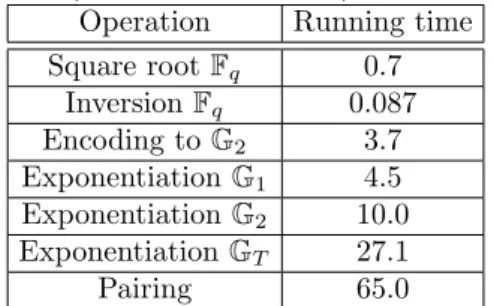
2.2 Running times for field exponentiation, square root, inversion, group exponentiation and pairing operations (in 106 clock cycles) . . . 45
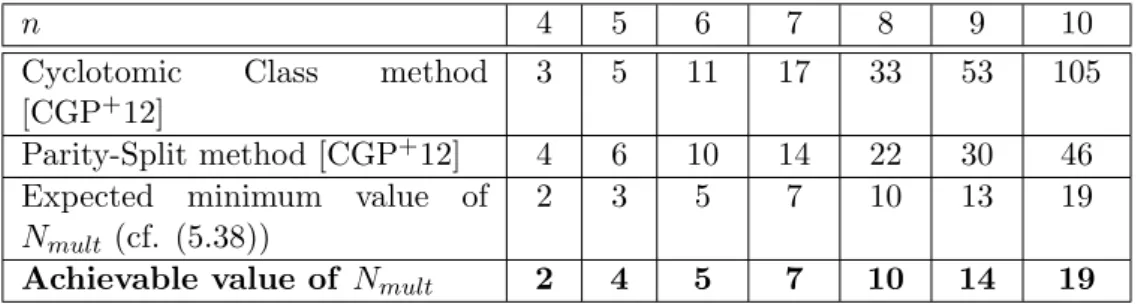
2.3 Comparison of running times for key generation, encapsulation and decapsulation for BEG-KEM and BEG-KEM+ (in 106 clock cycles) 45 5.1 Number of non-linear multiplications required for the CGPQR generic higher-order masking scheme. . . 84
5.2 Lower bound for non-linear complexity in F2n. . . 97
5.3 Minimum values of Nmult . . . 103
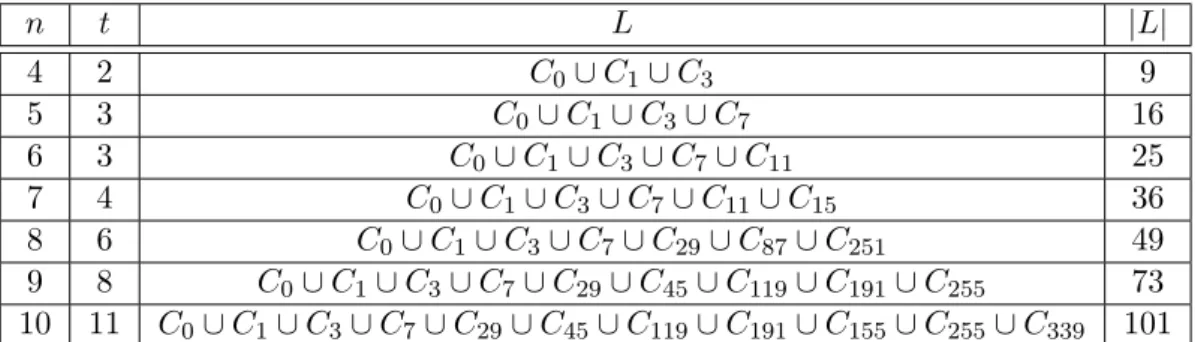
5.4 Heuristics for choosing parameterst and L. . . 104
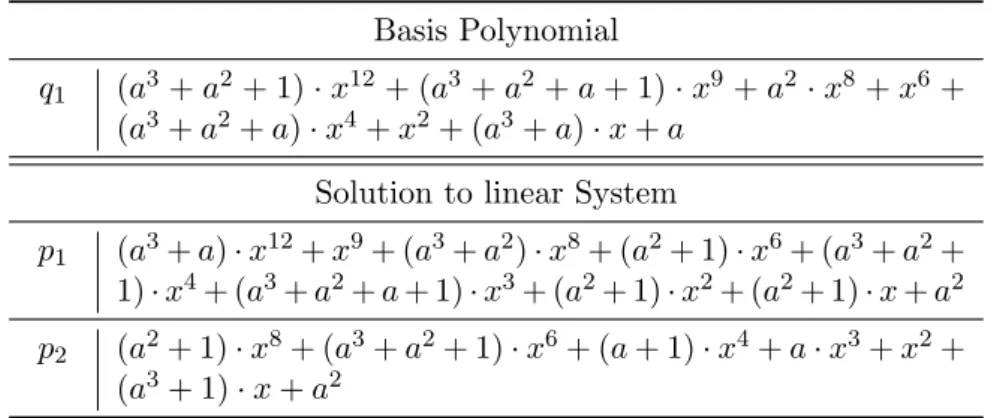
5.5 Basis polynomial q1(x) for 4-bit S-boxes, and solutions p1(x), p2(x) to PRESENT S-box. The irreducible polynomial is a4+a+ 1 overF2.107 5.6 Basis polynomials q1, q2 obtained from P(xL), for DES. . . 110
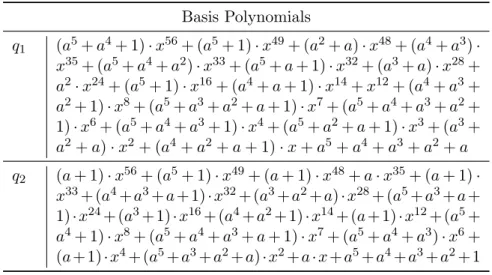
5.7 Solution to the system of linear equations for DES S-box (S1). The irreducible polynomial isa6+a+ 1 overF2. . . 110
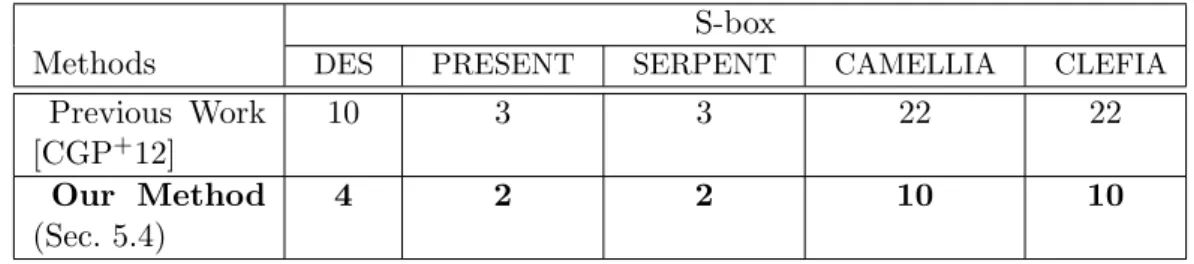
5.8 Comparison of secure implementations of DES. . . 111
6.1 Multiple block leakage-resilient CPA game for symmetric encryption. 130 6.2 The ENCencryption scheme . . . 132
6.3 The ENC1and ENC1I schemes. . . 133
List of Figures
2.1 The matrix M for the casen= 2. Letφ= 2k−m. . . 22
6.1 CBC-MAC. . . 121
6.2 Re-keying MAC. . . 122
6.3 Hash then MAC. . . 129
Chapter 1
Introduction
Contents
1.1 Information Security and Cryptography . . . 1
1.2 Cryptanalysis . . . 2
1.2.1 Implementation Attacks: Side-Channel Attacks . . . 3
1.2.1.1 Simple Power Analysis . . . 4
1.2.1.2 Differential Power Analysis . . . 4
1.2.1.3 Template Attacks . . . 5
1.3 Provable Security . . . 5
1.3.1 Leakage-Resilient Cryptography . . . 6
1.3.1.1 Split-State Leakage Model . . . 7
1.3.1.2 Probing Leakage Model . . . 7
1.3.1.3 Simulatable Leakage Assumption . . . 8
1.4 Our Contribution and Organization . . . 9
1.5 Notation . . . 10
1.1
Information Security and Cryptography
Securing information against unintended access and use has been a concern since the beginning of human civilization. With the advent of modern telecommunication systems and digital computers, the ability to generate, process, transmit and store information has tremendously improved. Needless to say, the need to protect the information in digital form has also become increasingly vital. Some of the infor-mation security objectives are as follows: privacy or confidentiality, data integrity, entity authentication or identification, message authentication, signature, autho-rization, validation, access control, certification, time-stamping, witnessing, receipt, confirmation, ownership, anonymity, non-repudiation,andrevocation[MvV96, Sec-tion 1.2].
Of the above objectives, the following four are the main ones through which others can be realized:
• confidentiality: to protect data from unauthorized access,
• data integrity: to protect data from unauthorized alteration,
• authentication: to correctly identify communicating entities and/or identify the origin of data,
• non-repudiation: to protect against denial of previous commitments.
Cryptography is a discipline that provides the mathematical foundations and techniques that are needed to realize the above goals of information security. Cryptography has an interesting history and it has been known to be used since the Roman times. It has also played a crucial role in the outcome of the World Wars. We refer to [Kah96] for a comprehensive account of the history of cryptography.
Cryptography can be broadly classified intosymmetric-key cryptography and
public-key cryptography. In the former the entities involved share a common secret key, while in the latter no common secret is needed. While symmetric-key cryptography has been in use since historic times, the commonly accepted origin of public-key cryptography can be traced to the seminal work of Diffie-Hellman [DH76].
Some of the most basic symmetric-key primitives are symmetric-key encryp-tion ciphers - stream ciphers and block ciphers, and message authentication codes (MACs). In public-key cryptography the corresponding primitives are
public-key encryption schemes and digital signatures. A hash function is an important unkeyed cryptographic primitive.
1.2
Cryptanalysis
The study of techniques to defeat the goals of cryptographic primitives and protocols is termed ascryptanalysis. Typically, the goal and the capabilities of an adversary attacking a cryptosystem will be clearly defined. Adversaries can be broadly classified into two types: passiveandactive. In the former scenario, an adversary merely observes the communications and/or the computations, while in the latter they try to influence the execution of the cryptosystem. Traditional attack scenarios (i.e., adversarial capabilities) for encryption sche-mes in both the symmetric-key and public-key settings are: ciphertext-only attack, known-plaintext attack, chosen-plaintext attack, adaptive chosen-plain-text attack, chosen-cipherchosen-plain-text attack, and adaptive chosen-ciphertext attack
[MvV96, Section 1.13]. The most common adversarial goal is to distinguish the encryptions of any two arbitrary messages of the same length [GM84]. In the case of MACs and digital signature schemes, the usual attack scenar-ios are: key-only attack, known-message attack, chosen-message attack, and
adaptive chosen-message attack. The usual adversarial goals are: selective forgery and existential forgery [Sti95, Section 7.2].
1.2 Cryptanalysis 3
We shall describe some of the above attacks in detail at appropriate places in later chapters.
1.2.1 Implementation Attacks: Side-Channel Attacks
The above traditional attack scenarios on basic crypto primitives do not allow an adversary to obtain information from the secret internal state of an execu-tion. However, it is possible to successfully mount attacks on cryptographic implementations that recover (possibly partial) information about the inter-nal state [Koc96, KJJ99]. Such attacks are particularly feasible on embedded systems such as smart cards, and hence protecting these devices against such attacks is often necessary. Some of the most commonly exploited sources of these “side-channel leakage” are timing information [Koc96], power con-sumption[KJJ99], andelectromagnetic emission [QS01]. Less commonly used leakage sources areacoustic emanation [GST13],optical emission [FH08], and
thermal emissions [BKMN09].
Implementation attacks, such as those mentioned above, that are based on observation of physical leakages, are termedside-channel attacks. Other than side-channel attacks, another important class of implementation attacks are
fault attacks [BDL01, BS97]. Fault attacks typically exploit the erroneous outputs induced by a fault in a computation to recover some secret informa-tion.
Implementation attacks, not necessarily on cryptosystems, have an interesting history dating back to the World Wars. However, it is not until the works of [Koc96, KJJ99] that these types of attacks got wide spread attention in the cryptographic community. For a brief history of implementation attacks, we refer to [Kiz11, Section 1.3].
Broadly speaking, implementation attacks are categorized into two types: pas-sive and active, analogous to the black-box setting. In passive implementa-tion attacks, an adversary merely observes an execuimplementa-tion of an implementaimplementa-tion that nearly works as intended, whereas, in active attacks, an adversary tries to influence the execution of an implementation causing it to deviate from its normal execution. Side-channel attacks belong to the category of passive attacks, while fault attacks are active attacks.
Alternatively, implementation attacks can be also classified as: non-invasive, semi-invasive, and invasive, depending upon to what extent an implementa-tion is intruded. Side-channel attacks are mostly non-invasive, but sometimes are required to be semi-invasive, for instance, by partially removing the pack-aging of an integrated circuit to facilitate the observation of electromagnetic emissions.
After timing attacks, the next most feasible side-channel attacks on crypto-graphic implementations are power analysis attacks. Power analysis attacks can broadly classified into: simple power analysis attacks, differential power
analysis attacks, and template attacks. In the following, we briefly describe these three attacks. For a more detailed account of side-channel analysis, in particular, the power analysis attacks, we refer to [MOP07].
Typical stages in a power analysis attack, and generally for any side-channel analysis experiment, are: profiling stage,online stage, andoffline stage[Kiz11, Section 1.3]. In the profiling stage, which is optional, an adversary sets up a characteristic profile for the leakage of a device which it has access to. In the online stage, the adversary performs the measurements to obtain the side-channel race. In the final stage, the offline stage, all the data gathered is analyzed to (usually) recover the secret key.
Leakage from a power analysis experiment, and also generally, will firstly be dependent on the device in hand. Additionally, it will be operation dependent and/or data dependent. Every measurement data will be accompanied with noise. In many attacks, to associate the leakage to intermediate variables, we need a “leakage model”. In practical analysis, a device is typically assumed to leak the hamming weight of intermediate variables or leak the hamming distance of the old and new values of a variable. Typically the goal of power analysis attacks, and also generally, is to recover the secret key.
1.2.1.1 Simple Power Analysis
In a Simple Power Analysis (SPA) attack an adversary tries to deduce a secret key by analyzing a single trace, or many traces individually. A well-known SPA attack scenario is on modular exponentiation implemented in a straightforward way using square-and-multiply technique, which is widely used in public-key cryptography [KJJ99]. SPA attacks on symmetric-key cryp-tographic implementations are also known to be effective [Man02].
1.2.1.2 Differential Power Analysis
Differential Power Analysis (DPA) attacks are based on first obtaining several power traces corresponding to many executions using the same fixed secret key [KJJ99]. It is a divide-and-conquer-based approach that recovers the secret key one part at a time. DPA attacks are effective against symmetric-key implementations, which are typically deterministic. Various statistical tools are used to analyze the resulting leakage trace and recover the corresponding chunks of the secret key [MOP07, Chapter 6]. DPA attacks exploit a single point (i.e., sample) in a leakage trace corresponding to a targeted variable. In higher-order DPA attacks, multiple points in a leakage trace corresponding to a targeted variable are exploited, and hence protection against such attacks can be more challenging [Mes00]. Nevertheless, mounting even third-order attacks is already challenging.
1.3 Provable Security 5
1.2.1.3 Template Attacks
Template attack is an another divide-and-conquer-based strategy to mount a power analysis attack when adversary has the option do profiling [CRR02]. Here, an adversary builds a collection of templates corresponding to known values of a targeted intermediate variable during the initial profiling stage. Once leakage traces are obtained, they are then compared against the template collection using statistical tests. Template attacks can be considered to be one of the most powerful form of power analysis attacks, and they do not necessarily need a model for leakage. But they require that adversary has full access to a copy of targeted device.
1.3
Provable Security
In the previous section, we saw various attack scenarios against cryptosys-tems ranging from black box cryptanalysis to implementation attacks. De-signing cryptoprimitives that are secure against a given set of attacks and formally analyzing their security is an important task. Such rigorous study of cryptosystems dates back to the work of Shannon in the 1940s [Sha49]. He introduced the notion ofperfect secrecy and mathematically argued that the one-time pad cipher satisfies such a property, that is, the one-time pad resists ciphertext-only attack. However, to achieve such a property, the key size has to be at least as long as the size of messages, which is impractical in modern communications.
The seminal work of Goldwasser and Micali [GM84] introduced the notion ofsemantic security for encryption schemes which may be viewed as an ana-logue, in the computational setting, of the notion of (information-theoretic) perfect secrecy. Semantic security requires that any adversary is not able to learn any efficiently computable function of the underlying message given only the ciphertext. This notion was shown to be equivalent to the notion ofindistinguishability. These notions and their generalization to other primi-tives allowed practical construction of cryptoprimiprimi-tives that allowed “security proofs” under certain computational assumptions.
The paradigm of provable security aims at the formal design and analysis of cryptosystems by first formally specifying the adversarial attack model. Then, the security of a designed scheme is argued via a reduction from an usually well-accepted computational assumption or from the assumed security of a smaller primitive. Namely, one argues that if there exists an adversary against the designed cryptosystem, then one could construct an algorithm (resp., ad-versary) against the computational assumption (resp., smaller primitive). The security definitions typically will be eitherattack-game based, such as the in-distinguishability game for encryption schemes, or simulation based, such as the security definitions used in multi-party computation. For a detailed
in-troduction to the provable security approach to cryptography, we refer to the books [Gol01, Gol04, KL07].
A computationally efficient adversary is specified either as a probabilistic polynomial-time turing machine or a family of polynomial-sized boolean cir-cuits. Widely used computational assumptions are the existence of one-way functions,psuedorandom generators and psuedorandom functions. In public-key cryptography, intractability ofinteger factorization problem,discrete log-arithm problem and certainlattice-based problems are widely used.
Often security reductions need to make use of certain idealized model of com-putations in order to obtain security proofs in some instances. Two such popular idealized models are therandom oracle model [FS86] and thegeneric group model [Sho97]. In the random oracle model, a hash function is assumed to behave as a random function. Whereas in the generic group model, the group elements are assumed to have random encodings. Since we use the generic group model extensively in Part I of this dissertation, we will briefly elaborate on this model.
Generic Group Model. The generic group model was introduced in the seminal work of Shoup [Sho97]. As mentioned before, group elements are gen-erally assumed to have random encodings, though some variants of this model do not need this random encodings requirement, for instance, see [Mau05]. Intuitively, in this model an adversary cannot exploit the representations of group elements other than checking for equality of the elements. A security proof in the generic group model only rules out “generic attacks,” that is, it rules those attacks that work over any instantiation of the underlying group. Generalizations of the generic group model are also widely used. One such extension that we use in our work is for pairing-based groups, called the
generic bilinear group model [BB04]. We defer a formal description of this model to Section 2.2.2.3.
The generic group model is often criticized (sometimes rather unfairly) as being too idealistic to be practically relevant. For a discussion on this issue, we refer to [KM07].
1.3.1 Leakage-Resilient Cryptography
In Section 1.2.1, we saw that side-channel attacks are a security concern for im-plementations on embedded devices. Various types of countermeasures both at the hardware/physical and software/algorithmic level have been proposed. For different classification of these countermeasures, we refer to [MOP07], [Kiz11, Section 1.3], and [Fau10, Section 3.3].
In this dissertation, we consider a class of algorithmic countermeasures that are usually referred to as being leakage resilient. Such countermeasures ad-dress the issue of side-channel leakage at the design stage of a cryptographic
1.3 Provable Security 7
primitive itself. For doing so, we need to specify aleakage model that “reason-ably” incorporates the side-channel leakages that we wish to protect against. In Section 1.2.1, we saw that timing attacks and power analysis attacks are a serious security threat for implementations on embedded devices. Timing attacks are simpler to prevent than power analysis attacks. Here we usually need to ensure that all the execution paths are of uniform length, say, by using dummy instructions. In contrast, power analysis attacks can leak intermediate variables and ensuring protection against such attacks is a serious concern. Next, we describe some previously used leakage models that we consider in this work. Though our primary concern is protection against power analysis attacks, we believe that in most cases they reasonably model a broader class of side-channel leakages, that arguably includes electromagnetic emanations.
1.3.1.1 Split-State Leakage Model
This model is based on theonly computation leaks paradigm introduced in the work of Micali and Reyzin [MR04]. In this model computations are divided into steps that leak independently. The split-state model is a slightly powerful leakage model that only requires that the internal memory is usually split into two parts that leak independently, and not necessarily only computation leaks [LL12]. The leakage in these models is specified as an efficiently computable function of the secret state, i.e., the secret key and the internal randomness. The output length of these leakage functions is bounded. An adversary can obtain leakages either a bounded number of times, or overall it can be un-bounded, i.e., continual leakage. Typical justification of the bounded length requirement of leakage functions is that in practice many side-channel attacks only exploit a few bits of leakage information for reasonable implementations [KP10a].
Some variants of the split-state model do not put bounded length require-ment for the leakage functions. Instead, they require that the remaining min-entropy or the computational entropy is sufficiently high. There are already several leakage-resilient schemes that are proposed in the split-state model and its variants, some of which are [DP08, Pie09, KP10a, FKPR10, LL12]. One important remark is that most of the public-key primitives that are leakage-resilient in this leakage model and have proofs of security in the “stan-dard model” are inefficient to be implemented on embedded devices.
1.3.1.2 Probing Leakage Model
This leakage model was introduced by Ishai, Sahai and Wagner [ISW03]. In this model, originally introduced for boolean circuits, any adversary could probe a bounded number of wires, sayt, and read the values carried. A general
circuit compiler was proposed that transforms a given circuit into a leakage-resilient circuit. The size of the resulting circuit is increased by a factor oft2. The secret-sharing techniques are employed to obtain the transformed circuit. Later this model was extended to computation over finite fields [RP10]. The technique of secret sharing (a.k.a. masking) has long been employed in cryptographic engineering to protect implementations against side-channel attacks [CJRR99]. Provably secure masking schemes of arbitrary order exist that are based on this leakage model [CGP+12, Cor14]1.
Recent works extend the probing model to the case where all the intermediate variables leak but the leakage is noisy [PR13, DDF14]. Such a leakage model captures practical scenarios more realistically.
1.3.1.3 Simulatable Leakage Assumption
This leakage model was recently introduced by Standaert, Pereira and Yu [SPY13] in the context of symmetric-key primitives that use block ciphers. This framework offers practitioners a hope of placing reasonable restrictions on leakage functions that are empirically verifiable in side-channel evaluation laboratories, unlike most of the known leakage models. A leakage-resilient psuedorandom generator was constructed in [SPY13], with a relatively simple security proof in the standard model.
Other Leakage Models. We briefly mention other leakage models that were previously considered, mainly by the cryptography theory community. For a survey of these models, we refer to [Wic11, Chapter 2].
One such widely considered model is the full memory leakage model that al-lows leakage functions to take as input the entire secret state [AGV09, NS09]. Variants of this scheme, similar to the split-state model, differ in terms of types of leakages allowed. Other models that allow such full leakage are found in works related to threshold cryptography [DF89], key-insulated cryptogra-phy [DKXY02], and forward-secrecy [DvOW92]. Some other known partial leakage models are oblivious RAMs [Gol87] and models in exposure-resilient cryptography [Dod00].
As remarked earlier for the split-state model, most of the public-key primi-tives whose security proofs do not resort to an idealized computation model, such as the random oracle or the generic group models, are inefficient to be implemented in practice.
1
Sometimes provably secure masking schemes, such as those based on the probing leakage model [ISW03], are not classified as leakage-resilient countermeasures. But we feel it is not inappropriate to consider them as being leakage resilient.
1.4 Our Contribution and Organization 9
1.4
Our Contribution and Organization
In this work, we aim to bridge the gap between the theory and practice of leakage-resilient cryptography, in both the public-key and symmetric-key set-tings.
This dissertation consists of three parts.
– In Part I, we analyze existing and propose new efficient leakage-resilient constructions for public-key encryption and digital signatures that tol-erate continual leakage in the split-state leakage model, where even key updates are allowed to leak. All the above schemes are simple variants of existing well-known schemes obtained byblinding (i.e., splitting) the secret key. Our security proofs are in the bilinear generic group model. Arguing about their security in the standard model is currently out of reach of existing techniques [Wic13].
∗ Chapter 2 contains two main results. First, we cryptanalyze a variant of the ElGamal key encapsulation mechanism by Kiltz and Pieterzak [KP10a] that was conjectured to tolerate continual leakage in the split-state model. We give a non-trivial upper bound on the amount of leakage tolerated by this conjecture, by exhibiting an at-tack that recovers the full secret key. The atat-tack uses a new variant of the hidden number problem, that we call hidden shares - hidden number problem. This part is based on the publication [GV14]. As a second contribution, we provide an improved security analysis of a bilinear variant of the ElGamal key encapsulation mechanism, also due to [KP10a]. We give an improved security analysis of this scheme. Next, for practical considerations, we modify this scheme. Then we implement our variant and analyze its side-channel resis-tance. This part is based on the publication [GGL+14].
∗ In Chapter 3, we propose a leakage-resilient signature scheme in the continual split-state leakage model that is based on the identity-based encryption scheme by Boneh and Boyen [BB04]. Our scheme is existentially unforgeable against adaptive chosen message and leak-age attacks. This chapter is based on the publication [GV12].
∗ In Chapter 4, we propose a leakage-resilient pairing-based variant of the Schnorr signature scheme. This scheme also enjoys properties similar to the scheme from Chapter 3. This chapter is based on the publication [GV13].
– In Part II (Chapter 5), we improve the efficiency of a generic higher-order masking scheme proposed by Carlet et al. [CGP+12]. This scheme is secure in the probing leakage model [ISW03]. Efficiency of this scheme is related to the problem of evaluating polynomials over binary finite fields representing S-boxes. The corresponding evaluation cost model considers onlynon-linear multiplications.
We take a formal approach to this polynomial evaluation problem. We investigate optimal methods for exponentiation inF2n by studying a
pre-viously proposed variant of addition chain that we call ascyclotomic-class addition chain. We define the notion of F2n-polynomial chain for
arbi-trary polynomials, and use it to count the number of non-linear multipli-cations required to evaluate polynomials overF2n. Among several
inter-esting properties, we prove lower bounds for optimal evaluation methods. We propose a new heuristic technique for evaluating arbitrary polyno-mials, whose complexity is asymptotically optimal. In practice, with this new technique, we significantly reduce the complexity of evaluating S-boxes compared to previous methods.
This chapter is based on the publications [RV13] and [CRV14]. A part of the results in [RV13] has also appeared in the dissertation of Arnab Roy [Roy13].
– In Part III (Chapter 6), we construct efficient leakage-resilient symmetric-key authentication and encryption schemes in the standard model under thesimulatable leakage assumption [SPY13].
We propose a leakage-resilient CBC-like message authentication code, and also propose a leakage-resilient PRG-based chosen-plaintext secure encryption scheme for which we quantify the leakage it tolerates during thechallenge phase in terms of security of a single iteration. Our con-structions tolerate continual leakage but requires leak-free updates. This chapter is based on the manuscript [PSV15].
1.5
Notation
In this dissertation, we denote the set of integers byZ, and Ndenotes the set
of positive integers. ByZp (resp. Zq) we denote, depending upon the context,
either the set of integers{0,1, . . . , p−1}or the ring modulop(resp. q), where
p, q >0. Unless otherwise specified, p and q are prime numbers. The field of pn elements is denoted by Fpn. The field Fp is identified with Zp, unless
evident from the context.
We denote a random sampling of an element a ∈ A from a set A, and also denote a (possibly probabilistic) output of an algorithm A, bya← A. If we want to explicitly denote the randomnessrused during the sampling/output, then we do so by s ←r S. Unless otherwise mentioned or implicit from the context, any sampling is from an uniform independent distribution. This is always implied by the notations←$ S.
The symbol “:=” is used to define a notation in an expression, as inA:=Z,
or to explicitly indicate an output of a deterministic algorithm or a function. Chapter specific notations are defined in respective chapters.
Part I
Split-State Leakage Model:
Cryptanalysis & Efficient
Public-Key Constructions
Chapter 2
Split-State ElGamal
Encryption
In this chapter, we first describe an attack on a variant of the ElGamal key en-capsulation mechanism (EG-KEM) proposed in [KP10a]. It was conjectured in [KP10a] that the said EG-KEM with stateful decryption resists lunch-time chosen ciphertext (i.e., CCA1) and leakage attacks in the split-state model We give a non-trivial upper bound on the amount of leakage tolerated by this conjecture. More precisely, we show that the conjecture does not hold if more than a 38 +o(1)
fraction of the bits are leaked at every decryption step, by showing a lunch-time attack that recovers the full secret key. The attack uses a new variant of thehidden number problem, that we call hidden shares - hidden number problem, which is of independent interest.
Secondly, we provide an improved security analysis of a bilinear variant of the ElGamal KEM (BEG-KEM), also due to [KP10a]. More precisely, we weaken the restriction on the image size of the leakage functions in the previously used bounded leakage model, and only insist that the inputs to the leakage functions have sufficient min-entropy left, in spite of the leakage, with no limitation on the quantity of this leakage. Such a model is closer to practice than the bounded leakage model. We provide a novel security reduction for BEG-KEM in this relaxed leakage model using the generic bilinear group model. Finally, consider the problem of implementing this scheme securely in practice. We propose, implement and evaluate an advanced variant of BEG-KEM, BEG-KEM+, that generates random elements in the pairing base group, avoiding exponentiation by a secret integer value, but rather uses an encoding to the pairing base group due to [FT12]. The implementation is in software and the side-channel evaluation (w.r.t. power analysis attacks) is based on an exhaustive survey of the side-channel cryptanalysis literature.
Contents
2.1 Limits of a Conjecture . . . 14 2.1.1 Introduction . . . 14
2.1.1.1 Our Contribution . . . 16 2.1.1.2 Known Hidden Number Problems . . . 16 2.1.1.3 Hidden Shares - Hidden Number Problem . 17 2.1.2 The Conjecture . . . 18 2.1.2.1 KEM and the Leakage Model . . . 18 2.1.2.2 Stateful ElGamal KEM . . . 19 2.1.2.3 Relationship to the HS-HNP . . . 20 2.1.3 Hidden Shares - Hidden Number Problem . . . 21 2.1.3.1 Setting up the Lattice . . . 21 2.1.3.2 Estimatingk . . . 23 2.1.3.3 Implementation Details . . . 25 2.1.4 PARI/GP script for solving HS-HNP . . . 26 2.2 Split-State Bilinear ElGamal KEM . . . 28 2.2.1 Introduction . . . 28 2.2.1.1 Our Contribution . . . 28 2.2.2 Stateful Bilinear ElGamal KEM . . . 29 2.2.2.1 Min-Entropy . . . 30 2.2.2.2 Bilinear Groups . . . 31 2.2.2.3 Generic Bilinear Group Model . . . 31 2.2.2.4 Stateful Key Encapsulation Mechanism . . 32 2.2.2.5 Bilinear ElGamal KEM . . . 33 2.2.2.6 A CCmLA1 Security Reduction . . . 34 2.2.3 Proof of Theorem 2.2 . . . 35 2.2.3.1 Non-Leakage Setting: CCA1 Security . . . 35 2.2.3.2 Leakage Setting: Completing Proof of
The-orem 2.2. . . 38 2.2.4 BEG-KEM+ : A Leakage-Resilient KEM Closer to
Practice . . . 41 2.2.4.1 An Advanced BEG-KEM+ . . . 41 2.2.4.2 BEG-KEM+: Description . . . 43 2.2.5 Secure Implementation and Performance Analysis . 44
2.2.5.1 Implementation Details and Performance Analysis . . . 44 2.2.5.2 Side-Channel Resistance: Practical Point
of View . . . 45 2.3 Conclusion and Future Directions . . . 47
2.1
Limits of a Conjecture
2.1.1 Introduction
Leakage-resilient cryptography is a recent research line that aims at building countermeasures and/or defences against side-channel attacks while provid-ing security reductions in a provable manner [ISW03, MR04, DP08, AGV09,
2.1 Limits of a Conjecture 15
NS09, DGK+10, DHLAW10a, SPY13]. The methodology is as follows: an abstract model specifying the leakage data is chosen and the goal is to exhibit a reduction from a hardness assumption to a hypothetical side-channel adver-sary. The theory of leakage-resilient cryptography has witnessed a tremendous activity despite its short life.
However, meeting the strongest security levels, such as, resiliency against a broad class of continual leakage attacks [DHLAW10a], under the weakest assumptions, say, memory leakage model [AGV09] or auxiliary input model [DGK+10], is still out of reach from a practical point of view. To our knowl-edge existing schemes are inefficient when compared to their counterparts in the non-leakage setting; moreover, current leakage-resilient constructions are conceptually far more complex than those a practitioner currently finds in its cryptographic tool-box. Indeed, in an important work, Wichs [Wic13] shows that it might be impossible to achieve leakage-resilience for cryptosystems whose secret key is uniquely determined by its public key, unless we weaken the security model. The former property is enjoyed by most practical cryp-tosystems nowadays.
In this sense it is worth to mention the work by Kiltz and Pietrzak [KP10a]. They proposeBEG(also denoted BEG-KEM), a pairing-based analogue of the ElGamal Key Encapsulation Mechanism (EG-KEM) [Gam85] with stateful decryption that is leakage-resilient against lunch-time chosen ciphertext and leakage attacks (CCLA1). The latter means that the classical distinguishing adversary against ElGamal is given access to decryption and leakage oracles only before the challenge ciphertext is given. The basic idea is to set the ElGamal secret key to be a group element (in contrast to an integer), and then multiplicatively share it. While splitting the secret key before decryption is a well-known technique from the side-channel countermeasures literature, the novelty of this work is to propose to split agroup element rather than an
integer.
The work [KP10a] does not contradict the impossibility result by Wichs. In-deed, [KP10a] slightly weakens the security model by using the split-state model [MR04], meaning that the computation can be divided into steps, where each such step accesses different parts of the memory that leak in-dependently. Their security arguments hold in an extension of the generic group model [Sho97] called generic bilinear group (GBG) Model [BBG05]. Still, they consider leakage to be continual leakage, i.e. the useful leakage data per decryption invocation is bounded in length, but unbounded over-all. More concretely, it is shown that if the secret key length is κ, then their scheme is secure against leakage of at most λ κ
2 bits at every decryption
step. More precisely, λ < κ2 −ω(logκ) to make it infeasible to guess the remaining bits of the secret key by a brute force attack.
The authors of [KP10a] discuss the limitations of getting a security proof for a similar leakage-resilient property for EG-KEM with stateful decryption over
be hard. Nevertheless they conjecture that, for certain such arbitrary groups, EG-KEM with stateful decryption, denotedEG?, might be resistant against side-channel attacks that abide by the continual leakage split-state model.
2.1.1.1 Our Contribution
In this work we impose a limit on the conjecture from [KP10a], by proving that if a minimum of 38 +o(1)
κ bits are leaked at every invocation of the secret key, a CCLA1 attack exists against EG-KEM with stateful decryption schemeEG?that recovers the secret key. Naturally our limit on the conjecture is built using the abstract model of leakage specified in the conjecture, that is, the only computation leaks information model. Interestingly, our limit to the conjecture applies to any arbitrary instantiation of the underlying group. To achieve this result we define a new problem, called hidden shares - hidden number problem, which is a close but new variant of the hidden number problem [BV96].
2.1.1.2 Known Hidden Number Problems
The hidden number problem (HNP) was originally introduced by Boneh and Venkatesan [BV96] to demonstrate the hardness of computing the most sig-nificant bits of the secret key in the Diffie-Hellman key exchange mechanism. In its most generic form it can be described as follows. Let
fα :D → V, α∈ A
be a family of maps between algebraic domains D and V. The map is parametrized byα, that takes values from some setA.
Definition 2.1 [Generic HNP [Shp05]] Suppose some partial information about fα(t) ∈ V is given for several values of t (also completely specified),
chosen uniform randomly from a subsetT ⊆ D, find α.
Typically,DandV are finite fieldsFp. An instance of the Generic HNP
prob-lem is the Modular Inversion Hidden Number Probprob-lem (MIHNP) [BHHG01], also calledFp-Inverse-HNP [Shp05]. In MIHNP, we haveD=T =Fp\ {−α},
V=A=Fp, where fα(t) = MSBk,p 1 α+t ,
where MSBk,p(z) means the (integer representing the)kmost significant bits
ofz (modp), and the elements ofFp are identified with integers of fixed
bit-lengthblog2pc+1. In other words, we are givenn+1 pairs (ti,MSBk,p(1/(α+
ti)) ), fori= 0, . . . , n, whereti∈Fp\ {−α}are chosen uniform randomly and
independently, and the goal is to find a polynomial-time (in logp) algorithm to recover α ∈Fp completely. The hardness of variants of this problem has
2.1 Limits of a Conjecture 17
been used to construct efficient algebraic PRNGs and MACs [BHHG01]. A close variant of MIHNP is one where
fα,β(t) = MSBk,p β α+t .
Another problem related to the HNP was addressed in [HGNS03] and it is called the “HNP with hidden multipliers” (HM-HNP). In [Shp05], the same problem is referred to as Fp-Approx-HNP.
Definition 2.2 [HM-HNP [HGNS03]] Givenn+1 pairs (MSBk,p(ti),MSBk,p
(α·ti)), wherei= 0, . . . , n,α∈Fp and ti
$
←Fp, findα.
In HM-HNP, we need to findα∈Fp given (MSBk,p(ti),MSBk,p(αti)), where
ti ∈ Fp. This variant is related to proving the bit security of “time-released
crypto”, among other applications. Variants of the HNP have also been used to attack DSA [HGS01, NS02].
2.1.1.3 Hidden Shares - Hidden Number Problem
We propose a variant of the MIHNP and HM-HNP problems that we call Hidden Shares - Hidden Number Problem (HS-HNP).
Definition 2.3 [HS-HNP] Given n+ 1 pairs MSBk,p(ti),MSBk,p
α ti , wherei= 0, . . . , n,α∈Fp and ti $ ←Fp\ {0}, find α.
Note that unlike the Generic HNP, in HS-HNP (also HM-HNP) only a partial information about the values of (random) ti is given. The name “hidden
shares” follows from the fact that ti and tαi (modp) are two multiplicative
shares of α ∈ Fp. To our knowledge the HS-HNP has not been explicitly addressed before. However, as is the case with most variants of the HNP, our approach uses lattice techniques [Cop97, BHHG01]. Particularly, we use the techniques of [BHHG01].
We stress that in spite of similarities in the techniques used to solve various variants of HNP, there are significant differences in the technical details. For example, the exact structure of the lattices set up in the solution vary ac-cording to the problem. These differences eventually reflect in the amount of partial information (value ofk) required to solve the problem with a reason-able success probability. For comparison, the values of k currently required for HNP, MIHNP, and HM-HNP are √logp+ log logp, 31logp, and 45logp, respectively [BV96, BHHG01, HGNS03]. As we shall see in Section 2.1.3, HS-HNP currently requires the value ofk to be 34logp.
The HS-HNP can be generalized to arbitrary commutative groups.
Definition 2.4 [Generalized HS-HNP] Let (G,·) be a group and α ∈ G.
If (G,·) is modelled as a “generic group” [Sho97], then the Generalized
HS-HNP is hard, provided that the shares have sufficient remaining entropy. This is a straightforward consequence of the work in [KP10a] and also of that in this dissertation (cf. Section 2.2). In particular, using the techniques in Section 2.2, it can be shown that the advantage of a (“generic”) adversary is at most
O q22λ/p
, where|G|=p,q is the sum of the number of group oracle queries
and the number (n+ 1) of pairs (ti, α·t−i 1), andλis a bound on the amount
of information obtained on eachti and α·t−i 1, measured in bits.
2.1.2 The Conjecture
By MSBk,p(z), we mean the (integer representing the)kmost significant bits
of z (modp), where the elements of Zp are represented by integers of fixed
bit-lengthm=blogpc+ 1. For instance, MSB2,7(3) = 1. The notation “log”
always refers to logarithm to the base 2.
First we shall briefly recollect the notion of a key encapsulation mechanism
(KEM) and a stateful KEM. Next we describe the ElGamal-based stateful KEM of [KP10a]. Then we discuss the conjecture in [KP10a] regarding the security of the scheme, and its relation to HS-HNP.
2.1.2.1 KEM and the Leakage Model
A key encapsulation mechanism KEM is a public-key cryptosystem used to establish a session key for a symmetric-key encryption scheme. Formally,KEM
consists of three algorithmsKG,Enc and Dec. The key generation algorithm
KG on input a security parameter κ produces a pair of public and secret keys (pk, sk). The encapsulation algorithm Enc, taking only pk as input, outputs an encryption C of a key K. The decapsulation algorithm Dec on inputssk and C outputs K. The goal of an adversary is to distinguish the encryption of a given key from that of a random key. An adversary may be a Chosen Plaintext Attack- (CPA-) adversary if it has no access to a decryption oracle. If it does have access to such an oracle then it is called a Chosen Ciphertext Attack (CCA) adversary. CCA adversaries can be further classified into CCA1- or CCA2-adversaries. A CCA1-adversary cannot query the decapsulation oracle after obtaining the challenge ciphertext.
In a KEMwith stateful decapsulation,KEM?= (KG,Enc,Dec1,Dec2), the de-capsulation algorithm Dec is split into two parts Dec1 and Dec2 executed consecutively. Each such algorithm uses different parts of the memory that therefore leak independent side-channel data, thus obeying to theOnly Com-putation Leaks/Split-Statemodel [MR04, LL12]. The secret key ofKEM?now consists of two parts ski = (σi, σi0), each part residing on a different portion
of the memory. Dec1 can access only the part of the memory containingσi,
while Dec2 has access only to the other part containing σi0. The decapsula-tion procedures may update the secret key (to a funcdecapsula-tionally equivalent key)
2.1 Limits of a Conjecture 19
after each access to it, say from ski to ski+1 = σi+1, σi0+1
. Note that in order to protect against continual leakage, the secret key must be “refreshed” regularly. We refer to one execution of the decapsulation query as around. The leakage in each round is modelled as the output of two adversarially cho-sen efficiently computable functions fi(·) and gi(·). The output of the two
functions is bounded by λ bits each, where λis the leakage parameter. The functionfi(σi−1, ri) models the leakage of one part of the memory containing
σi−1 and the internal randomness ri used by Dec1. Whereas, gi(σ0i−1, wi, r0i)
models the leakage of the other part of the memory containingσi0−1, the inter-nal randomnessr0i used byDec2, and the informationwishared betweenDec1
and Dec2 to obtain the complete decapsulation key. TheKEM? is said to be (κ, λ) secure under the Chosen Ciphertext with Leakage Attacks 1 (CCLA1) if the scheme remains secure even when an adversary can obtainλbits of leakage from each of the two functionsfi and gi, in every decapsulation query.
2.1.2.2 Stateful ElGamal KEM
The following well-known variant of the ElGamal KEM, where the secret key is multiplicatively shared, was studied in [KP10a].
Let the output ofGen(κ, λ) be a (multiplicatively written) cyclic group G= hgiof prime orderp, generated byg. It is required thatp−1 has a large prime factor, as we shall see later. LetEG? = (KGEG?,EncEG?,Dec1EG?,Dec2EG?) be
the stateful KEM defined in [KP10a, Section 3.1] as follows:
1. KGEG?(κ, λ): Compute (G, g, p) ← Gen(κ, λ). Choose random x ←$ Zp
and σ0 $ ← Z∗
p. Set h =gx and σ00 =x·σ
−1
0 (modp). The public key is
pk= (G, g, p, h), and the secret key is sk= (σ0, σ00).
2. EncEG?(): Choose random l
$
← Zp. The ciphertext is C = gl, and the
key isK=hl.
3. Dec1EG?(σi−1, C): Choose random ri
$ ← Z∗p. Set σi ←σi−1·ri (modp), and Ki0=Cσi. Return (r i, Ki0). 4. Dec2EG? σ0 i−1,(ri, K 0 i)
: Set σ0i ← σ0i−1 ·ri−1 (modp), and K = K
0σ0
i
i .
ReturnK as the shared secret key.
Claim[KP10a, Conjecture 1]EG? is CCLA1 secure if p−1 has a large prime factor.
The above statement is incomplete if the leakage parameterλ(i.e., the amount of leakage from each ofDec1EG? and Dec2EG?) is not specified. For instance,
the conjecture could hold forλ log2p. More precisely,λ < log2p−ω(log logp) to make it infeasible to guess the remaining bits by a brute force attack. Since leakage is modelled by functions fi(σi−1, ri) and gi σi0−1,(ri, Ki0)
, it is easy see that if λ > logp/2, then one can completely recover ri in the ith round
and also some bits of the initial state (σ0, σ00). In at most 2dlogpe rounds,
the secret key x can be fully recovered. This is the trivial attack. It is also necessary that the Decisional Diffie-Hellman problem is hard in the groupG.
The reason why p−1 must have a large prime factor is due to the fact that it is easy to compute discrete logarithms inZ∗p otherwise. Since log (σi·σi0) =
logσi+ logσ0i, one can effectively transform the multiplicative sharing of the
secret key into additive sharing if it is feasible to extract discrete logarithms. In [KP10a, Section 1.1], an attack is outlined on schemes using additive shar-ing, wherex=τi+τ0i(modp). The attack requires only a few bits of leakage
onτi and τ0i in each round i. Since τi+τ0i can only be equal to either x or
x+p, we can compute few bits of x and/or x+p at a time from the corre-sponding bits ofτi andτ0i (and carries, if any). This shows that the Generic
HS-HNP (Definition 2.4) is easy to solve in the group (Zp,+) with only a few
bits of leakage from each share. Note that this attack will not apply for the multiplicative sharing since σi·σi0 = x+s·p, for many possible values of s
(0≤s≤p−2).
2.1.2.3 Relationship to the HS-HNP
In the following we argue that it is possible to obtain 2λmost significant bits of each of the two shares of the secret key inEG?. This is a consequence of the fact thatλbits ofσi (respectively, σi0) can be leaked from each of fi(σi−1, ri)
andfi+1(σi, ri+1) (respectively,gi σi0−1,(ri, Ki0)
and gi+1 σi, ri+1, Ki0+1
), where i ≥ 1. After 2n+ 2 rounds of execution of (Dec1EG?,Dec2EG?), an
adversary will be able to obtainn+1 pairs MSB2λ,p(σ2i+1),MSB2λ,p σ20i+1
of the secret key, wherei= 0, . . . , n.
The above observation leads us to an instance of HS-HNP (Definition 2.3) withα=x,ti=σ2i+1 and tαi ≡σ02i+1 (modp), wherei= 0, . . . , n. Note that
ti is uniform random and independent inZ∗p. Hence investigating HS-HNP is
a natural approach to resolve the above conjecture. This is the topic of the next section.
Let us notice that in [KP10b] it is wrongly stated that breaking the CCLA1 security of the stateful ElGamal KEM is related to the Hidden Multipliers - HNP (Definition 2.2). That is, using our notation, the HM-HNP boils down to an adversary that is getting leakage onti andαti,which corresponds
to ti = σ2i+1 and αti ≡ σ20i+1t2i (modp), where i = 0, . . . , n. Apparently,
the value αti is never computed in the ElGamal KEM nor can possibly be
2.1 Limits of a Conjecture 21
2.1.3 Hidden Shares - Hidden Number Problem
Letpbe anm-bit integer. We havem=blogpc+1. Letyi = 2m−k·MSBk,p(ti)
and bi= 2m−k·MSBk,p α ti in Definition 2.3. Let ti =yi+δi, α ti (modp) =bi+i,
where 0≤δi, i <2m−k, where i= 0, . . . , n. Note that the integers yi and bi
are known, while the integersδi and i are unknown. We have
(yi+δi) (bi+i)≡α(modp). (2.1)
Sinceαis an unbounded variable, we will eliminate it from then+1 equations represented by (2.1). We obtain
(yi+δi) (bi+i)−(y0+δ0) (b0+0)≡0 (modp).
On rearranging the terms, we obtain a set ofnequations (fori= 1, . . . , n) as (−1)δ00+ (1)δii+ (−b0)δ0+ (bi)δi+ (−y0)0+ (yi)i
+ (yibi−y0b0) ≡ 0 (modp). (2.2)
For the sake of clarity, let us denote the coefficients in the above ith
relation by Ai, Bi, Ci, Di, Ei, Fi, Gi, respectively in the order. Equation (2.2) can
now be rewritten as
Aiδ00+Biδii+Ciδ0+Diδi+Ei0+Fii+Gi ≡0 (modp). (2.3)
Note again that the only unknowns in the above equation are δ0, δi, 0 and
i. Equation (2.3) can be rewritten over the integers as
Aiδ00+Biδii+Ciδ0+Diδi+Ei0+Fii+Gi+p·µi = 0, (2.4)
where theµi are unknowns, and i= 1, . . . , n. The quantities µi are of little
interest compared to that ofδi and i. We shall now construct a lattice that
captures the relations defined by (2.4). Since (2.4) contains non-linear terms likeδ00 andδii, we “linearize” the relation by treating the non-linear terms
as a separate variable. It is also desirable to have the solution we are looking for correspond to a “short” vector in the lattice. Our construction is similar to the one in [BHHG01, Section 3.1].
2.1.3.1 Setting up the Lattice
The lattice we construct has dimension 4n+ 4 and it is represented by a (4n+ 4)×(4n+ 4) matrix M consisting of rational entries. The lattice is generated as the row span of the matrixM. The structure ofM is as follows:
M = J R 0 P , (2.5)
whereJ and P are diagonal matrices having dimensions (3n+ 4)×(3n+ 4) andn×n, respectively. MatrixRhas dimensions (3n+ 4)×n. The rows ofM
correspond to the terms present in then relations represented by (2.4). The first row is associated with the constant term, the nextn+ 1 rows correspond to the variables δi, next n+ 1 rows with i, while the further n+ 1 rows
correspond to δii. The last n rows are associated with the terms µi. Each
of the last n columns of M correspond to a relation in (2.4), while the first 3n+ 4 columns are associated with the inverse of an upper bound on the size of the quantities 1, δi, i and δii (in the solution we are interested in). In
what follows, we give a complete description of the matrixM.
LetP[i0, j0] denote the entry in thei0th row and thej0thcolumn of the matrix
P. The matrixPhaspon all of its main diagonal, i.e. P[i, i] =pfor 1≤i≤n. Theith row ofP corresponds to the term µ
i in (2.4). The diagonal matrixJ
hasJ[1,1] = 1 (for the constant term), J[i0, i0] = 2k−m for 2≤ i0 ≤ 2n+ 3 (for terms δi and i), and J[i0, i0] = 22(k−m) for 2n+ 4 ≤ i0 ≤ 3n+ 4 (for
termsδii). As we shall later see, these entries ofJ are required to bound the
norm of the vector corresponding to our solution. Each of then relations of (2.4) is described in matrixR (excluding termsp·µi, which are described by
matrixP). The entry R[i0, j0] is the coefficient of the term corresponding to rowi0 in the j0th relation. Hence the columns of matrices R and P together completely describe the system of equations (2.4).
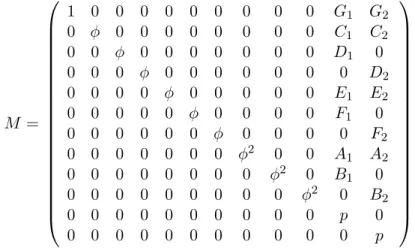
As an illustration, the matrixM is described for the casen= 2 in Figure 2.1, whereφ= 2k−m. The terms corresponding to the 12 rows ofM are (from top to bottom) 1,δ0,δ1,δ2,0,1,2,δ00,δ11,δ22,µ1, and µ2, respectively.
M = 1 0 0 0 0 0 0 0 0 0 G1 G2 0 φ 0 0 0 0 0 0 0 0 C1 C2 0 0 φ 0 0 0 0 0 0 0 D1 0 0 0 0 φ 0 0 0 0 0 0 0 D2 0 0 0 0 φ 0 0 0 0 0 E1 E2 0 0 0 0 0 φ 0 0 0 0 F1 0 0 0 0 0 0 0 φ 0 0 0 0 F2 0 0 0 0 0 0 0 φ2 0 0 A 1 A2 0 0 0 0 0 0 0 0 φ2 0 B1 0 0 0 0 0 0 0 0 0 0 φ2 0 B2 0 0 0 0 0 0 0 0 0 0 p 0 0 0 0 0 0 0 0 0 0 0 0 p
Figure 2.1: The matrix M for the case n= 2. Let φ= 2k−m.
Leti = ei, δi =di (0≤i≤n) and µi =ui (1≤i≤n) be a solution to the
system of equations (2.4), where 0≤ei, di <2m−k. Note that such a solution
2.1 Limits of a Conjecture 23
length 4n+ 4, defined as follows:
v=h1, d0, . . . , dn, e0, . . . , en, d0e0, . . . , dnen, u1, . . . , uni.
Sinceei,di and ui satisfy the system (2.4), it is easy to see that
v·M = 1, d0 2m−k, . . . dn 2m−k, e0 2m−k, . . . en 2m−k, d0e0 22(m−k), . . . dnen 22(m−k),0, . . .0 . (2.6) Note that the vectorv·M has a leading 1, andn trailing zeros. Its length is 4n+ 4 and its Euclidean normkv·Mk2 satisfies
kv·Mk2< √
3n+ 4. (2.7)
If we are able to find the vectorv·M, then we can readily recover the values
di, ei, and hence solve the system of (2.4). Since the vector v ·M has a
bounded length, we can try to choose a value for k such that the resulting lattice has a sufficiently large determinant, and hence is unlikely to have many vectors shorter than kv·Mk2. Then we can run a lattice reduction
algorithm, say LLL [LLL82], to obtain reduced basis vectors. We then hope that by exploiting the structure of the vector v·M, we can obtain it as a simple combination of a few short basis vectors. Since it appears hard to rigorously bound the probability of failure, we had to content ourselves with the heuristic arguments, as it is common with these techniques.
We have done an implementation of our method to justify the heuristics, and to get an estimate of the running time. The results have been presented in Section 2.1.3.3.
2.1.3.2 Estimating k
We now give an estimate for the suitable values ofk. The Gaussian heuristic gives an estimate of the expected number of lattice points in a sphere of given volume. Consider a full rank lattice L0 in Rn
0
whose determinant is det(L0). Let Vn0(r0) denote the volume of an n0-ball Sn0(r0) of radius r0, centered at
the origin.
Lemma 2.1 [Gaussian Heuristic [Ngu10, pp. 28]] The “expected” number of lattice points of L0 inSn0 is Vn0(r
0)
det(L0).
An explicit formula forVn0(r0) is
Vn0 r0= π
n0
2
Γ(n20 + 1)r
0n0, (2.8)
In our case, the determinant of the latticeM in (2.5), det(M), is det(M) = p n 2(m−k)(4n+4) ≥ 2(m−1)n 2(m−k)(4n+4). (2.9)
The above inequality follows from the fact thatp is an m-bit integer. Note that the value of det(M) increases with the value ofk. By (2.7), kv·Mk2<
√
3n+ 4. We would like to choose such a value for k so that the expected number of lattice points ofM inS4n+4(
√
3n+ 4) is at most one. By Lemma 2.1 and (2.9), it suffices if
2(m−1)n
2(m−k)(4n+4) ≥V4n+4( √
3n+ 4).
On rearranging the above inequality, we get
k m ≥ 3 +4n 4 +4n + n+ log2 V4n+4( √ 3n+ 4) m(4n+ 4) ! . (2.10) From (2.8),V4n+4( √ 3n+ 4) = (2πn2n+2)!+2 (3n+ 4)2n+2.Therefore, in (2.10), n+ log2 V4n+4( √ 3n+ 4) m(4n+ 4) =O logn m . If 1nm, we obtain k= 3 4 +o(1) m. (2.11)
The following remark summarizes the above result.
Remark 2.1 There is an efficient (heuristic) method to solve the HS-HNP (Definition 2.3) withk= 34 +o(1)m.
On applying the above method to attack the scheme KEMEG (c.f. Section
2.1.2.3), we obtain the following remark that disproves the claim in Section 2.1.2.2. Note thatk= 2λ.
Remark 2.2 On applying the above method to attack the schemeEG? (c.f. Section 2.1.2.3), we obtain that the stateful KEMEG? is not CCLA1 secure if the leakage parameterλ≥ 3
8 +o(1)
logp.We would like to note that our attack does not exploit any information about the elements of the underlying group G in EG?. Hence this attack will work for any instantiation of the
group. Also note that the attack can be easily adapted to composite-order groups.
2.1 Limits of a Conjecture 25
2.1.3.3 Implementation Details
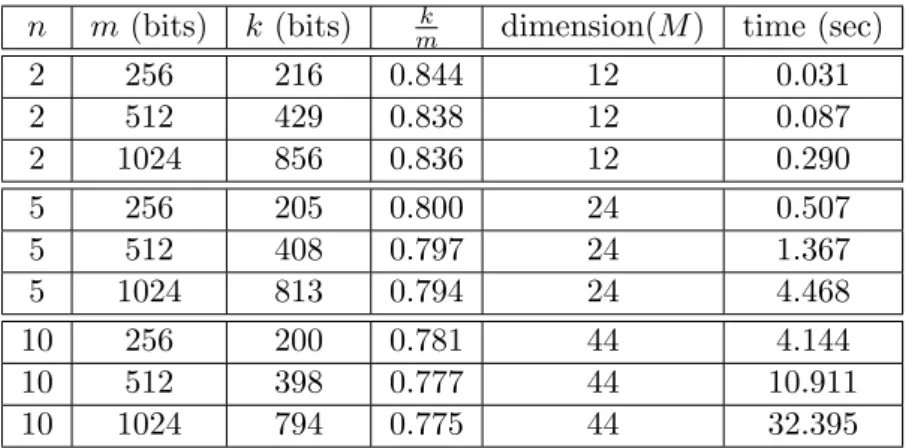
We have implemented the above method to solve HS-HNP. We have used the “PARI/GP” computer algebra system [The12] in our implementation. The experiments were run on an Intel(R) Core i7-2600 CPU with 4 GB RAM, running cygwin (ix86/GMP-4.2.1 kernel) 32-bit version. The results are given in Table 2.1. For every (n, m) pair, 10 random m-bit primes p were chosen. For each p, 10 random hidden numbers α were chosen. The running time reported is averaged over 100 (p, α) pairs for each row of the table. For lattice reduction, we have used the routineqflllin PARI/GP. The source code used for the experiments is given in Section 2.1.4.
n m (bits) k (bits) mk dimension(M) time (sec)
2 256 216 0.844 12 0.031 2 512 429 0.838 12 0.087 2 1024 856 0.836 12 0.290 5 256 205 0.800 24 0.507 5 512 408 0.797 24 1.367 5 1024 813 0.794 24 4.468 10 256 200 0.781 44 4.144 10 512 398 0.777 44 10.911 10 1024 794 0.775 44 32.395
Table 2.1: HS-HNP: implementation results
In the experiments, we have observed that there is one (reduced) basis vector of very low norm, of order 2m1−k. This is because the rows of the matrix M
(Equation (2.5)) corresponding to the terms δii (0≤i≤n) can add up to
produce the vector * 0, . . . , 0 | {z } 2n+3 ,2k−m, . . . , 2k−m | {z } , n+1 0, . . . , 0 | {z } n + .
For instance, in Figure 2.1, we haveA1 =A2 =−1, and B1 =B2 = 1. Hence
by adding up the corresponding three rows, we obtain the vector D
0,0,0,0,0,0,0,2k−m,2k−m,2k−m,0,0,0E.
We have also observed that there are many (reduced) basis vectors with norm of about √3n+ 4. In order to overcome these issues, we “randomize” the relations from Equation (2.2) by multiplying each relation by a random (in-dependent) non-zero element ofZp. Of course, this will not alter the solution
set. In spite of doing so, there will be very short vectors of the order 2m1−k.
But the experiments suggest that there will be only one (reduced) basis vector (second shortest) of norm about√3n+ 4, and we can get the required values
ofdi andei from the corresponding entries of the basis vector. This heuristic
has not failed even once for the 900 (p, α) pairs of Table 2.1, provided k is chosen according to Equation (2.10).
2.1.4 PARI/GP script for solving HS-HNP
1 \\ I n p u t p − m−b i t prime . 2 \\ I n p u t y , b − v e c t o r o f ( k−)MSBs , o f l e n g t h n+1. 3 4 HSHNP( n ,m, k , p , y , b ) = 5 { 6 l o c a l (M, R, S , T, i , j , tmp , a n s ) ; 7 8 M = m a t r i x ( 4∗n+4 ,4∗n+4) ; 9 R = m a t r i x ( 3∗n+4 ,n ) ; 10 11 \\ Matrix J 12 13 f o r( i =1 , 3∗n+4 , 14 i f( i ==1, M[ i , i ]=1 ) ; 15 i f( i>1 && i<=(2∗n+3) , M[ i , i ] = 2 ˆ ( k−m) ) ; 16 i f( i>(2∗n+3) && i<=(3∗n+4) , M[ i , i ] = 2 ˆ ( 2∗( k−m) ) ) ; 17 ) ; 18 19 \\ Matrix P 20 21 f o r( i =1 ,n , M[ i +(3∗n+4) , i +(3∗n+4)]=p ) ; 22 23 \\ Matrix R, M 24 25 f o r( j =1 , n , 26 while( ( tmp = random ( p ) ) ==0,) ; 27 f o r( i =1 , 3∗n+4 , 28 i f( i ==1, R [ i , j ] = ( ( y [ j +1]∗b [ j +1]−y [ 1 ]∗b [ 1 ] )∗tmp )%p ) ; 29 i f( i ==2, R [ i , j ]=(−1∗b [ 1 ]∗tmp )%p ) ;
30 i f( i>2 && i<=(n+2) && j ==(i−2) , R [ i , j ] = ( b [ j +1]∗tmp )%p ) ; 31 i f( i ==(n+3) , R [ i , j ]=(−1∗y [ 1 ]∗tmp )%p ) ;
32 i f( i>(n+3) && i<=(2∗n+3) && j ==(i−(n+3) ) , 33 R [ i , j ] = ( y [ j +1]∗tmp )%p ;
34 ) ;
35 i f( i ==(2∗n+4) , R [ i , j ]=(−1∗tmp )%p ) ;
36 i f( i>(2∗n+4) && i<=(3∗n+4) && j ==(i−(2∗n+4) ) , 37 R [ i , j ] = ( 1∗tmp )%p 38 ) ; 39 M[ j +(3∗n+4) , i ]=R [ i , j ] ; \\T r a n s p o s e o f ”M” 40 ) ; 41 ) ; 42 43 T = q f l l l (M) ; 44 S = M∗T ; \\Reduced b a s i s 45 46 \\compute t h e h i d d e n number 47 48 tmp = ( ( y [ 1 ] + 2 ˆ (m−k )∗a b s ( S [ 2 , 2 ] ) ) ;
2.1 Limits of a Conjecture 27
49 a n s = tmp∗( b [ 1 ] + 2 ˆ (m−k )∗a b s ( S [ n + 3 , 2 ] ) ) )%p ; 50
51 a n s \\return 52 }