HAL Id: hal-02160940
https://hal.archives-ouvertes.fr/hal-02160940
Submitted on 20 Jun 2019
HAL
is a multi-disciplinary open access
archive for the deposit and dissemination of
sci-entific research documents, whether they are
pub-lished or not. The documents may come from
teaching and research institutions in France or
abroad, or from public or private research centers.
L’archive ouverte pluridisciplinaire
HAL
, est
destinée au dépôt et à la diffusion de documents
scientifiques de niveau recherche, publiés ou non,
émanant des établissements d’enseignement et de
recherche français ou étrangers, des laboratoires
publics ou privés.
Mirage: 2D Source Localization Using Microphone Pair
Augmentation with Echoes
Diego Di Carlo, Antoine Deleforge, Nancy Bertin
To cite this version:
Diego Di Carlo, Antoine Deleforge, Nancy Bertin.
Mirage:
2D Source Localization Using
Microphone Pair Augmentation with Echoes.
ICASSP 2019 - IEEE International Conference
on Acoustic, Speech Signal Processing, May 2019, Brighton, United Kingdom.
pp.775-779,
�10.1109/ICASSP.2019.8683534�. �hal-02160940�
MIRAGE: 2D SOURCE LOCALIZATION USING
MICROPHONE PAIR AUGMENTATION WITH ECHOES
Diego Di Carlo
†, Antoine Deleforge
‡, and Nancy Bertin
††
Univ Rennes, Inria, CNRS, IRISA, France
‡
Universit´e de Lorraine, CNRS, Inria, LORIA, F-54000 Nancy, France
ABSTRACT
It is commonly observed that acoustic echoes hurt perfor-mance of sound source localization (SSL) methods. We in-troduce the concept of microphone array augmentation with echoes (MIRAGE) and show how estimation of early-echo characteristics can in fact benefit SSL. We propose a learning-based scheme for echo estimation combined with a physics-based scheme for echo aggregation. In a simple scenario in-volving 2 microphones close to a reflective surface and one source, we show using simulated data that the proposed ap-proach performs similarly to a correlation-based method in azimuth estimation while retrieving elevation as well from 2 microphones only, an impossible task in anechoic settings.
Index Terms— Sound Source Localization, Image Mi-crophones, TDOA Estimation, Supervised Learning.
1. INTRODUCTION
Sound source localization (SSL) consists in determining the position of a sound source from microphone signals in 3D space. In polar coordinates, most existing methods focus on estimating the directional of arrival, namely, azimuth and el-evation angles. Though this task is performed routinely by humans, it still challenges today’s computational methods, in particular in the presence of reverberation or interfering sources (see [1] and [2] for a review). Computational ap-proaches consist in two components. First, extracting features from audio data that are as independent as possible from the source’s content while preserving spatial information. Sec-ond, mapping these features to the source position. Two lines of research have been investigated to obtain such mappings: physics-based and learning-based approaches.
Physics-based approaches rely on a simplified sound propagation model [1, 3, 4, 5]. The free-field model is by far the most widely used one and assumes a single direct sound path from the source to each microphone. When the source is placed far enough, this yields a closed-form mapping from the sound’s time-difference-of-arrival (TDOA) in a microphone pair and the source’s azimuth angle in this pair. If multiple
The research presented in this paper is reproducible. Code and data are available athttps://github.com/Chutlhu/MIRAGE
s
1m
1m
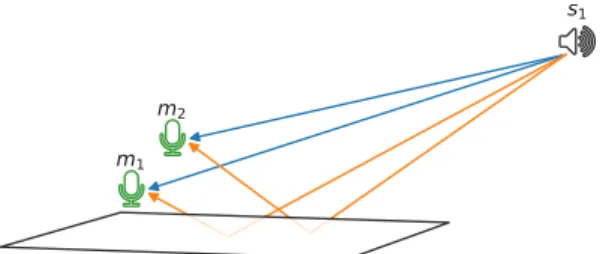
2Fig. 1: Typical setup with one source source recorded by two microphones. The illustration shows direct sound path (blue lines) and resulting first-order echoes (orange lines).
microphone pairs are available and form a non-linear array, their TDOAs can be aggregated to obtain 2D directions of arrival [4]. These methods strongly suffer in environments where the free-field assumption is violated,e.g., in the pres-ence of strong acoustic echoes and reverberation [6].
Learning-based approaches use an annotated training dataset to implicitly learn a mapping from audio features to source positions [7, 8, 9, 10, 11]. Such data can be obtained from real recordings [7] or using physics-based simulators [8, 9, 10, 11]. These methods were showed to overcome some limitations of the free-field model, but are usually trained for specific microphone arrays and fail whenever test conditions strongly mismatch training conditions.
Most sound source localization methods, including the above listed, regard reverberation and in particular acoustic echoes as a nuisance. In contrast, some recent work that we refer to asecho-awaremethods have showed that the knowl-edge of early acoustic echoes could be used to reconstruct the geometry of an audio scene [12, 13, 14] or to improve perfor-mance of signal enhancement methods [15, 16, 17]. In [12], some ad-hoc reflectors are used as artificial pinnaeto esti-mate elevation based on a simple reflection model. In [14], cameras, depth sensors and laser sensors are used to identify reflectors and build a corresponding acoustic model that helps SSL.
In this work, we combine ideas from physics-based, learning-based and echo-aware approaches to introduce the framework of microphone array augmentation with echoes (MIRAGE) for SSL. We consider a simple yet common sce-nario to illustrate this idea: two microphones, one source and
a nearby reflective surface, as illustrated in Fig. 1. This may occur, for instance, when the sensors are placed on a table such as in voice-based assistant devices or next to a wall. The reflective surface is assumed to be the most reflective and closest one to the microphones in the environment, hence gen-erating the strongest and earliest echo in each microphone. Under thisclose-surfacemodel, we ask the following ques-tions:
1. Can early echoes be estimated from two-microphone recordings of an unknown source?
2. Can they be used to estimate both the azimuth and el-evation angles of the source, animpossibletask in free field conditions?
We propose to use a deep neural network (DNN) trained on a simulated close-surface dataset to estimate early echoes prop-erties from audio features. The MIRAGE framework then exploits these estimated properties by expressing them as TDOAs in thevirtual 4-microphone arrayformed by the true microphone pair and its image with respect to the reflective surface. We show that the proposed framework approximately estimates echo properties, perform similarly to a correlation-based method in azimuth estimation for the considered sce-nario and estimatesimpossibleelevation angles with good ac-curacy in noiseless settings using two microphones only.
2. BACKGROUND IN MICROPHONE ARRAY SSL
In this section, we briefly review some necessary background in microphone array SSL. Let us assume a microphone array ofI sensors is placed inside a room and records the sound emitted by one static point sound source. In all generality, the relationship between the signalmi(t)recorded by the sensor
placed at fixed positionmiand the signals(t)emitted by the
source at fixed positionsis defined by:
mi(t) = (hi∗s)(t) + ni(t), (1)
where the convolution with room impulse response (RIR)
hi(t)embodies the fact that sensorireceives a so-called
spa-tial image of the source andni denotes possible
measure-ment noise. The RIR depends on the spatial parameters of the scene: microphone positions, source position w.r.t the room, as well as the room acoustic properties (size, absorption and diffuseness of the wall materials.)
RIRs can be typically modelled as the sum of the direct path and multiple reflections of the sound. This can boil down to modellinghi as a Dirac impulse at timeτiaccounting for
the time delay from the source to microphonei, plus an error term. In the frequency domain, this leads to:
Hi(f) =αi(f)e−2πf τi + εi(f), (2)
where the error termεi(t)collects echoes, the reverberation
tail, diffusion, and noise. The term αi(f) captures the air
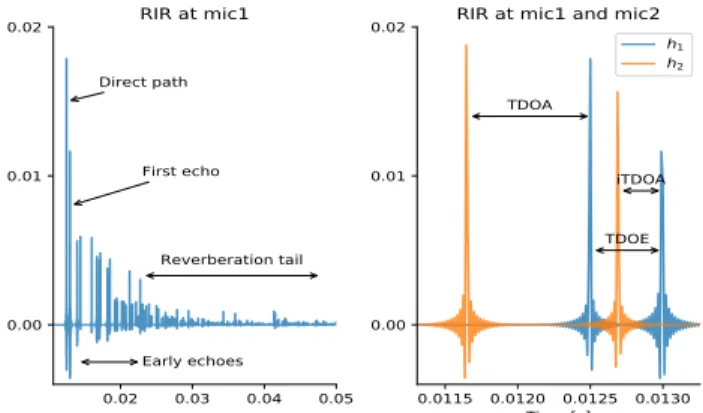
attenuation phenomenon. A time-domain example of RIR is shown in Fig. 2 (left).
0.02 0.03 0.04 0.05 0.00 0.01 0.02 Direct path First echo Early echoes Reverberation tail RIR at mic1 0.0115 0.0120 0.0125 0.0130 Time [s] 0.00 0.01 0.02 TDOA iTDOA TDOE
RIR at mic1 and mic2
h1 h2
Fig. 2: Left, a typical simulated RIR with annotated compo-nents. Right, superposition of two RIRs and visualization of time difference of arrival between direct paths (TDOA), first echoes (iTDOA) and direct path and first echo (TDOE).
2.1. 2-channel 1D-SSL
Let us first consider the stereo case (I = 2). Under the far-field assumption, traditional SSL methods use the time dif-ference of arrival (TDOA),τ , τ2−τ1, as a proxy for the
estimation of the angle of arrival (AOA), since:
AOA=arccos(c τ / d), (3) wherec is the speed of sound and d the inter-microphone distance. SSL then reduces to estimating the TDOA, which can be done by cross-correlation-based methods such as the widely used and well performing generalized cross-correlation with phase transform (GCC-PHAT) method [3, 18]. Given short-time Fourier transformsM1andM2of the
two microphones signals, the GCC-PHATangular spectrum
is defined as: ΨGCC(τ) = X f,n M1(f, n)M2∗(f, n) |M1(f, n)M2∗(f, n)| e−2πf τ. (4)
Then, the TDOA estimate is given byτˆ= arg max
τ ΨGCC(τ).
Note thatΨGCCcan also be expressed directly as a function
of the AOA using (3), hence the termangular spectrum.
2.2. Multichannel 2D-SSL
When more microphones are available and the array is not linear, 2D-SSL can be envisioned. A possible approach is to use 1D-SSL on all pairs and combine their results, a principle which was successfully applied in the steered response power with phase transform (SRP-PHAT) method [4]. SRP-PHAT exploits the geometry of the microphone array and the esti-mated TDOAs from microphone pairs to return the DOA. In a nutshell, this algorithm aims to estimate a global angular spectrumΨSRP(θ, φ)which will exhibit a local maximum in
the direction of the active source. First, a global grid of pos-sible DOAs is defined according to a desired resolution and
s1
m1
m1
m2
m2
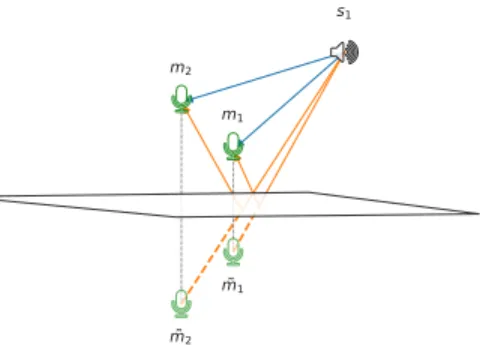
Fig. 3: Illustration of the imagesm˜1andm˜2of microphones
m1andm2in the presence of a reflective surface and a source.
Blue lines correspond to direct paths, orange lines correspond to echo paths.
computational load. Second, for each pair of microphones, a local set of AOAs is defined and a TDOA-based algorithm (e.g. GCC-PHAT) is used to compute the associated local angular spectrum. Finally all the local contributions (a col-lection of localΨGCC(τ)) are geometrical aggregated and
in-terpolated back to the global DOA grid to formΨSRP(θ, φ),
and the DOA maximizingΨis used as estimate.
3. MIRAGE: MICROPHONE ARRAY AUGMENTATION WITH ECHOES
We now introduce the proposed concept of microphone array augmentation with echoes (MIRAGE). Let us first expand for-mula (2) to account for more echoes:
Hi(f) = K X k=0 αki(f)e−2πf τik + ε i(f) (5)
where the sum now comprises the direct path (k = 0) and theK earliest reflections (K = 1in this paper) andεi
col-lects the remaining RIR components. Here,αki(f)accounts for both air attenuation and wall absorption phenomena. In the remainder of this paper, we make the approximation of frequency-independentαk
i. Eq. 5 then corresponds to the well
known image-source (IS) model, where reflections are treated as mirror images of the true source with respect to reflective surfaces, emitting the same signal. We will employ here a less common but equivalent interpretation of IS, namely, the image-microphone (IM) model. As illustrated in Fig. 3, vir-tual microphones are mirror images of the true microphones with respect to reflective surfaces. In this view, the echoic sig-nal received at a true microphone is the sum of the anechoic signals received at this microphone and its images. If we con-sider the virtual array consisting of both true and image mi-crophones, multiple microphone pairs are now available. For each of them, it is then possible to define a corresponding time difference of arrival. Among them, we will refer to the one between the two real microphones as TDOA, the one be-tween the two image microphones as image TDOA (iTDOA)
and the one between the first microphone and its image as time difference of echoes (TDOE). We have:
TDOA= (km2−sk − km1−sk)/c=τ20−τ 0 1, (6) iTDOA= (km˜2−sk − km˜1−sk)/c=τ21−τ 1 1, (7) TDOE= (km˜1−sk − km1−sk)/c=τ11−τ10, (8)
wherem˜i denotes the image of position mi. These three
quantities are directly connected to RIRs, as illustrated in Fig. 2(right). LetV ={TDOA,iTDOA,TDOE} ∈R3.
Fol-lowing the 2D-SSL scheme described in Sec. 2.2 and given the virtual microphone-array geometry (which depends on the relative position of microphones to the surface),V could in principle be used to estimate the 2D directional of arrival of the source. In the next section, we present a learning-based method to estimateV using audio features obtained from only two microphones.
4. LEARNING-BASED ECHO ESTIMATION
Our approach is to train a deep neural network (DNN) on a dataset simulating the considered close-surface scenario. We model the problem as multi-target regression, withinteraural level difference(ILD) andinteraural phase difference(IPD) as input features, andV ∈R3as output parameters. ILD and
IPD features are defined in the frequency domain as follows:
( ILD(f) = T1PT t=1log| M2(f,t) M1(f,t) | IP D(f) = 1 T PT t=1 M2(f,t)/|M2(f,t)| M2(f,t)/|M1(f,t)| (9)
More precisely, the input of the network is x = [ILD,
Re(IP D)],Im(IP D)], where Re and Im denote real and imaginary part operators, respectively. Note that for the IPD, the frequencyf = 0is discarded because it is constant for every observation. In general, the mapping betweenV and the proposed feature is not unique. In particular, this happen whenτ1
2 =τ11. In order to avoid this, we preventively pruned
all the entries with|τ1
2 −τ11|<10−6from the dataset.
We use a simple fully-connected DNN architecture con-sisting of aD-dimensional input layer, a3-dimensional out-put layer, and 3 fully connected hidden layers with respective input sizes500, 300 and 50. Rectified linear unit (ReLU) activation functions are used except at the output layer, and each hidden layer has a dropout probabilitypdo = 0.3. We
use the mean square error loss function for training and the Adam optimizer [19]. The normalized root mean square error (nRMSE) is taken as validation metric1. The network is
man-ually tuned on a validation set to find the best combination of number of hidden layers, their sizes andpdo. Once time
delay estimatesVˆ are returned by the DNN, they are con-verted to synthetic local angular spectra and passed toΨSRP 1The nRMSE takes values between0(perfect fit) and∞(bad fit). If it is
(See Sec. 2.2) together with the relative positions of true and image microphones which are assumed known. We call this algorithm MIRAGE. The synthetic local angular spectra con-sist of Gaussians centered atVˆ and with variances equal to the prediction errors made by the DNN on the validation set.
5. IMPLEMENTATION AND RESULTS
To the best of the authors’ knowledge, no reference imple-mentation of algorithms for 2D-SSL using only 2 micro-phones is available to date. To check the validity of TDOA estimation, it is compared to GCC-PHAT using the true mi-crophones (see Sec. 2.1). For training and validation of the DNN we generate many random shoe-box room configura-tions using the software presented in [20]. This software im-plements both the image-method for simulating reflections and a ray-tracing algorithm for diffusion. Room widths are uniformly drawn at random in[3,9]m, heights in [2,4]m. Random source/microphones positions and absorption coeffi-cients for the 6 surfaces are used, respecting the close-surface scenario. In particular, the microphones are at most30cm from the close-surface, placed10cm from each other, the ab-sorption coefficients of the other walls are uniformly sampled in(0.5,1)and the one of the close-surface is in(0,0.5). The same realistic diffusion profile [11] is used for all surfaces. Around90,000audio scenes are generated this way, yielding reverberation times (RT60)between20ms and250ms. For
training and validation, the RIRs are convolved with 1 sec of white-noise (wn) with no additional noise. All signals and RIRs are sampled at16kHz. The STFT is performed on1024
point with50%overlap. Finally the features are computed as in (9) yielding a vector of sizeD = 1534for each observa-tion. While we validate the DNN on a portion of the dataset in aholdoutfashion, the test is conducted on 200 new RIRs con-volved with both wn and speech (sp) utterances. This set is generated similarly to the training and validation sets. More-over the recordings are perturbed by external white noise at 10 dB SNR (wn+n, sp+n). The speech signals are normal-ized speech utterances of various lengths (from1 s to6 s), randomly selected from the TIMIT corpus. A free and open-source Matlab implementation of SRP-PHAT2is used to ag-gregate local angular spectra obtained from the DNN’s out-put. A sphere sampling with0.5◦resolution and coordinates
θ∈[−179,180]andφ∈[0,90]is used for the DOA search. TDOA estimation errors using the proposed approach and GCC-PHAT are presented in Table 1. Training a DNN to es-timate TDOAs brings similar performances as GCC-PHAT in terms of nRMSE. Estimation of iTDOA and TDOE seems to be a harder task for the simple DNN we used. Nevertheless, our results confirm the possibility of retrieving early echoes from only two-microphone recordings. When some exter-nal noise is added, performance of both methods severely
2http://bass-db.gforge.inria.fr/bss_locate/
nRMSE ACCURACY
Input TDOA iTDOA TDOE θ <10◦ θ <20◦ MIRAGE wn 0.18 0.28 0.25 4.10 (77) 5.97 (97) MIRAGE wn+n 0.68 0.69 0.89 5.00 (26) 9.89 (54) MIRAGE sp 0.31 0.34 0.56 4.83 (63) 7.26 (82) MIRAGE sp+n 0.99 0.98 1.48 4.60 (16) 9.88 (35) GCC-PHAT wn 0.21 - - 4.22 (81) 6.19 (97) GCC-PHAT wn+n 0.68 - - 4.03 (65) 5.34 (83) GCC-PHAT sp 0.32 - - 4.08 (82) 5.34 (97) GCC-PHAT sp+n 1.38 - - 4.70 (19) 8.38 (32)
Table 1: Normalize root mean squared error for TDOA esti-mation and mean angular error in◦(with accuracies (%)) for AOA estimation with10◦and20◦angular tolerance.
DoA ACCURACY ACCURACY
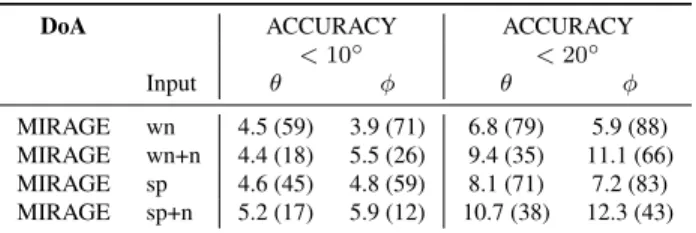
<10◦ <20◦ Input θ φ θ φ MIRAGE wn 4.5 (59) 3.9 (71) 6.8 (79) 5.9 (88) MIRAGE wn+n 4.4 (18) 5.5 (26) 9.4 (35) 11.1 (66) MIRAGE sp 4.6 (45) 4.8 (59) 8.1 (71) 7.2 (83) MIRAGE sp+n 5.2 (17) 5.9 (12) 10.7 (38) 12.3 (43)
Table 2: Mean angular error in◦ (with accuracies (%)) for 2D SSL (azimuth and elevation) with10◦and20◦tolerance. degrades. This is a well-know and expected behaviour for GCC-PHAT. It suggests that noise should be considered in the training phase of MIRAGE. When we compare the per-formance in terms of AOA, the two methods yield the same accuracy within a 20◦ threshold, as can be see in Table 1. When a smaller tolerance is considered, GCC-PHAT outdoes the proposed approach in accuracy, with comparable errors. Again, when adding noise, performance decreases. In Ta-ble 2 the performance of the full 2D-SSL pipeline is showed. Within a tolerance of20◦, the MIRAGE model allows esti-mation of both azimuth and elevation of the target source. However since in our data the 2 microphones were free to move, the inclinations of the true and image pairs are rarely flat. While this helps elevation estimation, it reduces the ac-curacy of predicting the right azimuth. While external noise is again decreasing the accuracy dramatically, it is interesting to notice that our DNN model trained and validated with white noise sources somewhat generalizes to speech sources.
6. CONCLUSION
In this paper we demonstrated how a simple echo model could allow 2D SSL with only two microphones, using simulated data. Future research will focus on extending this proof-of-concept to real data. The problem of echo-delay estimation proved to be very challenging, and extensions of the proposed learning scheme will be developed to obtain more reliable es-timations of angular spectra. Extensions of the method to bet-ter handle various types of noise and emitted signals will also be sought. Finally, applications of the MIRAGE framework to larger microphone arrays, higher order echoes and a variety of tasks beyond SSL will be explored.
7. REFERENCES
[1] Caleb Rascon and Ivan Meza, “Localization of sound sources in robotics: A review,” Robotics and Au-tonomous Systems, vol. 96, pp. 184–210, 2017.
[2] S. Argentieri, P. Dan`es, and P. Sou`eres, “A survey on sound source localization in robotics: From binaural to array processing methods,” Computer Speech & Lan-guage, vol. 34, no. 1, pp. 87–112, nov 2015.
[3] C. Knapp and G. Carter, “The generalized correlation method for estimation of time delay,” IEEE Transac-tions on Acoustics, Speech, and Signal Processing, vol. 24, no. 4, pp. 320–327, aug 1976.
[4] Joseph H. DiBiase, Harvey F. Silverman, and Michael S. Brandstein, “Robust Localization in Reverberant Rooms,” in Microphone Arrays: Signal Processing Techniques and Applications, pp. 157–180. Springer, Berlin, Heidelberg, 2001.
[5] Romain Lebarbenchon, Ewen Camberlein, Diego Carlo, Antoine Deleforge, and Nancy Bertin, “Evaluation of an open-source implementation of the SRP-PHAT algo-rithm within the 2018 LOCATA challenge,” in 2018 IEEE-AASP Challenge on Acoustic Source Localiza-tion and Tracking (LOCATA), InternaLocaliza-tional Workshop on Acoustic Signal Enhancement, 2018, pp. 2–3. [6] Jan Scheuing and Bin Yang, “Disambiguation of
tdoa estimates in multi-path multi-source environments (datemm).,” inICASSP (4), 2006, pp. 837–840. [7] Antoine Deleforge, Florence Forbes, and Radu Horaud,
“Acoustic space learning for sound-source separation and localization on binaural manifolds,” International Journal of Neural Systems, vol. 25, no. 01, pp. 1440003, 2015.
[8] Fabio Vesperini, Paolo Vecchiotti, Emanuele Principi, Stefano Squartini, and Francesco Piazza, “A neural net-work based algorithm for speaker localization in a multi-room environment,” in2016 IEEE 26th International Workshop on Machine Learning for Signal Processing (MLSP). Sep. 2016, pp. 1–6, IEEE.
[9] Sharath Adavanne, Archontis Politis, and Tuomas Virta-nen, “Direction of arrival estimation for multiple sound sources using convolutional recurrent neural network,”
CoRR, vol. abs/1710.10059, 2017.
[10] Laur´eline Perotin, Romain Serizel, Emmanuel Vincent, and Alexandre Gu´erin, “CRNN-based multiple DoA es-timation using Ambisonics acoustic intensity features,”
IEEE Journal of Selected Topics in Signal Processing (submitted), 2018.
[11] Cl´ement Gaultier, Saurabh Kataria, and Antoine Dele-forge, “VAST : The Virtual Acoustic Space Traveler Dataset,” inInternational Conference on Latent Vari-able Analysis and Signal Separation (LVA/ICA), Greno-ble, France, Feb. 2017.
[12] Hiromichi Nakashima, Mitsuru Kawamoto, and Toshi-haru Mukai, “A localization method for multiple sound sources by using coherence function,” European Sig-nal Processing Conference, vol. 1, no. 3, pp. 130–134, 2010.
[13] Ivan Dokmani´c, Reza Parhizkar, Andreas Walther, Yue M Lu, and Martin Vetterli, “Acoustic echoes reveal room shape,” Proceedings of the National Academy of Sciences, vol. 110, no. 30, pp. 12186–12191, 2013. [14] Inkyu An, Myungbae Son, Dinesh Manocha, and
Sung-Eui Yoon, “Reflection-Aware Sound Source Local-ization,” in 2018 IEEE International Conference on Robotics and Automation (ICRA). may 2018, pp. 66–73, IEEE.
[15] James L Flanagan, Arun C Surendran, and Ea-Ee Jan, “Spatially selective sound capture for speech and audio processing,” Speech Communication, vol. 13, no. 1-2, pp. 207–222, 1993.
[16] Ivan Dokmani´c, Robin Scheibler, and Martin Vetterli, “Raking the cocktail party,” IEEE journal of selected topics in signal processing, vol. 9, no. 5, pp. 825–836, 2015.
[17] Robin Scheibler, Diego Di Carlo, Antoine Deleforge, and Ivan Dokmanic, “Separake: Source separation with a little help from echoes,” in2018 IEEE International Conference on Acoustics, Speech and Signal Process-ing, ICASSP 2018, Calgary, Canada, Apr. 15-20, 2018, pp. 6897–6901.
[18] Charles Blandin, Alexey Ozerov, and Emmanuel Vin-cent, “Multi-source TDOA estimation in reverberant audio using angular spectra and clustering,”Signal Pro-cessing, vol. 92, no. 8, pp. 1950–1960, 2012.
[19] Diederik P. Kingma and Jimmy Ba, “Adam: A method for stochastic optimization,”CoRR, vol. abs/1412.6980, 2014.
[20] Steven M Schimmel, Martin F Muller, and Norbert Dil-lier, “A fast and accurate shoebox room acoustics simu-lator,” inIEEE International Conference on Acoustics, Speech and Signal Processing, ICASSP 2009, 2009, pp. 241–244.