Received July 16, 2019, accepted July 26, 2019, date of publication July 30, 2019, date of current version August 15, 2019. Digital Object Identifier 10.1109/ACCESS.2019.2932042
A Novel Design Approach for 5G Massive MIMO
and NB-IoT Green Networks Using a Hybrid
Jaya-Differential Evolution Algorithm
SOTIRIOS K. GOUDOS 1, (Senior Member, IEEE), MARGOT DERUYCK 2, DAVID PLETS2, (Member, IEEE), LUC MARTENS2, (Member, IEEE),KOSTAS E. PSANNIS 3, (Member, IEEE), PANAGIOTIS SARIGIANNIDIS 4, (Member, IEEE), AND WOUT JOSEPH 2, (Senior Member, IEEE)
1Department of Physics, Aristotle University of Thessaloniki, 54124 Thessaloniki, Greece 2Department of Information Technology, Ghent University/IMEC-WAVES, 9052 Ghent, Belgium
3Department of Applied Informatics, School of Information Sciences, University of Macedonia, 546 36 Thessaloniki, Greece
4Department of Informatics and Telecommunications Engineering, University of Western Macedonia, Karamanli & Ligeris, 50100 Kozani, Greece Corresponding author: Sotirios K. Goudos ([email protected])
ABSTRACT Our main objective is to reduce power consumption by responding to the instantaneous bit rate demand by the user for 4th Generation (4G) and 5th Generation (5G) Massive MIMO network configurations. Moreover, we present and address the problem of designing green LTE networks with the Internet of Things (IoT) nodes. We consider the new NarrowBand-IoT (NB-IoT) wireless technology that will emerge in current and future access networks. In this context, we apply emerging evolutionary algorithms in the context of green network design. We investigate three different cases to show the performance of the new proposed algorithm, namely the 4G, 5G Massive MIMO, and the NB-IoT technologies. More specifically, we investigate the Teaching-Learning-Optimization (TLBO), the Jaya algorithm, the self-adaptive differential evolution jDE algorithm, and other hybrid algorithms. We introduce a new hybrid algorithm named Jaya-jDE that uses concepts from both Jaya and jDE algorithms in an effective way. The results show that 5G Massive MIMO networks require about 50% less power consumption than the 4G ones, and the NB-IoT in-band deployment requires about 10% less power than guard-band deployment. Moreover, Jaya-jDE emerges as the best algorithm based on the results.
INDEX TERMS Massive MIMO, 4G, 5G, NB-IoT, network planning, network design, hybrid networks, power consumption, green networks, evolutionary algorithms.
I. INTRODUCTION
The fifth generation (5G) of cellular networks is expected to offer extremely wide spectrum and multi-Gigabit-per-second (Gbps) data rates for mobile users. Massive multiple-input multiple-output (MIMO) [1], [2] is one of the primary tech-nologies to be incorporated into the fifth generation (5G) framework of cellular systems. In Massive MIMO sys-tems each base station (BS) is equipped with several active antenna elements that communicate with user equipment that have single or multi antenna over the same time and frequency band. Moreover, future wireless access networks will require green networking as essential part for they
The associate editor coordinating the review of this manuscript and approving it for publication was Muhammad Imran.
deployment [3]–[6]. It is expected that the power consump-tion will increase in the 5G access networks as these will need to expand and become denser. However, Massive MIMO BSs will have a lower power consumption than conventional 4G BSs [7].
Moreover, 3GPP released the first recommendation of the NarrowBand-IoT (NB-IoT) [8]–[10] in 2016. NB-IoT is an emerging new wireless access technology, which will exist together with the other current cellular networks like Global System for Mobile communications (GSM), Uni-versal Mobile Telecommunications System (UMTS) and Long-Term Evolution (LTE). The basic idea from 3GPP standards is the integration of NB-IoT to current mobile 4G networks. NB-IoT devices are low cost and allow massive deployments with reduced data rates [11]. The subcarrier
bandwidth is 180kHz in case of co-existence with current LTE networks. According to a prediction from Ericsson the number of IoT connected devices will reach 1.5 billion by 2022 [12]. Thus, the massive NB-IoT deployment will gener-ate new optimization problems from the access network point of view. That of optimal coverage and power consumption.
At the same time, machine learning techniques play an important role towards future wireless networks and services [13]. Among others, evolutionary algorithms (EAs) belong to the core of machine learning paradigms. Addi-tionally, the application of EAs to LTE network optimiza-tion is also addressed in previous works [14]–[18]. In this work, we consider 4G networks, and 5G-Massive MIMO networks with a minimal power consumption. The optimiza-tion framework requires first the selecoptimiza-tion of the suitable BS locations from a set of given locations, and second the fine tuning of each BS antenna’s input power, in order to obtain an energy-efficient network. Moreover, we also con-sider LTE networks with massive deployment of NB-IoT devices. We also optimize the LTE NB-IoT network towards both optimal coverage and power consumption.
The above-described combinatorial optimization problem can be addressed using suitable EAs. Our goal is to design a wireless network optimized towards power consumption, while preserving QoS (Quality of Service). A capacity-based heuristic, meaning that it will respond to the instantaneous bit rate demand of the user in order to develop an energy-efficient network, was introduced in [6]. Herein, we will use a modi-fied algorithm that combines an EA optimization algorithm with concepts taken from the capacity tool. The applica-tion area of all the algorithms is Ghent, Belgium. We com-pare the obtained results in terms of both the energy and the network performance of all algorithms. We examine six different algorithms in order to compare performance of 4G networks, Massive MIMO future 5G networks and emerging NB-IoT networks. We will use state-of-the-art algorithms that have been recently applied to a wireless sensor network (WSN) optimization problem [19]. Namely, we consider the Teaching-Learning Based Optimization (TLBO) [20], the Jaya algorithm, [21] and the recently pro-posed hybrid TLBO-Jaya [19]. Moreover, we also apply a self-adaptive differential evolution algorithm (jDE) and a hybrid TLBO-DE algorithm resulting in the improved TLBO (ITLBO) [22]. Additionally, we introduce a new hybrid algo-rithm that combines Jaya and the jDE algoalgo-rithms, which we call Jaya-jDE. The main characteristic of all these algo-rithms is the fact that they are low complexity algoalgo-rithms. All of them they do not have any control parameters, and the only user selection is the population size and iteration number. It must be pointed out that in [19] the TLBO, Jaya, and TLBO-Jaya algorithms were applied in real-valued opti-mization problems, while in our case they are applied in a discrete-valued problem. We expect them to perform well regardless of the problem type.
The novelty in our work lies in the fact that (i) we per-form such a comparison regarding power consumption in 4G,
and 5G/Massive MIMO and NB-IoT networks and (ii) we introduce a novel hybrid algorithm the Jaya-jDE algorithm. Additionally, (iii) the whole optimization framework is mod-ified from the previous heuristic algorithm using a novel meta-heuristic approach and performance is compared for six different algorithms.
The rest of this paper is organized as follows. SectionII
provides a brief description of related work. The problem description is provided in SectionIII. We describe the algo-rithms details in SectionIV. SectionV, presents the numeri-cal results. Finally, we give the conclusion in SectionVI. II. RELATED WORK
The authors in [23] present an architecture vision for 5G mobile networks. Their proposal uses a two-layer archi-tecture having a radio network and a network cloud. Additionally, [24] uses cooperative distributed radio resource management algorithms for carrier selection, power control and time synchronization. The network planning applies to hyper-dense small cell networks for 5G communications.
The problem of energy efficiency (EE) maximization for 5G mobile networks is addressed in [25]. The authors per-form an review of state-of-the-art EE-maximization tech-niques for hybrid Massive MIMO systems and identify the open research problems.
The authors in [26] propose a novel method for the cell planning problem for LTE networks using metaheuristic algo-rithms. The authors try to satisfy both cell coverage and capacity constraints simultaneously by formulating an opti-mization problem that captures practical planning aspects.
In the same context, in [27] the optimization problem is to choose a subset of sites from a candidate list to deploy macro or small cells in order to minimize the total cost of ownership (TCO) or the energy consumption subject to practical constraints. For this reason the authors introduce approximation algorithms to solve two different cell planning cases which are NP-hard.
Moreover, the authors in [28] study advanced energy-efficient wireless systems in orthogonal frequency-division multiple access (OFDMA) downlink networks using coor-dinated multipoint (CoMP) transmissions between the base stations (BSs) in a heterogeneous network (HetNet). The optimization problem addressed by the authors is transformed into a convex optimization problem and it’s solved using an efficient iterative resource allocation algorithm.
The problem of ultra-dense small cell planning using cog-nitive radio network is studied in [29]. The authors provide an overview of reconfigurable radio and small cell technologies and introduce the tentative network architecture for 5G. They consider two different planning approaches; genetic-based and graphbased. The main purpose is to improve user throughput by eliminating communication interference.
The topic of green cell planning for small cell networks in smart cities is discussed in [30]. The authors model various traffic patterns using a stochastic geometry approach and propose an energy-efficient scheme for small cell planning
and deployment in accordance with the selected traffic pattern.
Additionally, the authors in [31] use a genetic algorithm combined with a location intelligence method for energy optimization in 5G Wireless Networks. The authors in [32] propose a new Bioinspired Self-Organizing Solution for auto-mated and efficient Physical Cell Identifier (PCID) configu-ration in 5G ultra dense networks.
Finally, a review paper that studies the problem of planning future cellular networks is given in [33]. The authors briefly give a tutorial on the cell planning process and they review the more important findings from recent works in the literature that have attempted to address the challenges in planning emerging networks.
III. PROBLEM FORMULATION
Two types of optimization problems are considered in this work: the maximum area coverage problem and the maxi-mum user coverage problem. The details of these problems are presented below. We assume that we have a mobile net-work that consists ofK BSs andN users. The sets of BSs and users areK = {1,2,· · ·,K}andN = {1,2,· · · ,N}, respectively. Moreover, we define the set of power values of each BS. This is denoted withP = {p1,p2,· · ·,pK}. We consider the binary variable,xknthat describes the association of thek-th BS with then-th user and can be formulated as
xkn=
(
1, ifn-th user is associated with thek-th BS
0, otherwise. (1)
Moreover, we define the binary variableykthat describes the operation or not of thek-th BS and can be formulated as
yk =
(
1, if BS k is turned on
0, otherwise. (2)
Additionally, we can define the discrete variable, pk that describes the transmission power value of the k-th BS as pk ∈ {0,1,2,· · ·,pt},∀k ∈ K. where pt is maximum allowable transmission power for a BS according to 3GPP recommendations. Thus, we define the solution vector to an integer vector that contains both the active or not BSs and the operating power in dBm. All the chosen EAs generate this vector.
A. GREEN NETWORK PLANNING FOR MAXIMUM AREA COVERAGE
The first case is a network optimization problem without taking into account users. Our objective is to derive an opti-mized network that has the smallest possible number of BSs, while maximizing the coverage area, and having a minimal BS transmission power. Therefore, there are two optimization objectives: the power consumption minimization and the cov-erage area maximization. We can formulae the first objective
as [3, Section 5]: P1a:Fp=min {y,p} 100 1− P k∈K Pcalc(ykpk) Pmax s.t.C1:yk ∈ {0,1}, ∀k∈K, C2:pk ∈ {0,1,2,· · ·,pt}, ∀k∈K wherePcalc( ) is the calculated power consumption in Watts for a given solution vector,Pmax=K×Pcalc(pt)is the max-imum power consumption of the network, i.e. when all BSs operate and their input power is set to the maximum allowable value. The constraintC1, denotes the operation or not of the k-th BS. Similarly, the constraintC2denotes the transmission power level ofk-th BS. More details for this power consump-tion expression are given in [3]. Moreover, we can define the second optimization objective as the maximum coverage area percentage. This is the percentage of the desired area that the network can cover ny using fewer BS with less power. In case of a Massive MIMO (MaMi) BS it has been found that this is approximately it is [7]
PMaMicalc =P 4G calc
7 (3)
where PMaMicalc , P4Gcalc is the power consumed by a Massive MIMO and an 4G BS, respectively. The coverage function Fcis specified by: P1b:Fc =min {y,p} 100 AtargetT P k∈K Acalc(ykpk) Atarget s.t.C1:yk ∈ {0,1}, ∀k∈K, C2:pk∈ {0,1,2,· · · ,pt}, ∀k∈K whereAtargetis the target area to be covered (in km2), and Acalc(ykpk)is the area covered by thek-BS station (in km2). The calculation of theAcalc(ykpk)requires first the calcu-lation of the maximum allowable path loss,PLmax (in dB), for each operating BS. This is accomplished using the link budget parameters for the 4G and Massive MIMO network of Table2. We can find the maximum rangeR (in meters) covered by each BS [3]. Thus, we may define the total area covered by a given solution vector as the union of all BSs coverage areas, which are derived by each maximum rangeR. From the above we can formulate the complete optimization problem as [3, Section 5]: P1c:F1 =min {y,p} F c+αFp, s.t.C1:yk ∈ {0,1}, ∀k∈K, C2:pk ∈ {0,1,2,· · ·,pt}, ∀k∈K, where α= 0 if Fc<90 (Fc−90)2 5 if 90≤F c≥95 5 otherwise (4)
The above objective problem has a minimum value of −600 that is obtained when bothFcandFpare equal to 100.
B. GREEN NETWORK PLANNING FOR MAXIMUM USER COVERAGE
We present a modified meta-heuristic approach to find the list of BSs covering a given set of users and reduce the total network power consumption [3]. This approach is based on a fitness function and uses concepts from the capacity tool. In this way a global optimizer can be set using any EA.
The solution vector is the input to another algorithm that calculates an objective function based on the number of cov-ered users and the power consumption of the current solution.
In this case, we formulate this objective function as
P2:F2= min {y,x,p} P k∈K Pcalc(ykpk) Pmax +4· 1− P k∈K,n∈N xknyk N , s.t.C1:yk ∈ {0,1}, ∀k∈K, C2:pk ∈ {0,1,2,· · ·,pt}, ∀k∈K, C3:xkn∈ {0,1}, ∀n∈N, ∀k∈K, C4: XK k=1xkn=1, ∀n∈N
where4is a very large number. The constraintC3, denotes the association or not between usernand BSk. Moreover, the constraintC4expresses the unique association between one usernwith BSkat the same time. Thus, if a possible solution vector is used as input, the algorithm first finds the number of users covered by this solution, and then it calculates the objective function value.
IV. ALGORITHM DESCRIPTION
In this section, we present the details of the algorithms. A. JAYA ALGORITHM
The Jaya algorithm was created by Rao in [21]. It is a pop-ulation based stochastic algorithm. The basic idea in Jaya is for each member of the population or possible solutionyito be modified using the information of the best solution and moving away from the worst solution found at each iteration. The name Jaya means victory in Sanskrit. Jaya does not have any control parameters. The user has to set only the population size and the maximum number of iterations. The Jaya concept is expressed mathematically by
ynewi =yoldi +rnd1 ybest−yoldi −rnd2 yworst−yoldi (5) wherernd1andrnd2are uniformly distributed random num-bers within the range [0,1]. In Jaya the new found child vector replaces the old one only in case that the new one obtains a better objective function value than the old.
B. JDE ALGORITHM
Storn suggested in [34] to select the differential evolu-tion (DE) control parametersM andCr from the intervals [0.5,1] and [0.8,1], respectively, and to set population size Np =10D, whereDis the problem dimension. The param-eter M is the mutation control parameter that is used for mutant vector generation, whileCr is the crossover control parameter that is applied for trial vector generation [34]. The proper selection of the control parameter values is, usually problem-dependent. Thus, additional running is required for finding the optimal control parameter values. In this context, in [35] a self-adaptive DE algorithm is proposed, which they call jDE. In this algorithm the same mutation operator as in DE/rand/1/bin is applied. In jDE each member of the popu-lation has its ownM andCr parameters. Thus, each vector is extended with two additional variables. These parameters evolve with the population and the new generated vectors use these values of the control parameters. Then the algorithm selects the vectors with the improvedMandCrvalues, which are more likely to survive and to generate new child vectors for the next generation. Thus, the newly found vectors use the obtainedMandCrvalues to the next generation. The way the algorithm self-adjusts theM andCr parameters is given by the following expressions:
MG+1,i = ( Ml+rand1[0,1]×Mu if rand2[0,1]<p1 MG,i, otherwise CrG+1,i = ( rand3[0,1] if rand4[0,1]<p2 CrG,i, ,otherwise (6) whererandi[0,1],i =1,2,3,4 are uniform random numbers ∈[0,1],Ml,Muare the lower and the upper limits ofM set to 0.1 and 0.9, respectively, andp1andp2the probabilities of adjusting the control parameters. In [35] it is recommended to use the value 0.1 for these probabilities. As it is reported in [35] when we use the jDE strategy, the time complexity does not increase. In fact, the time complexity of thejDE algorithm at each iteration isO(NpD+NpF) [36], whereF is the time complexity of the objective function. This is the same as the original DE.
C. HYBRID JAYA-jDE ALGORITHM
Algorithm1 describes the hybrid Jaya-jDE algorithm. The new hybrid algorithm presented here combines concepts from both Jaya and jDE algorithms. The basic idea is to prob-abilistically select the way to generate a new vector using the Jaya or the jDE algorithms. The probability of selection psel is initially set to 0.5, thus both algorithms have equal probabilities. At each iteration the algorithm loops in the entire population and selects to use the Jaya or the jDE algo-rithms based on the previous successful vector replacements. Thus, the best algorithm for a given optimization problem is more probable to be selected. Additionally, a stagnation avoidance mechanism has been integrated into the new algo-rithm. In case of stagnation, the algorithm selects with equal
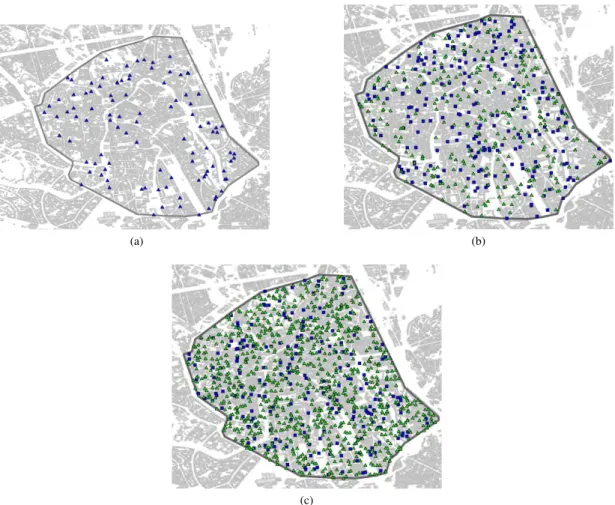
FIGURE 1. Distribution of users for a) 100 Voice/Data users at 1Mpbs-10Mbps b) 224 Voice/Data users+300 IoT Nodes at 10kbps c) 224 Voice/Data users+ 1000 IoT Nodes at 25kbps. The green triangles denote the IoT nodes, while the blue ones represent the Voice/Data users.
probabilities the way to generate new vectors using the Jaya or the jDE algorithms. Also, it must be pointed out that the new algorithm is control parameter free and requires only the setting of the population sizeNpand the maximum number of iterationsGmax.
For this case, we have introduced a new variable to the orig-inal Jaya algorithm, this is denoted ascntjayain algorithm1. This parameter is increased by one if the newly found vector is better than the old one. Thus, this parameter represents the number of successful vector replacements in the Jaya algorithm. Moreover, just like in the Jaya algorithm, the new variablecntjDErepresents the number of successful old vector replacements by the new one when the jDE is executed. The time complexity of the proposed Jaya-jDE algorithm at each iteration is the same as that of the originaljDE algorithm. Table1lists the complexity of each algorithm and computa-tion time for calculating the Sphere funccomputa-tion at 30 dimensions for 100,000 function evaluations. The simulations results are for a PC withi5−3470 CPU at 3.2GHz with 8GB RAM and Windows 7 operating system.
V. NUMERICAL RESULTS
We address the network planning optimization for all network types given 75 possible BS locations in the city of Ghent,
TABLE 1.Comparison of algorithms in terms of complexity and computation ime for the Sphere function.
Belgium. The total area to cover is about 6.85 km2(Fig.1). The BS can be either active (binary one) or not (binary zero). For active base stations the range of the input power of the BS antenna is between 0 to 43 dBm for the 4G cases, and between 0 to 46 dBm for the 5G, NB-IoT cases. In all cases the power step is 1dB. In case of a Massive MIMO BS, the input power is divided over all the antennas of the BSs. We consider macro-cell BSs for all cases here. The total number of unknowns is 2×75. We apply six different algorithms in each case and compare the results. These are the TLBO, Jaya, TLBO-Jaya, jDE, Jaya-jDE and the ITLBO. The TLBO-Jaya and the
Algorithm 1Hybrid Jaya-jDE Algorithm
1: Set Jaya-jDE initial parameters, population size Np, maximum iterations Gmax andcntjaya = 0,cntjDE = 0,psel=0.5,stagnation=false
2: Generate a uniformly distributed random population of sizeNp, setG=1
3: whileG≤Gmaxdo
4: if not(cntjaya=0 or cntjDE =0)then 5: ifcntjDE >cntjayathen
6: psel= cntcntjaya jDE 7: else 8: psel= cntjDE cntjaya 9: end if 10: psel= psel2 11: end if 12: fori=1 toNpdo 13: if notstagnationthen 14: ifcntjDE >cntjayathen 15: ifrand <pselthen
16: generate new vector according to Jaya algo-rithm
17: else
18: generate new vector according to jDE algo-rithm
19: end if 20: else
21: ifrand <pselthen
22: generate new vector according to jDE algo-rithm
23: else
24: generate new vector according to Jaya algo-rithm
25: end if 26: end if 27: else
28: ifrand<0.5then
29: in case of stagnation give equal selection prob-ability
30: generate new vector according to Jaya or jDE algorithm with equal probability
31: end if 32: end if 33: end for
34: ifbest vector does not improve in current generation then 35: stagnation=true 36: else 37: stagnation=false 38: end if 39: G=G+1 40: end while
ITLBO are hybrid algorithms, as well as the new Jaya-jDE. We run all algorithms for 20 times [6]. In all cases, except for the Massive MIMO extended set, we select the population
TABLE 2.Link budget parameters for the 4G/LTE and the 5G Massive MIMO network.
size to be 20 and the maximum number of generations is also 20. Therefore, the total number of objective function evaluations is 400.
A. LTE AND 5G MASSIVE MIMO CASE
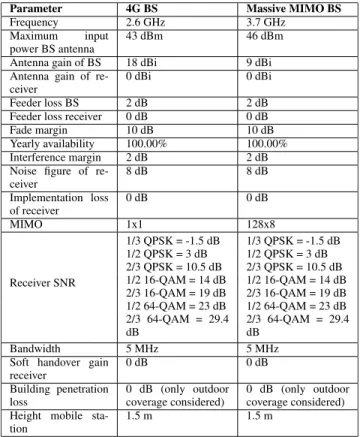
Several papers and reported testbeds use cm-Wave frequen-cies for Massive MIMO. The authors in [37]–[39] present a Massive MIMO testbed designed for a carrier frequency of 3.7 GHz. Moreover, the authors in a recent study [2] claim that the research on Massive MIMO has been focused on cellular frequencies below 6 GHz, where the transceiver hardware is very mature. Taking the above into account, we assume a carrier frequency of 3.7 GHz for all the sim-ulations using Massive MIMO. Table2lists the link budget parameters for the 4G and the Massive MIMO network. We use the Walfisch-Ikegami propagation model for all path loss calculations in the 4G/LTE network, while we apply the propagation model suggested in [7] for Massive MIMO. Fig.2compares the range for 4G and Massive MIMO BS for 1Mbps (receiver SNR−1.5dB) and 10Mbps (receiver SNR 19dB) date rates, respectively. The BS is placed on a building with 27.2 m height and the antenna height is considered to be 1.5m. The results are for non-Line-Of-Sight (nLOS) prop-agation and have been obtained using the above-mentioned propagation models. We notice that as expected the Massive MIMO BS has a significantly lower range, thus more BS are required in this case. We consider different optimization cases.
FIGURE 2. Comparison of BS range for 4G and Massive MIMO networks.
TABLE 3. Maximum area coverage case. Algorithms comparative results for all cases in terms of objective function value. The smallest values are in bold font.
1) CASE 1: MAXIMUM AREA COVERAGE CASE
First, we consider the maximum area coverage case, without taking into account users for both 4G/LTE and 5G Massive MIMO cases. Before we can actually start designing the network, inputs are required: the considered area, which is the city of Ghent as described earlier and the list of possible base station locations. The input to the optimization algo-rithm is the list of all BSs in the city of Ghent. Addition-ally, we consider an imaginary extended BS set that consists of 2450 BS distributed all over the city center. Thus, in order to obtain full coverage in case of a 5G network, we run also all algorithms for this extended BS set. The total number of unknowns is 4900 for this case and the problem becomes high dimensional. In order to test the algorithm’s performance we set the population size to 100 and the number of generations to 500 for this case.
TABLE 4.Maximum area coverage case.Best-obtained results comparison using different algorithms. The best values are in bold font.
TABLE 5.Power consumption reduction using optimization.
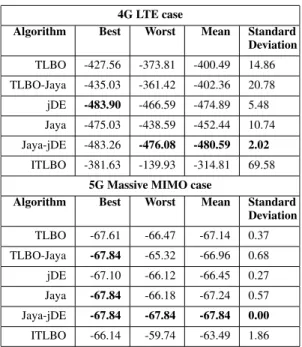
Table3holds the algorithms comparative results in terms of objective function values. We notice that for both 4G and 5G networks Jaya-jDE is the superior algorithm in terms of
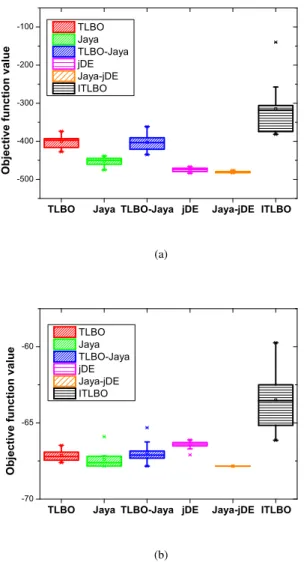
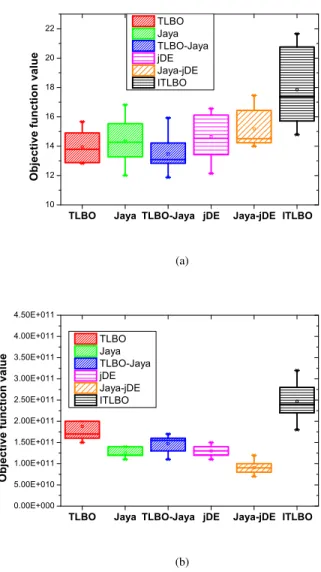
FIGURE 3. Case 1: Maximum area coverage case. Box plots of the algorithms results. a) 4G b) 5G Massive MIMO.
mean, worst and standard deviation of the objective function objective function. For the 4G case the jDE results is the best, while for the 5G case Jaya-jDE obtains the best result. Table4reports the comparative results for each technology case. In Table 4 the ‘‘BS No’’ column denotes the number of active BS required for the solution. We notice that the 75 BSs are not enough to cover the whole area with Massive MIMO technology and a lower coverage percentage of about 67% is obtained. This can be expected as the 5G network operates at a higher frequency than 4G. An indication that more BS are required using Massive MIMO technology is also evident by viewing the more than double number of BSs required for the Massive MIMO network. In the 4G LTE case, all algorithms succeed in obtaining 95% coverage. However, the results regarding power consumption and the number of required BSs vary. For the Massive MIMO case the number of required BSs increases compared with 4G, which creates the need for a new extended BS set.
Moreover, it is also evident that for the 5G extended BS set case Jaya-jDE obtains the best result with 1740 BS that
TABLE 6.Best-obtained results by the capacity tool.
achieves coverage close to 95%. ITLBO obtains a result with fewer BS (1210) but with smaller coverage percentage (92%). The other algorithms could not find a solution with coverage percentage close to 90%. As it can be expected the power consumption is very high for this case due to the large BS number. Thus, Jaya-jDE is capable of producing a solution for high-dimensional problems with a small population size. It must be also noted that the first 5G implementations will co-exist with current 4G networks, thus it will be heteroge-neous networks. Thus 5G coverage will not be provided for the whole city but for specific parts. The 5G network will provide coverage first at points with large concentration of people like stadiums, shopping centers e.t.c.
The benefit of controlling the BS locations as well as the BS power to achieve energy efficiency is proven from the data listed in Table5. We notice that the percentage of power reduction using an optimization algorithm and by using the worst obtained results ranges from about 37% to 57%. More-over, Figs. 3a-3b show the boxplots of the algorithms results. It is clear that Jaya-jDE obtained the results with the smaller distribution of values in both case cases.
2) CASE 2: MAXIMUM USER COVERAGE CASE
As mentioned previously, next we consider a capacity-based heuristic, which will respond to the instantaneous bit rate demand of the users in the considered area. More details about the capacity tool can be found in [6].
The input to the optimization algorithm for this case is the list of all BSs in the city of Ghent and the list of different types of users (voice/data).
For the LTE and the 5G Massive MIMO networks we consider a randomly generated list of 100 users with their required bit rate: this list contains the location of all the users active in the considered area together with the bit rate they require. The users are uniformly distributed over the considered area i.e., each location in the area has the same chance to be chosen as a user location. Four bit rates are considered: 1 Mbps (66 users), 2 Mbps (20 users), 4 Mbps (11 users) and 10 Mbps (3 users). Fig. 1a shows a randomly generated user distribution in the city of Ghent for the LTE and 5G-Massive MIMO cases.
We apply first the capacity based heuristic. The results are listed in Table 6. The capacity column refers to the total capacity in Mbps offered by each network configuration regardless of user coverage. We notice that although the
Mas-TABLE 7. Maximum user coverage case. Best-obtained results comparison using different algorithms. The best values are in bold font.
sive MIMO BS number is higher than the 4G one, the 26 BSs cannot cover all the users but 93% of them due to shorter range. We notice that when the goal is user coverage and not area coverage the 5G network has the ability to cover the users with small increase in BS number due to the higher capacity rates offered. The capacity in Mbps offered by both networks is also quite different with Massive MIMO network offering about two orders of a magnitude more. This means that more users that will be close to the BS will be covered. The power consumption of the 4G network is about three times higher than that of the Massive MIMO network.
Next, we optimize both networks using the meta-heuristic approach to address the same problem. We apply again all algorithms. Table 7 shows the best obtained results. For 4G/LTE all algorithms obtained solutions that cover 100% of the users. We notice that for the 4G case the smallest number of 12 BSs is obtained by three algorithms: TLBO-Jaya, TLBO-Jaya, and jDE. However TLBO-Jaya obtained the best results in terms of power consumption. Thus, the meta-heuristic approach obtained results that require about 14% lower number of BS and about 28% less power consump-tion for the 4G/LTE case. For the 5G Massive MIMO case the BS number is 8% lower and the power consumption about 6% less than the results obtained by the capacity tool for the same user coverage percentage. The capacity based heuristic obtained results with higher input power and smaller dispersion of values, while the hybrid algorithm obtained results with smaller average input power at about 14 dB.
FIGURE 4. Case 2: Maximum user coverage case. Box plots of the algorithms results for a) 4G b) 5G Massive MIMO.
Figs. 4a-4b show the box plots of the algorithms results for both network cases. We notice that for the 4G network, the TLBO-Jaya obtained the smallest dispersion of values, namely the standard deviation is about 1.2. For the Massive MIMO case Jaya-jDE obtained the best result. Jaya obtained the best result in terms of value dispersion.
The presented results show that future 5G networks using the Massive MIMO technology will need to be more denser than current 4G networks, even if they operate in the cm-Wave frequencies. The main advantage of such 5G networks will be the significantly lower power consump-tion and the higher bit rates offered. To reduce further the power consumption heuristic or meta-heuristic approaches can be applied. The heuristic approach is generally faster. The meta-heuristic approach could require more time, but it is considered to be a global optimizer.
B. NB-IoT CASE
Finally, we address the network planning optimization prob-lem for 4G NB-IoT networks. We consider a carrier frequency
TABLE 8. Link budget parameters for the NB-IoT network.
FIGURE 5. NB-IoT modes of operation.
of 2.1 GHz for all the simulations, which is one of the possible frequency bands for NB-IoT (Table8) operation [8]. There are three possible ways of deploying NB-IoT [40], [41]. These are the stand-alone as a dedicated carrier, in-band within the occupied bandwidth of a wideband LTE car-rier, and within the guardband of an existing LTE carrier (see Fig. 5). In stand-alone deployment NB-IoT uses one GSM channel of 200kHz, while for in-band and guard-band
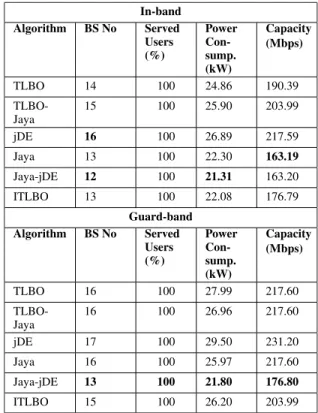
TABLE 9. NB-IoT 300 nodes case. Best-obtained results comparison using different algorithms. The best values are in bold font.
TABLE 10.Best obtained solutions for different IoT nodes number.
operation, it uses 180kHz. The latter is equal to bandwidth used by LTE for each physical resource block (PRB). The number of PRBs in an LTE network depends on the total LTE bandwidth, for 10 MHz bandwidth there are 50 PRBs. In band operation the NB-IoT occupies one LTE guard-band, thus the total number of PRBs increases by one. In all NB-IoT simulations we assume the maximum BS transmitted power to be equal to 46dBm and 2×2 MIMO operation for the
FIGURE 6. NB-IoT case. Box plots of the algorithms results. For 224 Voice/Data users and 300 IoT Nodes at 25 kbps a) in-band b) guard band.
BS. We consider also as described by 3GPP that the NB-IoT band is boosted by 6dB. Thus, the maximum BS transmit power for NB-IoT is 35dBm and 34.9dBm for in-band and guard-band operation respectively.
The input to the optimization algorithm for this case is the list of all BSs in the city of Ghent as well as the list of different types of users (voice/data/IoT nodes). As a result of the reduced bandwidth NB-IoT nodes use low data rates. We set the maximum data rate to 25kbps. The link budget parameters for the LTE NB-IoT network are listed in Table8. Additionally, as in previous cases, the propagation model used is the Walfisch-Ikegami.
Moreover, different user distribution cases for the NB-IoT network are considered. The number of total users is a con-stant number of regular voice/data users plus a larger number of low rate IoT nodes. Here, we have 224 voice/data users with rates of 64kbps/1Mbps respectively [3]. In each case, there is also a large number of NB-IoT nodes spread in the city center. The IoT nodes is a specific data user type with low bit rate and low power requirements. The first case is
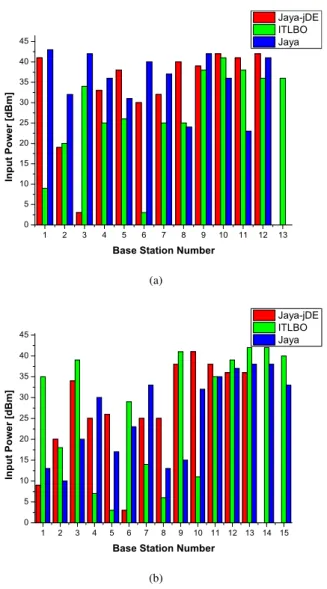
FIGURE 7. NB-IoT case. Distribution of BS input power of the best obtained solutions. For 224 Voice/Data users and 300 IoT Nodes at 25 kbps a) in-band b) guard band.
that of 300 IoT nodes having a low bit rate of 25kbps. This is in agrement with a typical number of nodes for smart city applications as it is considered by the authors in [42]. We con-sider both in-band and guard-band cases. Different network sizes are also considered starting from 1000 IoT nodes to 10000 IoT nodes. Figs 1b-1c depict the user distribution in the city of Ghent for 300 and 1000 IoT nodes. The IoT nodes are depicted by the green triangles, while the voice/data users are presented by the blue squares.
Table 9 lists the best obtained values for network con-figurations having 300 IoT nodes. One may notice that for the in-band case Jaya-jDE obtained a solution with 12 BS, while the other algorithms obtained best solutions with more BSs (13-16). Moreover, it is evident that a large difference in the power consumption among the algorithms (21.31-26.89kW) exists, where Jaya-jDE obtained the lowest power consumption. In general, as expected, the guard-band operation requires more BSs than in-band since it uses an extra PRB with 12 more subcarriers. For the guard-band case again Jaya-jDE finds a solution with fewer active BSs than
TABLE 11. Average rankings achieved by friedman test.
the other algorithms (2-4 less BSs than the others). In both cases ITLBO is the second best algorithm.
Figs. 6a-6b show the box plots of all the algorithms runs. In the in-band case, we notice that the TLBO results have the narrower distribution of values, however the smaller values are obtained by Jaya-jDE. For the guard band case Jaya-jDE obtained the best results, while Jaya obtained the larger dis-tribution of values. The disdis-tribution of BS input power of the best obtained solution by the three best algorithms is shown in Figs. 7a-7b. We notice that there is a variation of the BS input power, which differs in most of the cases from the maximum power.
Finally, we compute the network configuration using only Jaya-jDE with an increasing number of IoT nodes for both modes of operations. Again, in each case there are also 224 voice/data users as in previous example. We notice that the network can support up to 10000 IoT nodes with cov-ering about 99% of the users. As it can be expected power consumption increases as the number of IoT nodes increases. It is interesting to notice that for the in-band case the number of BS increases from 17 to 51, while the power consumption increases from 27.14 to 85.53 kW. Moreover, for the guard band case the BS number rises from 19 to 42, while the power consumption increases from 32.45 to 54.65 kW.
C. NON-PARAMETRIC STATISTICAL TESTS
Moreover, in order to validate the algorithms performance we have conducted a non-parametric statistical test. Namely, the Friedman test, which has been used as a metric for the per-formance evaluation of EAs [43]–[45]. We used the data from the obtained results. Table11lists the ranking results. We can see that Jaya-jDE algorithm ranks first and outperforms the other algorithms.
VI. CONCLUSION
In this paper, we have presented and addressed the prob-lem of designing emerging cellular networks like Massive MIMO and LTE NB-IoT for the best possible coverage and optimal power consumption. We have compared results for different networks using different heuristic and metaheuristic approaches. The results show that the Massive MIMO access networks will be denser than current 4G technology and will offer a greater capacity. Moreover, in-band operation in NB-IoT requires less power than guard-band operation (about 10% less in average). We have also proposed a novel
algorithm that combines both an EA and heuristic concepts to address the network design problem. Moreover, we have applied and introduced a new and simple algorithm to this problem, the Jaya-jDE algorithm. Jaya-jDE is a hybrid Jaya and differential evolution algorithm that combines concepts from both algorithms and includes a probabilistic selection mechanism and a stagnation avoidance mechanism. The pro-posed algorithm was compared with others in different cel-lular network design cases. The results indicate that in most cases it obtained a better performance than other emerging algorithms and achieved the best result in the Friedman test. The Jaya-jDE algorithm allows to achieve a good trade-off even when it does not have the best performance. Future work can consist of the analysis of distributed Massive MIMO networks.
ACKNOWLEDGMENTS
M. Deruyck is a Post-Doctoral Fellow of the FWO-V (Research Foundation - Flanders).
REFERENCES
[1] E. G. Larsson, O. Edfors, F. Tufvesson, and T. L. Marzetta, ‘‘Massive MIMO for next generation wireless systems,’’ IEEE Commun. Mag., vol. 52, no. 2, pp. 186–195, Feb. 2014.
[2] E. Björnson, E. G. Larsson, and T. L. Marzetta, ‘‘Massive MIMO: Ten myths and one critical question,’’IEEE Commun. Mag., vol. 54, no. 2, pp. 114–123, Feb. 2016.
[3] M. Deruyck, E. Tanghe, W. Joseph, and L. Martens, ‘‘Modelling and optimization of power consumption in wireless access networks,’’Comput. Commun., vol. 34, no. 17, pp. 2036–2046, 2011.
[4] M. Deruyck, W. Vereecken, W. Joseph, B. Lannoo, M. Pickavet, and L. Martens, ‘‘Reducing the power consumption in wireless access networks: Overview and recommendations,’’ Prog. Electromagn. Res., Vol. 132, pp. 255–274, 2012. doi:10.2528/PIER12061301.
[5] M. Deruyck, W. Joseph, and L. Martens, ‘‘Power consumption model for macrocell and microcell base stations,’’Trans. Emerg. Telecommun. Technol., vol. 25, no. 3, pp. 320–333, Mar. 2014.
[6] M. Deruyck, W. Joseph, E. Tanghe, and L. Martens, ‘‘Reducing the power consumption in LTE-Advanced wireless access networks by a capacity based deployment tool,’’Radio Sci., vol. 49, no. 9, pp. 777–787, Sep. 2014. [7] System Scenarios and Requirements Specifications, MAMMOET Project,
document ICT-619086-D1.1, 3GPP, 2014.
[8] Cellular System Support for Ultra-Low Complexity and Low Throughput Internet of Things (CIOT), Relase 13, document TR 45.820, 3GPP, 2015. [9] Evolved Universal Terrestrial Radio Access (E-UTRA); NB-IoT; Technical
Report for BS and UE Radio Transmission and Reception (Release 13), document TS 36.802,, 3GPP, 2016.
[10] R. Ratasuk, N. Mangalvedhe, Y. Zhang, M. Robert, and J.-P. Koskinen, ‘‘Overview of narrowband IoT in LTE Rel-13,’’ inProc. IEEE Conf. Standards Commun. Netw. (CSCN), Nov. 2016, pp. 1–7.
[11] A. D. Zayas and P. Merino, ‘‘The 3GPP NB-IoT system architecture for the Internet of Things,’’ inProc. IEEE Int. Conf. Commun. Workshops., May 2017, pp. 277–282.
[12] Ericsson. (2017).Ericsson Mobility Report June 2017. [Online]. Available: https://www.ericsson.com/en/mobility-report
[13] C. Jiang, H. Zhang, Y. Ren, Z. Han, K.-C. Chen, and L. Hanzo, ‘‘Machine learning paradigms for next-generation wireless networks,’’IEEE Wireless Commun., vol. 24, no. 2, pp. 98–105, Apr. 2017.
[14] M. Deruyck, D. Plets, L. Martens, W. Joseph, and S. K. Goudos, ‘‘Opti-mizing wireless access networks towards power consumption: Influence of the optimization algorithm,’’ inProc. Int. Conf. High Perform. Comput. Simulation (HPCS), Jul. 2016, pp. 261–265.
[15] S. K. Goudos, M. Deruyck, D. Plets, L. Martens, and W. Joseph, ‘‘Opti-mization of power consumption in 4G LTE networks using a novel bare-bones self-adaptive differential evolution algorithm,’’Telecommun. Syst., vol. 66, no. 1, pp. 109–120, 2017.
[16] S. K. Goudos, M. Deruyck, D. Plets, L. Martens, and W. Joseph, ‘‘Application of opposition-based learning concepts in reducing the power consumption in wireless access networks,’’ inProc. 23rd Int. Conf. Telecommun. (ICT), May 2016, pp. 1–5.
[17] S. K. Goudos, M. Deruyck, D. Plets, L. Martens, and W. Joseph, ‘‘Opti-mization of power consumption in wireless access networks using differ-ential evolution with eigenvector based crossover operator,’’ inProc. 10th Eur. Conf. Antennas Propag. (EuCAP), Apr. 2016, pp. 1–4.
[18] S. K. Goudos, M. Deruyck, D. Plets, L. Martens, and W. Joseph, ‘‘A novel design approach for NB-IoT networks using hybrid teaching-learning opti-mization,’’ inProc. 12th Eur. Conf. Antennas Propag. (EuCAP), Apr. 2018, pp. 1–5.
[19] A. Tsiflikiotis, S. K. Goudos, and G. K. Karagiannidis, ‘‘Hybrid teaching-learning optimization of wireless sensor networks,’’ Trans. Emerg. Telecommun. Technol., vol. 28, no. 11, 2017, Art. no. e3194.
[20] R. V. Rao, V. J. Savsani, and D. P. Vakharia, ‘‘Teaching-learning-based optimization: A novel method for constrained mechanical design opti-mization problems,’’Comput.-Aided Des., vol. 43, no. 3, pp. 303–315, Mar. 2011.
[21] R. V. Rao, ‘‘Jaya : A simple and new optimization algorithm for solving constrained and unconstrained optimization problems,’’Int. J. Ind. Eng. Comput., vol. 7, no. 1, pp. 19–34, 2016.
[22] K. Yu, X. Wang, and Z. Wang, ‘‘An improved teaching-learning-based opti-mization algorithm for numerical and engineering optiopti-mization problems,’’ J. Intell. Manuf., vol. 27, no. 4, pp. 831–843, Aug. 2016.
[23] P. K. Agyapong, M. Iwamura, D. Staehle, W. Kiess, and A. Benjebbour, ‘‘Design considerations for a 5G network architecture,’’IEEE Commun. Mag., vol. 52, no. 11, pp. 65–75, Nov. 2014.
[24] J. Xu, J. Wang, Y. Zhu, Y. Yang, X. Zheng, S. Wang, L. Liu, K. Horneman, and Y. Teng, ‘‘Cooperative distributed optimization for the hyper-dense small cell deployment,’’IEEE Commun. Mag., vol. 52, no. 5, pp. 61–67, May 2014.
[25] K. N. R. S. V. Prasad, E. Hossain, and V. K. Bhargava, ‘‘Energy efficiency in massive MIMO-based 5G networks: Opportunities and challenges,’’ IEEE Wireless Commun., vol. 24, no. 3, pp. 86–94, Jun. 2017.
[26] H. Ghazzai, E. Yaacoub, M.-S. Alouini, Z. Dawy, and A. Abu-Dayya, ‘‘Optimized LTE cell planning with varying spatial and temporal user densities,’’IEEE Trans. Veh. Technol., vol. 65, no. 3, pp. 1575–1589, Mar. 2016.
[27] W. Zhao, S. Wang, C. Wang, and X. Wu, ‘‘Approximation algorithms for cell planning in heterogeneous networks,’’IEEE Trans. Veh. Technol., vol. 66, no. 2, pp. 1561–1572, Feb. 2017.
[28] K. M. S. Huq, S. Mumtaz, J. Bachmatiuk, J. Rodriguez, X. Wang, and R. L. Aguiar, ‘‘Green HetNet CoMP: Energy efficiency analysis and optimization,’’IEEE Trans. Veh. Technol., vol. 64, no. 10, pp. 4670–4683, Oct. 2015.
[29] F.-H. Tseng, L.-D. Chou, H.-C. Chao, and J. Wang, ‘‘Ultra-dense small cell planning using cognitive radio network toward 5G,’’IEEE Wireless Commun., vol. 22, no. 6, pp. 76–83, Dec. 2015.
[30] L. Zhou, Z. Sheng, L. Wei, X. Hu, H. Zhao, J. Wei, and V. C. M. Leung, ‘‘Green cell planning and deployment for small cell networks in smart cities,’’Ad Hoc Netw., vol. 43, pp. 30–42, Jun. 2016.
[31] R. Sachan, T. J. Choi, and C. W. Ahn, ‘‘A genetic algorithm with location intelligence method for energy optimization in 5G wire-less networks,’’ Discrete Dyn. Nature Soc., vol. 2016, May 2016, Art. no. 5348203.
[32] A. Roy, N. Saxena, B. J. R. Sahu, and S. Singh, ‘‘BISON: A bioin-spired self-organizing network for dynamic auto-configuration in 5G wireless,’’Wireless Commun. Mobile Comput., vol. 2018, Nov. 2018, Art. no. 2632754.
[33] A. Taufique, M. Jaber, A. Imran, Z. Dawy, and E. Yacoub, ‘‘Planning wire-less cellular networks of future: Outlook, challenges and opportunities,’’ IEEE Access, vol. 5, pp. 4821–4845, 2017.
[34] R. Storn and K. Price, ‘‘Differential evolution—A simple and efficient heuristic for global optimization over continuous spaces,’’ J. Global Optim., vol. 11, no. 4, pp. 341–359, 1997.
[35] J. Brest, S. Greiner, B. Boskovic, M. Mernik, and V. Zumer, ‘‘Self-adapting control parameters in differential evolution: A comparative study on numerical benchmark problems,’’IEEE Trans. Evol. Comput., vol. 10, no. 6, pp. 646–657, Dec. 2006.
[36] S. Das, A. Abraham, U. K. Chakraborty, and A. Konar, ‘‘Differential evolution using a neighborhood-based mutation operator,’’IEEE Trans. Evol. Comput., vol. 13, no. 3, pp. 526–553, Jun. 2009.
[37] J. Vieira, S. Malkowsky, K. Nieman, Z. Miers, N. Kundargi, L. Liu, I. Wong, V. Öwall, O. Edfors, and F. Tufvesson, ‘‘A flexible 100-antenna testbed for Massive MIMO,’’ inProc. IEEE Globecom Workshops (GC Wkshps), Dec. 2014, pp. 287–293.
[38] M. Matalatala, M. Deruyck, E. Tanghe, L. Martens, and W. Joseph, ‘‘Per-formance evaluation of 5G millimeter-wave cellular access networks using a capacity-based network deployment tool,’’Mobile Inf. Syst., vol. 2017, p. 11, Jan. 2017.
[39] M. Matalatala, M. Deruyck, E. Tanghe, L. Martens, and W. Joseph, ‘‘Opti-mal low-power design of a multicell multiuser massive MIMO system at 3.7 GHz for 5G wireless networks,’’Wireless Commun.and Mobile Computing, vol. 2018, p. 17, Oct. 2018.
[40] R. Ratasuk, J. Tan, N. Mangalvedhe, M. H. Ng, and A. Ghosh, ‘‘Analysis of NB-Iot deployment in LTE guard-band,’’ inProc. IEEE 85th Veh. Technol. Conf., Jun. 2017, pp. 1–5.
[41] I. Z. Kovács, P. Mogensen, M. Lauridsen, T. Jacobsen, K. Bakowski, P. Larsen, N. Mangalvedhe, and R. Ratasuk, ‘‘LTE IoT link budget and coverage performance in practical deployments,’’ inProc. IEEE 28th Annu. Int. Symp. Pers., Indoor, Mobile Radio Commun. (PIMRC), Oct. 2017, pp. 1–6.
[42] A. Zanella, N. Bui, A. Castellani, L. Vangelista, and M. Zorzi, ‘‘Internet of Things for smart cities,’’IEEE Internet Things J., vol. 1, no. 1, pp. 22–32, Feb. 2014.
[43] J. Derrac, S. García, D. Molina, and F. Herrera, ‘‘A practical tutorial on the use of nonparametric statistical tests as a methodology for comparing evolutionary and swarm intelligence algorithms,’’Swarm Evol. Comput., vol. 1, no. 1, pp. 3–18, Mar. 2011.
[44] S. García, A. Fernández, J. Luengo, and F. Herrera, ‘‘Advanced non-parametric tests for multiple comparisons in the design of experiments in computational intelligence and data mining: Experimental analysis of power,’’Inf. Sci., vol. 180, no. 10, pp. 2044–2064, 2010.
[45] S. García, D. Molina, M. Lozano, and F. Herrera, ‘‘A study on the use of non-parametric tests for analyzing the evolutionary algorithms’ behaviour: A case study on the CEC’2005 special session on real parameter optimiza-tion,’’J. Heuristics, vol. 15, no. 6, pp. 617–644, 2009.
SOTIRIOS K. GOUDOSreceived the B.Sc. degree in physics and the M.Sc. degree of postgraduate studies in electronics from the Aristotle University of Thessaloniki, in 1991 and 1994, respectively, the Ph.D. degree in physics from the Aristotle University of Thessaloniki, in 2001, the mas-ter’s degree in information systems from the Uni-versity of Macedonia, Greece, in 2005, and the Diploma degree in electrical and computer engi-neering from the Aristotle University of Thessa-loniki, in 2011. He joined the Department of Physics, Aristotle University of Thessaloniki, in 2013, where he is currently an Assistant Professor. His research interests include antenna and microwave structures design, evolu-tionary algorithms, wireless communications, and semantic web technolo-gies. He is a member of the IEICE, the Greek Physics Society, the Technical Chamber of Greece, and the Greek Computer Society. He was the Editor of the book named theMicrowave Systems and Applications(InTech publishers, 2017). He has served as the Technical Program Chair at the International Conference on Modern Circuits and Systems Technologies (MOCAST). He was the Sub-Committee Chair in the Asian-Pacific Microwave Confer-ence (APMC 2017) in the track of Smart and reconfigurable antennas. He has also served as a member of the Technical Program Committees in several IEEE and non-IEEE conferences. He is currently serving as an Associate Editor for the IEEE ACCESS. He is also a member of the Editorial Board of the
International Journal of Antennas and Propagation (IJAP),theInternational Journal of Energy Optimization and Engineering, theEURASIP Journal on Wireless Communications and Networking, and theInternational Journal on Advances on Intelligent Systems. He was the Lead Guest Editor in the 2016 and 2017 Special Issues of the IJAP with the topic ‘‘Evolutionary Algorithms Applied to Antennas and Propagation: Emerging Trends and Applications.’’ He was also the Lead Guest Editor of the 2018 Special Issue of theEURASIP Journal on Wireless Communications and Networkingwith the topic ‘‘Optimization methods for Key Enabling Technologies: 5G, the IoT, and Big Data.’’
MARGOT DERUYCK was born in Kortrijk, Belgium, in 1985. She received the M.Sc. degree in computer science engineering and the Ph.D. degree from Ghent University, Ghent, Belgium, in 2009 and 2015, respectively. From 2009 to 2015, she was a Research Assistant with IMEC—WAVES (Wireless, Acoustics, Envi-ronment, and Expert Systems), Department of Information Technology), Ghent University. Her scientific work is focused on green wireless access networks with minimal power consumption and minimal exposure from human beings. This work led to the Ph.D. degree. She has been a Postdoctoral Researcher with Ghent University, since January 2015, where she continues her work in the green wireless access network. Since October 2016, she has been a Postdoctoral Fellow of the FWO-V (Research Foundation—Flanders).
DAVID PLETS was born in Torhout, Belgium, in 1983. He received the M.Sc. degree in electrotechnical engineering and the Ph.D. degree from Ghent University, Ghent, Belgium, in 2006 and 2011, respectively. His research inter-ests include localization techniques and the IoT for both industrial and health-related applications. He is also involved in research on optimization of (cognitive) wireless communication networks, with a focus on coverage, interference, and expo-sure. In October 2016, he became a part-time professor in exposure to multiple physical agents in smart buildings.
LUC MARTENS was born in Ghent, Belgium, in 1963. He received the M.Sc. degree in elec-trical engineering and the Ph.D. degree in the development of a multi-channel hyperthermia sys-tem: electromagnetic modeling of applicators, generator design, and estimation algorithms for thermometry from Ghent University, Belgium, in July 1986 and December 1990, respectively. From September 1986 to December 1990, he was a Research Assistant with the Department of Infor-mation Technology (INTEC), Ghent University. Since January 1991, he has been a member of the permanent staff of the Interuniversity MicroElectronics Center (IMEC), Ghent, and is responsible for the research on experimen-tal characterization of the physical layer of telecommunication systems at INTEC. Since April 1993, he has been a Professor of electrical applications of electromagnetism with Ghent University.
KOSTAS E. PSANNISwas born in Thessaloniki, Greece. He received the degree in physics from the Aristotle University of Thessaloniki, Greece, and the Ph.D. degree from the Department of Electron-ics and Computer Engineering, Brunel University, U.K. From 2001 to 2002, he was awarded the British Chevening Scholarship sponsored by the Foreign and Commonwealth Office (FCO), British Government. Since 2004, he has been a (Visiting) Assistant Professor with the Department of Ap-plied Informatics, University of Macedonia, Greece, where he is currently
an Associate Professor. He is also the joint Researcher with the Department of Scientific and Engineering Simulation, Graduate School of Engineer-ing, Nagoya Institute of Technology, Japan. He has several publications in international conferences, books chapters, and peer-reviewed journals. His professional interests include multimodal data communications sys-tems, haptic communication between humans and robots, cloud transmis-sion/streaming/synchronization, future media-internet of things, experiments on international connections (E-ICONS) over TEIN3 (Pan-Asian), Science Information Network (SINET, Japan), GRNET (Greece)-Okeanos Cloud, and GEANT (European Union) dedicated high capacity connectivity. He is also a member of the European Commission (EC) EURAXESS Links JAPAN and a member of the EU-JAPAN Centre for Industrial Cooperation. Since 2017, he has been serving as an Associate Editor of IEEE ACCESSand the IEEE COMMUNICATIONSLETTERS.
PANAGIOTIS SARIGIANNIDIS received the
B.Sc. and Ph.D. degrees in computer science from the Aristotle University of Thessaloniki, Thessaloniki, Greece, in 2001 and 2007, respec-tively. He is currently an Assistant Professor with the Department of Informatics and Telecom-munications, Department of University of West-ern Macedonia, Kozani, Greece, since 2016. He has published over 130 papers in inter-national journals, conferences, and book chap-ters. He has been involved in several national, EU, and international projects. He is currently the Project Coordinator of the H2020 project SPEAR: Secure and PrivatE smArt gRid (H2020-DS-SC7-2017) and the Operational Program MARS: sMart fArming with dRoneS (Competitive-ness, Entrepreneurship, and Innovation), while he serves as a Principal Inves-tigator in the H2020 project SDN-microSENSE: SDN-microgrid reSilient Electrical eNergy SystEm (H2020-SU-DS-2018) and in the Erasmus+
KA2 ARRANGE-ICT: pArtneRship foR AddressiNG mEgatrends in ICT (Cooperation for Innovation and the Exchange of Good Practices). His research interests include telecommunication networks, the Internet of Things, and network security. He is an IEEE member and participates in the Editorial Boards of various journals.
WOUT JOSEPHwas born in Ostend, Belgium, in 1977. He received the M.Sc. degree in elec-trical engineering from Ghent University, Bel-gium, in July 2000. From September 2000 to March 2005, he was a Research Assistant with the Department of Information Technology (INTEC), Ghent University. During this period, his scientific work was focused on electromagnetic exposure assessment. His research work dealt with measur-ing and modelmeasur-ing of electromagnetic fields around base stations for mobile communications related to the health effects of the exposure to electromagnetic radiation. This work led to a Ph.D. degree in March 2005. From April 2005 to 2009, he was a Postdoctoral Researcher with iMinds-UGent/INTEC. From October 2007 to October 2013, he was a Postdoctoral Fellow of the FWO-V (Research Foundation—Flanders). Since October 2009, he has been a Professor in the domain of Experimental Characterization of wireless communication systems. He has been the IMEC PI, since 2017. He is elected council board lid of the European Bioelec-tromagnetics Association (EBEA) (2015–2018), and re-elected as a Board Member-at-Large, in 2019. His professional interests are electromagnetic field exposure assessment, in-body electromagnetic field modeling, elec-tromagnetic medical applications, propagation for wireless communication systems, the IoT, antennas, and calibration. Furthermore, he specializes in wireless performance analysis and Quality of Experience. His research is ranked first in a number of dosimetric peer-reviewed studies for the radiofre-quency range, and ranked second for studies covering the entire freradiofre-quency range (Bodeweinet al.BioEM 2016 www.emf-portal.org).