Citation
Journal of Cultural Heritage (2019), 38: 88-93
Issue Date
2019-7
URL
http://hdl.handle.net/2433/241782
Right
© 2019 Les Auteurs. Publi´e par Elsevier Masson SAS. Cet
article est publi´e en Open Access sous licenceCC BY
(http://creativecommons.org/licenses/by/4.0/).
Type
Journal Article
Textversion
publisher
Available
online
at
ScienceDirect
www.sciencedirect.com
Original
article
Non-destructive
method
for
wood
identification
using
conventional
X-ray
computed
tomography
data
Kayoko
Kobayashi
a,∗,
Sung-Wook
Hwang
a,
Takayuki
Okochi
b,
Won-Hee
Lee
c,
Junji
Sugiyama
a,d,∗aResearchInstituteforSustainableHumanosphere,KyotoUniversity,Uji,Kyoto611-0011,Japan bNationalInstituteforCulturalPropertiesNara,Nara630-8577,Japan
cDepartmentofWoodandPaperScience,CollegeofAgricultureandLifeSciences,KyungpookNationalUniversity,Daegu41566,SouthKorea dCollegeofMaterialsScienceandEngineering,NanjingForestryUniversity,Nanjing210037,Jiangsu,PRChina
i
n
f
o
a
r
t
i
c
l
e
Historiquedel’article:
Rec¸ule18septembre2018 Acceptéle4f ´evrier2019
DisponiblesurInternetle23February2019
Keywords:
Gray-levelco-occurrencematrix Localbinarypattern
Imagedatabase
X-raycomputedtomography TripitakaKoreana
A
b
s
t
r
a
c
t
Weestablishanefficientandreliablemethodofwoodidentificationthatcombinesanon-destructiveand non-invasivelaboratory-scaletool,X-raycomputedtomography(CT),withmachinelearningforimage recognition.WeselectedsixhardwoodspeciesusedtocreatetheTripitakaKoreanaandobtainedthe X-rayCTdataofitswoodblocks.Imagerecognitionsystemsusingthegray-levelco-occurrencematrix (GLCM)orlocalbinarypatterns(LBP)wereappliedtotheCTimagesandthepredictionaccuracieswere evaluated.BecausethegrayleveloftheCTdataislinearlyrelatedwiththedensity,theCTimageswere preprocessedtocalibratethedensity.Althoughtheresolutionoftheimagesistoolowfortheanatomical microstructuresrequiredforwoodidentificationtobeeasilyrecognizedvisually,thepredictedaccuracies arequitehighinbothsystems.However,theLBPsystemhasslightadvantagesovertheGLCMsystem.The resultsmoreovershowthatthecalibrationofgrayleveltodensityimprovestheaccuraciesoftheresults. Ifthecandidatesforthewoodspeciesareselectedproperlyandsufficientdatafortrainingisavailable, thistechniquewillprovidenovelinformationaboutthepropertiesofwoodenhistoricalobjects.
©2019LesAuteurs.Publi ´eparElsevierMassonSAS.Cetarticleestpubli ´eenOpenAccesssouslicence CCBY(http://creativecommons.org/licenses/by/4.0/).
1. Introduction
Wood species are generally identified by visual inspection usingoptical orelectron microscopybased ontheirdifferences inanatomicalfeatures[1,2].However,thisconventionalmethod isdestructiveandtime-consumingbecausewoodsamplesmust beslicedorflattenedtoexposethreedifferentplanes:the trans-verse, radial, and tangential sections. Another difficultyis that identificationrequires a highly specialized knowledge of wood anatomy.Nearinfrared(NIR)spectroscopy[3–5],high-resolution X-raymicrocomputedtomography(CT)[6],andlow-resolution X-rayCTcombinedwithimagerecognition[7]havebeenproposed asasubstituteforsituations inwhichtheconventionalmethod isdifficulttoapply,suchastheinvestigationofregistered cultu-ralobjects.Low-resolutionCTwithimagerecognitionisthemost versatileandpromisingofthesemethodsbecauseofthelooser
res-∗ Correspondingauthorsat:ResearchInstituteforSustainableHumanosphere,
KyotoUniversity,Gokasho,Uji,Kyoto611-0011,Japan.
Adresses e-mail : [email protected] (K. Kobayashi), [email protected](J.Sugiyama).
trictionsonsamplesizeandcondition.Forinstance,thesurfaceof thesamplesimplyneedstobecleanandfreeofpaintforNIR spec-troscopy,andonlytinysamples(lessthan1mmindiameter)are neededforhigh-resolutionCTmeasurement.
TheTripitakaKoreanaisknownasthemostcomplete collec-tionof printing blocks of Buddhisttexts in Korea. Asindicated byitsnameinKorean,PalmanDaejanggyeong(Eighty-Thousand Tipitaka),itcomprisesmorethan80,000woodenprintingblocks thatwerecarved inthe13thcenturytoprayfor anend tothe warwiththeMongols.Theyhavebeenwellpreservedina spe-cialdepositoryinthetempleofHaeinsa,whichwasdesignatedas aUNESCOWorldHeritagesitein1995.Thewoodspeciesusedin thewoodblockshavebeenpartlyinvestigatedbymicroscopic ins-pectionusingsmallbrokenfragments[8].Theresultsshowthatall thewoodspeciesusedforthemainbodiesofthewoodblocksare diffuse-porouswood:Cerasus,whichaccountsformorethanhalf ofthetotal,followedbyPyrus,Betula,Cornus,Acer,Machilus,Salix,
andDaphniphyllum.Astheamountofattentionpaidtothe Tripi-takaKoreanahasincreasedsinceitwasaddedtoUNESCO’sMemory oftheWorldRegisterin2007,acompleteinvestigationis expec-tedtocomprehensivelyunderstanditshistoryandtheprotection
https://doi.org/10.1016/j.culher.2019.02.001
Abiesfirma 0.427 Magnoliaobovata 0.485 Trochodendronaralioides 0.514 Betulagrossa 0.636 Acerpalmatum 0.659 Acerrufinerve 0.660 Quercusacuta 0.909
itrequires.Toinvestigatesuchlargequantitiesofwoodblocks,we needtoemployanon-destructiveandsimpleanalysismethod.
Wepreviouslyevaluatedanimagerecognitionsystemfor iden-tifying thewood of theTripitaka Koreana using thetransverse sectionsof stereograms[9].The top six wood species compri-singtheTripitakaKoreana(Cerasus,Pyrus,Betula,Cornus,Acer,and
Machilus)wereusedforthedataset,andasimpleimage recogni-tionsystemwithagray-levelco-occurrencematrix(GLCM)[10]
andweightedneighboralgorithm[11,12]wasapplied.Although theimagesofthediffuse-porouswoodspeciesappearsimilarto eachother,woodspecieswereidentifiedcorrectlywithsufficient accuracywhentheappropriatepreprocessingandparameterswere selected.Inaddition,theresultsuggeststhepossibilityof applica-tiontoimageswithevenlowerresolutionssuchasCTimages. 2. Researchaim
Here,wepresentapracticalprocedurefornon-destructiveand non-invasivewoodidentification,basedonthecaseoftheTripitaka Koreana.Thedatawasobtainedusingalab-scaleX-rayCTsystem
[13],whichwasdesignedforlargeobjectssuchasthewoodblocks. Beforeinvestigatingtheimageanalysis,thecorrelationbetween theimage graylevels and densitiesof thewood sampleswere investigatedbecausedensityisanimportantfactorforwood identi-fication.Wetestedtwoclassictextureanalysismethods,GLCM[10]
andlocalbinarypatterns(LBPs)[14,15],withandwithoutadding densityinformation,andusedak-NNalgorithmforclassification. 3. Experimental
3.1. Woodsamples
Thewoodblocksusedinthepresentstudyarethesameasthose usedinourpreviouswork[9].Sixhardwoodspecies,Acerpictum,
Betula costata, Cornus controversa, Cerasus jamasakura, Machilus thunbergi,andPyruspyrifolia,weresuppliedfromacollectionof theKoreaForestryPromotionInstituteortheXylariuminKyoto University(KYOw).Onespecimenwaspreparedforeachspecies. Forgraylevelcalibration,12woodblockswithvariousdensities werealsoselectedfromKYOw.Thedensitiesofthewoodblocks weremeasuredgravimetrically(Table1).
3.2. X-rayCT
TheCTdatawasacquiredusingthemicro-focusX-rayCT sys-tem,whichisanupgradedversionoftheSMX-100CT-D(Shimadzu Corporation,Japan;[13]).Thedatawastakenwithcharge-coupled device(CCD)cameraat50kVand60A.Toobtainhigh-resolution data,weusedonlydatafromasinglelineintheCCDcameraand constructedthetwo-dimensionalimages.Theoriginalimageswere
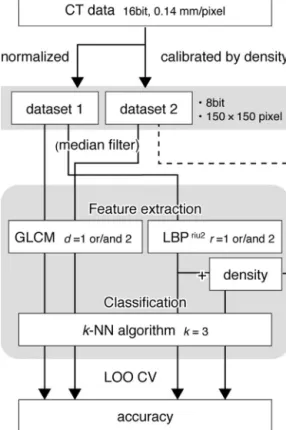
Fig.1. Imagerecognitionprocedure.
transversesectionsofwoodwith2048×2048pixelat16-bit grays-cale,aresolutionof14.4m/pixel,andslicethicknessof0.35mm.
3.3. Imagerecognitionprocedure
AnoutlineoftheimagerecognitionprocedureisshowninFig.1. AlltheimageandstatisticalanalyseswereperformedusingR ver-sion3.4.2[16]withthepackages“tiff,”[17]“stats,”‘‘class,”[18], and“wvtool”[19];thelatterwasdevelopedinourlaboratory.
3.3.1. Pretreatments
The150×150pixelimages(2.1×2.1mminactualsize)were croppedfromtheoriginalCTdata,excludingthecenterpartofthe dataandthesampleedges,wherethedatawasaffectedbystrong artifacts.Thetransversesectionimagedatasetincluded96to216 imagesforeachwoodspecies.
The16-bitgrayscaleimagesweresubsequentlyconvertedto 8-bitgrayscaleusingtwomethods(datasets1and2).Theconversion fordataset1wascarriedoutusingmin-maxnormalization.The graylevelsofdataset2werecalibratedtothedensitiesbyscaling overtherangethatcorrespondsto0–1.2g/cm3usingthefunction,
whichwillbedescribedinsection3.1.Amedianfilterwitharadius of1pixelwasappliedtotheimagesinthedatasetstoremovenoise.
3.3.2. Featureextractionandclassification
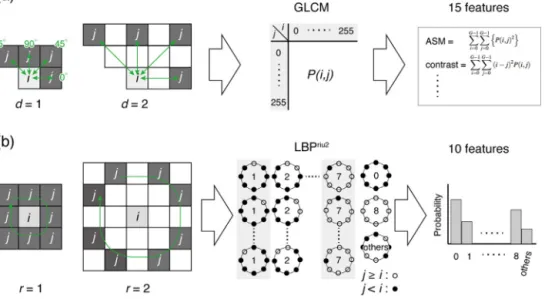
GLCMis amethodforcalculating thetexturefeaturesbased onthecompositionofpixelvaluesamongtheneighboringpixels (Fig.2a).Thecompositionisdescribedbyabsolutevalues;thus,the calculatedfeaturesdependonhowthegraylevelsweremodified duringpreprocessing.Incontrast,LBPfeaturesareindependentof pixelbrightnessbecausetheyarecalculatedbasedonwhethera pixel’sgraylevelishigherorlowerthanthatofitsneighboring pixels(Fig.2b).TheLBPpatternsareobtainedforeachpixelby convertingthesurroundingpixelstobinaryusingthegraylevelof thecenterpixelasathreshold.Therefore,GLCMswerecalculated
Fig.2. Featureextractionprocedures.(a)GLCM.(b)LBPriu2.
fromeitherdataset1ordataset2,whereasLBPfeatureswereonly calculatedfromdataset1andusedthedensity,whichwas calcula-tedasthemeanofthegraylevelofthewholeimage,asanadditional feature(Fig.1).
Inthepresentstudy,we usedrotation-invariantfeatures for bothGLCMandLBP.GLCMswereconstructedfromtheaverage offourdirections(0◦,45◦,90◦,and135◦)basedonthedistance bet-weenpixels,i.e.,d=1or2.Fifteentexturefeatures(ASM,contrast, IDM,entropy,correlation,variance,sumaverage,sumentropy, dif-ferenceentropy,differencevariance,sumvariance,f12,f13,shade, andprominence)proposedbyHaralicketal.[10]andAlbregtsen
[20] were calculated, as reported previously [7]. For rotation-invariantLBPfeatures,tenLBPriu2featureswerecalculatedusing
theradiusbetweenpixelsr=1or2,asproposedbyOjalaetal.[15]. Thefeatureswereusedforclassificationafterstandardization.
Thek-nearest-neighbor(k-NN)withk=3wasusedforthe clas-sificationalgorithm.Thekvaluewasdeterminedempirically.The predictedaccuracywascalculatedusingleave-one-outcross vali-dation.
4. Results
4.1. Calibrationofgraylevelwithrespecttodensity
Theaveragegraylevelvaluesweremeasuredfromthe trans-versesections, which were1×1cm inactualsize,of thewood blockslistedinTable1.Thecorrelationbetweenthegraylevelsand thedensitywasinvestigatedusingsimpleregression(Fig.3).The resultshowsthealmostperfectlinearitywithrespecttotherange ofwooddensities;thegrayleveloftheCTdatacanbeconvertedto densityusingacalibrationfunction.
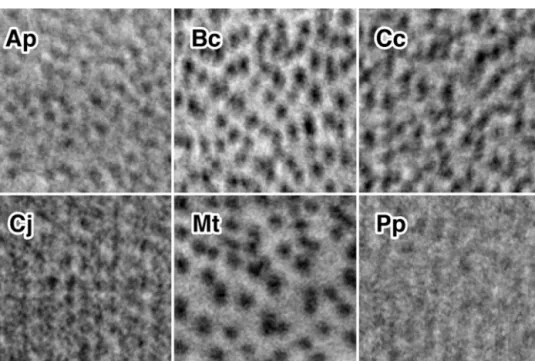
TheoriginalCTdatahada16-bitgrayscale,andthedata crop-pedfromthewoodenpartoccupiedonlythesmallrangeofthe wholedata(Fig.4a).This16-bitdatawasconvertedto8-bitgray scaleusingtwomethods(Fig.4b).Whengeneralnormalizationwas applied,thedistributionofthegraylevelcoveredthewholerange oflevels0–255.Incontrast,thehistogramofthedatacalibratedby thefunctionshowninFig.3shiftedthedistributiontolowergray levels,whichmadetheimagedarkerthanthenormalizedimage (Fig.4b,inset).Thetypicalimagesofeachspeciesthusobtainedare showninFig.5.Thebrightnessoftheimagesvariesdependingon thedensities.
Fig.3.Correlationbetweengraylevelanddensity.Eachpointontheplot corres-pondstothewoodsampleslistedinTable1.Thelineindicatesthesimpleregression withtheestimatedcoefficientsandmultipleR-squaredvalue.
Comparedwiththestereogramsthatweusedintheprevious study,theinformation appearing intheCT imagesis quite dif-ferent.Becausetheresolutionisapproximately1/20thatofthe stereograms,thesmallvesselsarequiteunclearintheCTimagesof
A.pictum,C.jamasakura,andP.pyrifolia.Inaddition,rays,whichare oneofthemostprominentfeaturesinthestereograms,arehardly recognizableintheCTimages,becausethereisnosignificant diffe-renceinthedensityoftherayswithrespecttoothertissues;hence, theimagesaredifficulttorotatesuchthattherayspoint inthe samedirection,asinthepreviousstudy[9].Wereportedthatthe anisotropicnatureofwoodprovidedhelpfulinformationforwood identification,butinthepresentstudy,weusetheimageswithout thisarrangementandcalculaterotation-invariantfeatures.
4.2. ClassificationaccuraciesusingGLCMandLBP
Theaccuraciespredictedusingthetexturefeaturescalculated by GLCM are shown in Fig. 6a. While theaccuracies are quite high,morethan90%,wheneitherd=1or2isused,theaccuracies increasefurtherwhentheyarebothused.Themedianfilter,which waseffectiveforthestereogramsinthepreviousstudy,doesnot improvetheaccuracyhere.Dataset2,whichwasobtainedusing thedensitycalibration, yieldsbetterresultsthandataset1.The woodspecieswithsmallvessels,i.e.,A.pictum,C.jamasakura,and
Fig.4. Gray-levelhistogramsofaCTimage.Insetsshowtheimagescorresponding tothehistograms.(a)Original16-bitgrayscaleimage.(b)8-bitgrayscaleimages afternormalizationandcalibration.Theinsetin(b)isdividedintothenormalized image(top)andcalibratedimage(bottom).
butthedensitycalibrationsubstantiallyreducesthese misclassi-fications(Table2b).The densityinformation hence enablesthe discriminationofwoodspecieswithsimilartextures.
Fig.6bshowstheaccuraciespredictedwhenusingLBPforthe featureextraction.Althoughthe10 LBPfeatures withr=1yield lowaccuracy(lessthan80%),theaccuracyincreasestomorethan
Fig.6. Predictedaccuraciesusing(a)GLCMand(b)LBP.Numbersinbracketsshow thenumberofthetexturefeatures.
90%whenr=2isused.Usingacombinationofthesetwoscales,
r=1and2,increasestheaccuracyfurther.IncontrasttotheGLCM method,themedianfilteriseffectivewhenusedontheLBP fea-tures. Adding the density as a feature causes the accuracy to reach99.5%,which isthehighestoftheconditionsthatwe tes-tedinthisstudy.SomeimagesofM.thunbergiaremisclassifiedas
A.pictumandC.controversa(Table3);thespeciesmisclassifiedby
Fig.5.Typicalimagesofeachspeciesindataset2.Ap:Acerpictum,Bc:Betulacostata,Cc:Cornuscontroversa,Cj:Cerasusjamasakura,Mt:Machilusthunbergi,andPp:Pyrus pyrifolia.
Table2
ClassificationtableforGLCMwithd=1and2. Trueclass Ap Bc Cc Cj Mt Pp (a)dataset1 Predictedclass(%) Ap 95.2 0.0 0.0 0.0 0.0 6.9 Bc 0.0 97.9 0.5 0.0 0.0 0.0 Cc 0.0 2.1 99.5 0.0 0.0 0.0 Cj 1.2 0.0 0.0 94.8 0.0 2.3 Mt 0.0 0.0 0.0 0.0 100.0 0.0 Pp 3.6 0.0 0.0 5.2 0.0 90.7 (b)dataset2 Predictedclass(%) Ap 97.0 0.0 0.0 0.0 0.0 6.0 Bc 0.0 99.0 0.0 0.0 0.0 0.0 Cc 0.0 1.0 99.5 0.0 0.0 0.0 Cj 0.0 0.0 0.5 100.0 0.0 0.0 Mt 0.0 0.0 0.0 0.0 100.0 0.0 Pp 3.0 0.0 0.0 0.0 0.0 94.0 Table3
ClassificationtableforLBPwithr=1and2andthemedianfilter. Trueclass
Ap Bc Cc Cj Mt Pp
(a)withoutdensity
Predictedclass(%) Ap 99.4 0.0 0.9 0.0 4.6 0.0 Bc 0.0 99.0 0.0 0.0 1.9 0.0 Cc 0.0 1.0 99.1 0.0 3.7 0.0 Cj 0.6 0.0 0.0 99.0 0.0 0.0 Mt 0.0 0.0 0.0 0.0 89.8 0.0 Pp 0.0 0.0 0.0 1.0 0.0 100.0 (b)withdensity Predictedclass(%) Ap 100.0 0.0 0.0 0.0 1.9 0.0 Bc 0.0 100.0 0.0 0.0 0.0 0.0 Cc 0.0 0.0 100.0 0.0 0.9 0.0 Cj 0.0 0.0 0.0 100.0 0.0 0.0 Mt 0.0 0.0 0.0 0.0 97.2 0.0 Pp 0.0 0.0 0.0 0.0 0.0 100.0
theLBP-basedsystemarecompletelydifferentfromthespecies misclassifiedbytheGLCM-basedmethod(Table2).TheCTimages ofM.thunbergiandA.pictumseemtobedissimilar,butthesetwo speciesbothhavevesselsarepredominantlysolitarywithlow den-sity.
TheresultsshowthattheLBPsystemperformsbetterthanthe GLCMsystem.Becausethetexturesappearing intheCTimages arederivedfromthewoodanatomical structure,whichis com-posedofthecrosssectionofthecellwalls,thefeaturesofthecell shapesremaininthelow-resolutionimages.Thus,theLBPmethod, whichrecognizes contourssuchasedgesand corners,can cap-turethefeaturesofwoodmoreeffectivelythantheGLCMmethod, whichconsiders onlytherelationship betweentwopixels.This alsoexplainswhythesmoothingeffectofthemedianfilterworks onlyontheLBPsystem;themedianfilteremphasizestheedges ofthestructurebyremovingthenoise,butsimultaneouslyloses somepixelgradientinformationbecauseofthelowresolutionof theimages.TheLBPmethodhasbeenusedforwood identifica-tionusingdigitalimagesorstereogramsbyseveralresearchgroups
[21–24],whichevidencesthesuitabilityoftheLBPmethodfor dis-criminatingwoodstructure.
5. Discussion
In this study, we investigated six diffuse-porouswood spe-ciesusedin theTripitaka Koreana.Infact,thetechniqueseems tobemostsuitablefortheidentificationofwoodusedin cultu-rallyimportantobjectsinwhichthenumberofspeciesusedfora particularpurposeislimited.Thisispartlybecausethepropertyof
thematerialdeterminesthequalityofartifactsaswellasbecause thecraftsmanselectsmaterialsbasedonhis/herexpertise,which ishandeddownfromgenerationtogeneration.Therefore,thiscase studyisagoodexampleforcurators,whomaynotbefamiliarwith wood anatomy,because theCT techniqueis becoming a popu-larnon-destructiveandnon-invasivewaytoinvestigatewooden artifacts.Tofacilitatetheadoptionofthisusefultechnique,some examplesoftheRscriptsandtheimagedatabaseusedinthisstudy areprovidedintheSupplementaryMaterial.
Theanatomistscandoidentificationinthegenuslevel empiri-callybasedonthesystematicknowledge,however,thecomputer doesitstatisticallybasedonthesuperviseddatabase.The poten-tialofthelattertechniqueistestedbymanyresearchersbutstill imagedatabaseisnotalwaysenoughtoconcludehowaccuratethis toolcouldbe.Onceagain,theobjectiveofthepaperwastoshow availability of laboratory-scale CT machine for non-destructive woodidentification.Theuseofmedianfilteringtothe reconstruc-tedimagesand gray-level calibrationtothedensitywas found requisite.Thismeansthatoneneedstorecorddensitycalibration togetherwiththeobjects.Theaccuracyofpredictionisless impor-tantasitwillcertainlydecreasewhenthecomputerstudiedmore samplesandlearnedsimilaritiesandvariationsbetweenandwithin species.Therefore,theaccuracywereportedislikely overestima-tedaswehaveonlyonewoodsampleforeachspeciesalthoughthe typicalsampleswereselectedcarefully.Makingdatabaseis ano-therimportanttask,andisinprogressincooperationwithmuseum curators.
6. Conclusion
Wepresentedamethodforwoodidentificationusinga non-destructivemethod:theautomaticimagerecognitionofX-rayCT images.Thismethodwasdemonstratedonwoodusedinthe Tri-pitakaKoreana.TheX-rayCTtechniquehasbeenadoptedinthe culturalheritagefieldasahelpfulnon-destructivetoolinthelast decade.However,onlypartofthedatathatisvisuallyrecognizable hasbeenutilizedforinvestigations,eventhoughthedatainseemly noisyregionsshouldcontainmoreinformation.Machinelearning enablestheanalysisofsuchnoisydata,whichwillincreasethe valueofCTdata,evendatathatalreadyexists.Althoughdeep lear-ningisnowamainstreammethodforimagerecognition,traditional imagerecognitionmethodssuchasGLCMandLBParesuitablefor manysituationsinthearchaeologicalfieldwherethereisonlya limitedamountofdataavailableandthenumberofcandidate clas-sificationsissmall.
Acknowledgments
This study was supported by Grants-in-Aid for Scientific Research (GrantNumber 25252033)from theJapanSociety for thePromotionofScience,RISHCooperativeResearch(database), andRISHMissionResearchV.WethankKimMoravec,PhD,from EdanzGroup(www.edanzediting.com/ac)foreditingadraftofthis manuscript.
Références
[1]IAWACommittee,IAWAListofMicroscopicFeaturesforHardwood Identifica-tion,IAWABull,N.S.10(1989)219–332.
[2]IAWACommittee,IAWAlistofmicroscopicfeaturesforsoftwoodidentification, IawaJ.25(2004)1–70.
[3]Y. Horikawa, S. Mizuno-Tazuru, J. Sugiyama, Near-infrared spec-troscopy as a potential method for identification of anatomically similar Japanese diploxylons, J. Wood Sci. 61 (2015) 251–261, http://dx.doi.org/10.1007/s10086-015-1462-2.
[4]S.W.Hwang,Y.Horikawa,W.H.Lee,J.Sugiyama,IdentificationofPinusspecies relatedtohistoricarchitectureinKoreausingNIRchemometricapproaches,J. WoodSci.62(2016)156–167,http://dx.doi.org/10.1007/s10086-016-1540-0.
SciTechnol.24(1996)80–89.
[9]K. Kobayashi, S.W. Hwang, W.H. Lee, J. Sugiyama, Texture analysis of stereograms of diffuse-porous hardwood: identification of wood species used in Tripitaka Koreana, J Wood Sci. 63 (2017) 322–330, http://dx.doi.org/10.1007/s10086-017-1625-4.
[10]R.M. Haralick, K. Shanmugam, I. Dinstein, Textural features for image classification, IEEE Trans Syst Man Cybern. SMC 3 (1973) 610–621, http://dx.doi.org/10.1109/TSMC.1973.4309314.
[11]N. Orlov,L. Shamir, T. Macura, J. Johnston, D.M. Eckley, I.G. Goldberg, WND-CHARM: Multi-purpose image classification using compound image transforms, Pattern Recogn, Lett. 29 (2008) 1684–1693, http://dx.doi.org/10.1016/j.patrec.2008.04.013.
[12]L.Shamir,N.Orlov,D.M.Eckley,T.Macura,J.Johnston,I.G.Goldberg,Wndchrm –anopensourceutilityforbiologicalimageanalysis,SourceCodeBiolMed.3 (2008)13,http://dx.doi.org/10.1186/1751-0473-3-13.
[13]T.Okochi,Anondestructivedendrochronologicalstudyonjapanesewooden shintoartsculpturesusingmicro-focusX-rayComputedTomography(CT): reviewingtwomethodsforscanningobjectsofdifferentsizes, Dendrochro-nologia.38(2016)1–10,http://dx.doi.org/10.1016/j.dendro.2016.01.004. [14]T.Ojala,M.Pietikäinen,D.Harwood,Acomparativestudyoftexturemeasures
withclassificationbasedonfeatureddistributions,PatternRecognit.29(1996) 51–59,http://dx.doi.org/10.1016/0031-3203(95)00067-4.
https://CRAN.R-project.org/package=class.
[19]J.Sugiyama,K.Kobayashi,wvtool:Imagetoolsforautomatedwood identifica-tion,(2016).https://CRAN.R-project.org/package=wvtool.
[20]F.Albregtsen,Statisticaltexturemeasurescomputedfromgraylevel coocur-rencematrices,technicalnote,DepartmentofInformatics.(2014)1-14. [21]P.R.Cavalin,M.N.Kapp,J.Martins,L.E.S.Oliveira,Amultiplefeaturevector
frameworkforforestspeciesrecognition,in:Proceedingsofthe28thAnnual ACMSymposiumonAppliedComputing,ACM,NewYork,USA,2013,pp.16–20, http://dx.doi.org/10.1145/2480362.2480368.
[22]J.G. Martins, L.S. Oliveira, A.S. Britto, R. Sabourin, Forest species recognition based on dynamic classifier selection and dissimilarity feature vector representation, Mach Vis Appl. 26 (2015) 279–293, http://dx.doi.org/10.1007/s00138-015-0659-0.
[23]A.R.Yadav,R.S.Anand,M.L.Dewal,S.Gupta,Analysisandclassificationof hard-woodspeciesbasedonCoifletDWTfeatureextractionandWEKAworkbench, in:2014InternationalConferenceonSignalProcessingandIntegrated Net-works(SPIN),IEEE(2014)9–13,http://dx.doi.org/10.1109/SPIN.2014.6776912. [24]A.R.Yadav,R.S.Anand,M.L.Dewal, S.Gupta,Multiresolutionlocalbinary patternvariantsbasedtexturefeatureextractiontechniquesforefficient clas-sificationofmicroscopicimagesofhardwoodspecies,ApplSoftComput.32 (2015)101–112,http://dx.doi.org/10.1016/j.asoc.2015.03.039.