University of Kentucky University of Kentucky
UKnowledge
UKnowledge
Theses and Dissertations--Computer Science Computer Science
2016
Data Persistence in Eiffel
Data Persistence in Eiffel
Jimmy J. JohnsonUniversity of Kentucky, [email protected]
Digital Object Identifier: https://doi.org/10.13023/ETD.2016.444
Right click to open a feedback form in a new tab to let us know how this document benefits you. Right click to open a feedback form in a new tab to let us know how this document benefits you. Recommended Citation
Recommended Citation
Johnson, Jimmy J., "Data Persistence in Eiffel" (2016). Theses and Dissertations--Computer Science. 51. https://uknowledge.uky.edu/cs_etds/51
This Doctoral Dissertation is brought to you for free and open access by the Computer Science at UKnowledge. It has been accepted for inclusion in Theses and Dissertations--Computer Science by an authorized administrator of UKnowledge. For more information, please contact [email protected].
STUDENT AGREEMENT: STUDENT AGREEMENT:
I represent that my thesis or dissertation and abstract are my original work. Proper attribution has been given to all outside sources. I understand that I am solely responsible for obtaining any needed copyright permissions. I have obtained needed written permission statement(s) from the owner(s) of each third-party copyrighted matter to be included in my work, allowing electronic distribution (if such use is not permitted by the fair use doctrine) which will be submitted to UKnowledge as Additional File.
I hereby grant to The University of Kentucky and its agents the irrevocable, non-exclusive, and royalty-free license to archive and make accessible my work in whole or in part in all forms of media, now or hereafter known. I agree that the document mentioned above may be made available immediately for worldwide access unless an embargo applies.
I retain all other ownership rights to the copyright of my work. I also retain the right to use in future works (such as articles or books) all or part of my work. I understand that I am free to register the copyright to my work.
REVIEW, APPROVAL AND ACCEPTANCE REVIEW, APPROVAL AND ACCEPTANCE
The document mentioned above has been reviewed and accepted by the student’s advisor, on behalf of the advisory committee, and by the Director of Graduate Studies (DGS), on behalf of the program; we verify that this is the final, approved version of the student’s thesis including all changes required by the advisory committee. The undersigned agree to abide by the statements above.
Jimmy J. Johnson, Student Dr. Raphael A. Finkel, Major Professor Dr. Miroslaw Truszczyński, Director of Graduate Studies
Data Persistence in Eiffel
DISSERTATION
A dissertation submitted in partial fulfillment of the require-ments for the degree of Doctor of Philosophy in the College of
Engineering at the University of Kentucky
By Jimmy J. Johnson Lexington, Kentucky Director: Dr. Raphael A. Finkel
Professor of Computer Science Lexington, Kentucky
2016
Jimmy J. Johnson November 9, 2016 Date Abstract of Dissertation
Data Persistence in Eiffel
This dissertation describes an extension to the Eiffel programming language that provides automatic object persistence (the ability of programs to store objects and later recreate those ob-jects in a subsequent execution of a program). The mechanism is orthogonal to other aspects of the Eiffel language. The mechanism serves four main purposes: 1) it gives Eiffel programmers a needed service, filling a gap between serialization, which provides limited persistence functions and database-mapping, which is cumbersome to use; 2) it greatly reduces the coding burden in-curred by the programmer when objects must persist, allowing the programmer to focus instead on the business model; 3) it provides a platform for testing the benefits of orthogonal persistence in Eiffel, and 4) it furnishes a model for orthogonal persistence in other object-oriented lan-guages.
During my research, I created a prototype implementation of the persistence mechanism using it effectively in several programs. Performance measurements showed acceptable perfor-mance with some increase in program memory usage. The prototype gives the programmer the ability to add automatic persistence to existing code with the addition of only a few lines of code. The size of this additional code remains constant regardless of the total number of lines of code in the project. Eiffel syntax remains unchanged and nonpersistent Eiffel code runs as is while incur-ring only a very small speed penalty.
KEYWORDS: data persistence, orthogonal persistence, persistent programming language, object-oriented programming, Eiffel
Dr. Raphael A. Finkel Director of Dissertation Dr. Miroslaw Truszczyński Director of Graduate Studies November 9, 2016
Data Persistence in Eiffel
By
Acknowledgements
I would like to express my special appreciation to my advisor Dr. Raphael Finkel. His advice and encouragement have been invaluable. He put up with my zealousness for the Eiffel programming language and supported my use of it as a platform for this research. I greatly ap-preciate his dedication to my work and for the opportunity to study under him.
I also want to thank Dr. Jerzy Jaromczyk, Dr. Miroslaw Truszczyński , and Dr. Victor Marek for their guidance, instruction, and encouragement during my studies and research.
I want to thank Dr. Bertrand Meyer for his support as I began my graduate studies. Without him, I would not have had such a wonderful language in which to work, and this project may not have materialized. Mrs. Annie Meyer at Eiffel Software also provided much encour-agement as she liaised between Eiffel Software’s technical support team and me.
Others at Eiffel Software and at ETH Zurich have been a great help as well and deserve my thanks. Emmanuel Stapf, Jocylyn Fiat, and Alexander Kogtenkov provided help with the Eiffel compiler and many other technical issues for which I am very grateful. Roman Schmock-er’s help with the Eiffel runtime was indispensable.
Finally, I wish to thank my wife for tolerating my late-night research and programming and for mostly ignoring the ensuing grumpiness the next morning. She held the fort down, allow-ing me to focus on this research.
Table of Contents
Acknowledgements ... iii
Table of Contents ... iv
List of Tables ... vi
List of Figures ... vii
Chapter 1 Introduction ... 1
1.1 Terminology ... 3
1.2 “Eiffel: The Language” ... 4
1.2.1 Eiffel terminology ... 4
1.2.2 A sample system ... 6
1.2.3 Classes... 6
1.2.4 Eiffel initialization rules... 8
1.2.5 Reference and value semantics ... 8
1.2.6 Tuples ... 10
1.2.7 Once features ... 10
1.2.8 Design by Contract® ... 11
1.2.9 Void-safe Eiffel ... 13
1.2.10 Feature renaming ... 13
1.3 The persistence problem ... 14
1.3.1 Serialization ... 15
1.3.2 Database mapping ... 16
1.4 Summary ... 17
1.5 Roadmap ... 18
Chapter 2 Interface and semantics ... 19
2.1 Interface classes... 19
2.2 Persistent and persistable ... 20
2.3 Example system... 21
2.3.1 Access to persistence and initialization ... 21
2.3.2 Create initial objects ... 21
2.3.3 Manual persistence ... 23
2.3.4 Automatic dirty marking ... 23
2.3.5 Checkpointing ... 24
2.3.6 Root-based persistence ... 26
2.3.7 Automatic persistence ... 27
2.3.8 Creating persistable objects ... 28
2.3.9 Loading persistent objects ... 29
2.4 Summary ... 30
Chapter 3 Implementation details... 33
3.1 Persistence identifiers ... 33
3.2 The P-Eiffel runtime... 33
3.3 Tracking object types ... 34
3.4 The storage algorithm... 34
3.4.1 The TABULATION class ... 35
3.4.2 The REPOSITORY class ... 37
3.5 The underlying datastore ... 38
3.6 Summary ... 38
Chapter 4 Performance ... 40
4.2 Automatic versus manual checkpointing ... 41
4.3 P-Eiffel versus Eiffel ... 41
4.4 Memory overhead ... 42 4.5 Meeting expectations... 43 4.5.1 Orthogonal persistence ... 43 4.5.2 Database features ... 44 4.6 Measuring effectiveness ... 47 4.7 Summary ... 50
Chapter 5 Future research ... 51
5.1 Looking back ... 51
5.2 Correct inefficiencies ... 52
5.3 Include persistent invariants ... 52
5.4 Allow queries with an improved persistent type system ... 54
5.5 Add other database functionality ... 54
5.6 Looking ahead ... 56
Chapter 6 Conclusion ... 58
Appendix A Review of persistent systems ... 59
A.1 PS-Algol (1982) ... 59 A.2 Galileo (1995) ... 60 A.3 Napier88 (1988) ... 61 A.4 E (1989) ... 62 A.5 PM3 (1991) ... 64 A.6 PHP (1995) ... 65 A.7 Thor/Theta (1996) ... 66 A.8 Java (1996) ... 67 A.8.1 PJava ... 67
A.8.2 Java object serialization ... 68
A.8.3 Java database connectivity ... 69
A.9 C++ (1999) ... 70
A.10Persistent Oberon (2006) ... 70
A.11Timor (2007) ... 71
A.12JavaScript (2010)... 72
A.13Summary ... 73
Appendix B P-Eiffel setup and use ... 75
B.1 Building P-Eiffel ... 75
B.2 Using P-Eiffel ... 75
B.3 The runtime patch file ... 76
References ... 81
List of Tables
Table 3.1 – The descriptor_table ... 35
Table 3.2 – The index_table ... 36
Table 3.3 – The objects_table ... 36
Table 3.4 – Automatic persistence steps ... 39
Table 4.1 – Memory allocation for HERO ... 42
Table 4.2 – Persistence goals and P-Eiffel ... 46
List of Figures
Figure 1.1 – Program executions and a persistent store ... 1
Figure 1.2 – A sample system ... 6
Figure 1.3 – Copy and reference semantics ... 10
Figure 1.4 – Run-time object structure ... 14
Figure 2.1 – Important interface classes ... 19
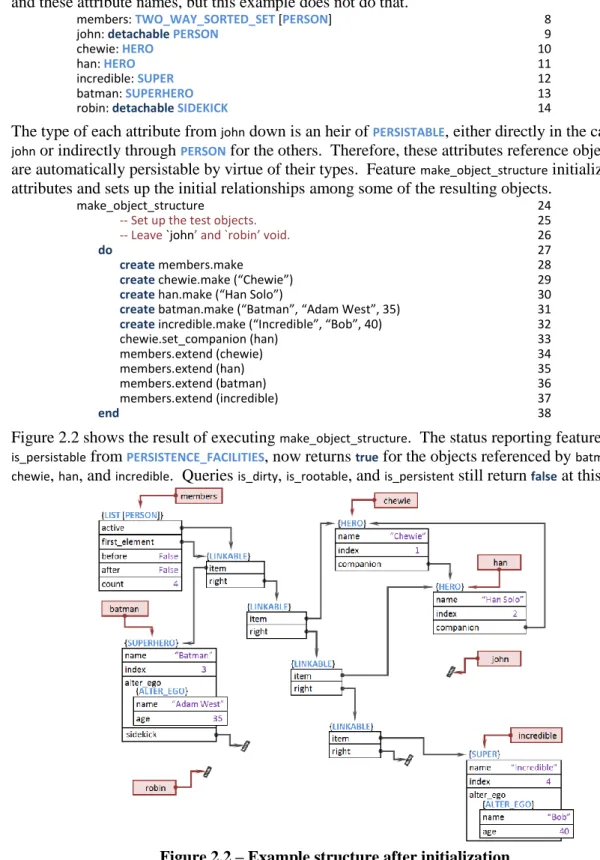
Figure 2.2 – Example structure after initialization ... 22
Figure 2.3 – Manual persistence of chewie and incredible ... 23
Figure 2.4 – Object states after becoming dirty ... 24
Figure 2.5 – Persistence_manager.checkpoint ... 25
Figure 2.6 – Change chewie’s name and create robin ... 26
Figure 2.7 – After Persistence_manager.persist_as_root (members) ... 27
Figure 2.8 – After create john ... 28
Figure 2.9 – After members.extend (john) ... 29
Figure 3.1 – Application and client/server dataflow ... 38
Figure 4.1 – Persisting_automatic versus checkpointing ... 41
Figure 4.2 – P-Eiffel v Eiffel (creations) ... 42
Figure 4.3 – P-Eiffel v Eiffel (assignments) ... 42
Figure 4.4 – Othello ... 48
Figure 4.5 – Victory in the Pacific ... 48
Figure 4.6 – Persistence-related lines of code ... 49
Chapter 1 Introduction
This dissertation presents P-Eiffel1, which extends the semantics of an Eiffel program to facilitate the automatic storage and retrieval of objects to and from long-term storage, eliminating almost all storage-related code from an Eiffel program and freeing the programmer to focus on the objec-tive of the program. P-Eiffel provides the added functionality through a small change to the Eif-fel runtime and a set of library classes, requiring no change to the EifEif-fel language or compiler. P-Eiffel provides a useful tool for P-Eiffel programmers, proves that storage and retrieval of objects need not require complex, database-related code or direct file manipulations, and provides a framework for future development and testing. P-Eiffel’s semantics and library structure should be feasible in other object-oriented languages. This section introduces and defines P-Eiffel terms and describes the motivation behind this research. Subsequent sections show how a programmer uses P-Eiffel, detail some of its implementation, present some performance data, and describe possible improvements and future research possibilities.
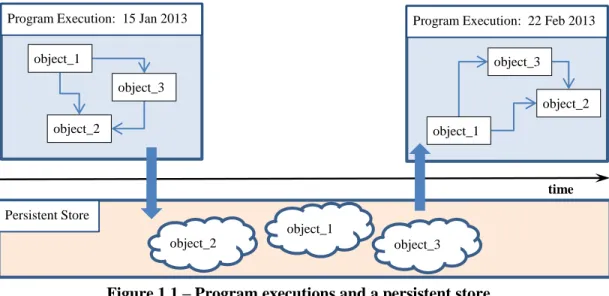
Persistence is the ability of data to live beyond the lifetime of the program that creates the data. More specifically, persistence refers to the ability to capture an object’s run-time state as defined by the stored values of the object’s fields or attributes (defined below), and later, dur-ing a subsequent execution of that program or a different program, recreate an object that has the same state as the original one. The reconstructed objects are distinguishable only by their separa-tion in time. Figure 1.1 illustrates this concept2, showing executions of a program at two different times. The first execution creates objects with references to other objects and stores the objects and references to a persistent store (defined below). The second execution retrieves the objects and references, placing them into volatile memory. Though the retrieved objects likely occupy different location in volatile memory, they are logically equivalent to the objects in the first exe-cution.
Figure 1.1 – Program executions and a persistent store
Many types of programs require data persistence. For example, word processors and spreadsheet programs preserve the state of a document by writing the document to a file. Online-shopping sites store the records of products, customers, and orders in a non-volatile (i.e. persis-tent) medium. Airline scheduling and reservation programs store flight, maintenance, and
1 The name, P-Eiffel, pays homage to the pioneering efforts of PS-Algol.
2 Figure 1.1 was inspired by a similar diagram in the user manual for an Eiffel persistence framework [26]. object_2 object_1 object_3 object_1 object_2 object_3 Program Execution: 15 Jan 2013
time
object_3
object_1
object_2 Program Execution: 22 Feb 2013
tomer information. Company databases store records about employees, customers, and products. Even a long-running program for a single scientific calculation may occasionally save the compu-tation state for resumption after a program failure. The need for easy access to persistence in my own Eiffel programs was the initial catalyst for P-Eiffel.
Meyer recognized the need for data persistence [55] and included basic persistence mechanisms in Eiffel from its beginning. A cursory internet search reveals some type of persis-tence mechanism for many programming languages, such as Java [88], C++ [17], Python [87], Swift [84], and Smalltalk [28], to name a few. This research, then, does not address whether or not programmers need persistence; it addresses the form persistence should take. This research does not accept that the current persistence methods are good enough; it demonstrates a better approach to persistence. P-Eiffel provides the programmer easy access to storing and retrieving long-lived objects and makes that access automatically available and native within the program-ming language.
As Atkinson and Morrison [9] say, programming languages have evolved within a para-digm in which persistence was not a major concern. Past engineering trade-offs, necessitated by the disparity between the speeds of system memory and long-term storage media, have led to two disparate technologies: programming languages that concentrate on expressiveness and calcula-tions with short-term data and database systems that focus on the management and reuse of long-term data. The result is programming languages with little or no persistence support and database languages with inadequate computational power.
To facilitate the data movement depicted in Figure 1.1, programmers typically use limited file I/O mechanisms of the programming language or employ complicated interfacing facilities of a database API. In both cases, the programmer must develop code to translate the data to a form acceptable to the file or database system. Fu and Dasgupta [32] estimated that 15% of application code deals with this memory and storage mismatch. Other authors [9, 10, 85] quote a 1978 IBM report [49] that purportedly1 states that 30% of application code concerns movement of data from the application to non-volatile memory.2 Furthermore, interfacing with a database necessitates the development and maintenance of two programs, the application and the database; a change in one program forces a change in the other.
To avoid this extra coding effort, Persistent Programming Languages (PPLs), such as those described in Appendix A , attempt to bridge the gap between system programming lan-guages and database lanlan-guages by adding easier-to-use persistence mechanisms to an existing programming language3. These PPLs attempt to make the movement of data from short-term memory to long-term storage transparent to the programmer and independent to other elements of the language, hoping to reap the usually stated benefits of reduced code, higher quality, easier maintenance, and overall improvement in software systems4. Despite many years of study in this area, these PPLs have experienced limited success and have seen very little practical use.
This research revisits persistence, specifically persistence in Eiffel. I chose Eiffel as the target language for this research because of its support of most object-oriented concepts, clean
1 I cannot find the actual report.
2 The movement to object-oriented languages has not removed the requirement for this translation code. In fact, the popular use of a relational database backend for the long-term store has so highlighted the differ-ences in system versus database data representation that the term “impedance mismatch” [95] is now in common use.
3 Others try to bridge this gap from the other side in the form of Database Programming Languages, which attempt to add computational expressiveness to the data definition and access capabilities of an existing database language.
4 One of the long-term goals of this study is to test Atkinson’s Orthogonal Persistence Hypothesis, which says that a built-in persistence mechanism will produce better code at less cost [8].
syntax, and well-defined semantics, and because of my familiarity and pleasant experiences with its use. An open-source, modifiable compiler is available, which facilitates this research. Eiffel’s existing persistence mechanisms illustrate and closely parallel the current state of persistence in other object-oriented languages. Existing persistence mechanisms force the programmer to choose between a severely limited but simple solution and a very capable but overly complex one. P-Eiffel provides a simple and capable alternative. Before summarizing at the end of this chapter the benefits of P-Eiffel and its contribution to computer language development, this dis-sertation explains Eiffel’s existing persistence mechanisms. In order to do so, it first defines terms and explains some Eiffel constructs important to the discussion.
1.1 Terminology
Programming languages use different nomenclature for similar constructs. For example, the terms “member function” (C++), “method” (Java), and “routine” (Eiffel) describe the same gen-eral concept. This section defines some gengen-eral terms used by this paper. The next section gives an overview of Eiffel and Eiffel-specific terms.
runtime – functions included in every execution of a program that implement the
core behavior of the language from which the program was built
object – an instance of a type1; data that exists in volatile memory during execu-tion of a program, but typically ceases to exist when the program terminates; any piece of program information, such as an integer, array, structure, or class instance
strongly typed object – an object for which enough information exists during program execution to determine its type
invariant – a consistency constraint applicable to an object that must be true at certain times during a program’s execution
consistent object – an object that satisfies its invariant (express or implied)
attribute – a value or reference (i.e. a pointer) in an object, taking up space, such as an array element, structure field, or instance variable
routine – a computation performed on the object, usually requiring more time than
an attribute access; analogous to a class method
persistent store – the logical construct where objects are maintained between
pro-gram executions; ideally viewed as infinite, non-volatile memory containing strongly typed objects
store an object – to place into the persistent store enough information about the
object so an equivalent object can be reconstructed
retrieve an object – to reconstruct an object based on information obtained from a
persistent store, placing the result into volatile memory
persistent object – an object that has been stored in a persistent store, allowing it to live beyond execution of the program that creates it
persistable object – an object that can become persistentbut is not requiredto be so
transient object – an object that cannot be stored
Programs that automate persistence must distinguish persistent and transient objects. Mechanisms to identify persistable objects rely on allocation-based or store-time-based tech-niques. An allocation-based mechanism, usually operating at compile time, requires the
1 An object can also be an instance of more than one type. In an object-oriented program, an object that is created as an instance of type PIGEON may also be an instance of types BIRD and ANIMAL.
grammer to mark an attribute or class as persistent or potentially persistent. Run-time mecha-nisms, operating during program execution, identify persistent objects while traversing the object graph. Run-time identification usually begins at a designated object and follows references until all recursively-referenced objects have been stored.
allocation-based persistence – a method that identifies persistent objects when they are defined or created
persistence-by-reachability – a method that discovers persistent objects at store time by starting at a designated object, recursively storing it and all objects refer-enced from that designated object
persistence root – a designated object in a persistence-by-reachability approach
where a persistence operation begins; the top object in a tree of persistent objects
reachable object – an object obtainable by following references from a
persis-tence root
Type checking ensures compatibility between retrieved objects and program entities. The type checking of persistent objects can use structural equivalence, name equivalence, or a combi-nation of the two.
structural equivalence – type compatibility and equivalence of objects deter-mined by the actual structure or definition [98]
name equivalence – type compatibility and equivalence of objects determined by
explicit declarations and/or the name of the types [94]
1.2 “Eiffel: The Language”1
Eiffel is a strongly and statically typed object-oriented language. It has a simple, Pascal-like syn-tax, yet it supports the development of large-scale systems with run-time performance similar to C and Fortran. AXA Rosenberg Investment Management, EMC Corporation, Hewlett Packard, Northrop Grumman, the Chicago Board of Trade, and others use Eiffel. [27] It has generic clas-ses, dynamic binding, and automatic garbage collection. Through feature renaming and redefini-tions, it encourages the use of multiple inheritance, leading to the reusability benefits promised by the object-oriented method. This research must anticipate the relationship between these various features of the Eiffel language and the desired functionality of a persistence mechanism. A somewhat contrived example shown below serves as a springboard from which to launch descrip-tions of this reladescrip-tionship. Before describing the example, though, this paper defines Eiffel-specific terms.
1.2.1 Eiffel terminology
Central to object-oriented programming are the terms class, object, and system. Because writers often interchange or use these terms in confusing ways2, their definitions as used in this thesis follow.
class – an abstract data type describing a set of possible run-time objects to which the same features are applicable [57]; text written by the programmer
object – an instance of a type; the data that exist during execution of a program
1 “Eiffel: The Language” [54] is the name the first book to cover Eiffel in full.
2 The author of this paper recently encountered a college textbook that even used the two terms together, referring to a variable declared within a class as a class-object.
system – an assembly of one or more classes, one of which has been designated as the root class, from which a compiler can produce an executable program
root class – the designated class from which execution begins
Programmers usually group related classes together into clusters using the operating system’s directory mechanism. A configuration file directs the compiler to the location of the clusters of classes, from which the compiler automatically determines class dependencies and selects those classes required for compilation.
cluster – a set of related classes grouped together, corresponding to the directory structure of the operating system
feature – an operation for accessing or modifying instances of the class [54]
attribute – a value or reference stored in the object
routine – a computation, taking zero or more arguments, performed on the object
procedure – a routine that performs some action on an object and does not return a value
function – a routine that returns a Result, possibly modifying1 the object
creation feature – a feature that can be used to initialize an object of that type in a creation statement; similar to a C++ or Java constructor
feature call – a fundamental program construct of the form obj.some_feature, apply-ing the feature of name some_feature, from the corresponding class, to the object that obj denotes (i.e. the target of the call) at that moment in execution [57]
qualified call – a feature call thatexplicitly lists the target object [57]
unqualified call – a feature call thatdoes not list its target object [57]
1 Eiffel style guidelines recommend that functions return values without changing an object’s state. System, in the context of Eiffel, is a technical term, referring to
one or more classes or groups of classes from which a compiler produces an executable program. Compiling an Eiffel system results in an executable program.
In Eiffel, class is the only abstraction for the definition of a type. Eiffel does not define constructs such as struct or union as seen in other languages.
The values of all the attributes of an Eiffel object taken as a whole define that object’s state.
Eiffel can ensure, through assertions (defined below), that an object is in a valid state immediately after returning from a cre-ation feature and after any qualified call.
1.2.2 A sample system
Figure 1.2 shows the class diagram for a sample system. It models a community of heroes, su-perheroes, and their sidekicks. The red arrows indicate inheritance (i.e. IS-A) relationships, and the green arrows indicate client (i.e. HAS-A) relationships.
Figure 1.2 – A sample system
The diagram shows that SUPERHERO and SIDEKICK inherit from SUPER and HERO, both of which inher-it from PERSON. (The diamond inherinher-itance pattern, shunned in other languages, einher-ither by conven-tion or by lack of multiple inheritance capability, presents no problem in Eiffel.) Class PERSON inherits from COMPARABLE, giving PERSON objects a total-order relationship with each other. Class PERSON introduces two stored attributes, name, which determines the ordering, and index, which is a simple basic field; class SUPER adds an alter_ego attribute, because supers cannot walk around in costume all the time; and class HERO gives the person a companion, since every hero needs a side-kick. All these attributes come together in SUPERHERO and SIDEKICK objects. Therefore, every HERO has a companion but not an alter_ego, and every SUPER has an alter_ego but no companion; a SUPERHERO or SIDEKICK has both. This system provides a framework with which to illustrate more Eiffel ter-minology, the Eiffel methodology, and, later, P-Eiffel.
1.2.3 Classes
The class PERSON shows the simple syntax and basic structure of an Eiffel class1 and provides examples for more definitions.
1 We depict Eiffel code in colors and fonts similar to the default syntax highlighting used by Eiffel Soft-ware’s integrated development environment. For brevity, this example lacks adequate whitespace and, with one exception, is devoid of comments.
classPERSON
inherit
COMPARABLE
create
make
feature {NONE} -- Initialization
make (a_name: STRING)
-- Create an instance, initializing `name’
do
name := a_name
In this class, make, name, index, and is_less are features of the class. (An object of this type actually has many more features, which it inherits from class COMPARABLE and other ancestors.) Features
name and index are attributes, and features make and is_less are routines. Feature is_less is a func-tion taking one argument that must be the same type as the object on which this feature is called. This feature determines the total ordering of PERSON objects based on comparison of the name of two objects. The create keyword designates make as a creation feature. Feature is_less contains two feature calls to name. The first targets the current object and the second targets the object to which other is attached.
This feature compares the name of the current object to the name of another object that is of the same type. The assignment statement Result := Current.name < other.name is equivalent to the one above, but this form is uncommon.
current object – the object to which the latest non-completed routine call applies [54]
Current – the Eiffel keyword denoting the current object [57]; similar to self or this in other languages
The PERSON class segregates the features into three groups using feature clauses comment-ed with Initialization, Access, and Comparison. These clauses allow the programming tools to present the features in ways that are helpful to the programmer. The clauses also aid information hiding. For example, the {NONE} in the clause before feature make, feature {NONE} -- Initialization, says the fea-tures following this clause down to the next clause are exported to no classes, making the feature uncallable from other classes (except from a creation statement.) A clause such as feature {SUPER,
HERO} selectively exports the features that follow the clause (down to the next clause) only to the listed classes. Feature clauses without an export qualifier make the features that follow it availa-ble to any class.
NONE – a fictional class that is logically the descendant of all classes, having no useful instance [54]
ANY – the ancestor of all classes, containing general-purpose features; analogous to the Object class in Java or Smalltalk
exported feature – a feature that may be used in a qualified call
non-exported feature – a feature that may not be used in a qualified call
selectively exported feature – a feature that may be used in a qualified call only from within those classes listed in its enclosing clause
As stated above, an object can be an instance of one or more classes; however, its type never changes. An object created by executing a creation feature from class SUPERHERO is an in-stance of class SUPERHERO. It is also an instance of its ancestral classes HERO, PERSON,
COMPARA-feature-- Access
name: STRING
index: INTEGER
feature -- Comparison
is_less alias “<” (other: likeCurrent): BOOLEAN
do
Result := name < other.name
end end
feature-- Comparison
is_less alias “<” (other: like Current): BOOLEAN
do
Result := name < other.name
BLE, and ANY, giving it access to all the features in those ancestral classes. The object is a direct instance of only one class, SUPERHERO, its generating type.
generating type – the class from which an object was created 1.2.4 Eiffel initialization rules
The following code segment illustrates the creation and use of the PERSON class by a client in fea-ture get_john.
This feature, though silly, shows the use of the creation feature make from class PERSON. It also serves as a backdrop for illustrating the Eiffel initialization rules and introducing the difference between reference and value types.
The local variables y and p show the two kinds of Eiffel objects: values and references. The local variable y has one of the basic types (INTEGER, BOOLEAN, CHARACTER, REAL, and DOUBLE) all of which represent a value. Local variables of features and attributes of classes declared of these types hold the actual value, not a reference. The other local variable p contains a reference to a value, not the value itself. This situation is similar to a pointer or address in other languages but without the problems associated with pointers. Local variables, such as p in this example, and the attributes name from the PERSON class are reference types. When a local variable comes into scope or the program creates an object, the runtime initializes the involved variables to specific values.
Type Default value
CHARACTER null character, ''
BOOLEAN False
INTEGER 0
REAL 0.0
DOUBLE 0.0
any reference type Void
Void – a predefined value representing the void value (a value not attached to an
object) [57]; analogous to nil or null
When the program flow enters the above function, it sets the local variable y to zero and sets p
and the Result of the function (a reference) to Void. After creating a PERSON object and printing a message, the function points Result to the newly created PERSON object and then passes the refer-ence out of the function to the caller.
1.2.5 Reference and value semantics
Value types allow the construction of simple objects similar to Pascal records or C structures. Reference types allow the modeling of complex objects containing links to other objects, as shown in Figure 1.4, where there are multiple references to an object or circular references among two or more objects. Sometimes, however, an object must contain, not a reference to a complex object, but the actual object itself. Attributes declared to have a type that is an expanded class
get_john: PERSON
local
y: INTEGER -- silly, unused local
p: PERSON
do
create john.make (“John Galt”) -- Sets `name’ and `index’.
print (p.name + “ at index “ + p.index)
Result := p
store values, not references. In this case, that object appears as a sub-object of the enclosing ob-ject.
In the sample system, class ALTER_EGO supplies a SUPER with an identity behind which he can hide in order to function in everyday society.
In addition, a SUPER must always have an alter_ego (i.e. it cannot be Void) and no other SUPER can possess (i.e. reference) that same object. An expanded class provides this functionality. The only difference in form between a normal and an expanded class is the addition of the expanded key-word at the beginning of the class. (The void-safe compiler also forces the assignment of a non-void reference to the name attribute, which SUPER inherits from PERSON. Void-safety also requires the declaration of default_create, from ANY, as a creation feature. The runtime calls default_create to construct objects in settings where it cannot call a constructor with parameters.)
The following code and object diagram illustrate the difference between reference and value semantics. The code creates a SUPER named “Mr Incredible”, setting his alter-ego name to
“Bob” and his alter-ego age to 40. It then assigns values to local variables b and other_ego. Varia-ble b is a SUPER, a reference type; and variable other_ego is an ALTER_EGO, an expanded type.
The diagram below shows the attachment status set up by the routine.1
1 Passing reference or value objects as routine parameters has the same semantics as assignment. classSUPER inherit PERSON create make feature-- Access alter_ego: ALTER_EGO
-- Every {SUPER} must protect his identity
end
expandedclassALTER_EGO
inherit ANY redefine default_create end create default_create, make
feature {NONE} -- Initialization
default_create
do
name := “no name yet”
age := 0
end
make (a_name: STRING; a_age: INTEGER)
do name := a_name age := a_age end feature-- Access name: STRING index: INTEGER end
create incredible.make (“Mr Incredible”, “Bob”, 40) b := incredible
Figure 1.3 – Copy and reference semantics
Because the alter_ego attribute is an expanded type, the runtime makes a field-by-field shallow copy1 into
other_ego so that no aliasing occurs.
expanded class – a class describing objects that have copy semantics
expanded object – an object with an expanded generating type, which therefore has copy semantics
reference semantics – attachments through assignment or argument passing
re-sults in aliasing
copy semantics – assignment or argument passing produces a shallow copy 1.2.6 Tuples
A tuple is a language mechanism useful for describing an object consisting only of attributes and their accompanying setter features, where a more complicated class is overkill. The programmer creates an instance of a TUPLE with one or more values enclosed in square brackets, treating the resulting object like any other reference. Normal type-checking rules apply.
The programmer accesses components of the TUPLE through the tags (e.g. day, month, and year) provided in the type declaration as if they were attributes of a class. TUPLE types are very useful, avoiding declaration of a class when a Pascal-like record suffices.
1.2.7 Once features
A once feature is a routine whose body is executed only when it is called the first time. Subse-quent calls have no effect even if the arguments are different. For a once function, subsequent calls return the Result computed on the first execution.
once feature – a feature whose body is called at most one time
1 For simplicity, the diagrams depict STRING attributes as values residing in objects. Strings are actually reference types in Eiffel; therefore, the structure is more complicated than depicted. The name attribute of the ALTER_EGO object contained in bob and the name attribute in the copied ALTER_EGO object referenced by
other_ego refer to the same STRING object, which, itself, has attributes, such as internal_hash_code and count, and a reference to a CHARACTER array called area.
some_feature
local
tup: TUPLE [day: INTEGER, month: STRING, year: INTEGER]
do
tup := [31, “Jan”, 2016] ...
Our sample system imposes a total ordering for an object of type PERSON based on its
index. The goal is to sort the objects based on their creation order. In the previous definition of
make from PERSON, the initialization rules set the index to zero. Eiffel does not allow global varia-bles, so there seems to be no way for a PERSON object to know what its index should be. A once
feature, added to PERSON, comes to the rescue.1
This non-exported feature returns on its first execution, not an INTEGER, but a reference to an GER_REF, an object containing an INTEGER. Subsequent calls return a reference to that same INTE-GER_REF object. This object serves as a global counter. A modified creation routine from the PER-SON class increments the counter and records the count in the index attribute.
1.2.8 Design by Contract®
Preconditions and other assertions are a very important part of recommended Eiffel practice. Assertions help programmers create correct software and serve as an aid to documentation.
assertion – a Boolean statement expressing a formal property of runtime values
precondition – an assertion expressing the constraints under which a routine
func-tions properly [56]
post-condition – an assertion guaranteed to hold at the end of a feature’s execution if the precondition was satisfied
Preconditions and post-conditions express properties of features. The class invariant expresses properties of objects.
class invariant – an assertion, expressing general consistency constraints applica-ble to every class instance as a whole [56]; checked after creation of an object and upon entry to and exit from exported features
The class invariant defines conditions under which the object's state, as defined by the values of its attributes, is valid. Recall that the PERSON class under section 1.2.3 has a state consisting of two attributes: name and index. So what constitutes a valid state for a PERSON object? Can a PER-SON exist without a name? Can a PERSON have a negative index? Is the first PERSON the zero-th object or the first object? A class invariant answers these design questions and enforces the deci-sions. The following code segment illustrates these assertions, introduced with the keywords
require, ensure, and invariant.
1 Eiffel is not case sensitive, but the usual convention is to use a leading upper case letter for constants, once features, and the predefined value Result.
feature {NONE} -- Implementation
Index_imp: INTEGER_REF
once
create Result end
feature {NONE} -- Initialization
make (a_name: STRING)
-- Create and initialize using parameters
do name := a_name Index_imp.set_item (Index_imp.item + 1) index := Index_imp.item end end
These invariants also apply to objects of any descendant class such as HERO.
In the sample system, the HERO class models objects that usually have a companion. This
detachable (i.e. possibly Void) companion attribute is also of the HERO type.1 For this model, the
com-panion of a companion must point back to the original HERO object. The invariant in class HERO ex-presses this referential integrity constraint.
The invariant of the HERO class is AND-ed to the invariant inherited from the PERSON class, which itself has invariants accumulated from its ancestors. The interface view of the HERO class shows this invariant accumulation. The interface view shows only the signatures of exported features, hiding implementation details. It has different colors to distinguish it from the normal text view of a class.
1 The companion attribute could have been modeled as a PERSON, for which the referential integrity would not be required, but modeling it as a HERO illustrates the point of invariant accumulation without adding uninformative complexity to the invariant.
classPERSON
...
feature {NONE} -- Initialization
make (a_name: STRING)
require
argument_exists: a_name /= Void do
name := a_name
Index_imp.set_item (Index_imp.item + 1) index := Index_imp.item
ensure
name_was_assigned: name = a_name
end
...
invariant
name_exists: name /= Void
index_large_enough: index >= 1 end classHERO inherit PERSON feature-- Access
companion: detachableHERO -- can be Void
invariant
integrity: attached {HERO} companion as c and then c.companion = Current end
classinterface
HERO
create
make (a_name: STRING)
-- Create an instance, initializing `name’
require
argument_exists: a_name /= Void feature-- Access
name: STRING
-- The person’s name
index: INTEGER
invariant accumulation – the conjunction of [assertion] clauses appearing in the texts of [the current class and all its ancestor classes] [57]
interface view – automatically generated documentation showing exported fea-tures and contracts of a class
1.2.9 Void-safe Eiffel
Invariants increase confidence that software is correct. Another, relatively new Eiffel mecha-nism, void-safety, also helps build quality software. Void-safe Eiffel ensures at compile time that if a program applies a feature to a reference, that reference is attached to some object. The com-piler prevents a variable declared as an attached type from ever being set to Void or set to anything that can be set to Void. In the example code above, companion is the only attribute declared to be
detachable and allowed to become Void; other attributes default to the attached type.
The attached rule applies to attributes in much the same way as the class invariant applies to features; an attached attribute must be non-void upon completion of the object’s creation rou-tine and must remain non-void throughout its lifetime.
1.2.10 Feature renaming
A class may rename features it inherits from other classes for convenience or to avoid name clashes. The SUPER_HERO class illustrates renaming.
feature renaming – syntax to change the name of a feature in a descendant; used for convenience, as above, or to remove name clashes with inherited features
feature-- Access
companion: detachableHERO
-- Possibly another hero that travels with Current
generator: STRING
-- Name of current object's generating class
-- (base class of the type of which it is a direct instance) -- (from ANY)
ensure-- from ANY
generator_not_void: Result /= Void
generator_not_empty: notResult.is_empty
-- other exported features not shown
invariant
integrity: attached {HERO} companionas c and then c.companion = Current
-- from PERSON
name_exists: name /= Void
index_large_enough: index >= 1
-- from COMPARABLE
irreflexive_comparison: not (Current < Current)
-- from ANY
reflexive_equality: standard_is_equal (Current) reflexive_conformance: conforms_to (Current)
end classSUPER_HERO inherit SUPER HERO rename companion as sidekick end create make end
Eiffel is an object-oriented application development language that supports almost all object-oriented concepts1. Eiffel’s characteristics, especially its assertion mechanism, support a development practice that helps developers create robust, reliable, and efficient software that scales up well to large systems. However, Eiffel lacks a lean mechanism for the persistence and concurrent sharing of objects.
1.3 The persistence problem
If a programming language does not have a built-in persistence mechanism, the programmer must resort to other, sometimes complicated, and hence more error-prone, mechanisms to move data to and from long-term storage. In older languages, the programmer relies on the input-output mechanisms to store and retrieve data via the file system. This technique may have sufficed for simple objects such as integers and characters, and even for arrays of these simple types; howev-er, it is insufficient for object-oriented languages or any language that allows references through pointers. Consider a hypothetical organization that requires an Eiffel program to track its mem-bers. The following Eiffel code shows one possible class and its attributes.
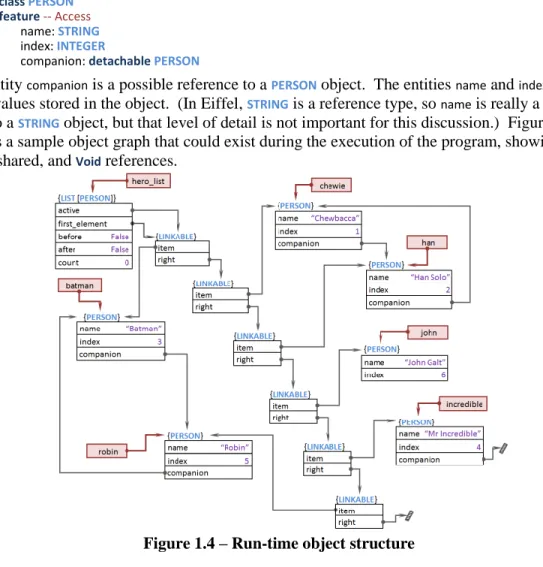
The entity companion is a possible reference to a PERSON object. The entities name and index are basic values stored in the object. (In Eiffel, STRING is a reference type, so name is really a refer-ence to a STRING object, but that level of detail is not important for this discussion.) Figure 1.4 depicts a sample object graph that could exist during the execution of the program, showing cir-cular, shared, and Void references.
Figure 1.4 – Run-time object structure
1 Eiffel does not have feature name overloading as found in Ada, C++, C# and Java. Meyer explains the reasoning behind this omission. [66]
classPERSON
feature-- Access
name: STRING
index: INTEGER
The program could store the object referenced by john without storing other objects, but if it stores the chewie, han, or members object, it must also store other reachable objects as well. Bertrand Meyer calls this storage-by-reachability concept the Persistence Closure Principle:
Whenever a storage mechanism stores an object, it must store with it the depend-ents of that object. Whenever a retrieval mechanism retrieves a previously stored object, it must also retrieve any dependent of that object that has not yet been re-trieved. [56]
If a program stores members as the root object, it stores all the other objects as well, because they are recursively reachable through references. When the program retrieves members, it must re-trieve the entire object structure.1 In order to obtain this type of processing, programmers typical-ly retypical-ly on serialization or database mapping.
1.3.1 Serialization
Serialization represents an object as a sequence of bytes. A serialization mechanism (e.g. the Serializable interface in Java2 or the Eiffel mechanism shown below) traverses the complete ob-ject structure starting at a root obob-ject, visiting and converting all reachable obob-jects in the process. Deserialization retrieves the byte sequence, building a complete copy of the original structure.
The Eiffel code below shows how to store and retrieve the objects depicted in Figure 1.4. The code assumes the entities employees, chewie, han, and john exist in the same class as the exam-ple routines, so these entities are available for use within the examexam-ple routines.
Given a RAW_FILE object, the second line of the routine, file.basic_store (members) serializes and stores the entire object structure into a disk file. Serialization preserves enough information, in-cluding types, so a deserialization operation will be able to rebuild the complete object structure. Deserialization does not restore location in memory, but it does restore content and type. Eiffel programs can restore most objects using this method, but not objects that depend on the current execution context (e.g. threads, sockets, windows, and pointers to routines.) Objects of these types are meaningless outside the constructing process.
Retrieving the entire object structure is also straightforward, as shown below.
1 After a program retrieves the stored structure into members, it loses the original list. Furthermore, the objects referenced from the other handles (e.g. chewie, han, and batman) are not the same objects referenced in the retrieved list. In fact, there may be two PERSON objects with the name “Chewbacca”.
2 Java serialization is similar to Eiffel, but it uses allocation-based persistence combined with persistence-by-reachability; the programmer must designate possibly persistent classes by implementing the Serializa-ble interface.
store_example (a_file_name: STRING)
-- Save `members’ to a file named `a_file_name’
local
file: RAW_FILE
do
create file.make_open_write (a_file_name) file.basic_store (members)
file.close
The routine retrieve_example calls retrieved on the RAW_FILE object, file, within an assignment at-tempt, introduced with the keyword attached. If the call to file.retrieved returns an object of the expected type, LINKED_SET, the temporary variable, temp, becomes attached to that object and is used within the if statement for assignment to the members attribute.
The serialization routines of the RAW_FILE class (or any other descendant of class IO_MEDIUM) provide an easy way to store and retrieve objects in simple applications, but these routines have a major weakness; there is no way to retrieve only a portion of the stored structure. The program cannot retrieve the object referenced by chewie in Figure 1.4 independently from the rest of the objects. Furthermore, after retrieve_example executes, chewie references an object that may differ from a programmer’s expectations. The retrieved routine creates an entirely new object structure, but chewie still references the object that existed before the call to retrieved, not the sec-ond object in members. Furthermore, serialization is an all-or-nothing operation in which the iden-tity of each object is lost. Serialization cannot selectively store and retrieve individual objects. In addition, there is no way for two or more running programs to access objects simultaneously. Overcoming these weaknesses and providing more complex store and retrieve operations requires the much heavier database-mapping approach provided by the EiffelStore library.
1.3.2 Database mapping
The EiffelStore library requires considerably more programmer effort, but it provides much greater control over the persistent store. This library allows an Eiffel program to interface with several different types of databases, such as ODBC, MySQL, Oracle, and Sybase. It provides benefits usually associated with a database, such as transactions, security, concurrency, and data-base triggers. This additional functionality comes with a price; the code is much more complicat-ed. The following summarizes the steps required to use EiffelStore.1
The first step is to create an object of type DATABASE_APPL [G], where the generic parameter G is one of ODBC, MYSQL, ORACLE, or SYBASE. Using this object, the program logs into the database and initializes a database handle. Next, the program creates a session manager of type
DB_CONTROL. This object allows the program to connect to the database, handle errors, and discon-nect. To modify a table, the program creates an object of type DB_CHANGE and calls the modify fea-ture on the object, passing an SQL statement as argument. Using the previously created
DB_CONTROL object, the program commits the change. Class DB_SELECTION provides a feature to query the database, which places its result into an object of type DB_RESULT. After converting the DB_RESULT object to a DB_TUPLE, the program accesses individual tuple items using an index. Pro-grams map Eiffel objects directly to relational tables using class DB_STORE and class
DB_REPOSITORY.
1 See [30] for a more complete tutorial.
retrieve_example (a_file_name: STRING)
-- Read the object structure from a file named -- `a_file_name’ and assign it to `members’
local
f: RAW_FILE
do
create f.make_open_read (a_file_name)
if attached {LINKED_SET} file.retrieved as temp then
members := temp
else
print (“Retrieval error”)
end
file.close
This cursory description of the database-mapping approach of the EiffelStore library illustrates its complexity. The programmer must be aware of many classes and call the features in the correct order. The interrelations between the classes are complex, making the use of this li-brary difficult to master. This approach also suffers from the two-system problem (i.e. the re-quirement to develop and maintain the application and a database in parallel.) This approach seems to fit Atkinson’s and Morrison’s [9] definition of glue-ware, hiding different technologies (a programming language and a database) behind an interface veneer in a hope of combining the two in an understandable and useful way.
This clash between the object-oriented data model and the relational data model has be-come known as the object-relational impedance mismatch [31]. An often-referenced blog post highlights the problems associated with object-relational mapping:
Object-to-table mapping problem – As long as the structure of data in the system is simple, regular, and of fixed size, a class can map directly to a relational table. But object-oriented systems typically have complex relations. Indirect access to an object’s property through another object, done simply in an object-oriented lan-guage with a call such as chewie.companion.name, requires the heavier relational al-gebra approach in the form of a join. Inheritance, which is hard to represent in re-lational tables, further exacerbates the problem.
Dual-schema problem – Two programs, the application and the database, must maintain the form of the data, raising the question of schema ownership. Is the schema owned by the application developers or by the database developers? This ambiguity greatly complicates system evolution.
Entity identity issues – An object in an object-oriented system has an implicit sense of identity separate from the state of the object, and this identity is not a con-cern for the programmer. An object-oriented program simply accesses the object through its references. In a relational database, the identity is part of the object’s state—its key.
Data retrieval mechanism concern– Relational database systems can arrange
da-ta in a way that optimizes typical retrievals. The relationships between objects in object-oriented programs can lead to very inefficient selections, projections, and joins. For example, a relational database requested to display just the name of a person may be able to select only the name field from a table; whereas an equiva-lent, object-oriented program may have to retrieve the entire person object, includ-ing irrelevant fields (i.e. address, job title, list of children, etc.) in order to construct a valid person object from which to obtain the person’s name. [64]
The Database mapping approach, exemplified by the EiffelStore library, attempts to solve the lack of flexibility inherit in the serialization approach, but the problems caused by the object-relational impedance mismatch call for other solutions to the persistence problem.
1.4 Summary
The two Eiffel approaches illustrate the extremes of the persistence problem. The serialization approach is easy to use but suffers from an all-or-nothing dilemma: either the entire object graph is retrieved and useable, or nothing is useable. It suffers a big-exhale and big-inhale problem as the whole graph is stored and retrieved. Object identity is lost, and there can be no simultaneous sharing of objects between programs. Database mapping libraries remedy these problems but require code that is more complicated. Object-oriented database systems attempt to solve the impedance mismatch problem but seem to have had limited success. Persistent programming languages, which attempt to merge database-like functionality with a systems programming lan-guage, have also failed to see widespread use. I believe P-Eiffel fares much better.
P-Eiffel fills a long overdue void1 in Eiffel as it bridges the
ease-of-use-versus-functionality gap between the serialization and database-mapping approaches. It provides some of the database-mapping functionality while remaining at least as simple as the serialization ap-proach. Though P-Eiffel requires further testing to determine its speed impact on the data-retrieval mechanism concern, it eliminates the other issues of the impedance mismatch problem. Testing with the current prototype, which is usable as is for programs requiring only local stor-age, indicates that the speed and memory overhead, though improvable, is acceptable. Testing also shows that P-Eiffel imposes a very small coding burden on the programmer. With P-Eiffel, the programmer who desires to add persistence to a program measures the amount of persistence-related code as a constant, extremely small number of lines, not as a percentage of code. P-Eiffel adds automatic persistence semantics to existing Eiffel constructs without a single change to the syntax of Eiffel. This simple-looking accomplishment coupled with the mentioned benefits proves that automatic persistence need not be complicated for the programmer. Empirical data on the benefits of automatic persistence can be gathered only after programmers have used P-Eiffel for some time. This paper details P-Eiffel’s semantics and implementation to encourage its use and in hopes that developers of other object-oriented languages will add similar functionality to their languages.
1.5 Roadmap
The next chapter shows how to use P-Eiffel, illustrating its benefits. Subsequent chapters describe the implementation, list some of the difficulties encountered during development, show the result of some performance tests, suggest improvements, and introduce ideas for continuing research in persistence. Appendix A presents an overview of some of the past approaches to per-sistence from which this research greatly benefited. Appendix B offers a quick-start guide for setting up and using P-Eiffel.
1 I remember that Bertrand Meyer, the developer of Eiffel, shortly after becoming Chair of Software Engi-neering at ETH Zurich, hired a full-time researcher and a PhD student for work on persistence. When I visited Dr. Meyer and this student in 2004, the research seemed promising; but it soon became upstaged by other concerns such as void-safety, concurrency, and automatic testing. Until now, persistence in Eiffel has progressed very little.
Chapter 2 Interface and semantics
P-Eiffel consists of a framework of classes coupled with a modified Eiffel runtime. The frame-work classes, residing in the jj_persistence cluster, provide the programmer interface to the per-sistence mechanism and implement most of the perper-sistence functionality. A small modification to the Eiffel runtime, included in the P-Eiffel compiler, makes automatic persistence, which is selectable by the programmer, possible. The persistence classes, which are written in standard Eiffel and require no changes to the language, give a programmer access to persistence function-ality through normal Eiffel techniques of inheritance and feature calls. Additionally, the persis-tence footprint is very small; only a few added lines of code give the programmer full control of the persistence mechanism. The interface classes provide this access. A programmer adds persis-tence to an Eiffel system by including the jj_persispersis-tence cluster in the system, inheriting from one or more of the framework classes, calling appropriate initialization features, and, if desired, turn-ing automatic persistence on.
2.1 Interface classes
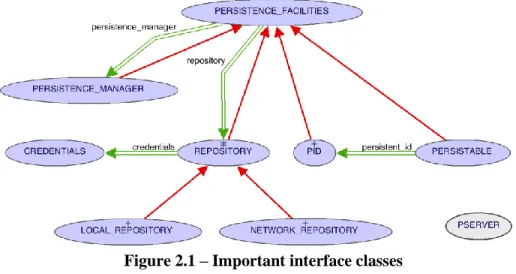
The persistence cluster divides the persistence classes into two sub-clusters, the interface cluster and the support cluster. The interface cluster contains about a dozen classes, some of which ap-pear in Figure 2.1. The red arrows indicate inheritance (i.e. IS-A) relationships, and the green arrows indicate client (i.e. HAS-A) relationships.1 Of the many classes and features available, the programmer need use only a few to take full advantage of the persistence mechanism.
Figure 2.1 – Important interface classes
Class PERSISTENCE_FACILITIES contains queries, constants, and global attributes used by al-most all of the persistence classes. A programmer who wishes to add persistence to a system should inherit from this class. The most convenient place for this inheritance relation is usually in the system’s root class. Through inheritance, the programmer gains access to the program’s single Persistence_manager.
Class PERSISTENCE_MANAGER adds commands to the queries, constants, and attributes of PERSISTENCE_FACILITIES to allow the programmer to initialize, activate, and perhaps fine-tune the persistence mechanism. A REPOSITORY is the abstraction for the data store, the location to which the persistent objects are stored. The programmer initializes the one REPOSITORY in a system as either a LOCAL_REPOSITORY or a NETWORK_REPOSITORY, creating it with the appropriate CREDENTIALS. A LOCAL_REPOSITORY connects to a local file, storing and retrieving objects to and from the hard drive. A NETWORK_REPOSITORY connects to a PSERVER, passing persistent objects across a network.
To use these classes and their features effectively, the programmer must understand the semantics of the persistence mechanism.
2.2 Persistent and persistable
P-Eiffel distinguishes between persistent and persistable objects. P-Eiffel provides automatic persistence, but does not demand it. A persistent object is one that resides in a persistent store and continues to exist between program executions. A persistable object is one whose state P-Eiffel can monitor and whose attributes P-P-Eiffel can store without explicit programmer involve-ment. In P-Eiffel, (almost1) all objects can become persistable.2
P-Eiffel marks an object as persistable by associating the object with a PID (i.e. a persis-tent identifier). Once P-Eiffel pairs an object with a PID, that association remains for the lifetime of the object. An object gets a PID, becoming persistable, in one of three ways: by an explicit call to identify, through reachability from some other persistable object, or through creation as a PER-SISTABLE type.
Though not the ideal method, a programmer can associate an object with a PID, manually making that object persistable, using an explicit call to feature identify. This feature obtains a new PID from the repository. The repository guarantees that the PID is unique. It is better to let P-Eiffel perform this object/PID pairing as it stores or creates objects.
When P-Eiffel stores an object, it uses persistence-by-reachability to achieve Meyer’s persistence closure principle. As P-Eiffel explores an object’s attributes during a persist operation, it calls identify on newly discovered objects, marking the newly discovered objects as persistable. After an object is so marked, P-Eiffel monitors that object for state changes. P-Eiffel, though, requires at least one object to be persistable already in order to initiate the persistence-by-reachability process. The easiest way to obtain this persistence starting point is to make at least one object begin its life as a persistable object.
P-Eiffel’s persistence-through-allocation comes via inheritance from class PERSISTABLE. An object of this type is automatically marked as persistable by a call to identify in this class’s creation feature. After an object is marked as persistable, explicitly or otherwise, P-Eiffel stores that object or updates its persistent representation automatically at the appropriate times during execution.
P-Eiffel stores or updates an object only when that object is in a consistent state, that is, when the object’s invariant holds, which is after object creation and after execution of an export-ed feature. Eiffel allows qualifiexport-ed calls (e.g. my_object.do_something or Current.do_something) for ex-ported features only, so the invariant is sure to hold after such a call. Therefore, if automatic persistence is enabled and the target object of a creation instruction or a qualified feature call is an automatically persistable object, then P-Eiffel stores that object.
When P-Eiffel stores an object, it sends all the attributes of that object to the repository, reducing references (i.e. pointers) to a persistable representation (i.e. a PID). It recursively follows
1 The almost caveat is necessary, because there are some object types for which persistence is meaningless. For example, a network SOCKET does not maintain its connected state when a program using it terminates, therefore restoring its previous state in the context of a different program is meaningless. GUI objects, which rely heavily upon the operating system of the current platform, also lose their state and are not re-storable once they go out of scope. Consider an EV_WINDOW. When a window is closed, the operating system removes that graphical element and those graphical elements contained in the window from the screen environment. Even though the underlying Eiffel objects still exist, restoring the corresponding graphical elements is impossible.
2 Creating a persistable GUI should be possible if the GUI widgets only relied upon its corresponding ob-ject state. These self-contained widgets would have to draw themselves instead of relying on the operating system; however, they might lose the native feel of the platform.