Managing evolution and change in web-based teaching
and learning environments
Claus Pahl*
School of Computer Applications, Dublin City University, Dublin 9, Ireland Received 14 December 2001; accepted 2 August 2002
Abstract
The state of the art in information technology and educational technologies is evolving constantly. Courses taught are subject to constant change from organisational and subject-specific reasons. Evolution and change affect educators and developers of computer-based teaching and learning environments alike— both often being unprepared to respond effectively. Educational systems are often designed and developed without change and evolution in mind. We will present our approach to the design and maintenance of these systems in rapidly evolving environments and illustrate the consequences of evolution and change for these systems and for the educators and developers responsible for their implementation and deployment. We discuss various factors of change, illustrated by a Web-based virtual course, with the objective of raising an awareness of this issue of evolution and change in computer-supported teaching and learning environments. This discussion leads towards the establishment of a development and management frame-work for teaching and learning systems.
#2002 Elsevier Science Ltd. All rights reserved.
Keywords:Architectures for educational technology systems; Distance education and telelearning; Interactive learning environments; Multimedia/hypermedia systems
1. Introduction
Computer-based instruction is a field that is characterised by rapid and substantial develop-ments in technology and pedagogy. Educators and developers involved in running these systems have served as change agents provoking change and driving the evolution of educational tech-nology (Ely, 1999). However, they have also been forced to react on external developments and changes. Changes required by the organisational environment and inevitable changes to the
0360-1315/03/$ - see front matter#2002 Elsevier Science Ltd. All rights reserved.
P I I : S 0 3 6 0 - 1 3 1 5 ( 0 2 ) 0 0 1 0 0 - 8
www.elsevier.com/locate/compedu
* Fax: +353-1-700-5442.
content itself have made teaching and learning environments increasingly difficult to run and to maintain. Asignificant number of systems today explore new technologies for teaching and learning, or evaluate the feasibility of new approaches. Flexibility and maintenance aspects have often been neglected in the design and development of these systems. This is only slowly becom-ing a problem, but, as we will explain, changes of any kind can have severe effects on the system and people involved. Considerable effort and costs are required to maintain and extend these systems. Alack of standardised concepts and procedures for design and management contributes to the dilemma. The only solution is to embrace evolution and change from the outset through the design of flexible systems. As Wilson (1999) says, ‘‘the need to adapt to change is already upon us’’.
Some progress in education systems development has been made concerning aspects of the product, e.g. about knowledge representation for Web-based education. The process of develop-ment and managedevelop-ment has been less well investigated. However, in particular later stages of this process dealing with change management and maintenance need more attention. Change and evolution do not only affect the technological aspects. Technology and pedagogy evolve hand in hand. These are the two aspects that developers and educators involved in the creation, delivery and management of teaching and learning environments are most concerned with. Domain-spe-cific engineering techniques for development and management have developed for various areas usually a few years after the emergence of a new technology—examples are hypertext systems (see
Lennon, 1997; Lowe & Hall, 1999)—and e-Commerce systems—(see Ince, 2002; Treese & Stew-art, 1998). Engineering techniques are now also sought for teaching and learning environments. We will explore the background for such a framework of change and evolution management.
Our objectives are to create an awareness of the practical aspects of the evolution and change problem—technology, pedagogy and cost related—and to illustrate the problems. Reported experience in managing educational technology over a longer period of time hardly exist; rare examples are (Palmer & Tulloch, 2001; Trikic, 2001). We want to bring factors of change into mind that are sometimes forgotten, ignored or neglected. Astructured account of factors of change and of the principles of a design methodology for change shall be given. Our experience with an evolving virtual Web-based course will be used as a model. We focus on Web-based delivery and management aspects, excluding authoring and evaluation support. However, our results apply to a wider range of teaching and learning environments (TLE)—see (Anderson & Jackson, 2000)—not limited to the Web as the representation and delivery medium, virtual delivery as the mode, or third-level institutions as the target organisation.
2. Teaching and learning environments
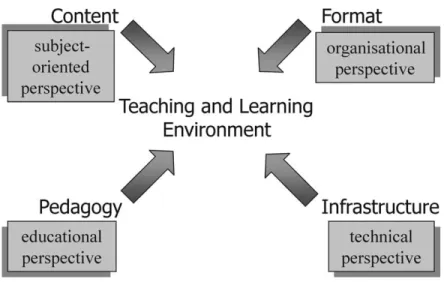
The notion of teaching and learning environments (TLEs) refers to a wide range of computer-based and computer-supported education and training systems. We propose to characterise these environments along four dimensionsproviding different perspectives—graphically summarised in
Fig. 1:
Content The subject-oriented perspective—refers to the subject taught and the representa-tion of knowledge in the TLE.
Format The organisational perspective—comprises attributes determined by the institu-tional context: curriculum, syllabus, staffing, etc.
InfrastructureThetechnical perspective—relates to the hardware and software environment in which the TLE is deployed.
PedagogyThe educational perspective—refers to the instructional design of the TLE deter-mining in which way the course is taught.
TLEs can be described in terms ofattributesalong these dimensions. Attributes of the pedagogy dimension that characterise TLEs that are often affected by change include multiservice, multi-media, interactive, autonomous, adaptive, and collaborative. In multiservice environments, dif-ferent services supporting different learning activities are integrated within one system. A multimedia environment uses various media. Learning by doing—supporting active learning—is the approach that is supported byinteractivefeatures, i.e. features of the system that the student can interact with in order to learn or train a specific topic or skill. Inautonomousenvironments, the system replaces major functions of the educator such as dialogue and feedback. Adaptive systems personalise the delivery of the system; the system adapts itself to a particular student’s characteristics and needs. Incollaborative systems, i.e. systems that support students working in groups towards a common goal, the communication and co-operation between students is sup-ported typically by offering both synchronous and asynchronous means of communication, and also shared workspaces for joint work. This discussion of the pedagogy attributes illustrates a close relationship between the pedagogical concepts supported and the enabling technology. New hardware and software technologies enable new pedagogical approaches to be implemented. However, systems characterised by these attributes typically need strong technological and administrative support in order to facilitate these features. Changes affecting these features often result in costly re-implementations.
Change and evolution of technology and pedagogy have affected our own course environment constantly. We introduce this course, a virtual undergraduate database course for a computing
degree, from a historical perspective, showing its evolution over the years. The history of our system reaches back to the early 1990s when a hypermedia system was developed (Smeaton, 1991). The course system has been re-engineered in 1996 as a multimedia lecturing system for the Web (Smeaton & Crimmins, 1997; Smeaton & Keogh, 1999). The lecture service transforms the classical idea of lectures—a lecturer speaking to students supported visually by a blackboard or overhead projector—into the virtual world. In 1999, advances in Web and communications technology initiated the third major development phase (Pahl, 2001a; 2001b), extending the sys-tem to a multiservice environment. New interactive features providing interactive tutorial and lab services have been integrated into the system. The course now supports several learning modes— attending lectures, tutorials and labs—through an integration of different educational services. Interactivity is a crucial element in a virtual course, since it allows us to engage the student. The interactive part of our virtual database course provides learning material for the database lan-guage SQL. The lectures are integrated with the interactive services and self-assessment features are provided, creating an effective educational scaffolding that allows self-reliant learning with adequate technical support. Afurther development step is currently in progress (Pahl, 2001c), implementing an adaptive and personalised system. We have re-engineered the HTML-based course content in a more flexible XML-representation (W3C, 2002)—a key to adaptive and per-sonalised systems.
An essential question concerns the transferability of our results. The key features of our system are also found in a variety of other systems—systems with interactive elements, multimedia fea-tures, or flexible content representation. Various other systems use multimedia technology such as audio and video material, e.g. (Bouras, Hornig, Triantafillou, & Tsiatsos, 2001). Klett (2001)
reports about a system with interactive features. Inoue and Ueno (2001) describe multimodal learning supported by several different educational services. Flexible representation of course material using XML is also used byBielikova (2001) and Quentin-Baxter and McDonald (2001). Even though the focus in those publications is rarely on change and evolution, similar problems are likely to be encountered in a long-term use of these systems.
3. Factors of change
According to Okamoto, Christea, and Kayama (2001), recent developments in information technology have triggered a shift from the teaching paradigm to the learning paradigm in com-puter-supported education environments. Students in these environments become more indepen-dent from the teacher. Although learner-centred education is not a new idea, new technologies developed for the Web and other computer-based platforms allow new forms of educational support to be facilitated, enabling new pedagogical concepts and enhancing learning ( O’Dono-ghue, Singh, & Dorward, 2001). As a consequence, the role of the educator changes from a tea-cher to a facilitator and manager. However, these developments are only part of the changes that impact TLEs. Besides the evolution of technology and pedagogy, the changes inflicted by the day-to-day business of an organisation or the evolution of the subject domain need to be considered. Our virtual course has evolved in several major phases focussing on hypertext representation, the Web and multimedia, interactivity, and adaptivity, respectively. However, the system has been subject to change constantly in the periods between the major development phases. The
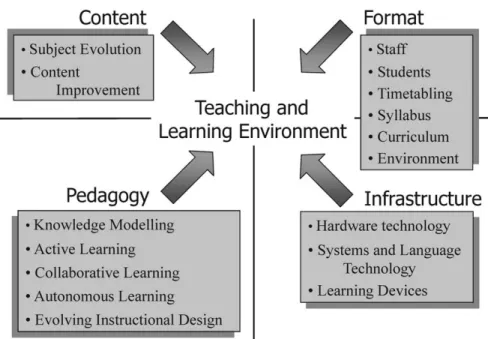
factors that influence the implementation of teaching and learning environments, and that require changes are numerous. Essentially, we can distinguish four main classes of factors of change— which we structure along the dimensions of teaching and learning environments:
Content: Changes relating to the subject that is taught.
Format: Changes related to staff and students involved or to curriculum and syllabus.
Infrastructure: Changes due to developments in hardware/software technology or learning devices.
Pedagogy: Evolution of teaching and learning in computer-supported environments.
The IT infrastructure and pedagogy evolution is a general process affecting all, whereas evolution in content and format is specific to an individual course or to an organisation. However, all aspects can have a severe impact on the system in use. We shall now discuss these different classes separately. We identify different single factors in these categories and illustrate them using our own course. 3.1. Content
Both external and internal factors, i.e. factors that are without or within the control of the educator, can result in content changes:
Subject evolution: The course subject itself evolves—an external factor.
Content improvement: Content is changed in order to improve the material in a planned process.
Theevolution of the course subjectis an external factor. Evolution in the subject area can force the course material to be updated or redeveloped. An example for our database course is the emergence of Web databases and the need to cover this topic from a theoretical as well as practical point of view with additional lectures, but also with adequate interactive tutorial and lab material.
There can also be change factors internal to the course, i.e. factors planned to be involved in the design. Planned content changes are based on evaluation results that are used to improve the course itself.
Content changes and updates are usually easy to carry out—at least as long as text is the medium. For audio and video material more technical preparation is needed. For example, for audio recordings a problem can arise if the previous speaker is not available any more.
3.2. Format
The organisation, which offers and runs a particular course, can require changes in a variety of ways that affect the format in which the course is taught. Factors of change arising from the institutional context in which the course is provided are the following:
Staff: Changes relating to educators, course developers, or technical support staff.
Students: The student body changes in terms of numbers, qualifications, or mode of learning.
Timetabling: Changes related to where and when a course takes place.
Syllabus: Content and organisation of the course content can change.
Curriculum: Organisational needs require changes in level, extent, or prerequisites of courses.
Environment: Issues such as the legal or financial environment require changes.
Significant disruptions in the delivery are usually caused bystaff changes—this includes educa-tors, course developers and technical support staff—in particular when a course environment is tailored towards interests and teaching style of the previous educator in charge. Our own system has been taught by two lecturers, one teaching the course until 1999, and the other since then. These two periods coincide with the essential phases of the course system development—the hypermedia and multimedia lecture development until 1999 and the interactive and adaptive services development since then. Both developments were driven by the interest of the lecturers in the respective features. In both cases the lecturers were in charge of the development of the features, supported by research assistants and programmers. Acrucial issue is that most of the developers involved in the actual implementation of our system have left our university in the meantime. Specific knowledge and expertise is no longer available—an issue that has been painfully experienced while relocating the course system from one hardware platform to another.
Over the years, thestudent bodyusually changes in a number of ways: total numbers, qualifi-cations, or mode of learning, e.g. full-time vs. part-time or distance vs. local attendance. The introduction of part-time or distance learning schemes certainly causes major changes to a sys-tem. Ascalability problem occurred when our student intake for the course was doubled. The database system originally used to support the interactive elements provided a too limited num-ber of possible connections and showed to be unstable under high loads. Alarger database system replacing the previous one had to be installed as a consequence of this technical insufficiency.
Times and places—thetimetablingof the course—is relevant for hybrid courses or for distance delivery where online meetings and discussions have to be scheduled. These might affect the form of presentation. For example, circumstances decide whether synchronous or asynchronous dis-cussions are held for a distance education course.
Thesyllabusmight have to change from time to time—this can be a consequence of changes in the subject area itself or changes in the curriculum, but sometimes there could also be an inde-pendent decision to focus more on for instance practical elements without another external cause. Another factor concerns issues arising from the context in which a particular course is embed-ded—thecurriculum. Due to organisational needs a course might change with respect to its level, extent, or the prerequisites. This is partly reflected by the student change factor. Our course has been moved to another year in the computing degree programme, and a variant has been offered to a different degree programme with different credits (measurements of workload). In general, this implies that the course content might need to be reduced or extended.
In a wider sense, we can also include changes in the legal environment. An open question in various institutions and countries addresses intellectual property rights. What, for instance, hap-pens if a course developer leaves an institution?Costingis another related element, which needs to be considered. An institution might decide because of financial reasons to discontinue the support for a particular technology.
3.3. Infrastructure
Developments in information and communications technology certainly influence the infra-structure and architecture of educational systems. We can distinguish these technological factors intocomputer hardware technology, systems and language technology,andlearning devices:
Hardware technology: Communications and network technology, computing power, and computer platforms have constantly improved.
Systems and language technology: Minor changes within the technology, technology leaps, legacy or pre-eminent technologies are frequent issues.
Learning devices: Software and hardware devices such as smart objects, information infra-structures and virtual environments serve as learning devices.
Changes in hardware technologycomprise communications technology and computer technol-ogy. Communications technology relates essentially to networks. An example is the increase of bandwidth in the past, allowing more data to be transferred in shorter time. In particular upgra-ded modem technology on PCs owned by students has improved the delivery and has made for example streaming of our audio material to PCs at home feasible. Improvements in computer technology have led to computing power increases and a substantial decrease in prices for PCs. Both factors have positively influenced PC ownership among students. More processor power and greater bandwidth are beneficial, if for example computers in labs are replaced. However, sometimes these replacements can introduce a newhardware platform—with possible portability problems for TLEs running on the previous platform.
Systems and language technology relates to computer software and languages. We can distin-guish minor changes—essentially caused by versioning of products and languages, possibly requiring small updates in the TLE—and major technological leaps. Occasionally, technology leaps occur when new technologies are introduced, sometimes even requiring existing ones to be replaced. An example for a technology leap is the emergence of the World Wide Web in the early and mid 1990s. Anumber of systems, such as ours, have existed before that. The phenomenal success and proliferation of the technology made the discontinuation of the previous technology almost mandatory. This has resulted in a substantial redevelopment since both the content representation and the delivery mechanism had to be changed.
Sometimes, the introduction of new technologies cannot be ignored, in particular when an existing technology becomes legacy and required support ceases to exist. Arelated problem occurred in our course when a data format for audio material, used in 1996 to record lectures and being the standard at that time, was replaced in 2000 by another, more advanced format as the standard. Using the 1996 format with the most recent versions of the corresponding audio player requires an additional module to be loaded and installed for the player. In the basic version of the player, the support for the old format is discontinued. Another example of technologies requiring TLEs to be changed is the pre-eminence of new technologies. XML—the eXtensible Markup Language—is a highly acclaimed technology, and has certainly impacted educational systems development. Avariety of newer systems use XML as the main content representation format, which has the property of being an interoperable data interchange format. Interfacing with these systems, or attempting to meet standards formulated in XML requires the conversion to XML. A
further example of a new technology that has been introduced into the educational context are metadata frameworks annotating educational objects in abstract terms, allowing them to be dis-covered and compared. An XML-based version of such a framework is the IMS metadata stan-dard for teaching and learning objects (IMS, 2002). Atechnological framework for metadata is RDF, the Resource Description Format.
Learning devices are certainly part of the technology aspect. However, we separate hardware and software technology from devices, which can be packages of hardware and software. The learning device in our course is the Web browser—a software device. Evolution in hardware and software technology can make other forms of devices possible, see (Dede, 1995b). New hardware and communications technologies can lead to smart objects using mobile microprocessors and wireless communication—devices that can be integrated into learning environments. Recent advances in handheld and PDAtechnologies are examples. Information infrastructures provide remote access to experts, archival resources, etc. Knowledge Webs are an example of this kind. The re-engineering of an existing system to a new platform also falls into this category. Atypical example is the conversion of CD-ROM-based courses to the Web. Shared virtual environments range from single-user simulators to group- and community-oriented virtual worlds. The con-clusion that has to be drawn from the evolution of learning devices is to design courseware with open, flexible, and interoperable architectures in mind.
3.4. Pedagogy
The state of the art in instructional design for computer-assisted teaching and learning has been strongly influenced by advances in information technology, education and cognitive sciences. In particular for Web-based systems the aspects knowledge modelling, active learning, personalised learning and collaborative learning have been investigated intensively.
Knowledge modelling: Acquisition, modelling of and access to educational knowledge.
Active learning: Engaging the student through interactive systems.
Collaborative learning: Supporting student communication and collaboration through communications systems and shared workspaces.
Autonomous learning: Personalisation and independent learning through adaptive systems.
Evolving instructional design: Planned evolution integrated in design through course evaluation.
The first four elements describe the stages that the development of educational technology went through over the last years.
Knowledge modellingis a central activity. The evolution of computer-supported TLEs has star-ted with systems providing easy access to course material in a different form. An issue that seem to appear again as a research topic is the organisation of learning resources. In particular in personalised and adaptive systems, the representation of learning material has to be co-ordinated with the learner model. Awider approach than structured representation of knowledge is required. Web technologies have improved access significantly, compared to the various forms of hypertext and hypermedia systems that existed before. Web-enabled databases allow the flexible storage and access to course content and learner data. In our particular case, we have re-engineered the original
HTML-material into XML and provided flexible access for configuration and delivery through database storage.
The development of advanced Internet and Web technologies such as mobile code has enabled interactive elements—students can respond to the presentation of material and proactively approach a system. The paradigm of active learning can be supported. The availability and accessibility of various forms of media—such as audio, video, and virtual worlds—supported by the Web has led to an improvement of interaction and simulation features. We have used advanced HTML- and server-technology to implement our interactive services.
Collaborative learning systems feature communications technologies ranging from email to video conferencing systems and shared workspaces in order to provide students with the means for group-oriented learning—essential for distance education and distributed learning. Our course is taught on-campus. Therefore, direct contact between teacher and students, and also among students, is possible and technical support is not necessary.
Personalised adaptive systems have been introduced based on new server and database technol-ogies, allowing developers to store user information and create content dynamically. Independent learning is supported by technologies based on personalisation that provide self-assessment and feedback functionality.Autonomous learningallows the student to take control over her/his own organisation of learning. Our course system implements some scaffolding features, i.e. support for the independent learner in form of feedback, self-assessment and links.
Evolution through evaluation is an iterative, incremental approach to improve content and instructional design. Essential for any TLE is the constant monitoring of students and their pro-gress and the evaluation of the course and the system effectiveness. We have used evaluations also to detect errors and inconsistencies in the content itself, but mainly to improve the instructional design.
The role of technology evolution as an enabler of new pedagogical concepts is evident. How-ever, student usage of computer-supported systems is far from being well understood and, con-sequently, the evolution of technology and pedagogy for these systems will continue for some time before agreed understanding and standards will have emerged.
3.5. Technology and pedagogy evolution
The close relationship between pedagogy and technology evolution is an important aspect in designing and managing educational systems. Often, systems will undergo major redevelopment to support new forms of instructional design enabled by new technological developments—as it has happened twice with our system. Some of these associations between technology and peda-gogy are multimodal learning as the pedagogical approach and educational service integration as the enabling technology, or independent learning as the pedagogical approach and scaffolding— the provision of links, help, self-assessment, etc.—as the enabling technology. Understanding this relationship is crucial for the anticipation of change and the most effective reaction to it.
Overall theories are sought linking pedagogy and technology together. Activity theory is a conceptual framework that can describe the structure, development, and context of computer-supported activities (Nardi, 1997). Its emphasis on the interaction between agents and their environments explains the principle of tool mediation. Tools shape the way humans interact with reality. Tools reflect experiences other people have made in trying to solve similar problems. This
experience is accumulated in structural and behavioural properties of the tool. ATLE is the tool that provides a student with access to a part of the reality—the course subject—guided by struc-tural and behavioural rules defined by the educator. Approaches such as problem-based learning, constructionism, or exploratory learning can be derived from constructivist theory, see (Dede, 1995a).Constructivismsays that knowledge is constructed by a student, rather than taught to the student. The process of knowledge construction is viewed as deeper than the traditional approach. The student is engaged in solving meaningful problems—we have called this active learning. Interactive services can enable active learning in a constructivist style if they create a representation of reality in which learning is relevant. Activity theory or constructivism together with technological developments can be the drivers of the evolution of TLEs.Instructional design is the crucial activity that embraces these pedagogical and technological developments. Courses need to be designed using the most appropriate learning approaches for the subject restricted by the technology that is available.
4. Development and management for evolution and change
Evolution and change are ubiquitous for computer-based educational systems (see Fig. 2) which can, as we have seen, pose some difficulties for educators and developers. Both educators and developers can be catalysts and proactively drive innovation, but also need to react to chan-ges in their environment. An adequate methodology for the support of change can provide help for the development, management and maintenance of teaching and learning systems. Standard methodologies for the development of software often address the problem of change and evolu-tion. However, the context of education requires some consideraevolu-tion.
4.1. Context for a methodology
Amethodology for education engineering—an engineering approach to the systematic and methodological development and management of TLEs—could hold the key to the change problem. Ultimately, we would like to achieve maintainable TLEs, i.e. TLEs that are scalable, configurable and interoperable in order to deal with change. We consider such a framework necessary in order to cope with the consequences of evolution and changes in technology, peda-gogy, content, and the institutional context. The presentation of a complete methodology for change is beyond the scope of this investigation. However, we discuss the context and the key aspects here.
The characteristics we have listed for TLEs are desirable for any computer system. Some authors such asVirvou and Tsiriga (2001)have addressed general software development issues in the educational context. However, it is worth looking more closely at where education and training systems differ from computer systems in general. Educational technology in this context is still less mature than classical computer systems technologies such as business applications. The users are not well understood. How students learn with computer-based system—the learning process—needs more research. The goal of learning is specific to the area. Learning is a complex process that can not easily be compared with goals in other computer-based systems—such as shopping at e-Commerce Web sites or administrative tools where tools support tedious work. The main person in charge of developing and running an educational system—the educator—usually does not have significant technological background. Teaching is seen by most as an art and often involves very individualised skills and personal styles. The institutional context is different from classical business and administration software. These differences call for a domain-specific evo-lutionary methodology for instructional design and implementation.
4.2. Key aspects of a methodology
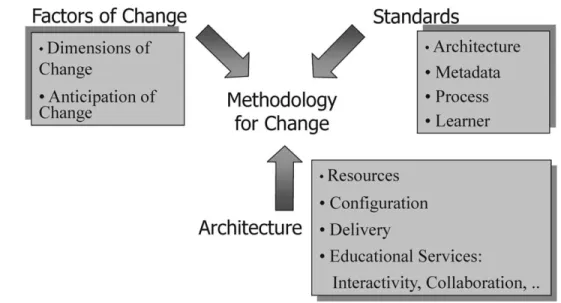
Avariety of factors can cause a TLE to be changed (seeFig. 2). Change is pervasive in these environments. Asustainable approach to the development and management of TLEs embracing change and evolution from the outset is sought. Asuitable methodology has to consider the changing roles of educators and developers. Elements of a methodology for incremental design and evolution for TLEs should include the anticipation of change and the consideration of innovative developments, architectural aspects, and standards, seeFig. 3. These aspects need to be considered for all stages of the TLE life cycle—such as design, deployment, and evaluation.
An essential lesson we have learned is that change has to be anticipated and reflected in the design. The fact that neither the content of our courses nor their meta-attributes such as format, infrastructure and pedagogy are static needs to be accepted. Requirements are volatile—some are mutable, others will only emerge during the development or deployment. We have listed the fac-tors of change in different categories, hoping that these might help to devise designs that allow us to deal with these changes with respect to the different categories. What is sought is an incre-mental, iterative method for ongoing construction and reconstruction that can cope with the changes that are required.
Another lesson learned is to look at new innovative developments at the verge of making an impact. The design of TLEs—in particular for Web-based environments for distance access—has
to aim at the lowest common-denominator technology available in order to make distance access acceptable for students working from home. This gives the chance to consider emerging technol-ogies and their maturation for future changes of the system. Atechnical horizon of several years can be incorporated. Interoperability is one of these emerging aspects, concerned with integration and interfacing educational systems among each other. Our experience with change and evolution can ideally be projected into the future through an appropriate design for change methodology.
The architecture of a TLE plays an important role in the determination of the location and impact of change in the system. We can relate factors of change to different components of a TLE architecture. Theresourcesare affected by content factors, theconfigurationcomponent is affected by format and content factors, and the delivery system is affected by factors of all four dimen-sions. Although we have not directly used the Learning Technology Standard Architecture (LTSA) defined in (IEEE LTSC, 2001) as our architectural framework, there is a correspondence between the processes in the LTSAand our components.1 Most often resources are affected by
changes. However, due to their static nature, changes to resources—to be carried out by an edu-cator—tend to be simpler than those effecting for example the delivery system where usually implementation work—to be carried out by a developer—is required. We can distinguish tech-nology infrastructure and feature-specific technologies. This classification helps us to structure and assess the impact of factors of change. Infrastructure technologies comprise basic function-ality, e.g. Web technology, networking and communication, and storage facilities for resources, configuration and delivery aspects. Feature-specific technologies enable certain forms of learning, such as active learning supported by interactive and streaming media. Feature-specific technolo-gies form an orthogonal dimension to the infrastructure dimension. Educators and developers are
Fig. 3. Aspects of a Methodology for Change.
1 Resources are distinguished into learner records and learning resources. The configuration is the essential task of the coach. The delivery service is identified in both architectures. We have neglected the evaluation service. Its position in the architecture would be similar to the delivery service.
affected in different ways by change. The educator is most affected by changes in pedagogy, content and format, whereas the developer is most affected by changes in pedagogy and infra-structure.
Standards play an important role in the development of any system. We can distinguish de facto standards, possibly dictated by concepts of best practice for the context, and standards presented by professional or standardisation bodies. Examples for the latter are subject-specific technology standards such as those suggested by the IEEE Learning Technology Task Force LTTF, or general education-oriented ones such as the standards and guidelines published by the American Association for Higher Education AAHE or the Association for the Advancement of Computing in Education AACE. Standards such as the IMS metadata framework (IMS, 2002) rely in their implementation on existing technologies—XML in that case. Other frameworks are usually platform-independent, such as the IEEE Learning Technology Standard Architecture LTSAor the Learning Object Metadata standard LOM. Standards affect the pedagogical side as well as the technical side. For the technical side, open source infrastructures and interoperability are key issues in this context. These open source standards, such as Web technologies, determine the interoperability of services with other services or systems. In the future, the need to integrate, to interface and to combine will increase. The use of standards should not be restricted to tech-nologies for the product itself, but should also be applied to the development and management process.
5. Conclusions
The design of Web-based courses can be described in terms of the four dimensions content, format, infrastructure and pedagogy. Our classification of change factors along these dimensions shows the ubiquity of change and evolution. Whether educators and developers trigger these changes or whether they have to react to change and evolution, we have seen that the change factors and their causes are manifold and that they can have severe consequences. Change might be beneficial, such as new pedagogical developments, or might just be forced upon the system through administrative and technical changes in the environment; in any case it comes with a cost from a management point of view. In order to keep costs low and to minimise them whenever possible, the need to plan for change and evolution in instructional design and management is imperative.
Educational technologies lack sufficient support for change and evolution. Let us summarise some of our key observations reflecting the current problems. Firstly, even though some progress with respect to standards has been made—Anido, Llamas, Fernandez, Rodriguez, Caeiro, and Santos (2001) describe some efforts—the standardisation of technology, development and man-agement techniques and procedures is not complete. Secondly, the life expectancy of technologies is usually limited to a few years before new ones dominate. Thirdly, costs have been under-estimated in the past. Cost-effectiveness so far could only be achieved for large student numbers. Finally, staffing is often inadequate—the development and deployment of educational systems depends much on the enthusiasm of individuals. In the presence of change and evolution, pro-blems are inevitable. We have demonstrated the consequences—difficulties in the reaction to change and in long-term planning—in our presentation of change factors. Planning with change
in mind helps to manage courseware in a rapidly evolving environment cost-effectively and increases the chance of including innovative developments into educational systems. System requirements are volatile and subject to change. As a consequence, requirements should embrace change and should reflect the possibility for change explicitly.
We have suggested some changes to the development and management of educational systems in order to deal with the difficulties we just described. Courses in the future need to be much less an expression of the educator’s style of teaching. The anticipation of staffing changes makes this necessary. New standards are another issue—current efforts need to be closely observed and incorporated into designs. Current and future technological innovation will enable new pedago-gical concepts for TLEs. Pedagopedago-gical needs and desired features and the development of tech-nology go often hand in hand. The future seems to show two developments that can impact computer-supported educational systems. Firstly, an increased mobility of people, devices and computer programs, and secondly, the evolution of the Web from an information-oriented to a service-oriented framework.
One lesson that we have learned—supported by other authors such as Palmer and Tulloch (2001)—concerns a more strategic level. High-end features in educational systems are showpieces that raise the profile of the developer. However, these systems have turned out to be costly and difficult to maintain. New investments and new developments are required if new concepts are to be implemented. The development of easy-to-use infrastructures and mainstream systems should be favoured if maintainability and not the exploration of new technologies is the objective. Even in the latter case, the technologies might remain in service for several years and, consequently, need to be maintained as well. Palmer and Tulloch point out that the implementation of high-end technology usually comes at a price and such developments are only sustainable if there is suffi-cient backing from the organisation in charge.
Our conclusion is that a development and management methodology for TLEs—a framework of education engineering—is needed. Wilson (1999)has pointed out that conceptual frameworks for learning support are always struggling to keep up with constantly developing technologies and theoretical advances in education and cognitive sciences. In order to keep TLEs manageable and cost-effective, we propose a systematic evolutionary approach to the development and deployment of these environments, acknowledging the different roles of the change agents. The anticipation of change and evolution needs to be incorporated, and all factors of change have to be understood and considered. Standards are of paramount importance. Such a framework extends to the technology in use, but also to the representation and organisation of course con-tent. Our objective has been to raise an awareness of the evolution and change problem, and to present the foundations of a methodology. Educators and developers need to be aware of changes in their environment and also changes to their own role, and in particular, need to adapt to change and evolution by planning for the management of change already in the design.
Acknowledgements
The author is greatly indebted to Alan Smeaton, who started developing the system described, and who also commented on a draft version of this paper. The author’s thanks also go to Mar-garet Farren for her comments and suggestions.
References
Anderson, M., & Jackson, D. (2000). Computer systems for distributed and distance learning. Journal of Computer Assisted Learning,16, 213–228.
Anido, L., Llamas, M., Fernandez, M. J., Rodriguez, J., Caeiro, M., & Santos, J. (2001). A standards-driven open architecture for learning systems. Proc. IEEE International Conference on Advanced Learning Technologies ICALT’01, 3–4.
Bielikova, M. (2001). Adaptive presentation of evolving information using XML.Proc. IEEE International Conference on Advanced Learning Technologies ICALT’01, 193–196.
Bouras, C., Hornig, G., Triantafillou, V., & Tsiatsos, T. (2001). Architectures supporting e-learning through colla-borative virtual environments: the case of INVITE. Proc. IEEE International Conference on Advanced Learning Technologies ICALT’01, 13–16.
Dede, C. (1995a). The evolution of constructivist learning environments: Immersion in distributed, virtual worlds. Educational Technology,35(5), 46–52.
Dede, C. (1995b).The evolution of learning devices. Available: http://www.ed.gov/Technology/Futures/dede.html. Ely, D. P. (1999). Conditions that facilitate the implementation of educational technology innovation. Educational
Technology,39(6), 23–27.
IEEE Learning Technology Standards Committee LTSC. (2001).IEEE P1484.1/D8. Draft standard for learning tech-nology—learning technology systems architecture (LTSA), 04/06/2001.IEEE Computer Society.
IMS Global Learning Consortium (2002). IMS Web Page http://www.imsproject.org.
Ince, D. (2002).Developing distributed and e-commerce applications. Harlow, UK: Addison Wesley.
Inoue, T., & Ueno, H. (2001). NACSIS-ILL WWW based training system.Proc.IEEE Symposium on Applications and the Internet SAINT 2001—Workshop on Internet-Supported Education, 39–44.
Klett, F. (2001). Adesign framework for interaction in 3D real-time learning environments.Proc.IEEE International Conference on Advanced Learning Technologies ICALT’01, 63–66.
Lennon, J. A. (1997).Hypermedia systems and applications. Berlin, New York: Springer-Verlag.
Lowe, D., & Hall, W. (1999).Hypermedia & and the Web—an engineering approach. Chichester, UK, New York: John Wiley & Sons.
Nardi, B. (Ed.) (1997).Educational context and consciousness: activity theory and human–computer interaction. Cam-bridge, MA: MIT Press.
O’Donoghue, J., Singh, G., & Dorward, L. (2001). Virtual education in universities: a technological imperative.British Journal of Educational Technology,32(5), 511–523.
Okamoto, T., Christea, A., & Kayama, M. (2001). Future integrated learning environments with multimedia.Journal of Computer Assisted Learning,17, 4–12.
Pahl, C. (2001a). Interactivity and integration in virtual courses.Proc. International Conference on Advanced Learning Technologies ICALT 2001, 395–396.
Pahl, C. (2001b). The evaluation of educational service integration in integrated virtual courses.Proc. Symposium on Applications and the Internet SAINT’01-Workshop on Internet-supported Education WISEd’2001, 61–66.
Pahl, C. (2001c). XML-technologies for the support of active learning in interoperable and open Web-based learning environments.Proc. 6th WebNet 2001 World Conference on the WWW and Internet.
Palmer, S., & Tulloch, W. (2001). The evolution of online teaching and learning in engineering at Deakin University. Journal of Computing in Higher Education,14(1).
Quentin-Baxter, M., & McDonald, T. (2001). Managing networked learning environments for health via XML data-bases and Zope.Poster Proc. 10th International World-Wide Web Conference, 114–115.
Smeaton, A. F., & Crimmins, F. (1997). Virtual lectures for undergraduate teaching. Proc. ED-MEDIA’97 World Conference on Educational Multimedia and Hypermedia.
Smeaton, A. F., & Keogh, G. (1999). An analysis of the use of virtual delivery of undergraduate lectures.Computers & Education,32(1), 83–94.
Smeaton, A. F. (1991). Using hypertext for computer-based learning.Computers and Education,17(3), 173–179. Treese, G. W., & Stewart, L. C. (1998).Designing systems for Internet commerce. Reading, MA: Addison Wesley. Trikic, A. (2001). Evolving open learning environments using hypermedia technology.Journal of Computer Assisted
Virvou, M., & Tsiriga, V. (2001). An object-oriented software life cycle of an intelligent tutoring system.Journal of Computer Assisted Learning,17, 200–205.
Wilson, B. G. (1999). Evolution of learning technologies. Form instructional design to performance support to net-work systems.Educational Technology,39(2), 32–35.
World Wide Web Consortium—W3C (2002).The extensible markup language (XML). Web page http://www.w3.org/ XML/.