IMPROVING THE DELIVERY OF PPP HOUSING PROJECTS
IN DEVELOPING COUNTRIES
By
NEEMA WILBARD KAVISHE
A thesis submitted to the University of Birmingham for the degree of
DOCTOR OF PHILOSOPHY
College of Engineering and Physical Sciences School of Engineering
University of Birmingham September 2017
University of Birmingham Research Archive
e-theses repositoryThis unpublished thesis/dissertation is copyright of the author and/or third parties. The intellectual property rights of the author or third parties in respect of this work are as defined by The Copyright Designs and Patents Act 1988 or as modified by any successor legislation.
Any use made of information contained in this thesis/dissertation must be in accordance with that legislation and must be properly acknowledged. Further distribution or reproduction in any format is prohibited without the permission of the copyright holder.
i
ABSTRACT
The supply of adequate and affordable houses is still a big challenge in many developing countries, particularly where the population and urbanisation rates are continuously growing. As the urban population of a city grows, so too does the need for more housing, quickly exceeding the existing housing supply and leading to the growth of informal, uncontrolled and unregulated settlements. Governments, through their housing agencies, have sought to use different housing strategies, such as public private partnerships (PPPs), to solve these urban housing problems, but with limited success. Despite the adoption of PPPs, this deficiency remains at a high level and progress is slow.
The aim of this study is, firstly, to examine the challenges affecting the delivery of HPPP projects in developing countries and, secondly, to propose a PPP conceptual model to address the identified challenges. A mixed-methods approach was used to collect data from 28 stakeholders involved with housing public private partnership (HPPP) projects. Tanzania was used as the case study for data collection, with this achieved via a hand-delivered and emailed survey and 23 semi-structured interviews with public and private sector respondents. Purposive sampling was used to select the targeted respondents. The quantitative data were analysed through the Statistical Package for the Social Sciences (SPSS 22.0) whereas the qualitative data were analysed by content analysis.
This study identified several challenges hindering the success of HPPP projects with the five highest ranked challenges found to be: inadequate PPP skills and knowledge; poor contracting and tendering documents; inadequate project management; inadequate legal framework; and misinformation on private partners’ financial capacity. In addition, other aspects that influenced the adoption of PPP in housing, such as cost and affordability, sustainability
ii
factors and advocated benefits were identified as having a significant impact. Results demonstrate that the PPP can be adopted as an alternative approach; however; the identified challenges need to be addressed for a successful outcome to be achieved. This has been achieved in this study by the development of a PPP conceptual model validated by the expert opinion approach.
The key contributions to knowledge include: bridging the literature gap as this empirical study is the first that identifies and ranks the challenges of the PPP for housing project delivery within the developing country context. Additionally, a conceptual model has been developed by adopting (and modifying as appropriate) success factors from international best practice. The conceptual model is based on the project life cycle approach whereby the key features (skills, planning, procurement, monitoring and controlling) of the model address the major constraints, as highlighted in this study. It is anticipated that the proposed conceptual model, validated by PPP experts, will provide a valuable road map for the successful delivery of HPPP projects in developing countries.
iii
DEDICATION
I hereby dedicate this thesis, firstly, to the ALMIGHTY GOD for without Him this work would never have existed. Secondly, this dedication goes to my dad Mr Wilbard Nicholas Kavishe and my late mother Mrs CONJESTER WILBARD KAVISHE: it is sad you are not with us to share my success.
Last, but very importantly, this thesis is dedicated to my special husband DISMAS and my two sons ETHAN and EVAN for their steadfast support and patience.
iv
ACKNOWLEDGEMENTS
My very heartfelt gratitude goes to the Almighty God for His sufficient grace and faithfulness Secondly, I am very thankful to my principal supervisor Professor Ian Jefferson for agreeing to take over in the middle of the course after my initial supervisor left. His insightful comments, flexibility and patience have given me all the support and guidance that I needed to shape my work.
In addition, my sincere thanks also go to Professor Nicholas Chileshe for his patience and motivation throughout my PhD journey. Nicholas has communicated regularly and has promptly responded to my queries. Not only that, but he has taught me the skills and ethics required to become a good researcher and has consolidated my desire to continuously learn and grow in the field of research. I am grateful for the hard questions he has asked, as they really helped me learn the philosophy.
I would also like to thank the rest of my thesis advisors, Professor Min An, Dr Dexter Hunt and Professor Nigel Cassidy for their guidance and support.
I acknowledge and am thankful to the Commonwealth Scholarship Commission for its financial support. I am also grateful to my employer, Ardhi University, for granting me the study leave to pursue my PhD studies.
Special thanks go to Professor and Mrs Buchannan for being such amazing family friends. Their love, care and support throughout my studies have made my stay and that of my family in the United Kingdom (UK) enjoyable. I am also sincerely grateful to my friends Mr and Mrs Swai, Dr Nkemi, Pastor Tolu, Betty Mntambo, Juliet and Godden for their prayers and moral support during my PhD journey.
v
Last, but not least, is my heartfelt appreciation to my family: words cannot express how grateful I am to my husband Dismas and my two adorable sons Ethan and Evan. Thank you for your patience and prayers. My love for you has really inspired me to finish this journey.
vi
TABLE OF CONTENTS
CHAPTER 1 ... 1
GENERAL INTRODUCTION ... 1
1.1 Background to the Research ... 1
1.2 Aim of the Study... 4
1.3 Rationale of the Study ... 5
1.4 Research Questions... 7
1.5 Expected Outcomes ... 8
1.6 Scope of This Study ... 8
1.7 Conceptual Framework ... 9
1.8 Structure of the Thesis ... 11
1.8.1 Chapter 1 ... 11 1.8.2 Chapter 2 ... 11 1.8.3 Chapter 3 ... 12 1.8.4 Chapter 4 ... 13 1.8.5 Chapter 5 ... 13 1.8.6 Chapter 6 ... 13 1.8.7 Chapter 7 ... 13 1.8.8 Chapter 8 ... 14 1.9 Chapter Summary ... 14 CHAPTER 2 ... 15
OVERVIEW OF URBAN HOUSING AND STRUGGLE FOR HOUSING PROVISION IN TANZANIA ... 15
2.1 Chapter Introduction ... 15
2.2 Population Growth and Urbanisation ... 15
2.3 Housing Stock... 18
2.4 Government Efforts towards Urban Housing ... 21
2.4.1 Provider Model ... 22
2.4.2 Enabling Strategy Model ... 23
2.4.3 Governance Model ... 25
vii
2.5 Chapter Summary ... 28
CHAPTER 3 ... 29
OVERVIEW OF PUBLIC PRIVATE PARTNERSHIP (PPP) ... 29
3.1 Chapter Introduction ... 29
3.2 Emergence of Public Private Partnership (PPP) Concept ... 29
3.2.1 PPP Definition ... 30
3.2.2 Types of PPP Arrangements/Models ... 32
3.2.3 Private Finance Initiative (PFI) ... 35
3.2.4 Value for Money (VfM) Concept ... 36
3.2.5 PPP Risks ... 39
3.2.6 PPP Benefits ... 43
3.2.7 Critical Success Factors (CSFs) for PPP Projects ... 44
3.2.8 Principles of PPP Project Implementation ... 49
3.3 Overview of PPPs in Tanzania ... 51
3.4 Chapter Summary ... 55
CHAPTER 4 ... 56
PUBLIC PRIVATE PARTNERSHIP IN HOUSING PROVISION ... 56
4.1 Chapter Introduction ... 56
4.2 Conceptualisation and Theoretical Basis of the Study ... 56
4.2.1 Gidden’s Structuration Theory ... 56
4.2.2 Transaction Cost Theory ... 57
4.2.3 Equity Theory ... 58
4.3 Embarking on Housing Public Private Partnerships (HPPPs) ... 59
4.3.1 Readiness to Adopt HPPP Projects ... 60
4.3.2 Drivers for Adopting HPPP Projects ... 61
4.3.3 Cost and Affordability ... 64
4.3.4 Benefits of HPPP Projects ... 65
4.3.5 Sustainability in HPPP Projects ... 66
4.3.6 Challenges in HPPP Projects ... 71
4.4 PPP Housing Experience in Tanzania ... 76
4.4.1 National Housing Corporation (NHC): Historical Context ... 78
4.4.2 National Social Security Fund (NSSF) ... 86
4.4.3 Private Partners Involved in HPPP Projects ... 87
viii
4.5 Experience in HPPP Projects Across Countries ... 89
4.5.1 Asian Region ... 89
4.5.2 African Region ... 92
4.5.3 Europe ... 94
4.6 Implications Drawn from Other Countries’ Experience ... 96
4.7 Chapter Summary ... 98
CHAPTER 5 ... 100
RESEARCH DESIGN AND METHODOLOGY ... 100
5.1 Chapter Introduction ... 100
5.2 Research Approach ... 100
5.2.1 Mixed-Methods Research ... 100
5.3 Adopted Research Method for This Study ... 101
5.3.1 Justification of Selected Research Method ... 102
5.4 Sampling ... 103
5.5 Research Design ... 105
5.5.1 Stage 1: Literature Review ... 105
5.5.2 Stage 2: Pilot Study ... 109
5.5.3 Stage 3: Main Study ... 110
5.5.4 Stage 4: Conceptual Model Validation ... 114
5.6 Data Analysis ... 117
5.6.1 Single Sample t-Test of the Mean ... 118
5.6.2 Ranking Analysis and Relative Agreement Index (RAI) ... 119
5.7 Methods, Tools and Techniques Chosen for Addressing Each Objective ... 120
5.8 Chapter Summary ... 120
CHAPTER 6 ... 122
DATA ANALYSIS AND PRESENTATION OF FINDINGS ... 122
6.1 Chapter Introduction ... 122
PHASE 1 RESULTS: CONCURRENT MIXED METHODS (QUESTIONNAIRE SURVEY AND INTERVIEW FINDINGS) ... 122
6.1.1 Questionnaires ... 122
6.1.2 Interviews ... 125
6.1.3 Part B: Housing Affordability in Tanzania ... 126
6.1.4 Part C: Public Private Partnership Aspects in Housing Projects ... 130
ix
6.2.1 Semi-Structured Interviews ... 173
6.2.2 Characteristics of Interviewee Sample (Part A) ... 173
6.2.3 Drivers for Adopting HPPP Projects (Part B) ... 174
6.2.4 Government Support Towards Development of HPPP Projects ... 180
6.2.5 Benefits and Critical Success Factors (CSFs) (Part D) ... 182
6.2.6 Risks Associated with HPPP Projects ... 185
6.3 Risk Management Strategies in HPPP Projects ... 187
6.4 HPPP Project Operation ... 189
6.5 Chapter Summary ... 191
CHAPTER 7 ... 193
CONCEPTUAL MODEL DEVELOPMENT AND VALIDATION ... 193
7.1 Introduction ... 193
7.2 Key Findings Necessitating Development of Proposed Conceptual Model ... 193
7.3 Model Development Approach ... 194
7.4 Proposed Conceptual Model ... 196
7.4.1 Explanation of Phases of the Model ... 196
7.5 Model Verification ... 202
7.5.1 Mapping PPP Challenges with Advocated Remedial Solutions to Conceptual Model ... 202
7.6 Validation of Conceptual Model ... 205
7.6.1 Survey Respondents ... 205
7.6.2 Respondents’ Demographic Information ... 206
7.6.3 Validation ... 208
7.7 Improved and Validated Conceptual Model ... 212
7.8 Comparison of New Proposed Framework/Conceptual Model to Existing Frameworks 215 7.9 Implications of the Study ... 216
7.10 Chapter Summary ... 216
CHAPTER 8 ... 219
CONCLUSIONS AND RECOMMENDATIONS ... 219
8.1 Chapter Introduction ... 219
8.2 Summary of Research Findings ... 219
8.2.1 Objective 1: To investigate PPP awareness and practice for implementing HPPP projects ... 219
x
8.2.3 Objective 3: To establish the PPP antecedents for adopting HPPP projects ... 222
8.2.4 Objective 4: To evaluate the cost and affordability factors for successful implementation of HPPP projects ... 225
8.2.5 Objective 5: To explore the sustainability factors influencing the adoption of HPPP projects ... 226
8.2.6 Objective 6: To develop an effective HPPP conceptual model, empirically validate it and draw conclusions ... 227
8.3 Contribution to the Body of Knowledge ... 228
8.3.1 Relationship with Existing Research ... 228
8.3.2 Scholarly Contribution to Knowledge ... 228
8.4 Research Limitations ... 234
8.5 Recommendations for Further Research ... 235
REFERENCES ... 238
APPENDICES ... 261
Appendix A: List of Publications ... 261
Appendix B: Questionnaire Survey Instrument for Pilot Study ... 263
Appendix C: Questionnaire Survey Instrument for Main Study ... 268
Appendix D: Interview Instrument (Phase 1) ... 274
Appendix E: Interview Instrument (Phase 2) ... 275
Appendix F: PPP Expert Invitation Letter ... 277
Appendix G: Information Sheet for Participants ... 278
Appendix H: Questionnaire Survey Instrument for Validation Process... 280
xi
LIST OF FIGURES
Figure 1.1: Conceptual Framework ... 10
Figure 1.2: Structure of the thesis ... 12
Figure 2.1: Housing provision systems in Tanzania... 20
Figure 3.1: PPP financial concept ... 32
Figure 3.2: Different forms of PPP contract ... 34
Figure 4.1: Map of Tanzania showing the regions ... 84
Figure 4.2: NHC PPP Procurement Framework adopted for 1995–2010 ... 85
Figure 5.1: Research design... 106
Figure 6.1: Common procurement methods in delivering AFH projects ... 128
Figure 6.2: Existence of housing policy in Tanzania ... 130
Figure 7.1: Proposed PPP conceptual model for housing projects ... 198
xii
LIST OF TABLES
Table 2.1: Number of persons and national population density in Tanzania ... 17
Table 2.2: Housing provision systems in Tanzania ... 19
Table 3.1: Summary of PPP definitions ... 31
Table 3.2: Types of PPP model arrangement ... 33
Table 3.3: Risks identified based on PPP project life cycle ... 41
Table 3.4: Critical success factors (CSFs) for PPP projects ... 46
Table 3.5: List of PPP principles ... 50
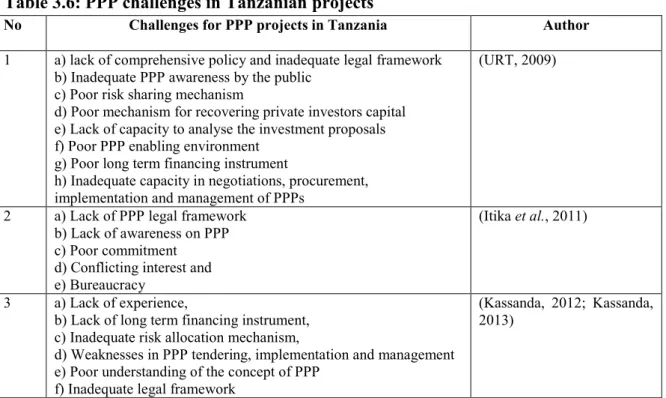
Table 3.6: PPP challenges in Tanzanian projects ... 52
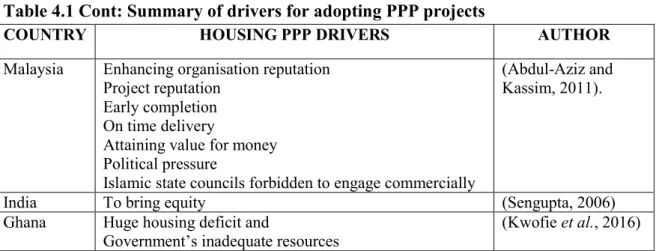
Table 4.1: Summary of drivers for adopting PPP projects ... 61
Table 4.1 Cont: Summary of drivers for adopting PPP projects ... 62
Table 4.2: Summary of benefits in HPPP projects ... 66
Table 4.3: Summary of sustainable development assessment tools for buildings ... 69
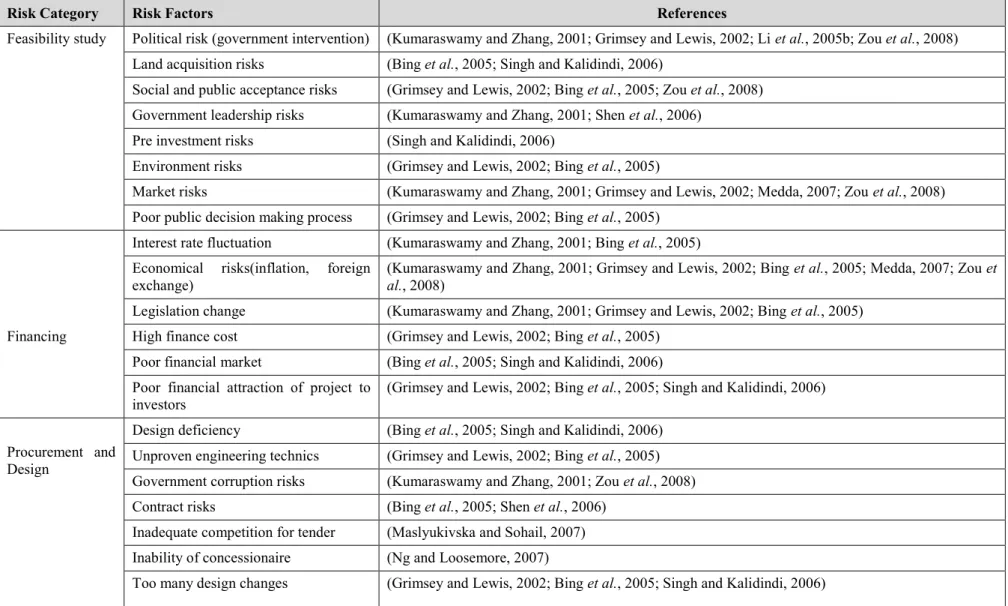
Table 4.4: Summary of selected literature on challenges affecting the delivery of PPP projects ... 74
Table 4.5: List of existing PPP frameworks/Conceptual model ... 77
Table 4.6: NHC projects under PPPs in Dar es Salaam region ... 80
Table 4.7: NSSF projects under PPPs ... 86
Table 4.8: Summary of key success HPPP features in selected countries ... 98
Table 5.1: Mixed-methods designs ... 101
Table 5.2: Summary of methods, tools and techniques chosen for each objective ... 121
Table 6.1: Profile of questionnaire study sample ... 124
Table 6.2: Interviewee profiles ... 127
Table 6.3: With which of the following PPP projects has your organisation mostly been involved in the last 5-10 years? (survey results) ... 131
Table 6.4: If you are to assess yourself, do you think that you have enough skills and knowledge on PPPs? ... 132
Table 6.5: Have you undertaken any PPP training to improve your skills in this type of project? ... 132
xiii
Table 6.6: Cross-tabulation for ‘If you were to assess yourself, do you think that you have enough skills and knowledge on PPPs? * Have you undertaken any PPP training to improve
your skills in this type of project? (survey results) ... 133
Table 6.7: Overall ratings of challenges in implementing HPPP projects in Tanzania (questionnaire survey) ... 136
Table 6.8: Summary of challenges in implementing HPPP projects in Tanzania (interviewee perceptions) ... 138
Table 6.9: Ranking of the five cost and affordability factors influencing the implementation of HPPP projects in Tanzania ... 145
Table 6.10:Ranking of the five sustainability factors influencing the implementation of HPPP projects in Tanzania ... 150
Table 6.11: Ranking of the six benefits from adoption of HPPP projects in Tanzania (questionnaire survey) ... 154
Table 6.12: Summary of benefits of PPPs in delivery of housing projects in Tanzania (interviewee perceptions) ... 155
Table 6.13: Scoring the levels of benefits of adopting HPPP projects in Tanzania ... 161
Table 6.14: Overall ratings of cost and affordability, sustainability factors and benefits influencing the implementation of HPPP projects in Tanzania ... 162
Table 6.15: Ranking of policy and regulatory framework factors ... 164
Table 6.16: Ranking of challenges influencing the implementation of PPP in affordable housing schemes (AFHSs) ... 166
Table 6.17: Summary of challenges hindering successful application of PPPs in affordable housing projects in Tanzania (interviewee perceptions) ... 168
Table 6.18: Summary of recommended and advocated solutions for improving delivery of PPP in affordable housing (interviewee perceptions)... 172
Table 6.19: Interviewee profiles ... 175
Table 6.20: Driving factors for adopting HPPP projects ... 177
Table 6.21: Government support towards the development of HPPP projects ... 181
Table 6.22: Critical success factors of HPPP projects... 184
Table 6.23: Summary of risks associated with HPPP projects ... 186
xiv
Table 7.1: Mapping the PPP challenges with advocated remedial solutions to the conceptual
model ... 203
Table 7.2: Profile of questionnaire study sample for validation process... 207
Table 7.3: Results of validation of questionnaire survey ... 209
Table 7.4: Results of overall applicability of conceptual model ... 210
Table 7.5: Summary of recommendations for proposed conceptual model ... 211
Table 8.1: Summary of unprecedented empirical work in HPPPs ... 231
xv
LIST OF ABBREVIATIONS
4 Es economy, efficiency, effectiveness, equity
AFH affordable housing
AFHS affordable housing scheme
ANOVA analysis of variance
ARCOM Association of Researchers in Construction Management
BOO build-own-operate (model)
BOT build-operate-transfer (model)
BREEAM Building Research Establishment Environmental Assessment Method
CA Contracting Authority
CBD central business district
CMHC Canadian Mortgage Housing Company
CSF critical success factor
DSM Dar es Salaam
ECAM engineering, construction and architectural management
EPEC European PPP Expertise Centre
EU European Union
GBCSA Green Building Council South Africa
GDP gross domestic product
GOT Government of Tanzania
HM Her Majesty
HPPP housing public private partnership
IFC International Finance Corporation
xvi
JVM joint venture model
NAO National Audit Office (Tanzania)
NCPPP National Council for Public Private Partnerships
NHC National Housing Corporation
No/n number
NHC-HPPP National Housing Corporation-housing public private partnership
NSSF National Social Security Fund
PFI private finance initiative
PMBOK project management body of knowledge
PPP public private partnership
Qual qualitative
Quant quantitative
RAI Relative Agreement Index
RDD Regional Development Director
RoB Registrar of Buildings
SD standard deviation
SE standard error
SI standardised item
SPSS Statistical Package for the Social Sciences (now known as IBM SPSS Statistics)
SPV special purpose vehicle
TCT transaction cost theory
TGBC Tanzanian Green Building Council
TOC theory of constraints
xvii
TPDC Tanzania Petroleum Development Corporation
UAE United Arab Emirates
UK United Kingdom
UN United Nations
UN ESCAP United Nations Economic and Social Commission for Asia and the Pacific
URT United Republic of Tanzania
US/USA United States/United States of America
1
CHAPTER 1
GENERAL INTRODUCTION
1.1 Background to the ResearchMany African countries, such as Tanzania, continue to lack suitable policies for housing development with this largely contributing to the growth of informal and poor housing conditions. Since independence in 1961, Tanzania, for example, like many African countries, has experienced a large increase in population from 12.3 million in 1967 to almost 45 million in 2012. Currently, Tanzania has a population of 55.57 million. Coupled with this is a rise in the urban population from 5.7% in 1967 to 29.1% in 2012, with the overall trend in population growth averaging nearly 3% annually while urbanisation grew by 5% annually (Nnkya, 2014; Wenban-Smith, 2015). The result is that the available social facilities and services have been significantly strained.
For several decades, this rapid growth in population and urbanisation has contributed to inadequate housing. Across Africa, a severe housing deficiency is being experienced; for example, in Tanzania, this is currently projected at three million houses and is growing at a rate of 200,000 houses per annum (NHC, 2010). The situation has worsened in Tanzania’s urban regions, where the data show that the urban population has grown from 14.8% in 1980 to 37.5% in 2005, rising to more than 55.5% by 2017 (NHC, 2010). Drawing from the previous study by Tesfaye (2007), urbanisation and housing demand are directly proportional and, in that case, as the urban population of a city grows, the need for more housing also grows, eventually exceeding the availability of formal land for housing, leading to the growth of informal settlement. The informal sector in Tanzania has predominantly been absorbing
2
most of this growth. According to UN-HABITAT (2009) definition, informal urban development/settlements are those that do not comply with the state’s land regulatory and legal requirements. Tanzania is one of the sub-Saharan African countries with the highest proportion of its urban population living in informal settlements whereby more than 50% of the whole urban stock is covered by informal housing (Abebe, 2011). Dar es Salaam, the capital of Tanzania, has a land area of 1,350 km2 and holds 10% of the country’s population, with 70% of its residents living in informal settlements (Mwiga, 2011; Kidata, 2013).
Coupled with the supply of housing in countries such as Tanzania failing to keep up with the growing population, investment in both public and private sector services is falling rapidly behind. Due to this widening gap, the Tanzanian government has had to seek alternative ways, such as the public private partnership (PPP) strategy to address this issue and relieve the existing situation (NHC, 2010; Kidata, 2013). More recently, the adoption of these PPPs has been considered the next best alternative to delivering public services such as housing (Sengupta, 2006; Sobuza, 2010; Moskalyk, 2011). However, despite the adoption of PPPs in housing delivery, the prevailing problems remain unresolved. For instance, in Nigeria, more high-cost houses have been built (Ibem and Aduwo, 2012) through PPPs; hence, they are not affordable. Similarly, attracting competent private partners has remained problematic in developing countries (Sharma, 2012). Furthermore, according to Ngowi (2006), the application of PPPs in developing countries such as Tanzania is a new phenomenon, still in its infancy.
Despite numerous studies on PPPs in which most have identified the challenges hindering the growth and success of PPP across various sectors, the focus has been mainly on the transportation sector. In both developing and developed countries, empirical studies are very
3
limited on the challenges affecting the delivery of housing public private partnership (HPPP) projects, as well as on the development of a conceptual model. Furthermore, according to Tang et al. (2010b), most empirical studies on PPPs in construction have largely centered on four themes: (1) risks; (2) relationships; (3) critical success factors (CSFs); and (4) financing. However, some Tanzanian-specific studies have investigated, for example, institutional arrangements and constraints within solid waste management (Nkya, 2004) and PPP challenges in Tanzanian municipalities (Ngowi, 2006), providing some insights into African-centric issues. The study by Mboya (2013), although it covered implementation roles and legal issues as well as a PPP framework road map, was more on a country level and based on non-empirical data.
The above suggests that, despite Tanzanian PPP studies being rather limited, they are mostly policy-related and not based on empirical data (URT, 2009; Mboya, 2013; World Bank, 2016) or non-construction and non-housing studies with an emphasis on local authorities (Ngowi, 2006) and solid waste management (Nkya, 2004). This highlights the need for construction and housing-specific empirical studies on several areas which affect public private partnerships (PPPs). More recently, Akintoye and Kumaraswamy (2016) renewed the call for more PPP research. The need for Tanzanian context-specific PPP studies is nested within the different prevailing regulatory and framework conditions. Additionally, as observed by Tang
et al. (2010b) and, more recently, in the World Bank (2016) report, the PPP partners, in exploring implementation issues (including challenges) and emergent benefits, should take stock of the internal and external conditions in the host country.
Despite the number of PPP-related studies undertaken worldwide, various researchers have also acknowledged that few studies have been conducted to assess the viability of PPPs in
4
housing delivery, for example, Sobuza (2010) in South Africa; Moskalyk (2008) in Canada; and Susilawati and Armitage (2004) in Queensland, Australia. Similarly, some selected recent studies in developing countries are described below. For example, Hashim et al. (2016) investigated the delivery of facilities management (Salman et al.) in Malaysia. In Nigeria, (Babatunde et al., 2012; Babatunde et al., 2015), respectively, focused on the critical success factors (CSFs) for and barriers to PPPs in infrastructure delivery. In Ghana, Kwofie et al.
(2016) studied a critical success model for HPPP delivery. Equally, within the developed countries’ context, recent studies, such as the work of Akintoye and Kumaraswamy (2016), have also highlighted several significant challenges for PPPs and directions for future PPP research. It is therefore evident that, despite the proliferation of PPP-related studies, limited empirical studies have been undertaken within the many African countries and their housing projects.
Therefore, the highlighted housing shortage, the identified literature gaps and the need to respond to the research agenda and knowledge gaps identified by Akintoye and Kumaraswamy (2016) provided a basis and served as drivers for carrying out this study to assess the viability of PPPs in delivering housing in developing countries, particularly in Tanzania. Moreover, the literature has acknowledged that PPPs in Tanzania is still in its infancy and a new phenomenon; thus, the current study intends to develop an empirical conceptual model so PPPs can be further improved and effectively and efficiently implemented in the housing industry.
1.2 Aim of the Study
The aim of the study isto examine the challenges affecting the delivery of HPPP projects and propose a PPP conceptual model to address the identified challenges in order to facilitate
5
improved delivery of HPPP in developing countries. To achieve the aim of this research project, the following objectives were addressed.
i. To investigate the PPP awareness and skills for implementing HPPP projects, to assess the current weakness and barriers to its implementation. ii. To identify challenges and risks affecting the delivery of HPPP projects. iii. To establish the PPP antecedents for adopting HPPP projects.
iv. To evaluate the cost and affordability factors for successful implementation of HPPP projects in developing countries, using Tanzania as the test bed.
v. To explore the sustainability factors influencing the adoption of HPPP projects.
vi. To develop an effective HPPP conceptual model to address the challenges, draw conclusions and empirically validate the developed model.
1.3 Rationale of the Study
The supply of adequate houses remains a major challenge in most developing countries in Africa. Tanzania, like most emerging economies, experiences similar challenges with its continuously growing population and urbanization rates. Tanzania is currently facing an enormous housing deficit. The demand is estimated at three million houses, and is growing at an average rate of 200,000 houses per annum (NHC, 2010). To mitigate the shortage of housing, as a consequence of this growth in population, the Tanzanian government, as with most governments in developing countries, has been encouraged to adopt the popular PPP strategy as the solution to delivering more houses. The need to adopt alternative means, other than the approaches traditionally used to address the problem, to prevent the gap between housing demand and supply was considered necessary by the Tanzanian government.
6
Therefore, the government redirected its public agency, the National Housing Corporation (NHC), to adopt PPP strategies in order to address the growing housing challenge (NHC, 2010).
Examples in previous studies (Tang et al., 2010b; Roumboutsos and Macário, 2013) identified the PPP as an appropriate alternative approach for governments to deliver public services. Developed countries, such as the United Kingdom (UK), Canada, the United States of America (USA) and Australia, and some other developing countries, such as India, South Africa and Malaysia, have successfully employed public private partnership/private finance initiative (PPP/PFI) projects to deliver affordable housing (Abdullahi and Aziz, 2011; Moskalyk, 2011; Liu et al., 2014). Likewise, a study by Sobuza (2010) suggested that the PPP can act as a “vehicle to fast deliver more houses”. However, according to Moskalyk (2011), PPPs are more complex than the traditional procurement process, requiring a very large amount of preparation, training and experience as well as good monitoring and management skills. Several studies have argued that numerous challenges affect the success of housing PPP (HPPP) projects particularly in developing countries (Sengupta, 2006; Abdul-Aziz and Kassim, 2011; Moskalyk, 2011; Ibem and Aduwo, 2012; Kwofie et al., 2016). Similarly, most Tanzanian HPPP projects have faced challenges and experienced failures (Kavishe, 2010; Kavishe and An, 2016) and early termination (World Bank, 2016) due to the complexity of public private partnerships (PPPs). Moreover, to date, insufficient preparation has been carried out towards PPP adoption. However, the current study’s literature review revealed that Tanzania lacks empirical evidence on how to better prepare the private and public sectors to adopt or implement PPP projects. Moreover, very little research has been conducted in Tanzania to identify the main causes of the challenges/failures in implementing HPPP projects and the ways in which to improve the delivery of these projects. Likewise, few
7
studies in developing countries have determined how PPPs can help housing schemes and what standardised procedures can be applied to facilitate the provision of a more adequate number of houses in developing economies, especially in Africa. Hence, the need for the current study has been identified as it seeks to achieve improved results in HPPP projects. Therefore, based on the demonstrated housing shortage (the research problem) and the identified research gap, the key rationale for carrying out this study is to bridge the knowledge gap and to improve the execution and delivery of HPPP projects by identifying the challenges and developing a PPP conceptual model as a tool to address these challenges.
1.4 Research Questions
The above objectives are to be answered by the following questions:
i. If you are to assess yourself, do you think you have enough skills on PPPs?
ii. Have you undertaken any PPP training to improve your skills in this type of project? iii. What are the major challenges in developing housing projects through the PPP option? iv. What major risks did your organisation encounter in the course of implementing HPPP
project?
v. What are the benefits of employing PPP strategies in Tanzania?
vi. What were the influential factors for adopting PPP in housing delivery in your organisation?
8 1.5 Expected Outcomes
This thesis contributes to the knowledge in the PPP housing sector by assisting PPP stakeholders, such as the public sector and private developers, to be aware of the PPP barriers, benefits and success factors, as well as other significant factors in HPPP projects. Similarly, PPP stakeholders are expected to learn proposed ways through the validated HPPP conceptual model to address the challenges to enhance the success of HPPP projects. Furthermore, policy makers will also be able to identify the weaknesses of the existing PPP policy and regulatory framework in order to make improvements or to formulate a better PPP policy and regulatory framework and strategies. In addition, this research study will improve the delivery of affordable housing through better PPP practice, thus bridging the gap between the growth in demand and the supply. Currently, the housing sector contributes less than 1% of Tanzania’s gross domestic product (GDP) per annum (NHC, 2010). This research work, by focusing on establishing the appropriate PPP practices, has developed a HPPP conceptual model which ultimately will support the public housing agency to improve the current housing situation in Tanzania. Both the Tanzanian government and policy makers could use the findings as the basis for re-examining the existing PPP policy and regulations, and for reflecting on the existing situation with a view to improving the delivery of future HPPP projects.
1.6 Scope of This Study
This research has concentrated on HPPP projects undertaken in the city of Dar es Salaam.The rationale for choosing Dar es Salaam as the study area includes: accessibility for conducting a survey to obtain the required data, and the fact that about 60% of HPPP projects, PPP experts, construction professionals and head offices are located in Dar es Salaam. The research has studied only residential houses; thus, other PPP projects, such as commercial buildings, roads
9
and bridges, are excluded so this study can focus more on addressing housing needs that have been identified as a major issue. Public and private partners, as well as other actors such as consultants, PPP advisors and researchers involved in the HPPP projects, participated in the study to meet the research aim of obtaining relevant and reliable information. The study was carried out over a period of four years, the time frame for undertaking the PhD study.
1.7 Conceptual Framework
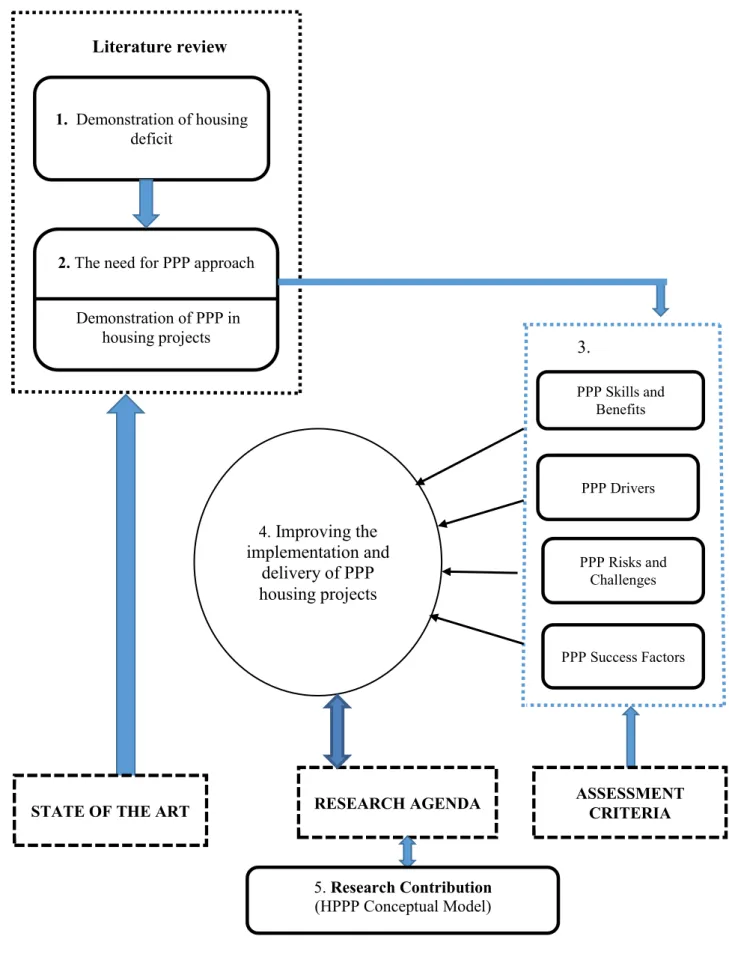
The need for a more adequate amount of housing has created a wide gap between the housing demand and the supply, thus increasing the housing deficit. In this study, a literature review was undertaken to demonstrate the empirical evidence of the existing housing deficit as well as the application of PPPs in housing projects. Key concepts and principles were identified so the best practices across countries could be mapped out. Figure 1.1, Stages 1 and 2 provide the state-of-the-art situation:
What is the current housing situation? What are the prevailing causes? What efforts have been made so far?
What were the outcomes? What is PPP?
What are the existing challenges, barriers, risks and needs for improvement? What are the success factors?
10
Literature review
3.
Figure 1.1: Conceptual Framework
1. Demonstration of housing
deficit
2. The need for PPP approach
Demonstration of PPP in housing projects PPP Skills and Benefits 4. Improving the implementation and delivery of PPP housing projects PPP Drivers PPP Risks and Challenges PPP Success Factors ASSESSMENT CRITERIA RESEARCH AGENDA
STATE OF THE ART
5. Research Contribution
11
Stage 3 identifies the key variables/inputs that are to be used as criteria for assessing the suitability of a PPP in housing projects. Stage 4 is the research agenda in which the assessment is done, with recommendations and conclusions then made for the development of the HPPP framework model which stands out as the research’s main contribution.
1.8 Structure of the Thesis
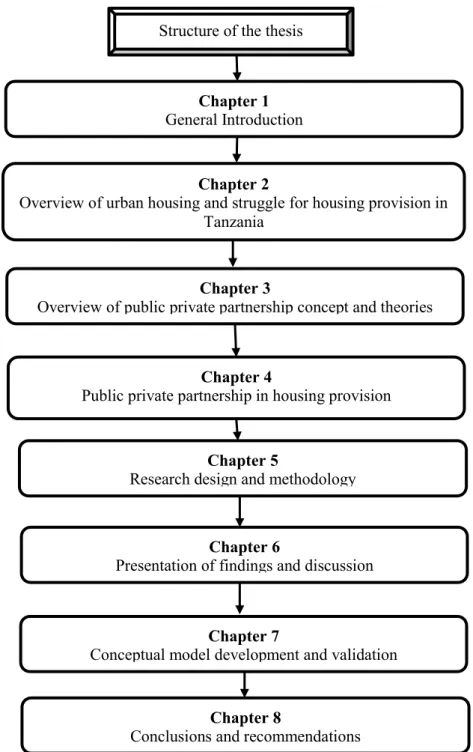
This thesis is structured into eight chapters with Figure 1.2 presenting the structure and order of the chapters. Following is a brief description of the chapters in their chronological order and with each chapter’s content outlined:
1.8.1 Chapter 1
Chapter 1 presents the general introduction to the entire thesis and discusses the rationale for carrying out the study on PPPs within the Tanzanian housing sector. It describes the aims and objectives of the study, the scope of the study and the organisation structure of the thesis. The major purpose of this chapter is to demonstrate a clear link between this study and previous existing research.
1.8.2 Chapter 2
Chapter 2 provides an overview of the Tanzanian housing industry and presents the past and present situation. It begins by describing Tanzania’s population growth and urbanisation, and the focus of the study. The chapter further describes the existing housing stock and the housing provision system, National housing policies, housing affordability, existing housing challenges and government efforts made towards the housing sector are all discussed.
12 1.8.3 Chapter 3
Chapter 3 provides the general impression of PPPs and their application in construction projects. Furthermore, the chapter explains how PPPs emerged.
Figure 1.2: Structure of the thesis
Chapter 1
General Introduction
Chapter 3
Overview of public private partnership concept and theories
Chapter 2
Overview of urban housing and struggle for housing provision in Tanzania
Chapter 4
Public private partnership in housing provision
Chapter 5
Research design and methodology
Chapter 6
Presentation of findings and discussion
Chapter 7
Conceptual model development and validation
Chapter 8
Conclusions and recommendations Structure of the thesis
13 1.8.4 Chapter 4
Chapter 4 presents a discussion of PPPs in delivering housing projects. Significant aspects (challenges, risks, benefits, critical success factors [CSFs], to mention a few) associated with the implementation of HPPP projects are carefully examined.
1.8.5 Chapter 5
Chapter 5 describes the methodology adopted in this research. It outlines the research design and the methodology applied. It further touches on the justification of the selected methodology and study population in order to measure the reliability and validity of the collected data.
1.8.6 Chapter 6
Chapter 6 discusses both the questionnaire and interview findings obtained in Phases 1 and 2 of the data collection. The main focus of this chapter is to achieve Research Objectives 1 to 5 which provide the main criteria for assessing the suitability of PPPs in housing delivery projects in the Tanzanian context. Furthermore, discussions of the research findings are incorporated in this chapter. The study results are examined in relation to the research questions and, more broadly, in relation to the existing literature to judge the study’s contribution to the body of knowledge.
1.8.7 Chapter 7
Chapter 7 addresses the final objective of this study as stated in Section 1.3, that is, it discusses the development of the HPPP conceptual model. Key phases of the proposed model along with its control method are explained into depth. The chapter also presents the empirical validation process and the obtained results.
14 1.8.8 Chapter 8
Chapter 8 concludes the research study, highlighting how the research aims and objectives have been met and presenting the study’s contribution to the body of knowledge. In addition, the chapter presents the study’s limitations and provides recommendations for further research.
1.9 Chapter Summary
This chapter has briefly outlined the general introduction and provided an overview of this doctoral research. It has described the rationale for undertaking the study of PPPs within the Tanzanian housing sector. The aims and objectives of the study have been presented. Moreover, the expected outcomes and scope of the study have been explicitly described. Furthermore, to outline and organise ideas, the notion of a conceptual model was presented. The chapter concluded by outlining the structure of the thesis.
15
CHAPTER 2
OVERVIEW OF URBAN HOUSING AND STRUGGLE FOR HOUSING
PROVISION IN TANZANIA
2.1 Chapter Introduction
This chapter discusses the housing situation in the urban areas in developing countries and Tanzania in particular. Three major issues will be considered and discussed here. Firstly, is how population growth and urbanisation have influenced the supply of housing? Secondly, is what government efforts have been made towards addressing the urban housing issues? Finally, is to identify housing provision systems and the rise of PPP in the housing sector. 2.2 Population Growth and Urbanisation
Challenges concerned directly with housing deficit amongst others include; rapid population growth, urbanisation, inadequate economic growth, inaccessibility to land for housing, poor housing financial facilities, low priorities in housing sector and high cost of industrial building materials (Mosha, 2012). The term Population Growth in this thesis is used to mean an increase in the number of people (either by birth or migration) living in a given locality (URT, 2000). Urbanisation refers to the movement of people from rural areas, (countryside) to urban areas (towns and cities) (URT, 2000). Both urbanisation and population growth are phenomenon experienced by both developed and developing countries as a result of natural increase (birth) and or migration. According to Indongo (2015) both large and small cities in Africa will harbour majority of its population from migration, as it becomes a much more urbanised continent. It is currently projected that, over 40% of Africa’s population lives in the urban and it is estimated that the percentage will further increase to 60% (1.23 billion) by
16
2050 (UN-HABITAT, 2010). Population size is one of the important indicators for economic development as it supplies labour resources for production. However, the same population requires basic needs such as food, shelter, cloth, water and other resources.
In Tanzania, since Independence (1961) the country has experienced a large increase in population, which has strained the available social facilities and services such as housing. According to a study by Wenban-Smith (2015), in 1967 the total population was 12.3million, and by 2012 the population grew to 44.9 million. Similarly, the urban population increased from 5.7% in 1967 to 29.1% in 2012. Looking at the trend the population growth averaged nearly 3% annually while urbanisation grew by 5% annually. This growth has contributed towards inadequate housing for several decades. Likewise, the 2012 census shows that Tanzanian population has tripled since 1967 and is continuing to increase as shown in Table 2.1. Other countries have experienced a similar situation to that of Tanzania. For example, in Brazil, urbanisation was among its biggest challenge that resulted into unequal distribution of land and public investment in urban areas (UN-HABITAT, 2013). Main challenges for Brazil’s poor housing included; high cost of land, high cost of construction, high price of completed houses and extreme levels of poverty (UN-Habitat, 2013). The solutions to the Brazilian housing problem did not only need the provision of new homes but strategically considering the population income level (UN-HABITAT, 2013). This implies that income level should be the main feature to be looked at when designing and building houses for a given community.
17
Table 2.1: Number of persons and national population density in Tanzania 1967 census 1978 census 1988 census 2002 census 2012 census TZ Mainland 11,958,654 17,036,000 22,584,000 33,462,000 43,625,000 TZ Zanzibar 354,111 476,000 641,000 982,000 1,304,000 Tanzania 12,313469 17,512,000 23,225,000 34,444,000 44,929,000 % increase - 42.2 32.6 48.3 30.4 Pop Density (Pop/km2) - 20,000 26,000 39,000 51,000
Source: Tanzania National Bureau of Statistics 1967, 1978, 1988, 2002 and 2012 census
In Tanzania, informal settlement has created the main sector shaping urban growth (Kombe and Kreibich, 2000). For instance, a study by Nnunduma (2009) identified 54 large informal settlements in the city of Dar es Salaam whereby 80% of its housing units are built in unplanned areas.A study by Indongo (2015) presents a similar situation in some other African countries such as Nigeria, where 80% of its urban inhabitants live in slums; in Zambia, the figure is 74%; and in the Sudan, 85.7%. UN-Habitat confirms that the sub-Saharan Africa is the only region where there is no noticeable progress made to improve the slum dwellers’ lives in line with the targets set under the Millennium Development Goal. The provision of sustainable and affordable housing is a widespread problem for all countries in the developing region due to rapid and progressing urbanisation. Tanzania is among the developing countries facing high shortage of adequate housing. The supply of housing is not keeping pace with the growing population. The city of Dar es Salaam specifically is more affected than any other regions in the country due to high urbanisation rate. In this case urbanisation has negatively impacted urban housing for the low-income earners and thus there is a need for large-scale production of affordable housing to cater for the growing population as most migrants are low-income people searching for a better life in the urban areas.
18 2.3 Housing Stock
After independence in 1961, the government of Tanzania initiated Five-Year Development Plan (FYDP). It was estimated in the period of (1964–1969) there was a shortage of 21,000 houses in urban areas (URT, 2000). The shortage grew to 25,000 houses at the end of the 2nd Five Year Development Plan (1969–1974) and reached 300,000 houses in 1982 (URT, 2000). By 2002, urban areas had a deficit of 2.3 million housing units (Nnunduma, 2009). According to recent statistics the current housing shortage is estimated at three million houses compared to a growth rate of 200,000 housing units per annum (NHC, 2010; Urban Solutions, 2012). While the current estimated deficit in Tanzania urban areas is about 1.2 million housing units, 36% are in Dar es Salaam (Urban Solutions, 2012).
Furthermore, it is noted the lack of a point of reference of how the deficit has been calculated can be misleading as it has not yet been established what is the acceptable standard of housing in Tanzania. Many Tanzanians live in houses lacking services for example electricity, water and access roads. The real shortage may even be higher that the identified shortage in the studies by (NHC, 2010; Urban Solutions, 2012).
Additionally, it is further established that a significant housing shortage exists, with this confirmed by overcrowding levels found in urban areas (URT, 2000; Seleki, 2001; URT, 2013). An occupancy rate of more than two people per room creates the state of overcrowding. According to the 2012 population and housing census report, the average household size in Tanzania has remained unchanged between 2002 and 2012 with average occupancy rates recorded to be 4.9 persons per household in 2002 and 4.8 in 2012. The average household size in the city of Dar es Salaam is 4.0 (URT, 2013).
19
In most cases the Tanzanians build their own houses from their own savings slowly over a long period of time, often taking up to 10 years to build two bedrooms of up to 25m2
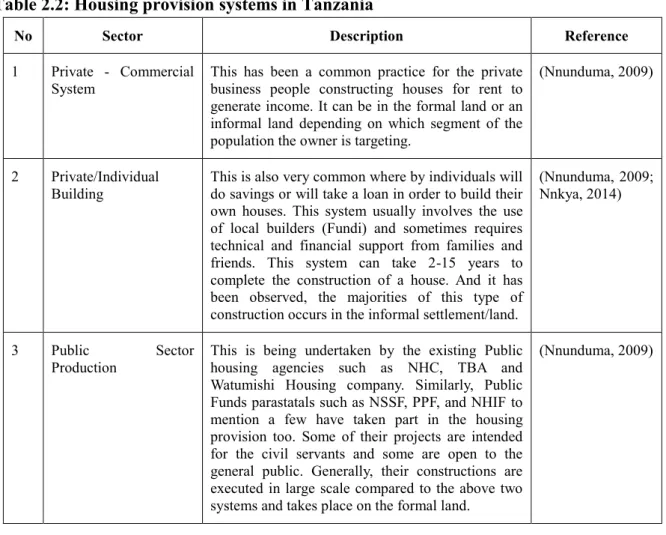
(Nnunduma, 2009). The provision of housing has mostly been dominated by the non-public sector. The most common approaches in housing provision systems in Tanzania are summarised in Table 2.2.
Table 2.2: Housing provision systems in Tanzania
No Sector Description Reference
1 Private - Commercial
System This has been a common practice for the private business people constructing houses for rent to generate income. It can be in the formal land or an informal land depending on which segment of the population the owner is targeting.
(Nnunduma, 2009)
2 Private/Individual
Building This is also very common where by individuals will do savings or will take a loan in order to build their own houses. This system usually involves the use of local builders (Fundi) and sometimes requires technical and financial support from families and friends. This system can take 2-15 years to complete the construction of a house. And it has been observed, the majorities of this type of construction occurs in the informal settlement/land.
(Nnunduma, 2009; Nnkya, 2014)
3 Public Sector
Production This is being undertaken by the existing Public housing agencies such as NHC, TBA and Watumishi Housing company. Similarly, Public Funds parastatals such as NSSF, PPF, and NHIF to mention a few have taken part in the housing provision too. Some of their projects are intended for the civil servants and some are open to the general public. Generally, their constructions are executed in large scale compared to the above two systems and takes place on the formal land.
(Nnunduma, 2009)
In addition, the availability and supply of land has been critical to the development of housing. In many cases land and financial hardships have been a stumbling block towards the supply of adequate housing (Mosha, 2012). Almost 90% of the land in Tanzania is owned by the government but individuals can lease a land up to a maximum period of 99 years and it is renewable (Nnunduma, 2009).
20
Figure 2.1 below provides a more detailed graphical representation model of the housing provision systems prevailing in Tanzania. The Model has been adapted from Keivani and Werna (2001) conceptual model of housing provision in developing countries, with slight changes and adjustment made to portray the Tanzanian case. The model portrays that two main systems exist, namely, the formal and informal systems.
Figure 2.1: Housing provision systems in Tanzania Adapted from Keivani and Werna (2001)
The public sector and some of the private commercial developers targeting the high and the medium income population are found to procure their houses through the formal system. While the informal system is dominated by the low income earners, these are mostly slum dwellers/squatters and private rental housing. It is noted that in the informal, system informal arrangement through local builders, locally known as “Fundi” is the common practice because it is considered the cheapest option.
By comparison the formal system uses quite a number of procurement options such as the traditional methods, joint ventures, PPPs as well as informal arrangement. Here the informal
Housing Provision
Formal Informal
Individual Public
Sector Private Squatters/Individual Rental/Private
Traditional JVs PPP
Local builders
Traditional Informal arrangement (Local builders) Local builders
Traditional JVs
21
arrangement is referred as the casual process of obtaining a local builder usually recommended by friends and family in order to undertake construction works. Such arrangements usually lack formal contracts as well as quality assurance. The informal arrangement and traditional methods will not be discussed further here as they are not the central focus of this study. Instead PPPs will be introduced on the next chapter.
2.4 Government Efforts towards Urban Housing
Having realised the housing issues and its major challenges as presented in the above sections, different efforts were made to address the shortage. All governments worldwide have tried different ways to address the problem of sustainable, adequate and yet affordable housing for the past four decades but the progress is slow and the challenge of housing shortage and informal settlements is still growing especially in the developing countries. This problem is too big for an individual sector to solve it alone, as the overall population requires support to acquire decent housing. This was also affirmed by the previous Tanzania Vice-President (Dr Mohammed Gharib Bilal) while addressing the housing shortage in Tanzania stressing that “housing issues can only be achieved through Public Private Partnership (PPP) and not through the government alone” (TanzaniaInvest, 2012). Following this, a number of strategies have been employed to solve the urban housing problems to date. For example, both the housing agencies and the public pension fund organisations have initiated quite a number of affordable housing projects in the city of Dar es Salaam as well as in other regions. Similarly, public organisations such as the NHC, NSSF and TBA have initiated joint ventures/partnership strategies to address the housing issue. The next section discusses the different models adopted in the supply of housing in the Tanzanian context since the 1950s.
22 2.4.1 Provider Model
This model extended between the 1950s and 1960s where the state/government was the main provider. A number of public institutions were established including the National Housing Corporation (NHC) in 1962 with the responsibility of constructing and managing urban housing. NHC planned to build 10,000 housing units in five years from 1969-1974 however it managed to achieve its goal only by 50%. Later in 1976 -1981 it had another plan of building 7,500 units but only around 200 housing units were achieved (Mushumbusi, 2011). Such a poor performance was caused by financial difficulties, as well as poor construction skills/knowledge. The building of these properties depended largely on external financial sources and little from internal sources (Mushumbusi, 2011).
Additionally, NHC could not operate by itself because of the 1962 Rent Restriction Act, which prevented both the public and private sectors in Tanzania from making any rent increase. The Act had negative impact because developers were discouraged from investing more in the housing sector and thus it distorted the housing market (Kaitilla, 1990). In 1962 again another strategy known as Revolving Housing Loan Fund for workers (civil servants) was put in place to provide financial support. This was the first housing loan scheme introduced by the government after independence, when they realised that number of their civil servants was growing while the housing conditions and actual number of units remained the same (Kironde et al., 2003). Later in 1972 loan scheme was ended and was transferred to Tanzania Housing Bank (THB), which failed in 1995. Among reasons for its collapse were;
High interest rates imposed on the loans while most civil servants were low income Few civil servants qualified to secure the loans due to inadequate capacity
23
According to Kironde et al. (2003), the awareness of these challenges, led the government to re-stablish the Revolving Housing Loan Fund for civil servants but with slightly different features including:
Beneficiaries included, were permanent and pensionable civil servants working in the central government.
One could only provide the property to be constructed as a collateral
At the start funds depended on support from the treasury, the scheme should work to fund both urban and rural housing all over the country and it should serve around 500 applicants yearly.
However, these features were still biased because the above financial scheme did not address all the social groups in the society. Instead, the low income segment of the workers who needed even more help were not included in, as it only cared for those working with the central government. Consequently, even with these efforts housing development remained a huge issue since the low income people in the urban areas were neglected and this led them to build houses from their own savings causing a major rise of the informal settlements/slums. As a result, majority of these houses in the informal sector as well as some of those in the formal sector were occupied before completion and so had poor infrastructure such as lack of power, water and or sewage system.
Generally, the Provider Model failed to address the housing challenge because of the financial difficulties and poor construction skills.
2.4.2 Enabling Strategy Model
This came to existence in 1970s when the state gradually shifted from being the sole provider. The idea behind this was to involve the community in housing development. According to
24
UN-HABITAT (1988), the enabling strategy was among the main principle towards reaching the goal of providing adequate housing for all by the year 2000. The efforts to facilitate the
implementation of the Global Strategy for Shelter in Tanzania can be mapped out in two schemes; “Sites and services scheme” and the “upgrading model”, which lasted between 1974 and 1981 (Lugalla, 1995). The sites and services scheme intended to provide some plots to people and encourage them to form cooperatives to build their own houses (Lugalla, 1995). However, it was identified that the scheme was never successful to meeting its objective because it had set too high standards, which were not affordable, by the poor (Kironde, 1991). The failure reasons of the Sites and services scheme as provided by Kironde, (1991. p 29) included:
The use of outdated building regulations which could not be met by low income households,
Shortage of building materials, Failure of the self-help approach and
Difficult conditions attached to obtaining finance from the THB.
Similarly, according to Mushumbusi, (2011) the second scheme, (upgrading model) intended to improve the squatter settlement, because the government realised the need to do it. Therefore through this strategy, the government provided local resources and physical intervention in planning based on incremental development, using self-help (Mushumbusi 2011, p. 33).
On the other hand, the enabling approach have been adopted not only in Tanzania but also by many governments around the world; some were more successful than others, and thus it continued to be the prevailing model recommended internationally (Hassan, 2011). The philosophy of the enabling approach had a broader context of addressing not only the housing
25
projects but also the housing system. Therefore, it was not the duty of the state to provide housing but to provide the enabling environment to enable other actors deliver effectively (Hassan, 2011).
2.4.3 Governance Model
Mushumbusi (2011) argued that the governance model is an extended version of the enabling model. Jenkins (2004) further stated that the governance model was a universal method aimed at boosting the sub-national level development as an alternative of the large-scale nationally dominated development strategies of the 1960s and 1970s. Therefore the UN and UNDP introduced the idea of Environmental Planning and Management (EPM) under the Sustainable Cities Programme (SCP) where, Tanzania was among the nominated countries to test the concept which was fully sponsored by the World Bank and UNDP (Kombe and Kreibich, 2000). ‘Sustainable Dar es Salaam Project’ (SDP) was the name given for the pilot programme in the city of Dar es Salaam 1992 (Mushumbusi, 2011). The goal of SCP was to support cities to attain more environmentally sustainable growth and development through capacity building to local authorities (Nnkya, 2005). However SCP was introduced at the time when Tanzania was experiencing its major political transformation. The government was moving from mono party system to multi-party system in 1992. Similarly in the mid-1980s, Tanzania had started to shift from command economy to market oriented economy and reached its peak in 1990 (Nnkya, 2005). Meaning that the government was withdrawing itself from providing services directly to the public, instead leaving it to the community and private sector while assuming the facilitating role.Therefore sustainable development was the major concern of the whole approach and it managed to make awareness on the environmental issues but it could not make adequate contribution towards urban housing because donor communities had their own priority focus (Kombe and Kreibich, 2000).
26 2.4.4 Joint Venture (PPP) Model
According to Kogut (1988), a joint venture (JV) is formed when two or more organisations share their resources within a common legal organisation aiming to achieve mutual goals. Similarly, Comino et al. (2007) while comparing JVs to contractual agreements, illustrated that JVs can be more appropriate when needing to transfer resources and knowledge. In addition, based on Akbiyikli and Eaton (2005), JV is a partnership in which a Public Authority may not take over 50% of the capital funding. Whereas, PPPs are collaborations between Public and Private Entity aiming to share resources and risks in order to achieve the agreed objective. For PPPs two different entities in this case public and private must collaborate while in JVs it’s not necessarily the case, parties could be private-private, public-public or one of each. Therefore not all joint ventures are PPPs unless the key features as explained in subsection 3.2.1 on Page 32 are achieved.
The deterioration of the existing public properties and failures in the above models to address the housing shortage, made NHC (a public organisation) decide to adopt the public private partnership in the form of joint ventures (JVs). The joint venture model (JVM) in real estate projects was NHC strategy for developing properties, particularly the condemned ones, where it partnered with private investors (Maagi, 2010). The NHC joint ventures (JVs) involve the public and private sectors in which they pool their assets, finance and expertise under joint management. The venture partners contribute in their resources in terms of capital, skills and or technology in order to undertake the project. The NHC JVM is represented by two distinct periods:
1) Before the Repeal of the 1971 Acquisition Act (1980–1990) 2) After the Repeal of the 1971 Acquisition Act (1990–to date)
27
During the first period (1980–1990), the defunct Registrar of Buildings (RoB) had planned a joint venture (JV) strategy with the aim of redeveloping its plots hosting condemned buildings and those buildings which are no longer in conformity with the best land uses in Mainland Tanzania’s urban centres, predominantly in the city of Dar es Salaam (NHC, 2006). The purpose of the strategy was to rescue their condemned properties, uplift their values and revenue. A number projects were initiated or undertaken however, they was no clear policy to guide the JV undertakings (Kavishe, 2010). Terms and conditions for these ventures varied from one project to another depending on the magnitude and cost of individual project. To a greater extent, they were governed by trust between partners (NHC, 2006).
The second period of (1990 –to date) existed after the Repeal of the 1971 acquisition Act and the enactment of the NHC Act No. 2 of 1990. During this period, investors gained confidence in economic liberalisation and therefore there was an increasing pressure from private investors seeking to invest in commercial and residential property with the NHC. In that regard, the influx of private investors awakened the need to have a JV policy. Therefore, the NHC Board of Directors approved the first version of the JV Policy on 11 June 1993. Later, in 2004, a second version was approved followed by the third version, which was approved in 2006. Similarly, in 1992, the government issued Circular No. 1, which required public parastatals to operate commercially (NHC, 2006). Consequently, no further subsidy was given to the Corporation. Therefore, NHC adopted partnership projects as a means of redeveloping its estates as well as a means of developing more properties. The corporation had prime plots, which were hosting condemned buildings. Fear of losing some plots, which were declared by the Ministry of Lands ripe for redevelopment, influenced NHC to secure financial support from private investors through the JV model.
28
Likewise, the increasing shortage of housing in the urban centres, made the government seek alternative means of addressing this issue and PPP strategy has been thought to help bring relief to the existing situation (NHC, 2010; Kidata, 2013). Therefore, the government redirected its housing agencies to adopt PPP strategy (NHC, 2010).
However, despite the adoption of PPP strategy in house provision, inadequate housing has not yet been resolved to date. Instead more failures are experienced in these housing PPP (HPPP) projects. This presents the reason why this study was undertaken, that is, to improve the implementation and delivery of PPP housing projects in Tanzania.
2.5 Chapter Summary
This chapter addressed the following issues: firstly, it justified in detail the existence of the research problem by explaining the impact of population growth and urbanisation towards housing shortage and the rise of informal settlement. Secondly, the need for more housing supply is clearly pin pointed to highlight its implication towards the existing housing stock, which proved that there is severe housing shortage. The third section investigated the efforts made by the government towards urban housing where five models were identified to describe the initiative made alongside their corresponding challenges. Despite the identified efforts, it was revealed through literature review that none of the five models were able to address the housing deficit. Hence the gap between the supply and demand was advancing. Finally, the fourth section introduced briefly the adoption of PPP in the housing sector. The next chapter will further review in detail the PPP concept.