University of New Haven
Digital Commons @ New Haven
Engineering and Applied Science Education Faculty
Publications
Engineering and Applied Science Education
6-2019
Assessing an Online Engineering Ethics Module
from Experiential Learning Perspective
Gokhan Egilmez
University of New Haven, [email protected]
Philip Viscomi
Business Growth AdvisorsMaria-Isabel Carnasciali
University of New Haven, [email protected]
Follow this and additional works at:
https://digitalcommons.newhaven.edu/sgiengineering-facpubs
Part of the
Engineering Education Commons
, and the
Operations Research, Systems
Engineering and Industrial Engineering Commons
Comments
ASEE holds the copyright on this document. It may be read by the public free of charge. Authors may archive their work on personal websites or in institutional repositories with the following citation: © 2019 American Society for Engineering Education. Other scholars may excerpt or quote from these materials with the same citation. When excerpting or quoting from Conference Proceedings, authors should, in addition to noting the ASEE copyright, list all the original authors and their institutions and name the host city of the conference.
Publisher Citation
Egilmez, G., & Viscomi, P. A., & Carnasciali, M. (2019, June), Assessing an Online Engineering Ethics Module from Experiential Learning Perspective Paper presented at 2019 ASEE Annual Conference & Exposition , Tampa, Florida. https://peer.asee.org/32110
Paper ID #26205
Assessing an Online Engineering Ethics Module from Experiential Learning
Perspective
Dr. Gokhan Egilmez, University of New Haven
Gokhan Egilmez is an assistant professor in the Industrial and Systems Engineering program at University of New Haven. He previously worked as assistant professor of Industrial and Manufacturing Engineering at North Dakota State University and postdoctoral research associate in the department of Civil, Environ-mental and Construction Engineering at University of Central Florida. Gokhan has Ph.D. in Mechanical and Systems Engineering, M.S. degrees in Industrial & Systems Engineering, and Civil Engineering from Ohio University, and B.S. in Industrial Engineering from Istanbul Technical University, Turkey. His re-search interests cover a variety of topics that include engineering education, applied optimization and simulation modeling, social, economic and environmental life cycle assessment, data analytics, energy and sustainability, input-output analysis, transportation sustainability and safety. Gokhan has over 50 peer-reviewed publications in prestigious academic journals, books, and conference proceedings related to sustainable development, life cycle assessment, manufacturing system design and control, supply chain management, transportation safety assessment, and predictive modeling & machine learning. For more information, please visit his personal blog at https://gokhanegilmez.wordpress.com/ and research group page at www.asoslab.com
Mr. Phillip A. Viscomi, University of New Haven
Mr. Viscomi is a technology industry veteran with 25+ years’ experience who has formed, led, grown, and returned value to investors in emerging, mid-size, and Fortune 50 corporations. His record of ac-complishment includes successfully launching four technology companies, multi-billion dollar growth of major global programs, and advising multiple expansion stage technology companies. Viscomi lectures in entrepreneurship, intrapreneurship, and engineering ethics. He published several Kearn Foundation eLearning modules on entrepreneurship-related subjects.
Dr. Maria-Isabel Carnasciali, University of New Haven
Maria-Isabel Carnasciali is Chair of the Engineering and Applied Science Education Department at the Tagliatela College of Engineering, University of New Haven, CT. She is also an Associate Professor of Mechanical Engineering in the Department of Mechanical & Industrial Engineering. She obtained her Ph.D. in Mechanical Engineering from Georgia Tech. She received her Bachelors of Engineering from MIT. Her research focuses on the nontraditional engineering student – understanding their motivations, identity development, and impact of prior engineering-related experiences. Her work dwells into learning in informal settings such as summer camps, military experiences, and extra-curricular activities. Other research interests involve validation of CFD models for aerospace and industrial applications as well as optimizing efficiency of thermal-fluid systems.
c
Assessing an Online Engineering Ethics Teaching Module from Experiential
Learning Perspective
Abstract
Today, engineers play a crucial role in the direction of technology, research, social wellbeing, and economic
growth, thus the lives of people. An engineer’s professional responsibility for complying with ethical
standards and conduct is essential to the needs and requirements of individuals, organizations, and the society. Educating the future engineering workforce and establishing effective and timely policies that
ensure engineering professional’s compliance with requirements are two important pillars of sustaining the ethical knowledge and practice in engineering profession. In this study, the researchers focused on investigating the learning effectiveness of an online ethics module developed for and implemented in a senior year Engineering Ethics Seminar course. The module consisted of three pillars: code of ethics, case studies, and methods for applying ethical reasoning. Each pillar requires the student to take a quiz consisting of 4 to 7 questions, and a final 10 question quiz at completion of the module. In-class activities and assignments complement the module. The research team conducted a two-semester assessment on learning effectiveness of the online ethics module with a sample of 41 engineering students from well-represented diverse majors, self-identification and racial/ethnic backgrounds compared to the enrollment population.
Results indicate that the proposed online module positively impacted the students’ proficiency in
knowledge of ethics and ethical reasoning in terms of students’ perception of improved confidence and the
instructor’s assessment. The same interpretation was reached by the instructor’s assessment as well. The team did not identify any correlation between the students’ answers to the survey questions and their final
grades, which indicates that the students’ positive response on their learning experience was found to be independent of their letter grade.
Key Words: ethics education, engineering ethics, online learning, survey, correlation
Introduction
Ethics is defined as the “science of morals” or the “study of morals”, which dates back to the famous work of Aristotle, “Nicomachean Ethics”[1]. Oxford defines the term as “Moral principles that govern a person's behavior or the conducting of an activity.” [2]. While its etymology addresses the field of study and the modern definition targets the individual, ethics is of the up-most importance for the individual, as well as the organization that the individual works for, and for the community/society that individual belongs to professionally, and/or voluntarily. Therefore, ethical conduct and practice is a traditional cornerstone of education and the professional conduct and development of workforce in all industries.
Today, engineers play a crucial role in the development of the direction of technology, research, economic growth and thereby impact on the safety, wellbeing, and lives of people. Engineers make decisions or are involved in the decision-making and operational processes of business, government, and/or non-profit organizations at various levels (strategic, tactical, and operational). Since engineers’ design and make solutions available to use for dealing with the societies’ complex problems, the direct and ripple effects of
these decision-making processes are always high and at stake. Thus, an engineer’s responsibility on living
up to the ethical standards and conduct have extensive risk. In this regard, educating the future engineering workforce (educational policy making) and establishing effective up-to-date policy making in the operational aspects of engineering profession (professional policy making) are two important pillars of sustaining the knowledge and practice of ethics in engineering profession.
Regarding the professional policy making, US National Society of Professional Engineers (NSPE) establishes the code(s) of ethicsfor professional engineering guidance and compliance [3]. NSPE requires engineers to perform under a standard of professional behavior that requires adherence to the highest principles of ethical conduct. The ethical standards (code(s) of ethics consists of three sections, which expresses the policy related to: 1) Fundamental Canons, 2) Rules of Practice, and 3) Professional Obligations [4]. The NSPE Board of Ethical Review develops and publishes a substantial list of case studies case description, a questions, answers, and critical analysis.
Universities, instructors, and the ABET formulate the body of ethical knowledge, reasoning, and conduct intended for post-academic use in resolution of complex professional and social engineering challenges. ABET addressed the ethics education in the student outcomes as follows [5]:
“an ability to recognize ethical and professional responsibilities in engineering situations and make informed judgments, which must consider the impact of engineering solutions in global, economic,
environmental, and societal contexts”
Student outcome clearly requires the engineering student to consider a comprehensive list of constraints, which includes ethical, social, economic, and environmental constraints, when building our common future. Overall, ABET requires instructors develop engineering education strategies, methods, and pedagogies that
result in the engineering workforce’s ability to actively employ ethical reasoning, consistently apply ethical
standards, and propose best-in-class solutions to ethical dilemmas they encounter in their professional career.
Literature Review
Engineering ethics education is more than a requirement in this era since the engineering workforce embodies multi-disciplinary, multi-national project and multi-culturally diverse teams. Today, most of the products and services that affect our lives arise from sophisticated processes utilizing engineering design, complex problem solving, and teamwork. In this context, engineers make, or are involved in, many decision-making situations where effective engineering ethics education is essential in the direct and ripple-effects of their decision process. According to a recent study, more than half of the colleges (59%) in the U.S. where engineering is taught were found to have adopted educational goals related to ethical reasoning [6].
In terms of ethical development, which is the total process of teaching the knowledge of ethics, reasoning, and behavioral aspects of engineering ethics; Finelli et al. (2012) conceptually formulized the ethical
development as the combination of “the knowledge of ethics”, “ethical reasoning”, and “ethical behavior”
(Fidelli et al., 2012).
The knowledge of ethics is taught to ensure that engineering students develop a clear understanding about the professional ethics codes [4], which encompasses the code of conduct related to micro-ethical education [7]. In addition to teaching knowledge of engineering ethics, FE examination tests students’ knowledge to
close the loop. However, this process is deficient because only 4-5 questions are typically asked students about ethics out of 110, which is quite a small portion given the importance of ethics on products, designs, decisions that we make, and at large to society, economy, the environment, and our common future. Another important concern is the fact that most students do not perform sufficient enough in ethics part of FE exam even though a long list of educational methods are implemented and assessed [8]. Finelli et al (2012) raise the question as to whether the FE exam itself can provide the required level of understanding about ethical development and sustainable positive behavioral change (Finelli et al., 2012).
Ethical reasoning is the critical reasoning applied to ethical issues and dilemmas [9]. It is the process of creating an ethical argument, which consists of the supporting ethical and non-ethical premises and conclusion [10], which is expected to hold 4C standards (clarity, coherence, consistency, and completeness).
Ethical behavior is the resulting behavioral action(s) which are intended to be positively in-line with a sound ethical reasoning process, which is also indicated in the findings of the Finelli et al. (2012) and the follow-up work, summarized in section 7 of SEED project (Sutkus et al., 2008). In fact, educational psychologists and other social scientists clearly argue that only rule-based ethical reasoning education will not create effective and sustainable ethical behavior in the upcoming engineering workforce.
The list of Engineering Ethics Education (EEE) methods and techniques are summarized as follows [12] [13] [8] (Balakrishnan et al., 2018):
1. Ethics across the curriculum 2. Professional code of ethics 3. Humanist readings
4. Ethical-problem solving, problem-based learning [14] 5. Groundings in theoretical ethics
6. Case studies, short abstracts, vignettes [15] 7. Debate
8. Role-playing 9. Service learning 10. Science fiction stories 11. Standalone courses
A recent systematic review on EEE works between 2000 and 2015 [16] found out the educational pedagogies and their application percentages.
1- Codes or rules (85%) 2- Case study exposure (81%) 3- Discussion or debate (77%)
4- Individual written assignments (54%) 5- Ethical tools, processes, or heuristics (46%) 6- Philosophical ethics (42%)
7- Team project/position paper (38%) 8- Presentation Peer mentoring (27%) 9- Developing heuristics (12%) 10-Developing a case study (12%) 11-Micro-insertion (8%)
12-Real-world exposure (8%) 13-Community engagement (8%) 14-Developing code of ethics (8%) 15-Game (8%)
Even with the abundant proposed new educational methods there remains a need to innovate educational strategies and methods which contribute to educating the future engineering workforce in engineering ethics applicable to economic, social, and environmental sustainability and sustainable development of humanity. The closest work in the literature,, Hess et al., (2016), focused on comparing online vs. hybrid delivery methods with a fairly good sample size and found no significant difference between the methods and also
both methods were found to be increasing the ethical reasoning significantly. Towards this effort, the pilot Institution developed a fully online learning module focused on ethics for engineering students. This paper presents the assessment of this module as an EEE method.
Methods
The University of New Haven an online ethics module. Data was collected from a group of 41 students who participated in the deployment during Fall 2018 and Spring 2019. The organization of the following sections includes an initial review of research objectives, a description of the online ethics module, and finally, presentation of study data collection methods.
Research Objectives
Assessing the learning effectiveness of the online ethics module in Ethics Seminar course by assessing the impact of the integrated e-learning module on:
1. knowledge of code(s) of ethics
2. using code(s) of ethics for ethical reasoning 3. conducting ethical reasoning
4. FE exam ethics section preparedness 5. ethical behavioral growth
Online Ethics Module
The University of New Haven developed a series of 18 online learning modules as part of their effort to develop the entrepreneurial mindset of their engineering and computer science students [18]. The university’s plan is to integrate the modules into core engineering, and applied science courses and does not plan to use the modules outside off core classes. Content experts developed the modules with an online education specialist. Core classes emphasize online content learning objectives, and module exercises to
integrate the module within the class’s syllabus. One of the modules developed was the Resolving Difficult Ethical Issues e-Learning Module [19]. At the University, all 4th-year senior seminar course engineering
and computer science majors study the module as part of the seminar syllabus. Other work related to the assessment of the use of the e-learning modules has focused on contributions to the development of
students’ entrepreneurial mindset. The work presented here focuses on the effectiveness of the module to the topic within the engineering ethics domain. The online module’s learning objectives were formed as sequentially [19]. The module asks students to respond to a basic ethics self-evaluation, in a private student note book, by self-assessing their position on engineering ethics on a graduated scale. The student repeats the assessment at the end of the module. The assessment includes:
1- Assess, and later reassess, your position on an ethics scale 2- Define “ethics” in the context of “professional settings”
3- Explain why ethical behavior and the trust it engenders are essential for all engineers especially entrepreneurial engineers
4- Analyze ethical dilemma case studies and explain who resolved them and how 5- Apply three methods for resolving ethical dilemmas
6- .
The module consists of 3 lessons: 1) The meaning of Ethics, 2) Case Studies, and 3) Methods for Resolving Ethical Dilemmas.
In the first lesson’s reading materials cover the definition of ethics, trust, ethical behavior and teamwork, the life cycle of ethical behavior subjects. Lesson one concludes with a short self-assessment containing 7 multiple choice questions. The questions are for student self-assessment; instructors to not see assessment scores.
Lesson two consists of Citicorp Center and the General Motors Ignition Switch case studies, which also ends with a short self-assessment, which consists of 7 multiple choice questions.
Lesson three consists of Code(s) of ethics, nine-step systematic process [20], and moral imagination subjects which also ends with lesson 3 self-assessment. In the end, student takes the final challenge assignment, which consists of multiple choice 10 questions. In addition to the 3 self-assessment and one final challenge quiz-type assessments, the students complete two reflection essay papers in the 9th an 10th
weeks of the semester.
Research Survey and Data collection
The students in the 4th year seminar were asked to complete the online module in the 9th week of the course
during fall 2018 term and the survey was administered in the last week (Week 10). The online module was integrated as a take-home assignment, where students were able to complete the online ethics module on
Blackboard (the University’s Learning Management System). A survey consisting of 10 sections with 18
questions was given to the students; the survey is included in the Appendix. The survey was deployed to 2
sections, namely: in fall 2018 and spring 2019. The survey was approved by the Institution’s human subject
review board prior to the research study.
Results
The study group identified result categories. The first category details demographics including student major, ethnicity/race, and self-identification in pie chart distributions. A total of 19 student took the survey at the end of fall 2018 semester and 22 students took in spring 2019 semester. The second category recaps total student time required to complete the online module. The third category presents students’ self -reported evaluation on the effectiveness of the online module and their opinion on achievement of module learning outcomes. The fourth category contains self-assessment of student self-confidence and broad-level understanding of ethics and engineering ethics subjects. The fifth category summarizes the results regarding overall student experience with the online ethics module.
Demographics Analysis
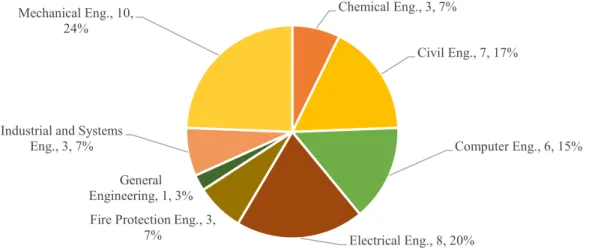
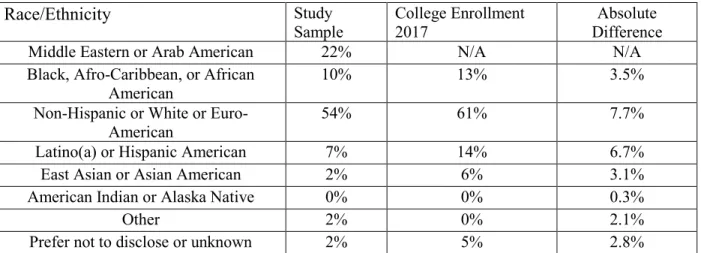
Figures 1, 2, and 3 contain survey participant demographics. Figure 1 indicates the demographics by major, figure 2 depicts the race and ethnic distribution, and figure 3 illustrates the distribution of self-identification. Comparison seminar class and College of Engineering major, ethnicity, race, and self-identification demographics show a high correlation of the study sample with the college.
According to the Figure 1, the largest chunk was mechanical engineering majors with 24% share, followed by civil and computer engineering majors with 15% and 17% shares. It is important to note that, in this sample, all majors are unequal, and the Table X compares college enrollment and student sample diversity. The study sample represents the college.
According to Figure 2, about half (54%) of the participants who took the survey were Non-Hispanic, White, and Euro-American. The breakdown of the rest of the ethnicity/race distribution was 22% Middle Eastern or Arab-American, 10% Black, Afro-Caribbean, or African-American, and 10% East-Asian or Asian-American, and Latino or Hispanic American.
Lastly, figure 3 depicts the self-identification distribution. The pie chart indicates that the female participants at 20% (Figure 3). This result is unfortunately in parallel with the female students’ low
representation in engineering and STEM majors. In a recent study, it was stated that “although women fill close to half of all jobs in the U.S. economy, they hold less than 25 percent of STEM jobs.”[21].
Figure 1. Distribution of the engineering majors (Major, Number of Students, Percentage)
Figure 2. Distribution of the race/ethnicity
Figure 3. Distribution of the self-identification (Female: 8, Male: 32)
Chemical Eng., 3, 7%
Civil Eng., 7, 17%
Computer Eng., 6, 15%
Electrical Eng., 8, 20% Fire Protection Eng., 3,
7% General Engineering, 1, 3% Industrial and Systems
Eng., 3, 7% Mechanical Eng., 10,
24%
Middle Eastern or Arab American 22% Black, Afro-Caribbean, or African American 10% Non-Hispanic or White or Euro-American 54% Latino(a) or Hispanic American 7% East Asian or Asian
American 3% American Indian or Alaska Native 0% Other 2%
Prefer not to disclose or unknown
2%
Female, 20.0%
Comparison of the study sample with the college of engineering enrollment:
The results of comparison indicate that up to 5% difference was found between the study sample and college enrollment in 2017 in terms of major distribution as shown in Table 1.
Table 1. Comparison by Major
Major Study Sample College Enrollment 2017 Absolute Difference Chemical Eng. 7.3% 11.6% 4.3% Civil Eng. 17.1% 15.3% 1.7%
Computer and Electrical Eng. 34.1% 37.7% 3.5%
Fire Protection Eng. 7.3% N/A N/A
General Engineering 2.4% 5.1% 2.6%
Mechanical and Industrial & Systems Eng.
31.7% 28.7% 3.0%
In terms of race and ethnicity (Table 2) and self-identification, no major difference was found between the study sample and college enrollment data, which indicates that the study sample represented the college of engineering students fairly well.
Table 2. Comparison by Race and Ethnicity
Race/Ethnicity
Study Sample College Enrollment 2017 Absolute DifferenceMiddle Eastern or Arab American 22% N/A N/A
Black, Afro-Caribbean, or African American
10% 13% 3.5%
Non-Hispanic or White or Euro-American
54% 61% 7.7%
Latino(a) or Hispanic American 7% 14% 6.7%
East Asian or Asian American 2% 6% 3.1%
American Indian or Alaska Native 0% 0% 0.3%
Other 2% 0% 2.1%
Prefer not to disclose or unknown 2% 5% 2.8%
Table 3. Comparison by Self-Identification
Self-Identification
StudySample
College Enrollment 2017 Absolute Difference
Female 20.0% 15.3% 4.7%
Male 80.0% 84.7% 4.7%
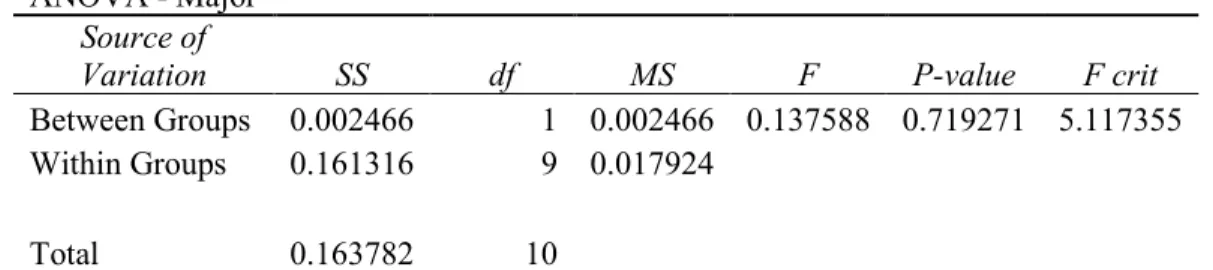
The comparison was also made statistically by using ANOVA tests. Table 4 depicts that all p-values are greater than 0.05. This also proves that there is no statistical difference between the study sample and the college enrollment in engineering major, race and ethnicity, and self-identification categories.
Table 4. Comparison of Study Sample vs. 2017 College Enrollment ANOVA - Major
Source of
Variation SS df MS F P-value F crit
Between Groups 0.002466 1 0.002466 0.137588 0.719271 5.117355 Within Groups 0.161316 9 0.017924
Total 0.163782 10
ANOVA - Race & Ethnicity
Source of
Variation SS df MS F P-value F crit
Between Groups 0.00119 1 0.00119 0.0307 0.86361 4.667193 Within Groups 0.504105 13 0.038777
Total 0.505296 14
ANOVA - Self-Identification
Source of
Variation SS df MS F P-value F crit
Between Groups 82082.25 1 82082.25 1.81196 0.310554 18.51282 Within Groups 90600.5 2 45300.25
Total 172682.8 3
Analysis of the time spent on completing the module
Table 5 contains results of the survey related to the completion time. Mean completion time measurement is 2.6 hours, with a median of 2 hours, minimum 0.5 hour and maximum 8 hours. There was no scale provided to students in this question, therefore they were free to enter any amount of time in hours. The standard deviation of the completion time is 1.55 hours. The shorter time of completion clearly indicates that the depth of content, the complexity, and the level of difficulty in the assessments would benefit from additional analysis.
Table 5. Completion Time of the Online Module
Section 4
Average N Median Minimum Maximum Std. Dev.Hours Spent 2.60 41 2.00 0.50 8.00 1.55
Assessment on the learning outcomes of the online module
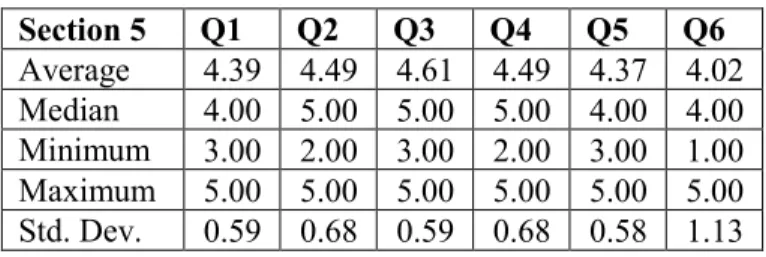
In this section of the survey, students were asked their confidence in assessing their position on an ethics scale (Q1); defining the ethics in the context of professional settings (Q2); explaining why ethical behavior and the trust it engenders are essential for all engineers especially entrepreneurial engineers (Q3); analyzing the ethical dilemma case studies (Q4); and explaining how ethical dilemma case studies are resolved (Q5);
and applying three methods for resolving ethical dilemmas (Q6). It is evident that the students reported remarkably an elevated level of confidence about reaching the learning outcomes with the online module as all learning outcomes received 4 out of 5 points in this category. The third question has the highest level of confidence demonstrating broad agreement about why ethical behavior and trust it engenders are essential for all engineers, especially for entrepreneurial engineers. The average level of confidence results shown in table 6 consistently indicate that students self-assess as having achieved online module learning outcomes.
Table 6. Descriptive Statistics of Section-5 Results
Section 5 Q1 Q2 Q3 Q4 Q5 Q6 Average 4.39 4.49 4.61 4.49 4.37 4.02 Median 4.00 5.00 5.00 5.00 4.00 4.00 Minimum 3.00 2.00 3.00 2.00 3.00 1.00 Maximum 5.00 5.00 5.00 5.00 5.00 5.00 Std. Dev. 0.59 0.68 0.59 0.68 0.58 1.13
Confidence Level on the Knowledge of Ethics
In this section of the survey, students assessed their confidence in being able to demonstrate ability in several categories. These are: Q7 - knowledge in professional code(s) of ethics; Q8- ability to use code(s) of ethics in an ethically challenging situation, Q9- ability to conduct scientific ethical reasoning, Q10 - behavioral conduct in dealing with ethically challenging situations, Q11- ethical conduct in assessing the impact of ethical issue(s) on society and community, Q12. The online ethics module enhanced my ethical conduct in assessing the impact of ethical issue(s) on the environmental, Q13- being ready to solve FE exam questions related to code(s) of ethics, and ethical reasoning, and Q14-being ready to face ethical issues in professional work environment. The survey results indicate a strong level of confidence in all categories as shown in Table 7.
Table 7. Descriptive Statistics of Section-6 Results
Section 6 Q7 Q8 Q9 Q10 Q11 Q12 Q13 Q14 Average 4.10 4.08 4.05 4.00 4.03 4.05 3.88 4.20 Median 4.00 4.00 4.00 4.00 4.00 4.00 3.50 4.00 Minimum 1.00 2.00 1.00 1.00 1.00 1.00 1.00 1.00 Maximum 5.00 5.00 5.00 5.00 5.00 5.00 5.00 5.00 Std. Dev. 0.90 0.86 0.88 0.93 0.86 1.08 1.20 0.99
Students indicate their highest level of confidence is readiness to face ethical issues in professional work environment (Q14), which is consistent with the learning messages of the impact of 3 industry case studies covered in the online module. The lowest confidence, 3.88, relates to proficiency and preparedness for the FE exam questions. The online module does not directly challenge students with quiz questions like FE exam, the quiz questions were prepared to have students demonstrate their knowledge and critical thinking ability about the content delivered in the 3 lessons. Students found most of the assessment areas were satisfactory.
Overall experience with the online module
The study collected the students’ perceptions of their overall experience with the online ethics module. The
questions focused on the student’s perception of experience in 4 categories, namely:
• Q15-the online ethics module overall positively impacted my interest in professional code of ethics, • Q16- the online ethics module positively contributes to the course,
• Q17- the online ethics module positively contributes to the curriculum of my engineering major; and,
• Q18- overall, I enjoyed completing online ethics module.
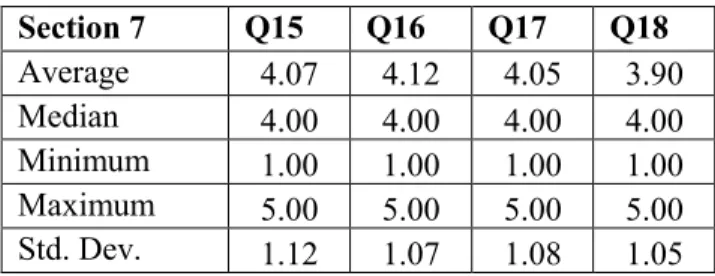
The average response results, shown in Table 8, indicate that vast majority of the students either agree or strongly agree with the four statements with scores ranging between 3.90 and 4.12. The median values of all questions are 4 (Agree).
Table 8. Descriptive Statistics
Section 7 Q15 Q16 Q17 Q18 Average 4.07 4.12 4.05 3.90 Median 4.00 4.00 4.00 4.00 Minimum 1.00 1.00 1.00 1.00 Maximum 5.00 5.00 5.00 5.00 Std. Dev. 1.12 1.07 1.08 1.05 Instructor’s Assessment
This section depicts the results of instructor’s assessment with the reflective essay 1, reflective essay 2 (final exam), and online module final challenge assignments completed in fall 2018. The objectives of the reflective essays were to assess students’ acceptance and obligation to ethical engineering behavior,
evaluate overall knowledge of the Codes, and to observe practical application of ethics resolution techniques to a simulated real-world problem. The instructor organized the final essay exam into two parts as out of class essay assignments, each part receiving a separate grade.
The first essay assignment (reflective essay 1) was to answer the question “Why are ethical behavior and the trust it engenders essential for all engineers?” Student responses consistently demonstrated students understood the meaning and value of the Codes as judged by the instructor. In their essay responses, the instructor observed that students frequently cited examples from the learning module.
The second assignment (reflective essay 1) asked students to reflect on questions as if they were a newly assigned member of the shuttle Columbia inflight damage assessment team and if they would be more aggressive in resolving ethical issues than the actual team. Specifically:
Congratulations (or regrets) on your assignment to the Columbia DAT (Debris Assessment Team) on day-6 of the planned 16-day mission. There are ten days left before reentry.
• How will you manage the foam impact issue based on weak evidence, but for which the consequences of failure are catastrophic?
• Describe, in writing, with an opening statement, three alternative additional actions, and the positive and negative consequences of each action. Which of the three alternatives will you implement?
• Please try to be as creative and innovative as possible with your three alternatives.
The instructor’s intent in the question structure was to solicit student response related to application of the Code’s Fundamental Canons within a situational simulation and with time constraints. Given these constraints, the specific ethics subject matter objectives included 1) knowledge of the codes, 2) application of the codes, 3) demonstrating ethical reasoning, and 4) benchmarking the change in ethical subject matter knowledge and application of Code principals over a one-semester time against a beginning of semester
survey. Further, selection of an essay examination method in parallel with the learning module’s exercises
and multichoice examinations was beneficial to assessing the student’s core knowledge and ability to apply ethics’ principals.
After final review of the student’s papers the instructor concluded:
1. The result of the attempt to create situational simulation and time pressures was not completely successful. Less than half of the student assessed the whistleblowing alternative. While whistleblowing carries negative connotations, future classes will increase emphasis on when and how to consider whistleblowing as an alternative.i
2. Students consistently assessed the astronauts’ safety, health, and welfare.
3. More than 80% of the essays described a thorough knowledge of and the ability to apply of the ethical dilemma resolution processes. A close correlation existed between learning module lesson content and processes described in student essays.
4. Compared to early semester quizzes and essays the final essay indicated students possessed newfound knowledge of the Fundamental Canons, understood selection of appropriate principals, and possessed competency in application of ethical resolution processes.
Online module final challenge
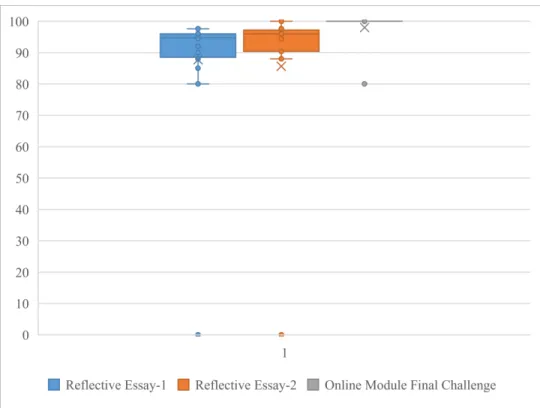
The final challenge consists of 6 multiple choice and 4 true false questions that were prepared based on the 3 lessons covered in the online module. Students only had one attempt to complete the final challenge quiz. Figure 3 uses box-whisker plots to represent the results of the three assessments. Results indicated that majority of the students performed very well in all the assessment categories.
Figure 4. Histogram of Reflective Essay, Final Exam, and Online Module Final Challenge Grades
Correlation Analysis
The correlation analysis assesses correlation between the students’ responses to the 18 questions and student’s overall grades from the course. Table 9 includes a two-tailed Pearson correlation analysis using SPSS software. According to the results of correlation test no question had statistically significant
correlation with the students’ grades. This means that not only the students who did well in the course
positively and highly evaluated their online learning module experience.
Table 9. Correlation analysis of grades with the survey responses1
Q1 Q2 Q3 Q4 Q5 Q6 Q7 Q8 Q9 Q10 Grades Pearson Correlation -0.013 -0.193 0.064 -0.022 0.293 0.092 -0.068 -0.052 -0.223 -0.053 Sig. (2-tailed) 0.959 0.429 0.794 0.928 0.224 0.708 0.783 0.831 0.359 0.830 N 19 19 19 19 19 19 19 19 19 19 Q11 Q12 Q13 Q14 Q15 Q16 Q17 Q18 Grades Grades Pearson Correlation -0.195 -0.137 0.067 -0.214 0.318 0.028 0.031 0.423 1 Sig. (2-tailed) 0.424 0.576 0.784 0.378 0.185 0.910 0.898 0.071 N 19 19 19 19 19 19 19 19 19
Conclusions, Limitations, and Future Research
In this paper, a learning assessment for the online ethics education module developed and used in an undergraduate level engineering ethics course. The online ethics module consists of three lessons: 1) the meaning of ethics, 2) case studies, and 3) methods for resolving ethical dilemmas. Students studied the module, responded to short quizzes, and completed final challenge tests in a two-week period. Upon completion of the module, students also submitted a reflection assignment.
The research team developed a research survey that consisted of 10 sections and 25 questions. The study team concluded demographics distribution of the survey sample was adequate in terms of majors and acceptable in terms of the race/ethnicity distribution to be a representative sample. However, male student share was high in the survey sample, which is unfortunately in parallel with the share of female engineering students in all engineering majors (1/4).
The proposed online module and research survey were the novel aspects of this research. However, increasing the 41-student sample size will be beneficial in further studies. The researchers are in continuous effort to survey more sample of students who are enrolled in this course in fall 2019 and beyond, and the online module is also under continuous revision for improvement towards increasing the learning
effectiveness of the students and educational impact of the online module on students’ not only the
educational knowledge of ethics but also ethical reasoning and behavioral ethics aspects.
The survey results also indicate that the students evaluated their level of confidence in reaching the specific learning outcomes of the online module very highly and positively. This outcome paralleled results obtained from student responses and evaluations on ethical conduct, reasoning, and ethical behavior abilities. The lesson 3 part of the module describes the code(s) of ethics, and their limitations, and provides a 9-step systematic process on how to act in an ethical dilemma but did not discuss how to implement these in an example that is in parallel with 9-steps, which is also a room for improvement in the online module.
Recent literature indicates that students’ understanding, and conduct of ethics and ethical behavior increases as their class level and age, which also has a lot to do with the organizational culture that they belong to in their educational institution, their families, and the local and global community that they are connected to (Finelli et all, 2012). The research team also plan to expand the focus of online ethics module to social and environmental sustainability aspects of ethical reasoning and conduct in future.
We can still argue that the state of art instructional methods in Engineering Education Ethics (EEE) sufficiently works and prepares students for the real world apart from being proficient in FE exam. The literature review indicates that knowledge of ethics, ethical reasoning, and ethical behavior components are severely fractured and are not well-aligned for the needs of future workforce development with the multilevel professional requirements of morality. Assessment results indicated that the students performed well in many of the assessments and found the to be module effective. These opinions correlated with
students’ grades. The analysis found no significant statistical correlation between student grades, and answers to the survey questions, or grade-related satisfaction.
Among the limitations of the study is that the researchers did not include the Defining Issues Test2 or DIT228 and the Engineering Ethical Reasoning Instrument or EERI tests in the research study. Future studies will include integration of these tools as part of the longitudinal research plan. Assessment of student behavioral ethical reasoning development and behavioral conduct did not occur as students completed a one-time survey, and no follow-up survey. A future study can focus on evaluation of student sample size and statistical comparison of ethics knowledge, reasoning, and behavior, in future years. While the study also omitted ethical behavior assessment, study of the topic will occur in the future. Including imaginary
challenge questions in future reflection essays will simulate application of student ability to apply ethical reasoning, knowledge, and skills future workplaces. Additionally, the students’ personal background, and
characteristics are immensely important in ethic education research since ethical reasoning and behavior are also related with these characteristics, which were outside of the current work’s focus and remains as a future study topic. Besides, the proposed online approach could be compared with traditional classroom settings. Lastly, FE exam ethics section preparedness and ethical behavioral growth research objectives were not addressed sufficiently, which needs addition of practical assessment of students with FE-like questions in the module, and longitudinal sample data of future years, and follow-up with the students after they graduate, and they had at least a credible time of industry experience. These are also among the future research plans on the research team.
References
[1] Online Etymology Dictionary, “Ethics (n.),” 2018. [Online]. Available:
https://www.etymonline.com/word/ethics. [Accessed: 08-Jan-2018]. [2] Oxford Online Dictionary, “Ethics,” 2018. [Online]. Available:
https://en.oxforddictionaries.com/definition/ethics. [Accessed: 08-Jan-2018]. [3] NSPE, “Code of Ethics Examination,” Ethics Resources, 2018. [Online]. Available:
https://www.nspe.org/resources/ethics/ethics-resources/code-ethics-examination.
[4] National Society of Professional Engineers, “NSPE Code of Ethics for Engineers,” Code of Ethics, 2017. [Online]. Available: https://www.nspe.org/resources/ethics/code-ethics.
[5] ABET, “Accreditation Criteria & Supporting Documents,” 2018. [Online]. Available:
http://www.abet.org/accreditation/accreditation-criteria/. [Accessed: 08-Jan-2018].
[6] C. J. Finelli, M. A. Holsapple, and E. Ra, “An Assessment of Engineering Students ’ Curricular
and Co-Curricular ...,” J. Eng. Educ., vol. 101, no. 3, pp. 469–494, 2012.
[7] A. R. Bielefeldt, N. E. Canney, C. Swan, and D. Knight, “Efficacy of macroethics education in engineering,” ASEE Annu. Conf. Expo. Conf. Proc., vol. 2016–June, 2016.
[8] D. Bairaktarova and A. Woodcock, “Engineering ethics education: Aligning practice and outcomes,” IEEE Commun. Mag., vol. 53, no. 11, pp. 18–22, 2015.
[9] R. Money, “Transitioning to Ethical Reasoning.” 2009.
[10] G. Varner, “A lecture on ethical reasoning.” 2002.
[11] T. S. Sutkus, J.A., Carpenter, D.D., Finelli, C.J., & Harding, “Building the Survey of Engineering
Ethical Development (SEED) instrument,” in Proceedings of the 39th IEEE/ASEE Frontiers in Education Conference, 2008.
[12] T. Harding, D. Carpenter, and C. Finnelli, “Two Years Later: A longitudinal look at the impact of engineering ethics education,” … 2013 Am. Soc. …, 2013.
[13] B. E. Barry and J. S. Herkert, “Ch. 33: Engineering Ethics,” in Cambridge handbook of
engineering education research, A. Johri and B. M. Olds, Eds. Cambridge University Press, 2014, pp. 1–43.
[14] P. Lloyd and J. Busby, “‘Things That Went Well - No Serious Injuries or Deaths’: Ethical
Reasoning in a Normal Engineering Design Process,” Sci. Eng. Ethics, vol. 9, no. 4, pp. 503–516, 2003.
[15] G. Hashemian and M. C. Loui, “Can instruction in engineering ethics change students’ feelings about professional Responsibility?,” Sci. Eng. Ethics, vol. 16, no. 1, pp. 201–215, 2010.
[16] J. L. Hess and G. Fore, “ASystematic Literature Review of US Engineering Ethics Interventions,”
Sci. Eng. Ethics, vol. 24, no. 2, pp. 551–583, 2017.
[17] J. Hess, L. Kisselburgh, C. Zoltowski, and A. Brightman, “The Development of Ethical
Reasoning: A Comparison of Online versus Hybrid Delivery Modes of Ethics Instruction,” 2016.
[18] R. S. Harichandran, M.-I. Carnasciali, N. O. Erdil, C. Q. Li, J. Nocito-Gobel, and S. D. Daniels,
“Developing entrepreneurial thinking in engineering students by utilizing integrated online modules,” in ASEE Annual Conference and Exposition, 2015, vol. 122nd ASEE, no. 122nd ASEE Annual Conference and Exposition: Making Value for Society.
[19] S. Walesh, “Resolving Ethical Issues e-Learning Module.” University of New Haven, West
Haven, CT., 2017.
[20] Texas Tech University, “Guidelines for Facilitating Solutions to Ethical Dilemmas in Professional Practice,” 2017. [Online]. Available:
http://www.depts.ttu.edu/murdoughcenter/products/resources/guidelines-for-facilitating-solutions.php.
[21] D. N. Beede, T. A. Julian, D. Langdon, G. McKittrick, B. Khan, and M. E. Doms, “Women in STEM: A Gender Gap to Innovation,” Econ. Stat. Adm. Issue Br., vol. 4, no. 11, 2011.
Appendix: Survey
Section 1. Please acknowledge that you are 18-years of age or older: Y/N
Section 2. Do you agree to participate in this study? (if so, please select yes and continue with the survey questions) Y/N
Section 3. Please indicate your major: − Chemical Engineering − Chemistry − Civil Engineering − Computer Engineering − Computer Science − Electrical Engineering
− Industrial and Systems Engineering − Mechanical Engineering
− Engineering (General) − Other (please specify)
Section 4. Approximately how much time did you spend completing the online portion of the Ethics Module? (If you did not complete the module at all, please enter 0 hours) _____
Section 5. After having completed the Online Ethics module, please evaluate your level of confidence on being able to do the following: (Evaluation scale: 1=Not at all confident, 2=Somewhat not confident, 3=Neutral, 4=Somewhat confident, 5=Very confident).
Q1. Assess your position on an ethics scale
Q2. Define ethics in the context of professional settings
Q3. Explain why ethical behavior and the trust it engenders are essential for all engineers especially entrepreneurial engineers"
Q4. Analyze ethical dilemma case studies"
Q5. Explain how ethical dilemma case studies are resolved" Q6. Apply three methods for resolving ethical dilemmas"
Section 6. Please indicate your level of agreement with each of the following statements (1=Strongly Disagree, 2=Disagree, 3=Neutral, 4=Agree, 5=Strongly Agree):
Q7. The online ethics module enhanced my knowledge in professional code(s) of ethics
Q8. The online ethics module enhanced my ability to use code(s) of ethics in an ethically challenging situation
Q9. The online ethics module enhanced my ability to conduct scientific ethical reasoning
Q10. The online ethics module enhanced my behavioral conduct in dealing with ethically challenging situations
Q11. The online ethics module enhanced my ethical conduct in assessing the impact of ethical issue(s) on society and community
Q12. The online ethics module enhanced my ethical conduct in assessing the impact of ethical issue(s) on the environmental
Q13. Overall, I feel ready to solve FE exam questions related to code(s) of ethics, and ethical reasoning. Q14. Overall, I feel ready to face ethical issues in professional work environment
Section 7. Please indicate your level of agreement with each of the following statements (1=Strongly Disagree, 2=Disagree, 3=Neutral, 4=Agree, 5=Strongly Agree):
Q15 "The online ethics module overall positively impacted my interest in professional code of ethics" Q16 "The online ethics module positively contributes to the course"
Q17 "The online ethics module positively contributes to the curriculum of my engineering major" Q18 "Overall, I enjoyed completing online ethics module"
Section 8. Your Race/Ethnicity (optional)
− Black, Afro-Caribbean, or African American − East Asian or Asian American
− Latino(a) or Hispanic American − Middle Eastern or Arab American − Non-Hispanic White or Euro-American − Native American or Alaskan Native − South Asian or Indian American − Hawaiian or Pacific Islander − Other (please specify)
Section 9. Please select how you self-identify (optional): − Female
− Male − Other
Section 10. For the next phase of our research we are looking for volunteers to meet and discuss the module and some ethical case studies in person. If you would be willing to participate, please provide your Name and email and we will follow up with more details.
iKenneth K. Humphreys, “What Every Engineer Should Know About Ethics,” Marcel Dekker, Inc. 1999