118
Journal of Education and Vocational Research Vol. 3, No. 4, pp. 118-126, Apr 2012 (ISSN 2221-2590)Practical Skill Improvement Needs of Technical College Mechanical Engineering Craft
Practice Curriculum in Nigeria
*Atsumbe, B. N.1, Okoro, O. M2, Ogwo, B. A.3
1Federal University of Technology, Minna, Niger State, Nigeria 2University of Nigeria, Nsukka, Nigeria
3State University of New York, Oswego, Nigeria *[email protected]
Abstract: In recent years, the curriculum of technical college mechanical engineering craft practice has been criticized as being shallow and inadequate. Because of this deficiency, the study was therefore designed to determine the needed practical skills improvement on the curriculum of technical college mechanical engineering. One research question and a hypothesis guided the study. The study was conducted in the North Central States of Nigeria. A survey research design was employed. Twenty-eight (28) industries were sampled for the study. Using purposive sampling sixty (60) mechanical engineers, one hundred technicians (100) and one hundred and fifty craftsmen were used for the study. A forty-eight item questionnaire was used for the study. A forty-eight item questionnaire was used to collect data, and data analysis was done using Mean, Standard Deviation, and One Way Analysis of Variance (ANOVA). Findings showed that respondents agreed with the items with a very high mean of 3.50 – 3.83, areas that attracted high mean included advanced machining, material treatments and engineering drawing. It was recommended that these new items should be incorporated into the curriculum during review.
Keywords: Practical skill, Technical college, Mechanical Engineering, craft practice, curriculum
1. Introduction
The survival of any industry is largely dependent on the caliber of its available craftsmen. Abdullahi (1995) affirmed that for any industry, be it mechanical or civil to remain in production, it would require the services of competent mechanical engineering craftsmen. He further emphasized the fact that it is the mechanical engineering craftsman who actualizes the plans and designs of the mechanical engineer. The mechanical engineering craftsmen are involved in services such as producing spare parts to specifications; carry out daily maintenance of tools and equipment. Kibbe, Neely, Meyer and White (1991) noted that the work of a mechanical engineering craftsman is multi phased. They said some of his jobs revolve around plant and equipment maintenance, operating on the CNC machines, align and locate mechanical components, production of die sinkers, structural iron work and being a tool maker amongst many areas. It is a well known fact that effective training in practical skills in engineering trades have immensely contributed to the technological excellence and economic self reliance of individuals and industrialized nations. It is for this reason that Okorie and Ezeji (1988) while stressing the importance of technical competencies, such as applied skills said proper and adequate skill acquisition is a means of increasing the productive power of a nation. Eze (1989) while buttressing the view of Okorie and Ezeji contended that technical competencies and psychomotor skills are indispensable in the training of competent mechanical engineering craftsmen. He said the mechanical engineering craftsmen are involved among others in the following operations, manipulating complex tools, and equipment, selection of appropriate metals and cutting of complex contours on metals using tools and equipment. As a result of the ongoing technological developments, mechanical engineering trades require not only technical knowledge, but also manipulative skills. It is also crucial to know that mechanical engineering at the craftsman level require serious manipulative skills; this is because most of their jobs are concerned with designs, manufacture, and installation of a wide range of products. The quest for this kind of functional education calls for constant review of the present curriculum of training. It is because of this that the revised National Policy on Education (2004) set some of the objectives of vocational education to be:
119
To provide trained manpower in applied science and technology
To provide technical and vocational skills necessary for industrial development To give training and impart skills leading to the production of craftsmen.
To achieve this, the Federal Government saddled the National Board for Technical Education (NBTE) in 1985 with the responsibility to restructure all craftsmen courses and to draw a curriculum directly relevant to the present needs of Nigerians. The duration of the program as spelt out in the new curriculum is three years, leading to the award of National Technical Certificate (NTC). The requisite qualifications for admission into the program are Junior Secondary School Certificate or Vocational Training Centre Certificate. The curriculum further stated that the objectives of the mechanical engineering craft practice programs amongst many should be
Ability to prepare and interpret Mechanical Engineering drawings of components, Produce simple mechanical components
Operate, maintain or service mechanical components Carry out plant installation and maintenance etc. Prepare a systematic engineering drawing report Carry out machine and bench shop operations.
If the objectives stated above are to be achieved the there is need to review the practical skill component of the mechanical engineering craft practice curriculum. This research on the need to review the practical skill content of mechanical engineering craft practice curriculum is been embarked on because changes in the need of industries and related organizations employing these craftsmen are clearly evident. According to Mogaji (2000), the industries have continued to complain that these craftsmen are useable without further re-training. He further said these craftsmen are suffering unemployment because the training they received while in school is no longer in consonance with the practice in modern day manufacturing industries. Above all researchers such as Eze (1989), Mbata (1990), and Atsumbe (2002) have criticized the present curriculum of technical mechanical engineering as inadequate, shallow and have been in use for the past fifteen years without review, hence the need for this study
2. Literature Review
Mechanical engineering is a branch of engineering that deals with machines and production of power (Crawford, 2010). It is particularly concerned with forces and motion. He further noted that mechanical engineering is one of the several recognized fields of engineering that has from the practice of machines of an art of trial and error to the application of scientific method in research, design and production.Defined it as that branch of engineering which deals with machines and mechanized processes. He further stated that mechanical engineering in particular is concerned with power generation, transmission and utilization of tools and equipment. The high demand for increased efficiency of engineering products is constantly calling for high quality training in applied practical skills for mechanical engineering craftsmen. Although government has done much to improve the quality of training given to mechanical engineering craft practice students, by procuring new tools and equipment, refurbishing of existing equipment and increased in-service training for teachers. Dikko (1997) observed that there is still a growing concern among industrialist that graduates of the program do not possess adequate practical background necessary for employment in the industries. Abifarin (1998) further observed that the mechanical engineering craftsmen experience unemployment not because the industries are saturated but because the current practical skills they have acquired are no longer in consonance with current practices in the industries. The current curriculum of mechanical engineering craft practice has been criticized for being shallow and inadequate. According to Atsumbe (2002) though the curriculum specify that 65% (sixty-five percent) of the content be dedicated to workshop practice, the truth of the matter is that the students are daily loaded with the theoretical knowledge aspect of the program. If the mechanical engineering based industries in the middle belt states of Nigeria are to continue in production then it becomes pertinent that a comprehensive review of the technical college mechanical engineering craft practice curriculum must be embarked on. According to Okorie and Ezeji (1988), it is with relevant curriculum that the training of quality and efficient skilled mechanical engineering craftsmen can be achieved. Abifarin (1998) while affirming the increasing demand in the training of
120
mechanical engineering craftsmen stated that they have to be exposed to basic practical foundations such as principles and operation of production machines like automatic lathe, magnetic chuck and center less grinding machines. Other areas include metallurgy and production of steels, principles of digital and computerized equipment, foundry technology, tolerance and interchangeability in production. For example, machine shop practice is an integral part of mechanical engineering, which involves the knowledge of how to operate and maintain all the equipment. Some of the basic training machines that could be found in the school workshop are the center lathe, drilling, shaping, milling, and grinding machines. Chapman (2001) while discussing the benefit of machine shop practice said for example, the following are achieved as a result of development in machine tool technology, increased production, production per worker, interchangeability of machine parts, high standards of quality products, reduction in high labor cost and increase in measure of well being for families and society in general. Other components of mechanical engineering as taught at the technical college level are foundry, engineering drawing, maintenance, basics if material technology etc. Quality and efficient skilled craftsmen particularly in mechanical engineering could only be achieved when the curriculum in use is relevant and up to date. An up to date and adequate curriculum for training requires that the existing content be reviewed periodically to accommodate new developments in technology. Gray and Brown (1997) buttressed the need for periodic curriculum review when he affirmed that most engineering machines today are numerically controlled or even computerized.
Research Question: The following research question was formulated to guide the study. Specifically the study seeks to answer the following research question.
What are the needed improvements on the practical skill content of Technical College Mechanical Engineering Craft Practice curriculum?
Hypothesis: There will be no significant difference in the mean responses of mechanical engineers, technicians, and craftsmen on the needed practical skill improvements on the technical college mechanical craft practice curriculum (p< 0.05)
3. Methodology
The design for the study is a survey research design. The study was carried out in the North Central Sates of Nigeria.
Sample: The sample for the study was drawn from technical Colleges offering mechanical engineering craft practice and mechanical engineering based industries in the North Central States of Nigeria. Using purposive sampling technique, 60 mechanical engineers, 100 technicians and 150 craftsmen were sampled for the study.
Instrument for Data Collection: The researcher developed the questionnaire items used for the study. There are two sections of the questionnaire. Section deals with the information relating to the Bio-data of the respondents while section B, which contains 48 items, deals with the needed practical skills that should be included in the current Technical College mechanical engineering craft practice curriculum. The respondents were asked to rate the items on a five (5point) rating scale as shown below.
Highly Required (HR) – 5
Required (R) – 4
Moderately Required (MR) – 3
Less Required (R) – 2
Not Required (NR) – 1
The research instrument was subjected to both face and content validation. The validated instrument was pilot tested using four engineers, five technicians and seven craftsmen. The reliability of the instrument was established using Cronbach Alpha. A correlation coefficient (Alpha) of 0.837 was obtained.
Method of Data Collection: The questionnaire was administered on the respondent by the researcher and with the help of research assistants. Three hundred and ten (310) questionnaire items were distributed and collected after two days. Two hundred and ninety six (296) were returned representing 95%.
121
Method of Data Analysis: Data collected were analyzed using frequency counts, percentages, mean and one-way Analysis of a variance (ANOVA). Mean statistics was used to answer the research question and One-one-way Analysis of Variance was used to test the only hypothesis. In deciding the real limits of the assigned values, the response categories were used to take decision on needed practical skill improvement of technical college mechanical engineering craft practice curriculum. Using the lower limits of moderately required (MR) category (2.50) as the cutoff point, an improvement item was regarded as required if its weighted mean was up to 2.50 and above, items whose mean fall below 2.50 was considered as not required for inclusion in the current curriculum. For testing the hypothesis, the calculated F ratio value was compared with F-critical (table value at 0.05 level of significance). A null hypothesis was accepted if the value of F ratio (calculated) is less than F-critical (table F); otherwise, the null hypothesis was rejected.
4. Results
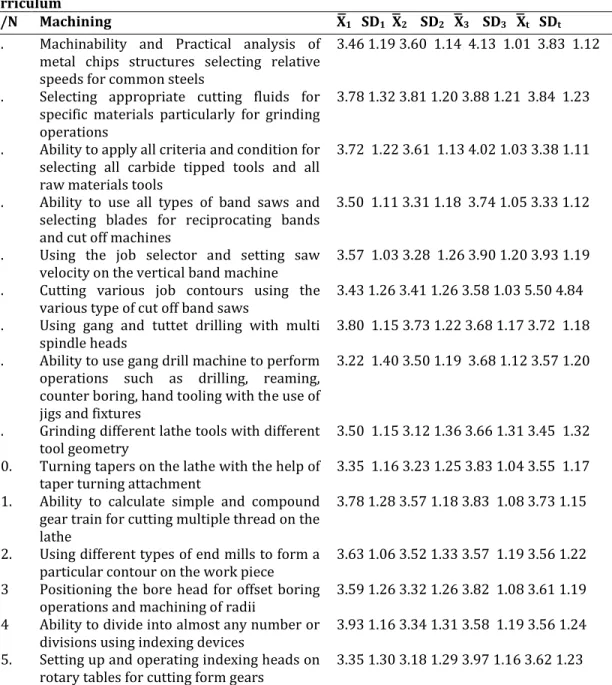
Table 1: Mean and Standard Deviation of Engineers, Technicians and Craftsmen on the Needed Improvement on the practical skill content of Technical College Mechanical Engineering craft practice curriculum
S/N Machining X1 SD1 X2 SD2 X3 SD3 Xt SDt Remark
1. Machinability and Practical analysis of metal chips structures selecting relative speeds for common steels
3.46 1.19 3.60 1.14 4.13 1.01 3.83 1.12 Required 2. Selecting appropriate cutting fluids for
specific materials particularly for grinding operations
3.78 1.32 3.81 1.20 3.88 1.21 3.84 1.23 3. Ability to apply all criteria and condition for
selecting all carbide tipped tools and all raw materials tools
3.72 1.22 3.61 1.13 4.02 1.03 3.38 1.11 3.50 1.11 3.31 1.18 3.74 1.05 3.33 1.12 3.57 1.03 3.28 1.26 3.90 1.20 3.93 1.19 3.43 1.26 3.41 1.26 3.58 1.03 5.50 4.84 3.80 1.15 3.73 1.22 3.68 1.17 3.72 1.18 3.22 1.40 3.50 1.19 3.68 1.12 3.57 1.20 3.50 1.15 3.12 1.36 3.66 1.31 3.45 1.32 3.35 1.16 3.23 1.25 3.83 1.04 3.55 1.17 4. 5. 6. 7. 8. 9. 10.
Ability to use all types of band saws and selecting blades for reciprocating bands and cut off machines
Using the job selector and setting saw velocity on the vertical band machine Cutting various job contours using the various type of cut off band saws
Using gang and tuttet drilling with multi spindle heads
Ability to use gang drill machine to perform operations such as drilling, reaming, counter boring, hand tooling with the use of jigs and fixtures
Grinding different lathe tools with different tool geometry
Turning tapers on the lathe with the help of taper turning attachment
11. Ability to calculate simple and compound gear train for cutting multiple thread on the lathe
3.78 1.28 3.57 1.18 3.83 1.08 3.73 1.15 12. Using different types of end mills to form a
particular contour on the work piece 3.63 1.06 3.52 1.33 3.57 1.19 3.56 1.22 13 Positioning the bore head for offset boring
operations and machining of radii 3.59 1.26 3.32 1.26 3.82 1.08 3.61 1.19 14 Ability to divide into almost any number or
divisions using indexing devices 3.93 1.16 3.34 1.31 3.58 1.19 3.56 1.24 15. Setting up and operating indexing heads on
122
16 Performing compound, differential andangular indexing with uneven minutes 3.78 1.13 3.62 1.24 3.61 1.21 3.64 1.19 17 Carry out gear inspection and
measurements in areas such as chordal addendum, chrodal tooth thickness and gear dimensions
3.65 1.25 3.12 1.48 3.72 1.19 3.50 1.33
18. Operate Horizontal and Vertical simple surface grinders with reciprocating or rotary tables
4.04 1.11 3.68 1.28 3.84 1.05 3.82 12.63 19 Identify and use all types of cylindrical
grinders e.g. roller types, center less, tools and cutters etc.
3.39 .31 3.40 1.20 3.71 1.04 3.55 1.15 20 Honing for finishing inside diameters of
bushings and cylinders of automatic engine blocks
3.41 1.31 3.38 1.34 3.73 1.24 3.56 1.30 21 Perform effectively mounting, truing,
dressing and balancing of grinding wheels 3.39 1.20 3.42 1.24 3.91 1.15 3.66 1.21 22 Use center type cylindrical grinder for
traverse, straight plunge and tapper with work piece swiveled to desired angle.
3.35 1.08 3.52 1.16 3.66 1.11 3.56 1.13 23 Set up the mill to perform angular indexing
and cut spur gears 3.80 1.09 3.56 1.19 3.57 1.17 3.61 1.16 24 Inspecting gears by measuring using
calipers, micrometers and optical comparators
3.37 1.20 3.56 1.32 3.84 1.13 3.66 2.22 25 Working with various types of advanced
grinding machine such as type III surface grinder, center less, tool and cutter grinders
3.70 1.03 3.51 1.28 3.84 1.15 3.70 1.18
26 Identify, select and use appropriate
abrasive materials for specific jobs. 3.65 0.99 3.39 1.27 3.53 1.15 3.50 1.17 27 Perform a variety of machining operations
on computer numerical controlled (CNC) machines
3.48 1.43 3.51 1.18 3.80 1.10 3.65 1.20 28 Write basic programming languages for
machining various components on the CNC machines
3.57 1.00 3.56 1.18 3.98 1.11 3.76 1.13 29 Machine various components using various
nontraditional machining processes, EDM, ECM, ELG, ultrasonic plasma beam and electron beam machining.
Foundry Technology
30 Prepare foundry patterns to standard with correct shrink, machining and core
allowance
3.22 1.21 3.48 1.27 3.80 1.25 3.59 1.27 31 Obeying every necessary foundry safely
during casting exercise 3.85 1.19 3.62 1.08 3.68 1.23 3.69 1.18 32 Ability to use both manual and pneumatic
foundry tools such as rammers etc 3.57 1.09 3.41 1.29 3.94 1.14 3.70 1.21 33 Cast various simple components using
green sand and machine molding method 3.50 1.17 3.62 1.15 3.82 1.15 3.70 1.16 34 Ability to select, prepare, control, handle
123
Fabrication Engineering35 Classification of cold reduced steel sheets
and hot rolled sheets. 3.57 1.00 3.56 1.18 3.98 1.11 3.76 1.13 36 Preparing metal, paper and other material
term plates (patterns) 3.63 1.39 3.56 1.29 3.66 1.24 3.62 1.28 37 Writing comprehensive operational
sequence for the production of any item to be fabricated
3.43 1.05 3.47 1.35 3.71 1.14 3.58 1.20 38 Performing wiring, rolling and bending
operations on cylinders and cones. 3.21 1.32 3.47 1.20 3.80 1.16 3.59 1.22 39 Ability to use various fabricating machine
such as rolling, shearing, bending and the guillotine machines
3.70 1.15 3.06 1.31 3.78 1.12 3.52 1.24 40 Perform spinning operations on the various
types of spinning lathes 3.52 0.98 3.19 1.15 3.88 1.27 3.56 1.22 Materials
41 Conduct destructive and non-destructive
test on metals 3.09 1.26 3.57 1.27 3.65 1.17 3.53 1.24 42 Use various methods to determine physical
and mechanical properties of metals 3.57 1.44 3.27 1.38 3.80 1.04 3.58 1.28 43 Using iron-carbon thermal-equilibrium
diagram to interpret the chemical constitution and changes in steel.
4.11 1.08 3.08 1.28 4.10 0.93 3.76 1.19 44 Selecting appropriate materials for various
jobs (Alloys, steel and non ferrous metals) 3.72 1.08 3.57 1.32 3.81 1.24 3.71 1.24 Engineering Drawings
45 Development of interpenetrations, of cylinders, co-axial and offset cones using triangular methods
3.22 1.43 3.24 1.23 3.85 1.16 3.53 1.27 46 Drawing involutes spur and bevel gears, in
volute racks and worm wheels. 3.17 1.52 3.47 1.25 4.06 1.02 3.71 1.25 47. Prepare assembly drawings, general
arrangement, Balloon referencing, part list and single part drawings
3.65 0.97 3.37 1.28 3.76 1.16 3.61 1.18 48 Drawing of rotating shafts, keys and key
ways, universal joints, constant velocity drivers, ball and roller bearings.
3.41 1.05 3.43 1.25 3.77 1.26 3.59 1.23 Key X1 – Mean responses of Engineers, X1 – Mean responses of Technicians,
X1 – Mean responses of craftsmen, Xt – Average responses
Results of table 1 Indicate that the three groups of respondents combined agreed with all the items proposed as additional practical skills required for the improvement of technical College curriculum mean(x) ranging between 3.50 – 3.84.
Table 2: One-Way Analysis of Variance (ANOVA) for the Needed Additional Practical Skill Items that should be included in the Technical College Mechanical Engineering Curriculum.
Source of
Variation Sum Squares of Df. Mean Squares F – Ratio F – Prob. Remarks
Between 5.838 2 2.919
Residual 316.945 263 1.205 2.422 0.0907* NS
Total 322.783 265
124
Analysis on Table 2 indicates that the value of F-cal (2.422) is less than the critical F value (3.04) at 2 and 263 degree of freedom. In addition, the F – probability value of 0.0907 is also greater than 0.05 level of significance. This result all shows that there is no significant difference between the mean responses of the engineers, technicians and craftsmen. Consequently, the null hypothesis was accepted at 0.05 level of significance.
Discussion: The findings of this study are presented and discussed in line with the research question and hypothesis. The results obtained from all the clusters showed that the three groups of respondents for the study adjudged all the items as appropriate for inclusion in the practical content of technical college mechanical engineering curriculum. Each of the items has a mean of between 3.50 – 371, which is an indication that they are highly required. The acceptance of all the proposed practical skills is consistent with the assertion of Ogbimi (1992), Yabani (2002), Odu (2007), Ezeji and Okorie (1988); who maintained that it is believed worldwide that the acquisition of practical skills is a means of increasing the productive power of a nation. These vocational education experts further reaffirm that Nigerian government and the entire society should recognize the fact that every citizen should be equipped with practical skills to contribute effectively to the welfare of the country. Most of the items boarder on machine tool practical processes and were over whelmingly accepted by the respondents, this is not coming as a surprise because according to Kibbe, Neely, Meyer and White (1991) standard machine practice is still very much relevant to machining technology even in the high technology computer age. Students of modern industrial and manufacturing technology especially at craftsman level will still require solid backgrounds in standard machine shop practice if they are to thoroughly understand and appreciate computer-controlled machining as well as other high technology manufacturing processes. It is also important to note that of all manufacturing processes that can be applied to the shaping and forming of raw materials into useful products, machine tool practice will always remain among the most important. The fundamental cutting processes in machining is those of bringing the work into contact with a cutting tool, are still very much evidence and will always remain the main stays of the industry. Metal casting and fabrication came next, this again agrees with the work of Shirly (1981) and Graham (1999) who observed that in America among all industries, metal casting ranks fifth in value-added-by-manufacture. This implies that the increased value of the product as it is changed from the raw material to the finished castings ranks metal casting as one of the most important manufacturing industries. Industrial survey by Atsumbe (2002) show that modern conveniences that surround us, such as cars, lawnmowers, washers, dryers, sewing machines, telephones, agricultural tools and weapon depends to a large extent on cast parts. Above all today, the casting industry employs approximately 50,000 workers in the nation’s more than 2,000 foundries.
Coming after casting and fabrication is engineering drawing. The complete acceptance of these clusters of items is because according to Hart (1980), drawing is the principal means of communication in engineering. It is the only method used to impart ideas, convey information and specify shapes in engineering and is often said to be the language of the engineer. It is crucial that a mechanical engineering craftsman should be familiar with this language, as he will be required to exhibit this knowledge in his or her engineering practice. He will be expected to read drawings, interprets and reproduce some drawings in practice. The One-way analysis of variance used in testing the only hypothesis showed that mechanical engineers, technicians and craftsmen do not show any significant difference in their responses on additional practical skill items suggested for improving the curriculum. This mutual agreement is not coming as a surprise. This only implies that the respondents are aware of the importance of acquiring appropriate skills. In fact Gobir (1994) pointed to the fact that the main objectives of manufacturing industries who employ these craftsmen is to meet production target and without quality man power that possess appropriate practical skills this “production target” can’t be achieved. The complete acceptance of all the practical skills suggested that the category of respondents appreciates the relevance of practical skills. Infact Folayan (2010) while contending the relevance of practical skills acquisition quoted the late John Kennedy as saying skilled manpower is the indispensable means of converting other resources to mankind’s use and benefits. He further pointed to the fact that how well we develop the practical skills of our personnel’s and employ human skills is fundamental in deciding how much we will accomplish technologically as a nation. Further analysis showed a high mean acceptance of machine shop practice skills. This corroborate with the work of Abifarin (1998) who observe that despite the high technology computer age and automation of machine tools students of modern industrial and manufacturing technology will still need solid backgrounds in standard shop practice, if they
125
are to thoroughly understand and appreciate computer – controlled machining as well as other high technology manufacturing processes. The endorsement of all the practical skills agrees with the assertion of Tilak (2002) who observed that possession varied practical skills is an antidote against unemployment and improves productivity and corresponding higher graduate earnings. Atsumbe(2002) noted that most schools in Nigeria do not furnish their students with the minimum skills to fit them for productive work, hence several school leavers live on a subsistence level and most of the time, out of frustration or desperation become beggars or criminals.
5. Conclusion and Recommendations
The desire to produce qualified and well-trained craftsmen in mechanical engineering through technical college program can only be achieved when the curriculum used embraces the relevant practical work skills. This study found out that the practical content of the engineering craft practice curriculum used in our technical colleges is completely in adequate and shallow in major areas like machine tool processes, metal casting, fabrication, materials and engineering drawing. If the graduates of this program are to meet the challenges of the ever dynamic technology labor market and the ability to effectively perform, the present curriculum must be broadened to accommodate the already emerging diverse innovations in mechanical engineering technology. Based on the findings of this study the following recommendations were made. 1. The findings of this study will be made available to National Board for Technical Education who is the coordinating ministry for technical colleges. 2. The identified practical skills should be incorporated into the existing curriculum immediately. Therefore, that students could benefit from these new areas and fit into the labor market. 3. Identification of new of new course areas calls for increased and new set of tools and equipment, facilities and teachers to teach the occupational areas. 4. Schools should foster closer ties with industries to enable the students learn some of the skills, since the schools may not have all the needed facilities.
Reference
Abdullahi, Y. A. (1995). An appraisal of the objectives of Technical College Programs in Nigeria. Nigeria Journal of Technical Education, 15(2), 28–38.
Atsumbe, B. N. (2002). Needed Improvements on the Curriculum of the Technical College Mechanical Engineering Craft Practice Unpublished Doctorial Dissertation, Dept. of Vocational Teacher Education? University of Nigeria, Nsukka.
Abifarin, S. A. (1998). Challenges of Practical Skill Acquisition in vocational and Technical Education in Nigeria, A paper presented at the 10th annual conference of Nigerian Association of Teachers of Technology. Minna, Nigeria.
Chapman, W. A. J. (2001). Introduction to Workshop Technology Part 1. Edward Arnold publishers Ltd. 25. Hill Street London.
Crawford, S. (2010). Basic Engineering Processes. Hodder & Stoughton. London Sydney.
Dikko, M. (1997). Training needs in Industrial Society, A paper presented at the common wealth regional Seminar on Technical Education and Industry, University of Ibadan.
Eze, T. I. (1989). Policy constraints to the growth of Technology Education programs. Journal of Technical Education Review, 2(2), 13–19.
Folayan, S. A. (2010). Re–Training Needs of Mechanical Engineering Technologist in manufacturing Industries. Journal of Technology Education, 7(2), 72 -76.
Gobir, S. A. (1994). Pre service Skill needs for increasing employability of Technical college graduates. Unpublished Doctorial Thesis. Dept. of vocational Teacher Education, University of Nigeria, Nsukka. Graham, D. (1999). What Industries and Business want from Vocational Education? Industrial Education
forum, 3(3), 6-9.
Gray, F. & Brown, D. (1997). Occupational Competence involves more than Skills and Knowledge. Journal of Industrial Teacher Education, 13(3), 41 – 47.
Hart, K. R. (1980). Engineering Drawing with problems and solutions. London. The English Language Book Society and Hodder and Stoughton.
Kibbe, R. R., Neely, J. E., Meyer, R. O. & White, W. T. (1991). Machine Tool Practices. Ney Jersey: prentice Hall, Englewood Cliffs.
126
Federal Republic of Nigeria (FGN). (2004). National policy on Education. Lagos Nigeria: Federal Government press.
Mogaji, J. O. (2000). Innovations in Mechanical Engineering, Implication for Curriculum review of Technical College Mechanical Trades. Journal of Teachers of Technology, 12(2), 34 -38.
Mbata, A. (1990). Towards a more Effective Manpower Training and Development in the field of Technical Education in Nigeria. Journal of Technical Education Review, 2(2), 20–31.
Odu, C. O. (2007). Strategy for Technology Development. Lagos, Sunday Times. May 30th Pg 8.
Ogbimi, F. E. (1992). Planning for the Acquisition of Relevant Production skills in skill starved economies: The Nigerian perspective. Journal of Training and Developments TRADEV, 1(1), 18–20.
Okorie, J. U. & Ezeji, S. C. O. A. (1988). Elements of Guidance, vocational and career Education. Onitsha: Summer publishers Nigeria Ltd.
Shirly, F. A. (1981). Metal Design and Construction. Great Britain. Hulton Educational Publications.
Yabani, A. M. (2002). Evolving Relevant Technical Education Programs for Nigeria Technological Institutions. A Seminar paper presented at the 40th anniversary of the Yaba College of Technology, Lagos. Oct. 27th.