Procedia Economics and Finance 26 ( 2015 ) 1080 – 1085
2212-5671 © 2015 The Authors. Published by Elsevier B.V. This is an open access article under the CC BY-NC-ND license (http://creativecommons.org/licenses/by-nc-nd/4.0/).
Peer-review under responsibility of Academic World Research and Education Center doi: 10.1016/S2212-5671(15)00933-8
ScienceDirect
4th World Conference on Business, Economics and Management, WCBEM
Evaluation of Outsourcing Efficiency Through Costs For Its Use
Gabriel Giertl
a* , Marek Potkany
a,Milos Gejdos
aa Technical University, T.G. Masaryka 24, Zvolen 960 53, Slovakia
Abstract
By influence of globalization and by increasing competition are many enterprises forced in the present to perform a variety of activities, which are although not related to the main subject of their activities, but for some reason are necessary for business. The implementation of subsidiary services and auxiliary activities has increased the amount of overhead costs. The reaction to a difficult economic situation is just an effort to reduce overhead costs. Potential way of reducing overheads costs becomes the application of the outsourcing principles. This paper is focused on the detailed specification of costs associated with the use of outsourcing. Outsourcing priority task, in addition to the cost savings, is the transfer of risk to the service provider, with the ensuring and increasing the quality level of carried out activities. Practice has confirmed that the vision at a cost saving are often greater than it actually is. The problem seems to be that it is quite difficult to determine and know the extent of its costs for the implementation of outsourced processes and there is often forgotten to the level of additional costs for manage the outsourcing relationship. In the paper we paid attention to the draft of assessment of the outsourcing efficiency from the cost savings perspective to ensure the business supported processes.
© 2015 The Authors. Published by Elsevier B.V.
Peer-review under responsibility of Academic World Research and Education Center.
Keywords: outsourcing, cost, effectiveness;
1. Introduction
Effort to costs reduction for certain processes in a company leads to a responsibility settlement for their implementation to an external provider. Company uses certain form of outsourcing, where a cost saving, resp. price of outsourcing services, shouldn´t be the only and the main criterion for decision of implementation of this plan and subsequently selecting a service provider. Nevertheless, a price should be one of the important factors, because exactly through cost savings it is possible to valuate effectiveness of outsourcing use the easiest way. The successful companies experience with outsourcing use points to many benefits, which can be provided. Except for a potential
* Gabriel Giertl Tel.: +421-45-5206-427
E-mail address: [email protected]
© 2015 The Authors. Published by Elsevier B.V. This is an open access article under the CC BY-NC-ND license (http://creativecommons.org/licenses/by-nc-nd/4.0/).
of cost savings, it is also orientation to the core business, risk transfer, quality improve and the expert know-how acquisition with support processes management. The most common risk in terms of company experience appears to be an area of hidden cost.
2. Theoretical and methodological aspects of the issue
Outsourcing as a concept comes from the American economic life and represents a combination of the words - outside, resource (s) and using to the one artificial word. Kakabadse and Kakabadse say that the one of the first example of outsourcing can be observed in the Antic Rome, where the process of tax-collection was outsourced (Kakabadse, Kakabadse, 2002). According to Hirschheim et al. the concept of outsourcing (as an agreement with the external entity for providing of goods or services) is being here for centuries (Hirschheim, Heinzl, Dibbern, 2006). According to James and Weidenbaum, outsourcing is not a new concept and we can find its origin in the sub-contracting of production activities (James, Weidenbaum 1993). According to Corbett , “outsourcing was first used in the 1970s by manufacturing executives and it has been gradually adopted since then by the executives in just about every other business function” (Corbett, 2004).
It follows that the outsourcing is primarily focused to the optimization of business functions and processes by the use outside sources for their implementation (Satanova, Gejdos, 2010). The concept of outsourcing has several interpretations: semantic, operational and juristical. Semantic interpretation devides outsourcing to the "out", which means outdoor and "source". Functional interpretation distinguishes the service from purchased services. Purchased service is not included to the basic services of business, thus the companies try to get rid of their non-core and anclillary activities which are economically disadvantageous for them. Juristical interpretation has in Slovak law no special support (Nedeliakova , Dolinayova, Gasparik, .2010). The legal interpretation of this concept is created directly in the contract with the service provider (Stachova, Stacho, 2013).
Outsourcing of business activities has become the tool which tries to concentrate to the core business and delegate certain functions to other institutions that have the resources and facilities to carry out these functions much more effectively (Aronsson, Koskela, 2009). Outsourcing allows companies to devide activities on those, which are considered to be the main "core" and "non-core" activities and allows enter ancillary activities to external partners to make them more efficient, more cost-effective. In practice it is not possible to outsource all activities. It is ideal to determine a plan based on company business philosophy, it means to focus on a core of company interest and not to outsource this base (Teplicka, Daubner, 2013). Outsourcing has become over the time a complexed object of business, and therefore can be described from different perspectives. In theory it is possible to find a number of definitions from various authors. In view of the complex characteristics can be used the definition from authors I. Hunter, J. Saunders, A. Boroughs, S. Constance, "Outsourcing is understood as a transfer of internal business activities or group of related activities to an external producer or service provider who is able to offer the required service at the agreed date and at the agreed price (Hunter, Saunders, Boroughs, Constance, 2008). Today, outsourcing is used primarily as a tool of strategic business management, namely as a tool for optimizing of corporate resources consumption focusing on core strategic business objectives. It is a general trend of the 21st century (Kampf et al., 2008). Priority task of outsourcing is been becoming the providing and increasing of the quality level of performing activities and cost savings to pay the attention to core business (Potkany, 2011). Companies frequently point to the cost savings for labor and training, but also cite the benefits of releasing corporate resources for alternative uses and allowing corporate resources for alternative uses and allowing the business to focus on its core competencies (Rainborn, Butler , Massoud, 2009).
Outsourcing brings several benefits, whether on tactical or strategic level. We focus our attention to the strategic advantages of outsourcing.
x focus of the company to its core business: outsourcing allows the company to focus on its core business, while complementary functional acitivties will be delegated to an external company.
x ensuring the access to skills and knowledge on the international scale: until company is not leader in a particular field, the retention of international level is very expensive and company has tends, in such functional area, rather stagnate.
x risk reduction: through outsourcing contracts are risks devided into network of several companies.
may bring. The most important risks (barriers) of outsourcing include (Potkany, 2011).
x Fear of losing control over the allocated area (business activity). In this case also the fear of the loss of knowledge that are important for the future innovations and loss of information leakage, or know-how necessary for carry out the important activities and fears arising from the increased dependence on the particular service supplier.
x Fear of orientation of the external company (supplier of outsourcing services) to their own short-term goals (profit) before the strategic goals of the company and the risk that the outsourcing provider does not know the company as well as his own employees and thus will be not able to provide an allocated area in the corresponding requirements, flexibility and quality.
x Fear of leak of important internal data and information related with the outsourcing area, respectively to ensure the protection of transmitted data.
x Fear of costs for outsourcing project and calculation of outsourcing efficiency in particular area. Very often appear to be a risk factor the costs associated with outsourcing, in expecation of savings arise strong tendency to underestimate the costs associated with managing of outsourcing process (transaction costs) (Popesko, 2010). According to Milecova, Grznar, Szabo many different risks are connected with outsourcing. These risks are named in the literature, but an analysis of these risks is missing and also the methodology for management of these specific risks connected with outsourcing (Milecova, Grznar, Szabo, 2010).
3. Outsourcing costs
When using outsourcing it is widely expected that costs of this activity would be reduced in comparison to the costs incurred in a use of the company internal capacity. If we want to compare the outsourcing effectiveness against our own process implementation, it is necessary to consider all costs that are related. Therefore it is very important to identify and quantify the outsourcing costs, which can be divided into three (Dvořace, Tyll, 2010):
x Production costs in a functional area. These are the costs invoiced by providers for delivery service.
x The transaction costs. Here can be included cost of creating a contract, check of its implementation, a communication and coordination between a client and a provider; and costs of the other expert and consulting services.
x Hidden costs. This area coincides with transaction costs and regards to additional costs incurred for example to manage transition phase of outsourcing implementation, costs of redundancies, costs of outsourcing relationship termination.
A precise identification of all groups of these costs is quite difficult and requires expert estimation. But a point is to identify these costs so that a company would count with them in an alternative decision of outsourcing use. It is a kind of risk, which is mainly necessary to identify, because after that it becomes a factor, which is calculated with.
The total costs of outsourcing therefore can be determined as follows (Dvořacek, Tyll, 2010): A price paid to the service provider
+ additional purchasing costs + costs related to implementation = total costs of outsourcing
From above equation it results that a low price doesn´t automatically mean low costs of outsourcing. In the table 1 we present the hidden costs of outsourcing, as stated in essay Deloitte consulting 2005. Regarding the costs of outsourcing, all costs (excluding costs of service provider selection, negotiation and parts of hidden costs) are spread evenly over time. This is called proporcionalization of costs over time so they can be better planned (Dvořacek, Tyll, 2010).
Table 1. Hidden costs of outsourcing (% of total outsourcing budget) Hidden costs of outsourcing
Outsourcing contract 1-2 %
Travel costs 2-3 %
Transfer of activities 1-2 %
Communication 1-3 %
Efficiency 0-20 %
Changing of business processes 0-10 %
Cultural diversity 2-5 %
Total costs 12-52 %
Source (Dvořacek, Tyll, 2010) Corbett presented the results of U. S. companies research essay, which usually spend 2% of its outsourcing contract costs to manage its relationship with a provider. An effective management of this relationship is however based on the following principles (Corbett, 2004):
x avoid transferring strategic decisions on a provider,
x create multiple organizational link between provider and sponsor,
x organize regular meetings between the two parties,
x use all available technology for relationship management (internet, video conferencing, …),
x define the eventual growth process,
x use balanced score card for an evaluation,
x use motivation and sanctions,
x reward employees of a service provider,
x be prepared for change,
x appreciate the contractual relationship as a strategic business asset.
4. Evaluation of the outsourcing effectiveness
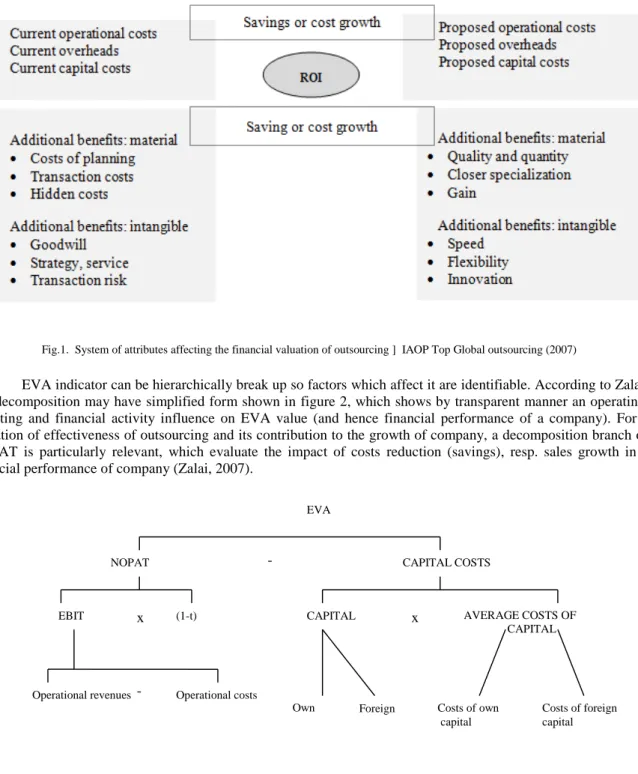
Costs of outsourcing are closely related to an evaluation of their effectiveness, which is often compared with an evaluation of investment return (ROI). A system of attributes that affects a financial outsourcing valuation is shown in picture 1. In addition to the values of ROI, it is possible to use indicators of labor productivity per employee, or to a specified unit of input (material, energy…) for a valuation of effectiveness of the use of outsourcing. A possibility is also to use soft indicators focused on valuation of customer satisfaction etc. Cost saving through outsourcing, therefore its effectiveness, is also associated with comparing of valuation indicators of a company financial performance. A modern indicator of performance evaluation is an indicator of economic value added EVA. It prefers economic gain i. e. profit consisted of a difference between the return of capital and economic costs, therefore costs, which except for financial costs include so-called opportunity costs (such as interest on equity).
Basic construction EVA indicator is based on three key values (Kislingerova, et. al. 2007):
x value of a Net Operating Profit After Tax (NOPAT)
x total value of invested capital (C)
x Weighted Average Cost of Capital (WACC)
A basic formula for calculating EVA presents the relationship 1 with positive evaluation of the performance only if EVA > 0
EVA = NOPAT – (WACC * C) (1) Net operating profit (NOPAT) can be determined as a multiple of EBIT (profit before tax from economic activity) and cleaned level of income tax rate (t):
NOPAT = EBIT * (1-t) (2)
In its quantification, however, all items related to the main activity of the company (such as sales of fixed assets and inventory) should be excluded. The same also applies to modification of invested capital (C).
Fig.1. System of attributes affecting the financial valuation of outsourcing ] IAOP Top Global outsourcing (2007)
EVA indicator can be hierarchically break up so factors which affect it are identifiable. According to Zalai, this decomposition may have simplified form shown in figure 2, which shows by transparent manner an operating, investing and financial activity influence on EVA value (and hence financial performance of a company). For a valuation of effectiveness of outsourcing and its contribution to the growth of company, a decomposition branch of NOPAT is particularly relevant, which evaluate the impact of costs reduction (savings), resp. sales growth in a financial performance of company (Zalai, 2007).
Fig. 2. Disaggregation of indicator EVA Source: Zalai, (2007)
5. Conclusion
An evaluation of the efficiency of use outsourcing is an important part of the decision-making process -
-
EVA
NOPAT CAPITAL COSTS
EBIT x (1-t) CAPITAL AVERAGE COSTS OF
CAPITAL
Operational revenues Operational costs
Foreign Costs of own capital
Costs of foreign capital x
concerning on the use of external sources (Hitka, Hajdukova, 2013). A critical question for deciding about using outsourcing services is to determine the economic benefits and in particular a potential cost savings arising from the use of outsourcing services. In practice it is often underestimated issue of identification and of use so-called transactional and hidden costs of outsourcing. From our own experience we can say that in a theory nor in practice there is not available general methodology of economic calculations of evaluating the potential cost savings (Potkany, 2011). Companies solve this problem intuitively and to quantification of cost savings occur only at the stage of evaluation of effects arising from outsourcing after a conclusion of the accounting period. A criterion for a comparison is the level of economic indicators such as profit, labour productivity and company turnover, comparing those indicators before and after implementation of outsourcing.
Acknowledgements
This paper is the partial result of the Ministry of Education Science, Research and Sport of Slovak Republic grant project VEGA No. 1/0268/13, „Perspectives of facility management application for the increasing of competitiveness within the wood processing and forestry companies in the context of outsourcing principles” and Cultural and Educational Grant Agency project No. 016-TUZ-4/2012 Multimedia education center for improvement possibilities of production higher quality raw wood assortments.
References
Aronsson, T., Koskela, E. (2009).Outsourcing and optimal nonlinear taxation. In: Economics Letters, Vol. 102, No. 2, pp. 135-137.
Corbett, M., F. (2004). The Outsourcing Revolution: Why It Makes Sense and How to Do It Right. Cicago: Dearborn Trade Publishing, p. 257. Dvořacek, J., Tyll, L. (2010). Outsourcing a offshoring podnikatelskych cinnosti, Praha: C. H Beck: p. 183.
Deloitte Consulting (2005). Calling a change in the outsourcing market. [online] [cit. 2013-02-18]. Available at: <http://www.deloitte.com/dtt/cda/doc/content/us_outsourcing_callingachange.pdf>.
Hitka, M., Hajdukova, A. (2013). Antropometricka optimalizacia rozmerov lozkoveho nabytku. In: Acta Facultatis Xylologiae, Vol. 55, No.1, pp. 101-109.
Hirschheim R.A., Heinzl A., Dibbern J. (2006): Information Systems Outsourcing: Enduring Themes. New Perspectives and Global Challenges. Berlin: Springer,
Hunter, I., Saunders, J., Boroughs, A., Constance, S. (2008) Human Resources Business Partners. Gower: Gower Publishing Limited, IAOP Top Global outsourcing (2007) http://www.iaop.org/Content/19/165/1793/Default.aspx
James H.S., Weidenbaum M. (1993): When Businesses Cross International Borders: Strategic Alliances and Their Alternatives. Preager Publishers, Westport, CT;
Kampf R. et al. (2008). Outsourcing of transport logistic processes, Brno: Tribune EU s.r.o.,
Kakabadse A., Kakabadse N. (2002): Trends in Outsourcing. Contrasting USA and Europe. European Management Journal, 20: 189–198. Kislingerova, E et. al. (2007). Manazerske finance. Praha: C. H. Beck, p. 745
Milecova, M., Grznar, M., Szabo, Ľ. (2010). Outsourcing: Decision making in the case of outsourcing the company activity and the management of outsourcing project. In: Agric. Econ. – Czech, Vol. 56, No. 8, pp. 387–396.
Nedeliakova, E. , Dolinayova, A., Gasparik, J. (2010). Methodology of transport regulation in the Slovak Republic. In: Periodica Polytechnica Transportation Engineering, Vol. 38, No. 1, 2010, pp. 37-43
Popesko, B. (2010). Activity-based costing application methodology for manufacturing industries. In: Ekonomie a management, Vol. 13, No.1, pp. 103-114.
Potkany, M. (2011). Outsourcing in woodworking industry in Slovakia, Zvolen: TU Zvolen, 79.
Stachova, K., Stacho, Z. (2013). Employee allocation in Slovak companies In:In: Business: Theory and Practice, Vol. 14 No. 4, pp. 332 – 336. Teplicka, K. Daubner, M. (2013). Study of the relation between tax competition and tax burden in European union member states, In:
Ekonomicky casopis, Vol. 61, No.2, pp. 172-186.
Satanova, A., Gejdos, P. (2010) Ekonomika kvality. Zvolen : TU Zvolen, p. 96.
Rainborn, C.A., Butler J.B., Massoud, M.F. (2009).Outsourcing support functions: Identifying and managing the good, the bad and the ugly. In: Business Horizons, Vol. 52, No. 4, pp. 347-356.