
A Mail-Based Teleservice Architecture for Archiving and
Retrieving Dynamically Composable Multimedia Documents
Heiko Thimm, Katja Röhr, Thomas C. Rakow
GMD - Integrated Publication and Information Systems Institute (IPSI)
Dolivostr. 15, 64293 Darmstadt, Germany e-mail: {thimm, rakow}@darmstadt.gmd.de
GMD - Research Institute for Open Communication Systems (FOKUS)
Hardenbergplatz 2, 10623 Berlin, Germany e-mail: [email protected]
Abstract
In this paper, a teleservice for archiving and retrieving multimedia documents using public net-works is described. This teleservice encourages a broad range of commercially applicable multime-dia archiving applications suitable for an asynchronous access mechanism. It is based on an inte-grated architecture comprising stand alone archive clients and a multimedia archive server which is realized using a database management system. Archive clients access the archive server via an extended X.400 Multimedia Mail Teleservice. This teleservice reflects the specific requirements of dealing with multimedia documents in a networked environment by supporting a global refer-ence mechanism. The archive server can dynamically compose new versions from an original ar-chived multimedia document including extractions of subsequences of continuous data streams, coding and quality transformations. Thus, users can retrieve multimedia documents that explicitly reflect his individual workstation environment, information needs, and preferences. Since this fea-ture allows to determine in advance the data volume to be retrieved and transmitted, users have more control over their service charge. The concept, architecture, and functionality of the teleser-vice as well as a sample instantiation of the proposed architecture showing an application called multimedia calendar of events are described. A comprehensive discussion of this prototypical im-plementation provides our experiences.
1 Introduction
In the near future, many users on possibly heterogeneous platforms will have access to multimedia mail allowing them to interchange multimedia documents over public networks. Besides its usage for conventional interpersonal messaging, this technology can also be exploited for innovative, commercial multimedia applications. It is especially suited for domains that can cope with the mail delay, i.e. which do not require immediate delivery of requested multimedia data, like, e.g., a product offering service, a virtual travel agency, subscription service for multimedia documents, or coopera-tive authoring of multimedia documents.
In this paper, we introduce an archiving and retrieval teleservice for multimedia documents which employs such a multimedia mail implementation. Connectionless, asynchronous multimedia mail
* This work is partially granted by DeTeBerkom GmbH, Berlin, as project ‘‘Globally Accessible Multimedia Archives (GAMMA)’’ within the BERKOM II initiative.
is applied as a means for interchanging multimedia documents between archive clients and an active multimedia archive server. Since the special requirements of multimedia data within a networked environment are reflected in the underlying mail implementation as well as in the archiving compo-nents, it extends those functionality provided by usual electronic document archives. One feature is that searching for documents is possible by descriptive search criteria addressing document con-tents as well as multimedia specific data. This allows, for example, to select documents which do not contain video clips longer than 1 minute. Another feature is support for dynamic document com-position. It allows to retrieve other versions of originally archived multimedia documents which are dynamically created by the archive. In other words, a copy of the original document is tailored to meet the user’s individual information needs, preferences, workstation environment and cost restric-tions (charge of the teleservice provider, network and storage costs). Furthermore, it is possible to retrieve only a description of a document’s structure which can be helpful for a user who has to de-cide if it is worthwhile to retrieve the document completely. The uncertainty with respect to the re-turned amount of data and the resulting costs faced in formulating queries is less critical. Users can control which of the following types of query result they want to receive: (1) a report of the number of matching documents, (2) for each matching document some application specific descriptive in-formation, or (3) complete documents.
The archive access protocol defined between archive clients and the server is using the multimedia mail service developed at GMD-FOKUS which is based on the principles of CCITT Recommenda-tion X.400 Message Handling System [3]. The client/server-communicaRecommenda-tion employs both, the store-and-forward mechanism inherent to electronic mail and the referenced object access (ROA) mechanism which complements electronic mail submission and delivery in case of high-volume multimedia information content such as video.
In our prototypical implementation of the proposed teleservice, the archive server which is described in-depth in [28] is based on the VODAK database management system (DBMS) [18] which is a re-search-prototype developed at GMD-IPSI. Our standalone archive clients provide functionality for the authoring and presentation of the multimedia documents as well as the management of the user access to the archive server. Except for its asynchronity, for the teleservice users, the utilization of the mail service is transparent.
The remainder of this paper is organized as follows. We conclude this section with a review of related work. In section 2, we introduce the multimedia mail implementation relevant for us. The architec-ture of our teleservice is described in section 3, while in section 4, we explain its functionality. A sample instantiation of the proposed architecture is outlined in section 5. In section 6, we evaluate our approach and discuss the experiences made by a sample implementation. We conclude the paper with a review of issues that have been out of scope, and an outline of our current state of implementa-tion as well as future work.
Related Work
To our knowledge, the integration of a multimedia database system with multimedia electronic mail for the realization of a multimedia archiving teleservice is a new approach not reported in any pre-vious work. Research in both areas from which technologies are applied have started almost simulta-neously. Information about multimedia mail can be found, e.g., in [2, 7, 22] while research on ar-chives for documents (mostly office documents) is reported, e.g., in [5, 30]. With respect to multimedia database systems, a research field which is still developing, first approaches were
data-base systems for specialized data such as spatial datadata-bases [20, 26] and pictorial datadata-bases [27]. Spa-tial databases were attractive because of the fact that the semantics of the objects and operations could be clearly defined. One of the first multimedia efforts in managing multimedia data was the Multimedia Information Manager in the ORION object-oriented database system, developed at MCC [31]. The integration of the new data types is accomplished through a set of definitions of class hierarchies and a message passing protocol not only for the multimedia capture, storage, and presen-tation devices, but also for the captured and stored multimedia objects. This way, a high degree of flexibility is achieved since new storage or presentation devices are easily included by providing the corresponding classes as subclasses of the existing classes. Another project is MINOS, in which the Multimedia Object Presentation Manager was developed at the University of Crete [4]. Synchro-nization mechanisms for distributed multimedia systems are addressed in [25]. An approach for an integration of multimedia into a distributed office application environment based on a multimedia database is described in [24].
2 Multimedia Mail
Research within the area of multimedia mail has been going on for almost 10 years [2, 19, 22]. While the early approaches have been very restrictive and support for continuous data was not fully pro-vided, today’s approaches are less restrictive and more powerful.
Within the BERKOM project, a Multimedia-Mail Teleservice for public networks is under develop-ment [7, 19]. It is based on the principles of CCITT Recommendation X.400 Message Handling Sys-tem (MHS) [3] and provides an extended Interpersonal Messaging Service running in an open heter-ogeneous environment on a series of different hardware and software platforms. Implementations may include access to de facto standard Internet Mail SMTP [21] and competing multimedia mail standard MIME [1].
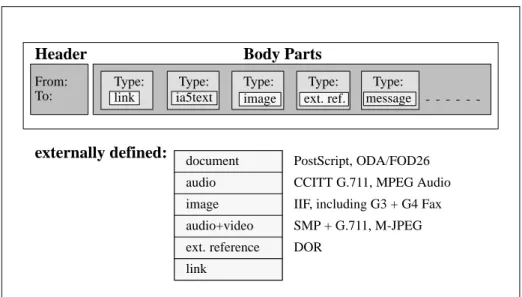
Figure 1: The BERKOM Multimedia Message Structure
Type: Type: Type: Type: Type:
From: To:
Header Body Parts
externally defined: document
audio image audio+video ext. reference ia5text message link PostScript, ODA/FOD26 CCITT G.711, MPEG Audio IIF, including G3 + G4 Fax SMP + G.711, M-JPEG DOR
image ext. ref. link
In terms of X.400, the body of a message consists of a sequence of bodyparts (figure 1). A bodypart contains data of a certain information type. Due to the fact that the information types supported by
X.400 do not meet the requirements of an extensive multimedia mail service, the BERKOM project makes use of the extension mechanism of X.400 (88), the externally-defined bodypart type. This mechanism allows to integrate additional (commonly used) multimedia and hypermedia informa-tion representainforma-tions as message bodyparts. Graphics, video, and audio as well as multimedia/hyper-media documents may now be included in a message. A special LINK bodypart contains information about how contents of bodyparts are related. The only content types which are mapped onto stan-dardized bodypart types are TEXT and MESSAGE.
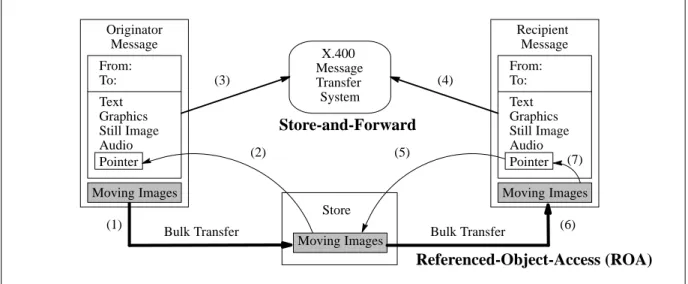
The Message Transfer System (MTS) is based on a store-and-forward mechanism. Most of the exist-ing nodes between originator and recipient in a X.400 MTS have message size restrictions. Large messages, one of the characteristics of multimedia information conveyed through electronic mail-systems, may lead to congestion in Message Transfer Agent (MTA) implementations as well as may go beyond storage capacities at the recipients’ sites. As a consequence, a powerful reference mecha-nism is needed, which makes it possible to include a reference to mono or multimedia data within a message instead of including the data itself. The data is then stored in a specific, remotely accessible store (figure 2).
The external references are based on the universal reference mechanism Distinguished Object Refer-ence (DOR) [14], defined as part of the ReferRefer-enced Object Access (ROA) model, described in the international standard Distributed Office Application Model (DOAM[13]). The DOR standard de-scribes a data structure and a coded representation of external references that specifies the store, the access method(s), the type of the data object, a local reference to the data object and quality-of-ser-vice (QoS) parameters. It allows data objects to be localized and distinguished globally.
Figure 2: Two exchange mechanisms: Store-and-forward plus Referenced-Object-Access
X.400 Message Transfer System Recipient Message From: To: Text Graphics Still Image Audio Pointer Moving Images Moving Images Originator Message From: To: Text Graphics Still Image Audio Pointer Moving Images
Bulk Transfer Bulk Transfer
Referenced-Object-Access (ROA) Store-and-Forward (1) (2) (3) (4) (5) (6) Store (7)
The recipient of a message is free to resolve the reference using communication protocols which provide direct access to the stored data object. In the BERKOM project, a non-realtime service and protocol, the Referenced Data Transfer (RDT) [16, 23] has been implemented to retrieve the refer-enced data object from the store. In case a client wants to view message bodyparts such as audio and video without prior local storage, a realtime protocol must be used between the store and the client’s
site. There are a number of activities going on regarding the design and implementation of such real-time protocols, in particular for the transport/network layer, where the transport user may specifiy QoS parameters (e.g. throughput and transit delay) to be fulfilled by the transport connection. The integration of such realtime protocols within the Multimedia-Mail Teleservice is under develop-ment.
As mentioned above, the LINK bodypart of a multimedia mail describes the relationships between the mail’s different content parts. The BERKOM-profile uses the concept of links between two parts of information to allow structuring for the whole range from simple annotations to complex refer-ences between bodyparts. This scheme may also lead to hypertext/hypermedia-like messages as re-quired for the Multimedia Archive Teleservice.
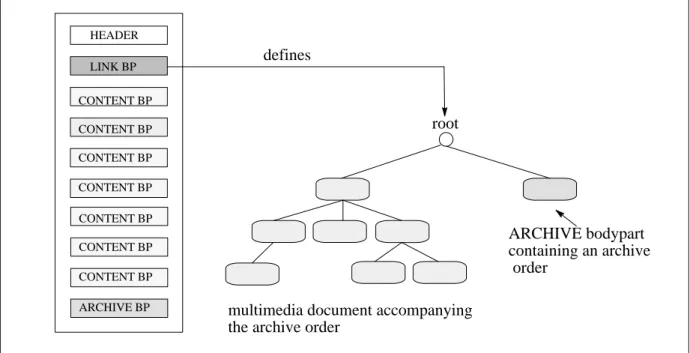
For separation of archiving specific information from the remainder of the message body, an exter-nally defined bodypart type called ARCHIVE is introduced. Multimedia mails exchanged between archiving recipients always provide a bodypart of this type which can be accompanied by a docu-ment contained in the remaining bodyparts. Its contents is only completely interpretable by the re-ceiver specified in the mail header. From the perspective of the mailsystem, however, an ARCHIVE bodypart is a document component as well which is treated in the usual way.
HEADER LINK BP CONTENT BP CONTENT BP CONTENT BP CONTENT BP defines root
Figure 3: Structure of a sample archiving multimedia mail
multimedia document accompanying the archive order
ARCHIVE bodypart containing an archive order ARCHIVE BP CONTENT BP CONTENT BP CONTENT BP
Figure 3 provides an illustration of these aspects. Besides the header which contains mailing specific information, the shown sample mail consists of nine bodyparts. The LINK bodypart defines a map-ping of the remaining eigth body parts into a hypermedia document structure. In general, one branch directly below the root embodies the actual multimedia document (of arbitrary size and structure) to be communicated (in figure 3 this is the left branch). The other branch exclusively comprises the ARCHIVE body part containing archiving specific information. This can be perceived as an archive order with an attached hypermedia document.
3 Architecture
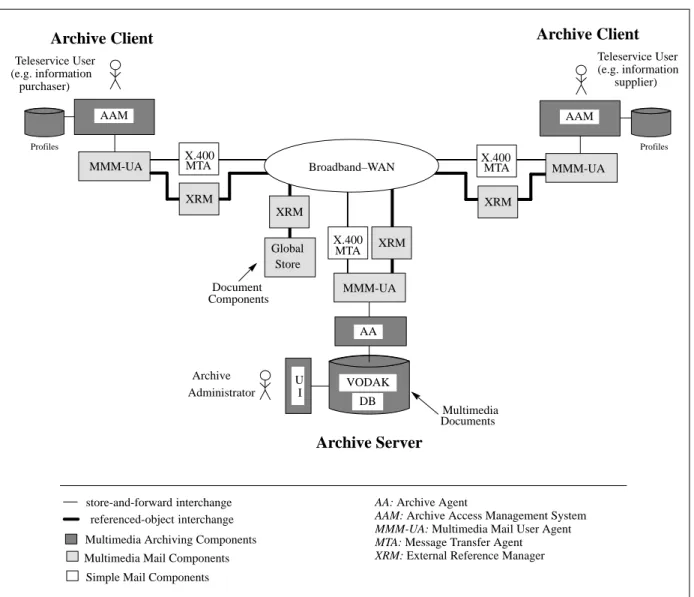
Figure 4 shows the central components of our architecture which is based on a client-server ap-proach. The archive server and each client are directly connected to a Multimedia Mail User Agent (MMM-UA). Each MMM-UA has access to a X.400 Message Transfer Agent (MTA) and an Exter-nal Reference Manager (XRM) [23] in order to support the two interchange mechanisms explained in section 2. In contrast to the server’s database which contains completely structured multimedia documents for an undefined period of time, the global store only contains document parts which are automatically removed after the guaranteed access time specified in the DOR value is exceeded. In our prototypical implementation, the multimedia documents are accessed via the data manipulation language (DML) provided by the DBMS used for the realization of the archive server. Alternatively, a standardized language such as, e.g., SQL [8], or ‘‘mailadopted’’ standards for synchronous
client-Broadband–WAN
Multimedia Archiving Components Multimedia Mail Components Simple Mail Components
X.400 MTA X.400 MTA X.400 MTA Archive Server XRM MMM-UA MMM-UA AAM AAM Multimedia Documents Document Components store-and-forward interchange referenced-object interchange VODAK DB XRM XRM AA MMM-UA U I Archive Client
Teleservice User Teleservice User
Profiles Archive Administrator (e.g. information (e.g. information supplier) purchaser) Archive Client
Figure 4: Architecture of a multimedia archiving teleservice XRM
Global Store
Profiles
AA: Archive Agent
AAM: Archive Access Management System MMM-UA: Multimedia Mail User Agent MTA: Message Transfer Agent XRM: External Reference Manager
server access, e.g. DFR [15], or RDA [10], could also be supported (respectively those subsets of these standards that specify the query functionality). However, the deficiencies in currently avail-able versions of such languages with respect to a realization of the required archiving functionality
have to be compensated by more sophisticated client functionality. The provided descriptive access to the documents includes access to a set of application specific search attributes that serve as prede-fined search criteria for the client (attribute-based retrieval of multimedia documents). Thus, in the database, every archived document is associated with an application specific set of attribute/value-pairs.
3.1 Archive Access Protocol
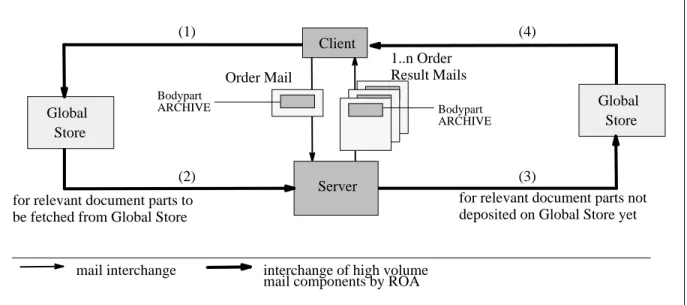
The archive access protocol, illustrated in figure 5, consists of rules that precisely define how an archive client can communicate with the server and vice versa.
Archive orders are issued to the archive server in separate order mails, i.e. a mail may only contain a single individual order (Note that for archiving, the order is accompanied by a multimedia docu-ment). Each order which is provided in the mail’s bodypart of type ARCHIVE includes an order type identifier, the client’s own order identifier necessary for the management of its individual orders, and the actual order. The server returns 1..n order result mails, that each include in the ARCHIVE mail bodypart an order result type identifier, the total number of order result mails, and the mails own order result number. In the possibly remaining bodyparts a multimedia document can be con-tained. Multiple order result mails belonging to the same order are returned whenever more than one document has to be delivered to the client separating the documents from each other.
Order Mail 1..n Order Result Mails GS Server Client GS Client Server Global Store GS Global Store Bodypart ARCHIVE Bodypart ARCHIVE
for relevant document parts to be fetched from Global Store
for relevant document parts not deposited on Global Store yet
Figure 5: Archive access protocol
interchange of high volume mail interchange
mail components by ROA (1)
(2)
(4)
(3)
For the delivery of documents to the server, optionally, the ROA mechanism can be exploited for relevant, i.e., high volume document components. If specified by the user, the server automatically fetches the raw data from the global store (With respect to figure 5, path (1) shows the deposition of the bulk data on the global store, while (2) shows the DOR resolution optionally performed by the archive). Likewise, if specified by the user, document components not already residing on a glob-al store are deposited at the globglob-al store by the archive. This is performed prior to the store-and-for-ward interchange of the document containing the DOR (With respect to figure 5, path (3) shows the deposition of the bulk data by the server, while (4) shows the DOR resolution at presentation time).
3.2 Archive Client
Archive clients are standalone Archive Access Management Systems (AAM) which manage the user access to the archive server and make the utilization of the underlying mail system transparent to the teleservice users. Its functionality directly supports multimedia document authoring and/or the import of multimedia documents created by other authoring environments. The concrete archive service profile and the kind of user (see section 4) determine the functionality to be supported. For the user’s convenience, in a concrete implementation, a high level graphical user interface al-lows direct manipulative creation of archive orders. After its specification, the AAM encapsulates an archive order in a multimedia mail which in turn is sent to the server. Result mails are dispatched, unpacked and their availability is notified to the user. Orders as well as results are persistently stored on the filesystem for reuse in other sessions. It is imagined that issued orders are collected in an ar-chive order list while an order’s results are collected in an order result list. Both lists should be part of the user interface (see section 5 for an example). The AAM makes sure that only those documents are retrieved, that are currently not available at the client’s site by cross-checking the involved docu-ment identifiers.
3.3 Archive Server
The archive server consists of a database and a so-called Archive Agent (AA for short). Information about the multimedia documents and the document themselves are stored in the database. This al-lows to support a descriptive access to stored documents based on search criteria that address the document contents or multimedia specific properties, respectively. The AA manages the connection to the mailsystem (sending and receiving). It maps statements of the archive access protocol into corresponding database operations.
When an archive order mail is received and the originator has the permissions required for the order execution, the archive order is interpreted, i.e. it is mapped into database operations. Its result is en-capsulated in 1..n single multimedia mails separating the multimedia documents to be delivered. This separation is necessary due to the possibly high data volume of multimedia documents. Functionality and an adequate user interface for typical archive administrator tasks should be pro-vided. It should include functions for the administration of the teleservice users, the management of the billing process, and for the direct insertion and manipulation of multimedia data. For mainte-nance purposes, the server should be dynamically connect- and disconnectable to/from the mailsys-tem.
In an efficient implementation, the server should be able to partially recognize redundant data e.g. by comparison of received and already archived DORs. In case of a match, the already archived DOR database instance can be shared by several document instances.
4 Access to Dynamically Composable Multimedia Documents
In general, three different service profiles for an archiving teleservice can be differentiated: (1) Doc-ument Pool – filing and retrieval of docDoc-uments, (2) Information Service - in contrast to the former here it is also possible to retrieve only document parts and to modify archived documents, (3) Work
Flow Management - support for computer supported cooperative work. The functionality provided to the users who can be differentiated in information purchasers (only read access to multimedia documents), and information suppliers (write access as well) depends on the service profile. In the following, we first summarize the functionality provided by the teleservice introduced in this paper that provides the notion of an archive order. Then we provide our motivation and solution for dynamic document composition. Finally, we discuss the notion of profiles which provide flexibility to control the dynamic document composition process and the parameterization of archive orders.
4.1 Archive Orders
Our proposed teleservice provides an information archive profile which functionality is accessible by issuing typed archive orders. Five different order types are supported which execution semantics and results are manipulated by type specific order parameters. In 4.3 we explain the origin of these order parameters. In table 1, the different order types and their corresponding parameters are sum-marized.
Note that the search criteria of a SEARCH archive order instance can address the documents contents as well as the structure inclusively multimedia specific data. This allows, e.g., to exclude those docu-ments which contain videos longer than 1 minute.
Order Type Informal description of order semantics
Order Parameters High level pseudo code description of the algo-rithm which executes the order and generates result mails
INSERT An accompanying multimedia docu-ment is inserted into the archive.
boolean PINS1 ;
PINS1 is called DOR
reso-lution request parameter; ...
insert document in archive;
if (PINS1 == true)
then
for all DORs of document
store bulk data in server as well;
// data is fetched from store and stored in the server as well
endif;
prepare order completion notification mail; send prepared mail;
SEARCH Selection of docu-ments based on an accompanying de-scriptive search query. (Note that search criteria can address the docu-ment contents as well as the docu-ment structure in-clusively multi-media specific data).
integer PSEAR1, PSEAR2;
constraint:
PSEAR2 >= PSEAR1;
PSEAR1 is called search
re-sult constraint paramter 1;
PSEAR2 is called search
re-sult constraint paramter 2;
boolean PSEAR3;
PSEAR3 is called DOR
cre-ation request parameter; ...
n:= EvaluateQuery(thequery); //n is number of matching documents
case
(n>PSEAR2):
prepare a search result notification mail providing n;
(PSEAR1< n<=PSEAR2):
for all matching documents
prepare a mail containing the application specific attribute values of the document;
(n<=PSEAR1):
for all matching documents
{
make a copy of the document;
if (PSEAR3 ==true)
then substitute each high volume document component by a DOR;
// deposite raw data on store if not already there endif
enforce document constraints; //dynamic document composition prepare a mail containing the document; };
endcase;
send prepared mails; ...
READ The document(s) with the given document identifi-er(s) is(are) re-trieved.
boolean PREAD1, PREAD2, PREAD3, PREAD4;
constraint:
only one of PREAD1,
PREAD2, PREAD3 can be true;
PREAD1 is called read result parameter 1;
PREAD2 is called read result parameter 2;
PREAD3 is called read result parameter 3;
PREAD4 is called DOR creation request parameter;
...
for all documents to be read
{
case
(PREAD1 == true):
prepare a mail containing a description of the document structure;
(PREAD2 == true):
prepare a mail containing the application specific attributes of document;
(PREAD3 == true): {
make a copy of the document;
if (PREAD4==true)
then substitute each high volume document component by a DOR;
// deposite raw data on store if not already there endif;
enforce document constraints; //dynamic document composition prepare a mail containing the document; };
endcase;
};
send prepared mails; ...
UPDATE The application specific attributes of the document with the given document identifi-er are updated.
...
update attribute values of given document; prepare order completion notification mail; send prepared mail;
... REMOVE The document
with the given document identifi-er is removed.
...
remove document with given document identifier; prepare order completion notification mail; send prepared mail;
...
Table 1: Summary of supported archive orders
4.2 Dynamic Document Composition
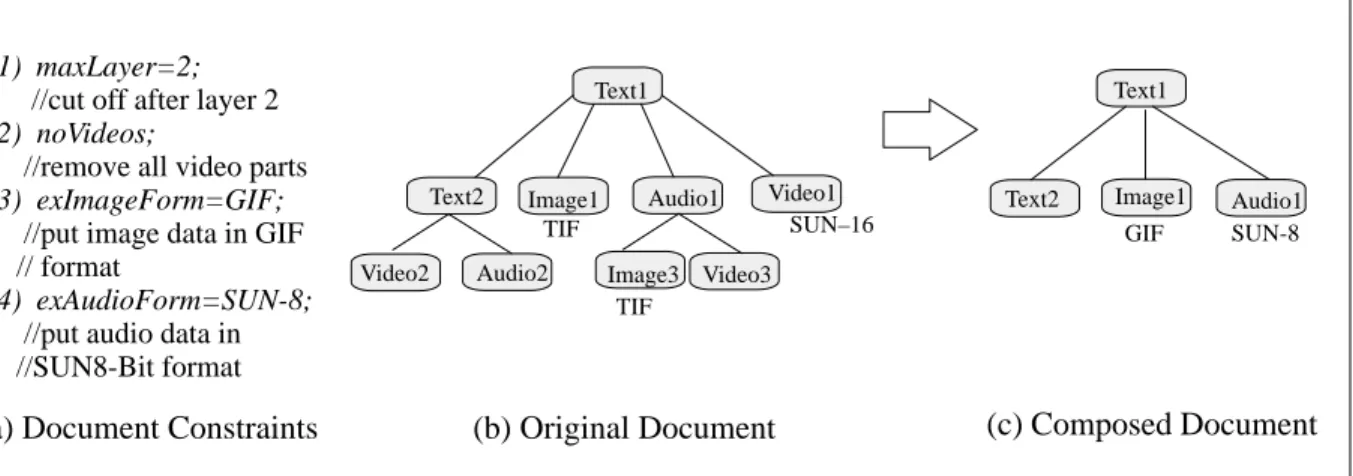
A multimedia information archive which only allows to retrieve documents as originally archived faces the users with the problem that the retrieved information might not fully reflect the user’s indi-vidual workstation environment, or his preferences with respect to structure, or contents of ments, respectively. Thus, e.g., it can happen that some components of retrieved multimedia docu-ments cannot be presented since the required presentation facilities (hardware/software) are lacking, or the documents include detailed kind of information despite the user is only interested in overview kind of information. Within the context of a networked environment for commercial utilization, this is even more problematic since the users’ final charge, more or less, depend on the retrieved data volume. To allow users to accomplish a minimum of such retrieved ‘‘missmatching’’ information, our teleservice provides functionality for dynamic document composition available for SEARCH and READ archive orders. It allows to retrieve multimedia documents that more properly fit to the individual workstation environment, preferences with respect to structure and contents of docu-ments, as well as service cost restrictions than the original one. The individual restrictions are ex-pressed in document constraints which are derived from the different profiles which are discussed in the next subsection. The document constraints are enforced by the archive server resulting in a new document (constraint driven dynamic document composition). Note that the original document is not altered.
Text1
Text2 Audio1
Video2 Audio2 Image3 Video3
Text1
Text2 Audio1
SUN–16 SUN-8
(b) Original Document (c) Composed Document (a) Document Constraints
(1) maxLayer=2; //cut off after layer 2 (2) noVideos;
//remove all video parts (3) exImageForm=GIF; //put image data in GIF
// format
(4) exAudioForm=SUN-8; //put audio data in
//SUN8-Bit format TIF Image1 GIF Video1 Image1 TIF
The types of document composition functions called by the constraint enforcement can be catego-rized as follows (Note the execution of such a function can include that the raw data is fetched from the global store):
Functions that alterate the document structure: Arbitrary document parts are removed. For
exam-ple, constraint (1) of figure 6 (a) cuts off all document parts below layer 2 since, e.g., they provide detailed information which are not relevant for a user who is only interested in overview informa-tion, and constraint (2) projects out all video parts which, e.g., a user on a workstation with low performance does not want to receive.
Functions that perform coding transformations: Specific document parts are transformed from
one coding into another. For example, constraint (3) of figure 6 (a) transforms relevant images contained in the multimedia document into GIF images since, e.g., the user’s workstation envi-ronment only provides a GIF viewer.
Functions that perform quality transformations: Specific document parts are transformed form
one level of quality into another. For example, constraint (4) of figure 6 (a) transforms relevant audio parts into SUN 8 Bit audios, since, e.g., the receiver does not have a SUN Sparc10 workstation which is required to present SUN16 Bit audios.
Functions that extract subsequences out of a continuous data stream: Specific subsequences of
a continuous data document component are extracted based on (a) temporal constraints, or, for video, based on (b) video data specific constraints. An example for (a) is the extraction of the first 20 seconds of an audio document component. An example for (b) is the extraction of only the first and last scene. More sophisticated examples can be mentioned such as the extraction of only every tenth video frame to generate some kind of summary.
4.3 Profiles
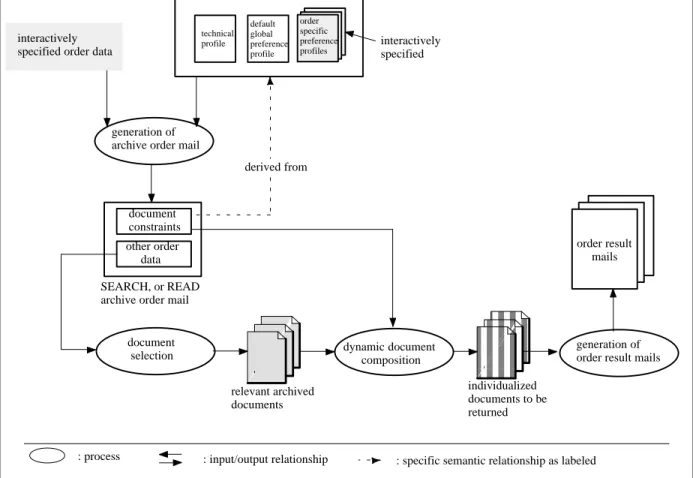
The input data for the generation of archive orders performed by clients are (figure 7):
• interactively specified order data such as, e.g., the search criteria for a concrete SEARCH or-der, and
• order data such as, e.g., the parameter values for the SEARCH order and the document constraints which are derived from so-called profiles.
For SEARCH and READ orders, in the first step of the order execution, the relevant archived docu-ments are evaluated. In the next step, the document constraints contained in these types of orders are enforced. As a result, there are individualized copies of the relevant archived documents to be returned to the client. Within this context, as figure 7 illustrates, the profiles are a means to determine the final individualized documents.
In the following, we describe the different profiles supported by our teleservice.
Technical Profile. The individual hardware and software environment of the client is described in
the technical profile. It is assumed that this profile is specified and updated by the person who con-ducts the installation of the archive client software.
Default Global Preference Profile. This profile comprises a set of default document constraints
Figure 7: The relationship between the profiles and the results of SEARCH and READ archive orders
dynamic document composition profiles
interactively specified order data
other order data SEARCH, or READ archive order mail
ËË ËË ËË ËËË ËËË ËËË ËËË ËËË ËËË ËËË derived from relevant archived documents individualized documents to be returned technical profile default global preference profile
: process : input/output relationship : specific semantic relationship as labeled order specific preference profiles document constraints document selection generation of order result mails generation of
archive order mail
order result mails interactively
specified
for the order parameters. For its interactive specification, the client user interface provides a specifi-cation mask from which the user can select predefined options.
Order Specific Profiles. The default global preference profile is ignored if the user interactively,
in addition to the other order data, specifies an order specific preference profile. The client user inter-face provides a corresponding specification mask from which predefined options can be selected. This feature is available for INSERT, SEARCH, and READ orders. Concerning concrete INSERT orders, it allows to manipulate the value of the supported parameter. Concerning concrete SEARCH and READ orders, in addition to the opportunity to manipulate the parameter values, this allows to specify document constraints to be enforced only for this individual order instead of the ones defined by the default global preference profile.
5 Sample Application
We built a concrete prototype that demonstrates an instantiation of our proposed teleservice architec-ture. This prototype shows a multimedia calendar of events (CoE) application which fits very well to the characteristics of applications encouraged by our proposed teleservice.
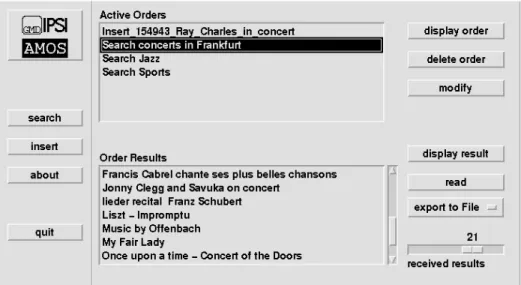
Figure 8 provides a screendump of the main window of our archive client’s user interface. In the upper list, the user’s orders are collected, while in the lower one, the result of a selected order is viewed. Note, a result can comprise a set of multimedia documents, e.g. there are already 21 result-ing documents that belong to the highlighted order of figure 8.
Figure 8: Main window of the archive client [28].
The archive server provides to the users multimedia event descriptions, i.e. information relevant to attract people for a specific event. In contrast to conventional calendars of events, the event descrip-tions are not limited to text. In addition, they can include pictures (e.g. some pictures characteristic for the event), audio pieces (e.g. a sequence of a song), and video clips. Figure 9 shows a sample multimedia event description. As usual, by clicking at the icons included in the text, the multimedia data is presented by using adequate media specific presentation tools. For audio, we use our own audio tool which offers a powerful editing functionality. Note, the video presentation initiated by clicking at the icon with the label DOR involves the ROA mechanism. The window at the bottom shows the CoE-specific attributes and corresponding individual values.
6 Discussion
In this section, we evaluate our concept and prototypical implementation of the proposed teleservice. The relevant aspects are differentiated and interrelated to each other. Conceptual as well as technical issues are addressed.
Applicability of Teleservice
The described teleservice architecture is highly generic. The customization to a concrete multimedia archiving application requires only the definition of the application specific search attributes for the multimedia documents to be dealt with. The client-server protocol remains the same. However, sup-port for multimedia documents created by an external authoring tool is lacking, i.e. the documents have to be created via the clients own editing functionality. This should be complemented by func-tionality to interchange (in either way) multimedia documents between external authoring environ-ments and the client based on standardized formats like, e.g., SGML/HyTime [11, 12], or ‘‘Hyper-ODA’’ [9].
Figure 9: Sample Multimedia Event Description [28]
Utilization of Multimedia Mail
The incorporated mail system’s two interchange mechanisms, asynchronous store-and-forward for complete documents and (possibly synchronous) referenced-object-access for high volume docu-ment parts, provide to the archiving components adequate means for the interchange of multimedia documents. A consequence of using electronic mail is that there is no guaranteed response time. This is a drawback of the proposed archiving teleservice implementation, especially if used for kiosk in-formation systems. However, on the other hand, by using electronic mail, the archiving teleservice’s availability for the users is decoupled from the server’s availability since mails are buffered in the mail system. Hence, mails can be issued at any time regardless if the receiver (client or server) is available. Thus, in contrast to usual client/server architectures where the server has a passive role, i.e. it is only responding to client requests, the mail service enables an active server. This allows the realization of active archive services, like, e.g., a subscription service. Another advantage of elec-tronic mail is that it is is accessible for a large number of users.
By introducing the additional mail bodypart type ARCHIVE (X.400 externally defined bodypart type), in mails exchanged within our teleservice, archiving specific information are separated from the remainder of the mail. The ARCHIVE bodyparts are considered as usual document components
by the mail system. The archive access protocol statements contained in these bodyparts can only be interpreted by the addressed receiver.
Between the mail system (i.e. the corresponding MMM-UA) and the archive server, the multimedia documents are exchanged based on files since there is no main memory based interface defined for the MMM-UA. However, there is no reason to neglect a tighter coupling between both systems, de-spite the multimedia data to be interchanged might not fit into main memory in one portion. A pos-sible solution is to strictly interchange the high-volume data via the ROA mechanism and to employ a synchronous transport protocol for the exchange of data between the archive server and the global store, respectively, vise versa. For the DBMS, this would require support of a continuous data ex-change mechanism for exchanging continuous data on a ‘‘portion by portion’’ basis.
To ease the implementation of the archive client functionality, the MMM-UA’s inherent mail tool functionality is employed for the creation, sending and receiving of mails, and the presentation of multimedia documents. Since the mail creation includes the authoring of multimedia documents, our teleservice’s authoring functionality is identical to the mail tool’s editing functionality.
Teleservice Functionality
Our teleservice provides functionality which is an extension of those normally provided by conven-tional, non-networked electronic document archives. Multimedia documents are encouraged to be used within archives. Specific functionality for dealing with multimedia data in a networked envi-ronment such as functionality to control the contents of search result mails, and functinality for dy-namic document composition are explicitly supported. The multimedia data handling capabilities (multimedia mail bodyparts, two data interchange mechanisms) of the underlying multimedia mail service are fully exploited. The application itself can control the interchange mechanism to be ap-plied. Flexibility to control order parameters and document composition constraints is given by means of profiles. The idea to use within this context a cost axis [17] to show what kind of alterations of the overall service utilization costs are implied by which profile modifications seems to be also advantageous for our teleservice.
Using an Object-Oriented DBMS
For the realization of the described teleservice functionality, the archive server must be based on a differentiated and semantically rich database model. Especially, the structure of the multimedia doc-uments must not be hidden in order to support dynamic document composition and descriptive quer-ies containing multimedia specific search arguments. These requirements can be best met with an object-oriented DBMS like VODAK. In fact, it turned out that with VODAK ’s object-oriented data definition language VML [18] which is also a programming language an adequate database schema can be defined. The contents of the multimedia documents are treated as database instances in order to fully support the shown dynamic document composition functionality. For audio data, we applied VML’s built-in AUDIO datatype that provides built-in methods for performing such transforma-tions. Since other built-in multimedia datatypes are not available yet, for other document parts, the required transformation methods were implemented in the corresponding object types. An in-depth description of the server’s modeling is given in [28]. This shows that for multimedia applications, DBMS which explicitly support multimedia data by adequate datatypes are demanded.
The archive server’s processing includes a mapping of archive access protocol statements into corre-sponding database operations. Due to the fact that VODAK offers the powerful object-oriented
query language VQL [6], even complex archive orders can be almost completely mapped into regu-lar query statements. These statements have just to be submitted to VODAK’s query interpreter, i.e. further processing steps need not be encoded outside the database schema (Recall that an object-ori-ented database besides the actual data objects provides methods which operate on these ob-jects).Thus, in this aspect, our first prototypical implementation could be achieved rather quickly. There are different alternatives for the organization of the database transactions. An object-oriented DBMS like VODAK allows the implementation of advanced transaction concepts. Currently we in-vestigate our approach to balance the more parallelism against the more overhead for such an ad-vanced transaction concept.
7 Conclusion and Future Work
We described and discussed the architecture and functionality of a teleservice for archiving and re-trieving dynamically composable multimedia documents. Its architecture is based on the integration of a standardized multimedia mail system with standalone archive clients and an archive server which is realized using an object-oriented DBMS. By supporting dynamic document composition, users can retrieve multimedia documents that fit much better as the original archived one to their individual workstation environment as well as preferences with respect to structure and contents of the multimedia documents. Thus, a better control of the service costs (teleservice provider charge, network and storage costs) is possible for the users and it is likely that the charge more accurately reflects the value of the information gained by using the teleservice.
Not all issues involved within an archiving teleservice for multimedia documents have been ad-dressed. Especially, authentification and security mechanisms required to prevent unauthorized uti-lization and access to the documents have not been addressed. However, we believe that the mail system should deal with these issues. We also did not consider the billing aspect which is important for commercial utilization of the teleservice. However, we are convinced that even sophisticated billing models which allow that each information supplier can define his own charging policies for his documents (cost sharing, e.g. retrieval of short information is toll free while retrieval of complete documents is charged based on data volume, applied interchange mechanism, ... etc.; refund for tick-et order; ... tick-etc.) can be implemented in a straight forward manner by using the modelling power of an object-oriented DBMS.
The current state of our prototypical implementation includes the described archiving functionality almost completely. Dynamic composition of multimedia documents is partially supported and the ROA interchange between the archive server and the global store in either way are still not realized yet. A future goal of our work is an upgrade of the archiving teleservice’s profile by functionality for work flow management to support the distributed authoring, composition, and management of multimedia documents, i.e. support for asynchronous cooperative work [29]. As sample application, we will use the CoE application for which the event descriptions should be cooperatively created following a formal specification of sequential and parallel steps performed by several information suppliers.
Acknowledgement
Thanks to K. Hofrichter, P. Hoepner, E. Moeller, H. Pusch, and G. Schürmann of GMD-FOKUS for providing comprehensive support with respect to the multimedia mail implementation. We would
also like to thank S. Jakob, and A. Ozimek of GMD-IPSI who implemented parts of our prototype. Thanks again to E. Moeller for helpful comments on an earlier version of this paper.
References
1. Borenstein, H., Freed, N.: ‘‘MIME (Multipurpose Internet Mail Extensions): Mechanisms for Specify-ing and DescribSpecify-ing the Format of Internet Message Bodies’’, RFC 1341, Bellcore, Innosoft, June 1992 2. Borenstein, N.S.: ‘‘Multimedia Mail From the Bottom Up or Teaching Dumb Mailers to Sing’’, Conf.
Proc. USENIX - Winter ’92, San Francisco, CA, 1992, pp. 79-89
3. CCITT Recommendation X.400 series: 1988, Data Communication Networks, Message Handling Sys-tems, Blue Book
4. Christodoulakis S., Ho F. and Theodoridou, M.: ‘‘The multimedia Object Presentation Manager of MINOS: A Symmetric Approach’’, Proc. Int. Conf. on Management of Data, Washington D.C., USA, May 1986, pp. 295-310
5. Clifton, H., Garcia-Molina, H., Hagmann, R.: ‘‘The Design of a Document Database’’, Proc. of the ACM
Conference on Document Processing Systems, Santa Fe, New Mexico, USA, Dec. 1988, pp. 125-134
6. Fischer, G.: ‘‘Updates in Object-Oriented Database Systems by Method Calls Queries’’, Proc. of 3rd
ERCIM Database Research Group Workshop, Pisa, Italy, Sept. 1992, pp. 69-76
7. Hofrichter, K., Moeller E., Scheller, A., Schürmann, G.: ‘‘The BERKOM Multimedia Mail Teleser-vice’’, Proc. of the Fourth Workshop on Future Trends of Distributed Computing Systems, Lisbon, Portu-gal, September 1993, IEEE Computer Society Press, Los Alamitos, California, USA, 1993, pp. 23-30 8. ISO/IEC, Database Language SQL2 and SQL3, international commitee document, JTCI/SC21, WG3
DBL SEL-3b, April 1990
9. ISO/IEC, Information Technology Open Document Architecture (ODA) and Interchange Format -Temporal Relationships and Non-linear Structures, DIFF 8613/14, ITU–T Draft Rec. T.424, 1993 10. ISO/IEC, Information Processing Systems - Open Systems Interconnection - Remote Database Access
(RDA), Part 1: Generic Model, Service, and Protocol, 1991
11. ISO/IEC Information Processing, Hypermedia Time-based Structuring Language (HyTime), Interna-tional Standard 10744, 1992
12. ISO/IEC, Information Processing - Text and Office Systems - Standardized Generalized Markup Lan-guage (SGML), International Standard 8879, 1986
13. ISO/IEC, Information Technologie – Text and office systems – Distributed Office Applications Model (DOAM), Part 1: General Model, International Standard 10031, 1991
14. ISO/IEC, Information Technologie - Text and office systems - Distributed Office Applications Model (DOAM), Part 2: Distinguished-object-reference and associated procedures (DOR), International Stan-dard 10031, 1991
15. ISO/IEC, Information Technology Text and office systems Document Filing and Retrieval (DFR) -Part 1 and -Part 2, International Standard 10166, 1991
16. ISO/IEC, Information Technology – Text and Office Systems – Referenced Data Transfer (RDT) – Part 1:Abstract Service Definition, Part 2: Protocol Specification, International Standard 10740, 1993 17. Kalkbrenner, G., Pirkmayer, T., van Dornik, A., Hofmann, P.: ‘‘Quality of Service in Distributed
Hyper-media-Systems’’, Proc. of the RPODP ’94, Second Int. Workshop on Principles of Document Proces-sing, Damstadt, Germany, April 1994
18. Klas, W., Aberer, K., Neuhold, E.J.: ‘‘Object-Oriented Modeling for Hypermedia Systems using the VO-DAK Modeling Language (VML)’’, Object-Oriented Database Management Systems, NATO ASI Se-ries, Springer Verlag Berlin, August 1993
19. Moeller, E., Neumann, L., Schürmann, G., Thomas, S., Weber, R., Wolf, F.: ‘‘The BERKOM Multime-dia-Mail Teleservice’’, Computer Communications, forthcomming
20. Orenstein, J., Manola, F.: ‘‘PROBE Spatial Data Modeling and Query processing in an Image Database Application’’, IEEE Trans. Software Eng. 14, No. 5, 1988, pp. 611-629
21. Postel, B.: ‘‘Simple Mail Transfer Protocol’’, August 1982, Internet RFC–821
22. Postel, B., et al.: ‘‘An Experimental Multimedia Mail System’’, ACM TOIS, Vol. 6, No. 1, January 1988, pp. 63-81
23. Pusch, H.: ‘‘Design and implementation of a global reference mechanism for arbitrary data objects’’,
Computer Standards & Interfaces, 17(1994), forthcomming
24. Rückert, J., Paul, B.: ‘‘Integrating Multimedia into the Distributed Office Application Environment’’,
Datenbanksysteme in Büro, Technik und Wissenschaft, GI-Fachtagung Braunschweig, Germany, March
1993, Springer Verlag Berlin, pp. 181-188
25. Steinmetz, R.: ‘‘Synchronization Properties in Multimedia Systems’’, IEEE Journal on Selected Areas
in Communications, Vol.8 No. 3, April 1990, pp. 401-412
26. Stonebraker, M., Rowe, L.: ‘‘The Design of POSTGRES’’, Proc. ACM SIGMOD, Washington D.C., USA, May 1986, pp. 340-355
27. Tamura, H. and Yokoya, N.: ‘‘Database Systems: A Survey’’, Pattern Recognition, Vol. 17 No. 1 1984. 28. Thimm, H., Rakow, T.C.: ‘‘A DBMS-Based Multimedia Archiving Teleservice Incorporating Mail’’,
Proc. of the 1st Int. Conf. on Applications of Databases, Vadstena, Sweden, June 1994, pp. 281-298
29. Thimm, H.: ‘‘A Multimedia Enhanced CSCW Teleservice for Wide Area Cooperative Authoring of Multimedia Documents’’, Position Paper for the ACM CSCW ’94 Workshop on Distributed Systems, Multimedia, and Infrastructure Support in CSCW, Chapel Hill, NC, USA, October 1994
30. Tsichritzis, D.C., Christodoulakis, S., Lee, Vandenbroek, J.: ‘‘A Multimedia Office Filing System’’, in Tsichritzis, editor, Office Automation, Springer Verlag Berlin, 1985, pp. 43-65
31. Woelk, D., Kim, W.: ‘‘Multimedia Information Management in an Object-Oriented Database System’’,
![Figure 9: Sample Multimedia Event Description [28]](https://thumb-us.123doks.com/thumbv2/123dok_us/1838647.2766444/15.918.194.716.38.553/figure-sample-multimedia-event-description.webp)