University LUISS “Guido Carli”
of Rome
Ph.D Program in Economics (XXIV Cycle)
Factor Models and Dynamic
Stochastic General Equilibrium
models: a forecasting evaluation
Gabriele Palmegiani a.y. 2011/2012
Advisor: Prof. Marco Lippi
Abstract
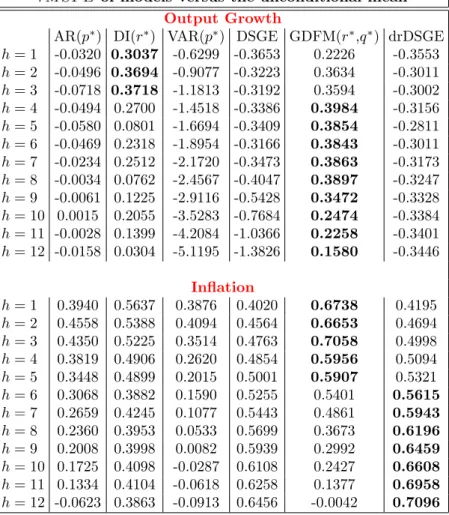
This dissertation aims to put dynamic stochastic general equilibrium (DSGE) fore-casts in competition with factor models (FM) forefore-casts considering both static and dynamic factor models as well as regular and hybrid DSGE models. The empir-ical study shows three main conclusions. First, DSGE models are significantly outperformed by the generalized dynamic factor model (GDFM) in forecasting output growth in both short and long run, while the diffusion index (DI) model outperforms significantly DSGE models only in the short run. Second, the most surprising result of the dissertation, we discovered that only the hybrid DSGE model outperforms significantly all other competitive models in forecasting infla-tion in the long run. This evidence falls out with recent papers that found just regular DSGE models able to generate significant better forecasts for inflation in the long run as well as papers where hybrid DSGE models are found to forecast poorly. Third, in most cases, the unrestricted vector autoregressive (VAR) model represents the worse forecasting model. Although our results are consistent with the prevalent literature who gives to factor models the role to forecast output vari-ables and to DSGE models the role to forecast monetary and financial varivari-ables, this research documents that exploiting more information on many macroeconomic time series, through hybrid DSGE models, is important not only to obtain more accurate estimates, but also to get significantly better forecasts.
Keywords: Diffusion Index (DI) model, Generalized Dynamic Factor Model (GDFM), Dynamic General Equilibrium (DSGE) model, Data-Rich DSGE (drDSGE) model, Equal Predictive Ability Tests.
Contents
1 Introduction 1
2 Factor models 5
2.1 The generalized dynamic factor model . . . 5
2.1.1 The identification of the GDFM . . . 8
2.1.2 Recovering the Common Components in the GDFM . . . 9
2.2 The static factor model . . . 11
2.2.1 The estimation of the static factor model . . . 13
2.3 One sided estimation and forecasting of Forni et al. (2005) . . . 16
2.4 Determing the number of factors: r andq . . . 20
2.4.1 Determining the number of static factors . . . 20
2.4.2 The number of dynamic factors . . . 22
2.5 From the static factor model to the GDFM . . . 23
3 DSGE models: from regular to Data-Rich Environment 25 3.1 Why DSGE models? . . . 26
3.2 The Data-Rich DSGE . . . 27
3.2.1 The drDSGE: representation theory . . . 29
3.2.2 Regular DSGE versus drDSGE . . . 31
3.2.3 The drDSGE estimation step . . . 34
3.3 The DSGE model of Smets and Wouters (2007) . . . 37
3.3.1 The equilibrium conditions . . . 38
3.3.2 The data-rich form . . . 43
4 The forecasting results 45 4.1 The forecasting experiments . . . 45
4.2 Forecasting models . . . 47
4.2.1 Forecasting with the AR model . . . 47
4.2.2 Forecasting with the VAR model . . . 48
4.2.3 Forecasting with the Diffusion Index Model . . . 49
4.2.4 Forecasting with the GDFM . . . 49
4.2.5 Forecasting with the regular DSGE . . . 50
4.2.6 Forecasting with the drDSGE . . . 50
4.3 Tests of equal predictive ability . . . 51
4.3.1 Test of equal unconditional predictive ability . . . 51
4.3.2 Test of equal conditional predictive ability . . . 52
4.4 Empirical results . . . 53
4.4.1 The mean square forecasting error analysis . . . 53
4.4.2 Equal predictive ability results . . . 64
Conclusion 68
Appendix A 71
Chapter 1
Introduction
Recent years have seen rapid growth in the availability of economic data. Statisticians,
economists and econometricians now have easy access to data on many hundreds of variables
that provide the information about the state of the economy. Coinciding with this growth
in available data, two main new econometric models that exploit this wider information have
been proposed: the factor models (FM) and the Dynamic Stochastic General Equilibrium
(DSGE) models. Factor models have been successfully applied when we have to deal with:
construction of economic indicators (Altissimo et al. (2010)), business cycle analysis (Gregory
et al. (1997) and Inklaar et al. (2003)), forecasting (Stock and Watson (2002a,b) and Forni et
al. (2000)), monetary policy (Bernanke and Boivin (2003) and Bernanke et al. (2005)), stock
market returns (Ludvigson and Ng (2007)) and interest rates (Lippi and Thornton (2004)).
DSGE models have been successfully applied when we have to deal with: forecasting (Smets
and Wouters (2002) and Smets and Wouters (2007)), estimation accurancy (Boivin and
Gian-noni (2006) and Kryshko (2009)), credit and banking (Gerali et al. (2008)), interest term of
structure analysis (Amisano and Tristani (2010)) and monetary policy (Boivin and Giannoni
(2008)).
Among all these applications, the recent economic global crisis has pointed out how
fore-casting well is central. For this reason, the main objective of this dissertation is to provide
a detailed forecasting evaluation between these two econometric models taking into account
of the recent developments in both factor and DSGE modelling. The novel of this research is
the expanded range of forecasting models treated. Infact, our forecasting competition
consid-ers not only static factor models and regular DSGE models but also dynamic factor models,
such as, the so-called Generalized Dynamic Factor Model (GDFM) of Forni et al. (2000) and
hybrid DSGE models, such as, the so-called Data-Rich DSGE (drDSGE) following Boivin
although there are some forecasting discussions on both dynamic factor model and regular
DSGE individually, there is no attempt in the literature, to carry out a strong forecasting
evaluation between dynamic factor models and hybrid DSGE models. In particular, what is
missing is a forecasting comparison between the GDFM and the drDSGE.
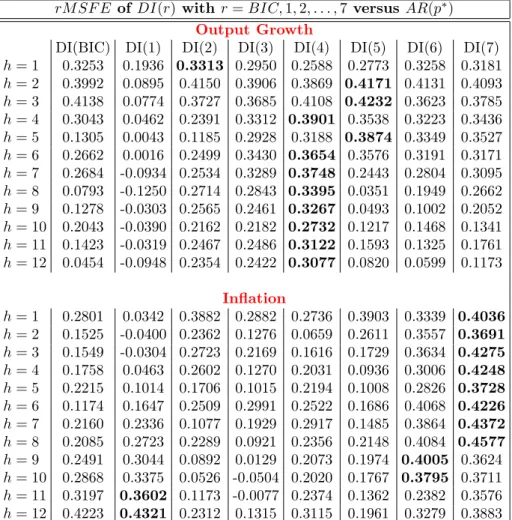
The empirical study shows three main conclusions. First, DSGE models are significantly
outperformed by the GDFM in forecasting output growth in both short and long run, while
the static factor model outperforms significantly DSGE models only in the short run. Second,
the most surprising result of the dissertation, we discovered that only the drDSGE
outper-forms significantly all other competitive models in forecasting inflation in the long run. This
evidence falls out with both Wang (2009) who found that a regular DSGE was able to generate
significant better forecasts for inflation in the long run, and Paccagnini (2011) where hybrid
models are found to forecast poorly. Therefore, the drDSGE outperforms significantly the
reg-ular DSGE in forecasting both output growth and inflation, confirming that exploiting more
information on many macroeconomic time series, through the drDSGE, is important not only
to obtain more accurate estimates, but also to get significant better forecasts. Third, in most
cases, the unrestricted VAR is outperformed by the unconditional mean of the time series of
interest, confirming that this model should not be used as benchmark model in forecasting
comparisons.
This work is closely related with Wang (2009), but while we share some of the features
of his study, our analysis is greatly expanded. First, we do not use the simple DSGE model
of Del Negro and Schorfheide (2004) but the most elaborated DSGE model of Smets and
Wouters (2007). Second, among factor models, we considered also the GDFM of Forni et
al. (2000) whose forecasting performance is documented to be superior than the static factor
model of Stock and Watson (2002a,b). Third, among DSGE models, we put side by side the
regular DSGE model of Smets and Wouters (2007) with its representation in terms of drDSGE
following Boivin and Giannoni (2006) and Kryshko (2009). Therefore, our work is also
re-lated with the fast growing literature in both factor models and DSGE models. About factor
models, Forni et al. (2000) have presented and estimated their GDFM using a two-sised filter
of the observations, Stock and Watson (2002a) have introduced their diffusion index model
demostrating its ability to outperform autoregressions and small vector autoregressions
fore-casts, Stock and Watson (2002b) have shown the asymptotically efficiency of static principal
Soggetta a copyright. Sono comunque fatti salvi i diritti dell’Università LUISS Guido Carli di riproduzione per scopi di ricerca ec didattici, con citazione della fonte.
static factors under a diffusion index model, Forni et. al. (2005) have proposed a refinement
of their two-sided filter into a one-sided filter to allow forecasting feasible, Forni et al. (2009)
have emphasized how identification schemes in strustural VAR analysis can be adapted in
their GDFM, while Stock and Watson (2010) have described in great detail dynamic factor
models. About DSGE models, Smets and Wouters (2007) have extended their previous DSGE
model allowing more structural shocks and more financial frictions confirming that the DSGE
model has a fit comparable to that of bayesian vector autoregression (BVAR) models, Del
Negro et al. (2004) and Del Negro et al. (2007) have shown that a relatively simply DSGE
model employed as a prior in a VAR is able to improve the forecasting performance of the VAR
relative to an unrestricted VAR or a Bayesian VAR, Rubaszek and Skrzypczynski (2008) have
emphasized how DSGE model forecasts are poor in forecasting inflation and interest rates in
short term, Christoffel et al. (2010) have pointed out that large bayesian VAR can outperfom
DSGE forecasts, while Edge et al. (2011) have shown how their DSGE model can forecast
poorly inflation and output growth.
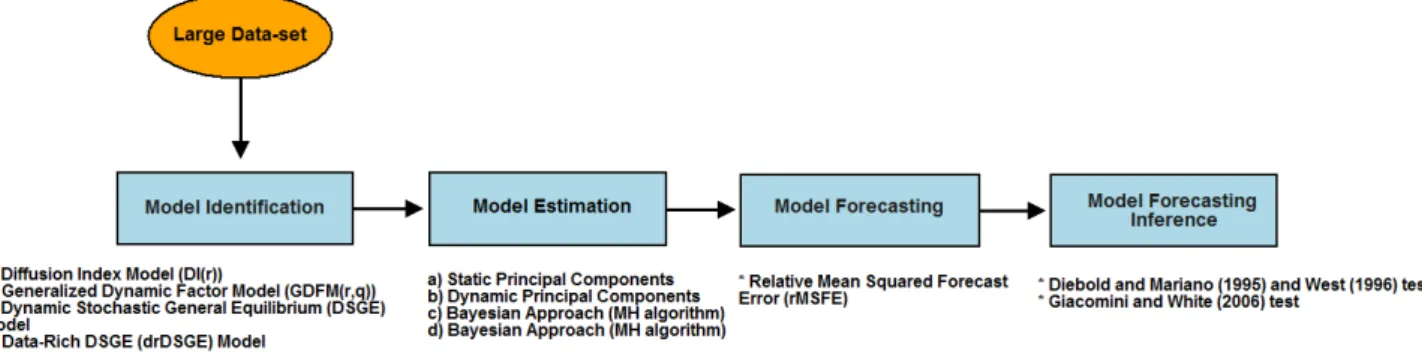
The dissertation is organized followingFigure (1.1). Given a large data-set, indeed a data-set
Figure 1.1: The dissertation path.
with many economic time series variables, we evaluate the forecasting performance of factor
models relatively to the DSGE models passing through: identification, estimation,
fore-casting and forecasting inference. We open discussing the identification and estimation
schemes of both factor models(Chapter (2)) and DSGE models (Chapter (3)). In particular,
Chapter (2)describes the identification and the estimation of both static and dynamic factor
models with a special focus to the recent identification and estimation scheme proposed by
Forni and Lippi (2001) of their so-called Generalized Dynamic Factor Model (GDFM), while
mo-tivating the advantages of using its Data-Rich Environment version. Estimated the models,
we move on forecasting and forecasting inference (Chapter (4)). The forecasting step
eval-uates the models forecasting performance through the relative mean squared forecast error
(rM SF E) metric, defined as:
rM SF E(m, n)|h= 1−
M SF Em|h
M SF En|h
whereM SF Em|h and M SF En|h denote respectively the mean squared forecast error
gener-ated from modelm at the forecasting horizion h and the mean squared forecast error
gener-ated from modelnat the forecasting horizion h. TherM SF E(m, n)|h can be interpreted as
a forecasting gain of modelm relative to the modelnat the forecasting horizionh when it is
positive, or it can be interpreted as a forecasting loss of the model m relative to the model
n at the forecasting horizion h when it is negative. In other words, the rM SF E(m, n)|h
answers to the question: ...between modelm and n, which model should be used to forecast
a given time seriesh steps ahead? This metric represents an appropriate tool to measure the
forecasting perfomance of DSGE models as documented by Smets and Wouters (2003), Smets
and Wouters (2007), Edge et al. (2010) and Edge et al. (2011).
As pointed out by Diebold and Mariano (1995) and West (1996) and Giacomini and White
(2006), the main drawback of this M SF Eanalysis is the lack of significance, indeed it is not
possible to make rigorous statistical statements by simply interpreting the observed differences
betweenM SF Esbecause any metric has not a significance power. We need to look into model
forecasting inference. We use two test of forecasting accurancy: the test of equal unconditional
predictive ability of Diebold and Mariano (1995) and West (1996) (hereafter DMW test), and
the test of equal conditional predictive ability of Giacomini and White (2006) (heafter GW
test). Since, as shown by Clark and McCracken (2001), the unconditional test has low power
in the finite sample, particularly when nested models are involved, the final results of the
Chapter 2
Factor models
“All models are wrong, but some are useful” George Box
This chapter presents the identification and the estimation schemes of the factor models used
in the out-of-sample forecasting experiments. A factor model is an econometric model where each observed time series variable xit is assumed to be linearly decomposed into two
un-observed orthogonal components, the common component χit driven by a small number of
common shocks uit, and the idiosyncratic component ξit who accounts for the residual of
that decomposition. The common component is responsable of the co-movement of the series,
while the idiosyncratic component is responsable to the specific time series variation. Both
the common and the idiosyncratic component are unobserved and need to be consistently
estimated.
The chapter is organized as follows. In Section (2.1) we start considering the
identifica-tion and the estimaidentifica-tion of the Generalized Dynamic Factor Model (GDFM). InSection (2.2)
we present the identification and the estimation of the static factor model or diffusion index
(DI) model, as special case of the GDFM. In Section (2.3) we describe the one-sided
esti-mation and forecasting of the GDFM. In Section (2.4) we face the problem of determining
the number of factors, while Section (2.5) concludes discussing the link between static factor
model and the GDFM.
2.1
The generalized dynamic factor model
The Generalized Dynamic Factor model (GDFM) is a factor model that differs from theexact factor model, in which the idiosyncratic components are mutually uncorrelated, because it allows the idiosyncratic shocks to be weakly serial and cross-sectional correlated. It combines
the so-called approximate static factor model of Chamberlain and Rothschild (1983), widely applied in financial econometrics, and thedynamic factor model of Geweke (1977) and Sargent and Sims (1977) for which respectively cross-sectional and serial correlation was allowed. The
model is called dynamic since the common shocks may not impact a series simultaneously, as in the static factor model, but they can propagate with leads or lags. Then, the model
is called generalized since the common components are derived assuming a dataset with an infinite number of series and an infinite number of observations.
To setting up the model, let’s introduce the notation. Let P = (Ω,I, P) be a probability model and letL2(P,C)be the linear space of all complex-valued, zero mean, square-integrable random variables defined on Ω. Let x = {xit, i ∈ N, t ∈ Z} be the infinite double sequence of random variables defined onxit∈L2(P,C) and let xN t= (x1t, x2t, . . . , xN t)0 be the finite
N-dimensional column vector for the observation made at timet. IfPis a complex matrix we
denoteP0 as the transpose ofPandP∗ as the complex conjugate ofP0. Withθwe denote the
real interval[−π, π]. Then, given the subsetG⊆L2(P,C), we denote the closed span ofGas
span(G)which is the minimum closed subspace ofL2(P,C)containingG. IfS is a closed lin-ear subspace ofL2(P,C)andx⊆L2(P,C), we denoteproj(x|S)as the orthogonal projection ofxonS. Therefore, we denote withΣx(θ)the spectral density matrix of the double sequence
x = {xit, i ∈ N, t ∈ Z} as function of the frequencies in θ ∈ [−π, π], while with ΣxN(θ) we
denotes the spectral density matrix of theN-dimensional vector xN t= (x1t, x2t, . . . , xN t)0 as
function of the frequencies inθ∈[−π, π]. Thei-th largest eigenvalue ofΣxN(θ), is denoted by
λxN i, while the i-th largest eigenvalue of Σx(θ) is denoted by λxi(θ). We denote the spectral
density matrices of the common and the idiosyncratic componenents and their eigenvalues in
a similar way.
We assume that for any N ∈ N the process xN t is covariance stationary, that is, it has
finite variance-covariance matrix: E[xN tx0N;t−k] =ΓxN k and spectral densityΣxN with entries
σij bounded in modulus: ΓxN k = 1 2π Z π −π eikθΣxN(θ)dθ ΣxN = 1 2π +∞ X k=−∞ eikθΓxN k
The generalized dynamic factor model
Soggetta a copyright. Sono comunque fatti salvi i diritti dell’Università LUISS Guido Carli di riproduzione per scopi di ricerca ec didattici, con citazione della fonte.
where the spectral density matrix can be estimated applying the discrete Fourier transform
to the sample covariance matrix.
Given these assumptions the model proposed by Forni and Lippi (2001) can be defined as
following.
Definition 2.1.1 The Generalized Dynamic Factor Model: Let q be a nonnegative integer. The double infinite sequence x = {xit, i ∈ N, t ∈ Z} is a q-dynamic factor se-quence if L2(P,C) contains an orthonormal q-dimensional white noise vector process u = {(u1t, u2t, . . . , uqt)0;t∈Z}={ut, t∈Z} and the double sequence ξ ={ξit, i∈N, t∈Z} such that: 1. For any i∈N: xt = χt+ξt (2.1) χt = b1(L)uit+. . .+bq(L)uqt= q X j=1 bj(L)ujt =B(L)ut (2.2)
where B(L) =b1(L) +. . .+bq(L) represents the lag polynominal of order q with bi ∈
Lq2(θ;C) for any i∈N andj= 1,2, . . . , q (or alternatively each entrybij ∈L2(θ,C) for any i∈N andj= 1; 2;. . .;q).
2. For anyi∈N, j= 1,2, . . . , q andk∈Z, we have ξit⊥uj;t−k, then ξi;t⊥χs;t−k for any
i∈N,s∈N andk∈Z.
3. ξ is idiosyncratic.
4. Puttingχ={χit, i∈N, t∈Z},λχq(θ) =∞ almost everywhere in θ.
where: χt and ξt are referred as the vector of common component and the vector of the
idiosyncratic component of xt, whileutis referred to as the vector of common shocks.
The corrisponding model in vector form is:
xN;t = χN t+ξN t (2.3)
= BN(L)ut+ξN t
Example 2.1 One dynamic factor GDFM
Let xit be the time seriesx at thei-th cross-sectional unit with i= 1,2, . . . , N, and at time t
witht= 1,2, . . . , T. Stating thatxit admits a generalized dynamic factor model representation
with one dynamic factor, means decomposing the series as:
xit = χit+ξit (2.4)
χi;t = b1i(L)u1t+b2t(L)u2t+. . .+bqi(L)uqt
where: χit is the common component, and ξit is the idiosyncratic component. The common
component is costructed with q unobserved common shocks or dynamic factors ujt for any
j= 1,2, . . . , q that are loaded with the filters bji(L) with leads and/or lags.
2.1.1 The identification of the GDFM
The GDFM model defined inEquation (2.1) must be identified. Identification means to find
conditions on the variance-covariance of the dataxtfor which the commonχtand idiosyncratic
component ξt are identified. Following Forni et al. (2000), we need to place conditions on
the spectral density matrix of the data xt, indeed on Σx(θ), under which the common and
idiosyncratic components are identified asN goes to infinity.
Assumption 2.1 Given the double sequence x = {xit, i ∈ N, t ∈ Z} where xit ∈ L2(P,C) and given the form:
xt = χt+ξt
= B(L)ut+ξt (2.5)
we assume that:
i) the q-dimensional vector process u = {(u1t, u2t, . . . , uqt)0, t ∈ Z} is an orthonormal white noise. That is, E[ujt] = 0 and VAR[ujt] =E[ujtu0jt] = 1 for any j and t; ujt⊥uj;t−k
for any j,t, and k6= 0;ujt⊥us;t−k for any s6=j, tand k.
ii) ξ={ξit, i∈N, t∈Z} is the double sequence such that,ξn={(ξ1t, ξ2t, . . . , ξN t)0, t∈Z} is a zero-mean stationary vector process for anyN, and ξit⊥uj;t−k for any i, j, t, k;
The generalized dynamic factor model
Soggetta a copyright. Sono comunque fatti salvi i diritti dell’Università LUISS Guido Carli di riproduzione per scopi di ricerca ec didattici, con citazione della fonte.
i∈Nand j= 1,2, . . . , q.
This assumption has two implications. First, it implies that the vector x = {xit, i ∈N, t ∈ Z} where xit ∈ L2(P,C) is stationary and zero-mean for any N. Second, it implies that the spectral density of the N-dimensional vector xN, indeed ΣxN(θ), can be written as the
sum of the spectral density of the common component ΣχN(θ) and the spectral density of
the idiosyncratic component ΣξN(θ). These matrices are unobserved, then to obtain their
consistent estimation we need further assumptions.
Assumption 2.2 For any i ∈ N, there exist a real ci > 0 such that σii(θ) ≤ ci for any
θ∈[−π, π].
Assumption 2.3 The first idiosyncratic dynamic eigenvalues λξN1 is uniformly bounded. That is, there exist a real Λ such that λξN1(θ) for any θ∈[−π;π]and N ∈N.
Assumption 2.4 The first q common dynamic eigenvalues diverge almost everywhere in [−π, π]. That is limn→∞λχN j(0) =∞ for j≤q, almost everywhere in [−π, π].
The Assumption 2.2 implies that all the entries σij(θ) of ΣxN(θ) are bounded in modulus,
Assumption 2.3 implies that the dynamic eigenvalues of the idiosyncratic components have
effects concentrated on a limited number of variables, while Assumption 2.4 implies that each
common shock uij is present in infinitely many cross-sectional units with nondecreasing
im-portance.
If the Assumptions 2.1 to 2.4 are satisfied, Forni and Lippi (2001) show that the double
sequence x = {xit, i ∈ N, t ∈Z} is a generalized dynamic factor model, or better, is a
q-generalized dynamic factor model.
2.1.2 Recovering the Common Components in the GDFM
Defined and identified the model, we briefly review this estimation method proposed by Forni
et al. (2000) to recovering consistently the common componentχt inEquation (2.1) starting
from the finiteN-dimensional processxN t= (xit, x2t, . . . , xN t)0. The idea is to be aware that
for the the spectral density matrix of the finite processxN t, indeedΣxN, there existN vectors
of complex-valued functions:
for j= 1,2, . . . , N such that:
a) pN j(θ) is the row eigenvector of ΣxN(θ), that is:
pN j(θ)ΣxN =λxN j(θ)pN j(θ) for any θ∈[−π, π] (2.6)
b) |pN j(θ)|2 = 1 for anyj and θ∈[−π, π];
c) pN j(θ)p∗N s(θ) = 0 for anyj 6=sand anyθ∈[−π, π];
d) pN j(θ) isθ-measurable on[−π, π].
Point a) tell us simply that the pN j(θ) for any j = 1,2, . . . , N are the eigenvectors
associ-ated to the eigenvaluesλxN j(θ). These eigenvalues and eigenvectors are calleddynamic, since they come from spectral eigenvalue decomposition (Equation (2.6))and not longer from the
contemporaneous variance-covariance matrix decomposition. Point b) affirms that dynamic
eigenvectors have unitary length, point c) states that dynamic eigenvectors are orthogonal,
while point d) affirms that the dynamic eigenvectors are functions misurable on the interval
[−π, π].
As consequence of properties a) to d) each dynamic eigenvector pN j(θ) can be expanded
as Fourier Series: pN j(θ) = 1 2π ∞ X k=−∞ [ Z π −π pN j(θ)eikθdθ]e−ikθ (2.7)
then applying the inverse Fourier transforme to pN j we can construct a square-summable,
N-dimensional, bilateral filter in the time domain:
pN j(L) = 1 2π ∞ X k=−∞ [ Z π −π pN j(θ)eikθ]Lk (2.8)
where we used the underlined notation to denotes thatpN j(L)is the inverse Fourier
transfor-mation ofpN j(θ). The product of the dynamic eigenvectors times the data, indeed the scalar
process:
dpcjt ={p
N j(L)xN t , t∈Z}
is the so-called thej-thdynamic principal component ofxN t. Notice that, dynamic principal
The static factor model
Soggetta a copyright. Sono comunque fatti salvi i diritti dell’Università LUISS Guido Carli di riproduzione per scopi di ricerca ec didattici, con citazione della fonte.
common component fromxN t, consider the minimal closed subspace ofL2(Ω, I,P)containing
the first q dynamic principal components:
UN =span(pN j(L)xN t=dpcjt , j = 1,2, . . . , q , t∈Z) (2.9)
then by projecting the data on the minimal closed subspace containing the first q dynamic
principal components, we get theN-dimensional common component:
χit,N = proj(xit|UN)
= KN i(L)xN t (2.10)
where KN i(L) = p∗N1,i(L)p
N1(L) +p ∗
N2,i(L)pN2(L). . .+p∗N q,i(L)pN q(L) is the filter matrix
that extracts the finiteN or estimated common componentχit,Nfrom the finiteN-sample data
xN t. Under the Assumption 2.1 and Assumption 2.2 this projection, indeed the estimated
common component χit,N, converges to χit in mean square as N goes to infinity, indeed:
limN→∞χit,N =χit in mean square. This result shows that the common componentχit can
be recovered asymptotically from the sequence KN i(L)xN t.
2.2
The static factor model
The problem with the previous estimator is that the filterKN i(L)used to recover the common
component from the data is a two-sided filter. A filter istwo-sided when the observed variables are related not only with the current and past values of the factors but also with their
future values. Although this leaves unaffected the estimate of the central part of the sample,
the performance of the estimator deteriorates as we approach the end of the sample. This
deterioration makes this method not suitable for forecasting. To outperform this forecasting
problem, the literature has proposed two approaches:
• Stock and Watson (2002b) have proposed a new estimation method based on the eigen-value decomposition of the contemporaneous variance-covariance matrix of xN t rather
than its spectral eigenvalue decomposition;
• Forni et al. (2005) have proposed the one-sided version of their two-sided filter, which respect to Stock and Watson (2002b) retains the advantages of their dynamic approach,
described in Forni et al. (2000), allowing observed variables to be related only with
current and past value of the factors.
The approach of Stock and Watson (2002b) bring us to the so-called static factor model or
diffusion index model (DI model), while the approach of Forni et al. (2005) bring us to the one-sided estimation and forecasting of their generalized dynamic factor model explained in
Section (2.3).
The model is called static when the vector of factors Ft are loaded in xN t without leads
and/or lags, but just contemporaneoulsy. Although the relation betweenxN tandFtis static,
bothFt and ξt can have a proper law of motion. For example:
xN t |{z} (N×1) = ΛN |{z} (N×r) Ft |{z} (r×1) + ξN t |{z} (N×1) (2.11) A(L)Ft = N t N t ∼iidNN(0;Q) (2.12) Ψ(L)ξN t = vN t vN t∼iidNN(0;Rv) (2.13)
is a static factor model, where: A(L) = I−A1L −. . .−ApLp is the static factors lag
polynominal, Ψ(L) = I −Ψ1L−. . .−ΨsLs is the idiosyncratic lag polynominal, while
N t and vN t are exogenous shocks of the common and idiosyncratic components respectly.
We have the so-called exact factor model, if we assume that the matrix Rv is diagonal,
otherwise idiosyncratic shocks are correlated and we have the so-called approximate factor model. Because any VAR(p) can be rewritten as VAR(1) using the so-calledcompanion form, throughout the dissertation, particular focus will be dedicated to the VAR(1) version of the
previous static factor model:
xt = ΛFt+ξt (2.14)
Ft = AFt−1+t t∼iidNN(0;Q) (2.15)
ξt = Ψξt−1+vt vt∼iidNN(0;Rv) (2.16)
where we dropped the time series indexN for semplicity.
The static factor model
Soggetta a copyright. Sono comunque fatti salvi i diritti dell’Università LUISS Guido Carli di riproduzione per scopi di ricerca ec didattici, con citazione della fonte.
(2.11)are not required to be uncorrelated in time, and they can also be correlated with the
id-iosyncratic components. The only condition required for identification is that: VAR[Ft] =I,
indeed the vector of static common factor has unit lenght. The dimension of Ft is always
equal to r=q(m+ 1)whereq is the dimension of the vector of common shocksut.
2.2.1 The estimation of the static factor model
Following Stock and Watson (2002b), let ΓχN0 and ΓξN0 be the variance-covariance matrices
of the common component χN t and the idiosyncratic component ξN t respectively. Let µχN j
and µχN j be the largest eigenvalues, in descending orders, of ΓχN0 and ΓξN0 respectively.
Assumption 2.5 We assume that:
a) limN→∞µχN j =∞ for1≤j ≤r;
b) there exists a real M, such that µξN j ≤M for any N.
Assumption 2.5 point a) establishes that, asN increases, the variance ofxN texplained by the
firstr eigenvalues of the common component increases to infinity. This means that asN goes
to infinity the weight of the idiosyncratic component in explainingΓxN0 becomes smaller and
smaller. Assumtpion 2.5 point b) allows that the idiosyncratic components can be correlated,
but the assumption sets a limit to the amount of this correlation. As N increases, the
vari-ance of the vectorxN t captured by the largest eigenvalue of the idiosyncratic componentµχN r,
remains bounded. Then, under both point a) and point b) of the Assumption 2.5, Stock and
Watson (2002b) shows that the static projection on the firstr static principal components of
xN t converge in mean square to the common component inEquation (2.11) for N → ∞.
To recover the common component ΛNFtinEquation (2.11), we need to estimate the vector
of static factors Ft. Assume we are working on an empirical application with the finite
pro-cess xN T ={xit, i= 1,2, . . . , N, t= 1,2, . . . , T}, Stock and Watson (2002b) have proposed to
estimate Ft as the r largest static principal components (SPC) starting from the estimated
contemporaneous variance-covariance matrix Γˆx0 =T−1PT
t=1xN T,tx 0
N T,t. The first principal
component is the linear combination of the observed variables that has maximum variance.
It is defined as the vector: spc1t = αˆN1xN t. The second principal component is the linear
is uncorrelated with the first one. It is defined as the vector: spc2t = αˆN2xN t. To recover
the common component we need exactlyr static principal components, then the r-th static
principal component will be the vector: spcrt =αˆN rxN t. To estimate the number of static
factorsr, we have used the Alessi et al. (2007) criterion.
To derive these SPC, we need to maximize the variance explained by each principal
compo-nent. Because we assumed that the data-set has zero mean, the variance of the first principal
component is: VAR[αˆN1xN t] = E[αˆN1xN t(αˆN1xN t)0] = αˆN1ˆΓx0αˆ0N1. This variance can be
incerased without limit unless we impose the unity lenght contraintαˆN1αˆ0N1 = 1. The
prob-lem becomes to maximizeαˆN1Γˆx0αˆ0N1 subject αˆN1αˆ0N1 = 1. The Lagrangian of constrained
maximization problem is:
L=αˆN1Γˆx0αˆ0N1−µ1(αˆN1αˆ0N1−1) (2.17)
whereµ1 is the Lagrange multiplier. Differentiation with respect toαˆN1 produces:
∂L
∂αˆN1
= 2αˆN1Γˆ0x−2µ1αˆN1= 0 ⇒ αˆN1Γˆ0x=µ1αˆN1 (2.18)
Indeed, µˆ1 is an eigenvalue of Γˆx0 and αˆN1 is the associated eigenvector. To decide which
eigenvector with maximum variance results from the product: αˆxN t, let’s multiply by αˆ0N1,
we obtain: VAR[αˆN1xN t] z }| { ˆ αN1Γˆx0αˆ 0 N1 = ˆµ1 1 z }| { ˆ αN1αˆ0N1 ⇒ αˆN1Γˆx0αˆ 0 N1 = ˆµ1αˆN1αˆ0N1= ˆµ1 (2.19)
So, to maximize the variance µˆ1 must be as large as possible. Thus, αˆN1 is the eigenvector
corrisponding to the largest eigenvalue ofΓˆx0 andVAR[αˆN1xN t] = ˆµ1 is the largest eigenvalue
of ˆΓx
0.
When we introduce the second principal component we require the variance of the sum of
the two to be maximum. The Lagrangian is:
L=αˆN;1Γˆx0αˆ 0
N1+αˆN2Γˆx0αˆ 0
The static factor model
Soggetta a copyright. Sono comunque fatti salvi i diritti dell’Università LUISS Guido Carli di riproduzione per scopi di ricerca ec didattici, con citazione della fonte.
where µ2 is the Lagrange multipliers corresponding to the second principal component.
Dif-ferenzation respect toαˆN1 andαˆN2 produces:
∂L ∂αˆN1 = 2αˆN1Γˆx0 −2µ1αˆN1= 0 ⇒ αˆN1Γˆx0 =µ1αˆN1 ⇒ αˆN1Γˆx0αˆ0N1 = ˆµ1αˆN1αˆ0N1 = ˆµ1 ∂L ∂αˆN2 = 2αˆN2Γˆx0 −2µ2αˆN2= 0 ⇒ αˆN2Γˆx0 =µ1αˆN2 ⇒ αˆN2Γˆx0αˆ0N2 = ˆµ1αˆN2αˆ0N2 = ˆµ2
Thus, the first order conditions are maximized if we consider the first two largest eigenvalues of ˆ
Γx
N0. In other words, the sum of first two eigenvaluesµˆ1+ ˆµ2 maximizes the sum of variances
given the unity lenght constraints. Therefore, since the second principal component must be
orthogonal to the first one, we have:
E[αˆN1xN t(αˆN2xN t)0] =αˆN1 ˆ Γx 0 z }| { E[xN tx0N t]αˆ 0 N2 = µ1αˆN1 z }| { ˆ αN1Γˆx0αˆ 0 N2 =µ1 ˆ αN1 ⊥αˆN2 z }| { ˆ αN1αˆ0N2 = 0
because eigenvectors are by definition orthogonal, indeed αˆN1αˆN2 = 0 or αˆN1 ⊥ αˆN2.
It-erating this procedure r times we get all the required principal components. Computing the
eigenvectors of the variance-covariance matrix ofxN tis equivalent to solve the so-called static
principal component (SPC) problem, defined as:
ˆ αN j = argmaxd∈RN dΓ x N0d 0 (2.21) subject to dd0 = 1 and d ˆα0N i= 0 for 1≤i < j
for j= 1; 2;. . .;r. For r= 2, we have shown that the solutions of this maximization problem
are the eigenvectors corresponding to the r largest eigenvalues of ΓxN0. Then, ordering the
eigenvaluesµˆj in descending order and taking the eigenvectors corresponding from the largest
eigenvalue to smallest, we define:
[
SPCt= (αˆN1xN t αˆN2xN t . . . αˆN rxN t)0
2.3
One sided estimation and forecasting of Forni et al. (2005)
The filtersKN i(L) inEquation (2.10) that extract the common components from the infinite
data-setxN tare unknown and must be estimated. In practice, we have to deal with finite
sam-ples, then we need to extract the common components from xN T ={xit, i= 1,2, . . . , N, t=
1,2, . . . , T}, rather than its infinite couterpartxN t. The idea is to estimate the filtersKN i(L)
under the assumption that xN t admits a Wold representation. Infact, if xN t admits a
Wold representation, any periodogram smoothing or lag-window estimator Σˆx(θ) is a
con-sistent estimator of ΣxN(θ) for T going to infinity. Therefore, also Σˆx(θ) is unknown, but it
can be estimated applying the discrete Fourier transform to the sample variance-covariance
matrix ofxN T. Let’s consider first, the estimation ofΣˆx(θ), then we consider the estimation
of the filterKN i(L) and its refinement as one sided filter.
Under the assumtpion thatxN t admits a Wold representation:
xN t=
∞
X
k=−∞
Ckwt−k (2.22)
where: {wt, t∈Z}is a second-order white noise with nonsingular covariance matrix and finite fourth-order moments, and the(ij)-th entries of the matricesCksatisfies
P∞
k=−∞|Ci,j,k||k|1/2 ≤
∞ for allN, i, j∈N. Given the sample variance-covariance matrix of the finite processxN T:
ˆ ΓxN k = (T−k)−1 T X t=k+1 xN T,tx 0 N T,t (2.23)
withk=−M, . . . , Mis the lag order fixed using the so-called Bartlett lag-windowM =M(T). Infact, to allow estimation, the number of variance-covariance matrices has to be truncated
trought the Bartlett lag-window. Estimated the sample variance-covariance matrices ˆΓxk, we
can estimate the spectral density matrixΣˆx(θ)by applying the discrete Fourier transformation
to Γˆxk. To avoid biases caused by the truncation, we need to multiply the sample
variance-covariance matrices by the Bartlett weights wk= 1−M|k+1| :
ˆ Σx(θh) = 1 2π M X k=−M wkˆΓxN ke −ikθh (2.24)
One sided estimation and forecasting of Forni et al. (2005)
Soggetta a copyright. Sono comunque fatti salvi i diritti dell’Università LUISS Guido Carli di riproduzione per scopi di ricerca ec didattici, con citazione della fonte.
where: θh = 2πh/(2M+ 1) are the number of frequencies in which the spectral densities are
estsimated, h = 0,1, . . . ,2M are the total number of points in which the Fourier
transfor-mation is worked out, and wk are the weights corresponding to the Bartlett lag-window of
size M = M(T). The estimation of the spectral density allows to decompose the
variance-covariance matrices into periodic components, fruitful to explain the dynamics of the data-set.
The choice of M represents the trade off between small bias (large M) and small variance
(small M). Forni et al. (2000) show that fixingM as the nearest integer to the square root of
the number of observations in the data-set performes well. Consistent estimates are ensured,
provided thatM(T)→ ∞ and M(T)/T →0 asT → ∞.
Now, we can observe that the estimated filtersKˆN i(L) are infinite two-sided, that is:
ˆ KN i(L) = 1 2π ∞ X k=−∞ [ Z π −π ˆ KN i(θ)eikθdθ]Lk
where, as we did before, we used the underlined notation to denotes that KˆN i(L) is the
inverse Fourier transformation ofKˆN i(θ). But, because xN t is not available neither fort≤0
nor t > T, the projection KˆN i(L)xN t onto the space spanned by the q dynamic principal
components cannot be calculated. Therefore, to allow estimation, a truncated version of the
filter may be used:
ˆ KN i(L) = M X k=−M ˆ KN i,kLk
The method discussed above produces an estimator of the common component wich is
two-sided. As discussed before, this approach has the advantage of exploring the dynamic structure
of the data, but the performance of the estimated common component deteriorates as t
ap-proaches the end of the sample, indeed 1 or T. Indeed, to compute the estimator for the last
observation, one needs M future observations which are not available, this problem makes
forecasting not possible.
To allow forecasting, Forni et al. (2005) propose a refinement of their procedure which retains
the advantages of the dynamic approach, but permits to obtain a consistent estimate of the
optimal forecast of the common component of xN t as a one-sided filter of the observations.
get-ting estimates of the variance-covariance matrices for the commmon and the idiosyncratic
components as the inverse Fourier transform of the spectral density matrix of the common
and idiosyncratic component respectively, then in thesecond step, they use these estimates
to construct r contemporaneous linear combination of the observations with the smallest
id-iosyncratic common variance ratio. In other words, they compute the eigenvalues and the
eigenvectors of the couple(ΓˆχN0(θ),ΓˆξN0(θ)), then, ordering the eigenvalues in descending
or-der and taking the eigenvectors corresponding to the rlargest ones, they obtain the so-called
generalised principal components that allow efficient estimates and forecasts of the common
component of xN t without the need of future values. Let’s inspect these steps in a more
detailed way:
first step: The first step follows Forni et al. (2000). The step is dedicated to the
esti-mation of the variance-covariance matrices of the commonΓχN k and the idiosyncratic
compo-nent ΓξN k, starting from an estimator of the spectral density matrix of the data-set, indeed
ΣxN(θ). We discussed that, under the assumption that xN t admits a Wold representation,
any periodogram smoothing or lag window estimator Σˆx(θ) of x
N T represents a consistent
estimator ofΣxN(θ)of xN t. Now, using the Assumption 2.1, we can decompose the estimated
spectral densityΣˆx(θ) into the sum of the a spectral density matrix of the common and the
idiosyncratic component, indeed:
ˆ
Σx(θ) =Σˆχ(θ) +Σˆξ(θ)
where Σˆχ(θ) =Pq
j=1pˆxj∗(θ)ˆλxj(θ)pˆxj and Σˆξ(θ) =
Pn
l=q+1pˆxl∗(θ)ˆλxl(θ)pˆxl are the estimated
spectral density matrices of the common and idiosyncratic component respectively, while
ˆ
pxj∗ is the j-th complex conjugate eigenvector ofΣˆx(θ). Then, applying the inverse discrete
Fourier transformation to these density matrices, the covariance matrices of the common χt
and idiosyncratic componentξtcan be estimated as:
ˆ ΓχN k(θ) = Z π −π ˆ Σχ(θ)eikθdθ (2.25) ˆ ΓξN k(θ) = Z π −π ˆ Σξ(θ)eikθdθ (2.26)
One sided estimation and forecasting of Forni et al. (2005)
Soggetta a copyright. Sono comunque fatti salvi i diritti dell’Università LUISS Guido Carli di riproduzione per scopi di ricerca ec didattici, con citazione della fonte.
These estimated variance-covariance matrices will be used in the second step to solve the
so-called generalized principal component (GPC) problem.
Second Step: The second step is dedicated to the estimation of the generalized principal
components given the variance-covariance matrices estimated in the first step. More precisely,
the objective is to findr independent linear combinationsWj = ˆzjxN t where the weightszj
are defined as:
ˆ zj = argmaxg∈RN dˆΓ χ N0d 0 (2.27) subject to dˆΓξN0d0= 1 and dˆΓξN0ˆz0l= 0 for 1≤l < j
for j = 1,2, . . . , r. The idea is that the information contained in the variance-covariance
matrices estimated in the previous step, can be used to determine linear combinations which
are more efficient than standard principal components. The improvement in efficiency is
produced because the idiosyncratic variance is minimized in the first step. As we have seen
before, a problem like that can be solved by compunting the eigenvalues and the eigenvectors.
In this case, we need to compute the eigenvalues and the eigenvectors of the couple of matrices
(ΓˆχN0,ΓˆξN0), rather than the eigenvalues and eigenvectors of the estimated contemporaneous
variance-covariance matrix ΓˆxN0. The aggregates that come from the couple (ΓˆχN0,ΓˆξN0) are
calledgeneralized to distinguish from the static aggregates that come fromΓˆxN0. Practically, the generalized eigenvalues are the solutions of: det(ΓˆχN0 −vjΓˆξN0) = 0 for j = 1,2, . . . , r,
while the corresponding generalized eigenvectors are the weightsˆzj that must satisfy:
ˆ
zjΓˆχN0 = ˆvjˆzjΓˆξN0 for j= 1; 2;. . .;r (2.28)
under the normalization conditions:
ˆ
zlΓˆχN0zˆ0j = 1 for l=j (2.29)
ˆ
Then ordering the eigenvaluesvˆj in descending order and taking the eigenvectors
correspond-ing to the r largest eigenvalues, we define gpcdt = (ˆzxN t ˆz2xN t . . . ˆzrxN t)0 as the first r
generalized principal component of xN t.
2.4
Determing the number of factors:
r
and
q
As mentioned in the introduction, the most important feature of factor models is to summarize
the information contained in a large panel of variables using a small number of unobserved
variables called factors. The question is that, the exact number of factors to use is not known
and it must be estimated. We need to estimate both the number of static factor r and the
number of dynamic factors q. In this dissertation the optimal number rˆof static factors is
estimated using the criterion proposed by Alessi et al. (2007), whereas the optimal number
ˆ
q of dynamic factors is estimated using the criterion proposed by Hallin and Lisˇka (2007).
Since, in empirical applications, we have to deal with finite sequences of length T of a finite
number N of variables, we describe these two criteria for a finite realization of the form
xN T ={xit, i= 1,2, . . . , N, t= 1,2, . . . , T}.
2.4.1 Determining the number of static factors
Alessi et al. (2007) have modified the criterion by Bai and Ng (2002) for determining the
number of static factors in approximate factor models. They select the true number of static
factorsˆras the number that minimizes the variance explained by the idiosyncratic component,
but in order to avoid overparametrization, their minimization is subject to a penalization,
in-deed, they have modified the original procedure of Bai and Ng (2002) by multiplying the
penalty function by a positive real number, which allows us to tune its penalizing power, by
analogy with the method used by Hallin and Lisˇka (2007) in the frequency domain. They
have shown that their modified criterion is more robust in estimating the true number of
static factors than the criterion of Bai and Ng (2002).
Formally, let’s suppose that our data-set admits a static factor model as inEquation (2.14),
here reported:
Determing the number of factors: r andq
Soggetta a copyright. Sono comunque fatti salvi i diritti dell’Università LUISS Guido Carli di riproduzione per scopi di ricerca ec didattici, con citazione della fonte.
wherextdenotes the(N×1)vector of observations given a timetforninfinite number of time
series, Λ denotes the (N ×r) matrix of static factor loadings,Ft denotes the (r×1)vector
of static common factors, and ξt denotes the (N ×1) vector of idiosyncratic components.
Considering just one single time series in xt, we can write:
xit=λiFt+ξit (2.32)
where λi denotes the i-th row of the matrix of factor loadings Λ. Bai and Ng (2002) have
proposed an information criterion to determine the optimal number of static factors r in
Equation (2.32)assuming to havekcommon static factors for the matricesλi andFt, denoted
by λ(ik) andF(tk). Let: V(k) = (N T)−1 N X i=1 T X t=1 (xit−ˆλ (k) i Fˆ (k) t )2 (2.33)
be the residual variance of the idiosyncratic componentsξitwhen the matrix of factor loadings
Λ(tk) and the common factorsFˆ(tk)are estimated using the method of static principal
compo-nents as described in SubSection (2.2.1). The idea of Bai and Ng (2002) to minimize V(k)
in order to find the optimal number of static factors. They define the following information
criterion:
ˆ
rIC_bn = argmin0≤k<rmax IC_bn(k) (2.34)
IC_bn(k) = log(V(k)) +k p(N, T)
where: ˆrIC_bn is the optimal number of static common factors,p(N, T) is a penalty function
which counterbalances the fit improvement due to the inclusion of additional common
fac-tors, and rmax is the maximun number of static factors. Notice that, when the numberk of
factors is increased, the variance explained by the factors increases too, thenV(k) decreases,
so the aim of the penalty function, which is an increasing function of both n and T, is to
avoid overparametrization. The information criterion IC_bn(k) has to be minimised in order
to determine the optimal number of static factors, its consistency is proved by Bai and Ng
(2002). In empirical applications we have to fix a maximum number of static factors rmax,
and estimate the model for all numbers of factors k= 1; 2;. . .;rmax. As a penalty function
According to what Hallin and Liˇska (2007) propose in a similar criterion for the number
of dynamic factorsq, because a penaltyp(N, T)leads to consistent estimation ofr if and only
if c p(N, T) does, wherecis an arbitrary positive real number, the idea of Alessi et al. (2007)
is to modify the criterion of Bai and Ng (2002) by multiplying the penalty function p(N, T)
by a constant c that has no influence on the asymptotic performance of the identification
method. The criterion becomes:
ˆ
rIC_a = argmin0≤k<rmax IC_a(k) (2.35)
IC_a(k) = log(V(k)) +c k p(N, T)
wherecis a constant which has the aim to tune the penalizing power of the functionp(N, T).
Alessi et al. (2007) show that the criterion IC_a(k) corrects the tendency of IC_bn(k) to
overestimate the optimal number of static factors and provide a more robust estimation ofr
than the original criterion IC_bn(k) proposed by Bai and Ng(2002). To select the optimal
number of static common factors ˆr, Alessi et al. (2007) suggest, as Hallin and Lisˇka (2007),
an automatic procedure which basically fix the number of static factors in correspondence
with the second stationary interval of the variance of the selected ˆr for the whole region of
values of the constant c.
2.4.2 The number of dynamic factors
Hallin and Lisˇka (2007) have proposed a method for determining q in a GDFM that exploits
the relation between the number of dynamic factors and the number of diverging eigenvalues
of the spectral density matrix of the finite data-setxN T. The ingredientes of the information
criterion are the estimated spectral density ofxN T, indeedΣˆx(θ), and its eigenvaluesλN T,i(θ).
The criterion proposed is:
ˆ
qIC_hl = argmin0≤k<qmax IC_hl(k) (2.36)
IC_hl(k) = log 1 N n X i=k+1 1 2MT + 1 MT X h=−MT λTN i(θh) + c k p(N, T)
where: θh = 2πh/T for h = −MT, . . . , MT and qmax is the maximum number of dynamic
factors. The authors suggest usingMT = [0.5
√
T]or MT = [0.7
√
From the static factor model to the GDFM
Soggetta a copyright. Sono comunque fatti salvi i diritti dell’Università LUISS Guido Carli di riproduzione per scopi di ricerca ec didattici, con citazione della fonte.
p(N, T) = (MT−2 +MT1/2 +N−1logAT) with AT = (min{N, MT2, M
−1/2
T T
1/2}). Therefore,
the penalty function should be large enough to avoid overestimation of qˆIC, but at the same
time it should not over penalize. To select the optimal number of dynamic common factors
ˆ
q, Hallin and Lisˇka (2007) suggest an automatic procedure which basically fix the number of
optimal dynamic factors in correspondence with the second stationary interval of the varaince
of the selectedqˆfor the whole region of values of the constantc.
2.5
From the static factor model to the GDFM
In this section, we show that a static factor model can be rewritten as a GDFM under suitable
assumptions. Let’s start considering a particular case of the static factor model described in
Equation (2.14):
xt = ΛFt+ξt (2.37)
(I−AL)Ft = But=t t∼iidNN(0;Q)
(I−ΨL)ξt = vt vt∼iidNN(0;Rv)
where we supposed that the vector(r×1)of factor exogenous shockstdepends on the(q×1)
vector of dynamic factorsuttrought the (r×q)matrix Bwithq < r. By plugging the law of
motion of the static factors into the equation of the data-set, we obtain a GDFM as in Forni
et al. (2000):
xt=
χt
z }| {
Λ(I−AL)−1But +ξt (2.38)
Then, we have shown that starting from a static or diffusion index model is possible to obtain
a GDFM assuming that the vector of r factor exogenous shocks t depends on the vector of
q dynamic factors ut. The relevant question is: ...does Model (2.38) exist? Indeed, ...can
t be expressed as the product of a matrix B times the vector of dynamic factors ut?. The
answer is given by Forni et al. (2009). They argues that Model (2.38) exists with a finite
number of static factors r if and only if the space spanned by theq dynamic factors is finite
dimensional. So, if this span is finite dimensional, the static factor model can be rewritten
as a GDFM. Therefore, the advantage of Model (2.38) respect to Model (2.14) is that, by
taking into account also the law of motion of the static factors, we can consider also the
Chapter 3
DSGE models: from regular to
Data-Rich Environment
“The more specific and data-rich the model, the more effective it will be" Jean Boivin and Marc Giannoni
This chapter presents the estimation of the Dynamic Stochastic General Equilibrium (DSGE)
models used in the out-of sample forecasting experiments. We work on two types of DSGE
models: the DSGE model of Smets and Wouters (2007), (hereafter also referred as regular or
no-augmented DSGE model), and its representation in term of the so-called Data-Rich DSGE model (drDSGE) following Boivin and Giannoni (2006) and Kryshko (2009). The motivation
from rewriting and re-estimating the regular DSGE in term of drDSGE, stands on the
doc-umented gains provided by Boivin and Giannoni (2006). Although, they have shown that:
first, the regular DSGE model is outperformed by the drDSGE in the estimation accurancy:
...exploiting more information (through the drDSGE) is important for accurate estimation of the model’s concepts and shocks, and that it implies different conclusions about key structural parameters and the sources of economic fluctuations. Boivin and Giannoni (2006)
second, better estimates imply better forecasts, at least for one quarter ahead for all pooled
observed DSGE variables:
...more precision in estimating these variables implies then more precise forecasts of the indicators. Boivin and Giannoni (2006)
nothing has been stated on the relative forecasting performance of the drDSGE respect to
factor models, especially respect to the GDFM. It remains an open part of the empirical
the output growth and the rate of inflation.
The chapter is organized as follows. In Section (3.1) we open discussing why we should
set aside factor models and build up DSGE models instead. InSection (3.2) we focus on the
approach of Boivin and Giannoni (2006), while Section (3.3) concludes showing the DSGE
model of Smets and Wouters (2007) and explaining how it has been estimated in term of
Data-Rich Environment.
3.1
Why DSGE models?
As mentioned in the introduction, the main drawback of factor models is the lack of an
un-derlying economic theory. This implies that factor models are constructed on the data rather
than using a strong economic theory based on utility-maximising rational agents. This
limita-tion makes, in principle, factor models vunerable to the so-calledLucas critique which argues that: it is naive to try to predict the effects of a change in economic policy entirely on the
basis of relationships observed in the data because the parameters of those models were not
structural, indeed not policy-invariant, and they would necessarily change whenever policy,
or the rules of the game, was changed. Then, policy conclusions based on those models would
therefore potentially be misleading:
...given that the structure of an econometric model consists of optimal decision rules of economic agents, and that optimal decision rules vary systematically with changes in the structure of series relevant to the decision maker, it follows that any change in policy will systematically alter the structure of econometric models Lucas (1976) In practice, the Lucas critique suggests that if we want to predict the effect of a policy, we
should model the deep parameters, such as preferences, technology and resource constraints parameters, that govern the individual behavior, rather than work on the data only. This
critique has been so influential that it has encouraged macroeconomists to build
microfoun-dations in their models. In this way DSGE models have been originated.
The point is that also DSGE models have important limitations. Schorfheide (2010)
evi-dences five main limitations or challenges. First, is the fragility of parameter estimates due
The Data-Rich DSGE
Soggetta a copyright. Sono comunque fatti salvi i diritti dell’Università LUISS Guido Carli di riproduzione per scopi di ricerca ec didattici, con citazione della fonte.
a DSGE model, exogenous disturbances generate macroeconomic fluctuations and we cannot
be sure whether these shocks capture aggregate uncertainty or model misspecification and
the formal econometrics is weak to distinguish these two interpretations. Third, many time
series show low frequency behavior which let the DSGE estimation difficult to implement.
Fourth, DSGE models often appear to be misspecified in the sense that VARs are favored by
statistical criteria that trade off goodness of in-sample fit against model dimensionality. Fifth,
the prediction of the effects of rare policy changes often relies exclusively on extrapolation by
theory which makes it difficult to provide measures of uncertainty. For example, Kocherlakota
(2007) explains that while a model with the worse statistical fit delivers the better policy
pre-diction, bad fit is not a guarantee of good policy prediction. These limitations produce DSGE
model misspecification, which leads to poor estimates and forecasts.
The idea proposed by the literature to get away from both factor models and DSGE models
limitations is to combine these models using an hybrid or mixture or augmented models. An hybrid model is an econometric model where a DSGE model is combined with a pure
statisti-cal data model (such as: a autoregressive process, a vector autoregressive process, a bayesian
vector autoregressive, or a factor model), in order to cover the gap between theory and data
mitigating the limitations of each model. Particular attractive is, in our view, the hybrid
approach proposed by Boivin and Giannoni (2006) whose representation, estimation and
fore-casting is dedicated the rest of the chapter. For a survey of hybrid models see Paccagnini
(2011).
3.2
The Data-Rich DSGE
This section contains both the representation and the estimation theory of the so-called
Data-Rich DSGE (drDSGE) of Boivin and Giannoni (2006), while its forecasting theory is discussed
together with all other forecasting models in the next chapter.
First of all, let’s introduce the DSGE’s notation used throughout the dissertation. Let xt
be a variable at time t, let xss be the steady state value of x, indeed the value of x not
affected by random shocks, let xˆt = log(xt)−log(xss) be its log equilibrium deviation of
lin-earized representation:
Γ0st=Γ1st−1+Ψet+Πηt (3.1)
where: st is the vector of all DSGE endogenous variables (for example: the capital ˆkt, or
the output growth xˆt), et is the vector of DSGE exogenous shocks (for example: monetary
shockert, preference shockector government shockegt),ηtis the vector of DSGE expectational
error (by definition is given by: ηt= ˜st−Et−1[˜st]where˜stis a subvector ofst that contains
expectational variables, satisfying Et[ηt+1] = 0 for all t), while Γ0, Γ1 and Πare matrices of
parameters. The linearized solution of Equation (3.1) delivers a VAR process for DSGE
state variables: ynt |{z} (n×1) = D(ϑ) | {z } (n×r) st |{z} (r×1) (3.2) st |{z} (r×1) = G(ϑ) | {z } (r×r) st−1 |{z} (r×1) +H(ϑ) | {z } (r×re) et |{z} (re×1) et∼ N(0;Qe(ϑ)) (3.3)
where: ynt denotes the n-dimensional vector of DSGE observed time series, st denotes the
r-dimensional vector of DSGE state variables,ϑdenotes the vector of DSGEdeep parameters
that we wish to estimate, et denotes the re-dimensional vector of DSGE exogenous shocks
with diagonal variance-covariance matrixQe(ϑ), whileD(ϑ),G(ϑ)and D(ϑ)denote
matri-ces of parameters as a function of the deep parameters vector ϑ. As in Kryshko (2009), in
order to interpret ther unobserved static factors asr state variables, we assumed thatsthas
the same dimension ofFt.
Handling this system for estimation and/or forecasting might generate the following
draw-backs:
1. As pointed out by Ireland (2004), this system is highly stylized, indeed it can not be
expected to mimic the data generating process (DGP):
...a method for combining the power of DSGE theory with the flexibility of VAR time-series series models, in hopes of obtaining a hybrid that shares the desirable features of both approaches to macroeconomics. The method takes as its starting point a fullyspecified DSGE model, but also admits that while this model may be powerful enough to account for and explain many key features of the US data, it remains too stylized to possibly capture all of the dynamics that can be found in the data. Hence, it augments the DSGE model so that its residuals (meaning the movements in the data that the theory cannot explain) are described by a VAR, making estimation, hypothesis testing, and
The Data-Rich DSGE
Soggetta a copyright. Sono comunque fatti salvi i diritti dell’Università LUISS Guido Carli di riproduzione per scopi di ricerca ec didattici, con citazione della fonte.
forecasting feasible Ireland (2004) pag.1206
To overcome this problem Ireland (2004) has proposed to sort out the linearized solution
adding a measurement error, which differently from Sargent (1989) and Altug (1989) is
allowed to follow an unconstrained, first order vector autoregression with no-diagonal
variance-covariance matrix.
2. ynt contains only few observed variables. Differently from factor models where all N
variables in the data-setxN tare explored, in DSGE modelling onlynobderved variables
(with N >> n) are accounted for. For example, in their DSGE model Smets and
Wouters (2007) consider onlyn= 7 observed variables, while Stock and Watson(2002a)
take into account of 215 observed variables in their diffusion index model.
3. As discussed by Boivin and Giannoni (2006), in regular DSGE models it is assumed that
each theoretical concept (such as, inflation or employment) is properly measured by a single data indicator inxN t and this choice is quite arbitrary. It means that imperfect
information is not allowed, while in realty, institutions, researchers and central banks
have different amounts of informations available.
To get away from these limitations the linearized DSGE solution must be augmented,
other-wise information is lost and DSGE model misspecification is generated. The most powerful
way, in our view, to overcome all these limitations is to combine a DSGE model with a static
factor model as proposed by Boivin and Giannoni (2006).
3.2.1 The drDSGE: representation theory
The idea of Data-Rich DSGE (drDSGE) is to extract the common factor vector Ft from
large panel of macroeconomic time series xN t and to match the state variable vector st of
the model to the extracted common factor Ft (this matching generates the so-called
Data-Rich Environment), where the law of common factorsFt is governed by the DSGE linearized
solution. The key assumption of their approach is the separation betweeen observed or data indicators andtheoretical or model concepts:
• the theoretical concepts are time series variables in the vector xN t observed by
econo-metricians or central banks, such as: employment, inflation or productivity shocks, that
are assumed to be not properly measured by a single data series, but they are merely
imperfect indicators of the observed time series. For example, the employment is
im-perfectly measured because there are discrepancies between its two main sources: one
obtained from the establishment survey and the other from the population survey.
This approach allows: first, to explore a richer amount of information by combining a DSGE
model with a static factor model; second, to introduce imperfect information on DSGE
esti-mation which is particular useful to characterize the desirable monetary policy (Boivin and
Giannoni(2008)); third, to interpret structurally the latent factors; fourth, to avoid theLucas
critique.
Let st = [ynt0 s0t]0 be the vector collecting all variables in a given DSGE model, by
defi-nition: st≡ ynt st = D(ϑ) I st (3.4)
where the sign ≡means identity. Representing the vector of common factorsFt as a subset
of the variables inst, we can define:
Ft≡Fst=F D(ϑ) I st (3.5)
where F is a matrix that generates the common factors Ft from the vector st of all DSGE
variables. Now, by substituting Equation (3.5) into Equation (2.14), we obtain the static
drDSGE observation equation:
xt |{z} (N×1) = Λ |{z} (N×r) Ft |{z} (r×1) + ξt |{z} (N×1) ⇒ xt |{z} (N×1) =Λ(ϑ) | {z } (N×r) st |{z} (r×1) + ξt |{z} (N×1) (3.6)
Then, thedrDSGE state space representationis:
xt = Λ(ϑ)st+ξt (3.7)
The Data-Rich DSGE
Soggetta a copyright. Sono comunque fatti salvi i diritti dell’Università LUISS Guido Carli di riproduzione per scopi di ricerca ec didattici, con citazione della fonte.
where ξt can be interpreted as serially correlated measurement errors. Adding their law of
motion, as we did in Equation (2.16), we obtain thedrDSGE static representation:
xt = Λ(ϑ)st+ξt (3.9)
st = G(ϑ)st−1+H(ϑ)et et∼ N(0;Qe(ϑ)) (3.10)
ξt = Ψξt−1+vt vt∼ N(0;Rv) (3.11)
where Λ(ϑ)st can be interpreted as the static DSGE common component of xt since the
state variables st are loaded in xt just in a contemporaneoulsy way. Because st contains
the vector of structural shocks ut, such as, the technical progressat and the vector of errors
in data indicators ζt , such as, the gdp measurement error yt, we may assume that these
shocks have effect in the present and in the past. Then the associated dynamic drDSGE
representation becomes: xt = B(L) ut ζt +ξt=B(L)st+ξt (3.12) ξt = Ψξt−1+vt where:vt∼ N(0;Rv(ϑ)) (3.13)
where B(L) are one-sided filters in the lag operator L as we defined in Equation (2.2), and
st = [ut ζt]0 can be interpreted as the dynamic (primitive) factors associated to the state
variables or static factorsst. This representation is not used by Boivin and Giannoni (2006)
and it remains an open part of the empirical research.
3.2.2 Regular DSGE versus drDSGE
In the drDSGE representation, the key role is played by the matrix Λ(ϑ) inEquation (3.9).
In aregular DSGE model, the number of observed variablesncontained inyntis usually kept
small (most often equal to the number of structural shocks) and theoretical concepts are often
assumed to be perfectly measured by a single data indicator in xN t. So, that there exists a
one-to-one relation between theoretical concepts and the data indicators. It implies that
matrix Λ(ϑ) is a(r×r) identity matrix, wherer is the number of state variables.
On the other hand, in a drDSGE model there are many-to-many relations between xN t
between data indicators inxN t and theoretical concepts in st. Therefore, the data indicators
inxN t are partitioned into two groups of variables:
• thecore series xF
t ∈xN t which correspond to only one model concept inst;
• the no-core series xSt ∈ xN t which are not directly relation with one specific model
concept in st but are related with more than one model concept.
In other words, the core series are time series in xN t that cannot be expressed as a linear
combination of model concepts st, while the no-core series are time series in xN t that can
be expressed as a linear combination of more than one model concept in st. The idea is to
separate key DSGE observed variables from no-key DSGE variables. For example, the core series might have been various measures of real output (such as: the real GDP or the in-dustrial production), of inflation (such as: the CPI inflation or the PCE deflator inflation)
or the nominal interest rate, instead the no-core series might include exchange rates, real exports and imports, stock returns and similar data indicators not related directly to any
model concept inxN t.
The drDSGE measurement equation becomes:
xFt − − − xSt | {z } xt (N×1) = Λ(ϑ)F − − − Λ(ϑ)S | {z } Λ(ϑ) (N×r) st+ ξtF − − − ξSt | {z } ξt (N×1) (3.14)
where the matrix Λ(ϑ)F contains just one non-zero element for each row, while the matrix
Λ(ϑ)S contains more than one non-zero element for each row and measurement errorsξ tmay
be serially correlated, but uncorrelated across different data indicators:
![Figure 4.2: The figure plots the Alessi et al. (2007) criteria [on the left] and the Hallin and Liˇ ska (2007) criteria [on the right] used to determine respectively the number of static factor r and the number od dynamic factors q.](https://thumb-us.123doks.com/thumbv2/123dok_us/1893650.2776629/58.892.120.806.758.1051/figure-alessi-criteria-hallin-criteria-determine-respectively-dynamic.webp)