Volume 2003, Issue 13
June 24, 2003
Relationship Management
in Higher Education
Information Technology
Robin Conant, Women in Technology International
Research Bulletin
Center for Applied Research
Overview
Higher education information technology (IT) service departments face significant challenges to traditional models of providing service to their constituents. Increasingly, these departments are pressured by a combination of internal institutional changes and marketplace developments. On the one hand, IT service departments face the increased expectations of incoming students along with administrative challenges to do more with less, while operational costs continue to rise. On the other hand, they find themselves “competing” with outsourcers, such as corporate help centers, that look attractive but do not necessarily provide the soup-to-nuts services required to support on-campus and remote access to institutional resources.
IT groups that serve academic institutions also confront a broad range of policy issues and legislative mandates, such as managing the privacy and security of data, accessing and protecting intellectual property, maximizing enterprise resource planning (ERP) systems, managing the increasing cost of technology, developing new funding strategies and structures, and helping faculty leverage technology in their teaching and research. In addressing these issues, savvy CIOs recognize that their organizational structures and processes must align with the educational and business goals of the client community.
Increased focus on relationship management is one response to this dilemma. Relationship management is a holistic, integrated, enterprise-wide approach to
managing customer relationships over time. Often, it necessitates a dramatic shift in IT management. Examining the nature of relationship management in IT today and its relevance in the higher education environment provides a framework for understanding how its successful execution can dramatically improve the way clients experience IT. Ultimately, a relationship-management strategy helps align IT resources with customer requirements, and it can help alleviate the following common criticisms of IT:
Lack of responsiveness to academic and business needs Ineffective use of IT resources
Inability to effectively and quickly deploy new technology System silos organized around business units and technology
Poor communications between IT and its institutional constituents—faculty, administrators, and students1
This research bulletin analyzes how four institutions—Yale University, the
Massachusetts Institute of Technology (MIT), Princeton University, and the University of California, San Diego (UCSD)—have applied relationship-management strategies in their respective IT organizations. It also provides additional insight into how various IT organizations are becoming more effective and efficient.
Highlights of Relationship Management
Although IT help desks and client-services, customer-services, and user-services departments have been around for a long time, relationship management as it applies to academic institutions is a relatively new concept. Improving on the mainframe-dominant organizations of the past, relationship management is driven by the need for IT services to be increasingly responsive to the academic and business needs of members of the academic community. Within the context of service, relationship management has become increasingly important to the success of IT organizations by sharpening their focus on results and on the impact of IT services on the business of the academy. Similarly, IT groups themselves have begun to reflect this model, influencing not only the structure of IT organizations but IT policies and procedures as well. The shift toward a service-oriented architecture, which presents IT assets as a collection of services, lends itself to an opportunity for greater alignment of internal IT processes needed to
successfully execute against customer requirements.
IT management should view relationship management as a key business process. It differs from traditional customer service in that it represents a systematic approach to developing organizational structures and inter-unit processes, whereas customer service is typically based on a transactional, event-oriented approach to service. Relationship management encompasses functional areas of support, customer service, planning, marketing, and strategic account management. It also implies effective coordination and communication among these functional areas, with a clarity of purpose focused on the customer’s needs.
While customer service focuses on the delivery and support of a specific product or service, relationship management seeks to understand how customers actually use those products and services and measures the resulting outcomes. Relationship management actually informs customer service strategies. It is inherently linked to satisfying, measuring, and improving the business process.
One of relationship management’s important strategic advantages is the ability to project demand based on a holistic view of the customer and then engage the entire IT
organization in the development of a comprehensive and coordinated response. Relationship management improves how clients experience IT by minimizing the organizational pressure between funding and performance constraints through increased client advocacy, communication, and measurement of client satisfaction. A well-executed relationship-management strategy ensures that the entire IT organization is properly aligned around customer requirements and business processes. Table 1 illustrates the primary distinctions between relationship management and customer service.
Table 1. Comparison of Relationship Management and Customer Service
Relationship Management Customer Service
Discovery of client needs and wants Performance against agreed-upon service and service levels
Definition of service and service levels,
customer expectations Response to identified customer needs, resolution of technical issues Business process management Service delivery
Long-term, ongoing Transactional, event-oriented Strategic (engages key decision makers) and
future-oriented Tactical and task-oriented response to customer and end-user inquiries Alignment of entire organization around
customer requirements and business processes Alignment of service departments around customer requirements and business processes
A solid focus on relationship management, either by formalized relationship managers (often called account managers) or through informal roles and processes, increases communication between IT and its clients, improves internal coordination across
divisions, feeds the IT planning process, and links innovations to business initiatives and goals.2 Additionally, it creates a channel for identifying relevant metrics to determine success and to measure customer satisfaction. Industry has already embraced this correlation. According to Gartner, 60–70 percent of large companies have created roles for relationship managers, up from 50 percent in 1997.3 But, is this relevant to higher education, an environment that often resists successful corporate models?
The Path to Successful Relationship Management
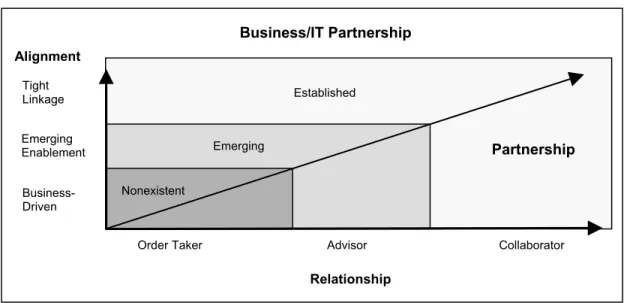
Successful relationship management requires defining a strategy, identifying processes, and executing the plan. Figure 1 illustrates how the linkage between IT services and customer needs increases as the partnership relationship between IT and the academic and business units matures.
Figure 1. Partnership Maturation
Business-Driven Emerging Enablement Tight Linkage Partnership Established Emerging Nonexistent Business/IT Partnership
Order Taker Advisor Collaborator
Relationship Alignment
Many IT shops have encountered turbulence in moving from the role of order taker to that of strategic partner.4 It takes commitment, consistency, and performance to build the trust needed to improve a weak or damaged relationship. Organizations that rush to act as strategic partners often miss the mark, especially if they have not earned a seat at the senior table or the credibility required for true collaboration. Solid execution is critical to establishing credibility. Disciplined project management and portfolio analysis are both essential for IT departments to successfully manage client relationships. These efforts foster communication and credibility, and they lead to a deeper understanding of client needs and balanced expectations. The entire IT organization becomes better positioned to establish a strong track record of performance and to execute against jointly obtained objectives, and it can begin to focus on delivering new capabilities such as new applications and services. The IT shop can also increase its communication with its client base and develop relevant performance and satisfaction metrics. Finally, with a demonstration of successful execution, the IT department is positioned to take on an active partnership with institutional leadership, proactively assessing and uncovering new opportunities.5
Yale University’s Approach
Yale University has articulated its relationship management strategy through the use of IT liaisons who work with administrative and academic departments to manage the department’s support and technology needs. Because the university functions as a collection of very independent academic units, the IT organization is organized around its clients in a distributed model. The departmental relationship includes working closely with a faculty committee and/or the business officers of a given department. In these roles, IT liaisons are responsible for helping the department to develop and execute comprehensive IT plans that cover technical and teaching support. This strategy strengthens the connection between Yale’s IT group and its faculty. With a single point of contact, faculty and staff always know where to turn for help and results, giving the entire IT organization a higher level of credibility.
For example, in an early interaction during the development of the program, the astronomy department experienced a serious security breach of multiple computers, essentially disabling their ability to work. This event led to a full-scale engagement with the IT liaison to remediate the problems. Once the remediation was complete, the astronomy department and IT worked together to develop a plan for future management of the department’s IT infrastructure. The consultation resulted in a partnership between IT and the department to create a solution that benefited both parties. The IT
organization provided guidance and expertise in the hiring of an astronomy post doc with the appropriate technical background to move the plan forward. Previously, in the absence of such solid rapport, departments often went their own way, developing ad-hoc solutions that weren’t always in their best interests, or they opted for solutions that were difficult for IT to support. The example of the astronomy department became well known in the science departments and resulted in increased credibility of IT and the diffusion of this model.
Some of the challenges that Yale’s Chief Information Officer Phil Long faces relate to increasing the consistency of technology investments and usage across the school. The key is aligning the IT organization with client interests; well-managed relationships make this possible. In an effort to assess its performance, the Yale IT department examines customer satisfaction, conducting an annual faculty survey and reviewing with clients all service level agreements (SLAs) and IT performance. In addition to the faculty survey, Yale IT plans to implement a staff survey. In the meantime, the SLA review process yields important information and insight from business officers within the department. Using the SLA review process, Yale evaluates its services and service levels by performance and continued viability. Through this annual process, IT ensures that appropriate business process management measures are taken to improve service delivery.
While these processes are helpful, Long emphasized that maintaining designated channels and ownership through his departmental managers allows clients to tell him whether the IT organization is doing a good job. He stressed the unique importance of relationship management as a key business process. Said Long, “When you talk about customer service, you’re talking about a customer pulling a product off the shelf. With relationship management, what you are really talking about is walking up to the table for a discussion and walking away from that dialogue with a negotiated service solution that both parties like.”
MIT’s Approach
According to Jim Bruce, chief information officer for the Massachusetts Institute of Technology, relationship management at MIT is distinguished by a pattern of informal relationships and roles, an environment of accountability, and regular customer satisfaction measurements that include working with clients to identify metrics, review results, and develop appropriate organizational responses to data collected. The primary objectives of Bruce’s strategy are to increase communication between IT and the
campus community and to improve internal coordination within his own organization. Directors within Bruce’s organization meet regularly with academic and administrative department heads to review IT performance and utilization and to discuss future needs. Building personal relationships is key, said Bruce, because department leaders behave uniquely. Success requires a matrix of relationships providing a rich set of connections that are both tactical and strategic in nature. Increased customer intimacy enables IT leaders to operate from the client’s perspective in the spirit of collaborative partnership. This approach has positioned the IT group to more aptly prioritize client needs and customize solutions. This process facilitates coordination within the IT organization, enabling the development of macro solutions for the relevant client community and the delivery of services in a timely way.
Additionally, an established process of measuring customer satisfaction provides another channel for IT to evaluate performance and improve service delivery when gaps are identified. For example, a recent survey revealed that MIT staff members wanted IT staff rather than student assistants to answer help-desk calls. Survey results
“regular” IT staff because the responses were better targeted to the client’s skills. In response to this concern, the help desk moved students off front-line positions to more research-oriented roles behind the scenes, thus improving customer satisfaction with the help desk.
According to Bruce, some of the greatest challenges in executing a successful relationship-management strategy within the higher education context lie with accountability and disseminating critical information. To address this issue, Bruce instituted a process of quarterly reviews in which key IT groups report on the progress of their work against commitments. Here we see the benefit of a comprehensive approach to both clients and the IT organization itself. These relationship managers are also responsible for naming their goals and objectives for the coming quarter. In terms of delineating who is actually responsible for leading relationship management, Bruce would ideally designate a central point of contact, but at this time the resources are not available to do so. Whether relationship management is designated as a specific role or a component of another role, accountability is essential, as Bruce makes clear.
MIT highlights another interesting way in which relationship management is especially critical in the higher education environment: disseminating information back into the IT organization. “Information is not a resource to be hoarded,” said Bruce, “but power and culture can get in the way.” The way university administrators are expected to do their work has changed significantly in recent years. A key element of successful client management includes managing expectations. This proves an important strategy for facilitating change and reducing resistance in an environment of uncertainty. The challenge for Bruce and his team lies in oversight of client relationships, both on the IT and client sides. Why is this important? Bruce pointed to a tendency of higher education IT groups to focus on client demand rather than to look at needs and address them. IT tends to produce micro solutions where clients actually want macro solutions.
Princeton University’s Approach
Serving about 6,500 students and 1,100 faculty, Princeton’s IT organization has recently instituted a new program aimed at providing a higher level of service and greater client advocacy. In her first year at Princeton, Chief Information Officer Betty Leydon created a team of 50 ambassadors from the Office of Information Technology (OIT) who act as liaisons assigned to academic and administrative departments. Though the program was initially slated to cover only academic departments, several administrative offices
contacted Leydon’s organization to be included from the program’s inception. The ambassadors are volunteers who take on that responsibility in addition to their current roles. The strategy behind this approach is that by gaining deeper familiarity with clients, ambassadors will uncover problems and questions that aren’t identified through the traditional channels. For example, ambassadors recently discovered some gaps in the training options offered by OIT. Faculty and staff felt more comfortable making requests informally to their ambassadors than through formal channels such as the help desk or training departments. In other instances, clients simply don’t know where to turn for a particular question that may seem too insignificant to mention or too complicated for a help-desk phone call.
At Princeton, the ambassadors provide a bridge between the IT organization and the client. They help faculty and administrative staff navigate the IT organization and act as conduits to educate faculty and staff on services provided by OIT. Leydon expects the ambassadors to be a key mechanism for disseminating information about clients’ wants and needs within her IT organization.
Coordinator Evelyne Roach oversees both the ambassadors and a more technically focused program called Support for Computing and Academic Departments (SCAD). Roach compiles the regular assessments provided by the ambassadors into one monthly report available to the OIT organization. This evolving knowledge base gives the entire IT group a broad perspective of the client base, and it gives employees who do not have direct contact with clients important insight into clients’ changing priorities. Global issues are elevated to the CIO cabinet for review and decision.
One of the challenges that Leydon’s organization faces is that many client problems need solutions that require a coordinated effort from multiple groups within IT. Cross-functional teams within OIT have been used successfully. The OIT ambassadors provide an important link in the client interaction lifecycle on the front and back ends. They identify a potential issue or problem, engage the appropriate cross-functional team, report progress to the client, and ultimately close the loop once the problem has been resolved.
To ensure that ambassadors remain accountable and highly motivated, Leydon and her managers have established a process of performance review for the volunteers as part of the annual performance review process for all IT staff. Ambassadors work with their managers to set goals for the coming review period and evaluate their progress against those goals.
UCSD’s Approach
Anticipating major growth in the coming decade, including 60,000 additional students and 7,000 new faculty members by 2010 across the entire University of California system, UC administrative leadership developed a comprehensive strategic plan to carry them forward. The plan, titled New Business Architecture (NBA), outlines in detail the strategic goals and objectives the administration has set. The document provides a framework that “will scale to meet the challenges driven by enrollment growth, technological advances, and the rising expectations of [our] constituents.”6 One of the key components of the NBA, which guides administrative planning at the UCSD campus, concerns leveraging new technology. The UCSD IT organization is fully integrated in the overall strategic planning of the university.
UCSD Chief Information Officer Elazar Harel is very clear about the role that the IT organization plays in the administration’s overall strategy. “We provide the campus with highly reliable and effective services, provide guidance on technology direction for departments, and help the reengineering process by serving as a facilitator helping business units and academic departments understand what technology can and cannot do to improve their processes.” At UCSD, IT people are seen as a resource for helping with what is possible.
These roles translate into offering campus-wide IT services and systems that reach most faculty, staff, and students at UCSD. Clearly, strong relationships facilitate much of this success. When asked about his strategy for fostering such partnership and collaboration between the business clients and IT, Harel talked about culture. He credited the
chancellor’s collaborative style and the resulting campus culture, explaining, “UCSD hires people that value teamwork and partnerships.” Harel made the rounds early in his role as CIO and got to know his clients, understanding what they needed and identifying quick wins. Relationship management at UCSD is defined by informal relationships, a high level of accessibility to executives, and a highly collaborative and cooperative culture. Harel is quick to point out that these relationships require ongoing work to achieve a high degree of credibility and trust.
Another factor in the UCSD strategy is the use of the balanced scorecard.7 A
comprehensive tool and process that encompasses business operations, the balanced scorecard serves as a critical tool in the IT planning process. The scorecard provides the IT organization with a consistent way to look at its performance and serves as an
excellent feedback mechanism. Each year, managers and customers review the results at a retreat at which action plans are developed collaboratively. This work ensures a constant dialogue between key IT leaders and their business partners and customers. During the 2002 retreat, managers were surprised by some relatively low ratings for Blink, UCSD’s business portal.8 Based on initial feedback, the Blink team organized focus groups to solicit end-user input and conduct usability studies. This led to
substantive improvements in the usability of Blink and increased customer satisfaction. While the current balanced-scorecard approach has served UCSD management extremely well, Harel sees some unique challenges for his organization in leveraging it fully. “The benchmarks for IT haven’t been as useful because it is difficult to collect directly relevant measures from other universities …. We are all organized and funded so differently.”
Another key to continued success includes an annual event hosted by IT, called Sharecase.9 Attended by more than 1,600 employees, the full-day conference creates an opportunity for UCSD to showcase technology trends, innovations, and services to university faculty and staff. The forum provides yet another opportunity for the IT group to get close to its customers and business partners, linking technology innovations and gains to the business goals and objectives of its client community.
What It Means to Higher Education
Some basic guidelines can help managers in higher education understand how best to approach relationship management. It is important to garner executive-level support for relationship management initiatives as part of organizational planning and to designate ownership and accountability through well-defined roles, responsibilities, and
performance-review processes. As with any organizational planning effort, begin the planning process with an environmental scan and situational analysis. Such analysis includes developing and updating accurate client profiles and conducting needs assessments. Obtaining feedback and input from key stakeholders is essential to
defining how the success of the relationship management initiative will be assessed. This effort helps manage expectations for both the client and the IT provider.
Adding to its relevance in the higher education environment, relationship management can be a key strategy for dealing with several challenges unique to the academy, such as the often politicized environment, strong emphasis on consensus building,
institutional inertia, funding and budgeting issues, and individual or faculty veto power. Significant changes in the expectations of incoming students also contribute to the relevance of a relationship-management strategy.
In their analysis of the impact and potential of customer relationship management applications in higher education, Grant and Anderson described a changing paradigm:
The focus is currently shifting from improving internal operations to concentrating more on customers. Higher education customers are demanding more attention and immediate service—that is, “Internet time.” Proactive institutions are now adjusting their practices by refocusing their efforts externally. Because of the need to concentrate more on customers, many institutions are once again turning to technology—this time to customer relationship management (CRM) software. Similar to ERP, CRM solutions focus on automating and improving processes, although the focus is on front office areas, such as recruiting, marketing, customer service, and support.10
Increased expectations of incoming students and the advent/implementation of CRM applications demand close collaboration between IT and university leadership. If an institution wants to apply relationship-management techniques to improve the perception, relevance, and efficiency of IT service delivery, relationship management should be approached by first obtaining executive support and then by working collaboratively with department leaders. IT organizations acting as internal service providers for academic and business services recognize this trend. A well-executed relationship-management strategy positions the IT group to partner with key decision makers to address institutional objectives.
Whether relationship management is handled by dedicated account managers or incorporated into the role and responsibility of existing employees, several key performance indicators predict the likelihood of successful execution. A relationship-management strategy should possess the following characteristics:
Commitment from the CIO and executive management
Commitment to building relationships with clients and business partners Accountability
Agreement on the definition of success
Process of performance measurement, such as the balanced scorecard, including financial performance, process performance, customer satisfaction, and employee satisfaction
Relationship managers with business-process expertise and knowledge of systems that support their clients
Broad understanding of technology Access to the CIO and senior executives
Credibility of relationship managers and the IT organization
Relationship-management objectives embedded in overall strategic plan
Key Questions to Ask
How will executives provide support and commitment to the relationship-management strategy once it has been clearly defined? How will they ensure that relationship managers have access to the CIO and executives?
Does the senior management of the institution see the value of the relationship management strategy and envision how it will contribute to the success of the institution?
How will we know if relationship management is successful? Does our vision and definition of success align with that of our clients?
What tools will be used to measure the return on the relationship management initiative? Increased use of IT services? Customer satisfaction? Cost
avoidance? Achievement of enterprise goals? All of these?
Where to Learn More
Implementing a Balanced Scorecard in Higher Education, <http://www-vcba.ucsd.edu/TQM/score.htm>.
R. S. Kaplan and D. P. Norton, “Using the Balanced Scorecard as a Strategic Management System,” Harvard Business Review, January/February 1996, pp. 75–85.
J. Luftham, “How to Improve Business-IT Alignment,” CIO Insight, November 1, 2001, <http://www.cioinsight.com/article2/0,3959,1838,00.asp>.
UCSD Business Affairs Performance Measurements, <http://www-vcba.ucsd.edu/performance/2001/>.
M. Cecere, “Evolving the Relationship Management Function,” Giga Information Group, January 27, 1998.
Endnotes
1. M. Cecere, “Planning Assumption, IT Organizational Design: Part 2—Today’s Improved Model,” Giga Information Group, March 6, 2000.
2. G. Leganza, “Roles and Functions of Relationship Managers,” IdeaByte, Giga Information Group, July 23, 2001.
3. J. Mateyaschuk, “Relationship Managers Gain Strategic Role,” Information Week, 1999, <http://www.informationweek.com/722/relate.htm>.
4. “Achieving Business IT Partnership: A Perennial Challenge,” Omega Point Consulting, LLC, 2001, <http://www.omegapt.com/connect/connect_article03.pdf>.
5. M. Cecere, “Evolving the Relationship Management Function,” Giga Information Group, January 27, 1998.
6. “UC 2010: A New Business Architecture for the University of California,” University of California, San Diego, July 2000, <http://uc2010.ucsd.edu/>.
7. “Components of the Balanced Scorecard,” University of California, San Diego, Business Affairs Performance Measurements, 2002, <http://www-vcba.ucsd.edu/performance/2002/>.
8. Blink is located at <http://blink.ucsd.edu/>.
9. Sharecase at the University of California, San Diego, <http://sharecase.ucsd.edu/>.
10. G. B. Grant and G. Anderson, “Customer Relationship Management: A Vision for Higher Education,” in
Web Portals and Higher Education: Technologies to Make IT Personal, R. N. Katz and Associates, eds. (San Francisco: Jossey-Bass, 2002), pp. 23–32.
About the Author
Robin Conant ([email protected]) is Director of the San Diego Chapter of Women in Technology International. Most recently, she led the Relationship Management initiative for the Stanford University Department of Information Technology.
Copyright 2003 EDUCAUSE and Robin Conant. All rights reserved. This ECAR research bulletin is proprietary and intended for use only by subscribers. Reproduction, or distribution of ECAR research bulletins to those not formally affiliated with the subscribing organization, is strictly prohibited unless prior permission is granted by EDUCAUSE and the author.