THE
QUERY
PROJECT
Michael Weber
European Association
for Accident Research
and Analysis
Developing Guidelines
for a Best Practice Qualification
of Accident Analysts
European Association
for Accident Research
and Analysis
THE
QUERY
PROJECT
Michael Weber
Developing Guidelines
for a Best Practice Qualification
of Accident Analysts
Part financed by the European Union (Directorate General for Energy and Transport of the European Union - DG-TREN) While every possible effort has been made to ensure the accu-racy of the information contained in this report, the author takes
no responsibility for any errors that may have occurred. Neither is the Commission liable for any use that may be made of the information contained herein. Published and co-ordinated by EVU headquarters, Hamburg, Germany
Project period July 2004 to June 2006 Key words: Accident, reconstruction, expert Layout and design: zwart design, Hamburg Lectorate: Isabel Severing, Hamburg Printed by reset Grafische Medien GmbH, Hamburg ISBN: 978-3-00-019328-6 © Hamburg 2006
The Author
Michael Weber holds a degree in Mechanical Engineering. He began working in the field of forensic reconstruction and research in 1984. In the 22 years since, he has prepared more than 6000 expert reports. In the year 2000, he set up a private institute for accident reconstruction in Hamburg, Germany, where he and his team work exclusively for the courts.
He has also written extensively on reconstruction-related matters. The standard work ‘Accident Reconstruction’, published in 2006, was co-authored by him. Michael is also the author and editor of a standard work on the forensic investigation of insur-ance fraud, the author of two standard references for lawyers concerning accident reconstruction, and co-author of two books on whiplash injuries. Since 1986, he has published more than 40 scientific papers on accident-related issues. In 1997, the study ‘Do whiplash injuries occur in low speed rear impacts?’ was awarded the AcroMed Prize by the European Spine Society (first published in Spine No. 6, 1997).
In 2001, Michael took up chairmanship of the EVU, with the aim of opening the association to all European countries and of install-ing an international network of accident reconstructionists. Today, the EVU has grown to have over 500 members across Europe.
Contents
Preface
. . . 61
Proposal for European Guidelines in Accident Reconstruction
. . . 7The QUERY Project –
Developing Guidelines for a ‘Best Practice’ Qualification of Accident Analysts
.1 Introduction 2.1.1 The Background to QUERY . . . 122.1.2 The Purpose of the QUERY Research Project . . . 12
2.1.3 The Reconstructionist within the Broader Field of Accident Investigation . . . 13
2.1.4 The European Dimension to QUERY . . . 13
2.1.5 The EVU – Bringing Together Accident Analysts Across Europe . . . 14
2.1.5.1 The History of the EVU . . . 14
2.1.5.2 The Association’s Aims and Objectives . . . 14
2.1.5.3 The EVU as a Hub for Knowledge Exchange . . . 14
. Progression 2.2.1 QUERY Phase I . . . 15
2.2.1.1 Finding Project Partners . . . 15
2.2.1.2 Conference QUERY Phase I, Budapest . . . 15
2.2.1.3 Achievement of QUERY Phase I . . . 16
2.2.2 QUERY Phase II . . . 16
2.2.2.1 The Questionaire – Development and Evaluation . . . 16
2.2.2.2 Conference QUERY Phase II, Bratislava . . . 17
2.2.2.3 Decision on the Proposal for Guidelines . . . 17
The Research Results of the QUERY Project
.1 Country Status Reports . Statistics – Detailed Results of the Questionnaire 3.2.1 Introduction . . . 563.2.2 The Professional Profile of Accident Analysts . . . 56
3.2.2.1 General Information on the Status Quo . . . 56
3.2.2.2 Opinions on the Professional Profile of Reconstructionists . . . 58
3.2.3 Qualification of Reconstructionists . . . 60 Austria . . . 20 Belgium . . . 22 Czech Republic . . . 23 Denmark . . . 28 Estonia . . . 29 Finland . . . 30 France . . . 31 Great Britain . . . 33 Germany . . . 35 Greece . . . 36 Hungary . . . 38 Ireland . . . 40 Italy . . . 41 Latvia . . . 42 Luxembourg . . . 43 Netherlands . . . 44 Norway . . . 45 Poland . . . 47 Portugal . . . 48 Slovakia . . . 49 Slovenia . . . 50 Spain . . . 51 Spain 2 . . . 53 Sweden . . . 54 Switzerland . . . 54
3.2.4 Certifying Systems . . . 62
3.2.4.1 Certifying Systems and their Availability . . . 62
3.2.4.2 Certification Procedure . . . 63
3.2.4.3 Satisfaction with Certifying System . . . 66
3.2.4.4 Effect of Certification on an Expert’s Working Life. . . 66
3.2.4.5 ISO Accreditation . . . 67
3.2.5 Remuneration of Accident Reconstructionists. . . 68
3.2.5.1 Remuneration of Self-Employed Reconstructionists . . . 68
3.2.4.2 Reconstructionists in Salaried Employment . . . 70
3.2.6 The Reconstructionist within the Legal System . . . 72
3.2.6.1 Requirement of Expert Attending the Accident Scene . . . 72
3.2.6.2 Penal case: Joint or Private Expert . . . 74
3.2.6.3 Confidentiality of Private Expert’s Report . . . 75
3.2.6.4 The Expert at Court . . . 75
3.2.6.5 Pros and Cons of the two Legal Systems - Opinions . . . 77
3.2.6.6 Litigation in the various Legal Systems . . . 78
3.2.7 Reconstructionists’ Working Fields . . . 81
3.2.8 Resources available to Reconstructionists . . . 82
3.2.8.1 Resources used . . . 82
3.2.8.2 Access to Resources . . . 82
3.2.8.3 Exchange of Information with Other Countries . . . 83
3.2.8.4 Availability of Country-Specific Further Training . . . 84
3.2.9 Endnotes . . . 84
Translation of the Proposal into most EU languages
1. Czech . . . 92 8. Greek . . . 106 15. Portuguese . . . 1202. Danish . . . 94 9. Hungarian . . . 108 16. Slovak . . . 122
3. Dutch . . . 96 10. Italian . . . 110 17. Slovenian . . . 124
4. Estonian . . . 98 11. Latvian . . . 112 18. Spanish . . . 126
5. Finnish . . . 100 12. Lithuanian . . . 114 19. Swedish . . . 128
6. French. . . 102 13. Norwegian . . . 116
7. German. . . 104 14. Polish . . . 118
Acknowledgements
. . . 1316
Appendices
Appendix I Agenda of QUERY Phase I Workshop and List of Attendants . . . 134Appendix II Agenda of QUERY Phase II Workshop and List of Attendants. . . 135
Appendix III List of Participant Countries with Country Codes . . . 136
Appendix IV Glossary / Definition of Terms. . . 137
Appendix V Excerpt from the UK’s ‘Road Death Investigation Manual’. . . 139
Appendix VI Sample Questions for Certification Examination in Germany . . . 140
Appendix VII Questionnaire: Detailed Information on European Reconstructionists. . . 142
6
Preface
Road accidents that have already occurred very rarely gain any official interest. Research work is generally focussed on accident prevention, with this report being one of the rare exceptions. While it is desirable to minimise the accident rate, we will always have to deal with the question of how to arrive at a just legal settlement of matters, both in regard to public prosecution and civil litigation.
In this regard, the accident reconstructionist (a term coined during the project) plays a pivotal role. With the help of the QUERY project, we will hopefully be able to reach a situation in which every European citizen involved in an accident in any European country can rely on a certain standard of scientific expertise with which the technical investigation is conducted.
The reconstructionists who took part in the QUERY project are a promising start in this regard. Without their commitment and enthusiasm, the project would have never been completed in such a short period of time.
Of course, technical investigation can only be as good as the material it is based on. Computer simulations cannot substitute the professional securing of evidence right at the accident spot. In this regard, the UK and the Netherlands have arrived at a profes-sional level that most other countries lack at present. Evidentially, professional training of reconstructionists and of accident inves-tigators are two sides of the same coin.
I really would like this book to be read by people concerned with the legal settlement of vehicular accidents. The reports on the status quo in all European countries offer concise access to information that has never been presented in such condensed form before. Promisingly, it reveals that the ways in which matters are handled already have a great deal in common throughout Europe. I hope that the proposals derived from this project will encourage still greater harmonisation.
Cologne, June 2006 Wolfgang Hugemann,
1. Proposal for European Guidelines
in Accident Reconstruction
I Accident Scene Examination vs.
Accident Reconstruction
Concerning vehicular accidents, a distinction should be made between two types of work:
• collection of evidence and data at the scene of an accident, including measurements (e.g. deceleration), preservation of ephemeral evidence and interviewing
• accident reconstruction, i.e. the use of scientific methods for the purpose of drawing conclusions from the evidence gathered at the scene of an accident
In most European countries, the first type of work is carried out by police officers, preferably with specialist training. We suggest calling such a specially trained person accident scene examiner.
The second type of work should be performed by persons with an academic qualification. We suggest calling this type of work accident reconstruction, and distinguishing the according profes-sion clearly from that of the first named group.
In the following, we are using the terms reconstructionist or comparable terms in the local language to describe persons carrying out such work. The use of terms like ‘technical expert’ or ‘vehicular expert’ should be avoided as they imply ambiguities.
The Netherlands and the UK do not agree with the requirement of academic qualification:
In these countries, where a system of accident scene data col-lection and analysis by the police authorities is in place, suitable training and education should be provided.
If and when an investigation is particularly complex, or it involves the application of physical laws or complex mathematics which are beyond the experience of the investigating officer, the evidence must be validated by an appropriate expert (whether a police officer or otherwise) who has the necessary knowledge and experience. In such cases, balance must be drawn between those who possess academic qualifications and those with essential practical experience.
II Protected Title for Accident
Reconstructionists
In most European countries, it is most common to use only one (‘joint’) technical expert in a trial, while in some countries there are usually two experts, one for each of the litigant parties. The use of only one expert in a trial makes severe demands on his/her qualifications and moral integrity: litigation is based on the conclusions drawn by the reconstructionist which a lay person cannot check in detail.
To guarantee qualification and moral integrity, a system of quality control needs to be established. Persons who are certified by this quality control system should be assigned a protected title (and preferably a protected stamp or seal along with it), which would enable lay persons to distinguish them from self-proclaimed experts.
This system would be comparable to the handling of titles in other professions, such as medical doctors and lawyers.
III Accident Scene Examination
Gathering evidence at the scene of a severe accident is a task which carries a lot of responsibility, and thus calls for specially trained personnel. It usually cannot be carried out by ordinary police officers.
In general, such an accident scene examiner does not need an academic qualification, as the gathering of evidence can, after suitable training, rely largely on a ready-made list of guidelines and requirements.
In the case of a complex accident, a (partial) reconstruction of the accident at the scene may, however, help in the gather-ing of the evidence, and therefore call for the attendance of a reconstructionist.
IV Qualification of the Accident
Reconstructionist
The reconstruction of an accident (as defined above) frequently calls for profound knowledge of physical and technical princi-ples, which generally can only be acquired by technical studies. A university degree in mechanical engineering, physics or a comparable subject is therefore a prerequisite for becoming a reconstructionist.
However, a university degree alone is not sufficient for carrying out this type of work. Special practical and theoretical knowledge in the field is required.
Regarding theoretical qualification, post-graduate studies are a possible approach, and would be preferable to training on the job alone. On the other hand, practical knowledge can only be acquired by practical work in the field, of which no less than 3 years are necessary. Furthermore, reconstructionists should at least have a working knowledge of the judicial system of the country they practice in, including the codes of procedure and the rules of evidence.
Reconstructionists need to possess at least a class B driver’s licence. Possession of licences in classes A and C1-CE is recom-mended. The possession of a licence in a particular class does generally not guarantee sufficient driving experience in that class. Driving experience is necessary, however, to judge the behaviour of a particular vehicle and of the driver.
V Certification Process
Candidates who wish to receive certification as reconstruction-ists should have to pass an examination in order to prove their specialist knowledge in the field of accident reconstruction.
Such examinations should be carried out by a limited number of accredited institutions. It would be essential that training and examination are not performed by one and the same institu-tion if the outcome of the examinainstitu-tion conflicts with financial interests.
The certification of a reconstructionist should be time-limited, and should have to be renewed approximately once every five years. In drastic cases, the institution which carried out the cer-tification should be allowed to withdraw it. In such an event, the certified reconstructionist should be obliged to take part in further training in order to remain certified.
VI Technical knowledge in the field
of Accident Reconstruction
Specialist knowledge in the field of accident reconstruction should comprise:
• collision mechanics • time-distance calculations
• basic knowledge of crashworthiness
• technical aspects of injury biomechanics and injury mechan-ics
• basic knowledge of human factors
• vehicle technology, especially concerning steering and bra-king systems as well as vehicle dynamics
• basic knowledge of simulation techniques
• basic knowledge of repair technologies and repair cost calculation
• technical proof of insurance fraud
• digital photography and digital imaging techniques (correc-tion/manipulation of images)
• road infrastructure
• basics of criminalistics and interpretation of evidence • as well as all knowledge required to carry out accident scene
examination
VII Remuneration
The remuneration of the reconstructionist when hired by the court should be adequate, i.e. comparable to that obtained on the free market.
VIII Reconstructionist vs. Expert for
Repair Cost Estimation
In many European countries, the profession of repair costs estimation is not clearly distinguished from that of accident reconstruction. This situation is facilitated by occupational titles such as ‘vehicular expert’.
While in repair cost estimation, judgement is required on the ‘final state’ (the damaged vehicle as it is), in accident reconstruc-tion it is usually necessary to determine dynamic processes (for instance the approach of the vehicles to the collision point). Apart from all the additional knowledge of various fields which the prac-tice of accident reconstruction requires, this dynamic approach is what distinguishes it from other fields of vehicular expertise.
Thus, an expert for repair costs estimation does not need to possess any knowledge of accident reconstruction. While an accident reconstructionist does not need any knowledge of repair cost estimation for the actual reconstruction of an accident, it might be useful if reconstructionists had a basic knowledge of repair cost estimation, as the need for a judgement on a particular estimation can arise at times.
11
. The QUERY Project –
Developing Guidelines for a ‘Best Practice’
Qualification of Accident Analysts
1
.1 INTRODUCTION
. 1.1 ThE BACkGROUND TO QUERY
Every year, approximately 40,000 people are killed on the roads of the European Union, and 1.5 million people are injured as a consequence of road traffic accidents. After a traffic accident, the question arises as to the cause of the accident and how it could have been avoided. In most cases, the answer to this can only be supplied by a suitably qualified accident analyst, who reconstructs the unfolding of the accident by means of the secured evidence material. Random sample surveys have shown that the profes-sional profile of this expert is defined very differently in the various member and accession states of the EU. As in other professional areas, it would be advantageous if this professional field could be harmonised throughout Europe.
The knowledge of the exact unfolding of an accident is an irrevocable prerequisite for the reactions to an accident, as listed in the following passages:
1. Prevention
In traffic-related court cases, criminal investigation presupposes that the unfolding of an accident is reconstructed and possible fault of the participants is proven. A preventative effect is achieved by prosecuting the culpable party.
. Just distribution of civil law costs
In most European legal systems, the material costs are paid by the insurer of the party who caused the accident. In a civil case, a party’s insurer is not liable in the event that unavoidability is proven. For a fair distribution of costs, it is necessary to determine to which extent each party is to blame. This can only be achieved by systematically reconstructing the accident.
. Compensation
Generally, the party who caused the accident is the one at fault. In this case, the victim of a traffic accident is also entitled to immaterial damages (‘compensation’). The extent of fault can be determined by the reconstruction of an accident.
. Improvement of vehicle safety on the road
The knowledge of the unfolding of an accident gained through a reconstruction can also be put to use in the form of practical recommendations as to how future accidents can be avoided (active safety), or at least how the consequences of an accident can be moderated (passive safety). An accident reconstruction expert can convert the experience gained from actual accidents, as well as from accident experiments, into technical recommen-dations which aid the improvement of accident prevention and protection.
.1. ThE PURPOSE Of ThE QUERY RESEARCh PROJECT
In all of the European states, there are highly qualified special-ists who can reconstruct the circumstances of an accident by means of analysing the accident evidence. There have always been differences between the individual countries with regard to the regulations on the education and training of accident analysts, on admittance to the courts and to other institutions, as well as on the position of the expert in court. Before the QUERY research
project, no inquiries had ever been carried out into the extent of these differences, nor into which common areas had developed. In 2004, the European Association for Accident Research and Analysis (EVU) set itself the target to firstly establish a European-wide accident reconstructionist network, and secondly to inves-tigate how the professional profile of specialists in accident reconstruction is integrated into the different legal systems. Thus the ‘QUERY’ Project, Developing Guidelines for a ‘Best Practice’ Qualification of Accident Analysts, was born.
The general idea for such research had been in existence for much longer; however, the EVU’s funds alone did not allow for such a large project to be carried out. When the Directorate General for Energy and Transport (DG-TREN) announced funding for research in this field, the EVU proposed the QUERY Project, and was granted funding of 50% of the costs. The remainder was made up of a considerable amount of the EVU’s own resources, sponsorship from the German Road Traffic Safety Council (DVR), as well as smaller contributions form several reconstruction-related organizations and individuals.
The professional profile of the European specialist in accident reconstruction can be determined through the following four questions:
1. What training must he/she have?
2. What are the minimum competences he/she must possess, and how can they be examined for admission (certifica-tion)?
3. How can further quality controls be carried out after admis-sion?
4. How are accident investigators remunerated?
For the first time, an overview of this data has now been col-lated: Detailed information on issues such as how the expert is incorporated into the various legal systems, what status he or she has, and what professional qualifications he or she must possess in the individual countries is now available. The Country Status Reports (see chapter 3.1) give a country-by-country overview of these details. The quantified analysis of the questionnaire results (see Statistics, chapter 3.2) provides a comparison between all participant countries.
More importantly, through consultations with the partici-pant countries, the professional profile of the expert in accident reconstruction was analysed, and guidelines for a ‘Best Practice’ qualification were developed. The final result of these consulta-tions was the adoption of the Proposal for European Guidelines in Accident Reconstruction (see chapter 1, and chapter 4 for same in other European languages).
1 .1. ThE RECONSTRUCTIONIST wIThIN ThE
BROADER fIElD Of ACCIDENT INVESTIGATION
Accident analysis, or reconstruction, is a relatively new pro-fessional specialisation, which has developed over the last few decades. It involves the reconstruction of road traffic accidents by way of forensics.
The accident reconstructionist, in most countries academically trained as an engineer or physicist, is commissioned by courts of law or by disputing parties – for example insurance companies – to reconstruct the unfolding of an accident on the basis of objective evidence. This professional branch exists in all European countries, but in many, it is generally only rarely made use of by the courts. In most of Europe, the reconstructionist is usually hired by the court as an independent expert.
This professional specialisation has had parallel development in the US and the UK. There, in contrast to other European countries, a reconstructionist is not commissioned by the court, but by the disputing parties. Both parties have their own expert, who will then exchange their frequently differing points of view before the court.
Accident researchers are less concerned with the reconstruction of traffic accidents than with the actual unfolding of an accident. They are mainly employed at research institutions, such as devel-opment departments of the automobile industry or universities. Their goal is to improve the passive or active safety of vehicles. It is important for their work that they can refer to the findings of accident reconstructionists. At the same time, accident reconstruc-tionists, who are more active in a practical capacity, can profit from the theoretical research results of the accident researcher.
There are many other experts in the field of accident inves-tigation. A very large group consists of specialists concerned with damage calculation, i.e. with determining the extent of the damage caused. These are either independent claims adjustors, or damage assessors employed in the insurance industry. The term loss adjustor is also used at times.
Another group of vehicle specialists are the experts invehicle examination. They are mainly employed in the field of technical vehicle monitoring.
Each of the above professional fields requires a particular expertise. With the development of such specialisations, a clear distinction between the professional profiles of the various experts working in the broader realm of accident investigation has become necessary.
One of the aims of the QUERY project was therefore an actual definition of the various professional profiles, so as to make a distinction between these possible even for the lay person.
.1. ThE EUROPEAN DImENSION Of ThE RESEARCh
A reliable and accurate reconstruction of road traffic accidents is only possible if and when the accident reconstructionist possesses the greatest possible specialist knowledge. From the experience gathered through their work, recommendations on both vehicle and road safety can be developed by reconstructionists, which may be converted into directives or laws, either on an EU or on a national level.
An increasing number of accidents involving citizens of other member states can be expected as a result of the expanding internationalisation of traffic. It is reassuring for both the ‘paying insurance’ and for the citizen to know that an accident analysis
is carried out by a qualified reconstructionist who fulfils criteria which apply throughout the EU. Such criteria also strengthen legal security within Europe.
This does not only apply to traffic accidents, but also to the monitoring of traffic offences. In some countries, questionable measuring methods are still used, which can lead to incorrect measurements. In a large number of countries, accident recon-struction experts are frequently consulted to verify these meas-urements to the courts.
Accident analysts take a great interest in the work of their professional colleagues in the other EU member states and futher afield. This is visible, for example, in the numbers attending the annual conferences held by the EVU. The foreign departments of insurance companies attach great importance to accidents in other countries being dealt with correctly and comprehensibly. They are therefore very interested in publications on this subject. Lawyers who deal with damages abroad need qualified experts on location.
If a standardised professional profile of the specialist in acci-dent reconstruction was successfully set down in writing, and a European certification was achieved, a quality assurance would be available to any of the groups requiring the services of a recon-struction expert, and a register of qualified experts throughout the entire EU could be made available.
1
.1. ThE EVU – BRINGING TOGEThER ACCIDENT ANAlYSTS ACROSS EUROPE
.1..1 The history of the EVU
The European Association for Accident Research and Analysis (EVU) was founded in 1991 by the German accident analyst Dr. Heinz Burg, to improve the standard of accident analysis and accident research.
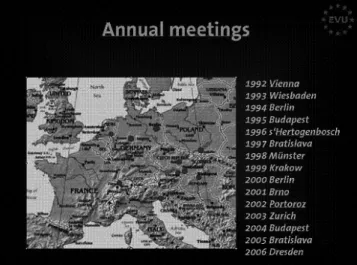
The EVU’s first conference was held in Vienna in 1992. Their annual conferences have since developed into an important educational event for accident analysts throughout Europe. The association was managed directly from its headquarters in Wiesbaden, Germany, until the year 2000, when it was restructured due to the constantly growing number of members. The EVU now consists of an umbrella association (‘the EVU’) with headquarters in Hamburg, Germany, as well as of individual country groups. Any European country may establish such a Country Group, and many EU countries, as well as Switzerland, have already done so. At the end of 2005, the EVU counted approximately 500 members from 24 countries.
.1.. The Association’s Aims and Objectives
The EVU aims to promote the improvement of accident research and of the methodology of accident analysis, as well as to con-tribute to an increased legal security in the process. Within the realms of its possibilities, the EVU further aims to improve traffic safety by publishing information on the unfolding of accidents, and by using the knowledge gained from the unfolding of actual accidents to derive concepts for the improvement of both active and passive safety. The EVU’s complete aims and objectives can be found in the association’s statute, which is printed in full in appendix VIII.
The EVU carries out its own research or takes part in suitable projects. The results are primarily made available to its members. Through publications and congresses, they are also passed on to the public.
Members appointed by the EVU contribute to national and international expert panels. The EVU makes every effort to sup-port international cooperation for the further development of science and research in the field of road traffic safety and accident research. The association is also committed to the harmonisation of training and of the appointment of experts.
It works together with the authorising and certifying bodies at national level, and promotes the European standardisation of the reconstructionist’s professional profile. The EVU Country Groups attend to the national interests of the profession and are represented on the corresponding boards.
The association holds an ordinary members’ meeting every year, which always takes place in the framework of the EVU annual conference, and is held in a different member country each year. The EVU also tries to foster ongoing training for reconstructionists by examining international educational events and recommend-ing suitable ones.
.1.. The EVU as a hub for knowledge Exchange
Achieving a high standard of education depends, to a large degree, on the exchange of information and the sharing of knowl-edge. While in the EVU’s early days, the association would have liked to use a European members’ journal to such end, this was beyond its financial means at the time.
Technological development since has of course paved the way for a much more accessible platform. Today, an extensive database on the EVU’s website, www.evuonline.org, is available to its members.
The dynamically constructed ‘European knowledge base’ went online at the beginning of 2004. All information, including a large amount of downloadable documents, is stored in an Access data-base with comprehensive search and research possibilities. Any new documents can be uploaded by the members themselves. The easy-to-use structure only requires a few clicks of the mouse. For the upload, editorial rights to the website are necessary, to ensure that all information is vetted before uploading. Any new material is therefore first sent to one of the members who possess editorial rights.
The following areas are covered in the knowledge base: • Comprehensive data collection with specialist articles, books,
worksheets, programs and Excel sheets
• Experiment database with differentiated research possibili-ties
• Calendar of events for specialist conferences and seminars • Collection of subject-related links
On the publicly accessible part of the site, address lists of experts and organisations are available. These are very useful tools for finding a suitable reconstructionist at a specific accident location.
The site is currently available in German and English. The knowledge base still contains many German-only publications. Over time, the EVU will be making the entire knowledge base available in the English language as well.
1
. Progression
..1 QUERY PhASE I ..1.1 finding Project Partners
The first step in the project was the search for competent contact persons from all EU countries. Partners in 26 countries were found. Apart from all EU countries bar Malta, Switzerland and Norway also offered to participate.
Switzerland – where an EVU Country Group is also in existence – was a rather significant partner, not only because of its central European location, but also because all German-speaking coun-tries have been important both to each other and to much of Eastern Europe with regard to knowledge exchange.
With Norway participating, it was also possible to include the whole of Scandinavia in this research.
We enquired as to the current situation in the various countries with regards to the following:
• reconstructionists’ qualifications • certification or accreditation methods • competences required for such certification • the reconstructionist’s position in court • reconstructionists’ working conditions • their working areas
• associations, institutions and activities
This information, gathered in the Country Status Reports from all the participant countries, is printed in full in chapter 3.1. While no partner was available in Malta to participate in the QUERY project, contact with a Maltese expert has since been made. Largely due to the small size of the country (an average of 24 fatal accidents occur there per year), the profession of reconstruction expert is not represented there as such, with the above expert the only one of his kind. Thus, no court expert lists are in place, nor were official authorities able to aid in the search for a suitable partner.
All communication was done through both English and German, to cover the foreign languages spoken in both the Western and Eastern parts of Europe. Any material made available by the par-ticipants was translated into the respective languages, so as to make it available to all project partners.
The reports had been submitted either in the local language or in English or German. Most required both clarification and correc-tions. While language difficulties were at play, this was also due to two other reasons: Firstly, the differing systems in the various countries often have different authorities in place, for which a specific nomenclature - not necessarily existent in other languages - is used. Secondly, both the nomenclature and the responsibilities of the various experts in the broader field of accident investigation also vary between countries.
The participants were then invited to the first workshop of the QUERY project, held in Budapest on November 4th, 2004.
..1. Conference QUERY Phase I, Budapest
The QUERY Phase I workshop was attended by experts from virtually all European countries (for detailed information, see appendix I – List of attendants).
To introduce the participants to the various concepts of the professional profile across Europe, nine representative countries were chosen to give an overview of their respective situation.
While the profession does exist in all European countries, it became apparent that the countries to the West of Europe (Spain, Portugal, France and Italy), as well as the Scandinavian countries, make much less use of experts in the reconstruction of road traffic accidents than the Eastern European and the German-speaking countries do. In the West of Europe, experts are mainly consulted in penal cases. Civil litigation is relatively uncommon there, as insurance companies try to avoid taking disputes to court. In comparison, reconstructionists in Germany, Austria and Switzerland are frequently consulted in civil litigation, to ensure a fair distribution of costs.
In these countries, vehicle owners often possess a traffic-related legal expenses insurance. Thus, in a civil case, the plaintiff carries no risk of having to bear any of the cost. As a consequence, in many cases the decision to go to court is neither based on the costs related to the case, nor on the value of the claim. In coun-tries where such insurance is available, a considerable part of a reconstructionist’s work relates to such claims. This sector of the insurance industry is growing steadily, and is most likely to expand to other parts of Europe.
The British legal system, similar to the American and Australian models, differs from most European ones in that virtually no joint experts are used in court. Instead, two or more experts are hired directly by the litigant parties, whose opinions compete against each other. The other countries mostly differentiate between a joint ‘court expert’ or ‘expert witness’, and a private one. The posi-tion of a court-hired expert is generally much stronger than that of a private one. While a list or panel of court experts is available to the courts in most countries, in many cases the criteria for registration on such a list are unclear.
The countries to the East of Europe have a surprisingly high standard in accident reconstruction, in most cases significantly higher than that in Western Europe. The remuneration court experts receive is, however, very low there (between €3 and €11 per hour). The expert needs to take on private clients to make ends meet.
With the many differences across Europe in mind, the minimum requirements necessary for the qualification and certification / accreditation of reconstructionists were discussed.
The vast majority of workshop participants agreed that an academic education with a degree in engineering or a similar discipline had to be a minimum requirement for the reconstruc-tionist’s profession. Where the degree does not include the basics of accident reconstruction or vehicle technology, postgraduate studies were considered necessary.
The Netherlands and Great Britain, however, have a different system of accident investigation in place, which is chiefly carried out by the police. These two countries therefore expressed con-cern over a guideline regarding minimum qualification require-ments which may give the - non-academically qualified - police no authority whatsoever over carrying out accident analyses.
The participants also agreed that certification as a court expert should additionally require several years of working experience in a reconstructionist’s office. This certification should not be valid for life, but limited to a period of two to five years. The moral integrity of the applicant should also be examined, as well as monitored after certification has been granted.
16
The workshop concluded with an initial framework of necessary ‘best practise’ guidelines being drawn up. It was decided that the following issues would need to be included in the guidelines:
• minimum requirements regarding qualification of experts • required postgraduate studies
• required working experience in the profession
• further necessary requirements, such as driver’s licences • criteria for accreditation / acceptance on a panel of
court-appointed experts
• quality assurance by means of an official seal for the European reconstructionist
• composition of an expert commission for the accreditation of reconstructionists
• catalogue of examination requirements for accreditation • minimum requirements regarding the expert’s moral
integ-rity
• temporal limitation of the accreditation’s validity
..1. Achievements of QUERY Phase I
In Phase I of the project, partners were found and all relevant information was gathered. The workshop, which concluded Phase I of the project, brought together accident reconstructionists from virtually all EU countries for the first time. This made a framework of necessary ‘best practice’ guidelines possible. Also, it helped define areas in which more in-depth information was required, which was to be gathered in the second phase of the project by means of a standardised questionnaire.
The Country Status Reports were published in an interim report in mid-2005.
The QUERY participants from the Western parts of Europe, from Scandinavia and the UK had expressed disappointment at the lack of exchange with Central and Eastern Europe. The EVU’s membership base has traditionally come from the German-speak-ing countries and from Eastern Europe. Hence, the EVU’s main language of communication had always been German.
As the EVU is the only pan-European organisation of its kind, it has now switched to English as its main language of communica-tion, and is publishing all material in both English and German.
Furthermore, another large step toward an increased pan-European exchange of knowledge was taken as a direct result of the QUERY Phase I workshop: an email discussion forum for European reconstructionists, accessible at http://uk.groups.yahoo. com/group/eurec, was set up shortly afterwards.
.. QUERY PhASE II
...1 The Questionnaire – Development and Evaluation
In the second phase of the QUERY project, an extensive stand-ardised questionnaire was developed to provide further detailed information as well as opinions on the status of the accident analyst.
Detailed questions on all points addressed in the Country Status Reports were put to the participants, and have now been gathered in a quantified analysis. Furthermore, by means of the questionnaire we were also able to establish how the broader field of accident investigation in general is organised in the vari-ous European countries, and which functions other professions fulfil in this area.
The questionnaire covered the professional profiles of recon-structionists in the participant countries as well as their working fields. Also, details on the professional qualifications needed to carry out reconstruction and on the availability of education and training were gathered. Detailed information on the availability of certification and on other methods used for the accreditation of experts was obtained. We also inquired as to the resources available to reconstructionists within their own countries, and as to the international exchange of information already taking place. Further, details on the remuneration reconstructionists receive were gathered and compared with that of other professions with a similar standard of academic qualification. It was also established how the various legal systems function, and how reconstruction-ists are incorporated into these.
Opinions on issues such as the professional profile of recon-structionists, the minimum requirements for their qualifica-tion, and the suitability of different certifying systems were also established by means of the questionnaire. These are reflected in the decisions made on the recommendations contained in the Proposal for Guidelines.
Responses from 23 countries were received. Of the 27 countries participating in QUERY, all except Estonia, Lithuania, Malta and Ireland submitted a response. The statistics gathered by means of the questionnaire can be found in chapter 3.2.
Participants were then invited to the second QUERY workshop, which was held in Bratislava on October 20th, 2005.
1 ... Conference QUERY Phase II, Bratislava
At the second and last QUERY workshop, the evaluation of the questionnaire was presented to the participants. This provided a quantified overview both of the individual countries’ situations and the respondents’ opinions regarding the minimum require-ments for the qualification of accident analysts.
Two presentations were then held, entitled ‘Training on the Job vs. Academic Study’. These highlighted the fact that there are two differing positions in Europe as to the qualification of the accident analyst.
The QUERY partner from the Netherlands introduced the participants to the Dutch system. There, only police officers with adequate specialist training are authorised to deal with traffic accidents, including their reconstruction. Detailed guidelines (‘GT norms’, regarding forensic medicine and technical procedures) specify which training courses a police officer must have attended in order to gather evidence at an accident scene, to investigate vehicles or to reconstruct accidents. For each field of activity there is a separate ‘GT Norm’. There is also a supervisory body, the NFI (Netherlands Forensic Institute), in existence. The NFI basically moni-tors the work of the police. In the event of disputes relating to the gathering of evidence or to the reconstruction of an accident, the NFI can be called in.
In the Netherlands, the police officers who work in the above fields generally do not possess an academic qualification. The Dutch representative at the conference was of the opinion that the training completed by the police can be seen as being on a comparable level to the academic education in other countries. Hence, while the Dutch model could not be applied in other countries, as a comparable set-up does not exist elsewhere, he considered the Dutch model as on a par with the systems in other parts of Europe.
The British representative was of the same opinion. The system there is very similar to the Dutch one. In the UK, a ‘City & Guilds’ certificate is available to police officers, which authorises them to carry out accident investigation. There is also a superordinate authority, the Forensic Science Laboratory, in existence.
In the UK, there are also guidelines as to the limitations of police officers’ competencies and responsibilities. This can be seen in the ‘Road Death Investigation Manual’ published by the Association of Chief Police Officers (APCO), an excerpt of which can be found in appendix V. From the text it becomes clear that a police officer’s training is not always sufficient for the reconstruction of complex accidents.
The second presentation was held by the Polish representa-tive. In Poland, an academic degree is a prerequisite for obtaining accreditation as court expert. Also, proof of working experience in the field has to be produced. Currently, the Polish accreditation criteria are in the process of being tightened further, with a special-ist two-year postgraduate training course being demanded.
The vast majority of experts attending the conference were of the opinion that an academic degree in engineering, physics or comparable was an indispensable prerequisite to the professional qualification.
All participants agreed that neither the Dutch nor the British model could be applied in other countries, as elsewhere no com-parable set-up exists and would have to be created first.
Furthermore all agreed that an ordinary police officer with only very basic training in accident data collection is not in a position
to carry out the reconstruction of an accident. This opinion is also clearly reflected in the questionnaire results; see chapter 3.2.2.2. In European countries other than the Netherlands or the UK, there is no training on accident investigation available to the police; yet, there are several countries in which the police inves-tigate accidents and are even asked to give evidence in court. This may relate to how the accident might have occurred, an issue on which no conclusions can be drawn without a specialist qualification.
... Decision on the Proposal for Guidelines
In the discussion of the different points of view in relation to the first recommendation, no consensus could be reached. All par-ticipants except the Netherlands and the UK were of the opinion that only academically qualified persons should carry out accident reconstruction. The function of the police should be limited to the gathering of accident evidence, while the analysis of same should be left to academically qualified persons. Due to the disagreement of the representatives from the above two countries, their differing opinion was included in the first recommendation.
In May 2006, well after the conference, the Country Group Austria let us know that in their country, students from both the University as well as the HTL (Höhere Technische Lehranstalt – Higher Institute of Technology) can presently obtain certifica-tion as reconstruccertifica-tionists. While with an academic degree 5 years of working experience are required, this increases to 10 years for the HTL qualification. The qualification from the HTL can also be credited towards a degree course at a University of Applied Science – in that event, a degree can be obtained there after only two further years of study.
The second recommendation was unanimously agreed upon. All participants were of the opinion that a pan-European pro-tected title for the expert in accident reconstruction was urgently needed.
The third recommendation was also decided unanimously. In general, the gathering of evidence at an accident scene may be carried out by the police. In the event of a more complex accident, however, an expert with experience in reconstruction would need to be called in. He or she would be in a position to gather and analyse evidence details which an ordinary police officer might overlook and thus not document. Also, this expert could already make recommendations at the accident scene as to further neces-sary investigation, both on the vehicles involved as well as in rela-tion to the documentarela-tion of evidence material. The importance of evidence material may only become clear when the nature of the marks left on road or vehicles has been analysed.
Consensus on the fourth recommendation was reached after an in-depth discussion. All participants agreed that postgraduate studies were of particular importance when they are based on a degree which did not include accident reconstruction as a subject. It was generally bemoaned that there were hardly any European universities which offer accident reconstruction as a subject at degree level. As a consequence, in some countries, there might be an insufficient number of qualified reconstructionists available in the near future. In others, such as Germany, this is already the case today.
This situation could be improved if universities were to offer the subject at least as an elective one.
1
The fifth recommendation was also unanimously agreed upon. A general grievance was the fact that in many countries the same institutions who offer certification also offer preparatory courses subject to fee. Training and certification should be strictly kept separate.
It would be desirable to have the examination criteria which are used for certification standardised throughout Europe. The relevant subjects for examination were gathered at the confer-ence and put down in the sixth recommendation. In appendix VII, we give a sample set of questions from such an examination for reference. These, prepared by Wolfgang Hugemann, chairman of the largest German Certification Committee, formed part of the 2006 certification examination.
The seventh recommendation appears to be self-evident. But the questionnaire, the Country Status Reports and the discussion at the conference itself all showed that issues on remuneration are handled very differently in the various countries.
Particularly in the Eastern European countries, the rates for court-hired experts are significantly lower than those for an expert on the free market (insurance companies, lawyers or private indi-viduals). There is always the risk that, in rare cases, the expert’s objectivity could suffer. A comparable rate of remuneration for a court-hired expert would prevent the enticement of getting too closely involved with lucrative partners on the free market. Poor remuneration, which is not comparable to that on the free market, generally has to be compensated by increasing the number of hours which are invoiced for a particular expert report. This way of invoicing has become a common way of financial survival in quite a few European countries.
A rate of remuneration which is not comparable to that received on the free market is incompatible with the appreciation the reconstructionist should receive for his or her work.
There was also unanimous agreement on the eighth agree-ment. In some Eastern European countries, but especially in Germany and Austria, the professional profile of the expert for accident reconstruction is not clearly distinguished from that of the expert for damage calculation. The participants were all of the opinion that the tasks in these two professions greatly differ from each other.
The calculation of damages is a process which is standardised to a large degree. Only very few of the skills necessary for the carrying out of damage calculation overlap with those a recon-structionist needs to possess as per recommendation VI. There was consensus among all participants that therefore the terms used for these two areas would also need to be clearly distinguished from each other.
The full Proposal for European Guidelines in Accident Reconstruction is printed in chapter 1. Translations of same into EU languages can be found in chapter 4.
In appendix VI, we give a sample set of questions from such an examination for reference. These, prepared by Wolfgang Hugemann, chairperson of the largest German Certification Committee, formed part of the 2006 certification examination.
1
. The Research Results of
the QUERY Project
0
.1 Country Status Reports
QUERY, Phase 1
Qualification of European Reconstructionists
Budapest workshop, Nov 4, 2004
Austria
Univ. Prof. Dl Dr. Ernst Pfleger, [email protected]
Qualification
The system of experts in Austria is regulated by the “Federal Law of Officially Sworn and Legally Certified Experts and Translators” (SDG)”. (BGB1. Nr.137/1975 idgF.).
In order to become a registered expert, the following general requirements of competence need to be fulfilled: physical and mental aptitude, trustability, the Austrian or citizenship of other European Union Member State, as well as the citizenship of other contracting states of the Treaty on the European Economic Area. In addition to that, the membership in the Swiss Confederation, the residency or place of work in the district of registration, and orderly economic conditions, are possible preconditions for registration.
To become registered, the applicant needs to meet the fol-lowing professional requirements: He or she needs to possess expert knowledge of the desired field of expertise, as well as the core regulations of the procedural law, and the expert system as such. Furthermore, he or she is required to have skills in accumu-lating evidence and laying out a coherent and comprehensible expertise.
Moreover, the authorities ask for a ten-year professional practice in a responsible position in a destined or related field of activity, immediate before registration. However, in cases in which the applicant has graduated from Technical University or holds a Higher Vocational School Degree, a five-year practice of that kind is demanded. For example, in the field of “Roadworthiness” a broad technical training including mechanical and physical engineering is recommended. Respective knowledge of apperception psychol-ogy is also called for
Expert Registration
The registration of experts in a particular expert list, is carried out by the presidents of state courts in the applicant’s place of work.
In the course of enrolment, the chairman of a court of law obtains an expertise by an independent commission, in order to examine the applicant’s competence, his or her professional qualification and the knowledge of the processes of regulation.
The commission comprises a judge as its chairman and two specialists who have either been appointed by the chamber or the legal lobby of the respective specialist area, and the Austrian Association of Publicly Sworn and Certified Experts.
The commission is to examine the applicant orally, if need be, also in written form, whereas he or she can be asked to deliver a test expertise. For purposes of exam preparation, the Austrian Association of Officially Sworn and Legally Certified Experts offers
introductory seminars in judicial training that are considered a precondition for admission.
In contrast, applicants with an academic qualification in the respective field from an EU-Member-State university, a contract-ing state of the Treaty on the European Economic Area, or the Swiss Confederation, are considered sufficiently qualified so that this part of the exam does not apply for them. This holds also for those applicants whose professional code entitles them to making expertise (i.e. Specially Certified Engineers).
After a passed exam, the expert is to be sworn in which obliges him or her to make a thorough and complete investigation, and deliver an expertise to the best of one’s knowledge and in accord-ance with the rule of science. Furthermore the expert is sworn to impartiality and thus obliged to equally consider both sides of the evidence. In addition to guaranteed quality of expertise, the official certification has the effect that the expert need not take an oath at the court.
For the purpose of identification, the expert receives an ID card with a photo containing such important information as (dates, field of expertise, limitation, etc.) which he/she has to carry on him/her while on duty. The written reports are to be stamped with a round stamp containing at least the expert’s name and the title “Officially Sworn and Legally Certified Expert”. Furthermore, additional specification such as the person’s field of expertise, or its equivalent code would be useful.
The expert registration for a particular field of expertise lasts for five years, and can be extended upon request for an additional ten years. Since the renewal can only happen when the (SDG) criteria are met, it is necessary for the expert to upgrade his or her knowledge through further training. Alongside a regular control of the expert’s activity by the courts, on particular occasions, a new verification can be requested.
For the purpose of quality assurance, a personal education book has been introduced in which the Austrian Association of Experts records the expert’s further training. An entry into that book is made after an evaluation by the State Associations of the person’s attendance of pertinent courses concerning either general issues of the expert system, or lectures and publications related to his or her field of expertise
The Status of Expert
The expert in Austria is an independent and an impartial sworn body aiding the courts in both criminal and civil proceedings. In contrast to some European legal systems, where the expert’s opin-ion is treated like any other type of witness evidence, the expert, in Austrian procedural law, is not only a source of more authentic evidence, but also a helper to the court and the judge’s assistant providing him or her with necessary expert knowledge. In such a way, the expert has a great effect on the judge’s fact finding. Even though the expert remains an exhibit, however, because of the increasing complexity of fact finding the judge’s consideration of evidence relies greatly upon his or her expertise
Furthermore, is the consultation of a legally certified expert for the purpose of private opinion, whose sorting out effect is a relief to the courts, also in the interest of the expert himself. Such private opinions are increasingly brought forward for refutation of findings of legal expert evidence. It also depends greatly on the expert’s authority whether a further legal opinion is requested or not. However, because of the standardized certification since
1
01.01.1999, the room for argumentation based on differing quality of experts should have ceased to exist.
Conditions of work
In Austria, only a part of the enlisted experts work fulltime as accident assessors. The other part pursue their assessor activity alongside their main profession which for the majority of them is, in return, closely related to their field of expertise. Amongst them are owners of specialist shops as well as experts on specific technical problems and subjects. In addition to that, some of them are on the payroll of insurance companies where they clarify repair-related questions.
As far as the payment of experts in administration and court proceedings is concerned, it is officially regulated by the (GebAG) law, (www.sachverstaendige.at). Although the fees for a private expertise are subject to negotiation, they must not be dispro-portionate to the rendered services (see duty of warning and disclosure to the client).
For coverage of possible claims, the Austrian experts are ordered by law to effect a liability insurance with a minimum sum insured for every insured event.
For all individuals and judges seeking expert opinion, it is pos-sible to choose an expert and get in touch quickly with one by visiting the web page (www.sdgliste.justiz.gv.at/) where all legal experts and translators are enlisted. This data base is set up by the Federal Ministry of Justice and is free and publicly accessible
working fields
The section “09 safety” comprises 23 very different fields of expertise, whereas the section “09.01 road safety: road traffic (primarily motor vehicle)” and “09.11 car repair and car break down (including assessment)” quantitatively outweigh other ones in courts.
However, the autonomy of the area “09.02 safety – simulation of traffic accidents” should especially be pointed out. For in order to be registered in it, the candidate needs to prove his or her very good mastery of the area 09.01, whereas a perennial activity in it is recommended. The candidate’s skills in simulation, his or her basic physical knowledge and the foundations and limitations or preconditions for the application of used models, need to be verified in an oral test.
There are further significant areas of expertise of the section 09, and they comprise the following fields of work: auto body, motor vehicle quantification and assessment, car repair, automobile elec-tronics, etc. The remaining areas rarely need fields of expertise in courts. A complete register of all areas of expertise are to be found online at (www.sachverstaendige. at/nomenklatur.html)
The expert on his part, however, is to immediately verify whether he is fit for the type of expertise he has been assigned to do or not. Should there be any doubts about his or her skills, the expert is to refuse to advise a party. However, should there only be doubts about certain parts of the assessment, the expert is to notify the client and suggest a joint expertise with another expert.
Associations, institutions, activities
The majority of experts in Austria are members of the “Austrian Association of Publicly Sworn and Legally Certified Experts”. This umbrella association, comprising four state associations, is
con-cerned with the assurance of continuance and further develop-ment of the expert system in Austria.
It is a special honour for this Association, that it has been assigned by the “Federal Law of the Publicly Sworn and Legally Certified Experts and Translators (SDG)” with the duty to appoint one of the examiners of the commission, who in the course of the certification process, is to produce an expertise. Such an expertise is also rendered in cases of renewed certification, and when an expert is deprived of his legal status.
As far as possibilities for exchange of expert opinions, par-ticularly where the field of accident reconstruction, is concerned, the Austrian Association organizes frequent conventions in the states of: Wien-Niederösterreich-Burgenland, Steiermark-Kärnten, Oberösterreich-Salzburg and Tirol-Vorarlberg. Those conferences are concerned mainly with already settled court proceedings. For instance, in the State Association Wien-Niederösterreich-Burgenland it is the group VUREKO (Commission of Traffic Accident Reconstruction) who in circular meetings offers discussion ses-sions devoted to special problems of the expert practice.
Alongside the Austrian Association which contains experts from all the various areas of expertise, in the year of 2004 an independ-ent “Austrian Country Group” under the wings of the European Association of Accident Research and Analysis was founded. All members of that country group are traffic accident analysts.
The “Austrian Country Group”, the EVU organizes seminars where the experts can upgrade their knowledge by studying the latest findings of research. In addition to that, the Austrian Association of Court Experts in cooperation with the Austrian Association of Judges holds further education courses. Furthermore, there are interdisciplinary seminars like the Annual International Seminar in Gastein that has “Road Traffic Accident and Motor Vehicle Loss” as its topic, targeting likewise judges, lawyers and experts.
The research by the Austrian accident analysts, has produced a number of simulation programs for the reconstruction of traffic accidents, but also viewpoint-recording programs with world-wide respect. The Programs “Analyser Pro” (www.analyzer.at), “PC-Crash” (www.dsd.at) and the so-called viewpointsystem-Blickerfassung (www.unfallforschung.at), deserve particular accentuation. Especially the last one of them has helped produce insights into the visual behaviour of motor vehicle drivers. With the help of special light measurement tests, some particular light-concern-ing questions of perceptibility could have been answered. Also because of the use of physiological measuring devices, informa-tion about the driver’s activainforma-tion and stress factor under excep-tional traffic and driving conditions could have been gathered.
Belgium
Ing. Marc VAN LIERDE (CERAC) [email protected]
Qualification
In the absence of any official regulation or legal framework, people who work as a traffic accident reconstructionist have at least an equivalent to a post graduate technical degree (three years cycle). So, usually, reconstructionists are either automotive experts or mechanical engineers.
One should keep in mind, that at the moment the profession of automotive expert is not legally recognised. Because this title is not protected, it is always at risk of being abused. In the past, some courts called on people with alleged high intellectual profiles (retired aviators or army officers) regardless of their specific skills in accident reconstruction or mechanical engineering.
In the field of accident reconstruction, there is no specific edu-cation except the lessons given during the post graduate technical studies. Therefore, the newcomer has to learn his profession on the job, coached by an experienced colleague.
Recently, the Gent University organised a general course (not specifically aimed at accident reconstruction) in judicial expertise (in Dutch). A similar course should exist in the near future at the Liège University (in French).
Certification
Again, in the absence of a legal framework, the candidate expert does not have to prove his skills by passing an official examination.
Within the context of court certification (intervention upon request of a public prosecutor immediately after the accident), the authorities carry on a public inquiry. Admittance criteria remain unclear, apart from a careful investigation concerning private life’s integrity. So, we can expect that only skilled people are called on i.e. experienced automotive experts or engineers.
In civil litigation, the procedure is almost equivalent, but in this realm, the expert lists are official. Once certified by one court, it is easier for the expert to be certified by another one.
In general, this expert in this area, regardless who his clients are (insurance companies, public prosecutors or courts) is required due to his expertise.
Position in court
Experts can be called on at different stages of the proceed-ing.
Immediately after the traffic accident, the expert can intervene upon request of the public prosecutor (only regarding the criminal aspect of the case). His assignment is to support the prosecutor’s charge concerning recorded offences (concerning either disregard of Civil Code or Highway Code). Intervention of the expert may arose from two situations, either the seriousness of the accident (death of a road user) or the difficulties to understand the circum-stances of the accident.
Unfortunately, the severity of the accident does not always justify the intervention of an expert called by the public prosecu-tor. This may cause problems when civil responsabilities must be established upon the often incomplete and insufficient observa-tions of the reporting officers.
In this case, the expert sends his report directly to the pros-ecutor.
When intervening before the Police Court, the report written upon the Public Prosecutor’s request is often preferred to the reports produced by private experts hired by one of the parties.
The parties are allowed to call on their own expert in order to give an opinion concerning either the circumstances of the accident or the report published by Public Prosecutor’s expert. These reports are given in written form and are submitted to the case file.
Then, having received all opinions, the Police Court may give a verdict. In case of technical dispute, the Court may ask each expert to make an oral statement in Court or call on a second expert if the first expert’s report would prove to be inadequate to establish the responsibilities. Technical advisors of the parties may intervene in this second expert evaluation by adding their remarks as soon as the report preliminaries are unclosed. The Public Prosecutor’s expert must reply to the possible remarks of the private experts and reach at a conclusion concerning the accident mechanism.
The expert may also intervene in an appeal procedure concern-ing the technical context of the case.
The reconstructionist testifies in court under oath of expert or witness, the juridical term is somewhat unprecise.
working conditions
Most of reconstructionists work either as independents or as associates in offices. Some of them are employees in bigger companies. According to the amount of work, a secretary and/or a technical assistant may support the expert.
When intervening in criminal court, fees are determined by law: 42.36 € per hour for an automotive expert and 54.47 € per hour for an engineer. The amount of working hours is also determined by law according to the seriousness of the accident. Any other fees are also fixed. The tariffs are set annually and are published officially.
Usually, no deposit is given. Expenses and fees are paid quite a long time (months or years) after the expert’s report has been published.
When called by a civil court, the reconstructionist can fix expenses and fees freely. However, he is obliged to determine them according to the size of the case. Usually, deposits are paid immediately after the first meeting with the parties.
Private expert expenses and fees are also freely fixed. Usually, they amount from 60 to 100 € per hour according to the expert’s competence. The expert is free to decide whether or not a deposit is necessary.
working fields
The activity of traffic accidents reconstructionist is so special-ised that it is financially justified only when important private interests are involved (death or severe injury). The only task of the expert is to bring technical precisions regarding the accident mechanism and circumstances.
Associations, institutions, activities
Although most of automotive experts gather in a professional association (UPEX), these association is not very interesting for an expert specialised in accident reconstruction.